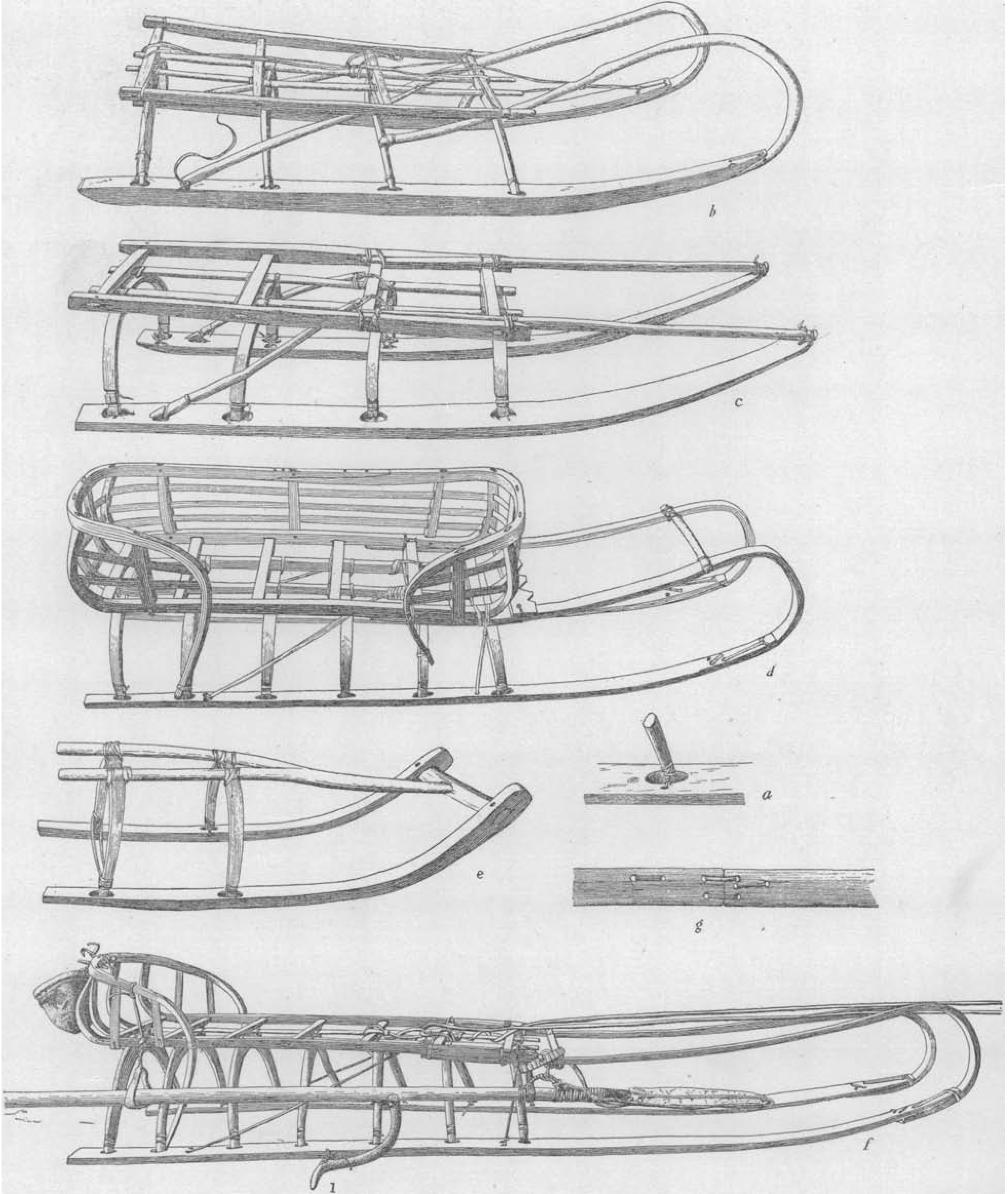
VIHunting and Fishing; War
Hunting and fishing
SEAL-HUNTING. — The Maritime Chukchee support themselves almost exclusively by hunting sea-mammals, the most important among which are the following species of seal: Phoca hispida (English, “ringed or rough seal;” Russian Siberian, акипка; Chukchee, mêˊmêl), Phoca ochotensis macrodens¹ (Russian Siberian, ларга; Chukchee, keliˊlɪn [“the spotted one”]), Histriophoca fasciata (English, “ribbon-seal;” Russian Siberian, крылатая нерпа [winged seal]; Chukchee, veˊhɪl-keliˊlɪn), and Erignathus barbatus (English, “ground-seal” or “thong-seal;” Russian Siberian, лахтакъ; Chukchee, uˊᵋnel).
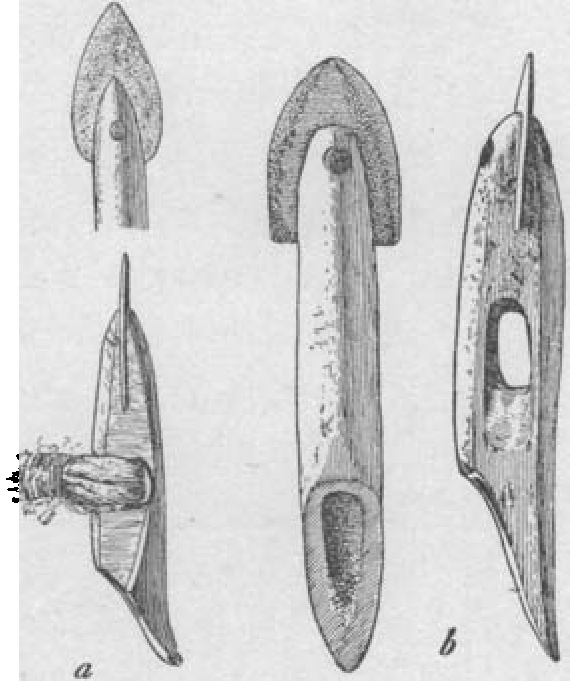
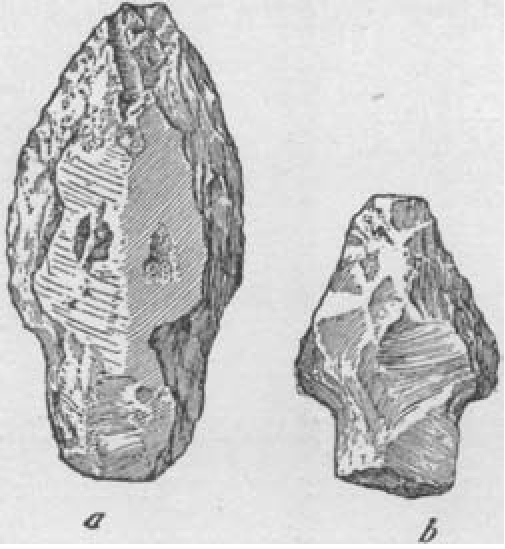
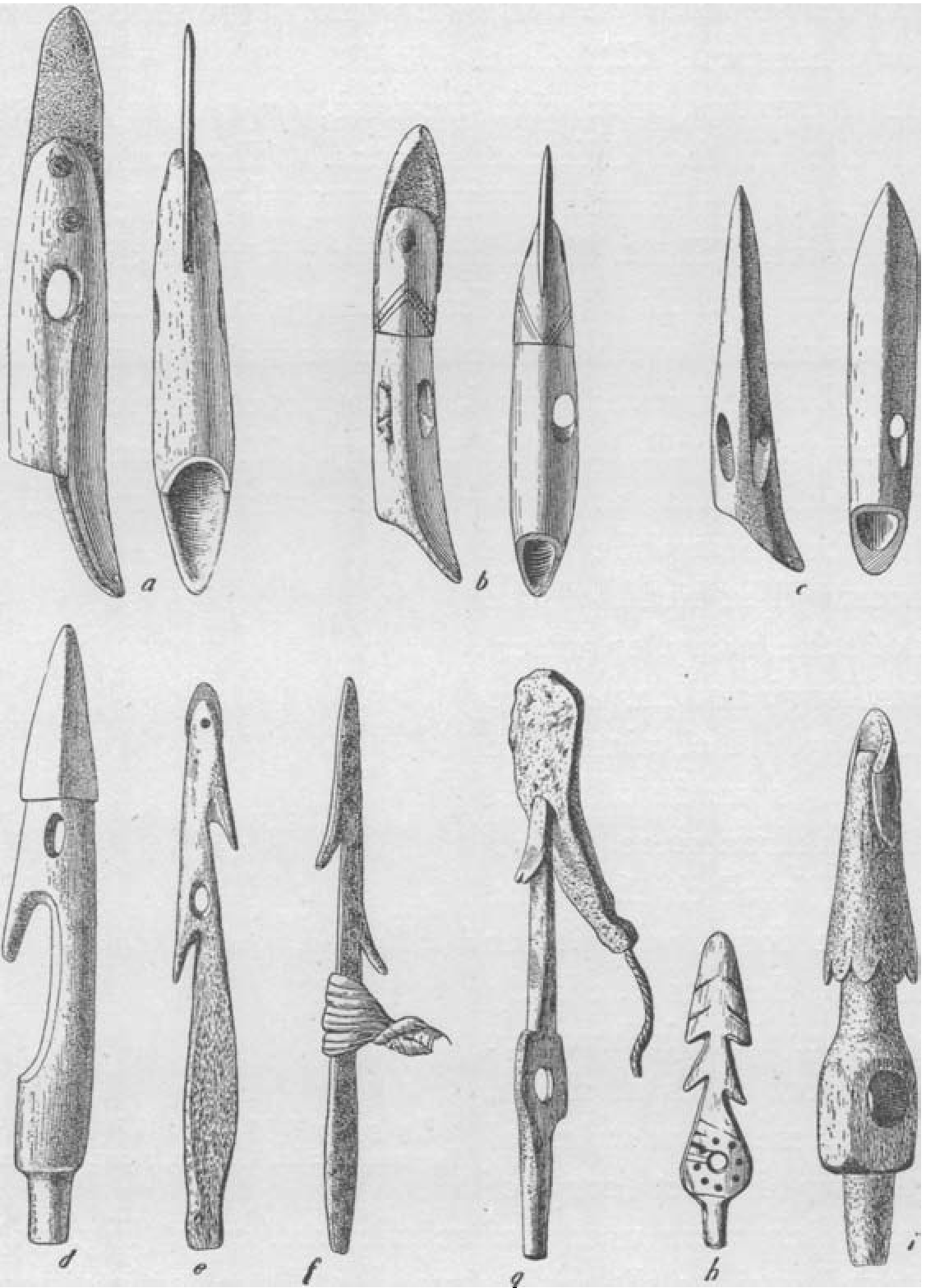
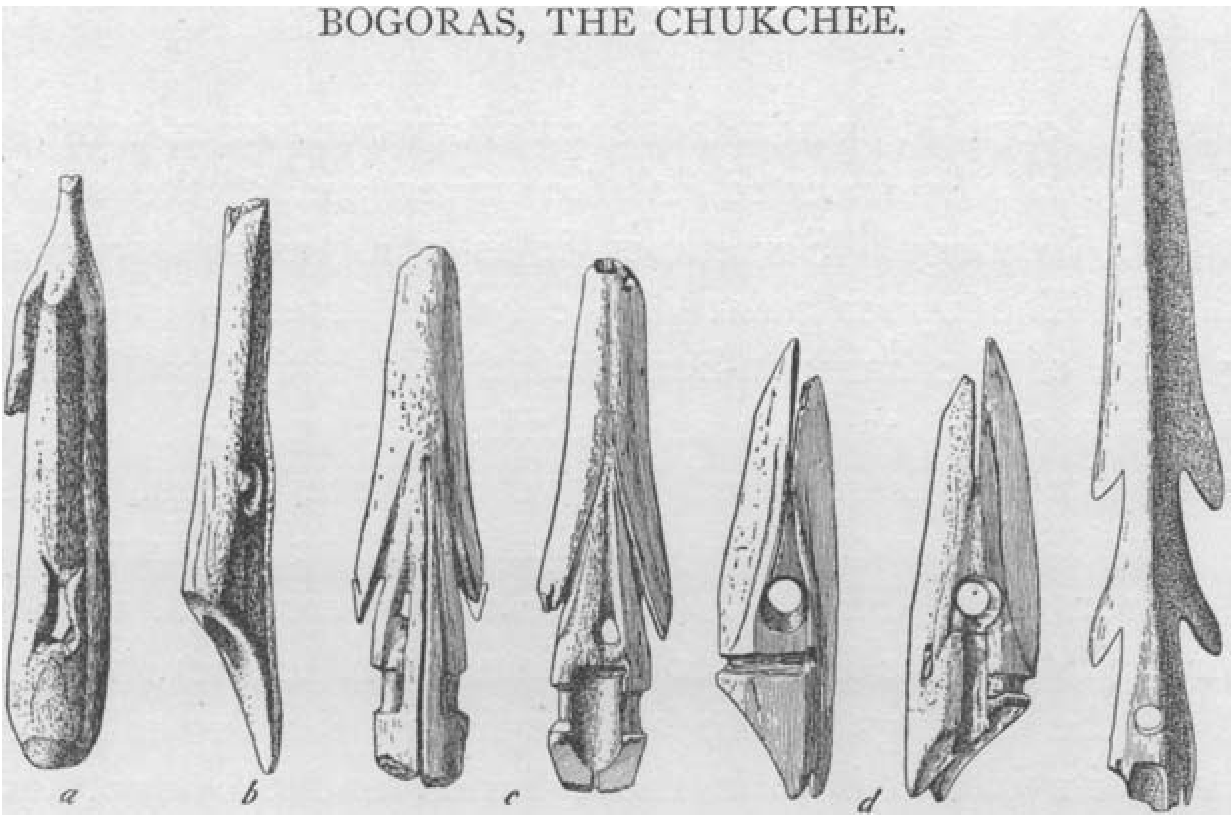
The seals are killed with harpoons, shot with fire-arms, or caught in nets, according to their mode of life in the different seasons. The varieties of harpoons used by the Chukchee in seal-hunting differ mainly in the length of the shaft and the size of the point. Short, light harpoons are used chiefly in winter in killing the animals through their blow-holes. Long-shafted harpoons are used in spring to stalk the animals on the smooth ice, and also during the summer on the open water. Now, however, this latter style of harpoon has been almost superseded by the gun in this kind of hunting. The form of the head is more or less uniform, while there are two different ways of attaching the head to the shaft, the method being the same for short as for long harpoons. The head of the Chukchee harpoon is cut out of bone, ivory, or antler. It is from three to four inches long, and has a piece of iron inserted in a slit at the top. I obtained one harpoon-head the body of which is made of brass, with the usual slit for inserting the iron piece. Two varieties of blade are used. One, found chiefly in the smaller heads, has a lanceolate form, with lower ends curved and filed off almost close to the body of the head (Fig. 30, a); the other form is broader, with lower ends protruding on both sides in sharp, cutting angles (Fig. 30, b). These two styles of blade correspond probably to two distinct forms of stone or slate harpoon-points, which were used before the iron ones (Fig. 31). The iron blade is firmly fastened into its slit with a wooden, bone, or iron peg.[116]🗗uncollated The usual hole for the line is, for the most part, parallel to the plane of the blade. The same two types occur among the Eskimo. I brought a number of harpoon-points from the Olutora and Kamchatka Koryak and northern Kamchadal, which present considerable variety in material and shape (Fig. 32). Some of the points resemble those of the Chukchee, although the hole is more frequently at right angles to the blade (Fig. 32, a). Others are made of a single piece (Fig. 32, c), bone or iron, with one, two, or several barbs (Fig. 32, d-h), which prevent their slipping out of the wound. Still another form (Fig. 32, i) has a round body. It is tipped with copper; and in the middle is a circular, scalloped notch, which acts as a combination of barbs. The Kamchadal seal-hunters consider this the most effective of all, since the slender, somewhat rounded point enters the flesh easily, and the circular notch immediately tightens its hold under the skin. Specimens found on ancient Chukchee and Eskimo village sites (Fig. 33) present, besides the usual type, also the barbed variety, made of a single piece of bone or antler. Some of the latter seem to have been worked with stone tools (Fig. 33, a, b).
Of all the contrivances employed by the Eskimo in maritime hunting, the detachable harpoon-head is most widely employed on the Asiatic shore. Its use extends even as far as the Amur[117]🗗uncollated country. The skin boat used extensively by the Chukchee and the Koryak is quite unknown to the Kamchadal, although all three tribes undoubtedly belong to the same stock.
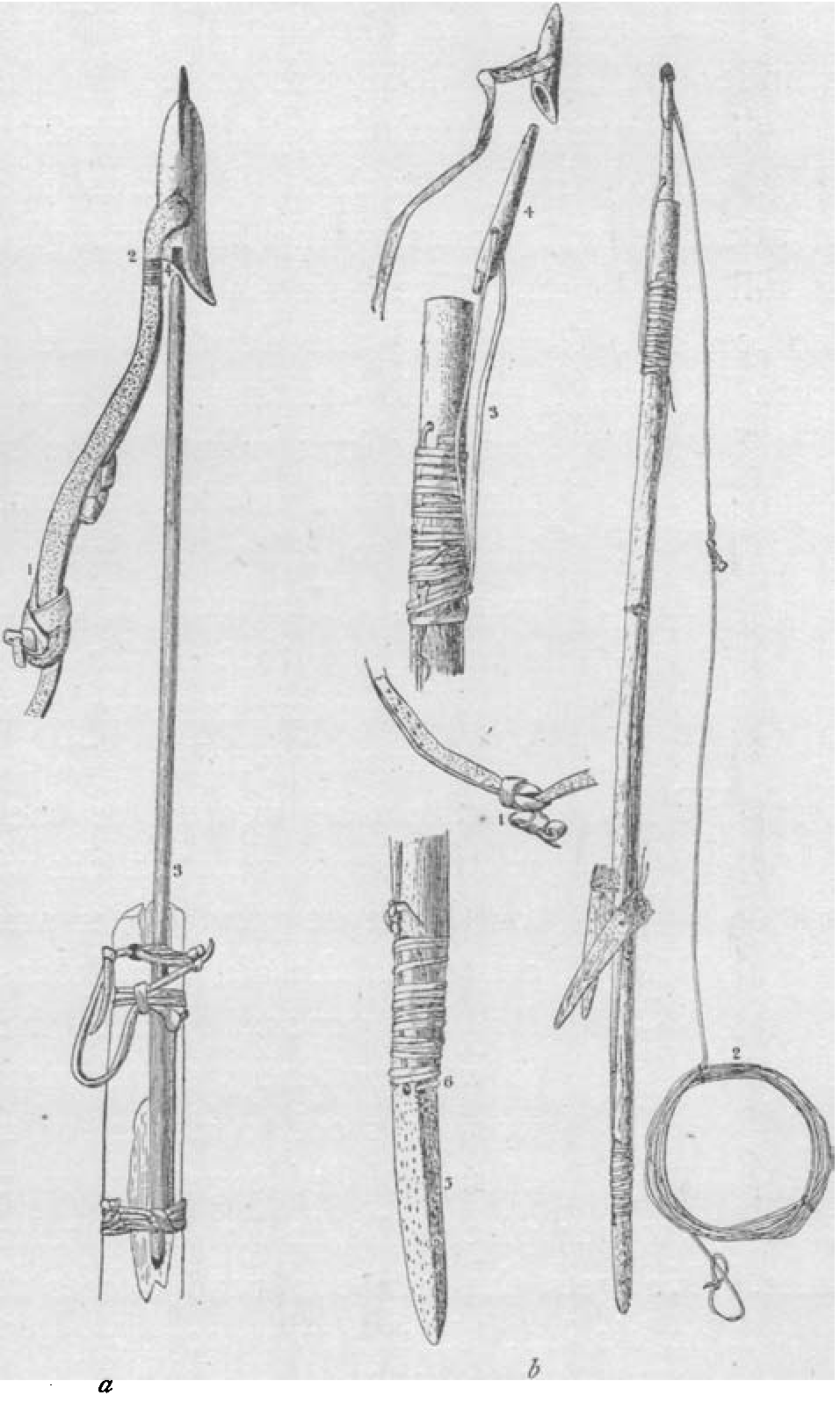
A strong piece of thong or sinew, about fifty centimetres long, is passed through the hole of the Chukchee harpoon-point. The two ends of the thong are tied together, so that it forms a loop (Fig. 34, a¹), and the sides of the loop are sewed or tied together very near to the hole (Fig. 34, a²). The lower end of the loop is fastened to a long line (Fig. 34, b¹), which, for the most part, is free from the shaft. The body of the line is wound into a coil, sometimes held together by a few thin threads of damp sinew twisted around it, which will easily come off when desired (Fig. 34, b²). Sometimes the line is fastened to the lower end of the shaft with a similar twisting, which is undone by the first violent pull of the game. The end of the line is usually[118]🗗uncollated tied into a loop. A short bone or ivory rod, or a long, slender piece of iron (Fig. 34, a³), is inserted in the upper end of the shaft, where it is held firmly with lashings. Sometimes it is also wound around with a thin strip of leather. The upper point of the rod is inserted in a circular hole in the slanting base of the harpoon-head, which fits it tightly (Fig. 34, a⁴). The harpoon-head is released as soon as it strikes the game.
Frequently the rod is replaced by two separate pieces. The lower piece (Fig. 34, b³), which is stout, and cylindrical in shape, is fastened firmly to the shaft. The upper piece (Fig. 34, b⁴) is a slender ivory rod, with a hole in the middle. Through the hole is passed a thin strip of leather, both ends of which are fastened to the lashings of the ivory cylinder, forming a loop. The lower end of the rod fits into a hole in the cylinder, and the loop, thus tightened, holds it in place, while the harpoon-head is firmly set on its top. The whole is at the same time tight and elastic. The head becomes disengaged with the blow and remains in the wound, while the movable rod separates from the cylinder and hangs down suspended by the loop.
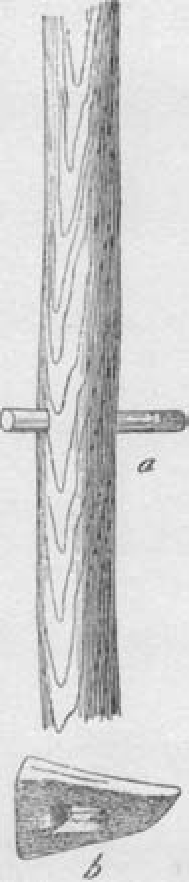
The lower end of the shaft is furnished with a strong bone or iron point (Fig. 34, b⁵) firmly attached by means of a strip of leather. The old method of attachment, by passing the line through holes made with a drill (Fig. 34, b⁶), is still employed. The point is used as an ice-pick for breaking holes through the ice, also for testing the depth of the snow, etc. In some cases a slender piece of ivory, used for testing thin, newly formed ice, is substituted for the bone or iron point. The shaft of the long harpoon sometimes has a small wooden or bone peg (Fig. 35, a, b), halfway of its length, to allow a firmer grasp of the hand in throwing the weapon. The shaft of the short harpoon is about four feet and a half long; that of the long harpoon, eight feet and a half long.
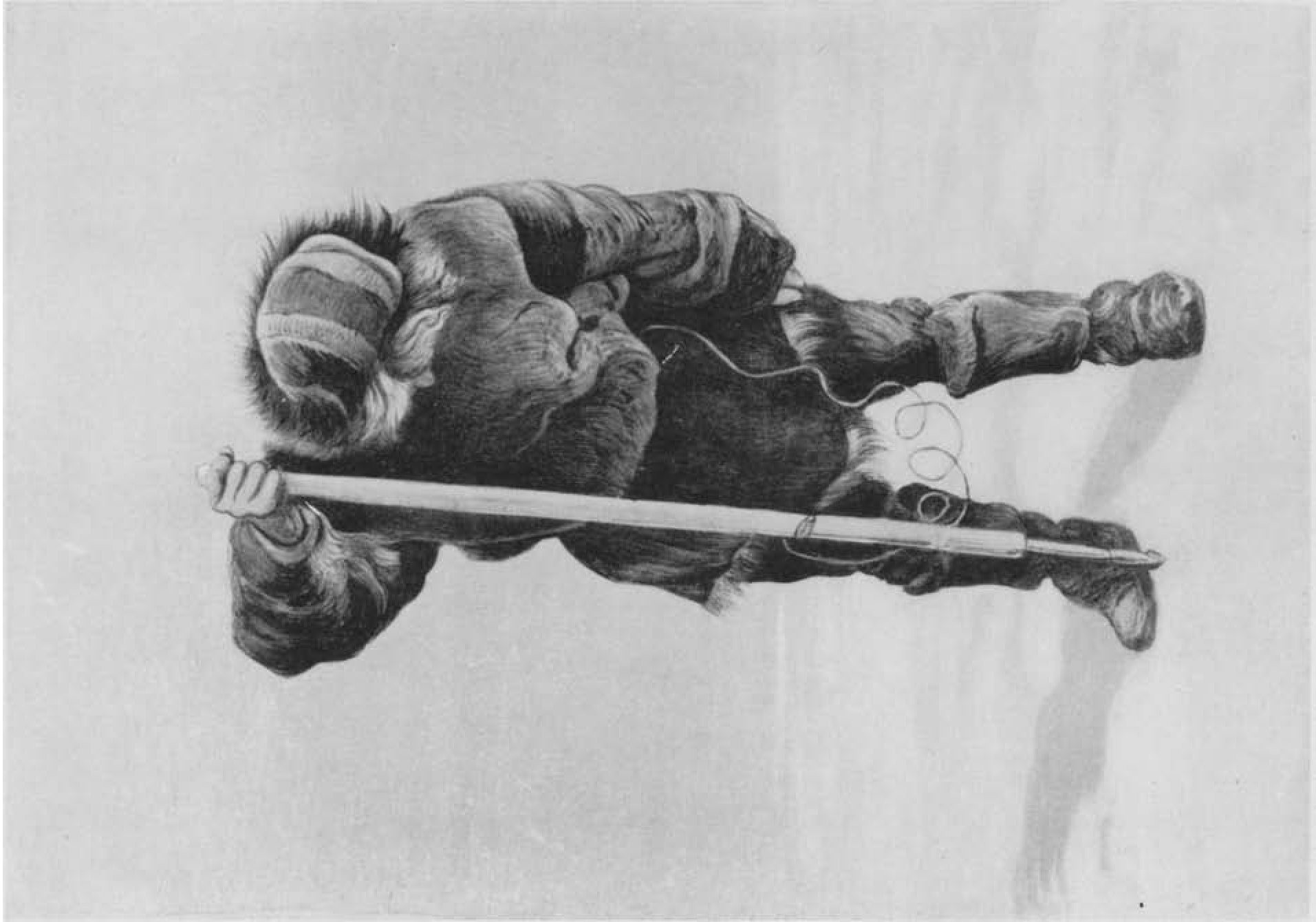
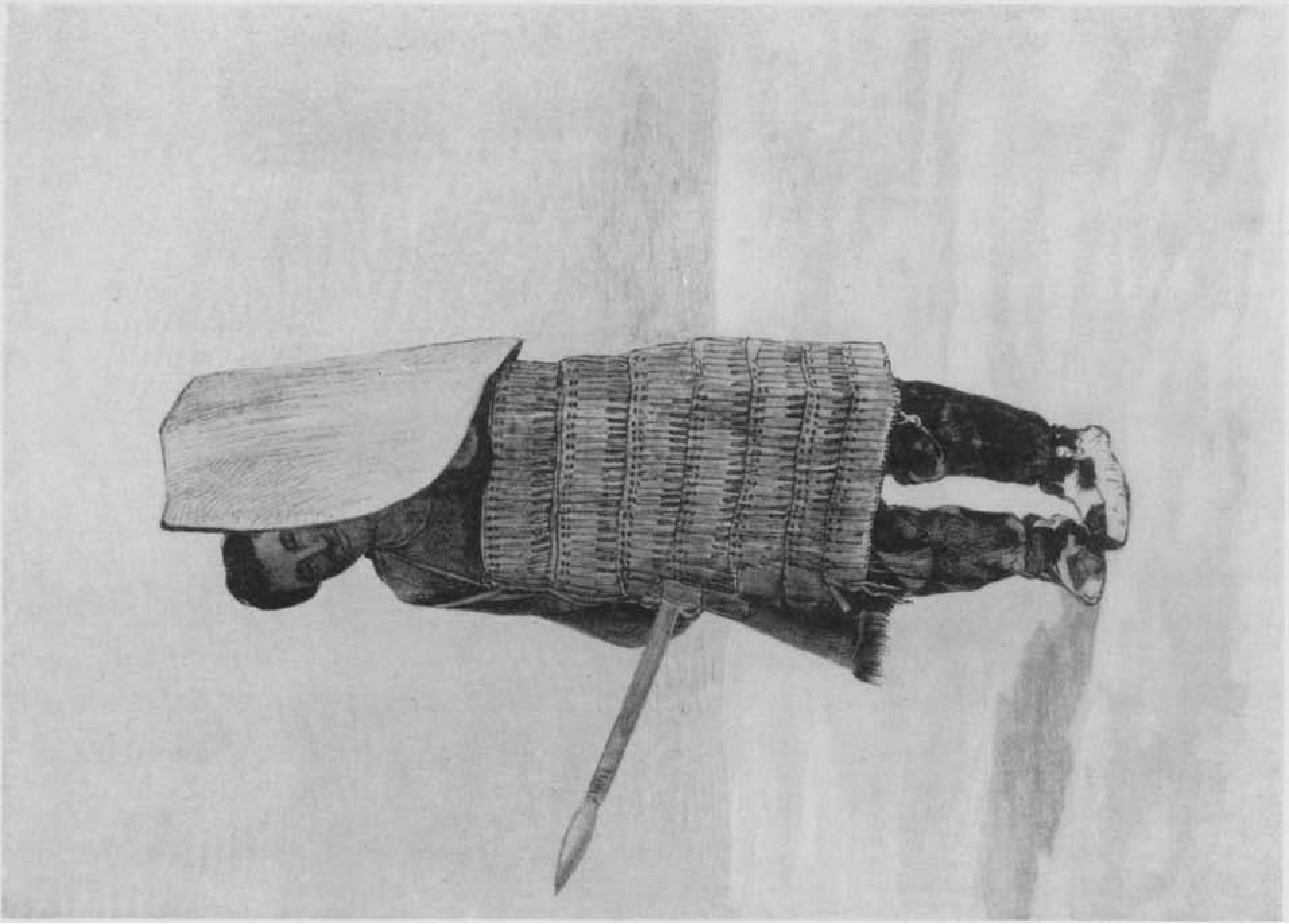
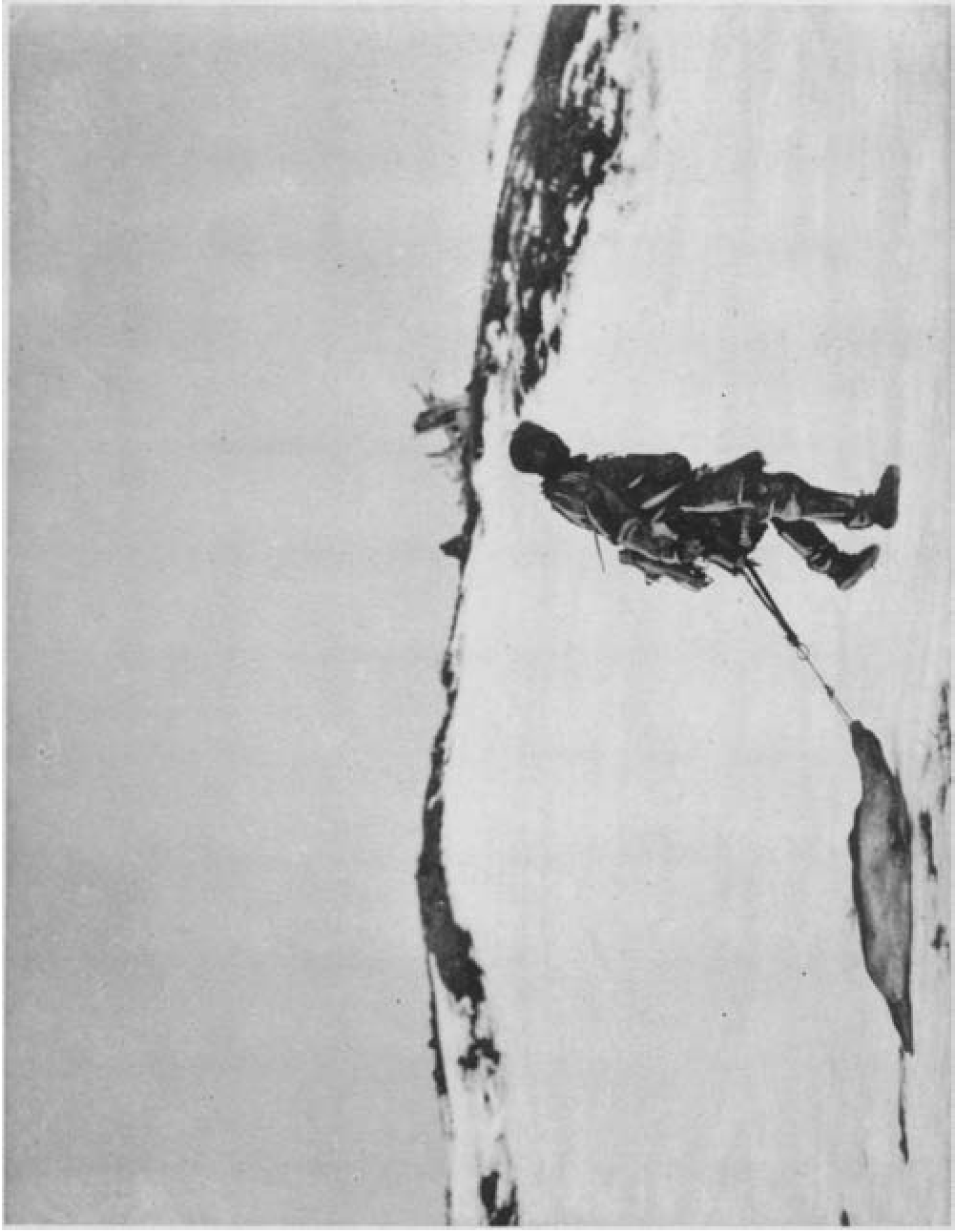
The short harpoon is used in winter for killing seals through their breathing-holes. These holes are found on the land-ice, or on the floe nearest to the shore, whither the ringed and the spotted seals resort in the winter time. The holes are concealed, for the most part, under small snow mounds, and can be located only with the aid of a keen-scented dog selected from the team for the purpose. When the hole is found, the sealer sits down to wait patiently, sometimes for hours. He brings along a small wooden stool to sit on, or makes himself a seat of square pieces of snow piled together, covering the top with a piece of reindeer-skin. Another piece of skin he lays under his feet to keep the cold from his soles. He gets the harpoon ready, frees the coil from the sinew twisting, and lays it on his lap. If the snow covering of the hole is very thick, he cautiously removes a portion of the snow. As soon as the seal is heard blowing, the hunter suddenly stands up and throws the harpoon straight down into the hole[119]🗗uncollated with all his might (Plate IX, Fig. 1), paying out the line, but keeping hold of the loop on its end. The force of the blow detaches the shaft, which remains on the surface. The seal pulls strongly only during the first few minutes. Then it becomes tired, chiefly from want of breath, and is easily hauled in, and despatched with a blow on the nose. When a wait of several hours is expected, the sealer sometimes builds around his seat a semicircular wall of snow-blocks to keep off the wind. The harpoon is laid across two wooden pegs stuck into the snow within easy reach. The sealer covers himself with a large cloak of reindeer-skin, puts on his fur-trimmed hood, pulls his arms inside of his fur shirt, folding them over his breast, and remains motionless, waiting for the familiar sound of the blowing seal.
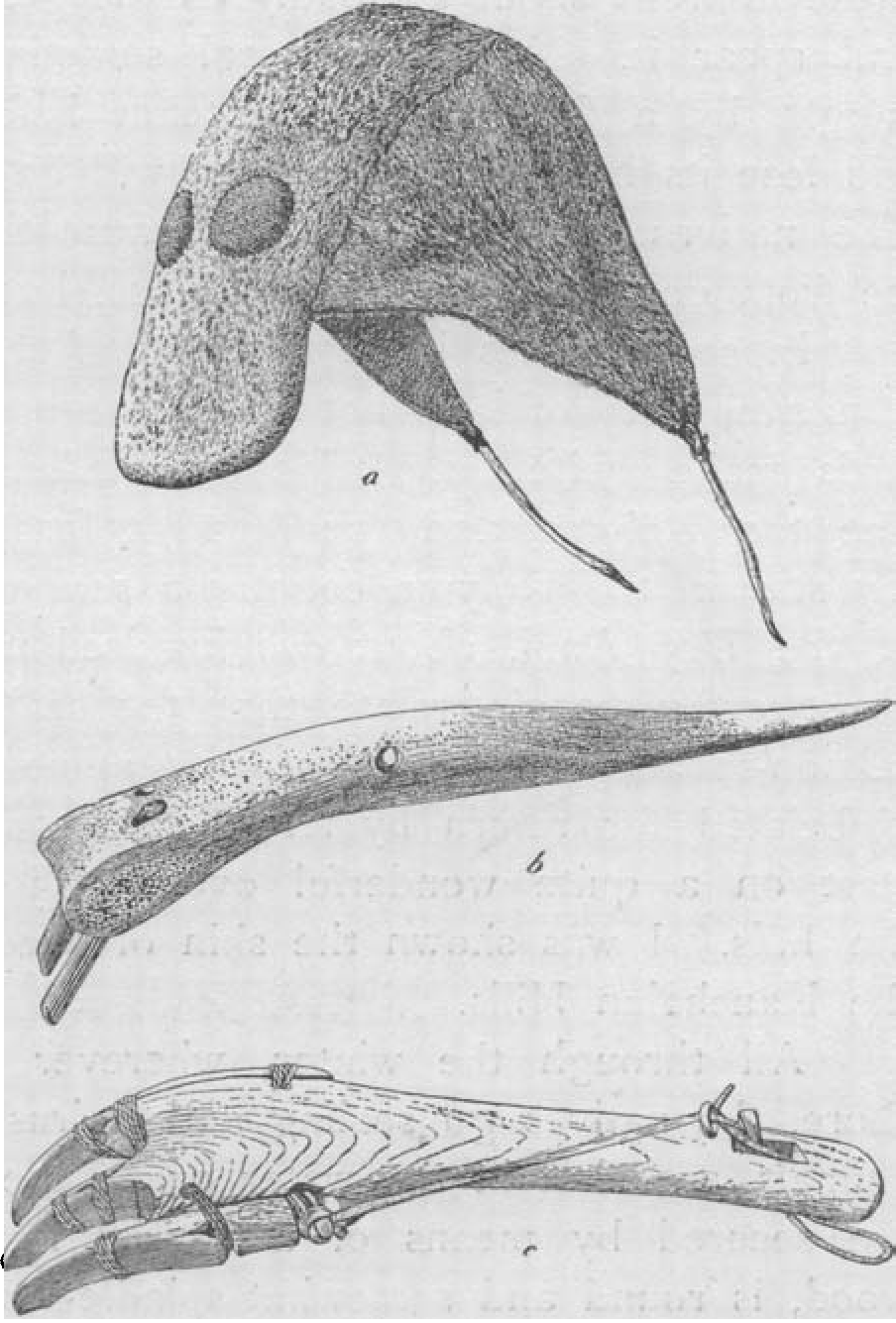
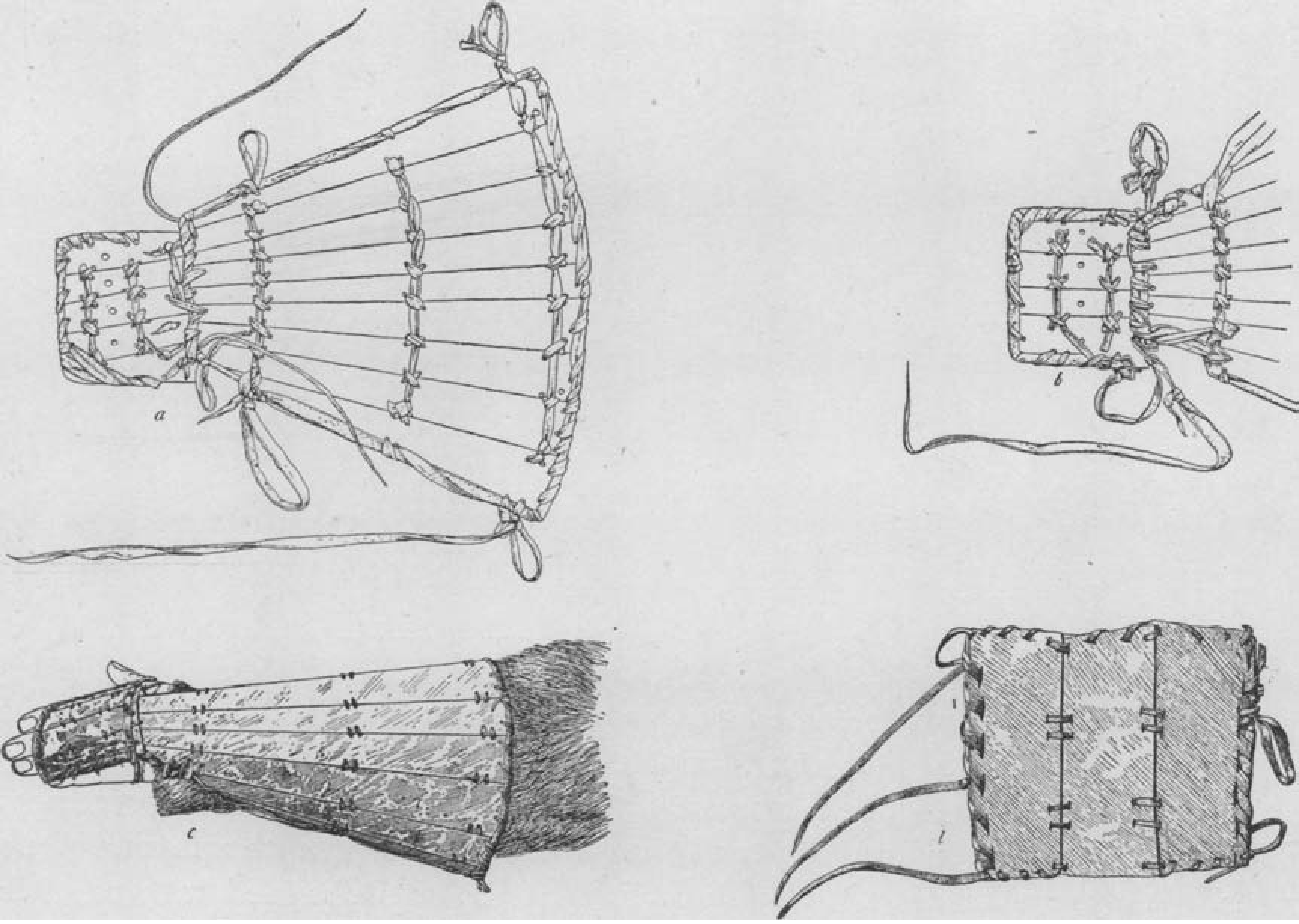
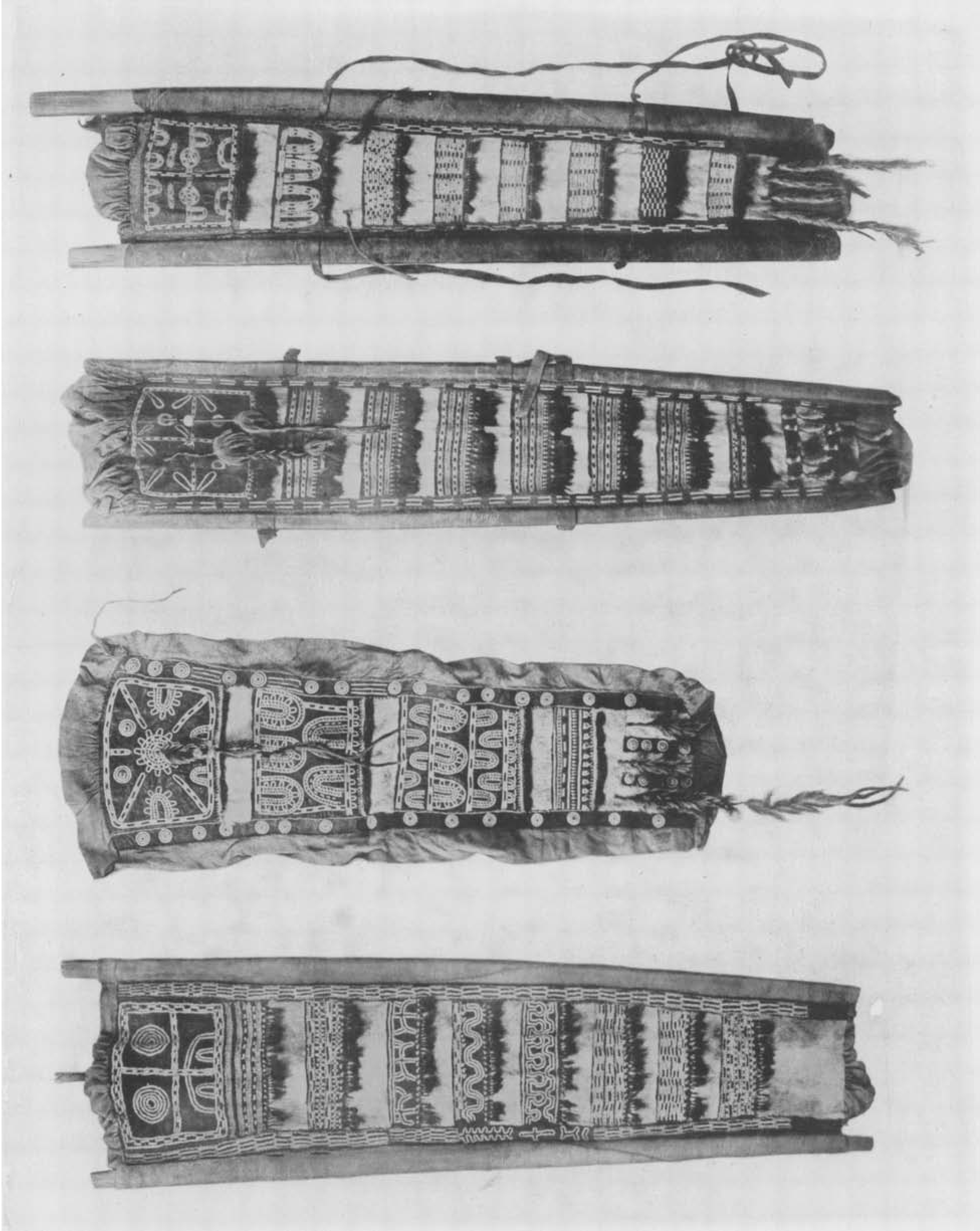
In the spring, when the seals come up to the surface of the snow to bask in the sun, another method of hunting is adopted. The hunter puts on a special hunting-dress, consisting of a short shirt of reindeer-skin, worn with the fur side next to the body and the gray inner skin outside. As the Chukchee have no seal-skin coats, this serves as the nearest imitation, in appearance, of the seal. A special cap is fastened on the head, in imitation of the seal-muzzle, with two round black pieces for eyes (Fig. 36, a). The left elbow and knee, sometimes both knees, are protected by square pieces of polar-bear skin, to prevent friction, and to keep off the moisture of the melting snow. Whenever the left hand is raised, the protecting piece acts like a white screen, helping to conceal the hunter from his prey. As soon as the animal is sighted, the sealer begins to creep. towards it from the windward side, armed with a long-shafted harpoon, or, more rarely, with a gun. He proceeds very slowly, imitating the motions of the seal, and from time to time scratching the snow, as the seal does, with a wooden scratcher tipped with seal-claws (Fig. 36, b, c). When the seal lifts its head, the hunter immediately lies still, and does not proceed until the seal lies down again.[120]🗗uncollated Gradually he approaches so close to the seal as to be able to play the harpoon. These two methods are quite similar to those of the American Eskimo.¹
Seals are also killed in the spring on the edges of the ice-cracks, where they like to sleep at noontime. Before the breaking-up of the ice, wherever small streams of fresh water run into the sea along an ice-crack, seals gather around their outlet to bask in the sunshine. A sealer will tie into a rough bundle some scraps of old skin and send it downstream. It will float down unobserved, but, on coming to one of the small whirlpools which form in the crack, it will pop out suddenly and frighten away the seals lying around, so that they can easily be overtaken on the ice. Seals sleeping on the ice, when suddenly frightened, will often lose their holes and crawl away in the wrong direction. Then they can easily be overtaken, especially the younger ones. Perhaps this accounts for the method of hunting of the Netchillirmiut, reported by J. Ross,² where a party of hunters slowly approach the sleeping seal, then those in front shout as loudly as they can, and the others run up to the seal and spear it. A basking seal sometimes sleeps so soundly that it may be caught by a fast-running dog-team before it wakes up. At other times it will lose its hole altogether, and will be found crawling helplessly on the ice. The natives say that this is because the seal wants to take a walk on the ice from one to another of its holes, but loses its way.
In some places large numbers of seals are killed while trying to go over a narrow strip of land between the sea and the inner bay. Occasionally the seals make quite long trips overland. Thus they ascend the largest rivers, like the Kolyma and the Anadyr, for more than a hundred miles. During my stay in the Kolyma country a seal was even caught on the middle course of the Dry Anui, about two hundred miles from the mouth of the Kolyma. Trustworthy people relate that the seals which ascend the Anadyr after the salmon-shoals often turn into its affluents, the Kanchalan and Big Rivers. If belated for return by river, on account of low water or early frosts, they start on a quite wonderful overland journey on impracticable roads among the hills. I was shown the skin of a rough-seal killed on such a journey in the Kanchalan Hills.

All through the winter, wherever the open water is not far from the shore, the natives go sealing and walrusing at the edge of the land-ice. The animals are shot in the water or on the drifting ice. Then, if feasible, they are secured by means of a special implement (Fig. 37), which is made of wood, is round and somewhat spindle-shaped, and has several iron hooks, and a long stout line at the bottom. It is flung at the passing body, and, if the aim was correct, one of the hooks will catch into it. When the body is too[121]🗗uncollated far away, the hunter will pick out a small cake of ice, and, using his spear for an oar, will push forward to the body, and then drag it to the land-ice with the harpoon-line.
In summer, seal-hunting is done chiefly with guns from the shore or from large skin boats. Kayaks are used on the Arctic, while on the Pacific shore they are employed only in reindeer-hunting on the Middle Anadyr, as will be described later. The Maritime villages on the Pacific have but very few kayaks. I saw one in the Eskimo village Wuteˊen (see Fig. 47, c), which was about fifteen feet long, and obtained a model of a kayak made at Indian Point. I had no opportunity of seeing the Arctic kayaks, but, according to the natives, they are of various sizes, sometimes have two seats, and are used for seal-hunting and travel, as mentioned many times in Chukchee tales. These kayaks are so large, that sometimes a man creeps into one and lies down, to be carried as a passive passenger. I was told of one case where three men set out in a kayak across Chaun Bay. Two of them fastened themselves in the manholes, and the third lay down in the hold. A tempest suddenly arose and capsized the kayak, so that the paddlers were drowned; but the man inside remained safe and sound, and on the second day drifted ashore in the kayak, together with his dead companions, and was able to get out and go away. Perhaps this is only a fragment of some folk-tale.
In hunting from boats, the harpoon is thrown at the animal, and the shaft becomes detached from the point in the same way as described. Then the animal is hauled in, and the floating shaft picked up. At present, however, seals do not allow the boat to come near enough for the use of the harpoon. With the rifle they are shot at wherever they come out of the water, no matter how far away they may be. The native hunters are pretty good marksmen, but of course many shots go amiss. The animals that have been killed sink so rapidly that they are often lost before the hunter can secure the body. Especially is this true in shooting from the shore, though the small boat stands ready to hand. Only fat seals, mostly the younger ones, do not sink after death.
Hunting on open water is more successful early in the season, when the drift-ice is abundant, because all kinds of sea-animals go along with it, basking all the while on its surface. Later on, when the ice has drifted away, the animals become more scarce and the hunt difficult. Then the seal-hunters go far out to sea in search of game. The Arctic hunters in their large boats sail off with fair wind, and go so far that the highest mountain-tops near the shore are out of sight. They remain in the open sea for two or three days, waiting for a change of wind to get back to land.
[122]🗗uncollated
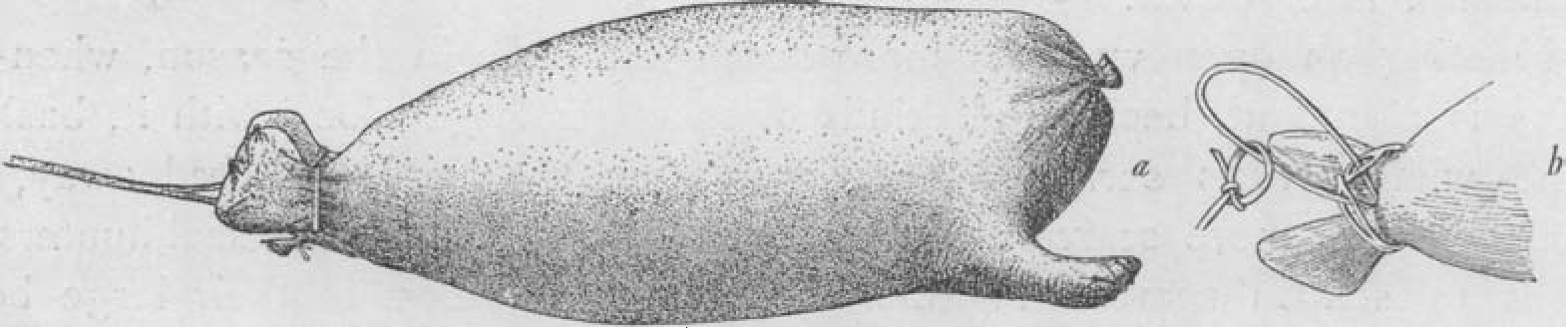
WALRUS AND WHALE HUNTING. — The long harpoon used in walrus-hunting has the same shape as the harpoons already described; but the end of the line has one or two floats tied to it (Fig. 38). These are thrown into the water after a successful blow. Floats (Fig. 39, a) consist of a whole seal-skin skilfully removed from the carcass of the animal. The mouth is enlarged by an oblong cut down the neck, and the skin is pulled off like a stocking. The head is carefully sewed up, the fore-flippers often cut off, and the openings firmly tied up. One of them is used for inflating the float, which is done without an inflating-pipe such as is used by the Eskimo. The skin of the hind-flippers is carefully stitched; and when the body is inflated, the flippers stand out, furnishing a hold for the separate loops on the end of the line (Fig. 39, b).
At the present time, however, walrus-hunting is done almost exclusively with rifles, especially on the Pacific. Thirty years ago American whalers applied themselves to a great extent to walrus-hunting, and the number of walrus on the Pacific consequently began to decrease rapidly. Later on, the whalers desisted from the pursuit, asserting that prices were too low, and that the whole business was not remunerative enough. Then the decrease slackened, although even now the reckless shooting of walrus by the natives continues to work disaster. To the south of Anadyr the walrus have greatly diminished in numbers. That is the reason that the Kerek on the southern shore of Anadyr Bay, who in former times subsisted on walrus, are now rapidly starving to death. Farther to the south walrus became very rare in the vicinity of most of the villages, and are now met with only on the shores of some islands, as Karagha Island, for instance. To the north of Anadyr, beginning at the northern shore of Holy Cross Bay, considerable numbers of walrus are still killed. For some villages, as Mɪˊs˙qᴀn and Rêˊtkên in Holy Cross Bay, also Yeˊrg̣ɪn and Kihiˊni, on the island of Kihiˊni, they still form the staple food of the inhabitants.
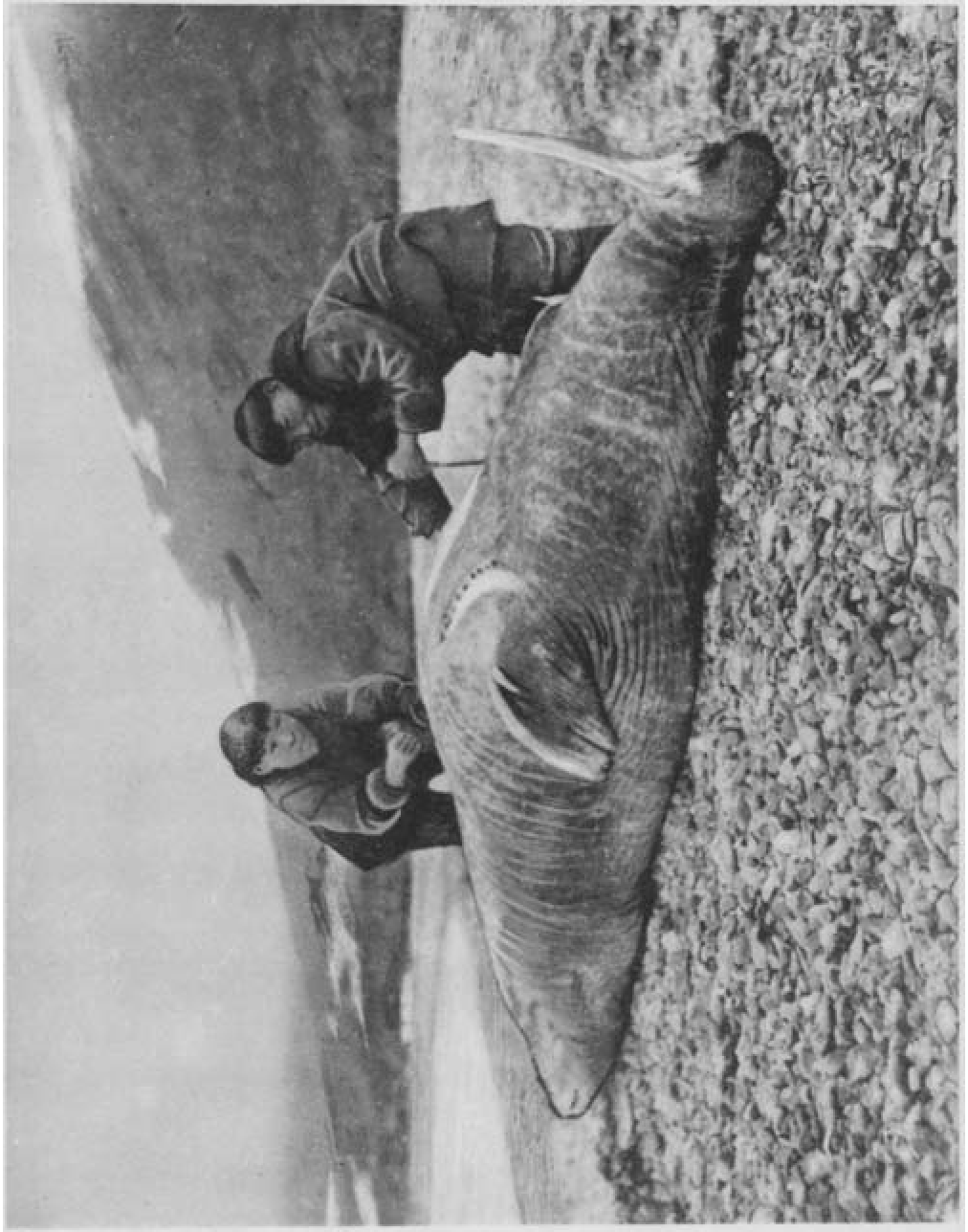
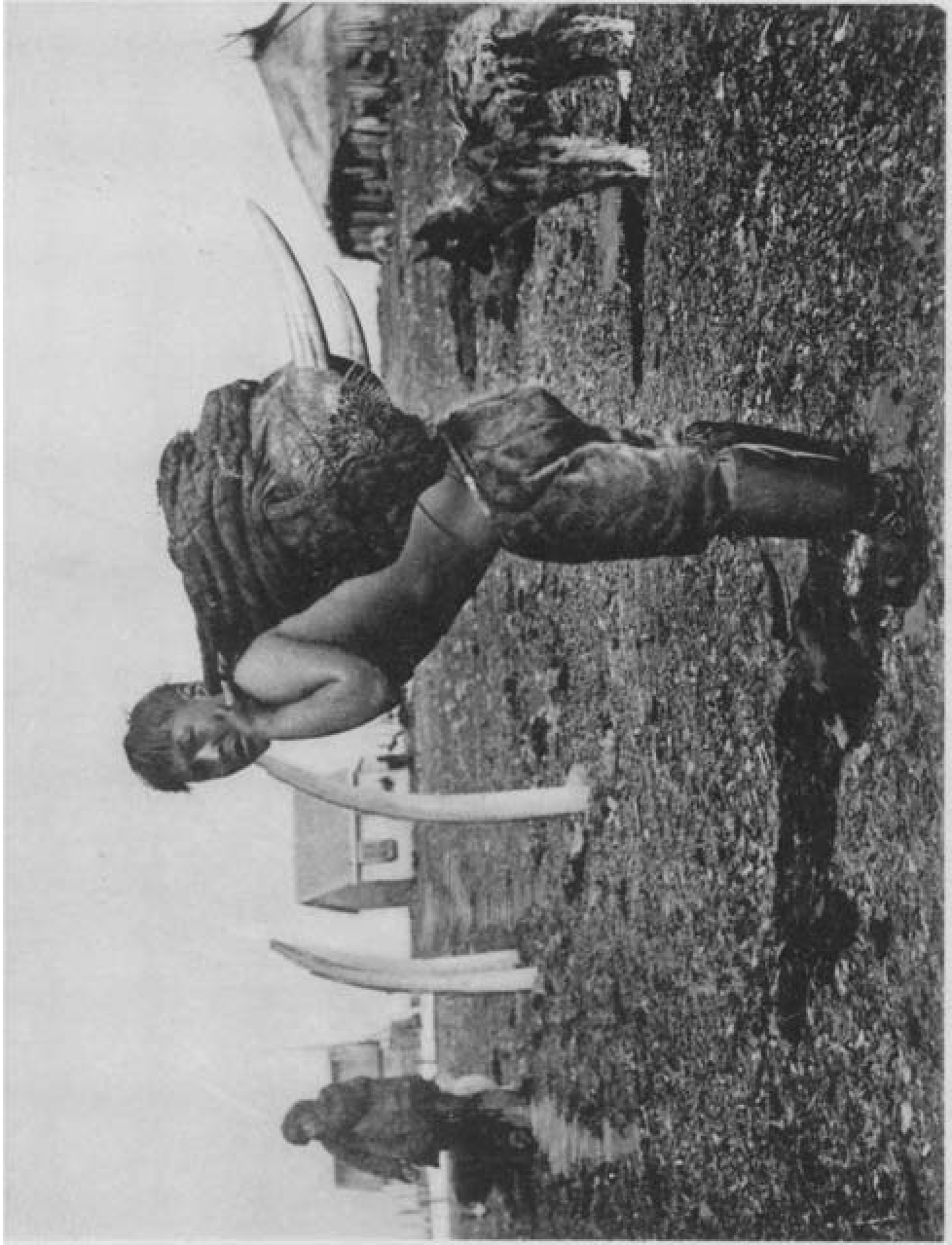
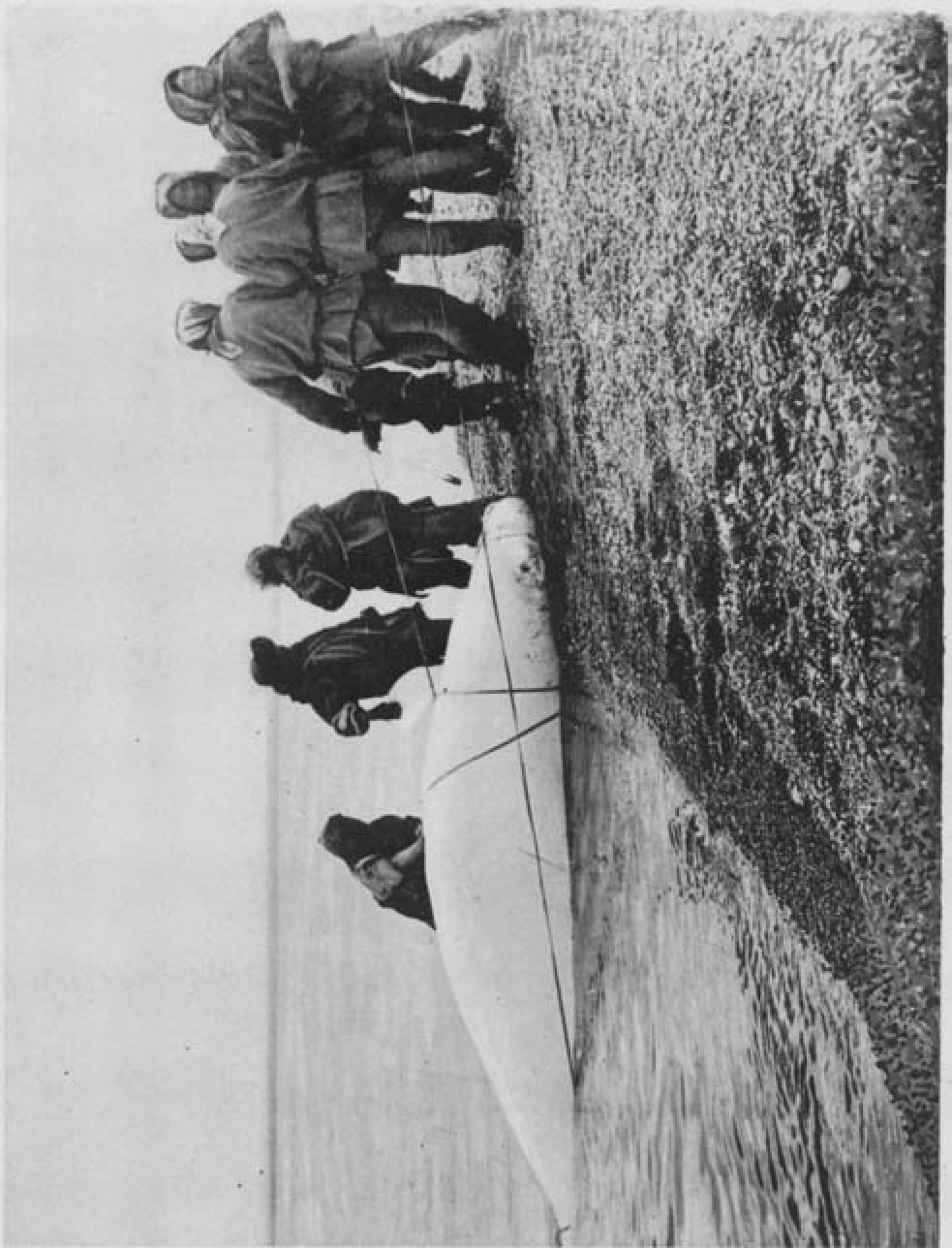
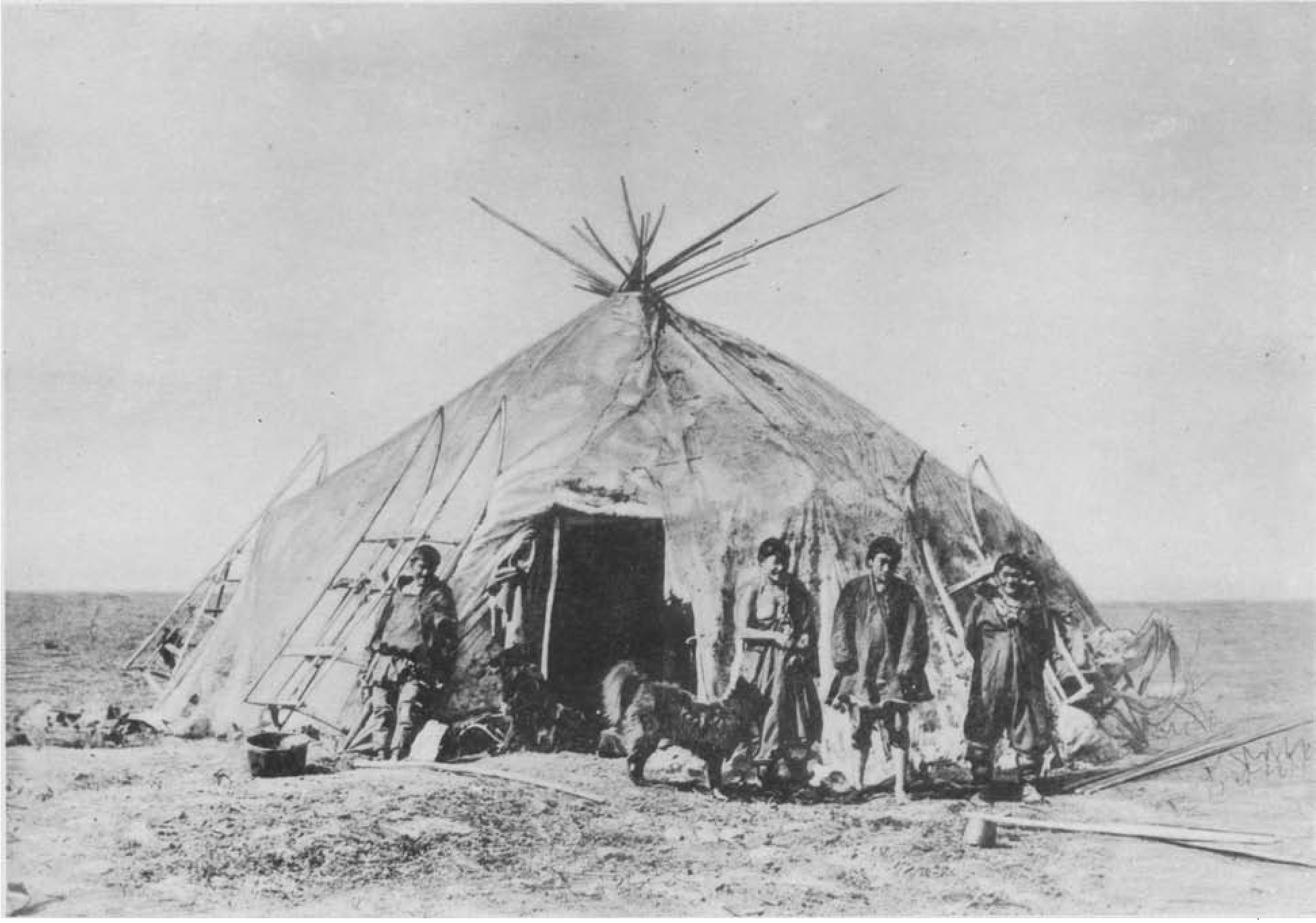
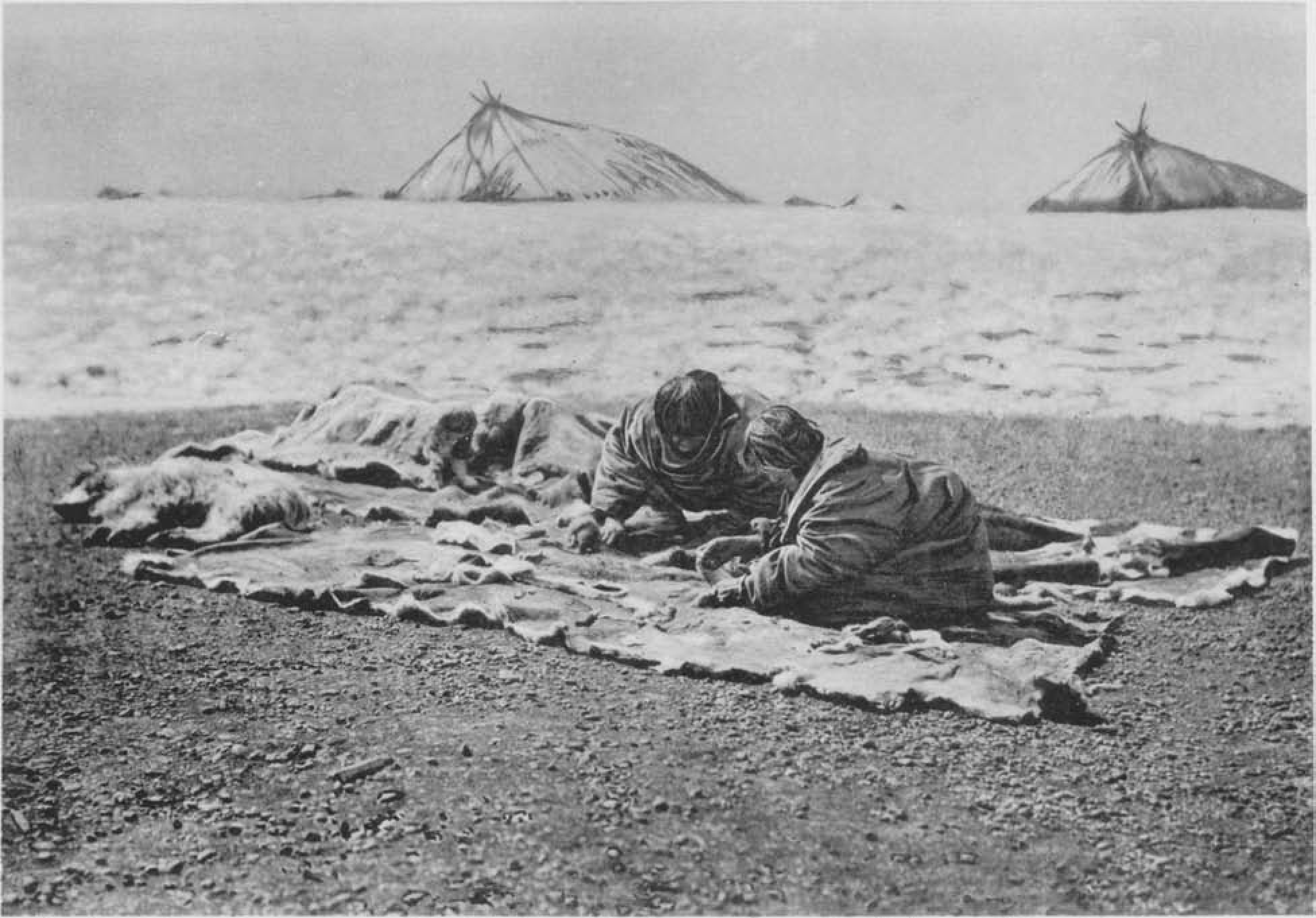
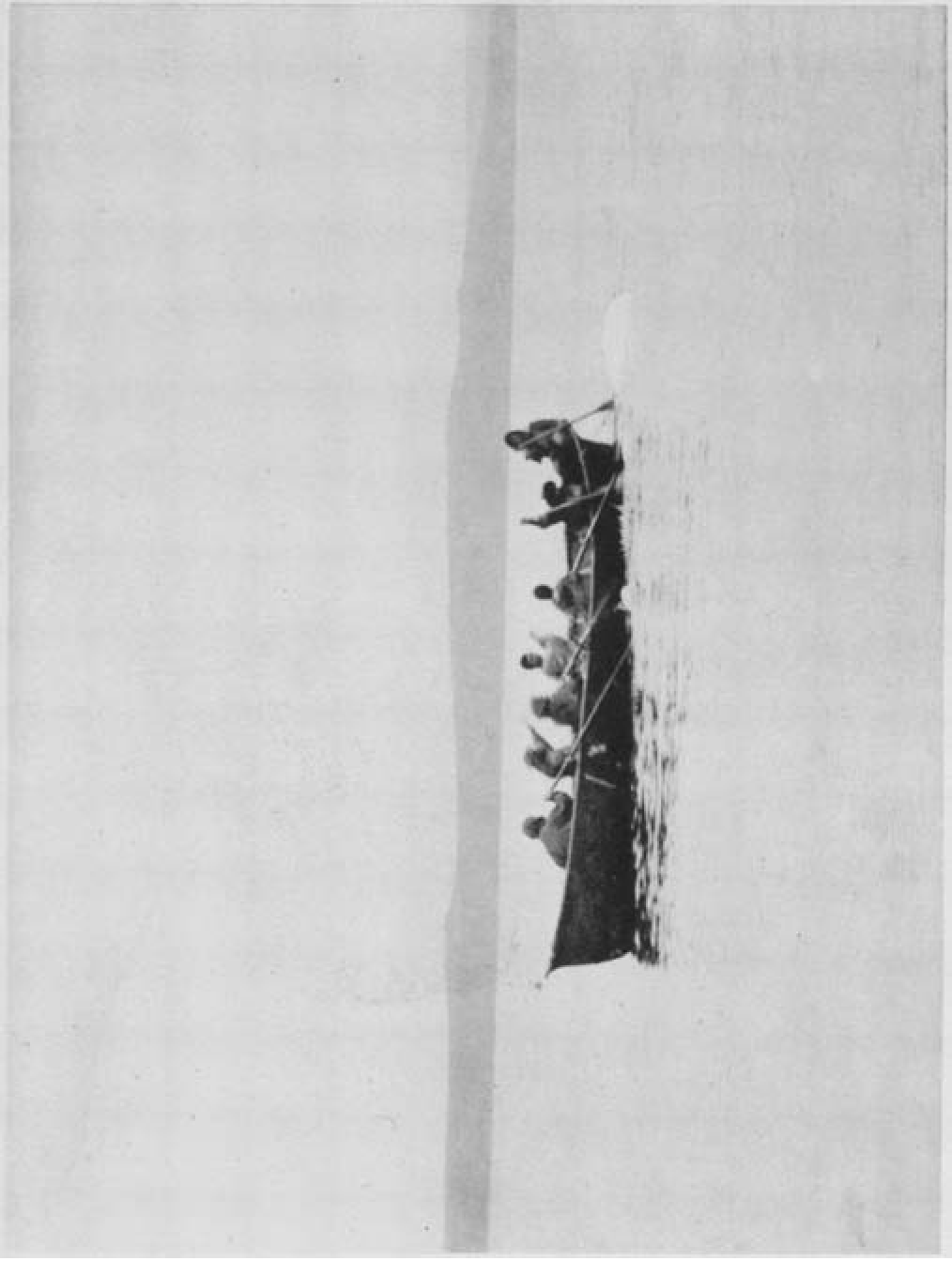
On the Pacific shore the walrus is killed chiefly during its migrations from Holy Cross Bay to East Cape and back again (Plate X, Figs. 1, 3).[123]🗗uncollated The first shoals pass northward in May with the drifting ice. The later ones begin to leave their winter places in Holy Cross Bay about a month after the first migration, and go northwards all along the shore. At the end of June, when returning from Indian Point to the mouth of the Anadyr, we met in one day, near the village ᴇˊnmɪlɪn, a great many of these shoals, containing perhaps more than a thousand animals. Their course lay a few miles from the shore; and the natives everywhere would open on them a most wanton shooting, killing a few, and wounding many more. Next day we saw on the shore in different places three large walrus-carcasses. The animals had evidently died from wounds, and were carried by the tide to the shore. One was already in a quite putrid state.

On the whole, at least half of the wounded sea-animals — seals, walruses, and white whales — escape the hunter, and are afterwards drifted ashore in a putrid state. Any animal of this kind that is found by the people is used for dog-food, and the blubber is tried out for lamp-oil, but of course the greater number are wasted. Several times I saw a man who was shooting from the shore use about three dozen cartridges in three hours. Although nearly every shot was well aimed, he would secure but a single seal. Of the others, two or three would occasionally be found afterwards by other people, twenty or twenty-five miles off, but without benefit to the hunter.

In the middle of September the walrus start on the return journey. The natives assert that at this time the walrus are most easily killed, since they are quite unmindful of the hunter’s presence until the shooting begins. Several boats join in the hunt in order to cut off the retreat of the animals. A peculiar kind of splasher (Fig. 40), made of seal-skin and about three feet long and four inches wide, is used to frighten the animals. Every time the walrus dive, several splashers from various boats are struck against the water, making a sharp sound, similar to the report of a gun. The walrus are so much frightened that they hasten to come out again, and are shot. After diving and emerging a few times, they become quite confused, and cannot discern which sounds are connected with the real danger. The wounded walrus are despatched by means of a long lance with an iron point (Fig. 41).
[124]🗗uncollated
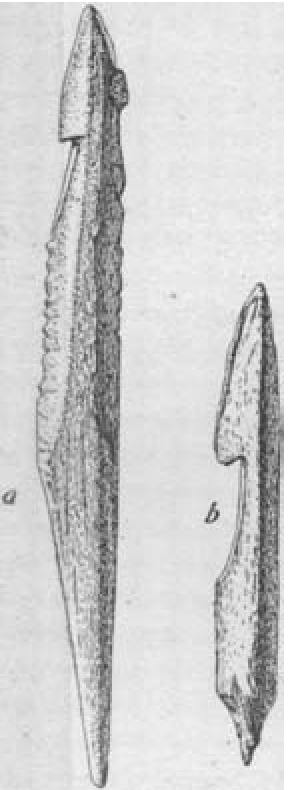
Whaling was done in former times chiefly by the Arctic Chukchee, and on the Pacific coast by the Eskimo. For this purpose a large harpoon, with a heavy head perforated at right angles to the blade, was used. The line was very long and stout, and floats were attached to it in pairs at several places. Altogether there were two, three, or even four pairs. Now, on the Pacific, but little whaling is done, and that exclusively by the Eskimo of Indian Point, of Cape Chukotsky, of Cape Ulakhpen, and also by the inhabitants of Čibuˊkak on St. Lawrence Island. They all use explosive harpoons. On the Arctic the number of whales has also considerably dwindled. Thus the natives of Yaˊqan told Maydell that they had hardly caught a whale in later years. The whalers ceased going along the Arctic shore of Asia, because whales became too scarce in that region. The single harpoon-head that I was able to procure at Indian Point is old and worn, showing that it is the remains of an old, now unused weapon (Fig. 42, a, b).
The white whale is killed in the same way as the walrus, with the rifle, and sometimes with the harpoon. The natives eagerly pursue it, because its meat and blubber taste better than those of any other sea-animal (Plates X, Fig. 4; XI, Fig. 1). I did not find current among the Chukchee the notion, peculiar to some American Eskimo, that white whales must be struck with a flint.¹ It is curious that this idea re-appears among the Koryak on the Okhotsk Sea, in the villages of Kamenskoye and Paren.
SEALING-NETS. — Sealing-nets are perhaps still more efficient than harpoons, especially in the winter-time. They are made of thin strips of seal-skin or reindeer-skin, with buoys of wood or of inflated pieces of gut, and stone or ivory sinkers. A peculiar net used on the Arctic and on portions of the Pacific coast is square in shape, and is fastened beneath the seal’s breathing-hole like a cradle (Fig. 43, a).² For this purpose four wooden poles tied to the mouth of the net are put through the hole and arranged underneath the ice so as to form a square. The net hangs by the corners on short cords, allowing the seal a free passage into the hole from all sides. The seal, arriving at the hole, may see perfectly well that something unusual has happened, but, as it is its breathing-time, it slips in between the net and the ice, and rises to the surface. That done, it will, as is its wont,[125]🗗uncollated plunge down head foremost; but instead of diving, it lands in the net, where its flippers easily become entangled, and it is drowned. Often the animal, with the net, comes out of the hole and dies on the ice. This net can be used only in the spring, when the ice is several feet thick and blow-holes are less numerous.
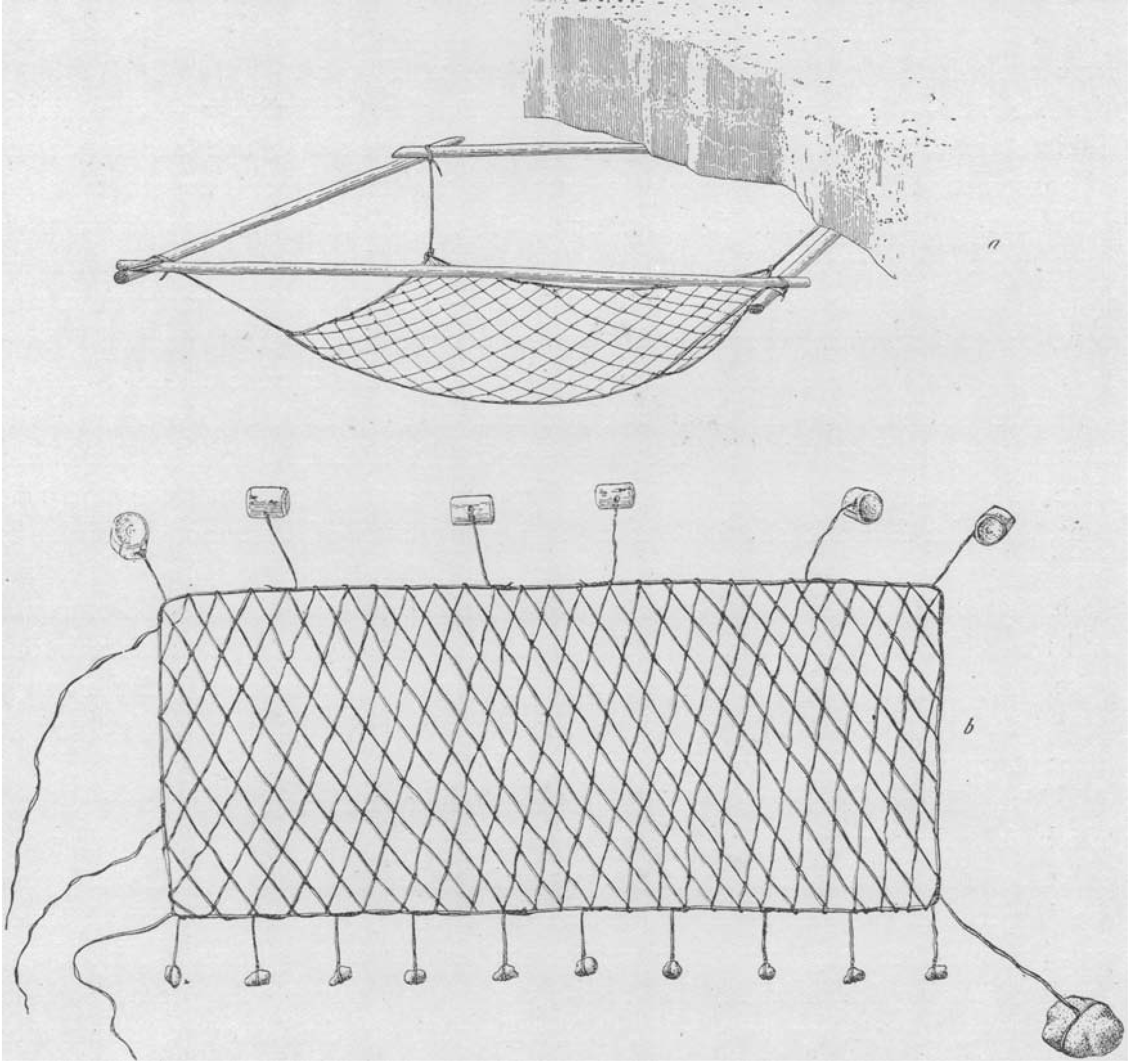
The more common kind of seal-net has a shape similar to that of the straight fish-net, only that its meshes are much larger (Fig. 43, b). The specimen obtained is twenty-seven meshes long and ten meshes high, each mesh being six inches square. It has large wooden buoys and stone sinkers. It is set under the ice between the breathing-holes or along the cracks, and during the summer in those places to which seals frequently resort. Thus, in the small bay of ᴇˊnmɪlɪn, near the village of the same name, the nets are[126]🗗uncollated set under the water very near the shore. The place abounds in seaweed, quantities of which gather near the shore. Numbers of small fishes live in this weed, and seals are all the time hunting for them. Therefore the net-catch is abundant; and while we were in ᴇˊnmɪlɪn every owner of nets secured daily one or two seals.
Ivory plugs for stopping the wounds of seal are known to the Chukchee, and have nearly the same shape as those of the American Eskimo. Seal-drags, however, are not used, but the seal is dragged along by means of a rope passed through a cut in his nose (Plate X, Fig. 2).
BOATS. — The large skin boats used by the Chukchee and the Asiatic Eskimo are very similar to those of arctic America in shape and in details of construction. The differences are not greater than those between boats of the western and eastern Eskimo, especially since whole frames and parts of them have been carried from ancient times across Bering Strait as objects for sale. The Koryak boats, with their flaring sides and semicircular stern and bow, on the contrary, form a quite separate type; while the Kamchadal have no skin boats, but use instead dug-outs with planks fastened to the upper edges.
The reason for this does not rest exclusively with the difference of the natural surroundings of the tribes mentioned. It is true, that with the Chukchee the scarcity of wood sufficiently explains their predilection for the skin boat, but the Koryak shore abounds in large trunks of driftwood suitable for building wooden boats. On the other hand, the shores of Kamchatka are probably even richer in sea-mammals than those of the Chukchee Peninsula, and thus afford every convenience for constructing skin boats. The Kamchadal, nevertheless, remain a fishing tribe, with clumsy wooden canoes; and they have never shown much skill in maritime pursuits, although they crave blubber and hides as much as do their northern neighbors.
The Chukchee and the Asiatic Eskimo cover their boats with walrus-hide, which is split for the purpose, one thin strip being left intact for joining the halves. The walrus-hide is so large that a skin and a half suffice to cover the largest boat. The specimen in the American Museum of Natural History is thirty-five feet long and is covered with less than two skins. Ground-seal skin, though quite suitable for boat-coverings, is never used because of its great value for thongs and soles. The Koryak, on the contrary, cover their boats with skins of the Okhotsk variety of ground-seal, having indeed no other material. I have never heard of large Chukchee boats, being made of skins of smaller seals. The Koryak, and especially the Kerek, sometimes have no better material, though such boats are weak, and tear very easily when landing in rough weather.
Besides the large boats, others of lesser dimensions are used, especially on the Pacific, where no kayaks are employed. They may have three or two thwarts, and sometimes only one thwart with two oars. The smallest carry[127]🗗uncollated but a couple of men, and are used for short trips within the village range; for instance, to catch dead seals floating on the surface or sunk to the bottom, to go shooting water-fowl along the shore, to inspect the fish and seal nets, etc.
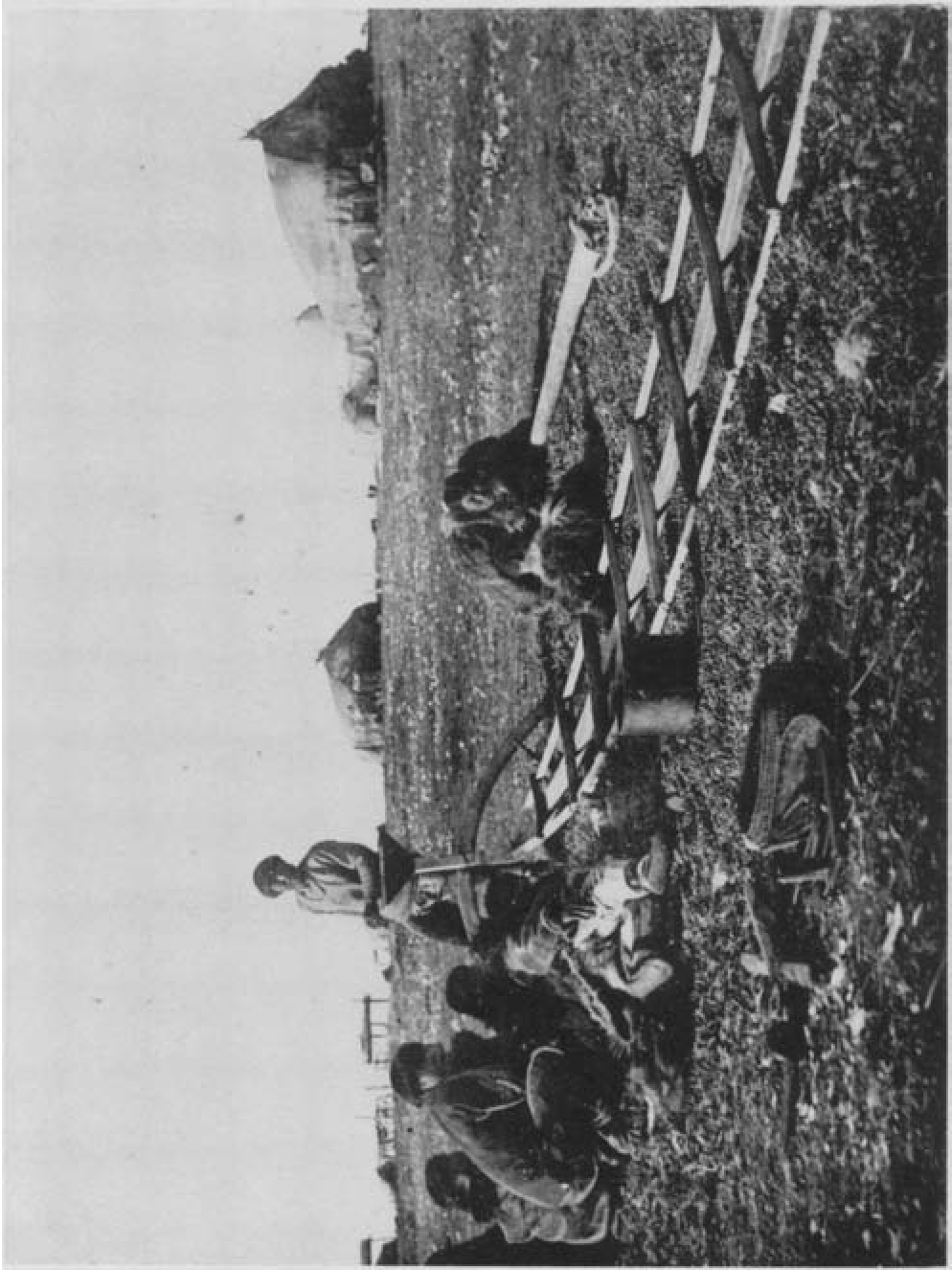
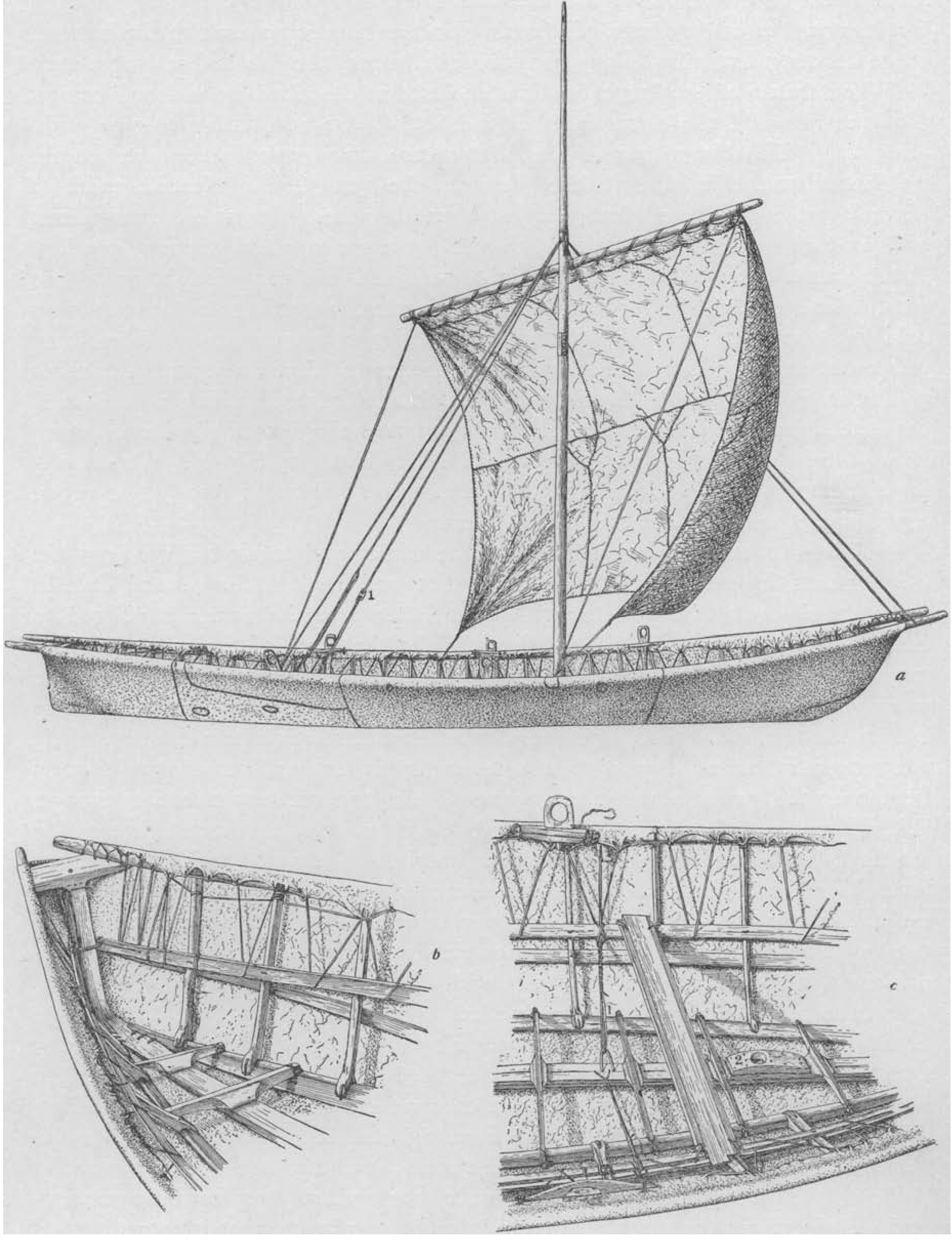
The frame of the large boat resembles that described by Nelson,¹ except that the ribs and the cross-pieces of the bottom are set much closer together (Fig. 44). The dimensions of the boat secured for our collection are, length, 35 feet; breadth in the middle, between the gunwales, 4½ feet; breadth of bottom in the middle, 2½ feet; height, 2 feet 8 inches. It has 21 cross-pieces, and as many ribs on each side; 4 thwarts; 5 large oars and as many paddles. It requires a crew of from six to eight men, and can carry freight up to two tons. The central timber, strips and gunwales, according to the man who sold me the boat, were brought from America in a rude state. The frame was constructed on East Cape, and taken thence to Mečiˊwmɪn, and afterwards to Indian Point. At the last-named place it was covered with skin and used for several years; so that, from the very circumstances regarding its construction, it must be called typical for the Asiatic coast (Plate XI, Fig. 4). The homemade boats of the Pacific villages between Indian Point and Anadyr, however, are clumsier, and their sea qualities poorer.
The skin cover is unfastened for the winter and safely hidden from the dogs. Late in the spring it is taken out and soaked for several days in some pond or in the sea, though in the latter case the owner is obliged to keep a sharp lookout for drifting ice and for the force of the current, which may break the thongs by which it is secured and carry away the skin. The work of covering is done by several persons; the boat’s crew, in order to hasten matters, calling on their acquaintances and relatives to aid them. The wet cover is pulled around the frame as tightly as possible, and its edge is bent over the gunwale and laced to the middle strip with stout leather thongs. After a while, when the lacings have dried a little, they are tightened by means of walrus-tusks, which serve as marline-spike and hand-lever. Every little hole in the skin is carefully patched and the boat turned bottom-side up and allowed to dry for twenty-four hours. During this time it receives two or three coatings of oil, and the patches are smeared around with thick oil-drippings, at present more frequently with oil paints bought from whalers.
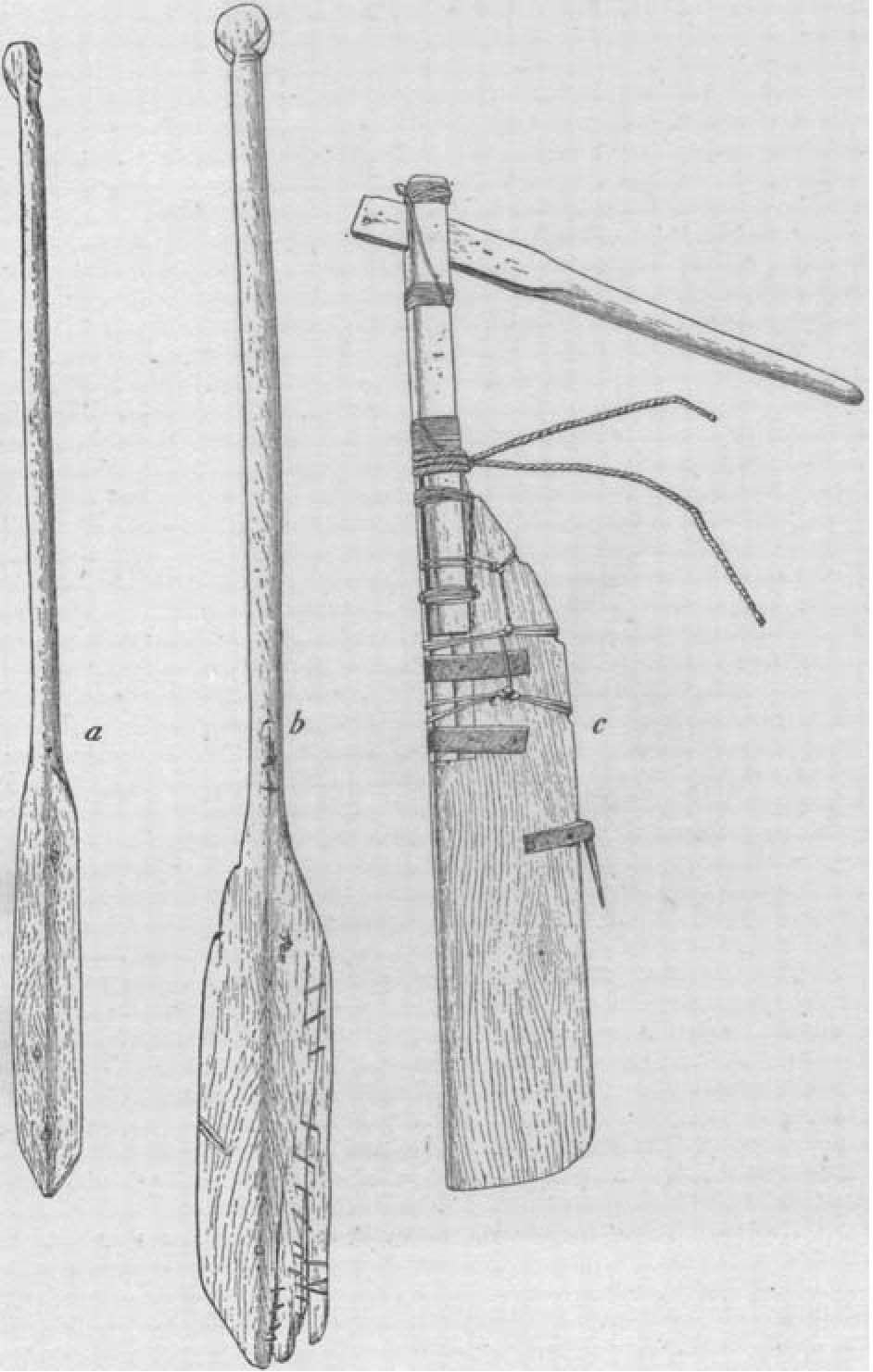
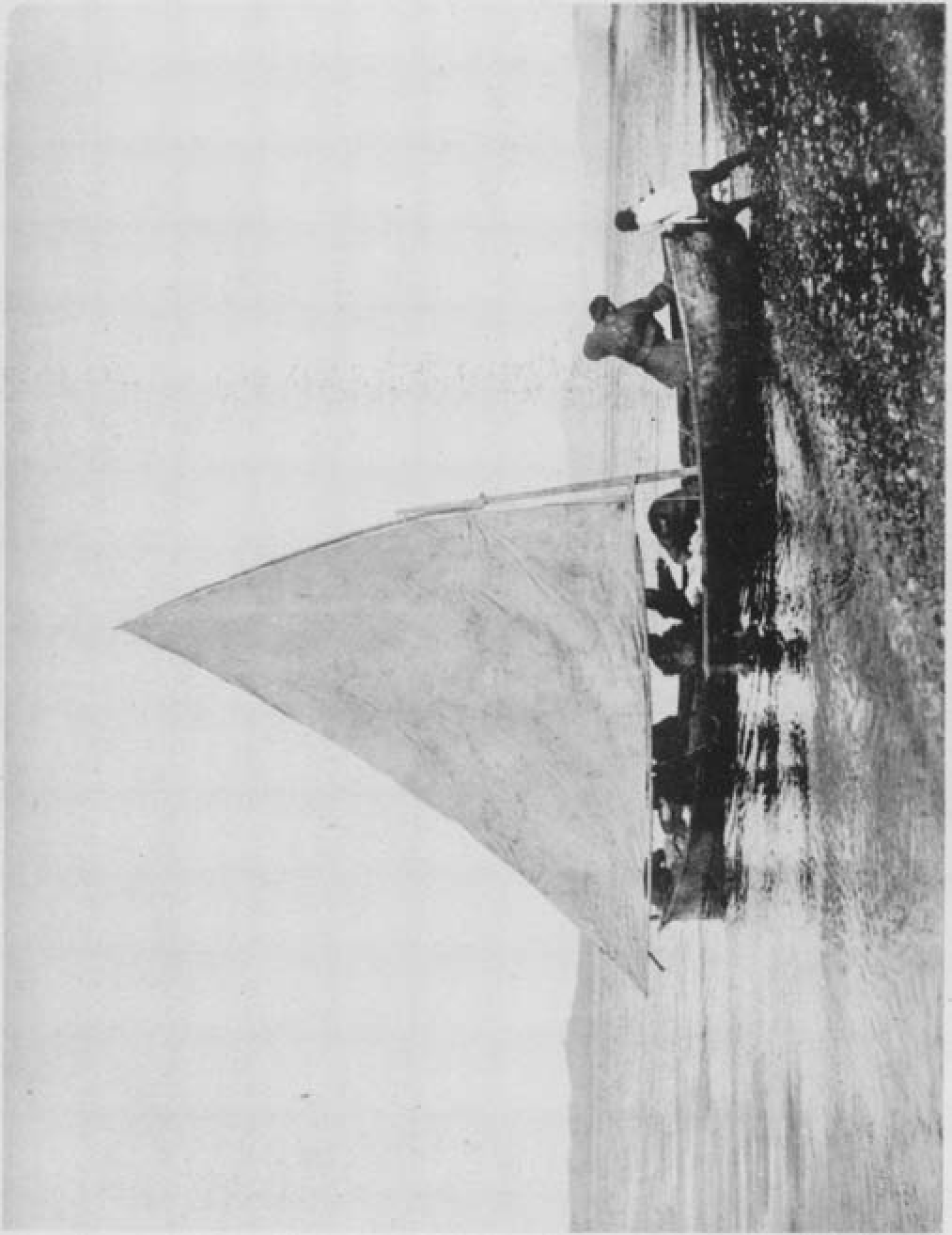
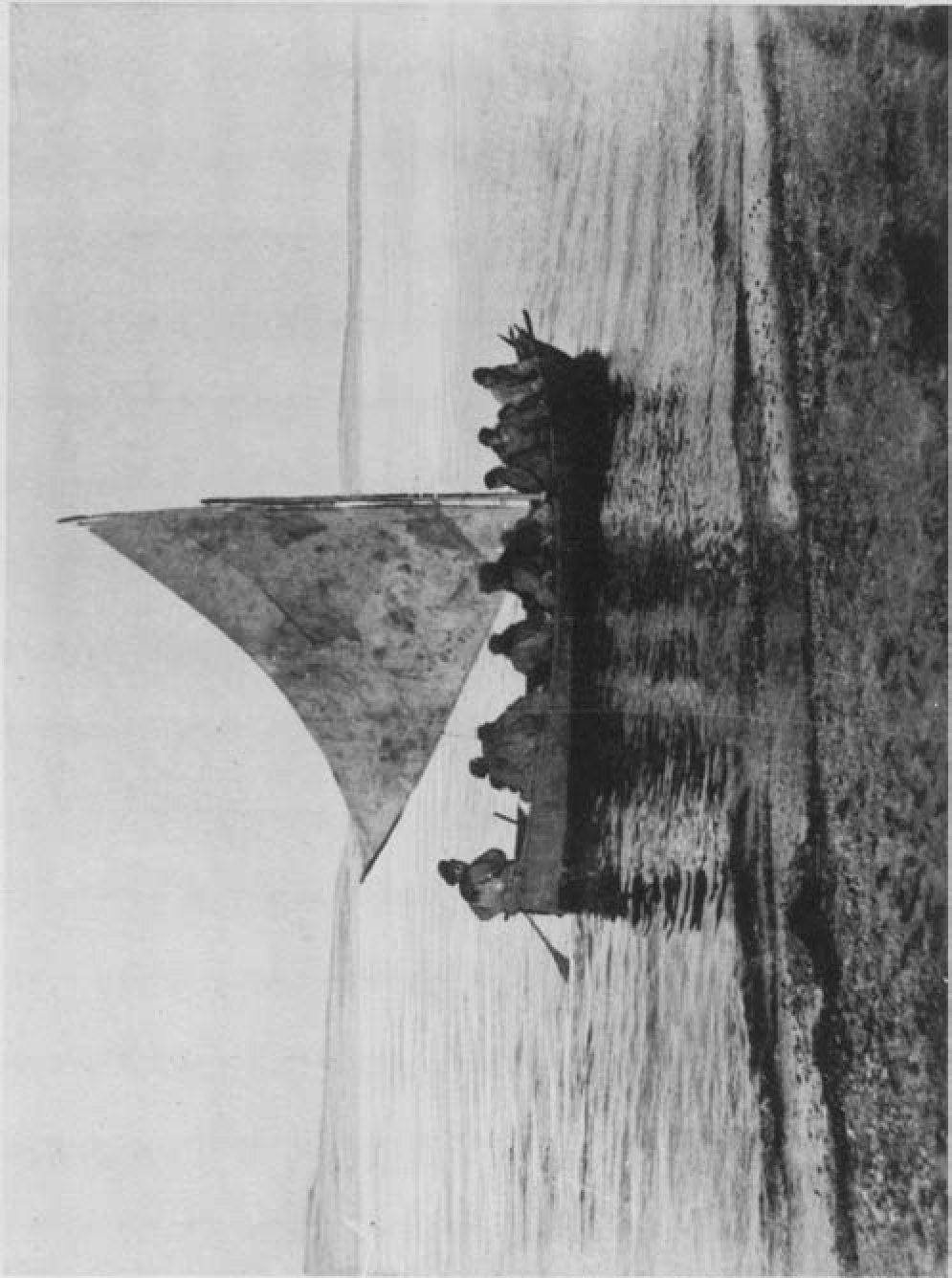
In former times boats were propelled by paddles (Fig. 45, a), and a large broad-bladed paddle was used for steering (Fig. 45, b). At present, along with the paddles, long narrow oars are used (Plate XI, Fig. 1). These are imitations of the American whale-boat oars, and are often simply bought from the whalers. Rowlocks, also copied from civilized designs, are fastened to the skin covering. Each thwart has, for the most part, only one man, who rows in civilized fashion. A rude helm (Fig. 45, c) has gradually replaced the steering-paddle. It is curious that the oars of the Koryak boats, rest in loops instead[129]🗗uncollated of rowlocks, after the manner of American Eskimo; also their gunwales are furnished with wooden guards to prevent friction of the oars.
Wherever the shore will allow, the boats are towed by a long thin rope. Dogs are used for the purpose; and with a well-trained leader, they will go by themselves, if the shore is straight enough, and has no sharp, projecting bowlders that will catch the rope.
On our journey from Indian Point to the mouth of the Anadyr, eight dogs were strong enough to tow the heavily laden boat; and when the weather was favorable, we made about a hundred miles in twenty-four hours of uninterrupted travel.
The skin boat has a mast, which is set on the central timber between the two foremost thwarts, more rarely between two middle thwarts. A small piece of wood serves as its socket (Fig. 44, c²). The mast is supported by four stays fastened to its top or passing through a hole in it. The fore-stays are joined together and simply slung over the end of the bow. The back-stays are fastened to the middle strips by means of ivory blocks (Figs. 44, a¹; 46, a¹; 46, b), which are occasionally replaced by loops of thong (Fig. 46, a²). Sometimes, when the weather is rough, two extra stays are fastened, one on the right, and the other on the left side.
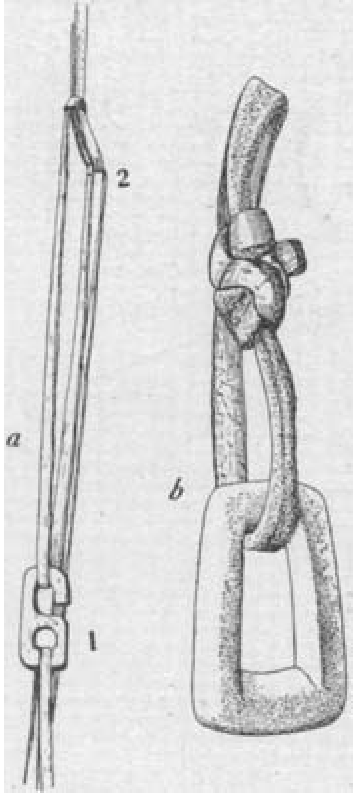
The sail is large and square, and is fastened by loops to a yard. It is hoisted by means of a stout seal-skin thong which is passed through a hole in the top of the mast, sometimes with the aid of a pulley. Four slender lines extend from the ends of the sail and yard to the stern, where they are tied to the inside strip-lashings. By means of these lines the position of the sail can be changed, enabling the boat to go with a side wind. The boat I obtained has two sails, one above the other, with separate halyards and lines. At the present time the square sail is gradually being superseded by a triangular one, copied after that of the whalers (Plate XI, Figs. 2, 3), which enables[130]🗗uncollated the boat to beat to windward. With the wind aft, however, the square sail is much more effective; and even with a side wind it keeps the boat much steadier.
In former times sails were made of curried reindeer-skins sewed together. Nowadays white and blue drilling is used in the trading-villages, while in more remote places numerous pieces of cotton and skin are patched together to form a large sail. In rough weather, if the wind is fair, two large floats are fastened on both sides of the boat, below the railing; while with a side wind the boat itself is too buoyant to allow the floats to be added. The sides of many boats are provided also with flaps of skin or drilling, which in rainy weather are used for covering the cargo, and in rough weather are raised, and held in place by sticks or simply by inverted paddles. These are very convenient, and keep off the dashing spray even in very rough weather.
The skin boat has many advantages over the wooden whale-boat. It is much lighter, and, while it carries more freight, can be propelled or towed along the shore with less labor. For the windward motion the skin boat is not so convenient, because it is too buoyant, and, moreover, has no outer keel. Much more important is the advantage the skin boat possesses in being able to land through heavy surf. Both on the Arctic and on the Pacific shore the sea is very rough, especially in the fall; and sudden squalls are frequent. The skin boat, when caught in a storm, does not seek the harbor, but makes for the first sandy spot free from stones, and screened from the rushing wind in some way by coast cliffs. The landing is effected in a peculiar way: the boat, propelled by oars, boldly makes for the shore, and in a favorable moment the end of a rope is thrown to the shore, or, when there is nobody to catch it, a man will jump out with it. The boat, while free on the water, is made by the steersman to turn in alongside the shore, and then the end of another rope is thrown from the stern, or another man jumps out with it. By pulling the ropes tight, the men on the shore make the water side of the boat stand up high against the breaking surf, and the first incoming wave catches the boat — crew, cargo, and all — and casts it ashore. The flat, slippery boat acts like a live fish; and the stronger the wave, the farther on shore will the boat be carried. Then all the crew jump out and begin to unload, the first two men all the time pulling the ropes, and making the boat, as it becomes lighter and lighter, bound farther and farther toward the shore. To prevent the skin from rubbing against the ground, oars are thrown under the boat and secured with separate lines, so that they cannot be carried away by the waves. When the boat is lightly laden and the people are numerous, — as, for[131]🗗uncollated instance, on a village shore, — they simply seize the boat by the lashings and carry it along, cargo and all. These methods of landing, quite impracticable with the ordinary wooden whale-boat, look strange to a civilized eye; but when, in the first heavy surf encountered on our journey, we tried to land with the bow forward, in the ordinary way, the boat filled with water and nearly capsized; and it would have been completely wrecked had it not been for the extreme toughness and elasticity of its frame.
Of the wooden boats I had occasion to see, the “sampan” of northern Japanese fishermen with flat bottom and smooth sides, more nearly resembles the skin boat. Like that, it is able to land through surf, when ordinary European boats are threatened at every attempt with capsizing.
For setting out from shore, the skin boat is put close to the water, with bow foremost but out of reach of the larger waves. Two or three inflated floats are laid under it, with long lines tied to their flippers. Then the boat is loaded, and with one effort pushed into the water; while the crew, with oars and poles, prevent it from being hurled against the shore.
On narrow strips of land between two shores the boats are unloaded and taken across. Six men can easily carry on their shoulders an empty boat, even when soaked with water. Sometimes only part of the freight is taken out, and the boat is pushed across on the floats, which act like rollers and prevent its contact with the ground.
One of the drawbacks of the skin boat is the fragility of its cover. Every sharp stone is liable to cut a hole through it, especially when it has been soaked and softened with water. At every landing it is necessary to look carefully over the whole skin surface, to clean away from under the central timber every small pebble, and to patch even the minutest hole; otherwise the boat may suddenly spring a leak while on the water, and necessitate an extra landing. When in good repair, the boat is water-tight, and requires no bailer; on the other hand, I know of cases where, on account of an overlooked gap, boats were almost sunk before a landing could be effected. While on shore, the boat is turned upside down, pebbles and sand are shaken off by repeated blows with the oar, and the cover is allowed to dry. If not dried for a long time, the boat will warp and get out of shape. To prevent warping, the boat has several sets of special lashings (see Fig. 44, c¹), which connect the gunwales with the central timber, and can be lengthened or shortened.
The Reindeer Chukchee living near the seashore also use skin boats; and the boats of the Telqäˊp people, for instance, are just as large as those of the Maritime villagers. The inland Reindeer people have no boats, and hardly need any. A few of them buy from the Russianized Yukaghir or from the Yakut small wooden canoes, and drag them along to use in summer on the lakes and larger rivers.
Camps travelling late in spring, especially those of the Kavraˊlɪt, are[132]🗗uncollated often hampered while on the road by the breaking-up of the ice. In order to cross the mountain rivers, suddenly swollen by floods, they sometimes construct a peculiar device, consisting of several sledges tied together in a pile, and protected from beneath by the cover of the outer tent. This is used as a raft to carry over men and household things.¹
HUNTING OF LAND-GAME. — Of land-game, the wild reindeer is the most important. It is nevertheless not so abundant in northeastern Asia as the caribou in America, because the best pastures are occupied by domesticated herds. Only the depths of the forests and the higher slopes of the mountains are left quite undisturbed for the wild breed, because they are unsuitable for the breeding of domesticated animals. Wild reindeer, however, are met everywhere in northeastern Asia, in single heads or in small herds.
The wild reindeer is larger than any of the domesticated varieties. Its step is wider, and its footprint longer, because its hoof-joints are more supple. Its antlers are more or less similar to those of the Lamut reindeer, but generally the ends are bent up in a hook-like shape. Also the difference in size of antlers between buck and doe is still more marked than with Lamut reindeer. The color of the skin is uniformly dark gray, somewhat lighter on the belly and lower part of the neck. Those living on the northeastern tundras and close to the ocean are smaller, but accumulate more fat. In this respect, however, all varieties of the wild reindeer are superior, even to the Chukchee breed. Late in summer, when insects cease to swarm around the pastures, a wild buck often takes on three inches of tallow on his hips, so that he is no longer able to run with his usual swiftness.
Some wild reindeer always live in the same places. They are called “resident reindeer.” Others gather every year in large herds and migrate considerable distances, from the forest border to the tundra and back again.
In former times there were two different trails in northeastern Asia for these migrations. One led from the Kolyma Mountains across the Omolon and the two Anui Rivers to the Chaun tundra; the other, from the high country of Palpal, across the Anadyr River, to the Chukchee Peninsula. About fourscore years ago the reindeer migration over the former trail began to lessen, and finally ceased altogether. Several Yukaghir villages which depended on wild reindeer for their subsistence were starved out in consequence, and the remainder went to the northwest and settled in the Russo-Yukaghir fishing-villages on the Kolyma River. In the year 1896, when descending the Omolon on a raft, I passed several of these deserted or starved-out hamlets. The houses of some were still standing. Others had completely fallen in, and only a grassy patch that interrupted the continuous line of the forest along the bank indicated the former dwelling-place of humanity. For the abandonment of this trail by the reindeer, Yukaghir hunters blame the Lamut, who every[133]🗗uncollated spring came from the south and followed the reindeer-herds to the very river’s edge, although, according to ancient Yukaghir custom, hunting was strictly forbidden on land, and allowed only on the river. The old men of both tribes attributed this calamity to the increase of sinfulness in the world. There is an old Yukaghir legend which aims at branding the wanton extermination of game and fish. It relates how some men, in most versions some Russian cossacks, tired of killing reindeer on the water, caught one, flayed it alive, and allowed it to escape to the shore. Afterwards, in the fishing-season, they took out the eyes of a live salmon, and in the same manner let it go free. The next year, in hunting-time, the flayed reindeer was seen on the herd’s trail, causing the herds to turn away from the river. Likewise the injured salmon made the salmon-shoals go back to the sea, and a frightful famine ensued. Up to a late period, when reindeer-herds or salmon-shoals were not forthcoming, it was considered by the old people as a just punishment for the reckless extermination of the game. It is true even at present, that the Chukchee or Markova hunters, when successful, will kill much more than they want, and afterwards take only the skins, at least from the lean animals, leaving their carcasses to rot. The real reason that reindeer ceased to migrate in the direction of Omolon and the two Anuis, however, probably lies in the fact that the Reindeer Chukchee spread to the west, occupying the tundra pastures, and so there was no place left for wild reindeer. On the upper course of the Omolon the Lamut hunters complain, too, that the “resident” wild reindeer retreated before the Chukchee herds farther into the forest. On the contrary, the hunters on the banks of the Kolyma within the forest border assert that the “resident” reindeer even increased in number, perhaps after their retreat from the tundra, only the animals ceased to gather in herds and to move northwards in certain seasons.
On the Anadyr River the crossing-places of the reindeer are situated on the middle part of the river, between the mouth of the Maïn and the small Chukchee settlement Chikayeva. The reindeer leave the Palpal Mountains about the middle of March, and keep crossing the river in bands of varying numbers till the end of June. The greater portion, especially the pregnant dams, cross before the ice breaks up. After having crossed the river, the reindeer scatter all along the tundra. A large number remain in the Peˊkul-ñei Mountains, to the north of the Anadyr. At the end of July the reindeer begin to assemble and come back to the river; then the most important hunting-season begins. Reindeer-herds take the same trail every year, and cross the river at the same places. There the hunters, in separate groups, lie in ambush and wait for the game, each tribe by itself. The Russianized natives keep watch more to the west, chiefly near the mouths of the Maïn and White Rivers. The Chukchee take their places farther downstream, as far as Chikayevo. Both tribes hunt in a similar manner, only the western natives use the wooden[134]🗗uncollated canoe, constructed of three very thin and flexible boards, or dug out of a hollow poplar-trunk, while the Chukchee use the skin canoe. The hunters occupy a place a little downstream from the trail, and keep very quiet. They even refrain from making a fire, in order that the animals may not be frightened away by the smell of smoke. The reindeer come to the river, one (usually a young active doe) running ahead as leader, and begin to swim across, being all the while carried downstream by the current. When the animals are not far from the middle of the river, the hunters rush out in canoes and boats, and try to impede their progress. The frightened animals turn upstream, and exhaust their strength in a vain struggle with the force of the running water; then one or two canoes go around the herd in order to cut off their retreat to the opposite bank, and slaughtering begins. The reindeer huddle together, and float quite helplessly in the middle of the stream. Men in canoes approach the herd and stab the reindeer with spears, which have a very long and slender shaft, a small iron point, and are not used for any other kind of hunting. One side of the double paddle is also often furnished with a small iron spear, which, though not so long, is much handier to use (Fig. 47, a).
The killing is done with incredible rapidity, a man being able to kill as many as a hundred animals in one hour. The wound is inflicted on the lower part of the body, and the wounded animals immediately turn on the side and are carried away by the stream. Most of them do not attempt defence. Young strong bucks, however, often try to kick at the canoe, though the hunter easily avoids their attack. Those hunters who are most skilful with the paddle penetrate into the middle of the herd, and, placing their canoe close between two large bucks, spear all the animals within reach, beginning with those farthest away; while the nearest, not being disturbed, keep quiet, and their bodies shield the canoe from the surrounding commotion. Old men, women and children, row in boats farther down the river, and intercept the game. All animals, when brought to the shore, are skinned. The fattest bucks are carved, and some of the meat is hung up to dry. All other carcasses are simply deposited in storehouses or in temporary hunting-huts, and are used chiefly for dog-food in the winter. A score of Chukchee families living in wooden huts on the Middle Anadyr have no herds, and do very little fishing, but live exclusively on the produce of the chase; and in a successful season one family will have as their share from a hundred and fifty to two hundred reindeer. For their own food they use the animals killed late in the season, especially those shot on the ice of the river, because the reindeer continue to cross late into the fall, and a few stragglers are met on the river even as late as the middle of November.
The Anui and Omolon Yukaghir, who had only a few dogs, were more careful to preserve the meat. They usually cut all the meat in long thin strips, drying it on special drying-racks in sun and wind.
[135]🗗uncollatedThe later the season, the better is the meat, because the animals are no longer worried by insects, and can feed undisturbed. The meat of young animals killed in midsummer is so lean and tasteless, that it is really only fit for dog-food. The buck-skins are valued for summer bedding and as the best material for curried leather. The fawn-skins, on the contrary, are poor, since the hunter cannot choose his own time for killing. Only the poorest people use them for garments, while all others buy fawn-skins from the reindeer-breeders.
At the places where the migrating reindeer crossed the Kolyma and its affluents, the Yukaghir inhabitants used to set long rows of snares on both banks of the river, spreading them out on the trees and among the bushes. These were still more efficient than hunting on the water; but bush and forest on the Middle Anadyr are too scanty to allow of this method of hunting. At the mouth of the Kolyma, where the migration of reindeer still continues to some extent, a few score reindeer are killed every summer on the water, and in some places single snares are still spread on the reindeer-trail.
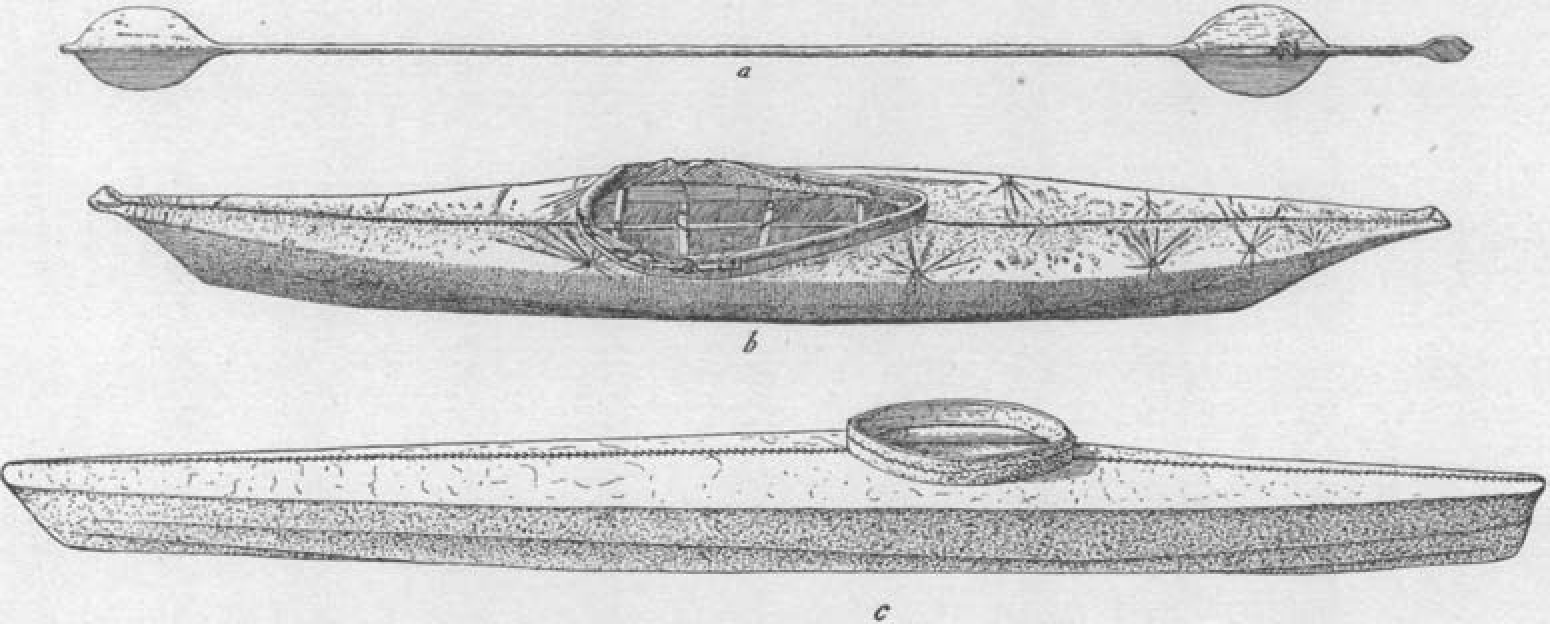
The frame of the kayak used by the Chukchee for hunting reindeer on the rivers (Fig. 47, b) is similar to the common Eskimo form, but it is covered with reindeer-skin instead of seal-skin. The manhole in the middle remains open, because there is no need of making it water-tight for use on the river. The kayak is employed because of its lightness as compared to that of the wooden canoes of the Russianized Yukaghir. The type of the Maritime Chukchee kayak is represented in Fig. 47, c. The double paddle (Fig. 47, a) is similar to that of the Yukaghir, and has a stem that is straight or somewhat curved, with blades in the shape of a poplar-leaf. In shallow waters two slender sticks about 150 cm. long and 1 cm. thick are used, both with the dug-out and with the skin canoe, for punting. The sporadic occurrence of the kayak all along the Asiatic shore is very curious. It exists on the Arctic, then almost disappears on the Pacific, again appears on the waters of the Middle[136]🗗uncollated Anadyr, then disappears for a long stretch of space, to appear finally on the Okhotsk Sea among the Maritime Koryak.
The hunting of “resident” reindeer is done with the gun, and sometimes even now with the bow. For instance, bucks that go to the Chukchee herds in rutting-time may be killed only with the bow or with the lasso. The Lamut, and, following their example, also the Reindeer Chukchee, take advantage of the well-known curiosity of the reindeer, to lure it within shooting range by means of a special decoy-reindeer, which is put to pasture in the open field, on the end of a very long and thin line. When wild reindeer are espied at a distance, the hunter hides behind some tree or large stone. The Lamut on the open plain will crouch behind the back of his riding-reindeer. Thus the hunter patiently awaits the oncomers, directing the course of his decoy-animal by dexterous pulls and jerks of the line. The best decoy-animal is a cross with a wild reindeer, — in the rutting-season a young doe, or a buck with large antlers, that is taken by the wild bucks for a rival.
The Lamut hunt reindeer in the spring, running on snowshoes over the hard-crusted snow, but this is possible only in a wooded country. On the tundra the snow is always too hard-beaten by winds to give a man with snowshoes any advantage over the reindeer.
To the Maritime Chukchee the wild reindeer cannot be so important as to the American Eskimo, because most of the hunt is done by the Reindeer Chukchee and other inland tribes; and the maritime people, for the most part, can only have a share in their large hunts. Thus, as already mentioned, people from Pacific villages in former times used to go up the Anadyr River to take part in the reindeer-killing on the water. On the tundra between the Anadyr and Indian Point the chief reindeer-hunters are Maritime Chukchee, who have acquired a few reindeer, and who for this reason spend much time inland, scouring the country the whole time far and wide. The same is true for the whole Chukchee Peninsula.
The elk, in former times, lived in the Kolyma country, close to the seashore; and the Kolyma Yukaghir derived from it a considerable part of their food. Around old dwelling-places at the mouth of the Kolyma I could always find an abundance of elk antlers and bones; and the jacket of a Yukaghir corpse that Mr. Jochelson found in a wooden burial-box on the lower part of the Dry Anui was made of elk-skin. In the last two centuries the elk has retreated into the forest, and does not go to the tundra. The Chukchee, therefore, hunt the elk but little, though in former times they were familiar with that animal, as is indicated by the frequent use of its name. Among the constellations, Castor and Pollux are called “elks;” a stray reindeer coming into a strange herd, and unlawfully appropriated by its master, is called “elk;” etc.
The mountain-sheep is eagerly pursued by all Reindeer Chukchee on[137]🗗uncollated account of its meat, which is considered the best of all game; also for its horns, which are used for manufacturing spoons, pronged clasps for the reindeer-harness, cups, etc. Its skin is very soft and warm, and is considered more valuable than reindeer-skin.
The mountain-sheep is very cautious, and lives only on rugged mountains. When caught on the plain, it immediately makes for the nearest hill, however low and easy to climb. In this case the dogs hold the sheep at bay, and the hunter is able to catch it with his lasso.
Of fur-bearing animals, the most important are the white and the red fox. The former are much more numerous, though the red variety also lives all along the Arctic and Pacific coasts, and is even met with and killed on the sea-ice while searching for young seals, or picking up bones left over from the feast of the polar bear. The Maritime and Reindeer Chukchee have several methods of hunting the fox. The most simple is to run it down on a sledge with a swift team of dogs or reindeer. The best hunting-time is after the first snow has fallen, which discloses every trace of the animal, and makes it hard for it to escape. Swift reindeer are able to overtake a fox after two or three hours of hard pursuit. When accustomed to that kind of hunting, they become so excited that they try to trample the fox down. The reindeer is also used in hunting down the wolf, and will be just as eager to catch it and to strike it on the head with the hoof. In fox-hunting the reindeer-driver often does not rely exclusively on the swiftness of his team, but sends a hunting-dog after the fox, replacing it by another when the run has lasted for a couple of hours (a dog-driver simply releases the swiftest dogs of his team one after another for the purpose: the fresh dog will be sure to catch the tired animal). When possible, the fox leads the pursuit to some large lake where the ice keeps bare of snow for a long time, and therefore is too slippery for the reindeer. The short feet of the fox, on such ground, give it advantage even over the dog, facilitating sudden turns and retreats. A good dog, however, would not give in, but would obstinately keep on with the pursuit. Sometimes the two adversaries are so tired that they lie down on the ice opposite each other, and rest for a couple of minutes, keeping a close watch on each other’s motions. An old wily fox, when pursued, does not go into its burrow, for it knows that it can be dug out from the shallow ground with but little difficulty. On the Arctic shore the crust of the unfrozen soil is so thin, that the ramifications of the burrow extend directly under the surface, and sometimes the roof can be broken in simply with the foot. Foxes, therefore, often prefer to lodge in hollow logs of driftwood or among stones rather than burrow in the ground. If the fox is in the burrow, the hunter often enlarges the entrance with an axe or an ice-pick; then the fox is extricated with a split stick that catches in some of the hair of its coat, or even simply with the hands, the animal having been dazed with smoke beforehand.[138]🗗uncollated In the Kolyma country the Reindeer Chukchee, like other inhabitants, are very assiduous in digging out the young of the white fox, though their skin has hardly any value; and this imprudent extermination has already decreased the number of foxes. In trade, seven qualities of white-fox skin are distinguished, according to age; and the first three are valued at not more than from ten to fifteen cents apiece. In the Kolyma country the Russianized Yukaghir and the Yakut often capture the young of the red fox, and raise them in willow baskets or wooden cases. The animals are half starved, because, if well fed, they would have thin and uneven fur. They are generally killed early in the fall. The Chukchee are too indolent to go to the trouble of raising young foxes in this way, and, moreover, they consider it as tabooed. In the eastern part of their territory, the Chukchee consider it unfair “to break into the house of any resident, even if it be a fox,” because every resident, though but a fox, is supposed to have a drum and charms in his house, and vengeance through magic means might ensue. Thus only a fox hunted down in the burrow is dug after, especially since often it does not hide in its own hole.
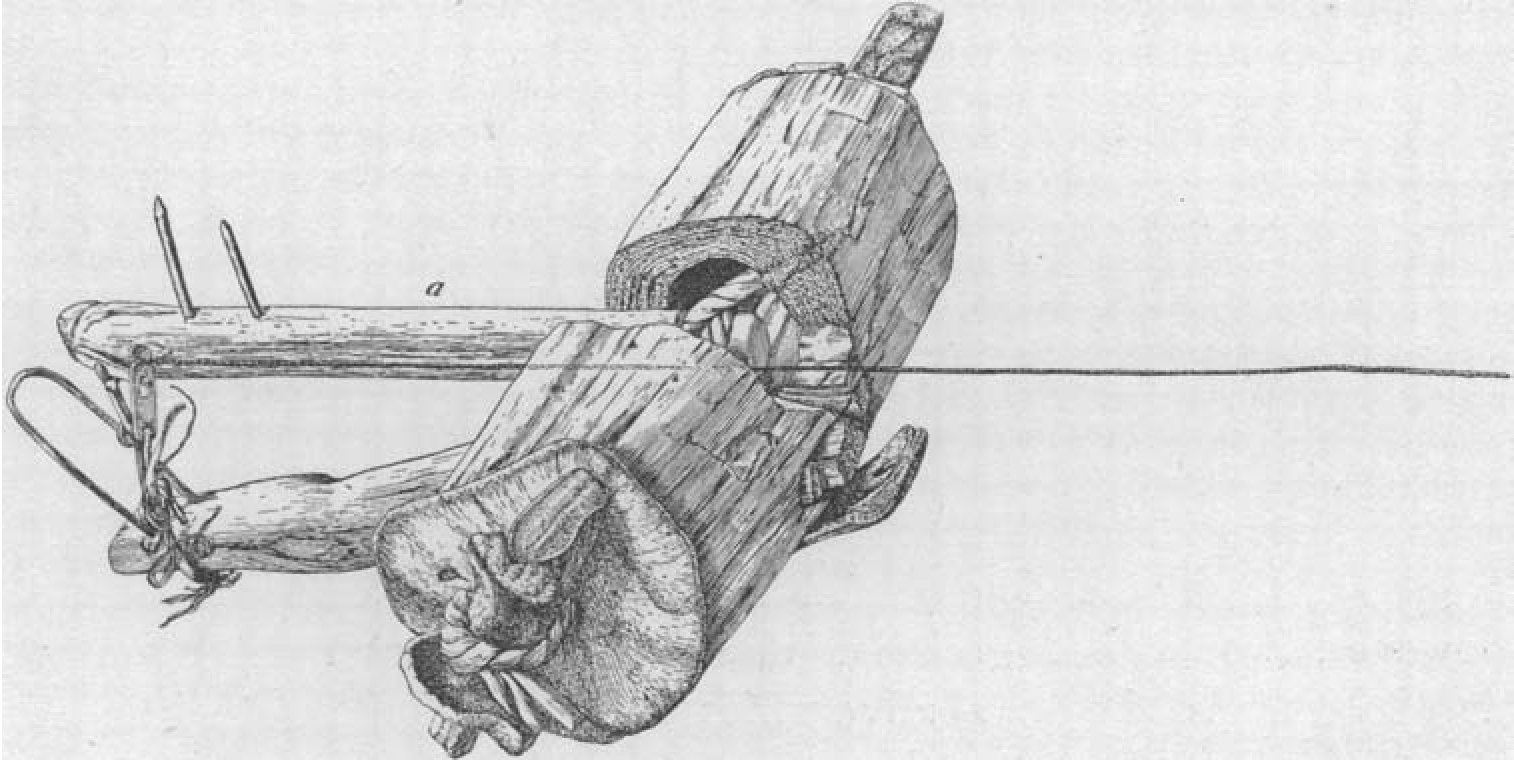
TRAPS. — Traps with a spring of twisted sinew (Fig. 48), of the shape common throughout the northern part of the Old World and possibly brought thither by the Russians, were much used in northeastern Asia, and even came to America;¹ but on the Pacific they are at present superseded by steel traps bought from the whalers, while on the Kolyma and along the Arctic shore the sinew-twisted trap still prevails. This trap strikes the animal from above; and the blow, though prompt and strong, is not quite sure, since the fox is often quick enough to dodge away in time. Then, instead of being killed, it is only hurt, and may be able to escape, breaking the trap, or biting through the sinew cords. On the other hand, this kind of trap is not very safe for[139]🗗uncollated the owner, and when visited may occasionally strike him on the feet, since under the snow it is not easy to ascertain the actual place of the releasing-string and the trigger.
On the Pacific shore some native blacksmiths, Chukchee and Eskimo, hammer traps of their own out of the bar-iron bought from whalers. They have usually but one spring; since traps with two springs work too strongly, and often cut off the paw, instead of holding it. Both kinds of spring-traps, especially the larger ones of steel, are used also for other animals, — hares, wolverines, wolves, and even swans and geese. When set for the wolf, the steel trap is fastened with a strong chain to a wooden block weighing from twenty to twenty-five pounds, so that the wolf may be able to drag it along on the snow. If the block should be too heavy, the wolf would snap the chain and carry away the trap. Sometimes the wolf that carried away the trap is able to live for several months on the tundra, preying on hares, moulting ducks, etc. Once in the winter I was shown, on the fresh trail of several wolves, the footsteps of one that evidently had only three paws; the fourth paw probably having withered, and dropped down with the trap. Another time a trap carried away by a wolf in the fall was found in the spring far away in the tundra, with the withered paw of a wolf in it.
Dead-falls are used only by a few Chukchee, in imitation of the Russians, who have large rows of them everywhere in the forest and on the tundra. On the Chukchee Peninsula, among the Maritime people, however, wood is too scarce for constructing dead-falls; and the Reindeer Chukchee in other parts of the country do not care very much about them, since they are not very skilful with the axe.
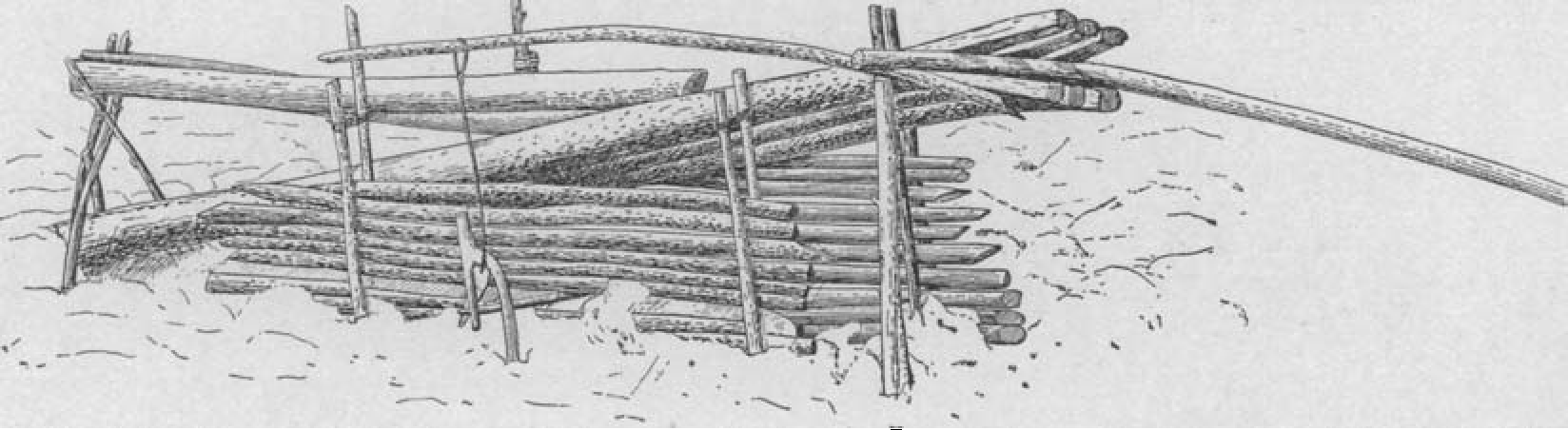
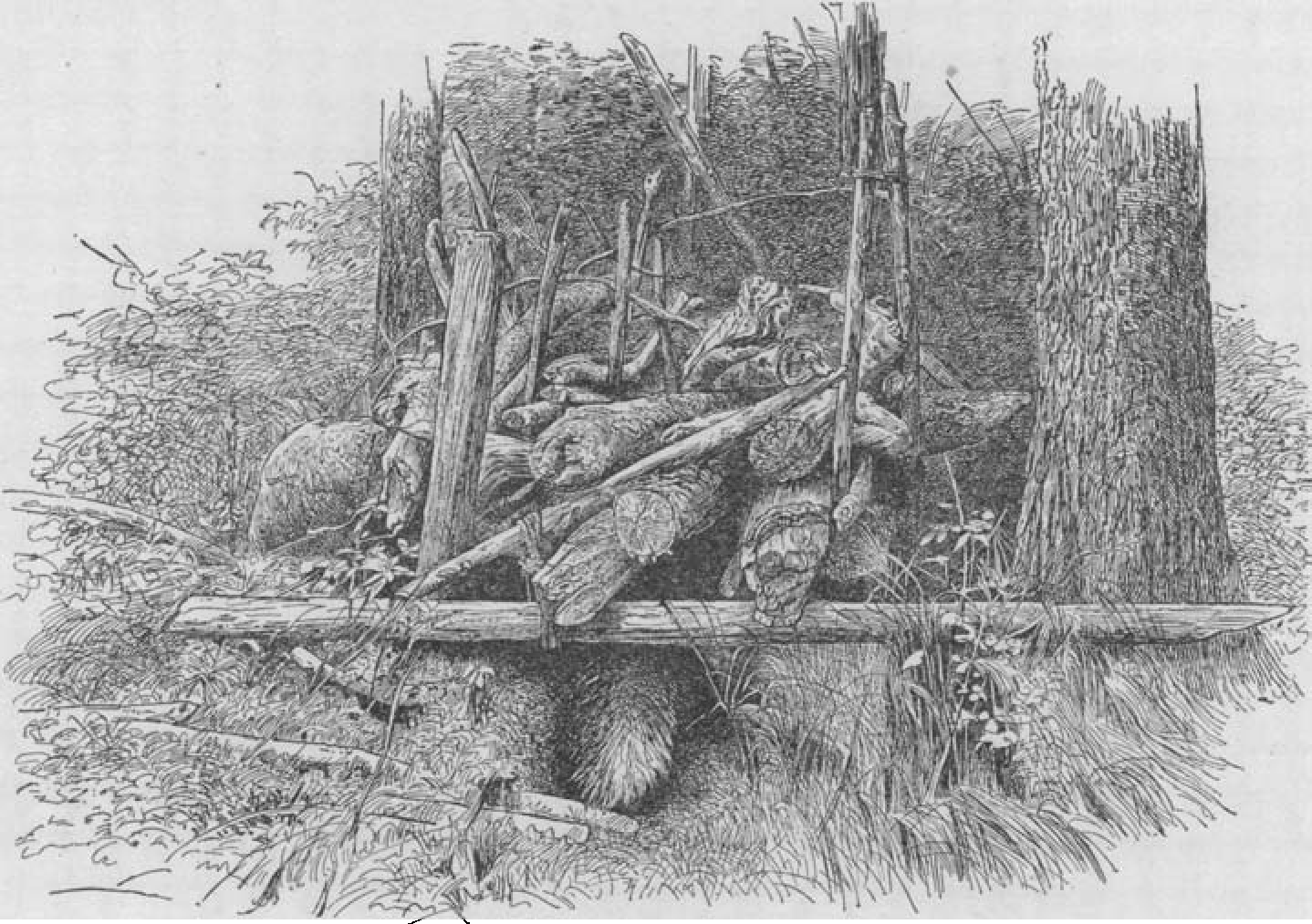
A common fox dead-fall (Fig. 49) consists of a double fence made of thin poles ten feet long and two feet high, with a space between about two feet and a half broad. The flooring is laid loosely; and the roof is formed of two or three strong beams split at the front end, and having a cross-pole jammed into the cleft. The rear end simply rests on the ground or on a special, very low support. Sometimes a large stone is put on the roof to make it heavier. The roof is quite free, and so fitted that in falling down[140]🗗uncollated it will not be interfered with by the side-fences. The long end of the cross-pole touches the ground. The short end is supported by a sweep, which rests on a stake firmly set into the ground. One of the ends of the sweep is connected by a willow withe or by a strong sinew cord with a trigger in the middle of the fence. This trigger is held in place by a short wooden stick, to which the bait is so tied that the first strong pull of the animal sets the trigger free, and the roof, loosened from its support, falls heavily down and crushes it (Fig. 50). For bait a dried salmon-head is used, or the wing-bone of a goose, or something of that kind, usually in the most putrid state, to attract the animals by its pungent smell.
On the tundra, dead-falls are often raised on special supports to prevent them from being blocked by snowstorms. They are of slight build, being intended chiefly for white foxes, and usually have two dropping-beams. Those within the forest border, being intended for red foxes, are more strongly built, and have three dropping-beams. However, the larger animals, such as wolverines and wolves, are caught in them only when the flooring is made with spaces between the poles. Then the feet of the animal will slip through, and the sudden pain and pressure on its back will deprive it of most of its strength. For hares a lighter dead-fall is used. It has only one stout beam; and the fence is made simply of small stakes stuck in a row around the fall. Pieces of willow-bark, or a few tender sprigs of willow or poplar, serve as bait, and are tied to the bait-stick.
On the Arctic shore the inhabitants make dead-falls of blocks of ice,[141]🗗uncollated which work on the same principle as the wooden ones. Sometimes, in the deep snow among the rough ice, a pit is dug and covered with a large block of ice. This is well poised on its axis, and will swing on slight pressure; so that the animal stepping on it falls into the pit, and the ice-block comes to its former place by its own weight.
Strychnine pills, procured from Russian or American traders, and wrapped in blubber or tallow, are also occasionally used for killing animals.
The self-acting bow was probably copied from the Russians, together with the sinew spring-trap. At the present time, of all the tribes of northeastern Asia, the Yakut and the Lamut use it most frequently. They secure with it even elk and reindeer. The Chukchee employ it for small animals, such as foxes and hares.
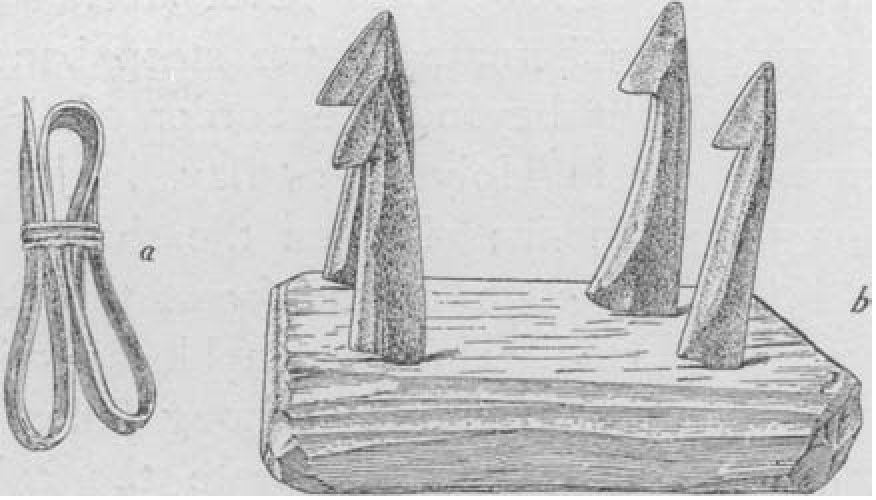
Till recent times the well-known spit of whalebone¹ (Fig. 51, a), identical with that of the American Eskimo, was used to catch wolves. It consisted of a slender rod of whalebone, with sharp-pointed ends, folded together several times, and bound with a thin thread of sinew well saturated with oil. Afterward it was several times soaked in water and allowed to freeze. The whole object was then well covered with blubber, tallow, meat, or such like. These folded spring-spits were often joined in strings of five or six, and hung on a bush on the wolf’s trail, but so high as to be out of reach of foxes; or they were laid in a hole in the ice and water was poured over them, so that it would freeze to a transparent protecting cover strong enough to resist the attacks of smaller animals. The wolf would break through the ice and swallow all the spits, which would unfold in the stomach, and, breaking through its walls, cause the speedy death of the animal. But with only one or two spits it was able to walk away for a considerable distance, even so far that it would never be found by the hunter.
Polar bears are sought on the sea-ice with dog-teams. When the animal is espied, two or three of the best dogs are released. The bear is easily overtaken by them, and, when held at bay, is speared with a lance, or shot[142]🗗uncollated with a rifle. The pregnant bear lies down in some convenient spot on the rough ice, and allows the snow to cover her over. She is killed in her snow den, together with her young, much in the same way as are brown bears in more southern latitudes. The polar bear of northeastern Asia is not dangerous, and rarely defends itself. When wounded or hunted down, it simply thrusts its head into the snow, and waits for the blow.
Brown bears are occasionally killed by the Reindeer Chukchee, chiefly during their winter sleep, because that is the least dangerous method. The entrance to the den is sometimes blocked with logs, and the animal is speared or shot through a hole made in the roof. The Maritime Chukchee occasionally have a chance to kill a brown bear, because in the summer-time bears go to the tundra far away from the forest border. Thus on the Arctic coast, near the Kolyma, brown bears are met on the seashore between the mouth of the Kolyma and Brown Bear River (Keiˊñu-weˊem). On the Lower Kolyma brown bears even hibernate on the steep banks of some brook, well protected from the wind, but beyond the border of the forest. On the Pacific coast I met a brown bear in Holy Cross Bay, in June, 1901, that was feeding on seaweed along the land-ice piled on the shore.
On the edge of the forest the Reindeer Chukchee sometimes catch the bear with small thin wooden blocks spiked on their upper surface (Fig. 51, b), and left on the pathway among fallen leaves. When the bear steps on one of these, the spikes penetrate the sole of its foot. A wound of this kind rapidly disables it for walking, especially since, in trying to tear away the block, the bear only makes the wound worse. This implement seems to have been copied from some tribe living within the forest limit, though I am not aware that any of the neighboring tribes use it at present.¹
The Maritime Chukchee catch hares in winter by cornering them and finally driving them into a spot surrounded by nets. Women and children join in the battue with rattles and sticks to drive the hares in the desired direction. I was told that in one successful battue several scores might be caught. In times of famine poor families often escape starvation by this kind of hare-hunting.
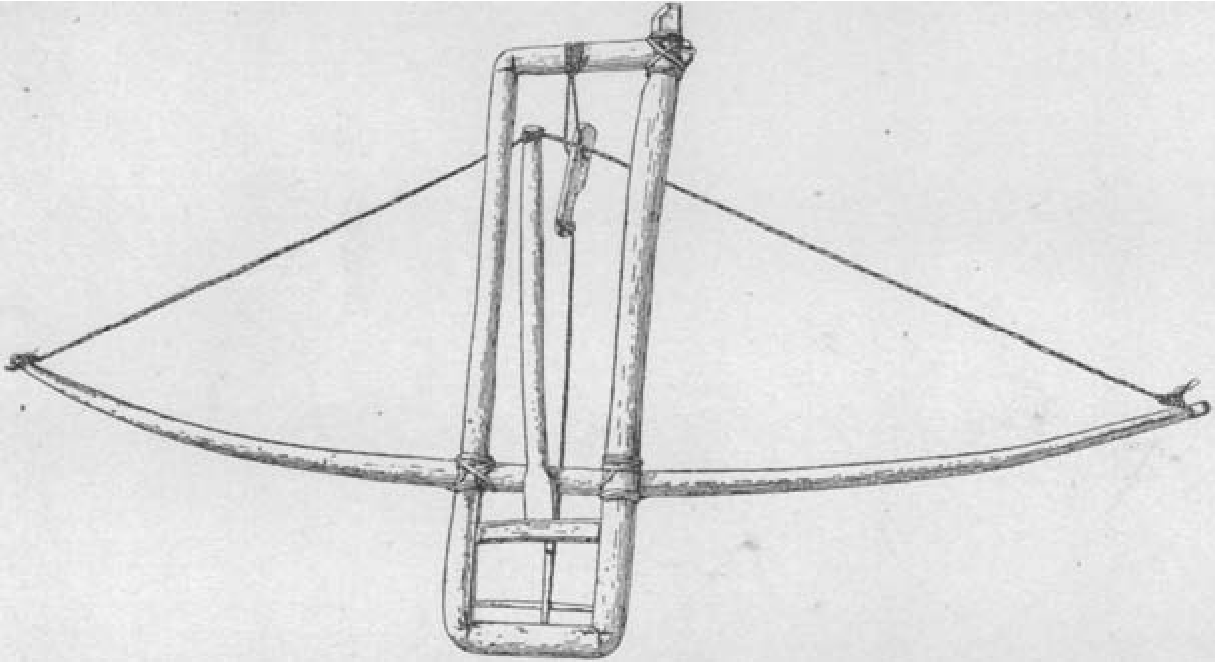
Small animals — like marmots, ground-squirrels, etc. — are caught with snares; house-mice, with special mouse-traps; ermines, with a kind of self-acting bow (Fig. 52), probably copied from the Russianized natives. It consists of a small but strong bow fastened in a vertical position to a wooden frame of narrow rectangular shape. The “arrow” is tied at one end to the middle of the string, while on its other end is a cross-piece which runs up and down in grooves, between the vertical sides of the frame. In stringing the bow, the arrow with the attached cross-piece is pulled upward. Then the string is held in position by means of a trigger, which is connected by a sinew cord with[143]🗗uncollated a slender chip of wood. The latter is propped against the bottom of the frame, and holds the cross-piece in place. It is braced by another very slender cross-piece, the ends of which are held by the grooves. The bow is set on the ermine’s track, so that the animal has to pass through the lower part of the frame, beneath the bow. A light touch pushes off the wooden prop, releases the trigger, and the arrow with the cross-piece shoots down, catching the animal and strangling it to death.
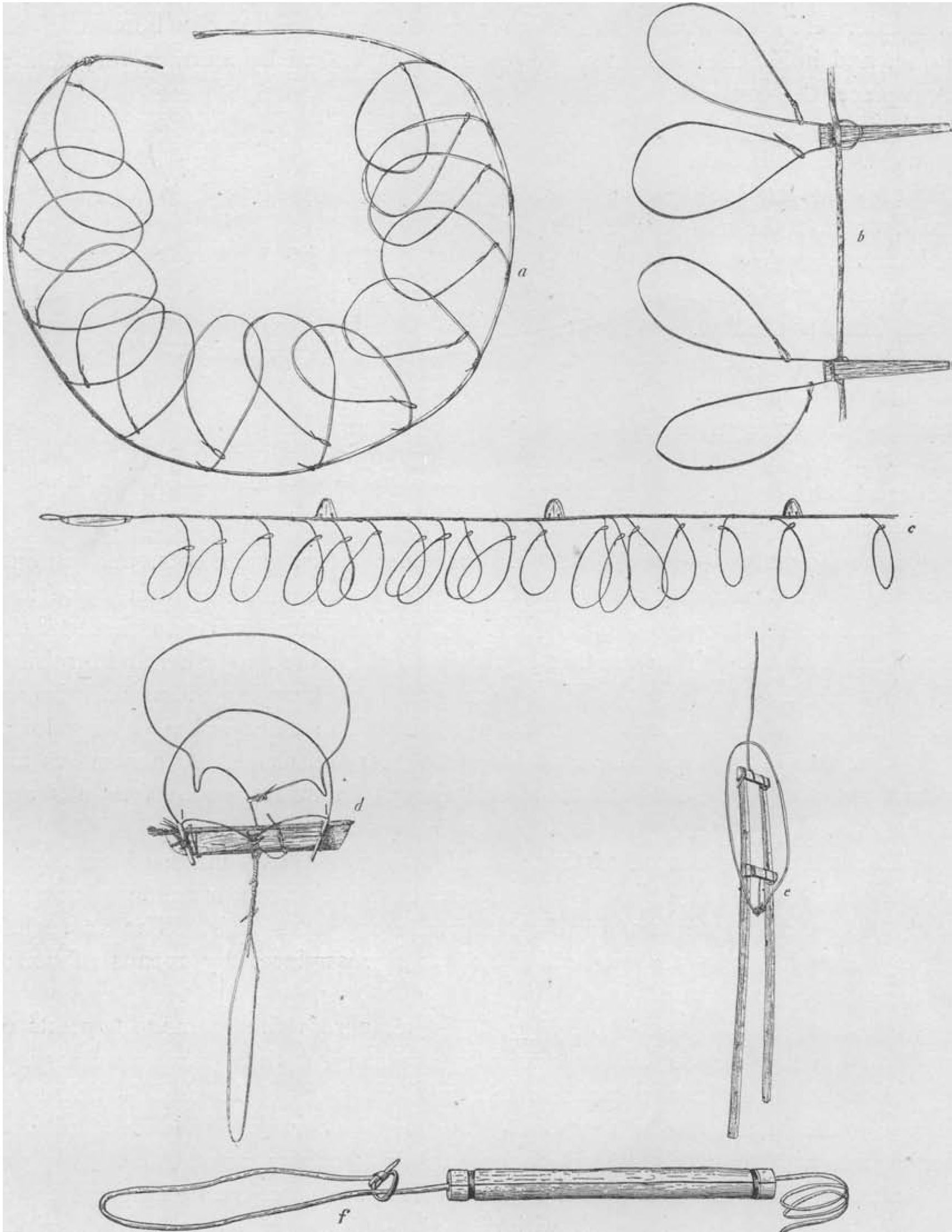
BIRD-HUNTING. — Sea-fowl, such as eider-ducks, guillemots, and puffins, are caught with various kinds of snares. These are made of whalebone and sinew thread, and some of them (Fig. 53, a) are quite similar to those of the American Eskimo.¹ Many snares of this kind are joined together and furnished with wooden buoys (Fig. 53, b, c), then tied to a very long rope and thrown from the shore into the sea as far as possible. The catch is best during long-continued tempests, when the sea-fowl come near the shore. Other snares are spread on the land, close to lakes and rivers, on nesting-rocks for auks and puffins, around entrances to nests, or in bushes for ptarmigan.
The snare represented in Fig. 53, d, has two nooses made of whalebone and fastened on both sides of a small stick. They are spread by placing a portion of each noose into small tubes made of goose-quills. The snare has a long line fastened to the middle of the cross-piece, by means of which captured birds are hauled in.
Another kind of snare (Fig. 53, e) is set across the entrance to nests of sea-fowl, already mentioned, so that they are caught when passing through.
A ptarmigan-snare is represented in Fig. 53, f. Its end is tied to a branch, while the noose is spread on the ptarmigan-track. It is identical with that represented by Nelson,² which he says is used for marmots.

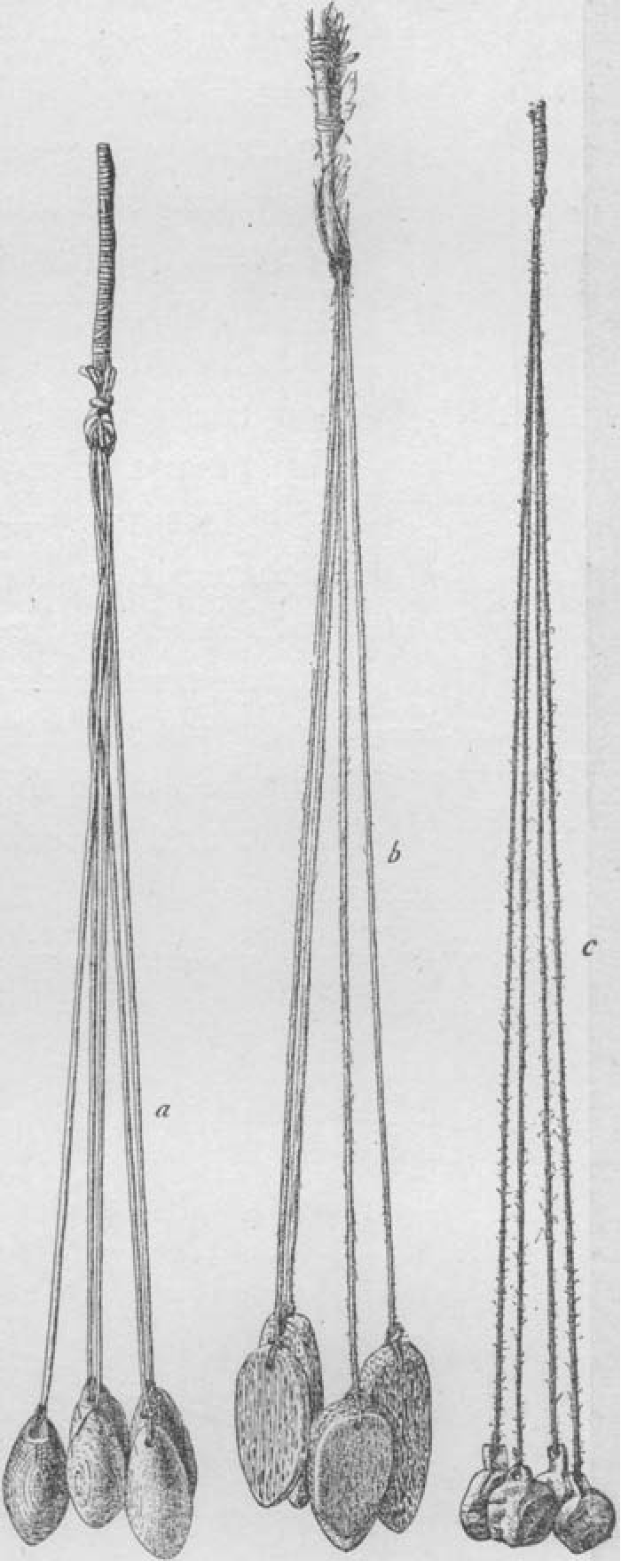
Sitting birds are killed with stones hurled from a common sling (Fig. 54). When on the wing, they are hit with throwing-balls, which have been described many times by travellers both in Asia and America. At the present time, throwing-balls have gone completely out of use, even on the Arctic shore, because with the introduction of the shotgun the birds ceased to come within[145]🗗uncollated throwing range of the balls. Therefore all specimens that could be secured are old and worn (Fig. 55). Besides bone and ivory balls, wooden ones were also used. These had the advantage of not sinking when they fell into the water.
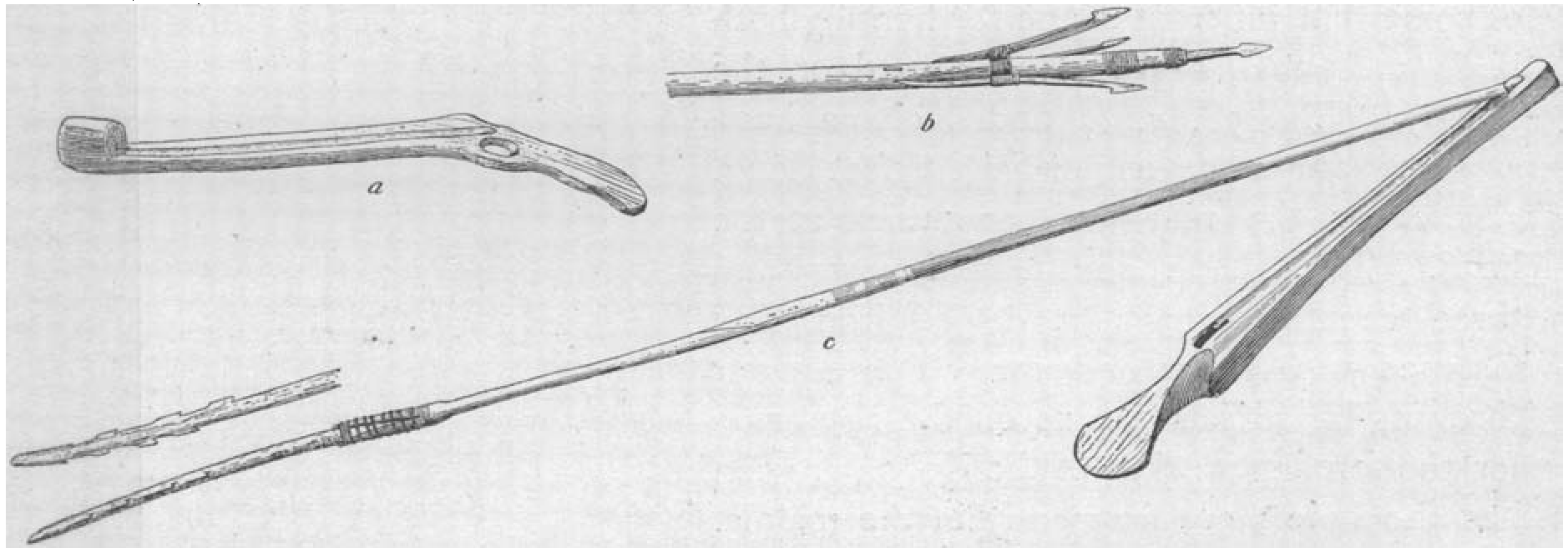
The bird-dart is used along the Arctic shore for the killing of moulting ducks and geese, on the Kolyma, alike by the Chukchee and by the Russianized Yukaghir (Fig. 56); on Bering Sea, only by the Russianized natives of the Middle Anadyr, who brought it over from the Kolyma. However, on old house-sites in Wuteˊen and Euˊnmun I found a few dart-prongs made of bone (Fig. 57). At Indian Point I came across a small dart and a throwing-board; but it was said that they came originally from the American side (Fig. 58, c). The Koryak of Penshina Bay in the Okhotsk Sea, however, use throwing-boards and darts of somewhat different shape for hunting both birds and small seals. Those used on the Anadyr (Fig. 58, a, b) and Kolyma have a shaft about seven or eight feet long, slender at the rear end, and thick at the head. They have one central prong and three circular prongs made of iron, and fastened with sinew or twine. The Anadyr throwing-board has a hole on the right side for the forefinger; that of the Kolyma region has the hole more frequently in the middle. The Chukchee on the Chaun tundra often use the bird-dart without the board, sending it off simply from the hand.
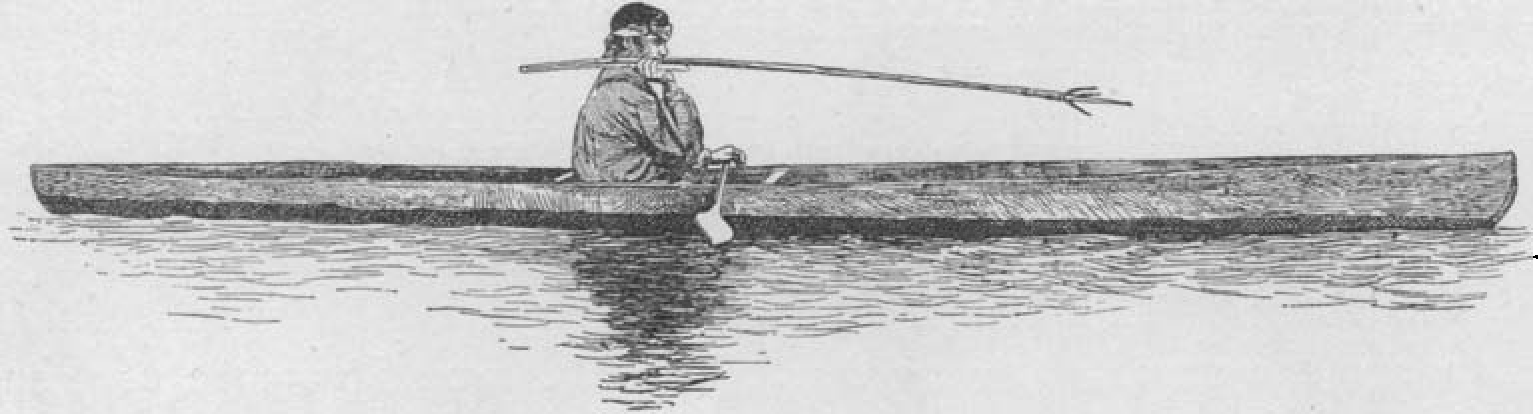
The dart is used for ducks and geese, but it is too weak for the swan. A kayaker, finding a moulting swan on a lake, usually tires it by long pursuit, making it dive frequently. The swan is not a good diver, and, because of its white plumage, can generally be seen while swimming under water. Finally the kayaker overtakes the swan when it comes to the surface. He seizes it by its long neck, which he breaks close to the head.
Ptarmigans and ducks are also caught by means of a drop-net fastened to a hoop. The birds are allured with bait strewn on the ground, and at a favorable moment the net is lowered by means of a long line.
FISHING. — Fishing is of comparatively less importance, because the coast of the Chukchee Peninsula is not very rich in fish. On the Pacific coast the mouth of the Anadyr is the last place to the north to which large shoals of Salmonidæ resort every year to spawn. Farther on, their number rapidly diminishes. On the Arctic shore, Coregonidæ begin to be abundant from Chaun Bay, and especially from the mouth of the Kolyma westward.
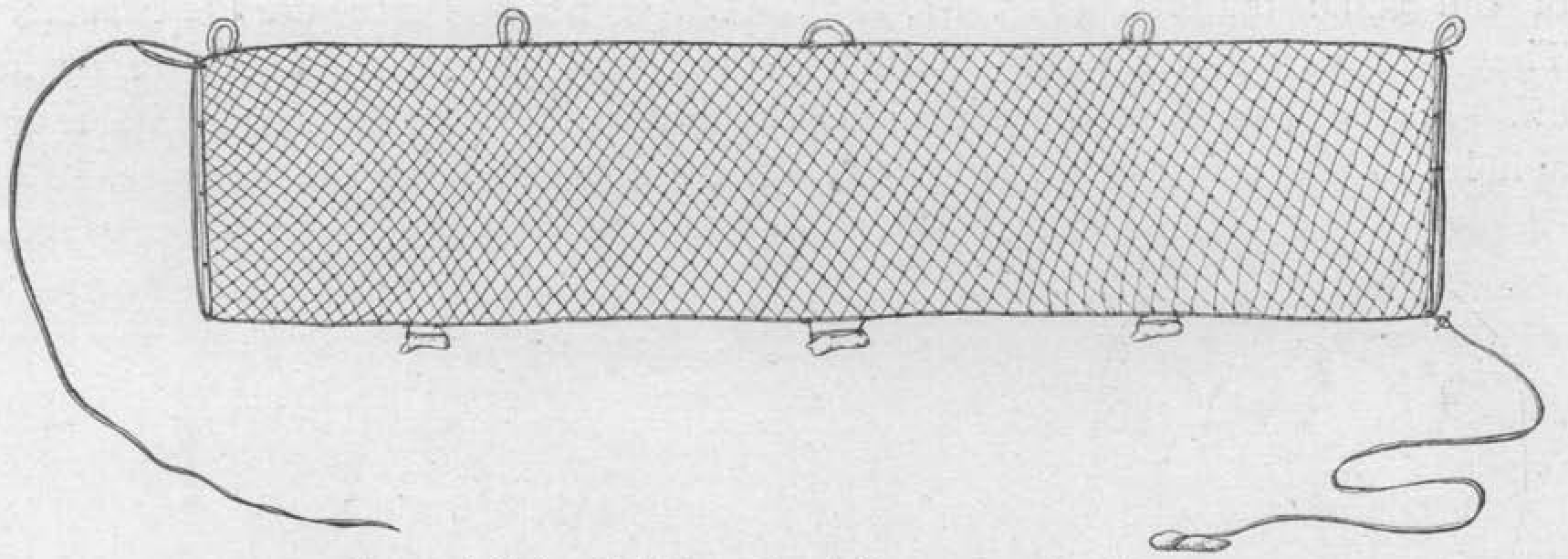
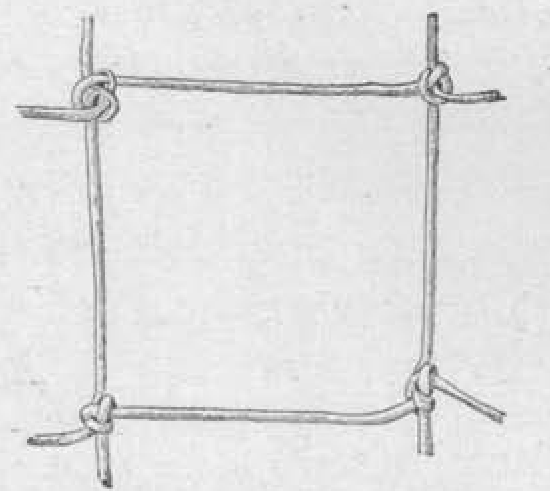
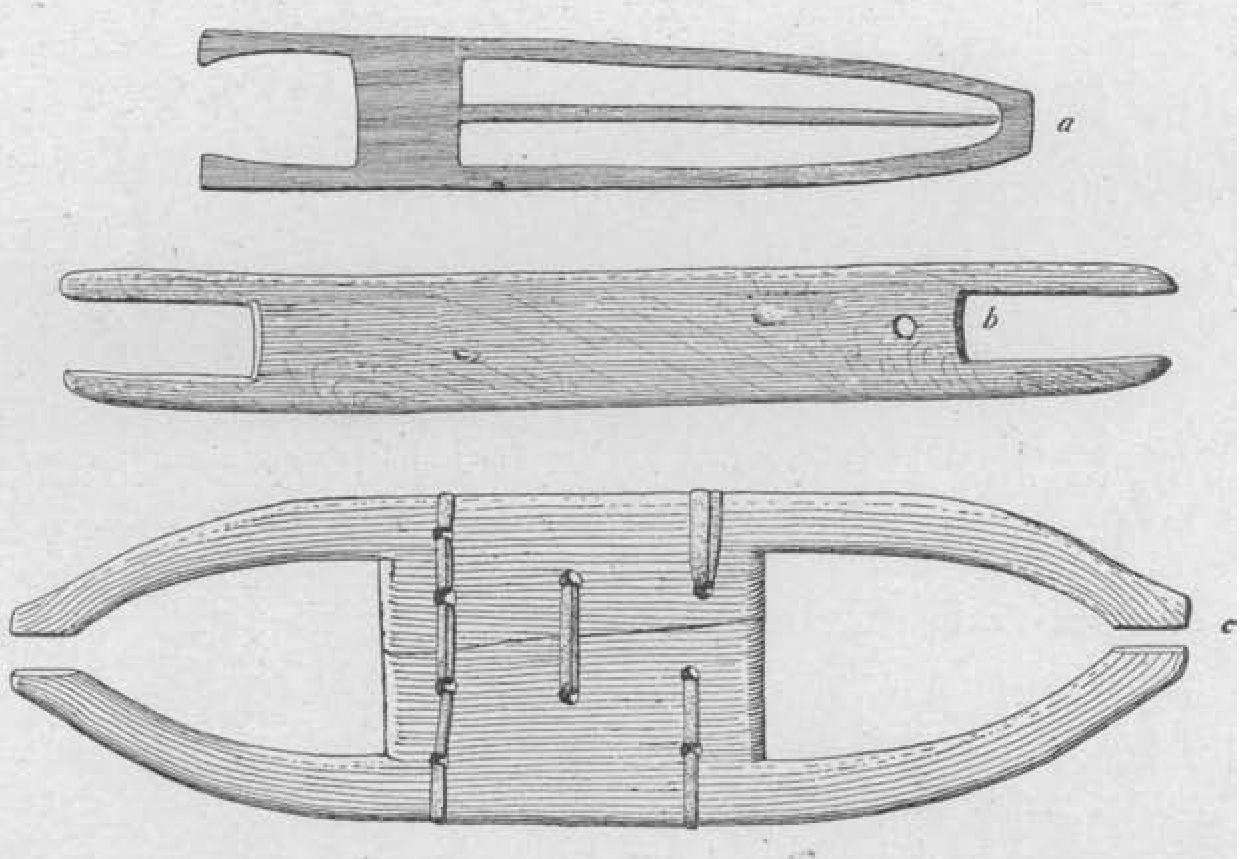
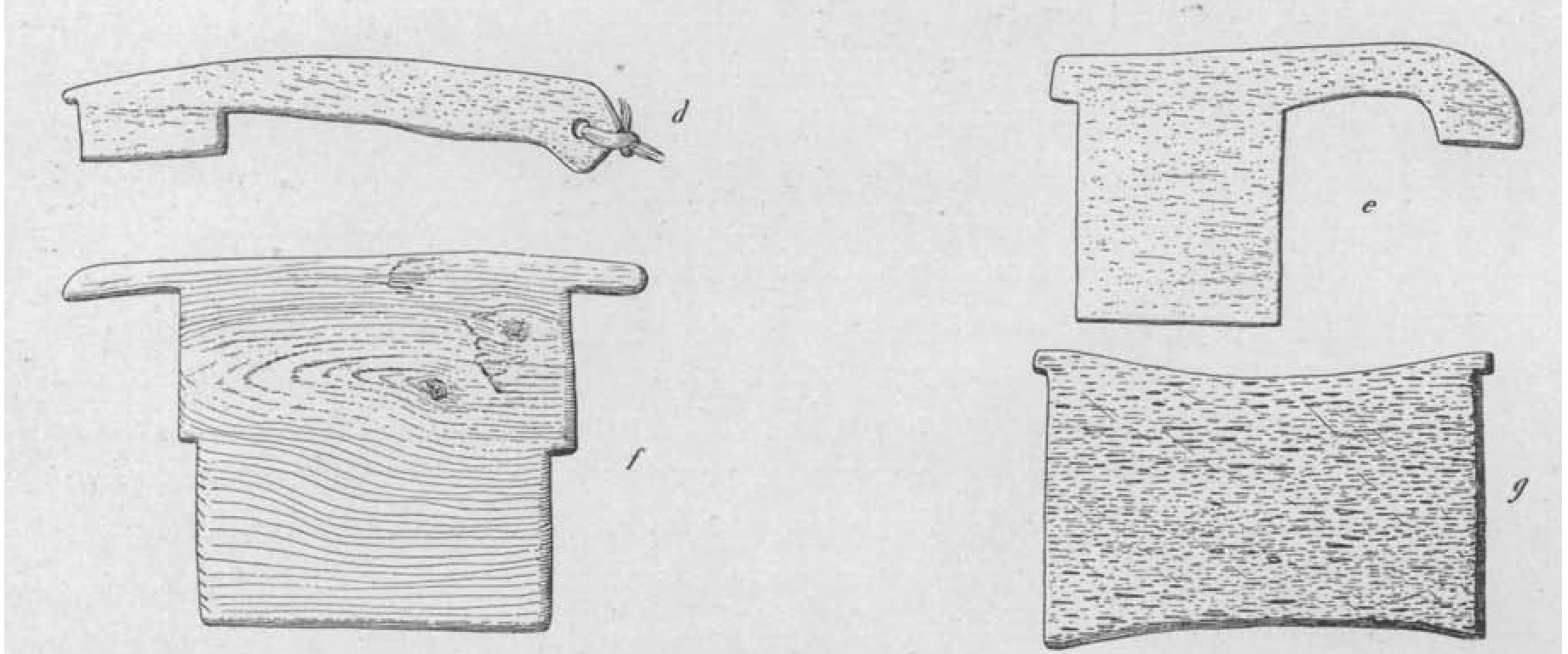
Fish-nets of sinew are used everywhere by the Reindeer and Maritime Chukchee. Their length varies greatly, according to whether they are employed on the seashore, or in the rivers and lakes of the interior. The small net of the Reindeer people, used in catching graylings, is made of from ten to fifteen pieces of sinew. A larger net of the Pacific fishermen (Fig. 59) requires from twenty to thirty pieces. The length of the latter varies from fifteen to twenty-five feet; the meshes are from two to four inches square. Other nets are made of thin strips of leather (Fig. 60), and in former times they were made also of whalebone. The Reindeer people often make their nets without a shuttle, though the process is very slow. The Maritime Chukchee use shuttles of whalebone (Fig. 61, a), wood (Fig. 61, b, c), or bone, with netting-sticks[148]🗗uncollated of the same material (Fig. 61, d-g). Large pebbles are used for sinkers. They are strung on loops of thin leather, and, having no notch, easily fall off. Pieces of bone or of walrus-ivory, with a strip of leather fastened through a hole on the upper edge (Fig. 62, b), are also used for the purpose.
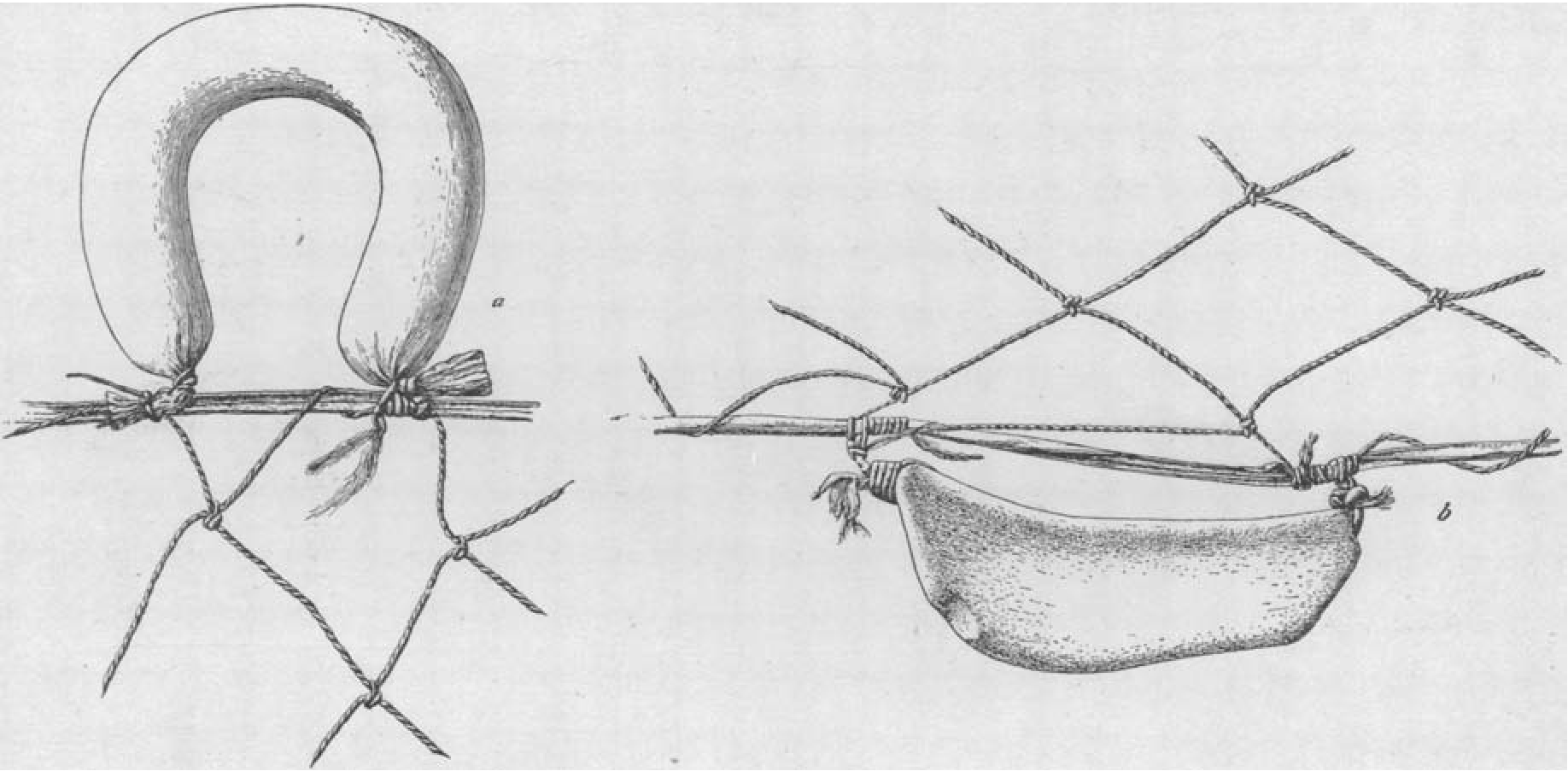
Floats are made of wood, or of pieces of seal-intestines inflated with air and carefully tied up (Fig. 62, a). The nets of the Russianized settlers on the Kolyma and Anadyr, made of hemp or horsehair, are eagerly bought, also Russian or American twine, cord, etc. On the small rivers the nets are put across shallow places, and the fishes driven into them by men and boys shouting, and by splashing the water a short distance farther along the stream. Often two nets are joined together and used in seine fashion. Even parts of tent-coverings are used to make the seine longer. Occasionally the whole seine will consist of a skin covering with a piece of net in the middle, in which to catch the fish. These methods are used chiefly by the Reindeer people.
The Maritime Chukchee push their nets into the sea by means of a long pole made up of two or three pieces joined together. A large stone is fastened to the water end of the net with a strong piece of leather. The shore end is tied to some stones or to a stake. These nets are used on the Pacific for catching several species of Salmonidæ, such as humpback salmon (Oncorhynchus horbusha), red salmon (O. lycaodon or niarka), and pink salmon (O. lagocephalus or keta); on the Arctic, for catching various species of Coregonus, such as Coregonus omul, C. leucichtys, C. maksun, C. nasutus, etc.
These nets are also set in the winter through holes cut in the ice with ice-picks having stout iron points (formerly the points were made of bone).[149]🗗uncollated However, no Chukchee has patience enough to cut six feet of ice, as the Russianized fisherman of the Kolyma does in setting his net.
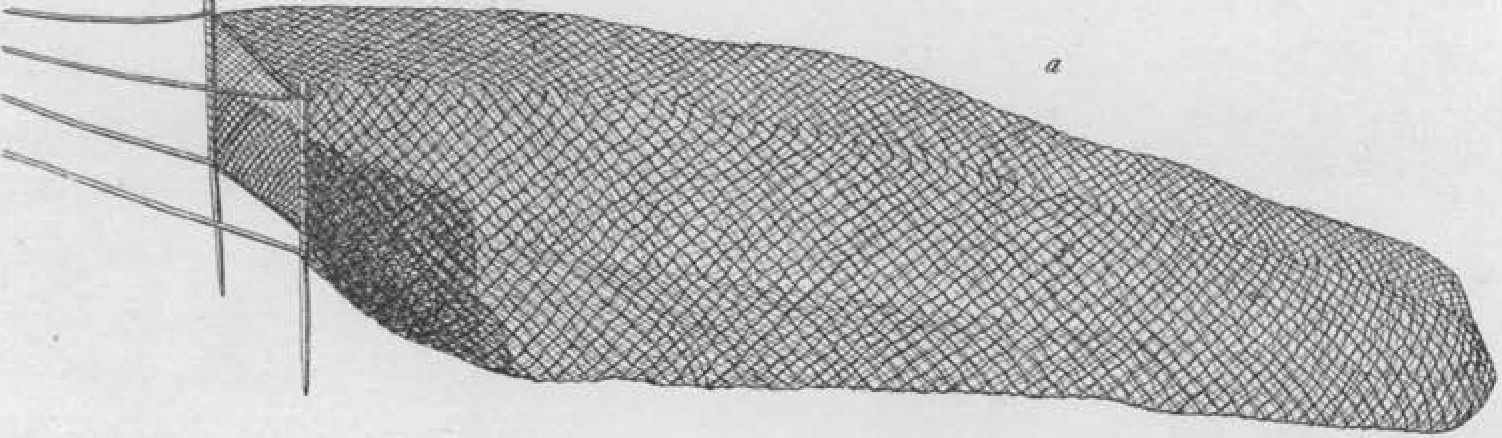
Bag-nets fastened to a square frame made of thin stakes (Fig. 63) are used in shallow water. The vertical stakes of the frame have sharp points, and are driven into the ground.
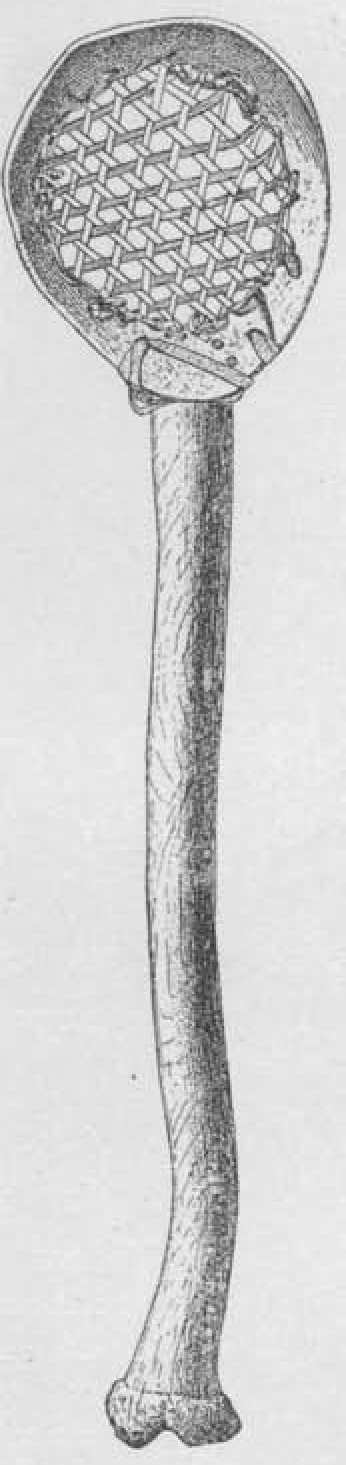
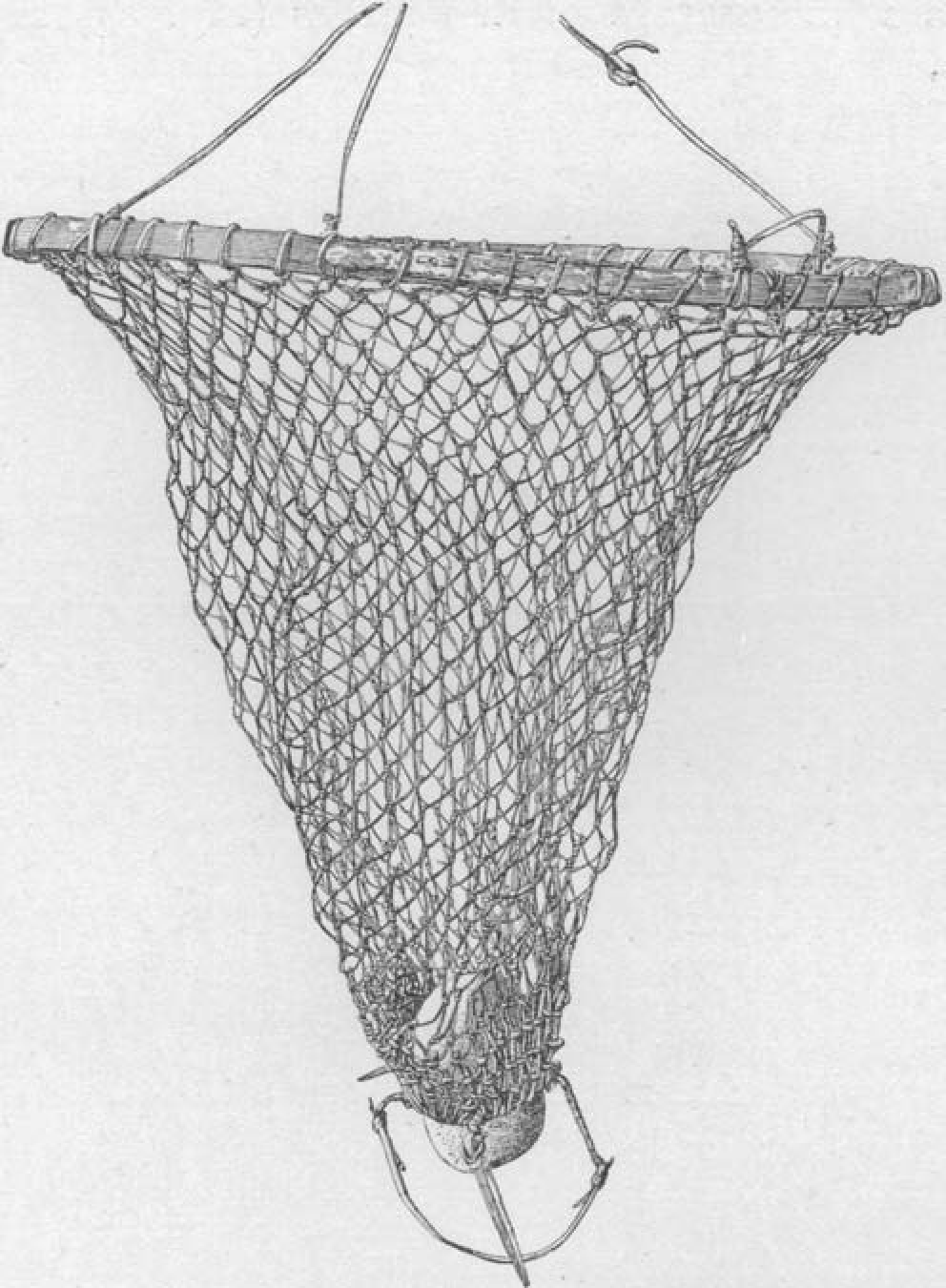
The ice-scoop used by the Chukchee (Fig. 64) is of the well-known Eskimo form, chiefly of small size, and has a circular hoop of antler netted across with whalebone strings or thin strips of leather. A round hoop-net made of whalebone (Fig. 65), with one large stone beneath for a sinker, is used for catching wachna.¹ It is identical with the American Eskimo net.²
Nordenskiöld³ gives a picture of a fish-spear made of bone. On the Pacific coast I met with the fish-spear only among the Kerek near Cape Anannon, and in several places among the Kamchatka Koryak. Their spears, however, are more or less similar to that given by Nordenskiöld. The specimen represented in Fig. 66 probably formed one of the prongs of a fish-spear.⁴ It is made of bone, and was found on an ancient house-site in the Eskimo village Wuteˊen.
The Chukchee make hardly any fish-weirs, because of the lack of proper material for constructing fences and fish-traps. On the Arctic coast, at the mouth of some of the smaller rivers, weirs are occasionally constructed of square pieces of sod piled up across the river in the form of a low wall. Fish-traps are[150]🗗uncollated made of willow-branches brought from the south, or they are simply bought from the inland fishermen, particularly from the Yakut and Russian.
The simplest kind of fish-hook is that used for catching burbot. It consists of a wooden peg pointed at both ends, with a line tied around its middle. It is baited with small fish of any kind; for instance, with Coregonus albula. When swallowed by a burbot, the peg works like a harpoon-point. A similar hook is sometimes used also by children for catching burgomaster gulls. I have seen fish-hooks of similar shape among the collections of Alaskan Eskimo in the United States National Museum at Washington.¹

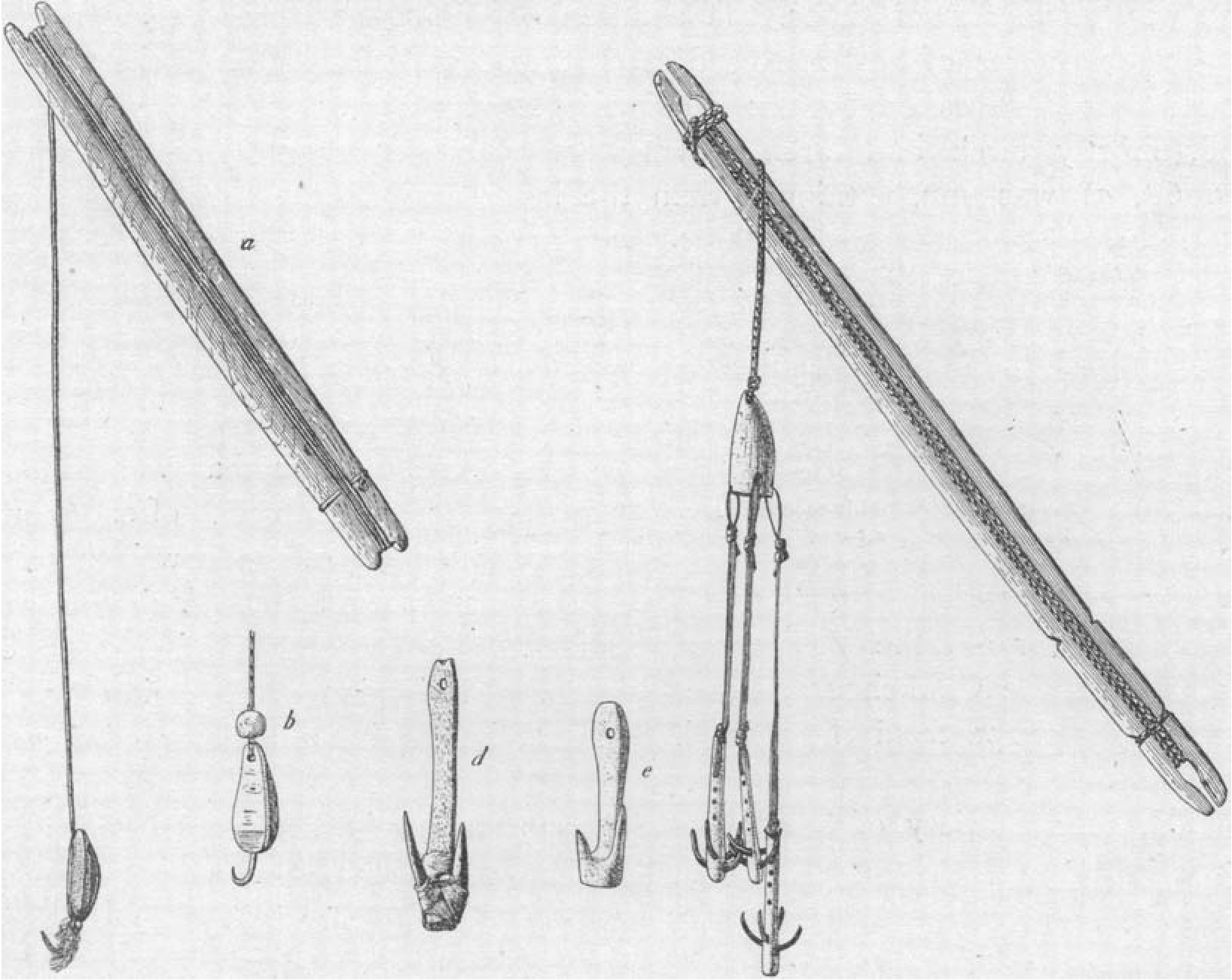
The ordinary form of hook used in fresh water is represented in Fig. 67, a, b. It is inserted in an ivory or lead body, and furnished with small pieces of red stuff, which serve as bait. The line is made of sinew or twine. It is used for catching grayling, also various kinds of trout and other fresh-water species of Salmonidæ. A short rod is sometimes used.
The fishing-tackle used in salt water (Fig. 67, c) is employed chiefly for various gadoid species, such as wachna and tomcod, also for sculpin,² flounder, etc. Three or four hooks are fitted together into an ivory stem, and several implements of this kind are fastened with short strips of whalebone to a common ivory or iron support. If the support is of iron, it serves also as a sinker. No rod is used. The line is of sinew or of thong. Small hooks employed in salt water are represented in Fig. 67, d, e.
Angling is done throughout the year, whenever opportunity offers. In winter and spring it is done through holes in the ice;[151]🗗uncollated on the rivers, more frequently on the edge of some open place, whither every kind of fish run in shoals to get a little fresh air. In this way the Omolon and the Anadyr Chukchee angle for grayling, the Chaun Chukchee for salmon-trout, etc.
Hooked poles are used both by the Reindeer people for catching grayling and trout and by the Maritime Chukchee for catching various kinds of salmon. The hook at the present time is made of iron, and is either firmly set in the shaft or is detachable. It is used also by the Russianized Yukaghir, the Koryak, and the Kamchadal.
War
BOW AND ARROWS. — For shooting, the bow was used until recently, and in some remote places it is still used by a few people. In former times it was the favorite weapon of the Chukchee; and as late as the thirties in the nineteenth century, the official reports of the Anui fair, speaking of the number of Chukchee comers, say that there were so and so many camps, with so and so many Chukchee men “versed in archery.”
The epic tales are full of descriptions of shooting-bouts and contests.[152]🗗uncollated Ability to split a blade of grass with the point of an arrow was proof of the greatest skill of the archer. Nowadays only the toy-bows of children are put to their full use; and shooting with small arrows is practised much in the same way as in former times, the children beginning at a very early age.
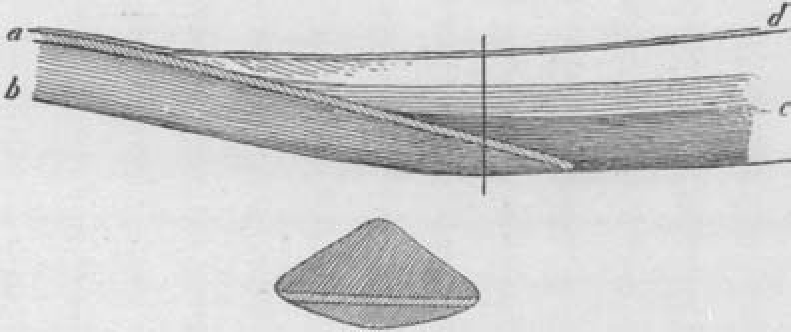
Two varieties of bow are used in northeastern Asia. One is the “double-wooded bow,” so called by the Russians. It was composed of two pieces of wood, mostly birch and larch, which were glued together. The outer piece (Fig. 68, a) was much thinner than the inner one (Fig. 68, b). The horns often consisted of separate pieces, and were spliced to the body of the bow (Fig. 68, c). The back of the bow was almost always covered with a thin layer of sinew pasted over with fish-glue (Fig. 68, d). Over that was glued a covering of birch-bark, often wound around the body of the bow in a spiral, to increase its resisting power. This bow was used by the Yukaghir, the Lamut, the Koryak, the Yakut, and, in fact, by all the tribes of northeastern Asia, besides the Chukchee and the Eskimo. The Reindeer Chukchee bought bows of this shape from their neighbors, and had quite a number of them in actual use.

The other variety of bow (Fig. 69) was made of a single piece of wood, mostly larch, but occasionally birch or pine, found among the driftwood on the coast. It was strengthened by a wrapping of birch-bark or sinew, and in addition had a plaited-sinew backing. Occasionally even a “double-wooded” bow would have a sinew backing, not only among the Chukchee, but also among the Yukaghir and the Lamut.
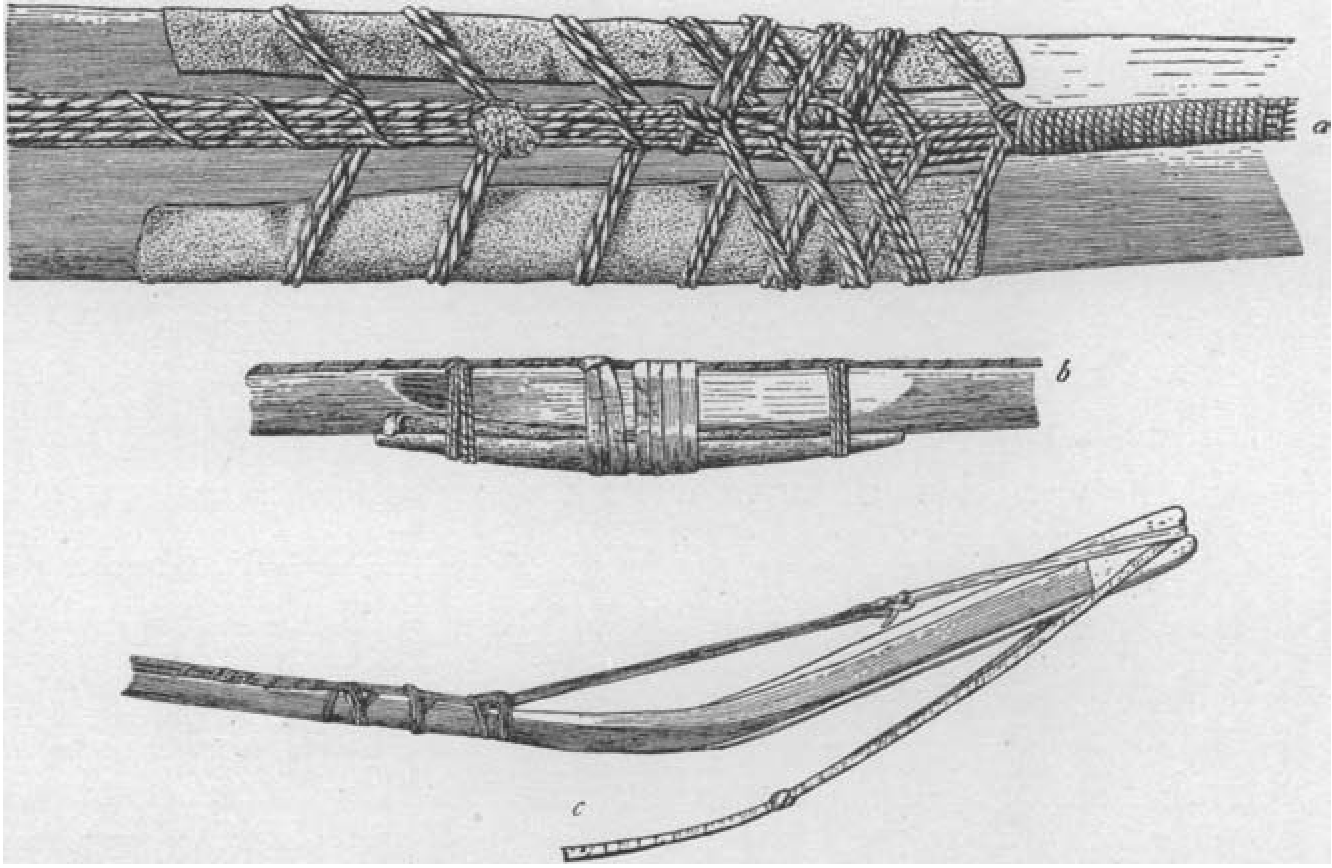
The lashing (Fig. 70, a) was of the western type, so called by John Murdoch, with a single sinew cable secured about the body of the bow in half-hitches, with extra strengthening on both bends. This type of lashing has been described by John Murdoch as characteristic of the bow of northeastern Siberia, with the occasional mixture of the so-called Arctic type.¹ Small ivory levers (Fig. 71, a) were used in twisting up the cords of sinew on the back of the bow, making them into a cable. In shape they are identical with those used by the American Eskimo and represented by Nelson² and[153]🗗uncollated Murdoch.¹ Like the latter, they were used in sets of two. The set in the collection was bought, together with one of the quivers. It has both levers tied together with a cord of sinew passing through holes at their middle points. Sometimes the belly of the bow was strengthened with a smooth flat piece of whalebone fastened to it with glue, or with an extra piece of wood lashed to the middle, beneath the grip (Fig. 70, b). This kind of bow was in use among the Chukchee and the Asiatic Eskimo.
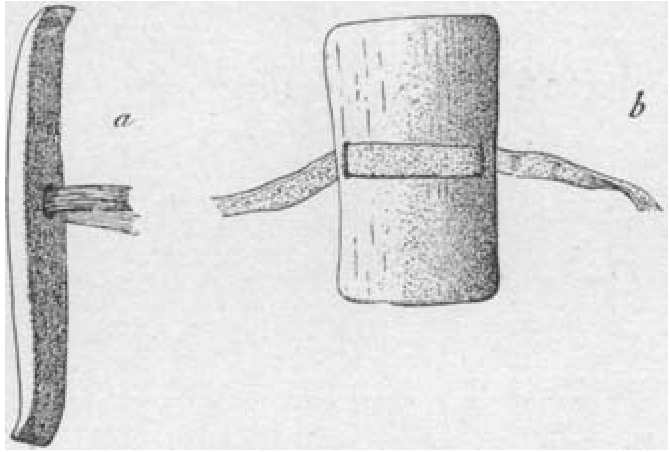
The bows of the Gilyak, as may be seen from specimens in the collections of this Museum, are strengthened with whalebone on the inside in much the same way as the Chukchee bow. They have a layer of sinew glued to the back, and over that a birch-bark covering, but no backing of plaited sinew. According to Schrenck, the finer specimens of Gilyak bows were strengthened with whalebone on the back and with elk-hide on the belly.²
The two forms of bow were alike in shape: they had recurved ends, a body flat on the outside, and flat or rounded on the inside. The grip was in the middle, and narrower than the arms. The bow became thicker and narrower towards the ends, which were almost triangular in cross-section. When unstrung, bows of both types assume a peculiar position, with the belly slightly curved, but with horns so much turned back that sometimes the bows look as if curved outwards.
The string was made of plaited sinew or of thong. The notches for the reception of the string were cut either on the back of the bow or across the[154]🗗uncollated ends of the horns (Figs. 69, 70 c). In bows without separate horns, each end was often tipped with a long piece of bone (Fig. 70, e) as a protection against the impact of the string. Small wooden supports (Fig. 69, a) were frequently fastened to the horns to make the string stand off. Some of the Chinese bows — as, for instance, those in the collections recently sent to the Museum by Dr. Berthold Laufer — have many details in common with the Chukchee bow. They are strengthened on the belly with a thin strip of hard black wood, have supports for the string in exactly the same places; their nocks are tipped with iron; and their whole appearance resembles that of the Chukchee bow.
Both varieties of bow were strong, and sometimes could be strung only with the help of the feet, as mentioned in many traditions.
One of the Chukchee bows brought by the expedition from the mouth of the Anadyr is 160 cm. long, and another measures 155 cm.¹ Both are similar in shape, but the former (Fig. 69) is made of a single piece of wood, strengthened from inside with a piece of whalebone reaching to the nocks and neatly fitted in. The back of this bow has the usual layer of sinew glued on, and over that a layer of birch-bark. This is overlaid with a backing of plaited sinew. The cable of sinew is fastened to the body of the bow with a few half-hitches, then it is firmly lashed to the bends and its ends fastened around the horns, not reaching the nocks by two inches. The string is of sinew, and the notches are on the horns of the bow.
The other bow is made of two pieces of wood glued together, as described before. The sinew layer is absent, but it has the usual backing of plaited sinew. The cable of sinew is fastened to the bow by a method similar to that used in the first specimen; but the cable, after being lashed to the bends, extends directly to the nocks. A loop of thong is slung around each nock, and meets the cable halfway, where they are tied together. The bow is covered with bark that is glued on, and adorned on the back with black cross-lines similar in description to those found by Dr. Adler² on a Chuvantzy bow from the Middle Anadyr. The string is of thong. Notches are cut across the ends of the bow, which are tipped with bone (Fig. 70, c). One horn was broken, and afterwards spliced and secured with bone wedges and a strong sinew lashing.
Bows were also made of one piece of wood, without backing or covering, and shaped in a single curve. Such bows occur among the Lamut or Yukaghir, but they were used only temporarily, in the absence of weapons of better make; or they may be degenerate forms of the better type that developed after the introduction of fire-arms.
[155]🗗uncollatedAmong the Chukchee, however, plain bows without recurving ends have always been in use side by side with those of better workmanship. The plain bows consisted of a single piece of wood, without elastic cover, but they were supplied with a heavy sinew backing of the combined Arctic and western types of John Murdoch. I found such bows among the Reindeer Chukchee of the Kolyma country.
The bow is held vertically, and the arrow is on its left. The so-called Mediterranean arrow-release was used, in which the first two fingers were employed for drawing the string, and the arrow was held between them. Arrows were often flattened around the nock, to make them better adapted to the position between the fingers.
The secondary release was also in use, at least among the Reindeer Chukchee, and perhaps also the Mongolian release, if we may judge from the occurrence of the thumb-guard. Specimens of thumb-guards were found among the Chukchee (Fig. 71, b), though the owners could not exactly tell their use. Perhaps they were used similarly to those of the Mongolian archers.
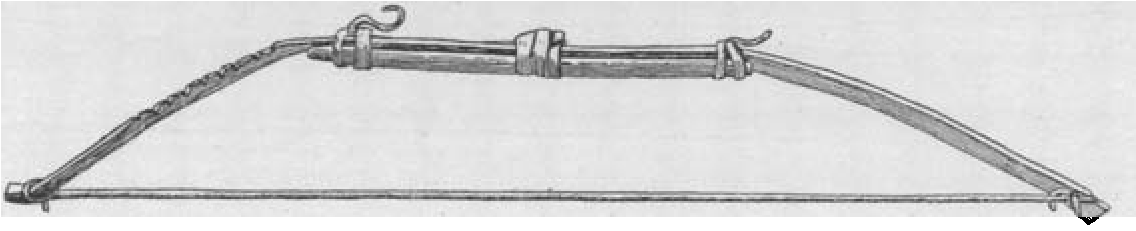
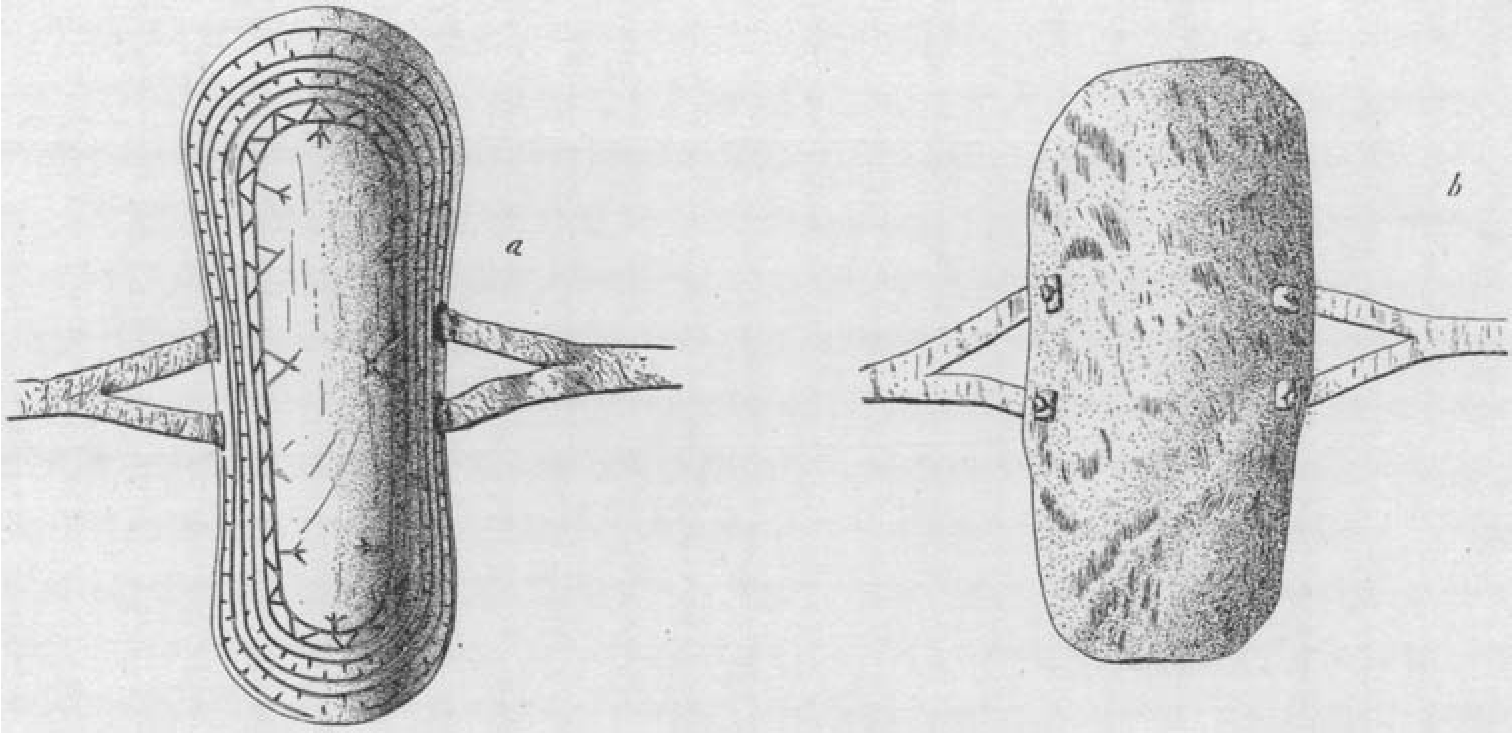
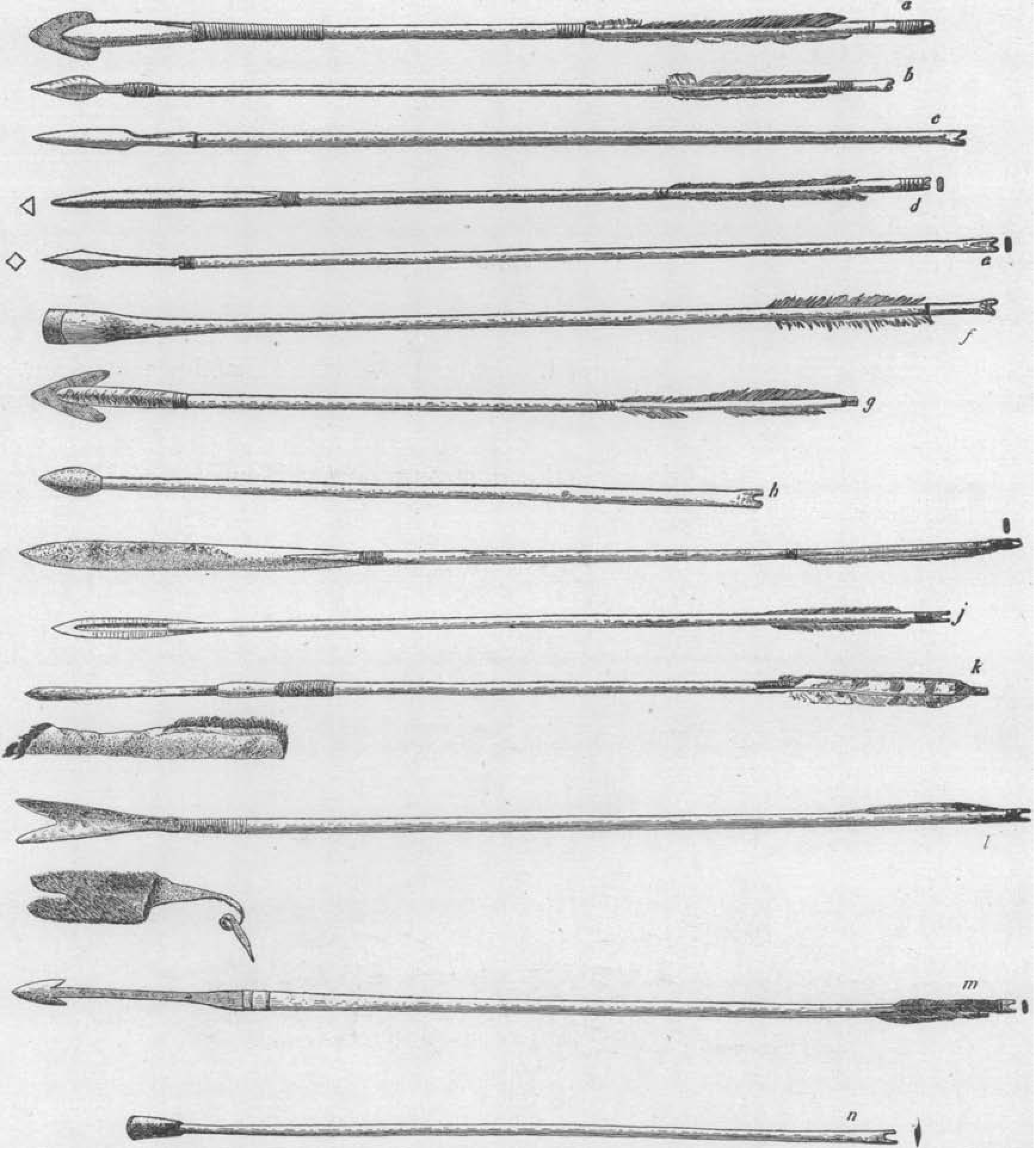
Tradition speaks also of bows that were made wholly of whalebone, although this material could not make a strong bow. However, children still use small bows made entirely of whalebone (Fig. 72). Wrist-guards (Fig. 73) made of ivory or of strong leather served for protecting the hands from the rebounding string. In recent times arrow-points were made of iron, bone, ivory, wood, and[156]🗗uncollated of all these materials combined (Fig. 74). They were fastened to the shaft in various ways, — wedged in and occasionally wrapped with sinew, or inserted in a hole in the tip of the shaft. I was told that some were simply slanted and tied to the shaft, though among the specimens obtained not a single splice of this kind is found. However, this method of splicing is well known in northeastern Siberia, and is used, for instance, in lashing a man’s crooked[157]🗗uncollated knife to its slender handle, and especially in joining two pieces of broken stick, as in canes, arrow-shafts, sledge-rails, etc.
Many of the points had fur sheaths to protect the sharpened edges. Those with heavy blunt heads were intended to stun birds and small animals. The ends of the shafts were often tipped with bone or wrapped with sinew to prevent the nock from splitting. Arrows were generally feathered, and the feathers were either glued on along their whole length, or only their tips were caught in a slit in the rearshaft, and the bases were tied to the nocks with sinew, while the middle remained free. There were arrows with one, two, or three feathers (Fig. 75). The length of the arrows was from 60 to 85 cm.¹
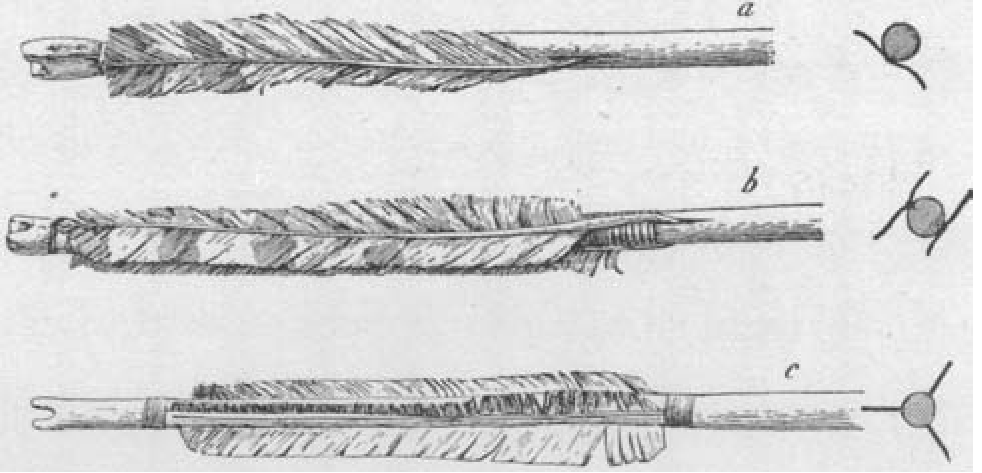
I could find no indications whatever that poisoning of arrows was known to any of the tribes of northeastern Asia, though Steller and Krasheninnikoff mention it as existing among the Kamchadal. The latter, they say, smeared their arrow-points with the juice of some kind of Aconita, numerous species of which are found in Kamchatka.
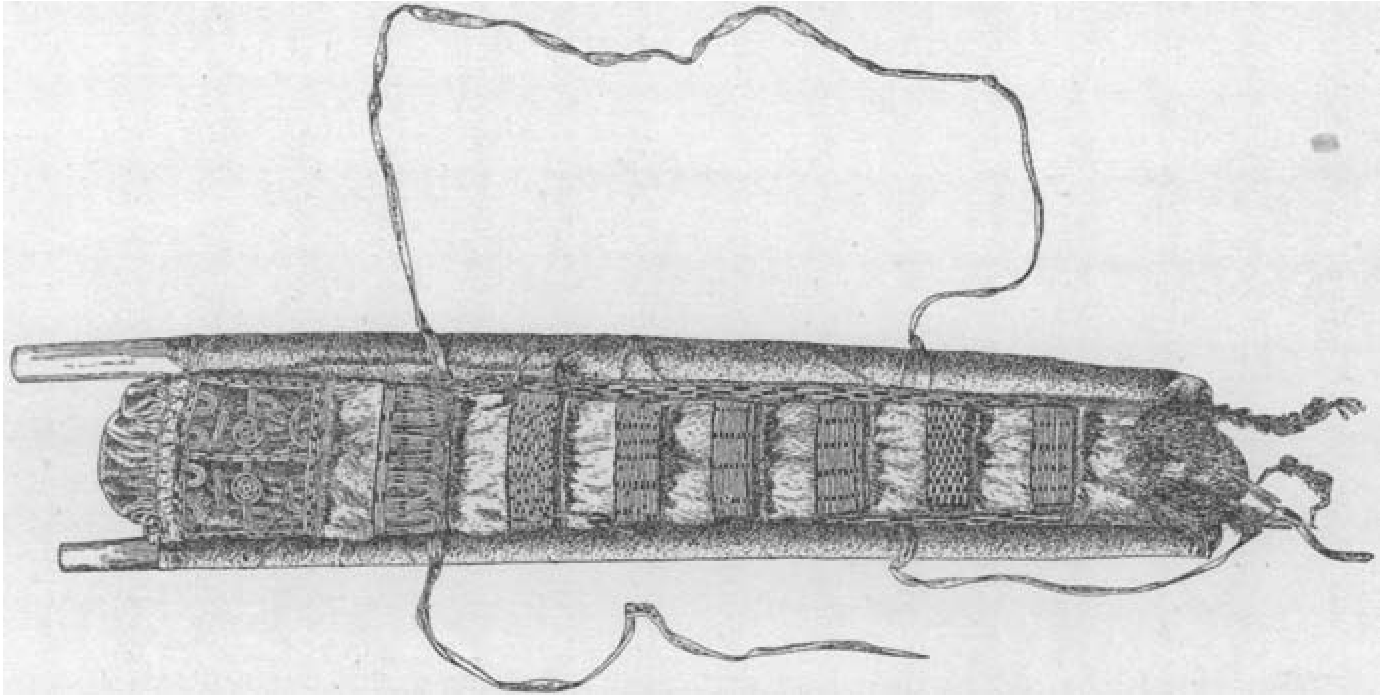
Arrows were usually put into quivers. These were rectangular in shape, and embroidered on the outer side. They were carried on the back, supported by shoulder-straps, like a knapsack (Fig. 76; see also Plate XXII). Sometimes, to protect the quiver from rain, an extra covering was used, which was frequently also embroidered. A covering for the bow was employed for the same purpose.
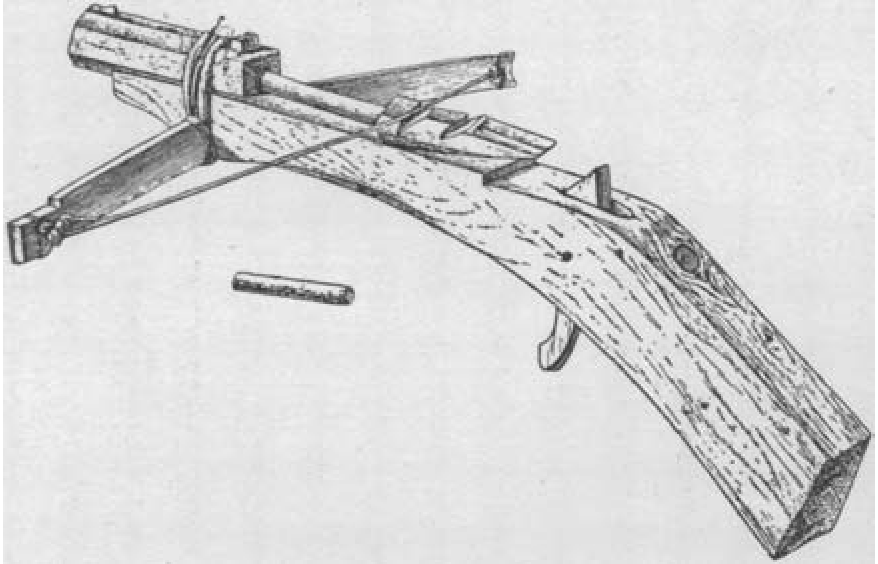
At present bow and arrows are used everywhere by children in playing. Besides the usual bow, crossbows are much used, with some variations in the[158]🗗uncollated shape of the trigger, etc. (Fig. 77). Sticks, small round stones, and small arrows are shot from them. The crossbow was probably copied from the Russians, since the Cossacks were armed partly with bows and arbalets as late as the forties of the nineteenth century. Whips of peculiar shape, for throwing light darts (Fig. 78), are also used by children.
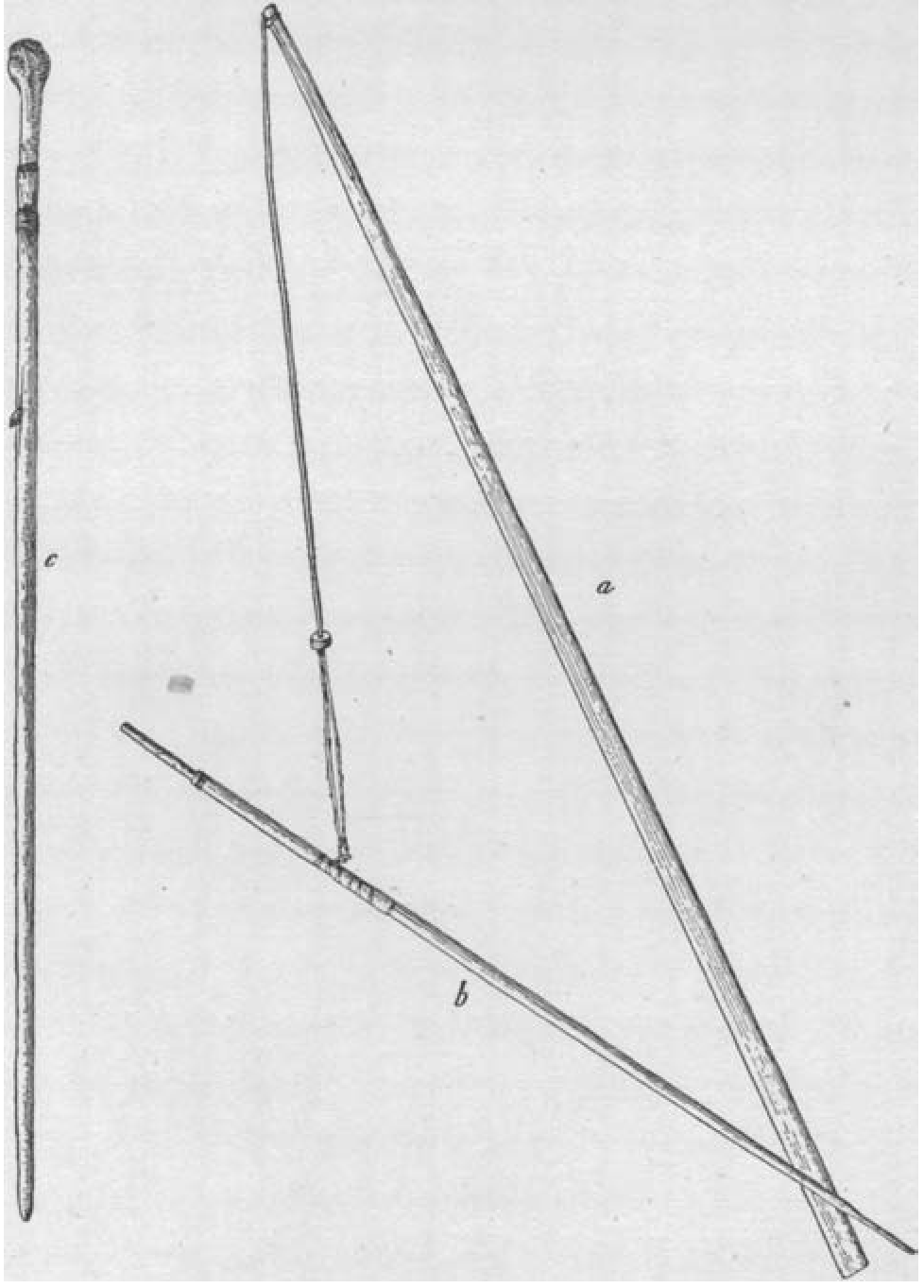
FIRE-ARMS, LANCES, AND OTHER WEAPONS. — Fire-arms of every possible description are used by the Chukchee. From the Russians they receive, even at the present time, clumsy firelocks (Fig. 79), while the Americans bring percussion-guns and breach-loaders. All fire-arms are furnished with supports¹ and gun-cases. A piece of cloth is tied around the lock to keep off moisture. To the firelock belong two flasks, — one for powder, and one for bullets (Fig. 80, a), — a powder-measure, a ramrod (the latter two often combined as in Fig. 80, b), and sometimes a small double tube (Fig. 80, c) with a partition in the middle, each part closed at the end with a small plug, and containing a charge ready for use. The plugs are held in place by a string, which passes through the middle of the tube, and is slung around the belt of the hunter.
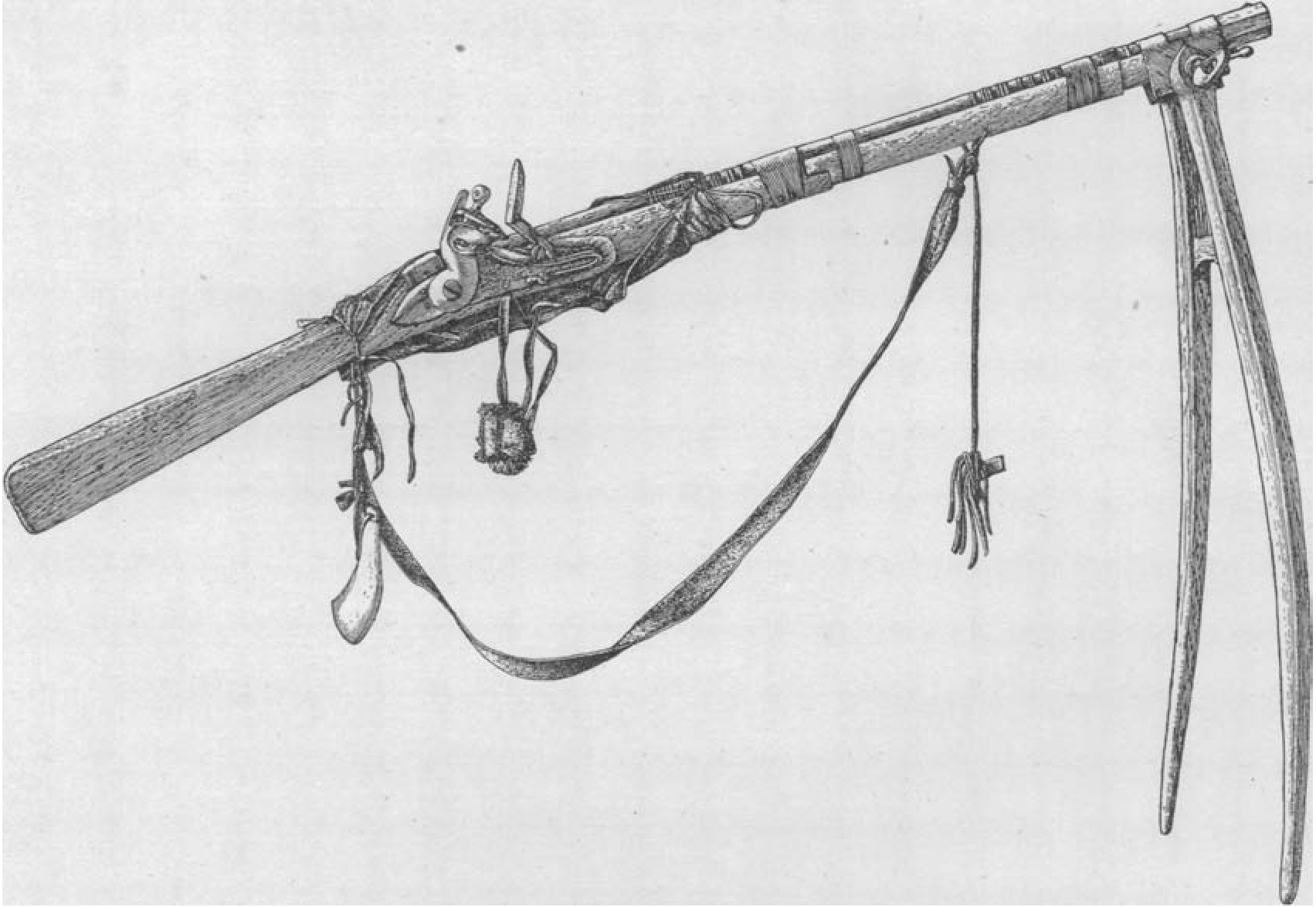
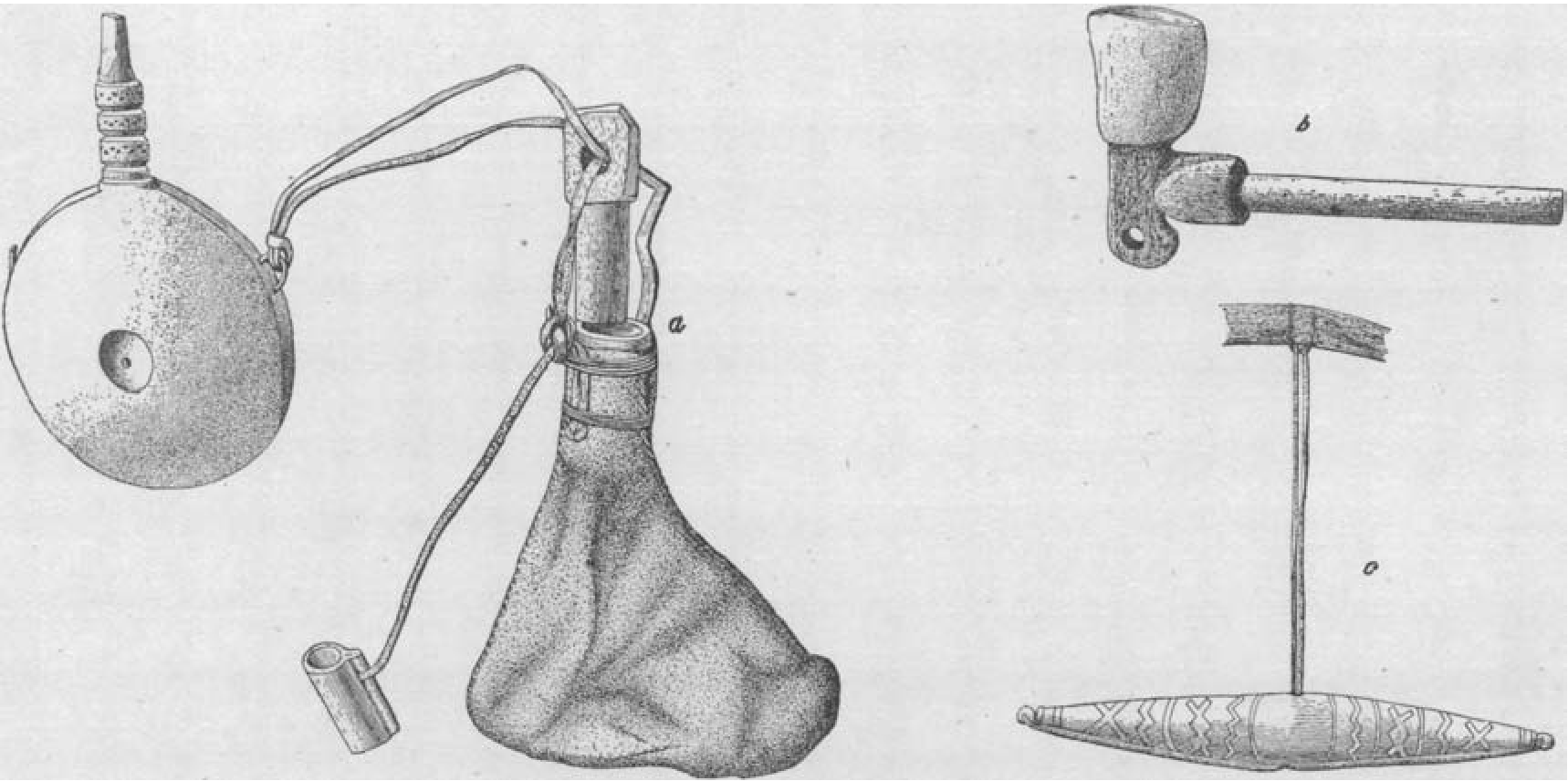
The lance, with the Chukchee, was chiefly a weapon for defence and war; and among the Reindeer people it still partially retains its former importance. Since the arrival of Russians, iron has been utilized for the point, which was formerly made of flint or bone. Iron lance-points are[159]🗗uncollated forged by blacksmiths of all the neighboring tribes, and sold to the Reindeer people, though recently but few new lances have been sold, the people being contented with the old ones.
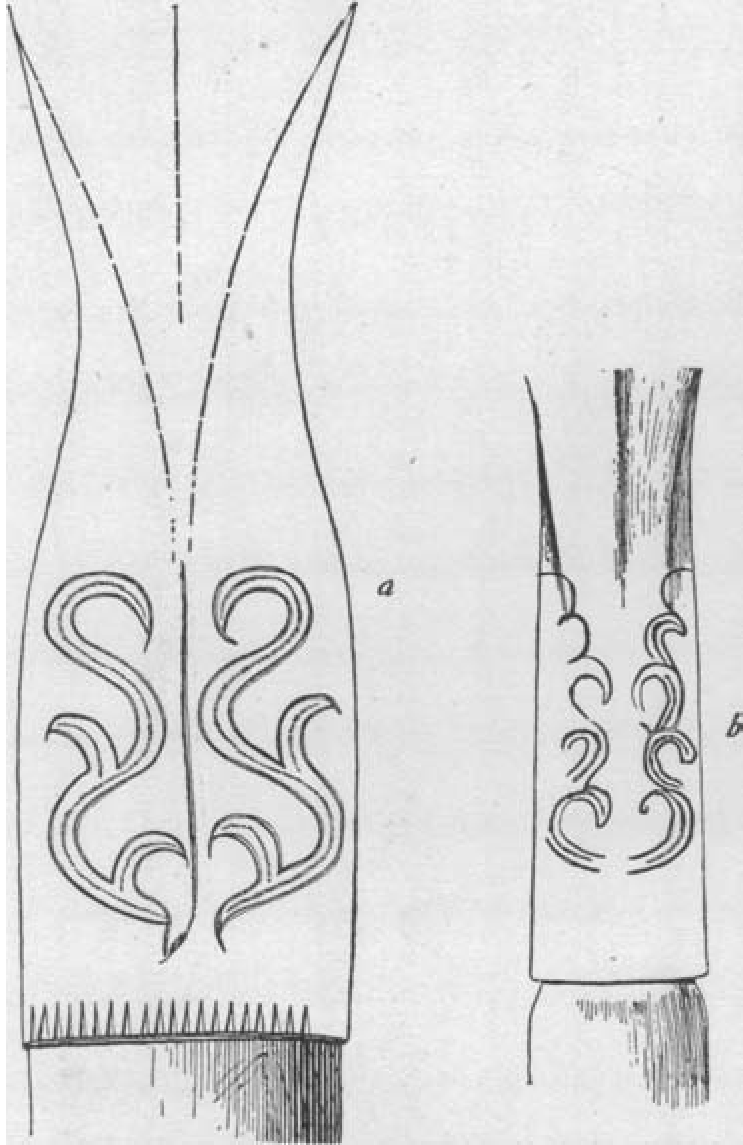

The points of lances, and sometimes the best arrows, are often adorned[160]🗗uncollated with various designs (Fig. 81), and inlaid with brass and copper, but not with gold, as Nordenskiöld presumes.¹ The pattern on the lance found by him in a burial-place near Pitlekaj is quite common on the Kolyma, and is probably inlaid in brass. On the Anadyr side, brass inlays are rare, and engraving is done with less care, especially at the present time.
The style of the designs is common to all tribes of northeastern Asia. It is also similar to that in use among the native tribes of the Amur country, as represented by Schrenck² and Laufer.³ The latter style has been largely influenced by Chinese art. In the case of northeastern Siberia, however, it seems possible that the style of ornaments was obtained from Russian sources. The Russian style of ornamentation is also of Asiatic origin, and is similar to the Chinese. We may even find in Russian carvings and embroideries the cock pattern described by Laufer. Therefore it cannot be decided whether the style of this art is due directly to southern influences, or whether it has been introduced indirectly by the Russians.
The point of the lance is often fastened to the shaft with iron or brass wire, which is sometimes coiled around down the middle of the shaft (Fig. 82). Frequently the lower end of the shaft is supplied with a bone knob. A special loop of thong fastened to the latter serves to suspend it from the railing of the sledge when travelling (see Fig. 17, f, p. 90). The lower end of the shaft is supported by a large ring of sheep-horn tied to the sledge. The point is provided with a skin sheath, and often small rings of sheep-horn (Fig. 82, a) are slipped over the point to keep the edge from being blunted.
The lance is hardly used in hunting, except for polar bear; but the herdsman usually takes it along on every trip, especially in the inland country. Even a firelock is not so handy for self-defence, because it takes too long to[161]🗗uncollated handle it in moments of surprise, and it cannot be used at all in rain or with a strong contrary wind.
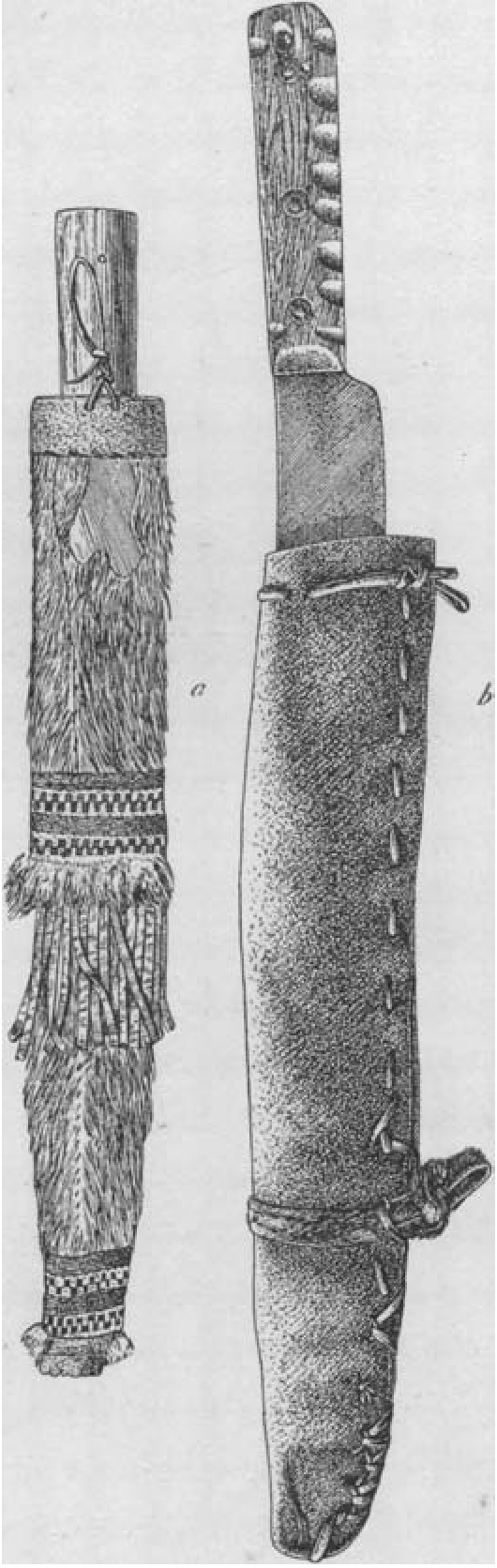
In times of war a fight with lances was a most common occurrence, as may be inferred from episodes in several tales. A certain degree of skill was displayed in such fights, and young men would assiduously practise fighting with the lance as well as running and carrying heavy stones. However, the chief aim of this practice was to increase the strength of the arms. “He practised so long, that the shaft of the lance became, in his hands, as pliable as a strip of skin,” says one tale about a hero. As recently as fifty years ago, fighting with lances, as well as wrestling and racing, were practised for sport in ceremonials. Maydell relates that Amrakˊwurg̣ɪn, already mentioned, was famous for his skill in fighting.
Large knives (rêˊsqᴀn-vaˊlᴇ, “a cutlass”) are carried on the hip, or sometimes on a separate strap slung over the shoulder. Elaborate scabbards are made by the Maritime Chukchee of thin fawn-skin, adorned with fringe (Fig. 83, a). These knives are used chiefly as weapons of defence, in the same way as spears. Some of the older cutlasses were quite long. One obtained from a Maritime Chukchee is two feet long, including the handle (Fig. 83, b).
Slung-shots were used for braining seals, and possibly also as weapons. However, I saw only one specimen, which was collected by Mr. Gondatti, and now belongs to the Museum of Anthropology and Ethnography of the Imperial Academy of Sciences, St. Petersburg, Russia. It looks ancient, and is quite similar to that of the American Eskimo, as represented by Murdoch¹ and Nelson.²
Regarding its use as a weapon, my Chukchee informants told me that in former times warriors would fasten a slung-shot around the waist like a belt, the stone serving as a button and being always ready for use. A belt of this kind, with a small pebble in place of a clasp, is sometimes improvised by careless persons; but of course the stone used for this is very small, and unfit to serve as a weapon.
ARMOR. — Armor was made of walrus ivory, ground-seal hide, and iron. Of ivory armor, an incomplete specimen is in the collections of the Geographical Society at St. Petersburg.[162]🗗uncollated Another was obtained by Nordenskiöld. Judging from the picture in his book, it is also an incomplete one, because it has only three rows of plates and no wooden head-protector. Two specimens are in the Museum of Ethnography and History, Helsingfors, Finnland, of which one is in fairly good condition, judging from the figure in Ratzel’s paper on the subject.¹
A number of specimens of ivory armor, chiefly from the American side of Bering Sea, are in the possession of the United States National Museum in Washington, but all of these are incomplete. Those represented in the valuable paper by Walter Hough on primitive American armor come respectively from Cape Prince of Wales and Diomede Island.² Apparently there is no difference between them and the specimens brought from the Asiatic shore. Mr. Hough mentions, besides, four armor-plates of fossil ivory from Cape Wañqarêˊman, on the Arctic shore; also nine iron plates found together with the ivory armor in a bog at Cape Prince of Wales. According to a communication of Capt. E. P. Herendeen, quoted by Mr. Hough,³ the Chukchee of Plover Bay, i. e., probably the Aiˊwan Eskimo, wore a cuirass made of long strips of baleen; but from Capt. Herendeen’s words it is not clear whether he saw this kind of armor or only repeats the words of the natives. At the present time no trace of armor made of whalebone can be found on the spot.
One specimen of armor made of hide is represented in my description of the Chukchee collection of the Museum of Anthropology, St. Petersburg.⁴ Another one, also from Siberia and quite similar in shape, is represented on Plate 4 of Hough’s paper.
This kind of armor is evidently an imitation in skin of plate armor. It is made of horizontal bands of seal-skin instead of rows of ivory plates, the rings telescoping together like the hoops of a farthingale when the armor is not in use. Mr. Hough compares this type of armor to the banded mail of the middle ages.
A stiff hide head-protector is fastened above the armor. It evidently served to protect the neck from behind and from both sides. Mr. Hough compares it to the neck-fender of the Kingsmill Island⁵ armor.
The specimen of hide armor now in St. Petersburg is made of ground-seal skin. According to Mr. Hough, the armor in Washington is made of sea-lion hide; but I should think rather that it also is made of ground-seal skin, because sea-lions are scarce near the shores of the Chukchee Peninsula.
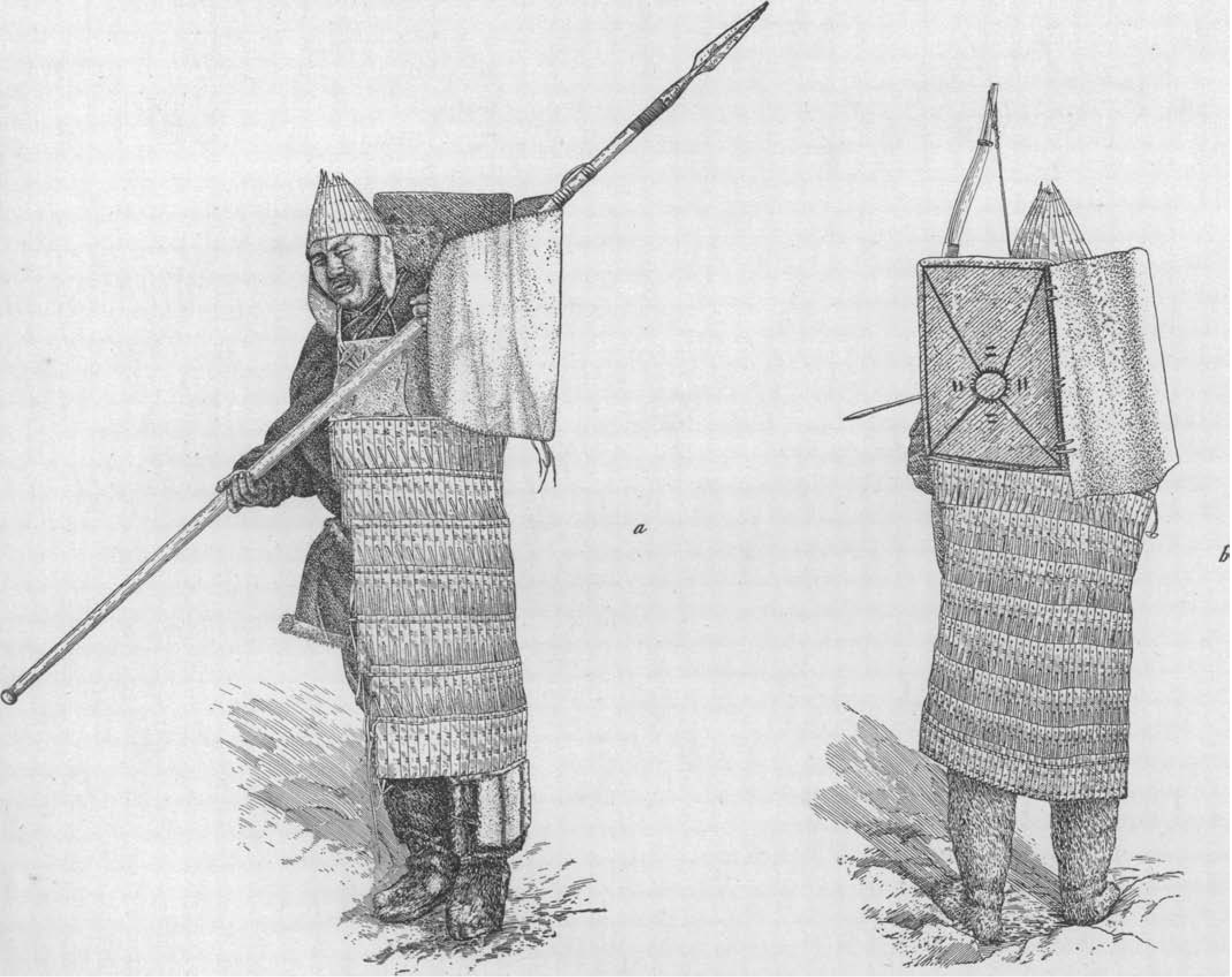
As stated before,⁶ iron armor has of late been very common among the Chukchee as well as among the Koryak. The expedition obtained two sets of armor from the Chukchee (Fig. 84, a) and three from the Koryak (Fig. 84, b),[163]🗗uncollated also parts and separate plates of several other sets of armor, besides the armor of Japanese make¹ mentioned before (Fig. 85). In the region of the Palpal Mountains and on the upper course of the Big River, which is a southern tributary of the Anadyr, many of the Reindeer Koryak and Chukchee still carefully keep such armor as heirlooms from their ancestors, and do not want to part with it at any price. One rich reindeer-breeder by the name of Kaˊka gave as a reason, that he might have need of it in strife with some of his neighbors.
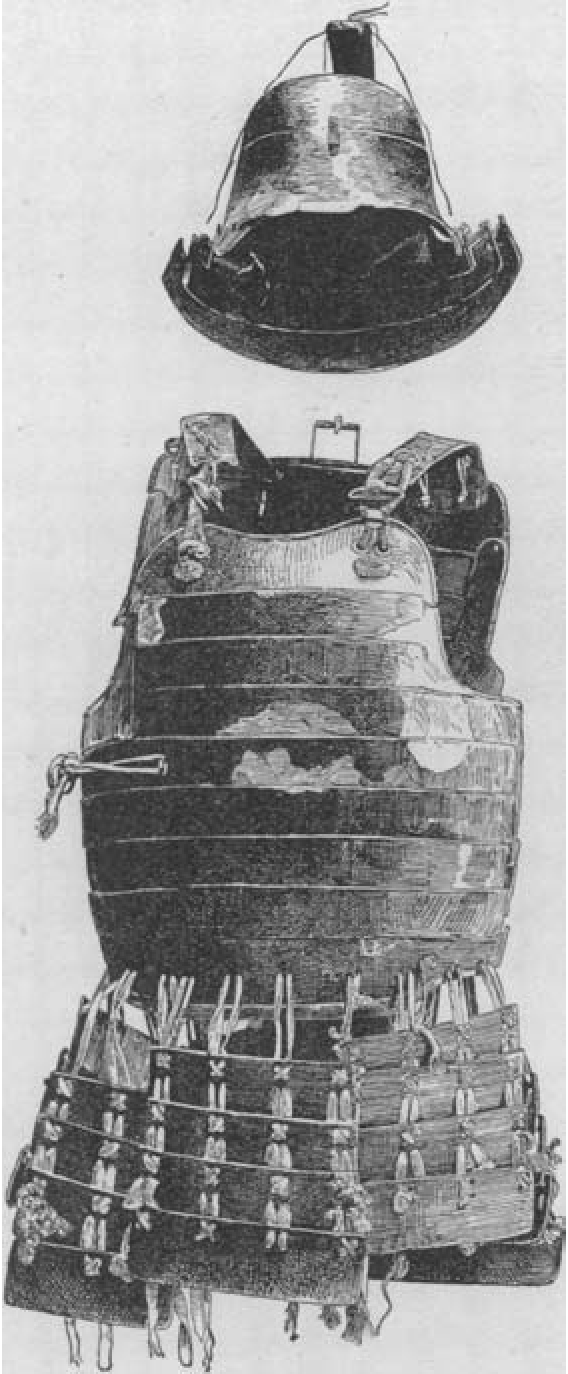
The specimens brought back, as well as others seen in the possession of the natives, consist of several rows of narrow iron plates, laced together with strips of leather and easily folded. The shape of the plates, and the manner[164]🗗uncollated of connecting them, are quite similar to those observed on the curious remnants of Gilyak armor collected by Schrenck¹ (Fig. 86, a). The number of rows ranges from six to ten. Sometimes the plates have rounded edges, which are adorned with small notches (Fig. 86, b). The measurements of a single plate are, breadth, 2-4 cm.; length, 6-13 cm. The armor opens at one side, and the edges are tied together with narrow strips of leather. Of five suits of armor obtained, three open on the right side, and two on the left side. A square piece of tough hide, or a piece of board covered on both sides with thin curried reindeer-skin, is laced to the front of the armor. It has toggles, which are fastened to the straps passing from the back over the shoulders. These straps support the whole weight of the armor, which, when quite complete, must have weighed not less than fifty pounds.
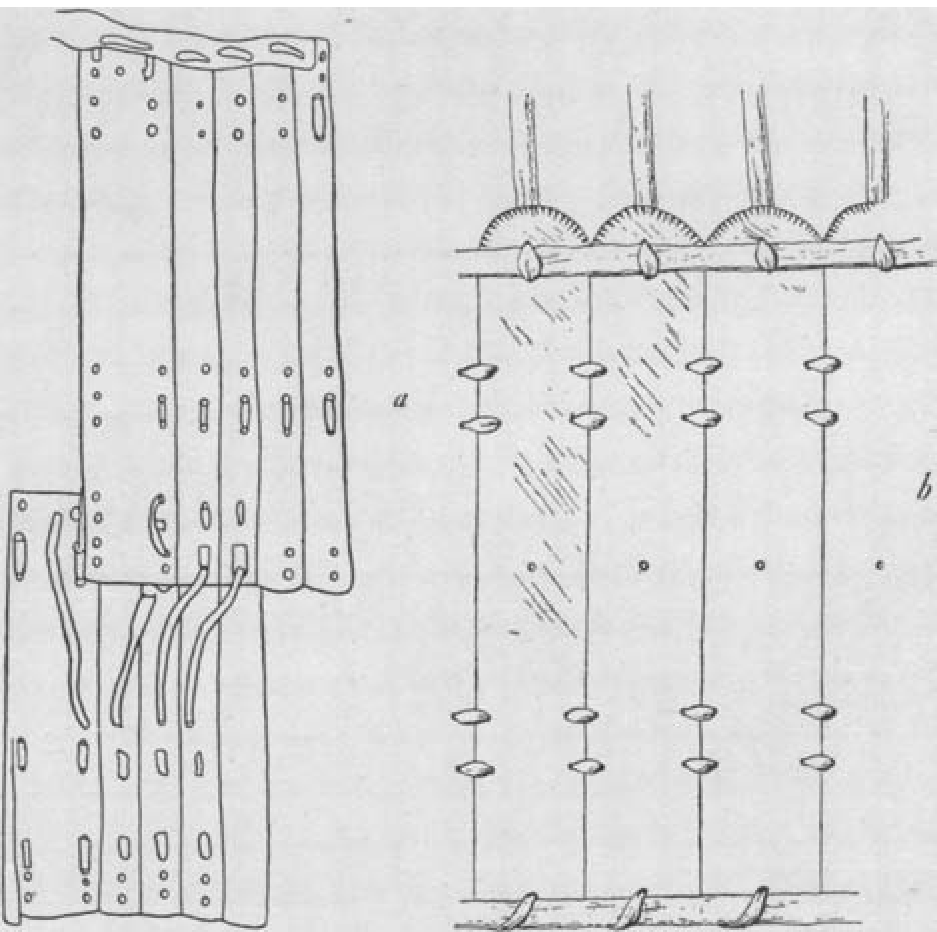
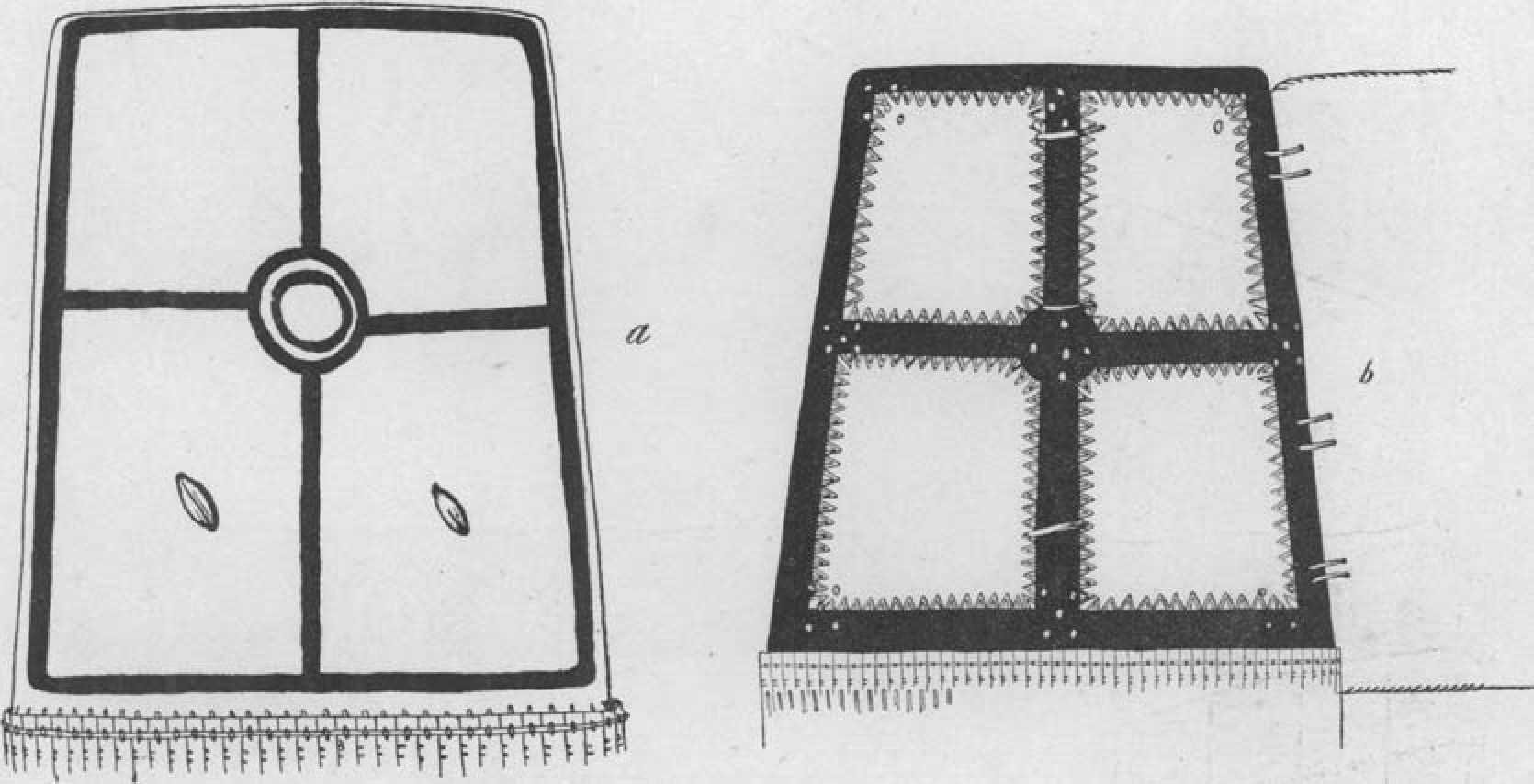
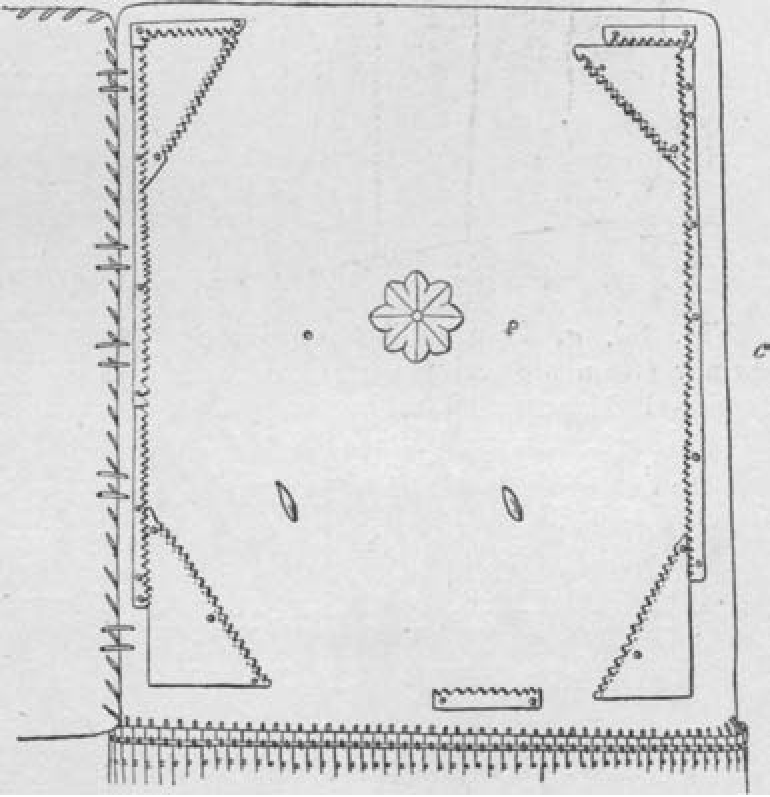
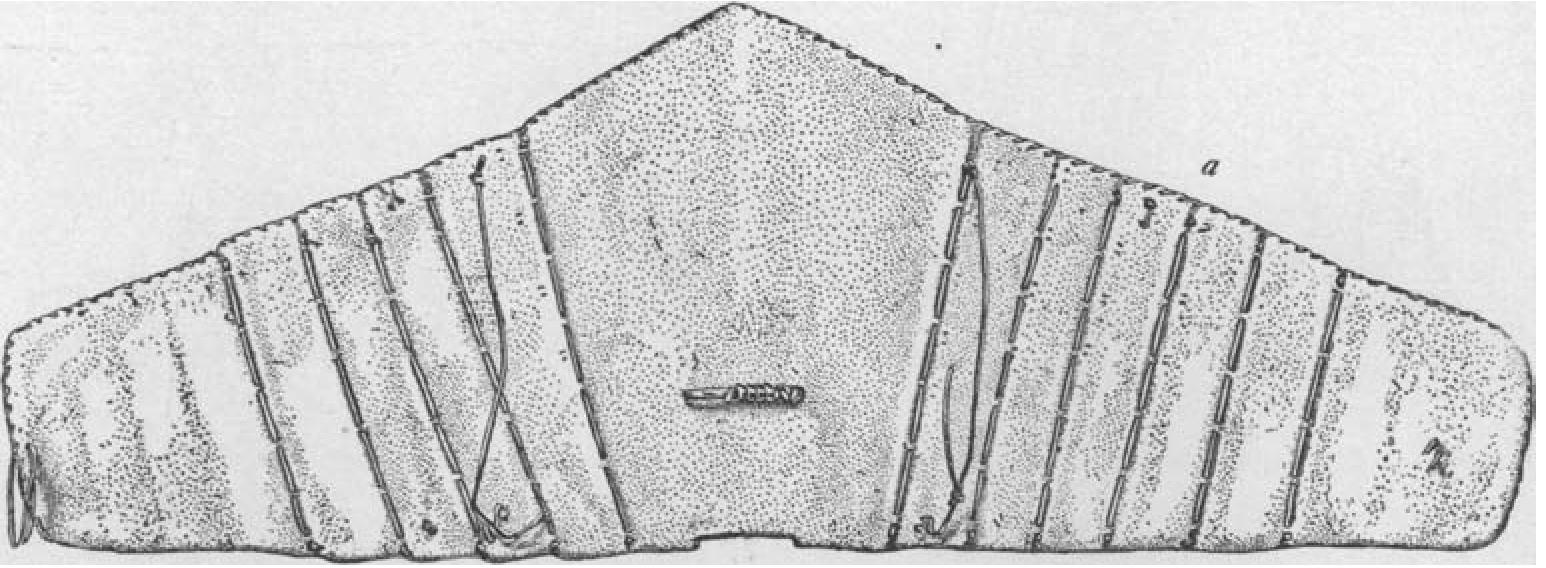
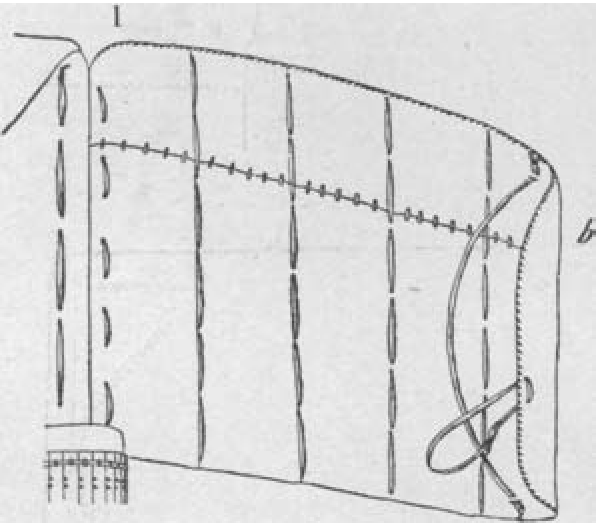
A head-protector made of thin wooden boards, likewise covered on both sides with curried skin, was firmly laced to the upper edge of the armor from behind and from the sides. All the specimens obtained by the expedition or seen in the field have a head-protector consisting of a central piece and one side-wing; but, judging by traces of the fastening, they formerly had two wings, as indeed Mr. Jochelson has been told by his Koryak informants. The whole was arranged in such a way as to protect the head and the neck from the rear and from both sides. The central piece consists of a square board about 1 cm. thick. Its outer surface was decorated with geometrical designs in black and red[165]🗗uncollated (Fig. 87; see also Fig. 84, b), or with pieces of tin fashioned after Russian patterns. The side-wing consists of several narrow parallel boards sewed between two layers of skin, so that the wing is movable. My Chukchee informants, both on the Kolyma and on the Anadyr, insisted that the armor was one-sided, and had only one wing, destined to protect the left hand, like a shield; while the right hand, armed with a spear or a bow, did not need a shield. Mr. Gondatti, according to his verbal communication, was told the same. It is remarkable that, of the four specimens having a wing on the head-protector, two from the Chukchee have it on the left side, and two from the Koryak have it on the right side; but, according to Mr. Jochelson’s informants, the latter were used by left-handed men, who evidently wanted to have their left hand free for the use of the bow or the spear. Thus the Koryak informants seem partly to share the idea that the head-protector was one-sided. The specimen of hide armor in the collection at Washington (Fig. 88, a), however, has two wings of equal size. Both have loops fastened from the inside, which evidently were slung across the arms. Each wing had two loops; but one of those on the left wing has been destroyed, and indistinct traces of its fastening are the only indication of it. When the armor was used, the left arm probably had one of the loops around[166]🗗uncollated the elbow and the other around the wrist, and was somewhat raised for covering the face with the left wing. The right arm probably had one loop near the shoulder and the other near the elbow, thus leaving the lower part free for handling the bow. In trying on the specimen, I found that this method was quite in conformity to the position of the wings. The wings of the head-protectors on the specimens in the collections of this Museum also have loops (Fig. 88, b) fastened from the inside. On the sketch of Mr. W. Alexander made in 1797, representing a Chukchee warrior in hide armor,¹ the head-protector has two wings, but the left hand is concealed within the armor, probably behind the shield-like part, while the right hand is quite free, and the right wing serves only as a neck-fender. The ivory armor of Helsingfors, represented by Ratzel, has only a narrow neck-fender and no wings. Perhaps there were several ways of arranging the head-protector on the armor.
Two photographs taken in the field show the modern ideas of the natives as to the manner of wearing armor. One was taken at Mariinsky Post (see Fig. 84, a) of a man who claimed to have learned the way from his father. The latter died in 1900 at a very old age. Another is that of Kaˊka, whose name was mentioned above, and who claimed to have actual occasion for using his armor (Plate IX, Fig. 2, p. 119.).
Several helmets were brought by the expedition both from the Koryak (Fig. 89, a, b) and from the Chukchee (Fig. 89, c). That represented in Fig. 89, c, is quite similar in shape to the helmet of the Gilyak (Fig. 90, a), although it has two iron ear-flaps hanging down on both sides, and no neck-fender. Another helmet of the Chukchee, in the collections of the Academy[167]🗗uncollated of Sciences at St. Petersburg (Fig. 90, b), has a neck-fender quite similar to the Gilyak specimen.
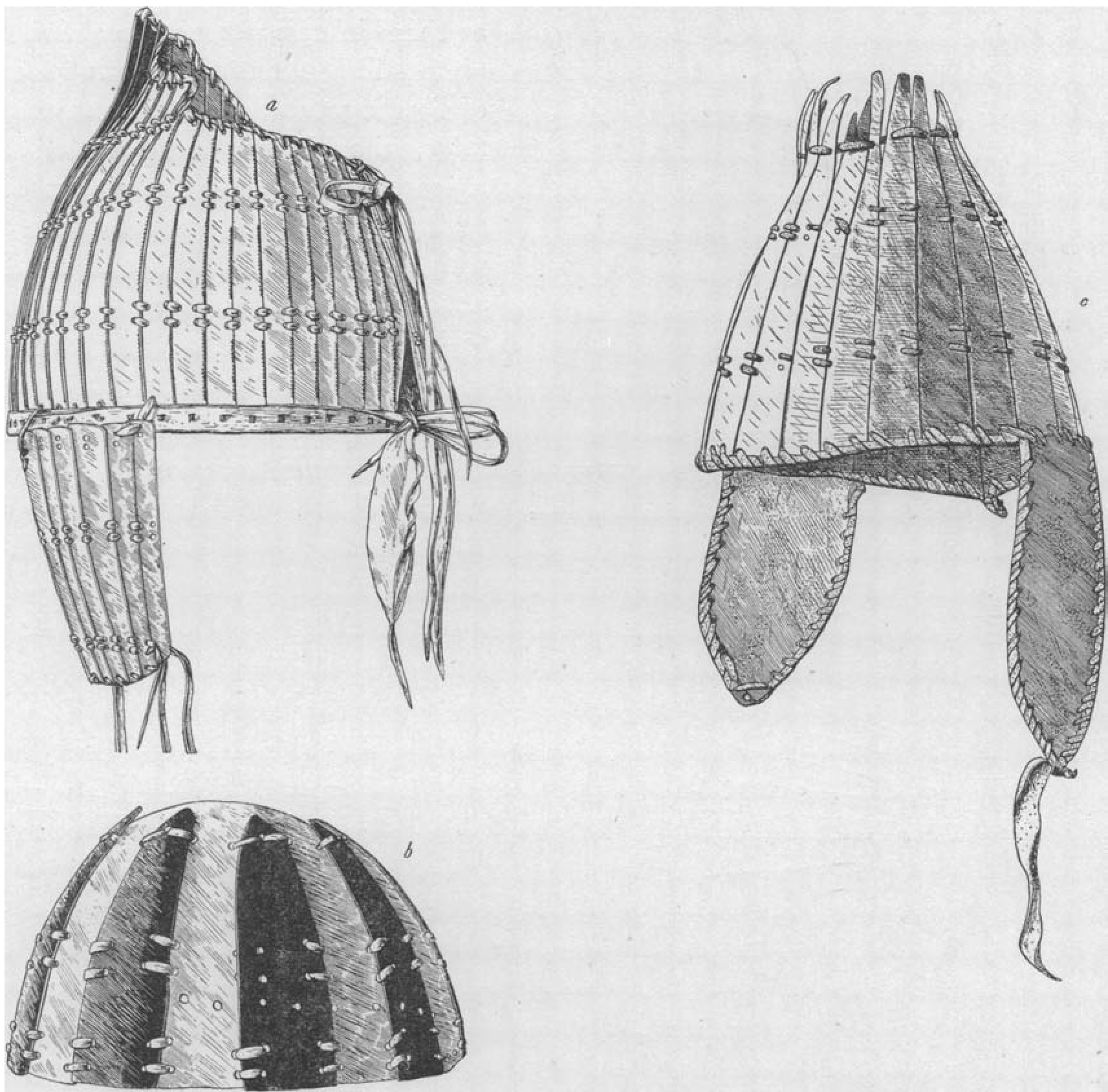
Greaves and arm-guards were also used. They were made of hide and of iron. The expedition obtained two iron arm-guards (Fig. 91, a, b) bought with one of the suits of armor, and evidently used with it for protecting both arms. They are quite Japanese in pattern, with special hand-protectors which were held in place by small loops slung over the thumb and little finger. A greave made of thick skin (Fig. 91, d) was obtained with another suit of armor. My informants insisted that usually only the left hand and the left leg were protected by these guards.
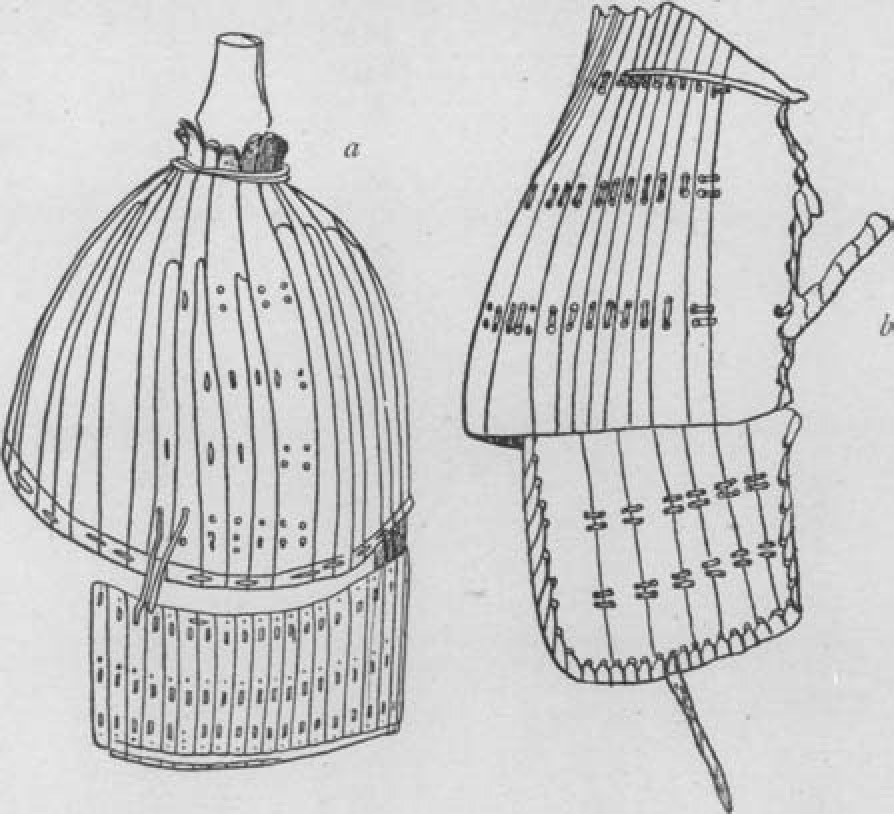
The lance was used, together with the armor, as a weapon of defence.[168]🗗uncollated Thrusts were made over the head-protector, as shown in Fig. 84, a. For attacks on the opponent the bow was used. On some of the head-protectors the marks of arrows shot at them in ceremonial or real fights may still be traced. Both kinds of fighting are described in several tales, though the combatants are represented as displaying more agility than would seem consistent with the armor. In other tales the action of the combatants is said to be slow and wary. They cover their faces with the head-protector and discharge one arrow after another, which certainly agrees more nearly with the probable facts.