IXManufactures
WORK IN STONE. — Stone tools and weapons are no longer used in northeastern Asia by the men. The more conservative women have preserved some of the implements, and even sought to increase their importance by connecting them with religious ceremonies. This was the case with the kitchen stone hammer among the Chukchee.
In the remotest parts of the country, — for example, among the Kerek, — stone adzes and knives were discarded within the remembrance of the living generation, not more than fifteen or twenty years ago, according to statements of older people made to me in villages of that tribe.
Among the Chukchee and the Asiatic Eskimo stone implements of this class disappeared more than half a century ago. Their character can be ascertained only from specimens found in old houses and on burial-places.
By comparing these implements with those found in other parts of northeastern Asia, it seems that the harpoon-heads, spears, and arrows of the whole region were usually made of flint, slate, obsidian, and sometimes of quartz. The pieces of obsidian occasionally found in the country at the present time are regarded as lightning arrows and balls which from time to time drop from the sky. The arrow-points made of obsidian are generally ruder than those made of flint. By carefully chipping off thin pieces the natives seem to have often made the flint arrow-heads with quite symmetrical outlines and sharp edges.
The slate implements were flat, and had their edges rubbed down with another stone. To assist in fastening these to the shaft, the Chukchee made holes in the slate, using a slender drill, and working alternately on opposite sides until the blade was pierced. One of the slate specimens in the Museum has a circular mark on each side, showing how they had started to drill holes.
The slate blades were rather weak and ineffectual. I was told by the older people that a fresh blade was usually placed in the whaling-harpoon after each blow, on account of the old one being spoiled. Slate was more appropriate for knives, and fragments of these are found in almost every old “jaw-bone” house. Regarding stone implements used at present in woman’s work, see p. 217.
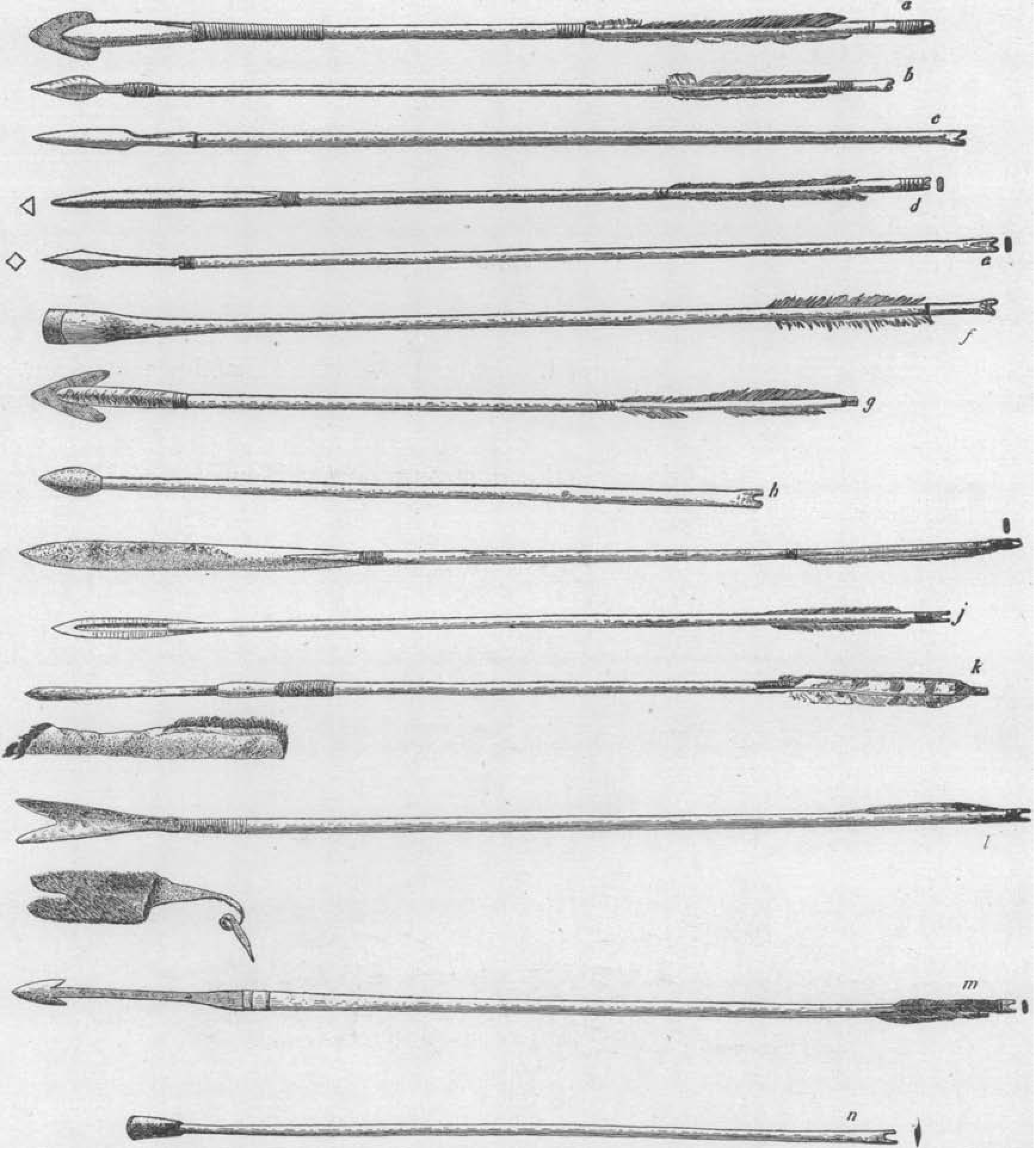
Bone, ivory, and antler were used also for all kinds of weapons, such as harpoons, arrows, etc. After the appearance of iron, they held their ground much better than the stone tools. Of the specimens found in old Chukchee and Eskimo houses, only a few bear traces of having been made with stone tools. Most of them were fashioned with iron knives. Even now the bodies[210]🗗uncollated of harpoon-points are cut out of bone almost exclusively. The same is true of the butts of harpoons which are used for breaking ice. Bone arrow-heads are also common in those parts of the country where the bow is still used.
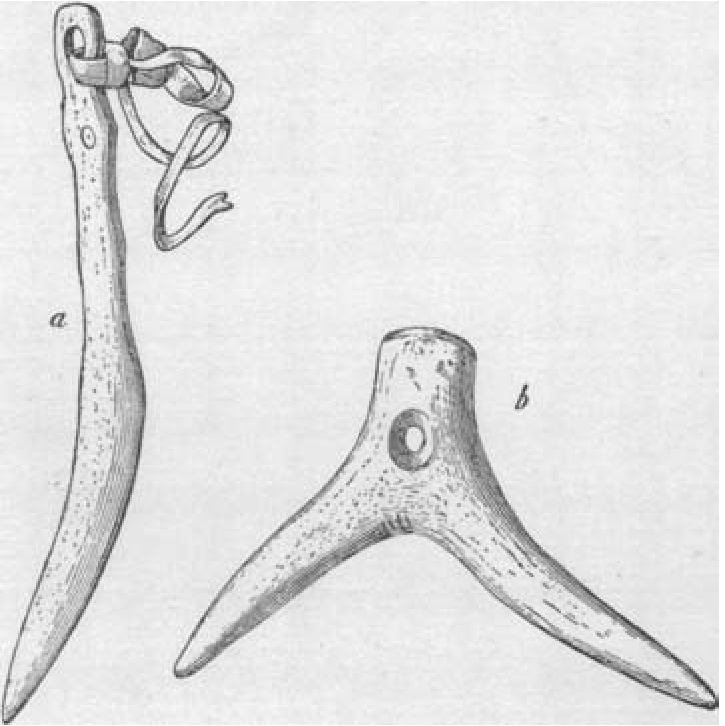
A bone instrument still in universal use is the marline-spike (Fig. 126). It has several variations in shape. Some show two-pointed branches¹ (Fig. 126, b); others, a small spatula at the rear end.²
Since iron nails are not used, and everything about the sledges, boats, etc., is fastened by lashing and tying with thong, the marline-spike is a very important tool, and is required whenever knots are to be untied.
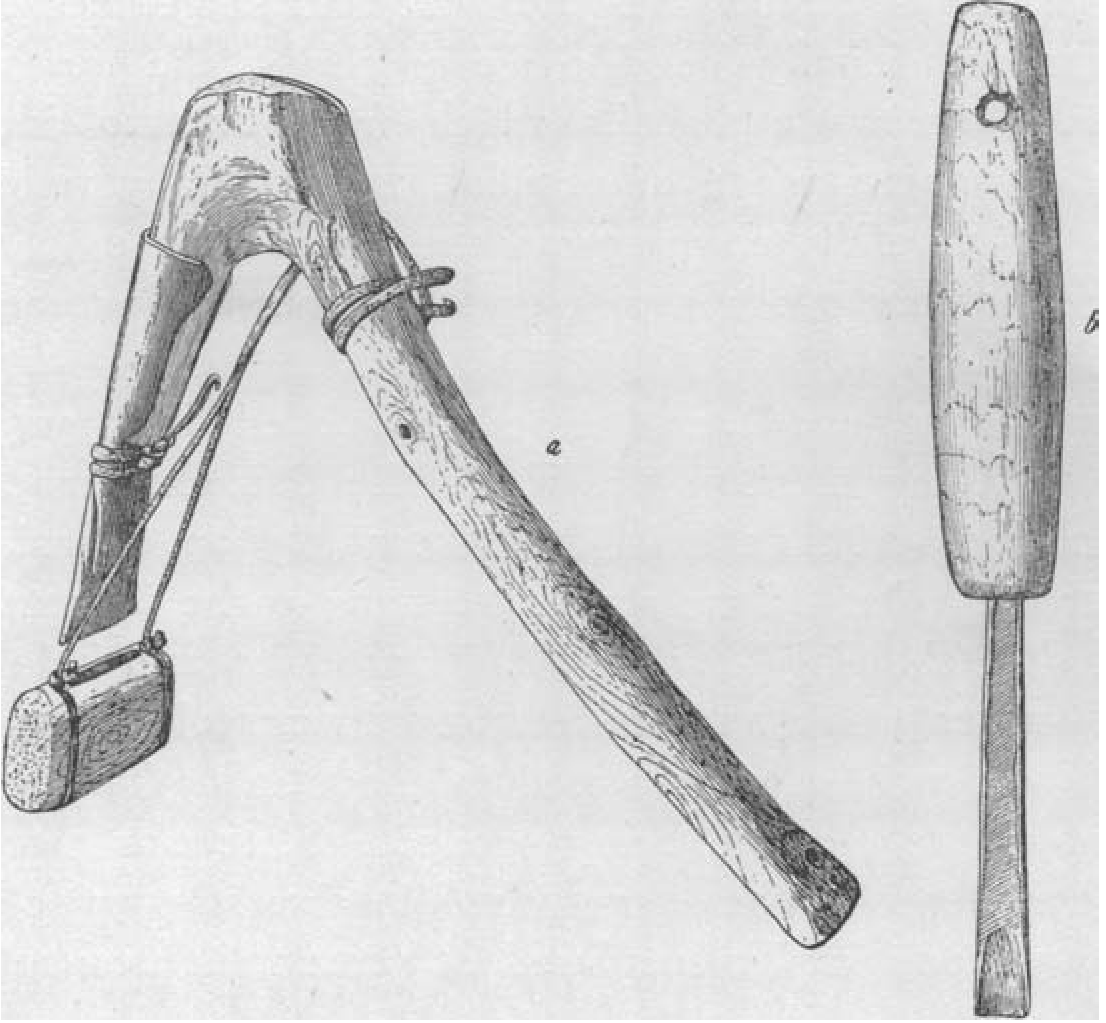
WORK IN WOOD. — Of the instruments now used for working wood, the iron adze (g̣aˊttɪ) serves for chipping and hewing. In contrast to the Lamut and the Yukaghir, the Chukchee are unskilful with the axe, and use it only for felling trees and preparing wood for fuel. The adze is used in all joiner’s work, even fashioning runners and hewing out tailoring-boards. The strokes are light, and not very effective.
The adzes in general use (Fig. 127, a) are made chiefly by the Russianized Yukaghir blacksmiths, and are sold to the Chukchee. The rear end is bent into a tube, forming a socket, in which the wooden handle is inserted. Those used in the maritime villages are sometimes made from old American files beaten flat with a hammer and lashed to the handle.
Adzes, as well as other iron tools of the Chukchee, often have a protecting sheath of wood over the blade, to prevent blunting[211]🗗uncollated when not in use. The form of the sheath is not like that of the Alaskan Eskimo represented by Nelson¹ as adapted to arrow-heads, harpoon-points, and working-knives. For long, slender weapons and tools the Chukchee use sheaths of skin, often simply the leg-skin of a fawn taken off like a stocking (see Fig. 74, k, p. 156.).
The gouge (luˊᵋmine) is used chiefly for scooping out shallow mortises in the sledge-runners, in which the ends of the ribs are inserted. The edge of the gouge (Fig. 127, b) is protected by a wooden sheath.
The bow-drill was an instrument much used before the appearance of iron to make holes in shafts for fastening spear-points, etc. To cut in two a piece of ivory or hard wood, a number of holes were drilled side by side in a straight line. Curiously enough, this method is still used by civilized peoples for dividing steel armor-plate. The reason is evidently the same as with the primitive man, — a lack of other tools adapted to cutting through the solid material.
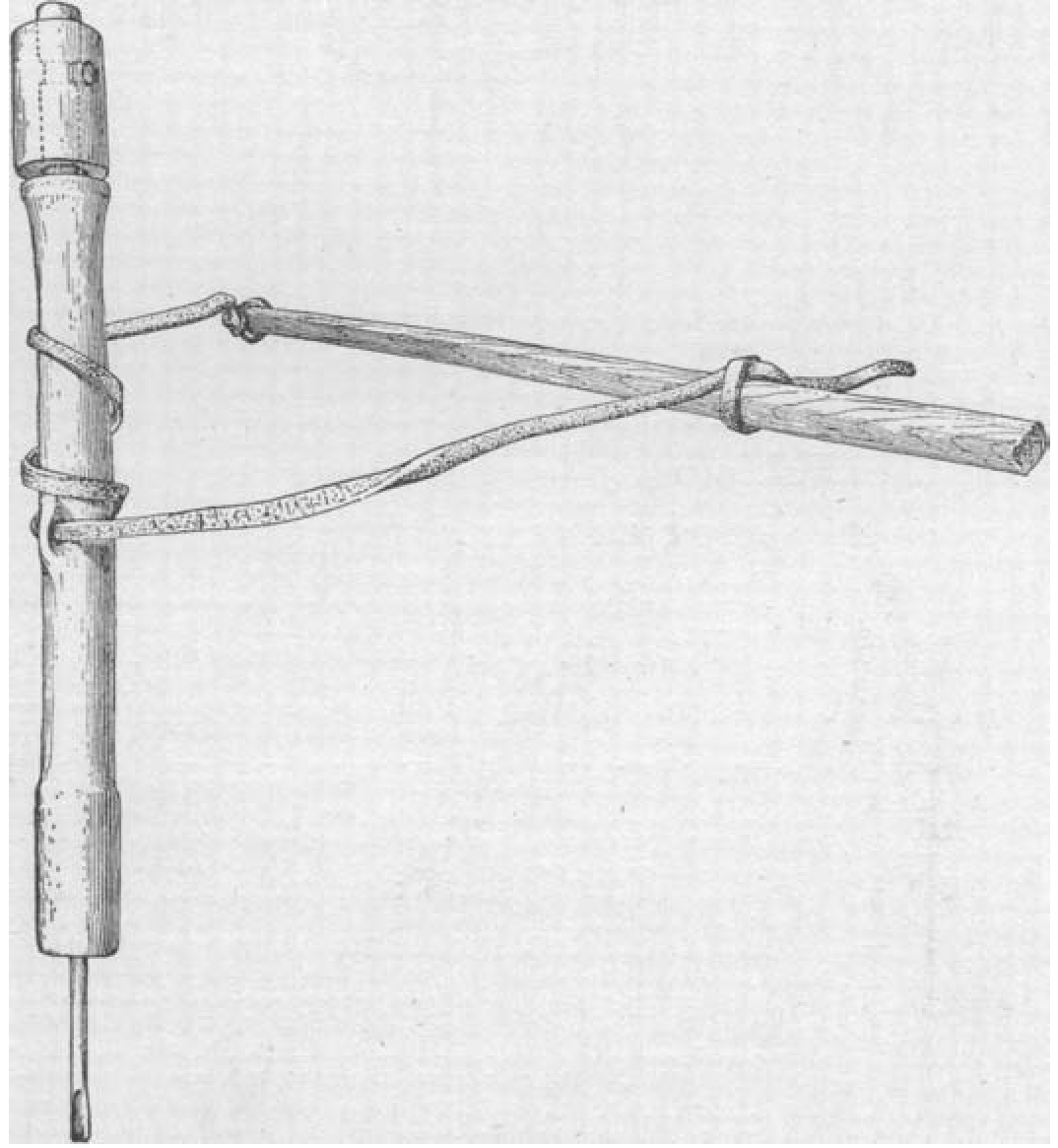
At the present time the Chukchee bow-drill (Fig. 128) always has an iron point. It is set in a stout wooden shaft, the top of which forms a strong pin. This passes through a circular hole in the middle of the head-cap, so that the latter can be held fast while the shaft revolves in it. Another pin prevents the cap from slipping off.
The bow may be straight or curved, but, unlike that of the Alaskan Eskimo, is always without carving or other ornament. It is made of wood or antler, and arranged so that the string passes two or three times around the shaft of the drill. Sometimes the string is put through a hole at about the middle of the shaft. The operator places his left hand on top of the head-cap of the shaft, and saws with the bow with his right hand. The forward-and-back movement of the bow causes the drill to revolve rapidly.
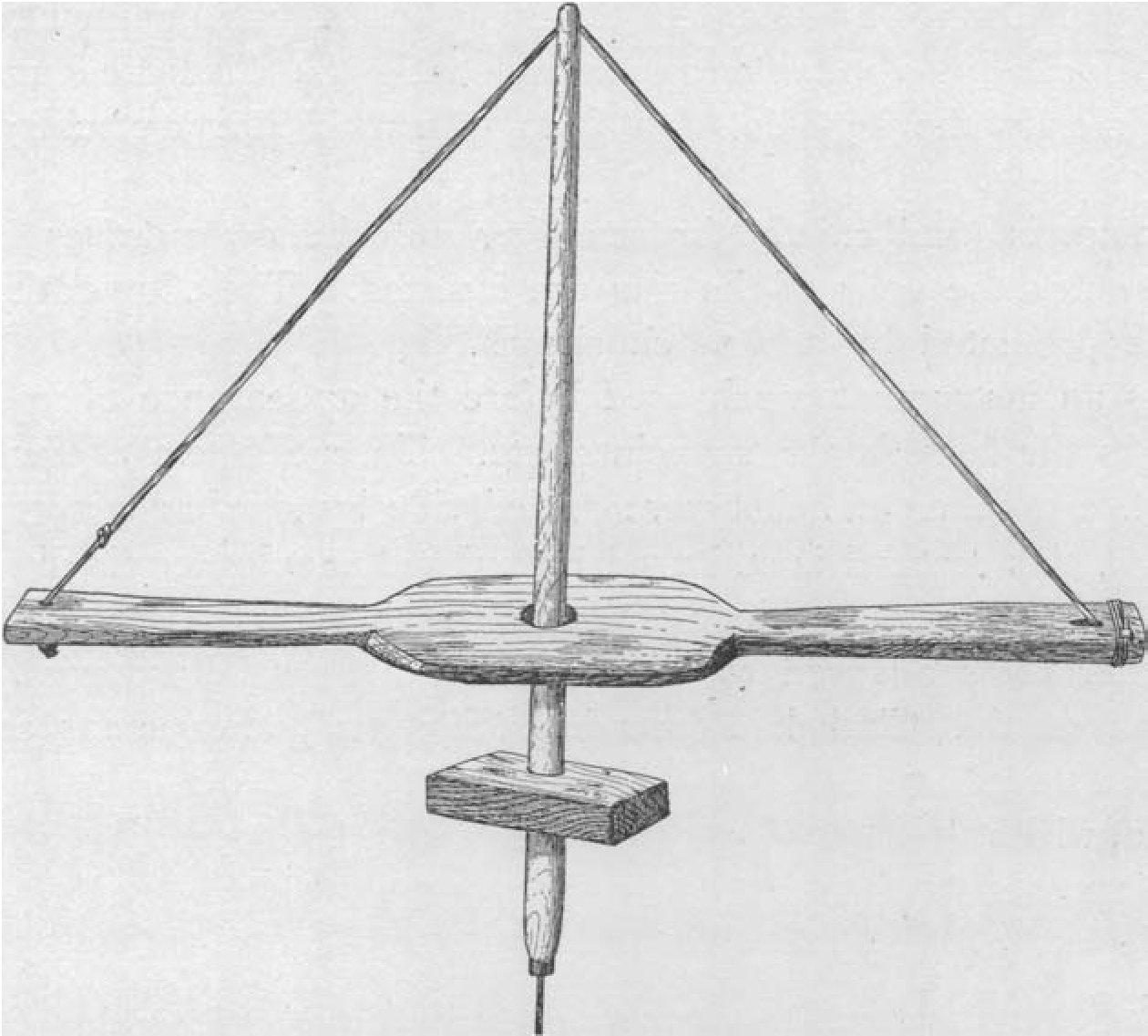
In the so-called pump or weighted drill (Fig. 129) the bow is a straight wooden stick, narrow at the ends, and broad in the middle. The shaft of[212]🗗uncollated the drill is thinner, and passes through a hole in the middle of the bow. The string runs through a hole in the upper end of the shaft, so that the bow hangs below the middle of the shaft. On the lower end of this shaft, between the bow and the iron point, is fastened a flat block of wood. The drill is rotated by pressing down on the bow after the string has been twisted around the shaft. The momentum partially rewinds the string. This drill is more effective than the ordinary bow-drill described before. It is used for drilling bone and even for sheet-iron.

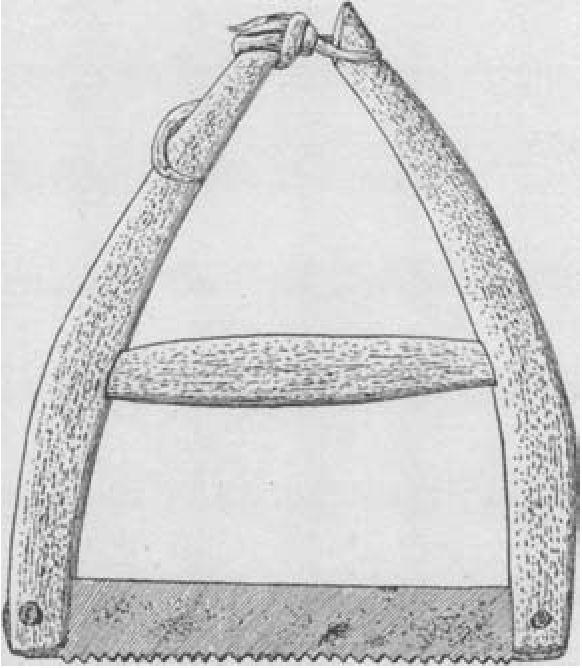
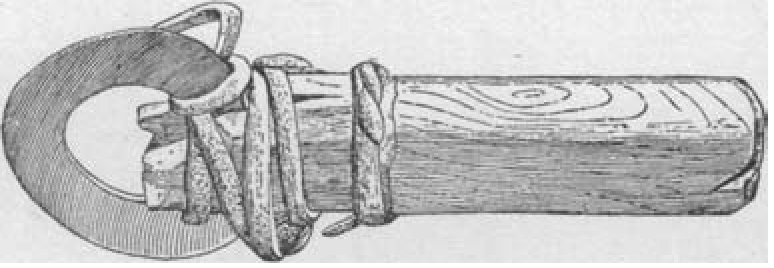
The Eskimo at Indian Point and on St. Lawrence Island until recently used another drill, which was turned between the palms without any bow (Fig. 130). Two drills of this kind were obtained. Notwithstanding their iron point, they are suited only for soft wood, not for bone or ivory. Small saws are made in imitation of the Russian and American forms (Fig. 131). They are used for cutting antler and bone, while wood is usually cut with a knife. For whittling, carving, and finishing all kinds of wood-work, the “crooked knife” is used by the Chukchee, the Koryak, the Yukaghir, and the Eskimo. The blade is made of a thin tapering piece of iron or steel from three to ten centimetres long, set in a slender wooden or ivory handle. It is fastened to the handle with a peg, or simply tied to it by a thin strip of leather (Fig. 132, a, b, c).
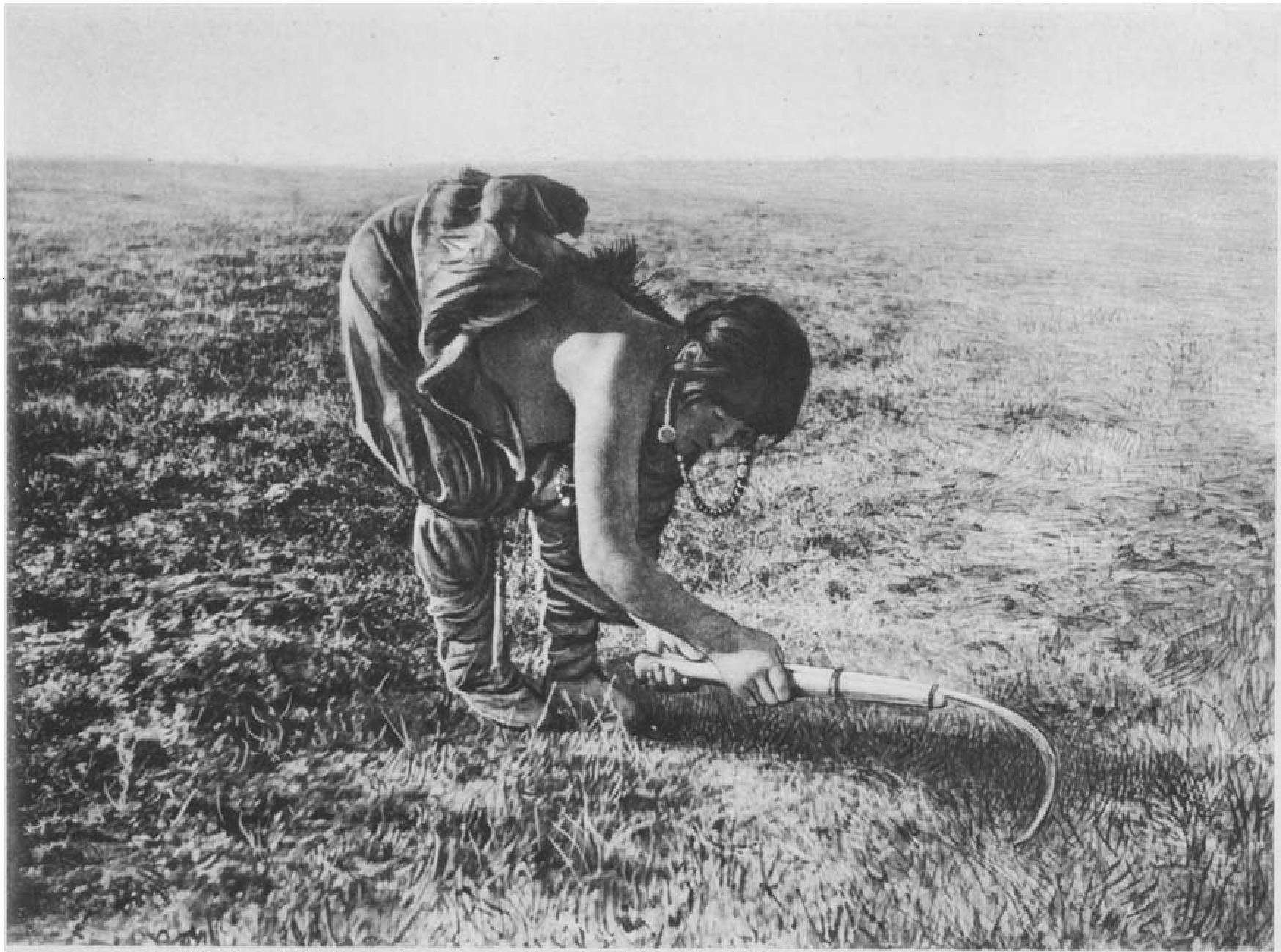
This knife is similar to the crooked knife of the Alaskan Eskimo.¹ It is used with the same characteristic motion of the hand toward the body which the Chukchee employs when using the ordinary knife. The Russian and the Russianized Yukaghir, on the contrary, move the knife away from the body.
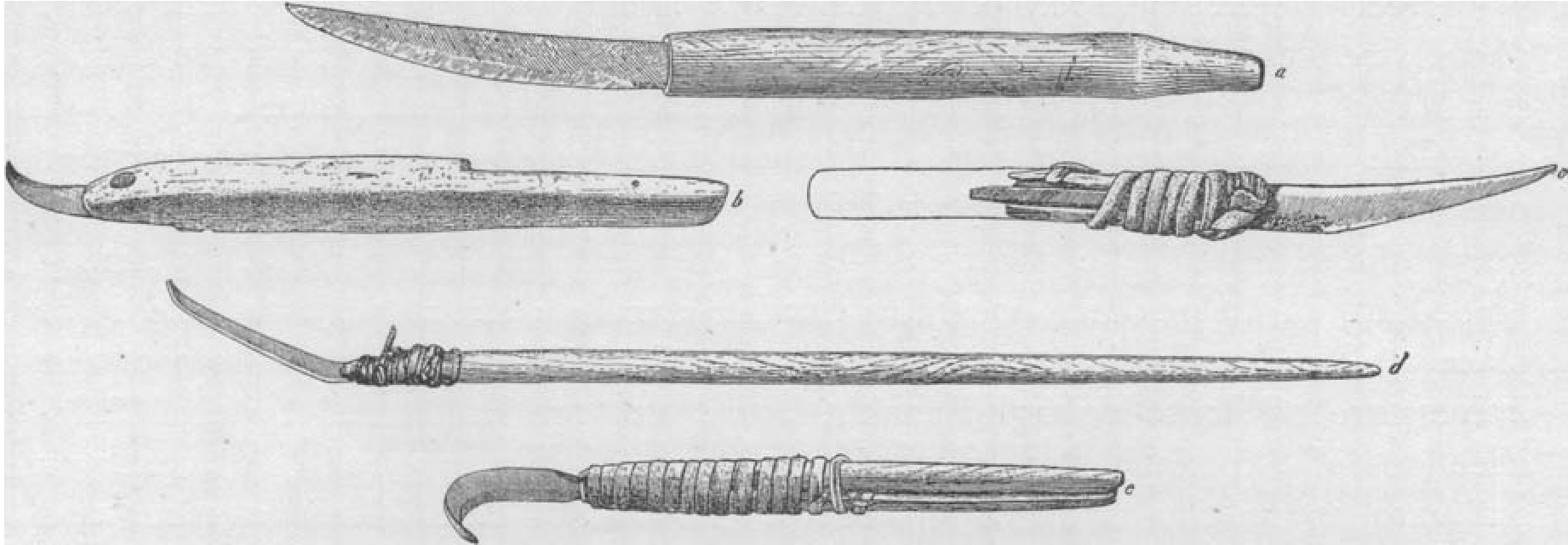
A knife quite similar in shape to the Chukchee crooked knife (Fig. 132, d) is used by the Russians on the Kolyma and Anadyr for the special purpose of finishing the hollowed tree-trunks scooped out for canoes. This knife is often grasped with both hands, and it is moved away from the body, as are the other knives used by these tribes. An adze of peculiar shape is used by the Russians for the rougher part of this work. One variety of this crooked knife (Fig. 132, e) is commonly used by all tribes of northeastern Asia for scooping out spoons.
Neither the Chukchee nor the other tribes have special tools used only for carving or engraving ivory or bone. This work is done with various knives, crooked or straight, but those with short slender blades are preferred.

Fig. 133 represents a knife used for carving ivory from the village Tɪˊḷḷɪran of the Olutora Koryak. It has a double-edged blade, rather thin and broad, inserted in a slender piece of wood, and wound all around with leather.

With most tribes of northeastern Asia the stout straight knife (Fig. 134), carried in the belt or tied to the hip, furnishes the chief tool, because it is adapted to so many uses. The Chukchee, however, prefer to use the crooked knife for regular work. The straight[214]🗗uncollated knife serves for ordinary cutting, or is used by reindeer herdsmen for slaughtering-purposes. It is also used for carving and cutting meat at meals. The kind of meat usually consumed by the Reindeer and by the Maritime Chukchee is so tough that it is quite impossible to get along without a knife.
Every adult member of a Chukchee family, and each child after he is about five years old, has his own eating-knife. Often these knives are simply small bits of iron, rudely set in a handle, and unfit for many uses.
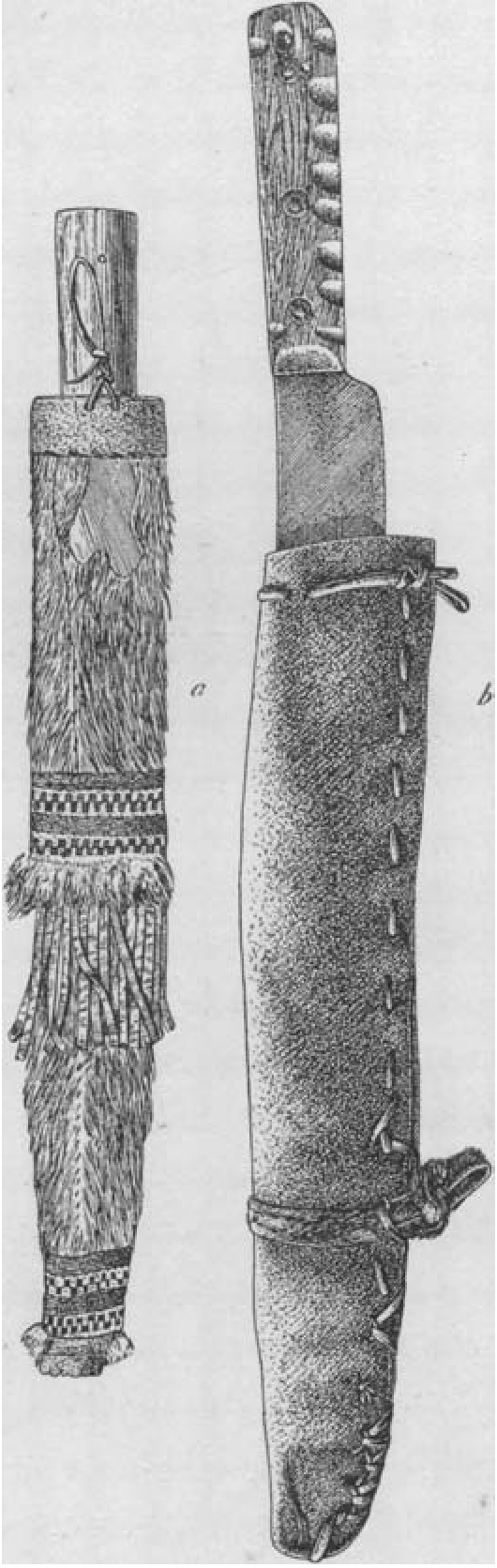
The knives used by the Chukchee differ chiefly in size. The smaller one is called rêˊččêt-vaˊlᴇ (“belt-knife”). The blade has a stout back and a long pointed end. The other end has a slender round stem, which is deeply embedded in a wooden or antler handle, usually without pegs to hold it in place. The handle is often notched to afford a better grip. Most of the knives are of Russo-Yukaghir make; some also are hammered by the Chukchee out of American steel files of small size (cf. Fig. 132, a). A sheath or scabbard is usually made of a piece of ground-seal hide folded together and roughly sewed or laced with a thin strip of leather (see Fig. 83, p. 161).
Knives made by the southern Yakut and brought over to the Kolyma by merchants are the most convenient for the Reindeer Chukchee, because their narrow blades make them fit for stabbing animals, while a deep groove along the blade allows the blood to flow freely from the wound. The Maritime Chukchee use American cutlery chiefly.
The Chukchee usually carry their knives in their belts, while the Lamut and the Russo-Yukaghir have the scabbard fastened to the hip by means of a loop of leather, and a toggle formed simply by a knot of the string.
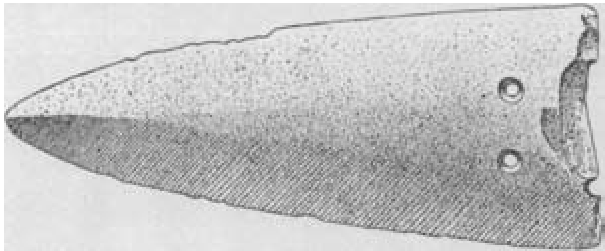
The double-edged knife of the usual Eskimo form does not exist at present in northern Asia. Among the more ancient stone blades there are some which clearly belong to this type. The blade represented in Fig. 135 is from the village Wuteˊen of the Asiatic Eskimo. It is made of slate, and is slightly convex on both sides. One side has a slight ridge near the point. Two holes are drilled in the bottom for fastening it to the shaft. They were probably made with a stone drill-point.
Knife-sharpeners are made of slender pieces of sandstone of fine grain. At Indian Point I found such a sharpener, made of jade, and pierced through at one end for convenience in fastening it to the belt. It was said to have come from King’s Island. In the Koryak villages of western Kamchatka, knife-sharpeners are made of pieces of petrified wood, which is frequently found on the seashore near the mouths of rivers.
Large whetstones for sharpening tools are made of square blocks of smooth-grained sandstone, which is found in various places about the country. A few revolving grindstones have been bought from the Russians and Americans.
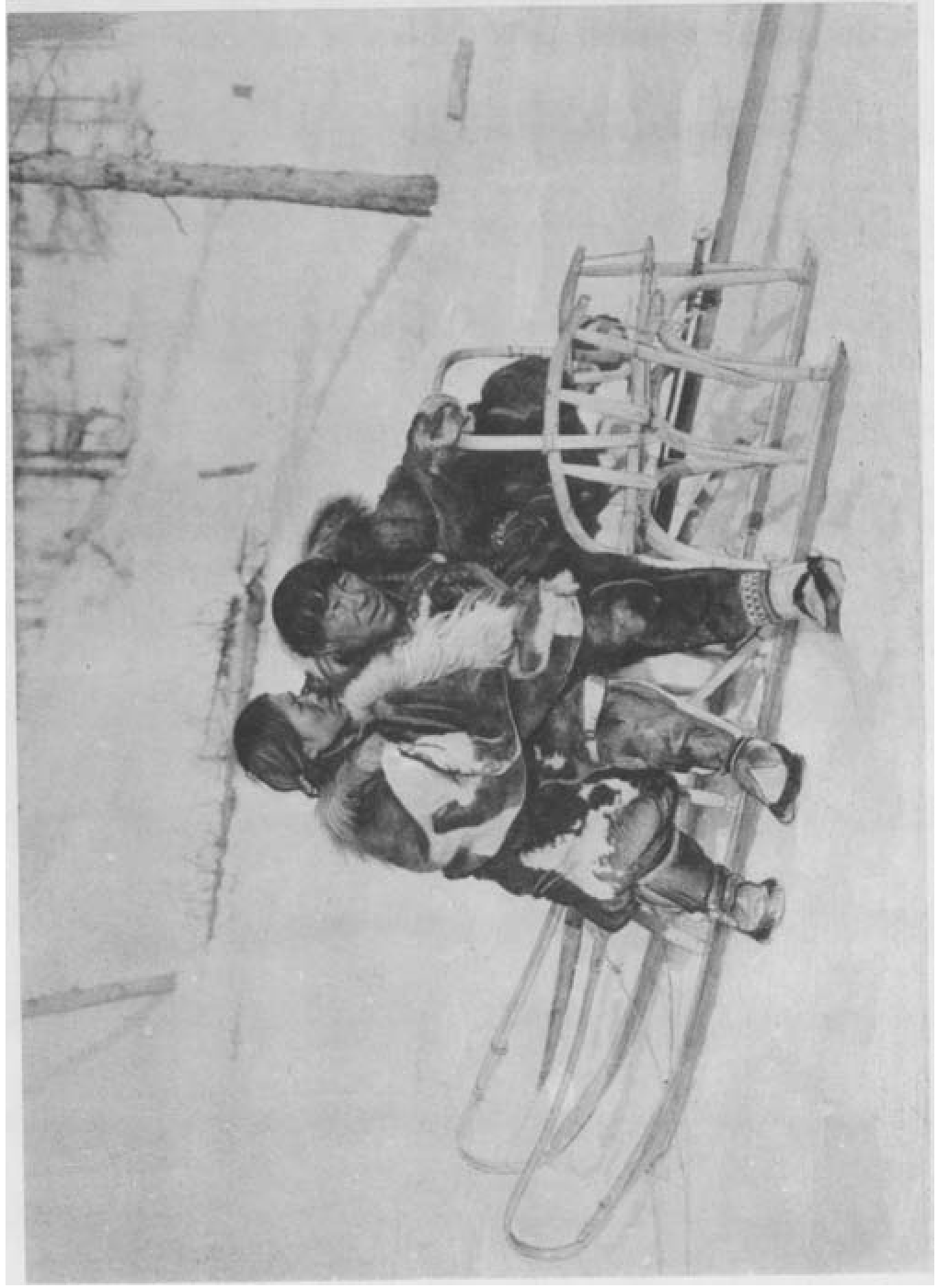
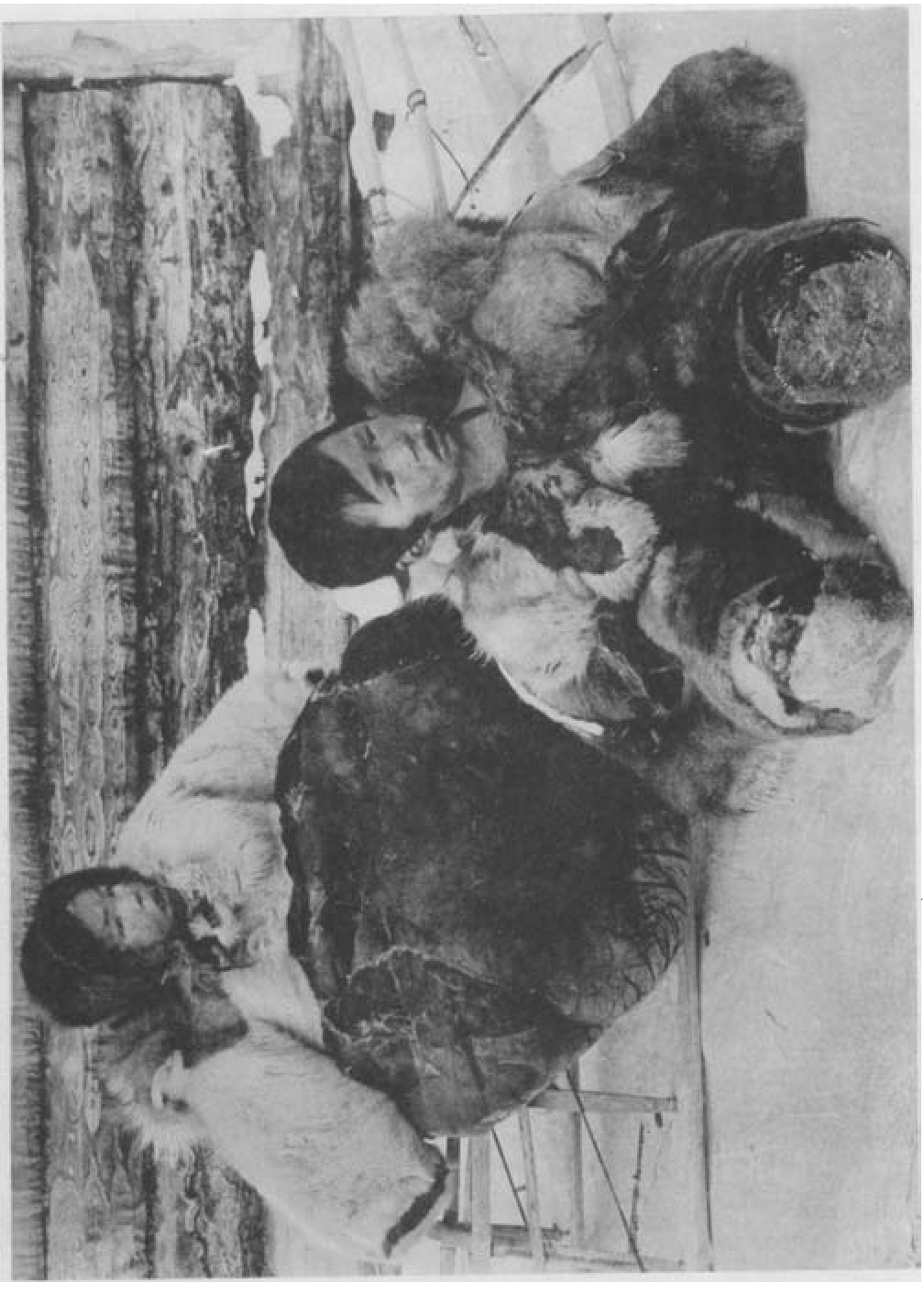
The Chukchee have little chance to split logs in their treeless country, and indeed they prefer simply to hew wood with their light adzes, though sometimes it takes a day to cut a single sledge-runner. They have learned, however, from the Yukaghir, who have more skill in handling wood, how to split wood by means of wedges made of the same material.
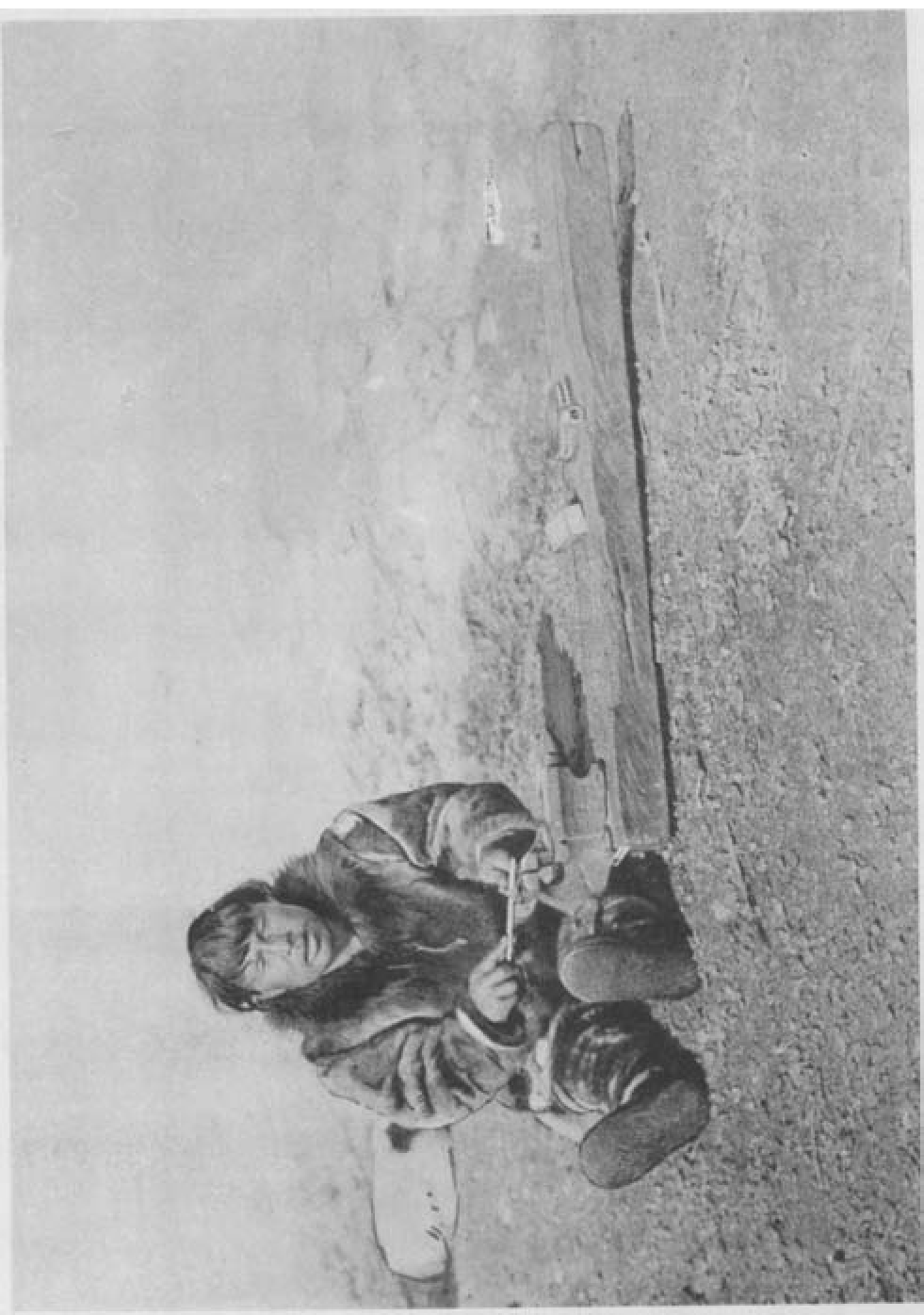
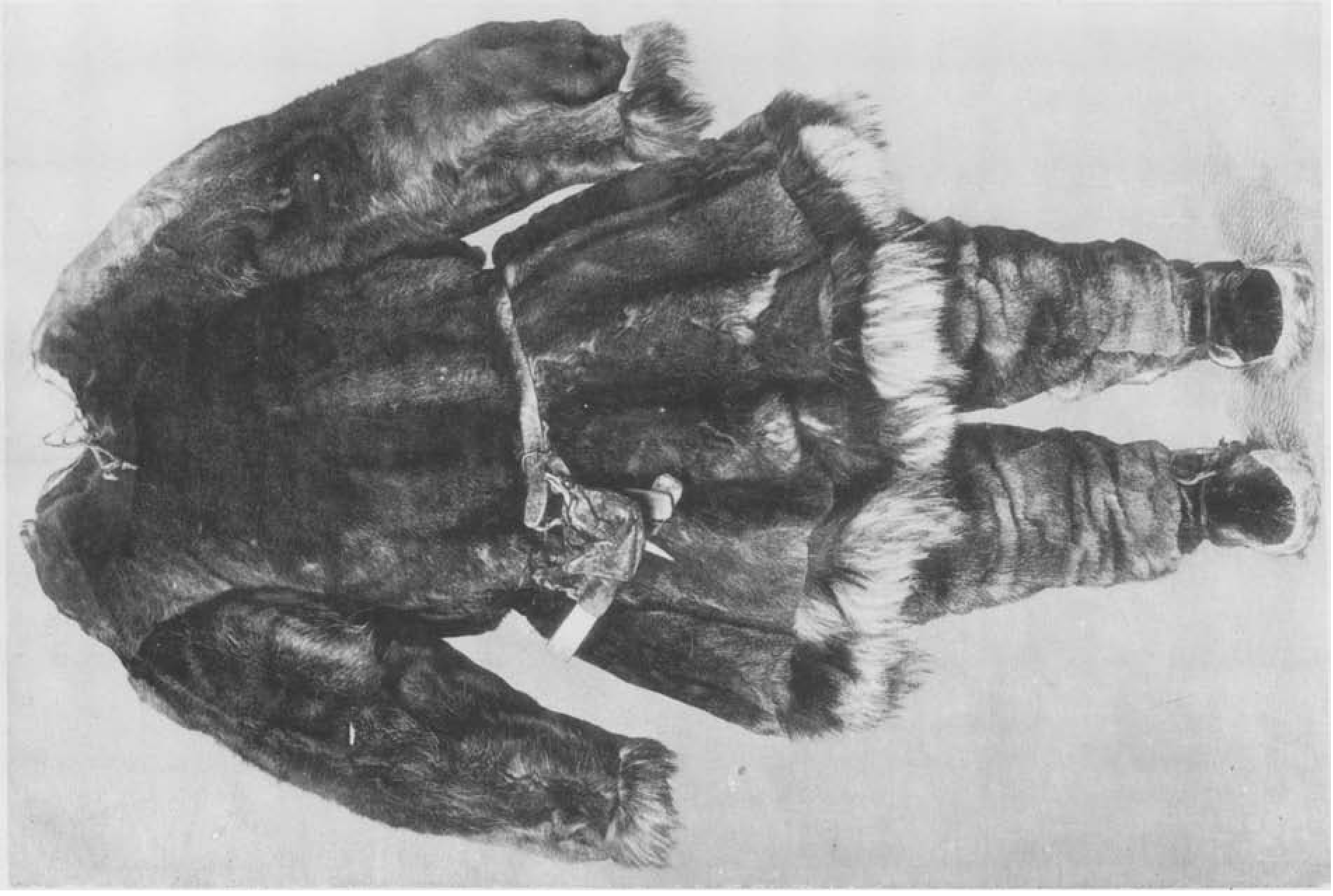
WORK IN IRON. — Work in iron has been but little developed up to the present time. This is explained by the difficulty in preparing charcoal, an indispensable material for the smith. The Chukchee work chiefly on cold iron with file and hammer (Plate XX, Fig. 2). A few clay forges with large bellows have been observed. Their form is directly copied after that used by Russianized natives.

The Chukchee bellows in the collection (Fig. 136) are made of seal-skin, with boards on the top and bottom. A barrel of an old gun is inserted for a nozzle. The bellows are worked simply with the hands. Among the Russianized natives and the Koryak a string is sometimes tied to an iron eye fastened to the handle of the bellows. This string is passed over a smooth beam; and the operator can thus work the bellows by pulling the string, and does not need to bend over. The eye on the side of the specimen illustrated in Fig. 136, however, is hardly placed in the proper place for such an arrangement. Iron is cut with files bought from traders. Sometimes a stout iron saw of native make is also used for this purpose (Fig. 137).
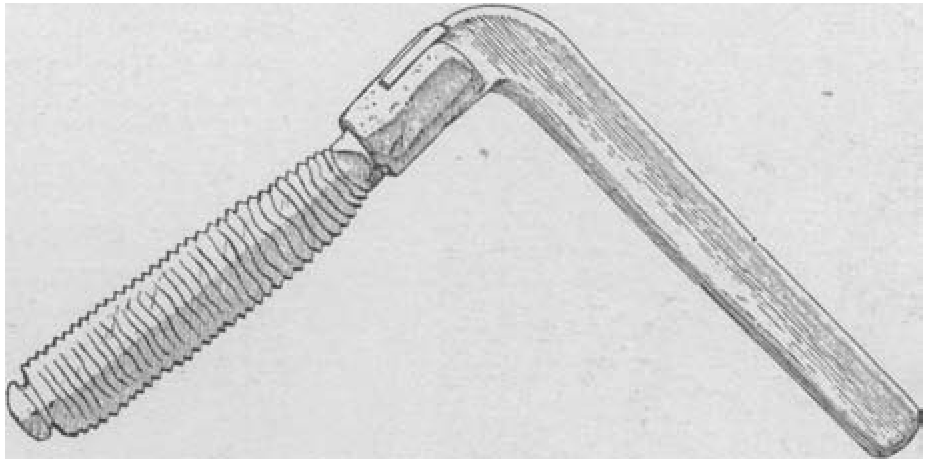
The Reindeer Chukchee of the Kolyma are quite unable to mend their iron tools and articles they use. They are compelled to seek the Lamut or the Russians for the most trifling cases. Reindeer-Chukchee blacksmiths are exceedingly few in number, and throughout the tribe the craft of the smith is esteemed as the height of human cleverness.
In one of the Chukchee tales¹ borrowed from the Russians, and curiously adapted to their own ideas about the civilized world, the hero is a young son of the great Sun chief; i. e., a prince. He is described as handsome and clever, with a face “like that of a blacksmith.”
The Maritime Chukchee on the Pacific side are better acquainted with[216]🗗uncollated methods of working iron. I met one who was able to turn broken Winchester rifles into firelocks, to mend gun-barrels, and to forge steel springs and traps.
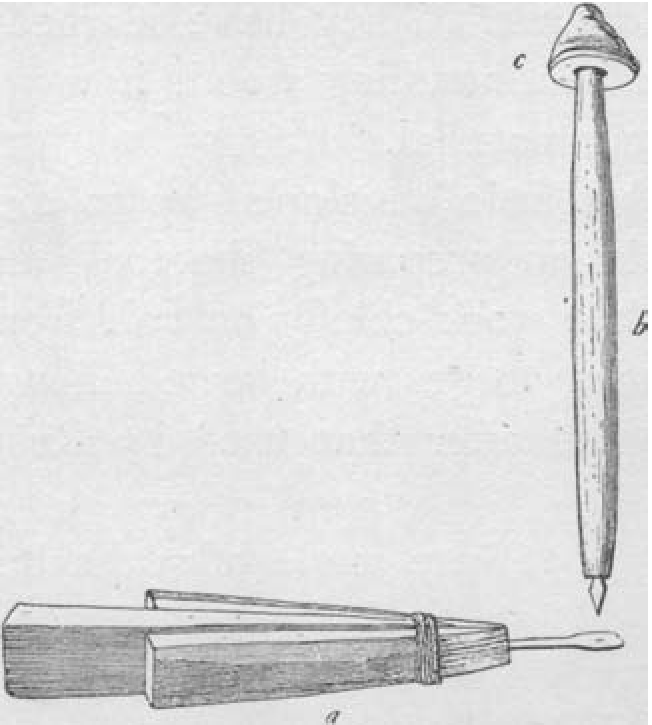
A distinct branch of iron-work is drilling out new eye-holes in broken needles. It is accomplished with a very slender drill (Fig. 138, b), turned either by hand or by a light bow. A small head-piece of ivory (Fig. 138, c) is used with it. The needle is held in position by a small awl-holder (Fig. 138, a), and wedged tight with a piece of wood. According to Steller,¹ the art of drilling needle-eyes was known to the Kamchadal before the appearance of the Russians.
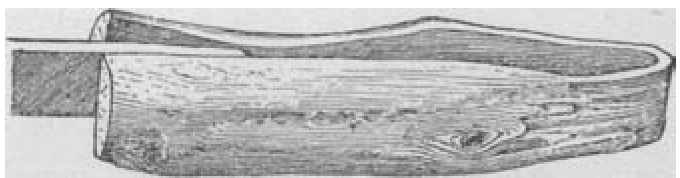
For tongs I have seen the Chukchee use a piece of wood whittled in the middle and then folded together (Fig. 139). The ends served as prongs, with which they picked small pieces of iron out of the coals.
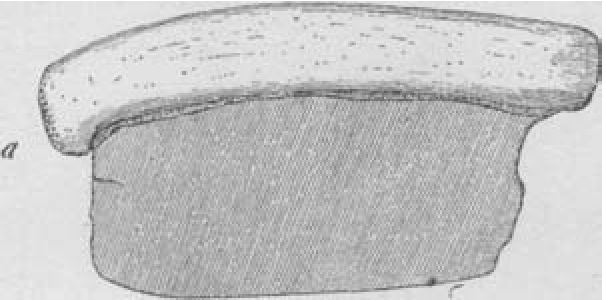
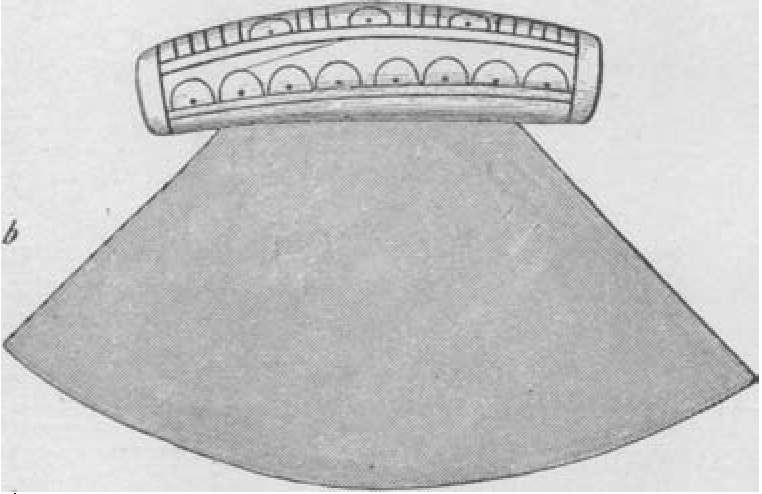
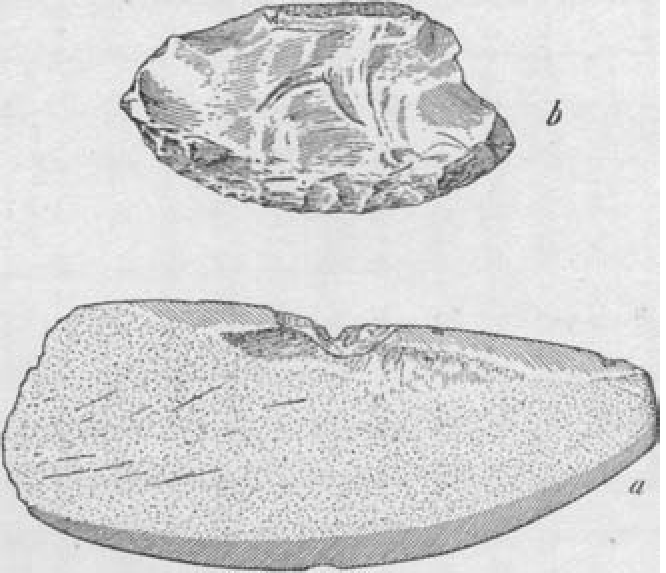
WOMAN’S WORK. — The work of women consists chiefly in skinning and carving the carcasses of animals, preparing the skins, cutting and sewing garments. The butcher-knife used by the Maritime Chukchee and Eskimo women is similar to the semilunar woman’s knife of the American Eskimo. It is called among the Chukchee peˊqul, and among the Asiatic Eskimo ūˊlaq. Modern specimens (Fig. 140, a, b) are all of iron; but in ancient dwelling-sites I found a few blades of slate and obsidian, which evidently were used for the same purpose (Fig. 141, a, b). The butcher-knife is used chiefly for cutting and chopping blubber. Its shape is not adapted to carve reindeer carcasses with their long, thick bones. The women of the reindeer-breeders, therefore, use for this purpose a stout knife of the common straight form.
In putting up a reindeer-carcass, the antlers are taken off with the top of the skull by means of an adze or an axe. Then a long cut is made in the skin from the lower lip backward along the[217]🗗uncollated under side of the animal. The skin is peeled off with the hands, beginning with the abdomen. Afterwards the head and the legs are cut off, and the intestines and blood removed. The carcass is then divided into seven parts, — two hams, two shoulders, the brisket, the back together with the pelvis, and the neck. The brisket is considered the best part of the deer.
When taken off from the animals’ bodies, all skins are cleaned of bits of meat or sinew with a knife. The inner membrane is also removed. Then the skins are stretched by various methods, and allowed to dry. The peltries are always taken off whole. They are turned inside out, i. e., the hair side in, and pulled over a wooden drying-rack, sometimes simply over a wooden block roughly fashioned to the proper shape.
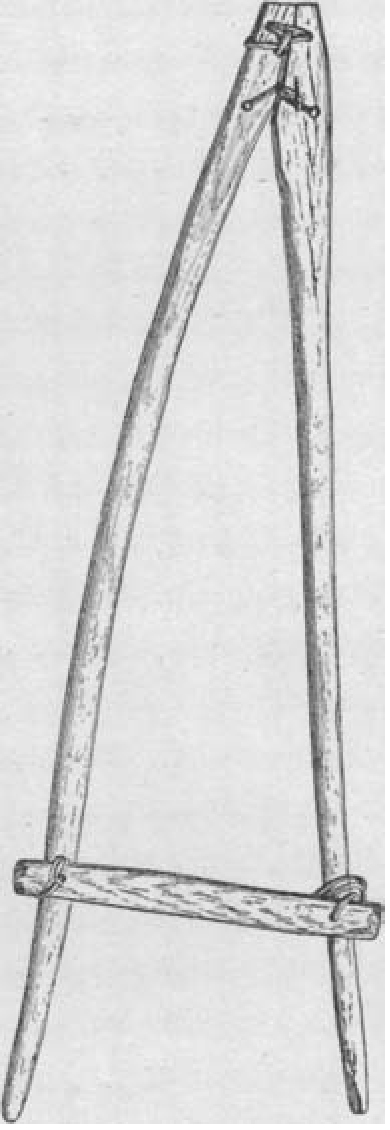
The drying-rack in use among all the tribes of northeastern Asia is formed of two sticks tied at their tops in such a way that they can be easily brought together (Fig. 142). A third stick is attached across the lower portion of the rack. One end of the cross-stick may be easily untied, allowing the rack to be folded and inserted in the skin. After that, the rack is stretched within the skin, and the cross-piece retied in its former position.
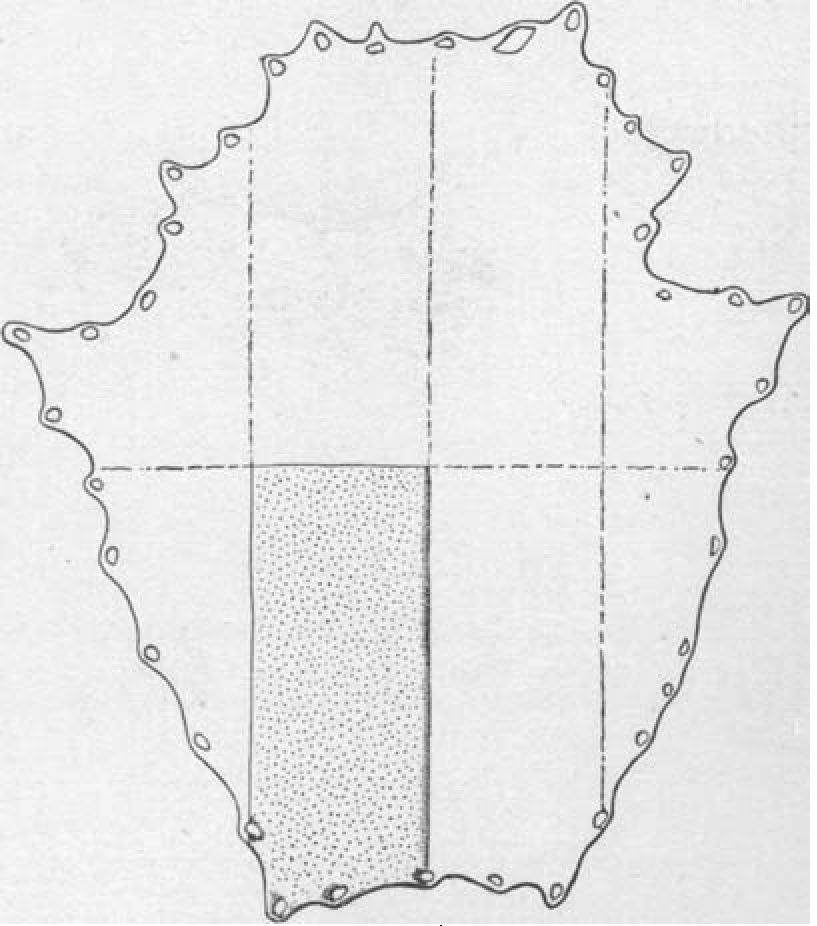
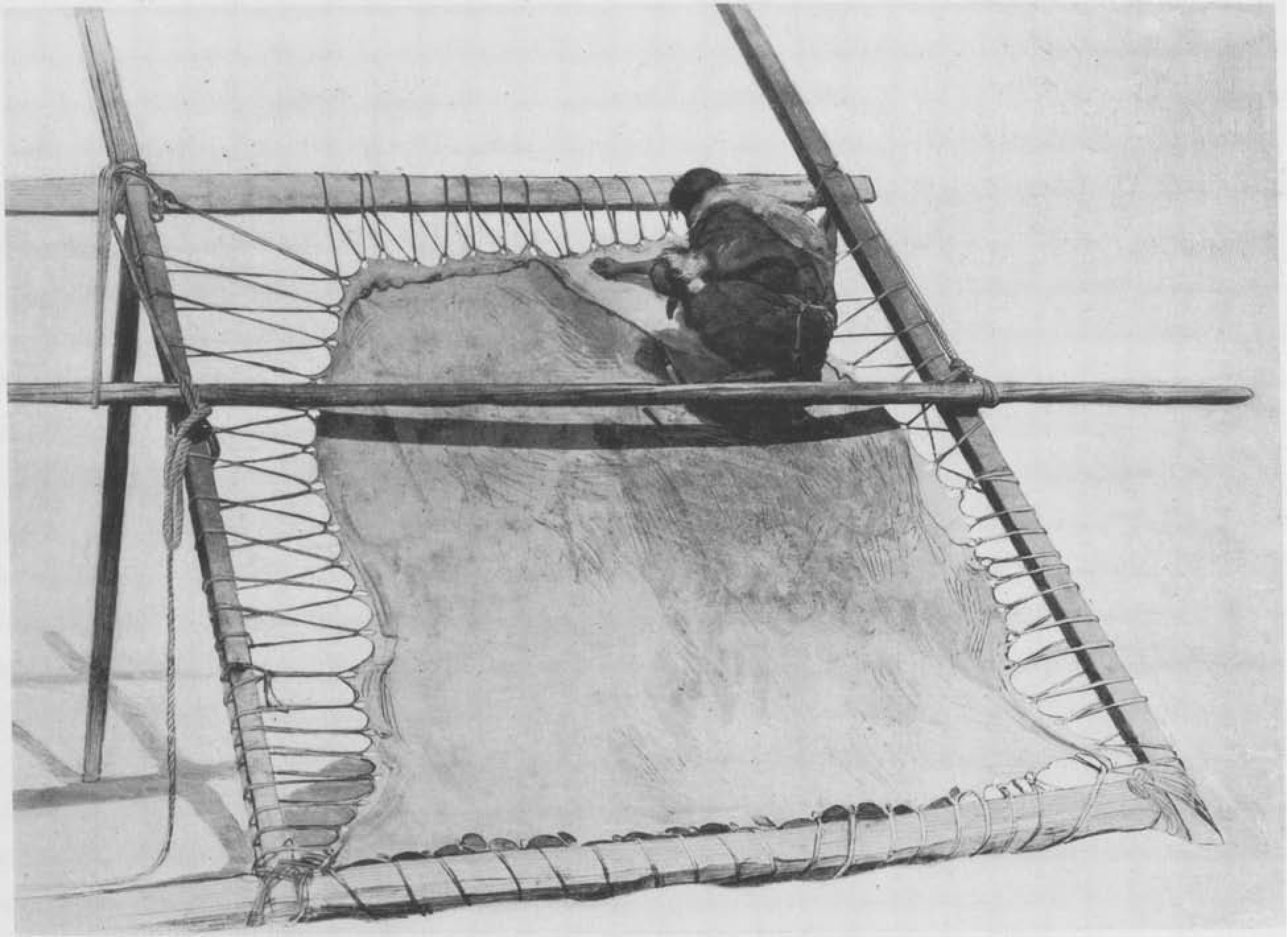
Reindeer-skins are stretched on the ground, and their edges are held with stones. Sometimes they are pinned to the ground with wooden pegs, which allow more strain in stretching, and make the skin larger when dried. Seal and walrus skins are stretched with cords on rectangular frames quite similar to those used in Alaska.¹ Cords are passed through holes cut in the edge of the skin. When dry, they are folded in compact elongated packages (Fig. 143), for the most part identical with those represented by Nelson.² Reindeer-skins are simply folded in two or rolled together and tied with a piece of cord.
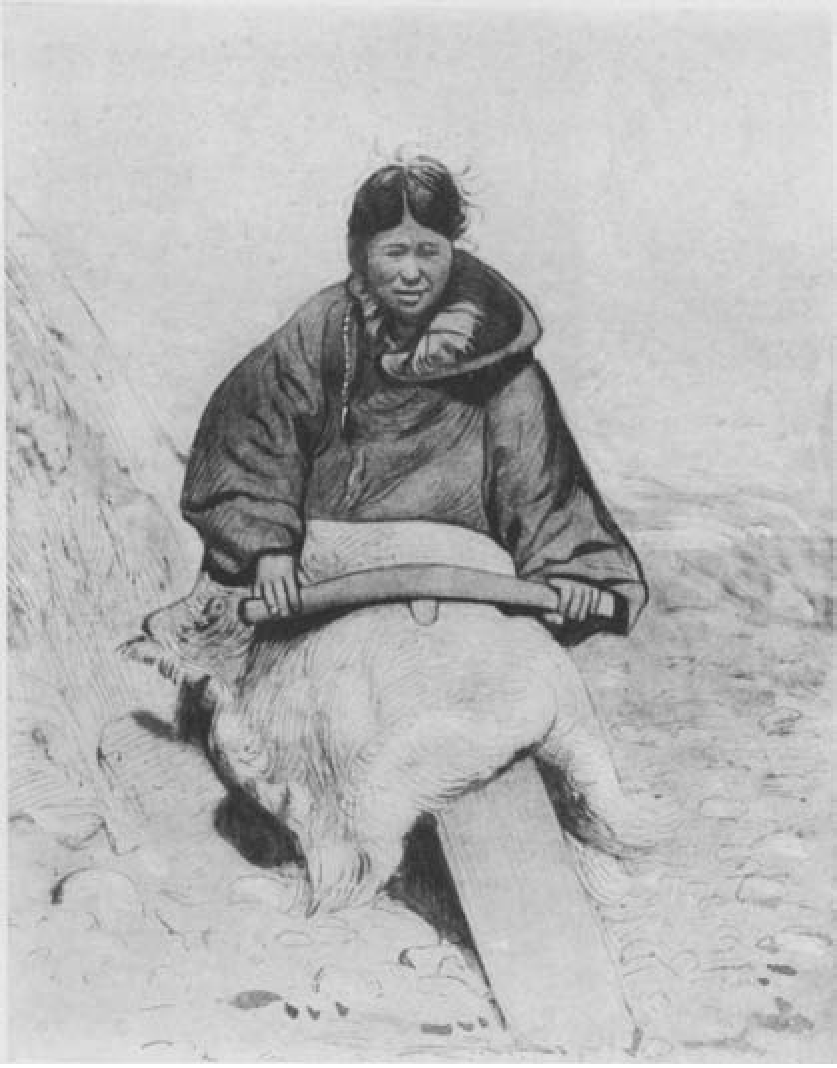
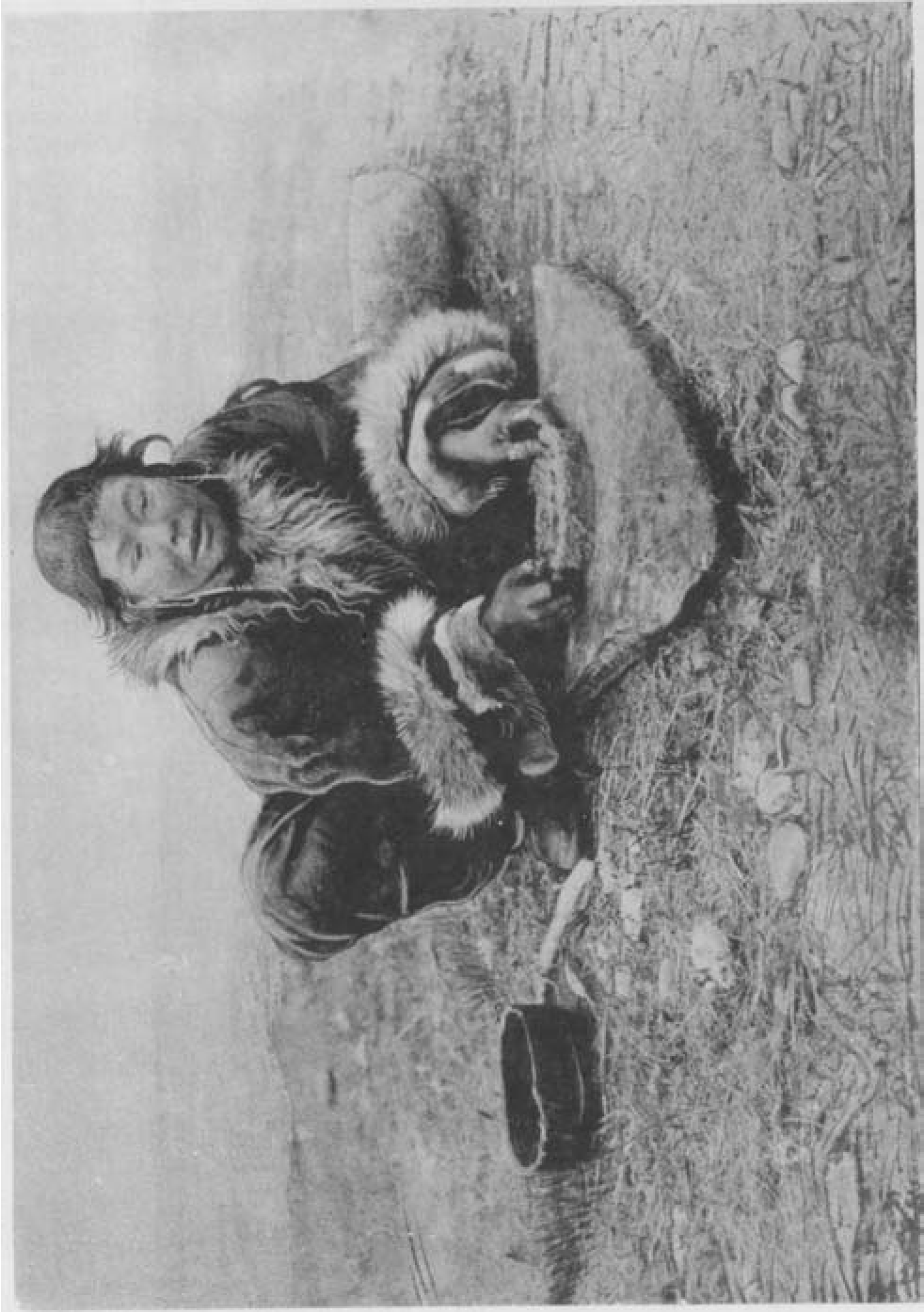
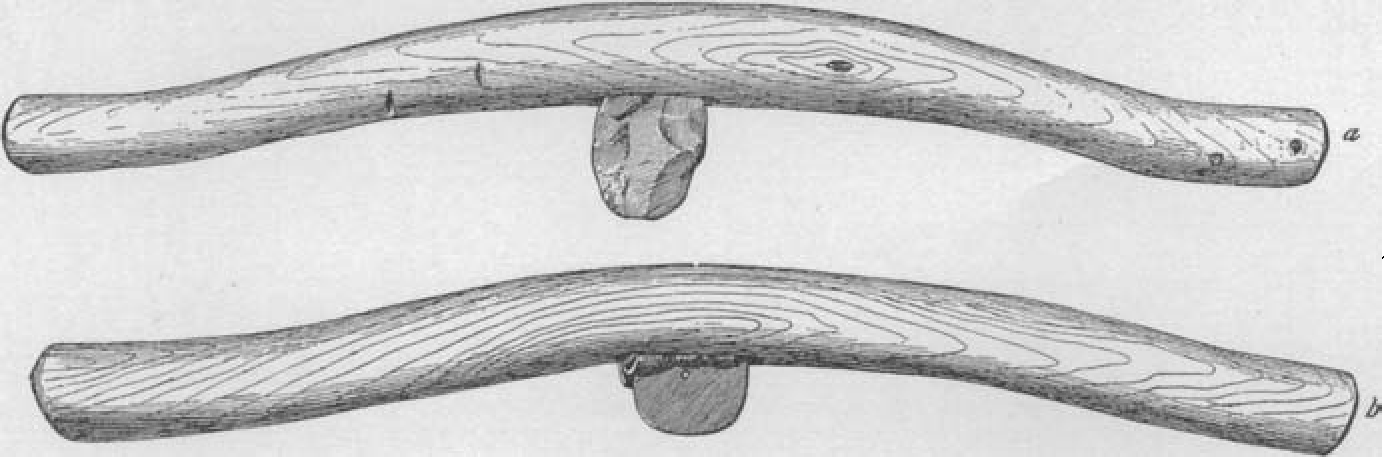
Tools for scraping the skins have the same shape among the Chukchee, the Koryak, the Yukaghir, and the Kamchadal. The typical one has a blade of a round flat piece of flint (Fig. 144, a) or obsidian. The edge is roughly flaked, while the butt is firmly fastened in a hollow scooped out of[218]🗗uncollated the middle of a curved wooden stick. The scraper is very strong. It is worked with both hands over a skin, a portion of which is spread on a smooth narrow board resting against the knees (Plate XIX, Fig. 2).
Along with the stone scraper there has come into use an iron instrument of exactly the same shape (Fig. 144, b). Originally adapted for finer work, the iron scraper is now gradually superseding its stone prototype in general use.
The women of the Lamut and Russianized Yukaghir use iron scrapers of two different forms. — one of them probably an imitation of a stone scraper (Fig. 145); and the other, of one made of bone (Fig. 146). Both forms also occur among other tribes.¹

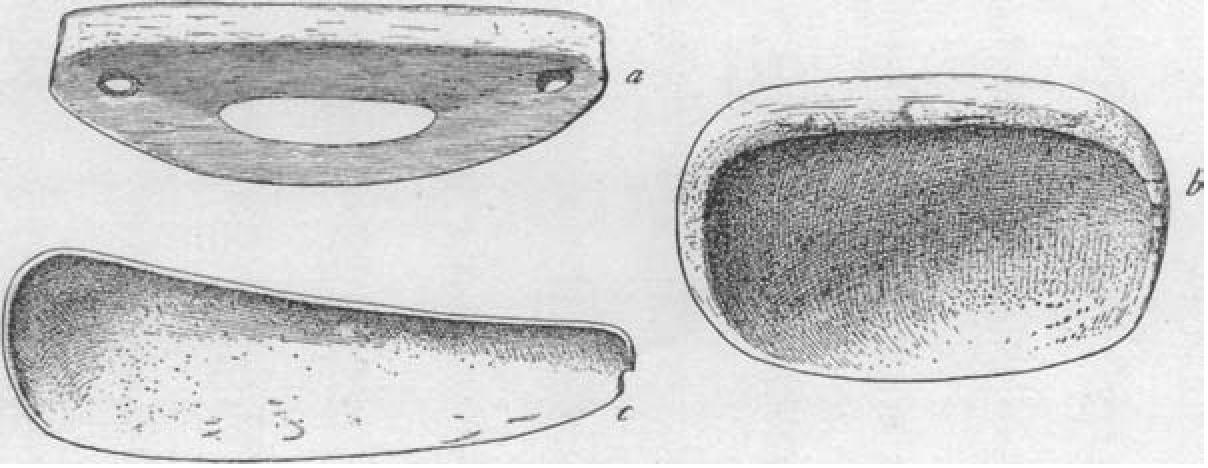
An ivory scraper, oval or semilunar in shape, and hollowed in the middle (Fig. 147, a, b), is used by the Chukchee as well as by the neighboring tribes for squeezing out the guts of sea-animals, which they use as material for various kinds of coats. The form of the scraper is similar to that used by the American[219]🗗uncollated Eskimo.¹ The Koryak and the Kamchadal use for this purpose a piece of sheet iron or copper bent or beaten into the same shape (Fig. 147, c). This implement also serves for squeezing the juice out of the stalks of fire-weed (Epilobium angustifolium) and other edible plants. Various shells are likewise adapted by the people in Kamchatka to these uses.
Skins are prepared with or without the hair on. For rubbing the skins the Chukchee women use mainly reindeer-dung and human urine, and sometimes meat-broth. Other tribes apply oil, putrid liver, fish-eggs (fresh, putrid, or dried, and subsequently soaked in water), bran, etc. Nevertheless the reindeer-skins of Chukchee make are softer and better dyed than those of any of their neighbors. The usual process begins with folding a fresh skin with the flesh side in, and leaving it in this state over night. If dry, the skin is previously soaked in water. In the morning the flesh side of the skin is scraped with the iron scraper and trampled with the feet, the right heel being covered with the back part of a short summer boot, the toe of which has been cut off at the instep to allow freer motion of the foot. The skin is then smeared over with reindeer-dung, and again left over night. After that, it is scraped a second time and trampled with the heels. A vessel filled with urine and some alder-bark cut fine is warmed for an hour over an ordinary lamp. When the liquor is sufficiently saturated, the inside of the skin is well rubbed with it, and the skin is hung up in the sleeping-room to dry. After drying, it is again gone over with the scraper, and all tough places are dampened with urine, scraped, and dyed anew.
With the largest skins the scraping is repeated several times. Each time the skin is left to dry over night. The scraping is begun with the stone scraper, and continued with the iron one. The more scrapings the skin has undergone, the softer and finer it becomes in the end.
The dyeing with alder-bark is considered quite indispensable for every part of the reindeer-skin, even for the tough strips taken from the legs, which are used for boots and mittens. This process makes the skin softer, and corresponds somewhat to tanning. The dyed skins will keep off dampness much better than those with a white inner side. The skins prepared by women among the Russianized natives, which have the inner side either left[220]🗗uncollated white or dyed with alder-bark dissolved in water instead of urine, are much poorer in quality than those of the Chukchee.
The chief drawback with all these skins is their complete unfitness to stand moisture. Even slightly damp skins, when drying, will become crumpled and as hard as wood. Faults of this kind can be partially corrected by fresh scraping and dyeing, but even then the skin is in much worse condition than it was before.
In currying reindeer-skins the Chukchee women do not manifest much skill. This work is neglected because the curried leather is comparatively little used among the Chukchee. For currying, the skin is soaked and left for twenty-four hours folded together. Then the hair is scraped off and the skin is dried. Such scraped skins are brought by the Chukchee to every fair, because they are much lighter than those with the hair on. In the further process of preparing the skin, it is smeared with any one of the materials mentioned above, then scraped again, and bleached in the wind or dyed with yellow ochre. The Russianized natives even wash the finest curried skins with soap, and then dry them in the air, giving them a snow-white appearance.
Most of the curried skins are smoked for a couple of days over the hearth or in a special shed which is employed for extra cooking, scraping of skins, etc. The women among the Russianized natives often make a temporary tent of a few sticks, covering them with skins they are going to smoke, and build a smouldering fire inside. A structure of this kind is called a “bath,” in reference to the fact that the Russians in that country still take sweat-baths inside of the tent sometimes, much in the same way as the American Indians do.
The best curried leather of Chukchee make is the retteˊm,¹ i. e., the covering of the outer tent, especially the upper parts, which get a continuous smoking from the hearth inside. This leather does not shrink after rain, and is waterproof to a considerable degree. The tent-covering has the hair closely cropped. In making clothes, this hair, if necessary, is scraped off with an iron scraper. Because of the previous smoking, it comes off easily. Often, however, it is left on.
The dressing of seal-skins has not developed to the same degree as that of reindeer-skins, because the former are utilized only for boots, bags, and purposes which do not require so much care in preparing the material as is necessary for clothing. Walrus and thong-seal skins, after they are dried, do not undergo any further process. The thong-seal skin is used with the hair on for soles of boots, to make the boot warmer. The walrus-hide is split in two with a thin broad knife, while the hide is tightly stretched on the drying-rack (see Plate XIII, Fig. 1, p. 170).
When used for covering a boat, the walrus-hide does not receive any[221]🗗uncollated additional preparation. It is simply soaked in water, then cut and sewed in the shape required, and pulled over the frame.
The skins of small seals that are used with the hair on are prepared by merely scraping their inner side with an iron scraper. A little blubber which is left on the skin helps to make it softer. These skins are not dyed, and are used for spring boots and trousers, also for bags of every kind. The seal-skin trousers and boots are very tough, and wear much better than those of reindeer-skin, especially in damp weather, for they are not spoiled when dried after being wet.
The skins prepared for summer boots are folded wet, with the hair side in, and allowed to lie for a night or two. Then they are well scraped on both sides. To make the skin black it is rubbed with coal mixed with oil, or sometimes with the black dust gathered from whetstones. Often the skins, when scraped, have the epidermis left on, which has a natural black color, and does not need artificial blackening.
The snow-white, parchment-like leather used for ornamental purposes is obtained by bleaching the well-scraped skins in the air for a long time. The best season for this is the early spring. Sometimes such leather is dyed with alder-bark, and then it takes on a deep russet color. The best white and russet parchment is obtained from the gullets of large seals, which are treated in the same manner.
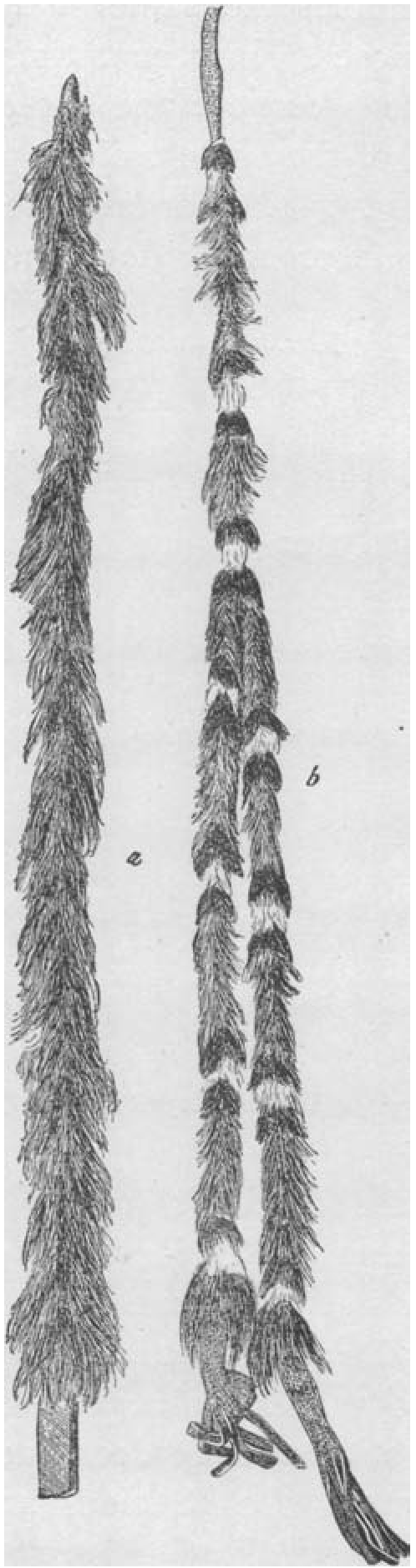
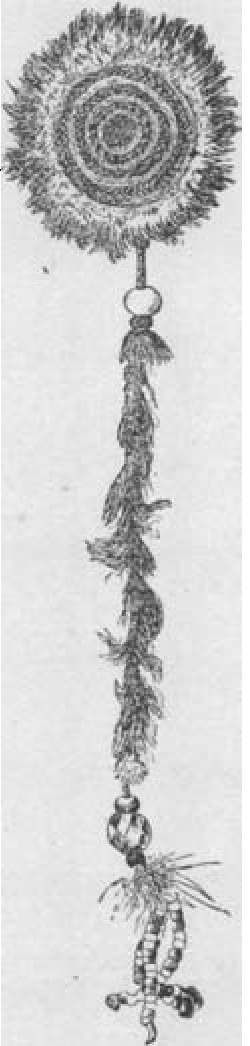
The soft fur of the young of the spotted seal is dyed a handsome red color by using the inner bark layer of the larchtree, boiled with alderbark. This skin is cut in narrow strips, which are sewed together in long thin tassels for the adornment of clothes, sledge-coverings, etc. (Fig. 148, a, b), often with a bead or two on the upper or lower end, as shown in Fig. 149. A small round piece of skin to which a tassel is fastened is used as an amulet.

Long tassels made of strips of brown leather, with white ringlets sewed[222]🗗uncollated on at intervals (Fig. 150, a), or tassels of small strips of fur alternately white and black (Fig. 150, b), are likewise used as amulets or to adorn objects connected with shamanism.¹
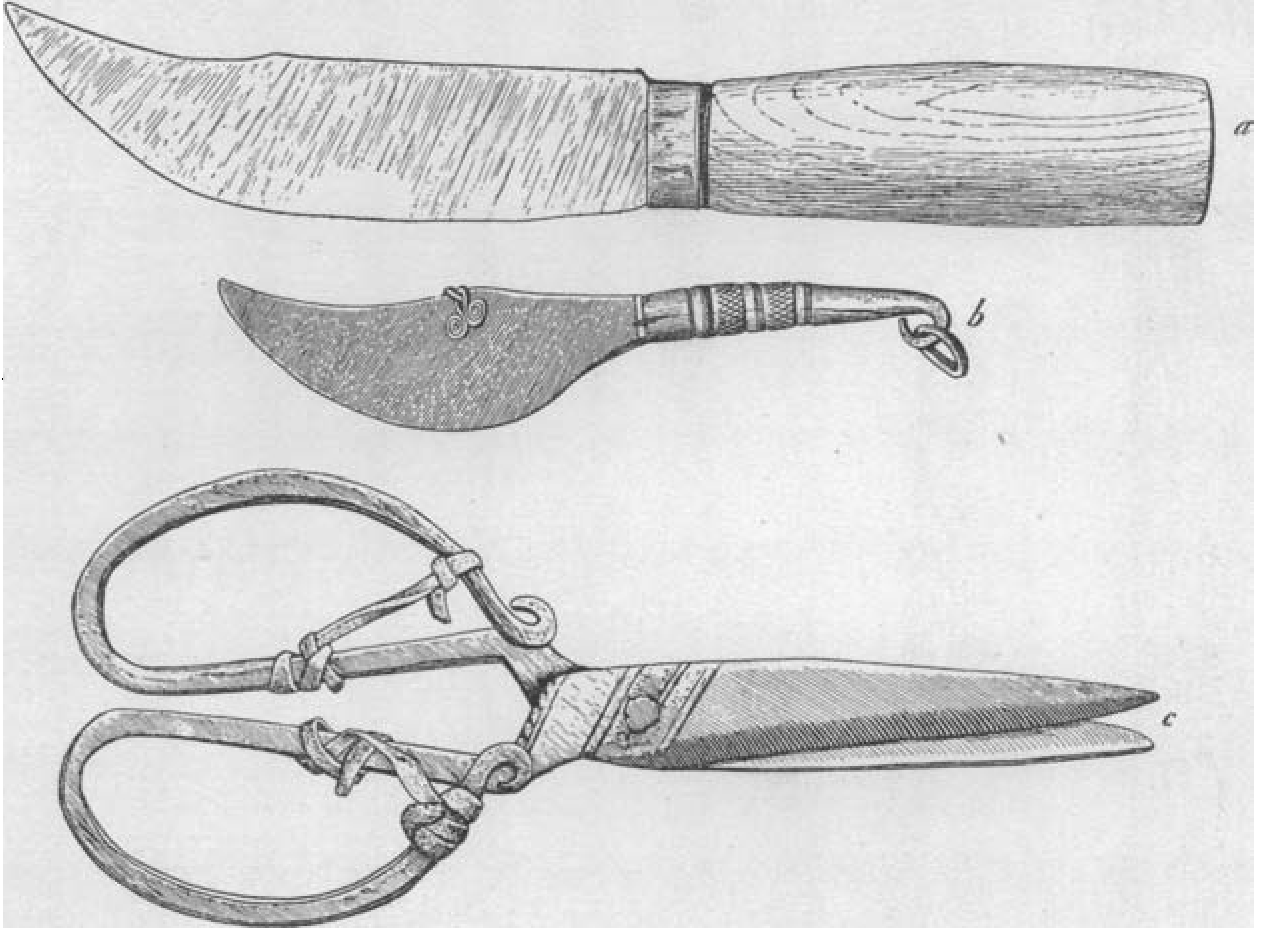
TAILOR-WORK. — For cutting skins in making garments a special knife is used. This knife is called the “woman’s knife” (ñaˊwan-wal, a word which resembles the name of the Eskimo knife used for the same purpose). In recent times this knife is made of iron. The blade is curved, and rather broad in the middle. The handle end of the blade projects as a small stem, which is set in wood (Fig. 151, a) or fashioned into a handle (Fig. 151, b). This knife probably developed from the same stone implement as the butcher’s knife. It may have been copied, however, from the Russians, whose women on the Kolyma and Anadyr use the same kind of knife for tailoring, and have a special Russian name for it, палемка (palemka), diminutive form of пальма (palma), which means a peculiar small-sized lance with a one-sided blade of palm-leaf shape, much in use among the Russians and the Yakut.
The tailoring-knives in use among the Reindeer Chukchee are either of Russo-Yukaghir or of Maritime Koryak make. The Maritime Chukchee generally employ American cutlery for this purpose.
[223]🗗uncollatedScissors used throughout northeastern Asia are of a peculiar pattern, common to the Amur tribes, and originating in China, as may be seen by comparing Fig. 151, c, with specimens in the Chinese collections of this Museum.
Tailoring-boards of various sizes, and rather long and narrow in shape, are used. The smaller among them are also employed to cut tobacco-leaves and wood-fibre on, in preparing a convenient mixture for smoking. They are almost always plain among the Chukchee, while those belonging to the Lamut or the Yukaghir are often decorated with engraved designs.
Only iron needles are used at present. In sewing hard leather, especially the soles of boots, needles with three edges are preferred, because they pierce the leather more easily. When short of these needles, the women soften the steel of the large round needles, and then hammer them with a stone into the required shape.
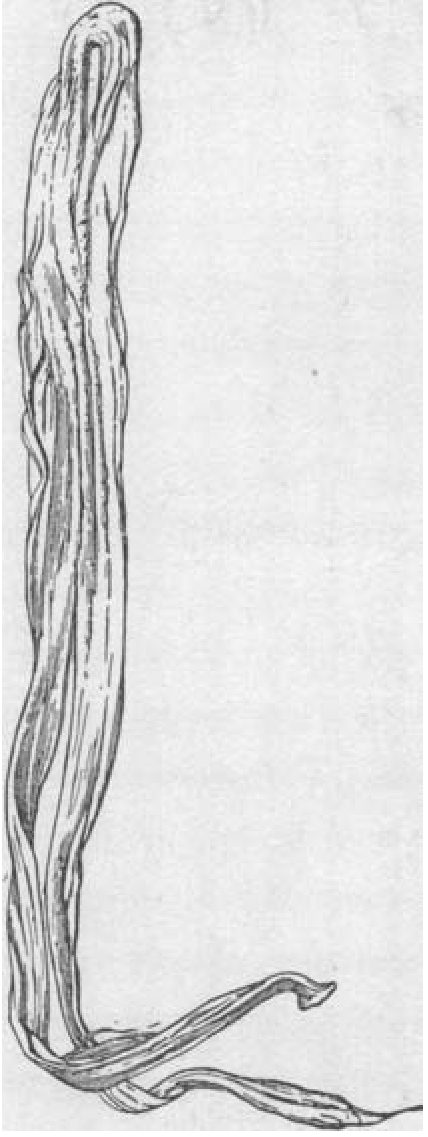
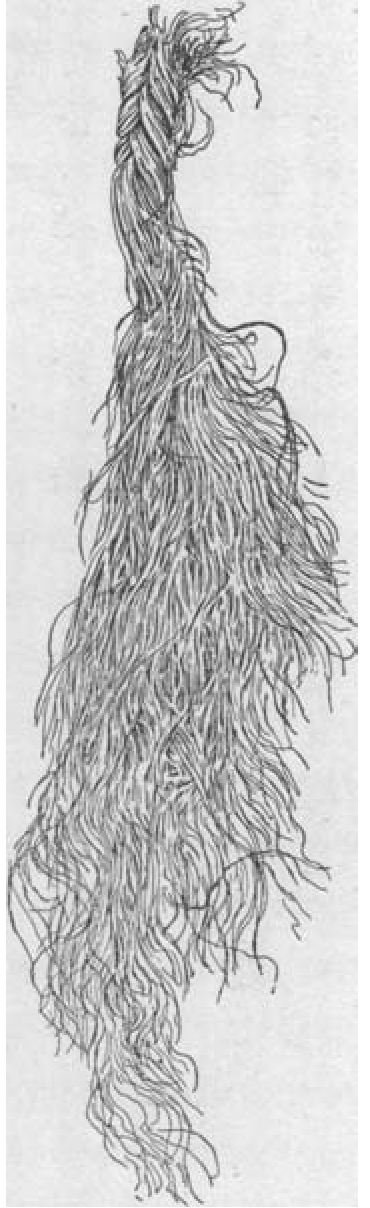
Thread is made of sinew of the reindeer’s back, which is dried (Fig. 152), then pounded with a hammer, and separated or combed into thin shreds not unlike the fibres of hemp (Fig. 153). The shreds can be easily twisted to a neat strong thread of any length desired. One end of the thread is tied in a knot, and the other worked out very fine for inserting into the eye of the needle. The needle is threaded in Eskimo fashion with a kind of loop, the thin end of the thread being pulled through the eye only a short distance, and twisted around the main thread (Fig. 154).
The women usually sew by pulling the thread towards them, and make an overcast seam.

The thimbles used at present are for the most part made of iron (Fig. 155, a¹), and are bought from traders. They are of the plainest kind, and are open at the ends. Ivory thimbles of the same pattern are made by the Chukchee, the Koryak, and the Kamchadal (Fig. 155, b, d¹). Leather thimbles in similar shapes are also used (Fig. 155, c¹).
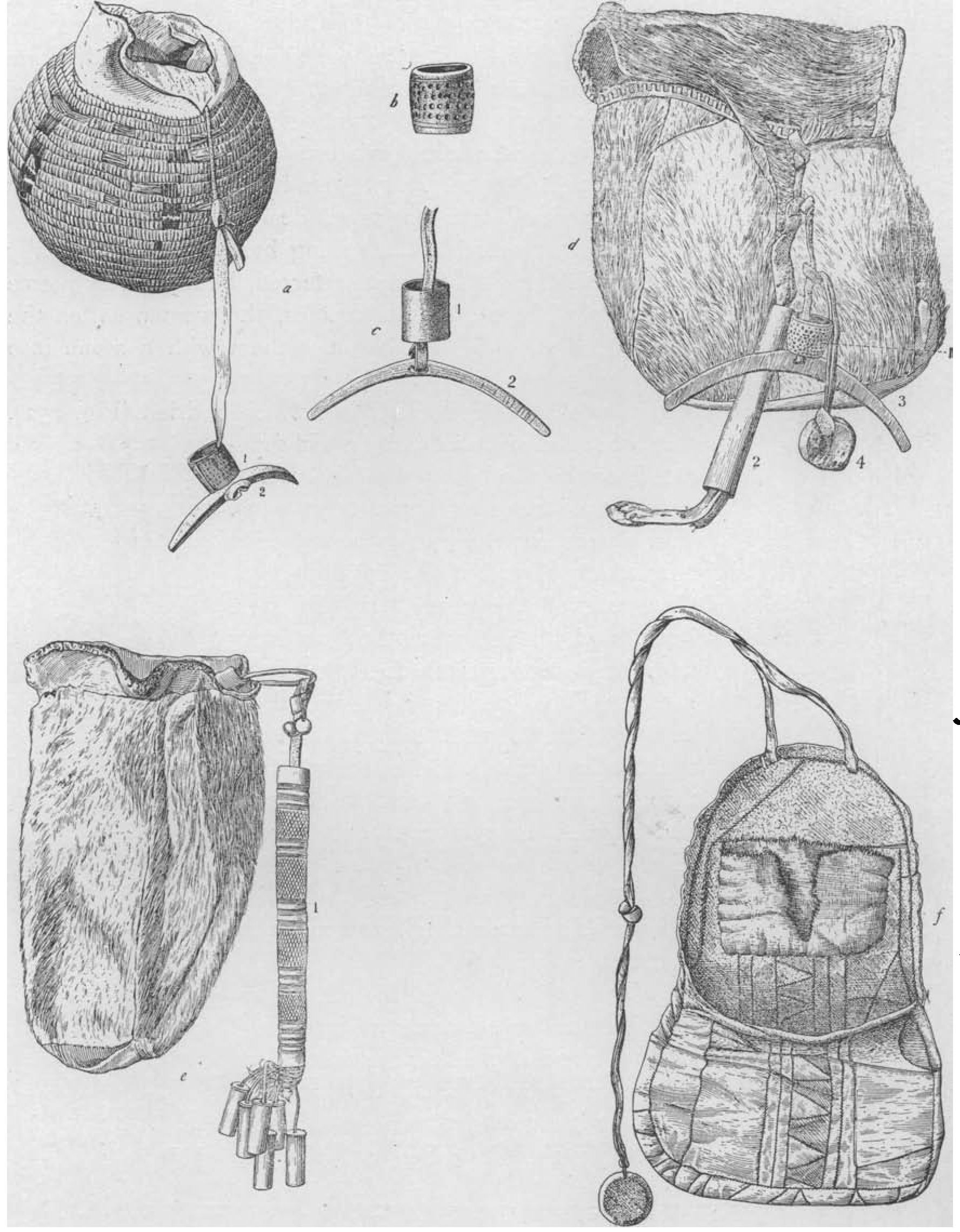
Needle-cases are made in Eskimo fashion, but always of iron or copper. They are long, thin tubes¹ (Fig. 155, d², e¹), inside of which the needles, thrust into a piece of rag or of thin leather, are kept.
The thimble is slipped on a thin strip of leather fastened to the needle-case, and prevented from falling by a thimble-guard generally made of iron (Fig. 155, d³), but sometimes of ivory (Fig. 155, a², c²).
Rude work-bags are made of the curried leather of the leg-skins of reindeer or of plaited grass (Fig. 155, a, d, e), occasionally adorned with a few pendants of beads or of iron. Their patterns are in general similar to those used by the American Eskimo. The Russianized Yukaghir have work-bags similar in shape to those of the Alaskan Eskimo. Both may be imitations of Russian patterns. Some are made in the Russianized settlements of Anadyr and Kolyma for sale to Chukchee women at the small fairs, and these are now and then imitated by them. A work-bag is represented in Fig. 155, f, which should be compared with one figured by Nelson.² When folded, it has a shape similar to another represented by the same author;³ but in place of a buckle a small round pebble is used.
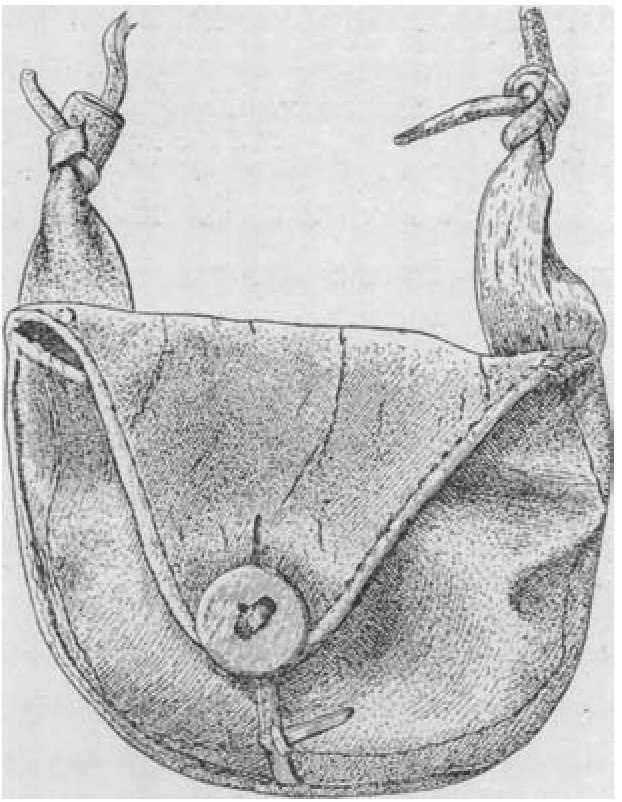
Pouches for holding snuff-boxes and sundry small implements are often worn on the belt (see Plate XXIII, Fig. 1). Their shape resembles that of American Eskimo specimens. For instance, that represented in Fig. 156 is similar to specimens from Alaska in the National Museum at Washington. Other pouches and small bags are made of a seal’s flipper or of a swan’s foot. Instances like this are met also on the American shore.
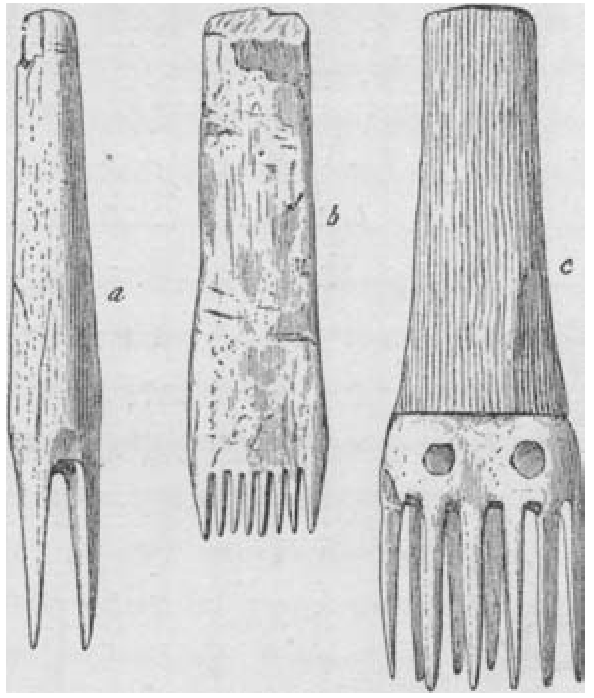
Bone or ivory combs are used for shredding grass needed for insoles, and for preparing sinew to be used as thread. Usually the combs have two prongs Fig. 157, a), and are shaped quite like those used in Alaska.⁴ Some, however, have several prongs (Fig. 157, b) or a circular head with prongs around it and a wooden handle inserted (Fig. 157, c). These are more like other kinds of Eskimo combs used for removing loosened hair from skins.⁵
[226]🗗uncollatedEMBROIDERY. — Skin clothes are ornamented in two ways, — either with embroidery or with appliqué work, formed, like a mosaic, of small squares of black and white skin cut out for the purpose and sewed together piece by piece (see Plate XXI, Fig. 1). In both branches of this ornamental work the women of the Chukchee have but little skill, while those of the Koryak and of the Russianized Yukaghir display considerable taste and great patience. Embroidery is done with the long hair of the reindeer-mane, which is white in color. Often it is dyed red with alder-bark. Thin sinew thread is used for the same purpose, as are also long narrow strips of soft white leather. Koryak women and Russianized native women also use woollen thread and silk bought from traders.
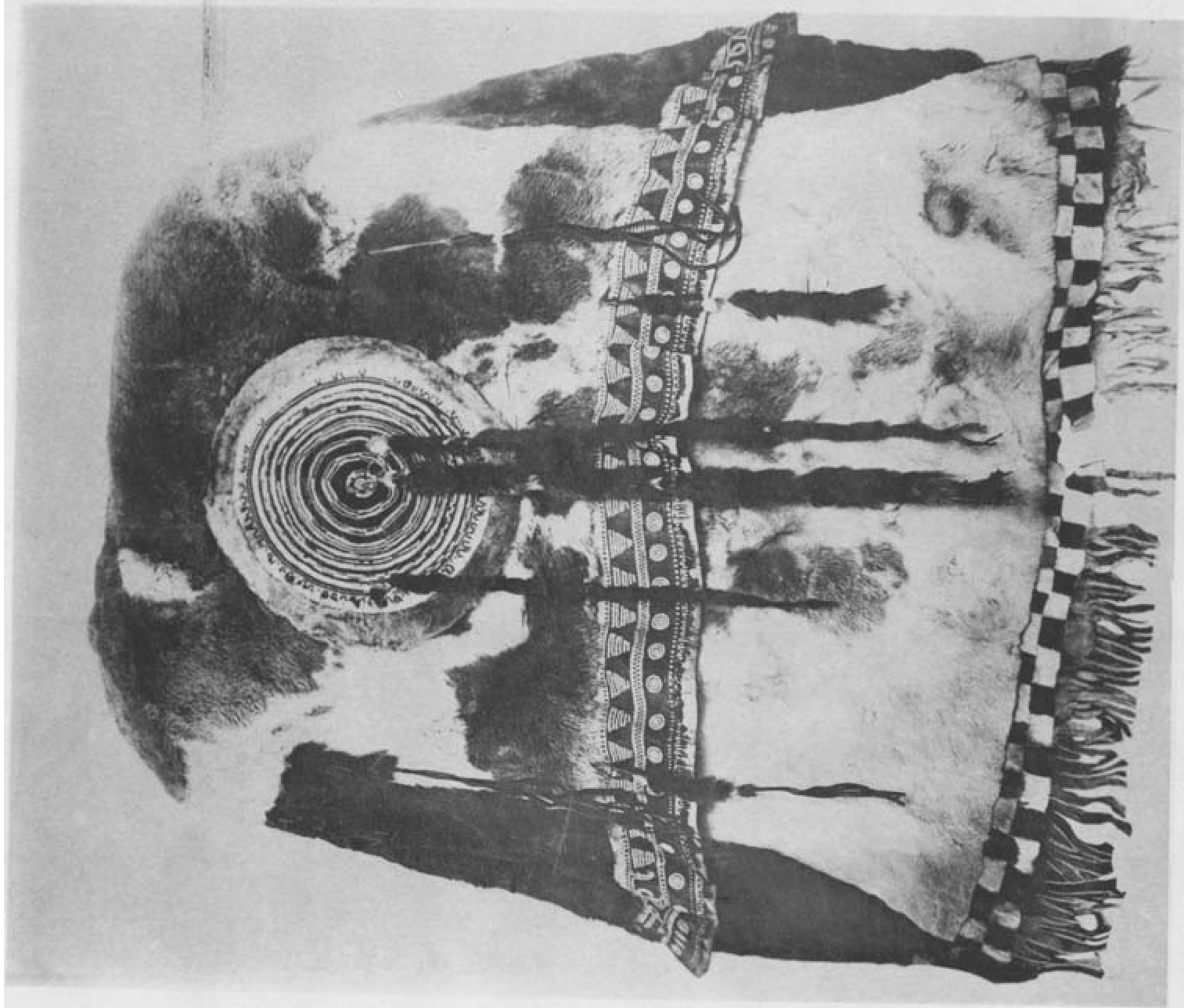
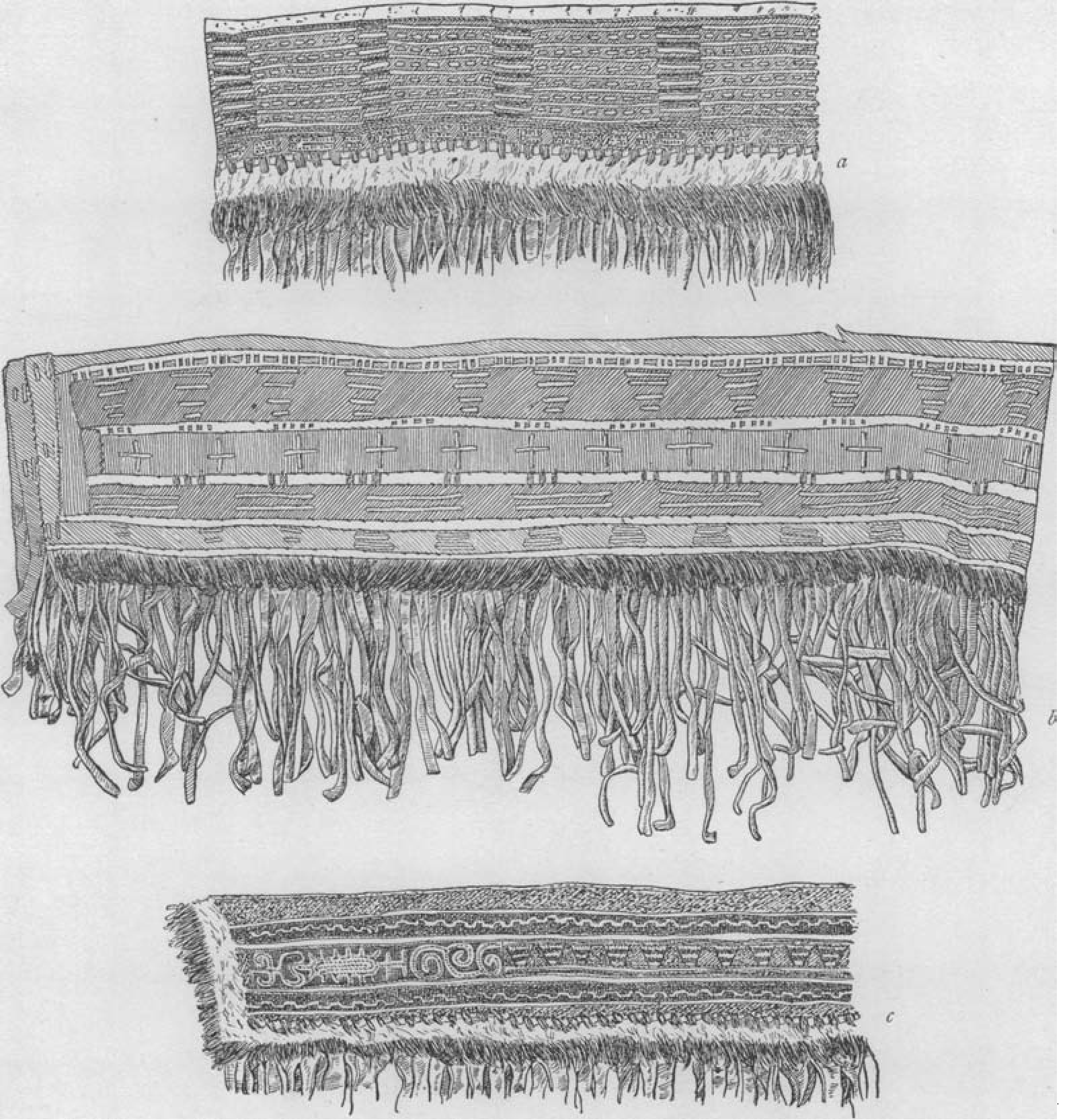
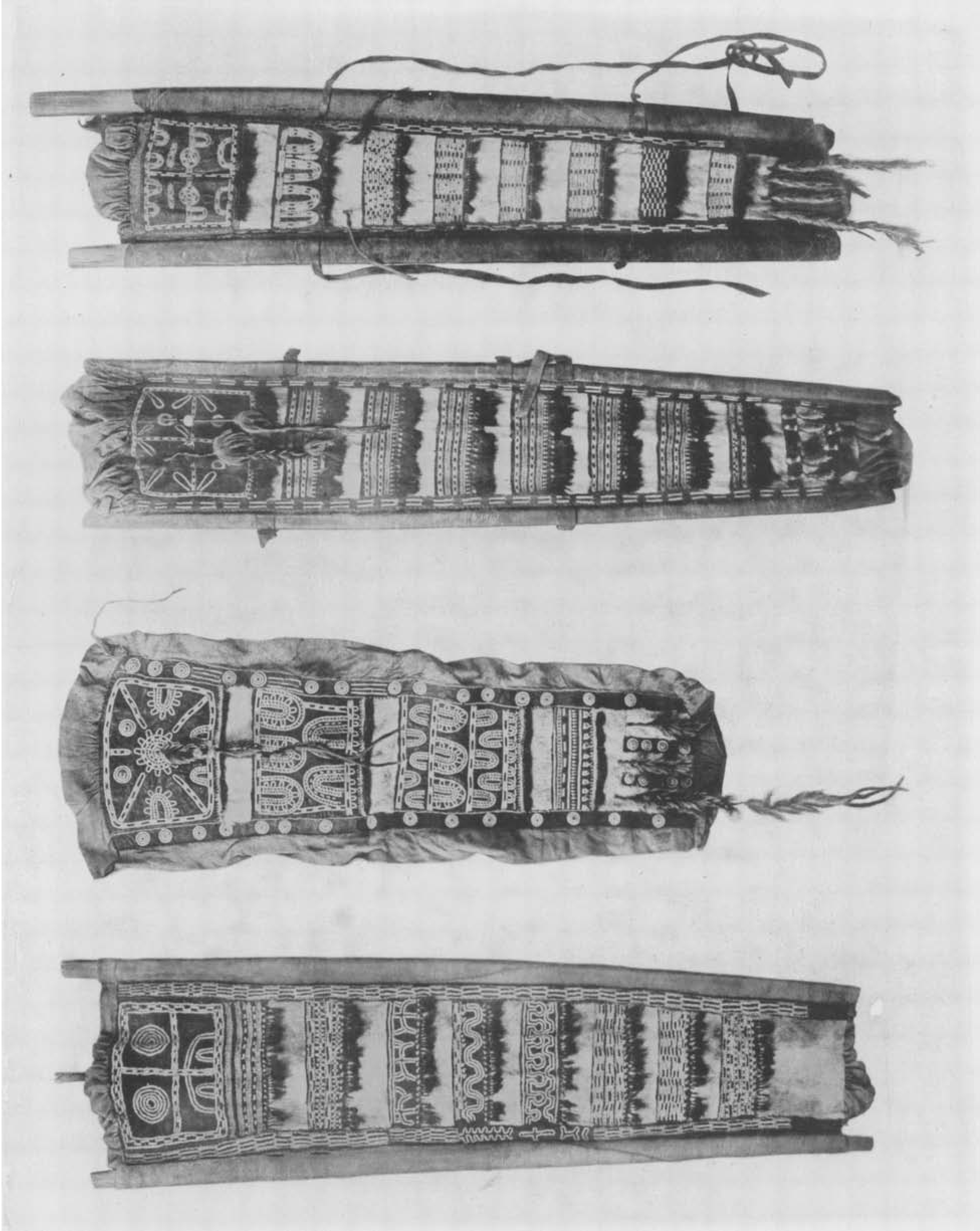
The embroidery patterns used by Chukchee women consist of a few very simple geometrical figures, chiefly straight lines, crosses, and circles, single or double. The circles are said to represent stars. All these figures may be seen on various pieces of embroidery (Plate XXI, Figs. 1-4; also Fig. 158, a-c). Occasionally they embellish the trimming of the “dry-shoes,” the opening of the sleeves, or the backs of women’s frocks, where tassels are fastened.
The Reindeer Chukchee women embroider the covers of their family sledges according to their skill. These covers have around their lower part a broad band of leather embroidered with various geometrical designs, and trimmed with fringe and red-dyed fur tassels (Fig. 158, a-c).
The triangles seen in Plate XXI, Fig. 1, and in Fig. 158, c, were said to represent mountains; and the zigzag-like lines in Fig. 158, c, were explained as rivers. A part of the design in Fig. 158, c, is apparently copied from the engraving on the iron spear-points, the pattern of which, as noted before, came from the south.
I could not find a single woman able to give full explanations of her own patterns; so that, if they ever had a meaning, it is forgotten by this time.
Above the band on the back part of the cover is fastened a circle about twenty-five or thirty centimetres in diameter, covered all over with embroidery. This is called “the sun,” the same name which the Lamut women give to the round metal breastplates that form part of their festive costumes. This round piece clearly represents the sun, which is often embroidered in the middle, and is easily recognized by the prominent rays spreading out from the centre of the circle (Plate XXI, Figs. 3, 4). The tassels which are sewed on in the centre of the sun or all around the disk also represent the rays. The sun is surrounded with many concentric circles, which indicate different worlds. In some of these worlds are seen flying birds and shining stars. The birds are represented by crosses; and stars, by small circles (Plate XXI, Fig. 4). Once in a while a sun-picture is replaced by a moon-picture, which is made in white or red, and crossed with several diagonal lines.
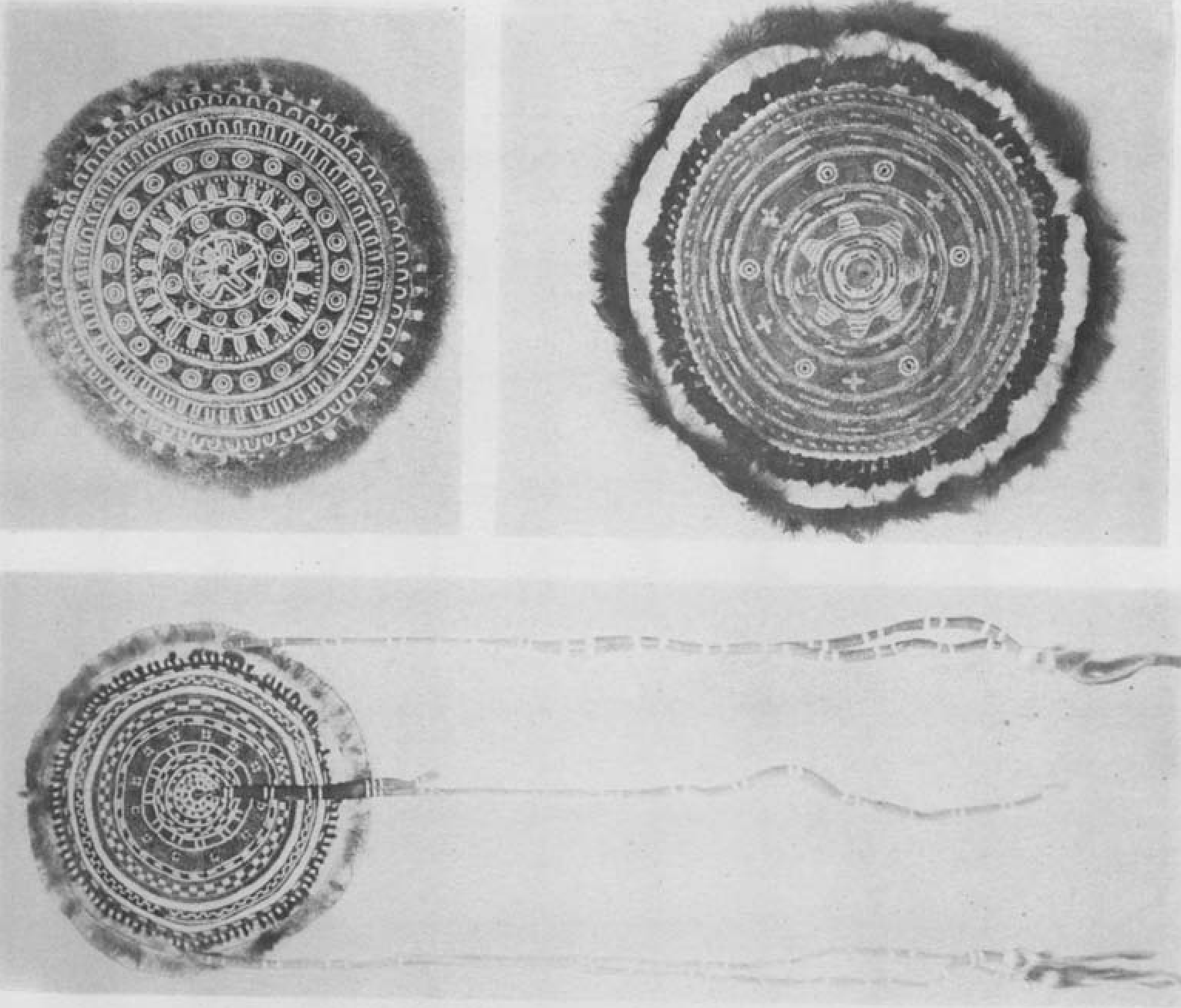
The Asiatic Eskimo adorn their fur shirts with a band of embroidered[227]🗗uncollated trimming, but this is only a clumsy imitation of the fine work of the Russianized natives. The cartridge-pouches and belts of the Eskimo are also embroidered, while those of the Chukchee are for the most part plain. The quivers of the Reindeer Chukchee, of which there are several in the collection, are also decorated with elaborate embroidery (Plate XXII). The meaning of these figures could not be ascertained, because the work belongs to a former generation. No quivers are made now. These embroidered designs, in their general character, resemble the drawings of the Chukchee, which relate to religion and ideas of creation;¹ and it is possible that the embroidered patterns in question have reference to some cosmogonical ideas.
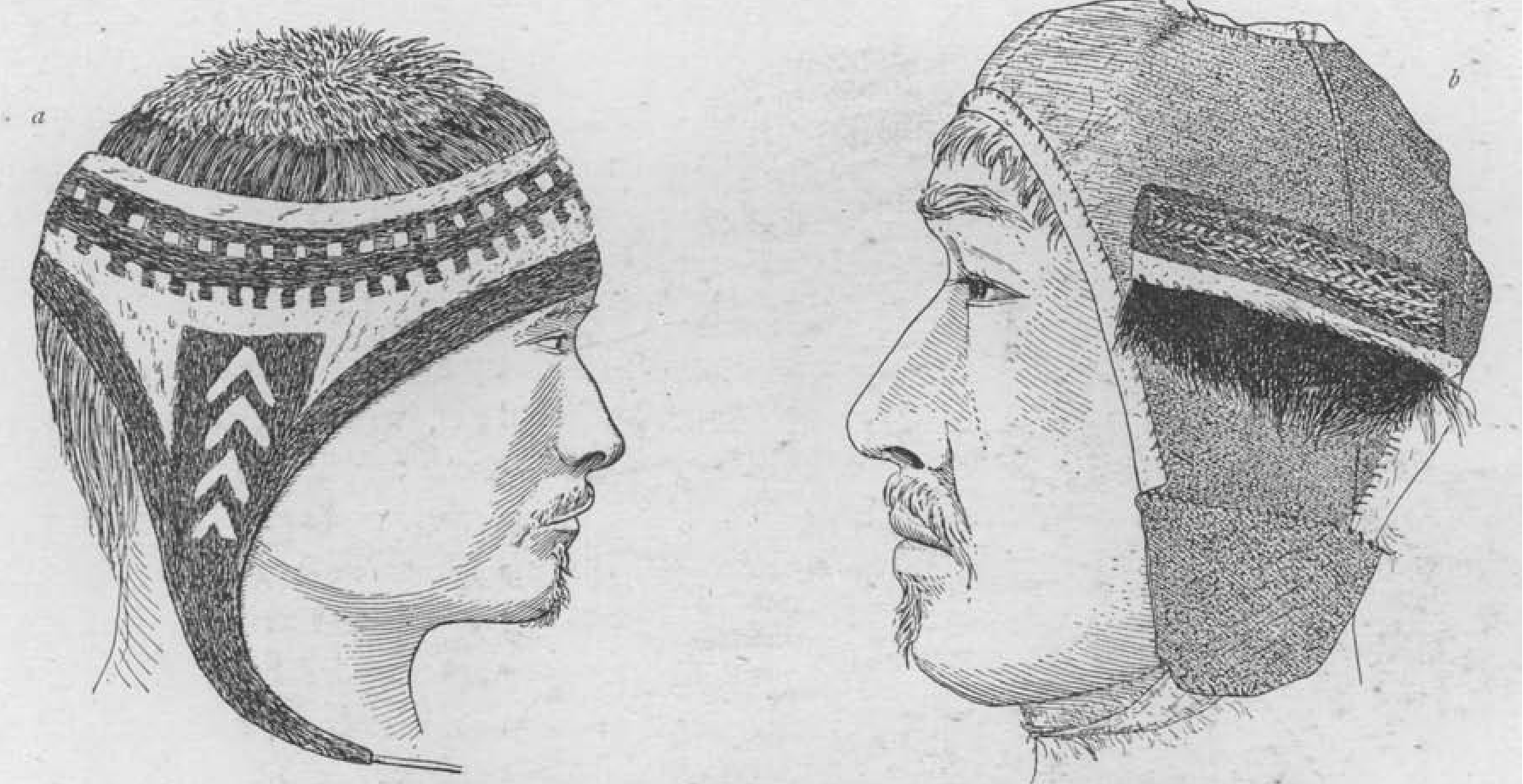
[228]🗗uncollatedAs to patterns formed of square pieces of skin, the Chukchee women make but very few, using them to decorate caps, hoods, leg-openings of trousers, the upper edges of boots, ear-laps (see Fig. 183, a), etc. Among the square pieces of skin they may insert a small bit of red flannel. The whole work is crude and irregular. The patterns made by the Koryak women are much more elaborate. The collections include a coat of Koryak make, with a large band around the skirt formed of several thousand small squares sewed together with untiring patience.
Embroidering with beads is practised very little. Pouches for tobacco and strike-a-lights are often adorned with beads, but most of these pouches are bought either from Lamut or from Alaskan Eskimo. I found among the Reindeer Chukchee a pouch which undoubtedly came from the Athapascan Indians. Chukchee work of this kind is a mere imitation of foreign patterns.
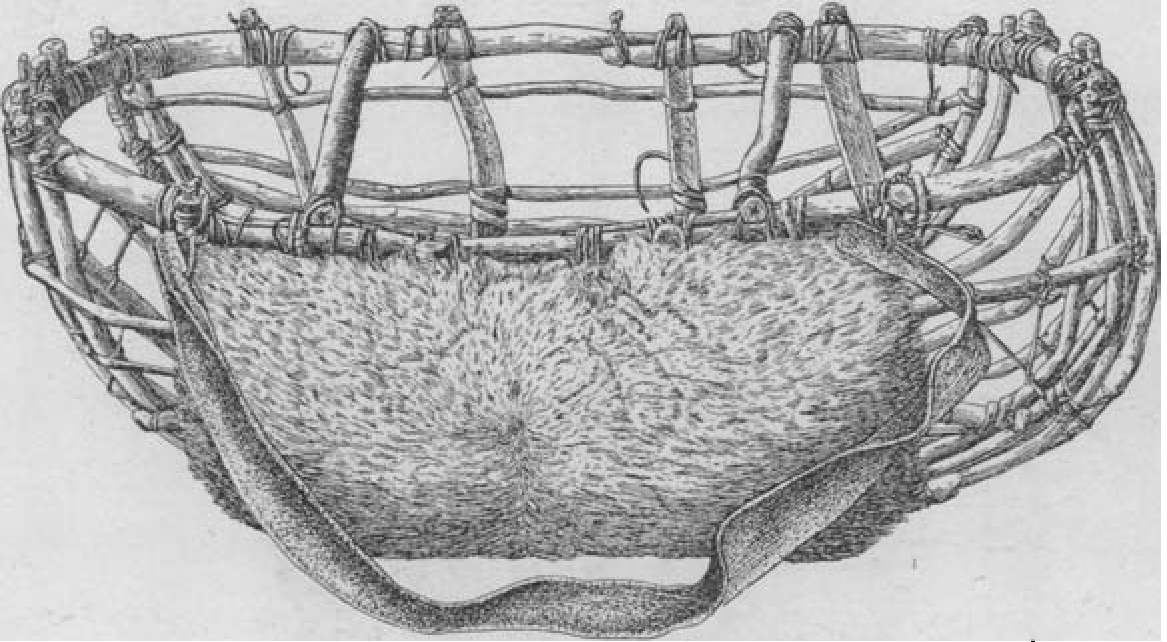
BASKETS AND TRINKET-BOXES. — The work of the Chukchee in mats and baskets is exceedingly limited. I have mentioned rough mats made by the Reindeer Chukchee for covering the ground in their sleeping-rooms. At the mouth of the Anadyr River baskets almost as crude are made of willow-branches, for carrying fish (Fig. 159). One or two of the Chukchee living on the Middle Anadyr make better baskets of willow-roots, but the style is wholly copied after the work of the Russianized natives of Markova.
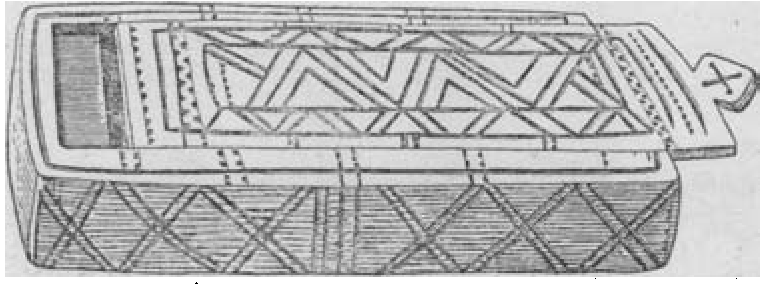
Small trinket-boxes are occasionally made of birch-wood, but for the most part are bought from the Lamut or the Russianized natives. Fig 160 represents a trinket-box of Lamut make, in the shape most common among all the tribes of northeastern Asia. It is covered with geometrical designs, and its form is quite similar to that figured by Nelson.¹
THONGS AND CORDS. — Thongs and lines of various kinds are made of skins, which are generally cut in a spiral from the circumference to the centre, so that the whole skin makes one long line.[229]🗗uncollated The poorest of the larger reindeer-skins, those not fit for any other purpose, are clipped of hair with a sharp knife, and then cut into a narrow strip less than half and inch broad. The skins are cut when fresh, or, if dry, they are dipped in water to make them softer and more pliable. The line is stretched out of doors, made as taut as possible, and allowed to dry. This kind of line is called a “leather line” (ñilhɪˊlhɪn). Among the Reindeer Chukchee it is used for almost every kind of lashing. The best line of this kind is made of the skin of old wild reindeer-bucks. The neck part is so thick that it might be used for boot-soles, and the line made of it is quite strong. When plaited, it is used for lassos (see Fig. 162, a). The Maritime Chukchee prepare a similar kind of thin line of the skins of smaller seals. It is called “seal-skin leather” (mêmɪčêˊčhɪn), and it is better in quality than the reindeer-skin line.
The skill of the natives in cutting the skin into narrow lines is very remarkable. Usually one man holds the hide and the line near the cut, and pulls them toward himself, while another makes the cut by steadily drawing towards himself a knife held in an upright position. For a hundred feet of line the hand of the cutter will not change its regular motion or swerve from the proper direction. The entire line seems of exactly the same width.
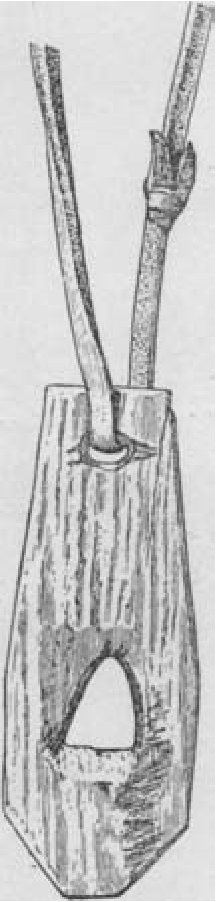
Stouter line is made of the skin of the ground-seal and of walrus-hide. These are cut in the manner described, either fresh or dry. The line is usually from an inch to an inch and a half broad. The line made of ground-seal skin (uᵋnečiˊčhɪn, “ground-seal leather”) is best in quality. That of the walrus-hide (rɪrkaˊ-ñêˊlhɪn, “walrus-line”) becomes flabby with moisture, and wears out more rapidly. The hide of young walrus gives a line of much better quality. The ground-seal skin line is often dyed black with soot mixed with oil, to make it stand the dampness better. When freshly cut and dried, the line is almost as hard as wood. To make it more pliable it has to be chewed all over, in which process it usually increases in breadth. After that, it is drawn with considerable force across the edge of some immovable object, like the runner of a heavily loaded sledge or one of the larger tent-poles. A special implement of bone or antler is sometimes used in this process (Fig. 161). It contains a hole with sharp edges, through which the line is repeatedly drawn. By means of another hole in the top, the implement is suspended from the house-frame.
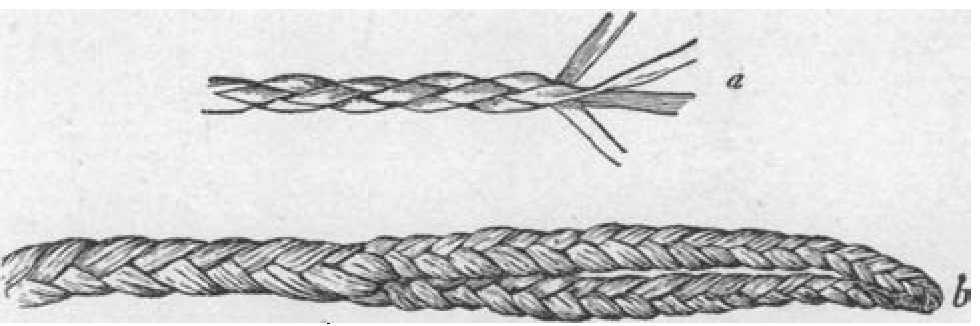
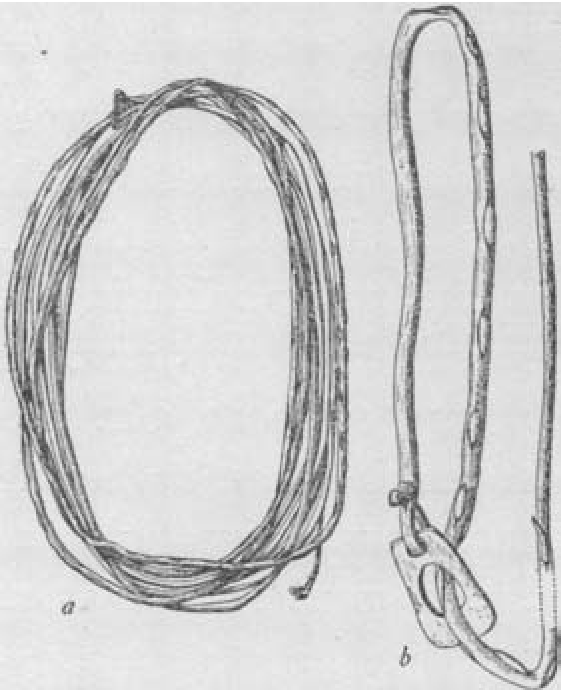
For lassos, tent-ropes, and various kinds of cord, the Reindeer Chukchee and the Lamut often use thin plaited “leather line” (Fig. 162, a) or plaited sinew (Fig. 162, b). The sinew of the legs is chiefly used, because it is too coarse for making thread, but it wears better than the sinew of the back. The twisting is done by hand. The sinew or reindeer-skin rope is often smeared with oil[230]🗗uncollated and smoked over the hearth for a day or two to make it less susceptible to moisture.
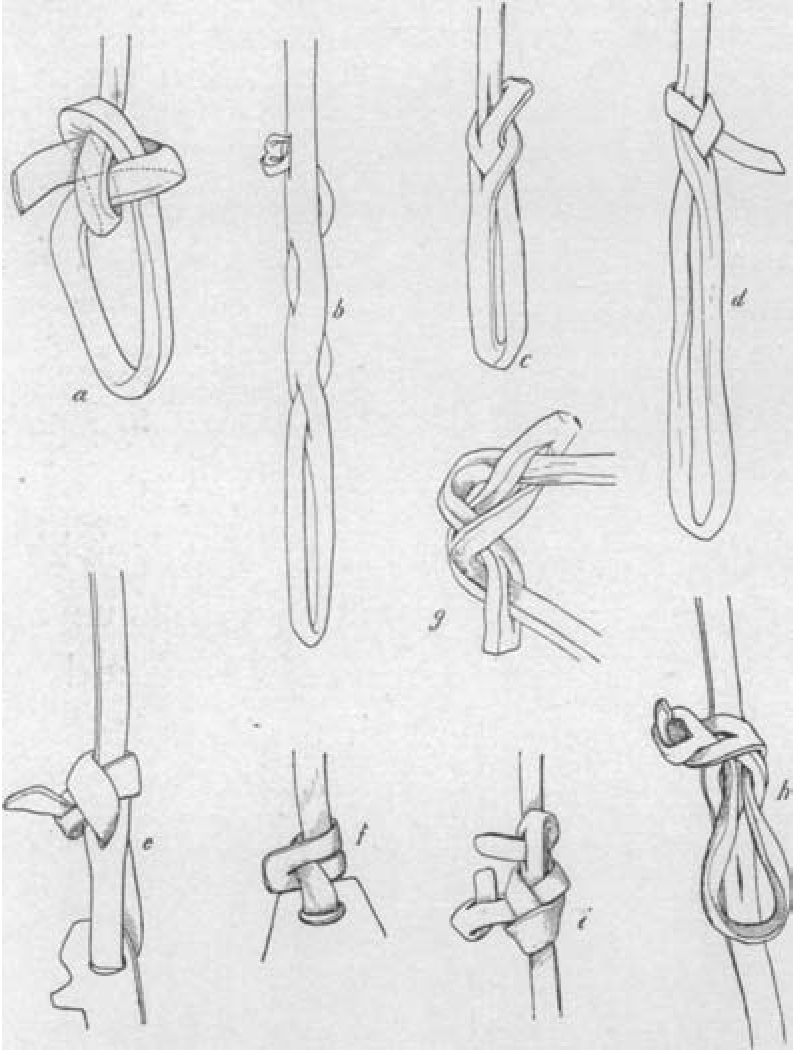
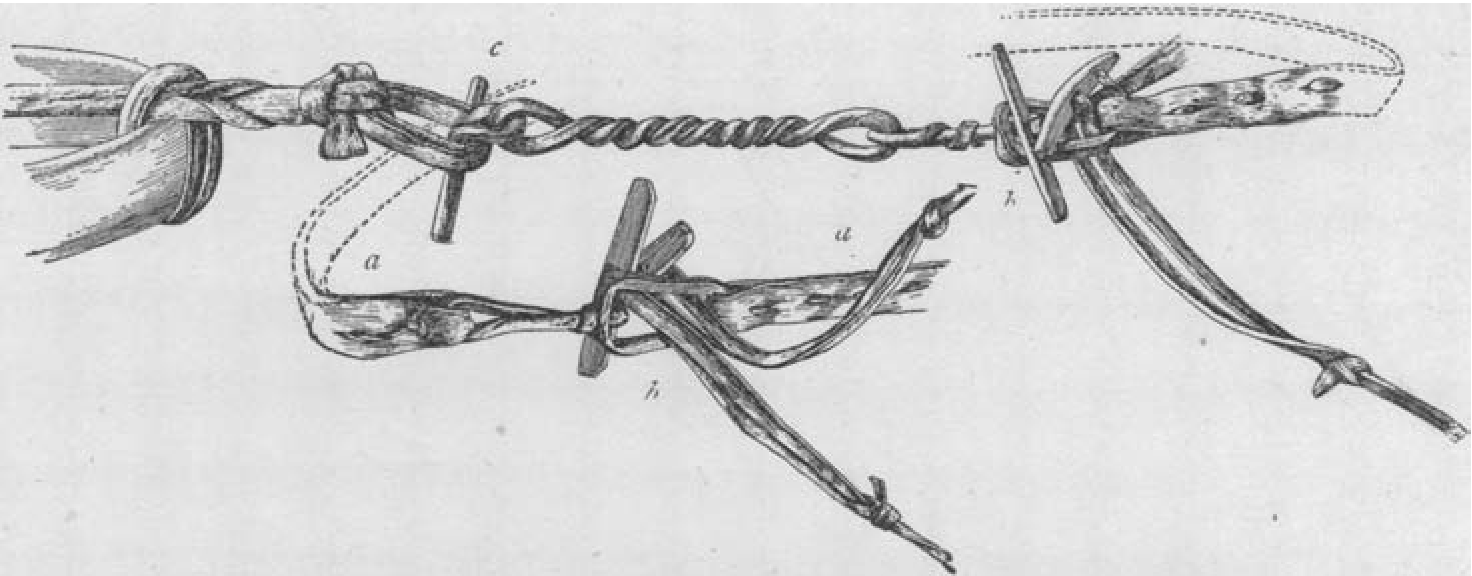
Most of the knots in use among the Chukchee are either identical or very similar to those used by the American Eskimo. For instance, those represented in Fig. 163, a-d, are identical with those figured by Boas.¹ In Fig. 163, e is the same as d, with the addition of the peculiar tied-in toggle on the free end of the line, which is a characteristic feature of many Eskimo knots. In Fig. 163, f is a variation of d; g is a splice identical with Fig. 44, n, of “Baffin-Land Eskimo.” Fig. 163, i, is a variation of Fig. 44, m, of “Baffin-Land Eskimo.” Fig. 163, h, represents a thong eye spliced with a line in true Eskimo fashion.
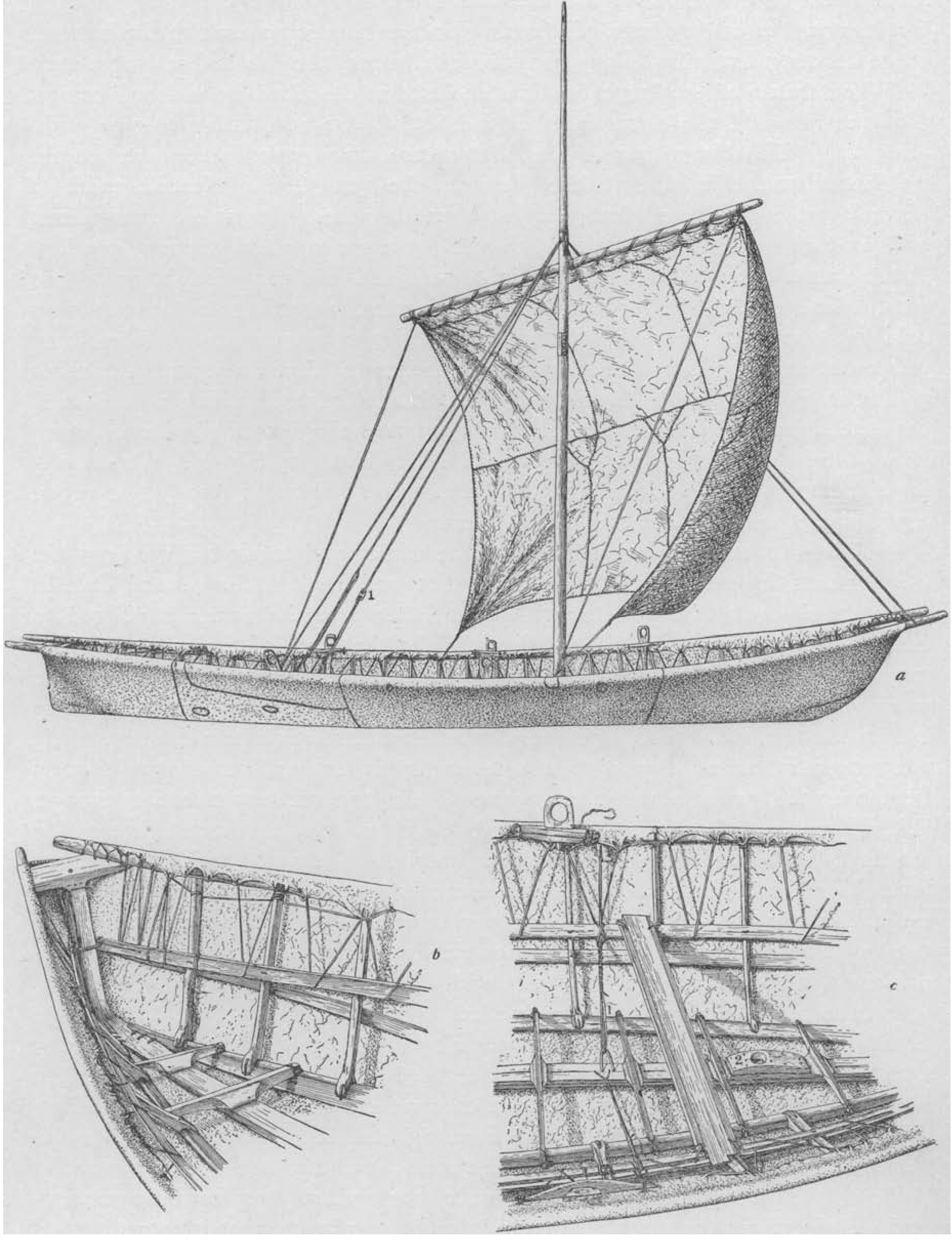
Fig. 164, a, shows the way to splice a thin line with a thicker piece of thong. It is employed on reindeer-halters to make their inner side — the part touching the forehead — rougher, thus assisting the action of the ivory prongs in making the animal turn around.
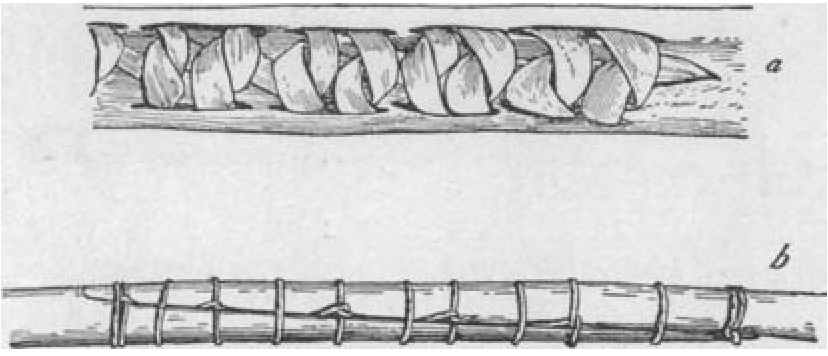
Fig. 164, b, shows the method of splicing two ends of a broken stick. It is used on reindeer-whips, and is mentioned also on p. 157.
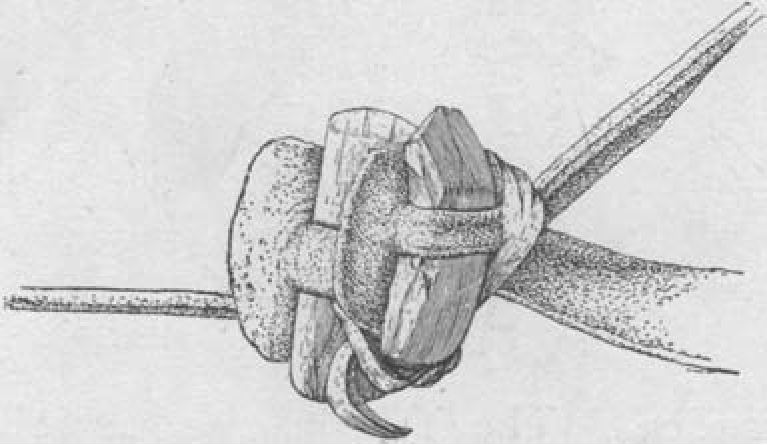
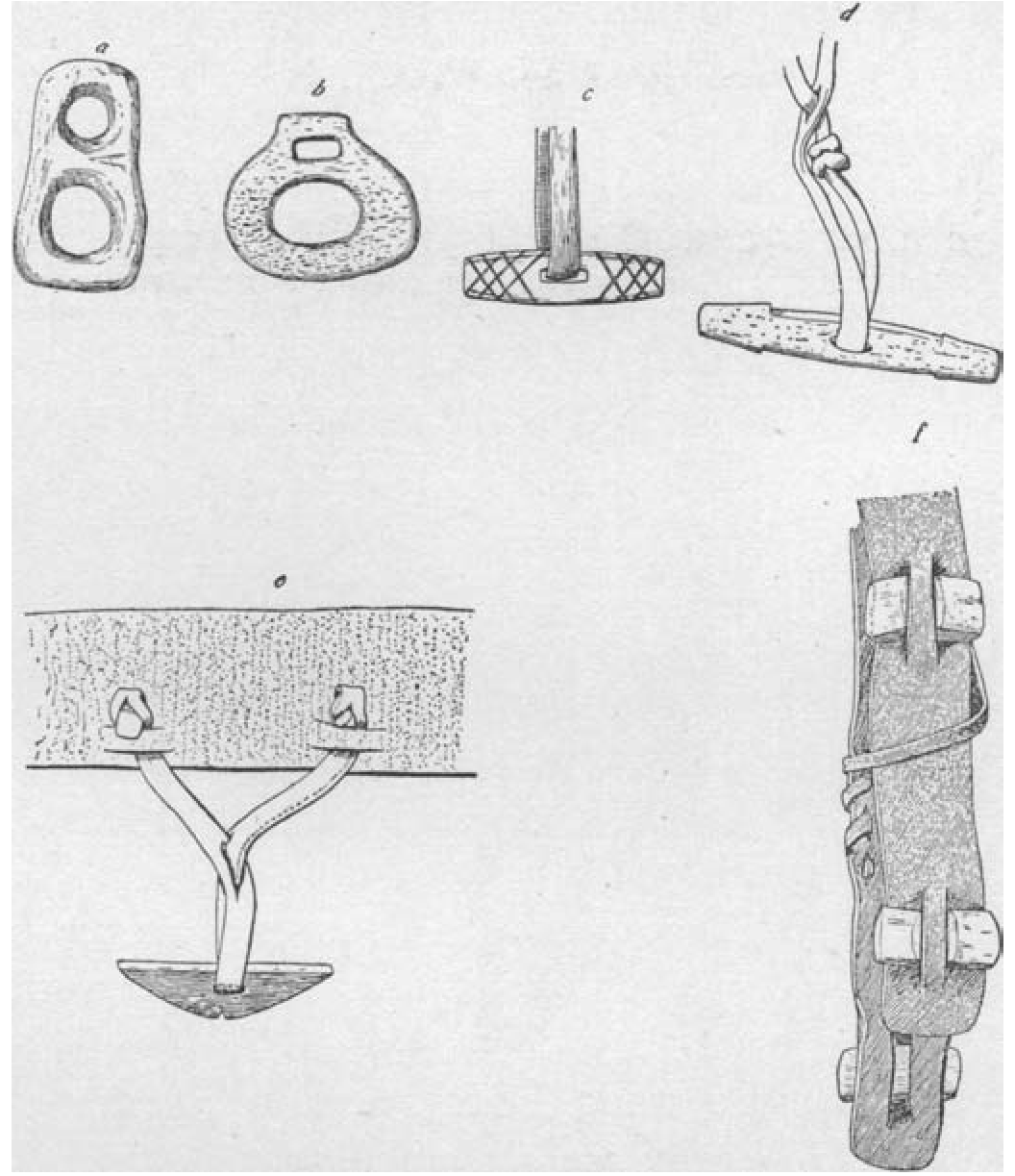
Fig. 165, a-f, shows patterns of buttons and eyes used for various purposes. For other buttons and eyes see Figs. 5, 11, 23, 25.
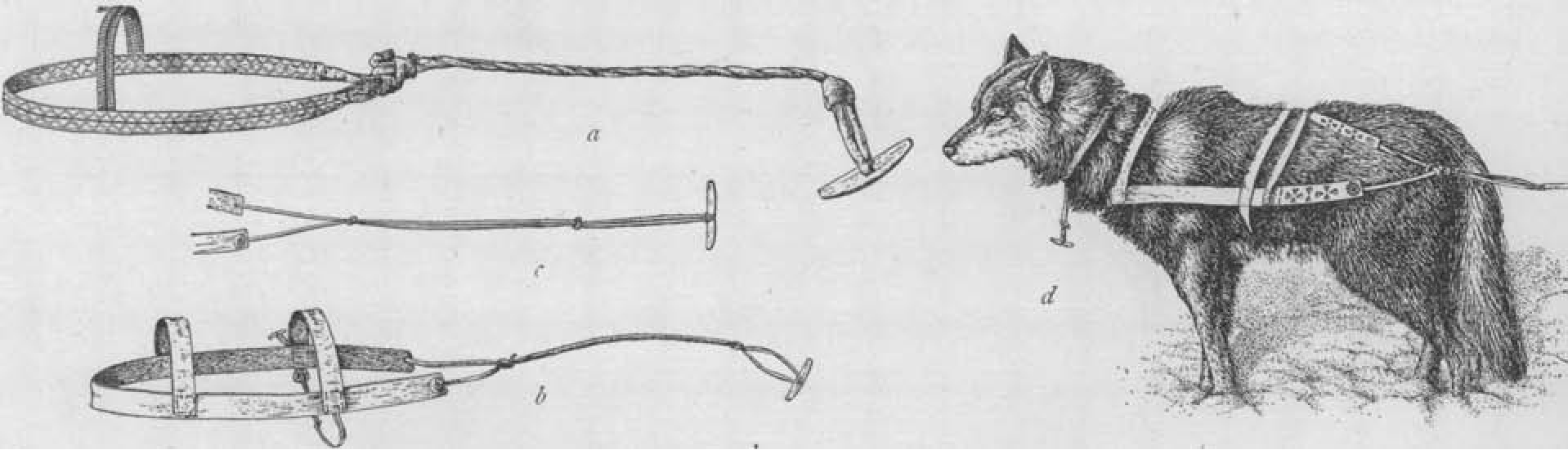
FIRE-MAKING IMPLEMENTS. — The fire-drill, even at the present time, offers one of the chief means of kindling fire among the Chukchee. It is not certain, however, whether the people of northeastern Asia did not formerly also use[231]🗗uncollated pyrites and flint for the same purpose. Yukaghir tradition says that the “first ancestor” used to get fire by striking together two stones. One old man related to me that the spark was caught in a tiny sulphur-dish in the same way as is now done. The sulphur at present is bought from Russians, but the natives say that in former times sulphur was found in the Anui Mountains and near Baron Korff’s Bay. In a Chukchee creation-myth the Raven first drills fire out of his right foot, by means of his forefinger, then strikes it out of his two thumb-nails.¹ At the present time, however, the strike-a-light, though quite prevalent among the Chukchee, is made of steel and flint, and bought from Russians or Americans.
Among the Maritime Chukchee the fire-drill (uˊttɪ-miˊlhɪmil, “wooden fire-tools”) has gone out of use. Among the Reindeer Chukchee it is still the only means of starting the sacred fire used in many ceremonials. It is also employed in remote places in ordinary life, when the household finds itself without touch-wood, which is necessary for use with flint and steel.
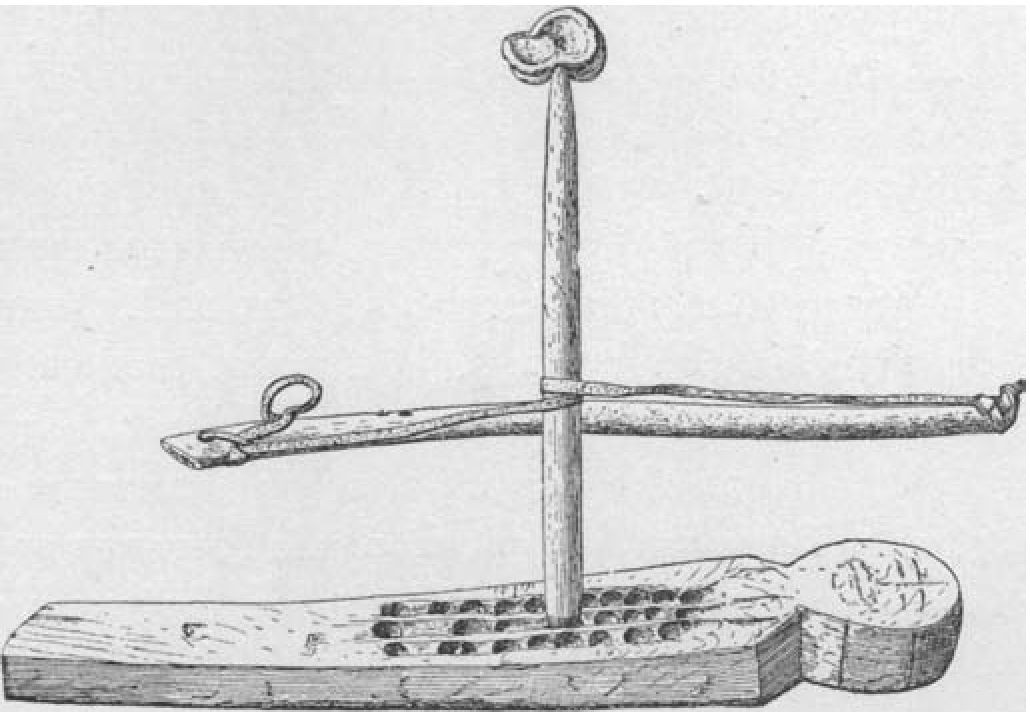
The fire-drill has the same shape both among the Reindeer Chukchee and the Reindeer Koryak (Fig. 166). It consists of a board roughly shaped, usually in[232]🗗uncollated human form (g̣ɪˊrg̣ɪr), a round wooden drill (ñiˊläq), an upper piece (ñɪrg̣ɪčɪčoˊčin), and a bow (tɪñuˊčin) separate from the drill.
I am not aware of a pump-drill being used for making fire by the Chukchee, as is stated by W. Hough.¹ The fire-drill board for every-day use sometimes has no particular shape, the real g̣ɪˊrg̣ɪr being kept for ceremonials. The board and the drill are usually made of the same wood, on the Arctic coast more frequently of Canadian pine, which is found everywhere along the shore in the driftwood. In the interior they are made of poplar and aspen. To work successfully, both parts must be completely dry. Therefore in damp weather the Chukchee women sometimes have considerable trouble in obtaining fire with this implement.
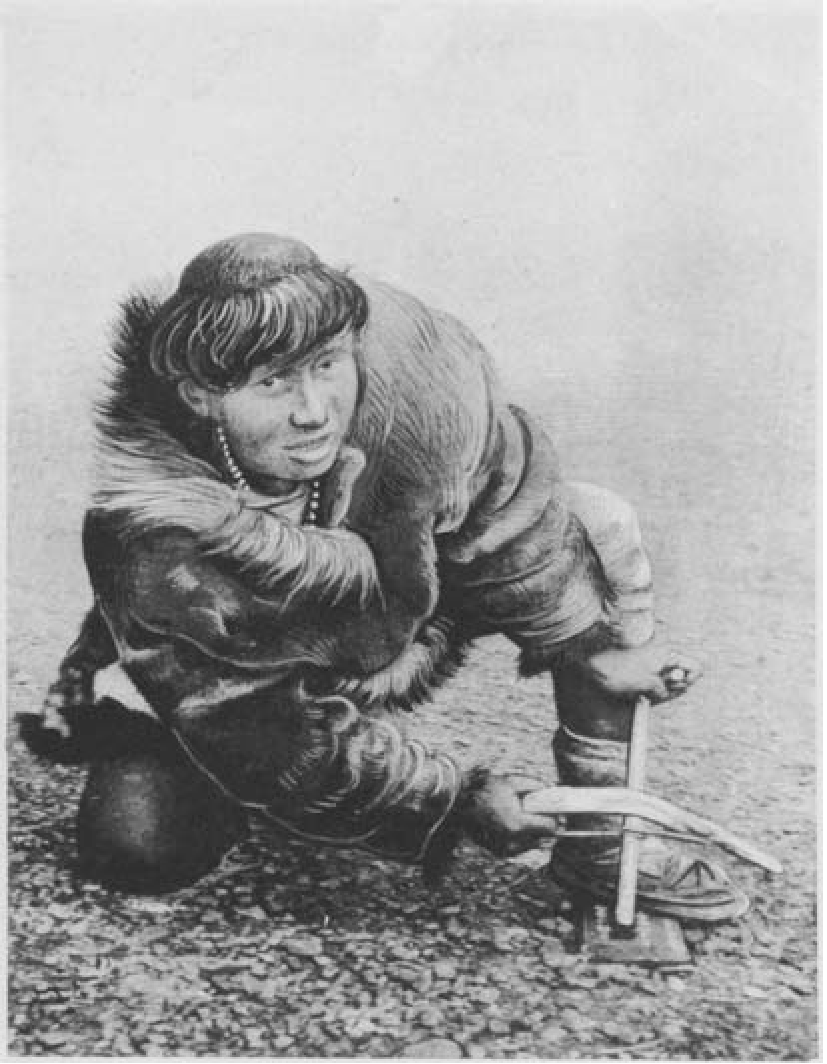
The board has several rows of holes, marked at first with a knife, and then made deeper by means of the drill. The upper piece is almost always made of the astragalus of a reindeer, while the Koryak use also wood and stone. It is held in position with the left hand or with the breast. The board is kept in place with the foot, while the right hand moves the bow, the string of which winds around the drill (see Plate XIX, Fig. 3 opp. p. 198).
Too hard pressure on the top of the drill makes the process slower. While turning in the hole, the drill produces a shrill sound, which is regarded as the voice of the g̣ɪˊrg̣ɪr.
When the wood is dry, smoke begins to rise out of the hole after a few seconds. To produce a flame, however, requires considerable skill. Often to increase the friction, a little coal is put into the hole under the drill. The lighting of the spark is indicated by a rapid increase in the density of smoke, not unlike the steam from boiling water. Then the drill is laid aside, and the board gently swung in the air to keep the spark alive. After that a minute portion of burning charcoal is quickly taken out of the board and put among some dry coals; and the fire is rapidly kindled by swinging it about and blowing it, at the same time feeding it with little chips and splinters of dry wood. The whole process, when the operator is experienced, requires not more than five minutes. The fire-drill, together with the chips and coals necessary for the process, is always kept carefully wrapped in dry skins and hidden in the depths of some voluminous bag to preserve it from dampness.
At present the fire-tools in most common use are the flint and steel (Fig. 167, a). They are bought from the Russians or the Lamut, who, while wandering across large territories, usually take the trouble to find the best pieces of flint, and to keep them for barter with the Chukchee. The touch-wood is made of a kind of fungus which is found on the poplar and aspen. This is the same as that used by the Alaskan Eskimo, and represented by Nelson.² The fungus is well boiled in water, and when dried affords excellent tinder, which[233]🗗uncollated is very easily ignited. Beyond the timber-line the Chukchee make touch-wood of young willow-catkins, dried, and mixed with powdered charcoal.
The continuous use of the strike-a-light for lighting pipes requires so much tinder that no amount seems sufficient for the winter’s supply.
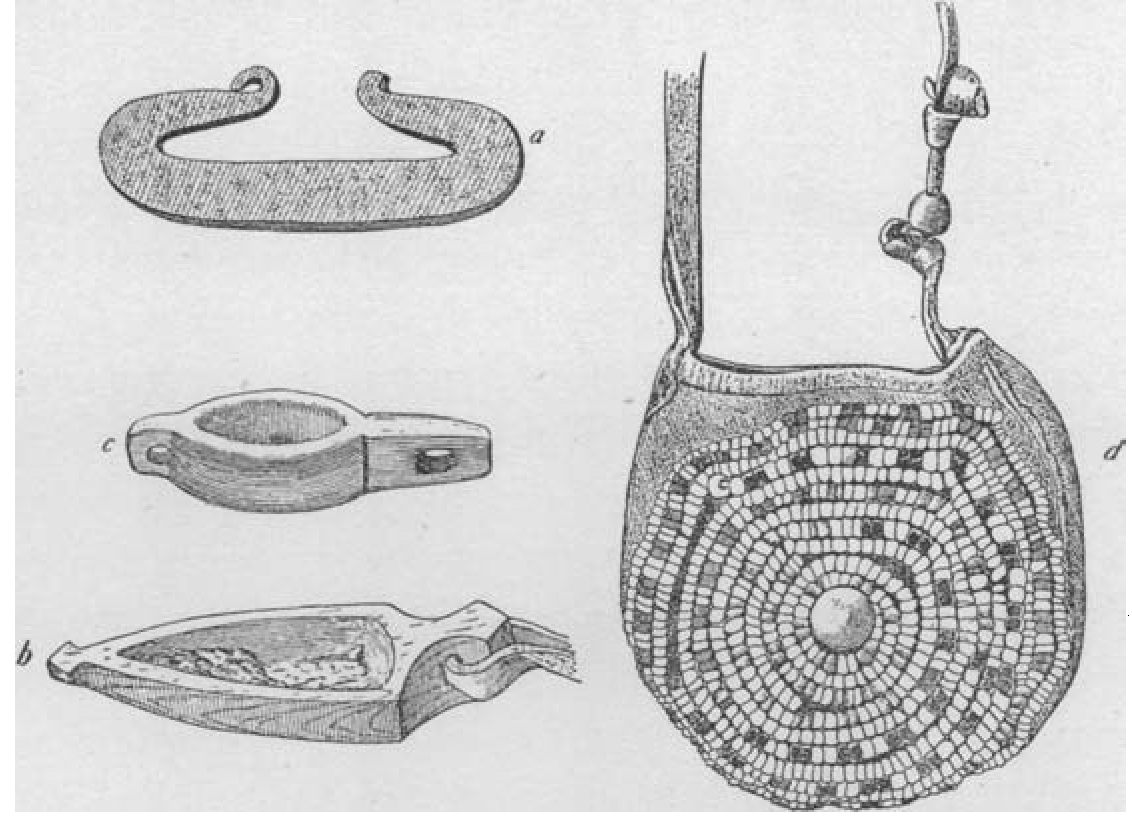
The sulphur-dish is made of wood or ivory (Fig. 167, b, c), and has the same shape among all the tribes of northeastern Asia. It renders the process of making fire much easier, because the sulphur catches the slightest spark, which can then be immediately transmitted to the tinder. The sulphur is rapidly consumed, and the dish must be frequently refilled. All tools and materials for producing fire — i. e., the flint, the steel, the sulphur-dish, and tinder — are kept together in a small pouch (Fig. 167, d), often embroidered and adorned with pendants and tassels. Careful people carry the pouch on a slender strip of leather around the neck, like a talisman, hanging down under their clothing over the breast. During a heavy rain they even place it under the armpit to keep it free from moisture. Others carry it on the belt or fasten it to their pipe with the tobacco-pouch.
Among the Maritime Chukchee, American matches (keˊwe-miˊlhɪmil, “chafing fire-tool”) are much used, and on the Pacific shore they have almost superseded other means of lighting fires.
