XVShamanism
FAMILY SHAMANISM. — Shamanism among the Chukchee, as has been said before,¹ is in large measure affiliated with the family ceremonials. Each family has one or more drums of its own, on which its members are bound at specific periods to perform; that is, to accompany the beating of the drum with the singing of various melodies. Almost always, on these occasions, one member at least of the family tries to communicate with “spirits” after the manner of shamans. Such a one will usually, with violent shouting and continuous exercise on the drum, work himself up to the highest pitch possible, and in this condition pretend that the “spirits” have entered his body. In proof of this, he acts in exactly the same way as do the shamans, — jumping about, twisting his body in the most violent contortions, and uttering gibbering sounds and unintelligible words supposed to be the voice and the language of the “spirits.” Oftentimes he essays soothsaying and foretelling the future, though such attempts do not usually receive much attention. All this is done in the outer tent, where all the ceremonials are performed, and mostly in the day-time.
The acts of real shamanism, on the contrary, are for the most part performed in the sleeping-room, at night-time and in perfect darkness. They are performed without preparation, on varied occasions, though usually the days of the ceremonials are terminated by a performance of this kind carried out during the night in the sleeping-room. The shamanistic acts, however, are by no means restricted to the ceremonials, but accompany the activity of the shaman proper in his own special calling. Nevertheless almost every third or fourth person arrogates to himself the right and the skill to act as a shaman.
Besides this, every adult Chukchee will occasionally take his drum, especially in the winter, and beat it for a while under the warm shelter of the sleeping-room, with the light or without it, singing his melodies to the rhythm of the beats. This he does merely for his own pleasure. The transition from such songs to shamanistic performances is quite imperceptible, and in this way it is fair to say that every Chukchee may play the shaman in all branches of the craft as far as his skill and inclination permit him to do so.
Family shamanism, being quite simple and primitive, probably antedated the shamanism of individuals having special skill and vocation, and the latter seems to have grown up based on the former. Family shamanism exists among the Koryak and the Asiatic Eskimo, and probably existed also[414]🗗uncollated among the Kamchadal and the Yukaghir. Each Koryak family has a drum of its own,¹ and performance on it to the accompaniment of songs is obligatory on days of certain ceremonials. I was told that the same custom existed among the ancient Kamchadal.² Among the Yukaghir, also, each family has its own drums.
While travelling in the country of Omolon and on both Anui rivers, I found drums half worn-out on every dwelling-site of the former inhabitants, who were starved out in the first decades of the nineteenth century, because the wild reindeer almost ceased their yearly wanderings in that country. My fellow-travellers, who were Russianized natives from the Kolyma country, felt very uneasy on account of this abundance of drums, and repeatedly insisted that the people must have been great sorcerers, and that it was no wonder that God took them away from this world. These drums, however, were only the old family belongings, which probably were used in a way similar to that peculiar to the Chukchee.
Besides this general resemblance, it is difficult to say whether the shamanism of the neighboring tribes had any direct influence on that of the Chukchee. The latter, indeed, treat “alien” shamans with as much veneration as they do their own. In the western part of the territory of the reindeer-breeders, many people apply to the Tungus shamans for advice, and some of the Chukchee go so far as to procure for their own use large drums of the more southern type employed by the Tungus.³
The old women of the Keˊrek tribe have the reputation of being very skilful in working spells, and this skill is mentioned even in tales.⁴ The shamans of the American Eskimo of the nearest shore of Alaska also enjoy the respect of their Asiatic neighbors, both Maritime Chukchee and Asiatic Eskimo. In one tale a contest between two shamans — one an American, one an Asiatic — ends with a full victory for the American, although the shaman from the Asiatic shore resorts even to treachery, and is severely punished for it.⁵
The direct influence of “alien” shamanism on the shamanism of the Chukchee may be traced only in the shamanistic garment, of which I shall speak in the latter part of this chapter.
INDIVIDUAL SHAMANISTIC INSPIRATION. — In modern times the importance of family shamanism is losing ground among all the tribes named, with the exception of the Chukchee, and there is a tendency of its being replaced on all occasions by individual shamanism. Individual shamans among the Chukchee are called “those with spirits” (eñeˊñɪlɪt, from eˊñeñ,⁶ “shamanistic spirit”).[415]🗗uncollated Shamanism is not restricted to either sex. The gift of inspiration is thought to be bestowed more frequently upon women, but it is reputed to be of a rather inferior kind, and the higher grades belong rather to men. The reason given for this is, that the bearing of children is generally adverse to shamanistic inspiration, so that a young woman with considerable shamanistic power may lose the greater part of it after the birth of her first child. She will recover it only after several years, — with the ending of the period of her maternity. It is also considered that all material objects in any way connected with the birth either of animals or of mankind may be detrimental to the shamanistic force, not only in women, but even in men who happen to come in contact with them. Thus, the grass which served for bedding to a woman in labor may be used to destroy the shamanistic power of any young man slowly “gathering inspiration” (eñeˊñɪtvɪlɪn). It need only be rubbed against the forehead of the young shaman during his sleep, and he will “come back” (to the usual life). A female shaman, by name Teˊlpɪñä, complained to me, in her description of “things seen by her,”¹ that her mother-in-law, seeing that she would be a great female shaman, gave her to drink of the amniotic fluid of a bitch. This injured her vitals, and the soul of the dog entered her own soul.
Since female shamanism is thought to be of an inferior order, it is considered to require a shorter period for “gathering inspiration,” and to be attended with less pain, than male shamanism. Female shamans, however, may acquire a high degree of skill in almost any branch of shamanistic action, with the single exception of the ventriloquistic art, which is considered entirely beyond their reach.
PREPARATORY PERIOD. — The shamanistic call begins to manifest itself at an early age, in many cases during the critical period of transition from childhood to youth. It is also the period of rapid and intense growth; and it is well known that many persons of both sexes manifest during this time increased sensitiveness, and that the mind often becomes unbalanced. It is easy to understand that this critical period of human life, which is always full of unexpected changes and developments, is peculiarly adapted to the first implanting of shamanistic inspiration.
Nervous and highly excitable temperaments are most susceptible to the shamanistic call. The shamans among the Chukchee with whom I conversed were as a rule extremely excitable, almost hysterical, and not a few of them were half crazy. Their cunning in the use of deceit in their art closely resembled the cunning of a lunatic.
The Chukchee say that young persons destined to receive shamanistic inspiration may be recognized at a very early age, even in their teens, by the gaze, which, during a conversation, is not turned to the listener, but is[416]🗗uncollated fixed on something beyond him. In connection with this, they say that the eyes of a shaman have a look different from that of other people, and they explain it by the assertion that the eyes of the shaman are very bright (nɪkêˊraqên), which, by the way, gives them the ability to see “spirits” even in the dark. It is certainly a fact that the expression of a shaman is peculiar. — a combination of cunning and shyness; and by this it is often possible to pick him out from among many others.
The Chukchee are well aware of the extreme nervousness of their shamans, and express it by the word nɪñɪˊrkɪlqin (“he is bashful”). By this word they mean to convey the idea that the shaman is highly sensitive even to the slightest change of the psychic atmosphere surrounding him during his exercises. For instance, the Chukchee shaman is diffident in acting before strangers, especially shortly after his initiation. A shaman of great power will refuse to show his skill when among strangers, and will yield only after much solicitation: even then, as a rule, he will not show all of his power. He is shy of strange people, of a house to which he is unaccustomed, of “alien” drums and charms which are hidden in their bags, and of “spirits” that hover around. The least doubt or sneer makes him break off the performance and retire.
The shamanistic “spirits” are likewise described as “fleeting” (nɪrɪˊnᴀqên), meaning that they want to flee before every unusual face or voice. When too many strange visitors come to the shaman, the “spirits” are shy of appearing, and, even when they do come, they are all the time anxious to slip away. Once when I induced a shaman to practise at my house, his “spirits” (of a ventriloquistic kind) for a long time refused to come. When at last they did come, they were heard walking around the house outside and knocking on its walls, as if still undecided whether to enter. When they entered, they kept near to the corners, carefully avoiding too close proximity to those present.
“Keˊlet belong to the wilderness,” say the shamans, “just as much as any wild animal. This is the reason that they are so fleeting.” Keˊlet of the animal kind have this shyness to an extreme degree. When coming at the call of the shaman, they sniff and snort, and finally, after some short exercise on the drum, flee back to the freedom of the wilderness. All this, of course, is brought about by ventriloquism, as will be described later. Even the keˊlet of diseases, especially those who cannot harm man much, — as, for instance, rheum or cold, — are described as very “fleeting.” Thus, in one tale, the rheum, before mustering sufficient courage to enter a human habitation, makes several attempts, and each time goes back overcome by its shyness. When caught on the spot, it manifests the utmost fear, and in abject terms begs for freedom.
The Chukchee generally are highly susceptible to any physical or psychical impressions of a kind to which they are unused; as, for instance, to[417]🗗uncollated unfamiliar odors.¹ This is especially the case in regard to diseases; and the saying, “The Chukchee people are ‘soft to die’” (nuthiwiˊqin), is frequently heard among them. Thus, though they are able to endure excessive hardships, they succumb quickly to any contagious disease brought from civilized countries. This sensitiveness is shared by other native tribes of northeastern Siberia, and even by the Russian creoles, who are just as susceptible to psychic influences of an unusual character; for instance, to warning received in dreams or from strange people, to threats on the part of shamans or high officials, etc. During the last epidemic of measles, a creole in Gishiga lived but one night after having been told by an official, who meant no harm, that in a dream he had seen him die. There have been several instances of suicide among the cossacks and Russianized natives as the result of reproof on the part of officials. In other cases, native guides of Lamut or Yukaghir origin, travelling with parties of Russian officials on exploring expeditions, have, on losing their way in the uninhabited country, run away from fear and despair, and every trace of them thereafter has been lost. Suicides are also frequent among the Chukchee.
It seems to me that Mr. Jochelson has in mind the same high degree of susceptibility when he calls attention to the fact that the young men of the Yukaghir were said in ancient times to be exceedingly bashful, so much so that they would die when a sudden affront was given them, even by their own relatives.² The shamans possess this nervous sensitiveness in a still higher degree than other people. This finds expression in the proverb that shamans are even more “soft to die” than ordinary people.
While speaking of this subject, let me add, that the slightest lack of harmony between the acts of the shamans and the mysterious call of their “spirits” brings their life to an end. This is expressed by the Chukchee when they say that “spirits” are very bad-tempered, and punish with immediate death the slightest disobedience of the shaman, and that this is particularly so when the shaman is slow to carry out those orders which are intended to single him out from other people.
On the other hand, apart from the displeasure of his keˊlet, a shaman is said to be “resistant to death” and especially “difficult to kill,” even when vanquished by enemies. Thus, in a description of a murder which took place in the Anui country in the nineties of the last century, the native, whose words were written down verbatim, says, —
“With an incantation of theirs they made him sleep. While he was sleeping, they attacked him from both sides. One cut his throat; the other stabbed him in the direction of the heart, the source of life and death. Nevertheless he jumped up. But he had no arms. They were also ‘knowing people;’ and thus they induced him, likewise by incantations, to leave the camp unarmed. If he had had only a small knife, perhaps he would have been able to overpower them. Now,[418]🗗uncollated though he (being a shaman) stood up, with what could he fight them, except with his teeth and nails? Thus they stabbed him; but his wounds immediately healed and he was as before. For a very long time they could not kill him. At last they fell upon him from both sides, and, throwing him down, scooped out his eyes, pierced the eyeballs with a knife and flung them far away. Then they cut his body here and there; also the heart they tore away and cut to pieces. All these pieces they buried in the ground in separate places, because they were afraid to bury them together, lest he should revive.”¹
Another account of similar kind says, —
“She [the murderer] came to her neighbor, a woman, who was busy with her fireboard, trying to make a fire. She stabbed her from behind. But the girl continued to work on the fire, because she was a shaman-girl, a woman able to stab herself (in shamanistic performance). Therefore she could not kill her, but only severed the tendons of her arms and legs.”²
A third account, referring to the small-pox epidemic of 1884 in the country of the western Kolyma, says, —
“Then Aˊmčê began to think about his son-in-law, because his daughter left him ill in the vacant camp. Aˊmčê said, ‘Let us go and visit him.’ He said, ‘He is one able to resist death, he is a shaman.’”³
The shamanistic call manifests itself in various ways. Sometimes it is an inner voice, which bids the person enter into intercourse with the “spirits.” If the person is dilatory in obeying, the calling “spirit” soon appears in some outward, visible shape, and communicates the call in a more explicit way. For instance, Aiñanwaˊt, whom I have mentioned before, says that at one time, after a severe illness, when his soul was ripe for inspiration, he saw several “spirits,” but did not give much heed to the fulfilment of their orders. Then a “spirit” came to him. He was gaunt, and black of color, and said that he was the “spirit” of reindeer-scab.⁴ Aiñanwaˊt felt himself very much drawn toward that “spirit,” and wanted him to stay and become his constant companion. The “spirit” hesitated at first, and then refused to stay. He said, however, “I may consent, if your desire for my company is strong enough, — if you wish me enough to take the drum, to handle it for three days and three nights, and to become a shaman.” Aiñanwaˊt, in his turn, refused, and the “spirit” immediately vanished.⁵
The shamanistic call is also manifested by various omens, such as meeting a certain animal, finding a stone or a shell of peculiar form, etc. Each of these omens has in itself nothing extraordinary, but derives its significance from its mystical recognizance in the mind of the person to whose notice it is brought. This process resembles the finding of amulets; and, indeed, the stone found, or the animal met, becomes the protector and the assistant “spirit” of the person in question.
Young people, as a rule, are exceedly reluctant to obey the call, especially if it involves the adoption of some characteristic device in clothing or in[419]🗗uncollated the mode of life. They refuse to take the drum and to call the “spirits,” leave the amulets in the field, from very fear,¹ etc.
The parents of young persons “doomed to inspiration” (eñeˊñɪtvu lɪˊnyo) act differently, according to temperament and family conditions. Sometimes they protest against the call coming to their child, and try to induce it to reject the “spirits” and to keep to the ordinary life. This happens mostly in the case of only children, because of the danger pertaining to the shamanistic call, especially in the beginning. The protest of the parents is, however, of no avail, because the rejection of the “spirits” is much more dangerous even than the acceptance of their call. A young man thwarted in his call to inspiration will either sicken and shortly die, or else the “spirits” will induce him to renounce his home and go far away, where he may follow his vocation without hindrance.
On the other hand, it is entirely permissible to abandon shamanistic performances at a more mature age, after several years of practice; and the anger of the “spirits” is not incurred by it. I met several persons who asserted that formerly they had been great shamans, but that now they had given up most of their exercises. As reason for this, they gave illness, age, or simply a decrease of their shamanistic power, which in the course of time manifested itself. One said that because of illness he felt as if his arms and legs were frozen, and that thereafter they did not thaw, so that he was unable to “shake himself” well upon the drum. Another said that he and his “spirits” became tired of each other. Most of the cases, probably, were simply the result of recovery from the nervous condition which had made the persons in question fit subjects for the inspiration. While the shaman is in possession of the inspiration, he must practise, and cannot hide his power. Otherwise it will manifest itself in the form of bloody sweat or in a fit of violent madness similar to epilepsy (iteˊyun).²
There are parents who wish their child to answer the call. This happens especially in families rich in children, with large herds, and with several tents of their own. Such a family is not inclined to feel anxious about a possible loss of one of its members. On the contrary, they are desirous of having a shaman of their own, — made to order, so to speak, — a special solicitor before the “spirits,” and a caretaker in all extraordinary casualties of life.
A shaman by the name of Teiˊñet, in the country near the Wolverene River, told me that, when the call came to him and he did not want to obey, his father gave him the drum and induced him to begin the exercise. After that, he continued to feel “bashful” for several years. On days of ceremonials[420]🗗uncollated he even fled from the camp and hid himself, lest his relatives should find him out and bring him back to camp, to show to the assembled people his newly acquired and growing skill.
For men, the preparatory stage of shamanistic inspiration is in most cases very painful, and extends over a long time. The call comes in an abrupt and obscure manner, leaving the young novice in much uncertainty regarding it. He feels “bashful” and frightened; he doubts his own disposition and strength, as has been the case with all seers, from Moses down. Half unconsciously and half against his own will, his whole soul undergoes a strange and painful transformation. This period may last months, and sometimes even years. The young novice, the “newly inspired” (tur-eñeˊñɪtvɪllɪn), loses all interest in the ordinary affairs of life. He ceases to work, eats but little and without relishing the food, ceases to talk to people, and does not even answer their questions. The greater part of his time he spends in sleep.
Some keep to the inner room and go out but rarely. Others wander about in the wilderness, under the pretext of hunting or of keeping watch over the herd, but often without taking along any arms or the lasso of the herdsman. A wanderer like this, however, must be closely watched, otherwise he might lie down on the open tundra and sleep for three or four days, incurring the danger, in winter, of being buried in drifting snow. When coming to himself after such a long sleep, he imagines that he has been out for only a few hours, and generally is not conscious of having slept in the wilderness at all. The accounts of such prolonged sleep are, of course, greatly exaggerated.
The Chukchee, however, sometimes, in case of sickness, fall into a heavy and protracted slumber, which may last many days, with only the necessary interruptions for physical needs, and which may, perhaps, end in death, though this is by no means assured. For instance, two years before my coming to the Anadyr, one Rɪkeˊwhi, a Chukchee living at Mariinsky Post, and his wife, both had an attack of grippe, which, as I have said before, ravages the country at short intervals. The woman died. The man slept it out for more than two months. During this time he took but little food, mostly dried fish, and very rarely could he have a hot meal prepared for him by sympathetic women among his neighbors. All this was corroborated by the Russian cossacks living at Mariinsky Post, in close proximity to the natives.
The before-mentioned Aiñanwaˊt also told me that in 1884 he lost his whole family by small-pox, but slept it out himself for two weeks, during which time he conversed with “spirits.” It is also believed that the “spirits” communicate with novices during their slumbers, and gradually assert their power over their minds and their whole persons.
The process of gathering inspiration is so painful to young shamans,[421]🗗uncollated because of their mental struggle against the call, that they are sometimes said to sweat blood on the forehead and the temples. Afterwards every preparation of a shaman for a performance is considered a sort of repetition of the initiative process: hence it is said that the Chukchee shamans during that time are easily susceptible to hemorrhage and even to bloody sweat. I myself witnessed two cases of bleeding from the nose among Chukchee shamans before their performances. As regards the bloody sweat, I knew of only one case, and even in that I was suspicious that the shaman in question, having an attack of nose-bleed, had happily thought to smear his temples with blood in order to increase our respect for his shamanistic powers. At least, he kept repeating that he was not like the modern shamans, but that he was the equal of the ancient “genuine” shamans, who sweated blood from the strain of their inspiration. He was, however, a typical specimen of a Chukchee shaman, — a very unsteady, excitable nature; and after all, I am not quite sure that he tricked us with his bloody sweat.
The preparatory period is compared by the Chukchee to a long, severe illness; and the acquirement of inspiration, to a recovery. There are cases of young persons who, having suffered for years from lingering illness (usually of a nervous character), at last feel a call to take to shamanistic practice, and by this means overcome the disease. Of course it is difficult to draw the line of demarcation, and all these cases finally come under one and the same class. The preparatory period of inspiration is designated by the Chukchee by a special term, meaning “he gathers shamanistic power” (the verb tewitɪˊñɪrkɪn and its derivatives). With weaker shamans and with women, the preparatory period is less painful, and the call to inspiration comes mainly in dreams.
To people of more mature age the shamanistic call may come during some great misfortune, dangerous and protracted illness, sudden loss of family or property, etc. Then the person, having no other resource, turns to the “spirits,” and claims their assistance. It is generally considered that in such cases a favorable issue is possible only with the aid of the “spirits:” therefore a man who has withstood some extraordinary trial of his life is considered as having within himself the possibilities of a shaman, and he often feels bound to enter into closer relations with the “spirits,” lest he incur their displeasure at his negligence and lack of gratitude.
This is evidenced in the case of Aiñanwaˊt, mentioned above. He was not careful enough to obey the instructions of the “spirits,” who came to him with benevolent intentions, and even performed upon him with a supernatural silver knife of their own an operation which freed him from all diseased matter. Hence, though he recovered from his illness, he had no further good-fortune in life. He was unable to increase his diminished herd, and after a few years of useless struggle found himself forced to bequeathe it,[422]🗗uncollated with the hereditary charms, to his elder son. He even left his house, and lived the last years of his life as a wandering hunter of wild reindeer.¹
On the contrary, another Reindeer Chukchee, Ñĭroˊn,² had a shamanistic call during his search for the herd which had run away in a thick fog. The search lasted for several months, during which time Ñĭroˊn suffered severe hardships. He was without food for days, had no shelter in which to sleep, was drenched with rain, and was even without any fire to dry his clothes. In this plight he met several animals who acted like men, and played various tricks on him. At last he met a Wolf who was eating from a carcass of a newly killed reindeer. The Wolf took compassion on him, saying that he knew well what hunger was. He bade him cut off the legs of the carcass, and feed on the sinew and the marrow, which the Chukchee, as said before, eat raw. The carcass, on its part, begged Ñĭroˊn not to touch it, promising to bring his herd as ransom. The Wolf sneered at the proposition, saying that the Reindeer was too slow, since it had allowed itself to be caught. Then Ñĭroˊn ate from the carcass. The Wolf then promised to find the herd. After two weeks he again met Ñĭroˊn, and told him where to find the reindeer.
Immediately after the recovery of the herd, Ñĭroˊn slaughtered a fat doe and sacrificed it to the Wolf. From that time on, Ñĭroˊn considered himself as “one with spirits” (eñeˊñɪlɪn). His claim, however, was generally ridiculed by his neighbors on account of his character. He was a spendthrift, much given to card-playing, and cared little for his herd and home, and the Chukchee refused to believe that such a good-for-nothing could amount to much in the eyes of the “spirits.” Ñĭroˊn himself, however, often beat his drum, sang his tunes, and called to the “spirits,” not so much for any real purpose, but simply to keep up the useful relation with them and to avoid their displeasure.
Still another acquaintance of mine, by the name of Kaˊtek, from the village of Uñiˊsak at Indian Point, entered into relations with the “spirits” when he was of mature age, during a terrible adventure he had while hunting seal. While walking on the ice-floe, along a wide crack, he happened to harpoon a seal, which came out of the water at some distance from the edge of the ice. With the ice-pick on the butt of his harpoon, he broke off a piece of ice large enough to support his body, and ventured on it out toward the seal, using the shaft of his harpoon as a paddle. Maritime hunters, lacking a canoe, often do the same. Meanwhile a strong gale came from the land and carried away the outer part of the ice-floe. Kaˊtek, who had already reached his seal, was carried away on his piece of ice. Seeing his danger, he wound the line around his waist, and fastened its ends to the points of his ice-block, in front and behind. Then he drove the harpoon[423]🗗uncollated firmly into the ice, and clutched it with both hands, trying to stand his ground against the sea. The sea was rough, the waves rolled over his head, and he was thoroughly drenched. After several hours of such suffering, Kaˊtek rebelled against his fate, and he was about to end the ordeal by stabbing himself with his belt-knife, when a large walrus-head suddenly popped out of the water quite close to him, and sang, “O Kaˊtek, do not kill yourself! You shall again see the mountains of Uñiˊsak and the little Kuwaˊkak, your elder son.” Then, quite unexpectedly, Kaˊtek saw a large iceberg, which drew the block on which he stood towards itself. Most icebergs are quite steep and inaccessible, but on this one he found a gentle slope where he could easily land. He took his harpoon along, and, hauling in the line, found the harpoon-point still fast to the seal-carcass. After that he climbed the iceberg, and, finding a suitable place, constructed a temporary shelter of the blocks of rough ice lying about. Then he skinned the seal, and, creeping under the shelter, spread the skin for a floor-covering, and, crouching down, took off his clothes piece by piece, carefully wringing out the water, and scraping it off with his knife. He ate of the seal-blubber, and swallowed a few pieces of ice, which tasted like fresh water. Then the wind changed and the iceberg drifted to land. At last, after more than twenty-four hours spent on the water, he came to land near the village of Čeˊčin. When he reached his own village, he found his family were already bringing sacrifice of seal-oil to his manes. He bade them direct the sacrifice to the walrus-head, and from that time on he was a shaman. He had some renown among his neighbors, and his art was in requisition in the village of Uñiˊsak.
There is a limit, however, as to the age at which a person may become a shaman, even with due call and occasion. In the case of Aiñanwaˊt, he was more than forty, and felt his soul unfit for a change.
In a Koryak tale, when Quikɪnn˙aˊqu unexpectedly makes for himself a drum out of a small louse, and becomes a shaman, his neighbors say sceptically, “Has the old Quikɪnn˙aˊqu really become a shaman? From his youth up he had no spirits within his call.”¹
Though this instance is taken from the Koryak, and that of Kaˊtek from the Aiwan Eskimo, both answer the purpose equally well, since the shamanism of the Chukchee and of these two tribes has similar features.
It is also considered perfectly natural that a young boy visited by some great misfortune should try to call to the “spirits.” If they deign to come to his assistance, their fellowship with the boy is likely to become very intimate, and he has the chance of being a really great shaman.
Thus a shaman, by name Scratching-Woman, told me that his father was a small, sickly fellow, who had but a few reindeer, which he finally lost in a thick fog, not far from the Russian village of Markova. He and his[424]🗗uncollated wife, dragging behind them a sledge with their boy, and with a few belongings, went there afoot. The Russians, however, gave them so little food that after a few days the father died. The boy and his mother lived on, but were nearly starved, when their relatives came to fetch them to their camp. After that they suffered severely for several successive years. The boy hauled fuel on a sledge for the richer people, and was paid with a few small bits of meat or with putrid blood. The food was so scanty that he could not grow, and remained sickly and weak. Then he began to beat the drum and to call for the “spirits,” and one by one he saw all the supernatural beings (vaˊɪrg̣ɪt), and he made himself a shaman. The vaˊɪrg̣ɪn of the Motionless Star came to him in a dream and said to him, “Cease to be such a weakling! Be a shaman and strong, and you will have plenty of food.”
Soon he acquired some reindeer which took to breeding. At last he reached manhood, and then he married into a family which had a good-sized herd. When his father-in-law died, he became the head of the family, his wife being the eldest of the children of the deceased one. He was no longer an orphan, and the herd at his disposal grew to be “awkward to count.” I saw the herd in question, and it did not number more than twenty scores (qlik-qliˊkkin); but, as has been said before, this number is about the limit of the Chukchee knowledge of counting.¹
Another man, Yeˊtɪlɪn by name, who belonged by birth to an Arctic Maritime village, but afterward married into a reindeer-breeding family on the Dry Anui River, and joined its camp, told me that in his early childhood his family perished from a contagious disease (probably influenza), and he was left alone with his small sister. Then he called to the “spirits.” They came and brought food, and said to him, “Yeˊtɪlɪn, take to beating the drum! we will assist you in that also.”
When I saw Yeˊtɪlɪn, he was a man of fifty, but the recalling of those early memories so worked upon his excitable nature, that he jumped up and chanted his recital to one of his favorite tunes. As a shaman he had much renown in the vicinity, and was generally called by the name the Russians gave him to designate his special art and calling. This name was Shamanchik (Шаманчикъ, “Little Shaman”).
In the same way a number of Chukchee tales tell of young orphans, despised and oppressed by all their neighbors, who call to the “spirits,” and with their assistance become strong men and powerful shamans.
The single means used by the Chukchee shamans, novice or experienced, for communication with “spirits,” is the beating of the drum and singing. As said before, the usual family drum is employed with a drum-stick of whalebone, while a wooden drum-stick is used chiefly in ceremonials. Some drums have two whalebone drum-sticks, of which the extra one is supposed[425]🗗uncollated to be intended for the use of “spirits,” when they approach and want to “shake themselves;” that is, to beat the drum.
The beating of the drum, notwithstanding its seeming simplicity, requires some skill, and the novice must spend considerable time before he can acquire the desired degree of perfection. This has reference especially to the power of endurance of the performer. The same may be said of the singing. The manifestations continue for several hours, during all which time the shaman exercises the most violent activity without scarcely a pause. After the performance he must not show any signs of fatigue, because he is supposed to be sustained by the “spirits;” and, moreover, the greater part of the exercise is asserted to be the work of the “spirits” themselves, either while entering his body, or while outside his body. The degree of endurance required for all this, and the ability to pass quickly from the highest excitement to a state of normal quietude, can, of course, be acquired only by long practice. Indeed, all the shamans I conversed with said that they had to spend a year, or even two years, before sufficient strength of hand, and freedom of voice, were given to them by the “spirits.” Some asserted that during all this preparatory time they kept closely to the inner room, taking up the drum several times a day, and beating it as long as their strength would allow.
The only other means of training for inspiration, of which I am aware, is abstention from all fat and rich foods, as well as great moderation in eating. The same strictness is observed ever afterwards in the preparation for each individual performance, in which the shaman tries to abstain wholly from food.
Various tricks performed by the Chukchee shamans, including ventriloquism, have to be learned in the preparatory stage. However, I could obtain no detailed information on this point, since the shamans, of course, asserted that the tricks were done by “spirits,” and denied having any hand whatever in proceedings of such a character.
In some cases, evidently, the old men have taught the younger generation, who are said to have received their power from them. The transfer is final, and cannot be revoked. The man who gives a part of his power to another man loses correspondingly, and can hardly recover the loss afterwards. To transfer his power, the older shaman must blow on the eyes or into the mouth of the recipient, or he may stab himself with a knife, with the blade of which, still reeking with his “source of life” (tetkeˊyuñ), he will immediately pierce the body of the recipient. These methods are also supposed to be used by shamans in the treatment of their patients.
Most of the shamans I knew claimed to have had no teachers, but to have acquired their art by their own individual efforts. I am not aware of a single instance of the transfer of shamanistic power in the whole domain of Chukchee folk-lore. Among the Eskimo, I met women who had learned their shamanistic performances from their husbands, and children who had been[426]🗗uncollated taught by their parents. In one family on St. Lawrence Island, the shamanistic power has been retained for a succession of generations, evidently having been transferred from father to son. This is connected with the more complicated performances which pertain to Eskimo shamanism, and of which I shall speak at another place.
PSYCHOLOGY OF THE SHAMANS. — I have already said that most of the Chukchee shamans are very nervous, highly excitable persons, often almost on the verge of insanity. To make this statement clearer, I will try to give instances of this in more detail.
A shaman from the Telkäˊp tundra, by name Keleˊwg̣i (“Keˊlᴇ-man”), with whom I made acquaintance in the Mariinsky Post, had, even among the Russians, the reputation of an odd customer, of one who seeks a quarrel on the slightest provocation. Once he came to a Russian cossack, bringing a couple of half hairless reindeer-skins, and peremptorily demanded to be paid for them a price quite out of proportion to the real value of even the best skins of that kind. On the refusal of the cossack, he instantly drew his knife, intending to strike, but happily the cossack turned aside the blow with a stick. Immediately afterwards the too exacting trader was turned out of the barracks where this incident had taken place.
Shortly after my arrival, Keleˊwg̣i came to me and declared his intention of giving me valuable material in relation to the abode of “spirits” and their ways with men. His accounts, however, were too incoherent and contradictory to be of any great value. Among other things, he gave me his biography. He was a grandson of a great shaman, Tɪluˊu, long since deceased. When he was still quite a young lad, a voice said to him, “Go into the wilderness: there you will find a tiny drum. Try it and prove its qualities.” He found the drum and began to exercise on it. Then he saw all the world, — both shores of the Anadyr River and the whole tundra. After that, he ascended to the sky and pitched his tent on the ground of the clouds. From that time on, he took to the practice of shamanism. Soon he equalled his grandfather in power, and then surpassed him.
All this was evidently borrowed from various tales and incantations. For instance, a tiny drum made of the skin of a beetle, or even of a small louse, figures in several stories, Chukchee and Koryak. When found in the wilderness, and shown to be of a supernatural kind, it gives to its possessor immense shamanistic power.¹ The same may also be said about the ground of the clouds.²
Keleˊwg̣i professed to be so sure of the great value of his information and of the corresponding high pay he should receive for it, that he brought to the fair nothing but this treasure of his mind. For all the provisions and wares he wished to take to his home, he relied wholly on my generosity and[427]🗗uncollated my common sense. After that I had trouble with Keleˊwg̣i for several months, because no pay seemed to him adequate for the sacrifice of his knowledge.
The shaman Scratching-Woman manifested symptoms of a nature even more excitable. He could not sit long in one place, but every little while he would jump up with violent gestures. At one time he came to me with complaints of a pain he felt “somewhere inside his back,” and I tried to help him with a cataplasm. He proved, however, quite unable to endure the burning, and began to shout that the fire of Russian shamanism was consuming his whole body: so I had to remove the poultice. Two other Chukchee who came at the same time with rheumatic complaints, and were treated in a similar way, declared only that they felt warm, as in a Russian sweat-bath, and requested the application of an extra cataplasm.
Notwithstanding his youth, Scratching-Woman had already quarreled with many neighbors of his own age, and had generally been worsted, because he had no peculiar strength or skill at wrestling. His temper was exceedingly bad when under the influence of liquor, however slightly. Once, when we were sitting in my house and he was on the point of beginning a narrative about his “spirits,” another acquaintance of mine and a distant relative of his, by name G̣ɪyewteˊhɪn, entered unexpectedly. We saw that he had been drinking, having procured the liquor, probably, from a Russian schooner then at anchor in the bay near Mariinsky Post. G̣ɪyewteˊhɪn declared that he felt lonely, and he also would listen to the words of the shaman.
Now, Scratching-Woman was exceedly “bashful,” the more so as the subject of our talk was concerning his ideas about the “spirits.” Up to this time, when acting in the presence of spectators, he had given no explanation of his actions or of their significance: therefore he was averse to having another listener, particularly from his own people. An altercation ensued, and G̣ɪyewteˊhɪn threatened to “count the ribs” of Scratching-Woman, should he ever again come to his camp. The shaman scowled, and answered with a broad allusion to the “spirits” at his command. At last G̣ɪyewteˊhɪn declared that he was ready to go if I would treat him to some alcohol. This, of course, had been his sole purpose from the beginning. Seeing that the shaman was trembling from excitement, and was on the point of pitching into his adversary, I hastened to quiet G̣ɪyewteˊhɪn and to send him from the house. There could be no question whether to use violence or persuasion, since he unhesitatingly declared that, rather than go away without his allowance of liquor, he would permit himself to be killed, and I gave him full credit for the sincerity of his words.¹ When at last he was off with his[428]🗗uncollated large green bottle, which now contained two ounces of undiluted alcohol, Scratching-Woman picked a quarrel with me.
“See now,” said he, “how foolish I am! Other people receive the precious liquor in my very presence, but you give none to me.” There was nothing else to be done but to offer him also a drink of alcohol. To my great surprise he was silent for a while, and then suddenly refused the treat. This was to my knowledge the first instance of a Chukchee refusing a drink of liquor.
“See now,” said Scratching-Woman by way of explanation, “I will be frank with you. Drink really makes my temper too bad for anything. Usually my wife watches over me, and puts all knives out of my reach. But when we are apart, I am afraid.” With this he showed me a long scar on his shoulder, which he said was the result of a drunken brawl when his wife could not watch over his actions. Only those who know the strength of the passion the Chukchee have for alcohol will appreciate the force of will shown by the shaman in this case, or will realize the danger.
This is only one incident characteristic of Scratching-Woman. By the way, the threats interchanged between G̣ɪyewteˊhɪn and himself did not amount to much, and were forgotten the next morning.
The shaman Yeˊtɪlɪn, before mentioned, had an incessant nervous twitching in his face, and the Chukchee said laughingly that he was probably “with an owl keˊlᴇ” (tɪleˊᵋkeleˊlɪn), comparing his affliction to the jerking motion of the owl’s head when it devours its prey. Another shaman, by name Kɪˊmɪqäi, whom I met on the Large Anui, and who belonged to a family of suicides, suffered from the same cause.¹
I have before spoken of the female shaman Teˊlpɪñä, who, according to her own words, had been violently insane for three years, during which time her household had taken such precautions, that she could do no harm to the people or to herself.
In contrast to all this was the shaman Koraˊwhê, whom I met in the Anui country. He was a good-looking, well-proportioned man of rather quiet manners, though an ill-advised word might throw him into intense excitement. He excelled in shamanistic devices which apparently required great physical strength and dexterity. At the same time, however, he declared that he did not consider himself a shaman of a high order, and that his relations with the “spirits” must not be taken very seriously. To explain this he said that when he was young he suffered severely from syphilis. To heal himself, he had recourse to spirits, and after two years, when he had become skilful in shamanistic practices, he was completely restored by their help. After that he maintained intercourse with the keˊlet for several years, and was on the point of becoming a really great shaman. Then suddenly his luck was gone.[429]🗗uncollated One of his dogs bore two black pups; and when he saw them both sitting side by side on their haunches, looking into his face, he took it as a sign that the time had come for him to withdraw from shamanistic practices. He suffered a relapse of his illness, and his herd was visited by hoof-disease. Fearing that worse things might happen, he dropped all serious pursuits of shamanism, and practised only the tricks, which were completely harmless. As far as I could learn, he had been a magician employing especially the powers of evil, or practising the black art; and after the return of his disease, he abandoned those practices, considering them detrimental to his health and well-being.
There can be no doubt, of course, that shamans, during their performances, employ deceit in various forms, and that they themselves are fully cognizant of the fact. “There are many liars in our calling,” Scratching-Woman said to me. “One will lift up the skins of the sleeping-room with his right toe, and then assure you that it was done by ‘spirits’; another will talk into the bosom of his shirt or through his sleeve, making the voice issue from a quite unusual place.”
Of course, he was ready to swear that he never made use of any of these wrong practices. “Look at my face,” he continued; “he who tells lies, his tongue stutters. He whose speech, however, flows offhand from his lips, certainly must speak the truth.” This was a rather doubtful argument, but I refrained from making any such suggestion.
Some of the people even are aware of the deceit of the shamans. Several men, when talking of shamanistic feats, said that, though the tricks performed were very wonderful, they were by no means real, but were produced only through illusion on the part of the observers. Others went even further. Thus, the trader Kuvaˊr at Indian Point, of whom I have spoken several times, assured me that even the most renowned shamans are only clever deceivers. “When I witness their best trick,” he asserted, “even then, with proper attention, I can discover the fraud. He [the shaman] will pretend to cut with a knife the abdomen of the patient; but I can follow the direction of the knife, and see that it glances off without hurting the skin, and that the blood comes from the mouth of the operator.”
This scepticism, perhaps, is the result of intercourse with civilized people. With some of the shamans, fraud is not restricted to jugglery. We caught Scratching-Woman in the very act of stealing our washing from the line. The woman who, during our stay at Indian Point, was caught thieving,¹ was also a shaman.
However, in giving directions and answers to persons seeking advice, Chukchee shamans often display much wisdom and circumspection, especially when they have to deal with matters out of the reach of their knowledge[430]🗗uncollated and understanding. This is the case when the inquirer is of a different stage of culture; for instance, with Russian officials or merchants, who sometimes do not despise the help of the native “spirits.” Thus the assistant of the chief official of Anadyr asked Scratching-Woman, during a shamanistic séance, whether his Second Interior Loan bond, with prizes, would draw a lucky number in the yearly lottery. It was no little trouble to explain to the shaman what was meant by “an Interior Loan bond;” but, when he understood it, he immediately answered that he saw that the foundations of the wealth of the questioner, which were in his own country, were going to increase. To a cossack who wanted to know whether the yearly mail steamer would bring him a furlough, the shaman answered, “The big boat brings change and joy to all people in this country.” I could cite other answers not less worthy of the oracle of Delphi. To my own questions of this kind, the shamans usually answered that my country was too far away, and the feet of their keˊlet too small, to go there. Furthermore, the keˊlet are too shy of the manners of the unknown dwellers in those distant localities. I saw similar circumspection displayed also in regard to the native questions. A shaman of the interior refused to give advice about the maritime pursuits of the people of the coast, explaining that his “spirits” were good only for walking upon the land, and that they were afraid of the sea.
CLASSES OF SHAMANISM. — The Chukchee divide all acts of shamanism into three categories, more or less distinct, though merging into each other. Under the first category comes “communication with the spirits” (kalatkoˊurg̣ɪn). This includes all kinds of intercourse with the “spirits” which becomes apparent to the listeners; that is, the voices of “spirits” talking through the medium of the shaman, ventriloquistic performances,¹ and other tricks, — generally speaking, the whole spectacular part of shamanism, which forms the main content of the shamanistic séances. As said previously, all this is often considered only as a kind of jugglery. For performances of this sort, young people are said to be better adapted than older ones. With increasing years, some of the shamans discontinue most of these tricks.
Constituting the second category is what is known as “looking into” (hêtolaˊtɪrg̣ɪn). This branch of Chukchee shamanism is held in the highest veneration, because the shaman possessing it has the faculty of seeing the danger lying in wait for the people, or the good in store for them, and accordingly he is able to advise them how to avoid the first and to secure the second. Most of the instructions given are of a ritualistic kind, and refer to certain details of such and such a ceremonial, which must be arranged in a certain manner in order to secure the desired result. The directions are[431]🗗uncollated usually given by the “spirits” in the second part of the shamanistic performance, which may be called “magical.”
There are, however, as I said before, many shamans, though they have many keˊlet at their disposal, whose predictions are wrong, and their advice worse than useless, and there are those even to whom the aid of conjury and divination is wholly denied. On the other hand, there are shamans who claim very little outward communication with the “spirits,” but give magical advice as a kind of internal, subjective inspiration, after self-communion for a few moments. These, notwithstanding the simplicity of their proceedings, usually enjoy the highest consideration of their neighbors.
For instance, one shaman, by name G̣almuˊurg̣ɪn, whom I met in the Anui country, declined to talk openly with “spirits,” and nothing was known about his connection with them. The Chukchee said that he was “[with] only his [own] body” (em-uviˊkɪlɪn); that is, that no other beings were seen to assist him in his actions. When giving a séance, he began by beating the drum and singing; but in a few minutes he would leave off the exercise, and drawing a few long, almost hysterical breaths, would immediately proceed to foretell the future. He talked to many people present, one by one. When he was through with one case, he would stop for a while, as if recollecting himself, and then, after several deep-drawn sighs, would pass on to the next applicant.
The third category embraces the “producing of incantations” (êwg̣anvaˊ-tɪrg̣ɪn), which includes the more complicated practices of shamanism. The incantations, together with the spells, form the greater part of Chukchee magic, to which I shall devote a special chapter.
There are incantations both of a benevolent and malevolent character. The Chukchee have some idea of the difference between “well-minded” (teñ-čɪˊmñulɪn) shamans, who ply their art in order to help the sufferers, and “mischievous” (kurg̣-eñeˊñɪlɪt or kuˊñičh-eñeˊñɪlɪt, literally “mocking shamans”) shamans, who are bent on doing harm to people.
For instance, in a statement by a female shaman, Teˊlpɪñä, she says, speaking of herself in the third person, “On her way the old women with many spells come to her, invisible to the others, and offer her their spells one by one. She sees in her dreams the quality of the gifts. Some of them she rejects, saying, ‘These are too evil-minded.’ The others, which are benevolent, she deigns to accept.”¹
On a sketch previously given,² good and bad shamanism are represented as two shamanistic coats, red and black, the choice of which is offered to a shaman by a deity. I have also referred to a shamanistic plank of Yukaghir provenience,³ one half of which was dyed red and the other half black, to designate good and bad shamanism.
[432]🗗uncollatedThe shamans, however, combine in varying degrees all these categories of Chukchee shamanism; that is, they converse with spirits, and make them play various tricks before the spectators; then they make the spirits answer the questions and give the necessary directions. If need be, they pronounce incantations, and perform other magical acts. They also perform the magical art in the treatment of various diseases.
PAY FOR SERVICES OF SHAMANS. — It goes without saying that Chukchee shamans are paid for their services, and, besides, try to get for them as much as possible. It is a common saying among them, that shamanistic advice or treatment, when given gratuitously, amounts to nothing. The “spirits” are too jealous of their power to spend it without pay, and they even become angry for such doings, both with the shaman and with his patients.¹ Even when, prompted by friendship or compassion, the shaman does not ask for recompense, some symbolical remuneration must nevertheless be given to him to make his treatment more effective. This, for the most part, consists of a piece of sinew with a bead fastened to one end of it.
Usually the shamans and the “spirits” do not hesitate to express their full opinion about this matter. Once, at a shamanistic séance given by Scratching-Woman in my presence, a woman from a neighboring camp asked whether she might hope to have a child in the near future. The voice of a keˊlᴇ who had already spoken a little before answered roughly, “I will not speak without fresh meat.” The woman meekly promised to kill a reindeer. “Then we shall see,” said the keˊlᴇ.
The substance and the amount of the payment vary, of course, in different cases. Meat, thong, skins, garments, living reindeer, “alien food” of civilized origin, — all are indiscriminately given by way of recompense for a shaman. In the tale of the Scabby Shaman, Meeˊmhɪn pays for the services of the shaman with a large reindeer-herd of his possession,² but I much doubt whether cases like that happen in actual life. A reindeer-breeder of the Omolon told me, however, that he paid a Lamut shaman who cured him of a severe illness three large bucks and some skins besides. Sometimes a man cured by a shaman has to give him in payment something that from personal motives he prizes exeedingly high; for instance, his own reindeer-team. This may be compared with a similar sacrifice to the “spirits.”³ I have never met shamans, however, who could be said to live solely on the profits of their art: it had only been to them a source of additional income.
PREPARATION FOR PERFORMANCE. — As said before, preparation for each shamanistic performance is similar to the preparatory period of inspiration which is so painful to the novice shaman as to be considered almost a peculiar kind of sickness. In conformity to this, most of the shamans show marked nervousness before the commencement of the performance. If a shaman tries[433]🗗uncollated to decline an invitation to act, alleging his weak power and small skill in communicating with “spirits,” when once his consent is given, he becomes impatient, and hurries his assistants and listeners. He wishes to begin and to be through as soon as possible.
I was told that the application of cold water to the head of a shaman in the very heat of his performance would suddenly bring his inspiration to an end. Therefore sometimes, during the ceremonials, if some performer is practising too long, or seems to be excited to a somewhat dangerous pitch, his neighbors may sprinkle him with water in order to bring him back to himself.
The performance itself is considered as a recovery from illness. The same shaman who was nervous before the performance regains after it his self-possession, and looks really as if he were braced up by some strong tonic. Even the physical fatigue is in most cases quite unnoticeable. “Why should I feel fatigued?” asked a Chukchee shaman in regard to this subject. “I do nothing. The ‘spirits’ make all the exertion.” Accordingly, the former, constraint gives place to an exaggerated self-conceit, and even the most “bashful” of the young shamans are wont, after a performance, to magnify their own ‘faculties and shamanistic powers. Every one of them is ready to offer a repetition of the séance, and, if taken at his word, will really again go through all the violence and madness. In some cases, especially in the matches between rival shamans, the performance will last for more than twenty-four hours, and finally the listeners will withdraw, perhaps, earlier than the actors.
SHAMANISTIC PERFORMANCE IN THE INNER ROOM. — The typical shamanistic performance is carried out in the following manner. After the evening meal is finished and the kettles and trays are removed to the outer tent, all the people who wish to be present at the séance enter the inner room, which is carefully closed for the night. Among the Reindeer Chukchee, the inner room is especially small, and its narrow space causes much inconvenience to the audience, which is packed together in a tight and most uncomfortable manner. The Maritime Chukchee have more room, and may listen to the voices of the spirits with more ease and freedom. The shaman sits on the “master’s place,” near the back wall; and even in the most limited sleeping-room, some free space must be left around him. The drum is carefully looked over, its head tightened, and, if it is much shrunken, it is moistened with urine and hung up for a short time over the lamp to dry. The shaman sometimes occupies more than an hour in this process, before he is satisfied with the drum. To have more freedom in his movements, the shaman usually takes off his fur shirt, and remains quite naked down to the waist. He often removes also his shoes and stockings, which of course gives free play to his feet and toes.
In olden times, shamans used no stimulants; but at present they often smoke a pipeful of strong tobacco without admixture of wood, which certainly[434]🗗uncollated works like a strong narcotic. This habit is copied from the Tungus shamans, who make great use of unmixed tobacco as a powerful stimulant.
At last the light is put out and the shaman begins to operate. He beats the drum and sings his introductory tunes, at first in a low voice; then gradually his voice increases in volume, and soon it fills the small closed-up room with its violent clamor. The narrow walls resound in all directions.
Moreover, the shaman uses his drum for modifying his voice, now placing it directly before his mouth, now turning it at an oblique angle, and all the time beating it violently. After a few minutes, all this noise begins to work strangely on the listeners, who are crouching down, squeezed together in a most uncomfortable position. They begin to lose the power to locate the source of the sounds; and, almost without any effort of imagination, the song and the drum seem to shift from corner to corner, or even to move about without having any definite place at all.
The shaman’s songs have no words. Their music is mostly simple, and consists of one short phrase repeated again and again. After repeating it many times, the shaman breaks off, and utters a series of long-drawn, hysterical sighs, which sound something like “Ah, ya, ka, ya, ka, ya, ka!” After that, he comes back to his songs. For this he draws his breath as deep as possible in order to have more air in his lungs, and to make the first note the longest.
Some of the tunes, however, are more varied, and are not devoid of a certain grace. Not a few are improvised by the shaman on the spot; others are repeated from séance to séance. Each shaman has several songs of his own, which are well known to the people; so that if anybody uses one of them, for instance at a ceremonial, the listeners recognize it immediately, and say that such and such a man is using the particular song of such and such a shaman.
There is no definite order for the succession of the songs, and the shaman changes them at will, sometimes even returning to the first one after a considerable interval has elapsed. This introductory singing lasts from a quarter of an hour to half an hour or more, after which the keˊlet make their first appearance.
The shaman sings all alone, and the auditors take no part in the performance. From time to time, however, some one of the listeners will cry out, “Hɪk, hɪk!” or “Hɪč, hɪč!” (interjection of wonder) or “Qaiˊvo” (“of course”) or “Emñoˊlɪk” (“certainly”), — all of which are meant to express the full approbation by those present of the doings of the shaman. The Chukchee have a special word for these exclamations, — oˊčɪtkɵk (“to give answering calls”). Without an očɪtkɵˊlɪn (participle), a Chukchee shaman considers himself unable to perform his calling in a proper way; therefore novices, while trying to learn the shamanistic practices, unsually induce a brother or a sister to respond, thus encouraging the zeal of the performer. Some shamans also[435]🗗uncollated require those people who claim their advice or treatment to give them answering calls during the particular part of the performance which refers to their affairs. The story-tellers of the Chukchee also usually claim the assistance of their listeners, who must call out the same exclamations.
Among the Asiatic Eskimo, the wife and other members of the family form a kind of chorus, which from time to time catches up the tune and sings with the shaman. Among the Russianized Yukaghir of the lower Kolyma the wife is also the assistant of her shaman husband, and during the performance she gives him encouraging answers, and he addresses her as his “supporting staff.”
In most cases the keˊlet begin by entering the body of the shaman. This is marked with some change in his manner of beating the drum, which becomes faster and more violent; but the chief mark is a series of new sounds, supposed to be peculiar to the keˊlet. The shaman shakes his head violently, producing with his lips a peculiar chattering noise, not unlike a man who is shivering with cold.¹ He shouts hysterically, and in a changed voice utters strange, prolonged shrieks, such as “O to, to, to, to,” or “I pi, pi, pi, pi,” — all of which are supposed to characterize the voice of the keˊlet. He often imitates the cries of various animals and birds which are supposed to be his particular assistants. If the shaman is only a “single-bodied” one, — that is, has no ventriloquistic power, — the keˊlet will proceed to sing and beat the drum by means of his body. The only difference will be in the timbre of the voice, which will sound harsh and unnatural, as becomes supernatural beings.
VENTRILOQUISM AND OTHER TRICKS. — With other shamans the keˊlet appear all at once as the “separate voices.” They manifest themselves with sounds and shrieks of the same harsh and unnatural character, and these are located outside the body of the shaman. After that a varied exhibition begins, in which the performance of the shaman far transcends anything attainable by a person of ordinary powers.
The Chukchee ventriloquists display great skill, and could with credit to themselves carry on a contest with the best artists of the kind of civilized countries. The “separate voices” of their calling come from all sides of the room, changing their place to the complete illusion of their listeners. Some voices are at first faint, as if coming from afar; as they gradually approach, they increase in volume, and at last they rush into the room, pass through it and out, decreasing, and dying away in the remote distance. Other voices come from above, pass through the room and seem to go underground, where they are heard as if from the depths of the earth. Tricks of this kind are played also with the voices of animals and birds, and even with the howling of the tempest, producing a most weird effect.
I heard a voice which professed to be an echo. It repeated faithfully[436]🗗uncollated all sounds and cries which we chose to produce in its presence, including phrases in English or Russian. The foreign words were, of course, slightly mispronounced, still the reproduction proved the “spirit” to be possessed of a fine ear, catching quickly the sounds of an unknown language. The only way in which the “spirit” could imitate the clapping of our hands (another test to which we put him) was by clacking his tongue, which caused much mirth even among the native listeners. I heard also the “spirits” of a grasshopper, horsefly, and mosquito, who imitated exceedingly well the sounds produced by the real insects.
In proof of his accuracy as to the location of the sounds, the shaman Qoraˊwg̣e, previously spoken of, made one of his “spirits” shout, talk, and whisper directly into my ear, and the illusion was so perfect that involuntarily I put my hand to my ear to catch the “spirit.” After that he made the “spirit” enter the ground under me and talk right in between my legs, etc. All the time that he is conversing with the “separate voices,” the shaman beats his drum without interruption in order to prove that his force and attention are otherwise occupied.
I tried to make a phonographic record of the “separate voices” of the “spirits.” For this purpose I induced the shaman Scratching-Woman to give a séance in my own house, overcoming his reluctance with a few extra presents. The performance, of course, had to be carried out in utter darkness: and I arranged my machine so as to be able to work it without any light. Scratching-Woman sat in the farthest corner of the spacious room, at a distance of twenty feet from me. When the light was put out, the “spirits,” after some “bashful” hesitation, entered, in compliance with the demand of the shaman, and even began to talk into the funnel of the graphophone. The records show a very marked difference between the voice of the shaman himself, which sounds from afar, and the voices of the “spirits,” who seemed to be talking directly into the funnel.
All the while, Scratching-Woman was beating the drum incessantly to show that he was in his usual place, and occupied with his usual function, that of beating the drum without interruption. He brought some of the entering “spirits” to my special notice. One was a fawn of a wild reindeer, found by him in the wilderness beside the carcass of its mother, which had been killed by a wolf. The fawn, when he found it, was trying to suck the carcass. The strange sight had evidently struck Scratching-Woman, and he took the fawn for one of his assisting keˊlet. The “spirit” manifested his presence by characteristic short snorts, peculiar to the fawn when calling for its mother. Another “spirit” entered with a dismal howl. This was the wolf who killed the reindeer-dam.
Scratching-Woman explained that when he desired to wreak his vengeance on some one of his foes, he transformed himself into this wolf, taking care[437]🗗uncollated beforehand to turn the other party into a reindeer. Then, of course, he was quite certain of victory. The idea that shamans, in case of need, not only may send their “spirits” to a destined place, but also may turn themselves into any of their “spirits,” and carry out their intentions, appears in many tales.
For instance, in the tale of the Shaman with Warts (Kukuˊlpin), this shaman, during a shamanistic contest, asks his adversary, “Which keˊlᴇ are you going to employ?” The other answers, “The small hawk.” — “And you?” — “The great diver.” Then they turn into these birds, and the contest begins.¹
Those episodes of the tales in which men in distress have recourse to their animal amulets — either reviving them and bidding them fight their enemies, or transforming themselves into their living likenesses — are evidently quite analogous.
Still another of the keˊlet introduced by Scratching-Woman was a raven, who cawed lustily. The shaman used him when working with magic medicine, because the raven could devour all germs of sickness and disease. Still another was a little mouse, who could travel very fast underground, and was employed on errands requiring haste.
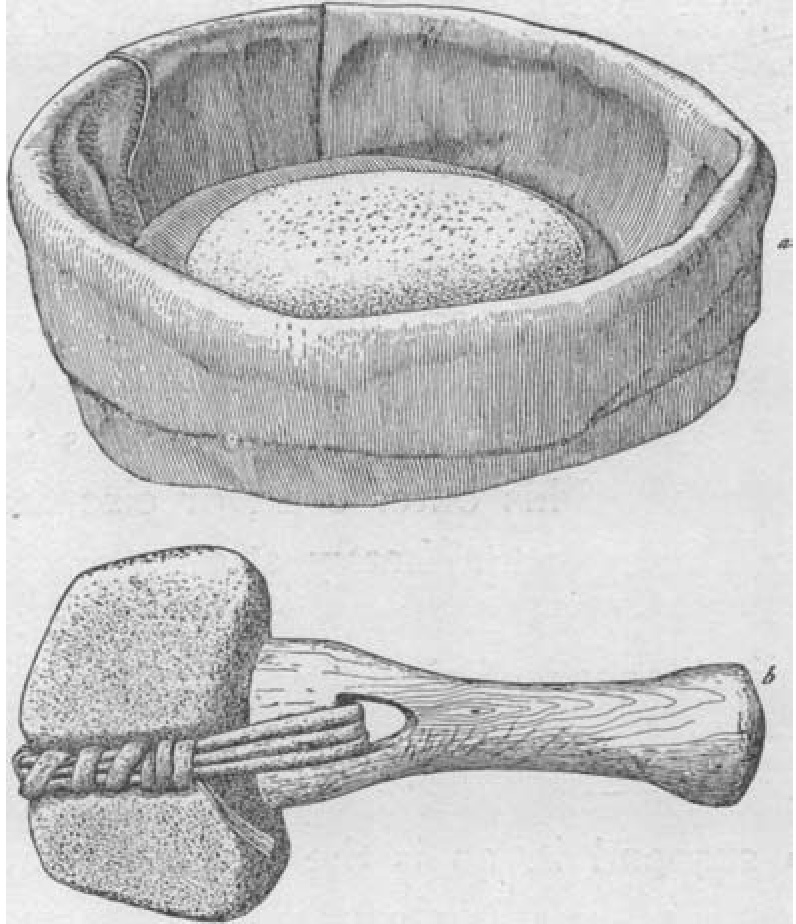
There followed the leather bucket, which forms a part of a “bone-breaking set,” and is used as a receptacle for pounded bones.² Once when Scratching-Woman was hunting wild reindeer, he succeeded in wounding a strong buck in the right fore-leg, but still he could not overtake it. Then he called for the Skin Bucket, bade it overtake the buck and entrap its head. After that the reindeer was easily caught.
After having entered the room and produced a few sounds, by way of making his presence known, the “spirit” usually offers to “try his breath;” that is, he beats the drum for a while, singing a tune in the special harsh voice peculiar to the “spirits.” This, however, lasts only a short time, after which the “spirit” declares that his breath is ebbing away. Then he either begins to talk, or straightway takes his departure with characteristic quivering sounds somewhat similar to the buzzing of a fly. These sounds are called by the Chukchee “gibbering” (moomg̣aˊtɪrg̣ɪn), and are always associated with the “spirits.” The same name is applied to the chattering alluded to before.³
Often the shaman declares to the “spirit” first entering, that the sound of his drum is bad, or even that the cover of it is broken, and this is corroborated by a few dull strokes. The “spirit” must then mend the drum by breathing upon it, which he does accordingly. This treatment is resorted to especially in cases of magic medicine. After the drum is mended, the shaman explains to the patient that it is a good sign. He says also, that, if the “spirit” were not able to mend the drum, it would forebode a bad turn in the disease.
[438]🗗uncollatedI must again repeat that the animal “spirits” produce their own characteristic sounds. The walrus and the bear roar, the reindeer snorts, the wolf howls, the fox bays, the raven caws. The last three, however, are able to talk, but use a particular timbre of voice, and intersperse among their words, from time to time, their peculiar cries.
In most cases the ventriloquistic performance soon takes on a dramatic character. A number of “spirits” appear in succession. They talk to the shaman and to one another, pick quarrels, abuse and denounce one another. It is superfluous to add that only one voice may talk at a time, so that even the most lively dialogue consists of a series of interpolations following each other in succession. The talk of the “spirits” is often carried on in strange, quite unintelligible words, such as “papire kuri muri,” etc. To make it understood, the shaman has to call for an interpreter, who from that time on takes part in all conversations, and also explains to the auditors the words of the other “spirits.” Thus the shaman is supposed to be unable to understand the language of the “separate spirits.”
The same idea obtains among other neighboring tribes. The most curious case of all is that of the shamans of the Russians and the Russianized natives of the Kolyma and the Anadyr, who know no other language than the Russian. The “spirits,” however, even when speaking through the mouth of the shaman, employ only the usual unintelligible gibberish mixed with some distorted and mispronounced phrases in the Koryak, Yakut, and Yukaghir languages. After a while the shaman calls for an interpreter, and at last, after some controversy, the “spirits” send for one who can speak Russian and who translates the orders of the “spirits.”
The Chukchee shamans have no special language of their own, with the exception of a few words and expressions. Thus the drum is called aˊᵋtwet (“canoe”), which is an additional proof of the preponderance of maritime pursuits in the former life of the people. The idea of shamanistic ecstasy is expressed by the word an˙ñaˊarkɪn (“he sinks”), which refers to the belief that the shaman, during the period of ecstasy, is able to visit other worlds, and especially that underground.
Among the northwestern branch of the Koryak, the “spirits” are said to use a special mode of pronunciation, similar to that used by the southeastern Koryak and the Chukchee. A few words are also said to be peculiar to them. Among the Asiatic Eskimo the “spirits” are said to have a special language. Many words of it were given to me by the shamans, and most of them are analogous to the “spirit” language known to various Eskimo tribes of America, both in Alaska and on the Atlantic side.
Tricks of various kinds break up the monotony of the performance, which may last for several hours. The “spirits” will scratch from the outside at the walls of the sleeping-room, running around it in all directions, so that[439]🗗uncollated the clattering of their feet is quite audible. In contrast to this, the motion of the keˊlet inside of the room produces but slight noise. The rustling of their flight is similar to the buzzing of a mosquito, and the rattling of their tiny feet as they run over the surface of the drum is hardly perceptible.
Often, however, a mischievous “spirit” suddenly tugs at the skin spread in the centre of the room with such force that things lying on it fly about in all directions. Therefore the housemates of the shaman usually take the precaution to remove kettles and dishes from the room. Sometimes an invisible hand seizes the whole sleeping-room by its top, and shakes it with wonderful strength, or even lifts it up high, letting in for a moment the twilight from the outer tent. This, of course, is possible only with the movable tent of the Reindeer people, where the sleeping-room is fastened none too firmly. Other invisible hands toss about lumps of snow, spill cold water and urine, and even throw blocks of wood, or stones, at the imminent risk of hurting some of the listeners.
All these things happened several times in my presence. The “spirits” would ask me, through the shamans, whether I really felt afraid; and, when I did not give a satisfactory answer, the “spirits” would try to increase my respect for them by such material manifestations. I must mention that the audience is strictly forbidden to make any attempts whatever to touch the “spirits.” These latter highly resent any intrusion of this kind, and retaliate either on the shaman, whom they may kill on the spot, or on the trespassing listener, who runs the risk of having his head broken, or even a knife thrust through his ribs in the dark. I received warnings of this kind at almost every shamanistic performance. In some cases the shaman would lay a bare knife within his own reach as an additional warning against any infringement.
The size of the sleeping-room is so small that it is really wonderful how a shaman can keep up the illusion, even under cover of the dark and with the protection of his resentful “spirits.” Many times I sat so near the performer that I could almost touch him with my outstretched hand, and the warning against too great inquisitiveness on my part was of course quite necessary.
All these tricks strangely resemble the doings of modern spiritualists, and without doubt they cannot be carried out without the help of human assistants.
MAGICAL ADVICE. — The second part of the shamanistic performance is of a magical character. To give a clearer idea of it, I will describe a few instances.
The shaman Tiluˊwg̣i, of whom I shall speak again, after some preliminary intercourse with the “spirits,” called a peculiar keˊlᴇ of his, who said she was an old maid, living alone in her house, and she expressed apprehension lest we should laugh at her talk with the peculiar feminine pronunciation. After that, however, she proceeded to give the magic instructions and explanations.
[440]🗗uncollatedShe told one of those present, Enmuˊwg̣i by name, who had recently been vanquished in a wrestling-match, that his defeat was caused by the use of malignant incantations by his adversary, and she advised him to take the matter into his own hands.
This female “spirit” reproached one of my fellow-travellers, a great hunter, with ill treating those “walking afoot,” which is the usual periphrasis for the bears. When he tried to defend himself, the female “spirit” reminded him of a hunting expedition, in which he took part about two months before, which was directed against a bear sleeping in its den. From the old Chukchee point of view, this certainly was a rather dangerous pursuit.¹ In the end the “spirit” said that the man in question, because of his offences against those “walking afoot,” was in danger of losing his powers of endurance in walking. To his question as to the means of warding off the danger, the female “spirit” answered that he must procure for himself the skin of the nose of a newly killed bear, and perform a thanksgiving ceremonial over it. That, probably, would appease those “walking afoot.”
Afterward she told another listener that she saw that in the last autumn he had killed a wild reindeer-buck. Though this happened far away from his herd, he should have made a sacrifice to the buck, which he omitted to do:² therefore the following winter he was visited by bad luck, in that the wolves attacked his herd, and killed nine fat bucks. To check the recurrence of such a misfortune, it is necessary to take a small crotch of willow³ cut on the place of the attack by wolves, and perform over it the required ceremonial.
G̣almuˊurg̣ɪn, the soothsaying shaman already spoken of, who gave a prescription at the very beginning of the séance, predicted in my presence to the master of the tent that the next fall many wild reindeer would come to his house. “One buck will stop on the right side of the entrance, and pluck at the grass, attracted by a certain doe of dark-gray hair. This attraction must be strengthened with a special incantation. The reindeer-buck, while standing there, must be killed with a bow, and the arrow to be used must have a flat rhomboid point. This will secure the successful killing of all the other wild reindeer.”
After that the shaman recollected himself for a while, and addressed the brother of the master, who, with one companion, lived in a separate camp. This companion was married to one of his relatives. The shaman said that, before the fall, they would part company, nor would they look at each other with clear eyes; and, by the way, his prediction was fulfilled much earlier than the time designated.
[441]🗗uncollatedTo still another of the listeners he said that he feared lest the “bad beings” might conceive a desire to approach his house. By this he meant the “spirits of disease.” In order to thwart their intentions, the man was told to go through some special preventive ceremonies during the celebration of the ceremonial of the antlers, which was then at hand. The ceremonies consisted in drawing several lines across the snow near the tent, and putting some small stones before the entrance. These were supposed to transform themselves into a large river, and high, inaccessible cliffs, on the route of the “bad beings.”
In this way the usual shamanistic performance is carried on in the inner room, and with the light put out.
TRANCES. — In other cases the shaman actually “sinks;” that is, after some most violent singing, and beating of the drum, he falls into a kind of trance, during which his body lies on the ground unconscious, while his soul visits “spirits” in their own world, and asks them for advice. Chukchee folk-lore is full of episodes referring to such shamanistic trances; but in real life they happen very rarely, especially in modern times, when shamans are so much less skilful than of old. Even the word an˙ñaˊarkɪn (“to sink”), from the explanation of modern shamans, has reference simply to the immersion of the performer into the depths of shamanistic ecstasy without its literal fulfilment.
In folk-stories the shamans sink into the other worlds chiefly for the purpose of finding one of the missing souls of a patient who claims their power for his treatment. In important cases, even at the present day, the shamans, when treating a well-to-do patient, will at least pretend to have sunk into the required unconsciousness. On one or two occasions I had an opportunity of witnessing such a state, but the whole performance was of a rather poor kind.
It began, as usual, in the dark; but when the shaman suddenly broke off beating the drum, the lamp was again lighted and the face of the shaman immediately covered with a piece of cloth. The mistress of the house, who was the wife of the shaman, took up the drum and began to beat it with light, slow strokes. This lasted the entire time that the shaman lay under the cloth, or about a quarter of an hour. Then he suddenly awoke, and, removing the cloth from his face, sat up in his place, took the drum from his wife, beat it for a while, and sang a few tunes as in the beginning. After that he began to give the patient magical advice regarding his illness, which, however, was nothing else than an elaborate incantation in dramatized form, like those of which I shall speak in the next chapter.
SHAMANISTIC PERFORMANCE IN THE OUTER ROOM. — As we have seen, the performances in the outer tent take place only at the time of ceremonials. The acts of the shamans do not differ essentially from those of the other people,[442]🗗uncollated except that their drumming is more violent and the tunes of their songs more complex and varied.
The Chukchee shamans do not practise the ventriloquistic art in the outer tent in daylight. I did indeed hear one or two shamans boast of their ability to call “separate voices” in the outer tent, and that some of these voices talked to them out of the fire of the hearth; but they were never able to make good these pretensions. One shaman, since dead, was said to have performed such a feat; but the “separate voices” of his calling were heard all the time very near to his knees, and he had even to stoop down to talk with them. The hearth, however, is considered to be a fit entrance for keˊlet. In Koryak tales the kaˊmak (evil spirit) comes into the house out of the fire of the hearth:¹ therefore the hearth is surrounded with a circle of stones, which are supposed also by the Chukchee to keep off the keˊlet. When a keˊlᴇ wants to enter, the stones turn into inaccessible mountains, and enclose the fire as a small world apart.
The “spirits” called by the shamans during the ceremonials in the outer tent can manifest themselves only through the body of the shaman, who in due time begins to utter the same gibbering noises and hysterical cries that have already been described. The shamans also imitate the voices of animals and birds, stamp the ground with their feet, and jump about violently, foaming at the mouth, and even breaking such things as may come within reach of their hands. A shaman whose body is entered by a keˊlᴇ loses the faculty of human speech, and may express his wishes either by gestures or by gibbering unintelligible noises. When the keˊlᴇ is an animal, the shaman tries to act accordingly. He crawls on all-fours, grunting, and gnashing his teeth. I was told several times that some of the shamans even put on a bear or a wolf skin, taken off with the claws and the skull.²
Sometimes a keˊlᴇ who entered the body of a shaman on the day of the ceremonial is bent on mischief, and, among other things, seeks to destroy the life which is under his temporary power.
Among the Reindeer Chukchee on the Wolverene River I knew a man by the name of Akɪˊmlᴀkê (“Marrowless”), who gave himself out as a shaman, though the people usually did not pay much attention to his claim. At the times of ceremonials, Akɪˊmlᴀkê would pretend that a keˊlᴇ had entered his body and was bent on destroying his life. He would usually spend a part of his time crawling about in search of a knife. The women of his house, however, well aware of this holy-day custom of his, usually took care to conceal all knives and other sharp weapons. Once, at a thanksgiving ceremonial at which I was present, he began his usual search, and came to me, among others, explaining with signs his desire for a knife, in order to be[443]🗗uncollated able to destroy himself. The “spirit” who possessed his body could not speak the human language. I really had a knife on my belt; and a Russian cossack who sat next me proposed laughingly that I give it to Akɪˊmlᴀkê. Hearing this, the women of the house raised a frightened cry. Akɪˊmlᴀkê, however, who doubtless was stung by the taunt implied in the words of the cossack, suddenly picked up from the ground a long, sharp-pointed chip of wood, and, baring his abdomen, put one end of the stick on his body, and the other against my breast. Then he made a thrust forward with the whole weight of his heavy body. The chip, of course, was snapped in two. One end flew up and hit me on the brow very near to the left eye, leaving an ugly gash. The other end cut a deep scratch entirely across the abdomen of Akɪˊmlᴀkê. I wonder that it had not been driven in. All this was done so quick that nobody had time to interfere.
Akɪˊmlᴀkê with much coolness picked up a handful of snow, and, wiping off the blood from his abdomen, quietly went to another tent. In half an hour, when he was no longer thirsting for blood, I asked him about his actions; but he disclaimed all knowledge, and expressed the utmost wonder when showed the bloody scratch on his own abdomen.
This incident is quite characteristic of the shamans of all primitive people, because it represents a blending of ecstatic excitement with daring and cool deceit, which is able to lead them to quite unexpected actions.
We have already mentioned¹ that in the thanksgiving ceremonial, as in many others, the day performance in the outer tent, with its special incidents, ends during the night-time in the inner room, with the usual shamanistic séance, which lasts frequently until broad daylight. Whenever several shamans are present, a contest takes place in both the outer and the inner tent. The shamans present must show their ability one by one, and in the end they receive presents from the host, according to their apparent skill and presumed power.
Chukchee folk-lore is full of detailed descriptions of such contests, and even of extemporaneous matches to which two men of power invite each other, and which are said to last often for several months.
Incidents of a similar kind are numerous also in the folk-lore of the Russianized natives. The details of all these stories, however, are mostly of a fabulous character. Those shamanistic contests which I had an opportunity of witnessing did not differ from the usual séance, with the single exception that there were several participants in the contest, who took their turn one after the other.
TRICKS PERFORMED IN THE LIGHT. — Besides those tricks described above as being carried out in the dark, various others are performed by shamans[444]🗗uncollated in the light, either in the sleeping-room or in the outer tent, and even in the daytime. Some are done clumsily enough; others, on the contrary, display wonderful skill, which would do credit to a prestidigitateur of the first rank in civilized countries. I must mention, moreover, that I had no chance of meeting a shaman of the first rank, — a man of such ability that, in the words of the Chukchee, “his renown would fully equal that of the ancient people,” because shamans like that are not to be met with every day in modern times.
One Eskimo shaman of Uñiˊsak at Indian Point enjoyed a great reputation in the surrounding country; and his neighbors, desirous of explaining to me his great strength, said that he was like a keˊlᴇ, and that they were afraid of him, as we Russians are afraid of the Sun Chief (Czar).¹ To my regret he died a year before I reached Indian Point. Mr. Gondatti certainly had an opportunity of meeting him, though he does not mention him in his papers. I met only his wife, Uˊpuñe, who acknowledged that she had acquired only a small part of his great art. Some of the feats effected by her were, however, quite wonderful. For instance, while we were sitting in the inner room of her house, with the lamps burning, she took the drum, and, after practising on it for a little while, passed over to the characteristic cries and violent motions ascribed to the keˊlet, thus conveying to us that one of them had entered her body.
After that she took a large round pebble of the size of a man’s fist, set it upon the drum, and, blowing upon it from all sides, began to mumble and snort in the same keˊlᴇ-like manner. She called our attention with signs, — being in the possession of the keˊlᴇ, she had lost the faculty of human speech, and then began to wring the pebble with both hands. Then a continuous row of very small pebbles began to fall from her hands. This lasted for fully five minutes, till quite a heap of small pebbles was gathered below, on the skin. The larger pebble, however, remained smooth and intact, as was quite natural that it should be.
I sat quite close to the juggler, and followed attentively all her movements, and I could not discover where all these pebbles came from. She wore the usual combination-suit of women of that country, but the broad waist was thrown open together with the sleeves; and all the upper part of her body, including arms and hands, was quite naked, and accessible to inspection. After a few moments I suddenly requested Uˊpuñe to repeat the trick, meaning to try if I could not catch her unawares; but she immediately took up her stone, and without more ado wrung out of it a stream of small pebbles still larger than the first.
Another of her tricks referred to the special methods used by shamans in their magic medicine. They pretend to be able to rip up with the knife[445]🗗uncollated the abdomen of a patient, in order to find and remove the cause of suffering. To show her skill in this respect, Uˊpuñe told her son, a boy of fourteen, to strip completely and lie down on the ground with his abdomen upward. Then, after some performance with the drum, she took a knife, and, placing the point between the first two fingers of her left hand, she put it on the top of the boy’s stomach, and pretended to rip up the abdomen, holding the knife by the handle with her right hand, and guiding the point all the time with the fingers of her left. It certainly looked as if the flesh was really cut open. On both sides, from under the fingers of Uˊpuñe, flowed little streams of red blood, quickly increasing, and trickling down to the ground. The boy lay motionless; but once or twice he moaned feebly, and complained that the knife had touched his entrails.
At last the performer removed her hands, and we saw on the abdomen of the patient a fresh wound filled with blood. Uˊpuñe, however, gave us very little time to look at the wound. She pretended to insert both her thumbs far into it, which made it look still more natural. All the time she mumbled frantically, shaking her head, which she held quite close to the patient’s body. At last she pressed her face close to the wound, and began to lick it swiftly, grunting something which was intended to represent incantations in the keˊlᴇ’s manner of speaking. After some moments she lifted her head, and we saw the boy’s body quite sound and whole, just as it was before the operation. To the best of my comprehension, this trick was carried out in the following manner: —
During the operation, Uˊpuñe several times gave us to understand that she felt hot, and then her daughter would bring her a lump of snow from the big kettle, where quantities of snow and ice were melting for the daily supply of water. It is quite usual for all the inhabitants of those countries to swallow snow and ice when feeling hot. Some of the lumps, however, must have contained fresh-frozen seal-blood coated with snow. A supply of seal-blood was at that time in every native house, because the seal-catch was going on. Of course, the snow and the blood melted in the mouth of the performer, who could have let out the latter on the abdomen of the patient, quite unperceived by the lookers-on. The boy was emaciated, and I noticed that his skin lay in folds over all the joints of his body. He had probably been trained, by the proper exercise of his muscles, to form the skin of his abdomen into a vertical fold, which, when filled with the seal-blood from Uˊpuñe’s mouth, looked exactly like a fresh wound. The children of Uˊpuñe acted as her assistants, and must have had special training for helping her in the performance of these tricks.
Two or three times I saw Chukchee shamans perform similar tricks on their own bodies, but of a more simple kind. For instance, a shaman would pretend to thrust a knife through his own breast. This, however, he did[446]🗗uncollated with his fur shirt on, and of course the knife had abundant room to slide under his arm between the ample folds of the fur garment.
Scratching-Woman, however, offered to stab himself on the bare body. For this purpose he obliged me to give him a new knife, which, after the feast, was to become his property and to be used in magic medicine. The knife must be keen-edged and sharp-pointed. Then Scratching-Woman started beating the drum, in order, according to his explanation, to “heat” the knife and to warm his body to a degree at which stabbing becomes harmless. He explained naïvely that the performance with the shirt on might be executed without “heating” the knife. The women of his household, however, protested violently all the time against the performance. They even reproached me with wanting to shorten the shaman’s life, because, according to their words, feats like this, even when ending without immediate harm, are nevertheless highly destructive to the vital forces of the shaman.
At last, when Scratching-Woman was almost ready to proceed with his experiment, and beat the drum for the last time, there suddenly appeared on the scene a “separate voice,” which claimed to belong to a female “spirit” among the acquaintances of Scratching-Woman. This new party declared that, Scratching-Woman, conformably to a promise given a year ago, owed her a sacrifice of a reindeer, and she requested her due, forbidding the performance of any shamanistic feats till after the liquidation of the debt.
Since it was summer-time, and the herds were away from the houses and would join them only in the fall, the interdiction by the female “spirit” put the whole matter of stabbing out of the question. Scratching-Woman, however, did not wish me to think he was merely boasting of his exploits, and, to prove his veracity, he showed me two deep scars on his abdomen, one of which, he asserted, was produced by the knife, and the other by a bullet from a rifle in a tour de force like those described. In tales and other relations of a similar kind, the exploit of stabbing one’s self with a knife is one of the most common achievements of the shamanistic art, and it is so generally practised that the spectators are said to ascribe little importance to it. A wooden imitation of a knife is said to be often used, which evidently makes the simulation still more apparent. Thus the account of a family feud¹ makes mention of a young shaman-girl, a “woman able to stab herself” with impunity. This ability, however, did not prevent her being murdered.
A tale collected among the Chukchee of the Anui mentions two rival wives of one man. One of them, who had been driven from her home, succeeded in going back with many rich peltries obtained by supernatural aid and by the protection of a great black bear. The other was skilful in stabbing[447]🗗uncollated herself with a wooden knife. But, on seeing the peltries, nobody would even look at the tricks of the shaman-woman, and she, in her turn, was expelled.¹
Similar practices existed among the Yukaghir. Thus, for instance, in the village Pyatistennoye I found, together with the wooden painted plank before mentioned,² drums, shamanistic dress, and other appurtenances of the shamanistic practice. Among other things was an old wooden knife covered with dark spots, which were said by the natives to be the shaman’s blood, which flowed down when he stabbed himself through the abdomen.
Krasheninnikoff describes a Kamchadal shaman, who likewise stabbed himself with a knife while having the fur shirt on, and then drew from under its cover handfuls of blood, which he swallowed.³
Sarytcheff tells the same of a Yakut shaman, who not only stabbed himself through the abdomen, but even ordered his assistant to drive in the knife with a log up to the handle. After that the shaman came to the hearth, took three burning coals, and swallowed them with much composure and without any visible pain.⁴
To describe any considerable number of tricks carried out by the shamans, both Chukchee and Eskimo, would require too much space. Uˊpuñe, for instance, pretended to draw a cord through her body, passing it from one spot to another. Then suddenly she drew it out, and immediately afterward pretended to cut in two with it the bodies of several of her children, who sat in front of her. These and other tricks resemble to a surprising degree the feats of jugglers all over the world. Before each performance, Uˊpuñe would even open her hands, in the graceful manner of a professor of magic, to show us that she had nothing in them.
It was said that her deceased husband had been able to wander underground with his drum and all, that is, to “sink” in a quite literal manner. During a séance in the dark, he would require two of his neighbors to put their hands upon his head, then he would gradually sink into the earth until they lost the last touch of his hair. After a while, some one would be heard rapping at the outer entrance of the house, some twenty feet from the inner room. When the entrance was opened, the shaman would appear, quite naked, with the drum in his hand.
At first, on hearing this account, I was disposed to ascribe it to the imagination of my Eskimo friends; but, after having seen the legerdemain practised by Uˊpuñe and her children, I came to the conclusion that the words of my Eskimo informants might have been nearer to the truth than I supposed. Indeed, the house of the shaman could have had an underground passage similar to the cellars which are sometimes dug under the houses and tents, and the shaman might have passed through it to the outside.
[448]🗗uncollatedIn a manuscript diary for the year 1898, by Mr. W. F. Dody, missionary on St. Lawrence Island, I found a rather curious description of a similar kind of legerdemain, in which Mr. Dody took an active part, so far as to keep his hands on the head of the performer. Mr. Dody says that the head of the shaman really began to move downward; but he ascribes this to a change in the position of the shaman, which he adroitly executed in the dark.
While I was on St. Lawrence Island, I witnessed a performance by the same shaman. His name was Assuˊnaṛak, and he belonged to a family renowned for shamanistic skill through several generations. Among other tricks, he made me throw a skin coverlet over his bare shoulders while he kept his arms tightly crossed over his breast. This was done by the full light of the lamp. The coverlet immediately stuck fast to his back, while I held it by the free ends. The shaman was able, notwithstanding my resistance, to haul me into the outer room of the house. He said, however, that he was no longer able to sink into the ground, because, according to his words, “this is not a time for great shamanistic acts.”
The trick of undoing the hands tied up with a cord is said to be common among shamans, but all the performances I witnessed were rather clumsy, and the leather line used for the purpose seemed to be capable of extension. Such tricks were performed in the inner room, in total darkness, as an extra feat after the regular séance.
The pretence of suicide is carried out with a rifle, or even with a rope, which is wound around the shaman’s neck, and the ends of which are drawn tight by two of the spectators present. The shaman, of course, remains safe all the while. Of these last-mentioned tricks I can speak only by hearsay, as I never witnessed any of them.
I have gone at length into the preceding details in order to show that the shamanism of the Chukchee and the Asiatic Eskimo, though still in a primitive stage of development, comprises, nevertheless, a number of complicated tricks performed with the help of assistants. All of these have developed more or less independently of foreign influence, although they present such striking resemblance to the feats performed by the sorcerers and magicians of so many other peoples.
SEXUAL PERVERSION AND TRANSFORMED SHAMANS. — A separate branch of Chukchee shamanism, dealing with the perversion of sexual sense, has acquired a somewhat peculiar form. The sexual organs play a part in various branches of Chukchee shamanism. Especially do the malignant spells acquire additional force through the performing of certain prescriptions regarding the organs of sex, male and female. Thus, a “mischievous shaman,” when he desires to make an especially powerful incantation, must strip himself naked and go out of his house at night, while the moon is shining. Then he must call to the[449]🗗uncollated moon and make an incantation, saying, “O moon! I show you my private parts. Take compassion on my angry thoughts. I have no secrets from you. Help me on such and such a man!” Saying this, the shaman tries to weep in order to win the compassion of the moon. He also makes peculiar movements with his mouth, as if catching something, and drawing it inward. This symbolizes his desire to catch and eat up the victim.
Incantations of this kind are often mentioned by the Chukchee. Scratching-Woman confessed having used them once against a foe of his, who shortly afterward became dangerously ill.
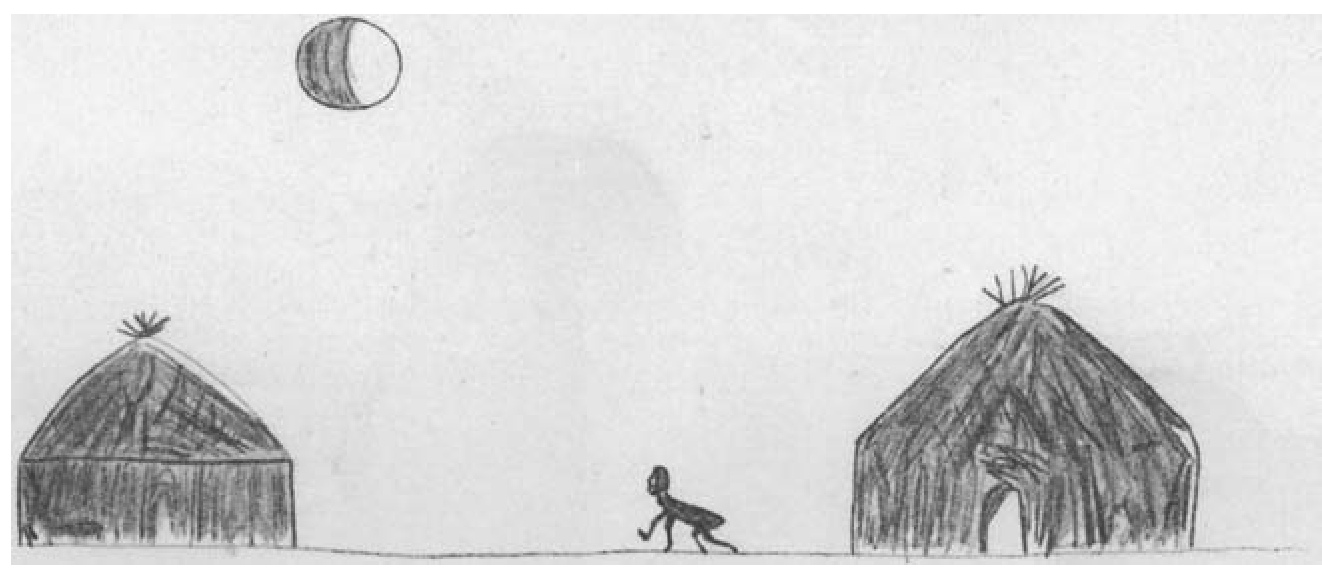
Fig. 286, made by a native of Mariinsky Post, represents a shaman who crawls on all-fours to invoke the moon. He is supposed to be naked, his head only being covered with a large shamanistic cap. Scratching-Woman affirmed that he performed his incantations of this kind without any clothing, but with a shaman’s cap on his head. A similar incantation, with the mention of genital parts, is used by the Chukchee hunters of wild reindeer on the Middle Anadyr.¹
I was also told that some shamans arrange, every year or every other year, a special thanksgiving performance, to take place on the day of some yearly ceremonial of their family. In this performance they appear naked, and pronounce an incantation with the mention of the genital parts, which is addressed to their assistant “spirits.”
The branch of shamanism, however, of which I am about to speak, is of a more special character, and refers to that shamanistic transformation of men and women in which they undergo a change of sex in part, or even completely. This is called “soft man being” (yɪrkaˊᵋ-laˊul-vaˊɪrg̣ɪn); “soft man” (yɪrkaˊᵋ-laˊul) meaning a man transformed into a being of a softer sex. A man who has changed his sex is also called “similar to a woman” (ñeˊučhičä), and a woman in similar condition, “similar to a man” (qaˊčɪkɪčhêča). Transformation[450]🗗uncollated of the first kind is much the more frequent; indeed, I had no opportunity of seeing personally an instance of the second kind, and my information is gathered only from hearsay.
Transformation takes place by the command of the keˊlet, usually at that critical age of early youth when shamanistic inspiration first manifests itself. It is, however, much dreaded by the youthful adepts; and in most of those cases in which I spoke of the young shamans preferring death to obedience to the call of the “spirits,” there was connected with the call a reference to change of sex. There are, however, various degrees of transformation of this kind.
In the first stage, the person subjected to it personates the woman only in the manner of braiding and arranging the hair of the head. This usage is widespread among the Chukchee, and is adopted not only by shamans at the command of the “spirits,” but also by sick persons at the bidding of shamans. In the latter case the aim is to change the appearance of the patient so as to make him unrecognizable by the “spirits.”
The second stage is marked by the adoption of female dress, which is also practised either for shamanistic or for medico-magical purposes. It does not imply complete change of sex. For instance, Kɪˊmɪqäi,¹ who claimed for himself shamanistic powers, wore woman’s clothes, which he assumed in his early youth. He was afflicted with a strange illness, which caused him to sleep in his inner room day after day, almost without interruption. At length a keˊlᴇ appeared to him in his sleep and ordered him to put on woman’s dress, which he did accordingly. Notwithstanding this, Kɪˊmɪqäi had a wife and four children, one of which was still nursing when I saw him. The cheeks of Kɪˊmɪqäi were also covered with a stubby black beard, and there could be no misunderstanding about the sex to which he really belonged.
A young man, by name Čaivuˊurg̣ɪn, a native of Indian Point, whose picture is given on Plate XXXIII, Fig. 2, was told by a shaman to put on a woman’s dress in order to relieve him from a chronic disease to which he had been subjected from childhood.
The instances of such practices, however, are by no means frequent, since the adoption of the dress, although the most conspicuous feature of the transformation, does not confer the extraordinary power which is considered to be the rightful appurtenance of the change.
The third stage of transformation is more complete. A young man who is undergoing it leaves off all pursuits and manners of his sex, and takes up those of a woman. He throws away the rifle and the lance, the lasso of the reindeer herdsman, and the harpoon of the seal-hunter, and takes to the needle and the skin-scraper. He learns the use of these quickly, because[451]🗗uncollated the “spirits” are helping him all the time. Even his pronunciation changes from the male to the female mode. At the same time his body alters, if not in its outward appearance, at least in its faculties and forces. He loses masculine strength, fleetness of foot in the race, endurance in wrestling, and acquires instead the helplessness of a woman. Even his psychical character changes. The transformed person loses his brute courage and fighting spirit, and becomes shy of strangers, even fond of small-talk and of nursing small children. Generally speaking, he becomes a woman with the appearance of a man.
Of course it is difficult to find out how far auto-suggestion is responsible for the change in a person transformed in such a manner, and which of these changes are merely assumed by him in order to make an impression on the public mind.
The most important of the transformations is, however, the change of sex. The “soft man” begins to feel like a woman. He seeks to win the good graces of men, and succeeds easily with the aid of “spirits.” Thus he has all the young men he could wish for striving to obtain his favor. From these he chooses his lover, and after a time takes a husband. The marriage is performed with the usual rites, and I must say that it forms a quite solid union, which often lasts till the death of one of the parties. The couple live much in the same way as do other people. The man tends his herd and goes hunting and fishing, while the “wife” takes care of the house, performing all domestic pursuits and work. They cohabit in a perverse way, modo Socratis, in which the transformed wife always plays the passive rôle. In this, again, some of the “soft men” are said to lose altogether the man’s desire and in the end to even acquire the organs of a woman; while others are said to have mistresses of their own in secret and to produce children by them.
The transformed men, however, keep their former masculine names. All of the “soft men” I met, or of whom I knew, had men’s names. One only was called “Woman’s-Dress-Amoˊᵋlên” (Kêr-Amoˊᵋlên), the latter part being a male name. In contrast to this, some of the ordinary people even are given women’s names by shamans,¹ either at the time of their birth, or later on.
The state of a transformed man is so peculiar that it attracts much gossip and jests on the part of the neighbors. Such jests are of course interchanged only in whispers, because the people are extremely afraid of the transformed, much more so than of ordinary shamans.
In a tale widely circulated among the Chukchee, a “soft man,” clad in a woman’s dress, takes part, with other members of the family, in corralling the reindeer-herd. The wife of his brother taunts him, saying, “This one[452]🗗uncollated with the woman’s breeches does not seem to give much help.” The “soft man” takes offence, and leaves the family camp. He goes away to the border-land of the Koryak, who assault him in his travelling-tent. He, however, snatches his fire-board implement, and with its small bow of antler, shoots the wooden drill at his adversaries. Immediately it turns into a fiery shaft and destroys all of them one by one. He then takes their herds, and, coming back to his home, shows his newly acquired wealth to his relatives, saying, “See now what that of woman’s breeches was able to procure for you.”
Moreover, each “soft man” is supposed to have a special protector among the “spirits,” who, for the most part, is said to play the part of a supernatural husband, keˊlᴇ-husband (keˊle-uwäˊᵋquč), of the transformed one. This husband is supposed to be the real head of the family and to communicate his orders by means of his transformed wife. The human husband, of course, has to execute these orders faithfully under fear of prompt punishment. Thus in a household like that, the voice of the wife is decidedly preponderant. The husband often takes the name of his wife as an addition to his own name; for instance, Têluˊwg̣ê-Yaˊtirg̣ɪn (“Yaˊtirg̣ɪn, husband of Tiluˊwg̣i)”. Otherwise the same is done by the children with the name of their father; as, Kokoˊlê-Yaˊtirg̣ɪn (“Yaˊtirg̣ɪn, son of Kokoˊlê”).
The keˊlᴇ-husband is very sensitive to even the slightest mockery of his transformed wife, because he knows that the “soft man” feels exceedingly “bashful,” and also because he is doubtless conscious that the position of the latter is ridiculed on account of his obedience to his own orders.
Speaking further of the marriage-relation with supernatural beings, some shamans of untransformed sex are said also to have keˊlᴇ-wives, who take part in the every-day life of their house. Thus, in the tale of a contest of two shamans,¹ one of them is said to have a keˊlᴇ-wife. Her face looks on him from the wall of his sleeping-room. Whenever he wants to take a meal, his human wife brings him meat and begins to cut it into small pieces. He eats them one by one, and during the meal the face of the keˊlᴇ-wife keeps watch on him from the wall. Notwithstanding this watch, another shaman succeeds in spiriting him away. This one also has a keˊlᴇ-wife of his own, but he takes also that of his vanquished rival; and now the faces of his two keˊlᴇ-wives watch over him from both walls while his human wife cuts meat for his meal. He also sleeps very comfortably with his three wives.
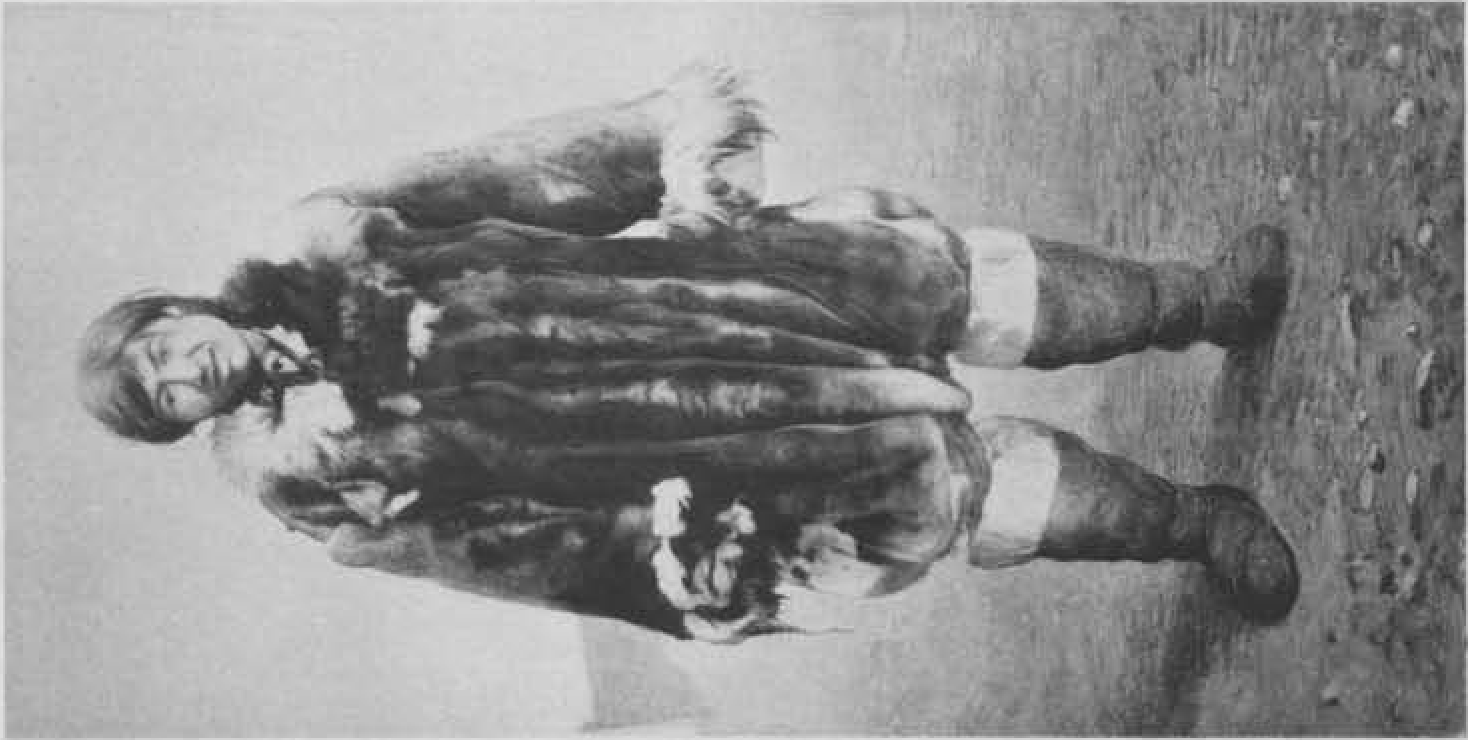
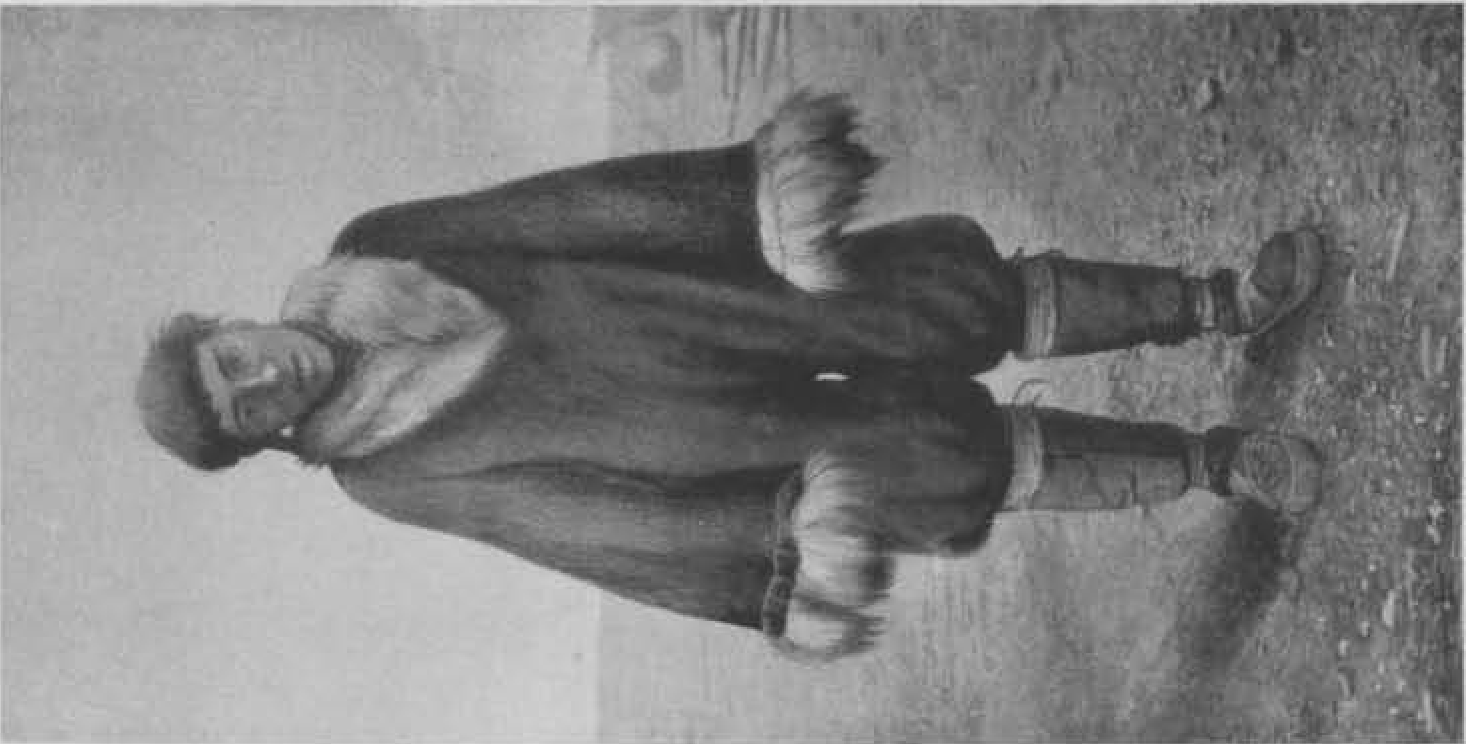
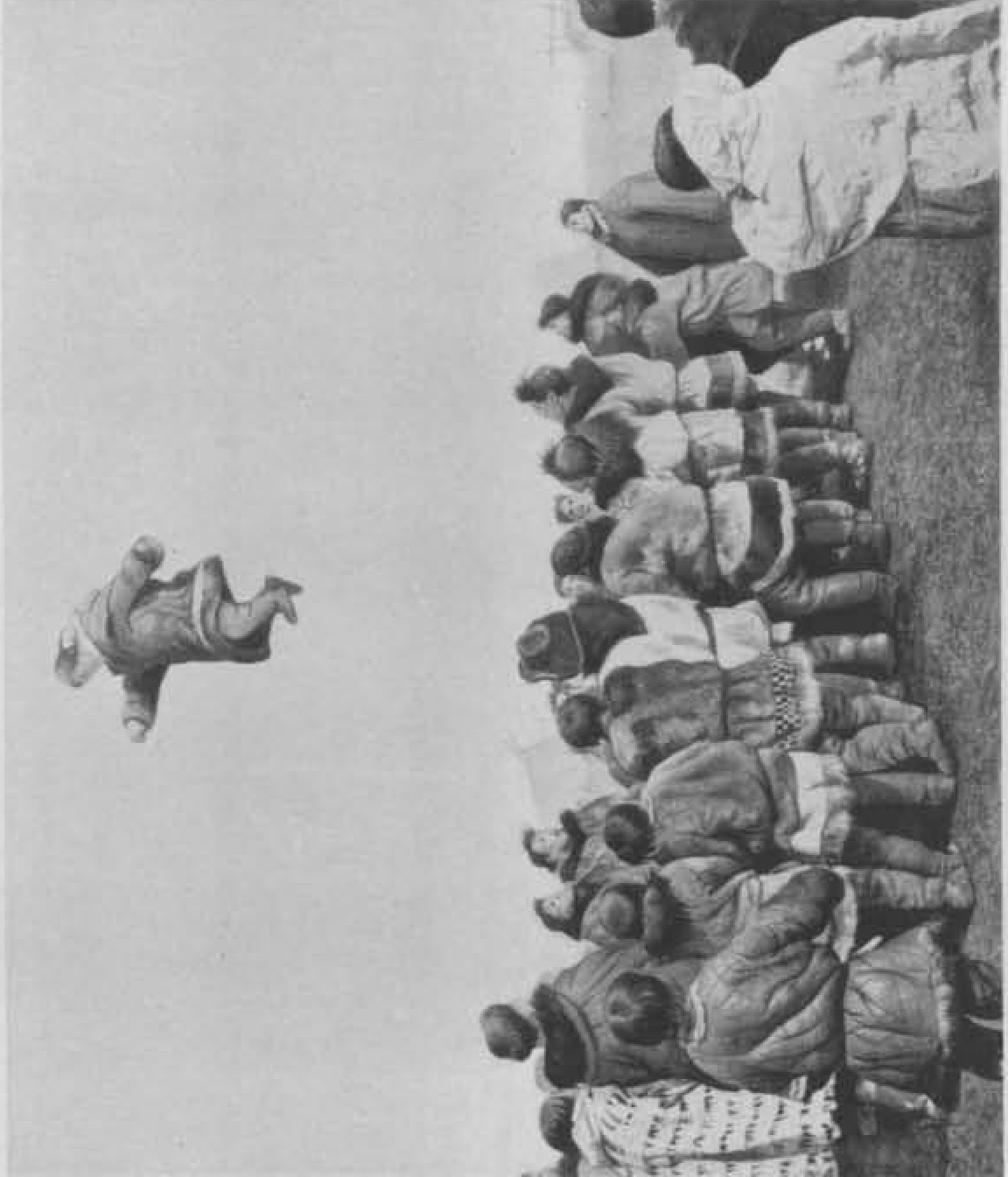
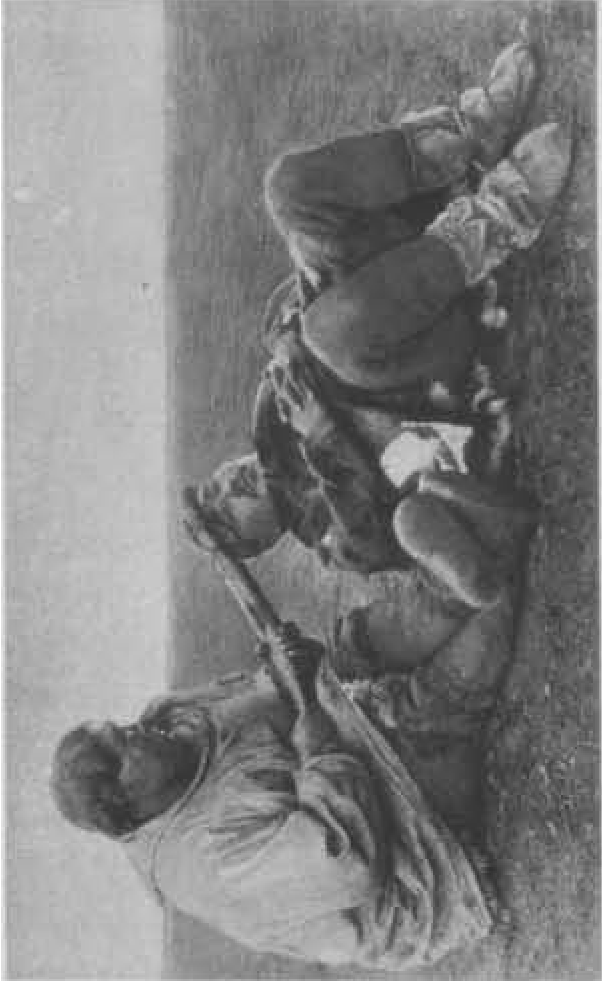
In the tale of Kukuˊlpin, the Shaman with Warts,² the latter bids his keˊlᴇ-wife pitch the sleeping-room. He enters it, and from thence is heard merry talk, laughing, jingling of bracelets and of necklaces. Another shaman, who is visiting Kukuˊlpin’s house, feels a desire to pass the night with this merry female, but she is invisible to him. After several attempts on his part,[453]🗗uncollated the other wife of Kukuˊlpin, the human one, asks him reproachfully, “Are you sure that you can sleep with an ‘alien’ keˊlᴇ-wife?”
“Soft men,” of course, are supposed to excel in all branches of shamanism, including the ventriloquistic art, notwithstanding the fact that they are supposed to be women. Because of their supernatural protectors, they are dreaded even by untransformed shamans, who avoid having any contests with them, especially with the younger ones, because they are exceedingly “bashful,” and readily stand back before the pretensions of other people; but afterward the supernatural husband retaliates for the slight.
Of all transformed shamans whom I have chanced to know, the most remarkable was Tiluˊwg̣i (Plate XXXIII, Fig. 1), of whom I spoke in an earlier part of this chapter. I met him at a small trade-gathering among the camps of Reindeer people on the Wolverene River. He, together with a party of traders, came from the Chukchee Peninsula. He was of Maritime origin; but his family had some reindeer, and spent most of their time tending the herd. Tiluˊwg̣i was young, and looked about thirty-five years of age. He was tall and well developed. His large rough hands especially exhibited no trace of womanhood.
I staid for two days in his tent, and slept in his small inner room, which was hardly large enough to accommodate four sleepers. Thus I had a chance to observe quite closely the details of his physique, which, of course, were all masculine. He refused obstinately, however, to permit himself to be fully inspected. His husband, Yaˊtirg̣ɪn, tempted by the offered price, tried to persuade him, but, after some useless attempts, was at last silenced by one scowling look from his peculiar “wife.” He felt sorry, however, that I had been baffled in gratifying my curiosity, and therefore offered me, to use his own words, his eyes in place of my own.
He described the physique of Tiluˊwg̣i as wholly masculine, and well developed besides. He confessed that he was sorry for it, but he hoped that in time, with the aid of his keˊlet, Tiluˊwg̣i would be able to equal the real “soft men” of old, and to change the organs of his sex altogether, which would be much more convenient than the present state. Notwithstanding all this, and even the brownish down which covered his upper lip, Tiluˊwg̣i’s face, encircled with braids of thick hair arranged after the manner of Chukchee women, looked very different from masculine faces. It was something like a female tragic mask fitted to a body of a giantess of a race different from our own. All the ways of this strange creature were decidedly feminine. He was so “bashful,” that whenever I asked a question of somewhat indiscreet character, you could see, under the layer of its usual dirt, a blush spread over his face, and he would cover his eyes with his sleeve, like a young beauty of sixteen. I heard him gossip with the female neighbors in a most feminine way, and even saw him hug small children with evident envy for[454]🗗uncollated the joys of motherhood; but this even the keˊlᴇ-husband could not place within the limits of transformation.
The human husband of Tiluˊwg̣i was an undersized fellow, shorter than his “wife” by at least half a head. He was nevertheless healthy and strong, a good wrestler and runner, and altogether a normal, well-balanced person. He was a cousin of Tiluˊwg̣i, as generally the transformed shamans prefer to choose a husband from among their nearest relatives.
The division of labor between the two followed, of course, the usual rules. In the evening, Yaˊtirg̣ɪn would sit idly within the inner room, while Tiluˊwg̣i busied himself outside with the hearth and the supper. Yaˊtirg̣ɪn, received the best pieces of meat, and the transformed “wife,” according to custom, had to be content with scraps and bones. In the more serious affairs of life, the voice of the “wife” was, however, dominant.
I heard also from their neighbors a curious story, that one time, when Yaˊtirg̣ɪn was angry at something and wanted to chastise his giant wife, the latter suddenly gave him so powerful a kick that it sent him head foremost from their common sleeping-room. This proves that the femininity of Tiluˊwg̣i was more apparent than real. The transformation in Tiluˊwg̣i began in his very early youth, after a protracted illness from which he freed himself by the song and the drum. He gave a shamanistic séance in my presence, which had no peculiar features, except that the keˊlᴇ-husband often appeared and talked to the public, extolling the shaman. In the very beginning, Tiluˊwg̣i called him and asked him to mend the drum, which, as he pretended, had not the proper ring.¹ We heard the keˊlᴇ-husband blow with great force over the cover of the drum, after which its sound at once improved.
Another shaman of transformed sex was Eˊčhuk, whom I met at the Anui fair. He was a person of about forty, tall and strong, of rather indecent behavior and strongly peppered talk. He boasted even that he had been able to bear two sons from his own body, through the assistance of his keˊlᴇ-protector.
Keeˊᵋulin, of the village of Aˊčon, was an old man of sixty, a widower, whose wife had borne him several children. At the same time the people asserted that he had a male lover with whom he had lived for more than twenty years. Now his male lover was also dead, so he was doubly widowed. He wore female dress, but his face was covered with stubs of gray beard, and his head was too bald to leave enough hair to be arranged in braids. He was quite poor, and even the shamanistic power had gone from him to a considerable degree. He was said, however, to have a new lover, — another old man who lived in the same house with him.
[455]🗗uncollatedTwo other cases that I met personally were very young men living with their parents. One was a nimble young fellow and a very able herdsman; but the people accused him of perverting all his young companions, who beset him with their courtship, to the great detriment and offence of the lawful beauties of the camp. The other one was a sickly fellow, who, however, was told to look seriously for a husband. Both were so “bashful” that they carefully avoided giving me time or opportunity for any annoying questions.
I heard, also, of another “soft man,” who was woman-like in face, talked in a thin, piping voice, and had very long hair. He changed his sex completely from the very beginning of his “shamanistic” call.
The perversion of the sexual functions, resulting from psychical or physical causes, may happen, of course, among primitive peoples as well as among civilized ones. I met among the Russian creoles of the Lower Kolyma, who do not differ practically from the Russianized Yukaghir of the same locality, an old man who had a bearded face and the outer genital organs of a male. Notwithstanding this, he acted like a woman throughout his whole life. He wore woman’s dress, performed woman’s work, and even in his conversation applied to himself the feminine gender, for which the Russian language presents numerous occasions. The neighbors called him Supan, (Жупанъ Супанъ), which is a local Russian term for a man of transformed sex, and is likewise applied to native cases.¹
The case of qaˊčɪkɪčhêča, that is, of a woman transformed into a man, is still more remarkable than that of the “soft man.” I obtained detailed information of only two or three instances. One was of a widow of middle age, who had three half-grown children of her own. She received at first an “inspiration” of a more usual kind, but later the “spirits” wanted to change her to a man. Then she cut her hair, donned the dress of a male, adopted the pronunciation of men, and even learned in a very short time to handle the spear and to shoot with a rifle. At last she wanted to marry, and easily found a quite young girl who consented to become her wife.
The transformed one provided herself with a gastrocnemius from the leg of a reindeer, fastened to a broad leather belt, and used it in the way of masculine private parts. I have said before that the gastrocnemius of a reindeer is used by Chukchee women for the well-known unnatural vice. After some time the transformed husband, desiring to have children by her young wife, entered into a bond of mutual marriage with a young neighbor, and in three years two sons were really born in her family. According to the Chukchee interpretation of mutual marriage, they were considered her own lawful children. Thus this person could have had in her youth children of[456]🗗uncollated her own body, and in later life other children from a wedded wife of hers. Another case was that of a young girl who likewise assumed man’s clothing, carried a spear, and even wanted to take part in a wrestling-contest between young men. While tending the herd, she tried to persuade one of the young herdswomen to take her for a husband. On closer acquaintance, she tried to introduce the same implement, made of a reindeer gastrocnemius tied to a belt, but then was rejected by the would-be bride. This happened only a few years ago; the transformed woman is said to have found another bride, with whom she lives now in her country on the head-waters of the Chaun River.
Of other tribes of northeastern Siberia, persons of a changed sex were found among the Koryak, the Kamchadal, and the Asiatic Eskimo. Thus Krasheninnikoff says¹ that the Kamchadal men lived with so-called koyekchuch, who wore female dress, performed the work of women, and avoided mixing among men. The Kamchadal kept them as their concubines, side by side with their real wives.
Steller calls such men koiach or kojachtschitsch. He says that in former times almost every Kamchadal had, besides his wife, such a koiach in his house.² The Koryak had also similar concubines, which in their language were called keiew or kewew. This, with proper phonetic change, is the same word as the Kamchadal koiach. The memory of persons of the transformed sex, as well as both terms mentioned, still lingers in the minds of the Kamchadal and the Koryak, but the custom as described has long since disappeared.
Sarytcheff mentions the same habit among the Kadyak-islanders. He says that among those who visited the Russian ship was one man of forty, repulsive of face, but clad in female dress. His cheeks were tattooed like those of a woman, and he had a nose-ring of beads. He was reputed to live as a wife with one of the islanders.³
Schelechow, one of the founders of the Russo-American Trading Company, speaks of the same thing among the inhabitants of other neighboring islands.⁴
Mamia Rinsô, the well-known Japanese traveller of the beginning of the nineteenth century, tells⁵ of seeing on the Island of Saghalin, among the people of Smerenkur (Gilyak), several men living in the same house with one woman. He describes their relations as those of polyandry. Von Siebold compares them with the koyekchuch of Kamchatka, and ventures the suggestion that the information by Steller and Krasheninnikoff is incorrect, and that the peculiar marriage-form of the Kamchadal and Koryak may also have been[457]🗗uncollated polyandry. What was said before will be sufficient to corroborate Steller and Krasheninnikoff. Schrenck, on his part, denies the existence of polyandry among the Gilyak, and supposes that the several men living with one woman, of whom Mamia Rinsô speaks, were in reality the slaves of the family.¹ Among the Chukchee a form of marriage much like polyandry exists at the present time.
Among the Asiatic Eskimo, transformed persons are found even now, as may be seen from what was told² about Čaivuˊurg̣ɪn of Indian Point. Mr. Gondatti asserts in his paper on the Population of the Anadyr District³ (and also in a verbal communication), that at Indian Point the transformed shamans have a great and baleful influence, which he, on his arrival, tried to counteract, and succeeded in partly overcoming. Mr. Gondatti was the chief official of the Anadyr country, and the curtailment of the unhealthy influence of the shamans lay evidently within the province of his duties (of course, from a Russian official point of view). When, however, I visited Indian Point, the only transformed person I found there was the sickly Čaivuˊurg̣ɪn. Another “soft man,” of greater age, whom Mr. Gondatti had probably met, died from measles in 1900. Other inhabitants did not undertake to follow his practices, remembering, perhaps, the reproofs of Mr. Gondatti.
SHAMANISTIC GARMENTS. — The shamanism of the Chukchee has not reached a stage of development high enough to have drums or clothing of peculiar form, or, indeed, any special belongings characteristic of itself. The Chukchee shaman uses the ordinary drum of his family, or perhaps he may make an extra drum for his own use; but this drum will have exactly the same form, and, moreover, it will probably be employed in all the family ceremonials, where additional drums are used for making as much noise as possible.
As to the shamanistic garb, the Chukchee have nothing similar to the well-known type of coat covered with fringes and images, which is in general use among the Yakut and Tungus, and which probably was borrowed from the latter by the Yukaghir, and perhaps also by the Kamchadal, if we may judge by the representations in Steller’s book.⁴ To understand the reasons for the absence of a peculiar shaman’s dress among the Chukchee, we must remember that their shamans perform most of their practices in the inner room of the house, in total darkness, where the outer appearance of the shaman is of no consequence. The atmosphere, too, is so close, that the[458]🗗uncollated shamans, instead of putting on a special garment, are accustomed, on the contrary, to take off their coats, or, in the case of women, to throw back the upper part of their ample fur waist. Thus, in both cases, they practise with the upper part of the body quite naked. The same is true of the Asiatic Eskimo.
Shamanistic spirits often show a tendency to attach some external marks to their followers in order to make them distinguishable from ordinary people. This, however, is applied only to the men. As far as I know, also among the other neighboring tribes, female shamans have no external marks, nor do they use the special shamanistic garb, which is assigned only to the male shamans. In contrast to this is the custom, which I have spoken of among Chukchee shamans, of adopting the clothes and the ways of a woman.
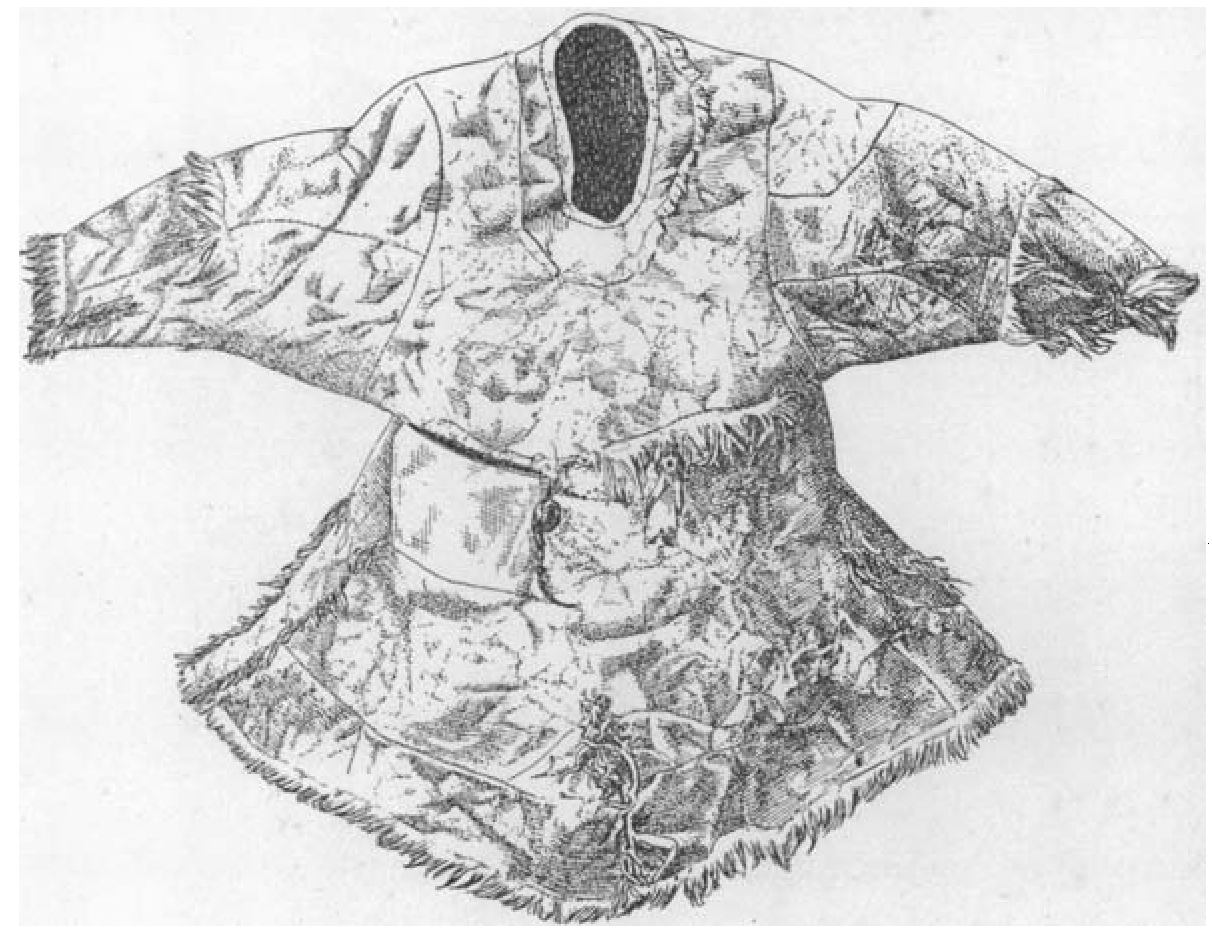
Another means employed for the purpose of shamanistic distinction is a man’s coat of usual cut with a white fringe. This fringe is placed around the sleeves a little above the openings, or around the neck a little removed from the collar (see Fig. 287). It is usually so narrow as to be quite inconspicuous. But this is adopted only in extraordinary cases by the shamans and also by their patients.
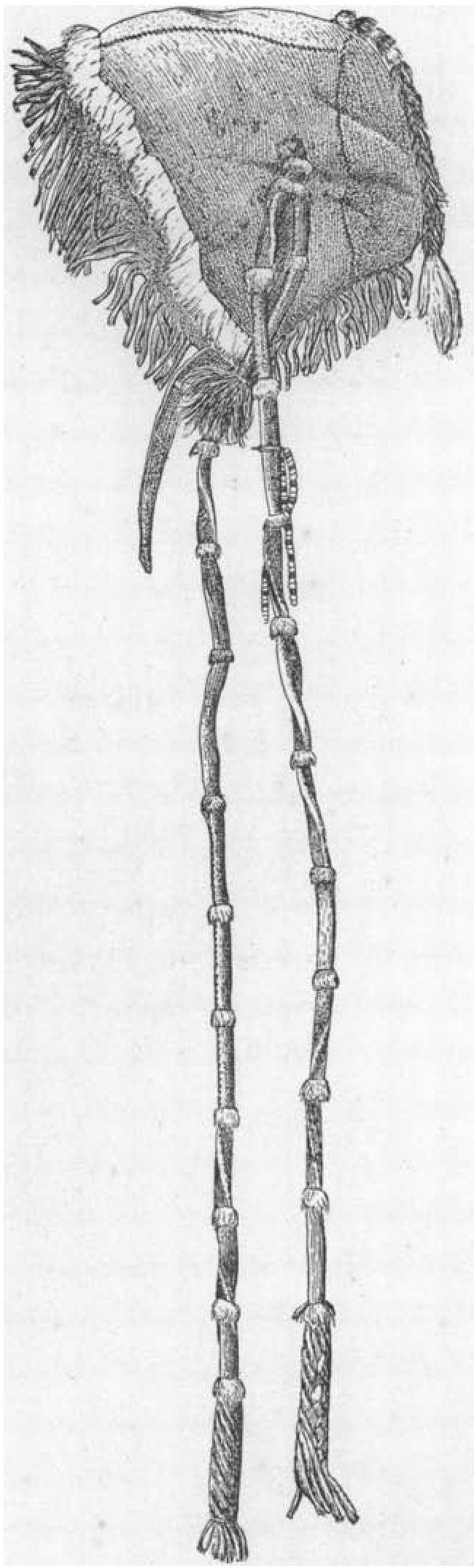
Sometimes the Chukchee shamans adopt some old coat brought from the American shores, arguing evidently that its appearance is sufficiently unusual to distinguish them from other people. In a few other cases the shamans prepare a coat of their own. That represented in Fig. 287, and belonging to the collections of the Museum, was acquired from the shaman Scratching-Woman, and is a characteristic specimen. It is a reindeer-skin coat of the usual Chukchee pattern, with the hair turned inward. It looks rather poor and threadbare. This, however, in the eyes of its owner, only increased its value. The neck and sleeves are adorned with white fringe, and there are, moreover, slits cut along the sleeves and in the front of the skirt below. These slits are ornamented with fringe made of curried leather. The cuts and the fringe are considered the[459]🗗uncollated characteristic features of the coat, and all shamanistic coats of which I heard were described as garments ripped up all around and adorned with fringe. The shamanistic garment represented in my “Chukchee Material Life”¹ belongs to the same type. These slits and fringes are usually said to represent the curves and zigzags of the Milky Way. It is quite possible, however, that both the slits and the fringes are simply the best imitation possible to them of the Tungus specimens.
Except when used by shamans, the Chukchee always ridicule garments of “alien” shape; and the clothes of the Tungus, which they say are all ripped up, are the special butt of their derision. “Alien” shamans, however, as mentioned before, are acknowledged by the Chukchee to have considerable power, and they are often consulted by their Chukchee neighbors. On the southwestern border of the Chukchee territory, some of the people, pretending to have shamanistic powers, have adopted the Tungus drum, which is larger than their own and of different shape. It is also in exclusive use among the Koryak, at least in modern times. This goes to prove that imitation of the Tungus in regard to the shamanistic coat is also quite probable.
The garment represented in Fig. 287 has in the front an image of tetkeˊyuñ (that is, of vital force), residing in the heart, and therefore having its form. It is made like a leather ball, and filled with reindeer-hair. The other figure, likewise of leather, represents a reˊkkeñ, who was an “assisting” spirit of the shaman. The shamanistic cap which belonged to the garment (Fig. 288) is also supplied with fringes, with a tassel on the top and a long double tassel on the left side. The tassels are of the type adopted for magic purposes;² that is, they are formed of alternating[460]🗗uncollated pieces of white and black fur. Another cap, with the opening on top, and likewise fringed and tasselled, was used by the shaman as a remedy against headache. For this purpose he put it on the heads of his patients, strengthening its action with proper incantations. This latter detail brings us to the question of magic medicine as practised by the Chukchee shamans.
MAGIC MEDICINE. — The Chukchee, as said before, ascribe all maladies to the influence of “genuine” keˊlet, the murderers.¹ Of these, the keˊlet of contagious diseases — such as small-pox, influenza, and measles — are so terrible that the shamans are almost powerless to check them. “Against those it is no use to begin,” said Scratching-Woman to me naïvely, “lest they grow angry and retaliate upon ourselves.”
Another Chukchee explained that even sacrifices are of little avail with those keˊlet. The people on the western tundra on the Kolyma explained to me that in the “bad year” (1884), the year of the small-pox epidemic, some of the people tried to propitiate the keˊlᴇ with sacrifices. Because he was killing people in the inner room, women sacrificed to him with oil from the lamp and with warm blood-soup from the cooking-kettle. These they would put on small round pieces of curried leather, and then set them on the snow pointed to the west, whence the keˊlᴇ used to come. But he wanted more than that, and did not relent in the least, even after receiving these offerings.
The sacrifice of something that is very personal, and highly valued by the owner, — as the Chukchee say, “taken to the heart” (liˊñliñkin), — is considered an effective means of warding off an assault by keˊlet. The best reindeer-team, the gun, or the clothes from the body, may serve for the purpose. If a man once loudly proclaims his readiness to give to the keˊlet any such object, it is very dangerous for him to go back on his promise. The keˊlet would be sure to avenge heavily their disappointment at the loss of the sacrifice.²
In a similar manner, when a man has once proclaimed a desire to die, be it from spite or rashness, he must fulfil it, otherwise his whole family will be exterminated by revengeful keˊlet.³ Against the keˊlᴇ of contagious disease, however, all sacrifices of even the most valuable things are of no avail. The only means of escape from the keˊlᴇ of contagious disease is by immediate flight, in order to leave between the keˊlᴇ and the human people large tracts of uninhabited country. Then he may not care to follow, being afraid of hunger on the solitary way, and therefore may choose another direction.
A flight like this is possible chiefly to the Reindeer people, among whom it is often carried out by the entire population of a district on the first news of the coming disease. Thus, in 1897 the Reindeer camps of the Chaun[461]🗗uncollated district, in order to avoid influenza, coming as usual from the west, retreated for several days’ journey from the nearest camp of the western people on the head waters of the Anui.
While a contagious disease is raging, the “shunning” of everybody suspected of being followed by the “spirit” is carried to the greatest extent. Even a visit to a camp tainted by disease is considered as a kind of trespass, a desire to tempt the keˊlᴇ, who otherwise might have passed by and hurt nobody.
According to an account by Aiñanwaˊt, during the small-pox epidemic of 1884, some sick people, while still alive, were left by their house-mates, who tried to flee from the anger of the keˊlᴇ. At the same time, some of the camps which stood quite apart escaped unharmed. One Aˊmčê, a rich reindeer-breeder, lived with many daughters, all of whom were married. One of his sons-in-law, also a well-to-do breeder, lived by himself. His camp was visited by the keˊlᴇ; and all the family, except the daughter of Aˊmčê and one young boy, died. These two had fled to a neighboring camp, leaving the husband dangerously ill. After a while the woman was visited by her father, who took her to his own camp.
The disease passed over, and the people began to live without fear. Then Aˊmčê thought about his son-in-law. They both were shamans, and Aˊmčê argued that the other might have escaped, after all. At last he resolved to visit the stricken camp. They started, a party of five, two other sons-in-law of Aˊmčê being of the number. When they reached the camp, Aˊmčê, brandishing his spear, went toward the tent of his daughter, and ripped the wall, taking care not to touch it with his bare hands. This is one of the usual precautions against contact with the “spirits.” After that, Aˊmčê ripped also a wall of the inner room, and saw the corpse of his son-in-law. “Oh!” said he, “then you are really dead. What can I do for you? It is of no use to carry you into the wilderness. You have here the whole tent at your command. Well, I have seen you, at least. Good-by! I am going.”
When they reached home, however, the two sons-in-law of Aˊmčê who had been of the party suddenly grew ill and died. Two others fled from the camp and thus saved their lives. But none of Aˊmčê’s own offspring were attacked by the disease.
The narrator told all this, attaching the greatest blame to Aˊmčê for his conduct, who acted as though he desired to find a keˊlᴇ and draw him to his own place. The explanation offered by the teller of the story as being the possible one was, that Aˊmčê, being a shaman, foresaw some bad luck for his family, and wanted to sacrifice to the keˊlet the people of “alien blood,” though they were his sons-in-law.¹
[462]🗗uncollatedIn contrast to the conduct of Aˊmčê, in the same year several fugitives from stricken camps, especially those who had no near relatives among the neighbors, were forbidden by the people of other camps, rifle in hand, to approach their dwellings, under danger of immediate death. One Peˊplu told me that, when he was only fifteen, his camp was visited by disease, and that all the people died. Then he fled and went to his uncle’s, but the latter met him, rifle in hand, and bade him immediately return. “Go and strangle or stab yourself!” cried the old man from a safe distance. “You belong to the keˊlᴇ. Go away!”
Exactly the same thing happened among the Yakut, and in some measure likewise among the Russianized natives of the Kolyma.
I have alluded before to the precautions taken against syphilis. In reference to this I was told by my Chukchee informants that in ancient times, trespass against those prescriptions was accounted a greater sin than murder, because the murderer kills only one man, and that one of an “alien” origin, while the trespasser against the “shunning” endangers the lives of his closest relatives and acquaintances.
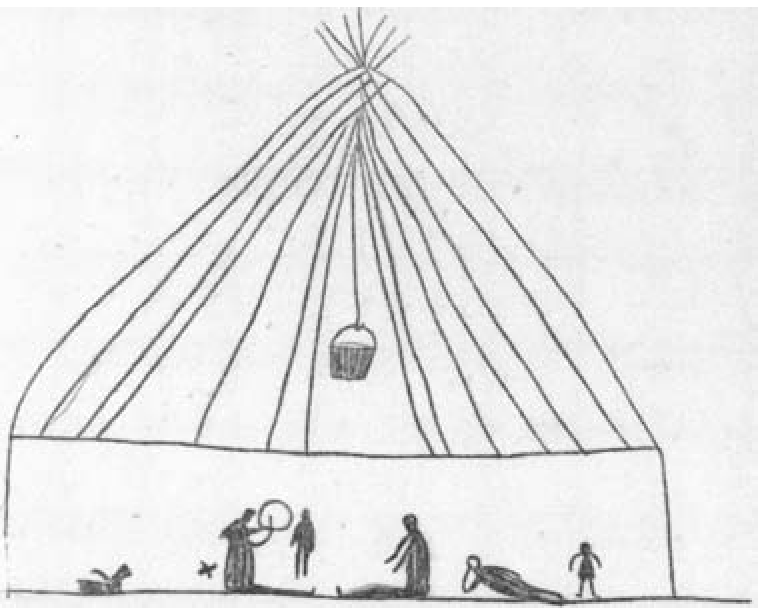
Shamans also in their medical practice do not like to enter into direct communication with the “genuine” keˊlet of other diseases, but prefer to inquire about the causes of such and such illness from their own assistant keˊlet. Therefore the “genuine” keˊlet are not called by the shaman in his performances. They come, however, of their own accord, and usually remain silent in a corner till the keˊlet of the shaman denounce them. Then the assistant keˊlet take to abusing them in every possible manner. This makes the “genuine” keˊlᴇ leave off, although he has to keep watch over his human prey which is undergoing the magic cure of the shaman.
In the native sketches of the performance of magic medicine, the “genuine” keˊlᴇ is represented as a being of a larger size than the “assistant” keˊlet of the shaman, perhaps to set off his dreadful power. Thus, in Fig. 289, copied from a native sketch, a shaman in a sitting position is practising, in the inner room of a tent, over a sick boy. Two assistant keˊlet are coming to his call, while a keˊlᴇ of disease is standing in the corner. All keˊlet are represented with wings, and resemble insects somewhat. Two men are listening, one in a sitting position and the other reclining on his elbow. A small boy, frightened, has jumped up and is about to flee.
I must mention here that the shaman is considered able to treat the sickness[463]🗗uncollated of other people, but not his own. On the other hand, persons feeling unwell take to shamanistic exercises without any particular aim other than to give vent to their frenzy, or with a half-unconscious purpose of drowning the feeling of sickness in the noise and nervous excitement of the practice. “I am no shaman,” I heard from such an occasional practitioner; “but with our people the power of singing comes voluntarily with every danger or illness. Then it passes away, but I cannot tell where its house is. It is the same with the power of drumming. It comes in time of need, then it passes and returns to its own house.” Once in my presence a boy of seven, who had been ill for several days, kept repeating to his father, “Please beat the drum, sing songs! I want noise!” as if it were a special kind of remedy for his illness.
During the long winter nights some people resort to drumming and singing simply to while away the time, or perhaps to counteract the depression of the long period of cold and darkness. Of course, in all these cases the improvising singers try, half unconsciously, to imitate the songs and gestures of real shamans.
Among the Russianized natives and Russian creoles, women feeling unwell take to singing in a shamanistic manner, which is said to greatly relieve their suffering. Sometimes this singing is accompanied with unintelligible words, which are believed, however, to belong to the Yukaghir or Yakut language, and which are unknown to the sufferer in her normal state. Sometimes she even receives the gift of foretelling the future in this state. All this is considered a special suffering, called laconically “a fit,” and liable to attack any woman of the settlement.
There are several methods of administering magic medicine used by the Chukchee shamans. One of the most common deals with the soul (uviˊrit) of the patient, a part of which is supposed to be stolen by the keˊlet.¹ Some shamans even say similar things in regard to themselves. “I cannot practise here,” shaman Keleˊwg̣i² said to me at Mariinsky Post. “I feel that the greater part of my soul is at home staying with my separate keˊlet. My mind is somewhat wandering, and I am using but a small section of it, the remaining part being carried away by ‘separate spirits.’”
The shaman’s search for the stolen soul of his patient was formerly effected in a shamanistic trance, which nowadays is replaced by the usual sleep over night, since dreams are considered by the Chukchee one of the best means of communicating with spirits. When the search is successful, the shaman returns, bringing the soul, and tries to put it back into the body of the patient. This is done in various ways. The shaman will set about a great performance with the drum and song. Then he will pretend that he is[464]🗗uncollated blowing the soul into the body of the patient through the breast, or through the ear, or through the crown of the head. He may also present it like a small insect, which will be heard buzzing around. Then he will suddenly proclaim that it has entered the head of the patient.
The souls, as well as the keˊlet, are said to produce a buzzing sound when flying. In one of the magic performances at which I was present, the shaman asked the patient, “Do you hear that buzzing sound? It is your soul that is passing by.” After a moment he asked again, “Do you hear that rapping noise? It is your soul that is running over the drum-cover with its tiny feet.” A shaman of sufficient power, who cannot find the lost soul of the patient, may blow into his body a part of his own soul. The patient is then said to become a son of the shaman.
I saw a shaman trying to recall to her senses a sick woman who had fallen into a heavy swoon. To do this he began to beat the drum with the utmost force. Then he pretended to catch something from the drum and to swallow it hurriedly. Immediately afterward he appeared to spit it out into the hollow of his hand, and then in the quickest possible way pretended to empty his palm over the head of the patient. After that, he began to mumble and gibber over the crown of the patient’s head. In order to prevent the soul from leaving, he breathed into the hollow of his hand, and then applied his palm to the breast of the patient. At intervals he pretended to suck out the source of the suffering from the crown of her head. For this he made sucking motions with his mouth at some distance from her head. From time to time he made grimaces, and pretended to be choking, evidently for the purpose of showing that something bad had entered his mouth. At last he spat violently, and then began again the whole process.
From my own observation I know that a real insect is sometimes used in treatments of such a kind. This is brought near to the breast or to the head of the patient, and then vanishes, deftly abstracted by the shaman, who pretends that it has entered the body. The supposed process of shamanistic search for the soul of the patient, and then of putting it back into the body, is described very vividly in the story of the Scabby Shaman.¹ I will cite only the part relating to the latter process.
He [the shaman] called his keˊlet and gave them the boy’s soul to hold, and then looked hard at the decayed heap [of the half-decomposed corpse], and gulped it down, spattering the putrid fluid about. Then he shouted, “Bring a new white skin!” He vomited, and spat out the boy’s body. All the bones were in their right places, and the flesh stuck to the bones again. Then he swallowed the body a second time and spat it out again. It was covered with new skin, all sores were smoothed down. He swallowed it a third time and spat it out again: blood mounted to the cheeks, and the lips almost wanted to speak. Scabby-One shouted, “Give me the soul!” He swallowed it and spat it out on the body. The soul passed through the body and stuck in the[465]🗗uncollated wall of the house. “The body is too cold,” said Scabby-One; “it will not hold together.” He swallowed the body a fourth time, warmed it in his stomach, and spat it out again on the skin. Then he flung the soul at it. “Oh, oh, oh!” sighed the boy, and then sat up on the skin.
Instances of the swallowing of souls and bodies of men by shamans frequently occur in Chukchee tales. Thus Kukuˊlpɪn, in one of the tales, when visiting the interior of America, swallows his companion and a young girl, and, turning into a bird, carries them to his home.¹ In the tale of the Contest of Two Shamans, a small bird, Perruˊper (Uria Brünnichi), acting as an assistant keˊlᴇ of one of the shamans, comes to the house of the other one, which is watched by a host of his keˊlet. The bird dives under ground and succeeds in pushing the point of its beak through the middle of the floor, then with one drawn-in breath, one whoop, it pulls him down and swallows him under the very eyes of his house-mates.²
During the process of bringing back the lost soul of the patient, the soul is spoken of as a “little fellow” (tuˊmg̣ᴀqäi), and the shaman is called the “restorer of a little fellow” (tumg̣e-neliˊlɪn).
Sometimes, however, the shaman refuses to put the soul back personally, and, instead of that, orders the mother or the sister of the patient, or, in their absence, the father or the brother, more rarely the wife, to go out at dawn the next morning, and to pick up a blade of grass somewhere near by, repeating, “Here, here, here, I found the ‘little fellow,’ be you under my power!” This grass represents the “little fellow,” and it must be tied to the collar-strings of the patient.
Another method of shamanistic treatment of diseases may be called “magic surgery.” In this the shaman pretends to operate on the diseased part of the body and to set it right, removing the pus and the bad blood, and sometimes even recasting the whole limb. The shaman acts in a way somewhat similar to that described in regard to the recovering of a lost soul; that is, he puts his face close down to the body of the patient, blows on it, or sucks for some time a fold of the skin. It is supposed that the keˊlᴇ who assists him is able to extract and to eat up the source of the illness. Some of the rubbing and sucking has the character of massage, especially in the treatment of swellings and bruises. The shaman often produces a beetle, a thorn, or even a small stone, which he pretends to have extracted from the body. The same cure may be carried out also by means of various incantations, which will be described in the next chapter.
Besides this, the shaman pretends to possess the power to open the abdomen of the patient in order to inspect the internal organs, to remove the stricken parts, and then to make the wound whole again. This can be done only with a special knife strengthened by various incantations. Moreover, the knife has to be “heated” by long and violent shamanistic exercise. A knife[466]🗗uncollated not “hot” enough might kill the patient on the spot. I have already described tricks of this kind performed by the female shaman Uˊpuñe, and have also quoted the story of Aiñanwaˊt about a keˊlᴇ having entered his body, and cleaned his interior with a small silver knife.

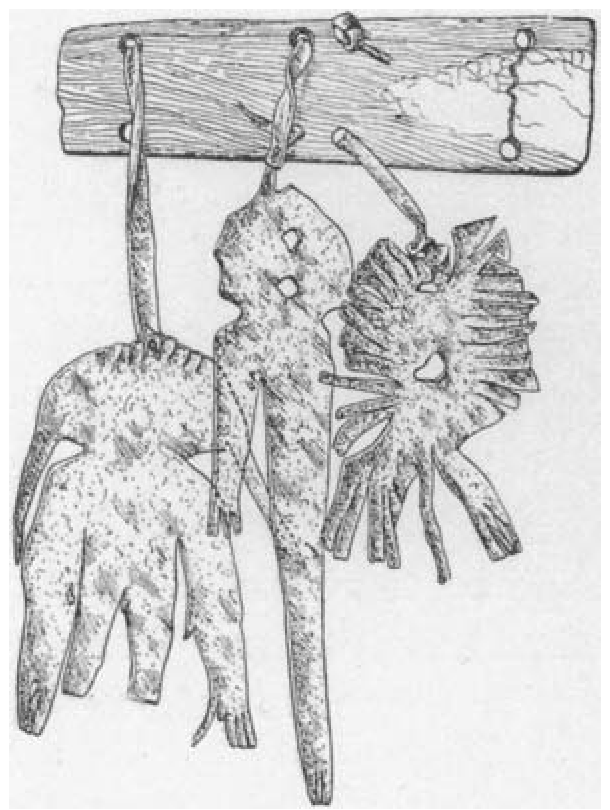
The shaman Scratching-Woman also pretended to treat his patients all the time in this way. For this purpose he used a special knife, represented in Fig. 290. This is an ordinary iron knife set into an uncouth block of wood with two circular notches and a double tassel of curried leather. A bead of blue glass almost as large as a hen’s egg is also tied to the handle. The bead looks quite old, and Scratching-Woman asserted that it was received by his grandfather directly from the keˊlet. The handle of the knife has some rusty spots, which were said by the shaman to be produced by the blood of patients operated upon with the knife. Together with the knife a small flat piece of ivory (Fig. 291) was used, which was said to be employed, as a rule, in cutting open the body. The shaman said it was a present from the Milky may.¹ Three leather images were fastened to the ivory. One was said to represent a keˊlᴇ from the “direction” of the darkness, with the arms longer than the legs. The middle image — with only one arm and one leg, and the eyes standing one over the other — represented the keˊlᴇ Iuˊmetun.² The third image represented a crawling “spell,” which one of the enemies of the shaman sent to attack him; but he intercepted it on the way and thoroughly subdued it, so that it began to do his bidding. With the aid of these instruments, Scratching-Woman pretended to have cut open and put to rights internal organs, backs, shoulder-blades, and several other parts of the bodies of many patients, although, according to his neighbors, he was too young to claim so many successful cases of treatment.
The supplementary method of magic medicine, after the treatment of shamans, consists in changing the appearance of the patient in order that the “spirits” may not recognize him again. I have already spoken of the assumption[467]🗗uncollated of women’s dress by men. The same purpose is accomplished by a change in the cut of the hair; for instance, by arranging a double fringe around the crown, closely cropped according to the Chukchee mode, or with the addition of an extra tuft on the crown or on the nape of the neck.
A change of a similar nature is adopted by others also; for instance, by a murderer when he wishes to escape the vengeance of his victim, who might easily come back in the shape of a keˊlᴇ. If not kept back, this keˊlᴇ will possess himself of the murderer and induce him to do further violence in order to have him punished by his neighbors for his crimes. The mind of the Chukchee can conceive of no other retribution for a crime unavenged by the relatives of the victim. The Greek conception of the Furies pursuing the unpunished criminal, and driving him to madness and despair, was probably also developed from a similar idea of the revengeful “spirit” of the victim pursuing its murderer. Besides this, I was told that the murderer must not cut his hair at all, but pull it out hair by hair. This process will act as a preventive against the return of the “desire to kill,” which otherwise is sure to come back and incite him to other murders. The “desire to kill,” in this case, is probably derived from the same idea of the revengeful “spirit” of the victim possessing itself of the mind of the murderer.
Another measure of like nature is a change of name, which is effected by the Chukchee very readily on several occasions of their life. The way in which the new-born infant receives its name will be described in a later chapter. Then, after a few years, the parents — if they are afraid that the name does not suit the little one, making him suffer, “making his bones heavy” — proceed to the first change of the name, after which, during later life, several other changes may follow. The names thus assumed are of the most varied character. Sometimes they are taken from among the usual Chukchee names, but more often they are chosen with the view of giving protection to the person concerned.
Some of these are names of animals, such as Aˊᵋttᴇn (“dog”), Aˊᵋttᴇqäi (“small dog”), Keiˊñɪn (“bear”), Êˊᵋhɪlhɪn (“wolf”), etc. Others refer to the “alien” tribes, such as Aiˊwan, Eˊtel, Taˊn˙ñɪtan,¹ Roˊčhɪlêᵋn (that on the other shore). Proper names taken from the “aliens” are also used for the purpose. Some names are even those of spirits, — Keleˊwg̣i (keˊlᴇ-man), Keˊle-ñeˊut (“keˊlᴇ-woman”), Kama-taˊhin (“spirit’s limit”); among the Koryak, Kaˊmak (“spirit”), etc. Female names are given to men, and vice versâ. Shamans themselves often assume a name from one of their favorite spirits. Thus one of the shamans was called Ñaw-rɪˊrkᴀ (“she-walrus”); another, Valv-ɪnpɪnaˊčhɪn (“raven old man”), etc.
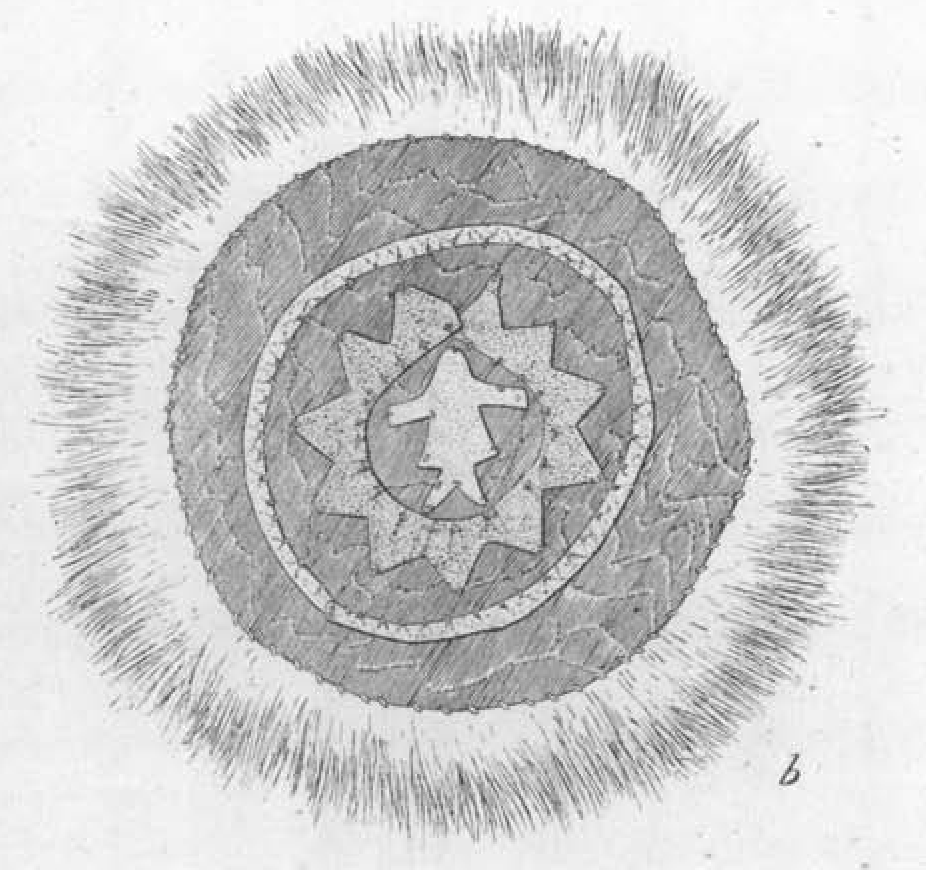
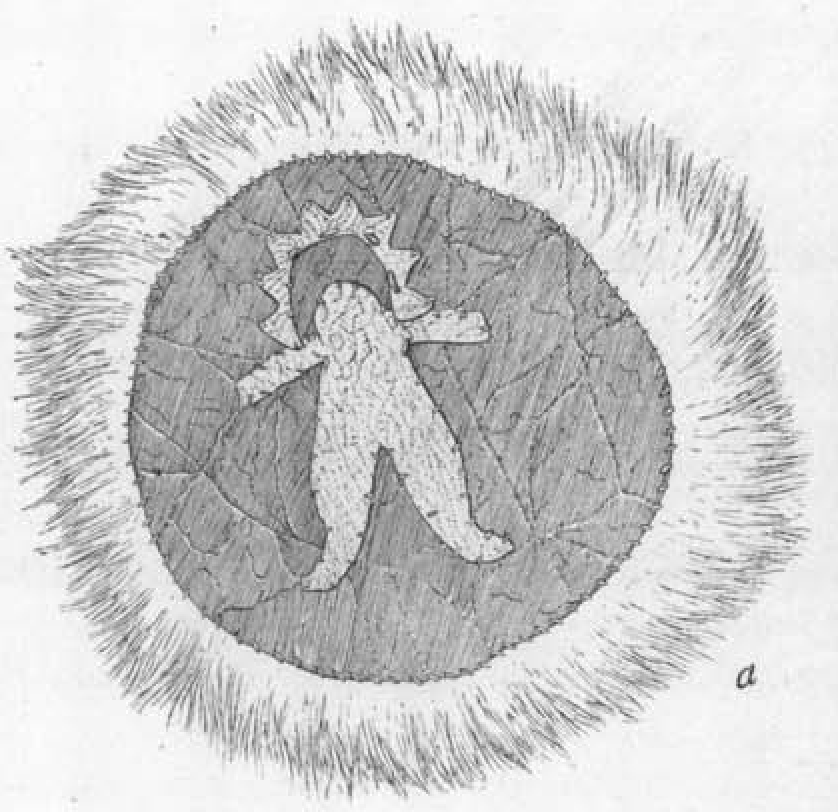
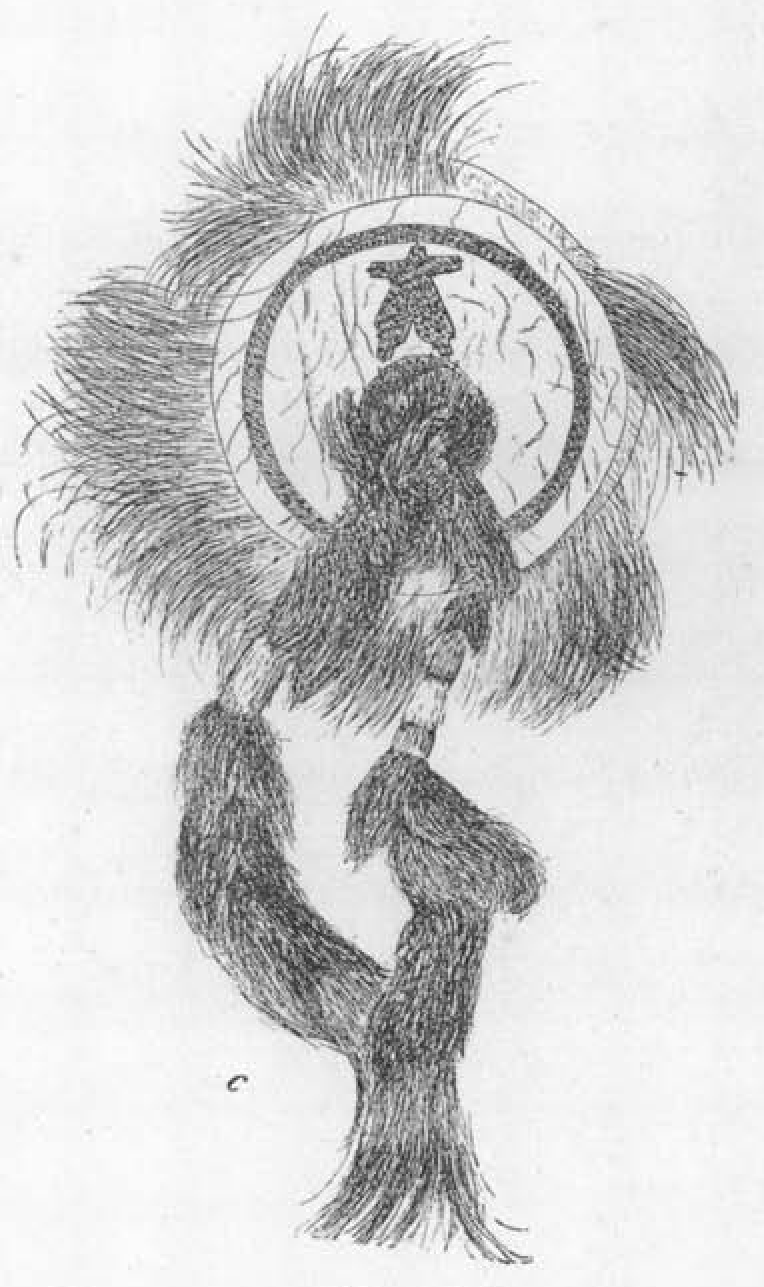
The most effective supplementary means against diseases is, however, the use of amulets, which are prepared and given by the shamans. These consist[468]🗗uncollated of various pendants and tassels made of skin and beads, and fastened to various parts of the body or dress, often also made into rings, bracelets, and necklaces to be worn for personal adornment.¹ In addition to these, I will mention the round patches of skin, often with a tassel in the centre (Fig. 292), which are considered as highly effective amulets among the Chukchee,² the Pacific Koryak, and the Asiatic Eskimo. They are sewed to the coat, on the breast or on the shoulders, and, if possible, against that part of the body where the pain is felt, or at least is supposed to be; for example, against the top of the stomach in all internal sufferings, against the shoulderblade in rheumatic affections of the back, etc. A rough image of the “guardian” is fastened in the centre. Often, however, the figure takes an ornamental character, and the “guardian” is replaced by a woman’s figure, by a man dancing, or by a warrior clad in Chukchee armor, all of which, of course, may not be considered as images of “spirits.” The whole object serves both magic and ornamental purposes, as is the case with many other pendanst and tassels.