INames and Habitat
NAMES. — The name of the Chukchee is derived from the Chukchee word čauˊču, which signifies “rich in reindeer.” The Reindeer division of the tribe call themselves by this name in distinction from other kindred people; as, for instance, the Reindeer Koryak or the Maritime Chukchee. The same word is used, too, by the Reindeer Koryak, while both tribes call each other taˊn˙ñɪtan (pl. taˊn˙ñɪt).
The Maritime Chukchee call themselves and other maritime people añqaˊlɪt (“sea people”), from aˊñqᴀ (“the sea”); or ramaˊg̣lat (“seacoast dwellers”). In distinction from other alien tribes, both Reindeer and Maritime Chukchee call themselves lɪˊi-yiˊlɪlɪt (“those of genuine language”), also oraˊwêʟ̣at (“men”) or lɪˊê-oraˊwêʟ̣at (“genuine men”), in the same way as the Asiatic Eskimo call themselves Yuˊɪt or Yu-piˊɪt (yuk, “man;” yu-pi, “genuine man”). The people of the alien tribes are called by the Chukchee aˊlva-yêˊlɪlɪt (“those of alien language”). All other names used by various writers in connection with the Chukchee tribe are for the most part the result of misunderstanding.
Thus the assertion of so many travellers, from Krasheninnikoff to Bogdanovitch, that the maritime inhabitants of the Chukchee or Koryak shores call themselves also Čauˊču, shows only that the people with whom they conversed, though following maritime pursuits to some extent, were originally of Reindeer stock, and probably still had some herds farther inland. The like is actually the case everywhere within the limits of the coast of the Chukchee and the Koryak.
The name Tuski, adopted by W. H. Hooper with the strange explanation that it means a confederation or brotherhood, has probably arisen from an attempt to simplify the misspelling Tchuski instead of Tchukotski (Чукотскій), the Russian adjective from the substantive Tchukcha (Чукча, “Chukchee”). Hooper writes Tchutskoi Noss instead of Tchukotskiy Noss (“Chukotsky Cape”).¹
The name Chukmari, adopted by A. A. Resin for a tribe “intermediary between the Koryak and the Chukchee,”² is derived from the popular Kamchatkan term for the Chukchee, Chukhmaryo (Чухмарье). He gives this name to the people living on the Opukski and Tumanski coasts; i. e., respectively to the Kerek and the Telqäˊp Reindeer Chukchee, who are in reality the rudest and most primitive branches of the Koryak and the Chukchee tribes.
W. H. Dall even considers the Kerek to be Eskimo. At least, he asserts that the Eskimo are slowly moving to the south along the coast. In[12]🗗uncollated the year 1879, he says, a new Eskimo colony settled at Cape Olutorsky, and another one was going to join them the next year.¹ The Cape Olutorsky of Russian and American maps is in reality Cape Anannon, close to which are situated the first southwestern villages of the Kerek; while the real Cape Olutorsky lies close to Baron Korff’s Bay (on the Russian maps, Cape Govensky).
In former times the Eskimo of Indian Point and other villages actually sent trading-expeditions to Capes Barykoff and Navarin, on the shores of which are situated the first northeastern villages of the Kerek, while Cape Anannon and Baron Korff’s Bay were not within their reach. Furthermore, no attempts at colonization were made as recently as the eighties of the last century; nor could the country around any of the capes mentioned be found uninhabited, as Mr. Dall was told by the people of Plover Bay.
The Russians call several of the divisions of the Reindeer Chukchee — for instance, those living around Chaun Bay and to the north of the Anadyr River — “White-Sea Chukchee.” This name is probably connected with the term êlh-aˊñqa-ñaw-yɪtooˊot (“offspring of the white-sea-woman”), which the Chukchee apply to themselves in their heroic tales. To the Maritime Chukchee the Russians give the name “Cape Chukchee,” or sometimes “Kavralin,” from the Chukchee word kavraˊlɪt (“those going around”). The Chukchee give this name to a peculiar class of traders, who travel all their lives with reindeer from East Cape and Indian Point to the fairs held on the shores of the Kolyma and the Anadyr, bartering, as they proceed on their way, among the camps of the Reindeer people. Almost all the Kavraˊlɪt are of Maritime descent. Many of them, in their youth, were poor seal-hunters; then they turned to reindeer-breeding, and, after obtaining a few score animals, started to travel for barter.
ANCIENT HABITAT. — According to the traditions of the Chukchee, they were in olden times primarily a coast people, engaged in maritime pursuits and occupations, but also carried on reindeer-breeding. In the modern life of the Reindeer Chukchee there are several traces of this former state of affairs. Thus their tales treat chiefly of maritime subjects, and but comparatively few refer to reindeer-breeding. Their winter habitations are arranged in the same manner as those of the maritime people. They remain in one place for three or four months, while the herdsmen move from one pasture to another with their herds.
Moreover, the inner room of the winter house is called “polar-bear skin” (umkᴀˊ-neˊlhɪn), though at present even the Arctic Maritime Chukchee make its covering of reindeer-skins. The tool-bag of the Reindeer Chukchee is called “whalebone receptacle” (ñalaˊwg̣očhɪn), though no whalebone is used at present for any kind of implement. The larger bags for storing food and[13]🗗uncollated clothing, though made of reindeer-skins, are invariably given the form of a seal-skin bag, stripped whole from the carcass, with a cross-slit in the middle for an opening.
In religious beliefs and rites the dog plays a more important part than the reindeer, though, under the present condition of life, dogs are of little use to the people; besides, dog-breeding does not harmonize well with reindeer-breeding, as will be shown later on. I was told several times by the Reindeer people, “The Russians unjustly wonder why we keep so many dogs. The dog is the guardian of man, a strong help in every misfortune, a true friend, keeping off the Evil One.” In travelling, a dog as a companion frightens the evil spirit away, while a reindeer has no such power. In times of infectious disease a small pup is rubbed against visitors coming from afar. This will either frighten away the spirits that may come with the traveller, or, if they are too powerful, it will at least serve as an expiatory victim.
On the other hand, the names of the months, both in Chukchee and in Koryak, curiously enough, indicate that both of these tribes, or some parts of them, came from more southern latitudes, and that perhaps they had reindeer-herds at that time. The fact is, that some of these names do not correspond to the real change of the seasons on the northern tundra. For instance, the fifth month of the Chukchee year (from the beginning of April to the beginning of May) is called “[month] of the waters” (Imlɪˊrɪlɪn). The rivers of the tundra, however, open only at the end of May. The third month of the Koryak calendar is called “false reindeer-birth month” (Tɪˊnmɪ-qoˊya-yo-yêˊᵋḷhɪn); and the fourth, “genuine reindeer-birth month” (Lhê-qoˊya-yo-yêˊᵋḷhɪn). These names seem to indicate that in some former country fawns were born a month earlier than in the present home of the Koryak. The incongruity in both cases was pointed out to me by the natives, who themselves were astonished at it.
Another curious detail in the Chukchee tradition points even farther to the south. It is the description of a large worm that lives near the villages of the dead, on the Aurora Borealis. This worm is red in color, and striped, and is so large that it can attack big game. When hungry, it is very active, and will spring from ambush upon a wild reindeer, and then, after having seized it, will kill it with the pressure of its coils. It swallows its prey whole, since it has no teeth. After taking a meal, it becomes inert, and sleeps for several days on the same spot; and the children of the dead cannot arouse it, even by pelting it with stones. This is a very accurate description of a boa-constrictor, and is apparently of ancient origin, since its location is in the sky and with the souls of the dead. There are no snakes in any part of northeastern Siberia; and therefore this tale, if based on facts, must point toward the south as far as those warmer shores where the boa-constrictor actually exists.
[14]🗗uncollatedPerhaps it will not be out of place to mention here another Chukchee legend which seems to be even more ancient. In olden times there lived in the Anui Mountains a large beast called Keliˊlhu.¹ He was tall and long, had a huge mouth which opened wide, and long-clawed paws. A certain young herdsman wandered among the crags, looking for a lost reindeer, and was seen and eaten by Keliˊlhu.
Some time afterward the young man’s father started to look for him. He went among the crags, and soon met Keliˊlhu. He said, “Keliˊlhu, have a laugh! I am fat, you will eat me; my reindeer are fatter, you will eat them too.” — “Ha, ha, ha!” laughed Keliˊlhu; and his mouth opened so wide that his upper jaw reached his back, while his lower jaw hung down to his breast. When he stopped laughing, he closed his jaws with his paws, and continued his pursuit; but the man had succeeded in gaining ground. After a while the beast approached him again; but the man repeated, “Keliˊlhu, have a laugh! I am fat, you will eat me; my reindeer are fatter, you will eat them too.” — “Ha, ha, ha!” laughed Keliˊlhu; and his jaws sprang as wide apart as before, and he closed them in the same manner, and continued his pursuit. At last they reached the village, where a number of young men killed Keliˊlhu with spears; but he had also killed many, because he was light and nimble, jumped high, bit with his teeth, and smote with his paws.
PRESENT HABITAT. — The villages of the Maritime Chukchee are situated on the Arctic coast between Cape Erri and East Cape, and on the coast of Bering Sea between East Cape and Anadyr Bay, except where a few Eskimo settlements are interspersed, — two near East Cape, and seven between Indian Point and Cape Ulakhpen (Улахпенъ). The latter is called by the natives Wuteˊen, the same name as the village close by.
The Reindeer camps are scattered over the whole country to the northeast of a line drawn from the mouth of the Indighirka River to Cape Anannon.
The part of the country lying to the west of the rivers Chaun and Anadyr forms the so-called “Chukchee territory”² (Чукотская землица). This territory, according to the obsolete but not yet abolished paragraph of the Russian Code, is considered to be “not thoroughly subdued.” Its inhabitants, as well as all other Chukchee, have the privilege of settling all their affairs according to their own customs, including even murder if committed within the limits of their own territories. Such privileges sometimes lead to strange results.
G. Dyachkoff³ relates the following incident, that occurred among the Olutora Koryak. In 1882 a man was murdered. The brothers of the murdered man refrained from the usual revenge, and sent a complaint to the magistrate in Gishiginsk. During the whole year there was no answer; after that, the[15]🗗uncollated collector of the tribute, a Cossack officer from Gishiginsk, passing through Olutora, explained to the complainants that they had to deal with the offender according to their own tribal customs. Then the relatives of the victim gathered together, and, coming to the village of the murderer, covered with burning wood the underground house where he lived with his numerous family, and all the inmates were burned alive.
The reason for this unusual forbearance lies in the fact that the last campaigns which the Russians conducted against the Chukchee, in the eighteenth century, utterly miscarried, since the Cossack captain, A. Shestakoff, was defeated and killed March 14, 1730, on the river Egaˊč; and Mayor Pavlutzky, after some temporary success, was likewise defeated and killed March 21, 1747, on the banks of Mayor’s Lake, not far from Markova, on the Middle Anadyr. After that, the government, tired of an expensive and useless war, withdrew its garrisons, and in 1764 even ordered the fort of Anadyrsk, the remotest Russian post in northeastern Asia, to be demolished.
Intercourse with the Chukchee, renewed in 1789, was carried on the whole time with much circumspection, and no new attempt was made to conquer the Chukchee by force. The border divisions of the tribe have gradually submitted to Russian influence. The bulk of the Chukchee territory, however, up to the present time, remains practically exempt from any trace of Russianization; and there are many camps and villages where a Russian face has never been seen, nor a word of the Russian language heard.
About a century ago the territory of the Reindeer Chukchee extended beyond the limits of the so-called “Chukchee territory,”¹ — on the Arctic side as far as the river Baranikha, and on the Pacific side to the river Opuka; but in the early twenties of the nineteenth century the Reindeer Chukchee, induced in a measure by the increase of their herds, began to extend their boundaries westward and southward. In the sixties they crossed the Kolyma River, and spread over the flat tundra between the Kolyma and the Alaseya; the people of some camps even crossed the Alaseya, and went as far as the Indighirka. At the same time, other bands went from the Dry Anui to the Large Anui, and thence to the Oloi and the Omolon, driving the original inhabitants, the Lamut, farther and farther into the woods, or settling side by side with them on the borders of the forest.
On the Pacific side, Chukchee herdsmen rapidly spread beyond their former boundaries, and occupied the lower parts of the rivers Opuka, Poqaˊč (Похача), and the high flat country around the Palpal Mountains, — lands which before had had no inhabitants at all, on account of the continuous petty wars between the Chukchee and the Koryak. Some of the Chukchee emigrated to the Parapolsky Dol,² interspersing themselves among the Koryak as far[16]🗗uncollated as southern Kamchatka. Most of these became assimilated to a considerable degree with the Koryak, though even in Kamchatka the older generation still speaks Chukchee. On the border-line between the Chukchee and the Koryak I came across some camps the inhabitants of which were themselves unable to decide to which tribe they belonged, since the tribal names of Reindeer Chukchee and Koryak are identical and the languages very similar.
NEIGHBORING TRIBES. — In the early years of the Russian invasion — that is, in the first half of the seventeenth century — there lived on the large tundra west of the Kolyma some Reindeer people whom the Cossacks also called Chukchee, and with whom they were engaged in continual petty warfare. Two rivers of the tundra were named after them, — the Large and the Small Chukchee. According to the tradition of the inhabitants, the oldest Cossack settlement on the western branch of the Lower Kolyma, the village Pokhotsk, was destroyed by them; though the story is given in an epic way, and some of the details call to mind the tales of the Central Eskimo of America, and must date back to a time prior to the appearance of the Russians. Other villages were pillaged and burned down by certain Chukchee who are reputed to have come by sea in skin boats, though at the present time there are no maritime villages within three hundred miles to the east off these places.
The Chukchee tradition calls this people, not Chukchee, but Čaˊačên, from the Čaˊan or Čaˊwan River (“Chaun” of the maps), whose banks were their principal territory (Fig. 1). They were, however, closely connected with them, though the Čaˊačêt spoke a language of their own. I was shown some very old burial-mounds on both sides of the mouth of the Kolyma, filled with large accumulations of reindeer-antlers which had been offered to the dead. These were said to have belonged to the Čaˊačêt; the Chukchee arguing that they could not have belonged to their own tribe, because among the antlers of slaughtered reindeer were some which had been shed, and they offer to the dead only the antlers of slaughtered reindeer. Some of the piles were so old that the antlers crumbled away under one’s fingers, and were large enough to indicate that a long range of years had elapsed during their accumulation. Some of the Chukchee with whom I was acquainted even claimed descent from a remote generation of Čaˊačên stock. The same claim was proffered by the Chukchee Kamakai on Cape Erri, in conversation with Wrangell.¹
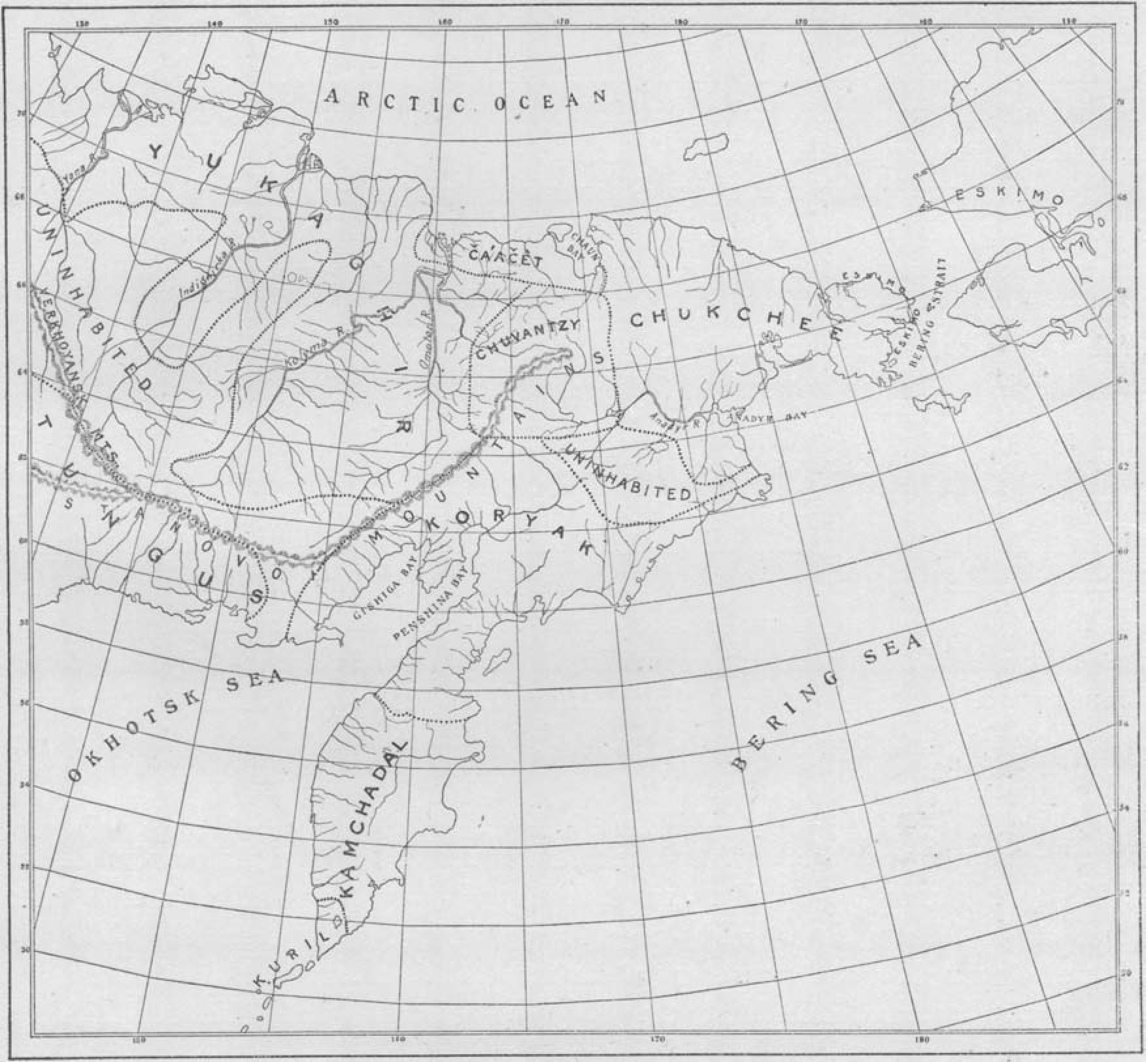
The Russianized natives² along the Kolyma tell of still another extinct tribe, whom they call Shelags (Шелаги), and from whom is derived the name of Cape Shelagskoy (Cape Erri) on the Arctic. These were maritime people, and lived somewhere along the Arctic shore. The remnants of the houses[17]🗗uncollated on the Bear Islands, near the mouth of the Kolyma, are also supposed to be theirs. They have often been confounded with the Čaˊačêt, though nothing is known about the mutual relations of the two tribes. Both are supposed by the natives to have emigrated westward. This is also mentioned by Wrangell.¹
Maydell, without any apparent reason, denies the existence of either tribe. He mentions, however, almost in the same passage, that Peter Mangol, one of his Chukchee fellow-travellers, affirmed that in former times, on Cape Erri, there had lived Maritime Chukchee who spoke a language different from that of the modern villages.²
Further on he mentions the hunter, Ivan Viligin, who lived in the latter part of the eighteenth century. He affirmed that he knew an old man by[18]🗗uncollated the name of Kopai, who claimed to belong to the Shelag tribe, and who had his place on the seashore at a distance of two hundred versts (about a hundred and twenty-five miles) from the mouth of the Kolyma. Maydell regards the whole story as a misunderstanding.
I was told by the natives, however, that on the seashore, westward from the island of Ayo, some ruins similar to those on the Bear Islands still exist, and this gives support to Viligin’s words.
The name Čaˊačên, in its Russianized form, would be Chavantzy or Chauntzy, which is almost identical with that of Chuvantzy. This latter tribe, almost extinct at present, in former times lived somewhere in the country between the Yukaghir and the Chukchee regions. It bred reindeer, and probably was an intermediate tribe between those two. The last remnants of the Reindeer Chuvantzy are, at the present time, assimilated with the Koryak, and speak the Koryak language; while the fisher-people of that tribe are Russianized. The few words of the Chuvantzy language given in the curious book by G. Dyachkoff,¹ the native school-teacher of the village of Markova, on the Middle Anadyr, who comes from Chuvantzy stock, are mainly Yukaghir. There are still on the tundra to the west of the Kolyma two or three clans of Yukaghir who to some extent breed reindeer, and are intermingled with the Tungus. The oldest documents in the archives of Nishne-Kolymsk, dated about 1770, mention several Yukaghir of the Khodynsky Chuvansky clan.² Now, the single clan of Chuvantzy existing to-day is called by this same name, Khodynsky.³
In later times the Chuvantzy were always allied with the Cossacks, and waged common warfare against the Chukchee. The latter, after the defeat of Major Pavlutsky, are said to have destroyed more than half of them. The situation in former times may have been different, since even the Yukaghir of the Upper Kolyma preserve a curious tradition that the Chukchee were once their brothers, and that they had a defensive and offensive alliance with them.
The names given by the Chukchee to their various neighbors are as follows: —
Taˊn˙ñɪtan (pl. Taˊn˙ñɪt), as mentioned before, is given to the Reindeer Koryak.
Mêˊlhɪ-taˊn˙ñɪtan, which signifies “fire-tools Taˊn˙ñɪtan,” is applied to the Russians. The same name is given to the Russians by the Koryak. Previously it may have been Mêˊlhɪᵋ-t-taˊn˙ñɪtan (i. e., “Taˊn˙ñɪtan with a fire-lock,” or, more[19]🗗uncollated literally, “fire-tools-bow Taˊn˙ñɪtan”). At present, however, on account of mispronunciation, there has arisen a tale of a fire-drill which was left on a camping-place and transformed into a Russian.¹
Aˊtal-taˊn˙ñɪtan is applied to the Chuvantzy. Aˊtal (eˊtel)² is the name these people give to themselves at the present time. Krasheninnikoff gives it as the Koryak name for the Yukaghir, which certainly agrees with the data I have already given concerning the Chuvantzy.
In contrast to all these Taˊn˙ñɪt, the Chukchee often call the Koryak Lɪˊê-taˊn˙ñɪt (“genuine Taˊn˙ñɪt”) in the same way, perhaps, as they call themselves “genuine men.” As to the meaning of the word Taˊn˙ñɪtan, no explanation could be obtained, and there is no existing Chukchee or Koryak root akin to it. J. Murdoch says that even the Point Barrow Eskimo use the word taˊnning or taˊngin for the Russians or for ships which pass by.³
On the Pacific shore the Russians are called also Ruˊssilɪt (from the English “Russian”).
American whalers are called Leluˊᵋtvɪlɪt (from leluˊᵋtvᴇt, “ship;” literally, “whisker-boat;” though no reason is assigned why a ship should be associated with whiskers [perhaps the whiskers of the crews were included in the definition]). Sometimes the Russians are also called Leˊlu-reˊmkɪn (“bearded people”), whence the Asiatic Eskimo term laˊlo-reˊmka. Americans also are called Pnauˊkulɪt (“file-mongers,” from pnauˊkun, “file” [literally, “whetting-stone”]); or they are sometimes called even Taˊn˙ñɪt, like the Russians.
The eastern branch of the Maritime Koryak, who live on the Pacific coast from Cape Anannon to Cape Barykoff, are called Keˊrek. The origin of this name is unknown. It can hardly have anything in common with Koryak, — a name created by the Cossacks from qoraˊkɪ, of the southeastern Koryak dialect, which means “(being) with reindeer.”
Both Lamut and Tungus are called qaˊa-raˊmkɪt, which signifies “Reindeer tribe.” More strictly speaking, the Lamut are also called qor-êmtêˊ-qaˊa-raˊmkɪt, or “reindeer-carried Reindeer tribe;” and the Tungus of the tundra west of Kolyma, together with the Reindeer Yukaghir, are called oˊrwu-qaˊa-raˊmkɪt, or “sledge Reindeer tribe,” because they travel with sledges. The Yukaghir have no special name, and are called veˊemɪlɪt (“river people”), the same as the Arctic Russians, because both are fishermen and live on the rivers or in their neighborhood.
The Eskimo of Indian Point and of the neighboring villages are called[20]🗗uncollated Aiˊwan (pl. Aiwaˊnat). This name is also applied to every Maritime Chukchee who does not own a single reindeer. Many of the Maritime Chukchee have a few reindeer-does in the herds of some friend. On the other hand, not only on the Pacific coast in the immediate vicinity of the Eskimo, but also even in the language of the Chaun Reindeer-men, aiˊwan čɪmčeˊkin means “a maritime relative,” čɪmčeˊkin signifying “relative.”¹ The Asiatic Eskimo call themselves Yuˊɪt (the plural of yuk, “man”) in the same way as the American Eskimo call their tribe Inuit (the plural of inuk or inung, “man”).
The inhabitants of the Eskimo village Nɵˊɵkan, on East Cape, who differ in language from those on Indian Point, are called simply Nɵˊɵkalɪt, or, with derision, Peˊekit.² The inhabitants of Wuteˊen, the last Eskimo village on Cape Ulakhpen, to the northwest of Plover Bay, also differing in language from those on Indian Point, are called in a similar way Wuteˊelɪt. Mr. Gondatti maintains the opinion that the Nɵˊɵkalɪt and the Wuteˊelɪt cannot understand the language spoken on Indian Point, and have to use Chukchee in speaking with its inhabitants.³ Following in his footsteps, Mr. Bogdanovitch speaks of the extensive mixing of peoples on the coast of the Chukchee Peninsula.⁴ However, from comparative texts in all three dialects, which I brought with me, it is evident that the dialectic differences are not so great as Mr. Gondatti supposes. Indeed, I had occasion several times to witness the people of all three tribes conversing without difficulty, every one using his own dialect. Of course, being conversant with the Chukchee language, they can also use it for the same purpose. In any case, it is not necessary to assume for these two villages an origin from an independent and unknown stock, as Mr. Gondatti is somewhat inclined to do.
The language of the Nɵˊɵkalɪt is intermediary between that of the Aiwaˊnat and that of the natives of the Diomede Islands, who in their turn are connected with the Alaskan Eskimo.
The case of the Wuteˊelɪt is not so clear, because they live farther to the south. They are so seaman-like and hardy, however, that they might easily have come over from some place on the opposite shore.
The inhabitants of St. Lawrence Island are called Eiwhueˊlɪt; and the island itself, Eiwhueˊn. Their language is quite similar to that of the Asiatic Aiwaˊnat; and they are plainly a colony from the nearest shore, probably from Indian Point. Tradition clearly points that way; and the immigration from the[21]🗗uncollated mainland is considerable, even at the present time, while the old families of the island are slowly dying out. Of course, some influence and connection with America have also existed on the island from ancient times.
The categorical assertion of Mr. Gondatti, however, that the Asiatic Eskimo came from St. Lawrence Island, seems to me highly improbable, though I also assume that the Asiatic Eskimo are not indigenous to the Pacific coast. Whether they came from the Arctic coast of Asia or that of America is another question; but, in any case, they migrated from north to south, and St. Lawrence Island is the limit of their migrations. W. H. Dall repeats a statement of a native of Plover Bay by the name of Nokum, who told that the “Bowhead [whale] men” came to Asia long ago from the Islands to the northeast (the Diomedes), and were allowed by the “Deer men” to settle on the barren, rocky coast.¹
The inhabitants of the Diomede Islands are called Yɪkɪrg̣aˊulɪt (“the [large] mouthed”), from yɪkɪˊrg̣ɪn (“mouth”), the labrets which they wore in former times having made their mouths their most conspicuous feature. The American Continent is called Kɪˊɪmɪn.² Its inhabitants are called Kɪˊɪmɪlɪt, and also Yɪkɪrg̣aˊulɪt, or, again, Roˊčhɪlɪt (“opposite-shore people”).
It is a question open to discussion, whether in former times there were any Eskimo villages on the Arctic coast. At present there are none except Nɵˊɵkan; though some of the inhabitants of Uweˊlen, the nearest settlement to the west, are Eskimo. The older travellers, such as Lütke and Wrangell, mention a few tribal names supposed to be Eskimo, as Onkilon and Namollo; but of these, the former resembles the Chukchee añqaˊlɪn,³ while Namollo brings to mind the Koryak word for “maritime settlers,” nɪˊmɪḷu, which in Chukchee takes the form nɪˊmɪlɪt (“inhabitants”), from nɪˊmnɪm (“habitation”).
Wrangell, and also Nordenskiöld, following in his footsteps,⁴ mention an Eskimo tribe that some two hundred years ago occupied the whole Arctic coast from Cape Shelagskoy (Erri) to Bering Strait, and was driven away by the Chukchee. They base their chief argument upon the difference between the actual Chukchee dwellings and the remnants of the old underground houses found here and there. In reality, this difference means nothing more than that, with the increase of reindeer-breeding, the underground houses, being unwholesome, and requiring a great consumption of oil, were gradually abandoned by both Eskimo and Chukchee for another type of house, probably also ancient, but more similar to the tents of the Reindeer people, and with a sleeping-room made of thick skins.
The Pacific Eskimo were slower to effect this change, since they had no[22]🗗uncollated reindeer of their own; yet at the present time, on the whole West Bering coast, there are only five underground houses still inhabited, — one in Uweˊlen, and four in Nɵˊɵkan. It is easy, however, to understand that to Wrangell, who approached the northern shore from the Kolyma side, the tents of the Reindeer people appeared to be typical Chukchee dwellings. The difference, was the more striking, since around Kuluˊči Bay the inhabitants turned from maritime pursuits to reindeer-breeding. I know of some, whom I saw on the northern tundra, who claim that their grandfathers lived on the coast and occupied themselves with seal-hunting. This same change occurred in several other places, as will be shown farther on.
It is not my intention to deny that on the Arctic coast there was previously more of the Eskimo element, which little by little became assimilated by the Chukchee. Thus, some of the Chukchee village names, both on the Arctic and on the Pacific shores, have an Eskimo sound, and moreover, especially in their Aiˊwan form, can be explained on the basis of the Eskimo language. Compare, for instance, the following village names.
ON THE ARCTIC COAST. Chukchee. Aiˊwan. Neˊᵋs˙qᴀn. Naˊs˙kok (“head”). Kuluˊči. Kuluˊsik (“old iceberg”). Iqäˊlurun. Iqaˊluwhak (fish of the species Gadus wachna). ON THE PACIFIC COAST. Chukchee. Aiˊwan. Nɪg̣čɪˊen. Nɪxcɪˊṛak (from nɪˊxcak, “ringed seal”). Nunäˊᵋmun. Nunaˊmo (“land’s end”). Čeˊwɪn. Caˊvik (“knife”). Ceˊčin. Teˊsik.¹ Mečiˊwmɪn. Meˊsik.
In regard to the legend cited by Wrangell, about the Eskimo chief Krächoj, who is said to have emigrated across the sea to certain islands, I may say that I too heard it among the Chukchee; but it is mythical in character, and is connected with other tales about vanished tribes, similar to corresponding tales of the Eskimo. It is true, however, that the northern Chukchee believe that in some northern land, not very far distant from the continent of Asia, there lives a race of men sprung from these ancient emigrants. This land is, said to have been seen by the crew of a boat which drifted out into the open sea. It corresponds to Wrangell’s Land, and I have heard from people from[23]🗗uncollated the same village, Kuluˊči, which was mentioned by Wrangell, a tale of seemingly still more recent origin than his, in which it was asserted that a few years ago two kayakers of the village were carried out by the wind to this land across the sea. They discovered houses and stole some provisions from the underground cellars, and finally succeeded in getting away unnoticed. All these details were given so vividly, that, if I had not known that Wrangell’s Land is destitute of inhabitants, I should have had no hesitation in crediting the narrative.
The belief that there are unknown tribes still living in some remote part of the country, exists in various places in northeastern Asia. Besides the tale of Krächoj, the Chukchee tell a story about the Vaiˊñê-qaˊa-raˊmkɪt, or “twilight Lamut,” and say that they, too, emigrated beyond the sea, but that they often swim back again, overcome by homesickness, and may sometimes be seen in the twilight, outlined against the last short rays of the fading day. They are supposed to be quite inoffensive, only stealing an occasional ration of food from the storehouses. From time to time the Chukchee have a chance to shoot one of them; and then it is seen that the victim looks very much like an ordinary man, except that his feet are larger and the toes are webbed for swimming.¹
The Chukchee do not assimilate readily. Whenever they come in contact with another tribe, they do not learn its language, but force the other to learn theirs. The chief reason for this is that they are the greatest reindeer-breeders in the country, and other tribes have to depend upon them for food and sustenance. Thus it is that outsiders are forced to seek a means of easy intercourse with them. The Maritime Chukchee in the immediate vicinity of the Eskimo likewise learn very little of their language, while all the Eskimo men and a majority of the women speak Chukchee as fluently as they do their own language.
Again, in the same way, a few Chukchee families living on the Anadyr River, not far from the Russianized village of Markova, have not learned much Russian, while at least all the men in Markova speak Chukchee fluently.
The Chukchee are so self-sufficient that they prefer to make words of their own for new objects coming from the civilized world, rather than adopt the foreign names. Thus they have for mustard, čɪˊmyɪčɪn (“bitterness”); flour, piñ-wuˊrrɪn (“powder-like” [Kolyma dialect]); bread, pin-tekiˊčhɪn (“powder-meat”); brandy, äˊᵋq-iˊmɪl (“bad water”); iron file, pɪlvɪˊntɪ-pnauˊkun (“metal whetting-stone”); tea-kettle, piˊlhɪ-kuk (“muzzle-pot”).
CHARACTER OF THE COUNTRY. — The territory of the Chukchee is situated chiefly in the tundra region, and includes the northern border of the forest.[24]🗗uncollated In the Kolyma district, on the western side of the mountains, the climate is cold and dry. The snowfall is not so heavy, and tempests are not so frequent, in the coldest time of the year, as on the Chukchee Peninsula.
On the Pacific coast, while the temperature does not fall so low, the snowfall is much heavier; and snow-tempests, dry in winter, and damp and misty in the fall and spring, often last for several weeks without cessation. Therefore the floras of the two districts are quite different. On the Kolyma side the chief tree is the larch, which attains a great height and has a well-developed form even beyond the polar circle and as far north as latitude 69°. The limit of its distribution is quite sharp, and runs along the larger rivers, about fifty miles from the seacoast. Shrubby willows of about a man’s height, are found even twenty miles farther north, and their growth becomes stunted only a few miles from the seacoast. On the Pacific side — in the valley, of the Anadyr River, for example — the larch-tree is less commonly found than west of the mountains, and thrives only in the interior portion of the country, along the river Main, a tributary of the Anadyr. The chief trees are the willow and the poplar, which are distributed about evenly. Even on the southern side of the polar circle, a hundred miles from the coast, their growth becomes stunted, but as shrubs they continue for some distance to the north. Almost everywhere some very small shrubby willows and alders are found in the river-valleys. The coast for many miles is bare of every kind of growth except reindeer-moss and a few lichens. On sandy spots, like Indian Point, the inhabitants cannot gather grass enough even for the soles of their boots, and are obliged to bring it from farther inland.
Bogdanovitch mentions that he has seen good grass on the mountain-slopes around Konyam Bay, but he does not specify how large these grassy spots were; he even expresses the opinion that the Chukchee Peninsula can be crossed with horses in the summer-time.¹ I wish to point out, however, that even farther to the south, along the forest-line, horses used for travelling² often starve for want of fodder.
According to the latest meteorological observations, the average temperature of the seasons in the Kolyma country is as follows: —
Nishne-Kolymsk. Sredne-Kolymsk. Winter —32.79° C. (—27.00° F.) —35.0° C. (—31.00° F.). Spring —13.06° “ (+8.49° “) —14.6° “ (+5.72° ”). Summer +10.37° “ (+50.67° “) +11.2° “ (+52.16° “). Fall —14.66° “ (+5.61° “) —12.6° “ (+9.32° “). Average of the year —12.50° C. (+9.50° F.) —12.75° C. (+9.14° F.). Absolute maximum, Sredne-Kolymsk, +29.4° C. (+84.92° F.). Absolute minimum, Sredne-Kolymsk, —54.0° C. (—58.72° F.).
[25]🗗uncollatedThe Kolyma River freezes, at Nishne-Kolymsk, Oct. 12; at Sredne-Kolymsk, Oct. 11. The ice breaks up, at Nishne-Kolymsk, June 15; at Sredne-Kolymsk, June. 4.¹ The average temperature in the Anadyr country is as follows: — Mariinsky Post. Markova. Winter —18.8° C. (— 1.84° F.) —22.4° C. (— 8.32° F.). Spring — 13.4° ” (+ 7.88° ”) — 13.2° ” (+ 8.24° ”). Summer + 9.0° ” (+48.20° ”) +12.6° ” (+54.68° ”). Fall — 4.4° ” (+24.08° ”) — 7.6° ” (+18.34° ”). Average — 6.9°C. (+19.58° F.) — 7.6°C. (+18.34° F.). Absolute maximum, Mariinsky Post, +20.2° C. (+68.36° F.); Markova, +26.6° C. (+79.88° F.). Absolute minimum, Mariinsky Post, —42.7° C. (—44.86° F.); Markova, —47.0° C. (—52.6° F.). The estuary of the Anadyr freezes, at Mariinsky Post, Oct. 17. The ice breaks up in the Anadyr River, at Markova, June 5; in the estuary of the Anadyr, at Mariinsky Post, June 17.² The average temperature at Piˊlhäqäi (Pitlekai), Arctic Sea,³ is as follows: — October — 5.20° C. November —16.58° December —22.80° ” Average for winter months, January —25.06° ” —24.32° C. (—11.81° F.). February —25.09° ” March —21.65° ” Average for spring months, April —18.93° ” —15.79° C. (+3.58° F.). May — 6.79° June — 0.6° ” July (1-17) + 2.68° ” Absolute maximum, +11.5° C. (+52.7° F.); absolute minimum, —46.1° C. (—50.98° F.).
CAMPS AND VILLAGES. — The camps of the Reindeer Chukchee are situated in groups, mostly along the rivers; and their grazing-grounds are divided by watersheds, which are ordinarily so devoid of vegetation and so exposed to winds as to be unfit for reindeer-breeding. In the fall the camps are moved to the border of the forest to find shelter from the winter tempests; while in the spring of the year the herds are driven to the tundra, as far as the sea-coast, in order to be freer from noxious insects, and to give them pasturage better suited for the summer season. Some of the camps near the head waters of several rivers move to the mountains instead of to the sea, and stay near some small glacier, where the insects are less numerous than in the valleys. Often these herds do not thrive so well as those which are driven down to the sea. The range of the wanderings of a Chukchee camp extends from a hundred to a hundred and fifty miles, and in most cases covers the same or nearly the same territory every year; but any camp that becomes dissatisfied with its range may pick out a new one wherever it chooses, the only condition[26]🗗uncollated being that it may not trespass on any ground already occupied by others for the season running.
The groups of Reindeer Chukchee are as follows: —
The Indighirka and Alaseya Group, along the rivers of the same names, — 13 camps, with a population of about 150 souls. This is the most westerly group, and its territory is surrounded by districts inhabited by Yakut and Tungus. Some of its reindeer-herds consist of as many as 5,000 head, and their owners reguiarly supply the Russian town of Sredne-Kolymsk and other settlements with meat. The Western Kolyma Group, as the name indicates, on the tundra to the west of the Kolyma River, — about 35 camps, with a population of 400 souls. This group, on account of a severe epidemic of small-pox, which in 1884 devastated it and caused one-third of the population to perish, is rather on the decrease. After the epidemic many large herds, left without guards, disintegrated, and joined the herds of wild reindeer; while some of the western camps, who formerly lived in this district, recrossed the Kolyma River and re-occupied their former territory. The Dry Anui Group, between the Arctic Ocean and the Dry Anui River. This group is the largest of all, and its camps extend at intervals of from five to ten miles from the right bank of the Kolyma, along the Anui, to the confines of the Chaun tundra. The camps number about 100. Their herds are not very large, for the most part consisting of from 300 to 400 head, which is sufficient to supply two families (i. e., from ten to fifteen persons, the average size of a camp) with meat, clothing, and trading-skins. Several herds, however, number 2,000- 3,000 animals. Farther to the east the herds of this group are of larger size. The Large Anui Group, consisting of hardly 20 camps. Their number has been considerably depleted by migration southward to the rivers Oloi and Omolon, where at present the most southerly portion of the tribe is living. This is a group of about 45 camps, with a population of 500 souls. Some of their herds are as large as those of the Indighirka, and supply two Russian towns — Sredne-Kolymsk and Gishiginsk — with meat. They have no access to the sea, however, and consequently live in the mountains during the summer months, so that there have been considerable losses in reindeer among them from time to time. The Upper Anadyr Group, which comprises about 30 camps. These also resort to the mountains in summer. Of late their herds, too, have been greatly reduced. The Chaun Group, — about 50 camps, living on the tundra near Chaun Bay. They are separated from the Anui Group by the mountains of the watershed. Their herds, like those of the Eastern Anui, number about 400 or 500 head, though more numerous herds also occur. The same may be said of The Erri Group, whose territory lies farther to the east, and which is made up of about the same number (40-50) of camps. The Oˊnmɪlɪn (“the inland one”) Group, living between the north bank of the Anadyr River and Holy Cross Bay, — about 60 camps. It varies considerably in the proportion and distribution of its herds. Many camps are very poor, and live on fish and seal three seasons out of four, while others are well-to-do. This whole group includes a number of Maritime Chukchee from the Pacific villages who have turned reindeer-breeders within the last thirty years. Their herds have not yet had time to become very large. The Telqäˊp Group, called by the Russians Tumanskiye Chukchee (Туманскіе Чукчи), — about 50 camps. Their herds are of moderate size (400-500 head). These are the roughest and most indomitable of all the Chukchee, and in former times were the leaders in the wars against the Koryak. The camps along the river Utteˊg̣nɪčen, a southern affluent of the Anadyr (called by the Russians Big River), and farther on along the Koryak border, including those scattered on the Parapolsky[27]🗗uncollated Dol¹ and in Kamchatka, numbering perhaps 80 in all. Owing to the extent of territory covered by them, the strength of their herds is very unequal. Their herds also resort to the mountains in summer. The White River Group, numbering about 25 camps; and the group in the Peˊqul-ñei Mountains, containing the same number. On the so-called Chukchee Peninsula, between Kuluˊči Bay, Holy Cross Bay, and the Pacific Ocean, the whole number of reindeer-camps is from about 80 to 100. The herds are not very large, owing to the severity of the climate and to scanty pasturage. Almost half of these camps obtain the best part of their food from the sea; they keep dog-teams, own skin boats, etc.
Within the last thirty years the breeding of reindeer has increased gradually, and even some of the Eskimo have succeeded in gathering herds of their own; but the winter of 1900-01, when we were in the field, was so unfavorable, that the reindeer were famished everywhere, and many of the northern herdsmen especially lost about one-half of their whole stock.
It would be easy to increase the number of the divisions, since almost every small cluster of camps, united by ties of kinship, claim to have a separate name derived from the river on the banks of which they wander with their herds. Thus Mr. Bogdanovitch gives the name Tahrait to those living around St. Lawrence Bay near the river Marich. Perhaps this is a distorted form of the word teg̣reˊtɪlɪt (“those coming down [the river]”).
According to the situation of their districts in the western or the eastern part of the country, the divisions of the Reindeer Chukchee call each other eig̣ɪˊs˙qɪlɪt (“westerners;” literally, “those coming leeward”) or aivaˊʟaᵋt (“easterners;” literally, “those coming windward”). These names have arisen from the fact that the chief wind of the country comes from the west along the Arctic shore. Perhaps the names Aiˊwan and Eiwhueˊn have a common origin with aivaˊʟat (from aiˊg̣-êpu, “windward”), since the inhabitants of the Pacific coast are called Aivaˊʟat by all the inland and Arctic Chukchee, whom they, in their turn, call indiscriminately Eig̣ɪˊs˙qɪlɪt.
All camps to the southeast from Chaun Bay are called by the more eastern people Uˊnmɪ-nuteˊkinet (“those from the inland country”).²
The whole number of reindeer camps amounts to about 650, with a population of 7500-9000, rather more than less.
In compiling the list of the maritime villages, I have utilized, besides information collected by myself, the very valuable paper by Nordquist and the official “Register of the Inhabited Places of the Seacoast Province of Siberia.” In the latter the data relating to the Chukchee were furnished by Mr. N. Gondatti. Unfortunately, while writing this memoir, I have not been able to use the very valuable article of Mr. Gondatti, the title of which is given on p. 20, but, so far as I can remember, it does not differ much from the Register. The journey of Mr. Gondatti from the mouth of the Anadyr to East Cape was made in the spring of 1895. Some data given by Krause, Bogdanovitch,[28]🗗uncollated Hooper, and Hilder, have also been taken into consideration as far as possible. I have enclosed in parentheses the statistics obtained from these authorities. Krause’s geographical information, and his maps of the coast, seem to me to be quite correct; his list of villages from Holy Cross Bay to Kuluˊči Bay is also accurate.¹
Only the names of the principal villages are here given, because the smaller ones mentioned by many travellers are not fixed dwelling-places. They are simply hunting-stations, that are used for a few years, and afterwards abandoned for other places a few miles away. The name belongs to the locality, not to the village. Even the larger villages are not very stable; and the population often desert one and move to another, according to the changing conditions of seal-hunting. However, those among the smaller settlements which were mentioned by several older travellers, and which happen to be inhabited at the present time, are included in the following list.
The villages on the Pacific coast are as follows: —
CHUKCHEE. Veᵋñ, in Anadyr Bay, near the mouth of the Anadyr River.² The Russians subsequently founded a settlement near by, and called it Mariinsky Post. In former times the Chukchee village lay nearer the open sea, on the low sandy shore of Geëk Land. Veᵋñ has at present 7 native houses and about 40 inhabitants. Mɪˊs˙qᴀn (“hill”), on the west point of the long, narrow island Mɪˊs˙qᴀn,³ in Holy Cross Bay; and Rêˊtkên (“clayish”), on the east point of the same island. During my visit in 1901 the former village had 3 houses, and, besides, 1 family was living a few miles off; while in two places there were 6 tents of some very poor half Maritime, half Reindeer people. The total population was 41 (according to the Register, 7 houses, 30 inhabitants). Rêˊtkên had 6 houses with 35 inhabitants (Register, 6 houses, 22 inhabitants). Farther along the shore, on Cape Wuˊkwên (“stony”), there used to be a small settlement whose inhabitants afterwards turned to reindeer-breeding and went inland.
[29]🗗uncollated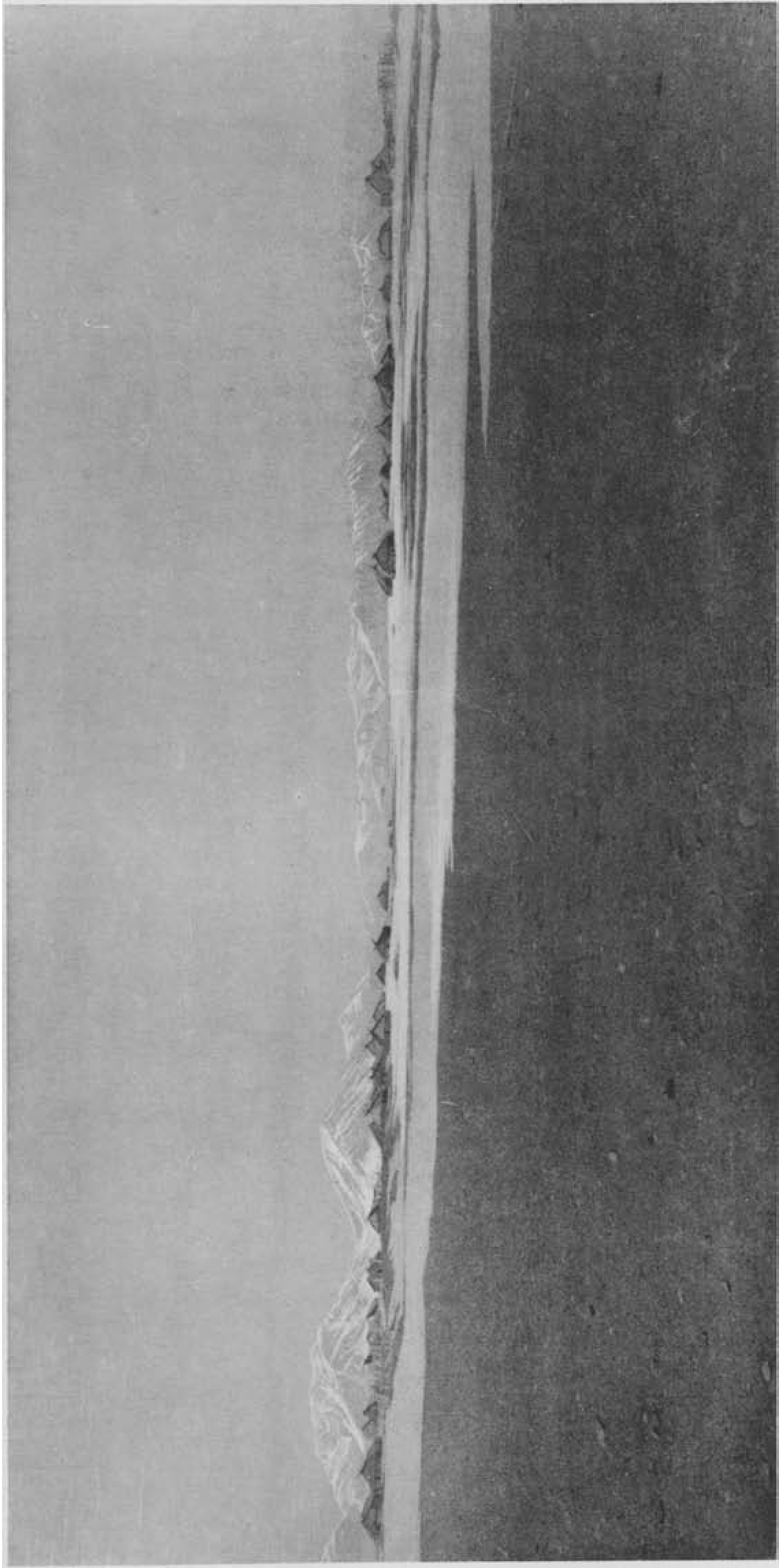
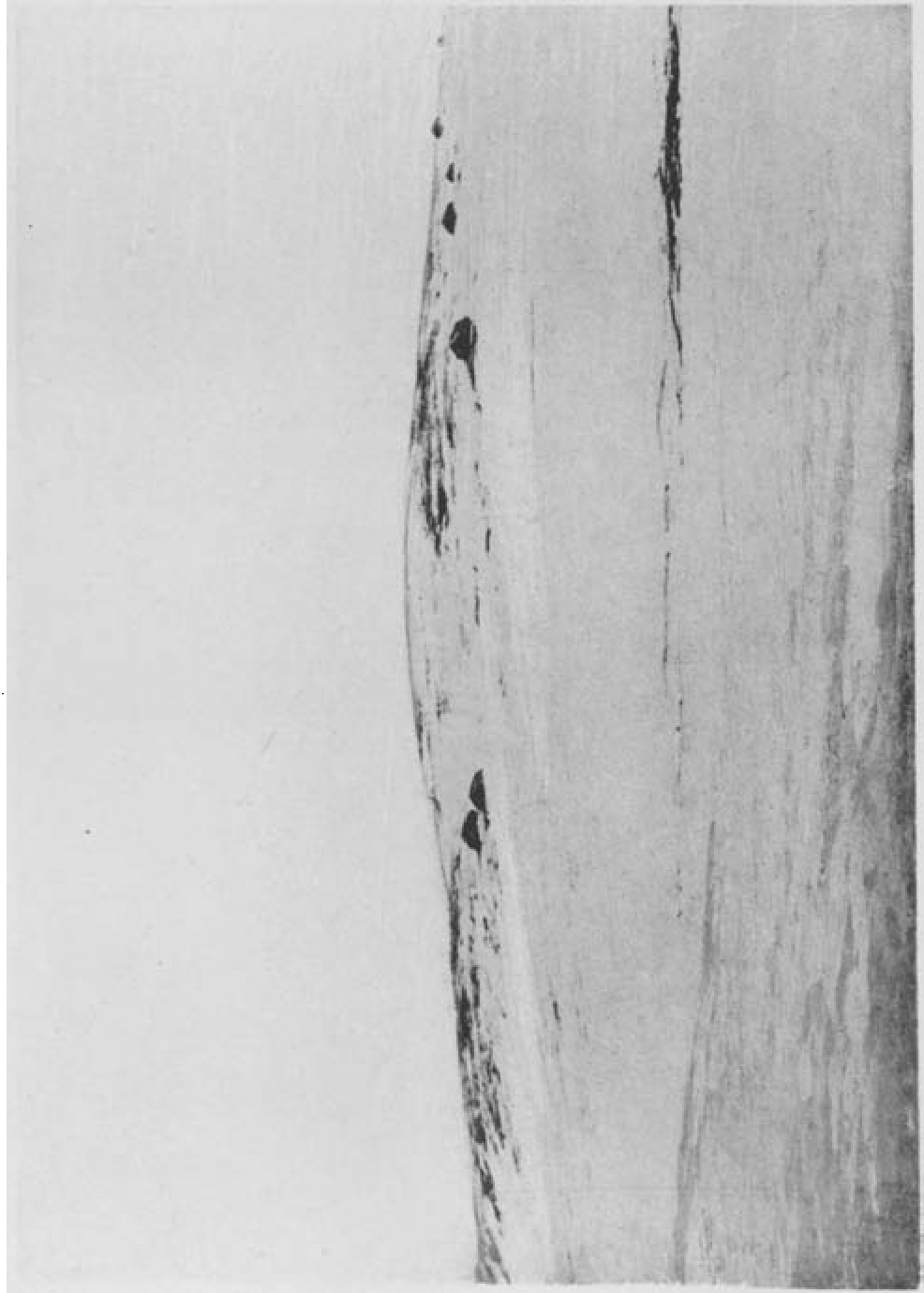
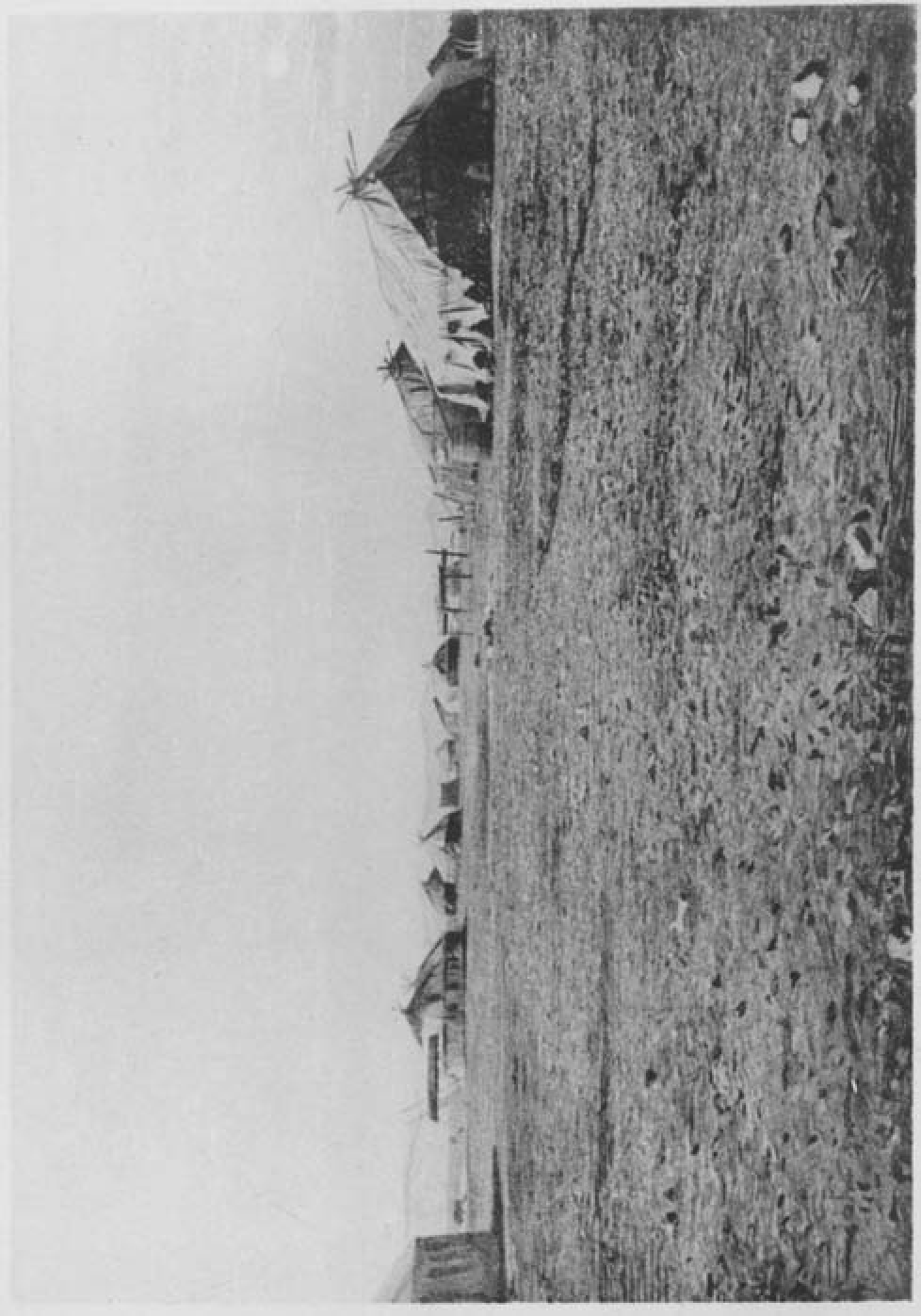
Valkaˊʟ̣ên (“having houses of whale’s jaw-bone”), which had during my visit 4 houses with 28 people (Register, 7 houses, 39 inhabitants). The underground houses alluded to in the name went out of use long ago, and the inhabitants now live in large “genuine houses” of the usual type.¹ ᴇˊnmɪlɪn (“craggy”), in the Aiˊwan Eskimo language Tɪkɪˊvak, which lies five miles farther on, along the shore. It had 17 houses, and a mile from it 2 more, with a total population of 126 (Register, 19 houses, 104 inhabitants). Nuˊnlig̣ren (see Plate I, Fig. 2), which had 17 houses in one place, and 4 in another near by, with a population of 104 (Register, 25 houses, 110 inhabitants). Aˊčon, the last Chukchee village, which had during my visit 5 houses with 24 inhabitants. They were very poor Reindeer people, who had turned to seal-hunting as a last resort, but were not successful even at that (Register, 4 houses, 19 inhabitants).
ESKIMO. Wuteˊen or Wuˊturen (Eskimo, Čeṛiˊnak), the first Eskimo village, which lies near Cape Ulakhpen. It had 8 houses with 58 inhabitants (Register, 14 houses, 77 inhabitants).² Between Aˊčon and Wuteˊen, in former times, there was a small settlement, Čeˊnlin, occupied by the Wuteˊelɪt and the Chukchee. The greater part of its inhabitants, however, perished in the famine of 1880. The remainder turned to reindeer-breeding or emigrated to Wuteˊen and to St. Lawrence Island. Iˊmtun (Eskimo, Iˊmtuk), a few miles off, which had 12 houses with 65 inhabitants (Register, 9 houses, 43 inhabitants). Most of the people are Aiˊwan, but four families came from Wuteˊen. Iˊᵋen (Eskimo, Ṛɪˊṛak), in Plover Bay, which had only 2 houses with 9 inhabitants (Register, 4 houses, 24 inhabitants); but two families moved to Euˊnmun a little while before our coming. The people are Aiˊwan, and very poor. Euˊnmun (Eskimo, Aˊvak), near Cape Chukotsky, which during our visit had 12 houses with 88 inhabitants. Besides these, two families with 10 men came over from Iˊᵋen, where of late sealing has been very unsuccessful. There were then 98 inhabitants in Euˊnmun (Register, 16, houses, 101 inhabitants). The people of Euˊnmun are Aiˊwan. Čeˊčin (Eskimo, Teˊsik), on the west shore of the bay of the same name (Čečiˊkin quˊim, i. e., Čeˊčin Bay),³ which had 18 houses with 94 inhabitants (Register, 25 houses, 142 inhabitants). The people are Chukchee and Aiˊwan, half and half. Uñiˊin (Eskimo, Uñiˊsak), on Cape Chaplin (Indian Point) (Plate I, Figs. 1, 3), which had 61 houses with 442 inhabitants, all of them Aiˊwan (Register, 51 houses, 500 inhabitants).⁴
NORTH OF INDIAN POINT.⁵ Nepeˊkuten (Eskimo, Napaˊkutak), on the island called Ipeˊkut in Chukchee (Eskimo, Ciˊṛluk⁶), the last Aiˊwan village: 4 houses, 37 inhabitants (Register, 5 houses, 52 inhabitants).
[30]🗗uncollatedKihiˊni (Eskimo, Kiˊhi¹), on an island of the same name: 3 houses (not mentioned in the Register). The people from here northward are Chukchee. Yeˊrg̣ɪn (Eskimo, Yaˊrg̣a), on the southwestern end of the island Kihiˊni: 3 houses (not mentioned in the Register). Alaˊyon (“the summer place”): 3 houses (Register, 5 houses, 26 inhabitants). Ilhiˊnin: 2 houses (Register, 5 houses, 28 inhabitants). Čeˊwin (Eskimo, Caˊvik, “knife”): 2 houses (Register, 2 houses, 8 inhabitants). Nɪg̣čɪˊen (Eskimo, Nɪxcɪˊṛak, “one with seals”): 2 houses (Register, 2 houses, 12 inhabitants). Yanřaˊkê-not (“separate land”): 2 houses (not mentioned in the Register). Mečiˊwmɪn (Eskimo, Meˊsik), on the bay of the same name: 6 houses (Register, 2 houses, 18 inhabitants). Aˊg̣rɪtkɪn, on the Mečiˊwmɪn spit: 2 houses (not mentioned in the Register). Luˊᵋren (Eskimo, Nuˊkak): 10 houses (Register, 21 houses, 115 inhabitants). Kuˊkun: 1 house. All the other inhabitants have become reindeer-breeders. (Register, 3 houses, 23 inhabitants). Akaˊnên (Eskimo, Akaˊnik): 7 houses (Register, 10 houses, 42 inhabitants). Yaˊnřa-ñai (“separate peak”): 15 houses (Register, 28 houses, 101 inhabitants, which number seems to me rather too large). Nuteˊ-pɪˊnmɪn (“tongue of land”): 2 houses (not mentioned in the Register). Nunäˊᵋmun (Eskimo, Nunaˊmo, “land’s end”): 11 houses (Register, 13 houses, 63 inhabitants). Čiˊñin (Eskimo, Siˊnik): 5 houses (Register, 4 houses, 17 inhabitants). Puoˊten (Eskimo, Puwuˊxtak): 6 houses (Register, 17 houses, 40 inhabitants). ᴇnmɪtaˊhɪn (“cliff’s end”): 6 houses (Register, 8 houses, 42 inhabitants). The people are Nɵˊɵkalɪt Eskimo. Nɵˊɵkan (Eskimo, Nabuˊqak), on East Cape: 48 houses (Register, 50 houses, 299 inhabitants). The people are Nɵˊɵkalɪt Eskimo.
The villages on the Arctic coast are as follows: —
Uweˊlen (Eskimo, Uˊlak, “carving-knife”): 30 houses (Register, 38 houses, 231 inhabitants; Nordquist, 40 houses). Half of the people are Chukchee, and half Nɵˊɵkalɪt Eskimo. Tuˊñqen (Eskimo, Toˊñqak): 4 houses (Register, 2 houses, 17 inhabitants; Nordquist, 5 houses; Krause, 10 houses). From here westward all the villages belong to the Chukchee tribe. Inčoˊwɪn (Eskimo, Inčoˊṛvik): 18 houses (Register, 19 houses, 142 inhabitants; Nordquist, 33 houses). Iñeˊᵋen (Eskimo, Inñeˊrñik): 3 houses (Register, 3 houses, 21 inhabitants; Nordquist, 5 houses). Ot-ᴇnmɪtaˊhɪn (“cliff’s end of Uˊten”): 1 house. All the rest of the inhabitants had turned reindeer-breeders. (Register, 2 houses, 27 inhabitants; Nordquist, 8 houses.) Uˊten (Eskimo, Uˊtak), 12 houses (Register, 8 houses, 64 inhabitants; Nordquist, 20 houses). Čuˊlpen (Eskimo, Čuˊlpak), called in the Register and by Lieut. Nordquist Čuˊtpen: 12 houses (Register, 4 houses, 32 inhabitants; Nordquist, 15 houses). Iˊᵋčen (Eskimo, Iˊčak): 11 houses (Register, 11 houses, 78 inhabitants; Nordquist, 13 houses). Čeiˊtun (Eskimo, Čaˊxtuk): 16 houses (Register, 8 houses, 56 inhabitants; Nordquist, 18 houses). Čêčaˊñɪn (Eskimo, Čečaˊñik): 10 houses (Register, 11 houses, 77 inhabitants; Nordquist, 11 houses). Iqäˊlurun (Eskimo, Iqaˊluwhak): 10 houses (Register, 7 houses, 48 inhabitants; Nordquist, 5 houses).
[31]🗗uncollatedKeˊñičvun (signifying, with a slight modification of the last vowel, “curve”): 11 houses (Nordquist, 17 houses; it is not given in the Register, and probably the inhabitants are counted with those of Neˊte-keˊñičvun, a hunting-station near Neˊten). Enuˊrmin (Eskimo, Anoˊrmik): 12 houses (Register, 20 houses, 125 inhabitants; Nordquist, 20 houses). Neˊte-keˊñičvun (“the curve of Neˊten”): 1 house (Register, 5 houses, 29 inhabitants; Nordquist, 2 houses). Neˊten (Eskimo, Naˊtak): 9 houses (Register, 5 houses, 33 inhabitants; Nordquist, 14 houses). Nat-ᴇnmɪtaˊhɪn (“cliff’s end of Neˊten”): 2 houses (Register, 4 houses, 30 inhabitants; Nordquist, 2 houses). Imɪˊlᴇ (“the whole one”): 4 houses (Register, 7 houses, 49 inhabitants; Nordquist, 4 houses). Mäˊᵋmi-piˊlhɪn (“mouth of Mäˊᵋmi”): 2 houses (Register, 3 houses, 19 inhabitants; Nordquist, 1 house). Mäˊᵋmi (“with arrows”): 3 houses (Nordquist, 7 houses; not mentioned in the Register). Teˊpqän (“low straight coast”): 8 houses (Nordquist, 9 houses; not mentioned in the Register). Paloˊnnan: 1 house. The other inhabitants had turned to reindeer-breeding. (Register, 4 houses, 28 inhabitants; Nordquist, 1 house.) Neˊs˙qᴀn (Eskimo, Naˊs˙kok, “head”): 8 houses (Register, 10 houses, 59 inhabitants; Nordquist, 6 houses). Velkäˊl-tɪnuˊp (“jaw hill”): 4 houses (Register, 6 houses, 33 inhabitants; Nordquist, probably under the name Kakodla, 9 houses). Neˊs˙qᴀqäi (“little Neˊs˙qᴀn”): 6 houses (Nordquist, 7 houses; not mentioned in the Register). Irg̣uᵋnnuˊp (“pointed hill”): 5 houses (Nordquist, 6 houses; not mentioned in the Register). Yɪˊnřɪlɪn (“having steep hills”): 5 houses (Register, 4 houses, 26 inhabitants; Nordquist, 4 houses). Piˊlhɪn (“mouth”): 1 house. The other inhabitants had turned reindeer-breeders. (Nordquist, 3 houses; not mentioned in the Register.) Kuluˊči (Eskimo, Kuluˊsik, “old iceberg”): 11 houses (Register, 14 houses, 94 inhabitants; Nordquist, 20 houses). Nuteˊ-pɪˊnmɪn (“tongue of land”): 4 houses (Register, 4 houses, 23 inhabitants; not mentioned by Nordquist). Wañkarêˊman (derived from Waˊñka, “walrus-tusk”): 7 houses (Register, 4 houses, 28 inhabitants; Nordquist, 9 houses). Rɪrkaiˊpɪyan (“walrus barred off”): 11 houses (Register, 9 houses, 52 inhabitants; Nordquist, 15 houses). Notaˊ-tɪˊmlɪn (“close to the land”): 4 houses (Register, 4 houses, 28 inhabitants; Nordquist, 3 houses). Reᵋn (“food”): 1 house. All the other inhabitants had turned reindeer-breeders. (Not mentioned either in the Register or by Nordquist.) Kɪnmaˊnka-uˊtir: 3 houses (Register, 2 houses, 13 inhabitants; Nordquist, 4 houses). Yaˊqan: 3 houses (Nordquist, 5 houses; not mentioned in the Register). ᴇnmaaˊtir (“cliff-brook”): 2 houses (Nordquist, 4 houses; not mentioned in the Register). ᴇnmɪtaˊhɪn (“cliff’s end”), 3 houses (Register, 2 houses, 16 inhabitants; Nordquist, 6 houses). Uwg̣aˊrg̣ɪn: 2 houses (Nordquist, 4 houses; not mentioned in the Register). Three different places on Cape Erri: 6 houses (Register, 2 houses, 10 inhabitants; Nordquist, 13 houses).
In summing up the whole population, we obtain in round numbers, for the Chukchee on the Pacific shore, 1100; for the Eskimo, 1200;¹ for the[32]🗗uncollated Chukchee on the Arctic shore, 1600, which should be increased to 2000, because I omitted in my enumeration some of the minor settlements the names of which I obtained, but which I was unable to identify with villages mentioned by Lieut. Nordquist. Lieut. Nordquist arrives at the same number of inhabitants, but the number of houses in his list are more than 400, as compared with 266 enumerated by me. His estimate is based, according to his own statement, on the assumption of only five persons to a house, whereas my figure is six and a half. With an equal average of inmates to a house, his census of the population on the Arctic shores would exceed mine by 600. It seems probable, therefore, as Mr. Gondatti asserts, that the maritime population has diminished of late years. His assumption, however, that the Arctic shore is more thickly populated than the Pacific, seems to me unfounded.
The total number of the Chukchee amounts to 12,000, rather more than less, of which three fourths are reindeer-breeders, and only one fourth maritime. The decrease in the maritime population may be partly accounted for by the fact that each year many families turn from maritime pursuits to reindeer-breeding.
Several villages have nearly or altogether disappeared, because all the inhabitants have gone inland and have turned reindeer-breeders. These are, on the Arctic coast, besides those of Kuluˊči Bay, mentioned above, the villages Reᵋn, Ot-ᴇnmɪtaˊhɪn, Paloˊnnan; on the Pacific coast, Kuˊkun, Čeˊnlin, Wuˊkwên, also nearly one-half of the inhabitants of the large village ᴇˊnmɪlɪn, and others.