IVReindeer-Breeding
GROUPS OF REINDEER-BREEDERS. — The domestication of the reindeer among the tribes inhabiting the Asiatic side of Bering Sea forms the chief distinctive feature in their economic condition as compared to that of the Arctic tribes of America. Nevertheless it is difficult to say how reindeer-breeding, and the nomadic state of life entailed by it, were introduced into the extreme northeastern corner of Asia.
Along the western parts of the Arctic shores of the Old World there dwell a number of tribes who have possessed from ancient times domesticated reindeer that are harnessed to sledges and also used for food. Their herds are, or rather were, large; and their whole existence is based on the supply of meat and skins furnished by these herds. Their economic condition resembles in this respect that of the more southerly cattle-breeding tribes. These reindeer tribes are the Laplanders, Zyrians, and Samoyeds (European and Asiatic). Their methods of reindeer-breeding are somewhat uniform, and they all use the shepherd-dog in managing their herds.
The widespread branches of the Tungus and Lamut constitute the most prominent reindeer tribe of eastern Siberia. Usually they live some distance from the shore, and many bands use the saddle in place of the sledge. Their herds are so small that they can use their reindeer for riding and transportation only, not for slaughter. They have not become nomadic, but, owing to the introduction of the reindeer, have been enabled to extend their hunting and fishing expeditions over a larger extent of territory, in the same way as the North American Indians did after the introduction of horses. Several bands, however, raise large herds, so that they are able to live on their products.

Although the riding of reindeer is the most striking feature among Tungus reindeer-breeders, numerous bands have adopted a peculiar form of sledge (Fig. 4) with stanchions fitted into circular holes in the runners and fastened with thongs, and with a circular bow-like fore-part for attaching the traces, — the same as is used throughout eastern Siberia for dog-teams.
[71]🗗uncollatedBetween the Yenisei and Indighirka Rivers the Tungus approach the seashore. In this region they are intermixed with a group of the Yukaghir, who, here at least, also used to possess some reindeer. The ethnography of this tract is still very imperfectly known; and the problems to be solved here are exceedingly intricate, owing to the invasion of the Yakut, who assimilated all the smaller tribes, and modified in many respects their original cultures. The Tungus do not use the dog with their herds. Their lean, small, and nimble-footed dogs are used only for hunting-purposes, and they retain all the ferocious habits of former freedom. They consider all reindeer, wild or tame, their lawful prey: therefore in camp these dogs are carefully tied up; otherwise they would give chase to the herd and disperse it in every direction. The reindeer are less thoroughly domesticated than among the western tribes, though tame enough to be milked, and used for regular service with post and merchant caravans.
The Koryak and Chukchee form the third group of reindeer-breeders, and live to the east and north of the Tungus. Like the tribes of the extreme west, they use reindeer only with the sledge, not for riding, and their herds are very numerous, perhaps the most numerous in the world; but the degree of domestication is very imperfect. One is almost tempted to assume that they did not introduce the tame reindeer from their neighbors, but that, in imitation of them, they attempted to domesticate the race of reindeer inhabiting their own country. This would seem the more plausible, since their reindeer is quite different from that of the Tungus. Their dogs are likewise the natural foes of the reindeer-herds, and the latter are so wild that they return easily to their former freedom. Milking is impossible; and the reindeer are difficult to manage even in harness, and are unable to endure prolonged and regular service.¹
BEGINNING OF KORYAK AND CHUKCHEE REINDEER-BREEDING. — Although at present the herds of the Koryak and Chukchee are numerous, it was probably otherwise in former times. Among the various Koryak bands in northern Kamchatka and around Baron Korff’s Bay there are still some who combine seal-hunting with reindeer-breeding; and while one part of the band is settled in huts on the coast, fishing and hunting, the other part is wandering about with its reindeer-herds on the neighboring mountains. Usually each band has only one village on the coast, but several inland camps, each with one herd. There is a constant interchanging of the inhabitants between the village and the camps, since every fisherman possesses a few reindeer, which are in charge of one of his relatives among the herdsmen. From time to[72]🗗uncollated time he visits them to enjoy the freedom of a wandering life under the skin tent. The herdsman, on his part, wishes to catch fish and to spear seals, and during the hunting season descends to the shore. The herds are not numerous, however, since the attention of the people is divided between their care and the sea-fisheries.
Not more than a hundred and fifty years ago the forefathers of the people of almost every Koryak village of Kamchatka had reindeer, while now the inhabitants live solely by fishing. Similar conditions prevail among the Reindeer Chukchee around the mouth of the Anadyr and along the seacoast from Holy Cross Bay to Cape Erri. Everywhere about half of the Reindeer-camps have small herds only, and support themselves largely by seal-hunting. It was only in the last century that the herds of the Chukchee became numerous. Even at the time of the appearance of the Russians, the continuous warfare on the Koryak border was carried on by the Chukchee chiefly for the purpose of carrying away herds of reindeer. For instance, according to Krasheninnikoff,¹ the Chukchee, in 1738-39, had driven off the herds of the Koryak of the Opuka and Khatyrka; and the latter had to settle in underground huts, and lived on fish and roots. The Koryak fishermen on the River Opuka claim to be descendants of those reindeer-breeders who were robbed of their herds by the Chukchee; and in reality they speak the Reindeer-Koryak dialect, and in some respects are different from their western Maritime neighbors. Almost all Chukchee tales referring to this subject give the same reason for the beginning of their border wars. The Reindeer Koryak are described as having large herds, living exclusively on their produce, and as being unskilful in sea pursuits. The Reindeer Chukchee are represented as a semi-maritime tribe, with a decided aversion to getting too far away from the seacoast, and with an excessive liking for sea-meat (anqaˊtɵl), — whale-skin and seal-blubber, — often ready to risk their lives to procure this relished food.² In the tale of “Elendi and his Sons,” a Chukchee girl is carried away by a Koryak warrior, and forced to become his wife. She upbraids him for his way of living, in words like these: “When I lived with my brothers, they fed me with sea-meat and seal-blubber. Why do you annoy me with your everlasting reindeer-meat?”³
INCREASE OF CHUKCHEE REINDEER-BREEDING. — The increase of the Chukchee herds has taken place chiefly during the last fifty years, and is simultaneous with their forward movement in a western and southern direction.⁴ When I[73]🗗uncollated was visiting the country on both Anui Rivers, twenty-five years after Baron von Maydell, the natives pointed out to me that at present the families who in Maydell’s time were dependent on other people’s herds, had for their subsistence, as a rule, herds of their own. On the Omolon, Eiˊheli, the son of Amraˊkwurg̣ɪn, — the rich herdsman (now deceased) who was selected by Maydell for the position of “principal chief,” — had five large herds instead of the two of his father.¹ His brother-in-law and one of his cousins had three each, etc. In 1901, however, I heard in Anadyr that the reindeer-herds in the Omolon country were greatly reduced by the hoof-disease.
I mentioned before that the inhabitants of several maritime villages have turned reindeer-breeders, and that even some of the Asiatic Eskimo have acquired reindeer-herds. Thus Kuvaˊr of Indian Point had two large herds that he had placed in charge of a Reindeer-Chukchee friend, whom he kept supplied with every American, Russian, or Eskimo ware required for the use of his family.
DOMESTICATED REINDEER. — There are several races of domesticated reindeer. The Chukchee reindeer (tɪmñêˊ-qor, “ordinary reindeer”) is distinctively different from the Lamut reindeer (waˊwa-qor or waˊwaq). It is undersized, its legs are shorter, body heavier, head not so long, the antlers thicker and heavier and the difference between buck and doe in this respect less marked, and the general color of the animal of darker hue. The Koryak reindeer is still smaller and darker than that of the Chukchee. The Lamut reindeer on the Sea of Okhotsk is large, and the darkest of all. The Chukchee reindeer is quite unfit for the saddle, and is not so strong in the harness, especially in heavy snow, as the Lamut reindeer; but it is much better for slaughter, since it fattens quickly, and does not lose its fat as easily. In good pasture the Chukchee reindeer accumulates so much fat that its whole body is covered with it. On the hind part, near the tail, the fat is about two inches thick.
At present a brisk trade in reindeer is carried on between the Lamut and the Chukchee. The Lamut reindeer commands about twice the price of the Chukchee reindeer. Usually a Lamut fawn is exchanged for a grown Chukchee reindeer. A broken Lamut reindeer is worth three Chukchee reindeer; and the Lamut and the Tungus often break all the young bucks in their herds in order to barter them away to the Chukchee. Therefore the larger portion of Chukchee harness-reindeer are at the present time of the Lamut race. The Lamut, on the other hand, have stopped slaughtering their own reindeer, because they can always get Chukchee reindeer, which are cheaper, and better fitted for the purpose.
Crossing between tame and wild reindeer frequently occurs, especially in the Chukchee herds, although with the wild reindeer the rutting-season begins a couple of weeks later than with the tame one. One by one wild bucks[74]🗗uncollated come to the herd, fighting with their tame rivals, and seeking for some doe that is still rutting. During this time the herdsmen visit the herd as little as possible, even at the risk of losing some animals. When visiting the herd, they are careful to keep on the windward side of the shy guest, in order not to frighten him away. The visits of wild bucks are considered as blessings, obvious tokens that Providence looks favorably on the herd: therefore the herdsmen, with special charms and incantations, strive to allure and to detain as long as possible the wild reindeer. After the crossing, the herdsmen try to kill the wild buck as speedily as they can, since its escape is interpreted as the recall of the blessing. If several bucks that have crossed with the herd should make good their escape, they will induce the herd the next spring to return the visit, and will keep them afterward. The offspring of the cross between tame and wild reindeer is highly valued by the Chukchee. They trace the lineage of such blood for three or four generations. All cross-breeds are broken for the harness, and used especially in racing, because they are swifter and have more mettle than any tame reindeer. The offspring of the wild buck and the tame doe is called rɪteˊqäu; and that of the rɪteˊqäu buck and the tame doe, ɪˊčve-teiˊkɪn (“wild reindeer made”). Sometimes the Chukchee buck, when roaming about free, will cross with a wild doe. The offspring, when caught young, can be broken, and is prized more highly than any other reindeer. The Chukchee assert that the first cross-bred generation of rɪteˊqäu is better and even more docile than the second, in which the innate wildness returns. The crossing between the Lamut and the Chukchee reindeer does not attract any special attention.
The tame reindeer shows considerable variety in color, ranging from spotless snow-white to dark gray and hazel-nut brown (usually called by the natives black). It is darkest shortly after shedding its hair, and lightest in the spring, before shedding. Fawns are darker than the old ones, and white fawns are therefore much valued. The Chukchee distinguish the following colors of reindeer-skin: —
1. Teñ-uweˊlᴇ (“quite black” [chestnut brown]). 9. Čêˊčhên-yaˊqɪlhɪn (“under-leg grayish” [light-2. Uuˊrg̣ɪlɪn (“black hair tipped”). gray spots under the legs and on the groins, 3. Čêvaˊro (“gray”). body brown]). 4. Êlhɪ-čêvaˊro (“gray with white”) or yiᵋlɪ-luᵋˊ 10. Uw-yaˊqᴀčhɪn (“black, under-leg grayish” (“moon-faced,” since the white is usually on [same as before, belly light gray, white spot the face). on the forehead]). 5. ɪᵋˊpɪrg̣ɪn (“yellowish hair tipped” [on brown 11. Yaˊqɪlhɪn (“under-leg grayish” [same as before, ground]). brown parts less extended]). 6. Uuᵋplɪˊlᴇ (“black yellowish” [somewhat lighter 12. Yɪˊhɪlhɪn (“whitish” [with brown stripe along than the preceding one]). the back]). 7. ɪᵋplɪˊlᴇ (“yellowish” [on gray ground]). 13. Êˊlhar (“white fox”). 8. Ilh-ɪᵋplɪˊlᴇ (“whitish yellow”). 14. Ilhɪ-lileˊ (“white-eyed” [albino]¹).
[75]🗗uncollated15. Elveˊek (“one hind-leg in white stocking” 22. Keliˊlɪn (“spotted” [white spots on brown or [body gray or brown]). gray ground]). 16. Keˊmg̣ekem (“both hind-legs in white stock- 23. Rew-ᵉiˊᵋtɪn (“ptarmigan-neck” [white body ings”). with a black head, like a ptarmigan in spring 17. ᵉIᵋñɪt-qeˊñu (“nose-tip white” [literally, “nose-plumage]). tip white mixed with brown”]). 24. ɪᵋplɪˊlɪ-qeˊñu (“yellowish gray mixed with 18. Arê-qaˊño (“groin white mixed with brown”). white”). 19. Rɪˊččit-qeˊñu (“belt white mixed with brown”). 25. ɪᵋplɪˊlɪ-keliˊlɪn (“yellowish gray spotted with 20. Qeˊñu (“white mixed with brown”). white”). 21. Meiˊñɪ-qeˊñu (“very much qeˊñu,” i. e., more 26. Kerg̣ɪˊpɪtku-qeˊñu (“speckled with white” [on white than brown). yellowish-gray ground]).
The name of the reindeer is generally taken from its color or from some peculiar feature of its antlers. Examples of such names are The-quite-Black-One, One-with-a-Cross-Branch-over-the-Forehead, etc. Some breeders give real names to a few reindeer of their herds: e. g., Young-Lamut-Reindeer (Tor-waˊwaq), — though this name was given to a Chukchee reindeer partly for the purpose of increasing its agility through the force of the word. — Mushroom-Eater (Poˊñolɪn), etc.
The term of a reindeer’s life is from twelve to fifteen years, though some animals live considerably longer. According to age, they are classified as follows: —
Qäyūˊ (“fawn”), both male and female. Qliˊkin (“male fawn”) and ečveˊk (“female fawn”). Pêˊêčvak (both male and female), less than one year old. Peˊnvel (male) and vañqaˊs˙-qor (female), from one to two years old. Krɪmɪˊntɪ (male) and krɪˊm-qor (female), from two to three years old. Taačɪmɪˊntɪ (male) and ñêraˊn-ɪg̣rɪˊm-qor ([literally, “two times krɪˊm-qor”] a female), from three to four years old. Ñireqäˊulɪn ([“one of the second time”] male) and tur-rewkuteˊtɪlɪn ([“new doe grown”] female), from four to five years old. Ñĭroqaˊulɪn ([one of the third time”] male) and reˊwkut ([“doe”] female), from five to six years old. Ñĭraqaˊulɪn (“one of the fourth time”), male only, from six to seven years old. Čŭˊmñɪñ (“buck”), more than seven years old.
The reindeer begins to shed its hair in the spring, and finishes in the middle of summer. Well-fed animals start shedding before lean ones, and grown animals before younger ones. A herd in good condition will finish two weeks earlier than a lean one. The new hair is short and sleek, but it thickens rapidly; and in September the skins of fawns are suitable for making winter garments. For this purpose skins of fawns are used almost exclusively. The fawns are killed at two set periods in early fall, according to the kind of fur desired. The late fall fawn-skins are used only for heavy overcoats; and the skins of grown animals, for sleeping-room coverings, bedding, and the like. For the Russian trade, spring fawn-skins of smaller size, called by the traders “vyporotki” (выпоротки), are required. Of these, the black skins are more highly valued, and bring almost three times the price of gray ones.[76]🗗uncollated Fall fawn-skins (black), called by the traders “pyshiki” (пыжики), are also traded. The full-grown skins are soft-curried before being sold to the traders. In bartering with American Eskimo, white spotted fawn-skins are most highly valued. Pure white skins are highly prized everywhere. For making garments, the Chukchee men lay equal value on white, black, and spotted skins; but the women prefer spotted ones.
In winter the reindeer feed solely on reindeer-moss, which grows in abundance everywhere on the flat tundra and on the hills. There are some seven species of reindeer-moss: —
1. Lêˊê-wattaˊp (“genuine moss,” Cetraria Islandica), otherwise called êˊlhu-wattaˊp (“white moss”) or koˊo-wattaˊp (“large moss”). 2. Qai-wattaˊpqai (“small moss”) or êˊmu-wattaˊp (“fine moss”), small moss with thin tender fibres. There are two varieties of different color: (a) kɪˊmčir, black; and (b) loˊᵋqai, light green, like the ordinary large moss. 3. Kaimaˊ-wattaˊp (“bald moss,” Stenocaulon paschale), otherwise called aᵋm-tal-wattaˊp (“ground-bones moss”). It is light green in color, with small round rolls of fibres. 4. Koihuˊ-wattaˊp (“glacier moss”), like the ordinary large moss, but dark brown in color. 5. Mɪˊrg̣ɪčhɪn, also of two colors: (a) uwaˊla-mɪˊrg̣ɪčhɪn, black, similar to very rough horse-hair tangled together; and (b) êᵋw-mɪˊrg̣ɪčhɪn (“wolf’s moss”), similar to wolf’s hair. 6. Kaˊkwêl-wattaˊp (“ear-like moss,” Cetraria arctica), in large flaps, and light green in color. Sprouts chiefly on burnt ground. 7. Aioˊpɪču-wattaˊp (“pricking moss”), of two different colors, — light green and dark brown.
Of all these varieties, No. 1 is the most common; No. 3 is scarce, especially on the tundra; No. 4 is very good fodder, but grows only in certain places; No. 5 is poorer fodder; Nos. 6 and 7 are good fodder, but they grow only on burnt places, and are scarce.
With the first green sprouts that shoot up through the snow, the reindeer cease to care for the moss, and scatter over considerable distances in search of new kinds of food. In summer they feed on sprouts growing on the tundra, chiefly on various species of reed-grass; also on young leaves of low willow-bushes, shore-grass, and the like, with the exception, however, of common grass, — “horse-fodder” (koˊnên-vaˊᵋg̣lɪñɪn) as the Chukchee call it. Even late in the fall, reindeer require some reed-grass and withered leaves mixed with moss, and without it they will not fatten. On the other hand, toward the end of summer they require moss mixed with the grass, and without it they will not thrive. This season is the most critical one for the herdsman, since a herd that does not gather fat enough in late summer will not be able to keep in condition through the whole winter, even in the best pastures, and in the springtime will be in danger of losing all fawns on account of the exhaustion of the dams. In the fall the reindeer has a great relish for mushrooms, and seeks for them so obstinately as to neglect its ordinary fodder, and lose fat. It also consumes bird-dung with relish, quantities of which are heaped around the moulting-places of ducks. The Yukaghir on the Middle Omolon, who subsist on fish, and ride reindeer instead of driving dogs, keep their[77]🗗uncollated animals, especially the younger ones, during the season of insects, pent up in sheds to avoid losing them in the thick forest. They feed them all this time with willow-sprouts and fresh fish. Two small graylings (Thymallus vulgaris) is the daily allowance of a grown reindeer. Frequently the reindeer has a liking for animal food. Occasionally it catches mice in the moss,¹ and unfledged birds among the sprouts, and picks up around the houses scraps of fish and meat. Some even steal frozen reindeer-meat from the stores; but such a reindeer is speedily killed, for it is considered to bring misfortune. The reindeer drinks water in the summer-time; but in the winter it is contented with eating snow, as are the dog and every other Arctic animal. If in the fall, after the lakes and rivers are frozen over, snow does not fall for a long time, the herd is in a sad plight, as the reindeer, on account of the peculiar position of its convex hoofs, is unable to walk on ice toward open places. The herdsman breaks water-holes in the ice near the banks. Nevertheless, without snow, the herd loses fat very quickly.
Reindeer-moss grows throughout the year, but, if too much trampled upon, it will wither and dry up. Such spoiled pastures are exceedingly slow in recovering, and they sometimes remain waste for more than twenty years. The same is true of districts that are burnt over.
Reindeer cannot remain too long at one place, since the constant scraping of their hoofs hardens the snow, and it becomes difficult to reach the moss under it. Large herds especially have to move forward after a few hours, and actually keep moving the whole winter. Therefore the animals in very large herds do not have much fat. A pasture, after having been grazed over for a day or two, is useless till the next year, and will not be resorted to again in the same season. A pasture that has been used for three or four successive years has to be given a rest for five or six years. Thus reindeer-herds will thrive only when the available grounds are large enough for a continuous change of good pastures, carefully picked out among the vast spaces of poor land and coarse fodder. The summer pastures are not so easily exhausted; and on the Arctic seashore, between the Kolyma and Chaun, although resorted to every year for half a century, they still thrive, and sprout again every spring. The best strip of pasture-land here lies close to the shore, and is usually occupied by poor people, who quite overcrowd it, — at least in the Chukchee conception of the word. They live so close together that “the tents are visible one from the other” (am-yaˊra-wuˊrra). In the spring of the year, when going to the shore, several camps often start a running-match in order to secure the best place. Their herds, however, get so tangled up at the end of the season, that it is difficult to separate them before leaving for the forest. Rich men do not care to go to this region, notwithstanding[78]🗗uncollated its abundant pasture, because they would lose half of their reindeer among those of their neighbors. In other, more spacious districts the reindeer-breeders keep a careful eye on the grounds around their summer camps, because they have to take the herd there for the ceremonials and slaughtering of the early fall. Therefore trespassing on these pastures is held to be a grave offence, and leads to quarrels and fighting. In the winter-time, trouble often arises, not from the encroachment upon pastures, but rather from the entanglement of the herds grazing together on the same spot, the separation of which requires considerable work and time. A rich breeder who finds a poor neighbor coming too near, always suspects that the latter wants the herds to become entangled, that he may have an opportunity of appropriating some stray animals, whose ear-marks he can change.
The reindeer scrape the snow with the hoofs of their fore-feet, the sharp rims and pointed ends of which penetrate the snow, even when covered with a very hard crust. But wherever the snow is very heavy, — for instance, in the thick of the forests, — the reindeer soon become tired, and want to lie down before they have had enough to eat. Reindeer-breeders, therefore, do not like to go too far into the forest. The hills of the forest-border are most favorable for them, because on their slopes snow is always scarce, and moss abundant.
The females calve from the middle of March till the breaking-up of the ice; i. e., the end of May. The fawns, after a few days, begin to dig for moss. They are weak, and sensitive to frost and hunger; and hundreds of them perish under unfavorable conditions (in the average year, about fifteen per cent). The wild reindeer calves two or three weeks later, in accordance with its later rutting-season. This is favorable for the fawns, which do not perish in such numbers as in the domesticated herds. During calving-time the herdsmen resort to an open place well sheltered from north winds, and with little snow; as otherwise the females will lack milk, and the fawns will be starved. In all the larger herds the pregnant females, before calving, are separated from the bucks, harness-animals, etc.; and each part of the herd is pastured on separate grounds. Otherwise the bucks would injure the fawns in their runs, which occur several times a day. The two parts of the herd are joined again late in summer, or in the fall of the year, when they are returning from the summer pastures. The reindeer-doe begins to rut when one year old; but some begin in the same year in which they were born. The more favorable the summer, the more frequent will be the cases of half-grown fawns beginning to rut. I was told by the herdsmen of the American Government herd on St. Lawrence Island, that, on account of the rich moss-pastures without insects, almost all the fawns began to rut the first year.
This early fertility accounts for the rapid increase of the reindeer-herds under favorable conditions, although the doe rarely brings forth more than one[79]🗗uncollated fawn. Even twins are often born dead. One of living twins, or even both, are often killed by the Chukchee because they are afraid of anything unusual in connection with their herd. Some of the breeders, however, value twins highly, asserting that when grown up they will be very swift, and will make good racing-reindeer. Therefore when living twins are born into their herd, they look for another doe that has just given birth to a dead fawn, and carefully wrap one of the living twins into the placenta of the dead fawn to make the dam raise it as its own. Of course, this is feasible only in large herds, where in calving-time there are daily about twenty or thirty fawns born. If a suitable reindeer-dam is wanting, they will sometimes kill some new-born fawn and put one of the twins in its place. If they prefer to kill one of the twins, they keep a female one, because they believe that it will grow up to be a barren doe, fit to use for the harness.¹ Breeding-bucks are best at the age of three and four years; later on, their value decreases, although the bulk of the body and the dimension of the antlers continue to increase until the fifth or sixth year. The doe breeds to the end of her life.²
The Chukchee herdsmen are careful to select for breeding those does that bear the strongest fawns. Those whose fawns have died for several years in succession are killed first, when meat is required. The herdsman observes the lineage (yɪčhɪˊyɪkwɪn) of his animals through three or four generations in selecting the best breeding-does.
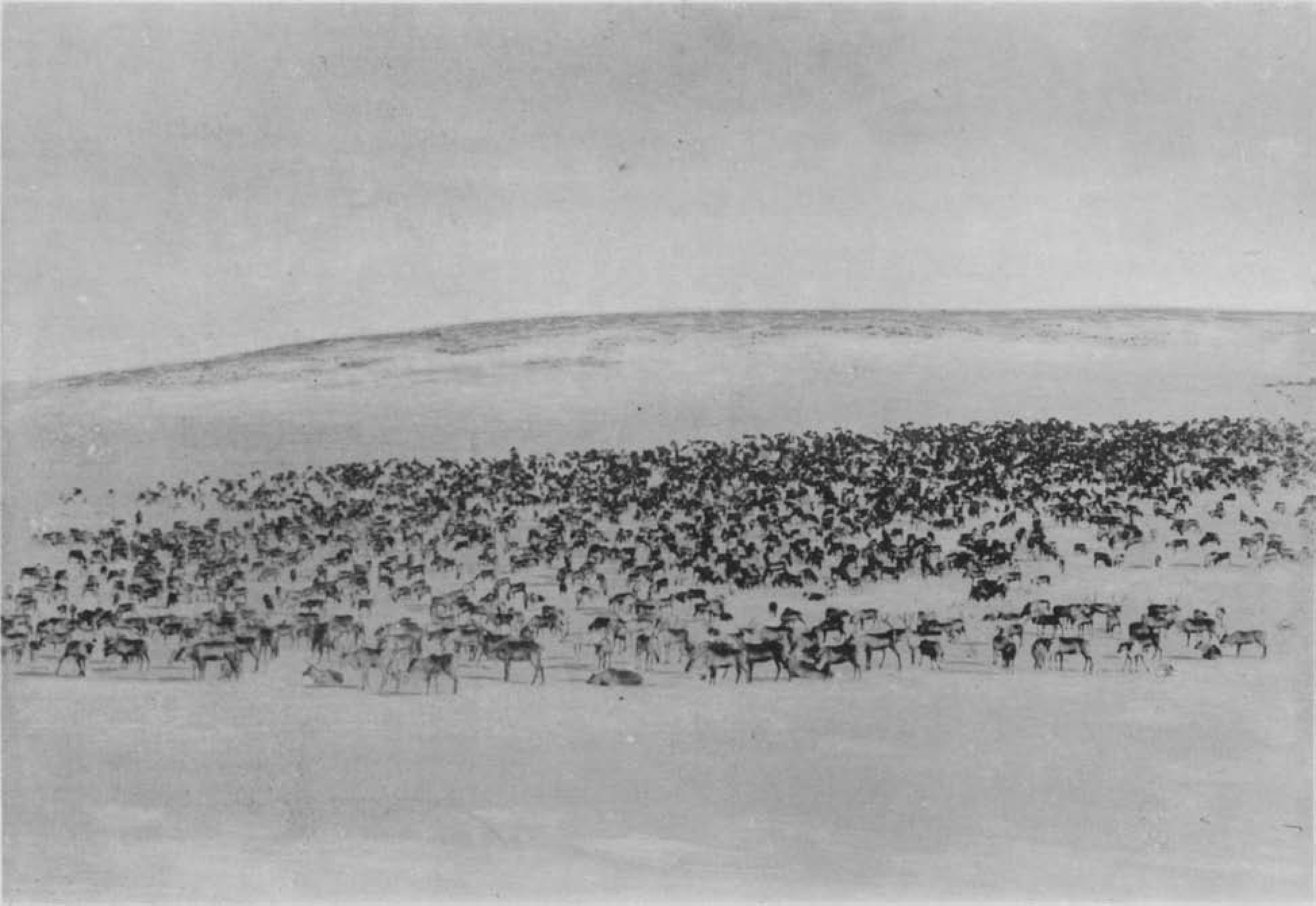
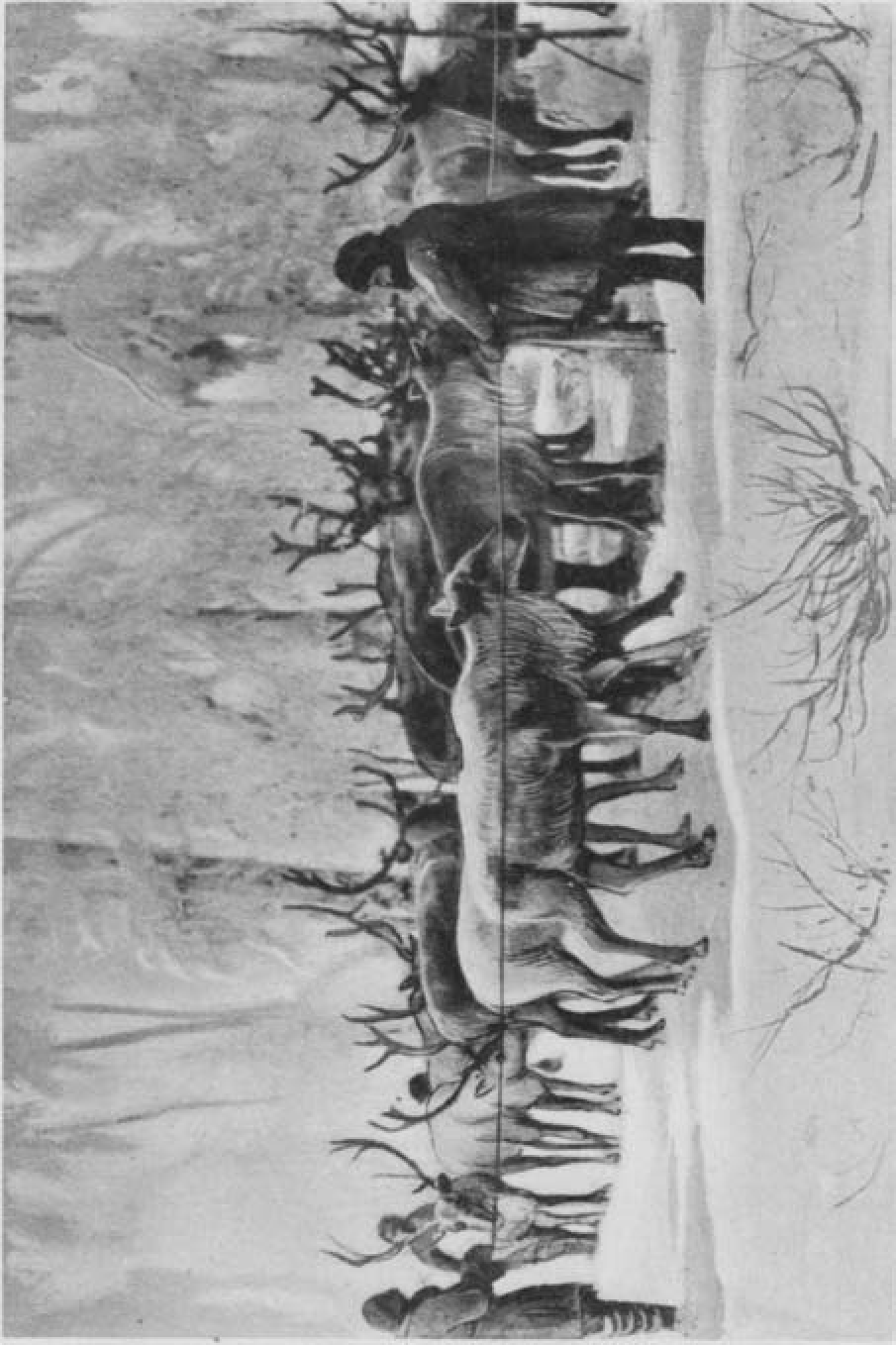
Although the Chukchee have a very imperfect system of numerals, and never know the exact number of animals in their herd, still they keep a strict proportion between its integral parts. Fertile does always form a large majority. The largest bucks, aside from those used for breeding, are usually gelded. Such geldings and a few barren does are allowed to fatten. The harness-reindeer are also geldings, with the exception of a few large barren females with large antlers. The majority of the bucks are killed for their skins in the first fall of their lives. On an average, there are in a herd, to every hundred breeding-does, about a dozen breeding-bucks, from ten to fifteen sledge-reindeer, and from sixty to seventy half-grown fawns. In a large herd (Plate IV, Fig. 1) there may be to a thousand breeding-does thirty breeding-bucks, eighty sledge-reindeer, and from three hundred to four hundred fawns. The number of fattened bucks varies from a very few to about as many as there are breeding-does. However, large bucks and barren does are highly prized, since the Chukchee assert that a herd without bucks with large antlers looks poorly, and that without barren fattened does, all signs of wealth disappear. Even in springtime, when almost every doe is with fawn, the Chukchee herdsman is often more ready to kill a breeding-doe than a large fattened buck.
[80]🗗uncollatedDuring the greater part of the summer the reindeer are much worried by large and small mosquitoes, and still more by two kinds of reindeer-flies. The first one (Œstrus tarandi Nordenskiöld, Tabanus tarandinus Slunin) lays its eggs on the hair of the reindeer, fastening them to the ends of the hair. After a little while a small maggot hatches from the egg, and immediately makes its way into the epidermis. While there it grows rapidly, and finally reaches the size of a hazel-nut. When full grown, it protrudes from the skin, and is ready to fall down. The maggots evidently cause itching, since the reindeer scratches its back whenever possible. When the maggots are very numerous, the reindeer loses its fat, and sometimes even dies. Later in spring the backs of some hapless animals look as if they were stuffed over and over with maggots, and the skin is riddled with small holes. Chukchee herdsmen very dexterously pick out these maggots, when large enough, from the reindeer’s back, and eat them with great relish. The Lamut sometimes gather a quantity and boil them in water. Although this fly, when laying its eggs, does not cause the reindeer any pain or discomfort, the animal is much more afraid of it than of the stinging mosquito, and the herd will not remain quiet when the flies are numerous.
Another fly, of smaller size and darker color (Œdemagena tarandi Slunin), lays its eggs in the reindeer’s nostrils. The larvæ go up to the throat, and penetrate the cartilage. The next year, when the maggots are full-grown, they cause a constant cough, which continues until the last one drops to the ground. The Yukaghir and the Tungus, following the example of Yakut cattle-breeders, try to protect their reindeer from obnoxious insects by a smudge of smouldering dung, or of a fire covered with green leaves. But with the wild and large herds of the Chukchee such fires are of little value, and not without danger. Thus, some five years ago, Tungus herdsmen who were tending the herd of a rich Chukchee on the Alaseya River tried to surround it with fires, and finally burned the whole pasture, and injured half of the animals.
Hoof-swelling is the most common of reindeer-diseases, and occurs almost every year to a greater or less extent in most herds. It develops where the animals walk on dry and hot ground. Large abscesses break out between the joints of the foot. Sometimes the foot swells to the size of a child’s head. The disease is catching, and is more dangerous in the mountains than on the seacoast. The Chukchee believe that when an animal afflicted with hoof-disease steps on the tracks of a healthy animal, it communicates the disease to the latter. Therefore an infected herd sometimes finds trouble in moving about the country. In an unfavorable summer a third or even half of the herd may die of it; but usually the loss amounts to only a few score. The first cold rapidly restores health to those that were not seriously affected. The symptom of another disease, that is not so frequent but much more dangerous, is a[81]🗗uncollated scab covering the whole skin, and causing all the hair to drop off. The disease is said to proceed from a very small insect that burrows through the skin, probably a species of tick. Dr. Slunin mentions having seen it, though he does not give the name of the species. It develops in mid-winter, and the reindeer die of cold and exhaustion. This disease is also catching; and a herd, once infected, will generally be exterminated. Sometimes the disease will last for several years, disappear for a while, and then break out with renewed vigor. “When it assumes a violent form, the Chukchee herdsmen often leave the whole herd, house and everything in it, even stripping themselves to the last fur shirt, as a sacrifice to the spirit of the disease. Sometimes they kill all their animals, and pile them together around the tent. According to data contained in the archives of Nishne-Kolymsk, in the spring of 1872 a Chukchee reindeer-breeder, Tɪñeiˊmɪt, brought his whole herd, stricken with scabies and about three thousand head strong, to that town to be slaughtered. The inhabitants of all the neighboring villages flocked together, and all the slaughtering was done in three days. The scabies infected the dogs and the people, who had touched and eaten the diseased meat; but the results were not so fatal as with the reindeer. Dr. Slunin also mentions that scabies may be conveyed to men. Other diseases — such as muzzle-swelling, abscesses on the sides, etc. — are of no great importance. The Chukchee do not undertake to cure any of them, but slaughter the affected animal, and consume it as readily as they would a healthy one. Occasionally they tie up, a fawn’s broken leg in thin boards, or they cut open the swollen penis of a buck that is too much affected by the rut, and sometimes they even bore with a knife an extra outlet for the urine.
A number of beasts of prey are dangerous to the herds. The wolverine and the black bear will occasionally kill a stray reindeer. The polar wolf is much more dangerous, since, in the localities where the Chukchee herds are numerous, it follows them wherever they wander, and generally lives on them. The natives assert that there are two varieties of polar wolf. One is smaller and swifter than the other; it hunts the wild reindeer, and never approaches the herds, since it dreads the smell of man. The other variety is of larger size, and, since it is not swift enough to overtake the wild reindeer, it preys entirely on the domesticated herds. In winter the wolf selects for its raids dark, windy nights, or those with heavy snowfalls. Oftentimes several wolves make a joint attack from various points. In such case they may in a single, night kill several scores of reindeer, and — what is worse — disperse the herd so widely that some of the younger animals cannot be found again. The Chukchee consider the wolf a shaman, who, among other things, possesses a charmed hood of thick hare-skin as white as snow. To make his raid successful, he will put it over the herdsman’s head when snow is falling, and thus put him to sleep. In summer the wolf sometimes becomes so bold that[82]🗗uncollated he makes an attack in broad daylight and in the presence of several herdsmen, as I myself had occasion to witness. Possibly this may be due to the fact that the Chukchee have a taboo against the use of fire-arms on the wolf, and will use only a lasso or a trap for killing it.
THE HERDSMAN’S WORK. — On the open, stormy tundra the Chukchee herdsman, who has no watch-dog, has a considerable amount of trouble with his half-wild herd. The reindeer are only half domesticated, and ready to disperse on the first occasion. When left to themselves in the open tundra, they soon become quite wild, and even more wary than the wild reindeer, since they know the ways of man. Every now and then, when going to a fresh pasture or wandering over the tundra, some wayward animals will start in the wrong direction, and the herdsman has to head them off. The herd, therefore, progresses but slowly; and the more slowly, the larger the number of animals. The highest praise for a herdsman is to say that his herd moves along swiftly; like “the small cluster of a poor man,” to employ the usual expression of the heroic tales.
During certain seasons, especially with the coming of insects, the herd requires the utmost exertion of everybody in the camp, including girls and married women. The latter, though not very active, are able to relieve the men for a little while, so as to give them their much-needed rest. The herd will not stay on the same spot, even for a short time, but wants to move against the wind to find relief from insects. When stopping for a while, only the centre of the herd stands quietly. The outer animals move swiftly around it — now from left to right, then from right to left — as if performing a dance, and then suddenly dash forward against the breeze, carrying along the whole herd. When the herdsmen are too few for regular watches, they may not get time to sleep for two or three days in succession, and often are so tired that they drop to the ground and fall asleep against their will. The worst weather is a heavy warm fog without wind, because then the insects are most troublesome, and the herdsmen cannot watch the movements of the distant animals. At such times a herd may easily be lost, if the herdsman should fall asleep even for a moment. To find its tracks in summer is no easy matter; and the reindeer may either disperse, small bands joining neighboring herds, or, in more lonely districts, run wild again. After the small-pox epidemic of 1884 on the western Kolyma tundra, so many domesticated herds ran free and dispersed, that their descendants may be recognized even now among the wild reindeer at the mouth of the Kolyma. The wild reindeer in Asia is uniformly gray. All those having black or white spots are descended from the domesticated race. The best qualities of a herdsman are endurance in walking, and ability to go without sleep for a long time.
A small herd is more difficult to handle than a large one;¹ and several[83]🗗uncollated poor families usually combine for the summer and form a large herd with plenty of herdsmen. Early in the fall the herds are separated; and in winter some of the poor men will join their wealthy neighbors and help them watch the herd, receiving for their pay some skins, and some animals for slaughter. Such temporary helpers generally leave in spring, before the calving-season, since at that time a large herd gives much trouble. It must be kept moving in search of new pastures. Does with young ones are very slow. In a herd of a thousand does there are some thirty calvings daily. The herdsman has to keep his eye on every one of these. He leaves them behind, then comes back for them, and even assists the inexperienced dam.
Many poor families, especially those who want to raise a herd of their own, enter the service of one of their wealthy neighbors for several years. They are very hard-worked, and receive as pay their meat-supply and skins from the herd of their master; but in moving from camp to camp they must use their own pack and driving animals. Meanwhile their own little stock is left undisturbed to multiply. In return for good services, they may expect to receive from their master every year about ten fawns; and with the natural increase of their own animals they may secure one hundred reindeer in the course of five fairly favorable years. Such helpers are called “dwelling-mates” (nɪm-tuˊmg̣ɪt); and the owners of every large flock, when short of hands, will strive in every way to attract at least one poor family. Often these are poor relatives of the owner of the herd. If there are any young unmarried men in these families, they will be offered a girl of the master’s family in marriage, and thus become relatives of his.
With the beginning of summer, when sledges become useless and tents cannot be moved around the country, the Chukchee herdsmen usually leave their families in camp, and move with the herd about twenty miles away, to the summer pastures. Boys and girls of more than ten years, and young women having no small children, usually go along for a time. While moving about with the herd, the herdsmen have to carry on their backs all necessaries, such as extra clothing, rifle and ammunition, kettles, and provisions. After they have killed a reindeer, they must carry its skin and meat until it is consumed. For this reason the herdsmen are so averse to slaughtering an animal at that season, that they sometimes go for several days on starvation rations. If the hoof-disease breaks out, they have plenty of meat, but they have to carry along additional loads of skins. Sometimes they are so heavily laden as to be hardly able to move. The burdens are carried by girls and by men who are not very agile; while the best herdsmen must remain unencumbered for moving swiftly around the herd.
The time of the first sprouting of weeds, and the mushroom season in the fall, are also hard on the herdsman; but the winter is easier, especially the coldest months, which have clear sky and calm air. If no wolves’ tracks[84]🗗uncollated are seen in the vicinity, the herd may be left for a day, and even for a night, without any watch; and two boys are sufficient to keep watch for several weeks, with an occasional visit from their father or elder brother, who attend chiefly to the change of pasture. Thus in the winter-time the older people have more leisure for visits and amusements.
The Chukchee are supplied with meat and skins from their herds. No milking is possible on account of the wildness of the reindeer. Early in summer the herdsmen may catch one of the does with fawn, strike her to the ground, and try to suck some milk from her udder, although she may kick desperately all the while. The man has to strike her udder with his fist, just as the fawn does with its forehead, to cause a more abundant flow of milk. Sometimes the milk that has been sucked out is spit into a bladder and brought home as a rare present. The amount is rarely more than half a glassful. But these milking-operations must not be repeated too frequently, otherwise the fawn would be starved. When the herdsman is very hungry, he may also chop off a few pieces of the soft velvet of some buck with large antlers, and eat the thick, soft outer skin. The animal is released without any dressing of the wound; and the blood will sometimes continue to trickle down for hours.
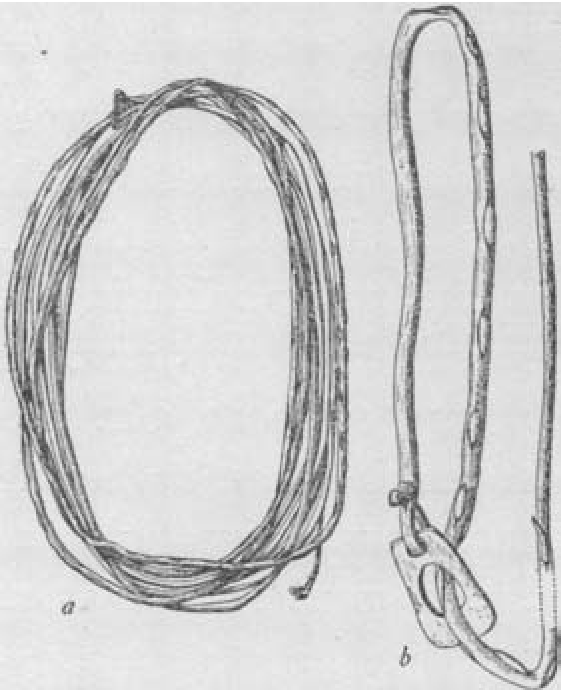
Bucks are gelded in a way somewhat corresponding to the process of milking. The animal is struck to the ground, and the herdsman bites with his teeth either through the dowcets or through the spermatic ducts. This operation does not affect the reindeer much, and immediately afterward it continues to graze. Sometimes the scrotum is tied very tightly with a sinew thread, and after a while becomes atrophied and drops off. Usually the antlers of the driving-reindeer are cut short with a saw early in the fall, when they are dry and hard. The mark of the owner (vêloˊlhɪn, “ear”), which is a very simple one, is bitten out of the fawns’ ears in late summer, or the next spring during the separation of bucks from pregnant dams. For catching reindeer the herdsman uses the long lasso (čaˊat) with a knot on one end and a noose formed by means of a bone eye on the other (Fig. 5). It is made of thin seal-skin straps plaited together, sometimes of intertwined sinew cords, or of ground-seal and walrus thong carefully softened by rubbing, and well smeared with blubber to make it more pliable.
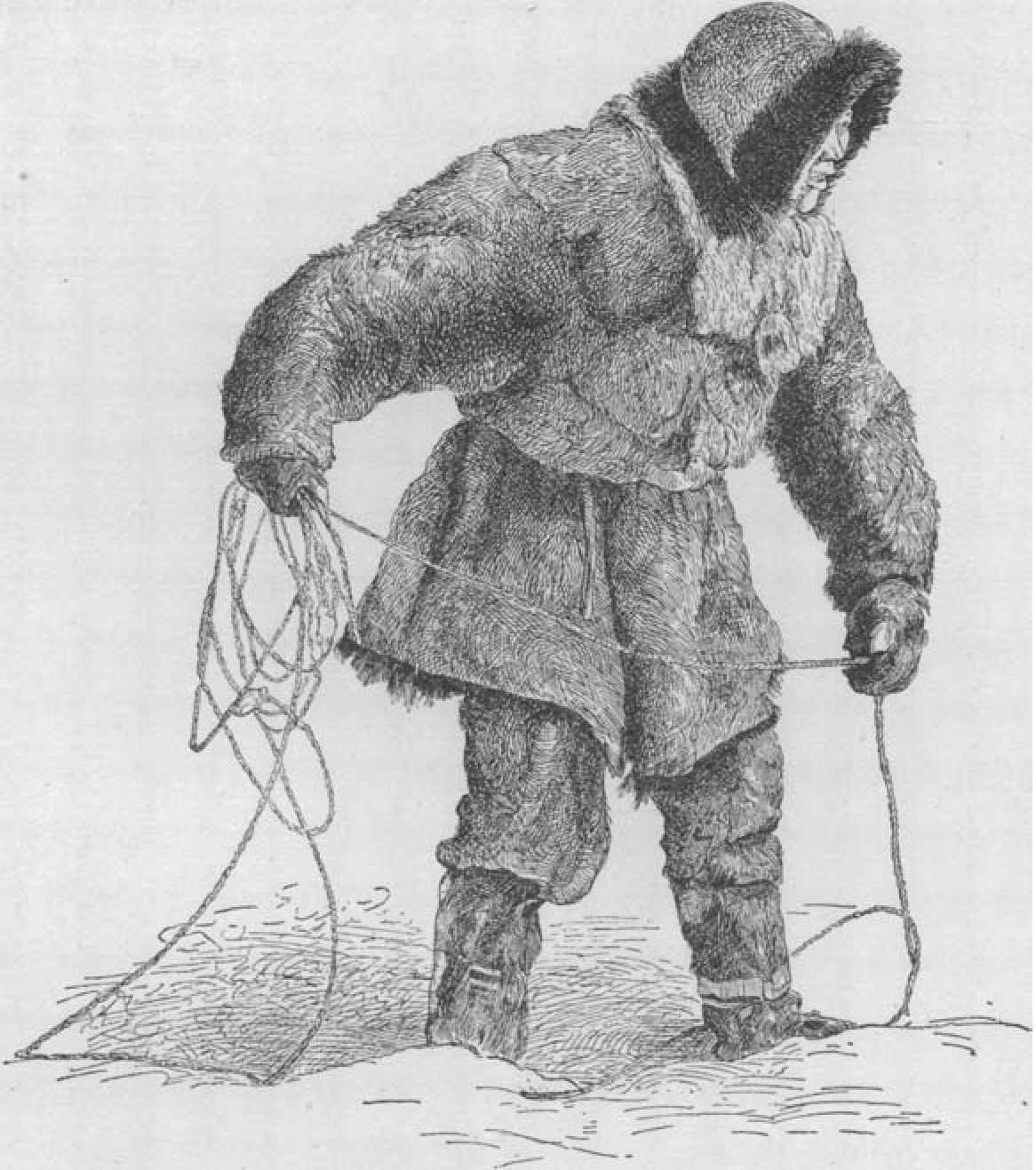
A good lasso is worth a fat buck for slaughter, or even a sledge-reindeer. The Chukchee herdsman will not go abroad without his lasso, even when far from his herd (Fig. 6; also Plate XXVII, Fig. 2). While walking, he usually carries it around his neck in a thick coil, like a huge boa. It is sometimes used in hunting[85]🗗uncollated wild sheep, also for catching wolves that are first hunted down with a swift sledge, and occasionally for black bear and wolverine. Once, in my presence, a man who was drowning in a large river was caught and drawn to the bank by means of three lassos tied together. Two men held the coils; the third, who was the strongest, threw the noose across the river.
After having caught the reindeer, the man tightens the line and swiftly approaches, gathering in the coils. At the same time another man seizes the reindeer by one of its antlers, and with the other hand deftly stabs it through the heart, using a long, thin knife pointed at one end, and strong enough in the back not to bend too easily. This is usually done by men. When, however, owing to lack of men, girls and young women have to tend the herd, they carry the knife in their belts, throw the lasso, and perform the slaughtering, just as well as men. For sacrifices and in ceremonials the reindeer is stabbed with a spear (Plate VI, Fig. 1). At the present time the Lamut kill the reindeer by stabbing; but I was told in the Kolyma district that in very ancient times the Lamut strangled their animals with a running noose.¹
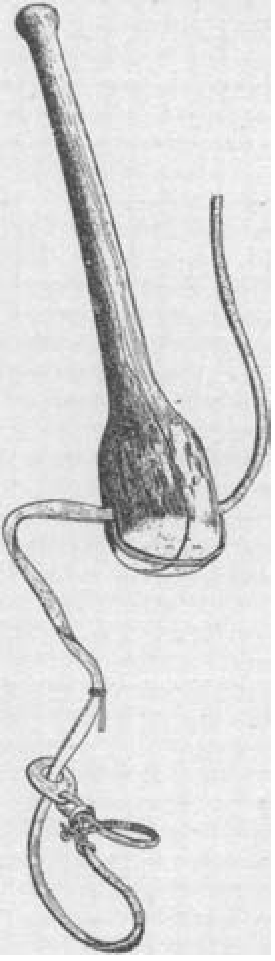
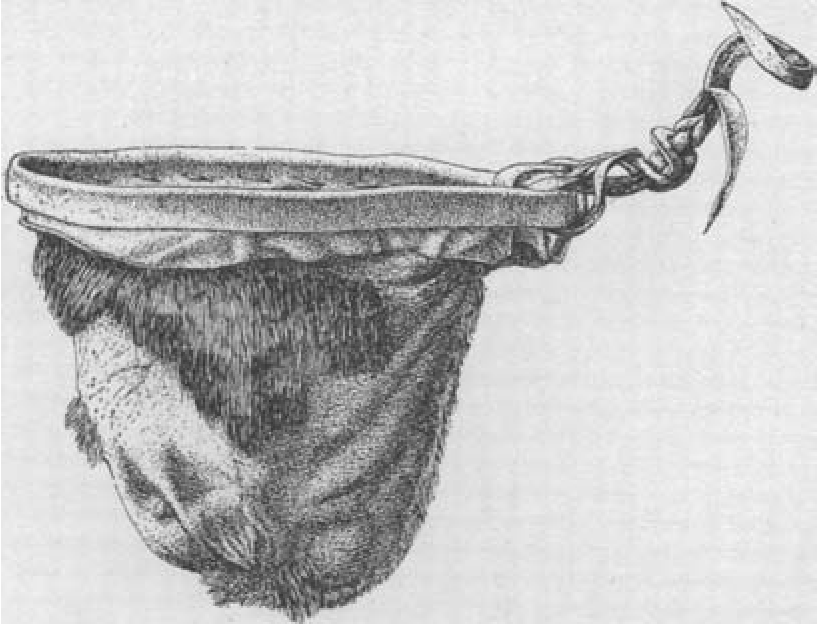
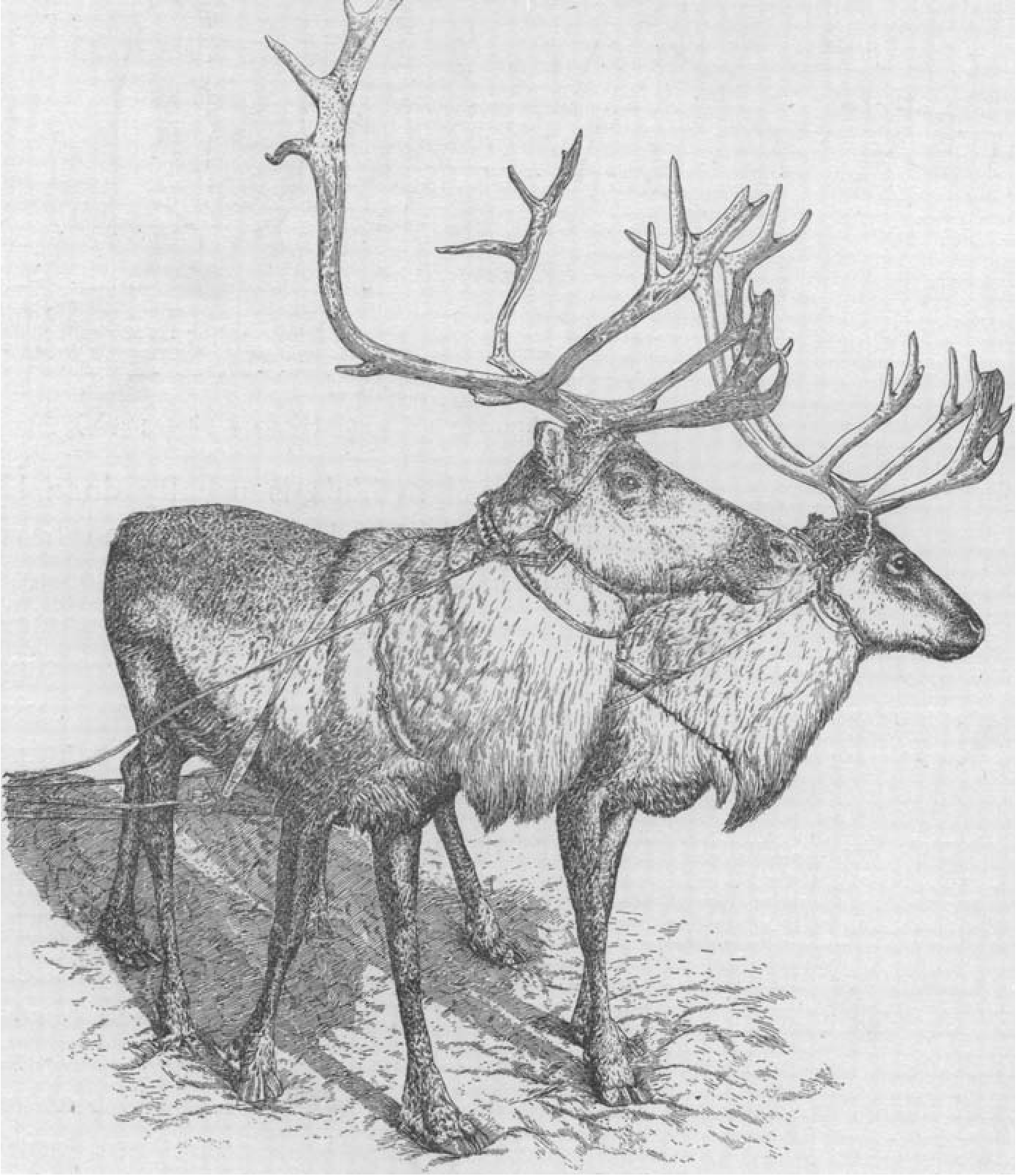
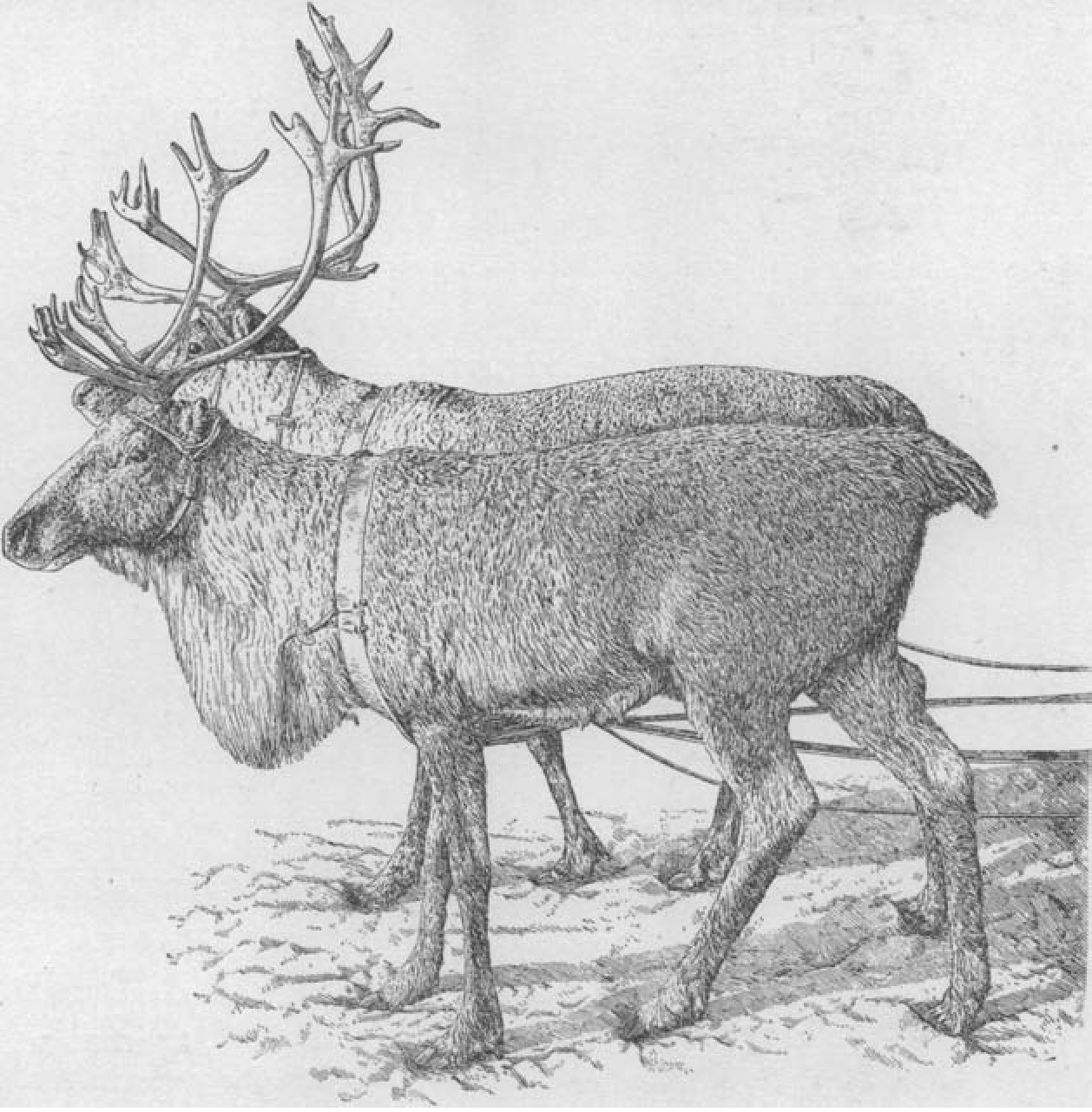
REINDEER-DRIVING. — Reindeer-fawns are usually broken in the first winter. The herdsman selects for this purpose those that seem to be the least shy. Sometimes the Lamut reindeer submits the first time it is put into harness, while the Chukchee reindeer requires considerable time to be thoroughly broken. The reindeer like the taste of urine. For this reason, every Chukchee herdsman or reindeer-driver has tied to his belt or fastened to his sledge a small leather urine-vessel (Fig. 7), which he uses to attract the reindeer that he wishes to harness. When thoroughly tame, reindeer will come and drink[86]🗗uncollated from the hands of their masters. Reindeer that are to be trained for pack-sledges are usually attached to the last little sledge of the line. On this sledge the tent-poles are carried, tied together, and the struggles of the reindeer can do no harm to the load. The sledge is attached to the preceding ones, which are hauled by trained animals. In a few days the young reindeer, after having been dragged several times behind the line, together with the sledge, learns to bear even with the rattling of the poles. Reindeer for driving-sledges are broken in by means of the čɪˊkɪl (Fig. 8), a heavy wooden club that is fastened to one of the reins or to the end of the halter. Whenever the reindeer wants to turn off the track, or even[87]🗗uncollated to turn its head, the čɪˊkɪl is violently jerked several times by the driver, causing the animal considerable pain. When the newly broken reindeer kicks too much, or, after pasturing, does not allow itself to be caught for harnessing, the herdsman will pull it for half an hour by one of its hind-legs by way of punishment. Reindeer are generally attached singly to the pack-sledge, and in pairs to the driving-sledge. Only a poor man will drive a single reindeer, and then for short distances only, because the reindeer would very soon be completely tired out.
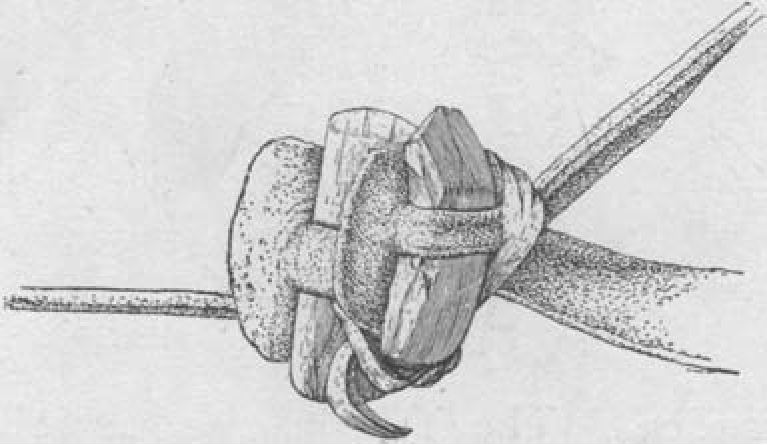
The reindeer-harness is quite simple (Figs. 9, 10). It consists of a heavy strap four centimetres wide, which forms a bight, one end passing along the right side of the animal, the other end across the left shoulder and then between the forelegs. I will call this bight the collar. The ends broaden, and a wooden toggle is inserted in a slit in each end (Fig. 11). Then both ends are passed through the eye of the trace. The harness-strap of the pack-reindeer sometimes has the middle part covered with soft skin, especially in the season of hair-shedding, when the skin of the reindeer is very sensitive and becomes sore easily. In winter little care need be given to the harness, since the reindeer does not perspire, and the harness is always dry and clean. Two thin strips of leather are fastened to each side of the collar. They reach around the chest, and are joined by means of a wooden toggle. Sometimes a stronger breastpiece is fastened in the same way.
[88]🗗uncollated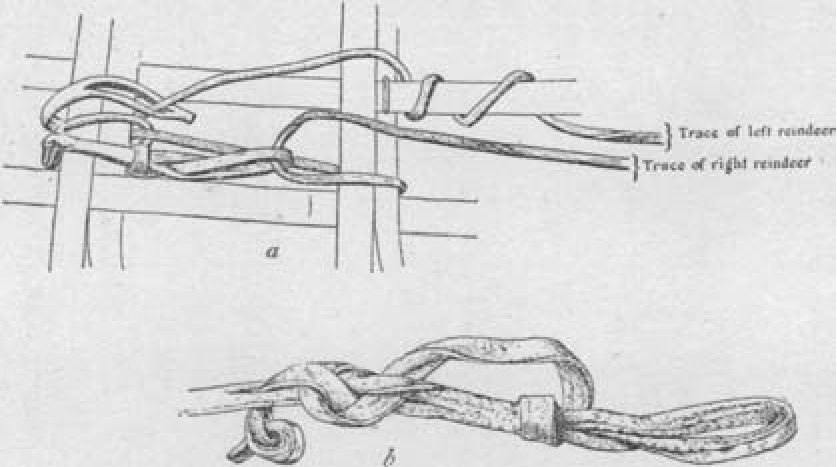
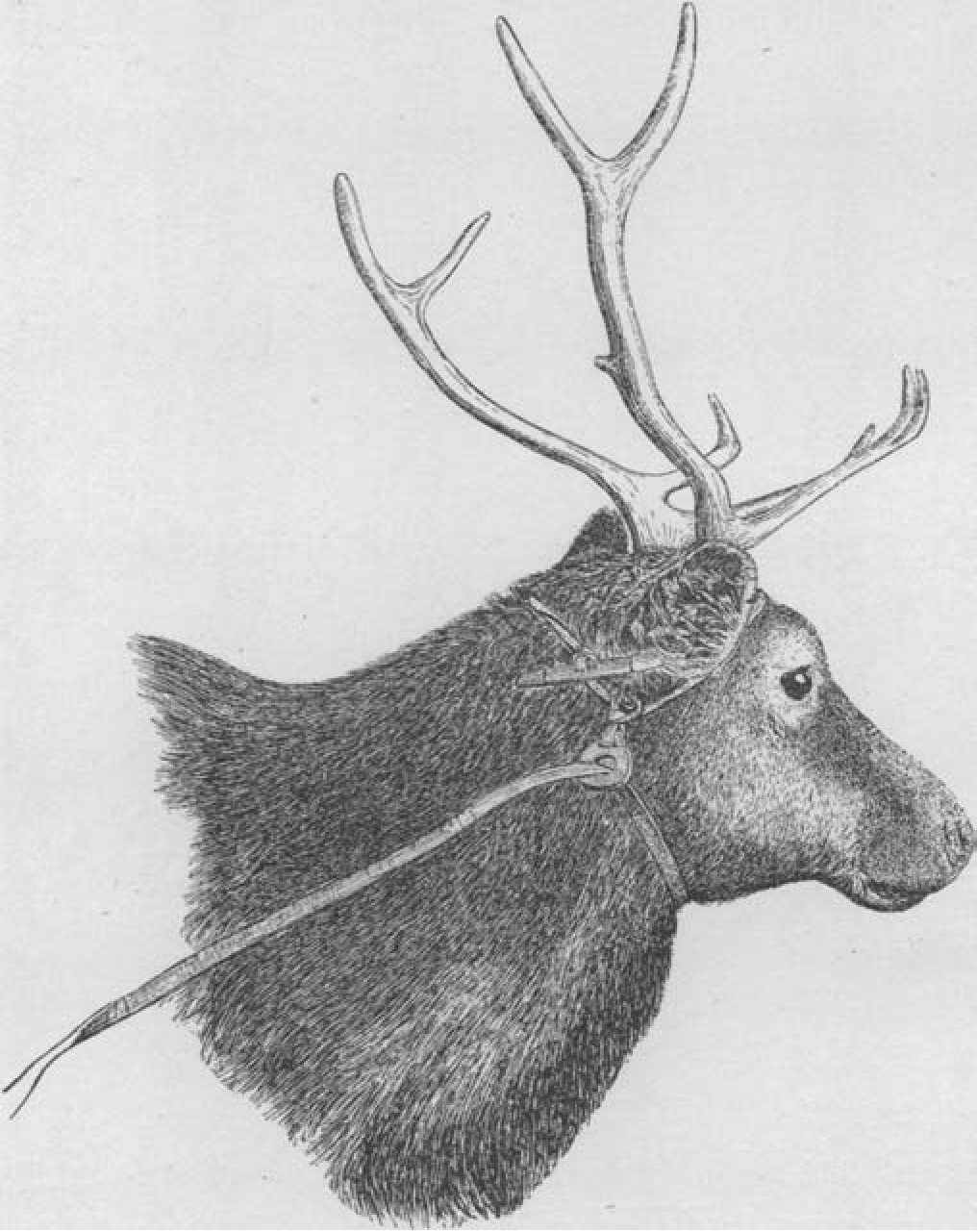
With the driving-reindeer the collar is slung over the left shoulder of both animals; and they have separate traces, which are fastened to the middle of the sledge-front (Fig. 12). The larger reindeer is usually placed on the right side; and it does more work than the one on the left, especially in turning and changing the course. Two reins — one on the right-hand side and one between the reindeer — are fastened to a common halter (Fig. 13). They end with loops that are usually put around the mittened wrists of the driver. The end of the right rein is strengthened by a thin piece of whalebone wound around with thin thong, and sometimes supplied with rings of ivory or lead to give a better hold for the hand. Several sharp, notched attachments made of ivory, antler, or iron, serve in place of the bit (Fig. 14).¹ When the reins are pulled, these prick the animal. When one of a couple of driving-reindeer is inclined to jostle its companion off the track, a wooden implement with sharp antler prongs is fastened on the body of the latter to prick the restive animal whenever it gets too near (Fig. 15).
Pack-reindeer are tied to the preceding sledge by means of a halter without notched clasps. Pack-reindeer do not walk without being thus attached.

Collars of about the same shape as those of the Chukchee are used by the Tungus, the Samoyeds, and even by the Laplanders. The Tungus reindeer-collar (used also by the Yakut and the Russian reindeer-drivers) passes along the left side of the left reindeer, and the right side of the right one. The trace is double, and for attachment is simply slung[89]🗗uncollated across the curved fore-part of the sledge, so that both reindeer are compelled to pull with equal force. Otherwise the traces of the weaker one would become shorter, and its hind-legs would be struck by the sledge.
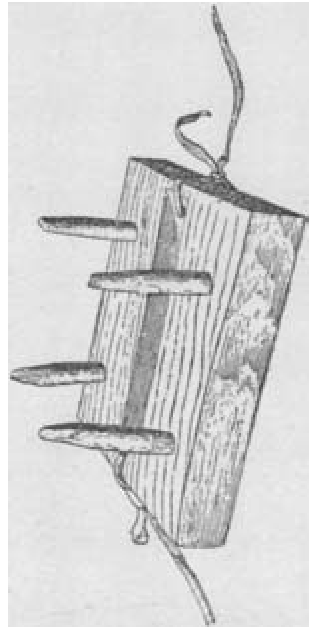
The driving-harness of the Tungus has only one rein, and therefore is less handy. Their draught-reindeer are attached to the sledge in twos with the same double trace, and tied to the fore-sledge with two separate halters. A Chukchee pack-reindeer hauls from a hundred to a hundred and fifty pounds on the sledge; a pair of Tungus or Yakut pack-reindeer, from two hundred and fifty to four hundred pounds; and a Lamut saddle pack-reindeer, from forty to fifty pounds.
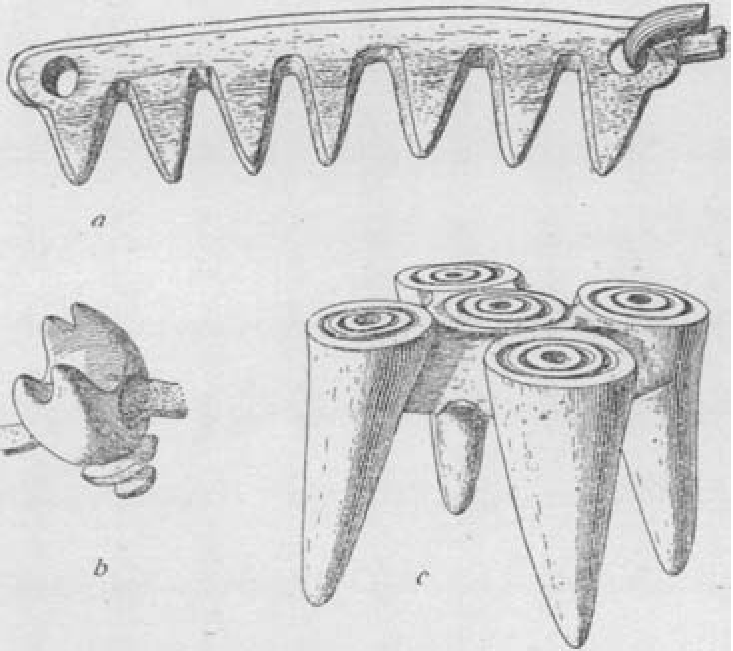
The whip is made of a long, thin, pliant rod of willow or birch, usually broken in one or two places and fastened together with sinew thread to give it greater pliability. It has a thick antler ring on the hand-end, and an ivory cap, usually made of a molar of the walrus, with one protruding, somewhat blunt end (Fig. 16, a-c). In experienced hands, this light and apparently inoffensive instrument can draw blood from the thick skin of the reindeer-buck, though generally the Chukchee do not strike their reindeer very hard. Maltreatment of reindeer or dogs is considered a great sin against Yaˊg̣tač-vaˊɪrg̣ɪn (“Life [giving] Being”).¹ Occasionally a whip with shorter handle and thin thong is used (Fig. 16, d).
The details of the Koryak harness, whips, and sledges, are more or less similar to those of the Chukchee.
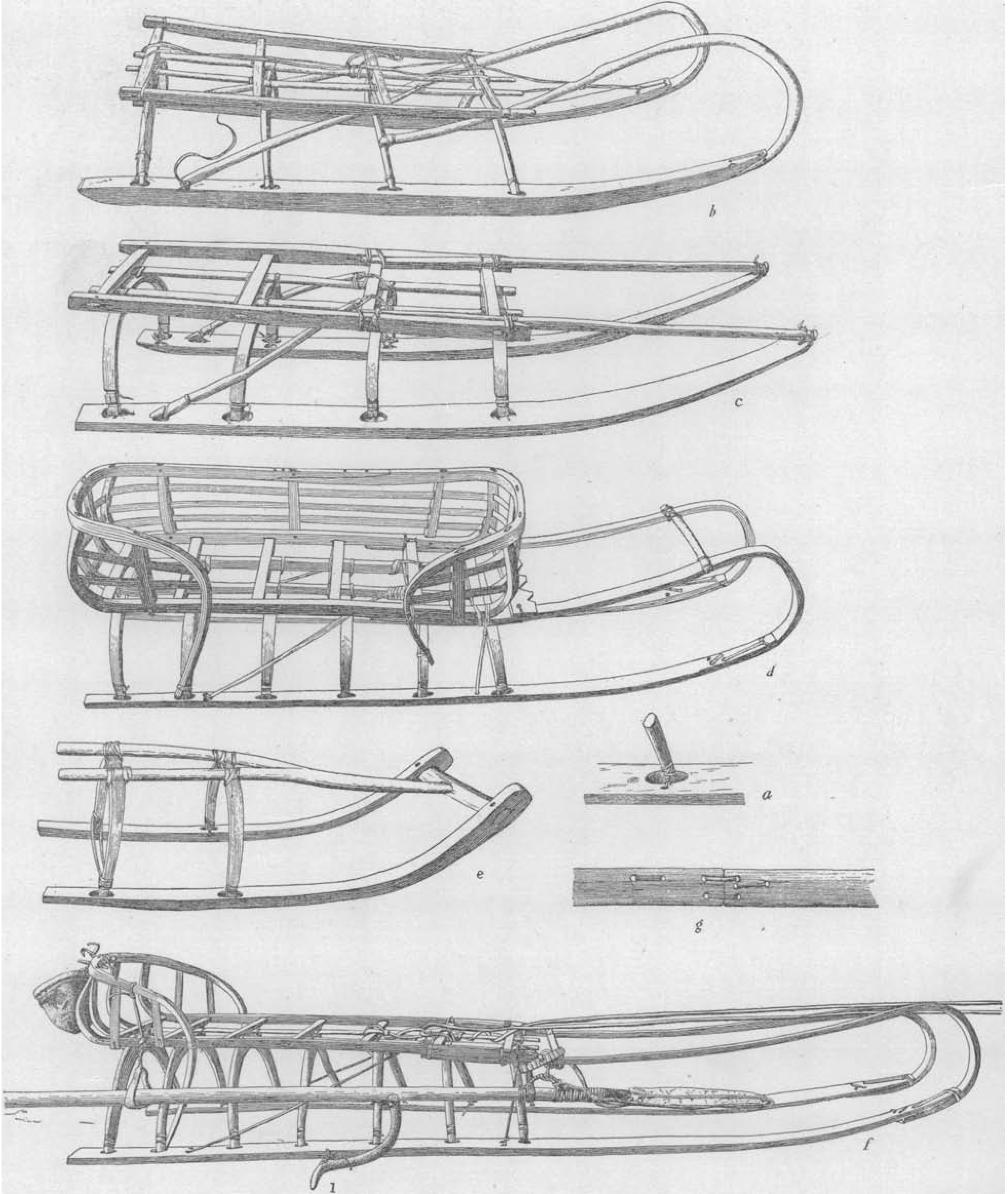
The Chukchee reindeer-sledge has double curved cross-ribs made of antler, or of strong boughs naturally curved. The fore-ends of the runners are joined to the upper rails, the whole forming a curve (Fig. 17, b, d, f), and the ribs are tied to the runners in shallow slots roughly hollowed out, but not[91]🗗uncollated exactly fitting the rib (Fig. 17, a). A hole is drilled through the upper edge of the slot on the inner side of the runner, and the line that fastens the rib passes through that hole. All joints are fastened together with thin, pliant thongs, which are drawn very tight, without any pegs or nails. The pack-sledge (Fig. 17, b) is made of larch-wood, and is of rude workmanship. The fore-ends of the rails are often straight, and tied to the runners in a very simple way (Fig. 17, c). The runners are thick; but the ribs frequently break or become unfastened under pressure. These sledges vary in size, according to their special loads. Those carrying the halves of the outer tent-cover are the largest; those for house utensils, kettles, etc., are supplied with a framework open on one side (Fig. 17, d); and the smallest ones, on which the poles are carried, often have a forked rail in the middle (Fig. 17, e). The tent-poles are attached to the arms of this fork. The driving-sledge (Fig. 17, f) is made of birch-wood, with thin, flat runners, curved ribs, and a frame of flat, slender sticks tied together with thongs. Often a hoop is fastened in the middle in an upright position, from which to suspend a bell. In the spring-time, when the birch runners do not glide so smoothly over the half-melted snow, they are shod with slabs of whalebone, or with several lengths of flat pieces of bone cut from the whale’s jaw and joined together (Fig. 17, g). This shoeing is fastened with thongs, which are sunk into grooves in order to avoid friction against the snow, or simply with wooden pegs, or with a combination of both. Driving-sledges are not ungraceful in shape; but they are very brittle, and can be shivered to pieces by striking against any obstacle. They vary in form and dimension. The woman’s sledge is usually larger than others, and has a wider and more comfortable seat. The usual measurements for the man’s driving-sledge are: length, 180-200 cm.; distance between the runners, in the middle, 30-35 cm.; height in the middle, 24 cm. The measurements for the woman’s driving-sledge are: length, 220-250 cm.; distance between the runners, 35-40 cm.; height, 25 cm. The racing-sledge, on the contrary, is so small, that the driver has hardly room to sit. Even the woman’s sledge is so light, that a man can easily lift it with one hand and carry it on his back, not to speak of drawing it with a rope over the snow. The seats of driving-sledges, of whatever shape, are usually supplied with a low back.
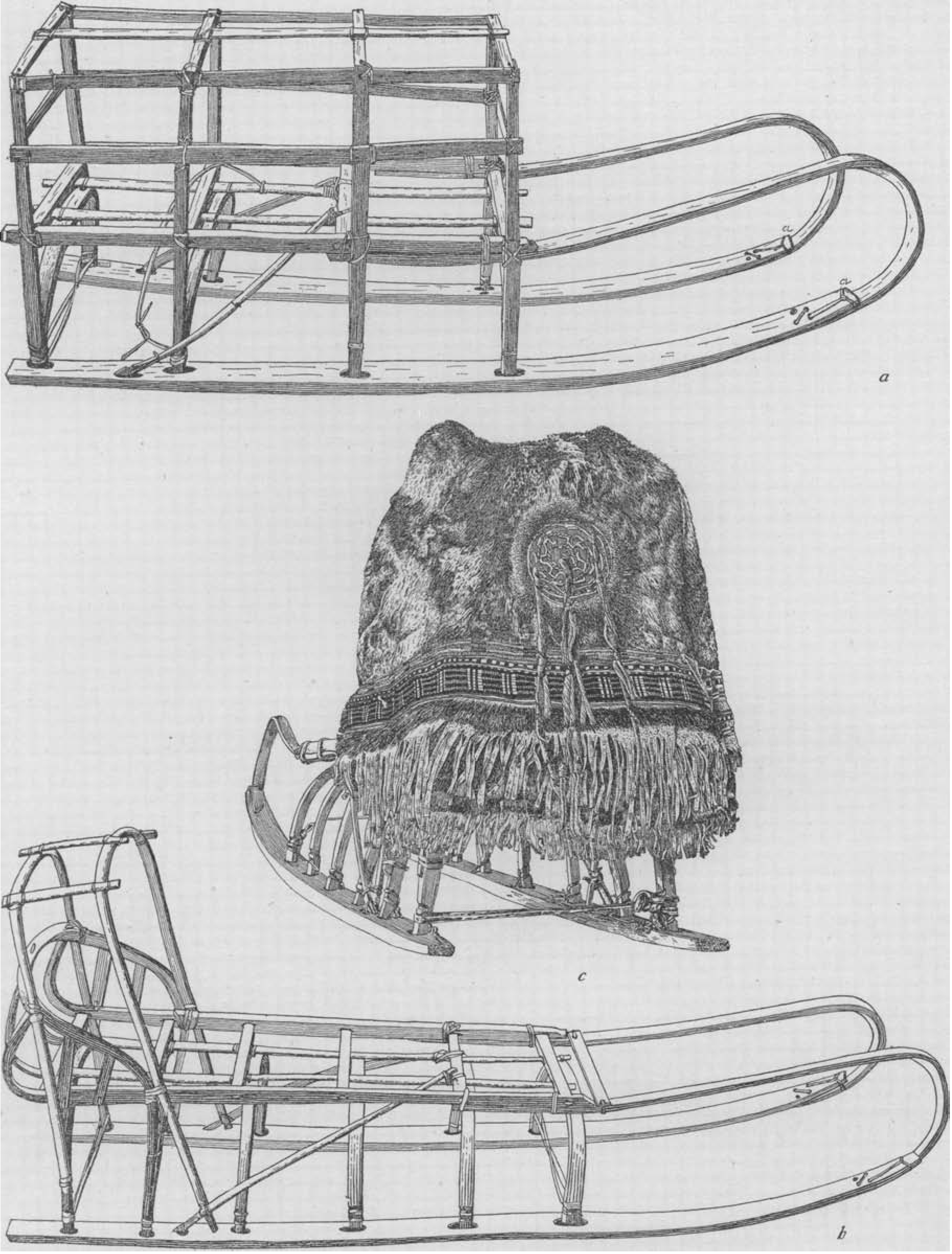
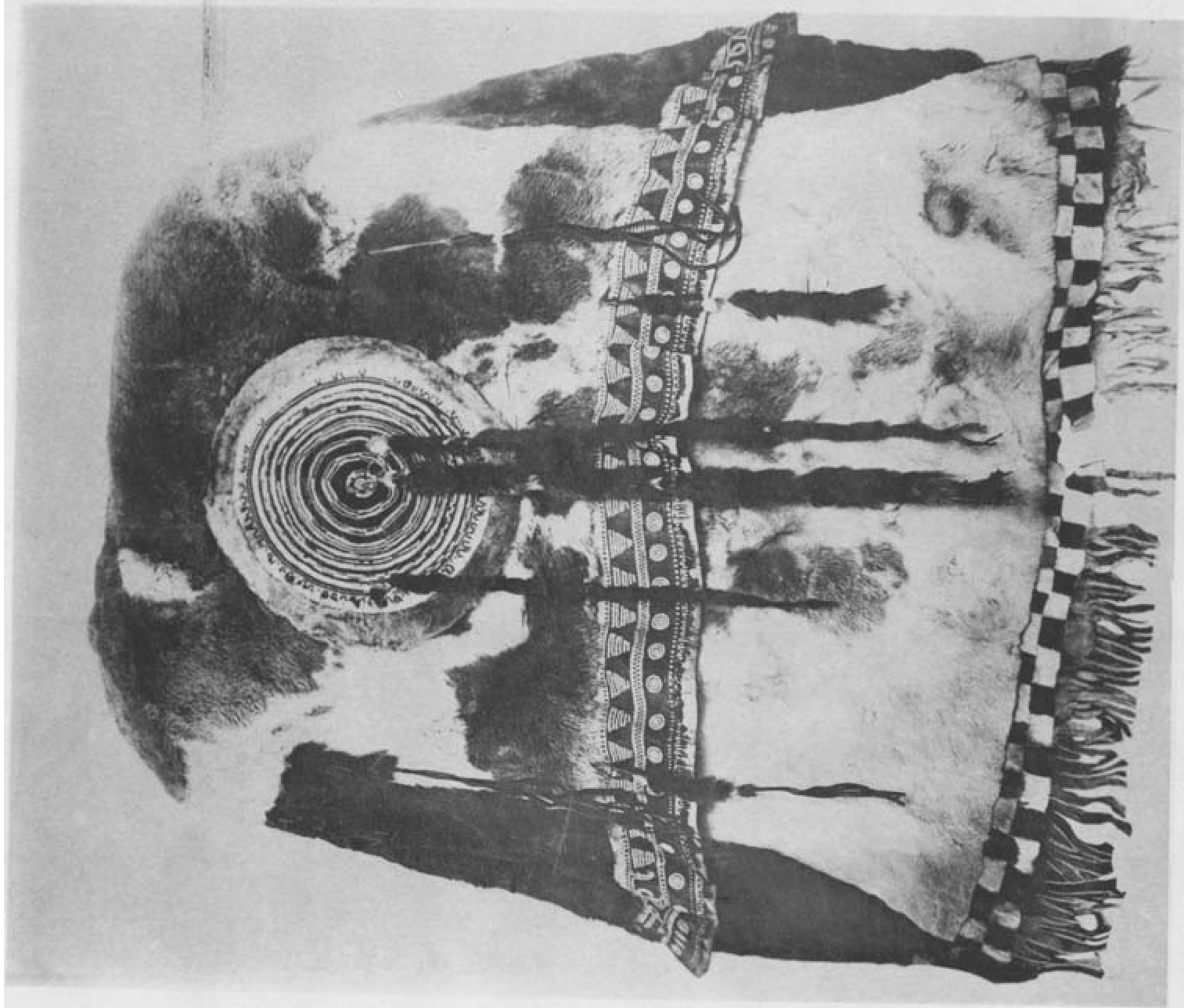
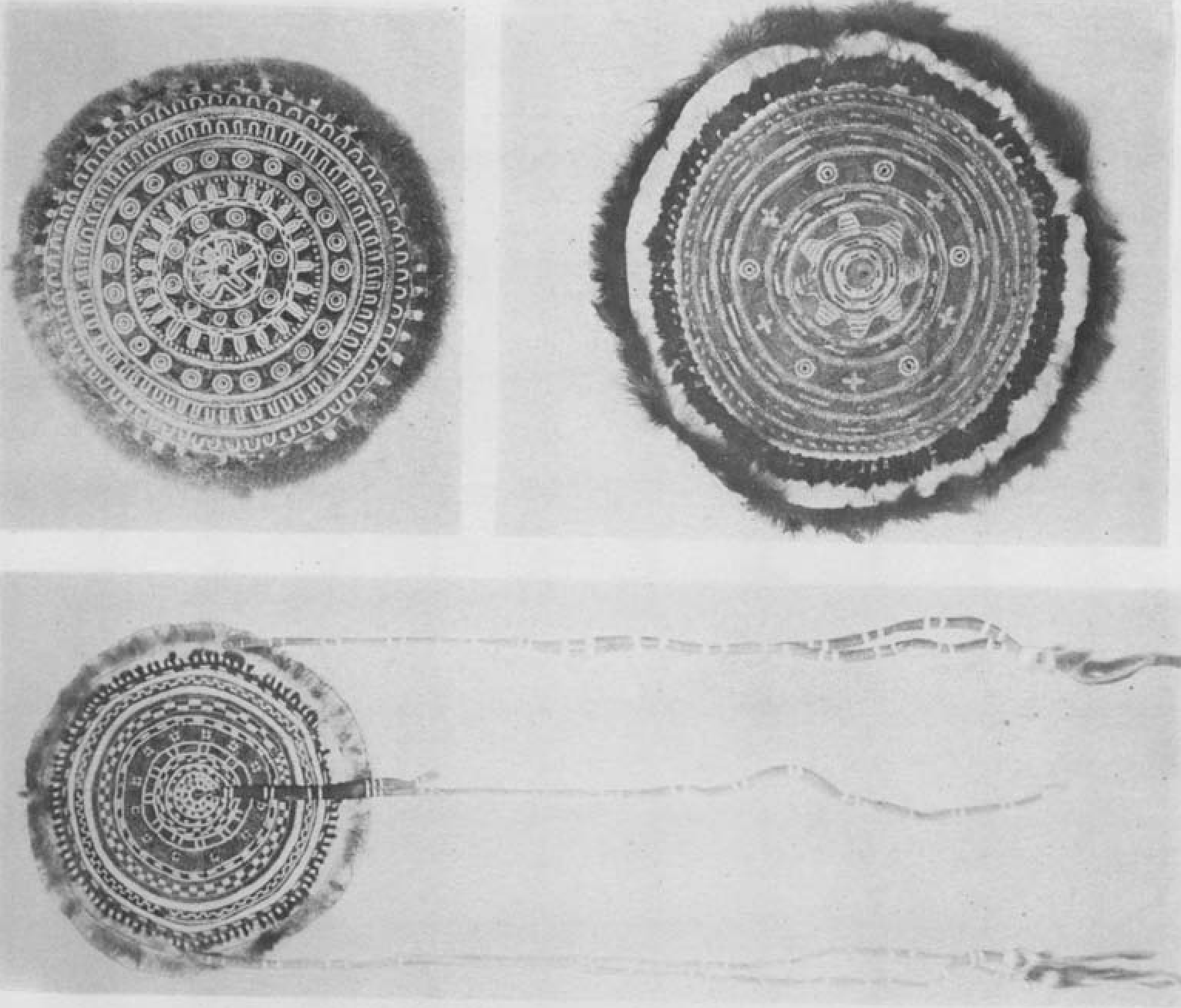
A special sledge, larger and broader than any pack-sledge, has a square frame (Fig. 18, a) covered with skin, and is used for carrying small children when changing the abode in the cold season. The woman’s driving-sledge is sometimes furnished with a small covered space on the back seat in which to carry her infant (Fig. 18, b, c). The coverings are usually adorned with a fringe of tassels, and are embroidered along the edges (see Plate XXI, Fig. 1). A large circular piece of embroidery (see Plate XXI, Figs. 2-4), called “sun” or “moon” according to its pattern, is also fastened on the back of the sledge.
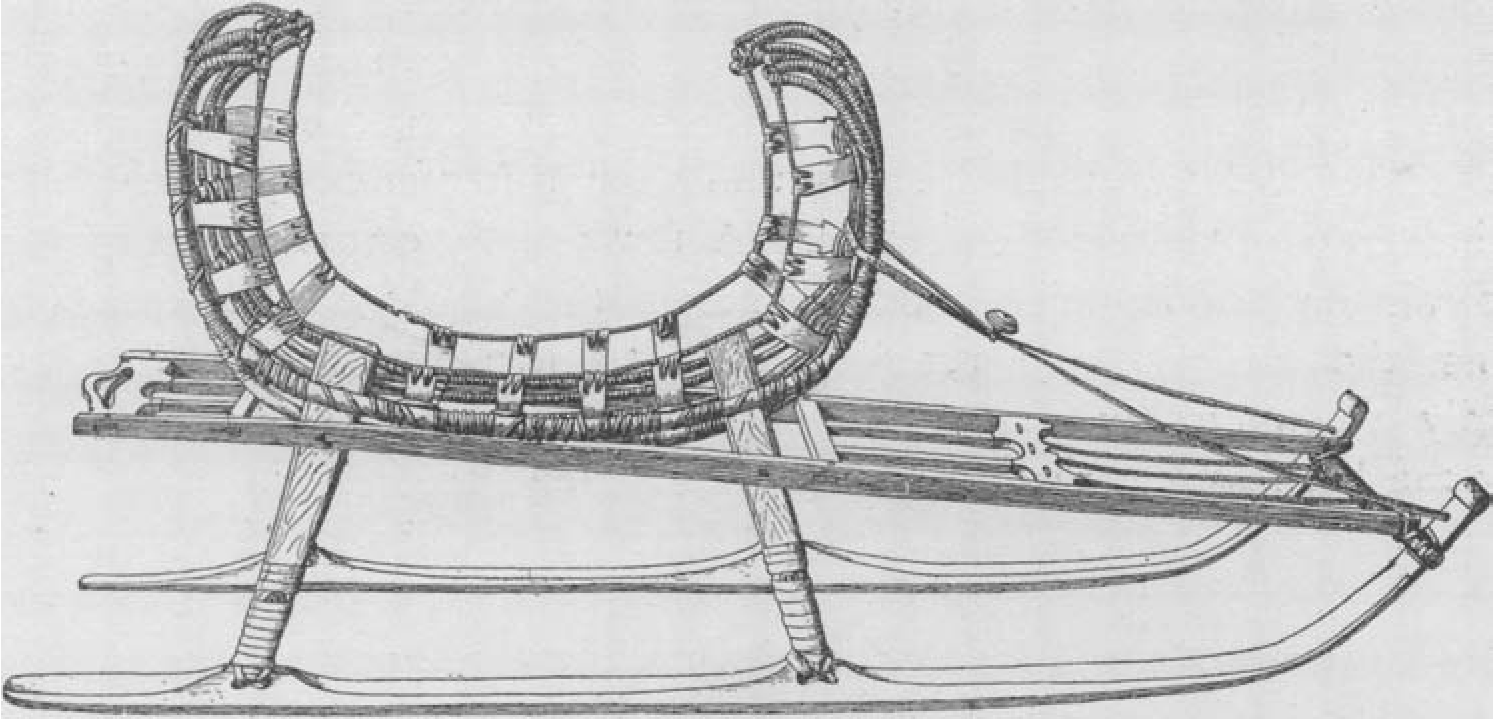
A man or a woman riding a sledge usually sits astride of it, with a piece[93]🗗uncollated of skin for a seat-cushion, and with feet hanging down or resting on the runners (see Plate V.). Thus they easily direct their course with their feet, and avoid stumps, bowlders, and other obstacles. The same position is required by the dog-sledge of the Gilyak, and especially by that of the ancient Kamchadal (Fig. 19), that had also curved ribs, and, on the whole, was similar to the reindeer driving-sledge of the Koryak and the Chukchee. When gliding down a slope, the driver generally uses his feet as a brake. In the spring, when the upper snow-crust becomes hard and slippery, a brake made of antler is used (see Fig. 17, f¹), that is loosely tied to the right runner, and, when required, firmly pressed with the foot against the snow.
The Chukchee driver, as a rule, does not carry anything on his sledge, for fear of fatiguing his reindeer. Even for a long journey he takes on his sledge only a lasso, a spear, an outer coat for protection against storms, and for provisions a cake of ground meat mixed with tallow, but no kettle and no cup. For subsistence he depends solely on the villages and camps along his route, or, if he fails to find these, he sleeps patiently on the snow without meals. For the most part, however, Chukchee journeys are undertaken with a train of from eight to ten sledges, a woman goes along to attend to it, and a few score reindeer drag it along.
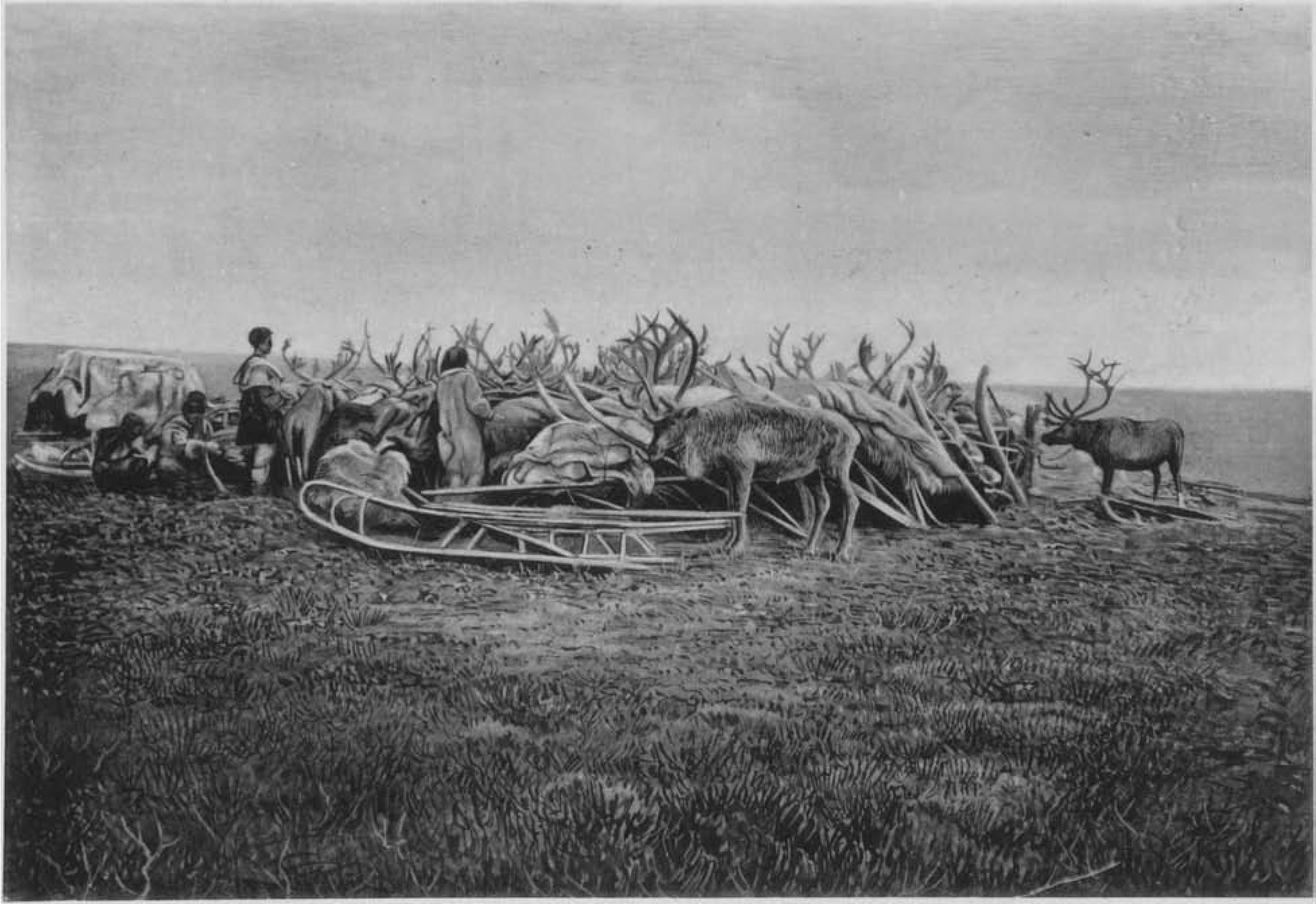
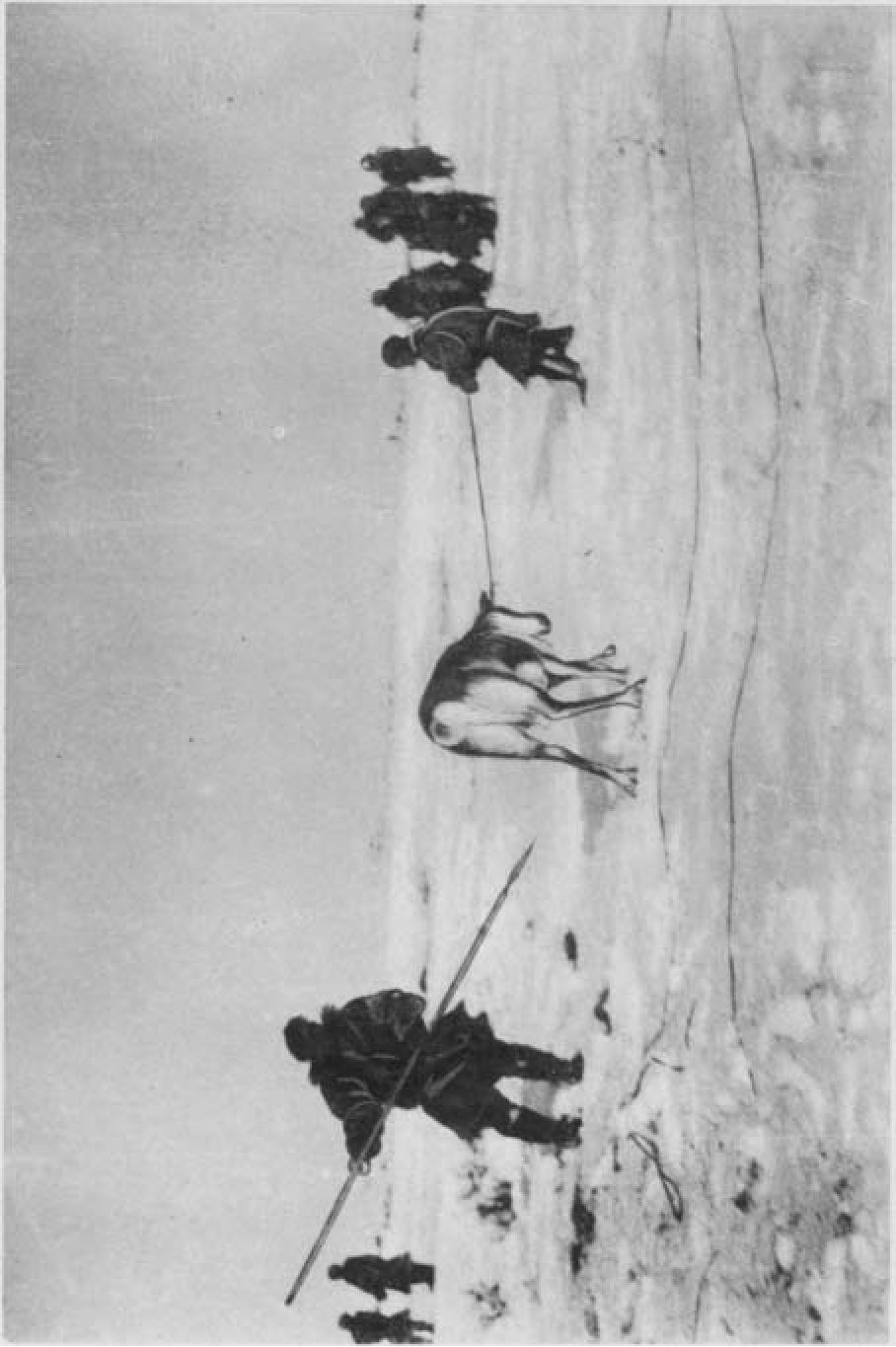
All pack-sledges have their definite place in the travelling-line, which begins with the woman leading it, and ends with the pole-sled. One woman can lead from ten to fifteen sledges; and a well-to-do house with a large family may have forty or even sixty sledges, which travel in from four to six separate lines. When starting, the sledges are packed early in the morning, and placed in the usual order. All the lines are joined together, forming a large corral (Plate IV, Fig. 2) in the shape of a horseshoe, into which the reindeer are driven. Most of the sledges are stood up one against another in a slanting position, and the corral is strengthened with sticks, shovels, large skins, etc.,[94]🗗uncollated and watched in all the weaker parts by old women and children. The herdsmen bring the herd, and first of all try to catch with their lassos, or by means of the urine-tube, about ten harness-reindeer, which are placed at the entrance of the corral; otherwise no free reindeer could be induced to enter it. Then they drive the herd to and fro before the corral, picking out one by one other harness-animals and driving them into the corral. The wildest ones are caught with the lasso, which is thrown over them, or spread like a snare on their track. When all the harness-reindeer are inside, the entrance is barred with a heavy rope, and all the men and women immediately enter and secure the reindeer with halters and traces. A few usually escape, breaking through the corral, or jumping it; and sometimes the whole pack succeed in overthrowing the sledges, and running away to join the herd. This happens especially when any of the unbroken breeding-bucks have entered the corral among the harness-reindeer. When all the animals are in their places, somebody gives the signal, and all the sledges drop to position at the same moment and start on, going in their respective lines. This difficult process requires the help of several people, and occupies usually three or four hours. A small family, living by chance in a separate camp, especially when lacking young, swift men, will sometimes fail to catch their own harness-animals for two or three days in succession. The Koryak and the Lamut harness-reindeer, on the other hand, are taken without any corral, by means of a long leather rope, which is drawn around the required animals (Plate VI, Fig. 2). All those not surrounded by the rope will come in of their own will. Many can be taken by hand. The whole operation takes not more than an hour.
Lieut. Polander,¹ as an eye-witness, describes one very docile Chukchee herd, about fifty head strong, that every morning came to greet their master. Then, at a signal of the master, the animals, which all the time stood in regular line, wheeled about and walked away to the pasture in the same unbroken order. I do not know the reason for this unusual docility. Possibly, since it happened early in the morning, the animals were attracted by the pieces of the large snow-clod, soaked with urine, that is carried out of the Chukchee tent every morning and eagerly consumed by the reindeer when near at hand. I can hardly imagine Chukchee reindeer, however, making turns at a given signal, “like the crew on a man-of-war,” to use the words of Polander.
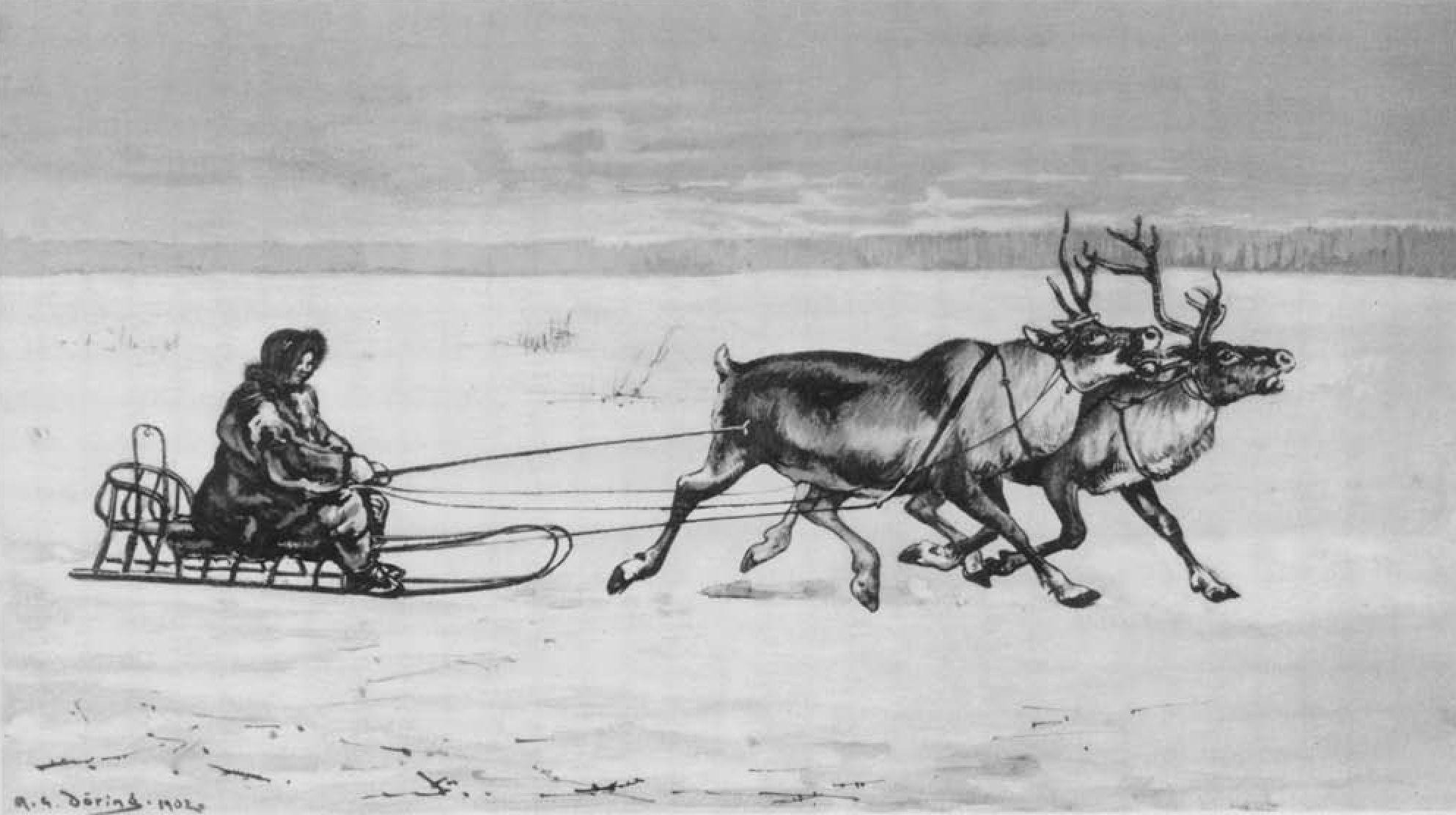
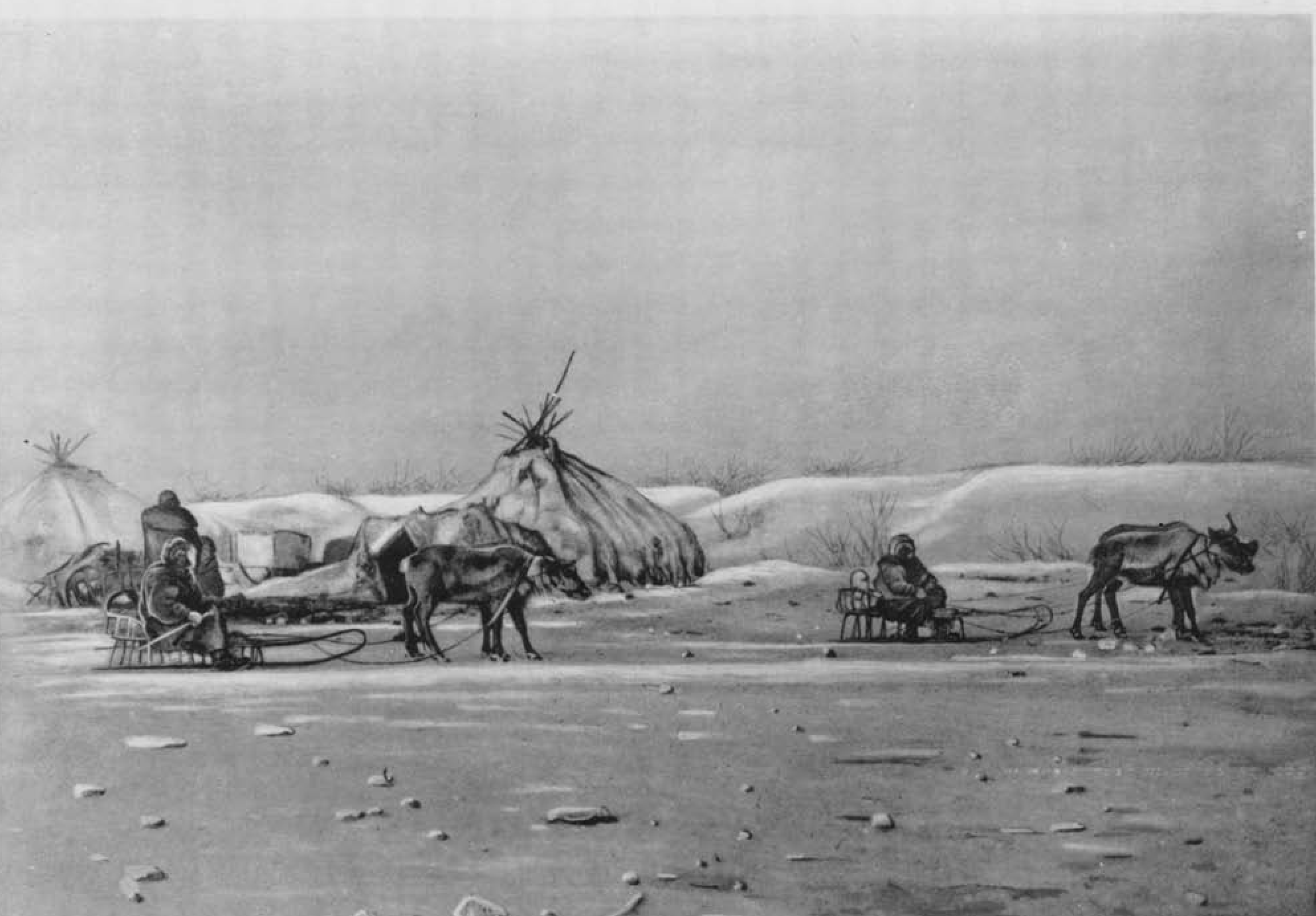
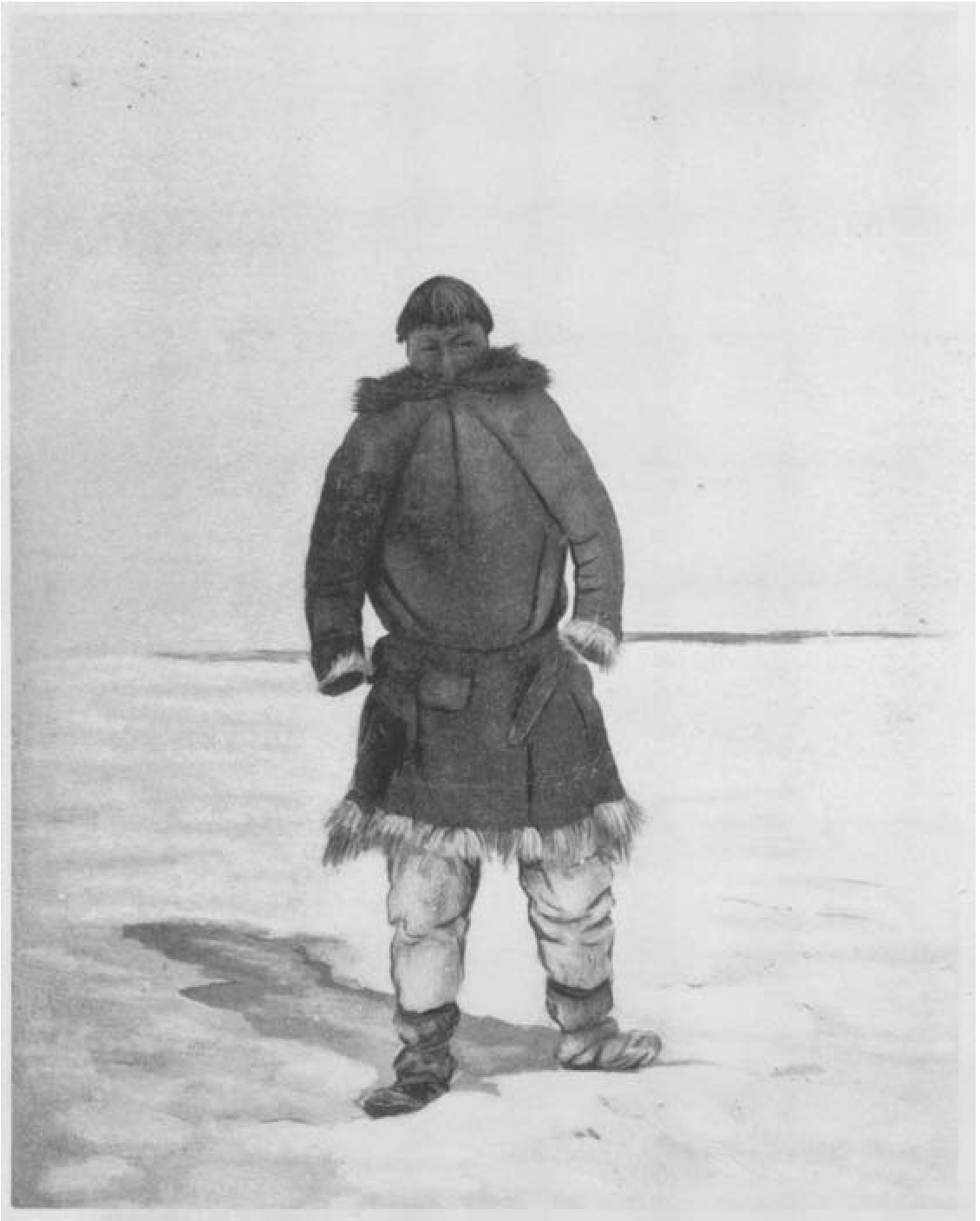
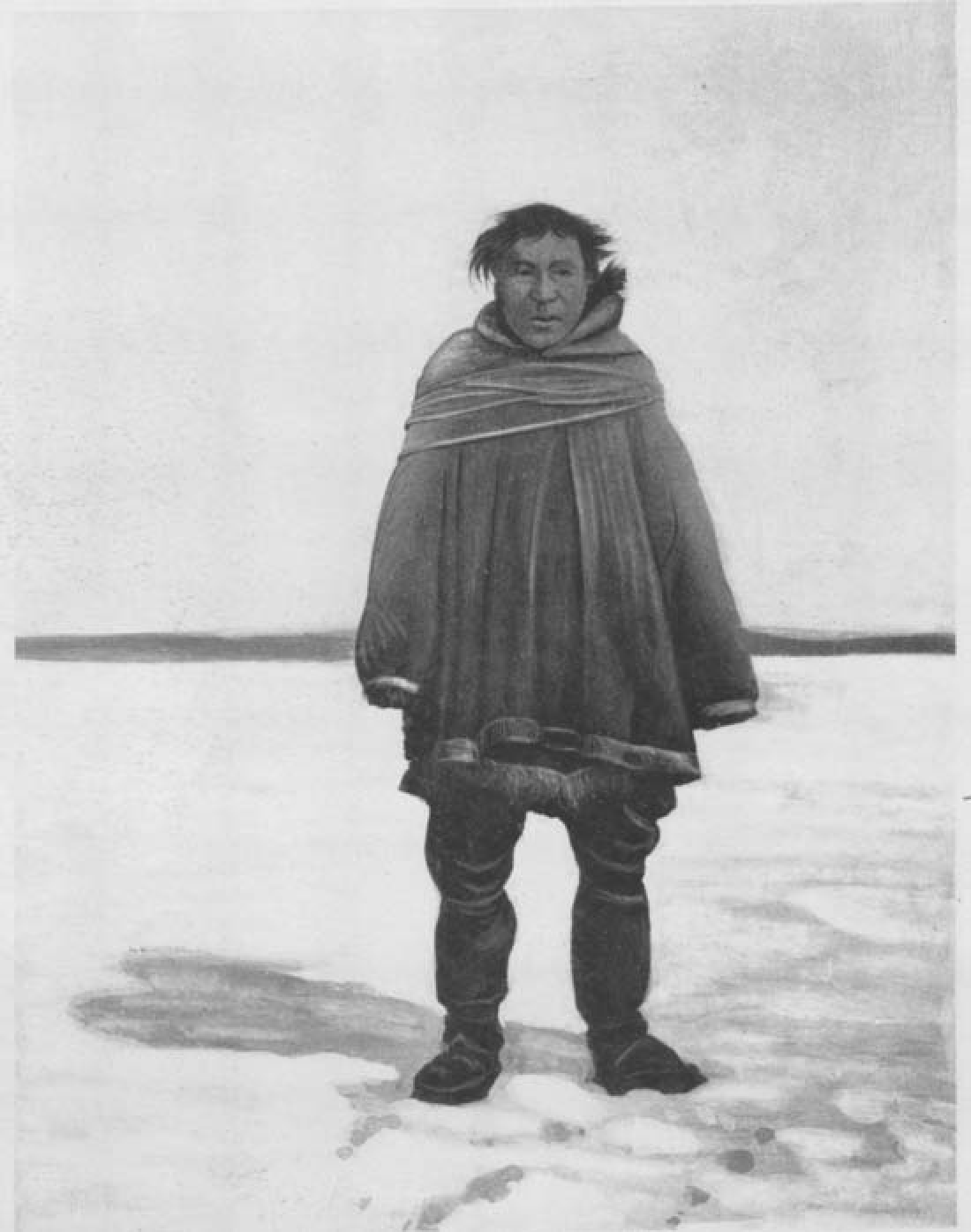
When driving a single sledge and stopping for the night in the open air, the Chukchee traveller cannot turn his reindeer loose, because they would probably go back to the herd, even if at a distance of forty or fifty miles, or because he would not be able to catch them in the morning. The reindeer are hobbled by means of a short noose tied loosely to one of the fore-feet of the animal, so that it keeps continually treading on it with the hind-feet.[95]🗗uncollated Sometimes a medium-sized log, or a clumsy wooden implement similar in shape to a thick two-pronged fork, is tied to the animal’s neck, though it hinders it from grazing properly. The reindeer, secured by the end of the lasso, are usually turned out to pasture for a short time daily; but at night the man who wants to pasture his animals well will sit up himself, holding the end of the rope in his hand, and now and then, while dozing, take a look at his reindeer; otherwise they would become entangled, and could not graze at all.
If well pastured and not overworked, reindeer are swift; and in two days a single driver often makes two hundred miles, provided the snow is thin and hard, as it usually is on the tundra. The lightest camp makes, on an average, twenty-five miles a day; and the large camp, from ten to fifteen miles, though often, especially early in the fall, not more than from three to five miles. When tired, the reindeer, especially the Chukchee reindeer, must be given immediate rest. If compelled to make further effort, it will become quite exhausted, and oftentimes drop dead on the spot. Therefore wealthy men are always on the look-out to acquire additional harness-reindeer, either for pack-sledges or for fast driving, that they may be able to relieve frequently those in use. The Chukchee saying is, however, “The poor man’s reindeer are more enduring,” compelled as they are to constant exercise. In the reindeer-races, the fresh, well-rested reindeer always win; and, to quote another saying, “All stakes are taken by the largest breeders.”
ECONOMICAL VALUE OF REINDEER-BREEDING. — The possession of reindeer-herds makes the material life of the nomadic Chukchee more stable, especially when compared with the precarious subsistence of most of the fishing and seal-hunting tribes in his neighborhood, not excepting even the Russians and the Russianized natives. In the Kolyma district, where the white salmon does not come from the Arctic Sea in large numbers, and where wild reindeer are thinly scattered over a large wilderness, the Reindeer Chukchee, though in every other respect inferior to the fisher-folk of the river, play the most prominent part in the economic life of the country. The river people depend on them for skins and fur clothing; and every spring, when the fish-supply is exhausted and the usual famine is at hand, the river inhabitants, one by one, drive over the tundra with their dog-teams, carrying with them all the household things they can spare, to buy with them such animals as their half-wild nomadic friends will sell. Even the officials of the towns of Sredne-Kolymsk and Nishne-Kolymsk find themselves obliged to visit the wealthy camps, and urgently beg the reindeer-breeders to come nearer to the river with animals for slaughter, as otherwise the people of the town and the cossacks will be starved. The trade of the country at present is carried on chiefly with the produce of reindeer-breeding, such as fawn-skins, curried leather, etc. The costly peltries, before coming to the market, also pass through the hands of the wealthy reindeer-breeders, who buy them with slaughter-animals from the Tungus, Lamut,[96]🗗uncollated and Yukaghir. At the fairs the numerous Russian dogs, as well as their masters, subsist solely on reindeer. At the Anui fair, for instance, there are killed in three days several hundred animals, besides which there are large supplies of meat, blood, and intestines, which have been stored in skin bags from summer time. The number of reindeer killed by the breeders for the benefit of their neighbors must be counted by thousands. Every small trader, when travelling with two or three dog-teams among the camps for barter, will want three reindeer daily for his three teams. I myself, when travelling with dogs among the Reindeer Chukchee, sometimes had to buy in one month, for dog-food, from fifty to sixty reindeer. Reindeer for slaughter are very cheap throughout the whole country. The highest famine price in Sredne-Kolymsk is eight rubles (four dollars) for a large buck. The usual barter price at fair-time for an average reindeer for food is one piece of brick-tea and one bundle of leaf-tobacco. The price of these two items together varies with the locality. It is a ruble and a half at Anadyr and Gishiga; three rubles at Sredne-Kolymsk; and four rubles at the Anui fair. Dog-food is much cheaper, especially in camps, where a young, not fat, buck is often bought with half a piece of brick-tea or a few leaves of tobacco. This peculiar dependency, however, in no way hinders every river inhabitant — from the well-to-do trader down to the poorest, half-starved dweller in the remotest Arctic hamlet — from striving to deceive and cheat in a hundred different ways the half-wild nomad, who cannot even count more than one or two scores.
According to Krasheninnikoff, the same relations have existed from very ancient times farther to the south, between the Maritime and the Reindeer Koryak. On the Anadyr River, which the red and pink salmon from the Pacific Ocean ascend in countless numbers, and which the wild reindeer twice cross in large herds, the Russianized fishermen are much more independent of the reindeer-breeders.
The relations between the Reindeer and the Maritime Chukchee are more complicated, since the breeders, though rich in reindeer, depend on the Maritime hunters for thongs, seal-skins, and especially for blubber and walrus-meat, which, as I said before, are considered the most palatable of the common diet. Moreover, the Maritime hunter is more daring, used to greater danger and to every kind of adventure, than the lonely herdsman living on the dull plain, always encumbered with his herd. However, a herdsman is considered to be much more amply equipped for life; and every year young men and whole families go from various Maritime villages to the Reindeer camps, often far inland. They settle as “dwelling-mates,” marry into families of the Reindeer people, and gradually acquire a competency of their own. The Eskimo of the Pacific shore, some forty years ago, were, on the contrary, in a position inferior to that of the Reindeer people, notwithstanding their trading ability and their constant journeyings between the shores of Bering Strait. Even[97]🗗uncollated their name, Aiˊwan, was used among reindeer-breeders as an expression of contempt. With the coming of American whalers, however, Eskimo traders came into possession of so many things necessary or tempting to the Reindeer people, that they could no longer be despised. With their increased trading capacity, their demand for Chukchee reindeer is much greater than ever. Every fall the squadron of Indian Point skin boats and whale-boats returns from St. Lawrence Bay or from Holy Cross Bay, where the Reindeer people are numerous, deeply laden with skins and meat, part of which is bartered off to the Eskimo of St. Lawrence Island for whale-skin and blubber.