IIITrade
ANCIENT TRADE. — Even before the arrival of the Russians, a lively traffic was carried on between the Reindeer Chukchee camps and the Maritime villages (both Chukchee and Eskimo), and also between Asia and America across Bering Strait. The Reindeer people were in need of blubber, thongs, and seal-skins, and would offer in exchange reindeer-skins and ready-made garments, just as is done at the present day. On the American side, reindeer-skins brought a much better price than in Asia: therefore Chukchee and Asiatic Eskimo parties crossed over every year on trading-expeditions, occasionally, however, indulging in piracy.
In the tale of “Elendi and his Sons,” the hero, coming to an American Eskimo, requests “a score of ground-seal skins, a score each of bleached and black-dyed coils of thong, the same of rough-seal skins; whatever you have, one score of each.” The host asks for an equivalent, but Elendi has nothing: so a quarrel arises, and they fight. Elendi vanquishes the Eskimo, commands the people of the village to deliver up to him everything he had asked for, and returns home carrying his subdued enemy away as a slave.¹
The chief part in such expeditions, however, belonged to the Nɵˊɵkalɪt Eskimo of East Cape, although the Chukchee often accompanied them. It is told that as late as three generations ago large parties would start from East Cape for America. The Nɵˊɵkalɪt went in their large boats, sometimes with thirty paddles in each; the Chukchee from the neighboring Arctic villages went in smaller boats. These fleets crossed to America, carrying on trade or piracy, as circumstances dictated. Similar expeditions of Eskimo and Chukchee, though on a smaller scale, went over from Indian Point to St. Lawrence Island.
Trade, even in Asia, was carried on with considerable mutual distrust. I was told that in very ancient times there was a kind of fair in Nɵˊɵkan or, in Uweˊlen, which was held outside of the village, on the flat seashore, for fear of hostilities (the same custom was afterwards universally adopted in the Russian fairs, and it is persisted in at the present time in Anadyr). The people came to trade fully armed, and offered their wares to each other on their spear-points; or else they would hold a bundle of skins with one hand, and with the other a bared knife, in readiness to raise a fight upon the slightest provocation.
A mute trade took place in Asia as well as in America. In this manner a party of adventurers, who in 1646 sailed from the mouth of the Kolyma westward[54]🗗uncollated along the Arctic coast, carried on trade with the Maritime Chukchee. They would leave their wares on the shore and go away. The Chukchee, would come afterwards, take the wares, and leave their equivalent in peltries, ivory, and ivory carvings.¹
Chukchee tradition relates the following regarding trade with America: —
“On the other side of the sea, in a large forest, live ‘the invisible ones.’ When they come to trade, one can see only the fox and beaver skins which they carry in their hands, and it seems as if the peltries move of themselves. They come to meet our traders on the border of the forest, and shout, ‘Let us trade!’ The traders take a bundle of tobacco and fling it far away. ‘Tobacco, tobacco!’ rings through the forest, but nobody is seen. After a while a bag filled with fox or beaver skins is flung from the forest. For one bundle of tobacco they will give a bagful of white-fox skins.”
Some trade with the Koryak was also probably carried on before the advent of the Russians. I heard that in the south of the Parapolsky Dol, on the river Anapka, an ancient fair was held at which several camps of Reindeer Koryak and Chukchee, of Maritime Chukchee, and even of Kamchadal, used to gather. Perhaps a few articles of Japanese manufacture may have come to the north in this way. At least, the question of the origin and manufacture of Chukchee iron armor suggests a connection with the Japanese which does not exist at present.²
This armor, made of small pieces of iron with fastenings of narrow leather strips, was very common among the Reindeer Chukchee until recently. Even now, many individuals preserve their armor out of reverence for its antiquity. Besides armor, helmets and greaves were used, all of which are in some degree similar to those of Japanese production. The Chukchee, however, are not sufficiently skilled in the blacksmith’s art to forge such armor. The only place where it could have been made is in the Koryak village of Poiˊtɪn (Russian Paren, Парень), the inhabitants of which have for a long time occupied themselves with farriery; and the tradition of the southwestern Chukchee points in this direction. The question arises, whether the manufacture of this armor was really developed only after the arrival of the Russians, especially as the wars have decreased since the last half of the eighteenth century.
Not less remarkable are the armor and helmet of Japanese make which I acquired from a Reindeer Chukchee of the North Anadyr tundra. They are old and rusty, and it was asserted that they had been in the family of their owner for several generations. It is certain that in recent times no Japanese traders have visited Anadyr Bay. The Japanese probably had some intercourse with the southern Kamchadal. Steller and Krasheninnikoff mention that the Kamchadal name of the Japanese (Sühsemen according to the former,[55]🗗uncollated Shishaman according to the latter) was derived from the Kamchadal word sühse or shish (“needle”), because of the iron needles obtained from them.¹
The Cossack S. Yepischeff, sent to the mouth of the Okhota River, on the Sea of Okhotsk, in the year 1656, reports that he met “numerous natives with arms and ammunition, with bows and spears, with breastplates and helmets of bone and iron.²
In the report of Midshipman Matiushkin, the Omoki³ of the Kolyma country are supposed to have been acquainted with the use of iron before the arrival of the Russians.⁴ The Chukchee name for the star Aldebaran is Cêʟ̣oˊ-maˊᵋqɪm (“copper arrow”), čêˊʟ̣očêl signifying “something red, copper.” The same word for “copper,” with proper phonetic change, is repeated in several Koryak dialects; likewise it is used for the name of Aldebaran. It seems to indicate that both tribes knew copper-tipped arrows in very remote times. It is pretty sure that a name like that applied to the star could not have been created in the course of the last two centuries, since the arrival of the Russians, and spread from tribe to tribe over a space of two thousand miles.
TRADE WITH RUSSIANS. — The wares of civilization added to this primitive trade an importance quite unknown to it before. The natives still preserve reminiscences of the strong impression which the iron tools, tobacco and brandy, made upon the minds of their forefathers. The Yukaghir on the Lower Kolyma tell of a native who was challenged by a new-comer to a tree-cutting match, and then received an iron axe as reward for his dexterity. The Yukaghir on the Upper Kolyma report the ecstatic exclamation of one of their old men of that period concerning brandy: “Have no evil thoughts, boys! In my life I have tasted no water so delicious as this.”⁵ The Chukchee describe how their warriors coveted the iron arrows, spears, and the glistening coats of mail of the invaders, and how much the women valued the beads, and how they would sometimes pay a good price for a single pair made into ear-rings.
Even the terms of the language applied to trade and its operations changed, and became more detailed. In olden times the Chukchee applied to the trade simply the verb ᴇlpuˊrɪrkɪn (“to exchange”), with its derivatives. The same word was applied also to the vendetta, with the meaning “to exchange revenge.” The modern language has a special word, viliˊurkɪn (“to trade”), with many derivatives, such as viˊlvil (“goods”), vêlɪˊtko-qlaˊul (“merchant”), etc. This word, in Koryak, with the proper phonetic change, is viliˊvikɪn, and signifies “to make peace with.” The difference between the old and the new term is very striking.
The first century of intercourse between the Russians and the Chukchee[56]🗗uncollated was spent, however, in war, and very little is known about the trade relations of that period. I heard in the Anadyr that the bartering of iron arms to the Chukchee was strictly forbidden, but that they bought kettles and cut iron into knives and arrow-points. Even now old kettles are utilized in this manner. Firelocks taken in battle were hammered with stones into rough spears.¹ At the present time the Chukchee make knives and adzes out of American files by hammering them into the desired shape.
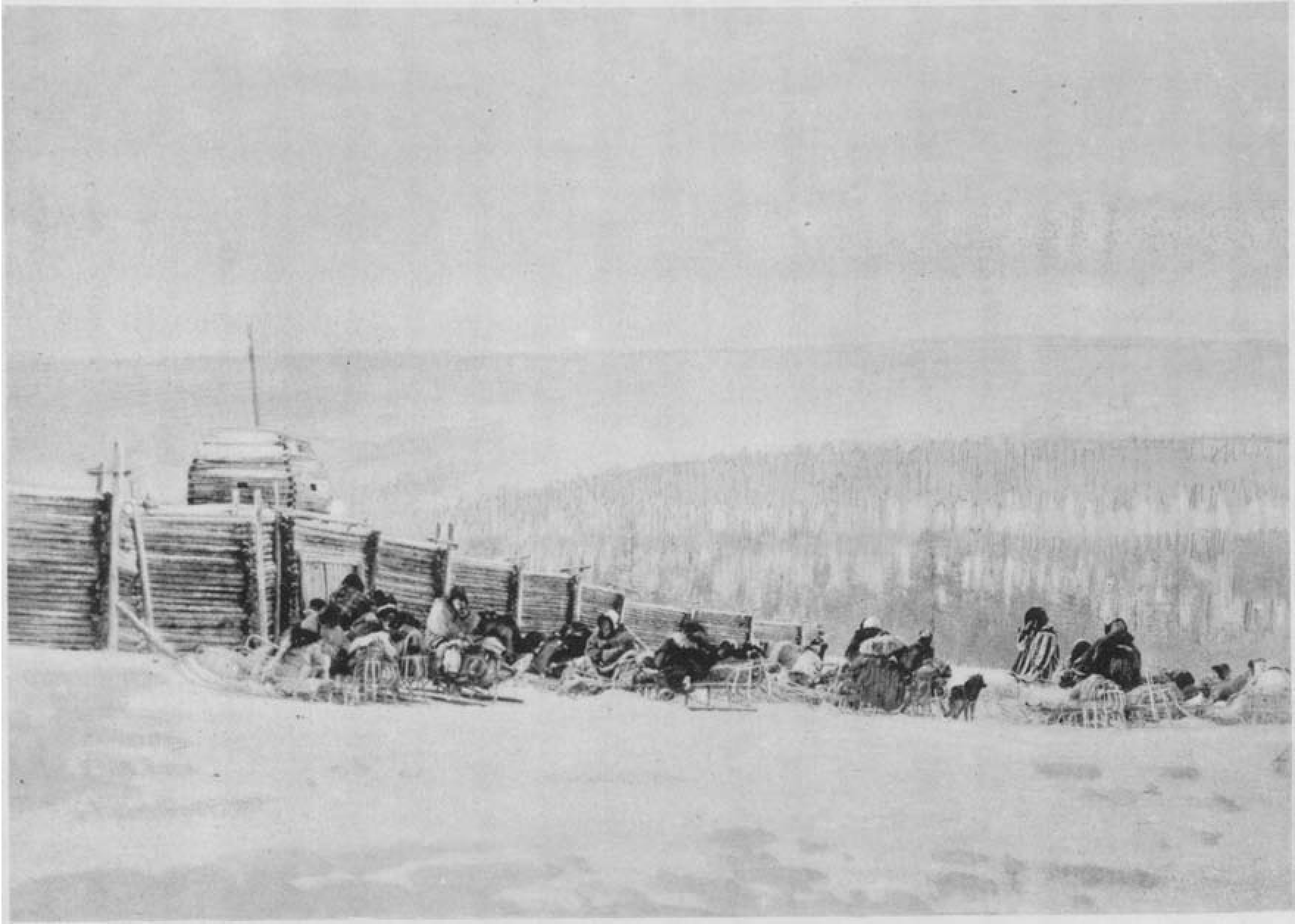
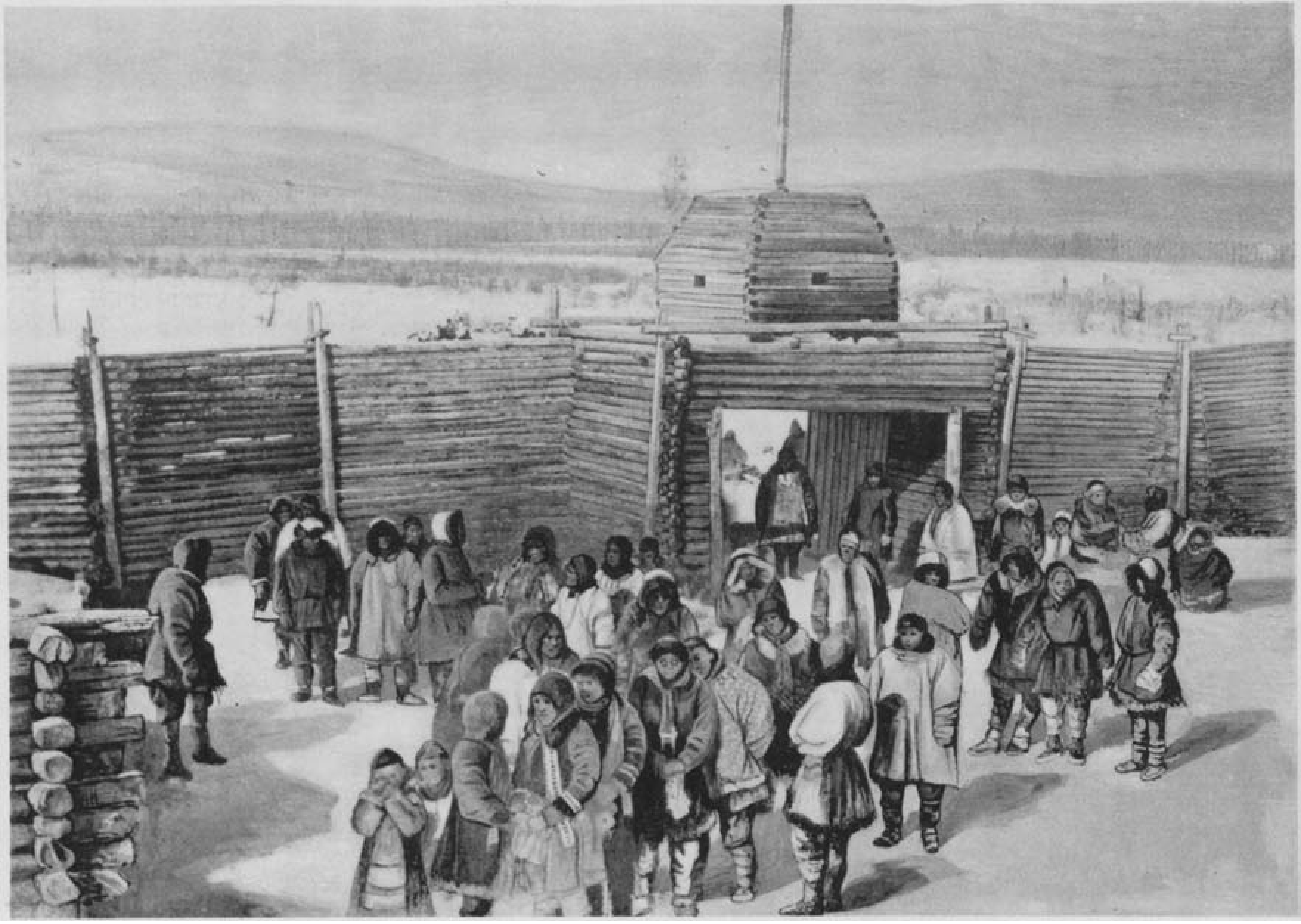
ANUI FAIR. — In 1788, forty-one years after the defeat of Pavlutsky, and twenty-four years after the recall of the garrison from the fort of Anadyrsk, Banner, the chief officer of the town of Sashiversk, on the Indighirka River, who also held command over the Kolyma country, succeeded in establishing anew peaceful relations with the western Reindeer Chukchee. As a result, a regular trade was started the following year. A few Chukchee were induced, by means of gifts and promises, to subject themselves to Russian authority and to pay tribute. The Chukchee were more anxious for trade than the Russians. From the Anadyr came complaints that the people of the district were forgotten by the Russians and did not get any wares. A tradition of the Anui Chukchee relates that three Chukchee warriors took captive the deputy of the Czarina,² and consented to release him only upon his promise to establish an annual fair. After this, to appease his anger, they gave him rich presents of black and blue fox-skins. The Chukchee fair was held at irregular intervals, sometimes on the Dry Anui, near Mount Obrom, and at a place called Ostrovnoye (“Insular”), sometimes on the Large Anui, near the mouth of its affluent, the Angarka. Finally Ostrovnoye prevailed, because the Chukchee were more numerous on the Dry Anui; moreover, travelling on the Large Anui was difficult for dogs and reindeer because of the heavy snowfalls; while the Dry Anui, which is contiguous to the tundra, is more open to the winds. The Russians built at Ostrovnoye, a wooden fort called Fort Anuisk. The fair grew rapidly in importance, and in the second decade of the last century its traffic amounted to two hundred thousand rubles³ yearly, which is a considerable sum in view of the scarcity of money in that period. Some of the best peltries (such as beaver, marten, and lynx), muskrat and marten garments, also a large portion of every kind of fox and polar-bear skins and of walrus-tusks, came from the American shore. For instance, in 1837, according to data contained in the official records found among the archives of Kolyma, there were sold at the fair 100 beavers, 395 martens, 30 lynxes, 31 marten garments, 13 musk-rat garments, etc., all from America, since these animals are not found in Asia. To this must be added about one-half of the 580 red foxes, 80 gray foxes, 13 black foxes, 268 white foxes, 8 blue foxes, and 1563 walrus-tusks sold that year at the fair. These figures,[57]🗗uncollated moreover, must be at least doubled to reach the real trade value, because the merchants of Kolyma always greatly underestimate data for official records. The products of reindeer-breeding were then of very slight importance, while at present they amount to about three-fifths of the total Anui purchases. The fair took place in the spring, and lasted three days; it was held in the open, before the gates of the Russian fort, sometimes even farther away on the ice of the river. The Chukchee came fully armed with spears, bows and arrows, and large knives tied to their belts. Altercations and brawls, and even bloodshed, were not uncommon because of disagreements about prices. Therefore in 1812 Gen. Treskin, the governor of Irkutsk, who also ruled the Yakutsk province (i. e., northeastern Siberia as far as Chaun Bay and the Anadyr River), ordered that trade in tobacco, the principal commodity, which was bartered by the Russians for beavers, foxes, martens, and walrus-tusks brought by the natives, should be conducted on terms fixed beforehand by the chief officer, with the advice of prominent merchants. The prices were fixed annually by the common consent of the merchants, and iron and copper kettles were often included in the list of commodities with fixed price.
At the usual rate, one pud (thirty-six pounds Avoirdupois) of tobacco or of iron kettles was equal to ten red foxes, and one pud of copper kettles was equal to twenty foxes. In later years a wolverine-skin or a large kettle was given in addition to the large tobacco-bags of three puds each, which were valued at sixty fox-skins. The value of other peltries was expressed in red-fox units. For instance, four white foxes were equal to one red fox, one gray fox or one beaver was equal to two red foxes, one black fox was equal to twenty red foxes, etc. The details of these rules were oppressive to the small traders, who were punished for the slightest infraction. In several instances even the richer merchants forfeited their right to trade with the Chukchee by accepting a seal-skin as the equivalent of a single missing paw in a lot of many hundred red-fox skins. The fox-skin should have had all four paws to be worth a price in tobacco. In the sixties of the last century, with the decline of the fair, the rules began to go out of use, and in 1869 they were abolished by Baron von Maydell.
In its most flourishing time, the Anui fair drew not only numerous Reindeer-camps and Kavraˊlɪt traders,¹ but also enterprising men from the maritime villages as far as East Cape and Indian Point, who came with dog-sledges the whole long distance, often running the risk of losing their animals from exhaustion on the return trip. These were called Aˊᵋttɪ-kavraˊlɪt, i. e., “Dog-kavraˊlɪt.” Their route was along the Arctic coast as far as Yaˊqan or even Cape Erri, then around Chaun Bay along the line of the Reindeer-camps, and across the watershed to the Upper Anui, whence an unbroken line of[58]🗗uncollated Anui camps led them to the fair. As late as 1879 Nordenskiöld saw several dog-sledges passing by on their return from the fair, while during the whole of my stay in the Kolyma district (1890-98), hardly a single dog-sledge came to the fair from the maritime villages.
At the present time about six or seven hundred people gather together for the Anui fair (Plate II, Figs. 1, 2). One-fourth of these are Russians, Russianized natives, and Yakut, from settlements on the Anadyr, Kolyma, Alaseya, and Indighirka; one-fourth are Kolyma Lamut; and the rest, Reindeer Chukchee and Kavraˊlɪt. Commerce has fallen off greatly, because American peltries have nearly ceased to come, and part of the peltries from the Asiatic shore are bought by the whalers. Of the remainder, a large portion goes to the Anadyr. Of late the total of the Anui trade has been, according to official data, from twenty to twenty-five thousand rubles annually. Of this amount, two thirds is contributed by the Reindeer Chukchee; the remaining third belongs to the Lamut, Russianized Yukaghir, etc.
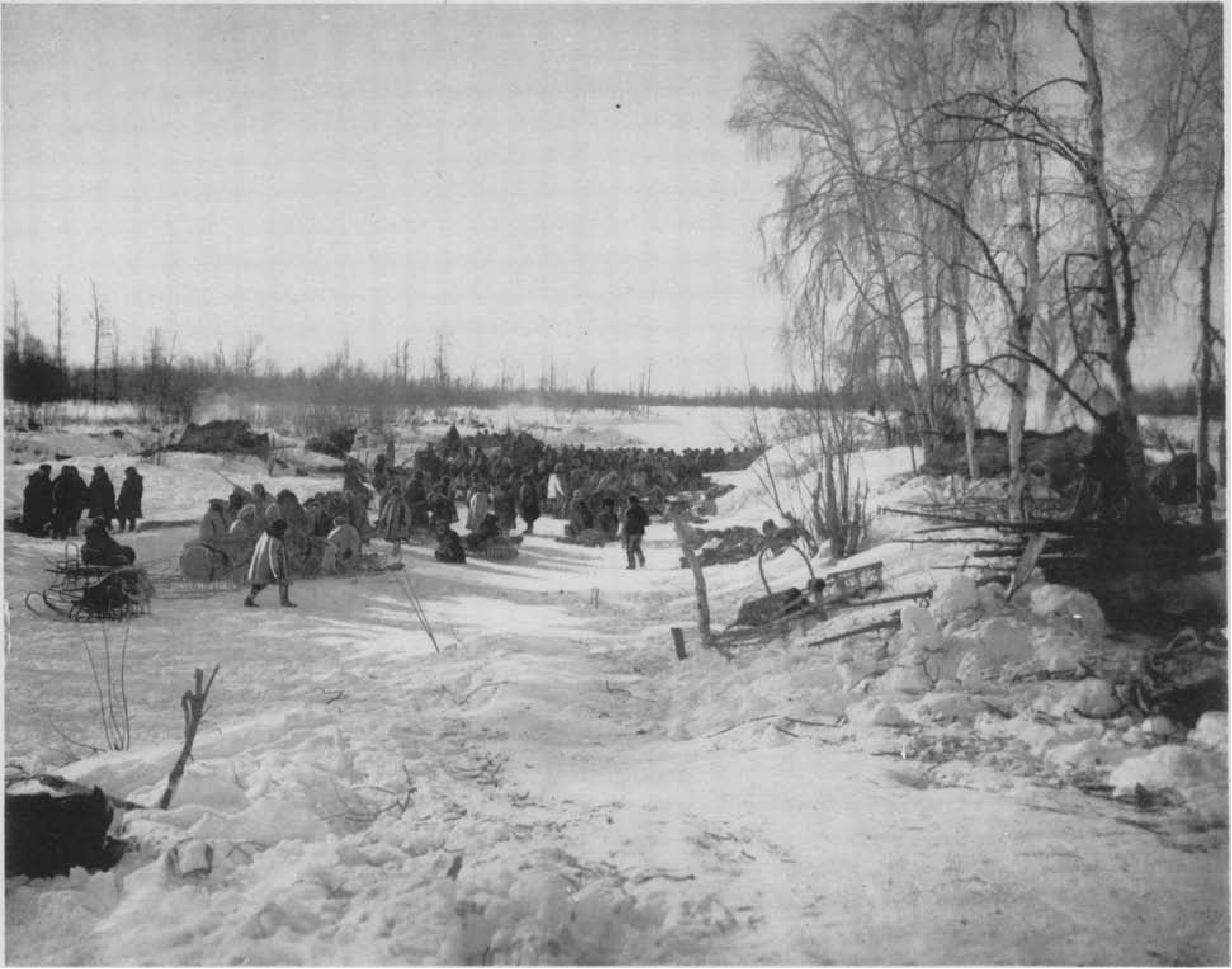
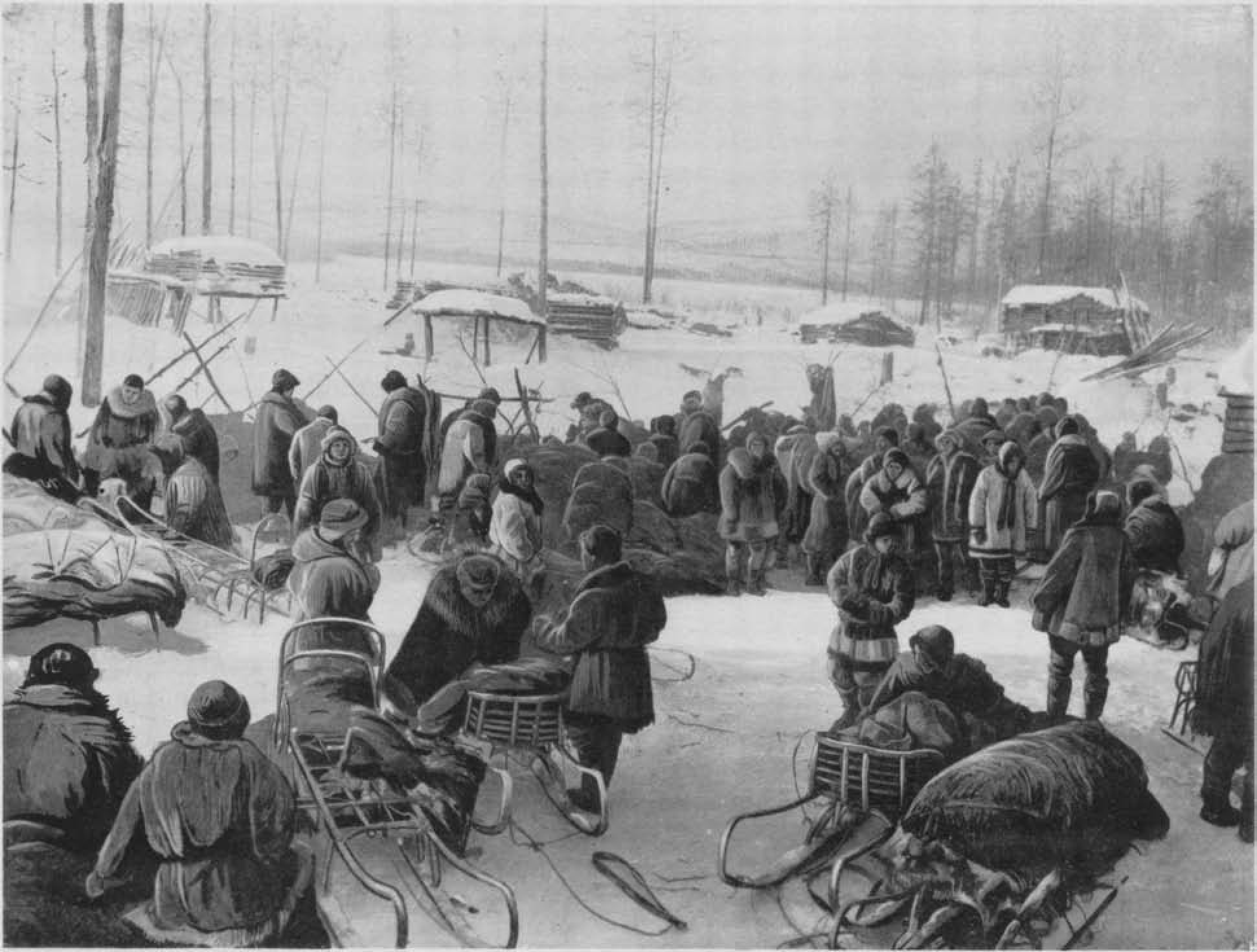
OTHER FAIRS. — At about the time of the founding of the Anui fair, the Anadyr and the Telqäˊp Chukchee began to trade at Gishiginsk and Kamenskoye, on the Sea of Okhotsk. In the beginning of the century, simultaneously with a spring fair for the Reindeer Koryak, was established another one for the southwestern Chukchee on the Parapolsky Dol, not far from the upper part of the river Opuka. In the village of Markova, on the Middle Anadyr, a fair was held, for the Anadyr and Oˊnmɪlɪn Chukchee. During the last fifteen years, from the time of the institution of separate district administration in Anadyr, three more fairs were opened, — one, the Tumanskaya fair, on the west (Plate III, Fig. 1), near the mountain Iˊrg̣u-ñei (“pointed mountain”), chiefly for the Telqäˊp Chukchee; another in the small village of Vaˊkarena, on the Middle Anadyr, for the Oˊnmɪlɪn; and a third on the Yeropol River, for the Chukchee of the Upper Anadyr and for the Lamut (Plate III, Fig. 2). The extent of trade in the Anadyr region, however, is by no means sufficient to support all these fairs, the annual receipts being about twenty thousand rubles. In 1901, on account of heavy snows, only two Telqäˊp camps went to the Tumanskaya fair, and but three Oˊnmɪlɪn camps to the Vaˊkarena. The annual trade at the Chukchee fair on the Opuka River amounts to not more than a few thousand rubles.
ROUTES. — In former times a few Russian traders went with dog-sledges along the seashore from the mouth of the Kolyma to the Arctic villages. This route was shorter, but more difficult, than the inland one, because between the mouth of the Kolyma and Cape Erri there are no settlements whatsoever. The last of these traders was the Cossack, Ivan Kudrin, who, in 1882, brought W. H. Gilder to the Kolyma, and in a way wanted to take him captive, as Mr. Gilder relates in his book.¹ Mr. Gilder names him Vanker, a corruption of his two[59]🗗uncollated names. The trouble evidently arose from their being unable to understand a single word of each other’s language; though Kudrin, now deceased, had the reputation of being out of his mind. His brother, Theodore Kudrin, who is still living, is even one of the few Russian shamans of the Lower Kolyma.
The people of the Pacific villages continue to go every year with dog-teams to the Russian settlements on the Anadyr, because the route to that point is much shorter than to the Anui. The best place for meeting is not at the fairs mentioned above, but in the neighborhood of the mouth of the Anadyr, whither the journey from the nearest Chukchee village, across Holy Cross Bay, can be made, in the spring of the year, in five or six days. For half a century the meeting-place has been on the tundra, twenty miles northward from the mouth of the Anadyr, near the Hare Mountains; but for the last ten years two small fairs have been arranged instead at Mariinsky Post, — one in the spring, and the other in the summer, about the time of the arrival of the mail-steamer. In the spring about fifty dog-sledges come from the Chukchee and Eskimo villages as far as Indian Point, and about twice as many reindeer-sledges from the Oˊnmɪlɪn and Telqäˊp camps. In summer ten or fifteen skin boats from the same maritime villages, a few boats of the Telqäˊp Reindeer Chukchee, and even some of the Kerek, visit the port.
TOBACCO AND BRICK-TEA. — Of all Russian wares, tobacco held the first place. The craving of the natives for it is aptly expressed in a tale well known to all tribes of northeastern Siberia.
In the time of a tobacco famine, when all the people were nearly mad because they had nothing to smoke, one well-to-do reindeer-breeder possessed a large pouch quite filled with tobacco, but would not share it with any one. At last his own brother asked for a pipeful, and was refused. The next day he overtook the owner of the tobacco on the tundra, stabbed him from behind with his spear, ripped open his breast, and took out his lungs, which he found covered with soot. He scraped away a part of this, and used it to fill his pipe. The pouch he left untouched. When caught by the Cossacks and brought before the Russian magistrate, he showed him the big pouch and the sooty lungs, and was acquitted of the charge.
Tobacco has found its way from Siberia far eastward into arctic America. The Chukchee tradition in regard to the ancient trade, previously referred to, continues as follows: —
“Farther on live men who dissever themselves at will. They stay among the trees on the shores of the lakes, cleft in halves; but, at the slightest rustling, the parts come together, and they dive into the water. These, too, have a longing for tobacco, and pay for it with large fish and otters.
“Still deeper in the woods live dwarfs not larger than the fore-arm of a man. Three of them can hardly overcome one goose. They dwell in trees, and buy tobacco with the skins of the lynx and of the muskrat.
[60]🗗uncollated“Then, again, there are shaggy people with the bodies of polar bears and the faces of men. These pay best of all, since for a small piece of the black deposit from a pipe-stem, not larger than a finger-nail, they will give a marten.
“And all men of that land covet tobacco throughout their lives.”
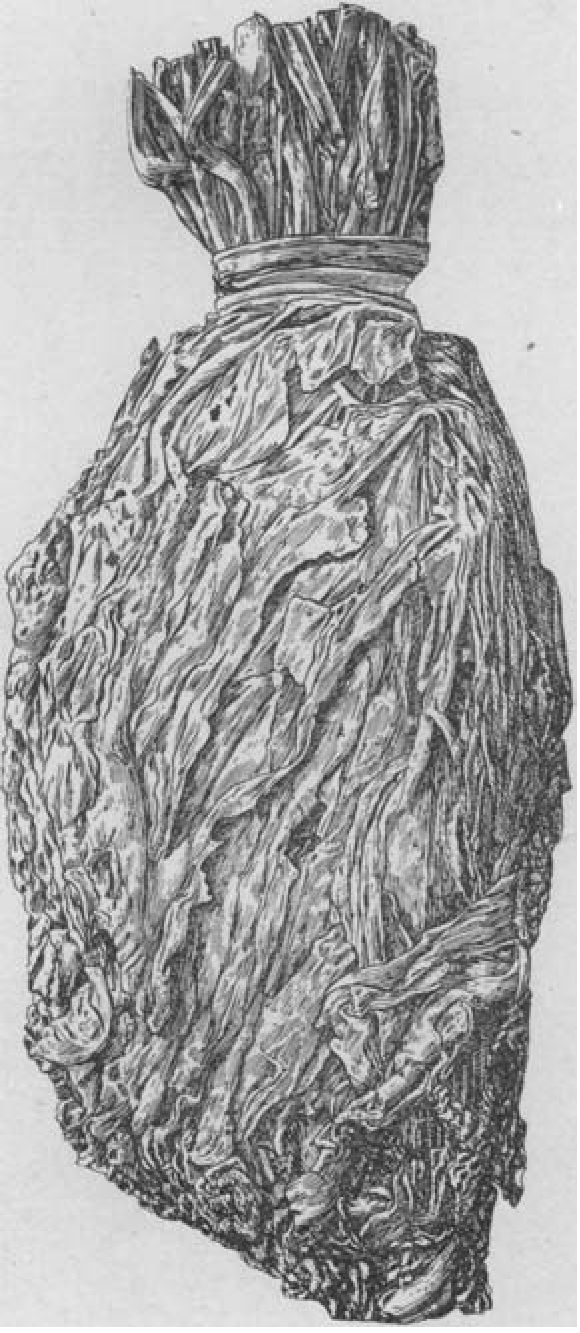
The kind of tobacco traded with the Chukchee was the strong cheap tobacco of southern Russia, called Cherkassky (Черкасскій, from the old Muscovite name for the southern Russians, Черкасы). Some English authors (for instance, Nelson¹) misspell it “Circassian” (Cherkessky, Черкесскій). It is sold either in bundles of about a pound and a quarter each, Avoirdupois (Fig. 2) or in large and small bags. A small bag has about twenty-five bundles; a large one, three times as many. A bag of the latter size generally forms one side of the usual horse-pack. Since the arrival of the whalers on the Pacific shores, American smoking and chewing tobacco has begun to replace the Russian, because it is sold more cheaply, and is brought in abundance every summer. The natives, even as far as St. Lawrence Island, still prefer the Russian tobacco, however, and are often willing to pay a higher price for a smaller quantity of it.
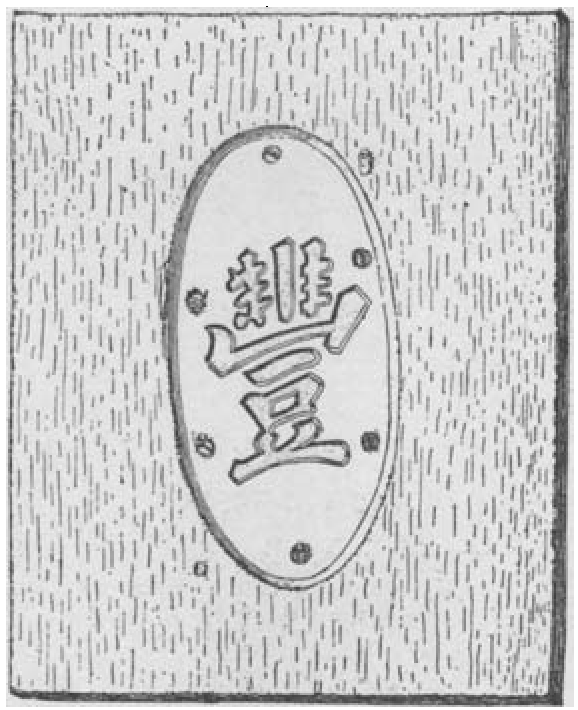
Other Russian wares are sugar, iron and copper kettles, cottons, cheap warm scarfs and shawls, cheap hardware and cutlery of Yakut make (brought from Yakutsk), beads, etc. Within the last fifty years brick-tea (tea compressed into so-called “bricks”), which furnishes the favorite drink of eastern Siberia, has become of more importance than anything else (Fig. 3). It is now used in the remotest inland camps and all along the Arctic and Pacific coasts. Those few people who still have no tea-kettle are derided by their neighbors as “tea-shunners” (ačaiˊkᴇlat).
SPIRITS. — Trade in spirits has at all times been strictly forbidden, but in the Kolyma country it forms one of the important items in the Russian dealings with the Chukchee. The town of Sredne-Kolymsk, which has three saloons, and imports from the south three hundred barrels (eighteen thousand bottles) of unrectified alcohol, is the central point whence the spirits are carried out through the settlements and camps. The traders have numerous ruses to elude official watchfulness when it occasionally becomes[61]🗗uncollated more than nominal. For instance, they put small wooden flasks of alcohol, more or less diluted with water, in among the bundles of tobacco that are placed in large bags. These bags are afterwards sealed and sold to the rich Kavraˊlɪt. The Yakut traders disguise the flasks, by covering them with a kind of whipped cream, which is much used in the north in a hard, frozen state. Petty traders of Nishne-Kolymsk sometimes soak in alcohol fresh rye bread, still hot from the oven, and prepare a kind of bitter bread, afterwards to be sold at retail. Most frequently the traders and the officials simply take large quantities of alcohol to the camps and fairs, labelled “for personal use.”
The Anui brawl of 1895, of which I spoke in the preceding chapter,¹ arose out of the trade in spririts. On the Anadyr side, strong drink is scarce; and whatever is brought there, is actually for the personal use of the traders. The Chukchee have a chance to buy it only from the mail-steamer, which, during the two weeks of her stay in Anadyr Bay, forms a retail store for the sale of every kind of provisions.
On Bering Sea, trade, as already stated, was formerly carried on by parties of Chukchee and Eskimo traders, who travelled in large skin boats along the Arctic and Pacific coasts to East Cape, and thence crossed to America, after stopping at both the Diomede Islands. American natives also went to Asia, though not so frequently, because all the products of civilization came from the Asiatic side, and the prominent part in this trade belonged to its inhabitants.
TRADE WITH WHALERS. — Since the year 1848, and especially after the purchase of Alaska, American whalers resorting to these waters started a trade on both shores of Bering Sea. In the beginning, the articles they sold were chiefly cheap rum, rifles and ammunition. Afterwards were added all kinds of wares needed by the natives, — flour, biscuits, granulated sugar, black molasses, drilling and muslin, hardware and cutlery, beads, etc. They took in return chiefly whalebone, making enormous profits, since the natives had large stores of it for which they had no use except to make lashings and to shoe their sledge-bottoms. It is curious that Russian traders, even at present, care little for whalebone.
The trade in spirits has somewhat decreased in the last few years, because most of the whaling-captains have ceased to consider it a very desirable way of making profit. Of ten ships which called at Indian Point during my stay[62]🗗uncollated there in 1901, only two carried on a regular trade in rum. Besides, the natives are not so eager for liquor as formerly, because their means of buying have rather diminished, and new and varied wants have been acquired, which they are bent upon satisfying above everything else. However, quantities of rum, put into bladders and small gut bags, are carried inland far from Indian Point and East Cape. In the traffic in the Hare Mountains it even formed one of the most important items bartered by the Chukchee to the Russians. At present similar transactions take place at Mariinsky Post every time the Chukchee and Eskimo traders come from the north. Thus the relations of the Russians and the natives toward each other are quite reversed, as often happens in remote parts of Siberia. The Russians pay in tea, tobacco, etc., also in live dogs, which last are considered to be much better than the Chukchee race, and are taken every year from Anadyr to northern native villages.
The guns sold now by the whalers are chiefly Winchester rifles of 44, 45.60, or 45.70 calibre, for the most part second-hand. They also sell cheap shotguns, and reloading-tools for both kinds of guns. At present all the natives on both the Arctic and Pacific shores are armed with these rifles, and use them for every kind of hunting. At Indian Point alone the number of fire-arms in 1901 was over four hundred in a population of four hundred and forty. The Reindeer Chukchee eastward from the Kolyma also have many Winchester rifles; while those of the western tundra and of Omolon still use firelocks, with only a small number of second-hand Berdan rifles sold by the Russian Government.
Wheat flour has become an article of regular consumption on the Pacific shore, especially in times when seals are scarce. Then, according to the assertion of the natives, it is their only means of keeping off famine. In truth, during the spring of 1901, people in the village of Iˊᵋen, on Plover Bay, and also at Indian Point, lived chiefly on flour cakes baked with a little oil. The same spring, at Indian Point alone, about five hundred sacks of flour (forty-four pounds to the sack) were bought from the whalers. On the whole coast, about twenty-five hundred sacks of flour — rather more than less — are sold every summer. Among the Reindeer Chukchee, cakes made of wheat flour form one of the most relished dainties, while rye flour is little cared for, even in the vicinity of the Russian settlements.
Besides these provisions and wares, the natives willingly buy second-hand whaling-boats, small whaling-guns, exploding-harpoons, and also mineral oil and oil-stoves; in 1901 even Primus lamps, ships’ compasses, the use of which is well known to the Eskimo at least, etc., were traded in.
In 1882, Kuvaˊr, the richest trader of Indian Point, tried to buy a schooner for the purpose of carrying on whaling and trading on a larger scale. Unfortunately a Russian warship, the “Kreisser,” had been sent that very year to keep off the American whaling-ships, and to seize such of them as might[63]🗗uncollated be found trespassing in Russian waters or carrying on unlawful trade on the shores. I cannot tell whether the “Kreisser” seized any American ships or not, though several of them have been taken at different periods; but she met the schooner “Henrietta,” just bought by Kuvaˊr, and carried her off as a prize, in spite of all remonstrance. The schooner was afterwards fitted with a steam-engine and used for keeping watch on the Sea of Okhotsk, where she was lost in a storm in 1895. Kuvaˊr applied several times to the authorities for redress, but without avail. The officials in Vladivostok maintained that the schooner was not yet paid for; but I was told at Indian Point that Kuvaˊr gave for it the whalebone of two whales, a large pile of walrus-tusks, three bagfuls of white-fox skins, and three polar-bear skins. During my stay, another occasion to buy a schooner presented itself, and I was asked for advice as to the possibility of a second confiscation, but withheld my opinion.
American wares generally are twice as cheap as those brought from the interior of Siberia. Even those brought from Vladivostok by sea cannot compete with them, because most of them are of American origin, and have come by a more circuitous route. American granulated sugar forms an exception. It is inferior to the well-refined, hard lump-sugar of the Russians. American cutlery is not always so well adapted to the uses of the natives as are the rough strong knives made for this purpose in Yakutsk, Sredne-Kolymsk, Markova, etc. Moreover, the whalers do not trade in brick-tea, because they do not visit any Chinese or southern Siberian ports. Once or twice they brought brick-tea from Japan; but Japanese brick-tea is of much poorer quality than Chinese, and the cakes are smaller in size.
After the native stock of whalebone became exhausted, the whalers began to accept instead walrus ivory and the skins of white foxes and of black and polar bears. Other Asiatic peltries, such as those of red and cross foxes and of wolves, also skins from America, like the beaver and marten, are taken to the Russian fairs because they fetch a much better price in Asia than would be paid by the whalers. At the present time the chief source of income of the natives are fawn-skins, which are much needed by the American natives and by the Alaskan miners for making garments; also skins of full-grown reindeer for sleeping-bags, ready-made garments even of poor quality, and, most of all, various kinds of seal-skin boots, which are used both by the whaling-crews and by the miners. Asiatic and American natives sell these boots by the thousand every summer; but the demand keeps increasing, and in 1901 the price at Indian Point was a sack of flour per pair.
The chief places for trade continue to be East Cape, and especially Indian Point, where the sea is cleared of ice by the strong currents as early as the middle of April. Two or three native traders in both places have acquired year by year a larger amount of native products, until finally they are able to obtain by exchange each summer a sufficient amount of European wares[64]🗗uncollated to last for the trade of the whole year. They have even bought wooden storehouses brought on purpose from San Francisco.
At the present time the whole number of such storehouses on the Pacific shore is fourteen. Indian Point has five, of which three belong to Kuvaˊr, now the richest man on the Chukchee Peninsula. Nɵˊɵkan has three; Uweˊlen, one. Single storehouses are found in several Eskimo and Chukchee villages.
The whalers seldom skirt the Arctic coast westward from Uweˊlen, and even then almost never go beyond Kuluˊči Bay. All the Maritime people who wish to take part in this trading, resort, those from the Arctic villages, to East Cape; those from the Pacific villages, to Indian Point. No positive times are set for these gatherings; but, beginning with the middle of March, the dog-teams and reindeer-caravans begin to appear one after another. They keep coming long after the appearance of the first whaling-ships, because the snow melts away only late in the spring. Travelling with skin boats begins at the end of May, and from July on wholly replaces journeying with sledges. Only skin boats are used, since it is difficult to make a landing with wooden whaling-boats, owing to the heavy surf, and because they are too heavy to be pulled ashore.
Direct trading with the American natives has fallen off, because the whalers act as middle-men. At the present time the American Eskimo have not enough peltries and seal-skins to trade with the Asiatic natives, because all such things go to the local white traders.
People from St. Lawrence and Diomede Islands often come over to the Asiatic shore, for the most part on board the whalers, carrying their skin boats with them for cases of emergency. Trading-parties from Indian Point still go over in boats to St. Lawrence Island to barter reindeer-skins for spare blubber, walrus-hides, and some whalebone, which last now forms an important item in the native trade before it is sold to the whalers. They also gather driftwood on the northern shore of the island, or buy roughly-hewn runners and parts of skin-boat frames from the natives of the island. A similar trade in wood and in roughly-hewn runners, dishes, trays, etc., is carried on across Bering Strait. Enterprising men from Indian Point and East Cape sometimes go over with the whalers to St. Michaels or to Cape Nome, carrying loads of reindeer-skins, which are sold chiefly to the white people.
TRADE IN REINDEER. — Live reindeer have always formed an object of trade between different native tribes. During the last ten years the American Government, to wishing breed reindeer in Alaska and on St. Lawrence Island, has also begun to buy live reindeer from the Asiatic shore. In 1899 there were 9 herds in Alaska, with an aggregate of 2,837 reindeer, of which 1,021 had been bought on the Asiatic shore,¹ 144 imported from Lapland. The[65]🗗uncollated remainder came from the natural increase of the herds. In 1901 there were in these herds 4,164 reindeer, of which 229 more were bought on the Asiatic shore, and 1,100 were fawns that survived from the spring. The total of those bought on the Asiatic shore was 1,300.¹ The American agents paid three times the usual price of reindeer, but nevertheless could not secure enough animals, because reindeer-herds are not sufficiently numerous on the seacoast from Kuluˊči Bay to Indian Point.
It is remarkable that the inland Reindeer Chukchee, especially the Kavraˊlɪt, are very hostile to this traffic, since they are conscious that their trade with American natives is decreasing all the time, and are afraid that the newly-bred American reindeer will diminish it still more. Five years ago, while the American purchasing agents still had the good-will of the Russian Government, I heard a curious tale among the Wolverine River people, who asserted that the chief aim of the Russian cruisers was the pursuit of the ships that carried on the trade in reindeer.²
Apart from this apprehension, trade in live reindeer, if organized in a proper way, can only be profitable to northeastern Asia, because there the reindeer number millions, and as many animals are slaughtered for food in three days at any of the larger fairs as the American Government has purchased in ten years. The Administration in Vladivostok, during my visit there, ceased to countenance the idea of this trade, influenced partly by the last two Russian travellers on the Chukchee Peninsula, Messrs. Gondatti and Bogdanovitch, both of whom do not favor the continuance of trade in Bering Sea, at least in the way it is carried on at the present time.³
INLAND TRADE. — Inland trade among the Chukchee is carried on at present in much the same way as it was before the advent of civilized people. In the Reindeer branch of the Chukchee, a man more active than the others, though oftentimes not over-attentive to his herd of reindeer, of which he has but comparatively few, will want to go to the seashore for barter. There is a special term for this journey, t-ñɪrkeˊurkɪn (“I go to the country about East Cape for trade”). He will begin collecting fawn-skins for trading, and pack-sledge reindeer for the journey, his relatives and neighbors loaning him some of the latter. He will go partly as their agent, and will carry skins to sell for them on commission. These skins to be sold on commission have a special name, viˊlɪnřɪr (“property held for sale”). He will start with a travelling-camp in February or March, and will proceed very slowly, being careful not to over-fatigue his reindeer, by routes leading from the Anui and Omolon to Chaun Bay; thence he will advance from one small watershed to another, following the general direction of the seacoast, but all the time keeping at a considerable[66]🗗uncollated distance from it. With the advance of the season, he will proceed eastward as far as possible, and turn to the shore only when travelling with reindeer becomes impossible. Sometimes he will reach East Cape; more often he will stop in some other village between Kuluˊči Bay and East Cape. To stay west of Kuluˊči is inconvenient, because in the western villages the population is scanty, and the sea-journey to East Cape presents more trouble, and even danger.
He will spend the whole summer on the seashore; he will take part in the seal-hunting, so as to have a share in the spoils without paying for it; and he will journey by boat to East Cape. In exchange for his skins, he will try chiefly to get ground-seal hides and all kinds of thongs, and American products, — alcohol, Winchester rifles, and cartridges. In the middle fall he will start on his return journey as slowly as before, and will finally go back to his own country in the spring. He will return the borrowed reindeer, for the most part without any particular pay, and will distribute some of the wares he has bought among those whose agent he has been, retaining a considerable share of profit for himself out of every transaction of this kind. Such a journey will last a whole year, and perhaps even longer; so that a caravan leaving two months before fair-time at Anui will be back just in time for the next fair. Travelling between Indian Point and the Anadyr is much shorter, and is usually accomplished in one winter, so that a caravan starting in the fall will come back about the middle of the next spring.
When a man finds zest and profit in such journeys, he makes them his vocation, and becomes a Kavraˊlɪn. As mentioned before, the greater part of the Kavraˊlɪt are maritime people who first turned to reindeer-breeding and then to trade, and thus are experienced in both pursuits and in the customs of both parts of the tribe. The Kavraˊlɪt are continually en route. In former years they were anxious to visit the Russian fairs. They went down to the seashore to meet the boats coming from the Diomede Islands and America, and often associated with them and made a trip across the sea to secure an additional supply of valuable peltries. Sometimes the father of a family would start westward with a reindeer-caravan. Meanwhile one of his sons would wait till summer and cross Bering Strait in his boat. The next spring father and son would meet, and arrange for the distribution of their wares for new journeys. Even now a few Kavraˊlɪt traders have not restricted the range of their travels, and continue to visit both the Anui fair and the Diomede Islands. Others, however, trade chiefly in fawn-skins, and do not go as far as the Ostrovnoye market-place or the Kolyma settlements.
At the present time about ten or fifteen caravans, each consisting of six or eight tents, resort every spring to the Wolverine River, on the eastern confines of the Anui country, coming from the east. Some of these come from the Chaun tundra, others from the neighborhood of Cape Erri, Yaˊqan,[67]🗗uncollated and Rɪrkaiˊpɪyan; still others from beyond Kuluˊči Bay. Lively barter goes on for two weeks; then the traders start on their return journey.
In former times there were richer men among the Kavraˊlɪt than there are at present. About forty years ago one of them bought horses and made summer trips between the Reindeer camps, carrying his wares on horseback. Another one, at his own request, was sent to Yakutsk by the officials of the Kolyma district. He visited the Russian governor at Yakutsk, and received through him a gold medal and a parade coat adorned with silver lace. At present none of them equals in wealth Kuvaˊr and the other Eskimo traders of the Pacific shore.
Several other regular trips, but of shorter range, are made for the purpose of trading. In the Anui country Russian traders travel among the camps, in winter with dog-teams and in summer with horses, collecting chiefly small fawn-skins and white and red foxes. The Russian traders of the Anadyr do not make such trips, and they do not go even as far as Holy Cross Bay; indeed, neither the Russian traders nor the Cossack invaders cared to go beyond the forest border, at least when travelling by land. On the other hand, petty traders go in the winter-time with dog-sledges from every native village of the Chukchee-Peninsula to the Reindeer camps, collecting large fawn-skins and ready-made garments. Later in the summer whole squadrons of boats start from Indian Point on their journey to Holy Cross and St. Lawrence Bays, where the Reindeer people perform the ceremonial slaughtering of the season. They return heavily laden with skins and meat. Some of the boats go to the Anadyr and proceed upstream to take part in the large reindeer-hunts. Twenty years ago they proceeded along the seacoast to the Telqäˊp summer camps, and as far as the Kerek villages. Here, near Capes Barykoff and Navarin, was the southern limit of the Chukchee-Eskimo trade on the Pacific coast.
UNITS AND PRICES. — The Chukchee trade is carried on exclusively in barter. Money is quite unknown. The Reindeer people have not even a word for it, and call it keliˊtul (“a piece of variegated”), which name may be applied also to any piece of paper with writing on it. The Maritime Chukchee call it manêˊman (from English “money” of the whalers).
The unit of value in Russian trade remains a bundle of tobacco “not tampered with,” because the traders often abstract a few leaves and replace the bindings. In recent years brick-tea has also come into use as a standard of value, and is even preferred because of the uniform size of the bricks.
In the trade with whalers no particular unit is applied. Prices are very variable, according to season and place. The same commodities are sold in some places and seasons at prices two and three times as high as in others. The following are a few samples of prices from different districts: —
In the nineties of the last century, in southern Russia, a bundle of tobacco[68]🗗uncollated (a pound and a quarter Avoirdupois) was worth about 30 kopeks;¹ in Yakutsk, 60 kopeks; in Sredne-Kolymsk, 1.80 rubles; at the Anui fair, 2.40 rubles or 3 black fawn-skins of small size; in Anadyr, 80 kopeks; on the tundra, 5 black fawns-kins; in the Chukchee Peninsula, 1 white-fox skin.
In Vladivostok or Irkutsk a piece of brick-tea is worth about 30 kopeks; in Yakutsk, 50 kopeks; in Sredne-Kolymsk and on the tundra it is equivalent to a bundle of tobacco. One Russian pound (nine-tenths of a pound Avoirdupois) of sugar is worth in southern Russia 15 kopeks; in Yakutsk, 40 kopeks; in Sredne-Kolymsk, 1 ruble; at the Anui fair, 1.50 rubles or 2 black and 1 gray fawn-skin of the smaller size.
A bottle of undiluted alcohol is worth, in Sredne-Kolymsk, from 2 to 2.50 rubles; at the Anui fair (largely diluted with water), 5 rubles or a good red-fox skin; on the tundra and in the Anadyr, any price that it will bring.
In trading with the whalers, a storehouse that is worth $100 in San Francisco, is sold for 100 slabs of whalebone (about 400 pounds), worth from $2.50 to $3.50 per pound; i. e., for $1000-$1400. A second-hand whale-boat, with equipment, is sold for 20-30 slabs of whalebone, or from $200 to $420; a shotgun or a Winchester rifle with reloading-tools, for 4-6 slabs; a small box of chewing-tobacco (6¼ pounds), for 2 pairs of boots; a keg of black molasses, for 1 or 2 pairs of boots; a sack of white flour, for 1 or 2 pairs of boots; etc. A good fawn-skin is equal in value to a pair of boots; a plain garment, to 2 pairs of boots; an embroidered garment, to a slab of whalebone; etc.
At the mouth of the Anadyr, American wares are bartered away by the Chukchee for commodities that, according to our scale of prices, are worth less than what is paid to the whalers for them. One rifle is sold for from 20 to 30 pieces of brick-tea, i. e., 8 to 12 rubles; one whale-boat, for 70 pieces of brick-tea, 30 pounds of sugar, 20 pounds of tobacco, — in all, about 50 rubles. Smaller articles, such as powder, percussion-caps, cotton goods, are bought by the Cossacks at still cheaper rates. The reason is, that in former times the Russians did not accept whalebone, and set on their wares high prices in peltries; so that the Maritime natives who barter at present for American wares with whalebone are accustomed to regard them as of lesser value in comparison with Russian wares.
In the inland trade among the western camps, prices are as follows: for a hide of a large ground-seal, from 10 to 15 fawn-skins of larger size; for a coil of white thong, 5 fawn-skins; for a large bag full of seal-oil, 3 reindeer for slaughter; for a Winchester rifle with accessories, 2 sledge-reindeer; etc. Among the Kerek a Winchester rifle with accessories is worth 2 sable-skins.
The total yearly trade between the Chukchee and the Russians, in all[69]🗗uncollated the three northern districts, yields about 70,000 rubles. The total amount of the whalers’ trade on the seashore is uncertain. In the last few years there have come annually to the shores of Asia about ten whaling-ships, each of which carries on trade to the amount of about one or two thousand dollars; so that the whole yearly proceeds may be anywhere from $10,000 to $20,000. As stated before, this trade is carried on chiefly with the Eskimo.¹
The yearly amount of trade done in the three districts of northeastern Asia by all the tribes — including the Chukchee, the Koryak, the Eskimo, the Lamut, the Yukaghir, the Russian settlers, the Russianized natives, and the Yakut — does not exceed 200,000 rubles, — 70,000 in Gishiga, 70,000 in Kolyma, 25,000 in Anadyr, and about 30,000 on the Chukchee Peninsula. Of course, even the first three figures, though based on official reports, are only approximate.