XIVCeremonials
THE ceremonials of the Chukchee, as said before, have for their chief purpose the protection of the material welfare of the family. Most of them form a yearly cycle, recurring from season to season with befitting changes. The reindeer-breeders and the maritime people have their separate cycles somewhat different from each other.
CEREMONIALS OF THE REINDEER CHUKCHEE. — The Reindeer Chukchee, in their ceremonials, differentiate those that are connected with the reindeer-herd from all others, and call them “sacrifices” (taaroˊng̣ɪrg̣ɪt) or “genuine sacrifices” (lɪˊê-taaroˊng̣ɪrg̣ɪt). Their essential feature is the slaughtering of reindeer for sacrifice. These are the only ceremonials that are considered to belong to the regular cycle.¹ The other ceremonials refer to various subjects, such as giving thanks for success in hunting, the fulfilment of orders received in dreams, engaging in ceremonial sports, etc.
I shall observe the above distinction in describing the ceremonials, though I consider some of the second class fully as important as those of the first. For instance, the ceremonial of giving thanks for success in hunting is conspicuous among the ceremonials celebrated by the Maritime Chukchee and the Eskimo. It is likewise very important in the life of the Reindeer Chukchee, and is accompanied by sacrifices, but they are of only secondary importance.
The ceremonials connected with birth and death, which are similar among the reindeer-breeders and the maritime people, will be described in a separate chapter.
Strictly speaking, every slaughtering of reindeer is a sacrifice, and is performed according to certain rules. After the animal is stabbed, the Chukchee watch carefully to see on which side it falls. To fall on the wounded side is a less favorable omen than to fall on the other; and to fall backwards is still worse, and forebodes misfortune. The man who holds the halter often tries by a dexterous jerk to make the animal fall in a favorable position. The carcass is pointed with its head in the direction which is to receive the sacrifice, and a small branch of stunted willow is put under the hind-quarters to serve as bedding. Then blood is taken from the wound and sprinkled, first in the direction toward which the offering is made, then in other directions. The antlers are cut away, together with the top of the skull, and the carcass is then ready to be skinned and cut up.
The antlers are placed in an upright position on the ground in front of[369]🗗uncollated the camp, in a line pointing in the “direction” of the dawn. When a new residence is to be made, all the antlers except the largest are left behind. Those are taken away to be used for monuments to the dead. A set of large antlers is sometimes attached to the end of a long pole made fast in the ground. This is intended as a special offering to the Upper Being or to the zenith. The antlers of wild reindeer-bucks killed on the hunt, which are larger than those of domesticated animals, are preferred for marking burial-places. All the antlers of domesticated animals slaughtered on ceremonial days must be left behind when the residence is moved.
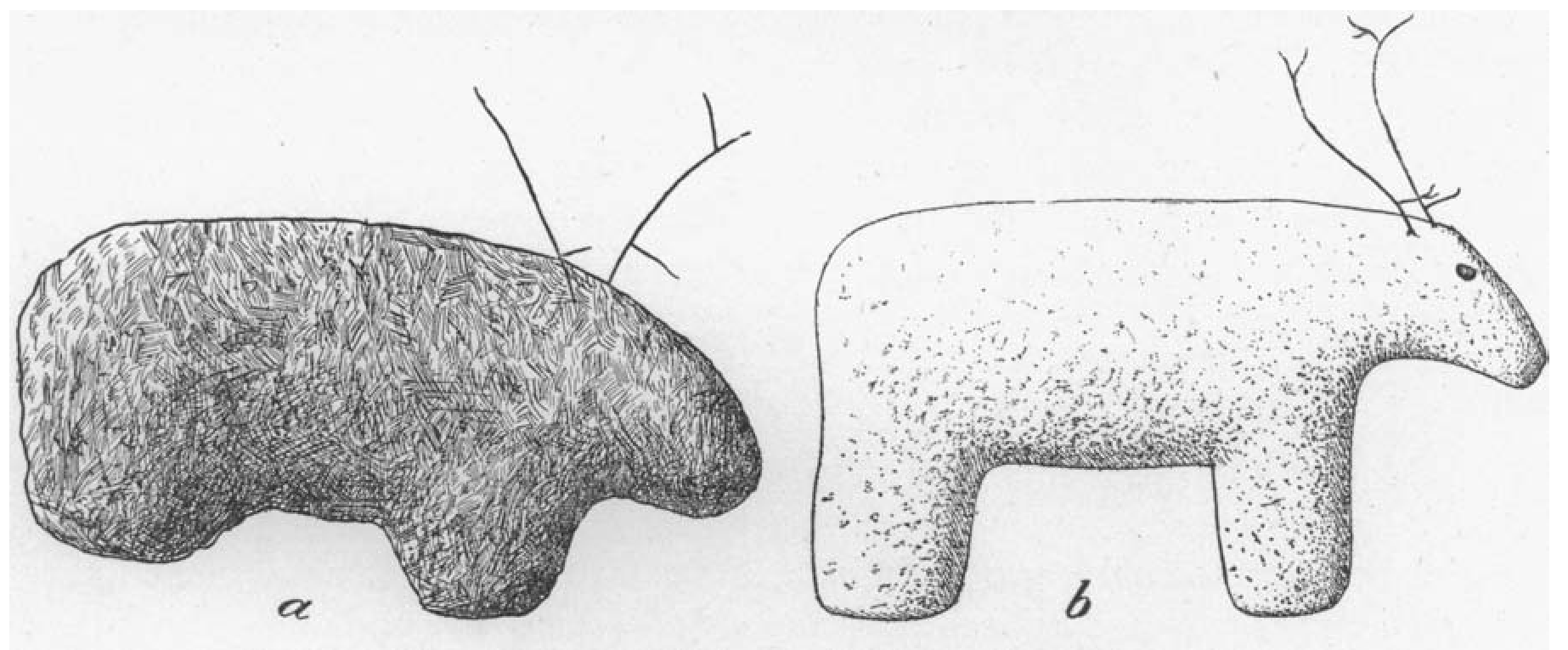
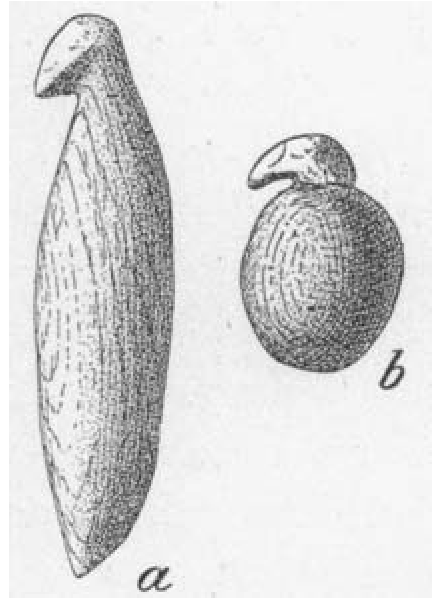
Besides slaughtered reindeer and dogs, the Chukchee offer several other kinds of sacrifice to the “spirits.” First among these should be mentioned the “substitute” offerings, which are small figures shaped like reindeer, and made of tallow, pounded meat, crushed willow-leaves, edible plants and roots (Fig. 263, a), or even snow (Fig. 263, b). The fœtuses extracted from the slaughtered reindeer-dams are used for the same purpose, and a few are sometimes stored away for the greater ceremonials.¹ Kidneys, and sausages made by stuffing the third stomach of a reindeer, are also used. Sometimes a small wooden image of a sausage (Fig. 264) is considered sufficient for the sacrifice. This makes the substitution double. Each is regarded as taking the place of a real reindeer: therefore a sausage or a kidney is often stabbed with a knife to represent the slaughtering.
Blood-soup, which is the favorite sacrificial dish, is believed to be much[370]🗗uncollated relished by “spirits.” Small quantities of it are poured into the fire, flung in all the “directions” sacrificed to, and smeared over the objects which happen to receive the sacrifice, as will be described further on. Small circles are cut out of curried leather, and pieces of blood-soup or tallow are placed upon them. This leather plate with its offering is laid on the snow in the “direction” receiving the sacrifice. Tallow, fat, bone-marrow, boiled meat, pounded leaves, and roots are flung in all the “directions” receiving sacrifice, or are put into the ground or the fire. The faces of fire-boards are smeared with tallow or bone-marrow. The sledges are sometimes painted with blood from the sacrifice.
All other materials which constitute a part of the food of the Chukchee are also used for the sacrifice. Most of them are, of course, of animal provenience. The “alien food” procured by trade, which is highly appreciated by the Chukchee, is also sacrificed to the “spirits.” The Reindeer Chukchee value for this purpose whale-meat and walrus-blubber bought from the Maritime hunters; and the Maritime people place a corresponding value on reindeer meat and tallow bought from the Reindeer camps. Both Reindeer and Maritime Chukchee are zealous in offering to the “spirits” the products of civilization, such as tobacco, sugar, flour, or bread, and even alcohol; but of the last-named they will offer only a few drops.
Most of the sacrifices are offered to the good “beings,”¹ while those to the keˊlet are looked upon as reprehensible, and requiring secrecy. Evening, midnight, darkness, the ground-beings of the nadir, receive, among the other “directions” to which sacrifices are made, their share of sprinkling with blood, and scattering of meat and tallow; but the slaughtering of a reindeer to one of these “directions” is rather exceptional, and the people are very averse to speaking about it.
When a reindeer has to be slaughtered to one of the “directions” of evening or night, it is led away to a certain distance from the camp. When it is felled to the ground, the head of the animal is pointed towards the “direction” sacrificed to. Right-minded persons hurry through such sacrifices with apprehension. Evil-minded persons, evil shamans “bent on mischief,”² on the contrary, seek the protection of keˊlet, especially when desiring to do harm to an adversary. They sacrifice to the keˊlet black animals, reindeer or dogs which are slaughtered at night, and whose carcasses are pointed westward. From time to time, however, any well-to-do reindeer-breeder — while slaughtering reindeer for ceremonial, trading, or household purposes — will designate one of the animals as a sacrifice to the keˊlet, and will point its carcass in a westerly direction. The Maritime hunter will do the same with a black pup.
The partial eradication of all dark and evil spirits from the usual system of sacrifices seems to be at variance with the assertion by a Chukchee shaman[371]🗗uncollated quoted in a previous chapter.¹ The shaman insisted that “we are surrounded by hostile spirits who walk about us invisibly with gaping mouths, and that we distribute gifts to such spirits on all sides.” Similar contradictory ideas may be found, however, among many primitive tribes. Some of them sacrifice chiefly to the evil spirits, arguing that it is of the greatest importance to disarm their ill-will. Thus, Urey Lisiansky says of the inhabitants of Kadiak, that they believe in the existence of two supernatural beings, one of which is good, the other evil. They sacrifice to the latter because they are afraid of his ill-will, and say that the former, even without sacrifice, does no harm to any one.² Other tribes, on the contrary, intend their sacrifices particularly as a means of securing the protection of “spirits” wishing well to the offerer.³ This is mainly the case with the Chukchee. Perhaps the regularity of the sacrifice, from season to season and from year to year, leads primitive man to suppose that naturally the recipients of all these offerings will be well disposed to the giver, and will provide special protection for the material pursuits of his life, since they always receive a share of its fruit.
For dealing with evil spirits and giving protection against them, shamanism is practised. These practices, when developed, were beyond the pale of the regular cycle of ceremonials and sacrifices, but each time they were wanted, recurrence was had to them.
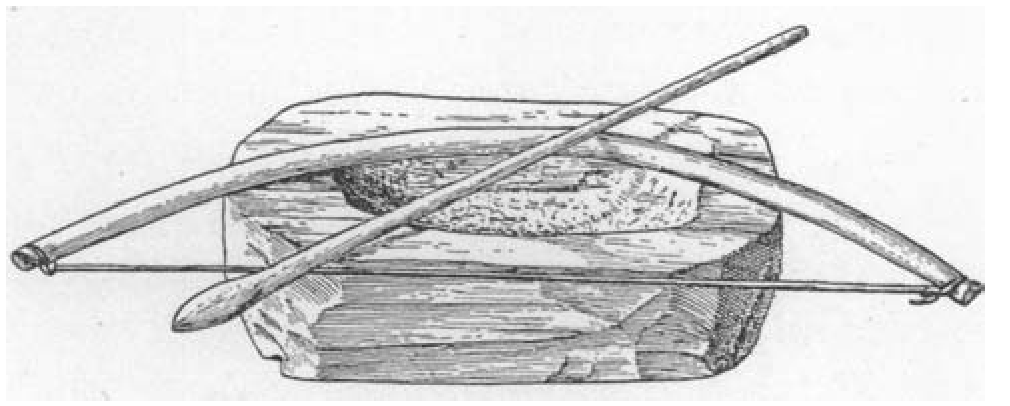
As a special material used for sacrifice to the keˊlet, soot may be mentioned, small pinches of which are thrown westward. The keˊlet are supposed to use it in the construction of their hearths. Sacrifice of a toy-like bow and arrow (Fig. 265) placed on a small roughly hewn image of a sacrificial vessel is also offered to the keˊlet, particularly at times of contagious diseases. The vessel contains particles of meat. According to the explanation given by the natives, this sacrifice signifies that the person making it, in offering to the keˊlᴇ a bow, invites him to hunt elsewhere. The sacrifice is offered in the night-time, and it is carried westward some distance from the house, where it is left on the snow.
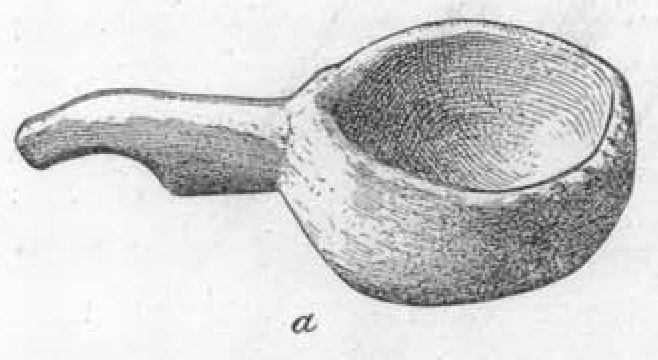
Sacrifices are often carried to their assigned places in ordinary vessels. A great number of sacrificial vessels are, however, in use among the Chukchee. Most of them are simple wooden bowls of usual size (Fig. 266, a). They may be recognized by their old, often dilapidated appearance. Other vessels of toy-like dimensions are also used. Sacrificial vessels of special form[372]🗗uncollated are used less frequently. The cut Fig. 266, b, represents a vessel intended for sacrifice to all “directions.” The four receptacles of the vessel were for the sacrifice to the four principal “directions” that receive sacrifices, — dawn, mid-day, zenith, nadir, — proceeding from left to right. Other vessels of this kind have only two receptacles, — one for the dawn, the other for the evening.

It is remarkable that while the women usually bring charms, and sacrifices to the hearth, and attend to all the smearing with blood, tallow, or blood-soup, the scattering-about of the sacrifice is the men’s duty: perhaps this is because of the closer connection of this rite with hunting-pursuits and the herd. The woman’s part in the sacrifices is described as “belonging to the sleeping-room;” while the man’s part — that is, slaughtering and throwing the food — is called “the outward sacrifice.”
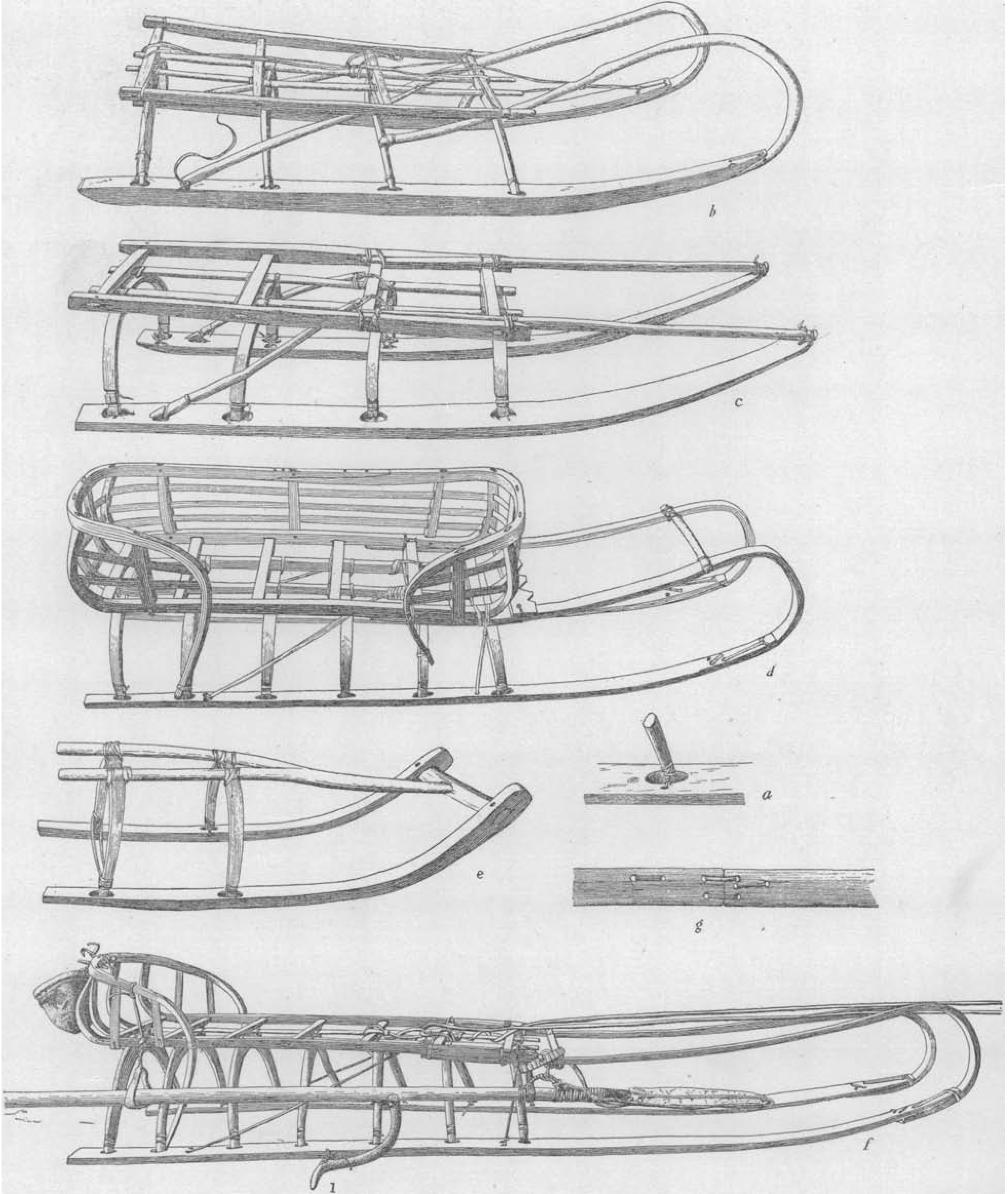
The place for the sacrifice is either in front of the entrance to the tent, which usually faces toward the dawn, or close behind the tent, where a small spot for the ceremonial fire has been carefully cleared of snow. The charms are here leaned against a sledge for carrying poles,¹ which is easy to handle because of its small size. This place is called poyaˊačên.
Fall Slaughtering. — The cycle of “genuine sacrifices” is opened in the fall with two “reindeer slaughterings” (qaanmaˊtɪrg̣ɪn). The first is called “thin fawn-skin slaughtering” (wŭˊlha-qaanmaˊtɪrg̣ɪn); and the second, “making skins for wearing [in the winter]” (têêtawñɪˊɪrg̣ɪn). As may be gathered from the names, the practical purpose of both slaughterings is to obtain the annual supply of skins for clothing. From the first slaughtering the thinner skins are obtained. These serve for the finer dresses used by young people, and they are also sold to the Russian traders. From the second slaughtering, thicker skins are secured for use in all kinds of winter clothing.
The ceremonials which accompany both slaughterings are intended to celebrate the re-union of the herd with the house after the summer separation, and the beginning of their journeys together. They form the chief herd ceremonial of the year. The essential features are, for the most part, the same in both ceremonials; but some of the rites are enacted only once. Most of the people perform these at the first slaughtering, although some delay them until the second; and others hold them alternately during the first and second ceremonials in succeeding years.
[373]🗗uncollatedThe first slaughtering is performed about the beginning or the middle of August, according as the fall is late or early. The family is still living at its summer camping-place, and the herdsmen bring in the herd, which has been absent during the summer. The women of each tent make a fire in front of the door. The fire may be lighted from a strike-a-light; but after that a spark drilled out with each fire-drill of the family must be added to the fire. Then the younger people, men and women, form in line before the fire of the principal tent, while the old men go around the herd and assist in bringing it nearer the house. The younger people meet the herd with loud cries, calling, “Ho hok hok hok!” which is quite like the usual call of herdsmen. Some of them, principally the children, shoot toward the herd, from their bows, sticks which have had one end burned in the fire; others fire off their guns; still others brandish their spears as if about to throw them against the reindeer. All these actions are intended to frighten away the evil spirits that may have become attached to the herd while it was on strange ground, away from the protection of the family charms.
As mentioned before, the reindeer-herd is not thought to have power in itself to repel bad spirits. Elderly men take part in the shooting and shouting, only when there are no younger members of the family to act in their stead. After this part of the ceremony is over, the first sacrifice is made with small pieces of sausage and various kinds of pudding made of pounded leaves and plant-stalks. These are thrown in all the “directions” sacrificed to,¹ beginning with the dawn. They are also tossed toward the herd.
Next, some men walk in amidst the herd, picking out animals for slaughter. The fawns are stabbed with a knife, in the usual way. For stabbing the larger bucks a spear is used; and for each of them an extra female fawn is killed, which is laid at its side and called its wife. Most of the other fawns killed are males.
Well-to-do people slaughter a grown buck for each fire-board which belongs to a living male. The poor people kill only a couple of bucks; and the poorest, no bucks at all, and sometimes only one fawn, for the blood-painting. A dog or two is very frequently killed with the reindeer, and some families use dog’s blood for painting. Each slaughtered animal has its head pointed in a special “direction,” and its blood is sprinkled around in the usual way.
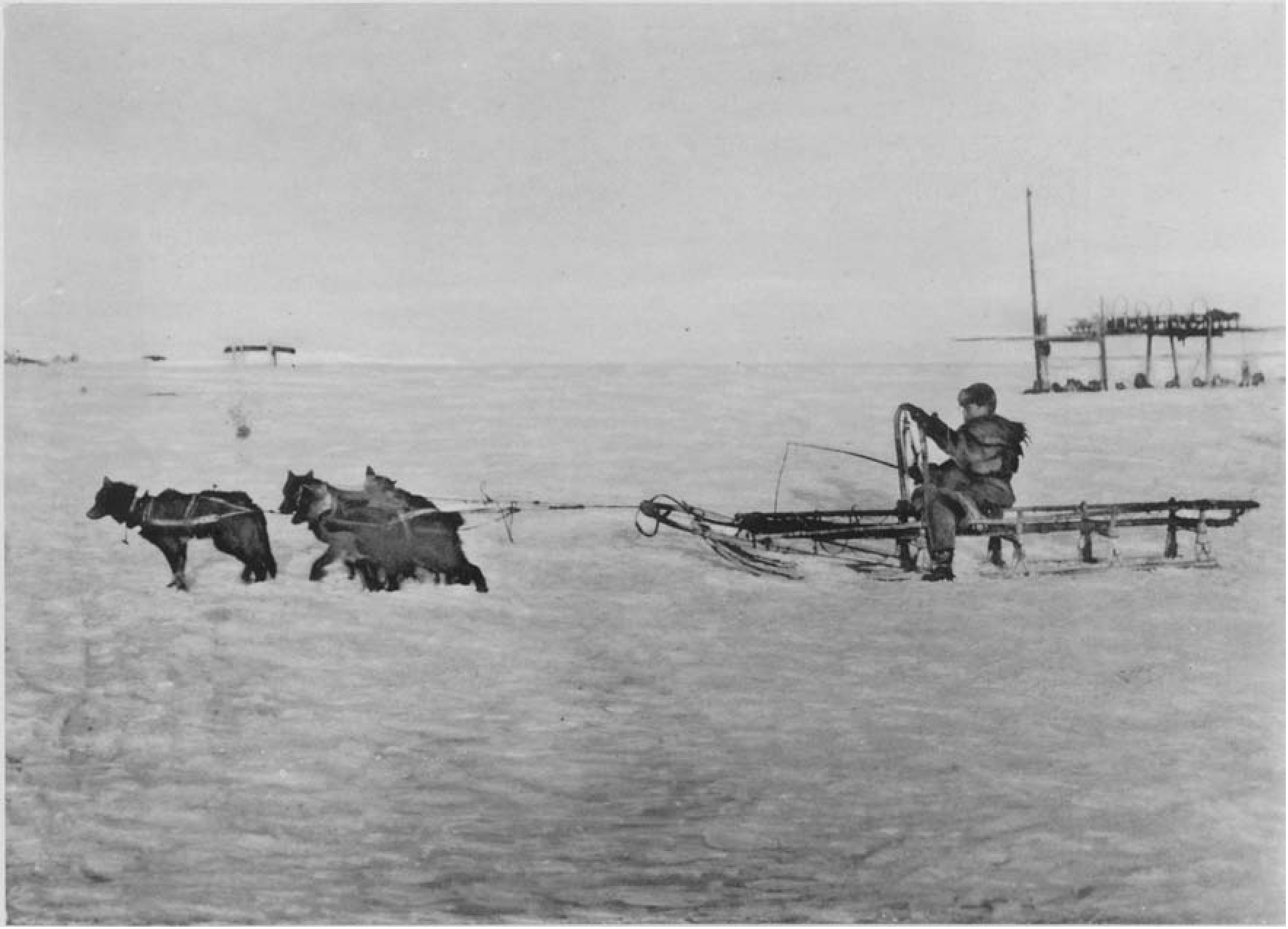
After the slaughtering is finished, women bring both covered sledges of the family and the pole-sledge, and put them in line before the tent at a distance from the door. A little farther away are placed two or three sledges that serve for carrying the tent-covering. The two groups of sledges are arranged with their fronts towards each other. In the space between, or upon one of the sledges, fire-drills and the family charms are placed.
[374]🗗uncollatedA small fire is lighted near by, and the women of each house bring to their line of sledges all the slaughtered animals belonging to them. Then they begin butchering and skinning them, leaving the heads with the skins (Plate XXXII, Fig. 2). A couple of such skins are thrown upon the sledge, near the family charms. Sometimes a freshly taken skin is spread on the ground, with the head pointed toward the dawn; and an old man or an old woman, or both, pronounce an incantation (Plate XXXII, Fig. 3). Various parts of the meat are brought to the fire, but principally those that are eaten raw, — the eyes, brains, kidneys, liver, lungs, gristle of the nose. Joints of legs are broken and the marrow is extracted. Small pieces from each part of the animal are thrown into the fire as sacrifices, and flung in all the “directions” sacrificed to. Family charms are smeared over with tallow and marrow.
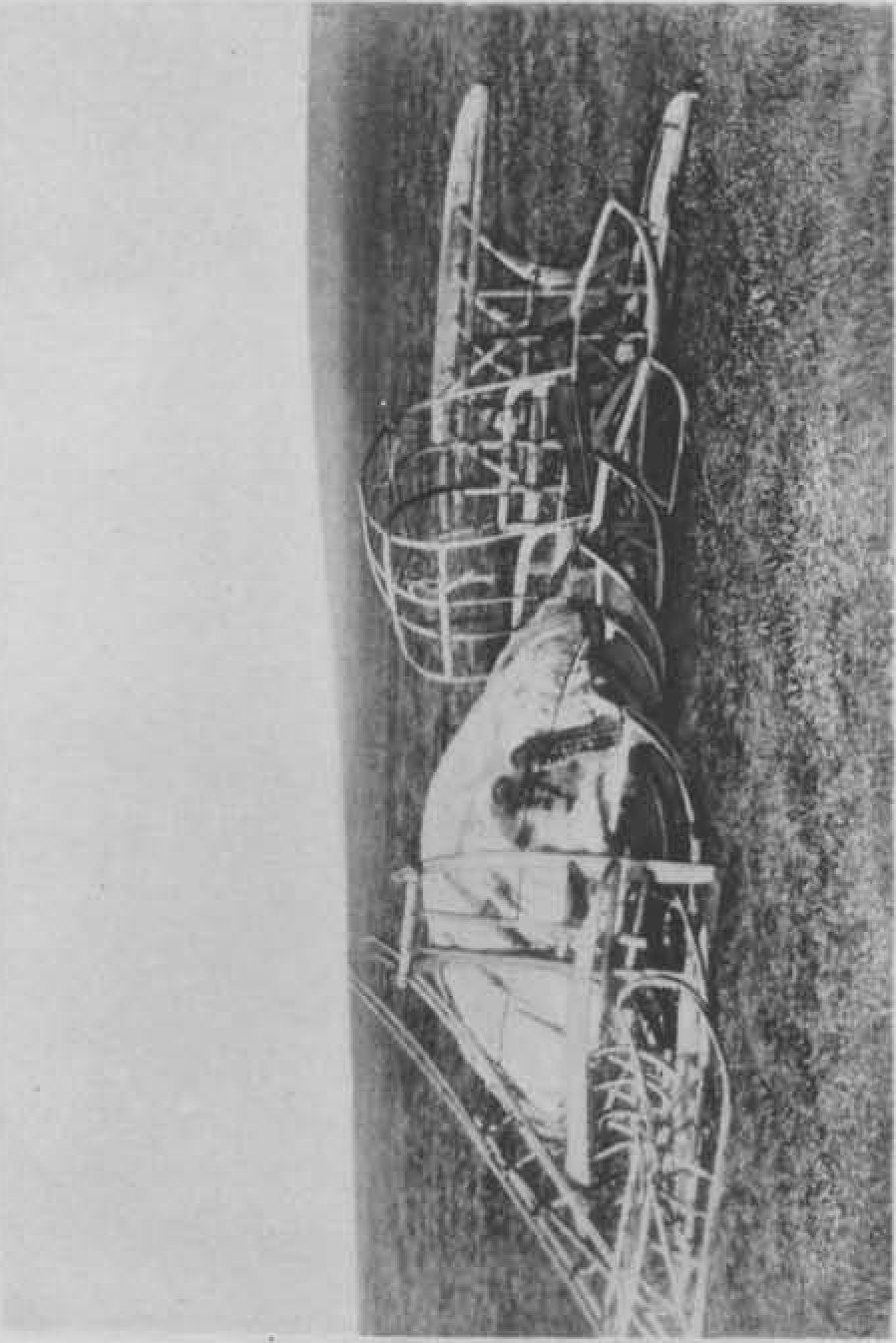
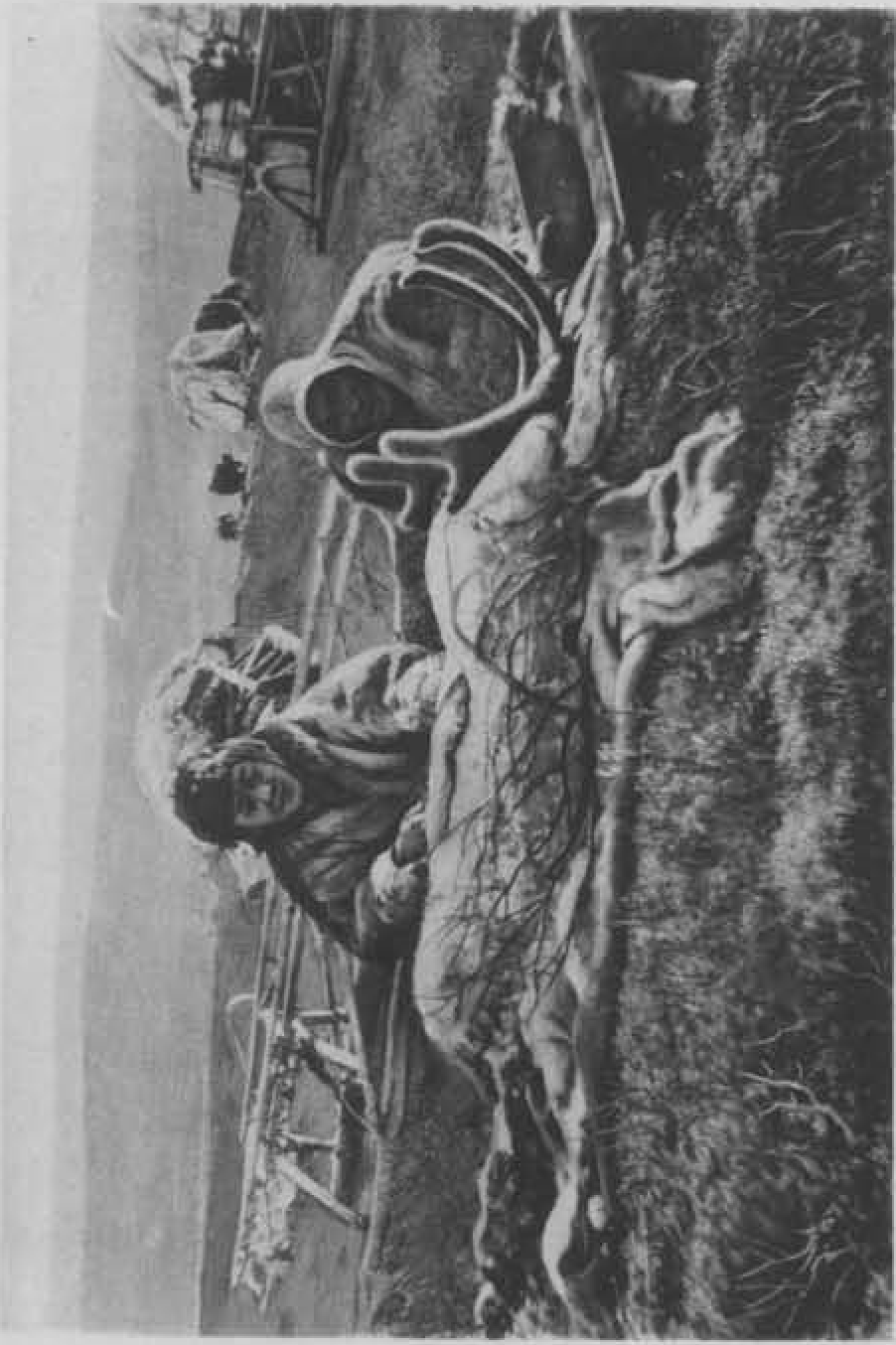
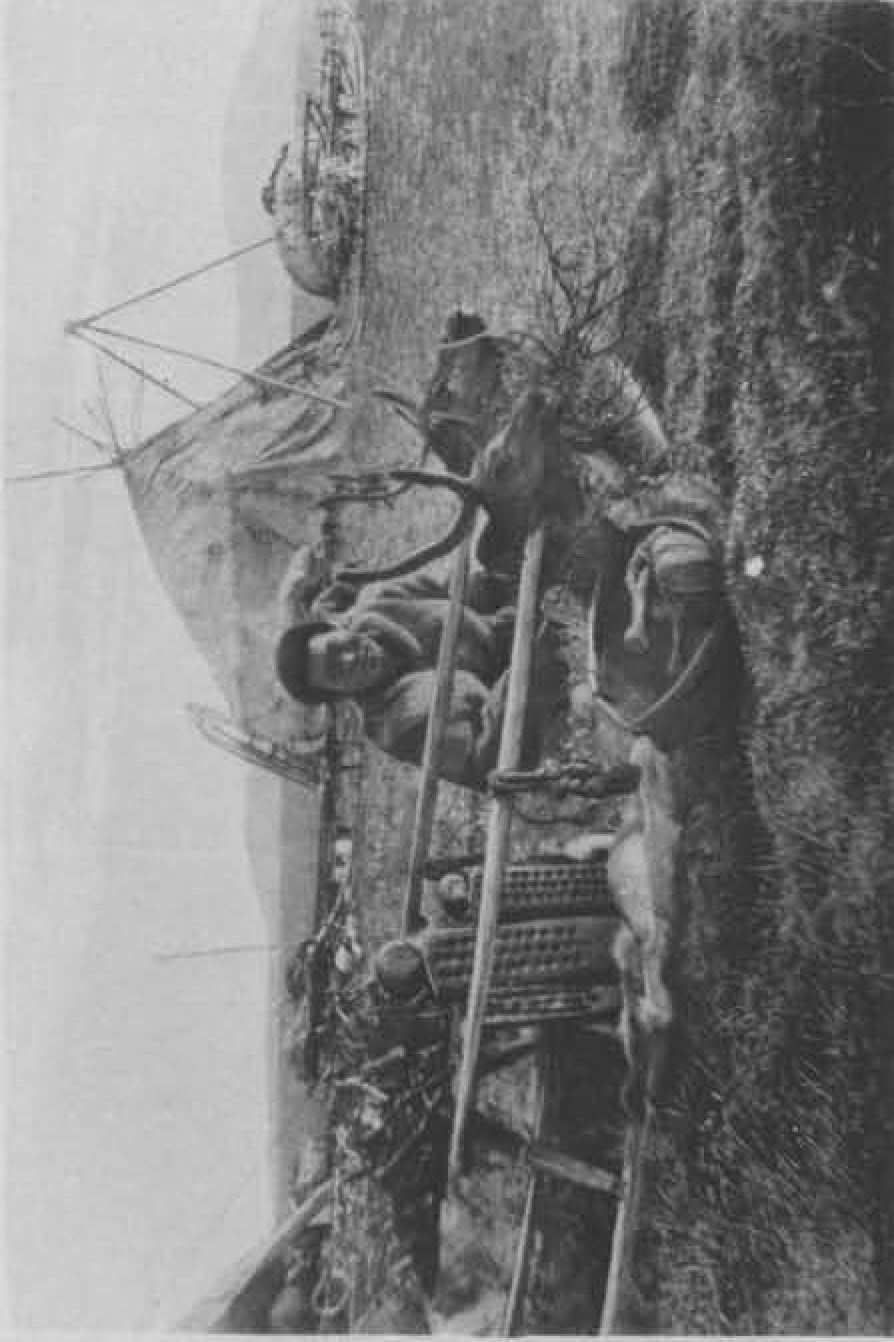
Next comes the painting with blood. First the people are painted, then the sledges standing in line. Each family has its own hereditary style of painting them. Among those that I saw, one had a line on the front part of the runners, and a dot on each of the rear stanchions; another had a straight line on the middle stanchion of the right side, a cross-line on both front stanchions, and a dot on each of the runner-heads.
After the painting is done, all the meat, bones, and skins are carried into the tent and hung over the poles, so that the sleeping-room is completely screened off as by a curtain. The cross-stretchers of the tent are put in place, and the outer covering is tightened to the utmost. A leg-joint is bound with willow to the stretcher standing over the sleeping-room. To this is tied some “food of the soil;” for instance, a root of Polygonum polymorphum or Polygonum viviparum. The women cook large kettles of meat, boil reindeer-heads, and prepare the blood-soup.
After the meal, the drums belonging to the family, all of which are hung on the tent-poles behind the curtain of raw skins, are beaten, and a shamanistic performance begins. The drums are beaten continually the rest of the day. Each member of the family is bound to have his turn. When the grown people have finished, the children take their places and keep up the beating. Many grown people, while beating the drum, call the “spirits” and try to induce them to enter their bodies. They imitate shamans, utter the cries of various animals, and make the peculiar noise supposed to be characteristic of “spirits,” which is produced by a vibrating motion of the lips while the head is shaken violently. The sound is something like prrr!
The “thin [skin] slaughtering,” besides being a family ceremonial, affords one of the most important social holidays. In wealthy districts, neighboring camps hold it on different days, so as to enable everybody to gather at one camp after another. The poorer camps of the Pacific coast have not the means to provide for large receptions, and perform the ceremonial in all the[375]🗗uncollated camps of the neighborhood on the same day. Rich reindeer-breeders at their slaughtering have guests gathered from far and near, including even members of foreign tribes, such as Lamut, Eskimo, or Russianized Yukaghir.
The invitations are sent out beforehand; and if the guests live far away, the host sends some one to bring them, so that there may be no excuse for their missing the feast. It is customary for the host, if possible, to “wrap” all the guests; that is, to make them presents of fawn-skins, killing a fawn for each. If any distinction is made, a female guest takes precedence over a male, and a stranger over a relative. Usually one fawn-skin is given to each guest, while the first-comer gets two or three skins. Any other guest who is bold enough to ask may also get more. To refuse such a demand is dangerous, because the guest might take offence, and bewitch the host. It is considered improper to make a present of meat, and keep the skin for one’s own use. One who receives such a gift resents it, and may declare aloud that the fawn does not walk without the skin. On the contrary, it is quite proper to keep the larger part of the meat, and to give only the skin.
The number of fawns slaughtered at this ceremonial by a well-to-do reindeer-breeder ranges from about a hundred to a hundred and twenty. At least one third of these are distributed among the guests, while the remaining two thirds are evenly divided; one half being destined for household uses, the other for trade. Guests are not supposed to give return-presents. The poor fellow-tribesmen, in truth, give none; but the neighbors afterwards present the host with similar gifts. The visitors from foreign tribes usually return the compliment later by giving some of their products. The Maritime Chukchee and the Eskimo, for example, bring their former host a little oil or a coil of thong; the Lamut give flint, and tinder made of fungus; the Russianized Yukaghir, dried fish or a quarter of a cake of compressed tea. The host has no right to grumble, should they bring little or nothing at all.
The ceremonial is accompanied by a foot-race, in which, in most cases, only the young people or children take part. The prize is furnished by the host. Wrestling-matches occasionally take place, but in these also only young people participate. Shamans gather from the neighborhood and assist in beating the drum. The occasion becomes quite a shamanistic contest when the slaughtering is combined, as is usual, with the thanksgiving ceremony. The latter is very important among the Chukchee, and will be described later in this chapter.
The guests go home the same evening, after the ceremony is ended. The next day the dams whose fawns were slaughtered are milked by sucking, thus adding to the daily fare of the family for several meals.¹ On the third day, all the broken bones of the leg-joints are heaped on the hearth between the sledges, and burned to ashes. The fire used for this purpose is lighted[376]🗗uncollated by means of a fire-drill. Any remaining particles of the leg-joint are covered with small pieces of sod; and a willow-twig, taken from those that were used in tying the leg-joint to the cross-pole in the tent, is put on top of it. The small mound of sod thus arranged is called “fireplace” (mêˊlhɪn). A few days later the first change of the camp-site takes place, but it is not accompanied by any particular ceremony. Some of the people merely build two fires in front of the two ends of the corral, and cause the train of sledges to pass between.
In the second slaughtering, all the details concerning the killing of the animals, arranging the sledges, painting with blood, etc., are repeated, but are done more hurriedly. The meeting of the herd with shooting and shouting is omitted. The guests gather and receive gifts in the same manner as was described before, but the shamans do not practise their arts. The thanksgiving ceremony is performed only the first time; neither are the races and wrestling-matches repeated. Immediately after the second slaughtering, the actual moving-about on the moss pastures and the winter life begin.
Winter Slaughtering. — Other slaughtering-sacrifices during the year are less complicated and less important. The next one in point of time is connected with the establishment of the permanent winter house. Two or three reindeer are slaughtered; two usually being sacrificed to the dawn, and one to the ground (notaˊs˙qa-vaˊɪrg̣ɪn).¹ The last-named sacrifice is laid by the left side of the others, with its head pointed towards sunset.
About the time of the winter solstice the “feeding” of the star Pehiˊttin is celebrated. Those who are living in winter-quarters begin by repeating the last-mentioned sacrifice, and a few days later sacrifice to Pehiˊttin. Fat bucks are selected for this purpose. Small “substitute” figures are made, corresponding to the number of fire-drill boards; and round cakes of pounded leaves are prepared. Tiny leather plates with tallow and blood-soup are offered to the east, because about this time the star begins to rise in the east. Some of the people also make a ceremonial fire for the star Pehiˊttin, and “feed” it, as already described.
Those who move about all winter celebrate the Pehiˊttin ceremonial in a simpler way. They often postpone it until the middle of the first month in the new year.
In the interval between the first and the second lunar months of the Chukchee year, a sacrifice to the sun is performed, but with no new details.
The next sacrifice is made between the “first summer” (kɪˊtkɪtɪk) and the “second summer” (aˊnok),² when the herd is being driven to summer pastures. The ceremonial opens with the last moving of the tent in the season. The women take off the covering, and, breaking down the frame, drag the three central poles off to a new camp-site, situated if possible on a hill where the[377]🗗uncollated ground is comparatively dry. There they lay the poles on the ground so that their tips form a centre from which the poles radiate. A reindeer is slaughtered over the poles, and the herdsmen take care that it falls exactly on them. The mistress soaks a small piece of skin in the fresh blood, and with it draws a circle on the ground, taking as the centre the place where the tips of the poles meet, and marking the poles one after another along the line.
Numerous reindeer are slaughtered to serve as provisions for the family for the greater part of the summer. For this reason there is no need of “substitute” sacrifices. A small fire, lighted by means of the fire-drill, is built in front of the door, and an offering of marrow is burned in it.
Sacrifices of reindeer may take place on any unusual occasion; for example, before beginning a journey (both going and coming), to ask the protection of “spirits,” and at market-places to secure the good-will of the local “spirits.”
When coming home after a long journey, the sledges are placed behind the tent, a reindeer is slaughtered in sacrifice, and a fire is built, and “fed” with fat, marrow, and blood-soup. A corral is built, and the reindeer used on the journey are penned in it. The wife of the owner enters the corral and paints each reindeer on its forehead and shoulders with soot mixed with water, or with a decoction of alder-bark. This ceremony signifies the desire to re-unite the reindeer and the family hearth.
Ceremonial of Antlers. — The ceremonial of antlers, which in Chukchee is called kiˊlvei, is celebrated without slaughtering reindeer. It is even doubtful whether it was originally connected with reindeer-breeding, since the Maritime people also perform a ceremonial under the same name and with some similar details, but of course without antlers.
In modern times this ceremonial, among the Reindeer Chukchee, is connected with laying out the shed antlers on the ground. The breeding-males lose their antlers immediately after the rut; the geldings, in the middle of winter; the older ones, later; the young bucks, early in the spring; and the does, after fawning, which happens as late as May with some of them.
All the antlers shed are picked up and kept for the ceremony, being taken along when the people move from one pasture to another. When the load becomes too heavy, a ceremonial is performed and the antlers are left on the ground. The wealthy people consequently celebrate this ceremonial three and even four times during the year; the poorer ones, only once or twice. The spring is regarded as the proper time for the performance, since most of the animals shed their antlers then.
A small fire is lighted on the customary place behind the tent. The antlers are laid on the ground in a large heap, and covered over with dry boughs. Fire-drill boards are leaned against them, and the charms hung on branches of the boughs or on antlers. Then the charms are smeared with[378]🗗uncollated tallow. Meat and tallow are also set on a piece of hide placed on the ground in front of the heap of antlers.
The head of the family and his sons throw the sacrifice to all the “directions” receiving sacrifice, and bury a part of it in the ground. Then they walk away a few hundred feet in the direction of the herd, and repeat the ceremony. I have already mentioned that some of the boughs used are taken from the heap and attached to the family charm-string (taiˊñɪkut).
Sacrifice to the Young Moon. — Many people offer sacrifices every month to the young moon. The offering consists of blood-soup, meat, and tallow, also of small figures of reindeer made of snow or of leaf-pudding, and is made in the evening. Slaughtering is rare, and happens only in midwinter. These sacrifices are evidently directed to the evil spirits: therefore they are not regarded as belonging to the general cycle of ceremonials. The people, when talking about such ceremonials, persist in thinking that they are not quite lawful, and should be kept secret.
Sacrifice to the Fire. — Sacrificing to the fire (enankaaˊw-kurg̣ɪn, literally, “inducing the fire to crack;” it is also called the “feeding of the fire”) occurs as an independent ceremony during the journey from the winter pastures to the summer locations (taˊg̣rɪ-tɪlaˊma, literally, “on the descending road;” that is, descending from the mountains to the tundra and the seashore). At this time the mistress every evening, after pitching the tent for the night, lights a small fire before the entrance, and sacrifices to it with fat, tallow, marrow, etc. The sacrifice to the fire accompanies several other celebrations, such as the ceremonial of antlers, ceremonial reindeer-races, etc.
Sacrifice for Luck in Hunting. — A man, when going alone into a strange country to hunt, or to a lake or river to fish, will offer to the place a small sacrifice from his scanty provisions. On the land he will throw the offering about; on the river or lake he will throw it into the water.
After a successful hunt of one of the larger animals. — such as the wolf or wolverene, black and polar bear, wild reindeer, walrus, and thong-seal, — various ceremonials are performed when the game is brought home. Their common feature is the “giving of a drink and a bed” to the animals. This is symbolized by bringing out of the house a small quantity of water, and pouring it over the head of the animal as it lies on the snow before the entrance,¹ and by placing a small willow-twig under the hind-quarters of the carcass for a bed.
The Maritime Chukchee also “give a drink” to all larger animals killed on the hunt, especially to the walrus; but the “bed” — that is, the willow-twig put under the hind-quarters of the animal — is often omitted. The Asiatic Eskimo, however, “give a drink” only to the first-killed walrus of the season.
[379]🗗uncollatedCeremonial connected with the Killing of Wild Reindeer-Bucks. — Of all animals killed on the hunt, the Reindeer Chukchee set the highest value on wild reindeer-bucks killed in the herd during the rutting-season, because their coming is thought to affect favorably the fortune of the herd.¹ With the killing of such bucks a complicated ceremonial — performed late in the fall, after the rutting-season is over — is connected. The Chukchee contend that these animals are not hunted down by the personal skill of the hunter, but that they are lured within his easy reach by the influence of the herd, therefore it is only fitting that a return should be made in the form of a ceremonial and sacrifice; while, on the other hand, animals killed far from home and herd require no such ceremony.
Since the ceremonial connected with the hunt of walrus and larger kinds of seal is performed about the same season and with somewhat similar details by both the Maritime Chukchee and the Asiatic Eskimo, it is my opinion that the purpose of this ceremonial is to celebrate success on the hunt. I believe it is connected with the bucks killed in the herd simply because they represent among the Reindeer Chukchee the most important game hunted. With the Reindeer Chukchee the ceremonial has a special name, ênatčɪˊɪrg̣ɪn. The Maritime Chukchee call the ceremonial connected with walrus-hunting by this name; and the Maritime Koryak apply it, with the proper phonetic change, to the ceremonial of the whale.
The details of the ceremonial with the Reindeer Chukchee are as follows. The first wild buck that comes to the herd is frequently met with incantations, the purpose of which is to make him assume for a while the ways of domesticated reindeer, so that he may serve as a successful breeder. The details of the incantations will be described later in a special chapter. After a week or ten days, when the incantations have lost their power, the owner of the herd catches the buck with his lasso and throws him down on a piece of the tent-covering. Then a young female, which is to represent his wife, is caught and thrown down by his side. The mistress puts on her overcoat, and, holding the buck’s head in her lap, covers it with her overcoat. The master now stabs the buck with an antler knife made for this purpose; then he stabs the female with an ordinary iron knife. After that a little urine in a chamber-vessel is offered to the buck while he is still in the agonies of death. With the handle of the antler knife, fashioned like a spatula, the owner of the herd touches all parts of the carcass of the animal, thus taking back his incantation, and restoring the buck to his freedom. As long as the buck is under the influence of the spell, the master must abstain from untying knots, otherwise he may “untie” the incantation.
The third stomach of the animal is filled with blood, and suspended from[380]🗗uncollated the tip of the antlers in order to serve for divining the luck in hunting the next buck. This divination is repeated with every animal killed.
The principal hunting-ceremonial is celebrated at the conclusion of the hunt. During the ceremony the carcasses are kept behind the tent on the snow. The carcass must be butchered on the spot where it lies. The hams and shoulders may be taken for consumption. The head, back, and pelvis must be left with the skin on and uncut; and the heart and the aorta must also be left intact. The heads must be covered for the night, and uncovered in the morning. The fire-boards are kept with the carcass during the night, leaning against their covered heads.
On the morning of the ceremonial two reindeer are slaughtered, — one as a sacrifice to the reindeer-bucks killed, and the other to the dawn. Sometimes a third reindeer is sacrificed to the nadir. The antlers of the wild bucks are adorned with festoons of sausages and dried guts. Blood-soup, meat-soup, and meat are cooked in abundance. The meal and the feeding of the charms proceed as usual. Then a female fawn is slaughtered, and the antlers painted with her blood. Those present rush up and grab for the sausages and remnants of the feast, scrambling for the best pieces. The master distributes among the guests the greater part of the meat from the reindeer-bucks. The heads are kept for the family, and taken into the tent, where they are suspended under the vent-hole over the fire of the hearth to thaw out.
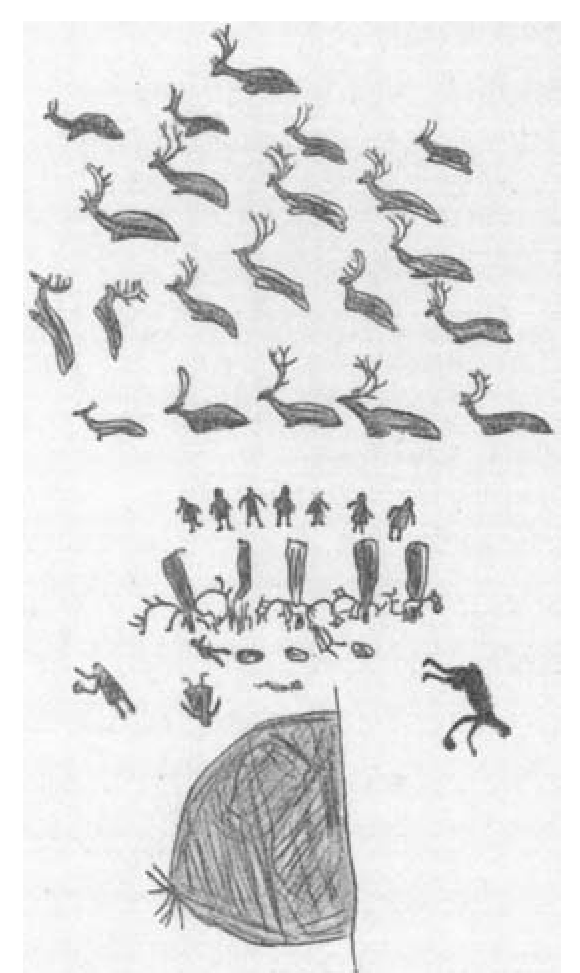
The family stand around the fire. The elders beat the drums, and the others sing the oldest family tune. The master sings, “Ha, meˊñin? Ha, leuˊton!” (“Ha, who [is there]? Ha, a head [is there]!”) The heads as they thaw are skinned, one after another, and the antlers cut off with the top of the skull. All the heads are boiled; and the women work the entire night, preparing balls of pudding made of pounded meat mixed with tallow and edible roots. In the morning a foot-race is arranged. All the balls are suspended on the poles of the tent-frame, and the guests grab for them as they did on the preceding day for the remnants of the feast.
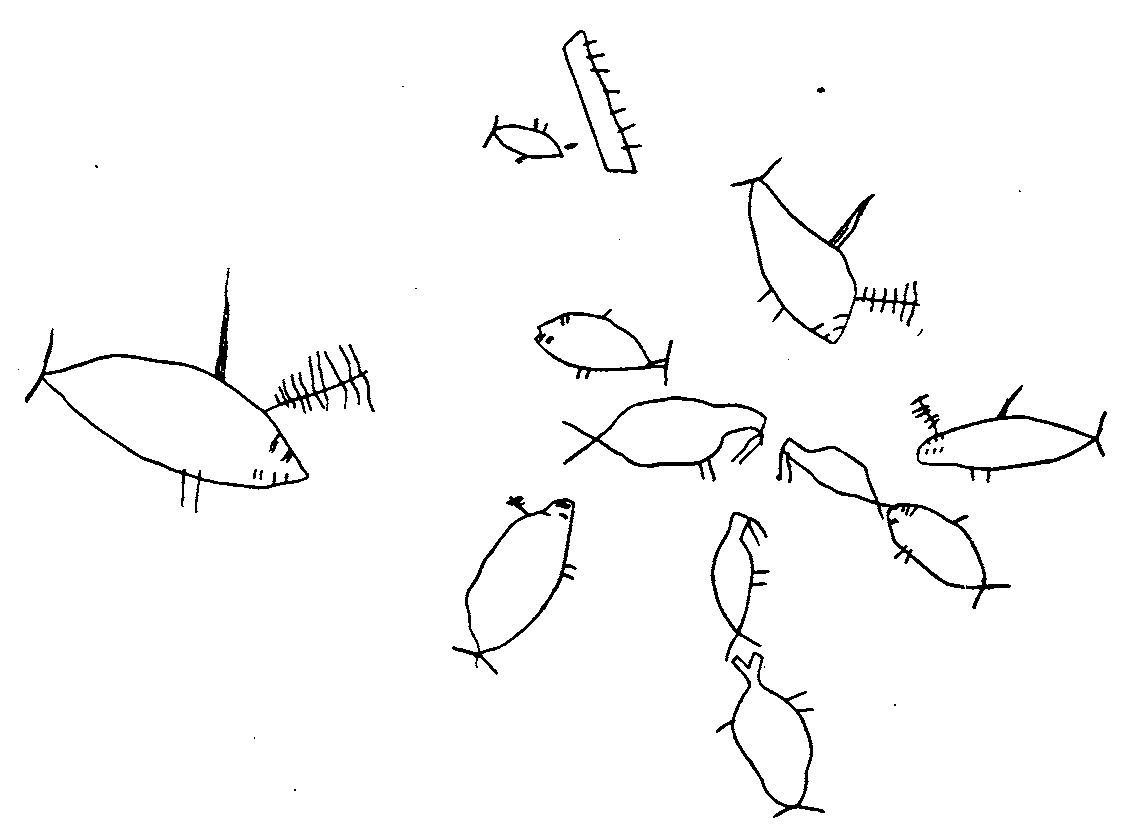
Fig. 267 is copied from a native drawing representing the hunting-ceremonial. Four carcasses of wild reindeer are lying on the ground. The fifth one is that of a domesticated reindeer slaughtered in sacrifice. A small fire is burning between the carcasses and the house. Two men, one on each side of the house, throw sacrifice to the “directions.” Two women adorn the antlers of[381]🗗uncollated the animals with sausage. A party of guests stand ready to rush on for sausage. The herd is lying on the ground not far off.
The manes of the deer are cut off, together with a narrow strip of skin. These are divided into small tufts of hair. Each of the guests pins two pieces on his back, one at each shoulder, and wears them until they drop off, as it were. A strip of the mane is also often tied to the string of family charms.
The sacrifice to the fire is performed several times, and the ceremonial ends with the “feeding” of the fire of the lamp in the sleeping-room. This last ceremony occurs but seldom in the ceremonials of the Reindeer people. After the ceremonial, the antlers are taken to the burial-places of the nearest relatives, as I shall describe later.
A wild reindeer-buck killed in the herd at any other season sometimes receives a slaughtering-sacrifice: at least, a sacred fire will be lighted near the carcass, and a small sacrifice thrown in.
The black bear, the elk, the wolverene, and the wolf are thought worthy of a brief ceremonial of the same kind. All the essential details are repeated, including the slaughtering-sacrifice, the sacrifice to the fire, the cooking of ceremonial dishes, and bringing the head into the tent, where the people greet it with songs and drum-beating. In most cases a special thanksgiving ceremony (mñêˊɪrg̣ɪn) ends the day.
I was told that with wolves, and sometimes with black bears, the master of the house, when performing the ceremonial, takes the fresh skin and puts it on in such a way, that his head is covered with the skin of the animal’s head, and the body of the skin dangles behind. The carcass of the wolf is carried into the tent. The master of the house, dressed in the wolf-skin, performs also the thanksgiving ceremonial, singing and dancing, and beating the drum, as will be described later. From time to time he also utters a howl, pretending that the spirit of the wolf has entered his body. In the wolf festival of the Koryak, likewise, one of the men puts on the wolf’s skin, and walks around the hearth, while another beats the drum.¹
These ceremonials, however, are performed chiefly in the fall. If the animals named are killed in the spring, they are brought home with simply the ceremony of “giving a drink,”² in which a drink is offered to the carcass. Some of the Reindeer Chukchee treat in a similar manner stray seals which happen to be taken by them at this season. Others store the heads of seals, and afterwards perform the thanksgiving ceremonial over them. The Maritime Chukchee store the heads of thong-seals and walrus for summer ceremonials of a similar kind.
Thanksgiving Ceremonial. — The thanksgiving ceremonial has no definite term or season, but each family must perform it at least once or twice a year. The unexpected killing of a high-priced animal (for example, a blue fox or a[382]🗗uncollated good wolverene), success in any other enterprise, whether in the hunt or in trade, or even the cutting of birch for sledges and spear-shafts, may cause the owner of the house to arrange the ceremonial. Or, again, quite as likely, its celebration may be brought about by a dream, for the Chukchee pay great attention to dreams, and, believing them to be the main source of religious inspiration, they follow them in regard to the details of rituals. As a matter of fact, several classes of ceremonials, such as the thanksgiving and all kinds of sport, are called “dream-answers,” because the time and the details of their arrangement are so very often indicated in dreams. If any member of a family, even a young child, has a dream about sports, such sports must be arranged, particularly those of thanksgiving. The family is obliged to make the dream real, under penance of severe losses and misfortunes. On account of this belief, the ceremony takes on a protective character. It expresses thankfulness for the successful result of an enterprise; but, which to them is still more important, it wards off any impending assault by “spirits,” and prevents future mischances in hunting or otherwise.
The thanksgiving ceremonial must have a central object. On most occasions it is a reindeer, wolverene, thong-seal, or other animal killed in hunting. Native or foreign objects of trade — a dried seal-skin, a cake of tea, or a bundle of tobacco — may, however, serve the purpose. The Reindeer Chukchee often slaughter a reindeer of their own herd, and perform the ceremonial over its carcass.
The ceremonial is performed indoors. Not even a fire is built outside of the tent. The object of the ceremonial is placed on a skin by the side of the fire on the hearth. A large quantity of fat meat is boiled, and the sacrificial blood-soup is prepared with fat and roots. The people gathered for the ceremonial partake of the food, while the children of the family carry plates containing meat around the outside of the tent, in the direction of the course of the sun. The principal heir, boy or girl,¹ walks ahead; and all the participants shout at the top of the voice, “Yoho, yoho!” which is intended to drive away the evil spirits. After that, the young people scatter the sacrifice to all “directions” in the usual way, and bury some pieces of it in the earth. Meanwhile the women climb to the top of the tent, and carefully cover the vent-hole with skins. The fire on the hearth is kept low, nevertheless the tent is full of smoke during the whole performance. The entrance is left open. Then the mistress of the house takes a drum and goes about inside beating it, for the purpose of frightening away the “spirits.” When all the “spirits” are supposed to have flown away through the entrance, and the young people who went out with the sacrifice have returned, the door is closed.
The chief features of the ceremonial which follows are singing, beating of drums, and the ceremonial dance. It affords the chief opportunity of the[383]🗗uncollated year to display shamanistic skill; so that shamans from the whole neighborhood gather for a performance, if possible for a contest of ability and inspiration.
The principal heir¹ makes a circle around the hearth, hopping in a curious way, and keeping his heels close together. The master of the house, who sits on a skin near the sleeping-room, begins to shout, repeating many times the same loud double cry, “Yoho, yoho!” One by one the people join him; others start singing, and the tent fairly vibrates with the deafening noise. There are no rules about the singing. Each sings his own particular tune, and stops for a rest when he feels tired. Those who have drums beat them for a while and pass them to the others. The drums for the ceremony are gathered from the whole camp, and sometimes as many as ten may be used in the performance. After a while the dance begins. One name for it is “the shaking-off thin” (têwlaˊɪrg̣ɪn), and it purports to shake off diseases and evil spirits from the body of the performer.
The dancers are formed into two sets, placed on opposite sides of the hearth. One set stand on the outer side of the hearth, with their backs toward the entrance: they are chiefly elderly men. The other set stand on the inner side of the hearth. They have their backs turned toward the sleeping-room, and face their partners at the entrance. These are women, who put on their overcoats, adorned with fringe and pendants. The first set are considered the more important; they are called “ceremonial movers” (mñiničuˊlɪt). The second set are termed “the standing ones” (vêʟaˊlɪt), or “the standing women” (vêˊʟa-ñeˊus˙qatti), meaning that they are standing on their feet while the onlookers remain seated.
The dance is usually opened by the master and the mistress of the house, while the others sit in their places. On this occasion the master of the house is called “road-maker,” because he opens the road for the others. A skin is spread on the ground under his feet. He beats his family drum, using, instead of the whalebone, the wooden drum-stick, with which he strikes the wooden rim of the drum from underneath. He and the woman sing different tunes, each choosing what he or she likes. He usually starts with the hereditary tunes of his family, then he passes to those that he himself has composed at various times. Each tune is repeated again and again for several minutes. The woman sings those which she has learned from her mother, or has composed by herself for her own amusement. Husband and wife each perform a dance, in which their motions are more or less alike. They keep the same place, swaying their bodies and swinging their hands, now to the right, then to the left. From time to time they squat down and immediately jump up again. At length the first performers give up their places to others, who at first appear singly, taking turns one by one. After a while, several performers appear on each side. One pair of dancers, however, — a man[384]🗗uncollated and a woman, — will be more conspicuous than the rest, and their dances will harmonize with each other; while the others perform quite individually, without any attention to their fellows.
A man often summons a woman to dance with him, in which case he spreads a skin on the ground for her to dance upon. After the performance, this skin is taken by the woman. Other presents are also offered and accepted, especially when the man and the woman are cousins, or relatives of other degree.
When the performance is in full swing, the shamans begin to take part in it, generally one by one, although at the end there may be two or three acting at the same time. Their acting, of course, consists of magical arts. They beat the drum with violence and persistence, and their songs are strangely complicated, because the tunes of shamans generally admit of considerable variations. Their motions, too, are violent and irregular, befitting those who feel the approach of “spirits.”
At last the “spirits” come and enter the bodies of their servants. From that time on, the shamans are supposed to assume the appearance of the supernatural beings that have entered them. They act accordingly, shake their heads violently, and produce the gibbering noise mentioned before, which is supposed to be the voice of the “spirits.”¹ In case some particular “spirit” of theirs is a bear, a raven, or a wolf, they try to imitate also its motions and cries. I have heard several times that powerful shamans even wrap the body in a bear-skin taken off whole for this purpose, or put a raven’s beak on the face. Then they turn temporarily into bears or ravens, and act like such. This may be considered in connection with what was said about the ceremonial concerning the wolf or bear killed and brought home. Nevertheless, I had no opportunity to witness such performances: therefore I am not able to say how far the information collected corresponds to the rites actually performed.
I am not aware that any disguise in the form of special garments or masks is used. Those shamans, indeed, who have a special dress, use it on such occasions; and sometimes an ordinary person may have a special garment, made by the advice of a shaman, as a protection against disease or misfortune. This will be supplied with tassels and pendants in the nature of charms. I heard of shamans performing the ceremonial in their own family quite naked; but this is undoubtedly connected with some details of Chukchee shamanism of which I shall speak later.
At the conclusion, those women who claim shamanistic power pass over to the men’s side, and begin to practise with the drum and to call their “spirits.” Even young girls imitate the actions of those possessed, stamping their feet, waving their hands, and uttering a series of shrill, grunting, or[385]🗗uncollated squeaky cries. The ceremonial lasts for several hours, but usually not later than evening. When it is ended, those present partake of the meat and blood-soup. Then the object which was the primary centre of the thanksgiving is sprinkled or smeared with the blood-soup.
In the evening, if it is the wish of the master of the house, most of the people enter the sleeping-room; and the regular shamanistic performance takes place, in which the contesting shamans may again show their skill. This happens frequently also after other ceremonials.
All kinds of extra sacrifices are offered to the good “beings” and to the keˊlet, according to intimations received in dreams, in order to strengthen an incantation, or to ask from supernatural beings some temporary assistance. Such sacrifices may be bloody or bloodless. In bloody sacrifices, dogs and reindeer are slaughtered without distinction. An animal is often promised for such sacrifice beforehand. In token of this, a small bit of red cloth is attached to one of its ears, and the animal is called “that pinned to” (ineˊtiflɪn). The same custom is observed among the Koryak.¹ A promise, once made, cannot be taken back without incurring the risk of heavy retaliation on the part of the offended “spirits.”
Races. — Reindeer-races partake of the nature of ceremonial performances, and are considered dream-answers. The usual time for them, as I have noted, is the latter part of the snowy season, — from January until May. A man who feels under obligation to arrange a race sends an invitation to his neighbors. When they are gathered, he provides the stake. The women of his camp meanwhile build small fires in the wilderness, and throw in the sacrifice of meat and tallow. Then the race is performed as has already been described.²
Foot-races also form an integral part of certain ceremonials.³ There is a particular form of foot-race, much in use also among the Maritime people, which is frequently arranged in connection with the ceremonials. In this the participants run in a circle over a comparatively small area, until one by one the runners drop out from exhaustion. The most enduring remains, the winner of the contest. Sometimes there are two concentric circles, the direction of the course in one being opposite to that in the other, though both courses belong to the one contest. These circular runs are said to have been used much more in former times. Then many Maritime villages had special places for them, with a circular track worn deeply into the ground by continual exercise.
CEREMONIALS OF THE MARITIME CHUKCHEE. — The cycle of the ceremonials with the Maritime Chukchee opens with two short ceremonials in the beginning of the fall, which are often joined together. One of them is a[386]🗗uncollated commemorative sacrifice to the dead, which will be spoken of hereafter. The other is a sacrifice to the sea, in order to insure good-fortune in subsequent sealing on the sea-ice in winter.
Late in the fall, or rather in the beginning of the winter, the chief ceremonial of the year is performed. It is consecrated to Kereˊtkun, or is made a thanksgiving ceremonial to the spirits of sea-mammals killed since the fall. Early in spring there follows the ceremonial of boats, which are made ready for the approaching season. In the middle of summer the ceremonial of “heads” is performed. This is for thanksgiving to the spirits of sea-mammals killed since early in the spring.
These four ceremonials are performed with varying similarity by both the Maritime Chukchee and the Asiatic Eskimo. To these must be added some slight ceremonial effected while moving from the winter lodging to the summer tent.
Most of the Maritime Chukchee offer sacrifice also in midwinter to the star Pehiˊttin,¹ and perform in the middle of spring a ceremonial analogous to the ceremonial of antlers of the reindeer-breeders, which is called by the same name, Kiˊlvei. The sacrifice to the whale is performed, in addition, each time after a whale has been killed or has drifted ashore.
Bloody and bloodless sacrifices are offered during these ceremonials. The Maritime Chukchee of course can slaughter only dogs for their bloody sacrifices. In comparison with the Koryak, however, they are merciful to their dogs, and kill them in no very great numbers. In this, as in other respects, they occupy a middle ground between the American Eskimo, who do not sacrifice dogs, and the Koryak, who often kill almost all the animals of their single team.
Ceremonial House. — According to information given by the natives, and also by inference from the example of Nuˊnlig̣ren, most of the villages have each a special house intended for the performance of the chief ceremonial of the winter. This house, however, differs in many respects from the kaˊshim of the American Eskimo. Its size is that of the houses ordinarily in use; and often it is really a house left by its owner, for some particular reasons, for another dwelling. In many instances it was the private property of a certain family, which is called, even at the present time, “one with the front house” (aᵋttoˊoralɪn). This term is in full use among the reindeer-breeders, by whom it is applied to the chief family of the camp, in distinction from the poorer “neighbors” (nɪm-tuˊmg̣ɪt) who help the first family to tend their herd. The chief family really has its tent “in the front” of the others; that is, first on the right side of the line which is, as said before, turned to the morning dawn “direction.”²
In the Maritime villages it is more difficult to determine who represents[387]🗗uncollated the “front-house family.” The natives explained to me that it is the family who have lived in a given place the longest, “from times unknown to the present generation.” Other families, who came afterward, are considered as “neighbors,” and they must apply for protection to the first, at least in their relations with the local “spirits.”
This explanation seems plausible in regard to the smaller villages, where the population is unstable, and subject to considerable change in the course of a few consecutive years. In each of such villages there is usually one family who remains, even when all others leave on account of temporary scarcity of game, or for other reasons. Thus, at Mariinsky Post, the “front-house family” is that of Ooplaˊnto (“Arisen-from-the-Garbage-Place,” so called from an old heap of garbage on the former site of the village). The line of this family may be traced backwards for at least four generations, and it is really the first family of the place as to success in the hunt and in general knowledge of the resources of the surrounding country.
But it is more difficult to explain the origin of the “front-house family” in the larger villages, Chukchee or Eskimo, such as Nuˊnlig̣ren or Wuteˊen, where, in all probability, several families have lived together for all time. Perhaps the position of the “front-house family” was more definite in former times. Thus in Nuˊnlig̣ren, until recent years, all the “neighbors,” who performed their winter ceremonials in the underground house belonging to the “front-house family,” had to leave on the spot some present for the use of the house. The present was looked upon in the light of a sacrifice to the spirits of the house and locality; but it belonged to the share of the master of the house.
The same arrangement was made in several other villages, and even in Čibuˊkak, on St. Lawrence Island. Each of those villages had a separate house for ceremonials, and it was considered the property of the “front-house family.” In some of those villages, — such as Wuteˊen, Yeˊrg̣ɪn, Nuˊnlig̣ren, — the first walrus killed by the hunters of the village falls by right, even at present, to the head of the “front-house family.” According to the ordinary custom of dividing the game, this person takes the head and the skin, while all the meat is divided among the participants of the hunt, and parts of it among all the inhabitants of the village. In the village of Kihiˊni the head of the first walrus killed in the fall is left on the ledge of a certain sea-cliff, and then the people perform the thanksgiving ceremonial over it. Here evidently the “spirit” of the place receives the results of the hunt; while in other places the head of the “front-house family” has the same rights, probably inferred from his familiar relations with local “spirits.”
There are, however, villages, like Uñiˊsak and Čeˊčin, which have no “front-house family.” As to the village of Uñiˊsak, however, W. H. Hooper describes it as having a kind of large tent, which serves for public purposes.[388]🗗uncollated “Possibly a council-room, as well as a theatre,” says he, “for in place of the usual inner arrangements, only a species of bench of raised earth ran around it, where were seated numerous spectators.”¹ No remembrance of such public tents, however, is retained at Uñiˊsak. Perhaps it was simply a private house in the course of partial reconstruction, as often happens with native houses. It may have been used temporarily by the people for a re-union on the occasion of the arrival of the author.
The ceremonials of different families, though performed at the same place, were rarely observed in common. On the contrary, families enacted their ceremonials one after another, even though each particular performance lasted for several days. Even at present, though the ceremonials are performed by each family in their own house, the consecutive order is still followed, and thus the winter ceremonial in the largest villages often extends over a month or even more. As a partial corrective, three or four families perform on the same day; but in this case they usually belong to opposite ends of the village, with separate circles of acquaintances and relatives.
The hunting of sea-mammals is not forbidden during this whole period. The members of the house actually performing the ceremonial must, of course, stay at home; but as soon as it is over, the family has a right to send some of their people to the sea, even though others go to take part in a ceremonial feast of some of their “neighbors.”
Sacrifice to the Sea. — The sacrifice to the sea, which, together with the sacrifice to the dead, begins the cycle of the Maritime ceremonials, is performed by the best hunter of the family. He comes to the shore accompanied by one woman. He carries his harpoon and other weapons; while she brings a vessel filled with blood-soup and sausage of reindeer-stomach. This sausage plays as important a part in the sacrifices of the Maritime people as it does among the reindeer-breeders. The Maritime people are more inclined to select “alien food” for their sacrifices than are the reindeer-breeders. The products of civilization, such as sugar or flour (thanks to the trading activity of whalers), do not appeal to them as rare dainties: therefore they give the first place, in sacrificing, to the products of the reindeer-breeders, which are their conception of what is most luscious.
While the woman brings the sacrifice, the man shows his weapons to the sea, and asks for good luck in hunting and for safety in his future wandering over the unstable ice-floes. A dog is often slaughtered in sacrifice to the sea. The time of this sacrifice differs in different families. Some perform it at the end of summer; others, on the contrary, delay it till the middle of October, when it coincides with the moving from the summer tents to the winter habitations. Connected with the sacrifice to the sea there is often[389]🗗uncollated another, designed for the zenith. This is offered before the entrance of the house, with some crumbs of food flung upwards.
Fall Ceremonial. — The time of the fall ceremonial varies, in different villages and families, from the end of October to the first days of January. The fittest time, however, is thought to be at the birth of the moon after the shortest days of the winter, and it is considered the beginning of the first month.¹ Moreover, in villages like Uñiˊsak or Uweˊlen, the ceremonial lasts more than a month, and thus the celebrations of the last families come into the second half of January. Where there is a “front-house family,” it begins the course. In other villages — such, for instance, as Čeˊčin, Aˊčon, or Uñiˊsak — without a “front-house family,” there is no particular order for the ceremonials, and it changes from year to year by mere accident.
The Chukchee have two different methods of celebrating this ceremonial. The simpler one is called “genuine thanksgiving ceremonial” (lɪˊê-mñêˊɪrg̣ɪn). Even the name shows that this ceremonial is identified with the ordinary thanksgiving ceremonial which was described previously. The other method is, properly speaking, a repetition of the ceremony of Kereˊtkun, Karaˊtko-vaˊɪrg̣ɪn. The choice of either method varies in different villages, and even among individual families. Nevertheless, as far as can be observed, the “genuine thanksgiving ceremonial” is more in use among those families which by their lineage or tastes fraternize with the reindeer-breeders; while the ceremonial of Kereˊtkun predominates among the Maritime people in the proper sense of the word. There are, however, reindeer-breeding families who descended from a Maritime stock, and who have brought far inland with them the ceremonial of Kereˊtkun.
The “genuine thanksgiving ceremonial” is performed with the details already described. It takes place inside of the outer tent, the entrance and the vent-hole being carefully closed for the purpose. Heads of the walrus, seal, and other animals, serve as necessary objects for the ceremony. It is not obligatory to preserve the heads of all animals killed in the hunt, and even a few suffice. The sacrifice is performed outside of the tent by the younger members of the family, who throw blood-soup, meat, and all kinds of “alien food,” towards all “directions” sacrificed to,² or “towards all winds,” as the Maritime Chukchee say.
The people inside of the tent beat the drum; and the women, clad in their ample overcoats, perform the ceremonial dance. All of them sing their particular tunes, which have no words, as is the case among the Reindeer Chukchee. Then the heads are cooked and the feast follows. The evening and a part of the night are occupied by shamanistic performances inside of the inner room.
[390]🗗uncollatedThe ceremonial usually lasts only one day; but sometimes it is repeated the next morning, when the people say that it has lasted over night.
The arrangement of the ceremonial admits of several variations. Several combinations of heads are used in it, such as one of walrus, one of thong-seal, and one of ringed seal; or one of walrus, one of wild reindeer, and one of hare; or two of walrus and two of wild reindeer; or one of walrus, one of ringed seal, and one of white fox; etc. The heads are either placed on the ground in the centre of the house, or are hung by a string under the vent-hole. Several lighted lamps are put by their side, often a lamp for each head, etc.
In a variety called “spear ceremonial” (poiˊhɪ-mñêˊɪrg̣ɪn), a long sharp-pointed pole is firmly fastened in the centre of the house, so that its end protrudes through the vent-hole, Various objects of thanksgiving are fastened to the pole, such as a set of antlers, a skin of peltry, several coils of new thongs, etc. During the ceremonial the male members of the family shoot towards the vent-hole with a bow, at the same time shouting loudly, “Yoho, yoho!” to frighten away the “spirits.”
The same ceremonial may be arranged outdoors. Then it is called “spear-house ceremonial” (poiˊhɪ-ra-mñêˊɪrg̣ɪn). Then a real spear, or a spear-like pole, is stuck into the ground, and made fast in its place by several lines supporting it from all sides, and tied to large stones lying on the ground. This is called the “spear house” (poiˊhɪ-ran). The ceremonial is performed inside with the usual details.
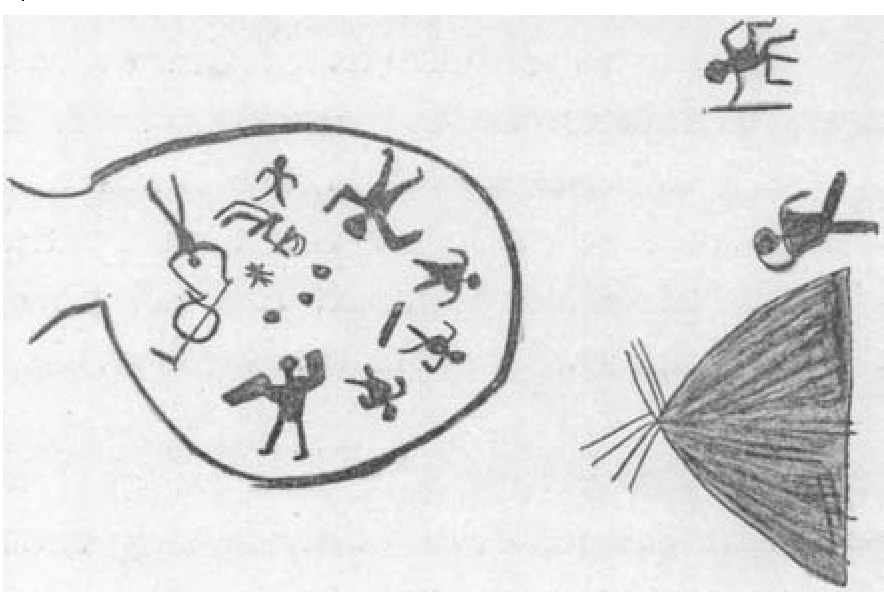
The outdoor ceremonial (naˊrgɪn-mñêˊɪrg̣ɪn) is performed also outdoors within a circle formed by a long line spread on the ground near the house. The sketch Fig. 268, copied from a native drawing, represents the outdoor ceremonial. A family is performing it on a spot encircled by a long leather line. Three round vessels and a long tray are on the ground. A fire-board is standing between two reindeer-heads. A man is beating the drum. Two women are dancing. Four children are looking on. A man is looking on from outside. Two other men stay near the house. One, who has a stick, is sitting on a stool.
Some families arrange this sort of a ceremonial at a distance from the village, choosing for it an even spot on a ledge of rock. I know cases where the ceremonial was performed within the space between the four poles of whalebone which were left from[391]🗗uncollated a half-destroyed boat-support (see Plate XXXIV, Fig 3). In other cases the ceremonial was performed near the so-called “bone [pole] stuck in” (aᵋmɪˊnpɪn),¹ which in some villages represents a kind of votive place of which I shall speak later. Thus, for instance, in the village of Čeˊčin, two or even three families join in performing the so-called “neighbors’ ceremonial” near the bone pole of the village.
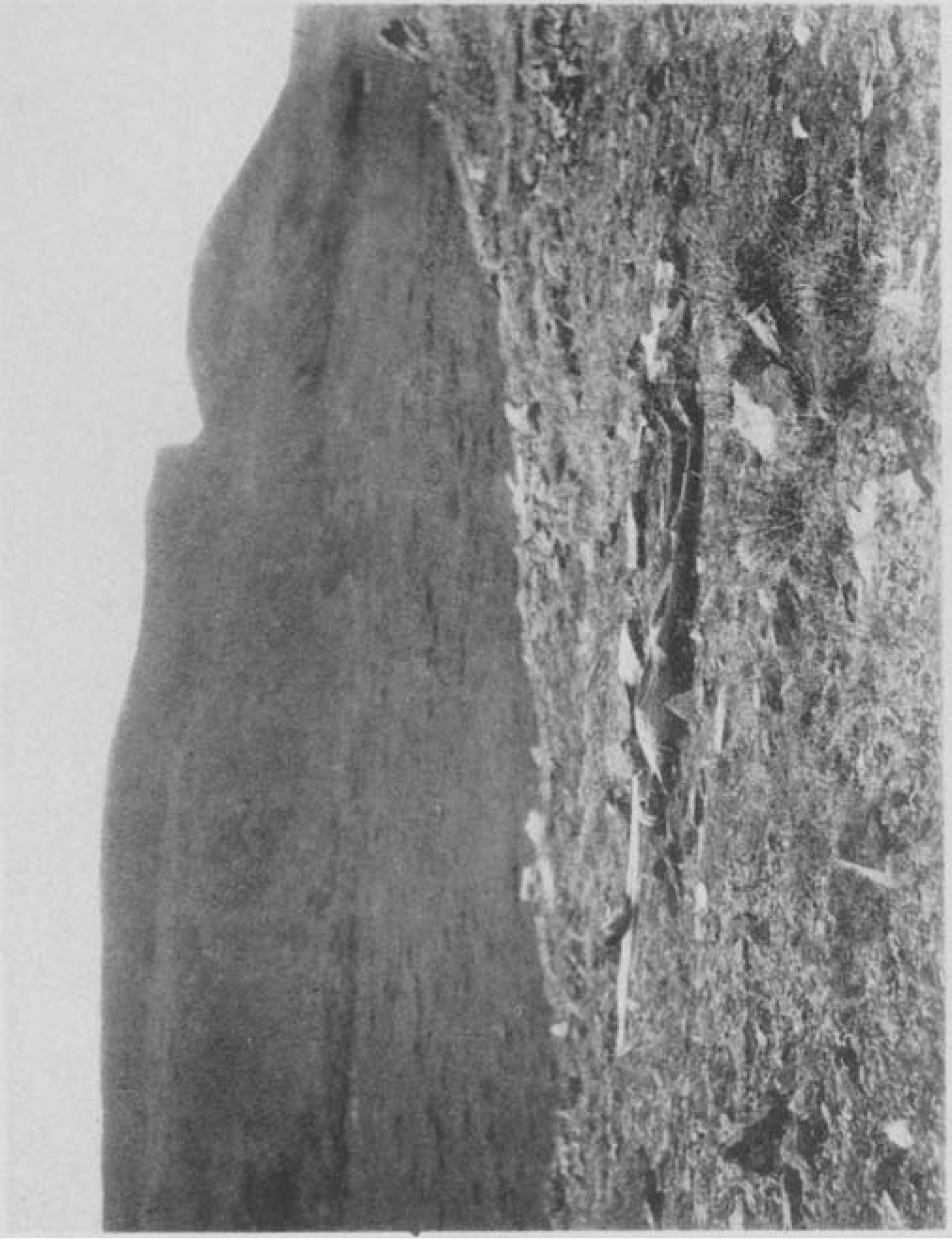
For this they pitch light temporary tents on three sides of the bone pole. The place for the sacrifice is arranged in the middle, at the foot of the pole. Here each family deposits the heads of their game, while a couple of heads are suspended from the pole. I had no opportunity to witness a ceremonial of this kind; but the native drawing (Fig. 269) will give a fair idea of the whole arrangement.
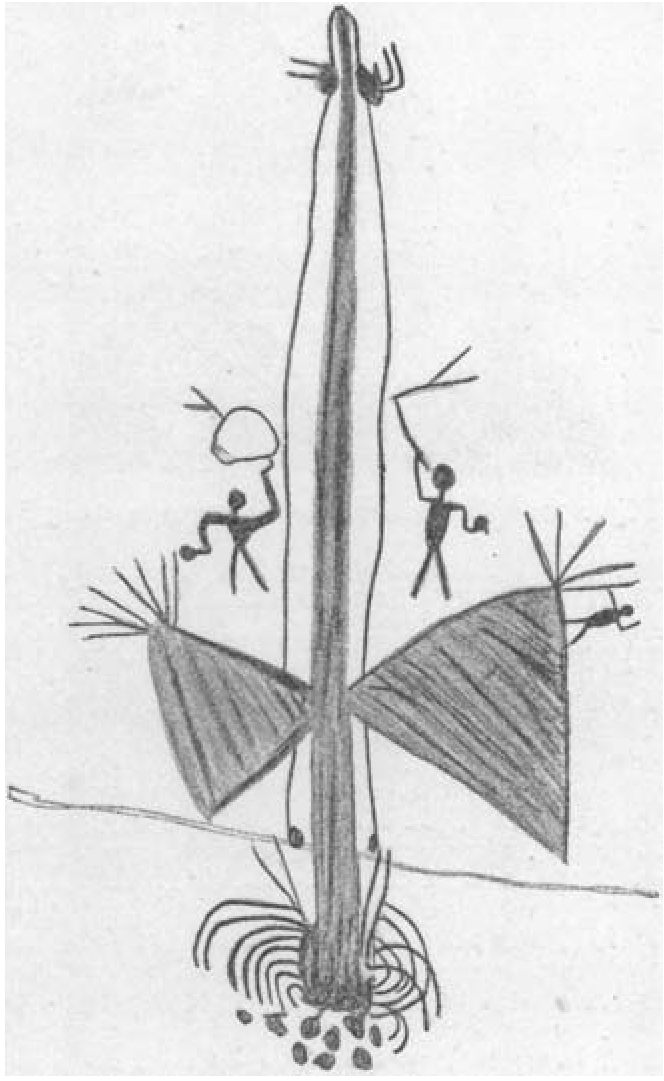
It represents two tents pitched at the foot of the bone pole for the ceremonial. As the population of the village of Čeˊčin is evidently descended from the reindeer-breeding camps, heads of reindeer play a considerable part in the arrangement. Thus, from the top of the pole are suspended two heads, one of reindeer, the other of walrus. Most of the heads lying on the ground are of reindeer; the others are of walrus and of seal. One person is standing on the top of his tent, pronouncing incantations; two others are standing on the ground near the pole. Each of them holds a sacrificial vessel, and in addition one holds a drum with a stick; the other, a drum-stick ornamented with red tassels.
The last-described ceremonials — such as that of the spear and of the spear house, the outdoor and the neighbors’ ceremonials — are observed also by the reindeer-breeders, at least in the camps on the Chukchee Peninsula and along the Pacific coast more to the south. But with the reindeer-breeders they are connected with no particular season, and may be arranged at any time, as well as all other thanksgiving ceremonials.
I was told that in ancient times the “spear ceremonial” was performed before starting on a war expedition; but I am not quite sure if this is not a modern interpretation. The “peltry ceremonial” is in vogue among both branches of Chukchee and also among the Asiatic Eskimo. The details are as usual. The peltries destined for sale, which accordingly are hung around[392]🗗uncollated on tightly drawn ropes, appear as the object of the ceremony. A ceremonial of this kind is usually performed before starting on a trading-expedition.
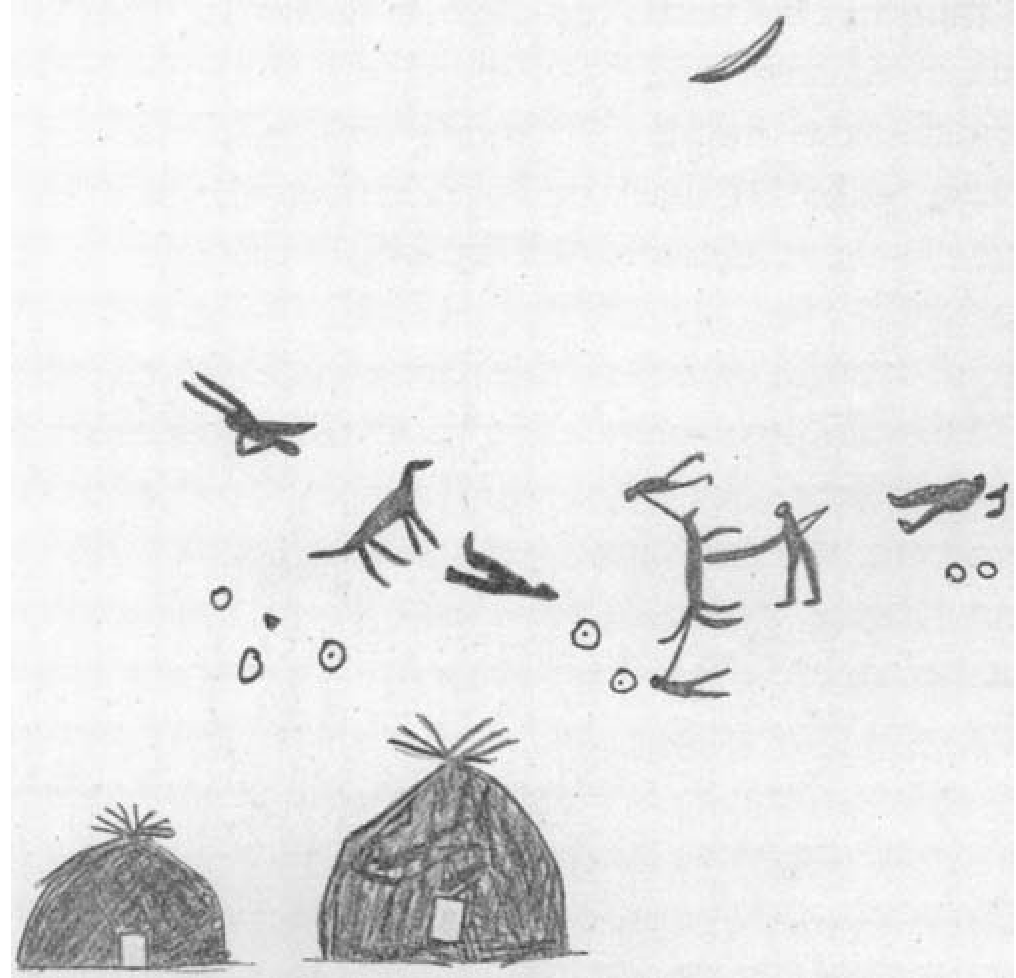
Some Maritime families bring sacrifices also to the new moon, as was described for the Reindeer people. The drawing Fig. 270 represents such a sacrifice. People are slaughtering a dog. Numerous vessels with food are standing on the ground. I was told, however, that the people who brought the sacrifice were the “people of spell.”¹ The other dog in the drawing is also a “dog of spell,” made of human excrement.
Ceremonial of Kereˊtkun. — The ceremonial of Kereˊtkun is more complicated, and lasts two, three, and even five days (or as many nights, the natives are wont to say) for each family. In some villages, for instances in Nuˊnlig̣ren, the ceremonial of Kereˊtkun alternates with that of his “assistant” every five years. The term of five years or days is mentioned also in connection with other ceremonials and rites.² The ceremonial of the “assistant” is much more simple, and lasts only over night. The details of it are similar to those of the “genuine thanksgiving.”
As a general rule, the performance of the ceremonial of Kereˊtkun varies greatly, according to the degree of wealth of the performers. The poorer families observe it in a very hurried way, and the performance rarely continues longer than one night; while with the richer families it lasts several days, and is an important event for the whole neighborhood. The reason for this difference is pre-eminently the fact that large quantities of food are necessary for its celebration.
This rule is applicable to all important ceremonials of the Maritime people. Only the richer people — the boat-owners, those who have had good success in the hunt — arrange great feasts that last several days, and attract numerous guests. The feasts of the richer families must not occur simultaneously, but so that the nearest neighbors at least can visit them all, each in turn. The time for the ceremonials of the poorer people is of no consideration. They may take place on any day, by threes or fours, and no[393]🗗uncollated one will notice it. On St. Lawrence Island the poorer people do not perform the ceremonials at all, but leave this duty wholly to the rich boat-owners.
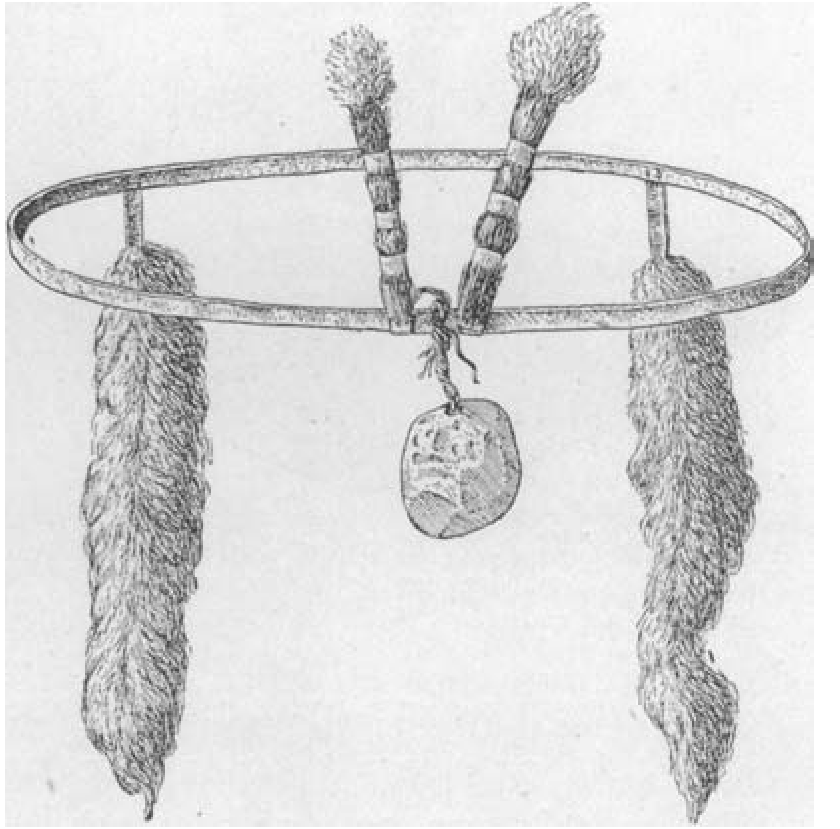
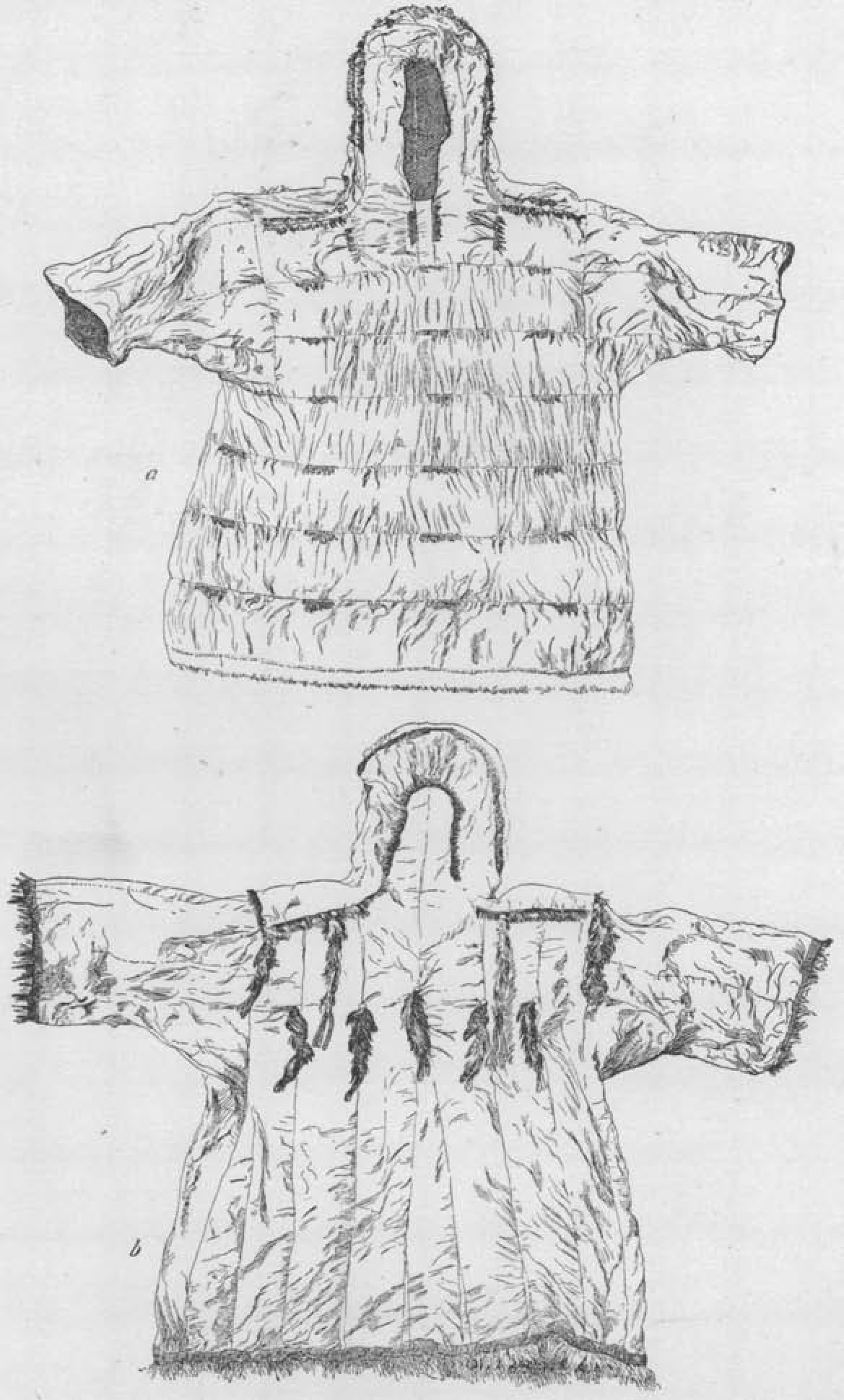
The essentials of the ceremonial are as follows. All the members of the family, down to the smallest children, must put on light overcoats made of dried seal-guts.¹ The reason given for this is that Kereˊtkun and his wife are dressed in such overcoats. On the Pacific coast, overcoats of this kind are prepared only by the Eskimo, the best and the prettiest of which come from St. Lawrence Island: therefore the Chukchee have to buy such overcoats from an “alien” tribe, which may imply that the whole ceremonial is of Eskimo provenience. It must not be forgotten, however, that in the “thanksgiving ceremonials” of the Chukchee, the overcoats are considered as quite necessary, at least for the women. The master and the mistress put on special head-gear (Fig. 271), which also is said to be imitated from Kereˊtkun and his wife. Another essential appurtenance of the ceremonial is the so-called “Kereˊtkun’s net,” which is made of sinew, and suspended from the vent-hole of the house. A special pole is often used for its support. This is set in the centre of the house, and the upper end projects through the vent-hole, similarly to that used in the “spear ceremonial.” Sometimes there are three poles with their ends crossing in the vent-hole, resembling the three principal poles of the Chukchee tent.
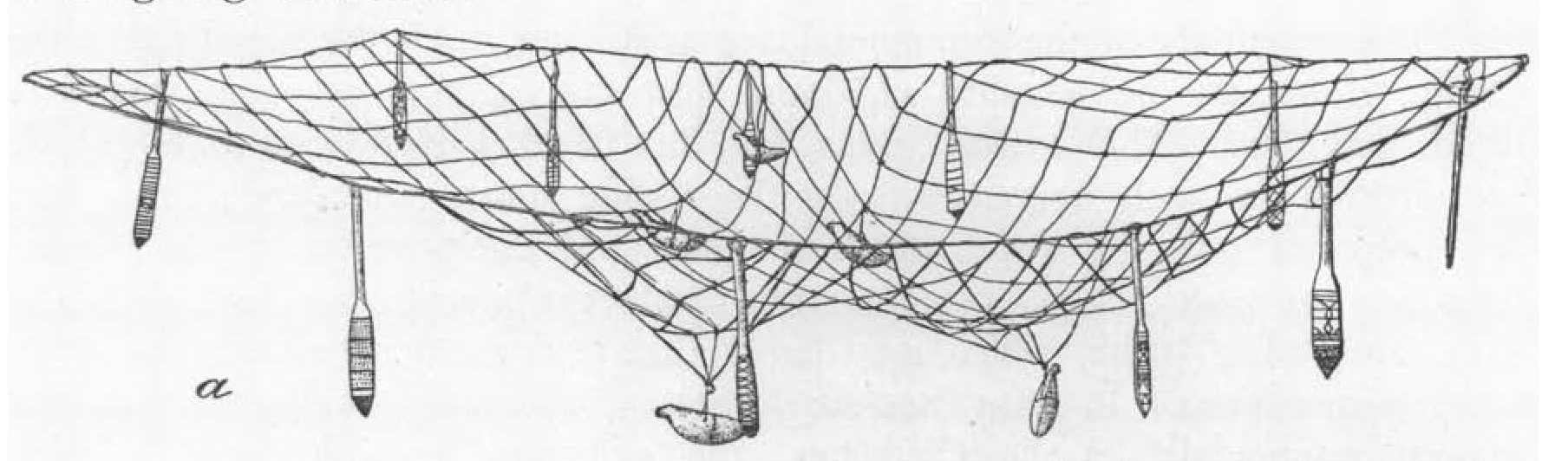
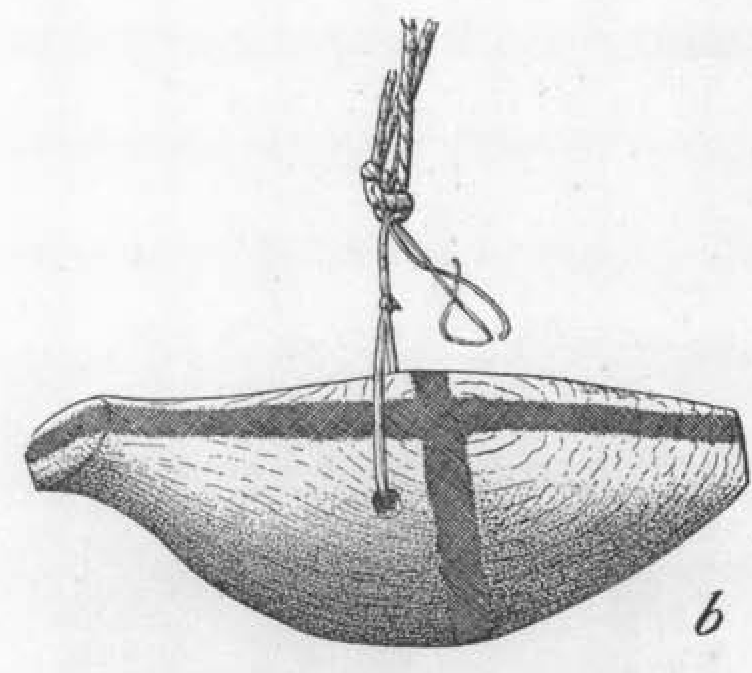
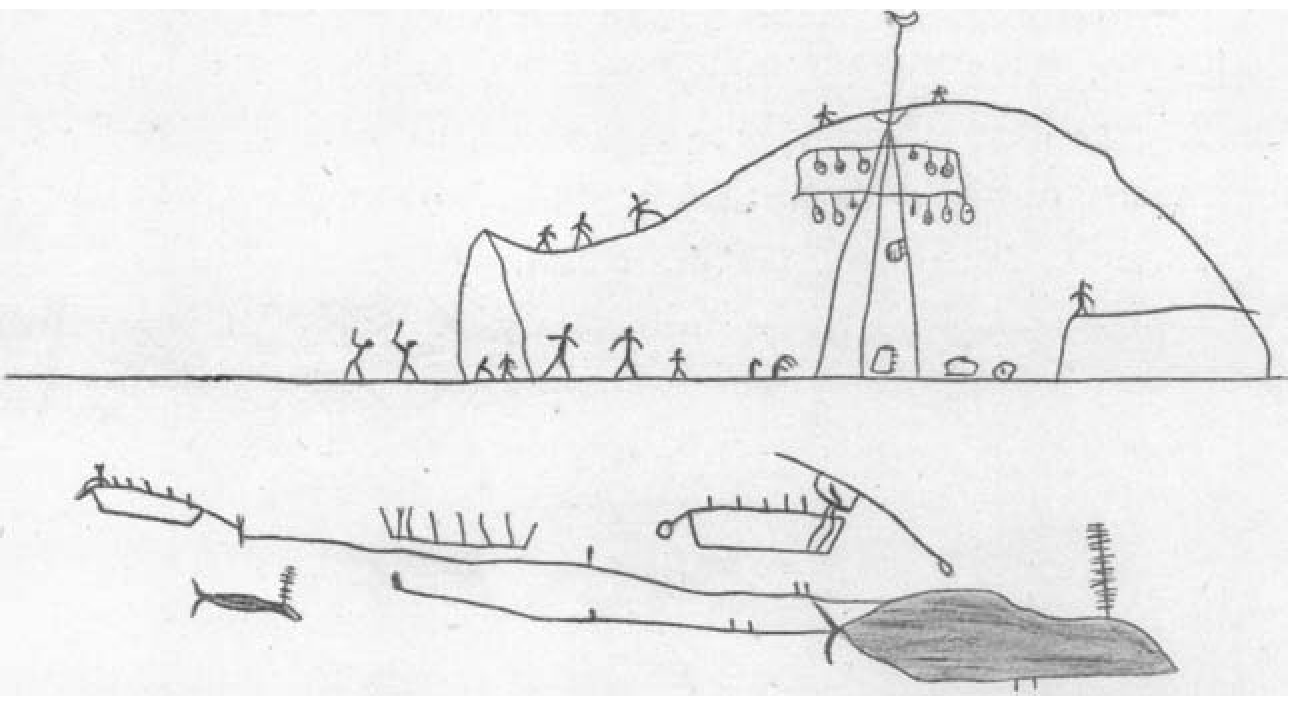
The net Fig. 272, a, is spread out horizontally, and each corner of it is fastened with strings to the sides of the house. All around the net are suspended images of birds and small toy paddles, painted ornamentally with seal-blood. The number of the paddles is about a dozen; the number of birds is considerably less. The birds (Fig. 272, b) are made of wood, clumsily enough, and are adorned with stripes of seal-blood painting. Their wings are represented either by two cross-lines or by two feathers stuck into cracks in the wood in the proper places (see Fig. 280). The birds represent probably sea-gulls; at least, the heads of sea-gulls figure in the boat-charms of the Maritime Chukchee. A similar net figures in the fall ceremonial of the Eskimo of St. Lawrence Island. It is spread on a wooden frame made of small[394]🗗uncollated paddles, with the bodies of four sea-gulls carefully preserved for the purpose.¹ A few heads of walrus or seal are put on the ground as in the “genuine thanksgiving ceremonial.” Fig. 273, copied from a native drawing, represents the ceremonial of Kereˊtkun in the house of a Maritime Chukchee. A pole protruding through the vent-hole supports a wooden image of a gull. The net with paddles and gulls is suspended in the middle. Two walrus-heads are lying on the ground. A lamp is fastened to the pole, and another lamp stands on the ground. Two sacrificial vessels stand on the right side. A man standing on the top of the sleeping-room pronounces an incantation. Two other men, before the entrance, are also pronouncing incantations. In this they point upwards wooden drum-sticks, which they have in their hands. A number of men are walking on the roof of the house, in order, as I was told, to cover the vent-hole. Other men inside are walking or sitting. The dance has not yet begun. On the lower part of the drawing a whale-hunt is represented.
A paddle of large size is used in the ceremonial of Kereˊtkun, and is intended to carry a painted prayer. Therefore it is called “incantation paddle.” A real paddle may be used for that purpose, or even a narrow plank shaped like the blade of a paddle.
The collections of the Museum contain several paddles with painted prayers destined for the ceremonial of Kereˊtkun. All of them represent various game and hunting-scenes of ordinary character. On each end of the paddle is often placed a spread net, or drawn bow pointed at the game, thus indicating the desire of the artist to capture all those animals. The painting[395]🗗uncollated is not infrequently done with considerable skill, and the style is similar to that of the etchings on ivory executed by the American Eskimo. Etchings are scarce in Asia, and those that I had an opportunity to observe are comparatively poor specimens of art. In some other paintings, however, the work is more clumsily done, and the style less pronounced, in accordance with the inferior skill of the maker.
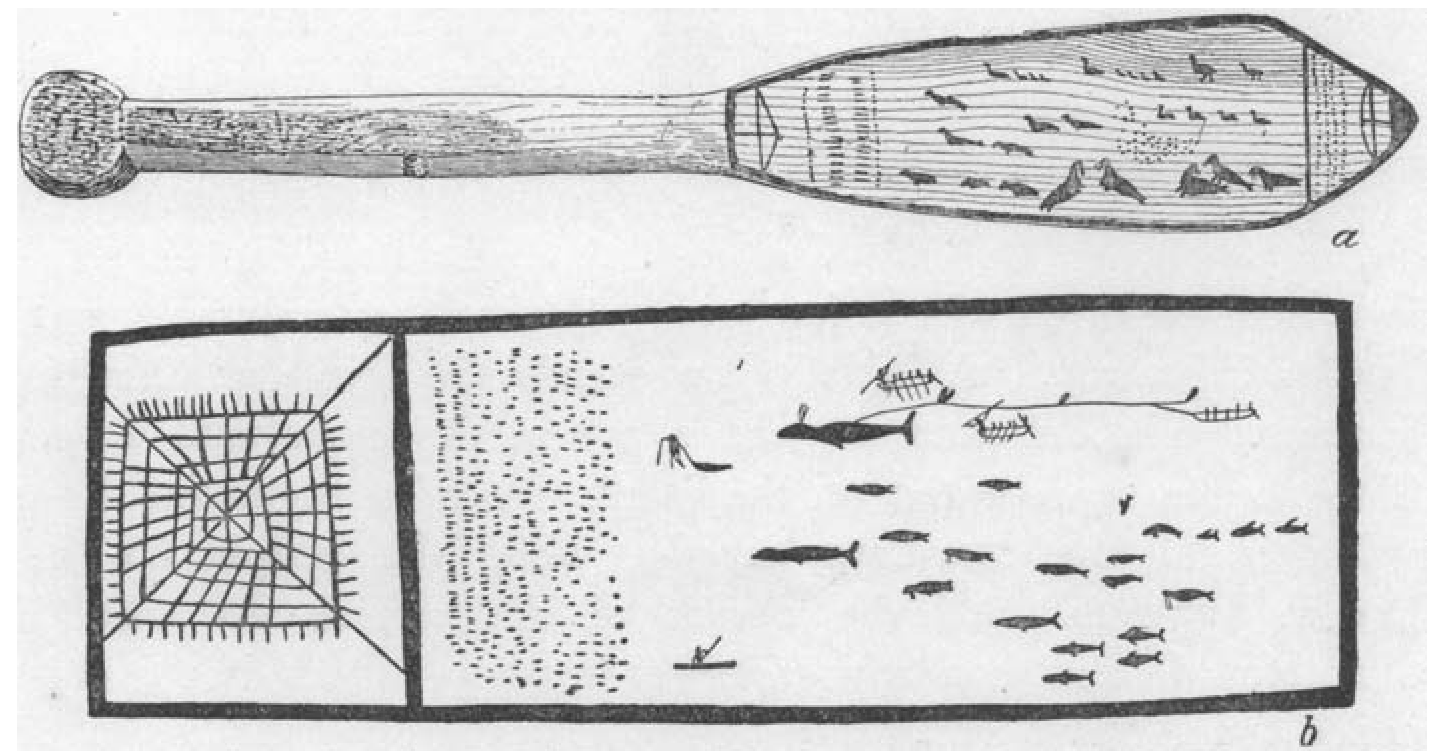
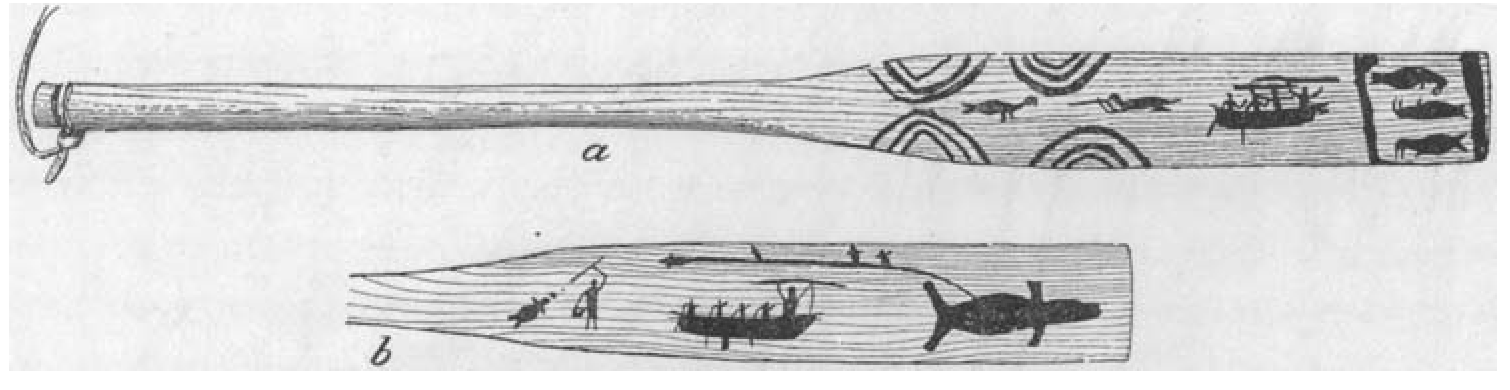
Fig. 274, a, represents a painted paddle from Mariinsky Post. It has on each end a drawn bow. In the middle, three large shoals of fish, flocks of various sea-fowl, seal, and walrus are arranged somewhat symmetrically. A plank of the same provenience (Fig. 274, b) has a large seal-net spread on one end. A big shoal of fish and all kinds of game are represented moving towards the net. Killer-whales are charging a group of walruses. According to the explanation by the natives, they want to drive them into the net. Three boats are pursuing a whale. A man is dragging a seal, and[396]🗗uncollated another one is paddling on a kayak. The part played by killer-whales is illustrated in a native sketch given before,¹ where killer-whales make a similar attack on a shoal of walrusses, while another killer-whale asks the paddlers of a boat for a little tobacco. The native artist evidently wished to represent the killer-whales as friendly to men, and as helping them in their hunt in exchange for a small sacrifice. The supernatural rôle ascribed to the killer-whale has been discussed previously. Fig. 275 is from the village of Nuˊnlig̣ren. It is painted on both sides. The painting represents hunting-scenes. In one a man is shooting a seal with a rifle. The seal is surrounded by rough ice represented in four big heaps made by several concentric circular lines.
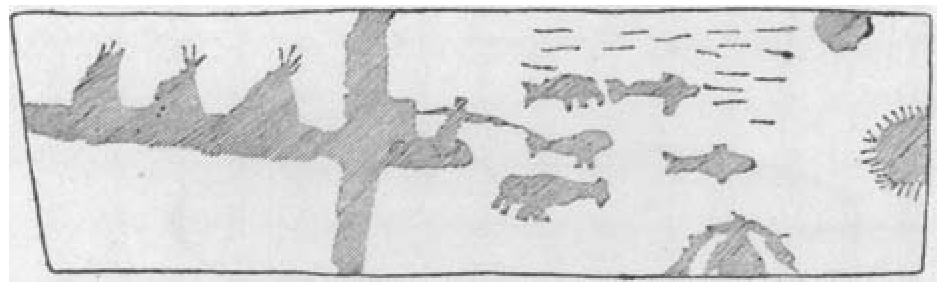
The plank represented in Fig. 276 is from the village of Chikaˊyeva, on the Middle Anadyr. It was used by a family which trace their origin to one of the maritime villages, and therefore perform Kereˊtkun ceremonials; while most of the other families in small villages on the Middle Anadyr follow the rites of the reindeer-breeders. The painting is clumsily executed, and represents a group of houses on the seashore. A man standing on the shore is hauling in a seal captured with a harpoon. Several sea-mammals and a polar bear are swimming away. A little below stands the figure of Kereˊtkun, with very long arms. The sun and the moon are in the right-hand corner of the plank. The houses represented on the plank are of the genuine house type, evidently houses of the Maritime people; while the people on the Middle Anadyr live in log-huts. All the details of the picture are also maritime, and have nothing in common with reindeer-hunting, which is the chief source of subsistence for Anadyr villagers.

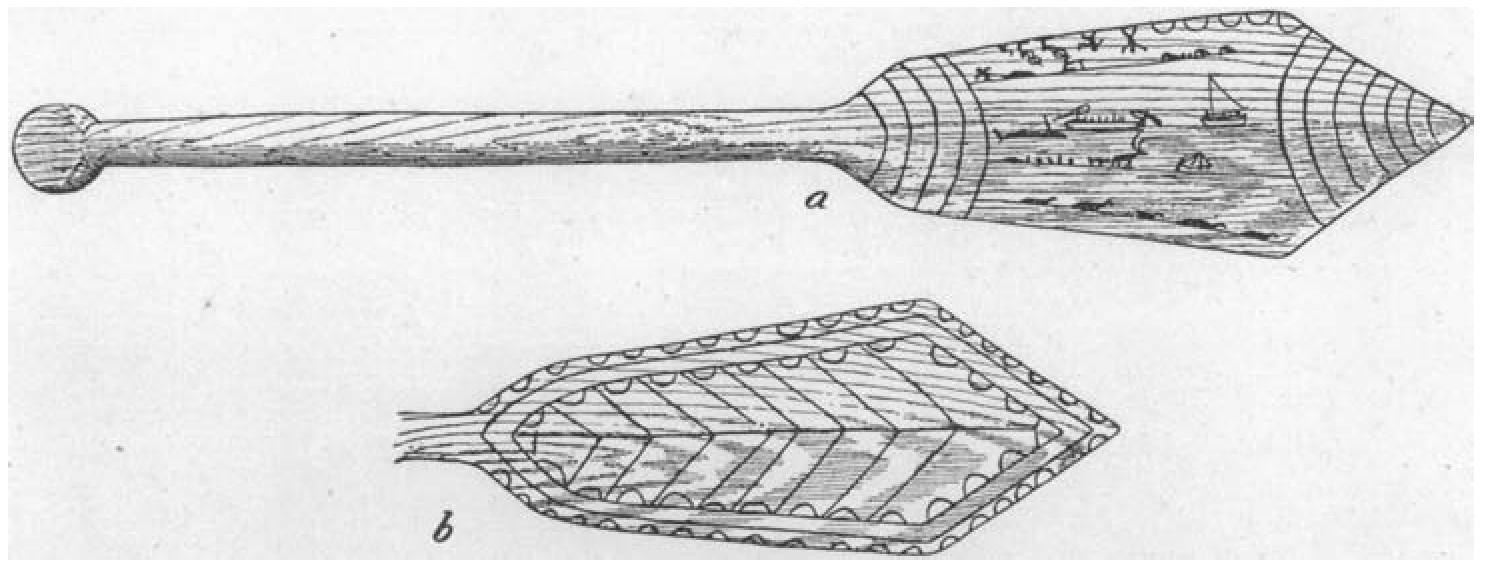
The painting copied on Fig. 277, a, which comes from the Eskimo of Indian Point, represents, on the contrary, land-game, reindeer, wolves, and foxes. One boat and two kayaks are pursuing them, probably in water. The family which used this plank was considered, however, as a true Maritime[397]🗗uncollated family. Another paddle from Indian Point (Fig. 278) represents sea-game and various hunting-scenes. At the top of the picture (Fig. 278, a) a group of men are practising shamanism. Two of them are beating the drum, and two others are performing a ceremonial dance. This evidently signifies magic influence on the sea-game, to draw it to the shore. Both ends of the picture are supplied with several semicircular lines, which probably represent conventionalized bows, though the natives were not able to tell anything about the matter. The other side of the paddle-blade (Fig. 278, b) is ornamented with a pattern of straight lines and small semicircles, in the style of the Eskimo.
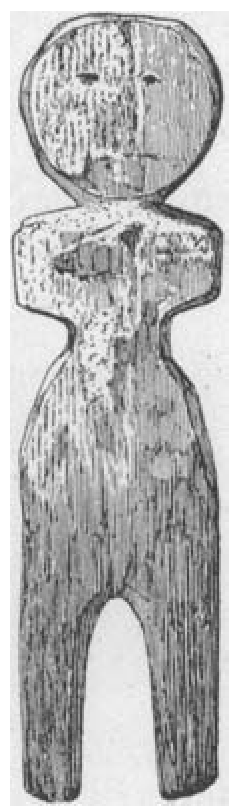
The whole performance of the Kereˊtkun ceremonial in the village of Nuˊnlig̣ren lasts three days, and with most families is carried out with the following details. On the first day, in the morning, the outer tent is carefully swept, and a net with appurtenances is suspended above. On both sides of the hearth are spread reindeer-skins, which represent two inner rooms. The place for Kereˊtkun is either on one of these skins, or inside of the real sleeping-room. A big lamp filled with the choicest oil is lighted, and placed accordingly in either of the indicated places. Kereˊtkun is supposed to enter, and, taking his place on the lamp, to wait for the sacrifice. He is represented by a small wooden image (Fig. 279), which is put on the lamp, and remains there till the end of the ceremonial. Opposite the lamp, on a small patch of bare ground scraped clean for the purpose, a small fire, which has a special name (“piˊntᴇ”), is built. This fire is supposed to be the place where[398]🗗uncollated Kereˊtkun desires to accept the sacrifice: therefore it is kept up all the time, from early in the morning until late in the evening. Small chips of wood, bones, and blubber, serve for fuel. The Asiatic Eskimo substitute for the fire another big lamp; or they sacrifice to Kereˊtkun on the lamp where he has taken his place. This difference is significant, as the lamp in the place of the hearth, is better adapted to the woodless tundra and to arctic maritime life than the hearth of the Chukchee ceremonial.
Quantities of pudding made of edible roots and stalks mixed with oil and liver are considered necessary for the ceremonial. We find the same feature in the ceremonies of the Reindeer Chukchee, the Koryak, and, formerly, in those of the Kamchadal, who declared that Kutq was exceedingly fond of pudding.
Families of friends and relatives take part in preparing the necessary pudding, and their women come every morning to the house where the celebration is going on, bringing a new supply. The guests gather a little later, and each woman brings a vessel in which she receives part to take home. Besides the pudding, all kinds of food are distributed in profusion to those assembled, and considerable time is used in eating and in drinking tea.
The first day of the ceremonial is considered as belonging to the inmates of the house, who beat the drum, sing their tunes, and prepare ceremonial dances in a way similar to that of the Reindeer Chukchee. The drummers are men, who stand in the usual place, — on the outer side of the hearth, facing the sleeping-room. The dancers, who are women, stand on the inner side of the hearth, facing the entrance. All the participants are singing, each his own tune. Some of the people have small whistles of wood or goose-quill, by means of which, from time to time, they send forth a short, shrill sound (see Fig. 281). This is done mainly by the children of the family, who have to skip around the hearth.
The second day belongs to the guests, and particularly to the shamans, who have to show, in turn, their skill in drumming and singing.
The third day belongs to the women, who act both as drummers and dancers. The drummers stand in the usual place of the men, — on the outer side of the hearth, facing the sleeping-room; and the dancers, in the usual place of the women, — on the inner side of the hearth, facing the entrance. All this is similar, even in the minor details, to the customs of the Reindeer people in the fall ceremonial and the “thanksgiving.” A new detail is that of a night-watch, which must be kept for the sake of Kereˊtkun, who is supposed to stay in the house all the time. This watch is kept by an old man or woman. A shaman is often invited especially for this purpose, and at the end of the watch he receives a coil of new thong in pay for his services. During his watch he sits on a whale’s vertebra which is used as a stool, with his back toward the entrance, and with his face toward the[399]🗗uncollated hearth. All this time he sings, and beats the drum, but in a subdued key in order not to awaken the supernatural guest slumbering on the lamp. The last night a woman occupies the stool, and keeps the watch.
On the last evening, meat of a whole reindeer is cooked in a big kettle suspended over several lamps, one of which is the lamp on which Kereˊtkun is placed. The cooked meat is distributed among the guests, who carry their shares home. Even comparatively poor families take care to reserve for the ceremonial a reindeer-carcass, either from their hunt or from the provisions bought from reindeer-breeders.
The image of Kereˊtkun is burned over his lamp. Then the whole house is carefully swept. The rubbish, stray hair, etc., are gathered together, as well as the crumbs of sacrifice from Kereˊtkun’s lamp and from the small fire, and then they are thrown into the sea. This is considered as returning to the sea all the game killed up to the time of the ceremonial. The same act is performed also in the other method of celebrating the fall ceremonial, the “genuine thanksgiving,” and, indeed, in almost all ceremonials of the Maritime Chukchee, especially in the “ceremonial of heads” of midsummer and in the “ceremonial of the whale.”
Exchanging of Presents. — In many villages, on the second day, the so-called “exchanging of presents” (čukêˊɪrg̣ɪn) takes place. It is performed with different details in various places. In the most common method, the female guests gather at the entrance of the sleeping-room, bringing all kinds of household things, which they thrust under the fold of the skin wall, and loudly demand the thing they want. The mistress must immediately take the offered object, and replace it with that required by the guest. Sometimes the objects offered and demanded are of no value whatever; for instance, an old woman will bring a piece of old skin, and ask in exchange for a lamp-support. This is done because the exchange is considered a part of the ceremonial and a special sign of friendliness on the part of the guests. On the other hand, if a guest asks for something of great value, it must be delivered promptly and without demur. If the mistress has not the desired object, she must borrow it from her neighbors in order to satisfy the guest. After the present has been delivered, the people standing by have the right, each in turn, to ask for it. To refuse it is unbecoming; and a desirable object may change owners two or three times before it is carried away from the house.
In some places young children are sent instead of grown persons. They come in, shout to the mistress, and say, “Do not refuse! So-and-so asks for such-and-such a thing.” The mistress gives the required object, exclaiming, “Ta ha! ta ha!” After that she has the right to send her own child immediately to ask for an equivalent. In most cases, however, she will wait till the observance of the ceremonial by the other party, when she will seize this opportunity to obtain an equivalent of her gift.
[400]🗗uncollatedThis method resembles that of the Pacific Koryak, where the young people cover their faces with wooden masks and go from house to house, asking in pantomime for various things. The givers have the right either to send their children immediately for an equivalent, or to wait till the next ceremonial, when their young people may, in their turn, ask for presents.
On St. Lawrence Island, young boys and girls arrange themselves in small processions, which go from house to house, dancing, and asking for gifts, mostly of food. This is done some time in winter and has no connection with the regular ceremonials, and the practice strongly resembles the customs of the Pacific Koryak as described above.
I must also mention that a similar performance has been in favor among the Russians from very remote times. In the first days of Christmastide, at dusk, young persons of both sexes go from house to house, singing, dancing, and asking for presents. They bedeck themselves in fantastic attire, and wear masks. The songs are called “koliada,” and the whole performance is thought by ethnographists to be a remnant of a winter ceremonial of Russian Slavs in honor of the deity Koliada. This name is associated with the Roman calends. Be this as it may, the same practice is found also in northeastern Siberia, among the cossacks and Russian creoles; for instance, in the Russian villages of the Kolyma, Anadyr, and Kamchatka, and even among the Russianized natives in the same localities. It must be assumed, however, that the performances of the Koryak and St. Lawrence Eskimo are quite independent, notwithstanding their resemblance to those of the Russians.
In arctic Chukchee villages the exchange is often arranged in the following manner. On the first day of the ceremonial, at the height of the drumming and singing, every guest who desires something belonging to the master must strike his left palm with his right fist, and exclaim, “I see such-and-such a thing!” The master must immediately give it away; and after the ceremonial is finished, he may ask for an equivalent. Should the thing asked for be something of exceeding great value, the master may refuse the demand, lifting his right thumb to his throat, and exclaiming, “I would (rather) cut my throat!” This, however, is considered a great offence, and may even lead to bloody vengeance.
Many families arrange the exchange between relatives only, and especially between those joined by the bond of compound marriage, literally “wife-companions” (ñew-tuˊmg̣ɪt). A man sends his wife to another man with whom he is connected by such a bond to ask for certain wares, and after a while the other man sends his wife to ask for an equivalent.
The Trading-Dance. — This brings us to another variety of the ceremonial exchange, which may be called “trading-dance.” It is performed during the second day of the ceremonial by couples, a man and a woman each, who are connected by the bond of compound marriage. Frequently the man looks[401]🗗uncollated on only, while the woman dances before him. He must provide a reindeer-skin, however, to spread on the ground under her feet while she is dancing. While the dance is being performed, the other dancers remain quiet, and look on together with the spectators. After the dance, the man must give some present to the woman; and the following night they sleep together, leaving their respective mates to arrange matters between themselves. On the next day, the husband of the woman, and the wife of the man, perform a similar dance, in which the man gives an equivalent of the present of the day before; and each newly-mated couple sleeps together for another night. Such dances are arranged chiefly among cousins or other relatives, who, among the Chukchee, frequently assume the bond of compound marriage. Conversely, a new bond of compound marriage may be concluded through a trading-dance. This is closely analogous to the customs of the Alaskan Eskimo as described by Nelson;¹ but with the Chukchee an exchange of wives leads, as a rule, to the lasting bond of compound marriage, or to what is so called. So often is this the case, that even the women who mix with the sailors from whaling-ships consider them their husbands by compound marriage. Among the Chukchee, clandestine intercourse with another man’s wife is called by the same name. When the affair first comes to the knowledge of the husband, a quarrel may ensue; but an amicable adjustment is soon brought about by a bond of compound marriage.
CEREMONIALS OF ASIATIC ESKIMO. Ceremonial of Kaˊcak. — Among the Asiatic Eskimo the ceremonial of the winter is connected in most villages, not with Kereˊtkun, but with the Big-Woman. Some families in the villages Wuteˊen and Iˊwtun, however, connect the ceremonial with Kereˊtkun, who is called by them Kaˊcak. The name of Kaˊcak as identical with Kereˊtkun is known also in Uñiˊsak and on St. Lawrence Island. In Uñiˊsak, some families are said to perform a simple “genuine thanksgiving” ceremonial analogous to that of the Maritime Chukchee. The ceremonial of Kaˊcak or of Big-Woman is performed with the same details as that of Kereˊtkun among the Chukchee. Even the net, the wooden birds, and the painted paddles² are of exactly the same character. The differences have already been referred. The most important of them is the complete replacement of the ceremonial fire by the lamp.
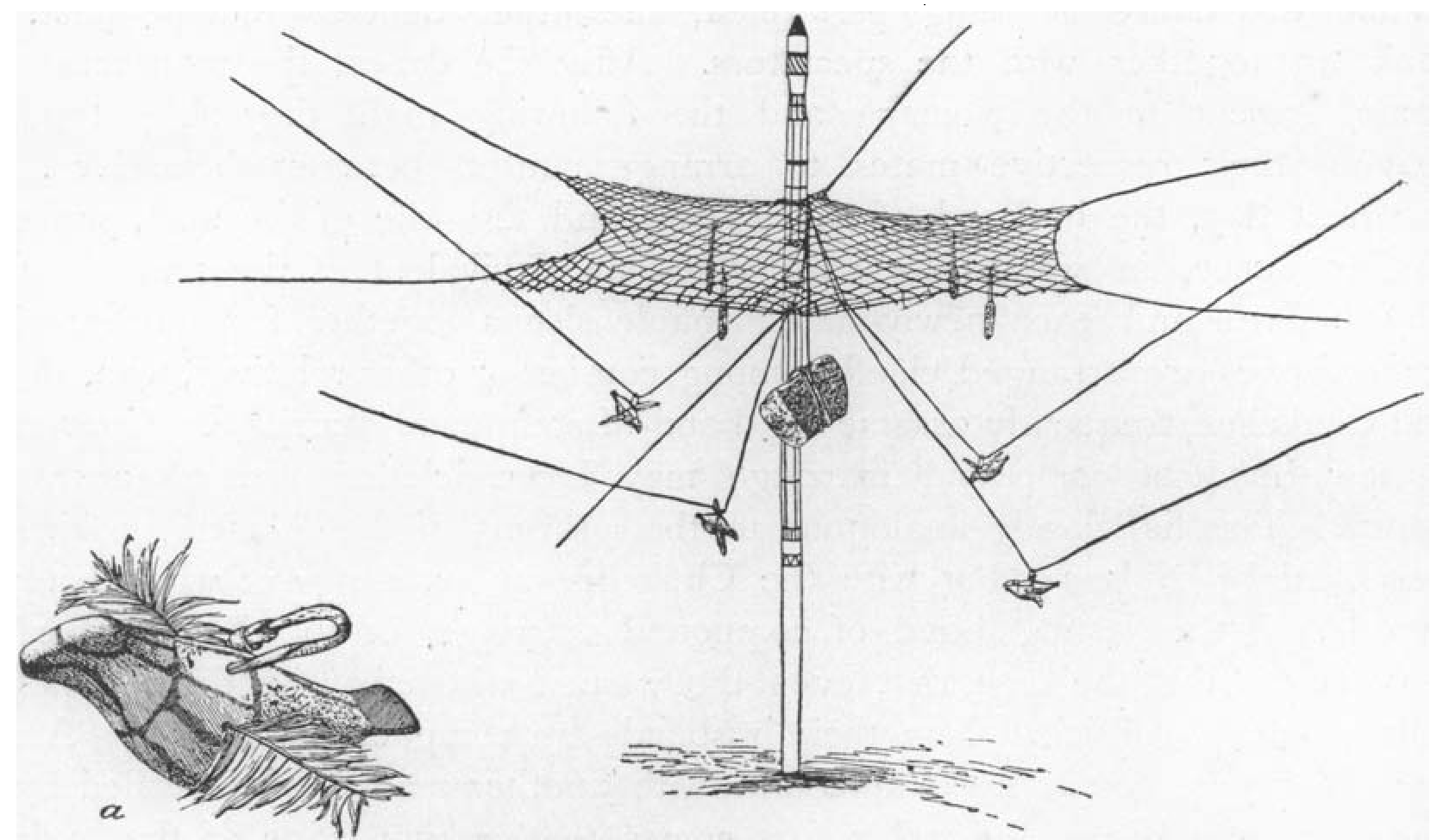
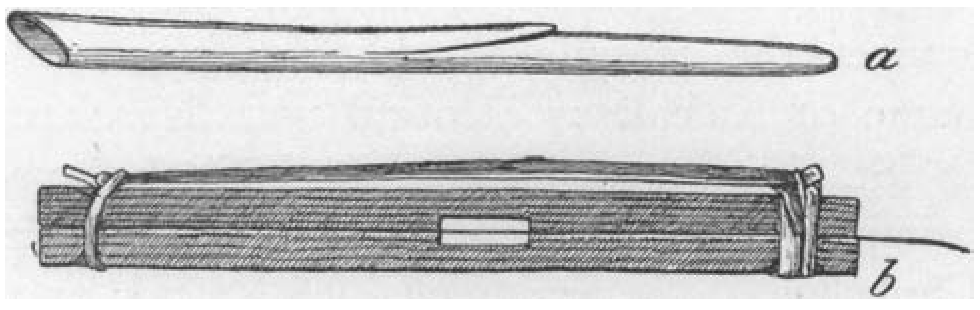
Eider-Duck Ceremonial. — There is also the so-called “eider-duck ceremonial,” in which, besides the usual net with wooden sea-gulls, is a net (Fig. 280) supported by a long pole painted over with patterns of straight lines. Wooden images of eider-ducks (Fig. 280, a), which, however, do not differ markedly from the sea-gulls mentioned before, may move on a special loop along separate lines of leather. Each line is held by one person, who,[402]🗗uncollated by a simple jerk of the hand, may make the bird soar aloft or descend the line. Very simple whistles (Fig. 281) made of goose-quill or of wood, with a thin tongue of whalebone, are used to produce from time to time a shrill sound, which is called the “eider-duck’s voice.” As said before, these whistles are used by the Eskimo and the Chukchee also in the usual form of the ceremonial; but my informants asserted that they were specially connected with the eider-duck ceremonial. I found whistles quite similar in shape to Fig. 281 among the collections at Washington, D.C. One of them (Cat. No. 7457) is marked “Fort Anderson, R. MacFarlane,” and belongs to the Central Eskimo. Two other whistles, probably from the same region, are without any mark. Nelson, however, does not mention the use of such whistles among the natives of Alaska.
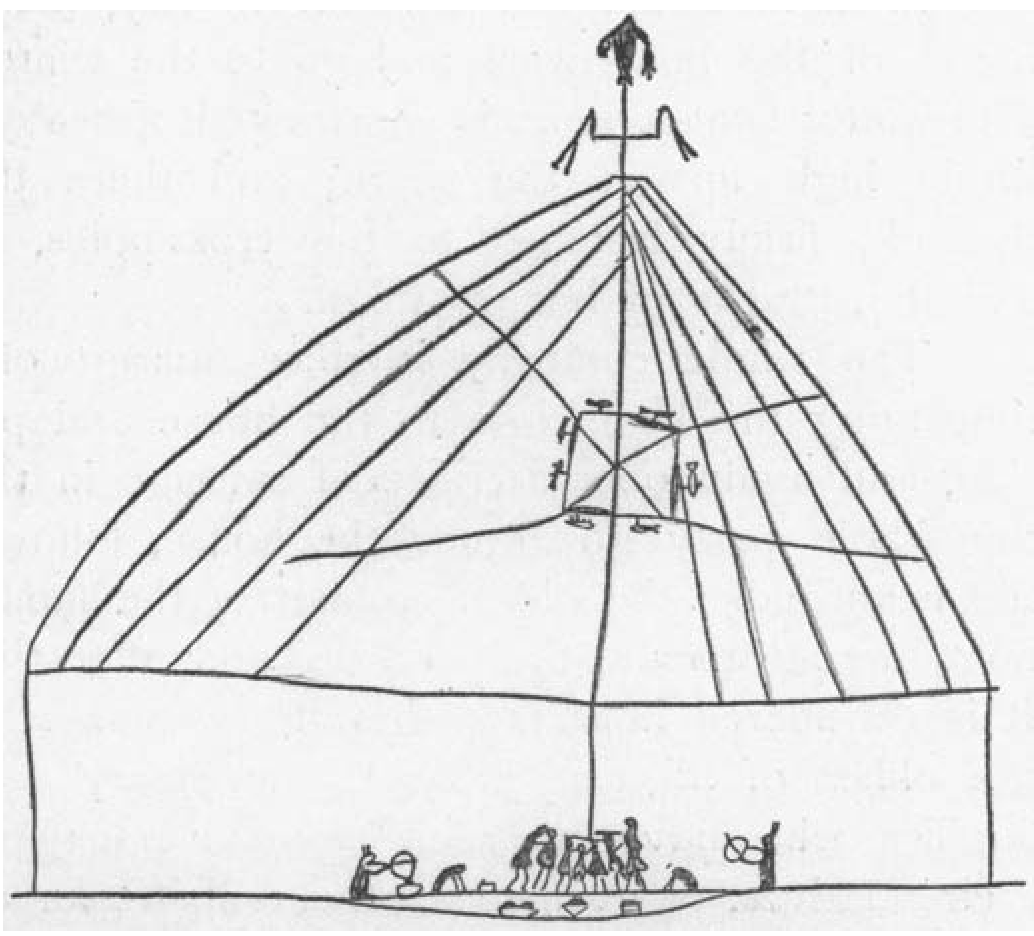
Ceremonial of Going-Around. — Another ceremonial encountered among the Asiatic Eskimo is the so-called “ceremonial of going-around,” which is considered as a kind of thanksgiving ceremonial. A native drawing (Fig. 282) represents the celebration of it in an Eskimo house. A long pole is fixed in the middle of the house, the upper end of which protrudes from the vent-hole. On it are two double tassels and a seal-skin float, to the flippers of which are fastened the pelt of a fox and an iron kettle. A[403]🗗uncollated square frame made of paddles surmounted by several wooden images of manned boats and whales is suspended halfway up the pole. A wooden wheel is fastened to the base of the pole, by means of which people may turn the pole with the frame. Several walrus-heads represent the object of the thanksgiving. The wheel is turned around as quickly as possible, and in the direction of the sun’s course, by people of both sexes; while several other persons beat the drum. All sing various tunes of their own choice. At last those turning the wheel stop; and the men, still running in the same direction, begin to seize women from all over the house. Every man has the right to sleep that night with the woman he has caught. The similarity of all this to the customs of the Alaskan Eskimo is very striking.¹
Other varieties of this ceremonial extant among the Asiatic Eskimo, in which wheels, images of whales and of manned boats, also figure, will be described in a separate publication.
Dance of Exchange. — The dance of exchange occurs also among the Asiatic Eskimo and the inhabitants of St. Lawrence Island. Besides being connected with the usual ceremonials, it may be arranged independently. Among the Asiatic Eskimo, the woman performs the dance, wearing only her loin-breeches; but the man is clad as usual. On St. Lawrence Island, the man puts on a head-band resembling that worn by the Chukchee in the ceremonial of Kereˊtkun; while the woman wears very short breeches of old-fashioned cut. These were in former times a part of the usual female dress of all Asiatic Eskimo. Further details will be given in a special publication treating of the Asiatic Eskimo.
Ceremonial of Boats. — The ceremonial of boats takes place early in spring, in the third or fourth month of the Chukchee year.² It is performed only by the families of boat-owners. The members of the crew and the older members of their families take part in the ceremonial, while the younger people stay at home. The ceremonial is performed by each company separately, with considerable variation, especially from village to village, as to the[404]🗗uncollated day of the observance, according to the time when the sea becomes navigable along different parts of the coast-line.
In the morning of the chosen day, men and women gather before the house of the boat-owner and go to the winter boat-support to get the boat. The winter boat-support is constructed of heavy pieces of bone of whale planted firmly high up on the shore; and there the boat rests the whole winter through, firmly fastened to the cross-poles, and protected from snowstorms and the attacks of hungry foxes.
The whole company sacrifice sausage of reindeer-meat to the sea; then they bring the boat close to the house and put it on the ground, on its west side, and again offer sacrifice of sausage in the “direction” of the sea. Then the whole party go around the house, following the course of the sun. At the head walks the oldest woman of the family, then follow the owner of the boat, the steersman, the paddlers, and after them come the other participants. It is considered important that the woman who walks in front shall really be the oldest of all, and know the necessary details of the ceremony: therefore families who have no such woman among their housemates often send to their relatives, or even to another village, for one. Old men, on the contrary, are not considered necessary for the ceremonial.
After the procession is arranged, it enters the house, and the people take their places around and begin singing their tunes. The singing, accompanied with dancing and beating the drum, lasts several hours, and ends with a shamanistic performance in the evening. On the next morning the boat is taken back to the sea and put on the summer support, which stands close to the water. This latter is of slight build, and made of wood; and it may be carried from place to place, according to the needs of the landing. The floats of the boat are taken along and placed within. On the next morning the participants in the ceremony bring to the shore a great amout of food. This is distributed among the guests, who, with their housemates and women, come by boat-loads. A sacrifice is offered to the sea, and then the boat is launched to try the first course of the year, which is necessarily short, and conducted with caution.
On the morning of the night when the boat is still lying at the side of the house, there is performed a divination with lumps of tallow which were left for the night in the boat. By the cracks found in them the people try to divine whether the boat will have good luck in the pursuits of the next season, especially in regard to the whale and the polar bear. Cracks resembling marks left by scratching with nails foretell good fortune and prosperity. Cracks resembling marks left by touching with the finger-tips augur bad luck and even death. Divination with tallow is used by the Maritime Chukchee on other occasions also. In the fall, when the boat is taken to the winter supports, the Chukchee do not perform any particular ceremonial, arguing that the great ceremonial of the fall answers for all such purposes.
[405]🗗uncollatedCeremonial of Heads. — Early in summer, as soon as the catch of the seals on the drifting ice is finished, the ceremonial of heads takes place. This, likewise, is performed by the boat-owners with the participation of the crew, and the details have many points of resemblance to the ceremonial of wild reindeer-heads among the Reindeer Chukchee.¹ It is even called by the same name, ênatčɪˊɪrg̣ɪn.
The heads of the walrus and of the thong-seal are the only ones stored for this ceremonial, while of the smaller seals only a couple or so are taken for the exhibition. When walrus-heads are scarce, the ceremonial is considered very poor, and even of no importance. In the morning of the day, all the heads are brought from the blubber-hole, and exposed on the skins in the middle of the house. A large lamp, placed on a flat stone, stands with them; and a little at one side a small piˊntᴇ fire² is arranged, which is wanting in the ceremonial of the Asiatic Eskimo. All kinds of “alien” food — sausage, reindeer-tallow, tobacco, flour — are produced for the sacrifice and put near the heads. Then the old woman presiding over the ceremonial sits down before the heads and begins to sing, one by one, the tunes of the family; while the male members of the family go around the heads, exclaiming, “Yoho, yoho!” in the usual manner. The old woman feeds the lamp, and keeps up the fire; while the men, with plates filled with provisions, go out to offer sacrifice to all the directions, beginning, as usual, with the morning dawn, then passing to the zenith, to the nadir, and after that to the other “directions.”
The other members of the crew stay in the house and are the onlookers. When those who performed the sacrifice are returning, the largest walrus-head is tied up with a long rope, which all the men grasp, pretending to haul in the captured walrus. This symbolizes a successful catch for the future. The old woman gives of the provisions which served for the sacrifice to the women present, who, as said before, are the oldest representatives of the families of the crew.
The ceremonial dance is performed in the usual way. A man with the drum stands on the outer side of the group of heads, having his back turned to the entrance; while the women dancers stand opposite to him, on the inner side of the heads. The movements of the dancers are of the usual character; that is, they make a short courtesy, then stand erect and turn their bodies to the right and to the left, all the while never stepping aside from their place. Among the Asiatic Eskimo, however, this dance alternates from time to time with a more active form, in which the dancer performs a series of jumps, swinging violently both his arms over his head. This latter variety of dance is, however, considered an imitation of the dance of the natives of St. Lawrence Island and Alaska. A dance like this is often performed on the spur[406]🗗uncollated of the moment by young men or boys for the amusement of spectators, and without reference to the ceremonials; then it is called the dance of the “opposite-shore people,” or the dance of the “large mouthed.”¹
In the ceremonial described (Plate XXXII, Fig. 4) all those present, down to the very small children, have to perform some exercise on the drum; while the women and the younger boys appear in turn as dancers. Then a feast follows, in which the men eat freely of the raw meat of walrus-heads, slicing it off with their knives. The ivory of the walrus and the remainder of the meat are divided among all the members of the crew, in accordance with the usual rules, which will be spoken of in the third part of this work.
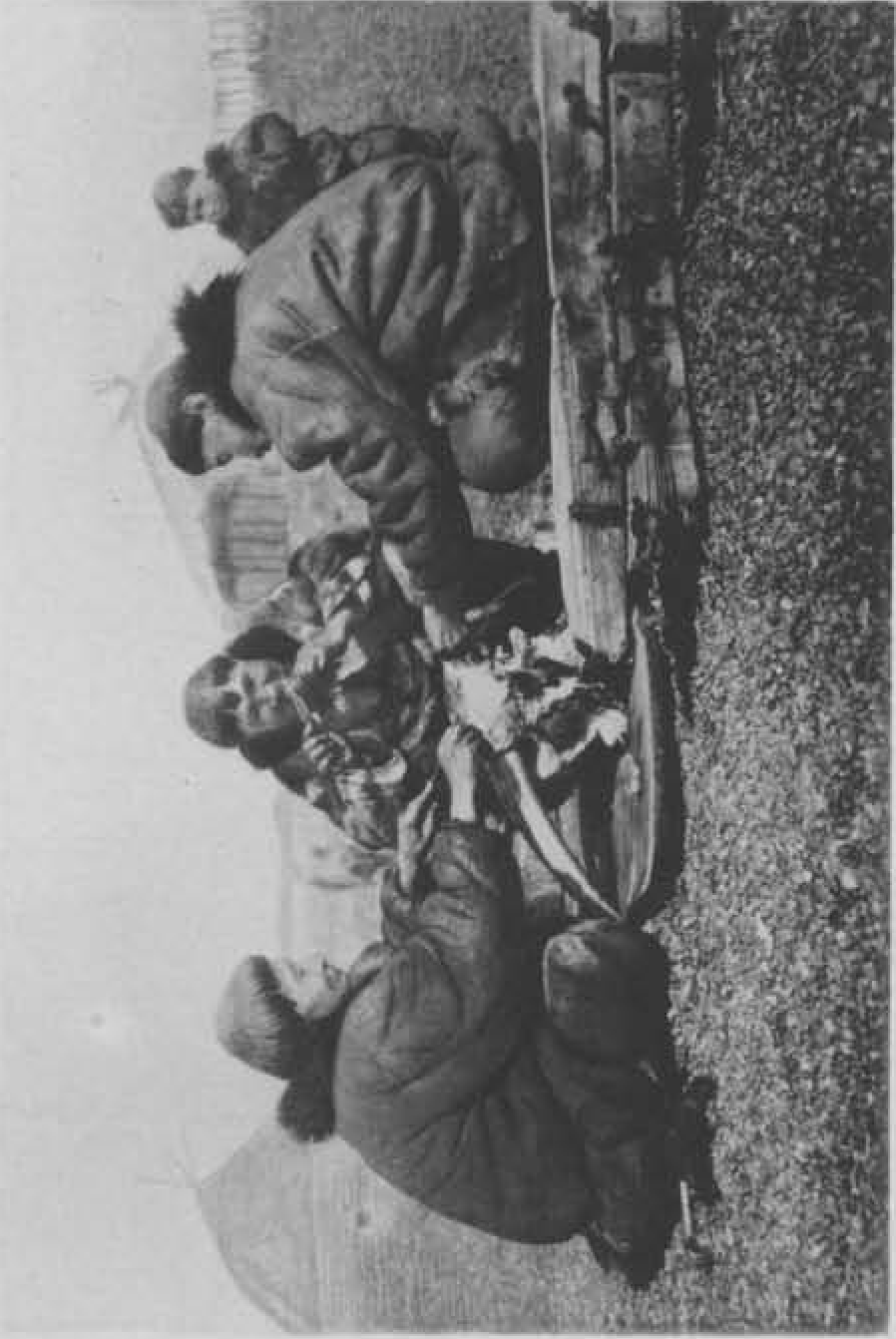
At the end of the ceremonial, all of the participants, particularly the women and children, shake off, over the big lamp, all diseases to which they may be liable, and, in general, their bad luck. The lamp, however, is covered with a wooden plank to protect the fire from contamination. The particles of rubbish, and especially the hair which has fallen from the fur clothes down on the plank, are picked up and burned, together with the plank, in a separate fire. The ashes of the fire are afterward carefully collected, and carried out of the house to be left in the wilderness. The bones and crumbs of the feast are gathered up and thrown into the sea to send back the animals, as was described before.
Sacrifice to the Fire. — The pitching of the summer tent, which takes place shortly after the ceremonial of the heads, is accompanied by a simple sacrifice thrown into a small fire built up before the entrance of the tent. This sacrifice is still more simple than the corresponding one of the Reindeer Chukchee.
Sacrifice to Pehiˊttin. — I mentioned that the sacrifice to the star Pehiˊttin and the ceremonial of antlers are performed also by the Maritime Chukchee. The sacrifice to Pehiˊttin has no features peculiar to the Maritime Chukchee.
Ceremonial of Antlers. — The ceremony of antlers (kiˊlvei) is performed with boughs, which are gathered in a heap on the place of sacrifice, behind the house. Then a fire is arranged and sacrificed to with tallow or meat. Those who have a few reindeer, with some reindeer-breeding friend, take care to have a few antlers on the top of their heap of boughs. Only those Asiatic Eskimo who have succeeded in acquiring reindeer-herds² celebrate this ceremonial. These, as remarked before, consider themselves obliged to perform all the ceremonials connected with reindeer-breeding life; at least, to the same extent as do their neighbors of Maritime Chukchee origin.
Whale Ceremonial. — The ceremonial of the whale is performed any time that a whale is killed by any of the villagers. On the Pacific shore, where polar bears are scarce, a ceremonial similar to that of the whale is[407]🗗uncollated performed over killed bears, both of which, of course, belong to the thanksgiving festivals. The essential features are as follows.
The boats that took part in the hunt pass around the carcass while it is still in the water, following the direction of the sun’s course. The owners of the boats exclaim, “Yoho, yoho!” the usual cry at the Chukchee ceremonials. When the carcass is landed on the shore, another procession is formed, which likewise passes around the animal. The owner of the boat from which the whale received the fatal stroke heads this procession, and after him comes the man who gave the death-blow to the whale. All the men who chance to be on shore during the landing take part in the parade, and each one exclaims, “Yoho, yoho!” Then the women appear and join in the procession, which passes again around the carcass. The women repeat incantations having for their aim the conciliation of the whale and the acquisition of his influence in inciting his mates to come to the shore in future.
After that the general carving of the meat follows, in which the inhabitants of all neighboring villages and camps may take part, if they arrive in season to do so. Meanwhile, however, the women comprising the household of the owner of the boat from which the whale was killed cut bits from the ends of his flippers, his nose, and both lips. They take also his eyes and some of the shortest whalebone, not good for sale, and they chop besides a few pieces from the longer bone. All these are placed on a skin, and are supposed to represent the whole of the whale.
The skin with the scraps on it is brought up to the house, where “the whale” is “given a drink” before the entrance; that is, it receives a libation of warm water, as is usual with larger game. Sacrifice is also offered to it with sausage and reindeer-meat. Then the skin and the particles are carried inside the house and put on the roof of the sleeping-room, near its front.
In the case of a bear the carcass is skinned; but the head, the neck, and the shoulders are left with the skin. This receives a “drink” before the entrance, and a sacrifice of sausage, and then is brought into the house and into the sleeping-room, where it is put on the master’s side and in the place of honor.
A big lamp burns all the time near the symbolized game; also a piˊntᴇ fire, which figures in all the ceremonials of the Chukchee. The “whale” and the “bear” remain in their respective places five days and nights, and all this time the most careful attention is lavished on them. Men and women make them presents of their bead necklaces, which are hung over the “bear’s” neck, or laid at the side of the “whale.” They receive frequent libations of water, and sacrifices of various meats; and neither of them is left alone for a moment in the house. The natives say, “The guest will feel lonely.” Every kind of loud noise is forbidden, lest “the guest should be awakened from his repose.” All the drums are hung in the outer tent, near the entrance;[408]🗗uncollated and if, perchance, a loud sound is occasionally given forth by one of them, it is immediately beaten lightly with the drum-stick, as if in punishment. The children, likewise, must not cry or be boisterous; and, should any of them be noisy, a drum is immediately beaten lightly in expiation of the “uncivil behavior toward the guest.”¹
After the five days, the head of the polar bear is cooked in a big kettle, and then a feast is arranged, to which all the neighbors are invited. The meat of the head must be entirely eaten.
An analogous custom in regard to the brown bear is found among the Lamut. The meat of this likewise must be boiled all at once and eaten by the neighbors of the hunter gathered for the feast, without reserving any for the future.
A feast, accompanied with a ceremonial dance and shamanistic performances both by day and by night, is also arranged for a whale. After the feast, all the crumbs, stray hair, etc., are gathered and thrown into the sea, which act restores the killed whale to life and to the sea.

The eyes of the bear and the whale are pierced; and the viscous fluid from them, mixed with soot, is used for painting the paddles of the boat in a special manner (Fig. 283). This painting lasts some time, until it wears off by use. The pupils of the eyes are wrapped in leather and then joined together in pairs, and added to the string of amulets belonging to the boat. Hunters who are fortunate in the pursuit of the whale often have a whole string of pairs of pupils so wrapped up. The man who gave the last stroke, if this happens to be his first whale or bear, has the skin near all his joints pierced with the tattooing-needle, leaving a simple but indelible mark. With the Eskimo of the Diomede Islands, the killer of the whale has on his face, near the upper lip, a simple dot marked with the tattooing-needle for each animal killed. Some of the luckiest hunters have two lines of dots extending across both cheeks, — a visible enumeration of the number of animals actually killed by them.
In some of the villages, the family of the chief hunter, after a successful hunt of the whale, arrange for a thanksgiving ceremonial at the time of the new moon in every month. This lasts during the whole season, for four or five consecutive months. On St. Lawrence Island, the successful hunter of the whale offers during the ceremonial a sacrifice of the hair of his head, which is thrown into the fire of the hearth, and is said to be directed to the giver of whales.
The Koryak ceremonial of the whale has many points of similarity to[409]🗗uncollated that of the Chukchee.¹ Even for the less important game, the Koryak arrange ceremonials with details closely resembling some of those described. Thus, in the Pacific Koryak and Kerek villages, the carcass of a killed fox is brought into the house and deposited near the fire. The master says, “Let the guest warm himself. When he feels warm, we will free him from his overcoat.” In the mean time the placing of the carcass near the fire has a very real purpose. As foxes are killed almost exclusively in winter, the carcass is always frozen, and it must be thawed out before it can be skinned. In due time the fox is skinned. Two broad strips of long, soft grass, which grows on the seashore, are wrapped around the bare carcass. One strip serves as a belt; the other, as a boa. The mouth of the carcass is filled with fish-eggs. The mistress gashes the flesh in several places, and puts into the cuts more fish-eggs or dried meat, pretending that the cuts are pockets of the fox, which she wants to fill with provisions. Then the carcass is carried out of the house, and the people say, “Go and tell your friends that it is good to visit yonder house. Instead of my old coat, they gave me a new one still warmer and with longer hair. I have eaten my fill, and had my pockets well stored. You, too, go and visit them.” It is believed by the natives that any neglect of this ceremonial will destroy all chance of further luck in hunting foxes.
Jochelson² gives details of a ceremony among the Koryak of the Okhotsk shore very similar to those relating to the fox-carcass. Steller³ mentions almost identical practices among the Kamchadal. In the ceremonial arranged after a successful hunt of the bear, when the bear-meat is cooked and eaten, the master brings in the head of the bear, adorns it with grass, hangs around it bits of various meats, and then asks the bear not to be angry with the hunters, because the last stroke was given by the Russians. He also asks him to inform his relatives of this, that they may come to the same place without any misgivings, etc.
Krasheninnikoff also mentions⁴ similar details in the Kamchadal ceremonial of seal-heads. The heads, he says, are fed with pudding. A large stone is deposited on the floor of the hut, which symbolizes the sea, and it is surrounded with smaller ones, which represent the pebbles on the shore. The seals are dragged upon these stones to give them an idea that it is very agreeable to visit the Kamchadal huts, where even the sea is surrounded with pebbles. In doing this, the people cry, “Come oftener! we feel dull without you.” Krasheninnikoff also mentions⁵ that the natives of Alutora, in their whale ceremonial, carry a wooden image of a whale to the seashore, exclaiming, “The whale is gone to the sea!”
[410]🗗uncollatedI must mention also a special performance of the walrus-hunt, which is performed without preparation, and generally on the last day of the great winter ceremonial. In this the men and the women sit down opposite each other, in two rows, and beat their palms, exclaiming, “Ha, ha, ha!” The men, from time to time, swing their arms, as if brandishing an imaginary spear.
I had no opportunity to witness a performance of this kind, which is considered by the people as having the character of a play or a dance. Among the Kamchadal, not more than forty years ago, there were observed various performances of a similar character, in which the hunting of the whale, the wolf, and the bear, was represented. Krasheninnikoff mentions such performances in even earlier times. He had the good-fortune to witness them in several villages. In modern times these performances have been thoroughly Russianized, and blended with popular dramatic performances of the cossacks, brought by them from Russia. I had an opportunity of witnessing a performance of such a kind in the village of Tighil. It represented a trip of cossack pirates in a boat, and was almost devoid of local features.
Tossing on Walrus-Hide. — The “tossing on walrus-hide” forms among the Maritime Chukchee, and especially among the Asiatic Eskimo, an extra ceremonial (Plate XXXIII, Fig. 3), which is arranged in early or middle summer in order to ward off danger from contagious diseases or to assuage too long and violent tempests. The “tossing on the walrus-hide” is considered akin to the races, and the family who arrange the ceremonial are called simply “racers” or “masters of the race” (ireˊlɪt).
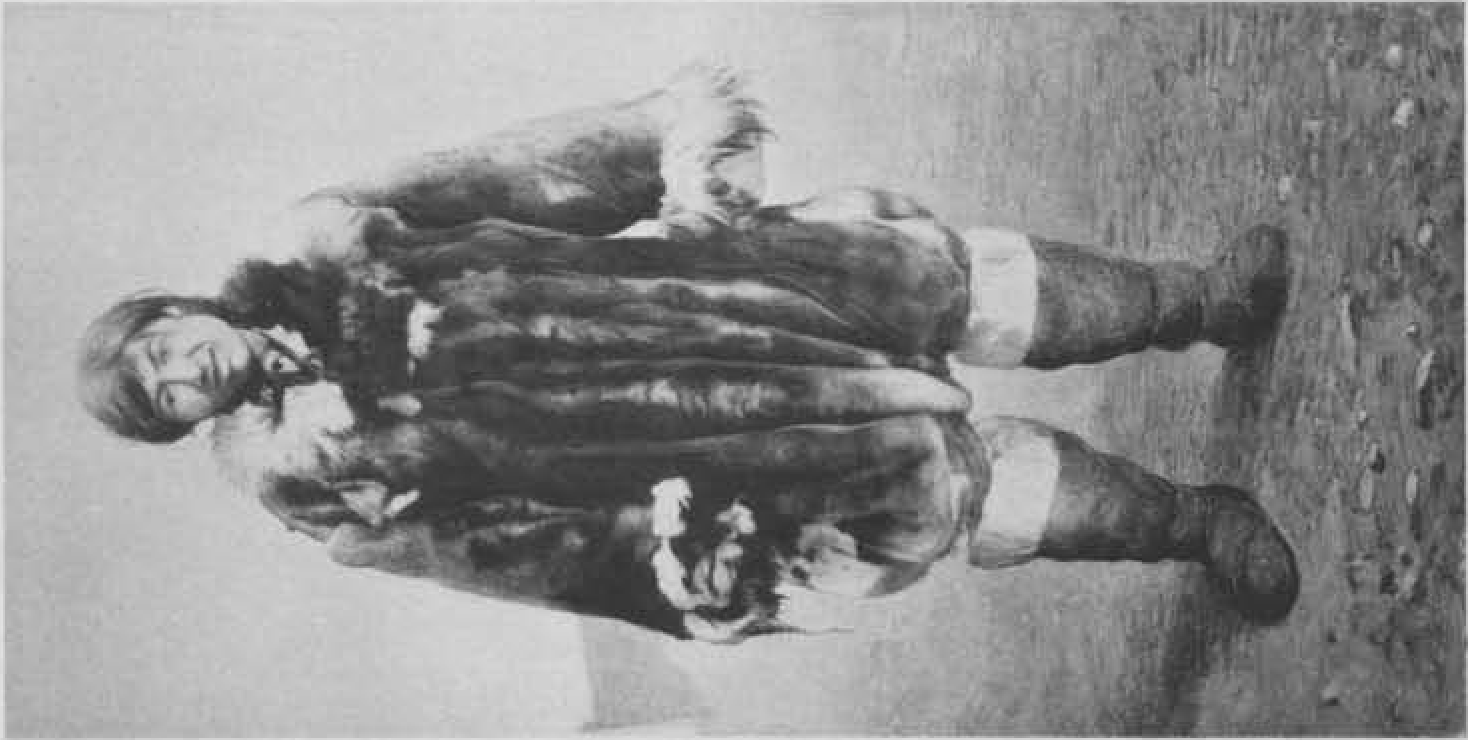
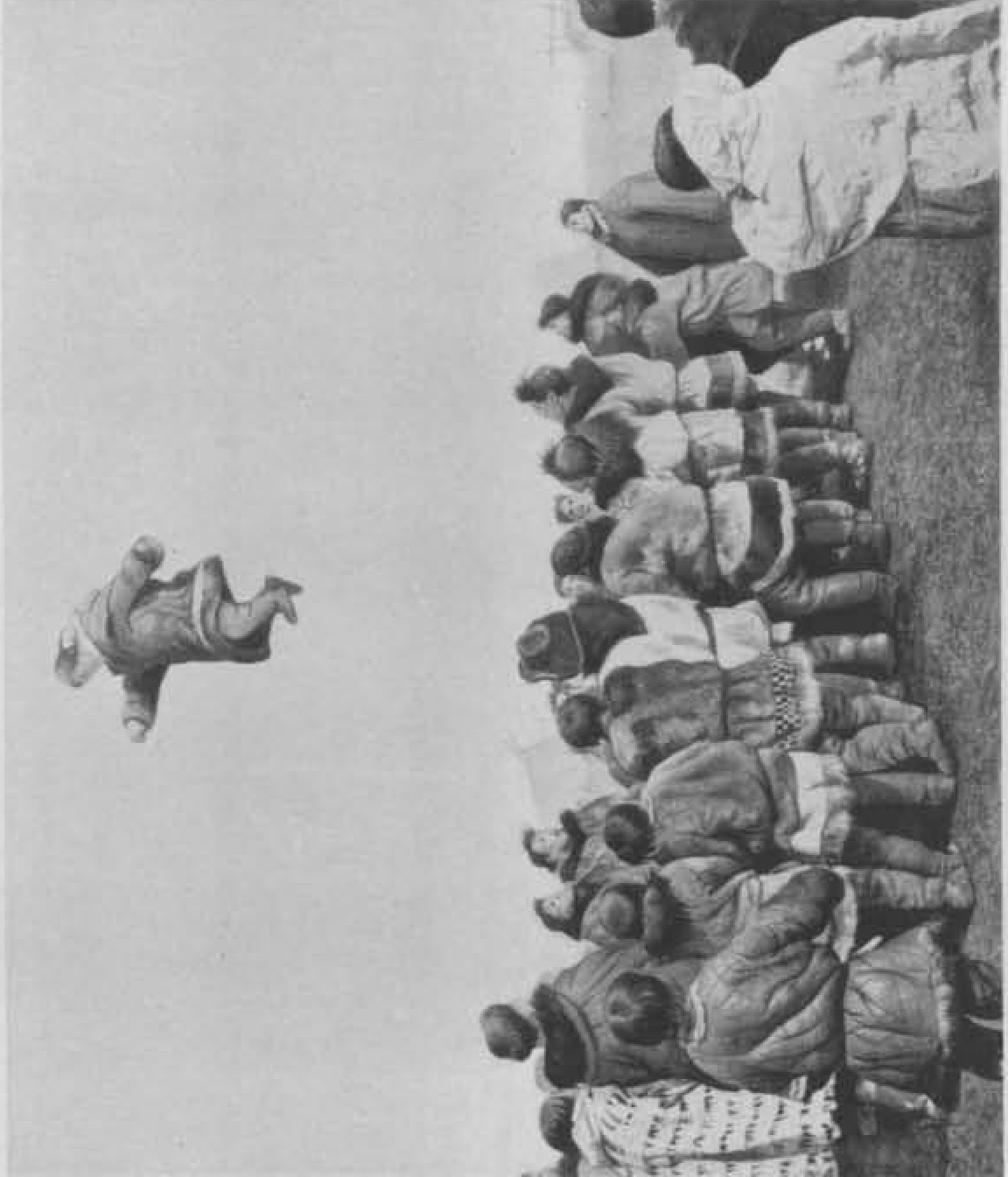
On the day chosen for the ceremonial, numerous guests gather at the house of the “racers.” The women of the family bring sacrifices to “all the directions.” Then a feast follows, at the end of which the house-master, or still better a shaman from among his nearest relatives, if there be any such, paints with red ochre the faces of all those who have recently been taken ill; also those who look sickly, and concerning whom there might be apprehension of an attack by keˊlet. Small children, with hardly an exception, are painted. The marks of the painting are varied, and closely resemble those of the painting with reindeer-blood in the “slaughtering-ceremonials” of the Reindeer Chukchee. After that, the tossing begins. Men and women seize a big walrus-hide (split in two to make it thinner), grasping it firmly by loops cut around its outer edge, and lift it from the ground. Then the young men and girls, one by one, or in pairs consisting of a man and a woman, try their skill. For this, the performer plants himself firmly in the middle of the hide, and with a sudden jerk those who hold it send him upward, often to the height of five metres. After that involuntary jump, he falls back on the skin, and is safe from harm. The greatest skill is in coming down on the feet without losing one’s equilibrium. Women are more clever than men at this, and there are those who can keep upright for three successive jumps.
[411]🗗uncollatedThe “tossing on walrus-hide” often assumes the character of a contest, in which a prize is offered to the winner. Every one who has taken three jumps successfully may stop, and wait his turn to compete with a performer who has achieved a similar success. I was told by the people that the “tossing on walrus-hide” is said to be copied from the keˊlet, after a certain shaman had seen them perform this exercise. This was put forth in explanation of the efficacy of such an exercise to ward off attacks by the keˊlet, or protect the people against disease.
Like the reindeer-races of the Reindeer Chukchee, the “tossing on walrus-hide” of the Maritime people takes on the character of a sport, and is frequently arranged merely for amusement, without connection with any religious or superstitious purpose. From the Maritime people the “tossing on walrus-hide” spread to the Reindeer Chukchee, among whom it is, however, much less in use, and serves only for a merry social exercise.
Races. — Racing with dogs by the Maritime Chukchee is much less frequent than reindeer-racing by the Reindeer Chukchee. The dog-races occur chiefly in spring, and have no connection with the ordinary ceremonials. The race is accompanied with a small sacrifice thrown into a small fire and towards the principal “directions.” It is followed by a foot-race of men and women and by a wrestling-contest. The Asiatic Eskimo arrange the dog-races similarly, but they still attach the dogs in the old way, — several abreast, with a leader in the front on a long trace.¹
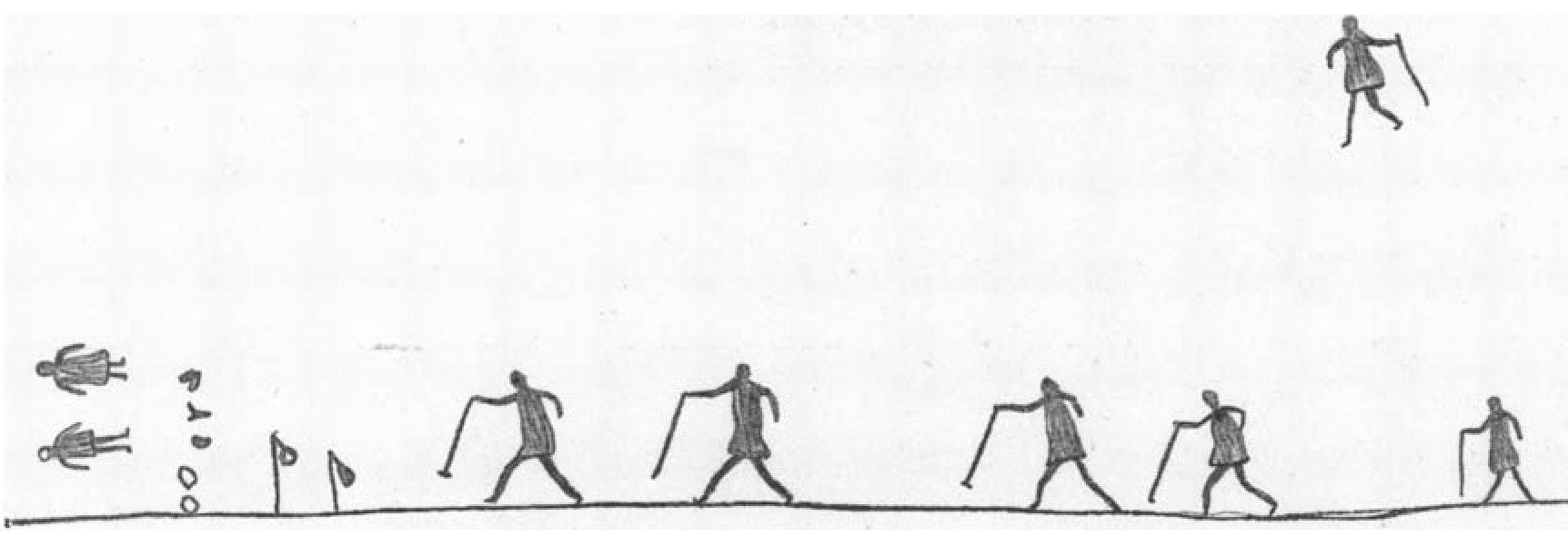
Fig. 284, copied from a native sketch, represents a foot-race of Maritime Chukchee, which was performed in connection with the “genuine thanksgiving ceremonial.” Six young men are taking part in the race. Two “masters of the race” are looking on. A coil of thong and a bunch of leaf-tobacco are suspended on two short sticks as prizes for the race. Three heads and two sacrificial vessels are set on the ground. The heads are those of the walrus, a white fox, and a hare.
[412]🗗uncollated
Stuck-in Poles. — I have already mentioned the “stuck-in poles” (aᵋm-ɪˊnpɪn) of bone of whale,¹ which represent in some villages a kind of votive place. The village of Čeˊčin has one of these poles (Fig. 285). It is very old, and the bone nearly crumbles between the fingers. It is hung all over with votive offerings made by sick persons, as it is supposed to have special virtue for curing rheumatism in the arms or legs, which ailment is very common among the Maritime people. The offering consists of a small bead strung on a piece of sinew. Some of them, as I was told, were previously bracelets, and were given by their owners as a substitute for the ailing limb. Among the Maritime Koryak, the “guardians of the village” resemble these Chukchee poles, but are made of wood instead of bone of whale. They are called “wooden spirit” (ot-kaˊmak or ok-kaˊmak), the name applied in Chukchee to small wooden amulets. Mr. Jochelson says² they are a kind of protector of the villages. They receive sacrifices of a more important kind than those hung on the Chukchee bone poles. According to Krasheninnikoff and Steller, poles of a similar character were in use also among the Kamchadal. They had grass tied around them, and received frequent sacrifices.³