XVIIIOrganization of Family and Family-Group
MAN IN THE FAMILY. — The units of social organization among the Chukchee are quite unstable, excepting the family, which forms the basis of the social relations between members of the tribe. Even family ties are not absolutely binding, and single persons often break them and leave their family relations. Grown-up sons frequently leave their parents and go away to distant localities in search of a fortune. The youths of the Reindeer tribe descend to the coast, and those of the Maritime Chukchee go inland to live with the reindeer-breeders. Not a few of the Chukchee tales open with a description of the life of a lone man who does not know any other people, and who lives in a wild place. It may be said that a lone man living by himself forms the real unit of Chukchee society. Even woman, whose social position is much inferior to that of man, sometimes breaks away from father or husband and goes to live with other people, though the family may pursue her, and, if she is caught, bring her back by force. Such cases will be described later on in detail.
I do not know of any cases of this kind happening among the Tungus, where the family and clan organization are much stronger. Tungus families often separate from the clan in search of new hunting-grounds, but a single person never leaves his family; and even an isolated family will retain the memory of its connection with the clan for a long time. The Lamut of the Chaun country, who consist of stragglers from all the clans living farther to the south, still consider themselves as belonging to particular clans; though this connection has at present no real force, because of the distance of their habitat from that of their clans. No such remembrance lingers among Chukchee who have left their families. Once separated, they are entirely separated from them.
SYSTEM OF RELATIONSHIP. — In the Chukchee system of relationship the paternal line preponderates to a marked degree over the maternal. The first is designated as “that coming from the old male (buck)” (kɪrñaiˊpu-waˊlɪn, also kɪrñeˊ-tuˊmg̣ɪn,¹ “old male [buck] mate”) or as “that coming from the penis” (yaêlhêˊpu-waˊlɪn). The second is designated as “that coming from the matrix” (kɪyolhêˊpu-waˊlɪn). The paternal relatives are also called “those of the same blood” (ᴇnneˊn-muˊʟɪlɪt), meaning the blood with which the usual sacrificial anointment is administered. It has been stated before² that at the time of ceremonials the people paint their faces with blood, and that persons of the[538]🗗uncollated same paternal line of descent use the same marks, which descend from generation to generation. In the same sense, people of the same paternal descent, the “old male companions,” are also called “those of the same fire” (ᴇnnaˊn-yɪˊnlaᵋt), because they have community of fire. Paternal relationship is considered to be much stronger than maternal relationship. There is a Chukchee saying which has it that even a distant relative on the father’s side is much nearer to the heart than a maternal cousin. The terms of relationship are as follows: —
CONSANGUINITY. Aᵋttuˊuʟɵᵋn (“fore-goer”) Forefather. Yaˊaʟaᵋn (“behind-goer”). Descendant. Miˊrg̣ɪn¹ Grandfather and great-uncle. Ñew-miˊrg̣ɪn (ñe, ñew, “woman”) Grandmother and great-aunt. ᴇndiˊw Uncle,² paternal and maternal. ᴇččaiˊ A Aunt,³ paternal and maternal. ᴇʟɪˊhɪn (address: aˊtê, “papa”). Father. ᴇʟaˊ (address: äˊmmê, “mamma”)⁴ Mother. ᴇʟɪˊhɪt (“fathers”) Parents. Yiˊčemit-tuˊmg̣ɪn⁵ (“fellow-brother”) Brother. ɪneˊelin Elder brother. ᴇʟeˊñi Younger brother.⁶ Čaˊkɪhêt Sister (said by male). ɪˊnpɪčɪ-čaˊkɪhêt Elder sister (said by male). Wuˊthɪtčä-čaˊkɪhêt or wuˊthɪtčeᵋn Middle sister (said by male). Ñêˊnča-čaˊkɪhêt (“younger sister”) Younger sister (said by male). Čaˊkêt-tɵˊmg̣ɪn (“sister-mate”) Sister (said by female). ɪˊnpɪčɪ-čaˊkêt-tɵˊmg̣ɪn (“elder sister-mate”) Elder sister (said by female).
[539]🗗uncollatedWuˊthɪtčä-čaˊkêt-tɵˊmg̣ɪn (“middle sister-mate”) Middle sister (said by female). Ñêˊnča-čaˊkêt-tɵˊmg̣ɪn (“younger sister-mate”). Younger sister (said by female). Yêᵋˊlhɪ-tɵˊmg̣ɪn (“cousin-mate”), more rarely Yêᵋˊlo Male cousin, paternal and maternal. Ñaw-yêᵋˊlhɪ-tɵˊmg̣ɪn (in respect to male cousins)¹ Female cousin, paternal and maternal. Eˊkɪk Son. Ñeˊekɪk Daughter. ᴇʟuˊê (pl. ᴇʟuˊwg̣ot) Grandson and nephew. Ñauʟuˊê Grand-daughter and niece. ᴇʟoˊo-tɵˊmg̣ɪn² Parents’ cousin’s son. Ñauʟoˊo-tɵˊmg̣ɪn³ Parents’ cousin’s daughter.
Of all these terms, a collective may be formed by means of the word -ret, -rat, which signifies “collection,” “set,” and is used only in combination with others. Thus, yičemreˊt, “company of brothers;” čakêˊttɪrat, “company of sisters” (in regard to the male relatives); yêᵋˊlhɪrat, “company of male cousins;” kret, “company of boys” (k shortened for kmiˊñɪn, “boy,” “child”).
The fourth degree of relationship is designated by means of the stem yɪˊlhɪ, which signifies “link,” “junction.” Thus, yɪˊlhɪ-miˊrg̣ɪn, “great-grandfather;” yɪlh-ᴇʟuˊê, “great-grandson;” yɪlhɪʟoˊo-tɵˊmg̣ɪn, “male cousin twice removed,” etc.
The more remote degrees of relationship are designated as čɪmčeˊkin, “the near one;” or čičeˊtkin, čičeˊʟeñ, “kinsman.” The compass of the second term is larger than that of the first.
All degrees of step-relations are designated with the suffix -lqäl, meaning “intended for.”⁴ Thus ᴇʟɪˊhɪlqäl, “step-father;” ᴇʟaˊlqäl, step-mother,” also, in polygamous families, “another wife of my father;” eˊkkelqäl, “step-son;” ñeeˊkkelqäl, “step-daughter;” yiˊčemit-tuˊmg̣älqäl, “step-brother;” čakêˊttɪlqäl, “step-sister” (in repect to the brother), etc. Even ñew-miˊrg̣ɪlqäl, “step-grandmother,” is often used in polygamous families.
Affinity is designated as follows: —
AFFINITY. Mataˊlɪn⁵ Father-in-law. Ñaw-mataˊlɪn Mother-in-law. ɪntuˊulpᴇr Son-in-law. ɪnteˊ Daughter-in-law. Aačêˊw-mataˊlɪn⁶ Brother-in-law. Ñaučhän-mataˊlɪn⁶ Sister-in-law. Takaˊlhɪn Husband of wife’s sister. Umiˊrit Son-in-law’s or daughter-in-law’s father. Ñeumiˊrit (“woman umiˊrit”) Son-in-law’s or daughter-in-law’s mother.
[540]🗗uncollatedRelatives by affinity are called collectively mataˊlit (pl.) or mataˊlɪ-raˊmkɪn (“affinity people”).
Men married to two sisters call each other takaˊlhɪn. Takaˊlhɪn more properly signifies “brace-companion;” for instance, one of the two reindeer harnessed to the sledge. Pɪtkaˊ-takaˊlhɪn signifies “twin-brother” (literally, “double-companion”). The degree of affinity thus indicated is considered to be very strong. In olden times it was considered even stronger than brotherhood. Takaˊlhɪn kɪrñaˊ-yêˊčamêt-tɵmg̣êˊpu paˊroč signifies “man of the wife’s sister (is) of the old-male-brother beyond.” An old proverb says, “Man of the wife’s sister is on the same lake shore a fall-companion” (takaˊlhɪn ᴇnnaˊn-hɪˊthɪlɪñkɪ rɪlteˊl-tɵˊmg̣ɪn). This means that both are to fight and fall together. The Chukchee say that if one takaˊlhɪn sees the blood of the other drawn by an enemy, he will rush forward again and again until his own body lies on the same spot. Perhaps this relation may be considered as a survival of group-marriage, although at present group-marriage between the takaˊlhɪt exists but rarely. The group-marriage, and the degree of relationship based on it, will be described later on.
The family is designated as raˊyɪrɪn (“houseful,” or simply “those in the house”), yaraˊ-tɵˊmg̣ɪt (“house-mates”); but both these terms relate, properly speaking, to the house and those living in it. The house with those living in it forms the real basis of the Chukchee family. Members of the family who have left the house (or, among the Reindeer Chukchee, the camp) lose their connection with the household and also with the family.
The system of consanguinity and affinity is represented in the following table: —
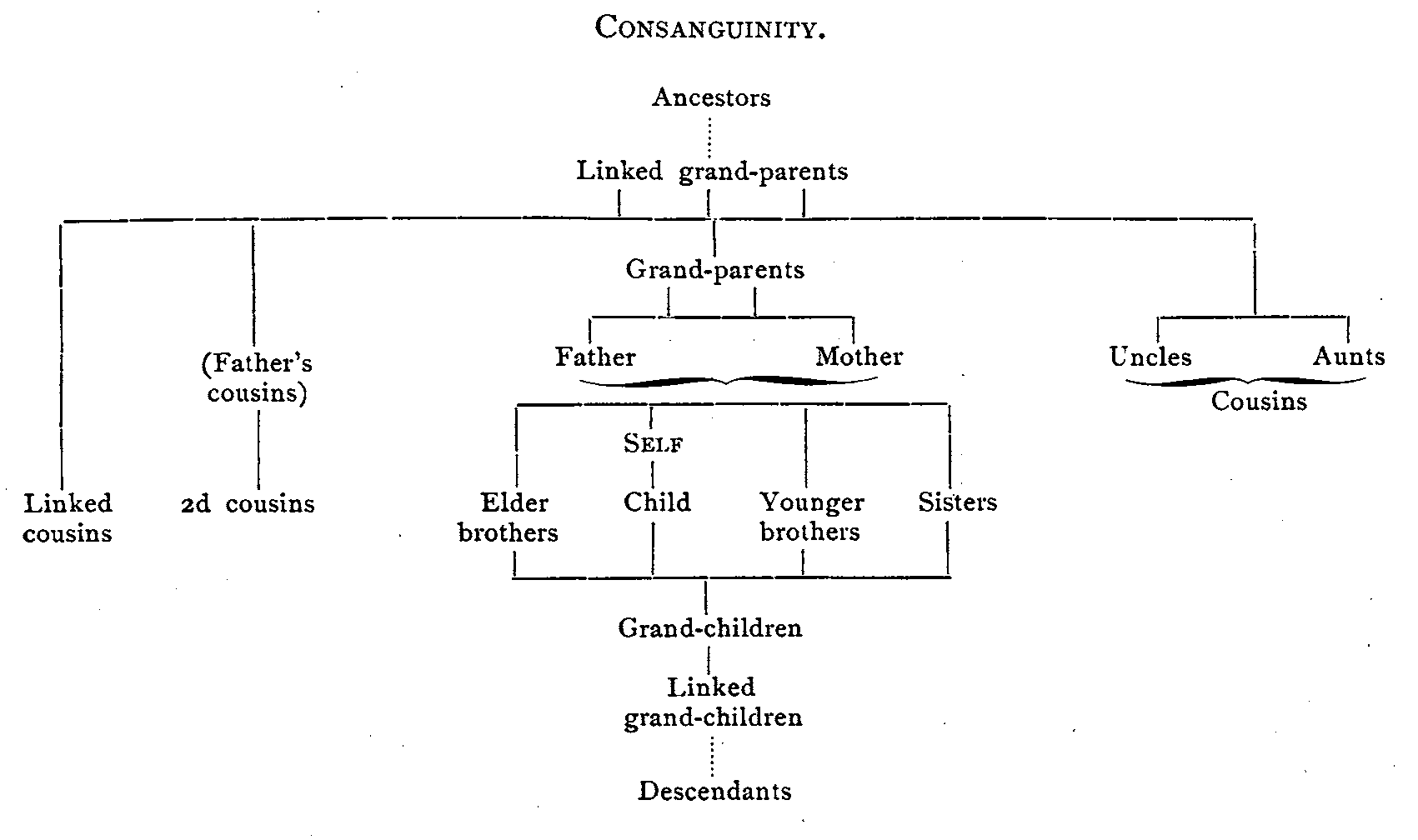
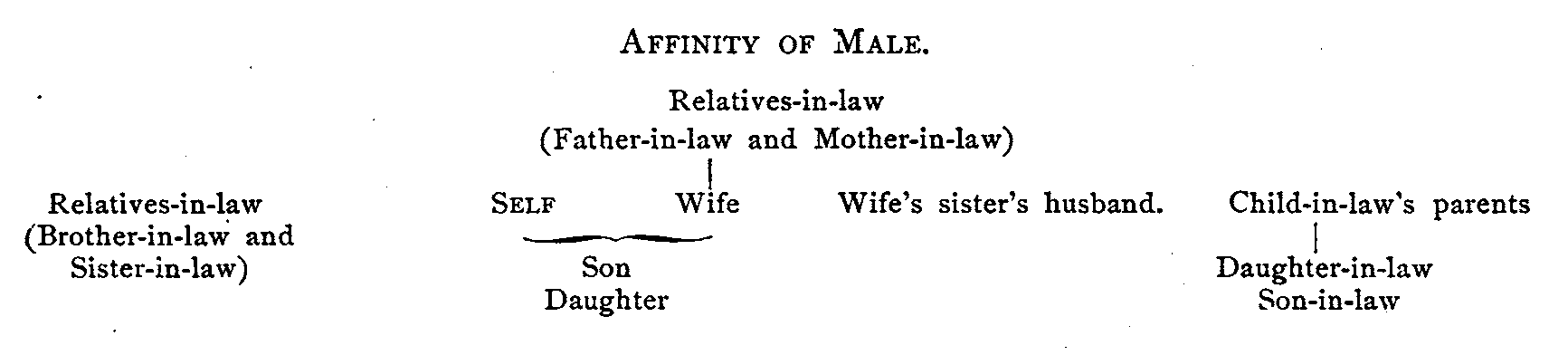
For the female the system is practically the same, except that in the table of affinity the takaˊlhɪn (“wife’s sister’s husband”) relation is not found.
THE FAMILY GROUP. — A group of kindred families is designated by the term vaˊrat (literally, “collection of those who are together”). Va is the root of the verb vaˊrkin (“thou art”), -ret, -rat, signifies “collection” (see p. 539). A member of the same family-group is called ᴇnaˊn-varaˊtkên (“one of the same vaˊrat”). In modern times, however, this term has acquired a broader meaning, and is used in the sense of “people,” “folk;” though for the latter idea there exists another word, reˊmkɪn (“people,” “folk”). Still another term for the family-group is more characteristic. It is čiˊn-yɪrɪn (“collection of those who take part in blood-revenge”). Čin is the stem of the word liˊñliñ (“heart”¹), but is used also for blood-revenge. Liˊñɪlɪn means “blood-avenger.” This term čiˊn-yɪrɪn is used frequently, because the vendetta still exists in full vigor.
The Chukchee vaˊrat may perhaps be called an embryo of a clan; it is unstable, however, and the number of families that “are together” changes almost every year. Moreover, when one vaˊrat picks a quarrel with another one (usually one living in the neighborhood), there will always be a few families that are connected equally with both interested parties. The centre of the vaˊrat forms a group of brothers, and secondarily a group of cousins, both of which are called “a group of boys.” A proverb says, “The group of boys is disposed to scoff” (Kraˊtɪčhɪn nɪkoˊraqên). This means that numerous brothers who keep together may abuse any of their neighbors with impunity. On the other hand, the lonesome one (kuwliˊkɪlɪn) is always downcast. He speaks humbly, he lives in poverty, and is subjected to the abuse of families consisting of many people.
In cases of blood-revenge, brothers and cousins are the first to come forward. For instance, in the year 1895, among the Chukchee of the Big Anui River, two young men of different families disputed over the dividing of a mammoth-tusk which they had found in the tundra. In the ensuing quarrel one of them picked up his rifle and shot at the other, though without success. A quarrel among the families ensued. The man shot at belonged to a numerous family; he had several uncles, each of whom had sons. He[542]🗗uncollated had also four adult brothers. The whole number of his male companions was twenty-two, and all of them were his nearest relatives. The offender, on the other hand, belonged to a small family. Therefore, when the offended family began to talk about revenge and threatened to attack the chief camp of their enemies, the offender left the camp and travelled sixty miles to the nearest Russian village. There he spent six or eight weeks, and felt wretched all the time, for the Reindeer Chukchee do not like to stay in Russian houses any longer than necessary, because the close air of the log-cabin, and the fish diet, are unbearable to them. During this time his people in the camp negotiated with the other party; and in the end the affair was smoothed over, even without ransom, since the pride of the offended family was satisfied with the flight of the other man and his wretched life among the Russians. It will be noticed that the quarrel was settled between the families, not between the family-groups.
In another case of a similar kind, nine members of the offended family came to the offender to make a demonstration of their strength. All were brothers, cousins and uncles of the offended one. It came to the drawing of knives, though no blood was shed.
Once in my presence two young Chukchee wrestled, and one vanquished the other. I mentioned before that wrestling-matches lead to quarrels among this excitable people. The father of the vanquished wrestler, who was present, grew very angry, and said to the victor, “Wait a while! Do you take us for a bad family, brotherless and cousinless? This young man has seven brothers. They are quite young now, but they will grow up; and all of them will be against you.”
In folk-stories, blood-revenge and retaliation for insults are also undertaken, almost always by near relatives only.¹
The organization of the Reindeer Chukchee camp depends upon the relations of the family-group. The Chukchee camp has a front house, the place of which is determined by the seniority of its owner. Other houses are located according to certain rules, based for the most part on the mutual family relations of the owners. For all that, the organization of the camp is unstable and loose, just as much so as that of the Chukchee family-group.²
In former times a union of “those that are together” was of a stricter character and really formed something like a clan. A unit of this kind included ten or fifteen families, who always camped near together. In summer, when near the seashore, they formed usually one large camp. Some of the young men were with the herd, which at that time was not numerous. The others were occupied with fishing and seal-hunting.³ The people occupied[543]🗗uncollated their leisure time with athletic exercise, wrestling, running, fencing with spears, etc. They were more ready for war, which was more frequent than it is now. In war the family-group acted as a unit against all other parties.
The Russian officials of the Kolyma country, when endeavoring to bring the Chukchee under Russian allegiance, treated them in the same way as the Yakut and the Tungus of eastern Siberia. These tribes had strictly organized clans (родъ, pl. роды), which could not intermingle as readily as the Chukchee vaˊrat. The Cossacks and their chiefs, when subjugating these tribes, taxed each clan separately. Therefore Russian officials, when trying to levy tribute on the Chukchee, invented clans and even clan-chiefs.¹ Baron von Maydell, who was the chief official of the Kolyma district in 1868-70, even invented a new rank and title, “The Highest Chief of all the Chukchee.” This sounds almost royal; and, indeed, the Russians sometimes called the person having this rank “Chukchee King,” “Black King of the Tundra,” “Chukchee Czar.” All this was quite imaginary. The family that was given this title was simply a rich reindeer-breeding family with some influence among its neighbors. I lived with this family for a few months, and shall speak of it later on in greater detail.²
The clans introduced by the Russians were also invented, and had no standing in the aboriginal organization of the tribe. The whole territory of the Chukchee was divided into five parts; and each of these parts, with the people living in it, was called a “clan.” Some rich reindeer-breeder among those friendly disposed to the Russians was called “chief,” and that was all. The Chukchee living beyond the sphere of influence of the Russian officials in the tundra to the west of the Chaun River and on the Chukchee Peninsula, reindeer-breeders and maritime hunters, were called “the maritime clan.” Even the tribute was nominal, — 247 rubles from all the clans, — though the Chukchee tribe has several thousand adult men. This tribute is paid in the following way. In the parts of the territory nearest to the Russian settlements, at least every other family pays a tribute of one ruble. It is understood that this sum represents the tribute of one man, as among the Tungus and the Yakut;³ but, as I have said, it is not true. The tribute is paid by a family; and not all the families pay, either. Those that are unfriendly to the Russians[544]🗗uncollated do not pay anything. The Tungus, the Yakut, the Kamchadal, pay per capita, and also for all those that are dead. Since many branches of these tribes have greatly diminished in number, the tribute becomes very heavy, sometimes quite abnormal. The Russianized Yukaghir and Yakut of the Lower Kolyma, until very recently, had to pay eleven rubles for each male. No such thing is possible among the Chukchee. The greater the distance from Russian villages, the smaller the number of families who are willing to pay tribute. The largest portion of the tribute allotted to each clan is paid by the so-called “chief.” It is not so very difficult for a rich Chukchee to pay thirty or fifty rubles. He takes a couple of bear-skins and some good fox-skins to the trader, and receives for them the money to pay his tribute.
Among the Maritime Chukchee and the Asiatic Eskimo, groups consisting of family units are still smaller than among the Reindeer people. The real units of social life among the Maritime people are the family and the village. Many of the villages are of course inhabited by relatives, especially among the Eskimo, who, as mentioned before,¹ are less inclined than the Chukchee to wander from village to village. Many other villages, Chukchee and Eskimo, consist, however, of elements of distinct provenience. For instance, the village of Čeˊčin consists of Eskimo, of Maritime Chukchee, and of a large admixture of Reindeer Chukchee who have lost their herds and have settled on the shore. Some of the villages have front houses, and others have none. On the whole, the village is a territorial unit. Neither has it any organization, beyond the fact that the inhabitants are neighbors and are friendly among themselves. Related families appear as units in the organization of the boat-crew.²
FAMILY. — The Chukchee family usually consists of a husband, with one or several wives and their children. Generally the parents of the man live near by in a lodging of their own; and with them may live younger sons and daughters, who are not yet married, or, if married, have no children. Their house is dependent on the larger one, and is considered as belonging to the “houseful.”
POSITION OF OLD PEOPLE. — Old men usually enjoy great consideration. Especially is this the case among the reindeer-breeding part of the tribe, perhaps because the herd is the property of the father as long as he lives. It seems that among all nomadic tribes there is a tendency to develop strong family and family-group ties, and that with this phenomenon is connected the high position of the old men of the family. Although I cannot make the general assertion that the organization of family and family-group is more highly developed among the Reindeer Chukchee than among the Maritime tribe, it seems that in special cases this is really the case. Reindeer-raising[545]🗗uncollated is probably not old enough among the Chukchee to have brought about a marked difference between the two branches of the people. In many camps in various parts of the territory of the Chukchee I have met very old men, perhaps of seventy or even eighty years; at least, their hair was altogether white, which change seems to occur among the Chukchee later than among the white race. Some of these old men were almost in their dotage; still they had retained possession of the herd and the general direction of life in their camps. For instance, in a camp on the Oloi River, a man named Kauˊno, who had great-grand-nephews ten years old, owned two large herds, and decided himself the most important question in the seasonal migration of the Chukchee, that of choosing the place of abode for the summer-time. Though enfeebled by age, he still made the April trip to the Wolverene River every spring for barter with the maritime traders from the Arctic villages, who come there at that time, bringing maritime products and American wares. Kauˊno’s own housemates told me that the old man had grown childish and often purchased things of little use in their life. Instead of sugar he took bottled molasses, because it was red, and red pleased his eye; he bought table-knives instead of hunting-knives, because they are brighter, etc. This was told, however, with broad grins, and without any visible signs of protest. “Foolish one!” (Yurg̣umteˊq) they added quite good-humoredly. “What is to be done? He is an old man!” (Qailoˊqɪm, miˊñkri, ɪnpɪnaˊčhɪn). And I am quite sure that Kauˊno kept the direction of his house till his natural end. Another old man of sixty on the Dry Anui had a dislocation of the hip-joint, which was altogether out of service in walking. He could only crawl about with the aid of two crutches. Therefore his name was Atkaˊ-Pañaˊnto (“Lame Pañaˊnto”). His lameness dated from a bad fall in a wrestling-match in which he took part. He was then married and the owner of a herd. He continued to be the master of his herd and the head of his family, and had several children, who grew up and took care of the herd. Every year he would go to the Anui fair for barter, carrying along peltries and reindeer-skins. He was very fond of strong liquor, bought it every time, and drank most of it himself, giving to each of the other members of his family only a few drops.
At fairs and gatherings for trade, whenever I visited a camp for the first time, those who came to meet me would say, “Let us take you to the oldest man. Talk first to him.” Baron von Maydell mentions that when he travelled in the country near the Upper Anadyr, a very old man from a remote camp, who came to meet him, was carried for a long distance on the shoulders of his young relatives.¹ This happened in summer, when sledges cannot be used. This is nothing unusual among the Chukchee, though usually the old man[546]🗗uncollated walks as long as he can; then he is carried for a while. After that, a short rest is taken, and he walks again. Even among the Maritime Chukchee, where the old men enjoy less consideration, those that cannot walk are carried on the shoulders of their young relatives. Thus, at Mariinsky Post I saw an old man with crutches, a certain Yɪrˊmᴇ, who had his feet badly frozen in an accident during the winter seal-hunting. This happened some fifteen years ago. Now Yɪrˊmᴇ is old, and unable to move about much, even with the aid of crutches. Whenever he has to be moved, his own son-in-law carries him on his shoulders.
I mentioned just now that among the Maritime Chukchee consideration for old men is not so marked as among the reindeer-breeders. The life of the maritime people is harder. Each morsel of food has to be obtained by great exertion, by danger and hardship: therefore an old man, unable to get his store of food himself, becomes a charge on other people. There is no herd or other property worthy of much attention. The experience of an old hunter does not count for much when he remains at home, and in times of privation he is one too many to feed; therefore the old men whom I met among the Maritime Chukchee looked dull and sad, nor were they as numerous as among the Reindeer Chukchee. This was due perhaps to the hardships of maritime life, the less active hunters being often unable to meet danger, and thus losing their lives. The killing of old people, of which I shall speak later on, probably originated among the Maritime Chukchee.¹
It seems that a similar difference, though less apparent, exists between the Reindeer and the Maritime Koryak. Mr. Jochelson, in speaking of the treatment of old people by the Koryak, remarks that among the Reindeer Koryak the new form of household economy has developed the principle of personal property more sharply.² In an oral communication he mentioned that in reality among the Reindeer Koryak the old men have more authority than among the Maritime Koryak, because of their ownership of reindeer-herds, which remains in their hands.
In recent times, property of value obtained in trade with American whalers appeared even among the Maritime Chukchee. Almost every large village has several traders, who go inland to the reindeer camps and barter white men’s ware for skins and reindeer-meat. Some of them even have storehouses of their own; others are poorer, and sometimes their capital is small indeed. The owners of this property, though ever so old, continue to hold it, and their position in life does not become lower with increasing age.
POSITION OF WOMEN. — The position of women, on the whole, is inferior[547]🗗uncollated to that of the men. “Since you are a woman, be silent” (Ñeˊus˙qät tuˊri, äquˊlike) — these words are repeated every time that a woman severely reproved dares to say a word back in her own defence.
In one tale a girl who came to a keˊlᴇ proposes herself as a wife for him in the following words: “I want to be your companion and your slave. My mother said to me, ‘That keˊlᴇ there has no slave. We will raise you as quickly as possible. Go to him and serve him.’”¹
Among the Reindeer Chukchee, women work much harder than men, especially the younger ones. The man’s part of the work is the herding, catching, and slaughtering of animals, the hunt, carrying of heavy logs and of the stones necessary to hold the tent firmly in place; also work on wood with axe, hatchet, and knife, etc. The harnessing of the reindeer is done by both sexes, also carrying fuel from the bush, and chopping wood and ice. The loading and unloading of sledges is performed for the most part by women. The care of the house, which in the nomadic life of an arctic climate requires almost uninterrupted hard toil, falls wholly to the share of the women, also skinning and butchering, gathering roots, preparing food, dressing skins, making garments, and much more, not to speak of the duties of the mother. Moreover, man almost never shares in the woman’s part of the work; he does not even know how it is performed. Often, when wandering with a Chukchee camp, I had occasion to go to the newly chosen spot with the male members of the family. We drove on light sledges, and therefore arrived long before the women, who crept along slowly behind with the pack-sledges. Sometimes the difference of time was about two hours or two and a half; but the men would only unharness their reindeer; then they would loiter idly about waiting for the women, or begin some kind of men’s work. Once in my presence a man took a snow-scraper and began to scrape the place for the tent, but after a couple of minutes he threw away the scraper. “Ugh!” he said, “this is woman’s work.” When I was trying to learn the Chukchee language, and took care to collect new words from every one, I found, to my great amazement, that young men did not know the names of some parts of the house-frame, house utensils, preparations for dressing skins, etc. “Ugh!” they would say, “I don’t know. That is the women’s business.”
In the every-day life, the man, when at home, is idle, or occupies his time with the inspection of sledges, repairing their broken parts, etc. The women take care of everything in the tent and in the sleeping-room. After the reindeer is slaughtered, the woman has to skin it and butcher it; then she must carry everything to its proper place. She prepares the food, and presents it to her husband. She cuts off the best, and takes what is left, gnaws the bones, gathers all crumbs and scraps. Such delicacies as brains, marrow, etc., are eaten almost exclusively by men. Women are satisfied with[548]🗗uncollated licking their fingers when cutting the dainties into small pieces for the use of the men. “Being women, eat crumbs,” is a saying of the Chukchee. Women eat only after the men have finished.¹ Only an elderly woman, the mother of a family, having grown-up daughters or some other women under her rule, goes into the inner room with the men and eats with them. As a rule, the women, though they stay more at home than the men, still spend less time under shelter of the sleeping-room. A young woman is the first to leave it early in the morning, and the last to enter it late in the evening; and when a guest comes to pass a night, and the room proves to be too small, the woman has to go out and perhaps pass the night in the outer tent, unless she is needed by the males for special reasons. On the other side the woman also performs much of the man’s work. Young women and girls help the men in herding in winter and even in summer.
When a reindeer herdsman comes home after twenty-four hours spent in running around the restive animals, he is given a change of dry clothes, takes food, and goes to sleep. A woman, though returning with him from the herd, has to prepare the food, and then take part in the household cares. When I was passing a summer among the Chukchee on the Oloi River, I staid for a couple of months in the camp of Eiˊheli, whose name has been mentioned before. His elder daughter-in-law would come from the herd after a two days’ absence. In summer the Chukchee herdsmen, while with the reindeer, have little time to sleep. They take their sleep when coming home. Still the young woman was not allowed to go to sleep. Eiˊheli would sit down in the inner room and order her to prepare tea and food. The woman was wearied. She looked like one in a trance. She would mechanically take the teapot, but, instead of pouring the tea into the cup, she would pour it right on the eating-table. In another camp I saw another woman of nineteen, who was the second wife of the master of the front house, fall down suddenly in the middle of her work as if struck by a bullet. She was struck, not by a bullet, but by sleep.
Eiˊheli, however, was considered an old man given to too much quarrelling with his female house-mates, and sometimes was for this reason laughed at by the people in the neighborhood. As mentioned before, he was the highest chief of the Chukchee;² and the people of the neighborhood said behind his back, that, from too much intercourse with the inhabitants of Russian log-cabins, he got a liking for indoor living; and since he had nothing else to do, he quarrelled with the women. The husband of the other young woman mentioned before was also considered harsh.
Aiñanwaˊt, on the contrary, left the house of his son in order to avoid quarrelling with the women. He told me the following: “I should like to live[549]🗗uncollated with my son, but he has too many women. They make me feel bad, they talk too much: therefore I have left them, fearing lest I grow angry. In my mind I rejected them all.”
Aiñanwaˊt, after losing his reindeer-luck in the bad year of 1884, got weary of his diminishing herd and dilapidated household, and, after his second wife had also died, he gave up the remainder of his property to his oldest son, and became himself a wandering hunter of wild reindeer. He felt restless, and probably would not stay at home even if the women had not been given to “too much talking.”
Some cases of protest of women against intolerable ill-treatment by the fathers-in-law are known to me. For instance, on the Wolverene River I met an old man, Omrêlqoˊt by name, who was a rich reindeer-owner. He was hospitable even to strangers, but stingy with his own house-mates. Since he was quite irascible, this led to quarrels. One summer all the people in the neighborhood were short of tobacco, and he alone had a few pounds. He distributed the greater part of it among his neighbors, and left almost nothing for his own house-mates. Being himself a great smoker, he stopped the supply of tobacco of the women of his household. Now, all the people of Arctic Siberia would rather go hungry than be without a smoke. “Tobacco is shameless,” is a saying of the Russian creoles: “it makes the poorest people bold in their demands even upon the chief officer.” Whoever knows the abject fear in which Russian creoles hold officers even of inferior rank, will appreciate the significance of this saying.
I mentioned before a story of two brothers, one of whom, at the time of a tobacco famine, killed the other because he refused to share with him his tobacco-supply.¹ This story is very popular among various tribes of northeastern Siberia.
In dealing with his neighbors, Omrêlqoˊt, to whom I have referred before, faithfully followed the general rule which requires, in case of need, that the last pipeful be divided or smoked by turns; but the women of his own household were not treated so liberally. A quarrel ensued; and one of his daughters-in-law, who was also hot-tempered, took up a lance and inflicted on the old man three wounds, — one on the shoulder, and two others in the back. The old man drew his belt-knife and seriously wounded his assailant. The end of the quarrel was, that the woman left the camp of her husband and father-in-law, and went back to her own people. But Omrêlqoˊt was called ever after, to his great ire and horror, “that one pricked by a woman.” I have told this story in some detail because it is very characteristic of Chukchee family life.
Another, more tragical case happened at the Anui fair in 1895, where one[550]🗗uncollated Chukchee was killed by Cossacks in a squabble. The Chukchee surrounded the wooden fortress and threatened to take it by assault. After some parleying, they grew less threatening, and asked for the body of the one killed, intending to come for the blood-money on the following morning. The gate was firmly shut from the inside; and it was necessary to take the body to the gate, then to open it, and, after the body had been delivered, to shut it again. None of the people in the fortress, including all the Cossacks and police officials of the Kolyma district, were willing to take part in that somewhat risky enterprise. Finally it was performed by myself and two other political exiles who happened to be present at the fair. We took it upon ourselves to open the gate and to shut it again. We did not want to carry the body; and after some hesitation, it was carried out by the Cossack manservant of the chief official. It was lying on a dog-sledge, and the man was pulling the sledge by the vertical bow. I acted as interpreter and mediator. My companions, being both very strong, heavy-set men, drew the bolts back, and opened the gate just wide enough for the sledge to pass through. A large number of Chukchee were assembled in front of the gate. They were clamoring for admission and for the body of their friend. When the gate was opened, the wife of the one killed clutched the Cossack and wanted to drag him out; but he succeeded in jumping back, leaving a piece of his skin coat in her hands. The gate-keepers pushed her out with the sledge and the body, hastily shut the gate, and locked it. The step-father, who was the third husband of the mother of the one killed, was also there. When still very young, the mother had lost her first husband. Later on, she was sent away with her child by her second husband, but was married by the third husband, with whom she continued to live, and who was at the time an old man. He was standing in front of the gate, together with his daughter-in-law, but he made no attempt to assist the angry woman in her endeavors. She yelled, “You old good-for-nothing! When quarrelling with women in your house, you can talk! Why don’t you fight now, when your son is trampled down by the Russians?”
Among the Maritime people, the women take no share in hunting; and the housework is also less burdensome, owing to the sedentary mode of life of the people. Therefore they are not so hard-worked as the women of the nomadic Chukchee.
According to the data in the census of 1897, as collected by N. L. Gondatti and myself, and published by S. Patkanov,¹ the whole number of women, as compared to that of men, forms, among the Maritime Chukchee 108 per cent, among the Reindeer Chukchee 101 per cent; total for the whole tribe, 102 per cent. The difference between the Maritime and Reindeer Chukchee[551]🗗uncollated corresponds to the difference in male occupations in both branches of the tribe; that is to say, the Maritime hunters incur far more danger and risk of life than the reindeer-breeders. The census of Maydell of 1870 is not taken into account, being too incomplete.
The wife is often harshly treated by her husband. I have mentioned the case of a husband killing his wife with a blow of a fire-brand. Blows, though less severe, are not infrequently dealt out to women; but it also happens that a wife ill-treats her husband. I recall one man of small stature, with but little physical strength, but very irascible. Quarrels between him and his wife were not rare. When it would come to blows, his wife would throw him, and keep him down, asking, “Have you enough? Will you cease?” until he would say, “Enough, I will cease.” His neighbors told me this story with much laughter, but their censure was not very harsh.
Another man, G̣ɪrg̣oˊl by name, a well-to-do reindeer-breeder, who used to maltreat his wife, was finally killed by her with a rifle. This happened in midsummer, when the family was alone with their herd on the summer pasture-ground. The family consisted of G̣ɪrg̣oˊl, his wife, and three grown-up unmarried daughters. Just what happened has never been known; but one day the youngest daughter came to the nearest camp, and said that G̣ɪrg̣oˊl suddenly felt very ill and requested to be killed, which was done by his wife. When the people went to attend the funeral, the women who assisted in dressing the body in his funeral clothes saw with surprise that the wound was on the back of the neck, although in cases of voluntary death the wound is always inflicted on the front part of the body. The daughters of the woman, however, confirmed the story that their father was killed by his own request. He had no near relatives in the country, and the murder was allowed to go without any attempt at blood-vengeance. The woman took the herd and remained its possessor. In the course of time she took another husband, who lived on her herd, and was therefore wholly dependent on her.
The position of old women, however, is much inferior to that of old men. Among the Reindeer Chukchee a widow having children may remain the owner of the herd, and keep that position till her children are grown up. Among the Maritime Chukchee an old widow lives with one of her sons; and her voice is of no great influence, even among the occupants of the inner sleeping-room, unless she happens to be a shaman or a “knowing one.”¹
The inferior position of the woman does not exclude tender love between husband and wife. Especially do marriages contracted among children develop into a very strong tie between the married couples. When I travelled on the Wolverene River, an epidemic of influenza appeared among the Chukchee. About twenty persons died within a few days. A man, Moroˊn by name, lost his wife, with whom he had lived for fifteen years, from the time when he[552]🗗uncollated was ten years old. On the second day after her death he took his own life by stabbing himself with a knife. “I want to follow her,” he said before he died. Another case illustrating the strong attachment between husband and wife is that of an old man living in the Dry Anui district, who had lived with his wife for half a century. Suddenly he declared that he wanted to take a certain girl of the vicinity for his second wife. His old wife threatened to return to her own relatives if he should take the girl. The old couple had no children living who might have prevented the dissolution of that marriage. The old man hesitated for some time; but his desire to have children — if not begotten by himself, then at least the issue of the customary group-marriage — prevailed, and he took the young woman. His first wife kept her word and left the camp, going to her brother, who lived at a distance of a hundred miles. For a few months the old man lived with his young wife; then he repined. He felt too proud, however, to go and see his old mate. Rather than do that, he requested that he be killed, which was done by strangulation with a rope.¹ Thus it will be seen that the married life of the Chukchee is not exempt from strong feelings and romantic episodes.
POSITION OF CHILDREN. — I mentioned before that small children are an object of great care and tenderness on the part of their parents. The endearing term for children frequently used in common parlance is “little eggs” (lig̣liqqäiti). The children are fed with the best morsels, and fondled and caressed by all grown-up people. The tender love of parents for their children has found expression in one episode which is repeated in many tales. A young boy dies a sudden death. His parents, in great sorrow, remain in the sleeping-room. The dead body is lying before them upon the ground on a reindeer-skin. They weep day and night. Their cheeks are furrowed with tears to the very bones. Thus they stay for one year, then for another, then for a third year.
The childhood of Chukchee children is quite happy. They grow up free and fearless in the freedom of camp life. Small boys are given knives just as soon as they can grasp the handles, and from that time on they learn gradually the use of this all-important implement. I have seen a small boy try to carve wood with a knife hardly shorter than the boy himself. One time a Cossack who accompanied me teased a boy about five years of age. The little man took offence, took up a hatchet that was lying on the ground, and flung it at the head of the man. His aim was accurate enough, though the hatchet did not reach the amazed Cossack, who began to howl and stamp his feet, intending to frighten the little warrior. Nothing daunted, the boy caught up a big knife and turned upon his enemy.
The heroic tales of the Chukchee also make mention of young boys taking part in combats and coming to the assistance of their parents. For[553]🗗uncollated instance, in a tale about Eleˊndi and his sons, a little boy, the grandson of the hero, plays all the time at shooting with a bow, not even taking time to sleep. One day his father says jestingly, “Here is a blade of grass. Try and hit its stem.” He made for the boy a small arrow of a piece of kettle iron. The boy shot and cut the blade in two. In the morning they continued their journey and met a Taˊn˙ñɪn. “Oh!” says the father, “you are but a child.” — “What of it?” says the boy. “And what will your mother say? Well, let us go near. Then you sit down at a safe distance. I will fight against that man with my lance. However, I may get tired. Then I shall return, and you shall string your little bow. I shall look at you, thus, and cross the road near to you. Then you shall shoot at his forehead. Try at least to cut the skin on his forehead.” The father began the fight with the Taˊn˙ñɪn, became tired, and retreated towards the place were his child was sitting. Then the boy strung his bow and shot and cut the skin on the fore-head of the Tan˙ñɪn. “Oh! this is how you take away our herds. You are strong through the aid of a boy. We do not act thus. Your strength lies in your union with boys.” — “Ah!” says the father, “I have created a strong man for times to come, one who will take the property of all those living in the country around us. I must be very good indeed.”
After several years, in a quarrel with his father about the distribution of tobacco, the son says, “If I had not then cut that broad forehead, we could not have smoked at this time.”¹
As in other hero-tales of the Chukchee, the details are given in a manner that is very true to life. Other instances of the same kind might be added.
The life of children among the Maritime Chukchee is less pleasant. Maritime villages are filthy in comparison with the ever-changing camp of the Reindeer people. The interior of the house, where the children spend a considerable part of their time, is black from smoke, and full of heavy odors. Food, too, is less abundant, and the supply less certain. On the other hand, the years of leisure and play are much longer here than among the reindeer-breeders. The reindeer-breeding Chukchee send boys of ten, and girls hardly older than that, to help in tending the herd. I remember having met one summer-time two such young reindeer-breeders, a boy and a girl. They were from ten to twelve years old. They were walking through the bushes quite alone, staff in hand, and wallet on back. They had to walk some ten miles before they could reach their herd. It was strange to see these young children wandering in the bush without any protection and shelter. While with the herd, the children have their share of all the troubles and care of guarding the restive animals. Of course they sleep more than the adult herdsmen, and do not run about so much; still their life is hard enough. When three or four years older, the young people, especially the boys, have to take up the[554]🗗uncollated full responsibilities of the herdsman. In winter-time, when the herd is quiet, the father of the family may not visit it for a week or more, leaving it to the care of his young sons. The father uses this time for attending gatherings, for visits to other camps, gossip, and good eating, especially when there are no snow-storms. The late autumn is therefore considered as the season of happiness and rest, especially as about that time the reindeer are fattest.
Even in the summer, young boys remain alone with the herd for several days, using their utmost efforts, notwithstanding their insufficient strength, to keep the animals together. Chukchee tales are full of incidents relating the adventures of young herdsmen. For instance, it is told that during the wars with the Taˊn˙ñɪt, when the enemy was overpowered, the warriors killed, and the herds captured, half-grown herdsmen were spared. They had to drive the herd to the country of the victors, and remained there taking care of it. In other tales, when a warrior is killed, his half-grown sons continue to keep watch over the herd. “When my father died,” one of the young Chukchee told me, “I was no higher than the back of a reindeer. I was afraid of the large-antlered bucks. Still I succeeded in preserving my herd, and even in increasing its size.”
It is in accord with these conditions that the bearing of the children before their father is very respectful. When the young herdsmen come home, they give their father a detailed account of the more important animals in the herd, about the pasture, the drinking-place, mosquitoes and reindeer-flies. The father puts one question after another, and the son has to give short and clear answers without talking too much. He repeats often words like “Yes, yes! surely!” and other interjections, showing his respect for the words of his parents. He even feels it improper to sit down in the presence of his father, especially while other people are present. These relations continue while the son is not yet full grown. As soon as the young man has reached the age of about twenty-five, and his mustache begins to grow, or when he has a wife and a couple of children, he feels greater self-assurance and independence, though he may continue to watch his father’s herd. He begins to bear himself towards his father, though with deference, without such extreme submission as in former years.
Among the Maritime Chukchee, boys take up their full duties considerably later than among the Reindeer people. When taken along in the boat on a hunting-expedition, they would be rather an impediment than a help. The young man does not take part in serious hunting before he is sixteen or seventeen years old. Before that time, he may be given a rifle to shoot at seals from the shore, or he may be expected to lend a hand in setting seal-nets on the nearest ice-floe which is firmly attached to the shore. Sea-hunting is largely in the hands of strong young hunters. The old men who can no longer competewith the younger, or who may even remain at home, cannot[555]🗗uncollated expect such marked deference on the part of the younger people as is customary among the reindeer-breeders.
Quarrels between father and sons occur every now and then. In this case the family ties may be broken by either party. Thus, on the Dry Anui River, one of my acquaintances, Kelhɪˊm by name, expelled from his camp his son Kɪʟeˊp, a young man of twenty, accusing him of laziness, bad temper, and neglect of his duties as a herdsman. The young man, according to the words of his father, wanted to attend friendly gatherings, to play cards, and to make merry. The father declared that he himself was entitled to these privileges, insisting that it was the duty of young men to take care of the reindeer-herd. Kɪʟeˊp left his father’s camp, and wandered around, trying to find a place in some family as an adopted son-in-law; but the work required in such positions seemed to be much harder than that required in his father’s house, and at last he returned home. His father was short of herdsmen, and the young man was re-admitted without much difficulty. After a few weeks, however, misunderstandings began anew. We visited the camp of Kelhɪˊm about that time. One night the young man came home from the herd, ripped up one of our leather bags, and stole half of its contents, chiefly hard-tack and sugar. The next morning, when my companion discovered the theft and commented upon the bad manners of the camp, the young man very quietly observed, “Don’t talk so much. I have taken your sugar and bread.” — “Why did you do so?” I questioned him. “Because I wanted to eat it,” was the unhesitating answer. The father felt ashamed, and offered us two reindeer-tongues and a bundle of skins of reindeer-leg as a “redemption price” (kɪˊtkau, literally, “hard return”). This proves that the father’s complaints against his son were not without reason.
In another camp of the same locality the following happened a few years ago. A man, Čeiˊpu by name, expelled his eldest son, Nuwaˊt, who was a very unsatisfactory herdsman, and made his younger son the principal heir (eˊun-miˊlhɪlɪn¹). The disowned youth wandered from camp to camp, and at last came to a rich reindeer-breeder, Yoˊnlɪ. He married Yoˊnlɪ’s daughter, and lived at his house as an adopted son-in-law. The following spring, when moving to the summer pastures, the father-in-law, who was much displeased with his work, wanted to drive him away. The young wife was with child, but among the Chukchee this forms no obstacle to the rupture of a marriage. The quarrel happened while they were travelling. The young man said nothing; but after a while he sat down on his wife’s sledge, embraced her from behind, drew his knife, and cut open her abdomen. Then he jumped from the sledge and cut his own throat.
In both these cases the young men disowned by their families were, as the Chukchee say, “bad.” If the fault lies with the father, a youth who is[556]🗗uncollated badly treated may leave of his own accord, and will seek his luck elsewhere. In poor families such cases are very frequent. Young men leave their parents’ homes displeased with the poverty and bad luck of the domestic hearth, and travel for many hundred miles to seek positions with well-to-do reindeer-owners. Even a girl may leave her father’s house, if the family want to force a marriage entirely against her inclinations. Of course, such incidents are rare. Still I know of two cases of flight which were carried out with success. Both took place in summer, when pursuit over long distances is very difficult. In one case, the girl returned to her former husband, from whom she had been taken by her family, in accordance with Chukchee custom. In the other case, the girl married into a new family; and her father, after some quarrelling, left her with her husband.
Among the Maritime Chukchee, whoever wants to leave his family may go to another house and become an adopted son-in-law, or he may go away to the Reindeer people and get a position with the owner of a large herd.
Violent quarrels between father and sons may lead even to murder. I mentioned¹ a case of parricide which happened near Cape Erri in the family of a rich reindeer-owner, and in which the wife, the son, and the nephew of the one killed took part. Old Cossack reports mention similar cases. Thus the Anadyr Cossack Boris Kusnetzky, who was captured by the Chukchee in 1754, mentions in his report of 1763 to Lieut.-Col. Plenisner, chief officer of Okhotsk, that while in captivity he witnessed a son stab his father with a knife and a brother stab his brother out of mere spite.²
ADOPTION. — A married couple who have no children may adopt some little child, most frequently a boy, the son of some related family, like that of a brother or a cousin; but the child may also belong to an unrelated friend or simply to a “neighbor in the camp.” Such a child becomes in the house of the adopting parents their “principal heir” (eˊun-miˊlhɪlɪn). When the neighbor is poor and has many children, and the foster father is rich in reindeer, the child is given away with much pleasure. The foster father, moreover, gives to the real father a “joyful present,” consisting of a couple of live reindeer, mostly those suitable for driving. The ceremonial of adoption is similar to that of marriage. A reindeer is slaughtered as a sacrifice to the Morning Dawn; and the adopted child, together with his foster parents, is anointed with blood. The marks of the new family are used in anointing, which symbolizes that the child joins the new hearth, with its special charms and “luck in life.”³ Notwithstanding this, with a boy of foreign descent, the ties of adoption are not very strong. Even after a stay of several years in the new family, he may be sent or taken away. One of my Chukchee acquaintances from the western Kolyma tundra, Aiñaˊɪrg̣ɪn by name, being childless, adopted[557]🗗uncollated a small boy of his camp neighbor Aiˊo. The boy remained with him three years. Then Aiˊo died. His wife resolved to leave the western tundra and cross the Kolyma River. She had some kinsmen on the eastern shore with whom she wanted to live. Leaving the camp of her master, she took her child back and carried him along with her. Aiñaˊɪrg̣ɪn, at the time of adopting the boy, had given to Aiˊo a “joyful present” of two well-broken driving-reindeer. Now the woman gave them back. Her chief reason for taking her child back was that Aiñaˊɪrg̣ɪn had meanwhile lost and squandered away a large part of his herd, and still continued to go downward, so that the prospects of life for the adopted child were by no means bright.
When a child has been taken from a brother or a cousin for adoption, the new tie soon becomes very strong, and almost equals the natural tie between parents and children. Thus, of the people I met, one Qoraˊwg̣ê adopted the little son of his younger brother Äqäˊwg̣i, and had him as his own child; another man, Eiñewg̣i by name, adopted Aqačaˊut, the son of his second-cousin; etc. Old people who have lost their children, however, do not like to adopt new children, but prefer to remain alone in their sorrow.
On the other hand, the ties between the adopting parent and an adopted child of quite foreign origin may sometimes become very strong indeed. The remarkable tale about Taˊlo, the adopted child of a Taˊn˙ñɪn (Taˊlo, Taˊn˙ñɪn rɪmaiñaˊwg̣o), describes how the Taˊn˙ñɪt were pursuing fugitive Chukchee. From one sledge a boy had fallen, — a very small boy, who still wore a diaper. He fell into the snow, and lay there weeping. The last of the pursuers were two brothers. One had children at home; the other had no boys, only one single daughter. When they reached that place, the wail of the child was heard by them. “Wait a little,” said the childless one, “let me go and see what voice is wailing in the snow.” He found the boy. “Oh, oh, a boy! I had better return home: go on by yourself.” He took the boy to his camp. There he brought him up as his own son. Taˊlo grew up very quickly. Every day he became larger and stronger. Then the adopting father said to him, “Oh, my son! I am old and weak. Now try your hand with the herd. Here is a girl, a stranger girl, whom I have brought up for you. Take her to wife, and both of you be the masters of the camp.” Taˊlo left the sleeping-room and went to the herd. From that time on he did not come home. All the time, from morning till evening, he ran about without interruption, exercising with his lance, shooting with his bow, carrying weights. He became as light and nimble as a two-year-old reindeer-buck, the offspring of a wild male. At last he was able to jump up into the air like a bird. Thus lived Taˊlo. One time his supposed cousins said among themselves, “Let us go and have a look at the adopted offspring of the hostile tribe.” They came to Taˊlo’s herd, and looked stealthily from behind the bushes. He was still exercising, fencing with his spear as if it were a shred of wet[558]🗗uncollated reindeer-skin, springing across the lake and back again, jumping up into the air like a very bird. Then they said, “It is terrible! This one must be exterminated. This stranger will want to kill all our people.” Unseen by him, they came to the old man, and said to him, “After two days we shall come in a large company and slay this Chukchee offspring.” They went away to assemble the people. The time was early in the fall, just after the fall slaughterings. Taˊlo came home. The father said, “Put on some dry clothes.” — “I don’t want them,” said Taˊlo. “Do you hear me, put on some dry clothes. Then I will tell you something.” Taˊlo entered the inner room, took off his working-clothes, and put on a dry fur shirt. He crouches in the tent, before the entrance of the inner room, covering his naked knees, tightly pressed together, with his shirt.¹ The father stands on the opposite side of the hearth. “Listen!” says the father. “You are not my own boy: you were born of a ‘white-sea woman,’² and found on the road in a heap of snow.” Taˊlo hung his head, sorrowful. “But this your wife is not a stranger: she is my real daughter. I gave her to you as a wife, and all my property I also gave to you. But now the anger of my people is coming upon you. They want to kill you. The hands of the angry ones are very nimble. Perhaps they will not hit the heart, will not kill you all at once. Better let me do it.” Taˊlo answered nothing, only hung his head still lower. The old man took his bow, put two sharp arrows on the string, bent one knee, and shot; but at the very moment when the string vibrated, Taˊlo deployed like an elastic trap let off by a trigger, jumped up, and touched with his head the roof of the tent; then he was back in his former place, and felt behind him with his hand the wall of the inner room. Two arrows had made in the earth wall two deep holes on a level with his breast. They entered quite deep into the earth. Only their points were visible. Taˊlo crouched as before, covering his knees with his shirt. The father too crouched on the other side of the hearth, imitating the son. “Oh, oh! you have grown up a very nimble man, to avoid an arrow so very near to you. Now cease living here among an alien tribe. Go to your own people. The trail from here leads to midnight. Far ahead stands a high rock. In the short winter days, when the sun is not visible on the earth, its top is still red with the sunlight. Beyond that rock, on the right-hand side, stand the tents of your people.” He told his daughter to sew six pair of boots of thick chamois, six pair of seal-skin, and six of reindeer-leg skin. For two nights and one day the woman did not sleep, sewing these boots. She also wept these two nights and one day, till from blindness she began to prick her fingers with her needle. On the third morning Taˊlo left. He did not take along either his bow or his spear, only a small girdle-knife of whalebone.
[559]🗗uncollatedOn the way ten Taˊn˙ñɪn warriors fell upon him; but he slew them all, and took for himself their reindeer and one full set of arms, a suit of armor, a spear, a bow, and a quiver. When he came to the rock and turned to the right, he saw a young Chukchee man driving a reindeer-team. This one, seeing upon the new-comer the weapons and dress of an alien tribe, turned and fled. Taˊlo’s reindeer were very swift. Very soon he passed the Chukchee, driver, and, wishing to talk with him, barred his way. The other one turned and fled in another direction. Taˊlo again overtook him and caught hold of the bridle of the right reindeer with his hand. The Chukchee threw down the reins. “If I became like a wild reindeer for you, (then slay me!)”¹ — “No, I do not want to slay you. But, tell me, who are you?” — “I am Omrɪtaˊhɪn’s son. We were three brothers, but the middle one was taken by the Taˊn˙ñɪt when very young.” — “Then I am your brother,” said Taˊlo. “I was brought up by Taˊn˙ñɪt. My armor is alien, but the body under the armor was borne by a white sea-woman.” Then they greeted each other, and grew to have no fear of each other. “Where are your houses?” asked Taˊlo. “Here, near by, hidden behind the hill.” — “How many tents?” — “Three tents, — my brother’s and mine, then that of an old ‘neighbor in the camp.’” — “Well, let us go there!” — “But I must go first. If you go before me, they will kill you.” — “No, let me go first; otherwise they will say that an enemy is pursuing you.” — “No, let me go! Whoever brings good news must go on ahead.” So they go together, one sledge behind the other. They drive very fast; and the reindeer of one sledge are all the time close upon the reindeer of the other. When they began to get near the camp, the people of the camp exclaimed, “A Taˊn˙ñɪn is pursuing our man!” Men with bows appeared, and shot a quantity of arrows at Taˊlo. Even the snow-dust flew upward as in a tempest. When the snow-dust settled down again, they saw Taˊlo standing a little apart, quite safe, and dusting the snow from his clothes. Then the brother told them. Taˊlo lived with his kinsmen, but the next year he arranged a daring invasion into the Taˊn˙ñɪn land. He slew a great many people, took fifteen herds and eighty young slaves. One night he came to his father-in-law. “I want to tell you something,” says the old man. “You take your wife and carry her to your land. As for us, better kill us with a lance. We are too old to leave our native country and adopt the ways of an alien tribe.” He slew the old people and left them on that very place, with the tent and all their belongings.
Another part of this interesting tale, also very characteristic, will be given in one of the next chapters.
In a tale of Yäkuˊnnin, which describes the struggle of the Chukchee against the Russian Cossacks, Yäkuˊnnin’s adopted son also figures, who fights[560]🗗uncollated faithfully by his father’s side, and is then severely wounded or killed. Then Yäkuˊnnin is also taken prisoner, put to torture, and killed.¹
VOLUNTARY DEATH. — Voluntary death is still of frequent occurrence among the Chukchee. It is inflicted by a friend or relative, upon the expressed wish of the person who desires to die. Though I had no occasion to witness a case of voluntary death, I know of about twenty cases which happened among the Chukchee during the time of my travels. One summer, while I was at Mariinsky Post, a large skin boat from the Telqäˊp tundra arrived for trading-purposes. One of the new-comers, after a visit to the Russian barracks, felt a sudden pain in his stomach. During the night the pain became acute, the sufferer asked to be killed, and his fellow-travellers complied with his request.
From what has been related, it will be seen that the voluntary death of old men is not prompted by any lack of good feeling towards the old men, but rather by the hard conditions of their life, which make existence almost unendurable for any one unable to take full care of himself. Accordingly, not only old people, but also those afflicted by some illness, often prefer death to continued suffering; and their number is even greater than that of old people who die a voluntary death.
The position of an infirm man among the Chukchee is very hard indeed, be he young or old. On the western Kolyma tundra I met a man less than thirty years of age, Aˊnɪqai by name, who three years before was stricken with palsy, and, though partly recovered, had become feeble-minded. I saw him in February. It was cold and windy. The Chukchee of the western Kolyma tundra have no winter houses, and wander about throughout the year with their usual travelling-tent and sleeping-room. Thus did also the family of Aˊnɪqai. We visited them at a newly chosen camping-place. The women had just begun to unload the pack-sledges. The tent could be pitched only late in the evening. Aˊnɪqai lay on the snow, looking very much like a heap of old clothes. His wife put a clothing-bag under his head; but, the bag being short and round, his head almost immediately fell to the ground again. His cap also had fallen off, and the wind began to fill his hair with fine dry snow. The cold was so severe that even the Chukchee could keep warm only by continual exercise. Aˊnɪqai lay there quite motionless. I caught his look. Though dull and feeble, it was full of helpless pain, and had something of that of a dying animal.
Another tragic figure of my acquaintance was a woman of forty, who suffered from lung trouble, and whom I saw on the Dry Anui River when I had to spend a couple of days in her camp. She had been very active in her youth, a good “shaker of the tent,” as the Chukchee say. Even at that time she tried to prove that she was still good for something. She continued[561]🗗uncollated the hard toil of the Chukchee housewife, which knows almost no interruption; but her work was not so successful as before. Her tent was full of filth, the sleeping-room was damp and cold, and she herself was black with grease and soot. She would move about in the smoke from the fire, which was fed with the damp fuel of the tundra, rattling the kettles and pans. Then a fit of violent coughing would seize her; and her figure would emerge from the smoke, and she would stand on the snow, stamping her feet, and clutching her chest with her hands. When the fit was over, she would curse her fate and sufferings, and even her own life; and her face, black with soot, became still blacker with anger.
The most peculiar cause for voluntary death is the wrath, the lack of patience, of the Chukchee, which was mentioned by Lotteri as early as 1765.¹ Unable to fight against suffering of any kind, physical or mental, the Chukchee prefers to see it destroyed, together with his own life. Thus Aiñanwaˊt told me how some years ago his neighbor in camp, Little-Spoon by name, requested that he be killed. “He and his wife often quarrelled because they had very bad sons. From quarrelling with his wife came his desire to be killed. One day his elder son and his mother picked a quarrel with him. Then he asked to be killed.”²
Other Chukchee of my acquaintance added the following explanation: “Among our people, when a father is very angry with his lazy and bad son, he says, ‘I do not want to see him any more. Let me go away.’ Then he asks to be killed, and charges the very son who offended him with the execution of his request. ‘Let him give me the mortal blow, let him suffer from the memory of it.’”
Deep sorrow on account of the loss of some near friend must also be mentioned as a reason for voluntary death. I have spoken before of a husband who wanted to follow his dead wife.³
Last among the motives of voluntary death, tædium vitæ should be mentioned. I have related the case of a man named Kaˊtɪk, who, when speaking with me, declared that he did not desire to live any longer. He gave as his reason that fortune did not like him, though his herd and family were prospering. I did not pay much attention to his words, but a few months afterwards I heard that he had really had himself strangled.⁴
Another case of the same character refers to a widow of forty, who lived with her son and two nephews, being an owner of a considerable herd. She felt that life held no pleasures for her. She was in fear that her herd might decrease, and that she would feel ashamed to live. She died by strangulation. The case was related to me by Aiñanwaˊt.
It must be borne in mind that all these psychical motives lead as often[562]🗗uncollated to suicide as to voluntary death. The difference is, that the younger people, especially those not yet fully grown, when desiring to die, destroy their life with their own hands, while those who are older more frequently ask to be killed. I know some cases of boys and girls who were not yet twenty, and who killed themselves from spite, shame, or sorrow.¹ Not one of them could have induced his house-mates to be his “assistant” in dying. For the older people, such assistance is considered more becoming than death by their own hands.
An additional source for this inclination for voluntary death is the idea that death by violence is preferable to death by disease or old age. Even the term which is used for “voluntary death” has some connection with this idea. It is called vêrêˊtɪrg̣ɪn (“single fight”). A man who feels a desire to die a voluntary death sometimes even says, “Let us have a single fight” (Mɪnmarauˊmɪk), or “Since like a wild reindeer I became for thee” (Čeˊñet-ɪm ɪlveˊnu ineˊlhɪiᵋ); and this is understood as a request to be killed. Another expression is used chiefly in folk-tales: “Since I became for thee like thy quarry” (Čeˊñet-ɪm g̣ɪˊnnɪku ineˊlhɪiᵋ), or, more directly, “Like thy quarry treat me” (G̣ɪˊnniku qineˊlhɪiᵋ). These formulas are used by warriors when they are vanquished by an adversary and do not want to outlive their defeat. The meaning is, “Give me a mortal stroke, since I have become for you as a game-animal.” The same formula is sometimes used in real life by those desiring voluntary death. The Chukchee explained the motive to me, saying, “We do not want to die through keˊlet. We want to die a violent death, to die fighting, as if we were fighting with the Russians.” The Russians were singled out probably for my own benefit. Death by disease, as has been explained before, is ascribed to the wiles of the keˊlet.² The tendency to desire voluntary death is more or less hereditary in some Chukchee families, not so much as a duty, as rather a fate which passes from father to son. In a detailed description of a case of voluntary death, which I noted down from the words of natives, it is said, “Since his father died this way, he wanted to imitate him.” The father was stabbed with a knife; but, when death did not come immediately, he requested that he be strangled with a rope, which was done accordingly. The son also was stabbed, but the stroke was not mortal. So he went still further in imitating his father, and also requested that he might die by strangulation, which was immediately executed.
Aiñanwaˊt, whose name has been mentioned several times, told me that his father and elder brother died this way, and that he himself felt an inclination to end his life in the same manner, though it is by no means obligatory for a son to follow the example of his father. One of his brothers died a natural death, and so did not continue the tradition.
That voluntary death is considered praiseworthy, may be seen also from[563]🗗uncollated the fact, that, in the descriptions of the other world, those who have died this way are given one of the best dwelling-places. They dwell on the red blaze of the aurora borealis, and pass their time playing ball with a walrus-skull.¹
When a man shows a desire to die a voluntary death, his house-mates usually show much fear, and often try to dissuade him. This is done in good earnest, because the duty of killing, and a near relative at that, is considered something terrible. When the person has no sons and wants to die by stabbing, there is often some difficulty in having his desire executed. Nobody wants to deal the mortal blow. In two cases mentioned before, the hand of the son who had to kill his father was unsteady, and the wound he inflicted was not immediately mortal. The dispute between the man wishing to die a voluntary death and his house-mates is well represented in the tale of Aiˊg̣ɪnto.
Aiˊg̣ɪnto said, “Oh! they (the keˊlet) have stolen my son. How can I continue to live? I am childless. My son is stolen. Why should I live any longer? Do something to me (i. e., kill me)!” — “No,” said the master of the camp, “why should I do such a thing to (against) my spleen-companion?”² — “No, no, do it. Have you any white driving-reindeer?” — “I have.” — “Have you white clothes?” — “I have.” — “Have you a white cap, white boots, white mittens, a white rug?” — “I have everything.” — “These shall be for my departure. Then do it.” — “No, no, I cannot. Let me give you one of my own sons. Let each of us have one son.” — “I do not want other men’s sons. Where is my own son? Make haste!” — “No, no! Let me give you both my sons. Let me be childless.” — “I do not want them. Where is my own boy? Here, kill me!” They quarrelled the whole day long. Aiˊg̣ɪnto reproved the master bitterly, so that the latter had to yield.³
Nevertheless, when the formula is pronounced aloud, no retreat is possible, because the spirits who have listened to the promise would severely retaliate at any failure to fulfil it. Thus it appears that voluntary death is at the same time considered as a preventive against death from the wiles of the keˊlet (i. e., against natural death), and also as a sacrifice to the keˊlet. This kind of contradiction is often met with in the ideas of the Chukchee.⁴ The two ideas refer to quite different aspects of voluntary death.
A man who is contemplating voluntary death thinks that he will free himself from death by the action of the keˊlet, but, when the time of execution comes, the voluntary death cannot be considered other than a bloody sacrifice to the same keˊlet; and, though it is not considered a direct means of gaining their good-will, failure to fulfil the promise of the sacrifice brings, according[564]🗗uncollated to the ideas of the Chukchee, severe anger and retaliation on the part of the spirits.
Three methods of voluntary death are known to the Chukchee, — death by stabbing with a knife or spear, death by strangulation, and death by shooting. The last method is used much less frequently than the others. The bow is never used, only the rifle. It seems, therefore, that this method has come into use quite recently. The reason for using the rifle is that death is more sudden and less painful. The people who kill the person desiring to die are called “assistants” or “followers,” like those in the funeral ceremony.¹ When death is inflicted by stabbing, the mortal stroke must be given by men. Women are not allowed to take part in the execution. The knife of the person being killed has to be used. Then the death-stroke is less painful. After death the wound has to be sewed up with thread. The knife is carried to the funeral place and left there. A death stroke dealt by the hand of a son is not painful, that given by the hand of a complete stranger is extremely painful. Therefore, when in a strange camp, while on a journey or at a fair, voluntary death is executed by other means than stabbing. When the person is stabbed with a spear, his face is usually covered with a piece of skin or with a shawl. Often he takes his position in the inner room, close to the entrance. The executioner stands in the outer room, holding his spear forward, and the man who desires to be killed takes the spear-head with both his hands and points it against his heart. Then he gives a signal for the death-stroke. Both in stabbing with the knife and with the spear, and also in shooting with the rifle, the blow is given from the front, never from behind. While only men are allowed to execute the wish of a person who desires to die a bloody death, women may also assist in killing persons by strangling. The wife of the man who is to die holds his head on her knees wrapped in a shawl, while two men pull from both sides at a rope put around his neck. If the man struggles too much, the woman “smoothes his hands” (i. e., keeps them down with both her hands), or, if her strength is not sufficient, another woman aids her. In one or two cases I listened to a description of strangling from the lips of women who had held the heads of their dying husbands on their knees. They spoke of it with much composure, and related how the strangled man kicked with hands and feet, and how they kept him quiet. After the desire to die is proclaimed aloud, the execution must be done speedily, — if possible, on the same day or the next one, — for the keˊlet hover about after the promise has been made, and if they have to wait too long, they may lose patience and take some other person. Previous to his last hours, the person is treated with fat meat and “alien food,” and all his wishes are fulfilled. The people avoid annoying him; even though he chides[565]🗗uncollated them, they must keep silent. Here it should be remembered that some cases of voluntary death originate in wrath.¹
I will add here two descriptions of voluntary death noted down from information given by the natives. The first one happened in the year 1894, on the western Kolyma tundra. The second happened on the same tundra a year later. Both were related to me by Aiñanwaˊt.
“One ᴇlɪˊhɪkɪ had taken a great quantity of goods on credit from a merchant of Yakutsk. Several years passed, and the debt was not fully covered. One spring he left his home and went to Sredne-Kolymsk from a distant place in the tundra. At the same time all the people passed over to the other shore of the Omolon River. His brother was Rultuˊwg̣i. They drank brandy there in the tent of Uˊnkuul, a Tungus. A hernia, which was an object of constant care with him, was frost-bitten, and therefore refused to go in. Thus ill-luck visited him. He suffered great pain and sorrow because he could not put his bowels in place. Therefore he began to speak, requesting his companion in marriage to give him death. Uˊnkuul was his companion in marriage. The neighboring camp was that of his younger brother. ᴇlɪˊhɪkɪ went to the town with them, without a tent of his own. His wife had very small children, (and could not go with them.) Then he was afflicted in the manner aforesaid; and, since his father died a voluntary death, he wanted to imitate his father. “Oh! why have I not begun with the father first? He was breaking wind badly, and could not defecate normally. In his anus was formed a white stone, a soft one, round in form and polished. They found it in his rectum after his death. That one asked to be killed. The elder son was assisting him. He seemed sighing his last, but unexpectedly tore out the knife and came to life again. Since he could not be killed by stabbing, he said, ‘Tighten it on me!’ So they strangled him with a rope. When he was dead, they carried him away into the tundra, and, putting his body on the ground, investigated his rectum. There they found the white stone. Still when alive, he defecated stone or sand, and who knows what not! “His son after him came to be in the same position. Therefore, being at the tent of his marriage-companion, he asked to be killed. They listened to him, and wanted to obey him. In obedience to him, they put him on a grated sled and took him to his brother’s tent. There they executed his desire. The younger brother was assisting him, but he could not do it in a proper way. His hand trembled. He himself said, ‘There, turn the knife a little more aside;’ but his assistant could not do it. Then he used that very word of his father,² ‘Tighten it on me!’ Indeed, they strangled him with a rope and killed him. That was the end.”
Another story refers to a desire for voluntary death once expressed and then revoked. The story is as follows: —
“My neighbor in the camp, Little-Spoon by name, also asked to be killed. With many words he persuaded his house-mates. Before that, he had quarrelled with his wife. They had very bad sons. His sons and their mother quarrelled with their father. For that reason he was angered. Therefore he asked to be killed. They had only driving-reindeer, almost no other reindeer. The other sons slaughtered a woman’s driving-reindeer led by the halter (i. e., very well broken), because he had many more sons. But the oldest son quarrelled with him. Therefore it was necessary to kill a reindeer-buck for his last meal. We thought he was really asking to be killed. We made haste and prepared everything necessary. We replaced the broken and mended parts of the sledges[566]🗗uncollated with new ones, for our people consider a repaired sledge not fit for use in death. If something broken and repaired breaks again on the trail of the dead, what would he (the dead one) do? “The dog people live halfway; and when the one who died reaches them, the dead come to meet him. They know that he is coming, and say, ‘He will lose his way.’ They are aware of his helplessness, because there are many paths, all leading to the relatives among the dead. For that reason the reindeer and the clothes of other people must not be used. The dead people going to and fro in their own country move windward, and catch the smell, saying, ‘These clothes have an odor of our home.’ Then they take them away. Therefore nothing belonging to other men must be used. Poor men will use only suits of clothes of their own. New clothes, taken from others, or received as a gift, are put aside. Things very bad, but one’s own, are put into use. I must say the truth, the dead people are very bad people. They would not say, ‘Leave him alone!’¹ “Meanwhile, whence do the living people know all about it? To be sure, many of our people come back from the trail of the dead. Probably they have made known the customs of the country of the dead. Many dead ones are turned back by the power of incantations. Even I, when I was rich, received several such incantations from hungry old women, gratifying their stomach with food. But I am sorry to say that at present I have lost those incantations, being so poor. “A man going along the trail of the dead may be turned back by a dog. The shaman bites the left ear of the dog, and says to it, ‘Go and bring back thy master. We will feed thee with the best food.’ (He may also be brought back with an incantation.) One with a slight disease may be turned back where the trail is barred by a dog, which, springing at his face, makes him come back. One with a serious disease would not yield. When a man coming back from the dead has turned back, the dog is killed. The Reindeer people keep dogs because they are very strong in bringing back those dying ones. Is there any other use for them? We have to feed them. I cannot deny, however, that the dog is good for many other uses. In hunting big game, he has a loud voice, that is a useful protection against a bear met unexpectedly in the dark. You know it yourself. — everybody has a dog, many of the people have dogs. When we travelled with you, nobody was without a dog. In connection with this, when a man goes along the trail of the dead, it is useless to take a reindeer for an incantation. The reindeer is full of fear. It runs from afar and exerts no influence; it is only visible to eyes. To be sure, it appears (on the trail), but only from afar. “And when a man is quite dead and has ceased breathing, those who are living do not weep for him, — those looking (upon the world) members of his family. They do not weep shortly after he is dead. Weeping is sinful. The one who has a slight disease is rejected by the dead. They say, ‘Why did you come? Go away, go home.’ Then he goes away, returns home. It appears in various ways. One may breathe, but he will lose his wits. In this case he probably has an hallucination. He says, ‘I have come back from the dead.’ “Some people eat fly-agaric. Those from the Anadyr bring fly-agaric. Before eating, they say to it, ‘Take me to the dead;’ and, indeed, they are taken there. He sinks down, falls into a swoon, and then he is taken away, — not his body, but only his soul. And some one who has a hidden disease may stay there forever. Therefore what has been said about the taking-away of clothes must have become known through those who eat fly-agaric. Indeed, from three sources it may become known, — from those who are turned back by dogs, from those sent back by the Merciful Being because the dead have rejected them (these first two bring tidings), and from those who eat fly-agaric. “Little-Spoon, however, unexpectedly stopped his preparations, although before it seemed that he had made up his mind. We had made all the necessary preparations, and were gathering our sledges and the other things required; but we were disappointed, for evening came, and we were still waiting in vain. Finally we could not wait any longer, and stopped our preparations. Evening came, night came. We were speechless. He had only gorged himself. He had eaten the best and sweetest morsels. I questioned his sons, and said to them, ‘Well, what is he doing?’ They replied, ‘We will begin after he has eaten.’ Then they said, ‘He has gone to sleep.’ The sledge remained behind the tent all night, as though in readiness for one really dead. The following morning, when he awoke, he would not come out of the sleeping-room. He remained there all the time. Among[567]🗗uncollated us reindeer-breeders it is a great sin to talk about voluntary death without executing one’s intentions: therefore the next fall three of his sons died. Thus he brought a great misfortune upon himself by talking about voluntary death. I sent him away, saying, ‘Do not stay here. We might become unlucky; we might lose our reindeer or have other misfortunes.’ Therefore we separated. Another year he died on the western tundra. And I say once more, when somebody speaks about voluntary death, the Outer Being hears his words. Should he say ever so little about it, he has to buy it off with heavy ransom. When his house-mates induce him to retract his intented promise, he gives away whatever is nearest to his heart. He gives it in ransom to the Outer Being, on account of a single word about voluntary death, saying, ‘This is my body, I have spoken foolishly.’ He gives as a sacrifice, on account of his word, something that he values most. This is because many who are sick ask for death and then recover, or are restrained by words of their friends and do not go away. “I myself once spoke thus foolishly. It is not very long ago, when I was old enough to know better. I must say also, that, for the reindeer-breeder, the wolf and the evil spirit are a pair. One spring I could not keep my herd together. It was at the end of spring. About that time the earth begins to free itself from snow, and the reindeer like to scatter in all directions. The reindeer-breeders call this time ‘greedy fuss’ (čipčiˊñɪlet). This time is terrible for all. On account of my inability (to manage the reindeer), I spoke thus foolishly. When I was younger, I could assuage my anger by outrunning the reindeer. That time I spoke foolishly because I felt my weakness: ‘Here wolves, catch them and eat them!’ After a while I gave a ransom for these words, — slaughtered some reindeer, and I also slaughtered one of my driving-reindeer that was very dear to me. It was the first time that I spoke such foolish words.”¹
Voluntary death occurs also among the Maritime Chukchee and the Eskimo, and with the same details as among the Reindeer people. I know of only a few cases, however. Thus, in the village of Euˊnmun, a man of middle age, who suffered from an abscess in his side, had himself strangled with a rope.
In the year 1898, in the Eskimo village Uñiˊsak, an old man was shot at his own request. He was shot from behind. This is the only case of voluntary death known to me, where the death-stroke was dealt from behind.
W. H. Dall, quoting a man named Noakum, a native of Plover Bay, describes the killing of old men in the following manner: “Old and useless people frequently ask to be put to death. The victim is taken to the place of the dead, and an oval of stones is built. A large head-stone is placed at one end, and another large stone at the foot; under these, two poles are laid with thongs attached. A deer is killed, and the blood allowed to flow on the head-stone. The victim is then placed on his back. The legs and arms of course extend over the stone oval, and are tied to the poles, so that motion is impossible. He is then asked if he is ready for death. If the answer is affirmative, his nostrils are stopped up with a substance which stupefies him. If the answer is negative, the deer-meat, which is otherwise eaten, is burned as a kind of atoning-service.” Dall describes part of these doings as an eye-witness. “When we arrived, everything was ready. The women and children were cutting up the deer-meat, and the blood was on the head-stone. The[568]🗗uncollated victim, a blind but not decrepit man, was sitting by the head-stone,”¹ etc. Further on Dall mentions that the natives were much disturbed at the approach of the Americans, and, fearing interference, refused to go on until the vessels had left.
I am afraid that Dall’s description of these facts is due to some misunderstanding. The Chukchee have no stupefying substance.² It is quite difficult to catch and bring a live reindeer to such a place of sacrifice, especially in the summer. As to the killing of the old people over the stone oval, I at least could get no information about it.