VDog-Breeding
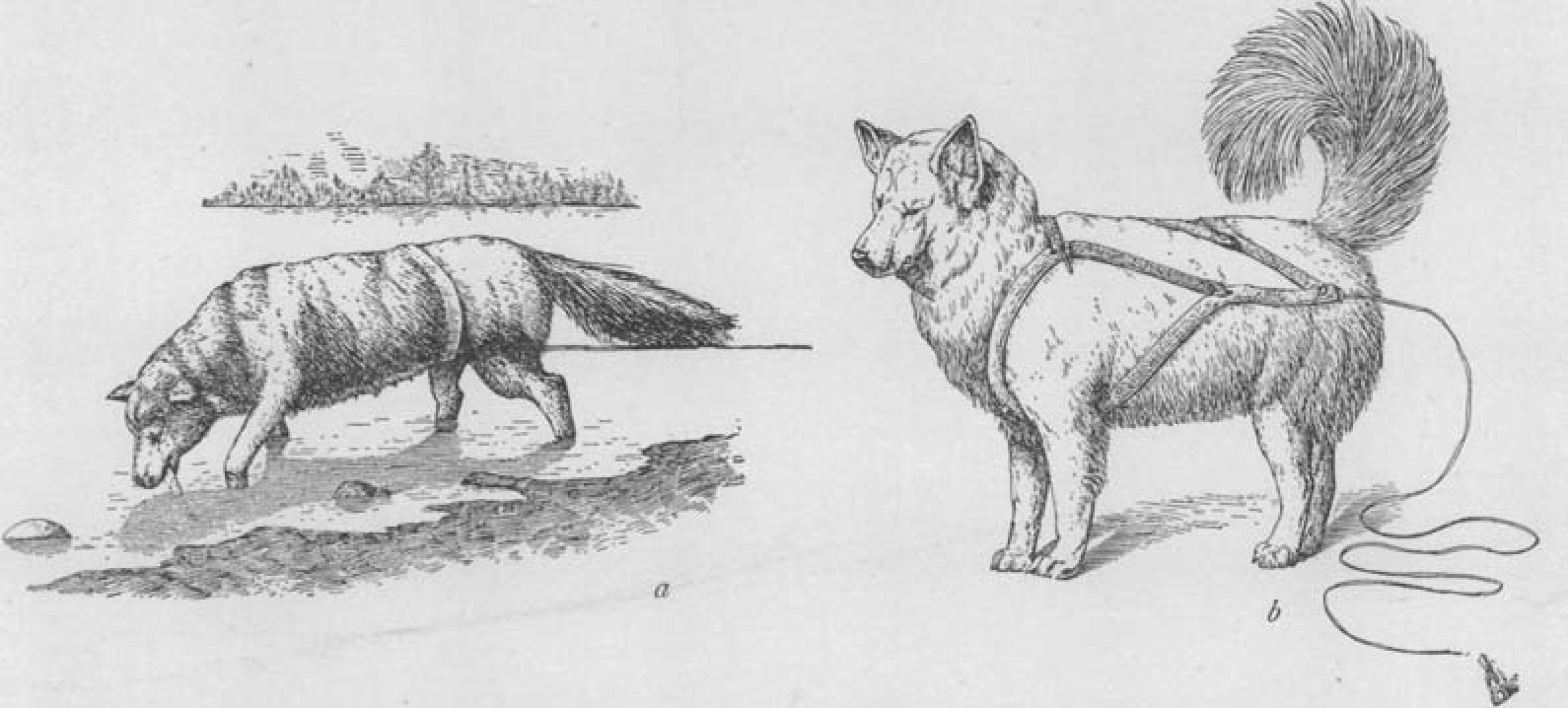
GROUPS OF DOG-BREEDING TRIBES. — The origin of dog-team driving is still more obscure than that of the domestication of the reindeer. In Asia there are three groups of dog-driving tribes, differing in their methods of harnessing, the shape of harness and sledge, etc. Those belonging to the first group, who inhabit northwestern Siberia, use a peculiar circular strap that girds the dog’s body about the middle, like a belt, and without bands across the shoulders, so that the dog can pull only with the hind-part of its body (Fig. 20, a). This method of harnessing does not work well: the dogs do not draw as heavy loads as the East Siberian teams, and they go more slowly.
East of the Lena River, and as far south as the Amur, all fishing and seal-hunting tribes use dog-teams with uniform sledge and harness. The sledge has three or four pairs of stanchions and a circular fore-part.¹ The dogs are attached in pairs to a long, thick strap, in place of a whiffletree, with about a fathom’s distance between the pairs; and a full team consists of six or seven pairs. The course is directed by the voice, with special call-words. These are understood and obeyed by the leading dog, which is trained specially for that purpose. The harness is somewhat similar to the ordinary horse-harness, with a breast-piece, and two or three bands across the back.
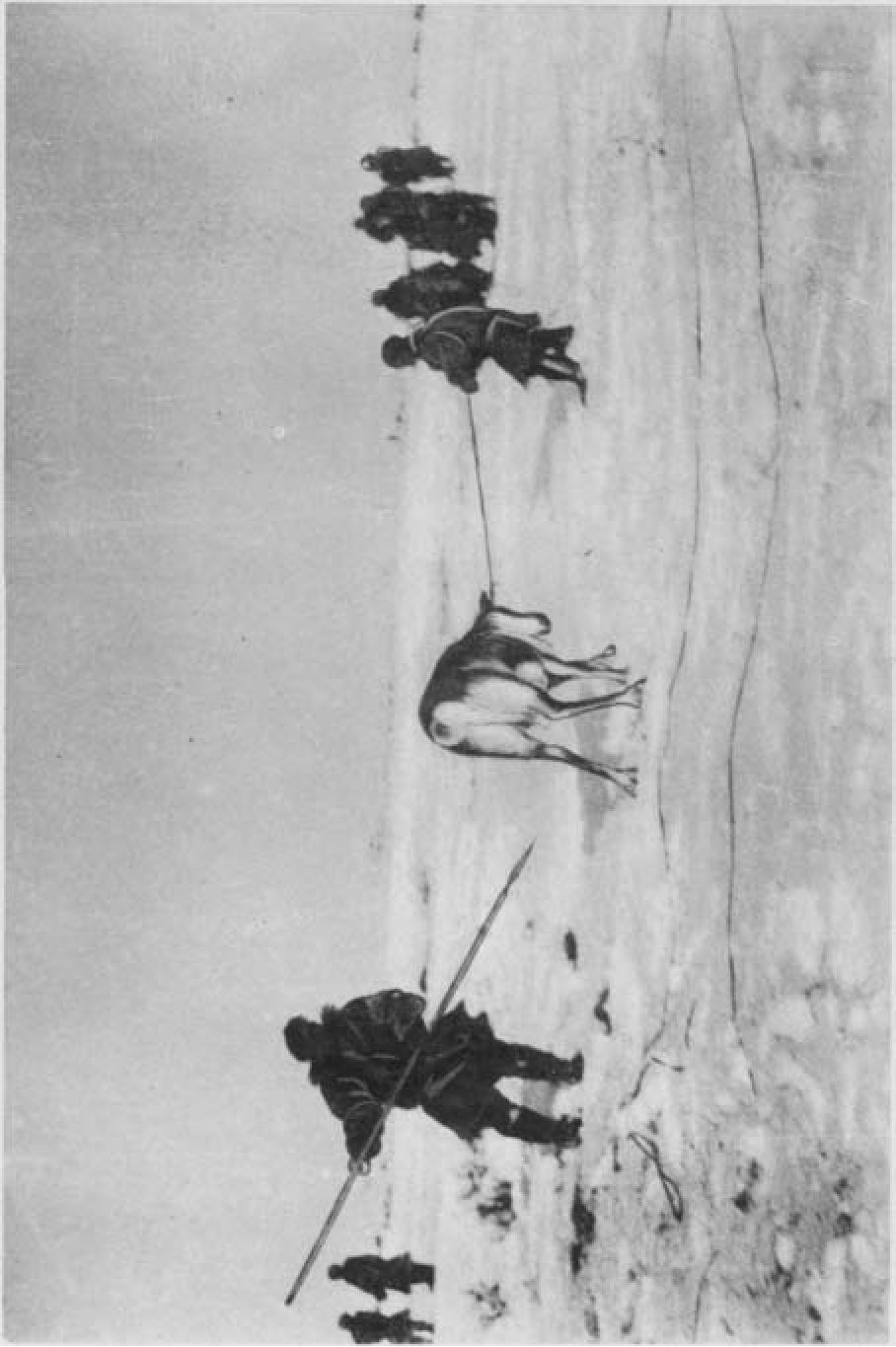
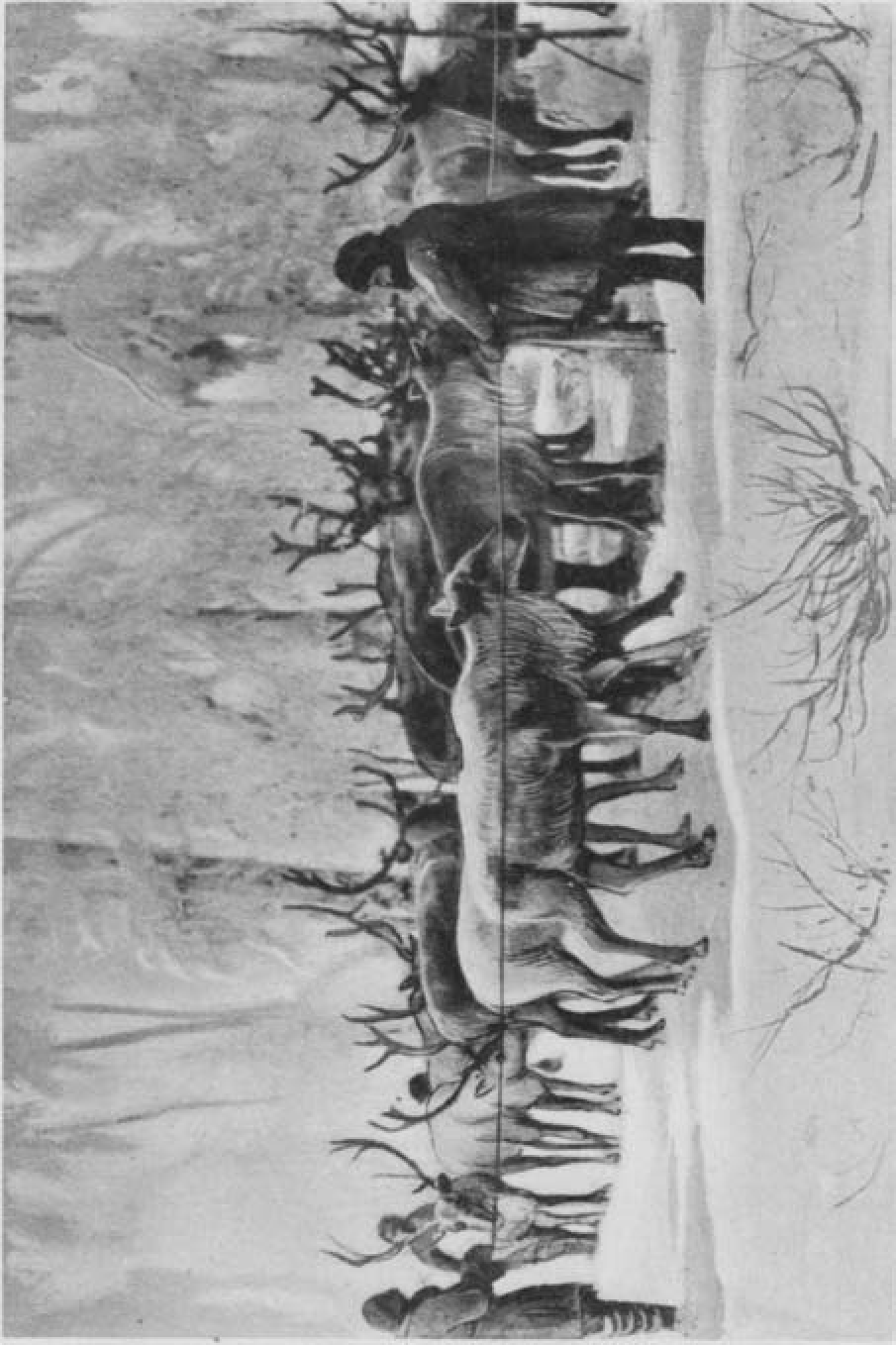
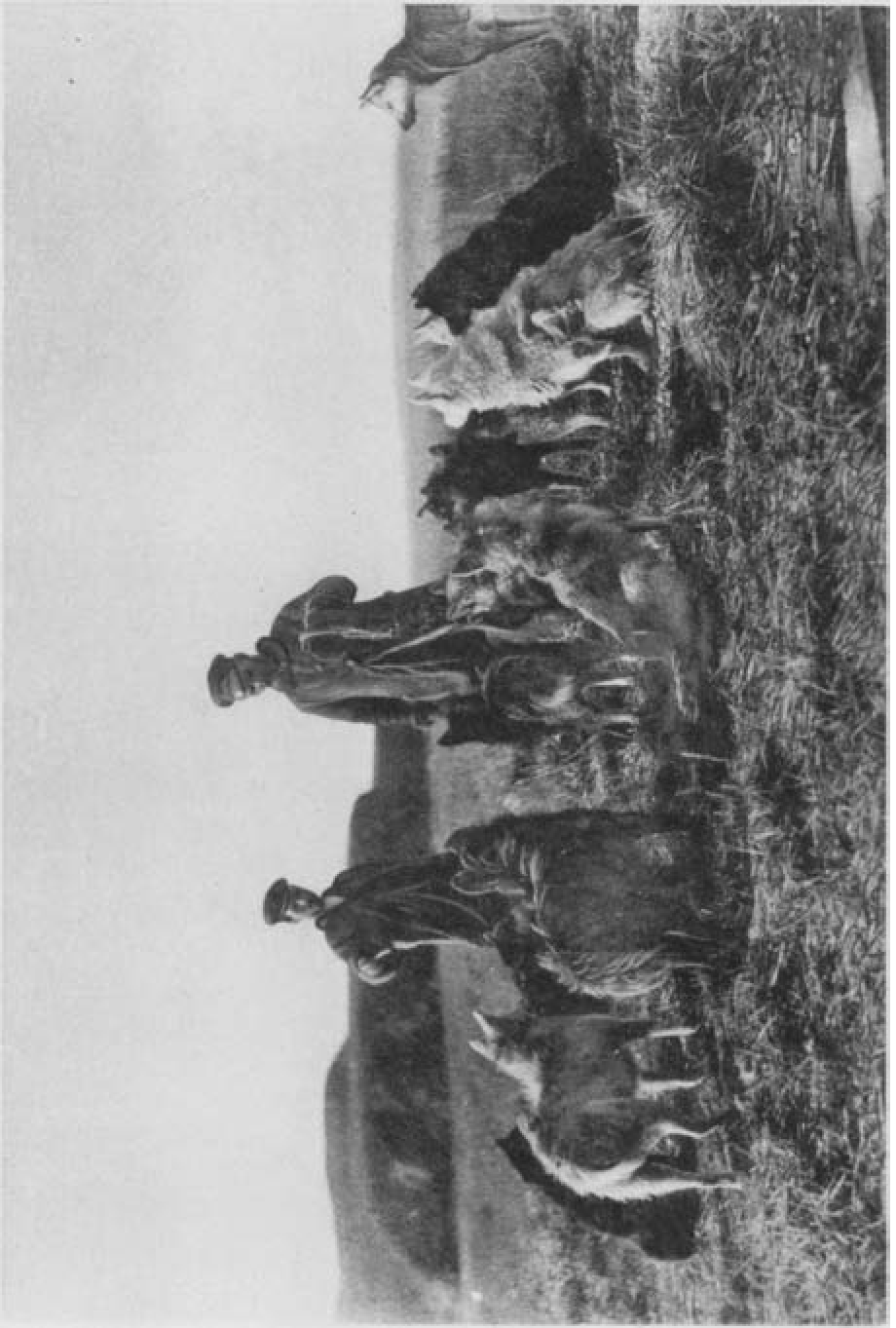
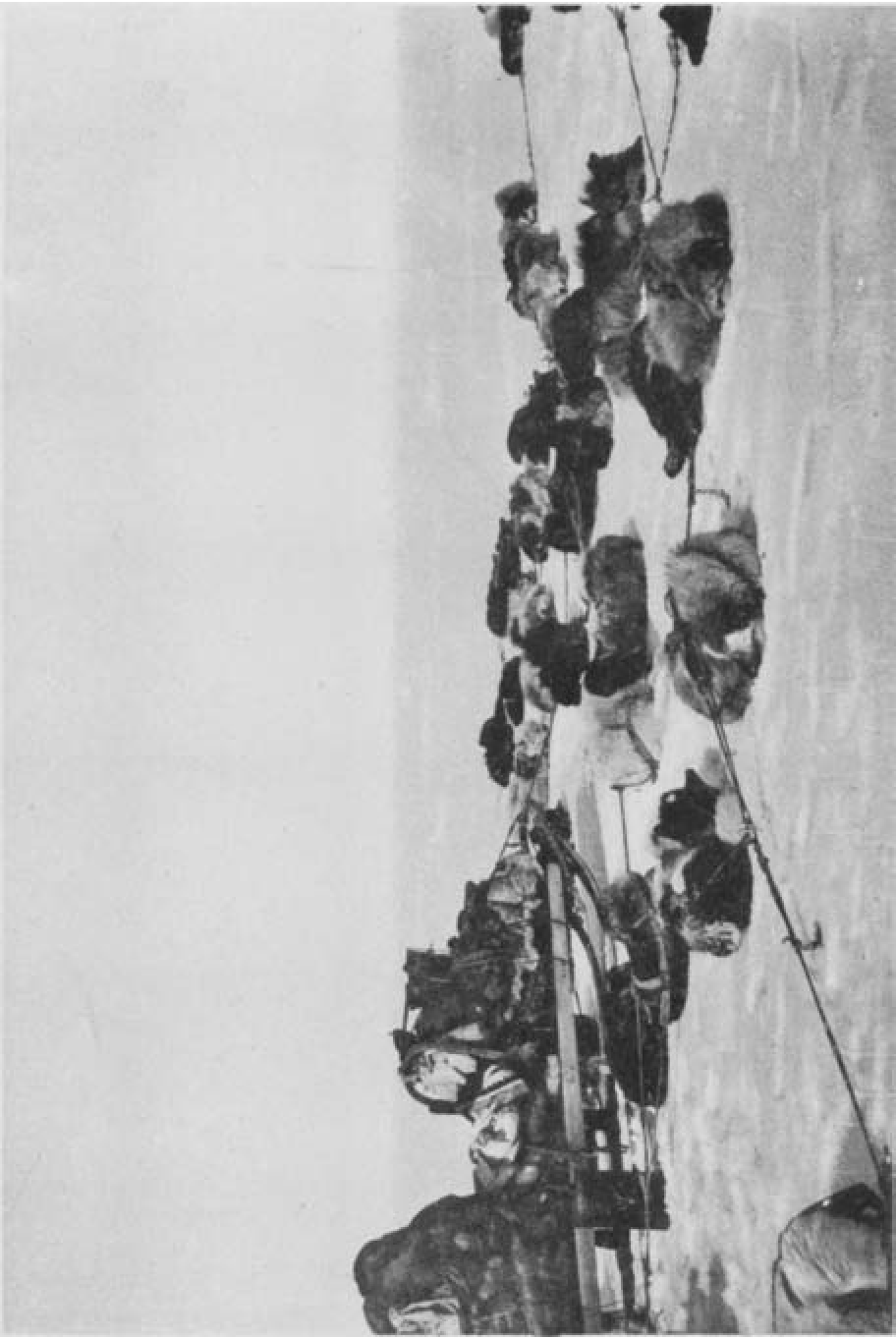
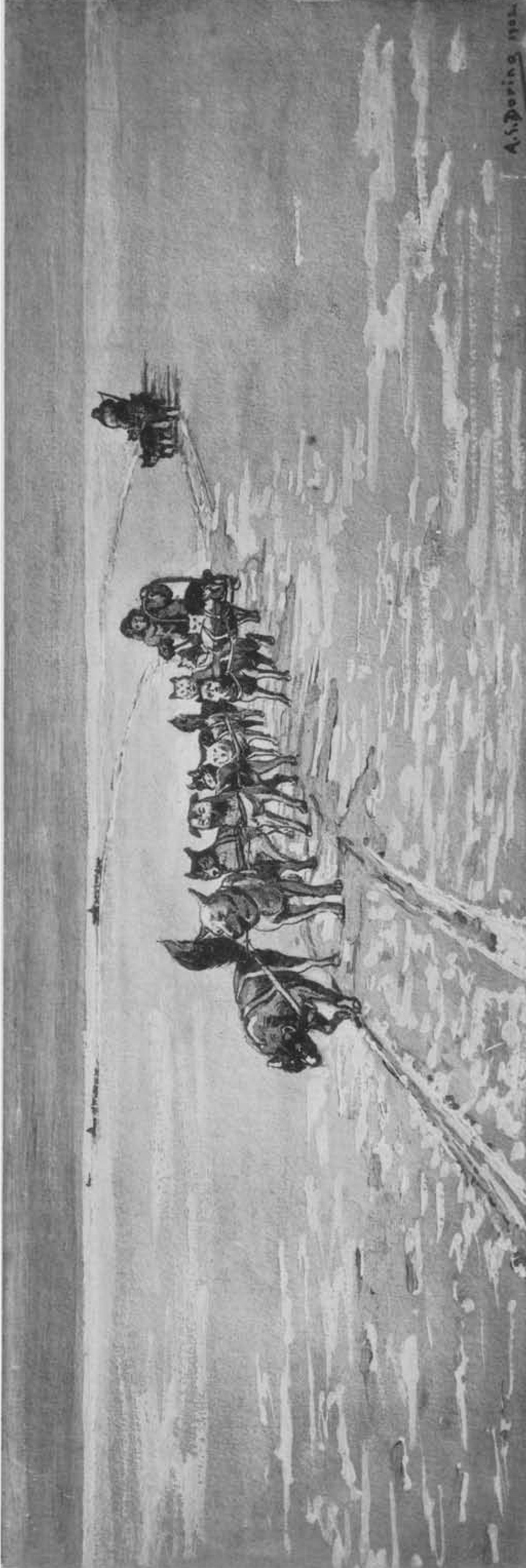
The third group of tribes — those of the Chukchee Peninsula — used,[99]🗗uncollated up to the middle of the last century, a sledge with curved ribs, similar to the reindeer-sledge, and a peculiar kind of harness (Fig. 20, b), identical with that used by the American Eskimo. They harnessed the dogs abreast in the same way as is done in North America. Since that time, however, they have entirely abandoned the old mode of dog-driving, and have adopted the southern form of sledge and the “tandem” method of attachment. Nelson¹ gives a sketch of a dog-sledge from Plover Bay, on the Siberian Pacific coast, which seems to me rather to be a reindeer-sledge, as it is too long and slender to be driven with dogs. It is somewhat strange that he did not see any other dog-sledge on the Siberian shore. Nordenskiöld,² too, gives a sketch of a dog-sledge similar to a reindeer pack-sledge. Of the native drawings reproduced in his book, one represents a man driving a similar sledge with three dogs harnessed abreast and a leader ahead; and another pictures a man driving an ordinary East Siberian dog-sledge with a tandem team. Lieut. Nordquist, in his Report given by Nordenskiöld,³ describes likewise the old method of dog-harnessing; but Nordenskiöld says elsewhere that it was used only for short trips, and that almost all drivers that passed along the coast on a prolonged journey had dogs attached tandem fashion. The old method of harnessing has gone entirely out of use; and I have never seen it employed in Maritime villages, though poor Reindeer people along the seacoast, when using dogs, sometimes attach them to a reindeer-sledge. Among the Asiatic Eskimo there are cases (for example, in the ceremonial races in the spring) in which the dogs are still attached in the old way (Plate VII, Fig. 1).
A model made in Mariinsky Post shows that the bone eyes at the ends of the long traces were strung on a line tied across the sledge in front of the first cross-piece joining the rails. This line is more or less similar to that of the Eskimo sledge described by Boas.⁴
I met with instances among the inland Yakut where ordinary house-dogs were attached singly to small sledges by means of a wooden shaft, or even with a small wooden yoke, in a manner similar to that used for harnessing bulls to wooden sledges. This method has no connection with that employed in the common dog driving-sledge adopted by the northern fishing Yakut on the Lena and Indighirka.
Perhaps in former times the methods of dog-driving among the first and second groups of tribes were not so different as they are at present. The ancient Kamchadal sledge, to which I referred in the preceding chapter, as has been said, was similar in shape to the Chukchee reindeer-sledge; and the[100]🗗uncollated driver sat on it astride, with his feet hanging down. He used for a seat-cushion double bags of seal-skin, that were thrown across the sledge, and hung from each side like saddle-bags. It is curious to note, that even now, when another form of sledge has been universally adopted, the dog-driving people on the Kolyma and Gishiga Rivers still use these saddle-bags for carrying provisions, etc., though now a single bag would be more convenient. The dog-teams were not so large as they are now. Krasheninnikoff says that the average team was three pairs, while now it is twice as many. A two-pair team was also much used. The driver frequently walked before the team, especially in heavy snow, breaking the path with his snowshoes, and with voice and motion urging the team to follow. This is still done in Kamchatka, and the dogs follow obediently; while Kolyma dogs, should the driver go ahead of them, would take it as a suggestion to stop. The method of walking before the dogs, urging them to follow, is generally employed by Eskimo drivers. It is interesting to note that two terms relating to dog-driving, and used by the Russians in northeastern Siberia, — kayuˊr for the driver, and oˊshtol for the brake, — are both of Kamchadal origin. In Kamchadal the driver is called keˊyux; and the brake, oˊcxtlᴇnañ, from the verb t-ocxtaˊl-ɪck (“I work with a brake”). This is the more curious, as the Cossacks went to Kamchatka later than to the Kolyma and to Anadyr.
Among the Yukaghir of the Upper Kolyma, who are probably the most primitive of all the tribes concerned, only a few dogs are attached to a sledge. They are placed in tandem position, — not in pairs, but separately,¹ — three or four dogs forming a team. There is no leader; but the men and women, on snowshoes, walk on both sides of the team. By means of long straps placed around the shoulders they help the dogs draw the sledge, and direct their course. The same method of dog-driving was adopted by the Yukaghir of the Lower Kolyma, of both the Anuis, and of the Omolon, as early as the fifties of the last century.
DOMESTICATION OF THE DOG. — The domestication of the dog in northeastern Asia surely preceded by a considerable period of time its adoption for carrying-purposes. Lamut dogs, for instance, are now used exclusively for hunting-pursuits. They scent squirrels and sables in the woods, overtake elk and reindeer on the hard-crusted snow in the spring-time, and catch white and red foxes on the open plain. Notwithstanding their fleetness, they are not well fitted for driving, on account of their roaming disposition. On the other hand, some European dogs, bought by Kamchatka drivers from merchant-ships, prove to be well adapted for the harness, and are able to keep pace with the native team, at least for short distances.
It is an interesting fact, that, among all northern dog-driving tribes, stories[101]🗗uncollated are told of experiences in harnessing young wolves. One Russianized Yukaghir told me that his own grandfather tried to harness tame wolves, but that they proved useless. They were too shy, and would frequently lie down flat and allow themselves to be dragged by the team. Moreover, the amount of food required by them daily was three times as much as is needed by the dog. According to the belief of the Russianized natives of the Kolyma, the “forest-owner,” a supernatural being,¹ drives, instead of dogs, foxes and wolves. Perhaps this belief accounts for the amplification of the above story.
Among the Chukchee and the Koryak the dog is also used for sacrifice, and even for food. The Maritime Koryak sacrifice so many dogs, that not enough are left for driving. The Reindeer Chukchee sacrifice both reindeer and dogs frequently, but the poorer people sacrifice principally dogs and puppies. Besides this, the Maritime Chukchee and the Eskimo use dogs for food in case of famine. In the winter of 1901, for instance, the Chukchee families of Mariinsky Post, at the mouth of the Anadyr, suffered greatly from famine, and ate nearly all their dogs. I know of cases where families of the Arctic shore have, in times of famine, eaten all their dogs. Even in times of plenty, some families occasionally kill a fat dog to feast on its head and intestines, although, on account of the jeers of Russian cossacks and American whalers, that taste has decreased rapidly, or at least its gratification is concealed from other people. However, when I wanted specimens of dog-skin, the natives who killed the animals for me were careful to take the meat home for their own private use. Sacrificed dogs are not generally eaten. The assertion of Nordenskiöld,² that the Chukchee do not eat dog-flesh even in times of need, evidently refers only to sacrificed dogs.
It is not necessary to speak of the races of the East Siberian team-dog, since all dogs are much alike in size and color. On an average, they are of the size of an ordinary shepherd-dog; rather smaller, however, than the dogs of the American Eskimo. Their appearance calls to mind the wolf; and the form of their heads, the jackal. They are shaggy, and have very thick, woolly tails, especially in the more exposed regions along the seacoast. Among the Yakut on the Upper Kolyma I have often met dogs of curious appearance, resembling that of the fox. They were undersized, with rather long bodies and furry tails. Their fur was red or reddish gray. These, however, were not team-dogs.
The most frequent colors of team-dogs are brindle wolf, black, white, black with white spots, white with black spots, red, and reddish yellow (the last two chiefly on the Pacific side); in southern Kamchatka they are sometimes white with gray or red spots.
The names of dogs among the Chukchee are derived chiefly from their colors; for instance, wuteˊl (“brindle wolf”), uweˊlᴇ (“black”), êˊlhar (“white[102]🗗uncollated fox”), etc.; though other names have a different origin, for instance, keiˊñɪn (“bear”), veˊʟ̣ᴇ (“raven”), neneˊn (“infant”), titiˊñɪ (“needle”). Other names cannot be translated; for instance, pappaˊlhɪn, which is given only to black dogs, and eliˊhɪkɪ.
Dogs of the southern and western districts are considered the swiftest and the most enduring. Among the Russianized natives the large and shaggy dogs of the Indighirka River are especially valued; among the Kamchadal, those of the southwestern villages Yavina and Golyghina; and among the Koryak, those of the Poqaˊč. The Chukchee dogs are considered the poorest of all, probably on account of their more scanty diet. Therefore the trade in live dogs between the Russian settlements in Anadyr and the Chukchee villages on the Pacific shore is of importance. A good dog can be bought with four or five white fox-skins, or two dogs with an American shotgun with accessories, etc.
Kamchadal, Koryak, and Russian dogs are fed exclusively on fish, — raw, dried, or frozen, according to the season or the locality (Plate VI, Fig. 3). The Kolyma Russians often cook for their dogs a kind of porridge made of putrid fish, roe, fish-bones, refuse of human food, etc., and serve it in long wooden trays; but this kind of food is convenient only at times of rest, since the dogs feel heavy with too much liquid food. The Chukchee dogs are fed on the intestines of seals, and on seal, walrus, and whale blubber. Their share of meat is small, and consists only of kitchen refuse, since their masters want all the meat proper for themselves. However, exclusive blubber diet is insufficient for dogs. In the summer-time, in the Chukchee villages of the Pacific coast, I saw large pieces of blubber strewn all over the ground; and the dogs prowling among them did not appear to be overfed. The natives said, that, whenever the dogs were satiated, they would desist from eating blubber for a long time. On the contrary, in the fishing villages of the Koryak or Kamchadal, at the same season, when food is scattered on the ground, the dogs grow so fat that they can hardly walk.¹
The continuous fluctuations of success in seal-hunting, and the frequent seasons of famine, have a deteriorating effect upon the Chukchee race of dogs; but fishing among the more southern tribes is much more regular. Chukchee dogs need something to season their blubber, and are generally inclined to eat up all the dry thongs they can get; they even gnaw at the lashings of sledges, and destroy their own harness and traces, much more than do the southern fish-fed dogs. On the contrary, the Russian fish-fed dogs thrive best when they are given blubber mixed with their dried fish. The dogs are fed once a day, usually in the evening, by some of the drivers immediately after stopping; while others prefer to wait until they have had three hours of rest. A piece of blubber measuring two inches each way, and some shreds of putrid walrus-meat or whale-skin, form the daily ration of every dog. During the[103]🗗uncollated day’s run, most drivers, when food is not scarce, give their dogs a piece of blubber by way of encouragement. The dogs can go several days without food, even on the journey. They will, of course, become very weak, and unable to carry heavy loads. When not at work, the dogs can subsist on very little. At the end of spring, when sledge-driving is over, the dogs are released for the summer, and are not fed at all, because the seal-catch is not abundant; then they live on such scraps as they can secure. During the entire summer, in certain localities, the dogs find their own subsistence. In the Kolyma country, for instance, they live on mice and spermophiles; on the southern shores of Bering Sea, on dead salmon, etc.
After the summer rest, the dogs, before being put into harness, have to be carefully tied up and kept for a day or two with very little food, or even without any, according to the amount of fat they have accumulated. Dogs harnessed too soon will be spoiled for the whole winter, being unable to endure long, fast runs. Dogs are harnessed in the first autumn of their lives, often when only two months old. Sometimes the female dog is attached in the front, and her whole litter of pups in the rear. In a few months, when the pups are quite grown, such a team will perform heavier and more uniform work than any other.
The females are good leaders; but, since they are weaker and smaller than the males, they are not good for drawing heavy loads. The males are gelded with an iron knife. The operation, contrary to that upon the reindeer, requires some skill, since the fat male dog will easily die from bleeding or inflammation. On the Kolyma, the operators assert that they can cause the animal operated on to assume afterward whatever pace they like, — trot, canter, or gallop. On the Pacific side there is no occasion for such assertion, because the dogs are not allowed to go at any swifter pace than a brisk trot. The Kamchadal and the Koryak crop the tails of their dogs, believing that this will increase their speed. Disobedient dogs often have their tails cropped on the road, and have to go till evening, the blood trickling all the while. The team-dogs serve till ten or twelve years old. After the sixth or seventh year they begin to decline. Contrary to what has been said of the Eskimo dog, the Asiatic harness-dogs are sullen, and care little about their masters. I myself had occasion to breed several generations of dogs under the ordinary conditions. Most of those that I gave away would not recognize me at all after a few months.
The same dog, however, when ungelded and rarely used in harness, is as merry and affectionate as any European dog, though perhaps more uncouth and boisterous in the display of feeling. The dog Mr. Jochelson brought with him from the Kolyma to St. Petersburg, though considered remarkably mild when in its own country, was a continual nuisance. It wanted to kill every domestic bird it happened to come across; it frightened the horses, and[104]🗗uncollated had to be kept carefully tied all the time. The Siberian harness-dogs are more given to howling than barking. Their howl is long and whining, and ends with an occasional yelp. On winter nights the whole canine population of the village, often several hundred head strong, will raise a chorus that will last for half an hour, subsiding several times, and then breaking out again.
Of dog-diseases, the peculiar Arctic form of rabies occurs frequently, especially in the spring. I observed that it occurred most frequently after a long course on the open tundra; and, according to native ideas, it results from the action upon the brain of the excessive brightness of the snow, analogous to the spring snow-blindness of men. Dog-rabies, however, is not so bad in northern as in southern latitudes; and, though I have known of many men being bitten by a rabid dog, I have never heard of any bad results from the bite, but I have heard of some such cases with rabid wolves. However, any dog bitten by a rabid one will itself go mad, and sometimes, when the rabid dog is not killed in time, several teams will be greatly injured. On long journeys the drivers simply muzzle the rabid dogs at first, so that they cannot bite their companions; and they continue to drive them thus for two or three successive days, as I witnessed when travelling among the Chukchee between Anadyr and Indian Point in March, 1901. Dr. Slunin¹ asserts that animals bitten by a rabid dog are not infected. However, I had dogs in my own team perish from such cause. A dog suspected of being rabid is speedily made away with, for fear that it may bite some of its companions — except on long journeys, when the driver has to utilize the whole strength of his team. I would also mention a kind of palsy — a disease of northern dogs, that affects the head of the animal, and disables it for walking — and a kind of cramp that often precedes the palsy. Both diseases are contagious, and may destroy a whole team in twenty-four hours, since the animal generally dies with the first fit.
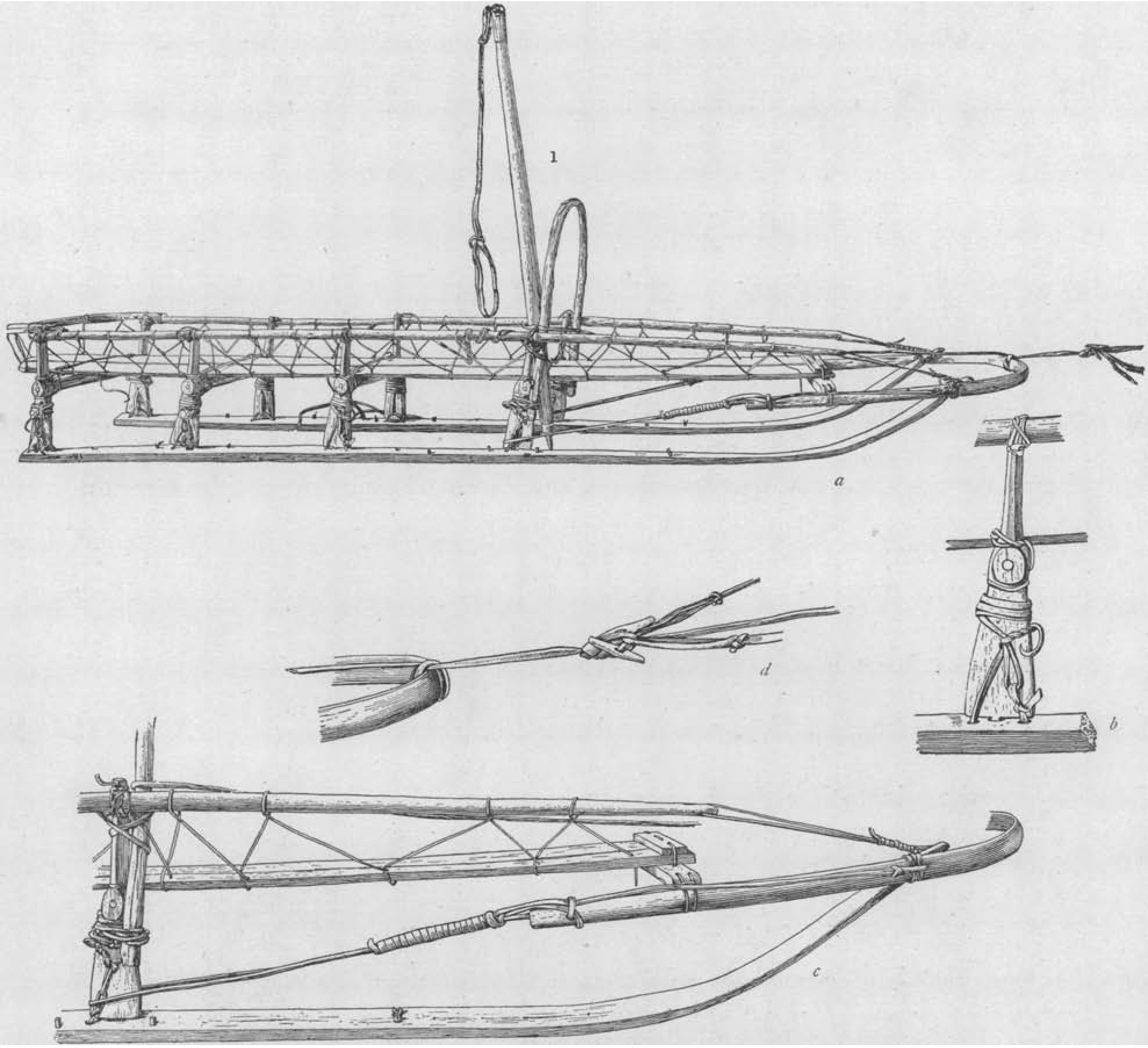
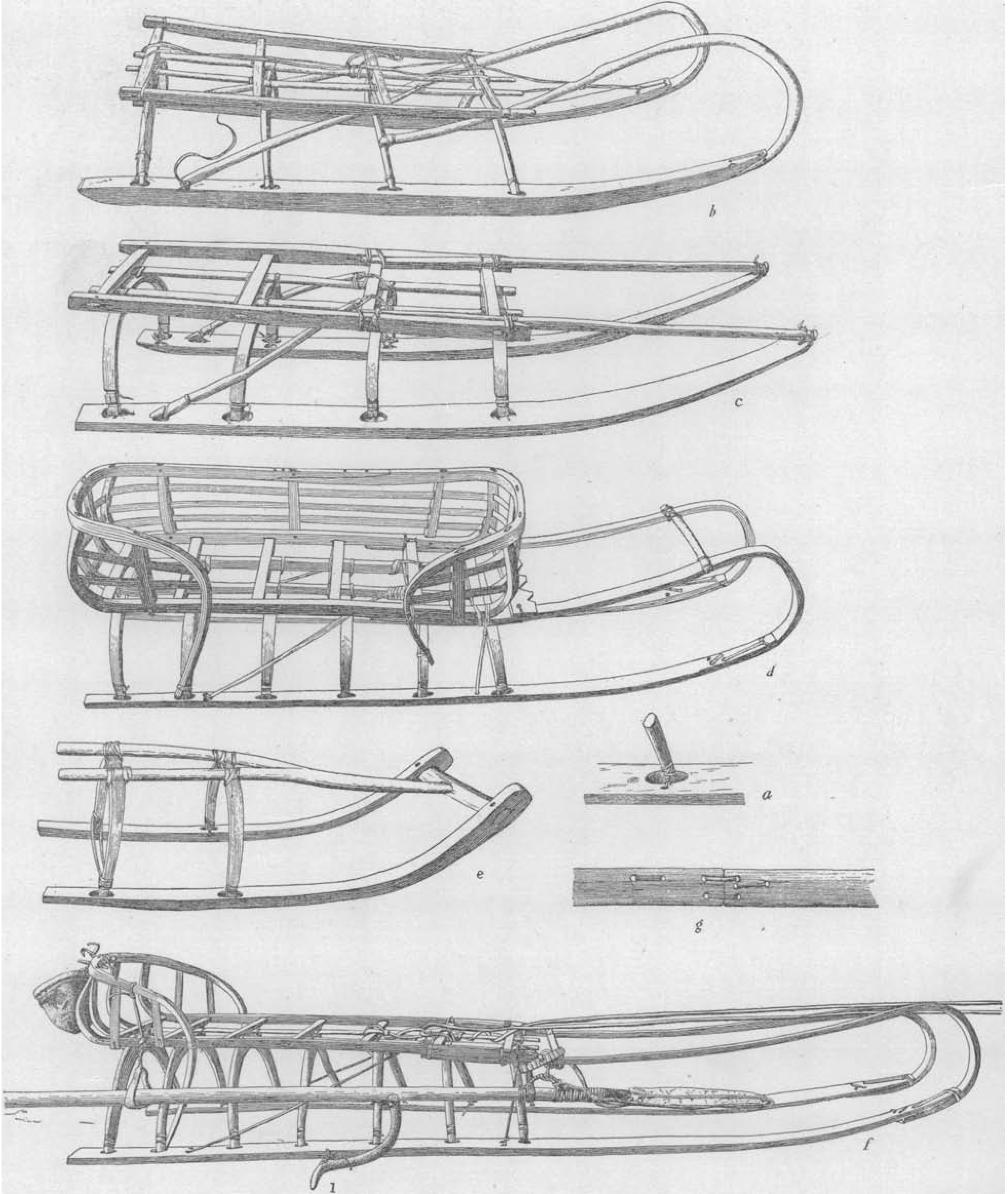
DOG-DRIVING. — The dog-sledge now in use in northeastern Siberia (Fig. 21) is long and narrow, and has three or four pairs of stanchions. The lower end of the stanchion is cut off square, except a rough peg which is left standing in the middle. The peg is inserted in a circular hole in the runner (Fig. 21, b). Each pair of stanchions is joined at half their height by a round stick, which is mortised into a circular hole in the stanchion. A thin, broad plank — or rather two planks laced together — rests on these sticks. Two rails are fastened on the upper ends of the stanchions, and are lashed to the boards with thong, which forms a kind of retaining-net all around the sledge. The runners are flat, and their front ends are strongly curved and tied to a strong wooden bow, which is fastened to the foremost stanchions with strong lashings (Fig. 21, c). Another vertical bow is fastened above the foremost stanchions; and the driver directs the course of the sledge, and prevents it from overturning, holding on[105]🗗uncollated to the top of this bow with his left hand, while with his right hand he works a brake (Fig. 21, a¹). The length of the runners is 3-3.5 m.; breadth, 8 cm.; thickness, 3 cm.; height of the standing bow, 120 cm.; height of the sledge when heavily laden, 1 m. All joints are fastened with strong, ingeniously twisted lashings (Fig. 21, b, c). The general shape of this sledge is, as has been said, identical with the Tungus reindeer-sledge, which, however, is shorter and clumsier. The latter has only three pairs of stanchions, and no standing bow in the middle. Its planks are broader, and the lashings are stiffer and ruder.
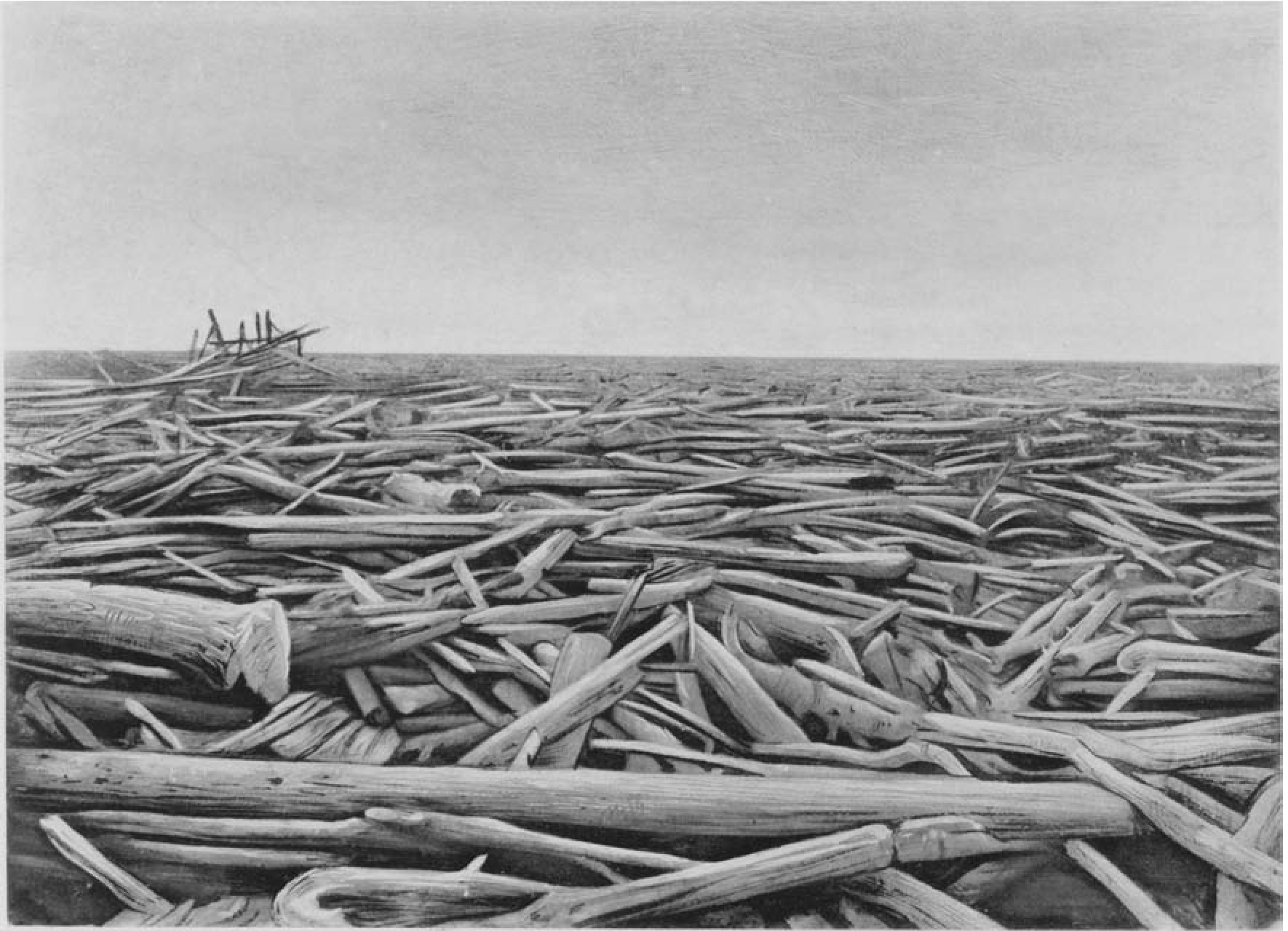
All parts of the dog-sledge, especially the runners, are made, if possible,[106]🗗uncollated of birch-wood; but the Arctic Chukchee use also various kinds of driftwood, especially American pine, and even oak picked out from wreckage. On some parts of the Arctic shore driftwood is piled up in large masses (Plate VII, Fig. 2), sometimes covering an entire acre, and wreckage may be found everywhere among the wood. The Pacific people buy lumber from whalers, or even bring it themselves from St. Lawrence Island or the Alaskan shore in their boats. Birch runners are fit only for the cold season, and after the end of March will not run easily in the daytime, when the snow is damp and loose and all the sharp points of the ground protrude. The friction of birch-wood is so strong as to tire out the best dogs, and, besides, wear out the precious runners in a couple of weeks. In the Kolyma district and in the eastern Arctic villages, runners made from the outer layer of the larch, with twisted fibre (called in local Russian крень), are substituted for use in springtime. The material is obtained from the trees that grow on the mountain-slopes, and is much harder than the ordinary larchwood. In the damp weather of spring the drivers will sometimes smear the birch runners with oil, though it may spoil them for the winter; or they will tie a piece of blubber to the quirt, and every now and then, while going ahead, whip it across the track, to be passed over alternately by both runners, to make them more slippery. Much more frequently the runners are shod with whalebone, or with pieces of bone taken from the whale’s jaw, sewed to the runner with sunken stitches (see Fig. 17, g) or fastened with wooden pegs. On the Chukchee Peninsula, drivers protect their wooden runners with bone shoeing throughout the winter, though it makes the sledge twice as heavy, and the bone does not run smoothly on the cold, crisp snow.
In the winter-time the birch runners are covered with a thin sheet of ice to make them run more smoothly. For this purpose they are well saturated with water in the early fall, usually by immersing them in a pool or small lake for a couple of weeks; or in winter, when the pools are frozen, by steaming them in long troughs filled with hot water or by frequently wetting the bottoms with boiling water. Only damp wood, well soaked with water, will hold the ice-sheet, which is formed by wetting the bottoms of the runners several times over by means of a small piece of skin. The colder the day, the hotter the water that is used for the process. Larch-wood holds the ice-sheet only for a short time, and bone hardly at all: therefore it is not subjected to the process. This method of covering the runners with ice is adopted by all the West Bering tribes. The people in South Kamchatka, however, on account of their damp winters with frequent thaws, do not employ it much. The Kolyma Yakut cover the runners of their reindeer and horse sledges also with ice.
Among the Maritime Chukchee and the Asiatic Eskimo there exists also a peculiar form of small sled, — not related to the usual Asiatic forms, but[107]🗗uncollated quite similar to the small sledge of the Eskimo. It has runners made of walrus-tusks or of whale’s ribs, also of wood shod with ivory or with bone of the whale.
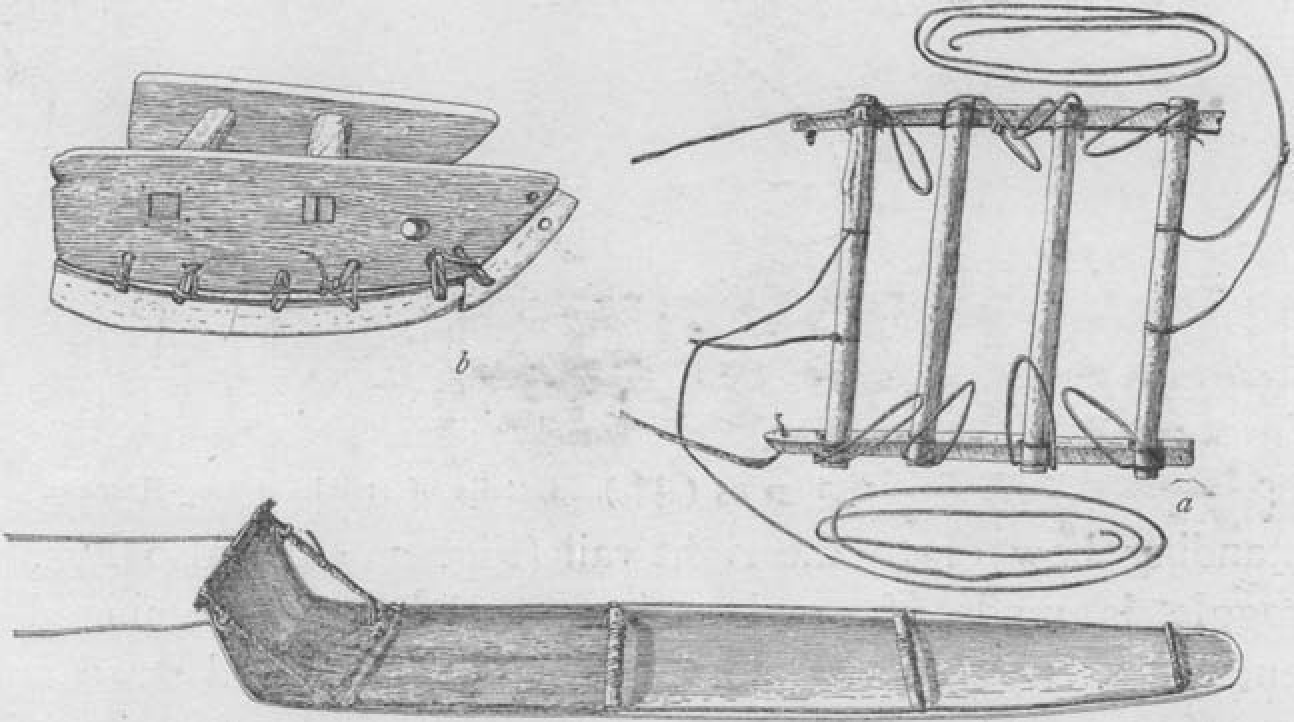
Fig. 22, a, represents a sled from Mariinsky Post, which was used by hunters on the ice of the sea for carrying to the shore walrus-meat cut into square pieces. It is similar to one from St. Lawrence Island which is illustrated by Nelson.¹ Fig. 22, b, shows a sled from Indian Point, that is used for carrying skin boats. A wooden sledge of a similar pattern is used by the Russianized natives of the Kolyma and the Anadyr for conveying tubs of water from the common “water-hole” of the village.
In former times a kind of toboggan made of whalebone was used for carrying meat over the ice, while at present the whalebone has too high a market value to be applied for any such purpose. The model in the collection (Fig. 22, c) is made of a single piece of whalebone, while the real toboggans had several slabs laced together side by side.
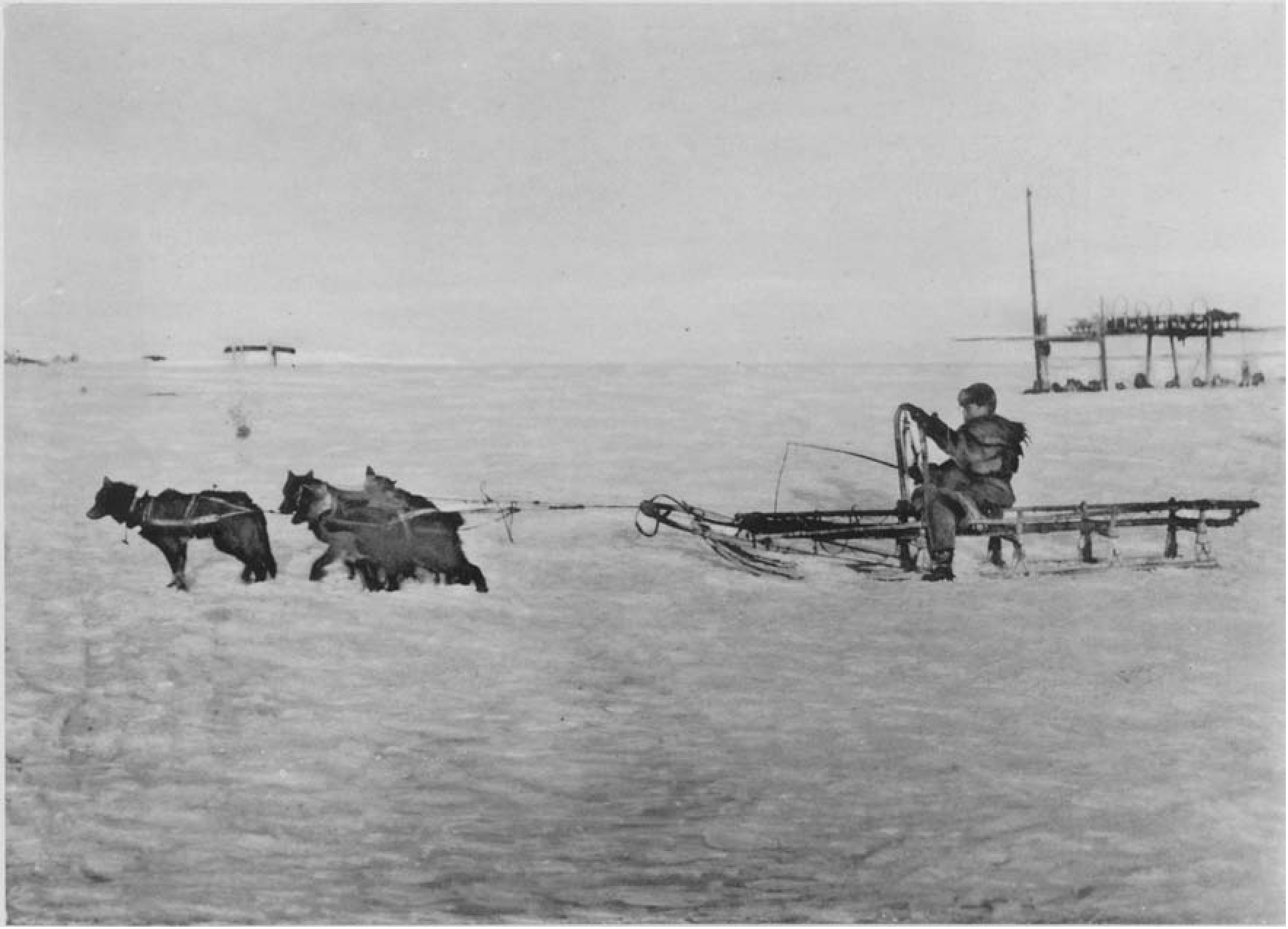
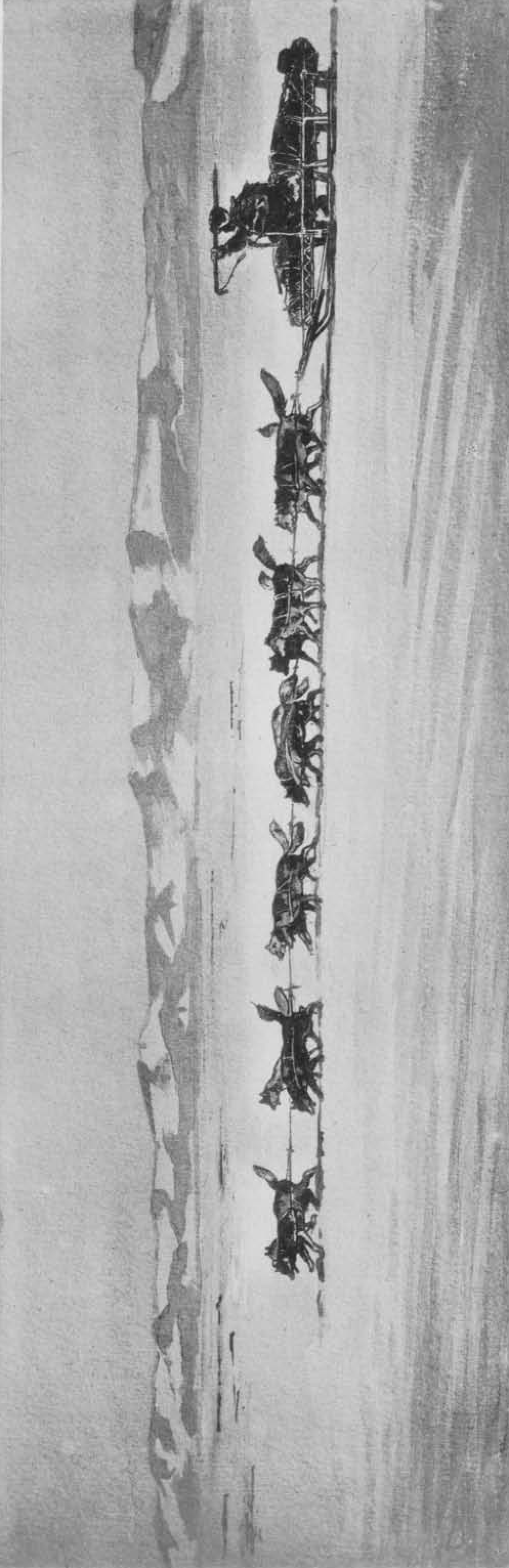
At the present time an ordinary dog-team has six or seven pairs of animals (Plate VIII, Figs. 1, 2; also Plate VI, Fig. 4). An odd dog is attached separately, generally at the rear end; or, if the central strap is too long for the number of dogs, two or three of them are attached separately. Chukchee drivers going on a long journey borrow from their friends and relatives as many dogs as they can, and thus have teams of from sixteen to eighteen dogs. Even double teams of more than twenty dogs are used; though this does not work well, because the foremost pair will hardly do their share of work, and the whole team will lack in unity. Moreover, a double train requires two drivers wherever the road is uneven, as on the hills and in the forests.
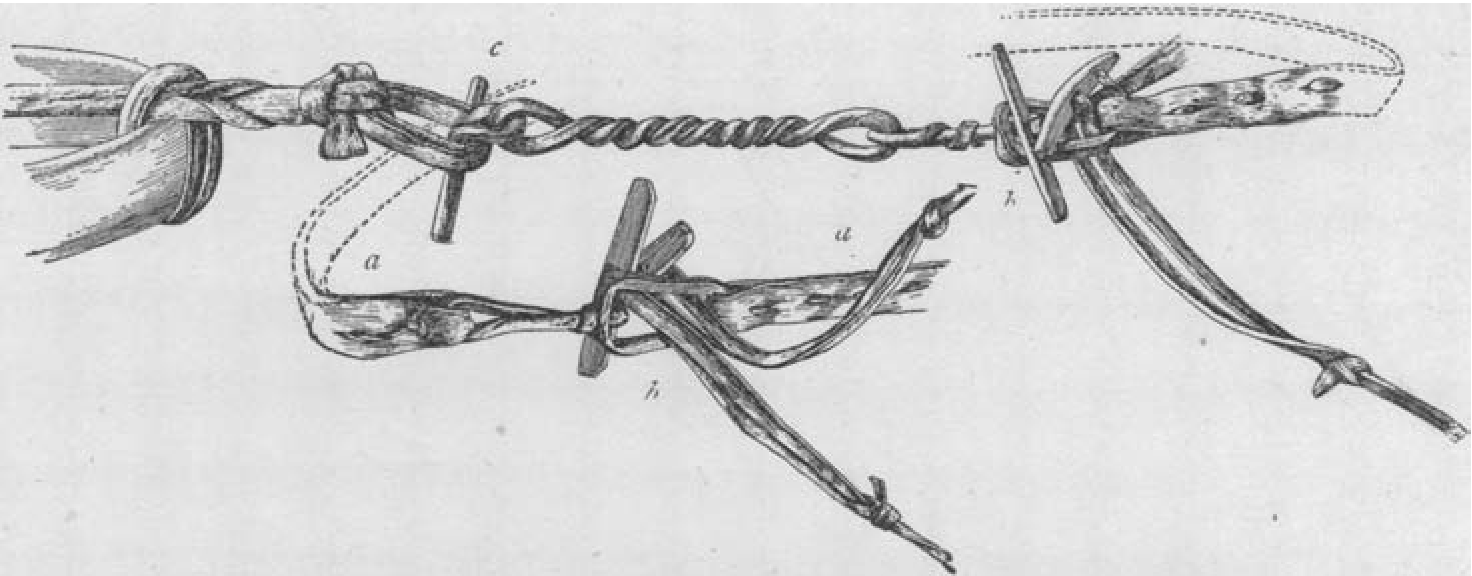
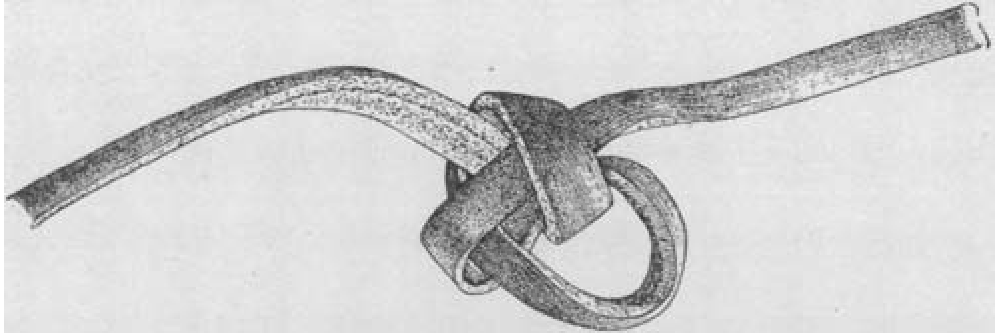
The strap serving as whiffletree (Fig. 23) is either made of one piece, or consists of two or three lengths of thong (a), each about a fathom long, joined together with bone or iron eyes (b). The ends of each piece of thong are slung through the eyes, and sewed together with thin leather or fastened[108]🗗uncollated to them with toggles. The rear end is fastened to the shaft with a larger toggle (c), or simply twisted around the curved shaft and then tied to the standing bow or to the right rail (Fig. 23; see also Fig. 21, a, b). The large toggle is made of wood or iron, and is often combined with a swivel which ends in a large eye. The rear end of the central strap and the first two traces are fastened to this eye. The rear end is thicker, and the strap gradually grows thinner toward the front end. If the strap is of one piece, loops are tied in it (Fig. 24) at distances of about a fathom. The toggles of the traces of each pair of dogs are fastened in one loop (Fig. 21, d). The attachment of the dog’s traces to the harness is illustrated in Figs. 21 and 23. The dogs pull on the traces somewhat obliquely, so as to leave sufficient room between the animals belonging to the same pair for them to walk without jostling. The two lines of dogs generally follow in the tracks of the runners of sledges that have preceded them. Thus on beaten trails an elevation is left between the two lines, which keeps the dogs apart.
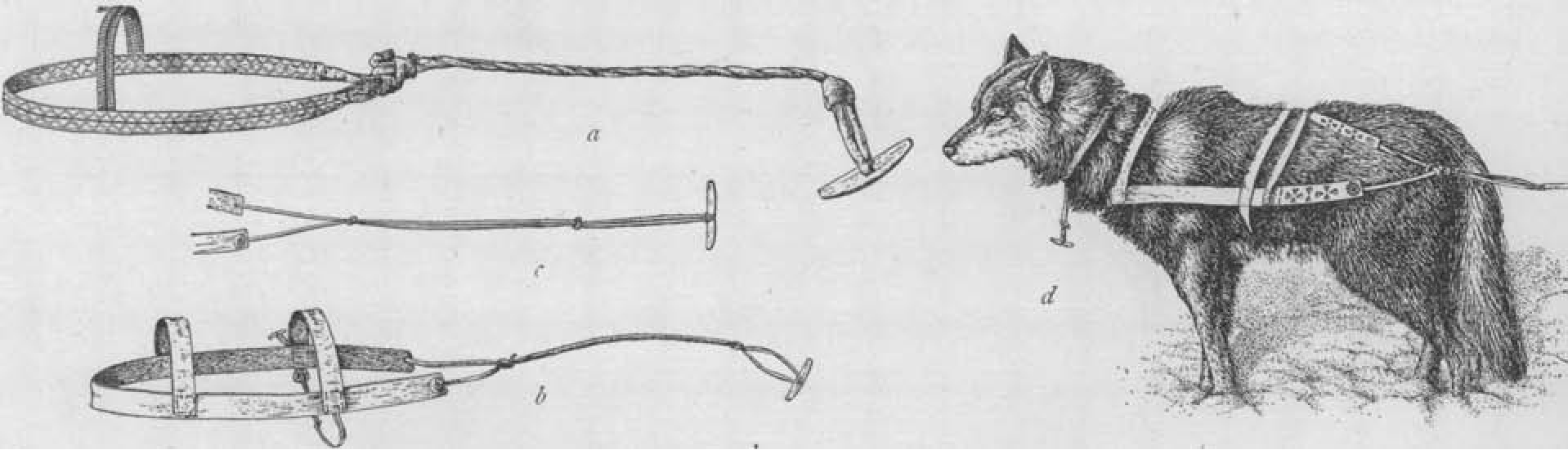
The harness described above allows of variation. One form, the so-called[109]🗗uncollated “oblique” harness (Fig. 25, a), is short, and has only one band across the back. With this harness the animal pulls in a quite oblique position, and its outer shoulder has to work harder than the inner one. This form of harness was introduced from the south. It is in use among the Amur tribes, as may be seen from the description and drawings by Schrenck.¹ It is also used everywhere in Kamchatka, and in the countries farther to the north it is therefore called the Kamchatka harness. The usual harness of northern type (Fig. 25, b) has two cross-bands and a single or double trace (Fig. 25, c). Those of the finest style even have a third narrow cross-band (Fig. 25, d).
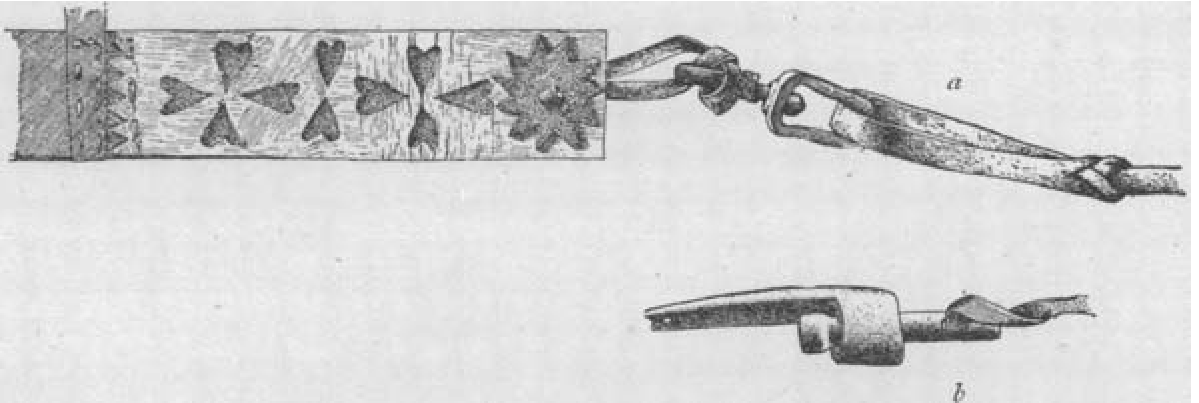
Iron, bone, or ivory swivels (Fig. 26) are inserted in the traces to prevent their twisting around the whiffletree-strap. Well-trained dogs, however, are extremely careful not to get their traces tangled up with the central strap. Even when a young or badly trained dog is matched to an old one, the latter will actually prevent its companion from causing trouble, biting it severely every time it wants to leap across the strap. I had opportunity to see this many times while driving. Wily or disobedient dogs are attached nearer to the sledge, where they can be reached by the stick. Moreover, the nearer they are to the rear end, the more exertion is required, since the sledge, on every slight deviation from the track, gives the rear dogs a hard shake and a pull backward. Therefore strong animals, somewhat slow from age or from lack of mettle, are usually placed at the rear; and those that are younger and more brisk, in the front. Sometimes even the leader may be placed in the extreme rear by way of temporary punishment. While on the run, the driver changes the dogs’ places from time to time, according to the change in their disposition and mettle.
The southern drivers cover their dog-harness with colored paint, and adorn it with red flannel and embroidery (Fig. 26, a). The Chukchee do not make such harness themselves, but gladly buy it from the Russianized natives of Anadyr. The Asiatic way of attaching dogs, when compared with North American methods, has its advantages for travel on land, especially in the woods, where the path is narrow and winding. With short traces fastened to a central strap, it is difficult for the animals to jump around any tree standing close to the road, as they would do with the long Eskimo traces. Even on the open tundra, the Asiatic method is more convenient, since the dogs do[110]🗗uncollated not entangle the traces so much, and well-trained dogs not at all. On the contrary, for journeying on rugged ice, the American method must be much more convenient; and from personal experience I can confirm the opinion of Dr. Boas,¹ that the cross-lines of the Asiatic harness would make it very difficult, and even dangerous, to travel on rugged ice.
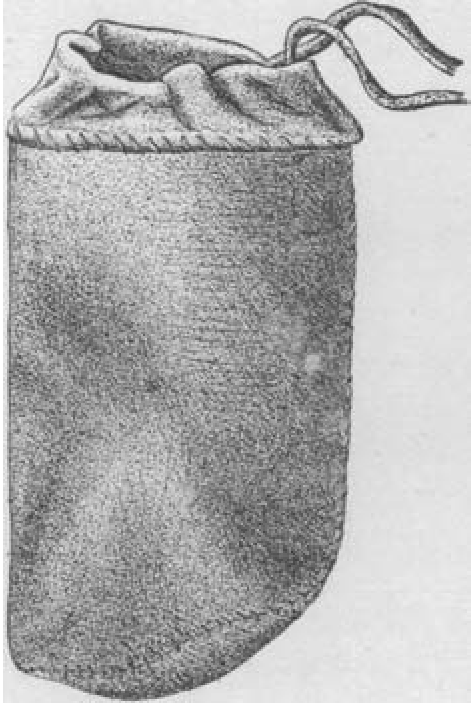
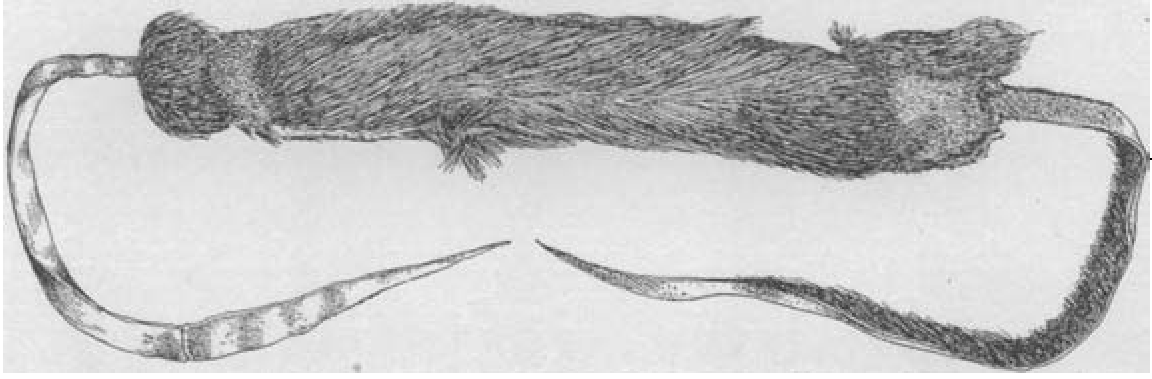
When bountifully fed, the dogs are quite unwearying, and can make long runs for twenty successive days with but two daily rests. Their feet, however, are very sensitive. Uneven ground with clods of hard snow, for instance; a moss pasture recently left by a reindeer-herd; or rough, bare ice in late spring, — will make their feet bleed, and rapidly disable them. Sore feet heal slowly, though a well-trained dog sometimes keeps pace with the team when all its feet are bleeding. Occasionally small boots of curried reindeer-skin (Fig. 27). are put on the sore feet, though many dogs cannot endure them, and will tear them off as soon as started on the journey. Frost-bites of the groins are still worse, since, even after recovery, the dog remains weak, and susceptible to cold. The drivers, when caught on the road by a severe tempest or even by a cold, contrary wind, protect the dogs with strips of soft skin tied around the groins (Fig. 28). The suckling females have square strips of skin tied over their bellies for the same purpose.
When resting for a night, the dogs are usually unharnessed, but are tied up with a halter. Sticks or pieces of horn about thirty centimetres long are fastened to the dog-collars. The ends of these sticks are tied by short lines to stakes or to the sledges. The sticks are long enough to prevent the dog from gnawing the thong fastenings at the other end. Iron chains bought from traders or made by the natives are also used. The dogs lie down immediately, hiding their noses in their bellies, and covering their heads with their large woolly tails, in the familiar attitude of all Arctic animals with large tails. In severe storms, however, the dogs are released altogether; otherwise, without freedom of motion, they would be in danger of being buried in the snow and stifled, especially when they are too tired to stand up every little while, and shake off the snow.
In the old method of Chukchee dog-driving, the course of the team was[111]🗗uncollated directed by means of a whip with a very long lash, that was made to snap either from the right or from the left, indicating to the leader to which side it was to turn. The urging call was “Ke, ke, ke!”¹ The stopping-signal was the slow and drawling “Hē!”¹ In the usual East Siberian method, the driver has only a short whip, which is used occasionally for punishing the slow and the disobedient animals. The team is directed chiefly by different calls and signals. According to the various localities and tribes, they are as follows: —
To the right! To the left! Go ahead! Stop! Indighirka Russian and Tax, tax, or Yakut Taraˊx, taraˊx, taraˊx. Taiñm, taiñm, Pošaˊ. Toy, to-oy. tax, tax, tax. Kolyma Russian S˙utaˊ, s˙utaˊ. Nax, nax. Poša; pod˙, pod˙. Toy, to-oy. Anadyr Russian S˙utaˊ, s˙utaˊ. Q!x!, q!x!. Ho, ho, ho. Toy, to-oy. Kamchadal and Koryak, S˙utaˊ, s˙utaˊ. Q!x!, q!x!. Huᵋy, huᵋy. □ña.² Chukchee Čutaˊ, čutaˊ, or Mra. Q!x!, q!x!. Ho, ho, ho. Toy, to-oy. Qu, qu, or Asiatic Eskimo Tɪ, tɪ. Q!x!, q!x!. Añ, añ, or Toy, to-oy. Tuˊlla, tuˊlla.
Of these calls, S˙utaˊ or Čutaˊ, Pod˙, pod˙, and Toy are of Russian origin. S˙utaˊ (from s˙uda [сюда]) signifies “here.” Pod˙, pod˙ (подь, подь) means “Go, go!” Toy (instead of Stoy [стой]) signifies “Stop!” Q!x! is probably an imitation of the raven’s cry. Mra is the Chukchee word for “right.” Qu, qu; Añ, añ; Tuˊlla, tuˊlla; — are identical with the urging calls of the Point Barrow Eskimo.
When running fast, the dogs are urged forward by whistling, shouting, or the utterance of various short words suitable to the occasion; such as, “He boys!” “Home, home!” “Goose!” “Reindeer!” When tired, the leader ceases to obey the driver or to understand his calls, and accordingly looks around more and more frequently.
The training of the leader is very simple. A swift and clever young dog, perhaps two years old, is placed as one of the front pair in the team, and in a couple of months begins to learn from its companion. Well-trained dogs, when turning aside, will cast a glance towards the driver to ascertain whether they are doing right. However, dogs that look around too often are considered to be badly trained, since this habit indicates either shyness or too much fear, and always impedes the pace of the team.
With a strange driver, the dog-team is wayward and very shy. For instance, if the leader knows that some turning of the road likely to be taken by the driver is ahead of it, it will accelerate its pace to the utmost, and try to pass before the word of command is given. A dog placed in a strange team feels shy, and often refuses to work, allowing its trace to slacken.
Siberian dog-driving requires the use of a special brake, which has the[112]🗗uncollated shape of a strong wooden stick (Fig. 21, a¹). In Kamchatka the brake is slightly curved, while that of other countries is straight. It has a bunch of jingling rings on one end, and a sharp iron spike on the other. A short strap is tied to the jingling end. The driver holds the brake with his right hand, and when required checks the motion of the sledge by thrusting the brake into the snow close in front of the first right stanchion. The brake is used to prevent the sledge from overturning or to raise it when overturned, to slacken the pace when the dogs go too fast, and, in connection with the word of command, to stop the team.
When a dog is disobedient on the way, the driver jingles the rings of the brake, or strikes the brake against the standing bow. Sometimes he throws it over the head of the animal, being careful, however, to hit it with the jingling end, because the spike would kill it outright. After the brake is thrown, the driver has to pick it up very quickly; otherwise the team might go ahead, leaving the driver on the road. When thus started, the team will not stop until it reaches the next village, unless the sledge should be overturned. Drivers not over-confident tie the brake to the bow with a strap, and avoid throwing it at the dogs.
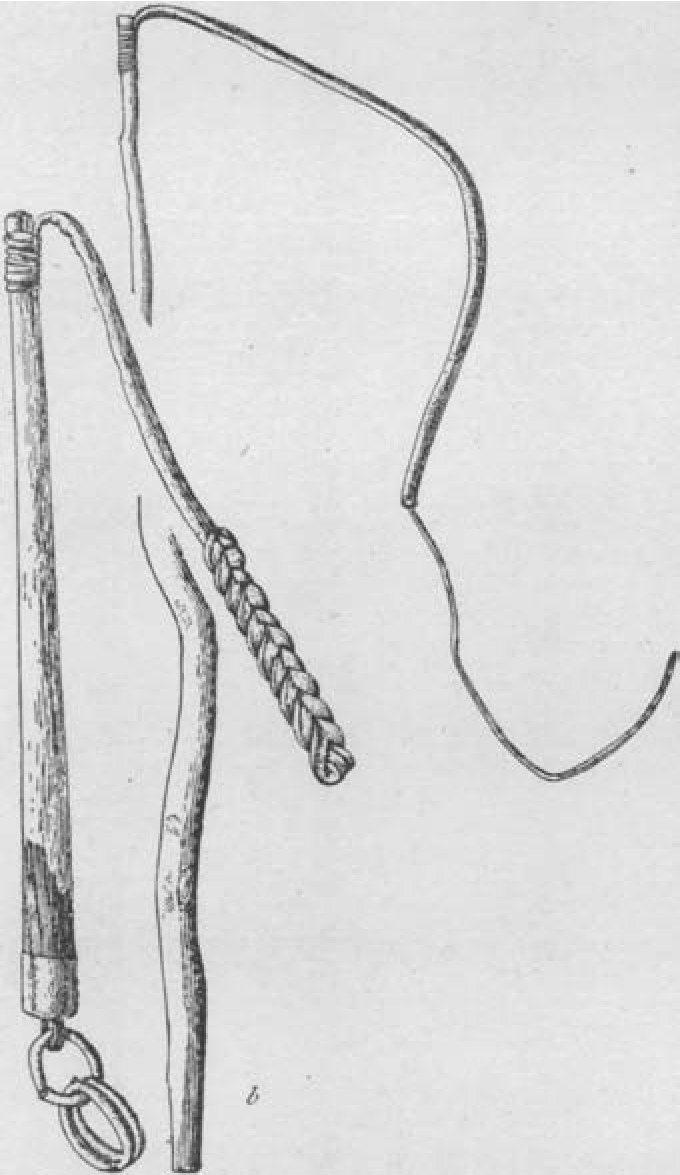
Besides the brake, the Chukchee drivers use a quirt with a short wooden handle and a thick twisted lash (Fig. 29, a). The handle has likewise a bunch of rings, and the driver uses the quirt instead of the brake for intimidating and punishing his animals. This quirt is probably a modification of the former long-lashed quirt of the Eskimo. A special whip is used for punishing dogs (Fig. 29, b). It has a longer handle and a lash with a very slender end, also similar to the end of the Eskimo quirt. Some of the dogs pull with such energy that foam flows from their mouth, their legs become strained, and they may die from over-exertion. This happens especially at the start-off, with a heavy load, and before the team is fairly under way. Other dogs are lazy and shy, and will pull the trace just enough to tighten it; they will even lean their backs against the central strap for a while. Pups, when first harnessed, often pull too obliquely, or lie down and are pulled along with the team. To prevent this, their collar-straps are fastened with a thin line to the next loop-hole ahead.
The driving of East Siberian dogs is very fatiguing, and more like a race[113]🗗uncollated than an ordinary run. Well-rested dogs become excited at sight of the harness, and it is difficult to hold them in till everything is ready.
From the start, they go very fast, and want to go at a faster pace than they can keep up afterward. Down hill their pace is quite dangerous, since the sledge behind is liable to hit them. The sledge — long, high, and narrow — overturns easily; and the driver, at any unevenness in the road, has to exert the utmost care to swing the sledge, now to the right and now to the left, and to support it by hanging down from one side or by standing on one of the runners. Of course a light sledge, although it goes faster, is easier to handle than a heavy one.
In short runs, dogs may be a little slower than the best reindeer or horses; but for long distances they excel any animal used for conveyance. I once had occasion to make, with a light sledge and good dogs, a hundred and fifty miles in twenty-three hours, and two hundred miles in two days.
Maydell mentions that in 1869, in a race between the merchant Baramigin and Chief Officer Anatovsky, on the Lower Kolyma, the dogs of the former made the distance between the Anui market-place and Nishne-Kolymsk (a hundred and fifty English miles) in fifteen hours, and the dogs of the latter in sixteen hours. While on the Kolyma I also heard of this race; and, in my opinion, the speed displayed on that occasion is the highest that Siberian dogs have been known to exhibit over long distances.
In the month of March and on a good trail, a strong well-rested team can make five hundred miles in ten days, and, after two days’ rest, will continue with the same speed. In the winter of 1900-01 I made from four thousand to five thousand miles with dogs, changing from time to time those that had sore feet or were over-tired. In the spring, after a continuous drive of fourteen days, our dogs were so tired that they would lie down on the slightest provocation, and we had much trouble in rousing them from sleep after even a moment’s stop. However, three dogs of mine were able to make the entire journey from the mouth of the Anadyr River to the middle of Kamchatka, up and down, and farther on to Indian Point, and still looked sleek and fat in the summer, after two weeks’ rest. Progress with a few weak and half-starved dogs is exceedingly slow. The opinion of Nordenskiöld, that the Chukchee dogs show much endurance, but little speed, is evidently based on experience at a time of famine, when the teams were weak. I saw teams that were hardly able to drag an empty sledge, although the driver walked the whole time. The animals had been ill fed in the fall, and well-nigh starved in the spring.
A good Anadyr team of twelve dogs can carry from four to five hundred pounds,¹ besides a hundred pounds of their own food. Of course over a short distance a dog-team can haul much more than that. The Kamchatka[114]🗗uncollated teams are stronger, though the mountainous roads of that country are more trying for the dogs than the level tundra. Chukchee teams are not as strong and well trained, nor are the drivers so skilful, as are the Koryak or the Kamchadal. Maydell asserts that on the Lower Kolyma a team of from twelve to fourteen dogs can haul a load of 60 puds (2160 pounds Avoirdupois), which would average about 154-180 pounds for each dog.¹ This is evidently a mistake, since even postal reindeer-teams often carry only 6 puds on each sledge, which makes 3 puds (108 pounds Avoirdupois) for each reindeer. The dog-drivers of the Kolyma allow for each dog (according to a local saying) “1 pud to carry, 1000 herrings to store” (i. e., for winter food). The “herrings” mentioned are, properly speaking, not herrings at all, but of the species Coregonus albula.
Middendorff says that on the Yenisei each dog is reckoned as able to carry not more than 100 Russian pounds’ weight (90 pounds Avoirdupois). This is also too high an estimate, and seems improbable, since a few lines before he calls the system of attaching the dogs on the Yenisei undeveloped and full of defects.²
In dragging a heavily loaded sledge, the dogs take advantage of its impetus, for they can draw it along only at a rapid pace. When stopped, they cannot even start again without the help of the driver. When going up hill, the driver has to walk along and pull the sledge with his utmost strength, and at especially steep places he sometimes has to partially unload. Every five or six miles the dogs are given a rest of about five or ten minutes, after which they start again with renewed vigor. In the middle of the day there will be given a longer rest (Plate VI, Fig. 4), perhaps three-quarters of an hour, while the driver melts snow for drinking, and cooks food for himself.
While in harness, the dogs are perhaps still wilder than when at large. A wild reindeer, a hare, or the fresh smell of seal, is quite enough to lure them off the track, regardless of the driver. When passing by a reindeer-herd, the dog-driver may always calculate that the excited animals will carry him into the middle of the herd, and may even succeed in seizing a reindeer, notwithstanding the exertions of the driver to arrest the heavy sledge with the brake.
The dogs preserve their hunting qualities, even while in harness. A Chukchee driver, meeting a white fox on the tundra, will set free his fleetest dog in the hope of good luck. However, hunters say that the speed and acuteness of the dog for hunting are spoiled by the harness, since its back grows stiff. The Kamchadal hunters, when tracking a bear in late spring, sometimes let the team overtake the bear, and, while the struggle is going on, wait their chance for a sure shot. The bear has no advantage in this struggle, and often is so entangled with straps and traces as to become quite helpless. The keen-scented dog, able to find the seal-hole for the hunter, may also be found among the team-dogs.