IIGeneral Characteristics
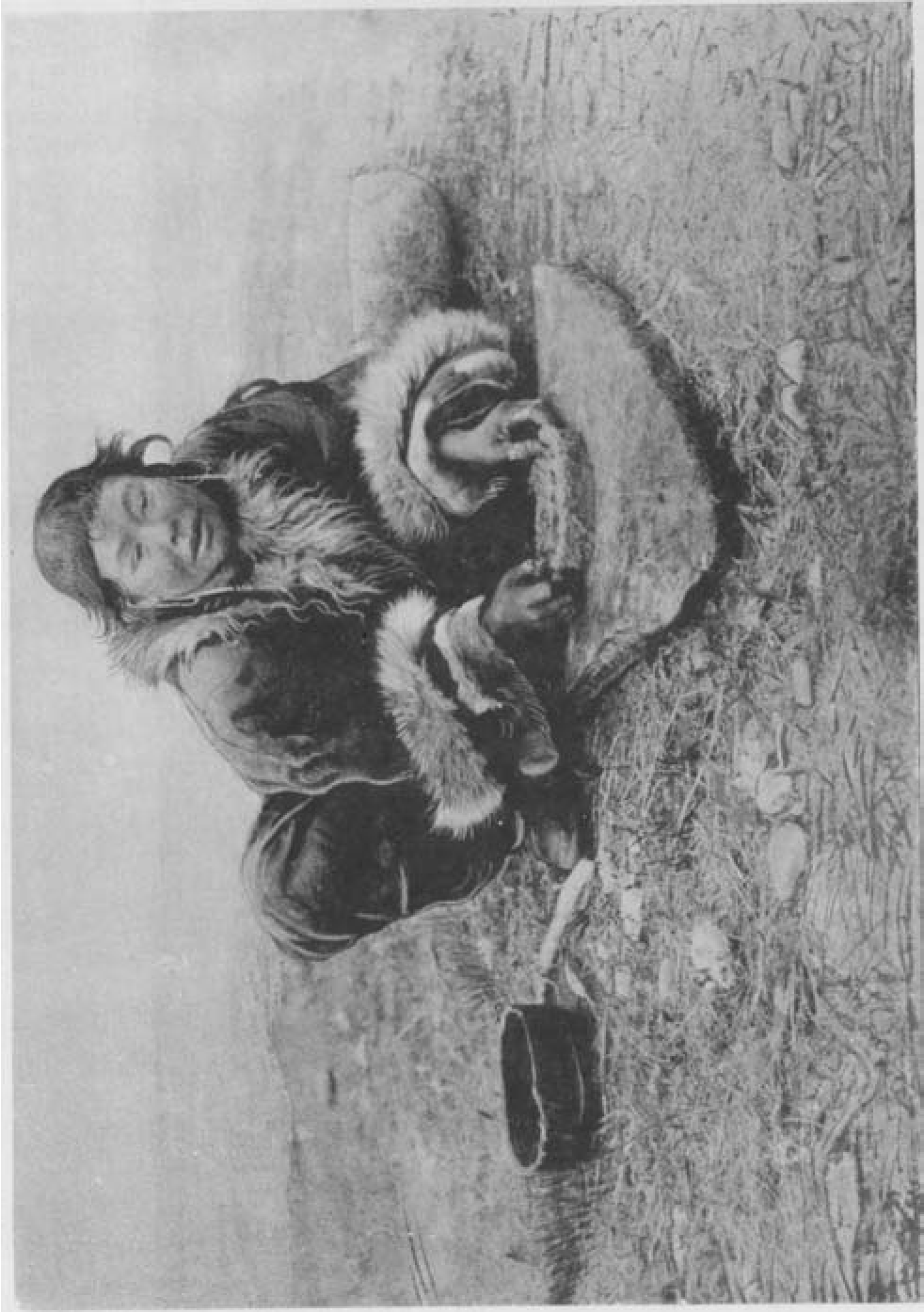
APPEARANCE. — As ascertained from anthropological measurements (148 of men, and 49 of women, all adult), the height of the Chukchee is, men, maximum, 186 mm.; minimum, 150 mm.; average, 162.2 mm.: women, maximum, 168 mm.; minimum, 138 mm.; average, 152 mm. The cephalic index of the men is, maximum, 96; minimum, 75; average, 82: of the women, maximum, 88; minimum, 74; average, 81.8.
The Chukchee are well built and healthy, though rather heavy; so that the saddle-reindeer bought from the Lamut frequently prove too weak for their new masters. Nor are the Chukchee as nimble of foot as are the Lamut hunters. Stout people, however, are rare. I met only one who was rather portly, and on this account he received the nickname Um-Kutuˊwg̣i; i. e., “Stout Kutuˊwg̣i.”
The hands and feet, as with all tribes of Arctic Asia, are small. The young men of the Reindeer division sweat copiously upon slight exertion, — for instance, while running about the herd, — and on this account the Reindeer Chukchee call themselves, half facetiously, “the sweating-people” (g̣ɪʟ̣oˊta-raˊmkɪn). Many of the women are clumsily shaped, with short waists, and legs out of proportion to the rest of their bodies. Some of the Chukchee have considerable physical strength, especially the reindeer-breeders, who have a superior diet. I saw men who were able to carry a whole reindeer-carcass on their backs for a quarter of a mile, or lift a great stone about two hundred pounds in weight. The younger Chukchee are continually bent on increasing their physical powers by lifting and carrying stones, by running foot-races for long distances, etc. The Maritime Chukchee and the Eskimo even have special lifting-stones for each man. These are picked up among the crumbling rocks, and are usually cylindrical in shape, with smooth surfaces. One of my European fellow-travellers, however, was able to surpass all the men of the villages between Mariinsky Post and Indian Point in a hand-pulling contest.
The cheek-bones of the Chukchee are much less prominent than those of the Tungus or Yakut; their noses are often large, well-shaped, and even aquiline, though noses with the low Mongolian bridge are also frequently met with, especially among the women.
Many Chukchee have faces that are clumsy in outline, flat skulls, and low straight foreheads, while the lower part of the face is disproportionately large and strong.¹ A handsome head is frequently compared to a round grassy hummock. In their tales, man is sometimes called “hummocky-head.”[34]🗗uncollated Faces strongly Mongolian in outline are more frequent among the women, though many are as fair and as well formed as the average woman of the white race.
Their eyes are straight, and frequently as large as those of Caucasians, and plica occurs but rarely among them; and their hair, as well as that of the Koryak, is often wavy or even curly, while the Kamchadal always have straight hair. Several Reindeer Chukchee that I met in various parts of their territory had the surname “curly” (kaˊmčɪ) because of their very curly hair; as, for instance, “Curly Yaˊtirg̣ɪn” (Kaˊmčɪ-Yaˊtirg̣ɪn). The hair of some people in Pacific villages even looked woolly. This effect was produced because the hair was coarse and thick, and at the same time formed tight curls.
In the interior and on the Arctic coast the color of the hair is black, but on the Pacific coast about fifteen per cent of the people have dark-brown or even light-brown hair. The growth of hair on the face is scanty, but beards are more frequently seen than among the Lamut or the Yakut. Accordingly, while the Lamut are very careful to pull out the beard-hair with tweezers, the Chukchee frequently allow their beards to grow, and are even proud of them. With the Reindeer people a mustache (or, rather, the appearance of a black down on the upper lip) is considered the crowning feature of full growth, the warrant of independence. The eyebrows are often thick and bushy, especially among old men. The growth of hair on the body is scanty. Thick eyebrows, long thick braids, and hairy pubes are counted as marks of beauty in woman.¹
The color of the face is bronze, with intermediate tints varying from brick-red to blood-red. The ideal of beauty in both sexes requires that the face be “as red as blood, burning like fire.” The color of the skin of the body is generally scarcely distinguishable from that of Caucasians. There are, however, numerous cases of brown or even dark-brown skin, more frequently among the Maritime Chukchee. The latter even consider the brownish complexion to be the handsomest. The breasts of women who are with child frequently assume a dark-brown color over the whole surface.
One of the marks of superiority is the ability to eat quickly. “When the young men eat quickly, the old men look on with pleasure,” says the proverb. Accordingly the Reindeer Chukchee have adopted a peculiarly fierce and hasty method of eating, accompanied by sounds reminding one of the snarling of a hungry dog. One of the young herdsmen whom I saw on the Anui River acquired so much skill in this respect, that he could strip a whole joint of its flesh by taking hold of it with his teeth and pulling off first one side, then the other, — “like a wolf,” his companions remarked admiringly.
[35]🗗uncollatedMIXTURE WITH OTHER TRIBES. — Notwithstanding considerable diversity in the features of the Chukchee, I doubt whether their blood is much mixed. At present the Reindeer men do not hesitate to take wives from among the Russians, the Lamut, or the Chuvantzy; but these intermarriages are of recent date. All cases of such intermarriages are on record, and they are but very few in number. Moreover, the births resulting from the marriages of Russian women (or, more strictly speaking, of Russianized Yukaghir women) with Chukchee men have not been numerous. The reason for this is probably that these women, who are not very prolific in their native environment, are still less so under the conditions of nomad arctic life.
On the Koryak border considerable intermixing with this tribe is going on at the present time. The Maritime Chukchee may have been intermixed with the Eskimo from ancient times. At the present date, in the village of Uweˊlen on the Arctic, and of Čeˊčin on the Pacific, one half of the families are Chukchee, while the other half are Eskimo, and very extensive intermarrying is taking place. Other villages have an unmixed population, and mixed marriages are not so frequent as one might suppose. However, the question is not yet settled as to whether the Chukchee and the Eskimo belong to the same anthropological stock or not.
FERTILITY. — The Chukchee are the healthiest of the tribes in northeastern Siberia. Their families contain more children than those of any of their neighbors. While taking the census in the Kolyma district in 1897, I came across several families having five, seven, and even nine children living. Ten per cent of the families had not less than five children living. One man had by two wives twelve children living. Another, by seven wives (three of them dead), had fourteen children living.
On the Pacific coast, among the Maritime Chukchee, one woman had had thirteen children (seven living and six dead); another one, eleven (three living and eight dead); still another, nine (five living and four dead); etc. Several times, chiefly among the Reindeer Chukchee, I met with twins. This degree of fertility results in the steady increase of the Chukchee, especially among the Reindeer division, in spite of the contagious diseases which ravage the country once every ten or fifteen years. It is interesting to note that even among the Kamchadal, who are steadily decreasing in numbers, I came across several women with many children. One, for instance, had eight living and two dead; another, five living and ten dead; a third, five living, two dead, and five abortions; a fourth, seven living, three dead, and three abortions; a fifth, six living, two dead, and two abortions; etc.: so that here, at least, the decrease is not produced by any reduction in the number of births.
As far as can be ascertained, the decrease of native tribes in northeastern Siberia was produced by the direct or even indirect contact with civilization, exactly as was the case in other countries. It began with extermination during[36]🗗uncollated the bloody wars of the early conquest by the Cossacks, and in subsequent mutinies, which were subdued by wholesale murder. After that came severe oppression; demand of tribute (hitherto wholly unknown); exactions from the officials and Cossacks, who succeeded in enslaving a number of the strongest men and women; and the fraudulent acts of the merchants, who imposed on all those that remained free the burden of interminable debts. Then came contagious diseases, which made havoc not only among the natives, but also among the conquerors, who lived under the same material conditions.
Worst of all, the natives lost their vital energy and their zest for life, which gave them the power and the will to struggle with the harsh Arctic nature. A number of them abstained from matrimony and from producing offspring. They dropped a large part of their former pursuits, and patiently submitted to regular periods of famine, considering their tribe doomed to destruction. For instance, among the vanishing clans of the Yukaghir on the Lower Kolyma the number of unmarried people is disproportionately large. The hunting of reindeer and the capturing of moulting birds to a considerable degree went out of practice, because they required too much exertion. The people live solely by fishing, and every spring suffer from the scarcity of food, often amounting to a real famine. It must not be forgotten that also under the natural condition of affairs before the arrival of the Russians, the increase of population, even among the strongest tribes, was very uncertain, and was continually checked by war and famine.
One of the old men at Indian Point said to me, “The spirits, it seems, take care that the people of this country shall not multiply. In olden times war was sent down to ward off increase. After that, in spite of the abundant variety of sea-game, famine would come and carry off the surplus. At present, with the fulsome supply of American food, the disease comes down, and the result is exactly the same.”
BIRTH AND CHILDHOOD. — The Chukchee women are delivered with little labor. Custom strictly forbids the woman to groan, or to give way to the pain by any audible sign. Nor may help be given by other women. The woman who has been delivered has to attend to her own needs herself, and to those of the new-born infant. She cuts the navel-string and puts away the placenta.¹ The woman who accepts help in these operations will be mocked her whole life long, and even her husband will occasionally receive the derisive nickname “the helped one.” Accordingly a large pelvis, because it eases delivery, is considered one of the chief features of womanly beauty. The Chukchee lover, in praising his beloved, will begin with her strength and[37]🗗uncollated stature, then state that she is fat, then mention her large pelvis, and only after that call attention to her long hair, heavy eyebrows, and ruddy face.¹ A short formula of praise is simply, “large woman, large pelvis, long braids” (ñaus˙qaˊtɪčhɪn, ñoiˊñɪčhɪn, kɪttaˊlčɪñɪn).
The Reindeer Chukchee assert that their young people become mature later in life than do those of the Maritime Chukchee, and give as a reason for this the hardships of nomadic life. This is, perhaps, partly true. However, so far as can be ascertained among a people who do not keep any written records, full growth is attained by the Chukchee not later than by northern European races. The young men marry early, and sexual relations sometimes begin before full maturity is reached. Not infrequently very young girls bear children, and the language contains a special term for them, êčvaˊk-äᵋʟaˊ (“the fawn-mother”). Nevertheless the Chukchee hold to the idea that early marriages are injurious to the health of the woman, and tend to diminish the number of births. It is therefore usually held to be blamable to have intercourse with a girl that is not perfectly mature, or, according to their own statement, with “one not having full breasts and the menses.” Notwithstanding this, the Chukchee are sensual, and enjoy ribald sayings and lewd gestures. When refused by a woman, they are inclined to violence and rape. Many of their pet names and nicknames are very obscene.
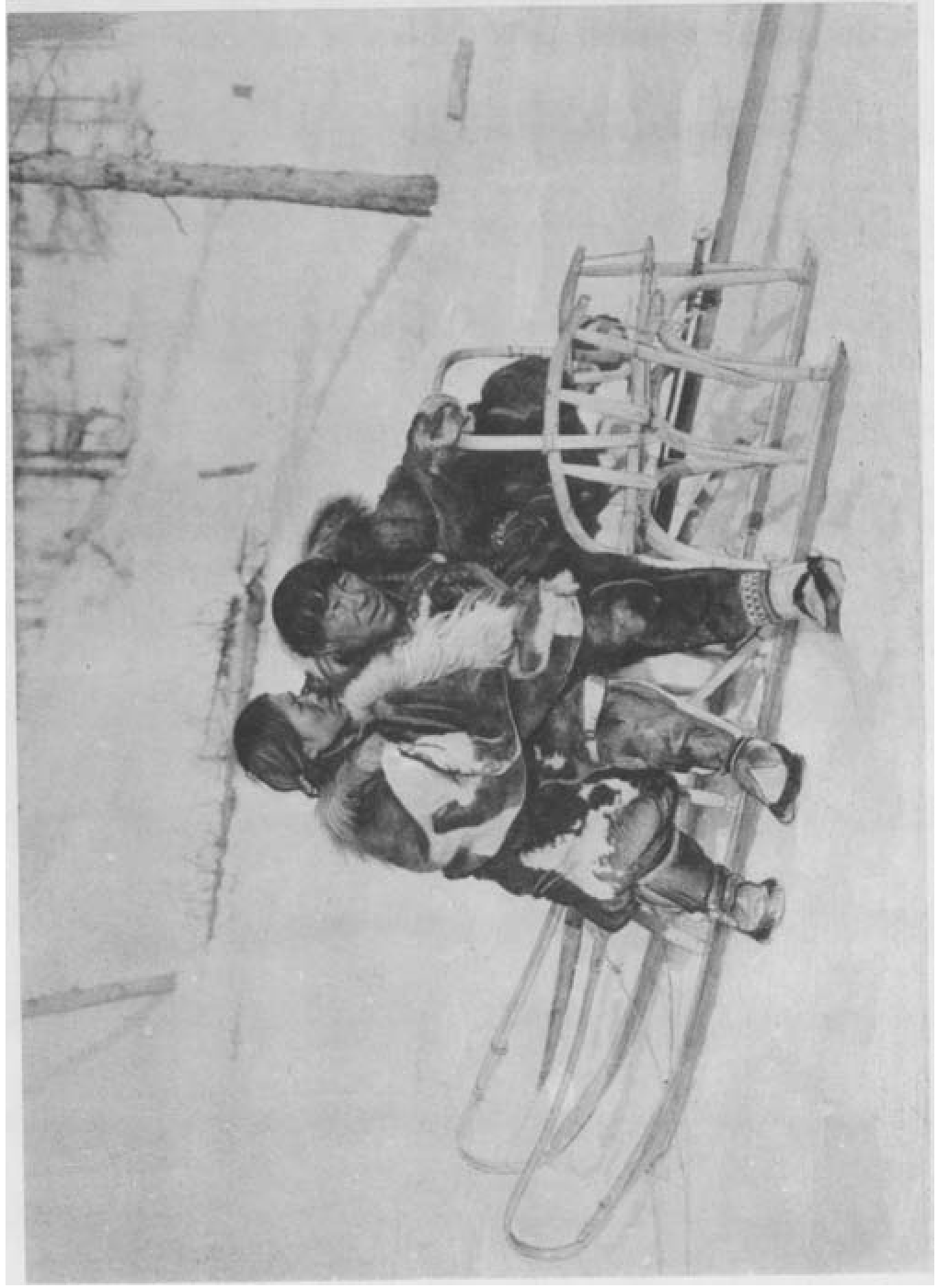
Their endurance in undergoing cold, hunger, and various hardships, is very great. Small children are left all day in the open air in winter. I have seen infants lying on the snow attempt to get out of their fur combination-suits. The upper part of their bodies remained naked for a long time, yet they did not show any signs of discomfort, though the cold was severe and the wind blew sharply. The women work with the needle in the open air even in March, at a temperature of 30° below zero, Centigrade. Their fingers remain unprotected for several hours at a stretch. The exertion even makes them feel warm and perspire so, that they throw aside their ample fur bodices and remain half naked, or else even thrust large cakes of snow into their bosoms.
The reindeer-hunters frequently start out with very little food, depending upon future quarry for their sustenance. When unsuccessful, they get along on very little food for several days, and all the while display the utmost agility in walking about and searching for game. Reindeer herdsmen, men or women, often go without sleep for two or three days. A young girl will work for a whole day on skins, then watch the herd all night long, and in the morning return home and busy herself till evening, without any visible strain upon her strength.
EXTREME AGE. — Among the Reindeer Chukchee there is a fair number of old men. Sometimes four generations live together in the same family, the great-grandfather being from seventy to seventy-five years old. Among the[38]🗗uncollated Maritime Chukchee the men who seem to be quite decrepit almost always prove to have become so rather from the hardships of life than from old age. Such men are speedily carried away by disease. Therefore the really old men, in my opinion, are not numerous.
THE SENSES. — Of the special senses, smell seems to be more developed than with civilized races, since the Chukchee assert that every man has a smell peculiar to himself, and that his clothes, etc., can be ascertained from it. I was told that in olden times, during the wars among the Koryak, the invading Chukchee parties, finding an old camping-place, were able to ascertain, from the odor of broken bones and other remains, whether they belonged to the Koryak or to their own tribe. Accordingly mutual sniffing has the same value as kissing, as is the case with many other primitive tribes. The Chukchee father, when leaving his family for a trip, will perhaps kiss his wife; but he will usually apply his nose to the nape of his children’s necks, and inhale the odor of their fur shirts.
I must note, too, the sensitiveness of the Chukchee to unfamiliar odors. Every time that I happened to open my small chest of medicines in a Chukchee sleeping-room, the inmates complained loudly of the offensive smell which came from it, and sometimes I was obliged to go away to the outer tent with my patients. Similar complaint was made against some wild onions that I brought in, though the Russianized natives use them for food and even store them in large quantities for winter use. The Chukchee name for them is tɪkêˊ-vaˊg̣lɪñɪn (“smell-grass”).
The taboo against bringing into a Chukchee sleeping-room any objects connected with the hearths and households of other families is founded, in the minds of the people, chiefly upon their unfamiliar odor. I have had some curious experiences regarding this idiosyncrasy. In 1896, while travelling among the Anui Chukchee, I happened to procure a document of the year 1789; acknowledging the loyal faith of a certain Qɪˊmɪqäi, evidently a rich reindeer-owner (the document calls him, with the usual misapprehension of the Chukchee social organization, “Chief of the Chaun Chukchee”). This document had been preserved in the family of Qɪˊmɪqäi for more than a century, and had gradually come to be considered, along with the fire-drills and strings of amulets, a part of their sacred possessions. The family became extinct, and I was able to acquire it, together with a curious wooden case adorned with beads and tassels, for a moderate price. When I brought it to the tent in which I was temporarily living, my host warned me against taking it into the inner room; but as it was bitterly cold outside, and as I wished to examine the paper, I took it in. No sooner had I produced the fatal wooden case from my bag, than the mistress of the house, a sickly woman of thirty, who sat opposite me, nursing a child on her lap, moaned and fell senseless. We had much trouble in reviving her, and afterwards I had to expiate my offence[39]🗗uncollated by making offerings to the household spirits. She declared that an unfamiliar odor given off by the case made her feel giddy and sick; “since it has seen so many strange countries and hearths,” was added by way of explanation. On the other hand, my books and instruments, although they have been in still stranger countries, were not objected to at all; nor were the provisions of civilization — canned meats, fruit, vegetables, sugar, etc. — rejected on account of their foreign odor.
Regarding taste there are also some peculiar features. Thus the Chukchee generally do not care for salt; many of them have, in fact, a decided aversion to it, declaring that it is bitter and tastes of sea-water. The Lamut, on the contrary, relish salt, and, when it is at hand, often use it with their tea. Some of the Chukchee have also an aversion toward soft bread, which to them tastes too sour. They will consume only hard biscuit, especially unsalted hard-tack. The Russianized natives, on the contrary, who are used to baked bread, find ship-biscuit tasteless. The desire for fat seems to be innate in the Chukchee. I saw an infant not a year old that cried every time an oil lamp was carried past his head. As the oil was very rancid, he evidently recognized it by its odor, and wanted some of it. To grown people an admixture of fat will improve the taste of all spoiled provisions: therefore putrid meat which has been stored in summer is usually consumed with oil or tallow. The consumption of fat, however, has some limitations. Many persons, especially women, cannot eat the blubber of the male rough-seal (Phoca hispida) because of its disgusting odor. Among the Reindeer people the marrow of the wild reindeer-buck is considered the best food in the world. Notwithstanding this, most of the people are not able “to break the joints” (i. e., to eat the marrow) of a whole animal, and some are contented with a single leg. There is a special term for the taste of food that is excessively fat and sweet, — nɪñɪˊrñuqin (“too rich” or “too savory”).
The Chukchee scale of colors is also somewhat peculiar. The best-known colors are white (niˊlhᴀqin), black (nuˊuqin), red (nɪčêˊʟ̣oqên), gray (čêvaˊro). Among reindeer-skins the color “yellowish” (ɪplɪˊlɪ) is also recognized. Occasionally this term may be applied to other skins, but never to anything else.
Other colors are not strictly defined, but are included among the preceding, or described by comparison with various existing objects. Thus we have the following: —
“Weed-like” (nŭwtɪčɪˊrrᴀqên), an indefinite term, that is applied to all the tints of green, yellow, or even blue when not very deep. The usual summer color of the weeds on the tundra is green for the leaves and the tip-ends of the stalks, but the lower parts of the plant are more or less yellow. When shown both green and yellow, the Chukchee are able to distinguish between them; but generally they apply one term to both colors, and in ordinary conversation always confound the two.
[40]🗗uncollated“Black weed-like” (n-uwaˊla-nŭwtɪčɪˊrrᴀqên), which is given as the color of gall. On the other hand, sprouting leaves, in the Chukchee eye, have the color of gall (nɪ-lêlê-pêraˊqên, “gall-like”).
Withering leaves look red to the Chukchee.
Light yellow ranks sometimes with white, sometimes with red.
“Ochre-like” (nɪ-čêˊra-pêraˊqên) is applied to the straw color of reindeer-skins curried and dyed with ochre.
The color of the sky seems to them light green.
“White weed-like” (n-êˊlhɪ-nŭwtɪčɪˊrrᴀqên).
Deep blue is grouped with black.
The Chukchee are fond of singing, especially on ceremonial days. Every family, and even every individual, has several songs of his own. Some of them are hereditary, and others they compose themselves. The shamans have numerous and various tunes, some of which have a pleasant effect, even on the civilized ear. The Chukchee are likewise sensitive to the melodiousness of a fine voice; and the people often gather in the house of some young shaman, known not so much for his skill as for his pleasing voice, to enjoy his singing.
The Maritime Chukchee are said to have a larger percentage of deep and rather hoarse bass voices than the Reindeer people, by whom they are much ridiculed on this account.
CLEANLINESS. — The Chukchee cannot be called a clean people, at least from a civilized point of view. They eat their own lice (Plate XX, Fig. 3), wash with urine, and allow the dogs to lick out their dishes. They consume the large larvæ of the reindeer-fly, and in summer the herdsmen occasionally consume even reindeer-dung mixed with young leaves of various plants. Habits of cleanliness, however, are liable to be considered from different standpoints. For instance, many of my native acquaintances strongly objected to cow’s milk on account of the unclean ways of the animal that yields it. They asserted also that beef has a peculiar and unpleasant odor, similar to that of cow-dung, and some of them even refused to enter the room where beef was being cooked. On the other hand, when we objected to the odor of seal-meat, they, in their turn, would say, “The seal is quite clean. It washes itself continually in clean water. Why do you not object rather to the meat of your own filthy animals?”
DISEASES. — Contagious diseases have repeatedly made their appearance among the Chukchee. Small-pox has several times ravaged the population of northeastern Siberia. Its latest outbreaks were on the Lower Kolyma in 1884, and on the Middle Kolyma in 1889; though the latter epidemic affected chiefly the Russians and the Yakut, and had little effect on the Chukchee.
In 1899 an epidemic of measles, brought from Vladivostok by a Russian trader, spread northwards, and in the summer of 1900 reached the Chukchee villages and camps. Everywhere its effects were most disastrous, especially[41]🗗uncollated as it requires the utmost caution against colds during convalescence, and the conditions of arctic life make this practically impossible. Even in the Russian settlements, such as Gishiginsk and Markova, almost a fourth of the inhabitants were carried off. The Chukchee suffered even more severely. In several Reindeer camps near the Pacific coast only a few children were left, and the masterless herds were scattered. This also happened on the Kolyma tundra in 1884, after the epidemic of small-pox. In the year 1901 the disease crossed over to America, and there also carried off many victims. The whole number of people who perished from this disease must have amounted to several thousands.
Some fifty years ago syphilis was much dreaded. The Chukchee regard it as indigenous, though its name (aˊtal-vaˊɪrg̣ɪn [aˊtal, “Chuvantzy;”¹ vaˊɪrg̣ɪn, “substance”]) suggests the tribe who in earlier times were mediators between the Russians and the Chukchee, and probably, after obtaining the disease from the Russians, introduced it among the Chukchee. However this may be, one afflicted with syphilis was regarded as unclean. At home he was provided with bedding of his own, with a separate dish and bowl, and was kept aloof, lest others should contract the disease. A family having several syphilitics among its older members was considered as “subject to shunning” (kuˊrg̣u lɪˊn˙yo). Their fire especially was regarded as tainted. They were not allowed admission into clean camps, lest the odor of their hearth and the shadow of their entrance might prove infectious to their neighbors. Nowadays syphilis has evidently decreased; but elderly men and women with deformed noses and ugly scars on their foreheads, showing the third stage of the disease, are frequently met with everywhere. Even now these are considered unclean, though the precautions against them are not observed. The outbreaks of syphilis which occasionally occur among the younger people are considered simply as a different sort of disease, milder and less contagious.
Curiously enough, among the Reindeer Chukchee of the Kolyma, the children have a game in which the winner each time “immerses” the loser one degree deeper into syphilis; for instance, the fourth point scored is called t-ᵉiᵋñinnuˊpet˙-hɪt (“I [immerse] you to the instep”); the sixth, t-ɪmɪpčaˊk-g̣ɪt (“I [immerse] you to the boot-tops”); etc.²
Another contagious disease, a kind of grippe or influenza, spreads through the various parts of the country almost every year, claiming scores of victims. I found it mentioned in the archives of Kolyma as far back as a hundred years ago, and witnessed it myself two or three times among the Chukchee, the Russianized Yukaghir, and the Kamchadal. Its symptoms are those which usually occur in influenza, — violent cough; headache; affection of various organs and parts of the body, such as deafness in one ear, partial lameness, sharp pain in the muscles, etc. It usually spreads from the south and the[42]🗗uncollated west, and therefore must be considered as coming from the Russian settlements. The Chukchee are very much afraid of this disease, since it occurs so often. In 1896, while I was travelling on the Upper Anui, all the Chaun people, hearing of some cases of the disease on the Wolverine River, fled from the whole western part of the Chaun tundra in order to avoid the “spirits seeking for prey.”
Of nervous diseases, which are also dreaded and considered “subject to shunning,” I may make mention of iteˊyun, akin to epilepsy. Sometimes it occurs with the usual fits; sometimes with convulsions or with contraction of the muscles, amounting almost to a temporary catalepsy. It lasts for several hours, and the patient is unconscious during the whole time; then it gradually passes away, but in a few days returns, perhaps in a more violent form. Iteˊyun progresses rapidly, and invariably ends in the death of the sufferer. Sometimes, however, it lasts for years before the fatal issue.
Another disease of a like character is iuˊmetun, a kind of violent nervous affection, which comes on at night like nightmare. During an attack the breath appears shortened, the blood rushes to the face, and sometimes the sufferer chokes on the spot. The Chukchee attribute both diseases to special spirits, and do not like even to mention their names. A man suddenly afflicted with such an illness while travelling, may be almost sure that he will not be allowed to enter any house, nor will he be given either fire or warm food.
The well-known form of Arctic hysteria, which is so widespread among the Yukaghir and Lamut women, is very rare among the Chukchee, especially among the Reindeer branch of the tribe. This disease develops chiefly in the form of an uncontrollable desire to repeat in a loud voice each word spoken by somebody else, and to imitate every sudden gesture or action. Even the women among the Russianized natives, and Russians, are affected with it to a considerable extent, while those of the Chukchee are practically exempt from it.
Leprosy, so frequent among the Yakut, does not attack the Chukchee, who have, however, various kinds of skin-diseases, perhaps on account of their filthy habits of living. They often call themselves “the not-washing people” (ilhɪteuˊkä-reˊmkɪn).
The most common of skin-diseases is scabies, which often afflicts whole families. The Chukchee pay little attention to it. Scabby people have told me, half in joke, that they even find pleasure in spending their spare time fingering their itching sores.
More uncommon is taˊɪrg̣ɪn, a peculiar disease that increases the pigment in the skin, so that the afflicted look like mulattoes. They do not complain of any pain, but lose in strength and agility; nor can they endure the hardships of their former pursuits, though their term of life does not seem to be shortened. I met with only five cases of this disease.[43]🗗uncollated Kalêˊlɪ-taˊɪrg̣ɪn (“spotted taˊɪrg̣ɪn”) covers the skin with large spots of a light, ashen color, often over the whole body, including the face and the hair of the head. It does not seem to affect the health. A man named Tuˊrkew, who was affected by this disease, received the name of Keliˊlɪ-Tuˊrkew (“Spotted Tuˊrkew”). He was well known in the Anui country on account of his piebald hair. At the age of fifty years he was still active for his time of life.
I came across five deaf-mutes. Three of them were full-grown, and took part in all the daily pursuits of their camp. They communicated with other people by means of simple signs. Sleep, for instance, was expressed by leaning the face on the palm; eating and drinking, by representative motions of the hand to the mouth; woman, by forming an imaginary braid on each side of the face; man, by pointing out the mustache; going, by a motion of two fingers on the palm; etc. These signs are similar to those used by the Chukchee for communicating with people who do not understand their language, though no conventional signs exist in either case.
I met two dwarfs. One of them was married, and had three well-developed children. There were several weak-minded people. One of them was a deaf-mute; another had been struck with the palsy, and could not walk or move his left hand. But the Chukchee had no notion of supernatural power possessed by such people, as is held by the American Eskimo. Cases of violent madness also occur. I was told by a woman shaman that she was out of her mind for three years, because of a spell wrought on her by a rival. When in a fit, she would lose all feeling in her wrists, and sometimes in her whole body. At such times she would snatch a stone and pound her fingers with it, without feeling any pain. In fact, the upper joints of two of her fingers were missing. Frequently she would want to harm other people, and then her housemates would tie her hands and bind her to one of the house-poles.
In another case I heard that a man of the Reindeer division of the tribe, who for a long time was afflicted with similar fits, kept making attempts to injure his camp-companions, and ultimately was put out of the way by common consent.
Blindness occurs often, especially among old people. The young herdsmen often have sore eyes on account of loss of sleep in the seasons when the herding of the reindeer requires extra exertion, and because of the corrosive action of sweat mixed with dirt. Snow-blindness in the spring is very common among all who make journeys across the tundra. In treating inflamed eyes, the lids are sometimes turned outward and bled by being rubbed with the large hard larva of the reindeer-fly, the segments of which act like the teeth of a fine file.
Lame people use crutches of various shapes, made in the same way as those used by civilized people.
The Chukchee do not use any remedies of their own except magic, unlike[44]🗗uncollated the Kamchadal and Russianized Yukaghir, who apply many plants and minerals for medical purposes. Even the medicines of civilization, of which the Chukchee are often very fond, have received the name eˊñeñ, which, in the proper sense of the word, signifies “shamanistic spirit,” and also “Russian (Christian) God,” “crucifix,” “image of a saint,” etc. The civilized physician is called simply eñeˊñɪlɪn (“shaman”).
MENTAL TRAITS. — There exist two exactly opposite notions concerning the natural disposition of the Chukchee. The older writers, drawing chiefly from the accounts and narratives of Russian Cossacks and other adventurers, represent the Chukchee as the inscription on Lotteri’s chart of their country runs: “Tjutzchi natio ferocissima et bellicosa, Russorum inimica, qui capti se invicem interficiunt.”¹ All tribes in their neighborhood, even at the present day, hold a somewhat similar opinion regarding them, perhaps on account of former wars, in which the Chukchee always gained the upper hand.
Recent travellers among the Chukchee, — Hooper, Maydell, Nordenskiöld, Gondatti, Dr. Slunin, Melikoff, — on the contrary, describe them as quite peaceful and inoffensive. Maydell undertakes the thankless task of defending them against the former reports of the Cossacks, who, as he has it, were always deceived by the treacherous Koryak, and ascribed all their misdeeds to the Chukchee.²
W. H. Gilder, who in 1882 made a long journey among the Chukchee villages quite alone and unarmed, and the Russian priest Benedict, who in 1898-99, without an assistant or provisions, made a still more remarkable trip among the Reindeer Chukchee, and thence through all the villages on the Arctic and Pacific, were treated very kindly and hospitably by the inhabitants, though unable to pay even for conveyance and food.
These cases indicate very clearly that the Chukchee have laid aside their former hostility toward the civilized world, and after more than a hundred years of constant trading with Russian settlers on the Kolyma, and with American whalers on the Pacific coast, have tried to show themselves friendly to the few white people who have happened to come to their villages and camps. From the visits of several men-of-war, the Chukchee have been able to form an opinion of the real power of the white people. Trade has become quite indispensable to them; and those who have come into contact with Russian officials have been willing to submit, at least nominally, to Russian authority, and even to pay tribute, however slight and precarious. “These are peaceful times,” said one of the wandering Chukchee traders to me at Indian Point. “Wars have ceased, everybody thinks only of gain, and all[45]🗗uncollated tribes and nations intermingle.” Raˊlɵ g̣eneˊʟ̣eet (“blended together”) is the ordinary Chukchee term to describe intertribal relations on all borders. On the other hand, when in 1895, during a brawl at the Anui fair, a Reindeer Chukchee was killed by the Cossacks, the others resented the deed so much that they were almost ready to attack the fort. Notwithstanding the “weregild” paid by the officials to the family of the slain man, the Chukchee harbored a feeling of ill will for a long time afterwards; and the next winter, when travelling among the Anui camps, I had one or two rather unpleasant encounters with the people.
A considerable part of their former intractability remains at the present time, especially among the Reindeer people, and shows itself even in the minor details of every-day life. The Chukchee is easily angered; often a trifle will suffice to transform his merry laughter into the most unreasonable rage. They themselves are not unconscious of this peculiar feature of their mind. “I am a tundra wanderer,” one of my Chukchee acquaintances, named Ñĭroˊn, would say to me. “My anger rises suddenly. It comes and goes of its own accord.” Some women bear a special name on account of their violent temper. They are called “quarrelling women” (maraˊ-ñaˊus˙qattê). These are regarded as nuisances even by their housemates. Among the men, some have the very suggestive epithet “hasty” (qɪvr) prefixed to their names, as “Hasty Aᵋmuˊlin” (Qɪvr-Aᵋmuˊlin).
The Chukchee, when angry, growls, shows his teeth, and makes a threatening bite on his sleeve or on the handle of his knife, in defiance of his foe. Some of them, when angered, shed tears of rage, and tear their hair like unruly children.
Their language is singularly poor in abusive terms, and quarrels are immediately settled by blows or wrestling. There is no lack of murders, some of them of a barbarous character. Thus, in a camp near Cape Erri, the son and the nephew of the rich reindeer-breeder Yekuˊtku, being goaded to the extreme by constant blows and abuse, cut his throat, and that with the knowledge of his wife, the mother of one of the murderers. In the summer of 1896 on the Poplar River, an affluent of the Small Anui, a young man killed his brother in order to get possession of his flock. The murderer, with his accomplice and their victim, arranged a contest of jumping over a barrier, the loser to pay the forfeit of skipping about for a while with his feet and hands bound together. When the elder brother lost, the other two men accordingly tied his feet, and coolly stabbed him with their knives. I heard the details of both deeds from the murderers themselves.
In the tale of “Elendi and his Sons,” published in my “Chukchee Materials,” Elendi, to avenge the treachery of his slave, kills him in a most cruel manner. With sharp stakes he fastens the slave’s hands, feet, the fleshy parts of his sides, and the skin of his scalp, to the ground, and then makes both of his wives urinate and defecate into his mouth.¹[46]🗗uncollated Not all the Chukchee are of this irascible type. Some are quiet and good-natured, often prone to loquaciousness and to giving reasons even for obvious things; but these also are not free from occasional outbursts of anger. An old man named Aiñanwaˊt, who had lived with me for two years in the Kolyma country, and had patiently helped me the whole time even in the most tedious ethnographical work, told me an incident of his former life. When vexed by the unruliness of his reindeer-herd, he so lost his patience that he suddenly stopped running after the reindeer, and, turning to the setting sun, invited the wolves to come and devour the herd. According to the belief of the Reindeer Chukchee, such words amount almost to a sacrilege; since the wolves are classed with evil spirits, and the curse, once uttered aloud, can never be revoked, because it becomes a promise of sacrifice. Within a few moments the exasperated herdsman realized what he had done, and tried to avoid the disastrous consequences by the sacrifice of his best team, but it was of no avail. His luck had turned, and his herd suffered misfortune without end.
In addition to this irritability, the Chukchee shows a peculiar obstinacy in accomplishing whatever seems of momentary interest to him. In trading, when a Chukchee has set his heart on any trifling object, he is often ready to offer thrice, or even ten times, the price of it. If his offer is not accepted, he will start a brawl rather than desist from his purpose of his own free will. The small Russian traders sometimes skilfully avail themselves of this weakness by goading their wild customers on, and then withholding the article, in order to get a larger price for it. In a wrestling-match the defeated competitor will again and again try his luck, though repeatedly thrown, until at last a fight ensues. When thwarted in his purpose, the Chukchee is ready to go to any extreme, even to committing suicide, from uncontrollable rage. I know an instance of a young girl who went out to the herd and hung herself to a tree, out of anger because her mother refused to take her along to the feast in a neighboring camp.
This motive frequently plays a part even in cases of voluntary death among old men, of which I shall speak later on. Thus in one of the texts published in my “Chukchee Materials” (p. 52), a man, Little-Spoon, having been angered by his sons, requested that he be killed. The Chukchee frequently have a lurking inclination towards suicide, which is mentioned in the words of Lotteri previously quoted, and is well known even to the Chukchee themselves. “You know our people,” I was told on several occasions. “For any reason they want to kill another man or themselves.” During the epidemic of influenza on the Wolverine River, before mentioned, there occurred two cases of suicide. One was that of a husband vexed at the loss of his young wife; the other, that of a mother who had lost her only son, a child of ten. There are cases of something like tædium vitæ. In 1895, at the Anui fair,[47]🗗uncollated I spoke with a man named Kaˊtɪk, who declared that he did not want to live any longer. He gave as his reason, that fortune was adverse to him, that all his relatives had died, and that he was afraid that his herd at some time might begin to dwindle away, although at the time of speaking his reindeer were prospering. I did not pay much attention to his words, but the next winter I heard that he really had ordered himself to be strangled.
At the head waters of the river Omolon I met a family four of whose members had taken their own lives within four years without any apparent reason. Their neighbors felt much afraid, and expressed the opinion that the spirits who wanted more prey had treacherously led them on to self-destruction.
A rough kind of compassion for all suffering characterizes the Chukchee mind. Once in my presence a Reindeer man rescued a ptarmigan that was being hunted down by a hawk and had come to the camp exhausted, and angrily expostulated with some children who wanted to catch the bird. Another time a Reindeer woman paid a ransom to one of my dog-drivers to stop him from punishing one of his own dogs.
Still more remarkable is the generosity which the Reindeer Chukchee display toward everybody who is in need, even if he be of strange tribe and language. On the Chaun tundra live a small number of Lamut families, members of various clans who have wandered northward. They are a peculiar people, very poor and very indolent; and fully one-half of their food is drawn, with very little pay, from the herds of their well-to-do Chukchee neighbors.
Similar relations have existed of late between the Chukchee and the Tungus on the western Kolyma. At present, however, most of those Chukchee are poor; and the few rich breeders farther to the west have acquired a taste for trade, and have gradually adopted the ways of the Yakut or Russian dealers. In occasional times of need the starving Russian settlements on the Kolyma and Anadyr were relieved, up to a very recent time, by the neighboring reindeer-breeders, who often slaughtered several hundred animals, taking very little or no pay for them. This disposition to help the needy of a strange tribe probably sprang from the peculiar relations of both branches of the Chukchee, which in so many respects form a unit, although they differ widely economically.
The woman, as is the case among all peoples, is more compassionate than the man. In the tale of “Elendi and his Sons,” quoted before, the hero reproves the wife of his foe, who had been very severe to his neighbors, saying, “Why did you not feed your neighbors in secret? Why did you not give them food yourself?”¹ In reality, in the camps of rich reindeer-breeders, when the master is too niggardly toward his helpers, it is considered the duty of the mistress to make up for his shortcomings from her storerooms and clothing-bags.
[48]🗗uncollatedI heard of no cases of cannibalism among the Chukchee, notwithstanding the fact that several cases of famine which wiped out whole villages were still fresh in the memory of the people. On the other hand, a Yukaghir family which was starved in 1895 on the Middle Omolon had recourse to the most horrible cannibalism. Nor am I aware of any cases of exposure of new-born girls, as among the American Eskimo. New-born babes, indeed, after the death of their mothers, are frequently smothered, and carried out with them to the funeral-places, but this is because of the impossibility of raising them. I have heard, too, of women just delivered, who, when feeling very ill, would smother their children as a sacrifice to the spirits.
Hospitality to travellers is much more liberal among the Maritime Chukchee than among the reindeer-breeders. The Arctic people say, that, even if a guest wants to strike his host, the latter must continue to be friendly. During my last journey along the Pacific coast, when we were several times detained in Chukchee or Eskimo dwellings by a storm, it would often happen that the master of the house, having little blubber and no wood to feed the fire, would break up his sleds, and even tear out one by one the wooden supports of his house, thus endangering its safety.
With the Reindeer people it is otherwise. First of all, they are much more superstitious about the “shunning” of diseases. In times of disease, even a healthy traveller, when he comes to a Chukchee camp from afar, especially if he arrives at night, runs the risk of not being admitted to any of the tents. This would never happen in a Maritime village. Many travellers of the Reindeer tribe are themselves averse to entering strange houses at such times, and prefer to sleep in the open, content with an incantation against the spirits, in lieu of supper. Even at ordinary times a guest arriving at the camp is considered as having no more rights than the inmates of the house. He will have to wait outside with the other people till evening, when the sleeping-room is made ready. Sometimes he will be given no food until the time of the principal meal, which is eaten in the evening. At the time of the great reindeer races, scores of people come to take part in the races or to look on. Often they are given no food at all, and, after a whole day spent in the open, return in the evening to their respective camps, scattered around at a distance of some thirty or forty miles.
Theft among the Maritime Chukchee is comparatively rare. To steal from a neighbor in the same village is considered very improper. It is customary for a stranger to place all his property in the storehouse of his host and under his personal care. In recent years, however, the increase of trade has spoiled this native honesty. Now, in all large villages, the owners of wooden storehouses, which are bought from the whalers, carefully lock their doors with steel padlocks for fear of robbers. During my stay in Indian Point a shaman woman was caught twice almost in the very act of stealing some peltries from[49]🗗uncollated a storehouse in order to sell them to the whalers. The skins were restored to their owner, but the thief was not punished, except with harsh words. As witnessed by Nordenskiöld, theft, and deceit toward a stranger, are not considered unlawful. I must acknowledge, however, that, during my journey among the Maritime Chukchee and the Eskimo, hardly any of my belongings were lost; while among the Reindeer people not a single trip would pass without almost open attempts at stealing, amounting even to robbery. “Look out for my mother!” I was once warned by my host. “Her nature is such, that she will steal even fresh excrement from under a man.”
Among the Reindeer people, indeed, theft between the camps and herds is held to be an almost lawful pursuit. There is in the language, besides the usual word for stealing, tɪ-tuleˊerkɪn (“I steal”), still another, rather euphemistic term, tɪ-ng̣ɪntɪweˊerkɪn (“I abstract;” literally, “I cause [the thing] to flee”). Quarrels are continually going on between neighbors on account of mutual accusations. Several of the people that I knew were given new derisive names on account of their thieving exploits. One was called “Knee-Walker” (Ñɪreˊ-čeiˊvun) because he was once accused of crawling on all-fours to his neighbor’s herd in the calving-season with the intention of taking away some of the new-born fawns. Another was called “Necklaced Latuˊwg̣ê” (Êˊnnɪčhɪ-Latuˊᵋwg̣ê) because while on a visit to another camp he stole some half-cooked entrails that were boiling in the kettle, wound them around his neck, and, when pursued, continued to eat from one end thereof. These names stick so well, that at last even the persons themselves begin to use them, especially after some trouble with the spirits of disease, when the Chukchee like to change their names. During the Russian fairs small thefts take place every day in the block-houses as well as in the camps, and even inside the tents. In my presence, a young man who came into the trading-store, picked up a bunch of squirrel-skins from the floor, and tried to sell them to their real owner. When detected, he only said, “Take them, if they are yours,” and then sat down on the bench, waiting for the usual hospitality.¹ I have in my collection a white fox-skin roughly patched with hare-skin to make it look whole. Nordenskiöld² relates similar tricks, chiefly of the Arctic Maritime Chukchee.
As mentioned before, quarrelling between the Chukchee and their neighbors has almost ceased. The Kerek of Cape Barykoff occasionally complain that the Telqäˊp Chukchee ill-treat them, taking their peltries without paying for them, and carrying away their children to use as herdsmen; but even here a good mutual understanding usually prevails, since the Kerek obtain from the Telqäˊp Chukchee reindeer-skins for garments, sinew for nets, meat, Russian wares, and American rifles and cartridges, which come all the way[50]🗗uncollated from Indian Point. The dog-drivers from Kuluˊči complained at Indian Point that the inhabitants of the Pacific village Luˊᵋren had the habit of occasionally robbing the sledges which returned from trading-trips loaded with foreign wares. Between Luˊᵋren and the village Yaˊnřa-ñai a kind of feud is kept up that was going on even two generations ago.¹
The inhabitants of Luˊᵋren, Yaˊnřa-ñai, and other villages and camps around St. Lawrence Bay, are famed for their roughness. Some of them buy from American whalers revolvers, which they carry in a special pocket up the sleeve, ready to handle. Mr. J. Kelly, the American agent for buying reindeer, who spent the winter of 1897-98 on the shores of St. Lawrence Bay, in a block-house built for the purpose near the village Yaˊnřa-ñai, had considerable trouble with the natives; and I heard that an attempt was made to attack his house and to rob it.
The Chukchee cannot be called quick-witted, especially in trading-transactions, in which they are easily imposed upon by their neighbors. Their system of calculation is quinary-vigesimal, but very imperfect, and all numerical operations are performed with the help of the fingers of both hands. The word for counting means literally “I finger” (t-rɪˊlhɪrkɪn). The question “How many?” runs “How many fingers?” (Ter rɪˊlhɪt?) The numbers proceed in the way usual to many primitive languages, so that mɪˊʟɪñên (“five”) is shortened from mɪng̣ɪˊʟɪñɪn (“hand”); mɪng̣ɪˊtkên (“ten”) signifies “belonging to two hands;” kɪlhɪˊnkɪn (“fifteen”) is probably contracted from g̣ɪtkaˊlhɪkên (“belonging to the foot”); qliˊkkin (“twenty”) signifies “belonging to a man.” The word qlaˊul (“man”) is also used frequently for “twenty.” The fingers and toes play such a prominent part in counting, that I doubt whether a Chukchee would be able to make a calculation without them. The larger numbers are composed of groups of “twenty” (“man”). They are also counted on the fingers, so that the limit of enumeration is “twenty scores” (qlik-qliˊkkin). All numbers above this are called “knowledge limit” (g̣ɪyeuˊ-teˊhɪn).
This term is also applied by a few rich traders to express the idea of “one thousand.” Many of the people, especially the Reindeer men, are unable to deal with as high a number as a couple of scores. Therefore when dealing in small skins, like those of fawns, squirrels, etc., which are traded in large numbers, they tie them in bunches and trade off each bunch or small group of bunches by itself. Squirrel-skins are tied in tens after the manner of the Lamut; the fawn-skins are done up in threes (the usual barter price of a piece of compressed tea, called a “brick”) or in fives; then four bunches are fastened together to make a score.
In recent years the Chukchee traders, and especially the collectors of tribute, in imitation of the Russians, have begun to use small notched sticks as tallies, every notch representing one five, and the fourth notch being marked out by a deeper cut to indicate a score.
[51]🗗uncollatedThe herdsmen, of course, never count their reindeer, nor are they able to remember all their animals by their looks, as has been asserted by travellers.¹ In the larger herds they know only the more conspicuous animals, such as breeding-bucks, old dams, harness-animals, etc. If there be any loss, they become aware of it only by the absence of one of them. Of the smaller animals they take little notice, nor do they care much about them.
The Rev. Argentoff relates that one Maiˊñɪ-qlaˊul, a rich reindeer-breeder from the Dry Anui, tried to ascertain the number of his animals by counting them by corrals. Each corralful was represented by a chip of wood, and these were placed together in a glove.² Operations of this kind were performed by the rich Tungus for the same purpose; but among the Chukchee they can occur only exceptionally, because every new experiment with the herd is considered to thwart the qaˊa-vaˊɪrg̣ɪn (literally, “reindeer substance;” i. e., the herd’s good fortune).
SEASONS. — It may not be out of place to add here the Chukchee method of dividing the year. The year is divided into twelve lunar months or “moons” (yiˊᵋlhɪn). The series begins with the winter solstice, the time of which is marked pretty accurately. The dark interval between two “moons” is called “moon interval” (yuˊᵋtir). The names of the months are —
1. ɪnp-luˊwleñ-yiˊᵋlhɪn (“old-buck month”), from about the 20th of December to the 20th of January. The origin of the name is uncertain. 2. Čačanloˊrg̣ɪn (“cold udder [month]”). 3. Lêˊê-loˊrg̣ɪn (“genuine udder [month]”). 4. G̣roˊ-êˊᵋlhɪn (“calving month”). 5. Imlɪˊrɪlɪn (“water [month]”). 6. Taˊwtɪñ-yêˊᵋlhɪn (“making-leaves month”). 7. Om-yêˊᵋlhɪn (“warm month”) or Aˊno-yêˊᵋlhɪn (“summer month”). 8. Neǰ-iˊᵋlhɪn (“rubbing-off-velvet [antlers] month”) or Eleˊ-yiˊᵋlhɪn (“midsummer month”). 9. Ñeˊrg̣eǰ-iˊᵋlhɪn (“light-frost month”). 10. G̣ɪthaˊ-êˊᵋlhɪn (“autumn month”), called also ɪlv-eiˊñe-yiˊᵋlhɪn (“wild-reindeer rutting month”). 11. Yaraˊučɪn, probably from Yaˊraw (“muscles of the back”), because it is supposed that the muscles of a reindeer’s back strengthen in mid-winter. The same name, with the same explanation, was found among the Koryak of the western shore of Kamchatka in the form yaraˊwučɪn. This month is also called by the Chukchee Tuˊr-eᵋče (“new-snow cover”). 12. Quˊuleǰ-iˊᵋlhɪn (“shrinking [days] month”).
The Maritime Chukchee use the same table of months. The Koryak in different localities have different systems of names, but for the third and the fourth month most of them have names signifying “false reindeer-birth month” and “genuine reindeer-birth month.”³ Of course, the twelve lunar months do not exactly coincide with the solar year between two winter solstices; but the Chukchee do not care about a few extra days. In ordinary talk the names of the months are often replaced by those of the seasons, which are much more numerous than with us. The following are most frequently employed.[52]🗗uncollated 1. Emyiˊrɪk (“in the extending [of the days]”). Loosely speaking, it corresponds to the first month of the year. 2. Ureˊtvik (“in the lengthening”). This corresponds to the second month. 3. Niwleˊwkɪ (“during [the days] growing long”). It lasts about six weeks, until the reindeer-dams begin to calve. 4. Am-g̣roˊkĭ (“in the calving [time]”). This corresponds more or less to our term “spring.” 5. Tur-eleˊtvuk (“in the new summer growing”). 6. Kɪˊtkɪtɪk (“in the first summer”). 7. Aˊnok (“in the second summer”). 8. Eˊlek (“in the middle summer”). 9. Êh-ɪˊntok (“with the fresh air going out”). 10. Ñerg̣eˊrɪk (“with the first light frost”). 11. Tur-äᵋleˊtɪk (“with the new snow”). 12. G̣ɪthaˊk (“in the fall”). 13. Läᵋleˊñkɪ (“in the winter”). Yawrɪˊna means “in the next year,” and is applied to the beginning of the next fall.
LANGUAGE. — The Chukchee language is rich in words, and pliant in forms; and the people are eloquent in their own way, but they do not like to be bored with questions. The Reindeer men, who are in their houses practically only when eating or sleeping, and keep in motion all the time, were with difficulty persuaded to spend a few hours with me in the tent, giving explanations or dictating texts. Even the old men would say, “Bad thing, dotage,” and would prefer to stay outside. Most of them, moreover, were quite unable to dictate. Even their curiosity is not lasting. When I came to a new camp, the inhabitants would pay close attention to my doings for a few hours; then they would gradually drop off, and finally would be interested only in barter. There were certainly exceptions, as Aiñanwaˊt, whom I have mentioned, and a few others. In the Maritime villages, where the inner rooms are much larger, and furnished with steadily burning lamps, the old people are more used to sitting indoors, and accordingly are more tractable and more useful for scientific investigation.