VIIIFood
ANIMAL FOOD. — The staple food of the Reindeer Chukchee is reindeer-meat, and that of the Maritime people, “sea-meat,” — the meat of sea-mammals. On the whole, the latter is more relished by the whole people, because it is fatter, and because it formed the chief food of their forefathers. The reindeer-breeders have quite a liking for sea-food. This peculiarity may also be observed in the traditions of the tribe. In the tale of Elendi and his sons the old man and his wife risk the safety of their herd in sending their sons to procure some sea-food. After a while, when the enemies have been defeated, the old man is described as sitting in the sleeping-room, eating blubber, the oil dripping down from both sides of his mouth.¹
I myself witnessed that Reindeer Chukchee who had not had any blubber for a long time develop a craving for it, and are ready to pay extravagant prices for it. For this reason every spring, when the traders from the sea-coast visit the Reindeer camps, a continual feasting begins, and blubber and meat of sea-animals are offered to every one as the best of dainties.
On the other hand, the Maritime Chukchee and the Eskimo value reindeer-meat very highly, and call it the “sweet food of reindeer-breeders.” In their tales it is often praised beyond any other kind of human food. The Maritime people undertake long expeditions by sea and land to obtain a supply, and occasionally trade some of it to the Eskimo of St. Lawrence Island and of the Diomede Islands. Although the meat is usually in a very poor state, it brings quite a good price. Generally it is bartered for the meat of sea-mammals, because one of the principles of trade in those countries is the interchange of similar articles whenever possible. Cotton is traded for skins, sugar for reindeer-tongues, ready-made shirts for ready-made skin coats, etc.
The Reindeer Chukchee have no opportunity to consume fish in any considerable quantity. The Russianized natives, on the other hand, live almost solely on fish; and therefore the Chukchee who live near these settlements utilize fish, which they reckon as belonging to what is called “alien food.”² The Maritime Chukchee also consider fish as rather poor diet.³ They consume it, however, whenever they have a chance to obtain it, and also gather oysters and shells on sandy beaches or in shallow waters.
METHODS OF COOKING. — At present most of the meat is eaten boiled. It is hard to tell how food was prepared in former times. I collected one[194]🗗uncollated tradition among the Reindeer Chukchee, according to which, in olden times, their forefathers had no clay kettles, and the meat was roasted on large flat stones heated for the purpose. The Lamut tell the same story of their ancestors; but such a method of cooking is possible only within the borders of the forest, where the supply of fuel is abundant. On the tundra and on the treeless coast a method of cooking that requires less fuel must always have been in use. Therefore it seems probable that the lamp and the kettle were in use in former times as well as now.
The Yukaghir and the Kamchadal used to boil their meat and fish in bark or wooden vessels by means of heated stones. This method of boiling meat is still used occasionally by the hunter, who carries no kettle, and who may boil his meat in the old way. The Kamchadal of Central Kamchatka extract the fish-oil of Salmo sanguinolentus by trying out the fish in a dug-out with heated stones.
At present the Chukchee use little roasted meat. They hardly know how to roast it properly. Fish and lungs, which are sometimes roasted near the fire, are always covered with ashes, charred from without, and quite raw within. The Yukaghir and Kamchadal roast fish and meat very well on thin wooden spits stuck into the ground near the fire.
RAW AND PUTRID MEAT AND CARRION. — Raw, frozen meat is eaten by the Reindeer Chukchee and all the neighboring tribes. The Arctic people consider meat that is raw and hard-frozen just as palatable as cooked meat. I must acknowledge that I soon learned to eat it and to like its taste. Especially when we had to live for a long time exclusively on fat fish, with not so much as a pinch of salt to season it, we found this diet more tolerable when the fish was eaten raw and frozen hard.
Liver and kidneys, heart, tendons of the legs, gristle of the nose, eyes, and marrow are consumed raw summer and winter, immediately after the reindeer has been slaughtered. Blood is also consumed raw, fresh, or half-putrid. The Chukchee are averse to eating other parts of the animal raw; and I know of cases where a herdsman who had no kettle killed one buck after another, and ate only those parts that are considered fit to be eaten raw, leaving all the rest of the meat to spoil.
The Reindeer Chukchee, and especially the herdsmen, however, are not very particular as to their food. They eat the maggots of the reindeer-fly, and various herbs which taste to us unsavory or repugnant. In exceptional cases they gather toadstools and the green, half-liquid dung of the reindeer that has taken to eating leaves in the spring. This is mixed with herbs and a little blood or putrid liver, and eaten raw.
The herdsmen among the Telqäˊp people are accused by their neighbors of catching mice and eating them raw, after removing the intestines. During calving-time, when short of drinking-water, they are said to drink the birth-water[195]🗗uncollated of dams. In a similar way the Maritime Chukchee and the Eskimo, while killing a walrus in the summer-time, far away on the open sea, open it, and squeeze out the liquid contained in the intestines.
The Maritime Chukchee eat more raw meat than the reindeer-breeders, because of the difficulty of procuring fuel. Especially in the spring, when the supply of fuel runs short and the snow is very deep, they live almost exclusively on raw meat or blubber, frozen or not frozen, with the addition of some dried meat which is half putrid and tastes bitter. The meat of animals that have died of disease is eaten without aversion. For instance, the Reindeer Chukchee consume reindeer that die of the hoof-disease, fawns that perish from starvation in an unfavorable spring, etc. Late in the spring and early in summer, well-to-do families live almost exclusively on the meat of reindeer that have died of disease, because there is always plenty of it, and it is considered sinful to throw away any kind of food unless absolutely compelled to. During this period, the poor people, who do not lose so many animals, live on slaughtered reindeer. Animals killed by wolves are eaten, but not as freely as those that have died of disease, and children are forbidden to eat of their hearts or marrow.
In former times the meat of reindeer killed by wolves was tabooed, because it was believed that a man who had eaten of such meat would become an easy mark for his foes; but at the present time this custom has lost much of its force.
The Maritime Chukchee consume the carcasses of all sea-animals that are drifted ashore by the currents, so long as they are not too putrid.
Although it would be easy to construct storerooms in the frozen ground, in which meat could be preserved in good condition, the Chukchee are satisfied with their ill-protected cellars, in which the provisions soon begin to become putrid. Therefore both the Reindeer and the Maritime Chukchee live on putrid meat throughout the summer and part of the winter.
When the Reindeer people drive their herds to the summer pastures, ten or fifteen animals are slaughtered for summer provisions. The meat is simply hung in the tent, where it is easily accessible to carrion-flies and other insects. After several days it is placed in a pit dug in the centre of the tent, and covered with sod. Later on, when the pit is opened, the stench is so strong that it is disagreeable to the natives themselves, who avoid staying in the tent until the pit is covered over again.
The Reindeer Chukchee do not let any part of the carcass of the reindeer go to waste. They eat the gristle, and consume the half-digested moss of the paunch.
Blood is eaten fresh, mixed with herbs or dried meat. It is also preserved in large bags. It is frozen in winter, and fermented in summer. The ears, the gristly part of the nose, and the rims of the hoofs, are singed over the[196]🗗uncollated fire, cut into pieces, and thrown into the blood. The guts are also chopped and thrown into the blood. The same is done with fish-heads and such bits of meat as are not consumed immediately. This mixture does not readily become putrid, on account of the fermentation that is going on in the blood. Bags filled with fermented blood, and putrid meat of slaughtered or dead animals, are stored up by thrifty families for winter use. These stores are gradually consumed during the cold season, although the Chukchee prefer to use fresh meat, and sell them at a low price to the Russians for dog-food.
The Maritime Chukchee store away bags of seal-blood prepared in the same manner, but their supply is not so abundant as that of the reindeer-breeders. Walrus-meat, whale-skin, and the like, are cut into square pieces and stored in underground cellars. Whole carcasses of seals and walruses are often stored for several months, and afterwards eaten or used for dog-food, although they generally become quite putrid. Blubber is stored in bags. Oil is extracted from chopped or pounded blubber by protracted boiling. The blubber is not chewed, as is done by the Central Eskimo in America.
In spring, about the middle of April, the Reindeer Chukchee dry some of their meat in the open air. Under the combined action of the warm breezes of noon and the frost of night, quite large pieces become thoroughly dry, and keep much of their savor and softness. The dried meat is slightly smoked over the hearth in the tent. Unlike the Lamut and the Yukaghir, the Reindeer Chukchee do not care to dry meat in summer, because at that season the meat must be cut into thin strips and strung on lines, which is considered too much work. The Maritime people dry some seal-meat in summer. It is sliced thin and hung on long poles, which form a drying-rack. Whenever a whale drifts ashore, quantities of whale-meat are sliced thin and hung on poles or strung on lines, or, if the weather is favorable, spread on skins or on dry smooth rocks. The Chukchee fishermen at the mouth of the Anadyr dry their fish on racks made in imitation of those of their neighbors, the Russianized natives.
The drying is done very carelessly. The meat or fish is seldom protected from rain. It becomes soft, and so full of maggots that often they can be gathered by the handful on the ground below. When it is at last dry, it is as hard as wood, and almost as tasteless.
TABOOS. — There are several restrictions connected with animal food. The Reindeer Chukchee abstain from the meat of the wolverene and black bear, of all the species of Canis, and of most birds of prey. The large owl of the tundra (Strix nyctea) and its large eggs are eaten. Milt of reindeer is supposed to cause the impotency of men and the flabby breasts of women, and is tabooed for young people of both sexes. The same taboo exists concerning the tongue and the gastrocnemius muscle of the sacrificed fawn.
The Maritime Chukchee eat all kinds of animals except a few birds, such[197]🗗uncollated as the eagle and the raven. To kill the former would bring a dense fog. In times of want, meat of foxes and wolves is often eaten, and the popular saying for a man born of a poor family is that he has been raised on fox-meat.¹
VEGETABLE FOOD. — Vegetable food of various kinds is used by both branches of the tribe, though rather as a substitute in cases of scarcity of meat than as a relished change.
I have already mentioned the moss extracted from the paunch of the reindeer. It is a soft greenish mass of the consistency of thick gruel. The women strain it through a piece of old net. The coarse shreds of moss that remain in the strainer are placed back in the paunch, and smoked for a long time over the hearth. This method of preparation, however, is used principally by the Tungus. The Chukchee throw away the shreds and keep the green gruel, which they use for preparing a soup by boiling it with some blood, fat, and chopped guts of reindeer. In former times this soup formed the usual breakfast of the Reindeer people. The moss-gruel was stored in great quantities and used throughout the summer, but at present tea is gradually superseding the old moss-porridge.
Poor people still store a couple of bags for winter use every year, but the greater part is left unused. In the fall, when the Chukchee have their great slaughtering, the poor fishing-people of the Russian and Yakut settlements of the Kolyma take some of it for dog-food without pay. With it they thicken the fish-soup prepared for the dogs.
Leaves of stunted willows are gathered early in summer, pounded into a pulp, mixed with moss-gruel, and put into bags, in which the mixture is allowed to ferment. After fermentation it tastes sour, and is eaten with putrid meat, like a salad, though not in large quantities.
Leaves of Polygonum polymorphum, Oxyria digina, Claytonia acutifolia Willd, and several other plants, are used for the same purpose, or are eaten raw, mixed with blood or putrid liver, or some animal food of similar kind. The Maritime Chukchee pound these leaves and store them for winter use, without admixture of moss-gruel. They eat also several kinds of seaweed which are found on the seashore. This is gathered only when animal food is scarce, but children eat it raw while playing on the beach.
The inner bark of the thickest roots of stunted willow is also utilized as food. In olden times it was much more important than at present, as may be judged from an ancient saying: “The people come to life in spring because the roots of the willow begin to thaw.” The bark is stripped off, thoroughly pounded, and then mixed with fresh or putrid blood, and eaten raw or boiled as a kind of soup. The women also put some of this bark into the fermenting blood, which is stored for winter use.
[198]🗗uncollated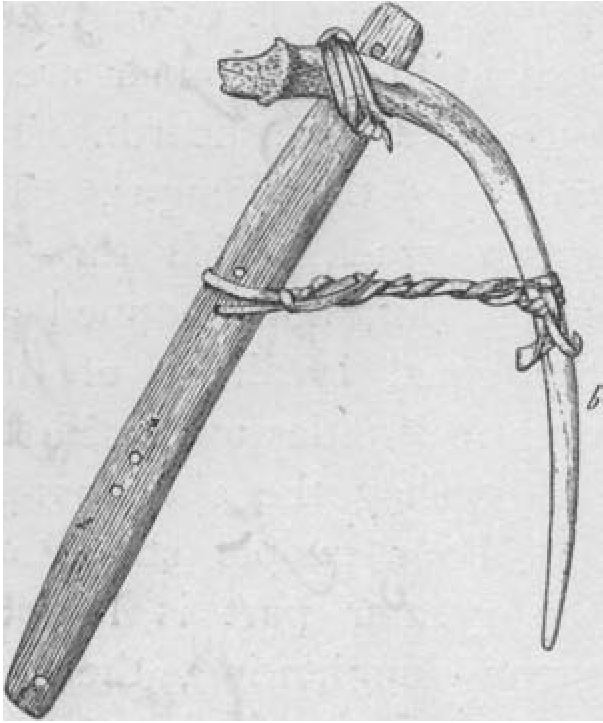
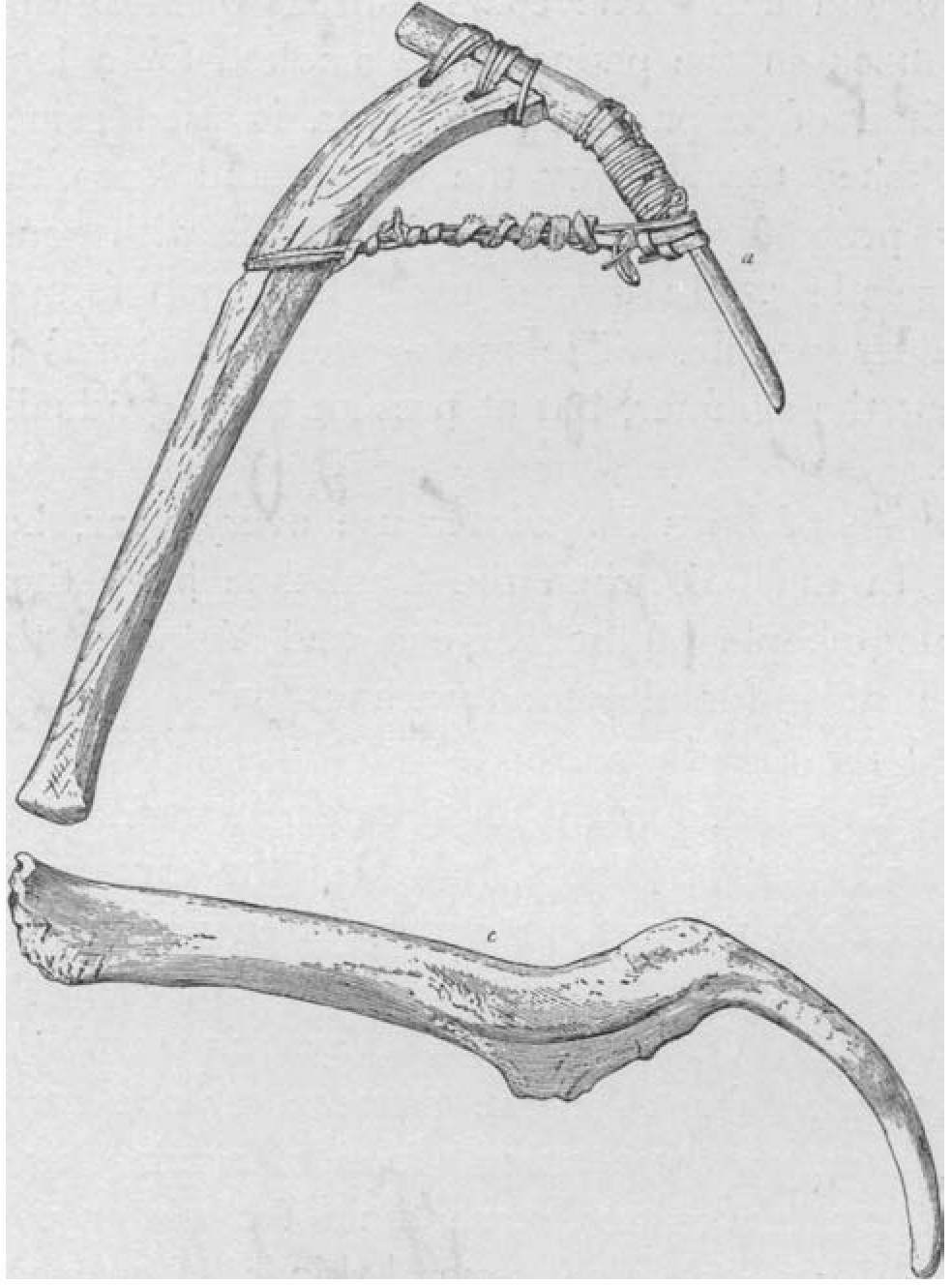
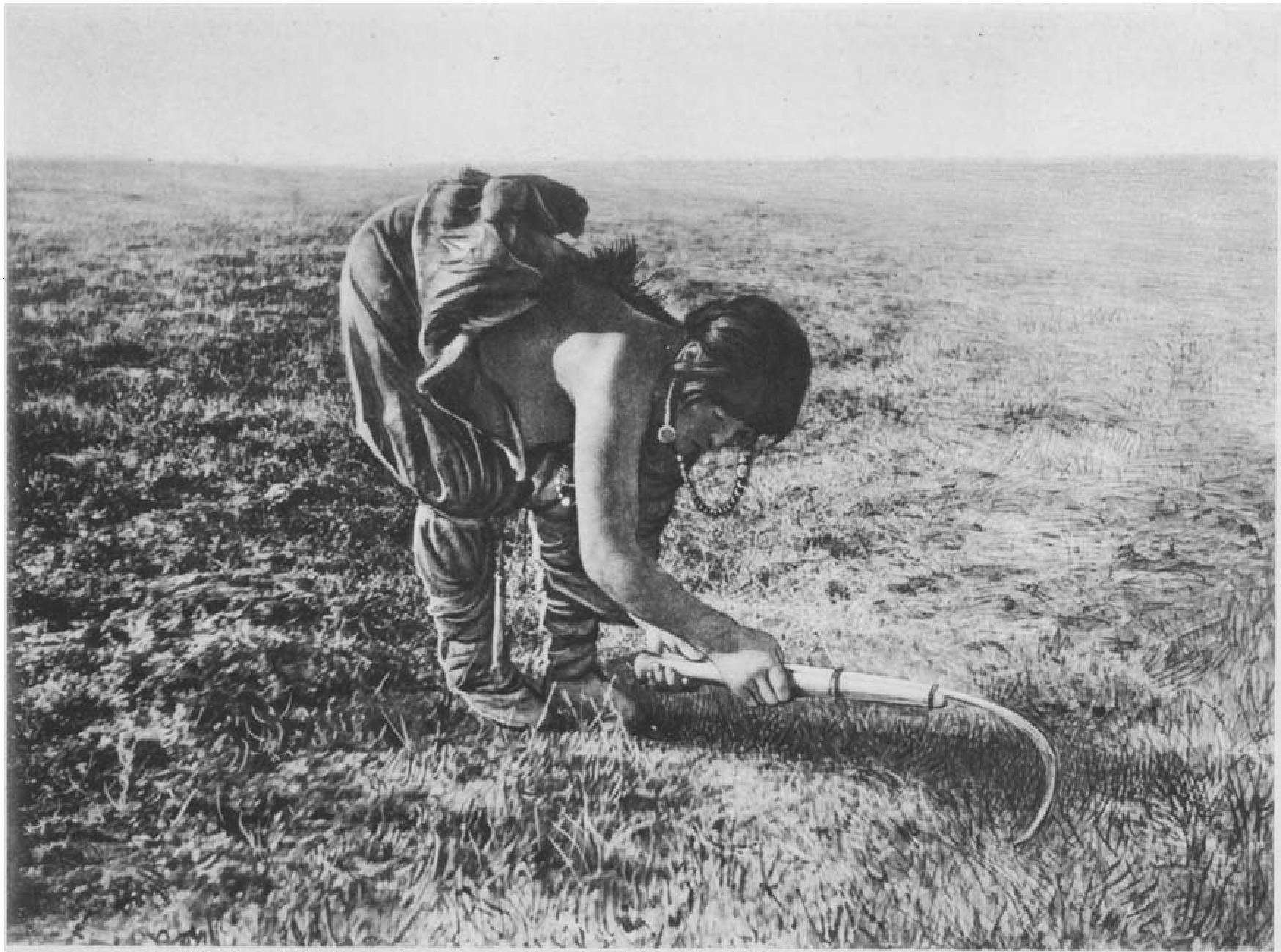
The roots of Claytonia acutifolia Willd, Hedisarum obscurum, Polygonum viviparum, Polygonum polymorphum, Pedicularis sudetica, Potentilla fragiformis, Oxytropis, various species of Carex, and several others, are used by the Chukchee. They are the only vegetable food that is really relished. During the summer women often go digging roots (Plate XIX, Fig. 1). They use a digging-pick, which in former times consisted of a handle with bone point (Fig. 117, b) or simply of a sharp-pointed piece of antler (Fig. 117, c), while at present it has an iron point tied to a wooden handle (Fig. 117, a). Nests of mice are also robbed. It is considered dangerous, however, to take all the roots from the nests, because the owner might retaliate by means of magic. Moreover, the Chukchee believe that some of the roots and herbs found in the storehouses of mice are poisonous, and are gathered by the mice partly for the purpose of poisoning the robbers, partly as an intoxicant, like fly-agaric (Agaricus muscarius),¹ which is used by man.
Roots are eaten raw, added to meat-soup as vegetables, or pounded fine, together with the choicest meat and tallow, and made into a pudding, which is considered the most delicious dish of the Chukchee bill of fare.
Berries are gathered and eaten on the spot. They are very seldom stored, since the tundra is not very rich in berries. Those occurring most frequently are Empetrum nigrum and Rubus chamæmorus.[199]🗗uncollated On the whole, vegetable food is much more used by women and children than by men. In tales, men living in solitude are always described as hunting animals and procuring animal food. A solitary woman is more frequently described as gathering herbs and roots, laying in stores of vegetable food, and often it is told how she brings up on it several small children.¹
DISHES. — The Chukchee bill of fare is not very varied. Boiled meat forms the staple food, and the brisket is considered the best part of the animal. The head of the animal is generally eaten first; and the other parts are prepared in order, going backward along the body. There are a few more elaborate dishes. First of all is kiˊvlet, a kind of soup, which is made of blood mixed with fat, chopped guts, and edible roots if on hand. This soup is cooked in large quantities at all the principal ceremonials. It is used for sacrifices, and eaten by the guests as the chief course of the feast. Another dish is made of pounded flesh mixed with fat and roots and boiled with a small quantity of water into porridge.
Pounded meat mixed with fat, and sometimes also with edible roots, is boiled in water, and then well kneaded and formed into large round balls, which in winter are frozen hard, and form the chief travelling-provisions of the Chukchee. A man going alone on an expedition of any kind will take along a ball of frozen meat-pudding and a few sticks of frozen marrow. Meat-pudding is prepared in quantity for ceremonials of a social character; for instance, for weddings. It is the customary present which is interchanged between the families of the groom and of the bride.
The Chukchee women do not care to prepare these dishes for every-day consumption, especially because boiled reindeer-meat is, after all, the dish best to their liking. Among the Koryak and the Kamchadal, puddings are prepared chiefly of roots, stalks of herbs, and berries pounded and mixed with oil; but the country of the Chukchee is too poor to yield vegetable food in sufficient quantities. For sacrificial purposes, however, puddings are made of pounded leaves and herbs of the plants named, and on these occasions some such pudding is eaten by the people.
The ordinary meals of the Chukchee consist of solid food only. Like all the other tribes of northeastern Siberia, they drink tea after the meal. Broth is taken afterwards as a cold drink, for which purpose it is often cooled with slabs of snow. According to reports of former travellers, they ate much snow to quench the thirst; but, owing to the introduction of tea, this custom has fallen off to a great extent.
TEA, TOBACCO, AND OTHER FOODS. — The people of northeastern Siberia use compressed “brick tea” almost exclusively, and drink it very strong and black, when their supply is sufficient. They have no milk, and practically no sugar; nor do they add tallow or rye-meal, as do the people of southern Siberia.[200]🗗uncollated Roasted rye-meal is sometimes used in the north as a substitute for tea, but it is not much liked by the people. They drink tea in large quantities three or four times daily, sometimes as much as forty large cups a day; but it does not seem to affect their nervous system. This is due to the fact that compressed tea, being prepared of the refuse leaves mixed with sheep or ox blood, contains but small quantities of the alkaloid. Europeans travelling in that country generally consume nearly as much tea without ill effects. Tea is considered by the people as a substitute for food. Its chief importance, however, is that it presents an excellent means of restoring heat after travelling or walking out of doors in the cold. It is considered to be healthy; and the natives believe that in the summer-time, when camping on the damp tundra, plenty of hot strong tea keeps off cold and fever. For all these reasons, scarcity of tea is considered almost everywhere as nothing short of a calamity, which, however, befalls the people almost every year for several weeks, whenever the arrival of the merchant caravans is retarded by blizzards or by swollen rivers.
As substitutes for tea, leaves of the sweet-brier, of Epilobium angustifolium and of various berries, such as Rubus chamæmorus and Rubus arcticus, are used.
As stated before, the principal meal of the Chukchee is in the evening, after all the people have entered the sleeping-room. At this time the Chukchee eat much and ravenously. They swallow large quantities of meat, gnaw the bones, and try to outdo each other in quickness. Nevertheless the Chukchee do not seem to be greater eaters than their neighbors; and my cossacks and other companions, after a long day spent in travelling through the cold weather, ate just as swiftly and ravenously as the natives. There are some exceptionally great eaters among the Chukchee, although I myself met such a one only among the Russianized Yukaghir of the Kolyma. I was told about one Reindeer Chukchee of the Telqäˊp tundra who was able to consume at one eating a two-year-old reindeer-buck. I was told that before a meal the skin on his stomach lay in large folds, which he gathered up with his belt. He could stay without food for two or three days. Then, after a sumptuous meal, his stomach would be enormously distended, so that the skin would look quite smooth, and he would spend a whole day motionless digesting.
The Reindeer Chukchee, as well as the Lamut and the Koryak in Kamchatka, occasionally use as food a kind of white clay, which is called nuˊte-eˊčen (“earth-fat”). This, of course, is eaten only in moderate quantities, mixed with broth or with reindeer-milk.
Pitch from the larch-tree is used as chewing-gum, as is done by many other tribes. For the same purpose the Maritime Chukchee and the Eskimo make a preparation of seal-oil by boiling the dregs from the oil till they become quite ductile and sticky. A small piece is steeped in fresh seal-oil just before chewing it.
[201]🗗uncollatedThe Chukchee like to try every kind of “alien food,” and even become accustomed to condiments, like mustard and pepper. They even offer sacrifices of sugar, bread, etc., to the spirits, supposing that they are also fond of new kinds of food. In cases of voluntary death, the self-doomed man often declares his last wish to be to taste “alien food.” In the next world, he argues, there will be no place for other tribes, so this will be his last chance to taste foreign foods.
I have already mentioned the passion for tobacco among the native tribes of northeastern Siberia. It is stronger in the Kolyma country, possibly because tobacco is more difficult to get there. Among the Chukchee very few people are met in that region who do not use tobacco in some form. Even children three years old, who are just toddling about, are seen smoking. Mothers give their pipes to suckling babes to quiet their crying.
“The tobacco-weed knows no shame,” says a proverb of the Russianized Yukaghir. Of the same nature is another common saying in this tribe, which refers to their girls selling their virtue for a stem of tobacco.
Scarcity of tobacco is felt as keenly as a food or tea famine. The same term is used to express all three ideas in local Russian and in the native languages. When tobacco gives out, the people use the black deposit which gathers inside of the pipe-stem. Indeed, one of the reasons for making pipes with cleft stems is for the convenience of extracting this nicotine deposit, which is stored in a bag for future use. It is considered especially suited to chewing, and during prolonged hard work it drives away drowsiness and fatigue more effectually than genuine tobacco. More commonly they use for chewing small pieces of tobacco-leaf without any preparation. The stamens are considered to be less desirable than the broad part of the leaf.
Tobacco for smoking is cut fine with an ordinary knife on a small board of the same shape as a woman’s tailoring-board. Two parts of tobacco are then mixed with one part of wood to weaken it properly. The wood used is dry poplar or aspen bark, or pieces of young willow, which are scraped fine and rubbed with the fingers. The Russian leaf-tobacco is too strong, though a few people use it without mixture. The so-called “Turkish” tobacco, which in reality is grown in southern Russia and in the Crimea, is used pure, because it is much weaker. The same may be said of Manchurian tobacco and the lighter American tobaccos. All strong American tobaccos are smoked with a mixture of wood.
The receptacle for tobacco in the bowl of the pipe is extremely narrow, and each dose for smoking is therefore very small. The smoker consumes a pipeful at once by several prolonged puffs. The northern smokers, in consequence, refill their pipes almost every ten minutes. After a long period of abstinence, a passionate smoker, on consuming his first pipe in this hasty manner, often becomes so giddy that he falls unconscious. This is particularly noticeable among the young men and women.
[202]🗗uncollated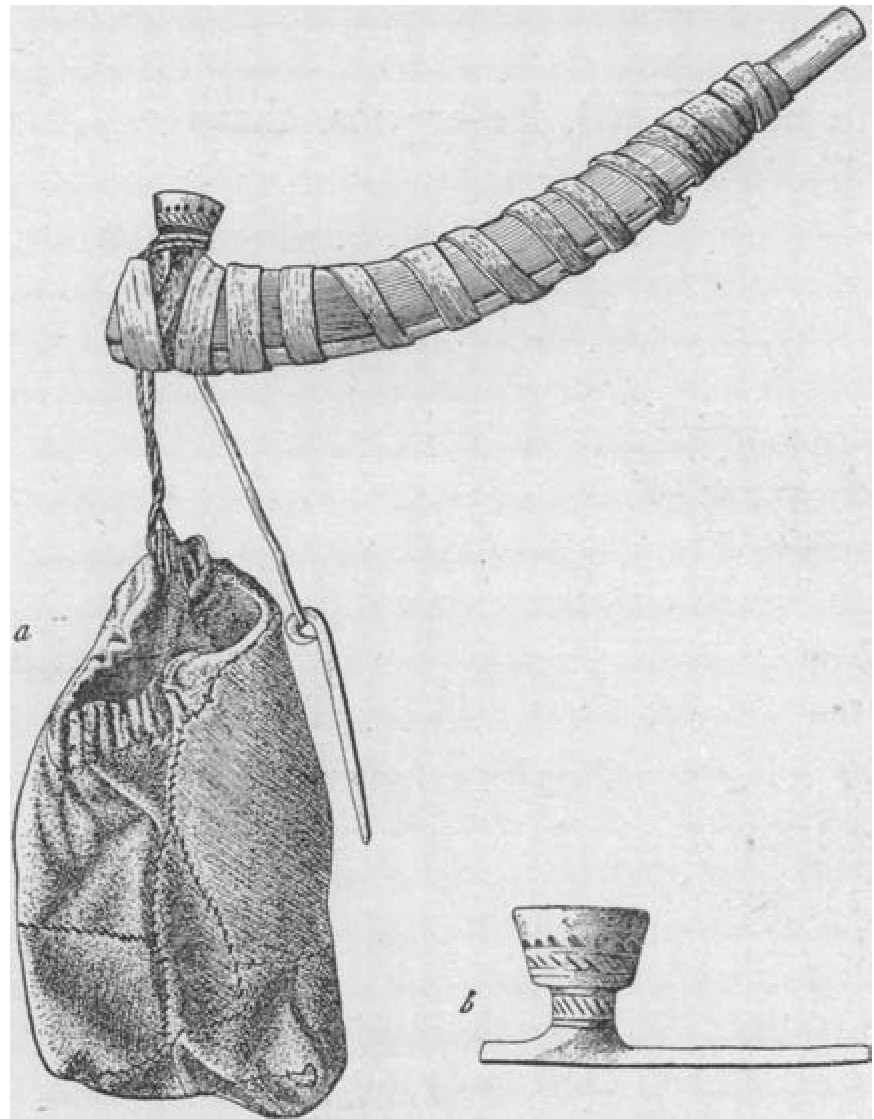
Tobacco-pipes of various shapes are used. The oldest and simplest pattern (Fig. 118, a, b) has the stem made of two parts, unequal in size, the narrower part forming the bottom. The stem is held together by being wound with a strip of leather. The bowl (Fig. 118, b) is made of tin or pewter, and is more or less similar to Chinese patterns. Indeed, brass pipes of Chinese make are found widely distributed among all tribes of eastern Siberia, and have undoubtedly influenced the native manufacture. Other pipes have a bowl of tin or pewter, with a round wooden stem. They are joined in a manner similar to that shown in Fig. 118, a, but the stem consists of a single piece (Fig. 119, a). It has a hole in the butt-end, closed with a stopper, which allows the deposit to be extracted.
A few pipes in the collection have bowls of the same shape made of bone, or stone roughly hollowed out with a chisel. Other pipes (Fig. 119, d) are made of a single piece of wood, with a very small bowl and bulging stem. All along their lower side are round holes closed with stoppers. Through these holes the black residue from the pipe is extracted. Some of these pipes are quite large. On the Kolyma I saw an old woman who carried her pipe on her shoulder like a club, and indeed it might have been used as a weapon. A Koryak pipe in Mr. Jochelson’s collection is about 60 cm. long.
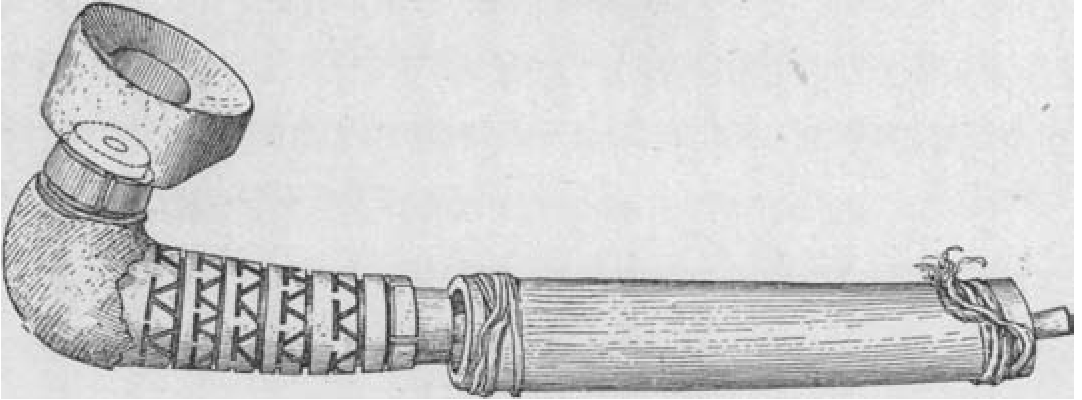
Some single-piece pipes are ornamented with patterns inlaid with pewter (Fig. 119, b, c). The bowl and the mouth-piece are of pewter, and are cast in wooden mantles (Fig. 120). The wooden part of the pipe, with its surface grooved for inlaying, is interposed between the end moulds, which are connected by a paper tube. The metal parts are thus all cast at the same time, the pewter being poured into the bowl-end of the mould. The pipe is afterwards finished with a knife and a file.
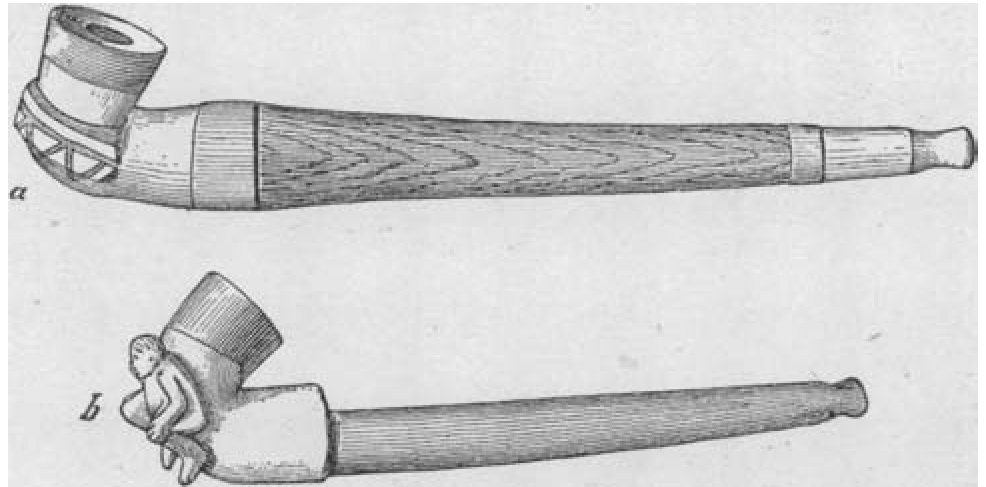
One style of pipe (Fig. 121 a, b) has an ivory bowl, and a stem made of wood. Its shape is nearer to that usual among Europeans, and may be an imitation. The bowl is adorned with very clever carvings. This work is rare among the Chukchee, but the Koryak pipes display a great variety of carved patterns.
[203]🗗uncollated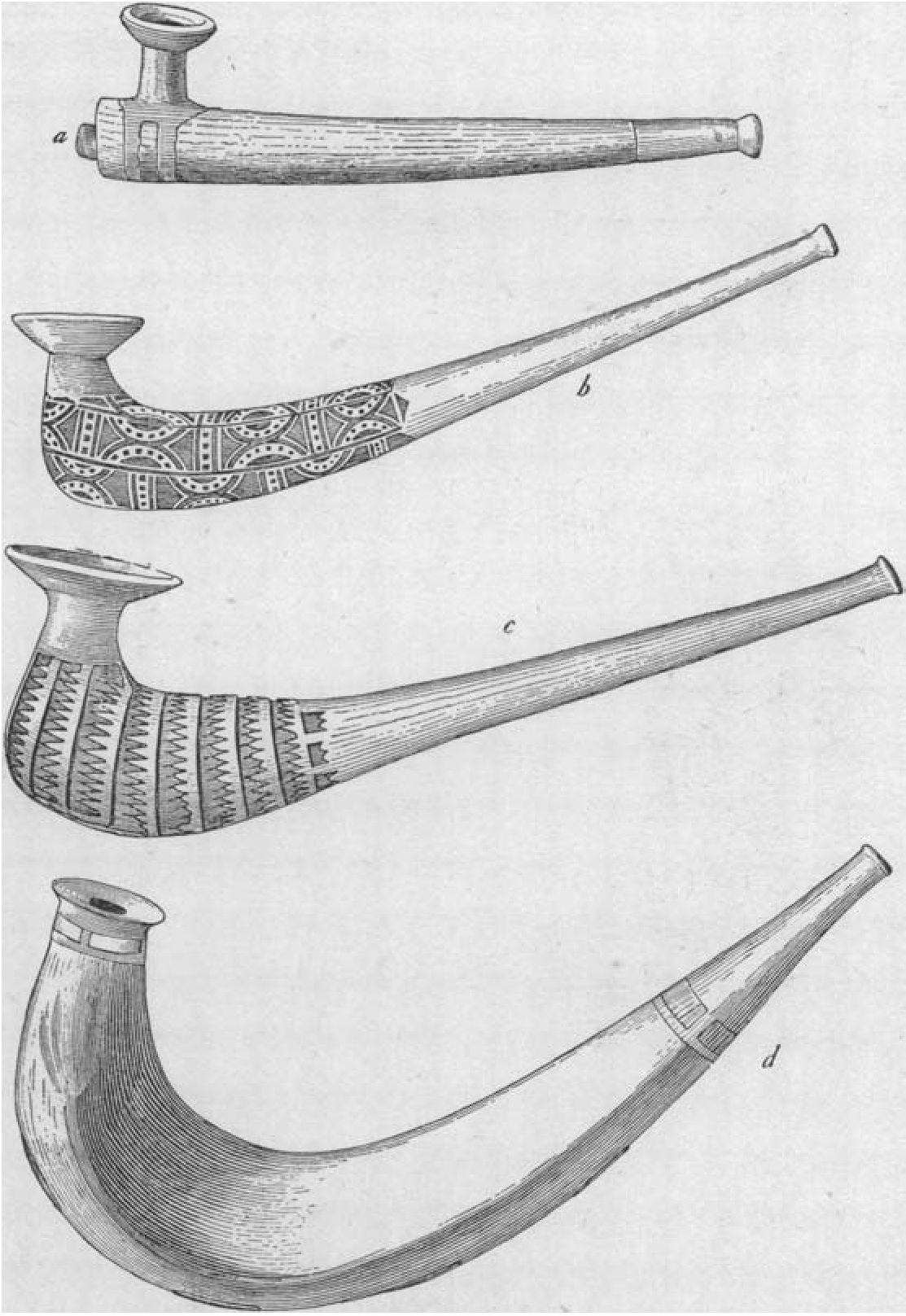
With the pipe are kept a stout iron pin to clean the bowl, and a small tobacco-pouch made of leather and sometimes adorned with crude embroidery.
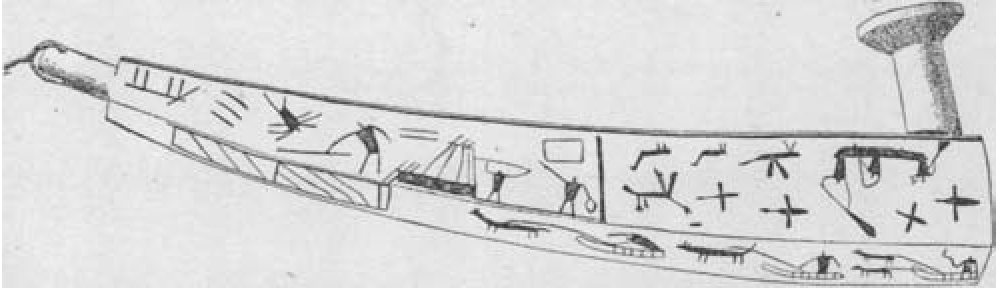
All the pipes described resemble the pipes of the Alaskan Eskimo. This may be seen by comparison with Nelson’s plates.¹ Some of the Alaskan Eskimo pipes, however, have the body of the bowl higher, and the rim wider and more flattened. The difference was pointed out to me by the natives. Furthermore, American pipes carved of ivory retain the same form as the simpler pipes; while the Asiatic carved pipes, as noted before, resemble the civilized form. The Asiatic Eskimo have pipes quite similar to the Chukchee patterns. The ivory pipes of St. Lawrence Island, on the other hand, already show quite an American shape. Their stems, moreover, are engraved with pictographic etchings (Fig. 122), while on the Asiatic side the pipe-makers use only relief-work.

The use of snuff is found rather among the Russianized natives than among the Chukchee. Tobacco for this purpose is ground in a very small wooden mortar (Fig. 123) by means of a long, heavy, wooden pestle. The[204]🗗uncollated mortar is placed on the ground, between the operator’s feet. The small end of the pestle is put into the mortar, while the other end is moved slowly around with the hand. Mortars used by various tribes of northeastern Asia resemble those used by the Alaskan Eskimo. Some white ashes of poplar-wood is added to the tobacco, and often a pinch of pulverized glass, to increase the irritation of the snuff. On the Pacific coast, ground tobacco is used very generally, but for chewing rather than for snuffing.
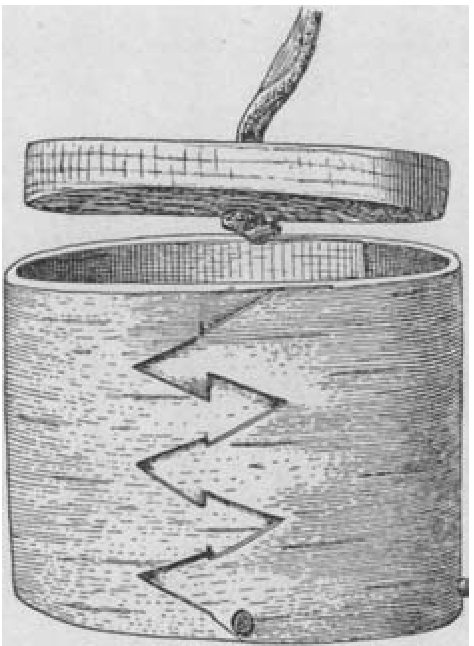
The Chukchee buy snuff-boxes from the Russianized Yukaghir or the Maritime Koryak. These boxes are made of birch wood or bark (Fig. 124),[205]🗗uncollated and sometimes are ornamented with geometrical designs scratched in with a knife or impressed in the soft bark with sharp stamps. The Chukchee use these boxes for holding snuff, chewing-tobacco, and any small objects which they are afraid of losing. Occasionally a lump of sugar gets in with the mixture, and its sweetness is improved, to their taste, by the additional tobacco flavor. The Koryak, the Kerek, the Russianized Yukaghir, and also the Chukchee of the Kolyma, make snuff-boxes of the same styles, using wood, antler, and ivory. The same is true of the Alaskan Eskimo. Many of the shapes represented by Nelson¹ have their counterparts in Asia.
I have met men and women who used tobacco in all three ways at the same time. Usually, however, snuff is only used when smoking cannot be continued because it causes a cough, or for some other reason. Taking snuff is considered a cure for rheum, weakness of the eyes, and even dulness of hearing. In the Kolyma region, smoking and chewing are of equal importance, but on the Pacific chewing is much more general.
INTOXICANTS. — Fly-agaric is the only means of intoxication discovered by the natives of northeastern Asia. Its use is more common in the Koryak tribe, as agaric does not grow outside of the forest border. For the same reason only the Southern Pacific Chukchee — e. g., those around the Anadyr, Big River, and Opuka River — are supplied with the intoxicating mushroom. They do not compare with the Koryak, however, in their passion for agaric.
The Russianized natives of the Anadyr until recently shared in the consumption of this intoxicant, but now they have almost wholly given up its use. The reason of this change is that they consider the strong intoxication produced by this stimulant as shameful for a Christian. They also realize that the consumption of fly-agaric involves some danger. With a person unaccustomed to its use it may even cause death. The abstinence from agaric is also noticed among the northern Kamchadal, and to some degree among the Maritime Koryak of northern Kamchatka, though all of these people gather it assiduously in order to trade it to their less civilized reindeer-breeding neighbors.
Fortunately for the tribes consuming the fly-agaric, it grows only in certain places, and the supply is often limited. The mushrooms are usually dried up and strung together in threes, that number being an average dose. Some of the natives of course require much more to produce any effect. The intoxication may be followed by sickness, or the after-effect may be very slight. When eaten, the mushrooms are torn to small shreds, and these are chewed piece by piece, and swallowed with a little water. Among the Koryak the woman chews the mushroom, and offers the ready quid to her husband to swallow.
I witnessed a few times the progress of intoxication by means of agaric. The symptoms are analogous to those produced by opium or hasheesh. The intoxication comes on rather suddenly, in about a quarter of an hour after[206]🗗uncollated the consumption of the mushrooms. Usually the person remains awake; but the natives say that if a person falls asleep immediately after eating mushrooms, they will work more effectively, and in a short time he will awaken more thoroughly under their influence. The intoxication has three stages. In the first the person feels pleasantly excited. His agility increases, and he displays more physical strength than normally. Reindeer-hunters of the Middle Anadyr told me that before starting in canoes in pursuit of animals, they would chew agaric because that made them more nimble on the hunt. A native fellow-traveller of mine, after taking agaric, would lay aside his snow-shoes and walk through the deep snow hour after hour by the side of his dogs for the mere pleasure of exercise, and without any feeling of fatigue. During this period the agaric-eater sings and dances. He frequently bursts into loud peals of laughter without any apparent reason. It is a state altogether of noisy joviality. His face acquires a darker hue and twitches nervously; his eyes are now contracted, and again almost bursting from their sockets; his mouth puckers and grins or spreads into a broad smile.
Flashes of the second stage often appear early, shortly after the first traces of intoxication become visible; indeed, all three stages are frequently intermingled. This is noticeable especially among elderly inveterate agaric-eaters. During the second stage the intoxicated person hears strange voices bidding him perform more or less incongruous actions; he sees the spirits of fly-agaric and talks to them. He still recognizes surrounding objects, however, and when talked to is able to answer. All things appear to him increased in size. For instance, when entering a room and stepping over the door-sill, he will raise his feet exceedingly high. The handle of a knife seems to him so big that he wants to grasp it with both hands.
The spirits of fly-agaric have an outward appearance similar to that of the actual mushrooms, and the agaric-eater feels impelled to imitate them. For example, I saw one man suddenly snatch a small narrow bag and pull it with all his might over his head, trying to break through the bottom. He was evidently imitating the mushroom bursting forth from the ground. Another walked around with his neck drawn in, and assured every one that he had no head. He would bend his knees and move very quickly, swinging his arms violently about. This was in imitation of the spirits of fly-agaric, who are supposed to have no necks or legs, but stout cylindrical bodies which move about swiftly.
The spirits of fly-agaric are fond of playing practical jokes on men under their influence. They begin with asking for homage either for themselves or for surrounding objects, — the hills, the river, the moon, etc. Then they show some of the objects under a delusive aspect. When asked why this strange change has occurred, the spirits answer that it portends danger to the man’s life unless he makes obeisance in a particular way. To illustrate.[207]🗗uncollated An intoxicated man, while talking to me reasonably enough, suddenly leaped aside, and, dropping on his knees, exclaimed, “Hills, how do you do? Be greeted!” Then he stood up, and, looking at the full moon, asked, “O Moon! why are you waning so fast?” He told me that the spirits answered, “Even so will your life wane, unless you show the moon your bare buttocks.” This he did, and then, suddenly recovering his senses, began to laugh at his foolish actions.
In the third stage the man is unconscious of his surroundings, but he is still active, walking or tumbling about on the ground, sometimes raving, and breaking whatever happens to come into his hands. During this period the agaric spirits take him through various worlds and show him strange sights and peoples. Then a heavy slumber ensues, lasting for several hours, during which it is impossible to rouse the sleeper. How persistent are the spirits’ commands is shown by the following instance of a man, who, when about to retire, was ordered to lie down in the midst of his dog-team. Although he was attacked by the dogs, we could not keep him away from them. He finally succeeded in staying with the dogs all night.
On awakening, a general weakness and heavy headache ensue, accompanied by nausea, often violent vomiting. The drunken state can be renewed by a single mushroom. In this manner inveterate agaric-eaters keep up their intoxication day after day.
Drinking the urine of one who has recently eaten fly-agaric produces the same effect as eating the mushroom. The passion for intoxication becomes so strong that the people will often resort to this source when agaric is not available. Apparently without aversion they will even pass this liquor around in their ordinary tea-cups. The effect is said to be less than from the mushrooms themselves.
I have already spoken about the amount of trade in strong liquors carried on in northeastern Siberia. The Chukchee, as well as all other inhabitants of the country, are eager for a chance to drink spirits. In all my journeys through these countries I met people in only two places who knew nothing about strong liquors. In one case they were some Maritime Koryak in small villages on the northern border of the Kamchatka district. These people were far from the Kamchatka towns and from Gishiginsk trading-settlements. At the same time, they were so poor that nobody sought to bring liquors to them. The other case was that of the Kerek of the southern shore of Anadyr Bay.
On the other hand, I hardly met a single adult man or woman among the Chukchee who would refuse a drink of spirits. Younger people, of course, have little chance to taste them. When offered drink, they consider it their duty to pass the treat to their elders. Occasionally they will moisten their lips with the liquor to indicate that they have partaken. With the older[208]🗗uncollated people the offering of a single drop when liquor is scarce is considered a quite acceptable treat. They feel that it adds to the general enjoyment. The Chukchee do not approve of diluting alcohol with much water. I have witnessed them drink large glasses of 95% alcohol, one drop of which was sufficient to make my mouth burn for several minutes. Even the unrefined alcohol of the Kolyma country is drunk undiluted when possible. The so-called “principal chief” of the Reindeer Chukchee, previously mentioned,¹ died suddenly in 1898 on the day of his arrival at the town of Sredne-Kolymsk, after a generous drink of unrectified alcohol.
The Reindeer people are more eager for liquor than the Maritime. This may be because they have less chance to satisfy their craving. When they know that there is some strong liquor within their reach, most of them are ready to pay an exorbitant price for it. I was assured by many that if necessary they would be quite ready to give a piece of their own flesh for a drink.
Small wooden kegs, in which the liquor is brought from the Russian settlements, are carefully washed with hot water, and if possible boiled in large kettles. I have seen people sitting around a keg, which finally refused to yield any more, weep bitter tears over the end of their festivity.
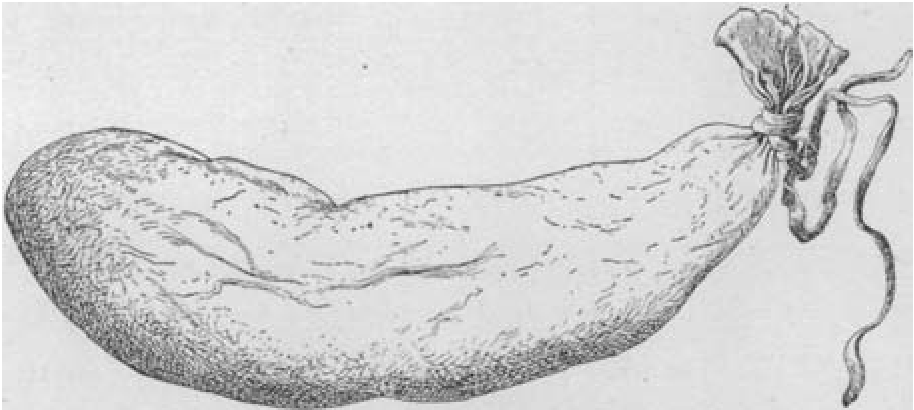
Between the native villages and camps the liquor is carried in bags made of the stomachs or bladders of various animals (Fig. 125). The bags resemble those used by the Alaskan Eskimo for carrying water or oil,² but they do not have an ivory nozzle, and are merely tied around the neck with a string.
The Maritime Koryak and the Kamchadal sometimes distil a kind of brandy from berries of Vaccinium uliginosum. They use for this a large iron kettle with a wooden cover pasted over with dough. An old gun-barrel serves as a condenser. This art was learned from the cossacks, though at present the latter are strictly forbidden to distil in private any strong liquor. The Chukchee, however, do not have enough berries for this purpose, or the skill to thus distil them.