XIIICharms and Sacred Objects
While the religious rites of both branches of the Chukchee tribe are comparatively homologous, their material accompaniment presents many striking differences, conformable to the material life of the maritime and inland branches of the tribe.
Thus we find that, while the individual charms of both branches of the Chukchee tribe and of the Asiatic Eskimo are quite similar to each other, the family charms are arranged according to their connection with the pursuits of their material life. The families of reindeer-breeders use charms and amulets to protect their herds; while those of the maritime people use them to secure success in hunting.
The same may be said regarding the ceremonials. The individual ceremonials — those connected with death, burial, and marriage — are much the same among the two branches of the Chukchee and the Asiatic Eskimo.
The family ceremonials are arranged in a regular cycle, are celebrated from season to season throughout the year, and are directly connected with the pursuits of material life; therefore those of the reindeer-breeders differ from those of the maritime people. In this respect the difference between the Reindeer Chukchee and the Asiatic Eskimo is still greater. Some of the ceremonials of the Maritime Chukchee bear a resemblance to those of the Reindeer people, and show only such changes as result from their diversity in material culture. Many of their ceremonials are similar to the religious rites of the Asiatic Eskimo. In this respect, as in many others, the customs of the Maritime Chukchee occupy a middle ground between those of the Asiatic Eskimo and those of the Reindeer Chukchee. Each family, moreover, has its peculiar groups of images and ceremonials, characterized by special details, and differing from those used by neighboring families. These differences develop continually under orders received from shamans, or directly from spirits through dreams. In this way, even the chief ceremonials of the year come to be observed somewhat differently by neighboring camps and by different families in the same villages.
AMULETS. — The charms of both the Reindeer and the Maritime Chukchee are used as amulets; that is, as objects having peculiar power, which they may use for the benefit of a person who has possession of them.
It is probable that primitive man began to use amulets very early, in the first stage of religious development. Regarding all surrounding objects, animate and inanimate, as living and powerful enemies, he, from the very[339]🗗uncollated first, thought it necessary to propitiate the good-will of the most important of them, and to rely upon their protection against all others.
Thus originated sacrifice to the mountains, rivers, etc., and to the chief phenomena of nature, such as thunder or wind. These, however, could not be used as amulets by man, because of their size; and their protection, therefore, could not be considered as quite secure. Man from the beginning, probably, would pick up some of the smaller objects which struck his fancy by the singularity of their outward appearance or by the circumstances under which they were found in the wilderness. From this singularity he assumed, first, that they had peculiar force, and, second, that they wished him to take them for his protectors.
Thus Urey Lisiansky says of the inhabitants of Kadiak, that as soon as spring comes their whale-hunters wander over the mountains in search of eagle-feathers, bear’s hair, stones of unusual shape, roots, bird-skulls, and such like, for use as amulets.¹ The same thing is told by Veniaminoff, regarding the Aleuts, in his “Notes on the Islands of the Unalashka District.”
To illustrate the primitive conception of amulets, a story from Krasheninnikoff may be given. It refers to a native, a member of a Maritime Koryak tribe, who lived in the village Uka, on the eastern shore of northern Kamchatka. The native in question had suffered for several years from an obnoxious disease, probably syphilis.
One day, while walking along the bank of the little river Aˊdka, he found a stone. When he picked it up, the stone blew on him as if with human breath. He threw it away, and his illness increased to such an extent that he kept to his bed through the summer and winter. The next year he went to look for the stone, and after a long search found it several miles distant, lying on a flat stone slab. Close to it lay another stone of smaller size. He picked up both, took them home, and made clothes for them. Shortly after that, he recovered entirely from his illness. Ever after, he kept the larger stone as his wife, and the smaller one as his son, and took the latter with him on all his hunting-trips.
I have heard stories of the same character from the Chukchee, and have met persons who had picked up amulet wives or husbands in the same way. The amulets had nothing peculiar in their outward shape; but they desired special people to pick them up, and made this clear to them by some sign or action. One man stumbled against a stone and nearly sprained his ankle, and thus learned that the stone wanted to become his amulet. Another, while sleeping on the tundra, found the amulet under his pillow, etc.
Primitive man, in selecting his amulets as well as in offering sacrifices to surrounding objects, must have adopted very early some simple rites,[340]🗗uncollated which were suggested at first by various accidents, but which were soon looked upon as quite indispensable. The more vague and unsettled the primitive conception of the mysterious force of surrounding objects, the greater was the tendency of man to have some stable element of his religious conceptions in the manner, at least, of carrying out the rites. Thus we find that, while the average Reindeer Chukchee is quite unable to explain who the beings are to whom he sacrifices, he is very positive about the details of the sacrifice and about various acts connected with it. There is a marked tendency to maintain the observance of these performances, which have obtained a firmer hold than the ideas they represent, and which the people continue to observe even when their original purport is greatly changed, or even wholly lost and forgotten.
Primitive magic performances include certain acts, and utterances of verbal formulas which tend to acquire an established text that is learned by heart. A verbal formula with its prescribed act forms an incantation, and one is rarely used without the other. An incantation is thought to increase the mysterious force of an amulet and make it more permanent. The Koryak give expression to this idea by calling their amulets “fixed by an incantation” (ewyaˊnwɪčō).¹ They even say that the force of the amulets and of the incantations is weakened by age, and that they must be renewed from time to time. With the Chukchee, however, incantations have not such prominence, and the chief potency of amulets lies in the inherent power the natives ascribe to them.²
In selecting amulets, primitive man is not satisfied with objects as they present themselves to him naturally. Actuated by a general desire to accentuate the anthropomorphous qualities of the objects of his veneration, he very early undertakes to improve them with his own hand and to give them a human-like form. In this, however, he does not go beyond the first steps, because the power of a belief once established hinders further innovation. Thus, among the Chukchee as among the Koryak, the anthropomorphous amulets are shaped very crudely, while children’s toys are often made in a truly artistic manner.
We find among the Chukchee both classes of amulets, — those of natural shape, and those worked up by man. To the first class belong stones, pieces of bone, and other objects, which are picked up under various circumstances, as was said before. For purposes of divination, stones are generally used, as will be explained in Chapter XV. Amulets of animal provenience belong to the same class. These may consist of dried skins, or be represented by a small part of a skin, by a skull, by the tip of the nose, by a single claw, or by a tuft of hair. A bird is represented by a feather.
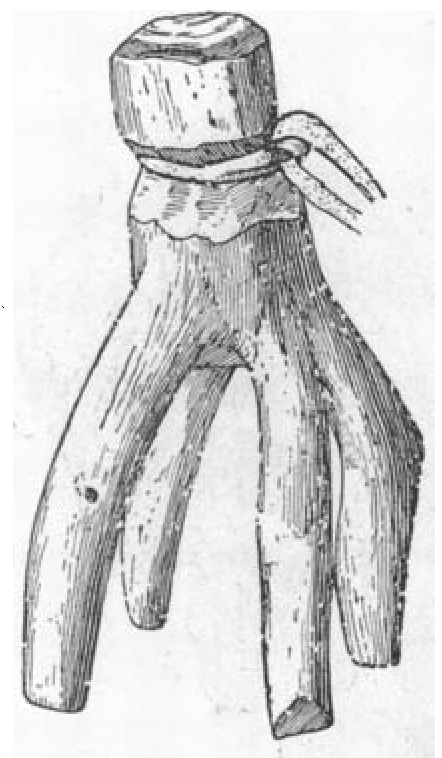
“Wooden Spirits.” — The amulets wrought into human shape appear as[341]🗗uncollated small human images roughly shaped out of various material. Some are made of wood, and usually consist of a small branch of wood forked at one end so as to represent the legs (Fig. 237, a). Sometimes two other branches represent the arms (Fig. 238). Others are made of leather, or are painted in color on leather or wood, or are even pricked into the skin of the face or hands with a needle. All are very imperfectly shaped, and consist usually of a straight line with a mere suggestion of a head and four extremities.
Those made of wood are called ok-kaˊ-mak (pl. ok-kaˊmakɪt), which means literally “wooden spirit.” It is interesting to note that the word “kaˊmak” is Koryak, and is rarely used by the Chukchee.¹ On the whole, human images of this shape have no special names. Some amulets are carved by the Chukchee out of wood or ivory, and with more care than these rough images. They are called “faces” (luˊᵋlqälti), because they consist chiefly of a head or a face. The term “face” is also applied by the Koryak to small carved amulets. They call such amulets “spirit faces” (kaˊmak-luˊᵋu). Some of the faces also represent animals or birds.
Guardians. — The common Chukchee name for all these charms is “watch-keeper” (g̣ɪnrɪreˊtɪlɪn) or “guardian” (inend˙uˊlɪn). Their function is to protect objects and persons to whom they are attached. They are also called “assistant” (vɪˊyolɪn), “helper” (vinreˊtɪlɪn), or “assisting companion” (vinreˊt-tuˊmg̣ɪn).² Most of them are carried by their owners on the body, and their protection is considered especially desirable when travelling in unknown parts. They are therefore called “that used in travel” (leiˊg̣ukin), or “travelling companion” (leiˊg̣u-tuˊmg̣ɪn). The form of these is practically identical with the form of those of the Koryak.³
Each man has one or several “guardians.” They are worn on the necklace, or are fastened to the belt. Among the amulets of animal provenience, preference is given to the ermine, because it is so nimble and active. Other[342]🗗uncollated small skins, skulls, claws, and feathers of birds, are also used.¹ These charms are supposed, in case of need, to turn into living animals, and to give required help. In many tales the owner puts on the skin or the feather, and turns temporarily into the animal or the bird from which they were taken. In actual life this may be done symbolically by means of an incantation.

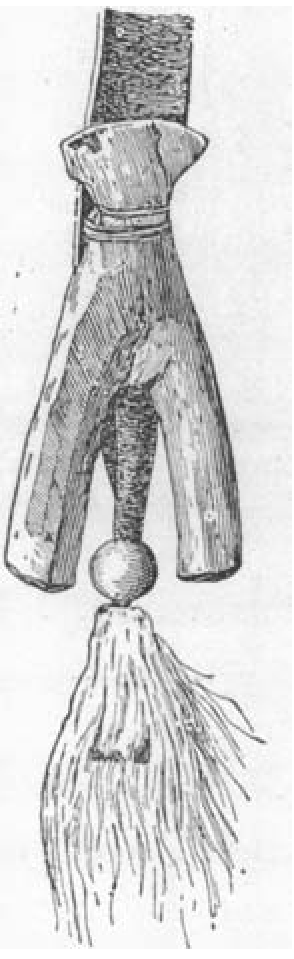
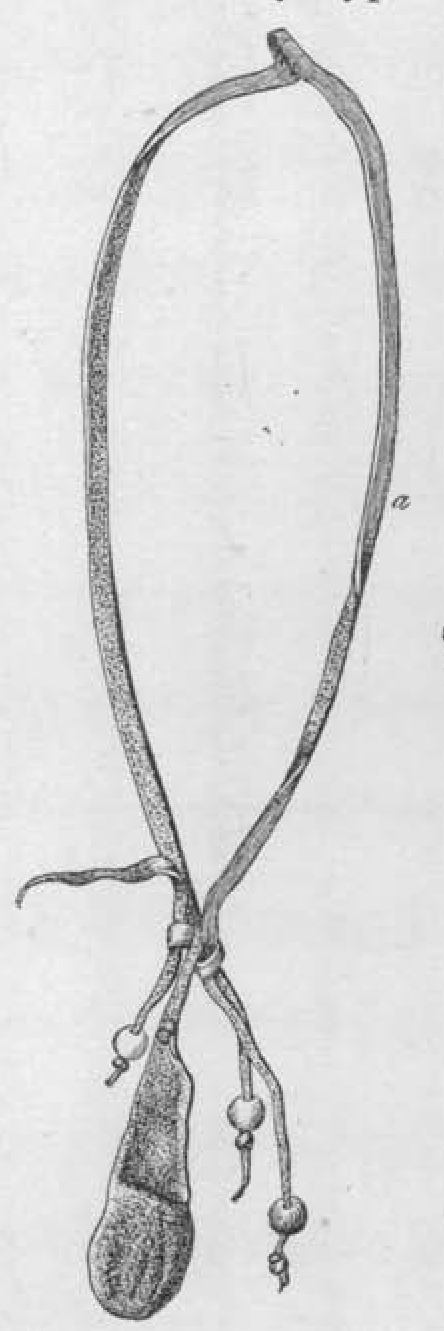
Rude human images made of wood (“wooden spirits”), which represent the “guardians,” are worn on the necklace, hidden generally in a small leather pouch. They are fastened to the collar or to the back of the dress of a new-born infant (Fig. 239). Rude figures cut out of curried leather, and similar in shape to the wooden crotches, are fastened to the clothing in various places, to the scabbard of the knife, to the walls or ceiling of the sleeping-room, to the clothes-bag, etc. They are called kiˊpur or kêproˊlhɪn. When adorned with beads, they form a conspicuous ornament (Fig. 240). Sometimes an image like this is painted or sewed on the walls of the sleeping-room, painted on the boats on both sides, near the bow, or pricked with a fine needle into a person’s cheeks, forehead, or arms.
In an underground house in Nuˊnlig̣ren I saw two human faces roughly scratched on top of one of the whalebone uprights near the entrance. The owner of the house called them also “guardians,” and, while showing me the house, offered a sacrifice of tallow and tobacco to them. Faces of similar character were also found scratched on the top of the ladder-tree in a Koryak winter house.
On the face or hands of a sick person a figure like Fig. 241 is tattooed to provide the sick one with a new “assistant.” This is done especially in nervous diseases. In other maladies the aching limbs are tattooed. Tattooing is also resorted to by murderers, who will mark signs of this kind on their shoulders, hoping by this means[343]🗗uncollated to appropriate the soul of the murdered man, and turn it from a possible foe into an “assistant,” or even cause it to become a part of himself.
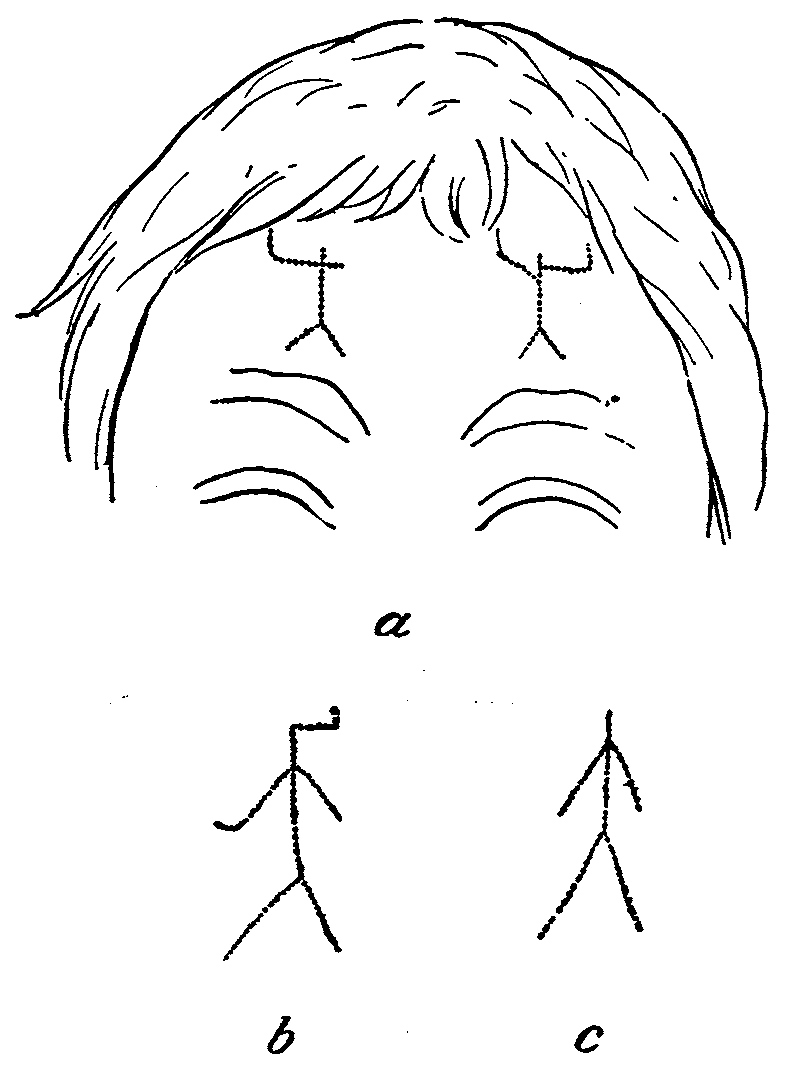
I think it probable that the marks seen by Mr. Nelson¹ on arrow and spear heads at East Cape, and supposed to represent the raven’s foot, and symbolize the raven totem, were in reality simply sketches of “guardians.” It is still more probable that two supposed raven-marks seen by him on a boy’s forehead at Plover Bay² were nothing but these marks of a “guardian.” Their position is quite similar to those represented in Fig. 241, though I have never seen a “guardian” mark with a round head at the top of it. It is clear, however, that they are intended for human figures.
The small circular marks tattooed on the cheeks of many male Maritime Chukchee and Asiatic Eskimo are, according to the explanation by the natives, a kind of prevention against attacks by the keˊlet, though originally they may have been only substitutes for labrets.³ The same custom prevails among the Aleuts. Sarytcheff mentions⁴ that the women of the Andreyanoff Islands had on their cheeks small double circles tattooed with black. Hooper⁵ speaks of tattoo-marks which he has seen among the Asiatic Eskimo in Plover Bay. He gives a facsimile of two marks which were on the breast of a native, and which represent two fighting men. The general character of these marks is similar to those described above. The figures, however, have in their hands objects which resemble shields. No tribe of that country has ever known the use of the shield.
Some of the human images are considered as supernatural husbands or wives of their owners. At the time of ceremonials they are called “ceremonial husband” (mñiˊkin uwäˊquč) or “ceremonial wife” (mñiˊqin ñeˊwän). During the performance they are placed on the floor in an upright position. The owner steps forward and performs the usual dance opposite to his ceremonial mate, who is supposed to share in the action.
The figures of these mates are considered highly effective in cases where[344]🗗uncollated help is needed and for divination, especially when used by persons having skill in magic, who consider themselves shamans. A female shaman in the Kolyma country showed me a stone of a strange form, with two projections at one end, similar to the two branches of a “wooden spirit.” It had a string tied around it, and could be used as a divining-stone. The woman called it her husband, and said she loved it much more than she did her living mate. She assured me that most of her children were conceived from this stone.¹
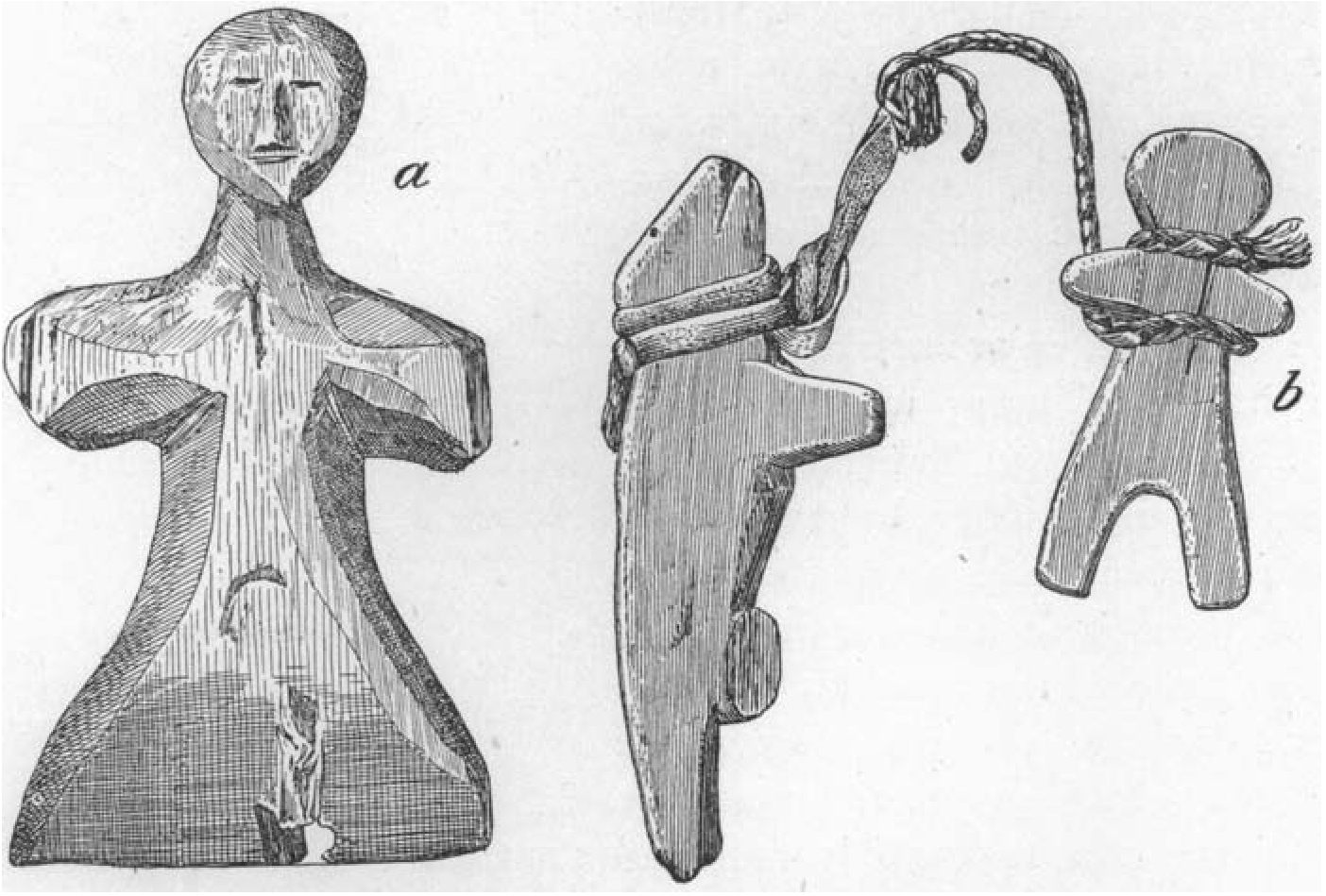
Some personal “guardians” made of wood are carved with more care than the usual crude wooden crotches. Some of these are represented in Fig. 242. The second figure has a dog attached to it for hunting. We shall find numerous figures of a similar character on the family charm-strings of the Chukchee. Among carved animal faces we find the walrus, the polar bear, the black bear, the wolf, and the raven. The dog is also a favorite, because, as I have said before,² the dog or its image is supposed to give protection against evil spirits.
When necessary, the figures can not only acquire life, but grow to very large proportions. A woman who had two small figures of black bears told me that ordinarily she kept them in her work-bag; but whenever she thought she was in danger from spirits (for instance, if a contagious disease broke out in the vicinity), she took the bears from the bag and put them on the ground on either side of the entrance to the house. They were supposed to keep watch in the way described in the folk-tales, and represented in pencil-sketches.
[345]🗗uncollated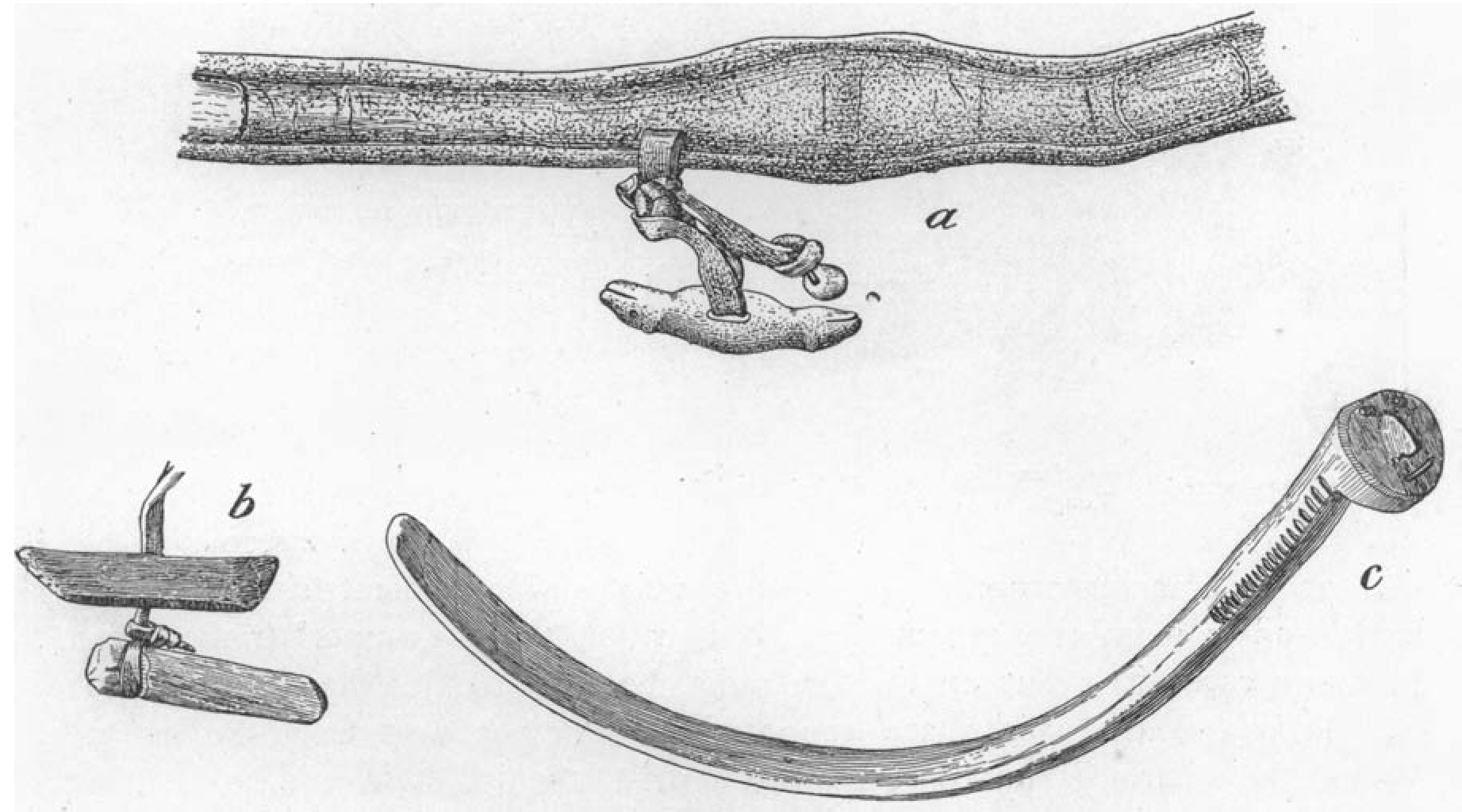
A necklace to which is attached a walrus-head carved in ivory is represented in the chapter on clothing.¹ Another amulet of this kind is shown in Fig. 243, a. It consists of a double-headed dog carved in ivory and made like a small toggle. The image and a single bead are tied to the back of the leather belt.² This is considered an especially suitable place for wearing amulets. The ermine-skin amulet which is sometimes attached to the necklace is often fastened to the back of the belt instead.³ Fig. 243, b, is a similar amulet worn on the belt of a Chukchee. It is made of wood, and represents a canoe with paddle. The shape is quite similar to a wooden button of the Baffin-Land Eskimo described by Boas.⁴
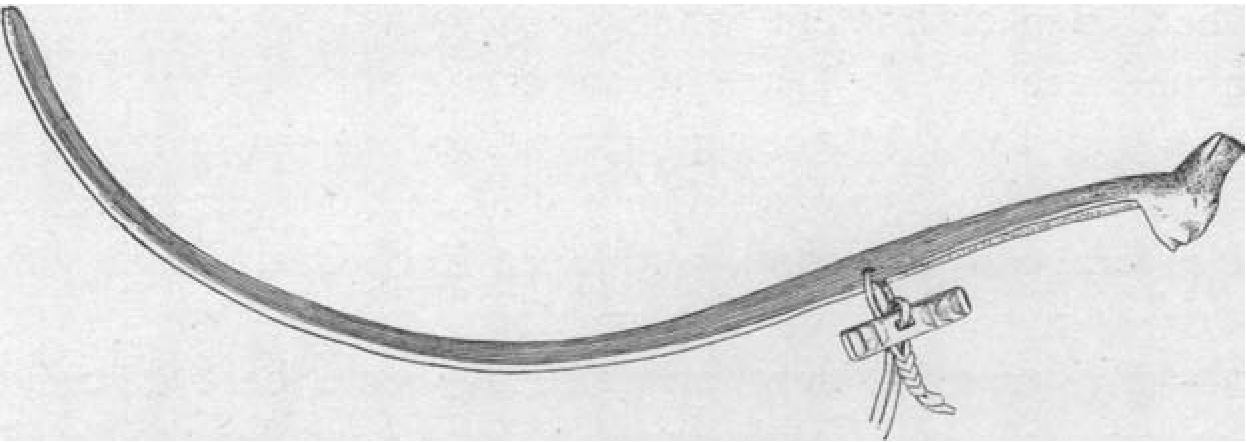
Human or animal “faces” are frequently carved on the handles of snow-beaters for the purpose of giving protection to their owners. The snow-beaters are then called “having a face” (g̣eluˊᵋlqᴀʟ̣in), Fig. 243, c.⁵ A snow-beater with a carved face is especially important for a man who has to live alone in the wilderness, like a herdsman or a hunter.
Fig. 244 is a “guardian” in the shape of a dog, but with a human face on the front of the muzzle. It is covered with a coat made of skin. Combinations of animal figures with additional human faces are often met with on the carvings of the American Eskimo.⁶
[346]🗗uncollated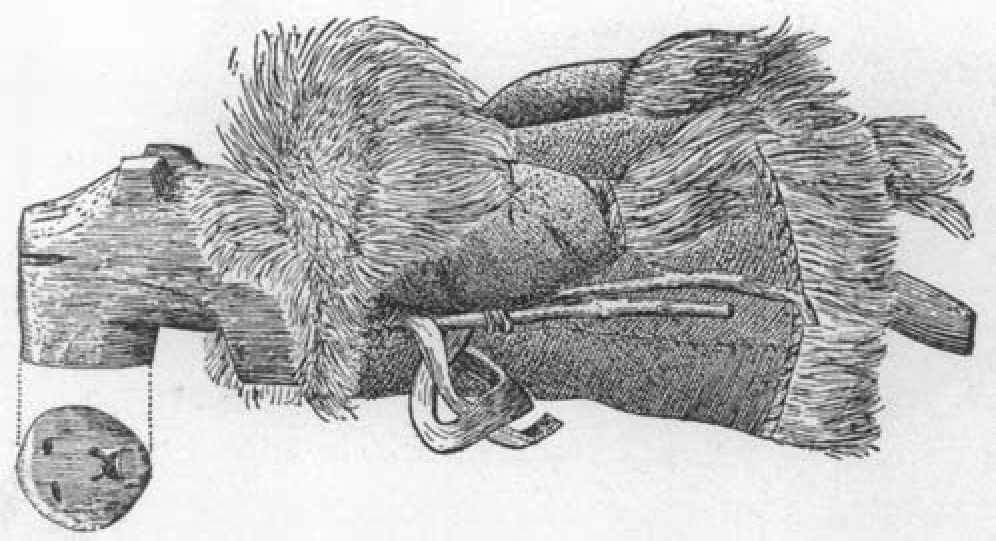
Beads. — Beads are usually substituted for small images and faces of every kind, and they are transformed into charms by means of incantations. The virtue of the bead is twofold, since it may at the same time be considered a charm and an offering to the spirits. A thin strip of leather or sinew with a bead strung on one end of it is a typical single charm.
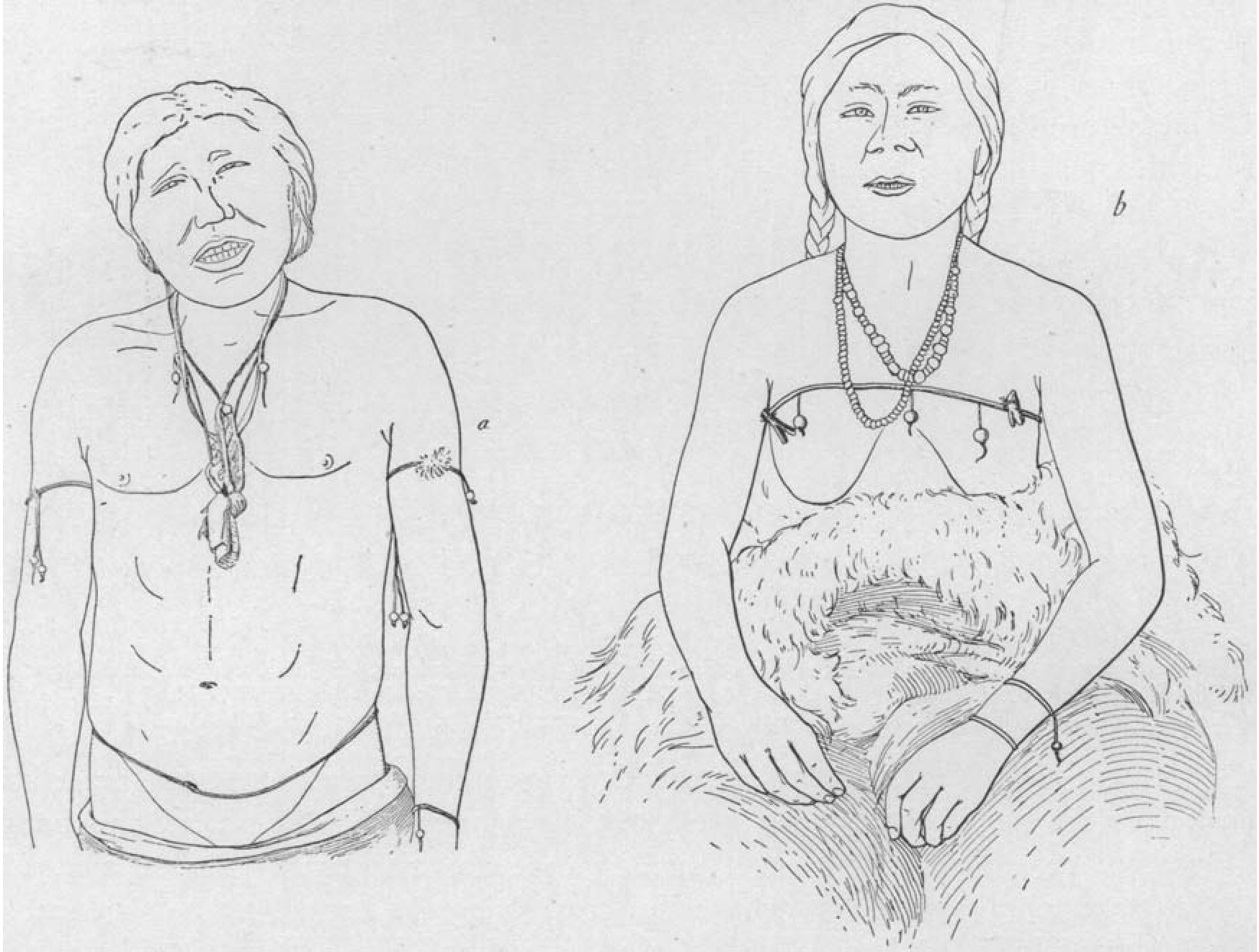
In the chapter on clothing¹ I spoke of the way in which beads are arranged for ornaments, while at the same time many of them serve as charms. A narrow strip of leather with a single bead fastened to it is tied as a bracelet around one of the wrists of an infant shortly after its birth, and is worn throughout life. It is called “hand-wrapper” (mɪng̣-aˊččaw). In many cases it is put on the left wrist, because the left hand is a hand of bad luck and the spirits are supposed to approach man from the left side. When the charm is put on an infant’s wrist, the infant is said to be “swallowed” by it. This implies a wish to proclaim that there is nothing left for the “spirits” to swallow. Similar ideas are expressed in incantations, as will be explained later.
Many people, especially women, wear bands of similar shape tied around their arms. These are called “arm-wrappers” (ronm-aˊččaw).
Pendants made of a bead strung on a strip of leather are sewed to various parts of the clothing, especially that of women and children. Thus they are made to serve as charms and ornaments at the same time. A head-band with a few beads fastened on it, “head-wrapper” (čeˊwčeččew), likewise has protective power. In the Kolyma country the beads on such head-bands are sometimes replaced by tiny bits of wood. This was probably the older form of this charm. They are called “manikins” (qlaˊulqaitê). Whenever disease comes, it is sure to strike one of them. In several tales the hero, when fighting with a supernatural being, is saved from death by his head-band, because every blow aimed at him can only strike one of the manikins.
After the death of a near relative, if it is feared that the “spirit of disease,” or that the deceased, will come for new victims, the Chukchee fasten a bead on the head, stringing it on a lock of hair without any thread or leather.
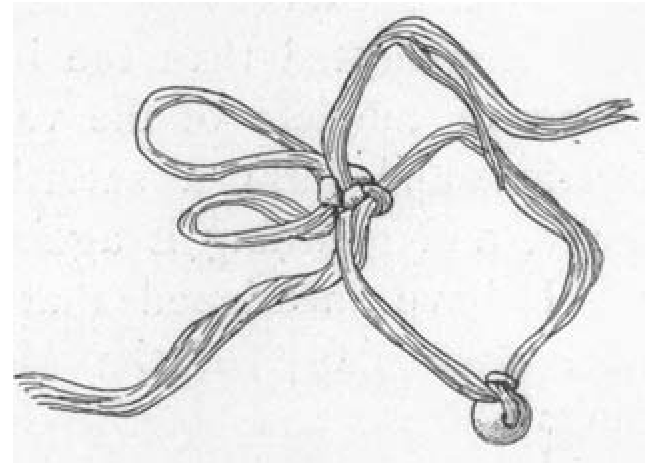
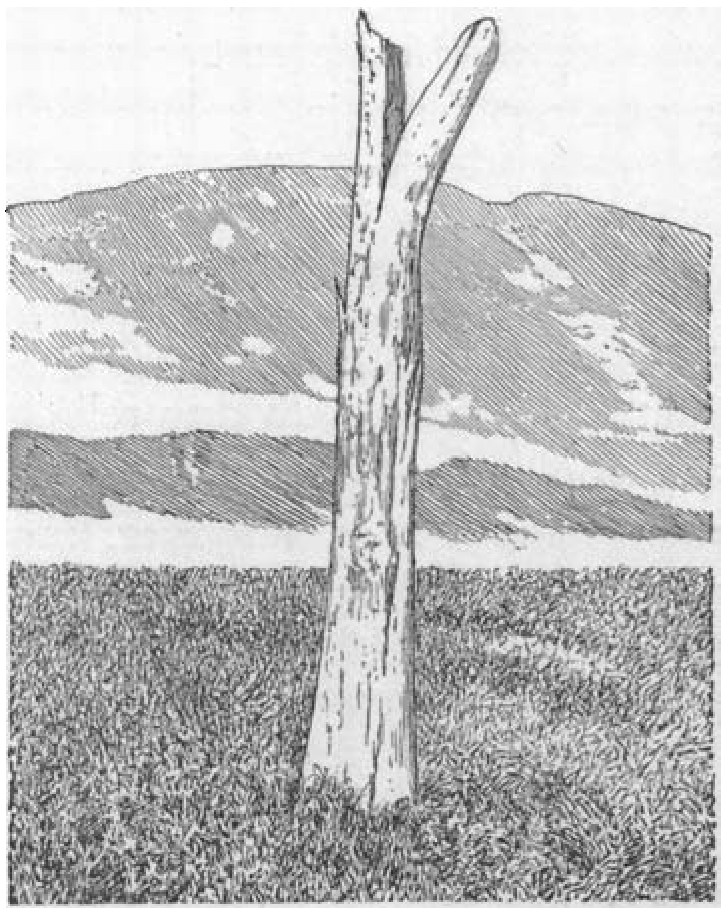
A bead which has become a charm may be put in a tiny bag, and[347]🗗uncollated worn in place of a necklace. Sacrifices of beads strung on leather or thread are frequently presented to “spirits” as expiatory offerings to ward off disease. On a big whale’s rib stuck into the ground, which represents the local deity in the village of Čeˊčin,¹ I found many such offerings (Fig. 245). Single beads strung on a thread are exchanged in concluding a bond of friendship between strangers. When I came to Indian Point, we concluded a bond of this character with the trader Kuvaˊr, and exchanged a coil of thong with a bead fastened at one end.
In taking anthropological measurements, we met with cases in which the people measured declared on the next morning that they felt ill. This was, of course, ascribed to our malevolent instruments. The affected party, to prevent more serious consequences, would usually ask for a bead strung on a piece of sinew, in order to make an expiatory sacrifice of it to the “spirits.” They could not tell, however, what particular kind of “spirits” it was necessary to appease, nor did they think it of any importance, if only he required sacrifice were performed.
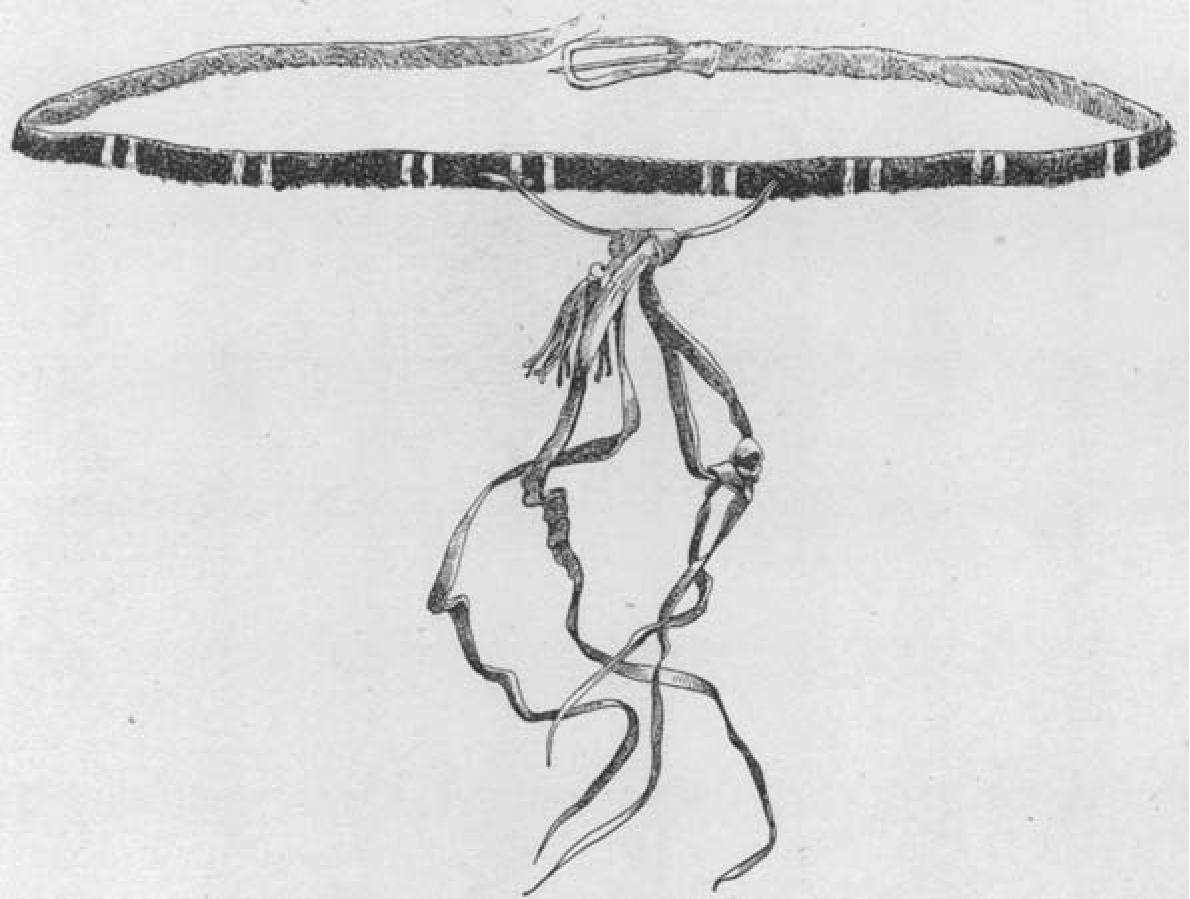
Some amulets consist of pieces of skin tied in various knots, without any likeness to living figures, as may be seen on the necklace of Fig. 190 (p. 258), and on the back of the belt, Fig. 176 (see p. 244). These knots are usually tied by a shaman, who imparts to them some of his magic power. They may, however, be fashioned by a man himself according to a shaman’s directions, or after orders received in a dream.
There are, however, persons who do not wear amulets at all. Some are forbidden by the “spirits” to avail themselves of this kind of protection. Others abstain from following the usage on the ground of philosophical reasoning. “I do not wear anything upon my body,” said such a person to me, “because I am convinced that protection by such small objects must be a mere delusion.” A shaman by the name of Scratching-Woman even went further, and declared that all sacred things made by man are good for nothing. He said that the fire-tool boards, strings of images, and dolls are of no real use. “Nothing created by man has any power. On the contrary, all power is in the deity, who created man himself and the objects of his hunt.”
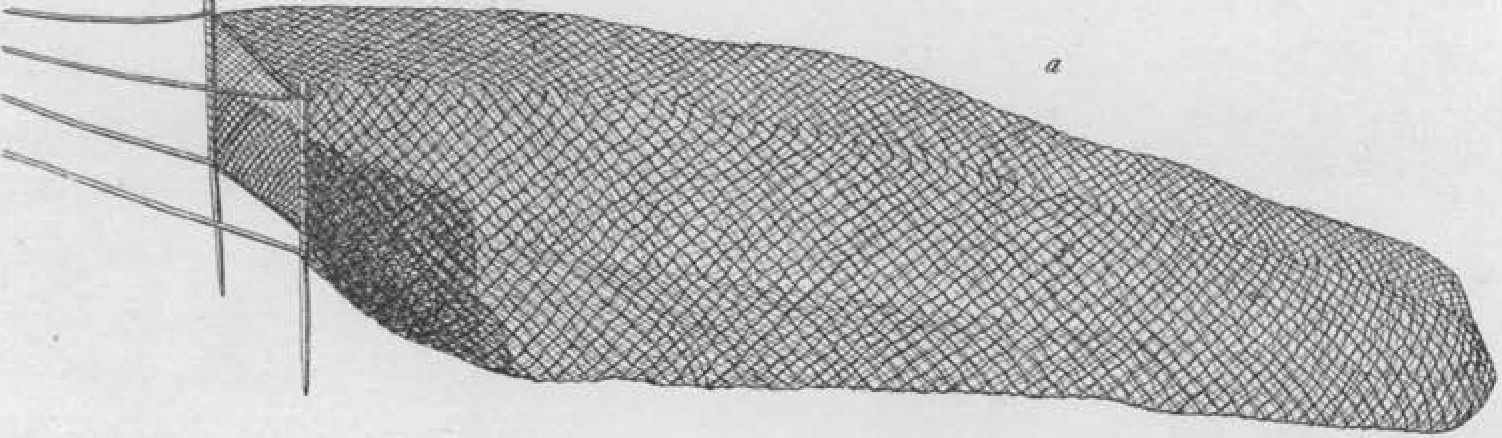
Amulets are also attached to the various implements used in fishing and hunting. Thus, wooden images of seals are fastened to a seal-net among its floats, for the purpose of drawing to it other seals and capturing them. Sometimes all the floats of a seal-net are in the form of such images.² At other times a gay-colored bead forms the amulet. The large bag-net represented on[348]🗗uncollated p. 149, Fig. 63, has an amulet like this strung on one of its meshes. Small pieces of red cloth or curried leather, roughly fashioned like human figures, are often attached to nets, fishing-tackle, rifles, and self-acting bows. They represent “assistants,” which were spoken of before.
FAMILY CHARMS OF THE REINDEER CHUKCHEE. — The family charms are more complicated than the individual ones, but we shall see that they consist chiefly of amulets of the various kinds described. These amulets are joined together and form a sacred object, protecting the material welfare of the family, and guarding it against attacks by evil spirits.
I have mentioned that the family charms of the Reindeer Chukchee differ from those of the Maritime people. The family charms and sacred things in use among the Reindeer Chukchee protect their material welfare, particularly in regard to whatever affects the herd.
Hearth. — The chief place among the sacred things of the household belongs to the hearth itself, to the fire of which a spark is added from each of the hereditary fire-tools at every ceremonial. Each family has a fire of its own, and interchange of fire is strictly prohibited. Families whose fires are derived from different lines of ancestors, even though living for years in the same camp, will carefully guard against any contact of their fires. To borrow a neighbor’s fire is held to be one of the greatest sins. If a camp is pitched on the spot formerly occupied by another family, the Chukchee woman, in order to start a new fire, will not avail herself of the coal or wood that was left. Even when camped on the treeless tundra, she will break up the sledges for fire-wood rather than take a single splinter bearing marks of an alien fire. Interchange of household utensils connected with the hearth — like kettles, dishes, lamps, receptacles for meat, etc. — is also strictly forbidden. It is even considered sinful to warm at one hearth a piece of cold meat which has been boiled at another. All these restrictions, however, refer only to the “genuine fire,” obtained for a native hearth by means of a wooden drill and the sacred fire-board.
On the other hand, the strike-a-light, sulphur-dish, and matches may be freely borrowed and interchanged, because they have nothing to do with the sacred family fire. A Chukchee woman will also take from a neighbor of her tribe a match, or flint and steel, because these have nothing to do with the sacred family fire; but she will not take willow tinder, because it is mixed with coal, and the coal was taken from the alien hearth. She will show the same aversion to the fire of the Reindeer Koryak, who also have sacred fire-tools; but she will not hesitate to borrow a firebrand or burning coals from a Russian or from a Lamut.¹
[349]🗗uncollatedDuring my travels I had much trouble with women on account of the fire. Many of them had no teakettles of their own, and yet refused to boil water in mine because it had stood by an alien hearth. Sometimes their scruples would give way at the prospect of drinking hot tea. In other cases we had to make a separate fire, and drink our tea outside of the tent.
Brothers, cousins, and relatives of male descent, while living in the same camp, or at least in the same neighborhood, may freely interchange fire. If one of them has moved to a distant country, his fire gradually becomes estranged from the primary hearth, because it consumes strange fuel, and inhales alien and unseemly odors. In this way, even brothers who have been separated for a long term of years may lose the right to interchange their fires.
When there are two or more fires of different family descent in the same camp, a community fire may result, if the children playing together should happen to mix one fire with another. The respective families will then bring a common sacrifice, and for the future will keep up a common fire. The community of related people who use fire from a common source are called “those having the same fire” (ᴇnnaˊn-yɪˊnlɪt). This term is equivalent to another one which designates kinship in the male line, — “old buck-fellow community” (kɪrñeˊ-tuˊmg̣ɪ-ret).
Most of the camps have a common fire because their inhabitants belong to related families. Difficulties regarding the fire arise in the camps of rich reindeer-breeders, who hire poor assistants (coming often from a quite distant country), and also among very poor families, who not infrequently are heedless of the ties of relationship when they join their herds together to watch them more effectually. Sometimes near relatives, even brothers, will sever their fire from the family fire. When a house has been visited by misfortune and the anger of “spirits,” — for instance, when many grown people or male children belonging to it have died. — it may suddenly be cast out from the community of fire. In this case the man who pronounces the protecting incantation¹ may cut off the fire of the stricken family during the funeral ceremony, so that others may not share in its bad fortune.²
The hearth is closely connected with the herd. The chief ceremonial of the year, held early in the fall, represents the meeting of hearth and herd after the summer’s separation. A large sacred fire is built, and the animals are driven to it from the leeward side, so that the breath of the fire may drive away the evil “spirits” that might come with the herd from the wilderness. For the same purpose, burning fire-brands are thrown against the reindeer.
Wooden Fire-Tool. — The most important sacred objects of the household connected with the hearth and the herd are wooden fire-tools, strings of family charms (taiˊñɪkut), and family drums.
[350]🗗uncollated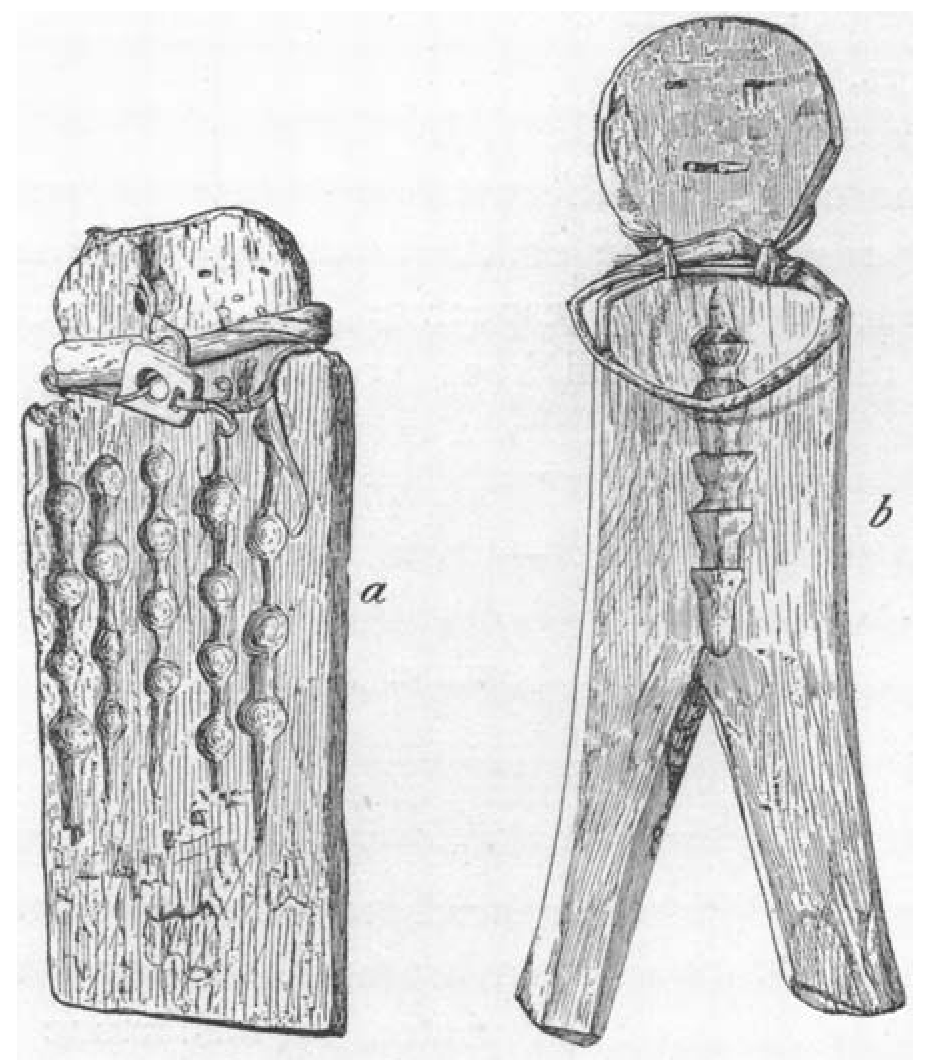

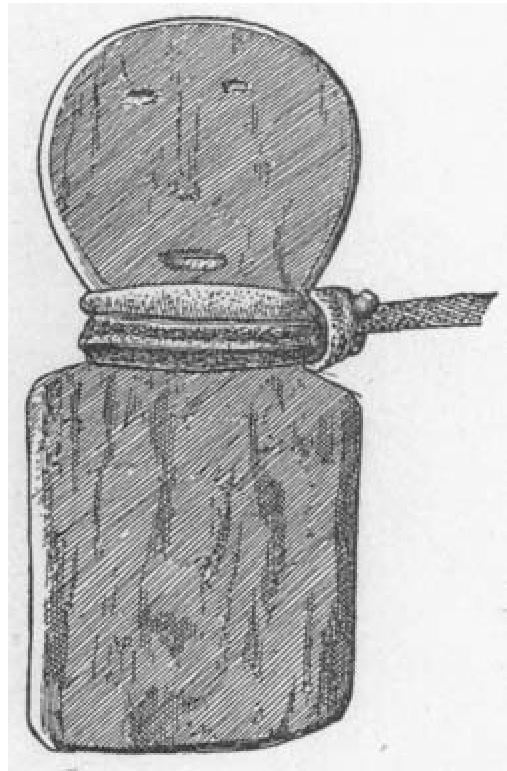
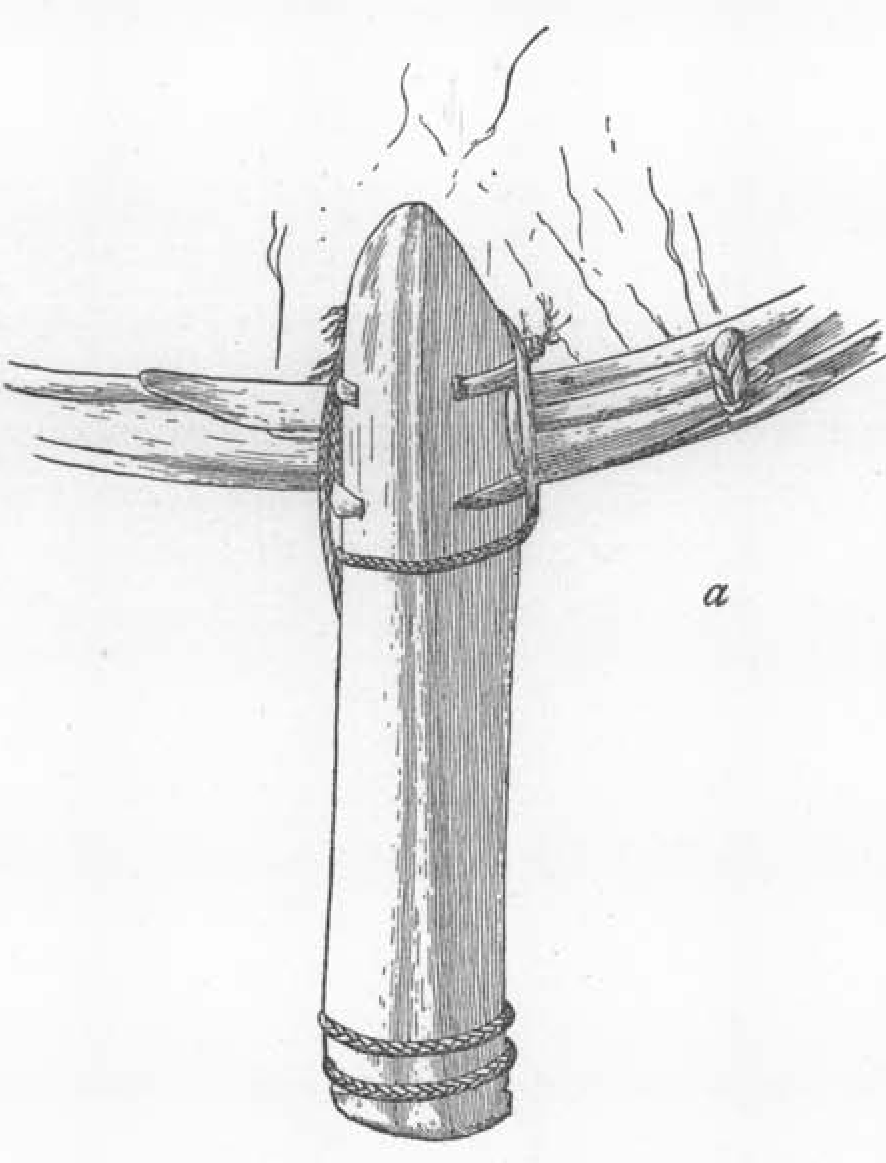
The wooden fire-tool has already been described. The board in which the drill revolves is roughly shaped into a human form. Usually it represents only a head and shoulders, though legs are sometimes added (Fig. 246). Eyes, nose, and mouth are indicated by cuts of appropriate form and position. At every sacrifice its mouth is greased with tallow or with the marrow of bones. This image is called “reindeer fire-tool” (in Chukchee, g̣ɪˊrg̣ɪr, pl., g̣iˊrg̣itti; in Koryak, g̣ɪˊčg̣ɪč; and also qaˊa-mêˊlhɪmêl), indicating its direct connection with the herd. The holes made by drilling are considered the eyes of the fire-board; and the squeaking noise produced by the drilling, its voice. In those camps where the wooden fire-tool is still daily employed for lighting fires, the sacred fire-boards are often reserved for ceremonials, and for regular use a substitute is made (Fig. 247). Sometimes this is merely a board; in other cases it is given the shape of a human figure, and after several years’ use it is laid aside with other fire-boards. Its sacredness is derived from its daily connection with the fire of the hearth.
Many families have several fire-boards. Some of them are comparatively new; others, inherited from preceding generations, are often quite ancient. Each is associated with the ownership of a certain portion of the herd, marked with its own brand. These brands pass with the sacred fire-board from generation to generation. Each boy born to the family is given, when he is four or five[351]🗗uncollated years old, a fire-board and a reindeer brand from the family heirlooms. If the number of ancient fire-boards is insufficient, a new one is made and a new brand established, to be given to the son. If the forefathers were poor and the herd is beginning to increase, the owner, unwilling to unite the poor luck of his ancestors with his own prosperity, will make for his sons new fire-boards, and establish new brands for the reindeer. On the other hand, people who remain poor in reindeer do not keep all of their fire-boards, because it would be inconsistent with the lack of increase of the herd. Even those boards that are kept are assigned new functions.
One of the fire-boards, usually the most ancient, is considered the protector of the herd; another protects the hunting-pursuits; a third guards the sacrifices. Some families do not make new fire-boards for their children, even though the family has inherited but a few. Only when the family separates and the herd is divided between the heirs, when each portion must have at least one fire-board, do they make new ones.
In every case the oldest fire-board, and with it the oldest brand of the reindeer, and the house and its belongings, are assigned to one of the possible heirs, usually either to the oldest or to the youngest son. He is the principal heir, and is called “one with the principal fire-tool” (eˊun miˊlhɪlɪn), or “one with the fire-tool” (miˊlhɪlɪn). He takes a prominent part in slaughtering reindeer and offering sacrifices. His place in the sleeping-room is on the left-hand side.¹ The parents often move to the right-hand side, leaving the left-hand side to him, so that he may sleep there alone.
The Chukchee consider that the best time to destroy an antiquated or superfluous fire-board is in the spring, at the ceremonial of the antlers. Then the fire-board is burned in the ceremonial fire. Its head may be cut off and joined to the string of family charms; but oftener the fire-board is completely burned, and replaced in the string by a small wooden image (Fig. 248).
Fire-boards are supposed to actually keep guard over the herd. One tale relates that two wooden men without feet, who looked like fire-boards, came to a reindeer-breeder whose animals were very restive. The herdsman fed them with tallow. Before going to sleep, they said to the host, “If the herd becomes suddenly frightened and tries to run away, it would be better for you to waken us at once.” When they had spoken, the master asked, “How shall I waken you?” — “Take the bow,” they replied, “and turn the drill in one[352]🗗uncollated of our eyes. When the drill begins to sing, the herd will stand still, and then return to the house.”¹
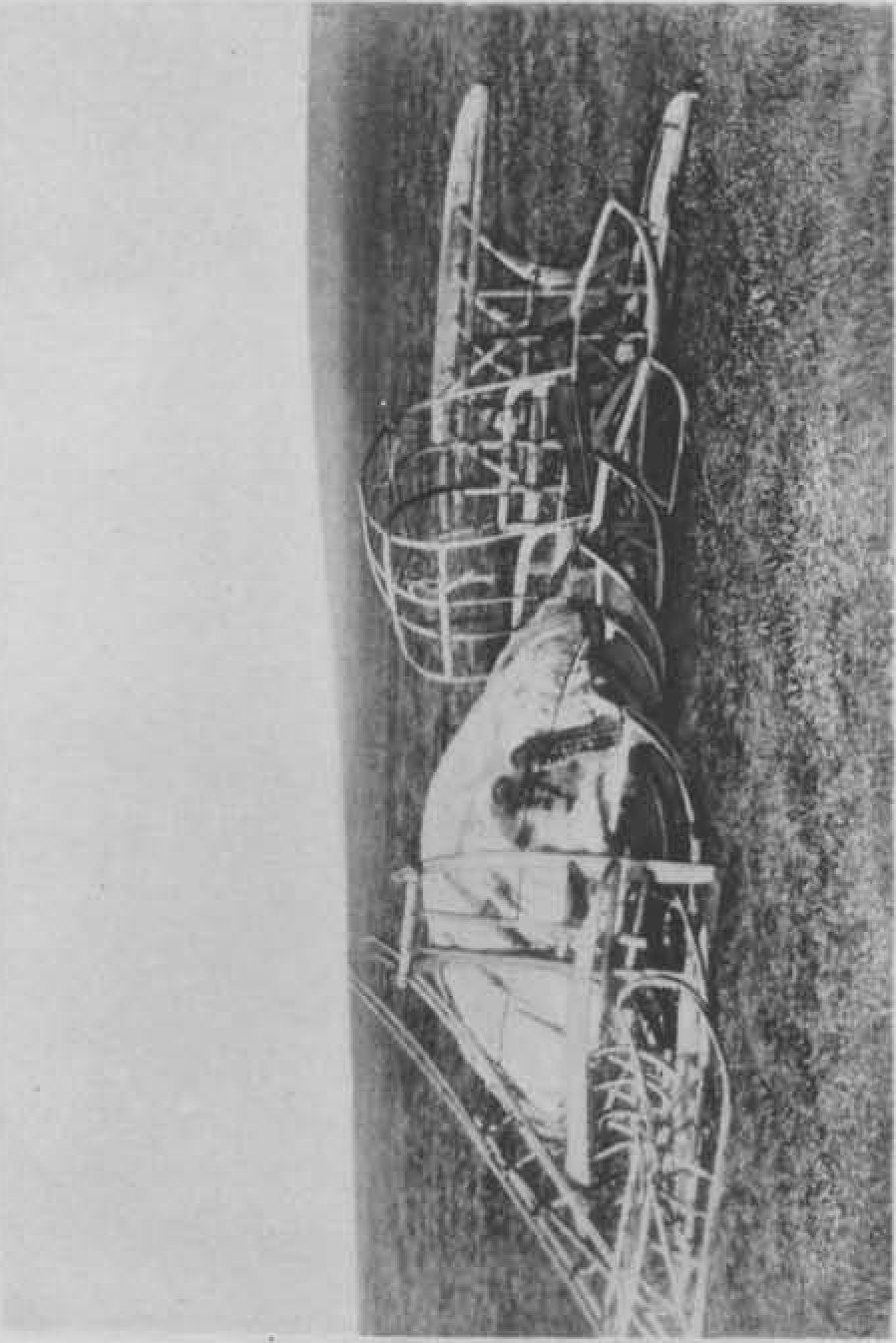
During the calving-season the fire-boards are taken from the bag in which they are kept and placed behind the frame in the outer tent, so that they may protect the calving dams. Pieces of sinew (see Fig. 246) are put around the necks of the fire-boards to represent lassos. Sometimes these are provided with small bone rings resembling those through which the rope of a regular lasso slips in forming the noose. If the herd is divided into two parts for fawning, a separate lasso is tied around the neck of every fire-board for each, part of the herd. During the ceremonial in the fall, these lassos are changed for new ones; but later in the winter they are taken off and burned in the fire. If a part of the herd goes astray, the owner will take out his fire-boards and request them to find the lost animals. Household property (extra tents, sledges, etc.) piled up out of doors may have a fire-board fastened to it in some conspicuous place, which will act as a “guardian.” Such a fire-board may be seen on Plate XXXII, Fig. 1.
When a new fire-board is made, a short ceremony is performed over it, which shows clearly that it is looked upon as a supernatural herdsman. The board is brought home and put behind the tent in the usual place of sacrifices. The master declares aloud, “I have brought a fire-tool man” (melhaˊᵋ-laˊul). Then a reindeer is killed and the fire-board is smeared with blood, though usually fire-boards are smeared only with tallow or bone-marrow.
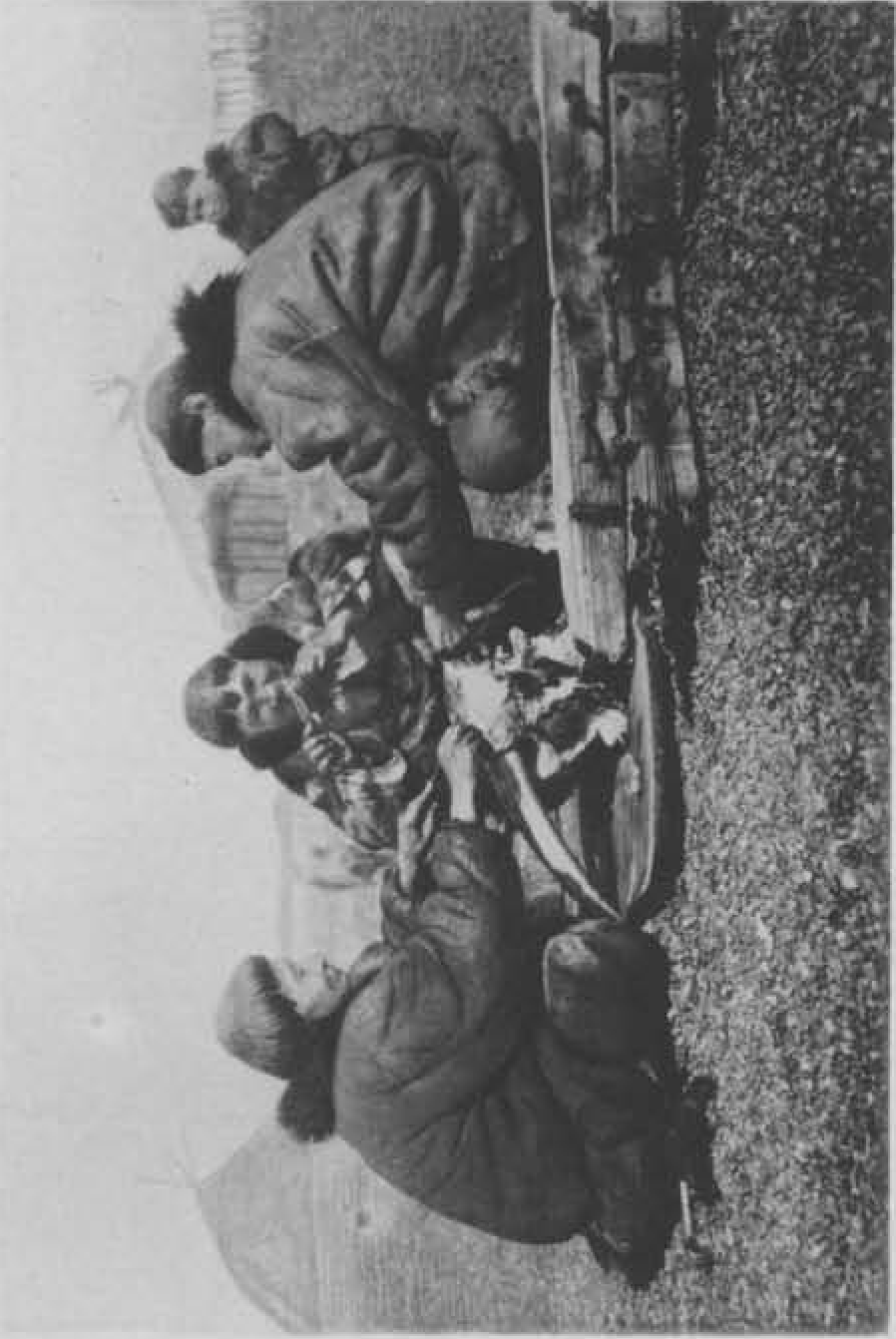
While smearing it with blood, the master says to it, “Enough! Take up your abode here!” Then other fire-boards are brought to the same place and set side by side on the ground. The master says, “Ho! These are your companions. See that I always find easily every kind of game!” Then he slaughters another reindeer and says, “Hi! Since you are one of my assistants (literally, ‘one of my young men’), go and drive the herd hither.” After a little while he asks him, “Have you brought it?” and he himself answers, “I have.” — “Then catch some reindeer![353]🗗uncollated It seems that you will keep a good watch over the herd. There, from the actual chief of the fire-boards, you may learn wisdom.” This short dialogue is a good example of the dramatized incantations of the Chukchee.
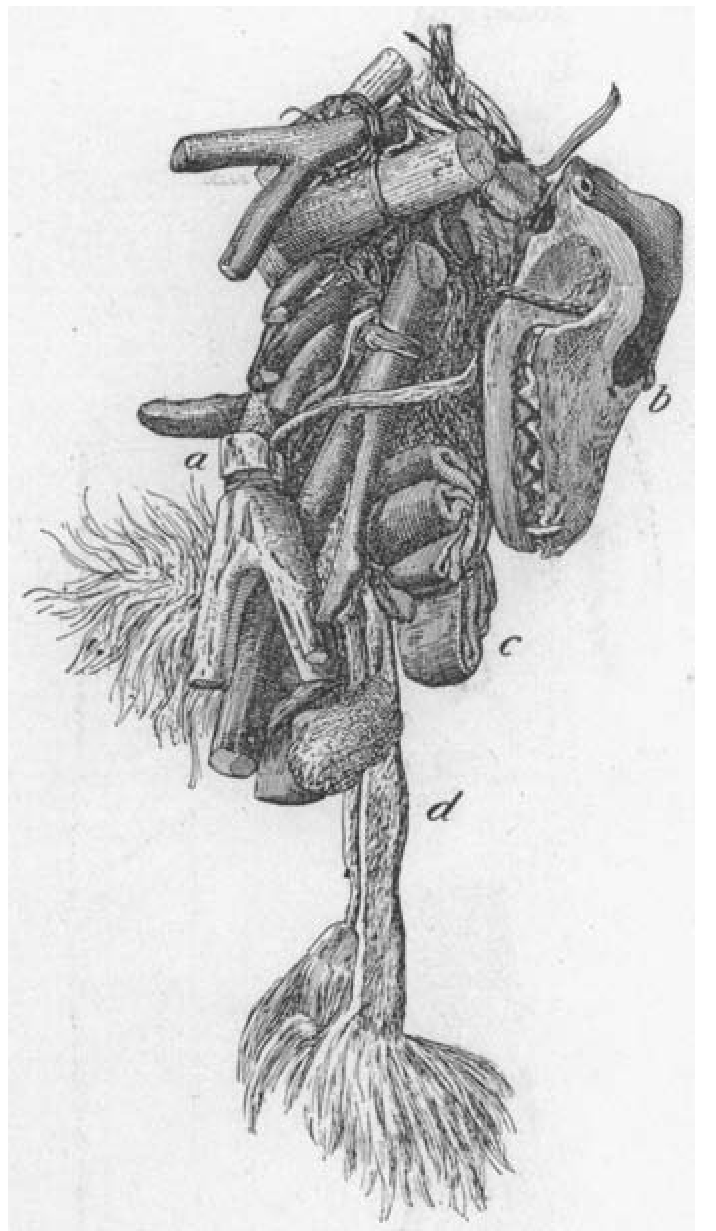
Charm-Strings. — The family charms (Fig. 249, see also Fig. 237) tied on strings are called taiˊñɪkut (sing., taiˊñɪkulhɪn, which, however, is rarely used). This word means literally “misfortune-protectors.” The common string includes articles of a heterogeneous nature. In my opinion the charms are tied together simply to guard against possible loss during the multitudinous travels of the family.
The greater part of the string of charms is taken up with simple wooden images which are used singly as amulets, and which were described above as “wooden spirits.” When tied on a family string, these wooden images are meant to be the protectors of the reindeer-herd, and in this sense they are called “masters of reindeer” (qaaˊkên êtɪˊnvɪt).
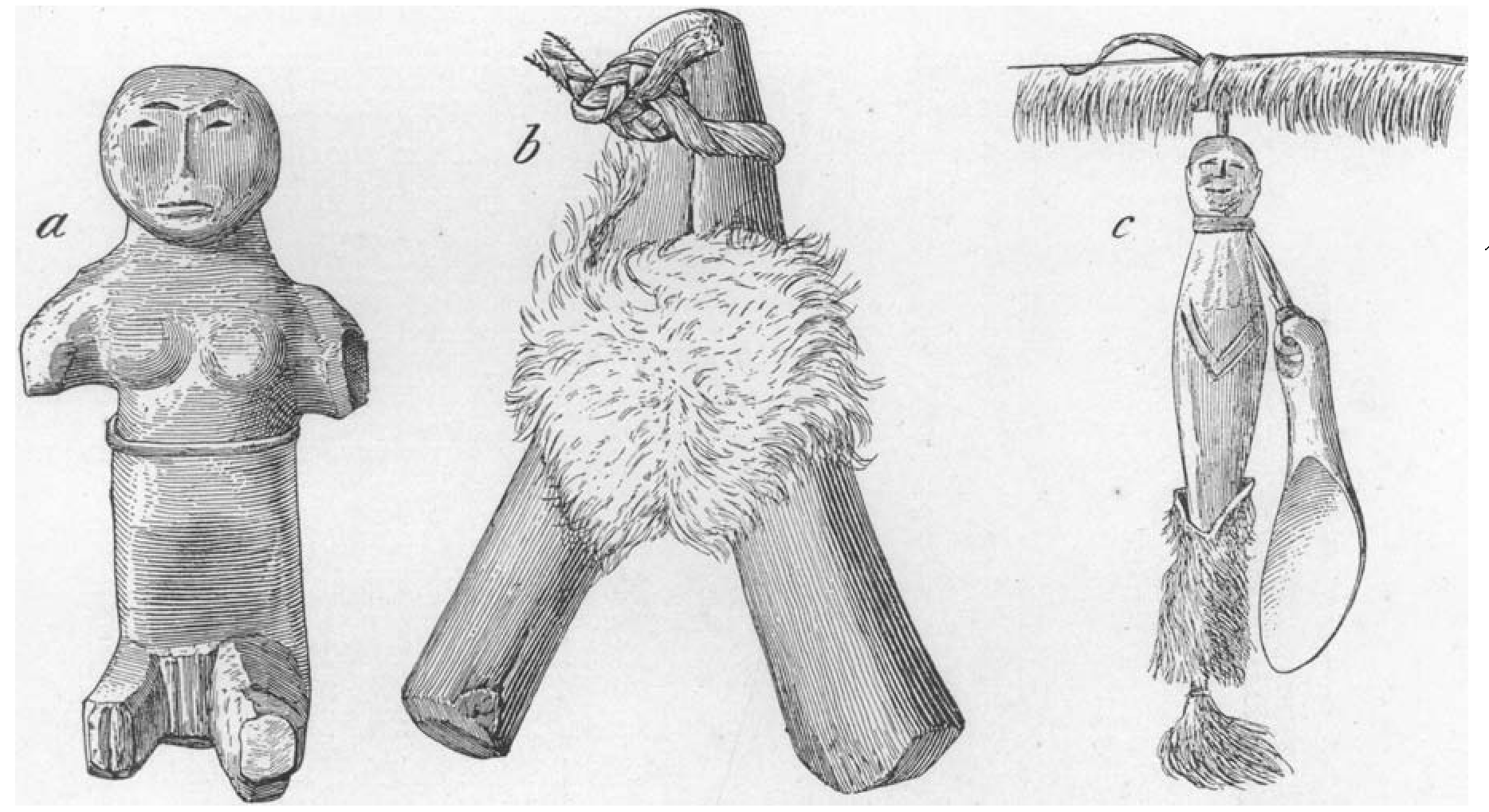
The tale alluded to before¹ goes on to tell that the fire-tool men created several herdsmen, and sent them to watch the herd. The next morning the herdsmen vanished, and in their stead a string of charms was left. The number of wooden images corresponded to the number of herdsmen.
Another episode often occurring in the tales is that of a young man, who, desiring to create herdsmen for his reindeer, kicked a number of dry boughs lying on the ground among the bushes. Some of these branches then turned to herdsmen. This probably refers to the same idea.
[354]🗗uncollatedThe number of wooden images in a set varies from a few to a score or two. New images are cut every spring from willow-branches used in the ceremonial of the antlers. Sometimes five, or even ten, are made at once, especially when the family is about to divide the herd and the household amulets. Each party returning from a hunting or trading expedition brings with it at least one bough from the forest of the country it visited. Figures cut from these are added to the other images. If there are too many charm-strings, some of the old ones are burned during the ceremonial of the antlers.
There are also special images on the charm-strings. One of these is the “wooden woman” (uˊttɪ-ñew), also called “mistress” (ñew-eˊrmečɪn). This is a wooden figure having some indication of her sex, or often simply a forked bough wrapped in a piece of skin which represents the skin dress (Fig. 250).
Fig. 250, c, is a wooden woman with a human face and the body of a seal. She has a skin wrapping and a ladle for receiving sacrifices. Small sacrificing-vessels are attached to several other images. This female figure was also considered the chief “mistress” of the house and the protectress of the herd.
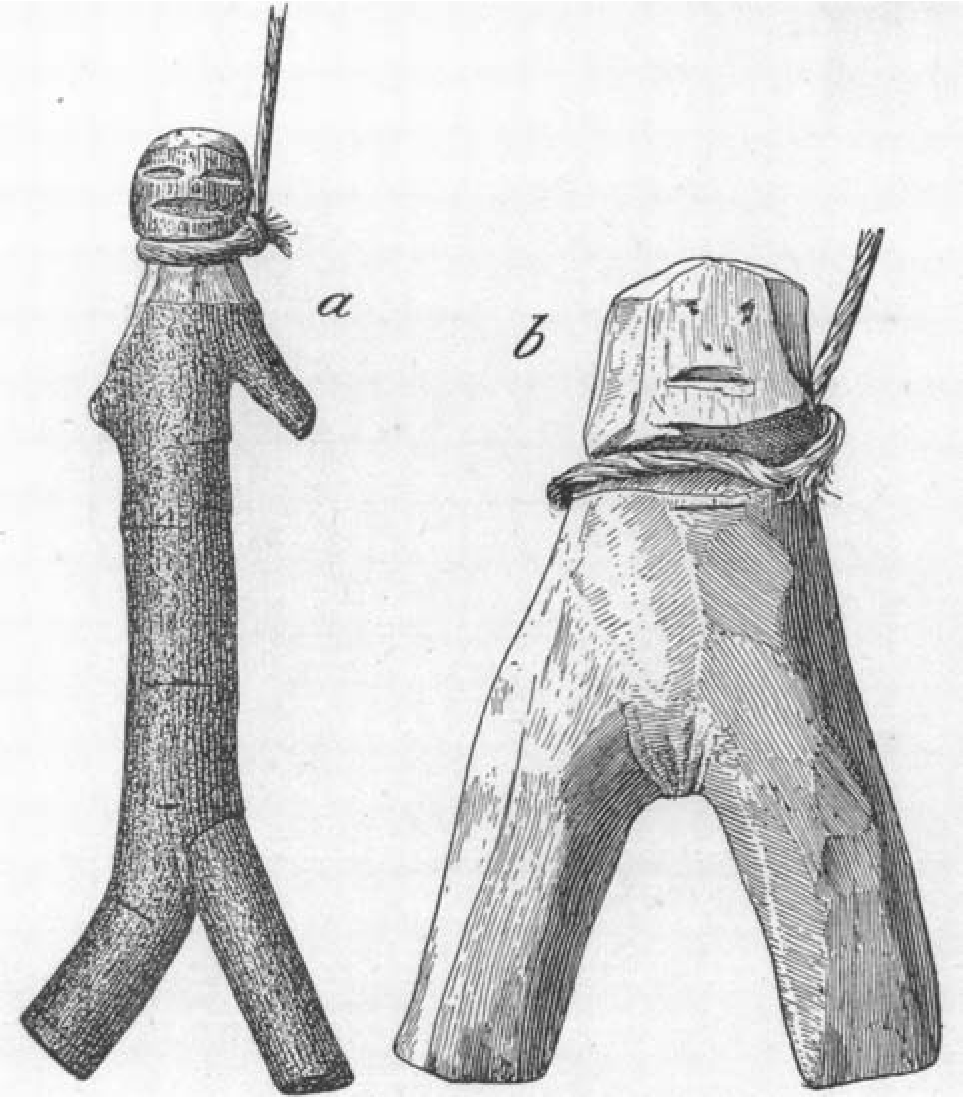
Another special image is the “wooden man” (ottaˊᵋ-laˊul or ott-oraˊwêʟ̣an). This is a human figure made of wood, and regarded as the husband of the “wooden woman.” It is always without clothes. The shape of the figure varies according to the fancy of its maker. Sometimes it is only a head, and is called “wooden head” (uˊttɪ-leˊut). In other cases a forked branch is furnished with a rough face, and is then supposed to be the chief of the herd and the husband of the “mistress” (Fig. 251). Sometimes the “wooden man” and the “woman” are called kama-taˊhin and kama-ñaˊut,¹ in imitation of the most common of the Chukchee names. These mean “spirit-border” and “spirit-woman.”
Other figures on the charm-strings are considered children and relatives of the chief figures. Those wrapped, in skin are female; those not wrapped are male. The latter are the more numerous. All these figures taken[355]🗗uncollated together are called “men of the charm-strings” (taiˊñɪkut oraˊwêʟ̣at). Among the Reindeer people of the Kolyma I saw several times small wooden images of canoes fastened to the charm-strings. This is the more remarkable, as those people do not build canoes, and rarely buy them from the Russians, as they have but little opportunity to use them. The canoe-image of the charm-strings thus adds new proof to the conjecture that the maritime mode of life predominated in ancient times with the whole Chukchee tribe.
ᴇnaˊattê (pl. of ᴇnaˊal) are parts of the funeral clothes, which are taken from every grown member of the family shortly before the final ceremony, and added to the family string of charms. From the men’s clothing are taken their belts (see Fig. 237, c); from the women’s, narrow strips of the fur trimming of the collars (see Fig. 237, d). These pieces are wrapped or sewed together in a small parcel, and tied to the string. They also represent the chief masters of the herd, and are often more or less confounded with the wooden images. In connection with this, the charms are considered to represent more or less directly the ancestors of the family. As such they are called in common conversation “the ancient ones,” or even “the deceased ones.”
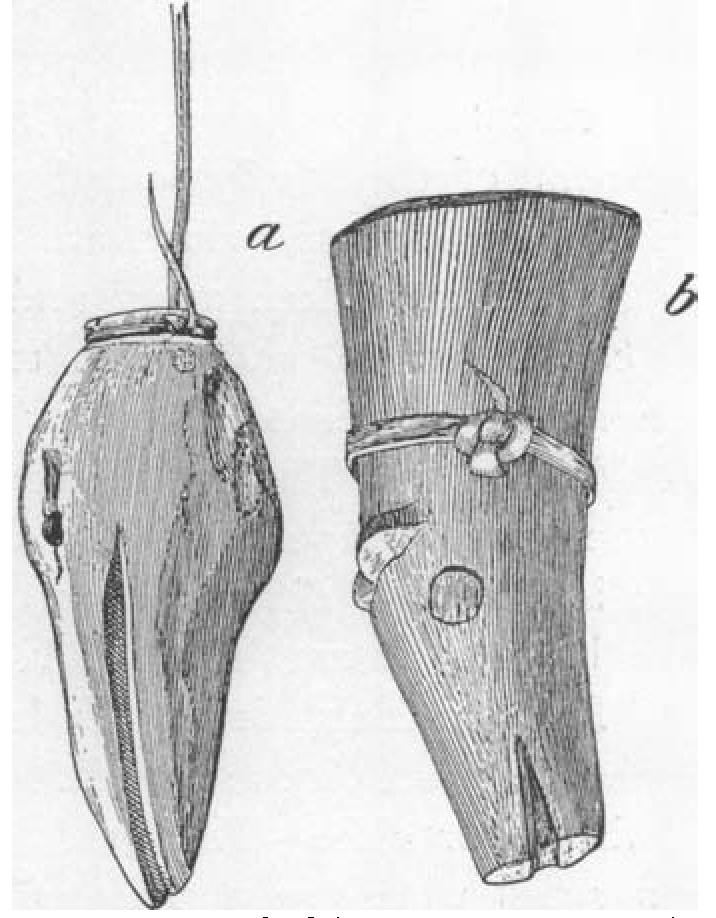
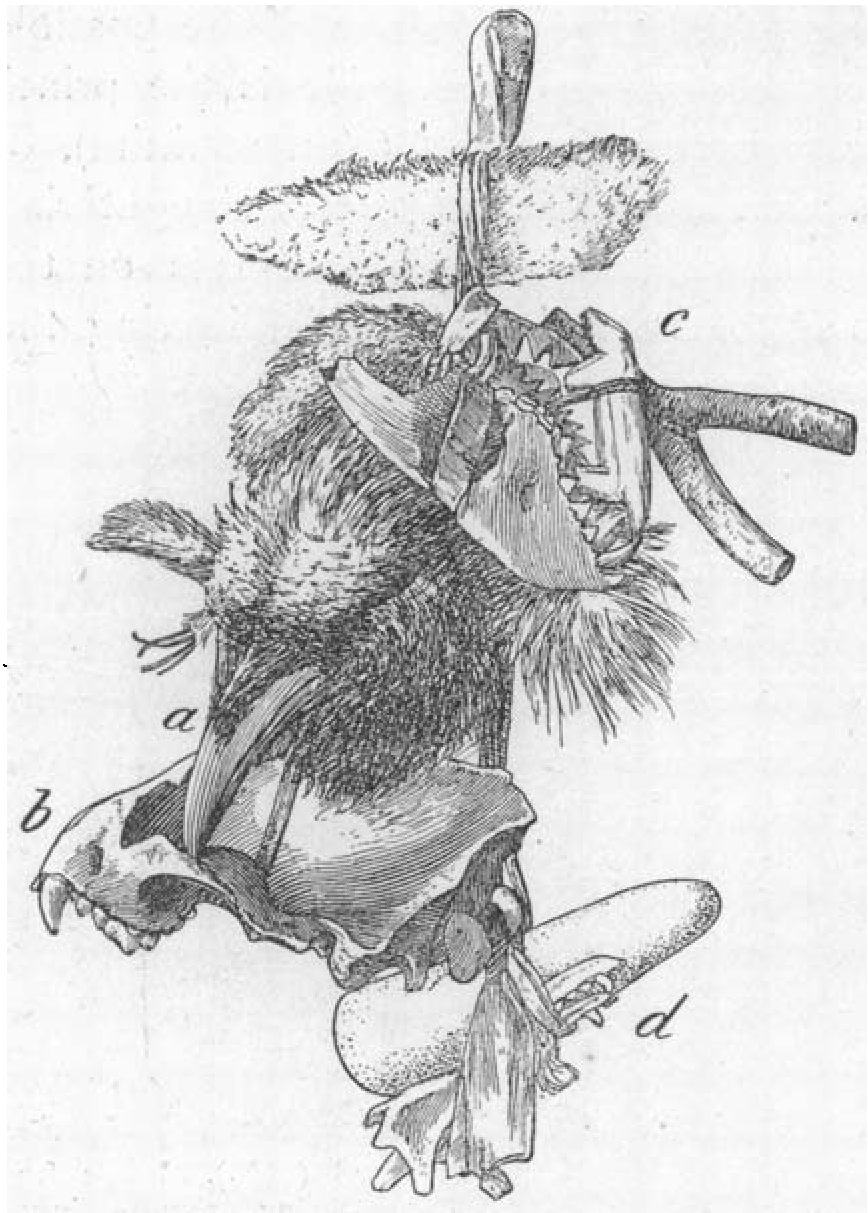
A raven’s head (veˊlvɪ-leˊut) is used in its natural form (see Fig. 249) or as a wooden image (Fig. 252, a). A wolf’s head (ᵉiᵋh-leˊut) is used only as a wooden image. The real skulls of the fox (see Figs. 237 b, 249 b), hare, and wolverene, are used, or they are represented by images. The image of the head of the polar bear is also employed (Fig. 252, b). Wooden dogs are found in the shape common among various other charms of the Chukchee (see Fig. 249, c).
Among the skulls, those of the white fox are the most numerous. Rarely are all of these skulls and images joined on the same set, and each string usually includes an assortment of the various forms. Details in the form of these private charms, as in the rites, depend with the Chukchee upon chance influences, such as dreams, the meeting of wild animals, or other prophetic signs, or the command of an old man or a shaman. These variations are in accord with the vague religious views of the Chukchee, which have not taken fixed forms, and indicate in general a primitive state of religious culture.
From sacrificed reindeer, especially from those which have a strange or misshapen feature, there is taken for this string of charms a piece of the skin[356]🗗uncollated from the head, with part of the velvet, or one of the dew-claws. Pieces of skin covering the nose are cut from fur animals or sea-mammals, and tied to the charm-string. Stones of strange form — for instance, those with a natural hole through them — are also tied to the string. Occasionally a curiously shaped piece of petrified wood or bone is added.
Taken in connection with the human-like images on the string, the raven’s head represents the “assistant” in the upper regions; the wolf’s head, the “assistant” on earth; the head of the fox, hare, wolverene, and polar bear, and the noses of their peltries, are charms for hunting these animals. Stones (see Fig. 249, d) represent the ground upon which the men of the charm-strings walk (teˊntin, “walking-ground”). Since the skulls of animals and stones are used for divining the future, those on the string are thought to be used for that purpose by the “men of the charm-string.”
A wooden image of a dog is supposed to represent the dog belonging to the chief master of the string of charms, and is used for hunting-purposes.
The part the charm-string plays in relation to the herd and the house is similar to that of the fire-boards. Both figure in all sacrifices and ceremonies. When the family want to separate, the charm-strings are cut into as many pieces as there are heirs, and a piece is given to each.
Occasionally, in times of disease, the fire-boards and the charm-strings are presented to the spirits as expiatory sacrifices. For this purpose all members of the family, one by one, shake their imaginary diseases down on their sacred objects, which are spread on the ground to receive them. Then the objects are taken away and left in the wilderness. By this act the family are considered to have given to the “spirits of disease” all the luck and protection they possessed, and they must collect new charms, which is to easily done.
Drum. — The drum used by the Reindeer and Maritime Chukchee is of the same shape and size as that employed by the Asiatic Eskimo. Its form is markedly different from the more southern type adopted in northeastern Asia by the Yakut, Tungus, Koryak, Kamchadal, and Yukaghir.
The southern drum¹ is large, somewhat oval in shape, and has a grip formed by four loose bands. These are fastened to the hoop of the drum on the inner side. The other ends meet in the middle, where they are tied to a small wheel or a cross, which is without other support. When the grip is grasped by the hand, the drum hangs loosely, and it may be shaken and its position changed at will. The drum-stick is made of wood, and covered with skin or with curried leather.

The Chukchee drum (Fig. 253) is similar to that of the American Eskimo.² It has a wooden handle, which is fastened with sinew lashings to the wooden hoop. The diameter of the hoop is from forty to fifty centimetres; breadth of the rim, four centimetres. It is nearly circular in shape.[357]🗗uncollated The head is made of very thin skin, usually the dried skin of a walrus-stomach. The curried skin of a young fawn is often used by the Reindeer Chukchee of the interior, but it is not considered as good. To fasten the skin, it is moistened with water or urine, and the edge is then tied with sinew cord in a circular groove at the outer surface of the hoop. The ends of this cord are fastened to the handle. The drum is very light, some specimens weighing not more than half a pound, and others weighing from a pound to a pound and a half.
The drum-stick varies with the use to which the instrument is put. It is either a narrow, light strip of whalebone¹ from thirty to forty centimetres long, or a piece of wood (Fig. 253, b) from sixty to seventy centimetres long, which is sometimes adorned with fur tassels. The former is used in magical performances, when the drum is beaten inside of the sleeping-room; the latter, chiefly in ceremonials, when the drum is beaten in the outer tent.
When the whalebone stick is used, the drum is held in the left hand, and the drummer so strikes with the stick that the middle of it hits the rim of the drum or the knuckles of the hand holding the drum. The end of the stick thus vibrates lightly against the drum-head. In using a wooden drum-stick, the drum is held horizontally, with the cover upwards. The stick is grasped in the middle; and the hoop is struck from beneath, first on one side, then on the other.
The Reindeer Chukchee keep the cover on the drum only when they stay in the winter house. The drum is then usually placed behind the frame of the sleeping-room; at other times, on its ceiling, ready for use whenever wanted. When the family is moving about, the cover is removed, folded,[358]🗗uncollated and tied to the hoop, near the handle. When thus taken apart, the drum is put away in the family bag. It is but little work to soak the drum-head and fasten it on, so that this is not done until just before the drum is wanted. During the season of ceremonials the drum is hung on the frame of the outer tent, ready for use. It is placed near the fire-board, because it plays an important rôle in the performance.
With the Kolyma Chukchee the drum is considered of less importance than the fire-board and charm-string. On the Pacific side the reverse is true. There the drum is called the “voice of the hearth,” and it is more difficult to obtain a drum which has been in use than to get a fire-board.
In the Kolyma and Anadyr countries, drums belonging to strange families may be brought at least into the outer tent, and there played upon. At the season of great ceremonials, as many as ten drums are sometimes beaten at once in the same tent.
House. — The covering of the house and the sleeping-room, the poles of the frame, the bedding and the pillow-bags, and the sledges on which these things are carried, — all are considered to belong to the hearth. They pass on to the heirs with the fire-boards and charm-strings, and with the latter are divided among the relatives.
When building a new tent, one man goes out into the woods and cuts the three principal poles. After fastening them together and bringing them home, he kills a reindeer and smears the poles with the blood of the sacrifice. Every year the poles receive a further sacrifice in midsummer, as will be described later.
The house with its belongings, the hearth with the fire-tools, and other sacred objects, are thus all regarded as a unit. It is not very sinful to part with some of these things (the Chukchee will sell, for example, a part of the tent-covering to the Russians, or even give away charm-strings to the spirits); but it is unpardonable to take any part of the home unit belonging to a stranger, and use it in one’s own house. For this reason, though I was able to procure (but not without some difficulty) a few fire-tools and charm-strings, on bringing them into the tent which was my shelter for the night, I invariably had trouble with the Chukchee tent-owners, who were unwilling to have alien sacred things enter their dwelling. This peculiarity sometimes led to disagreeable consequences, as, for instance, in the episode described on p. 38. Sledges, however, may be used, provided they are not taken into the tent. If a tent-pole which some one has lost on the road is found, it may be used for fuel. No other part of the home unit can be used in any way. If a house is left without a male heir, nobody will touch it, and it is left to rot on the spot where it stands.
CARE OF SACRED OBJECTS. — All sacred objects of the household, as well as the house itself, are in the care of the women. The Reindeer Chukchee[359]🗗uncollated call the woman of the house the “hearth-keeper.” The women prepare the sacred objects for the ceremonial, feed them with tallow, etc.: consequently the women are more expert than the men in the details of ceremonials. Even the incantations and spells which are connected with household charms are better known by the women. The same is true, also, among the Maritime Chukchee and the Eskimo. An old man, one of the Eskimo at Indian Point, said to me, “It is a mistake to think that women are weaker than men in hunting-pursuits. The home incantations are stronger than those pronounced in the wilderness. In vain man walks around, searching; but those that sit by the lamp are really strong, for they know how to call the game to the shore.”
Among the Reindeer Chukchee, even the smallest house cannot be kept without a woman to attend to it. When a family is left without any woman, it folds up its house, and packs away the household things and the sacred objects until a female keeper of the hearth is secured by marriage.
When a woman marries into another family, she renounces her former hearth and house, and takes allegiance with those of her husband: therefore a daughter who marries into a strange family has no share in the property of her former household. Even when a house is left without any male heir, a married daughter has no right to the heritage, unless her husband and she renounce his house and acknowledge that of his father-in-law.
When a family has no male children, one of the daughters may be chosen to become the principal heir, the future possessor of the principal brand and fire-board, the permanent keeper of the family house. Then she also is called “the one with the principal fire-tool” (eˊun-miˊlhɪlɪn).¹ The mother turns over to her care all the sacred objects of the household, and in the ceremonies she plays the part of the principal heir and the female keeper of the hearth. Of course such a female heir will not be led in marriage out of her house. Her husband renounces his own hearth and house, and is adopted into her family. When a man has several wives, the oldest, who has the care of the household sacred things, is also called “one with fire-tool.”
If a male child is born to the family after a daughter has been elected principal heir, they may change places, and the boy become the heir. Even then the girl will be married in her own house, and her husband will be adopted.
Poor young men often apply for the position of herdsmen to rich reindeer-breeders who have many daughters. From this position they may marry into the family and be adopted. Their own house is often brought along, and kept by a mother or aunt. When the elder brother leaves, the house is then given over to a younger brother, who becomes the principal heir.
[360]🗗uncollated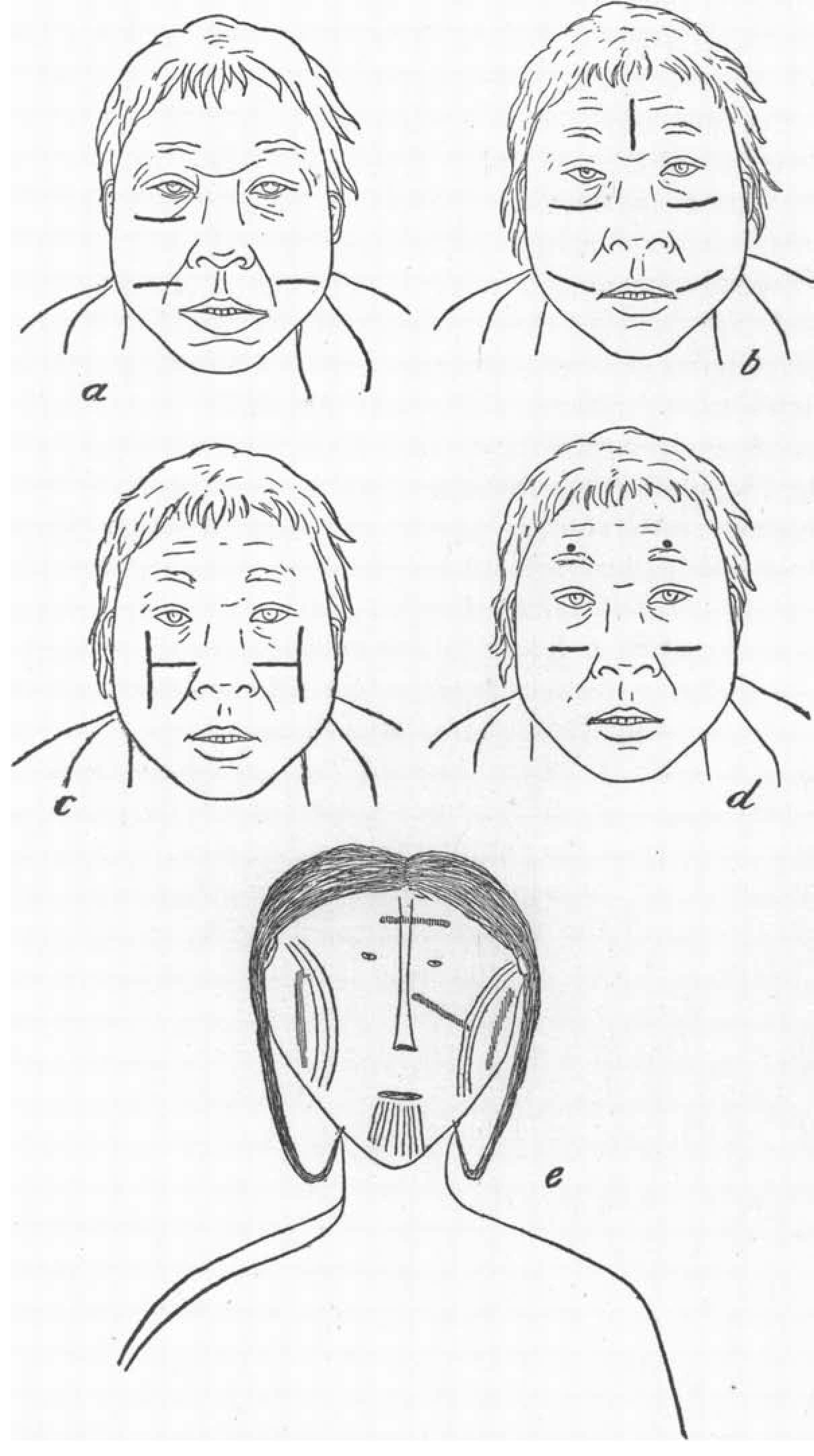
It may happen that two families — the one having a son, the other a daughter — agree to have their children marry when older. If no children are born afterwards, there is some dispute as to whose house shall be renounced. Sometimes one of the houses is actually forsaken, with everything belonging to it. Much more frequently the family that gives way finds some poor relative, male or female, secures a spouse for that person, and adopts the young couple as its future housekeepers.
PAINTING WITH BLOOD. — Special painted marks go with each set of sacred family objects. These are painted on the faces of all members of the family each year, during the fall ceremonial. A reindeer-fawn is slaughtered, and its blood is used for this purpose. The marks are quite simple, only a few lines or thick dots on the fore-head and cheeks (Fig. 254). They are meant to make the face similar to that of the spirit protecting reindeer-breeding (qoˊrên vaˊɪrg̣ɪn).¹ Dots over the eyes represent its eyes. Two[361]🗗uncollated dots or lines on the cheeks represent ears. Lines across the cheeks are meant to enlarge the mouth, because the spirit is large-mouthed. A native sketch (Fig. 254, e) also represents the face of a Reindeer Chukchee woman with blood-marks on it. The woman is tattooed. The marks on the sketch were made with real blood.
Every family has marks of its own, which, with the sacred objects of the household, pass to the children. When the family is divided, the identity of these marks is preserved for a couple of generations, but in course of time they gradually change.
No person may paint himself. The mistress of the house usually does the painting for the whole family, beginning with her husband. Then he in turn paints her. If several adult women belong to the same hearth, they usually paint one another. Argentoff says that the wife paints her husband and children on the forehead, breast, and soles of the feet, and afterwards is painted by her husband in the same way;¹ but I have never heard of painting any part of the body except the face. Mr. Jochelson, however, was told that the Reindeer Chukchee and the Reindeer Koryak of the Palpal Mountains paint forehead and abdomen during the ceremony.
The daughter who has been made the principal heir performs the ceremony instead of her mother. When the principal heir, — son or daughter, even though not at the age of maturity — is married and lives in the same tent with the parents, the latter often take no part in the ceremony. Then the painting is performed by the young mistress, though she may be no more than ten years old.
Painting with the blood of the sacrifice is symbolical of the membership of all members of the family in the same hearth. For this reason it is an essential part of the marriage ceremony. A fawn is killed as usual; and the bridal pair, with at least one female member of the family, perform the ceremony of painting. The woman paints the bride and groom, and then she is painted by the groom. The same ceremony is gone through in the case of adoption.
When two men enter into a bond of brotherhood and companionship in marriage, as is often done among the Chukchee, the act is sometimes accompanied by a double painting ceremony. This is performed in the house of each party in turn. It signifies that from that time forth their hearths are united. Carrying this idea still further, the ceremony is accompanied by a free interchange of fire.
SONGS. — In connection with sets of charms and painted marks, each family has special songs, or rather tunes, which are used during the ceremonials. Part of these are hereditary, and therefore have been preserved for some time; but after a generation or two they change, or are crowded out by the tunes that each man composes for himself.
[362]🗗uncollatedCHARMS OF THE MARITIME CHUKCHEE. — On the whole, the charms of the Maritime Chukchee are quite similar to those of the Reindeer people. The differences discoverable are largely due to differences in their mode of life.
Family Charms. — In olden times, both the Maritime Chukchee and the Eskimo used the wooden fire-drill; but at present it is never used, even for ceremonial purposes. Nevertheless, the Maritime Chukchee guard against an interchange of fire, although the observance of this interdiction is more lax with them than it is among the Reindeer people, and in recent years it is neglected to a considerable degree. The bringing into the house of utensils or sacred images belonging to an “alien” house is likewise forbidden, as I had occasion to notice while making the collections for the Museum. Even while travelling in a skin boat it is reprehensible to take fire from an “alien” hearth, or to borrow kettles, because of the soot that covers them. So great is the value of skins and timber (the materials for house-building) among the Maritime people, in consequence of their scarcity, that a house the owner of which has died, leaving no direct heirs, is not left untouched, as is the case with the Reindeer people. Some distant relatives will surely come, tear down the house, and divide the spoils; but they will be careful not to set foot within the house while it is being demolished.
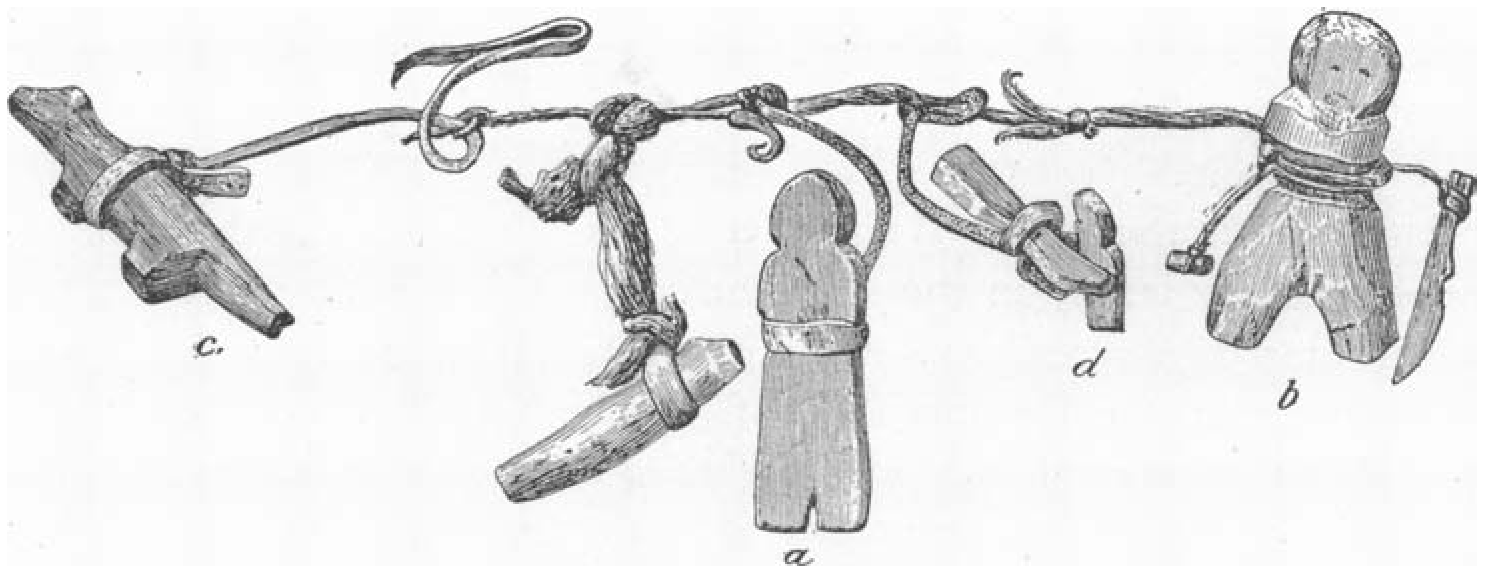
Many of the Maritime Chukchee also have the charm-strings (Fig. 255), but they do not attach the importance to them that the reindeer-breeders do. The images of their charm-strings, on the whole, are similar to those of the reindeer-breeders; but they are intended to help their owners in hunting-pursuits, not to protect their herds. These images are usually human figures roughly cut out of wood or curried leather, and similar to those previously described. Many of the charm-strings also have figures of dogs attached to them, which serve likewise for hunting-charms.
The human figures are called “guardians” or “assistants.”¹ Sometimes[363]🗗uncollated they represent the image of the Upper Being; at other times, the image of the Sea Being, though they are not identified with Kereˊtkun.
Among the symbols of game killed, there are to be found, besides the animals already mentioned, parts of the nose of the walrus, the skulls of various sea-birds (for example, of murres and eider-ducks), as well as their wooden images. Seals and other sea-animals are represented by images of wood.
The charm represented in Fig. 255 has two “guardians” (a, b), one of which is armed with a knife, a small dog (c), a small image of the fire-drill board (d), and two pieces of wood without any definite signification.
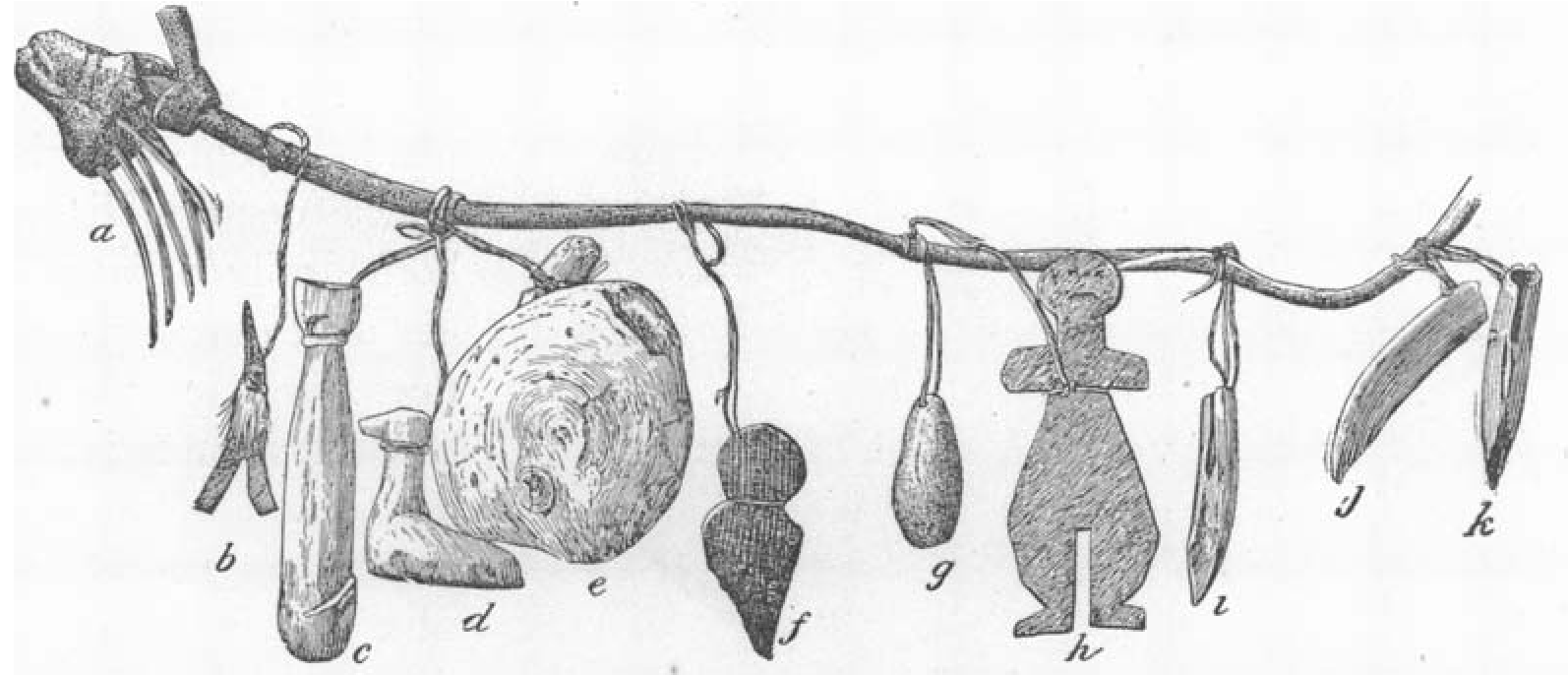
The charm shown in Fig. 256 contains a part of the upper lip of a walrus (a), a rough leathern image of a “guardian” (b), a wooden image of a sea-spirit with human head and the tail of a fish (c), a wooden bird (d), a round piece of wood representing a divining-tool (e), an image of the head of a fire-drill board charred in the fire to make the likeness more apparent (f), a piece of bone forming a divining-tool (g), a leathern image of a “guardian” (h), and three claws of a seal (i, j, k).
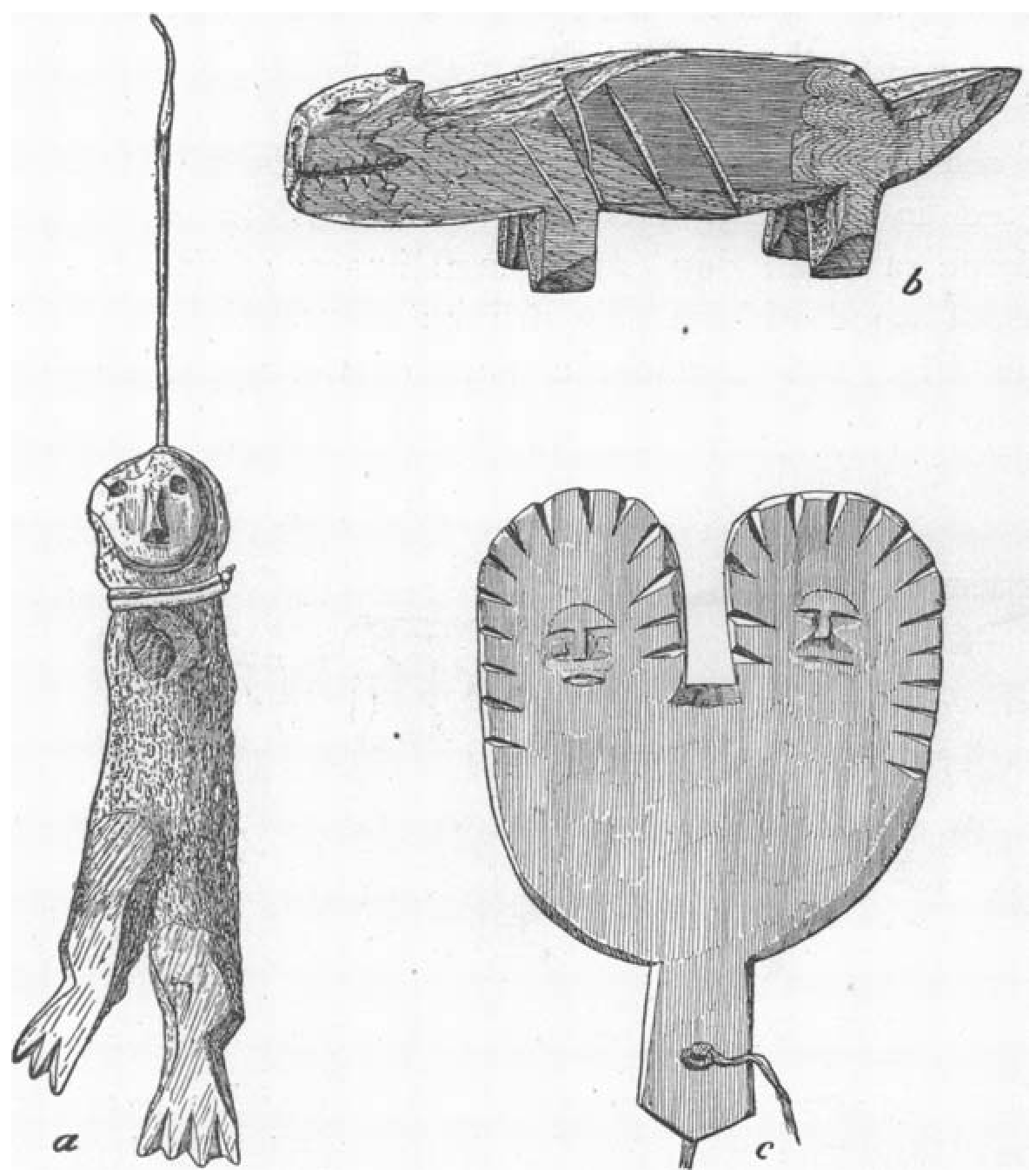
In Fig. 257, a and b represent an image of a sea-spirit and its dog, both parts of charm-strings; c shows a double-headed image which belonged to a charm-string of an inhabitant of Mariinsky Post, a sort of Chukchee blacksmith with very little skill. He told me that one of the heads represented himself, and the other his “assistant” in the blacksmith’s craft. This “assistant,” among other things, attended very carefully to securing prompt payment for the blacksmith’s work. In the case of slow payments, he punished both the workman and the customer. He was apparently jealous because his activity as “assistant” was slightingly treated: therefore he was angry with both parties. In one case, when the blacksmith failed to collect the fee for mending a kettle, the “assistant” became so angry, that while the blacksmith was at work he jumped into his left eye in the form of a red spark. As a result, the eye was seriously hurt, and the dilatory customer was soon afterward stricken with palsy.[364]🗗uncollated I bought the charm-string, with the image tied to it, from the blacksmith; but, after accepting the price, he said he would sleep over the absence of his charm, and see in his dreams during the first night whether the “assistant” was angry with him, over the transaction. The next morning, however, the blacksmith was taken suddenly ill with influenza, which at that time prevailed in the country, and within twenty-four hours he was dead. His neighbors firmly believed that his death was caused by the revengeful “assistant.” The above story is a good illustration of the way in which the Chukchee invent their own particular “assistants,” and of their ideas regarding them.
In some cases the “guardian” is represented simply by a head cut out of wood or leather (Fig. 258). A simple line even, roughly stitched or cut through a piece of leather, and representing the mouth, is sufficient for an image of a “guardian.” The mouth is considered the chief feature of the image, because it is needed for swallowing the sacrifice. Not infrequently the dog is represented by a small piece of wood or ivory with a head on each end (Fig. 259). The two heads are supposed to protect at the same time both the front and the rear. Sometimes the image of the “guardian” is also given two heads or two sets of hands for the same purpose.
Charms of the Boat. — Many of the families among the Maritime Chukchee have no charm-strings. Another form of charm, however, tied on a string, is found among the Maritime Chukchee and the Eskimo. Such charms are connected with the hunting of sea-mammals, and belong to the family boat. They consist of old worn-out harpoon-heads, a few worn-out tools used in the construction of the boat, a couple of heads of the large gull Larus argentatus, a divining-stone, and small pieces taken from various[365]🗗uncollated parts of a whale’s body and sewed in a small skin bag which has been used in a whale ceremonial. This string of charms is called yorêˊlhɪn. Its use is evidently founded on the same ideas as those on which the use of the family charms of the reindeer-breeders is based, with the important difference that objects referring to deceased ancestors do not form part of it.
Painting-Ceremony. — Among the Maritime Chukchee also, the painting-ceremony forms the chief part of the marriage-rite; but instead of blood they use red ochre. Those families who own a few reindeer in some friend’s camp perform the same painting with ochre during the time of the fall ceremonial of the Reindeer Chukchee. Sometimes, if many reindeer are owned by a family of Maritime people, a friend from the reindeer-breeders, after performing the ceremonial in his own camp, will come over with his herd as near to the Maritime village as he can without encountering danger from dogs in the vicinity. There he will kill the fawn required for the sacrifice, and then repeat the ceremony in company with his Maritime friends. This is done in order to secure for them a share of the good luck in reindeer-breeding which the owner of the larger herd has received. Even those of the Aiˊwan Eskimo who have reindeer perform the same ceremony carefully.
Both the Maritime Chukchee and the Asiatic Eskimo paint with red ochre as a safeguard against contagious diseases. This painting is not done regularly, but only when danger is feared. It is generally connected with the tossing on blankets, which is a sort of ceremonial with both tribes that will be described later. After the performance, the master of the house or a special shaman paints all those present. Various marks are used, but on the whole they are quite similar to those of the Reindeer Chukchee.
As a precaution against contagious diseases, we find also that the Reindeer and Maritime Chukchee, the Asiatic Eskimo, and even the inhabitants of the Diomede Islands and of certain parts of the American shore, paint their faces with graphite. They do this also when coming to a new country, to keep off the “ground-spirits,” or, if a visitor arrives at night, to ward off those “spirits” that might have come with him.
[366]🗗uncollatedSome of the Chukchee say that ochre comes from the vaˊɪrg̣ɪt, and graphite from the keˊlet. Thus, in one tale, a boy and a girl, coming home from a long journey, are painted, — the boy with ochre, and the girl with graphite. The former lives, but the latter dies.
The marks used by the Maritime Chukchee on these occasions are a simple combination of dots and lines, and are quite similar to those described as found among the Reindeer Chukchee.
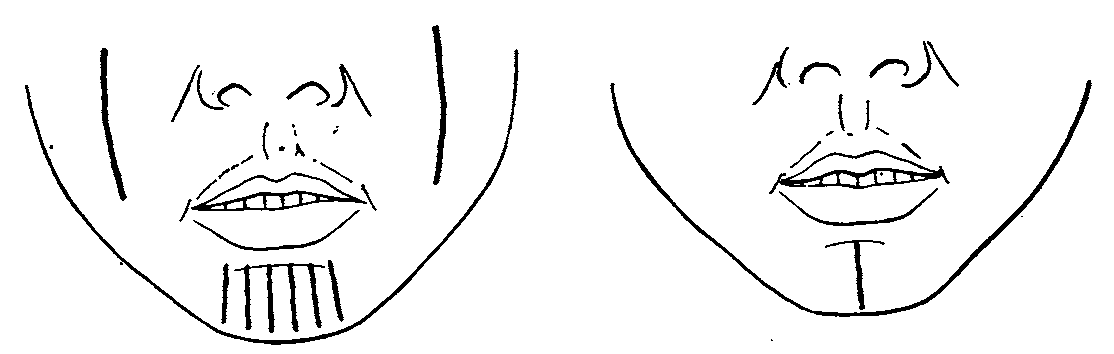
A sample of the marks made with graphite, and in use among the Asiatic Eskimo and the inhabitants of the Diomede Islands, is given in Fig. 260.
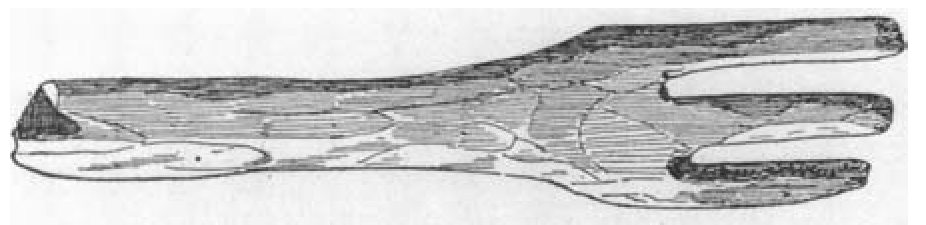
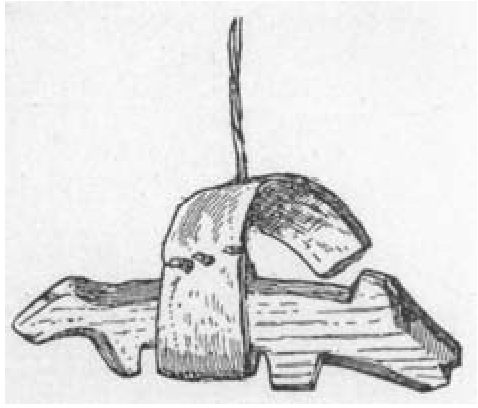
I must mention here a wooden model of a hand (Fig. 261), which I found in the Chukchee village of Chikayloa, on the Middle Anadyr. This image was used in various ceremonies, for throwing sacrifice into the fire. In several localities I was told of a similar custom among both the Maritime and the Reindeer people, but I had no other opportunity of seeing the image. So I think it must be nearly obsolete. The fact of its having been in existence is, however, important for comparison with the images of human hands, painted on cloth or on the skin of the human body, which are used by the Indian shamans of North America to indicate their alliance with the “spirits.” Recently Captain Comer brought to the Museum, from Iglulik, a village of the Central Eskimo on Fury and Hecla Strait, a shamanistic coat of somewhat peculiar appearance, which has, among other things, images of human hands in white reindeer-skin sewed on the skirts of the garment.¹
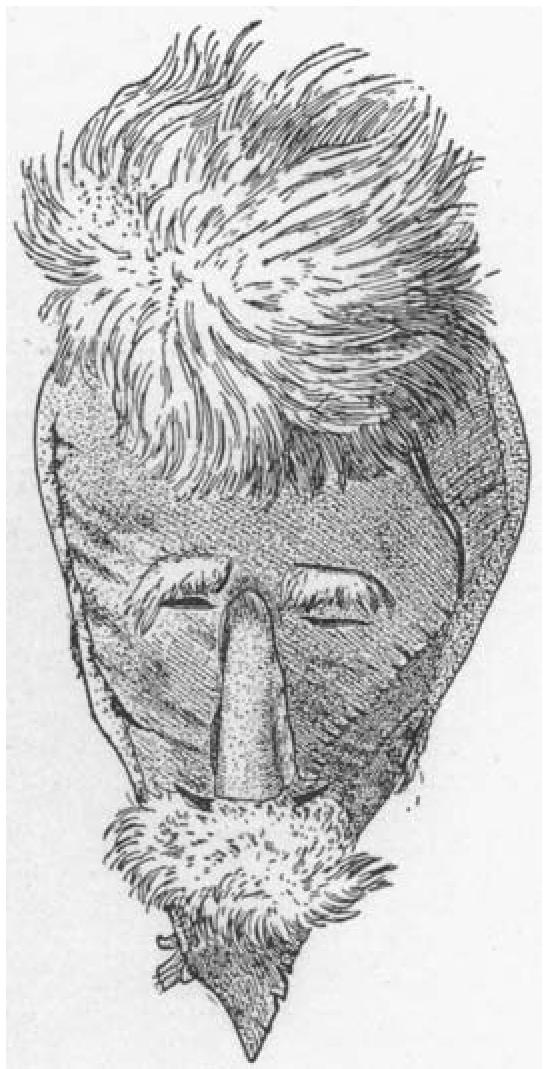
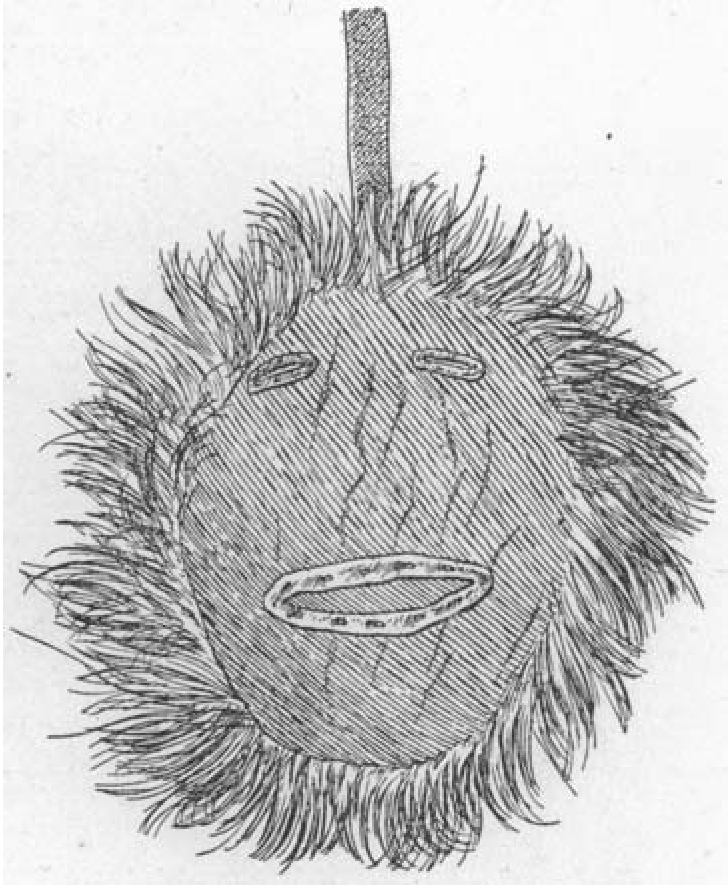
Masks. — I am not aware of any use of masks in the ceremonials of either the Chukchee or the Asiatic Eskimo. I found, indeed, among the Maritime Chukchee, a couple of masks made of reindeer-skin (Fig. 262), which were called “hairy face” (rɪnɪluˊᵋ), after the manner of the Koryak, who call their wooden masks, used in performances of a somewhat ceremonial character, “wooden face.” The “hairy faces” of the Chukchee, however, have no connection with their ceremonials, at least not at the present time. According to an explanation of their owners, such masks are simply used by mothers to frighten refractory children into obedience.² For this purpose the mother puts[367]🗗uncollated on the mask, and pretends to be a keˊlᴇ who has come to carry away the naughty child. I witnessed a scene in which a Chukchee woman tried to silence her rebellious and crying boy by a similar method. She pretended to be a keˊlᴇ, and howled like one possessed, and made frightful grimaces; but this was done without the use of a “hairy face.” (For a presentation of shamanistic performances during the thanksgiving ceremonial performed on killed game, see the next chapter.)
Dolls. — Some of the dolls with which the girls play are used also as charms to procure future fertility for their owners. Such dolls pass from mother to daughter, and are kept carefully patched and mended, so as to last for an indefinite time. The bride brings this doll to her new house, and keeps it in her bag. In due time she gives it to her oldest daughter to play with and to keep. When other daughters are born, a little stuffing is taken out of the hereditary doll and put into a new one, which is then supposed to possess all the qualities of the first doll. Dolls of this kind are usually shaped like new-born babies. Incantations are recited over them by each generation, so that their force is supposed to increase continually.¹
The peculiar feature of this kind of charm is, that it passes in the female line, and therefore continually changes from one family to another. The Chukchee women value such dolls highly. In the Kolyma country, when stopping for a night in a Chukchee tent, I bought an hereditary doll from the mistress. On the second day, after we had gone a long distance, the woman suddenly changed her mind and started to overtake us, so that she might return the price and recover her heirloom. She found us in a camp fifty miles from her home, and no persuasion could prevent her from annulling the bargain.