XIGames
ATHLETIC SPORTS. — The Chukchee are fond of all kinds of sports, and indulge in them whenever opportunity is offered. Many of their games are connected with religious ceremonials, as will be described later.
Among the Reindeer Chukchee the chief sport is reindeer-racing. Once a year almost every camp arranges a race. These races are held in circuits, so that the whole neighborhood can visit all in their vicinity. The principal man of the camp, who figures as the host of the race (ireˊlɪn), has to supply the prize, which varies from a couple of leaves of tobacco to a beaver-skin or a pack-sledge reindeer. The prize is tied to a tree-branch, which is stuck into the snow. For this reason it is called “the thing stuck in” (rɪˊpyo). The larger the prize, the greater will be the concourse of people at the race, and the longer the stretch to be covered by the contestants, sometimes ten miles and upwards.
There are no particular rules about starting the race. The participants gather in front of the prize in an irregular group. The host gives the signal, and all start off. While some keep to the road, others strike off through the deep snow, trying to intercept the leaders. The race is to a distant point and back again. Until the contestants are on the return stretch they spare their animals. The race begins in earnest on the way back, and becomes very exciting as they near the prize.
The onlookers are very enthusiastic, and meet the racers with encouraging cries or hootings. The winner snatches the prize, and the race is over. Often one or two minor prizes are also put up by other people of the camp. These are taken by the next comers in order. Sometimes there is also a small stake for the last comer, partly in derision, partly (according to a native saying) “to console him for his disgrace.” The host takes part in the race, but it is regarded as discourteous if he seriously tries to beat his guests out of the prize. If he comes in first, he will not touch the prize; or, if there is more than one prize, he will take the smallest, leaving the others for his guests.
The Chukchee are passionately fond of reindeer-racing. In the spring, which is the usual season for the sport, some of the young people undertake long journeys to try their reindeer against a possible rival. Doubtful races often lead to quarrels, and even to feuds. I had a chance to observe one of these in 1896 in the East Anui camps on the Wolverene River. Two rivals of several years standing met in a race. When one had almost reached the goal, one of his reindeer suddenly stumbled and fell, thus allowing the other man to capture the prize. A quarrel ensued; and the winner, who had the[265]🗗uncollated reputation of being a shaman, was accused of laming the reindeer by means of secret incantations. The quarrel was quieted down by the other guests. After two days the loser suddenly died. Of course, the other one was accused of using further incantations to kill his rival. He fled in the night to his native country, about five hundred miles away. Two brothers of the dead man followed his tracks in the morning, but were unable to overtake him. It was understood, however, that one of them would seek the supposed criminal the next fall in order to settle the blood score.
The Maritime Chukchee have races with dogs, or, in summer, with skin boats; but both are of little consequence compared with the racing-contests of reindeer-breeders. Chukchee dogs, as I have already mentioned, are of inferior quality. Paddling in skin boats is rather too irregular to allow a spirited contest for any long distance. The Russianized natives frequently arrange private dog-races, with a bet to be paid to the victor. In these races the contestants are allowed to use any means, fair or unfair, even to cutting the traces of their adversaries. The excitement approaches that in reindeer-races.
Foot-races and wrestling usually take place at the reindeer-race meets. The foot-race follows the reindeer contest, over the same track through the snow loosened by the hoofs of the deer. The race is always for a long distance, and often covers several miles. The participants remove their outer clothes, or else they take off their underclothes and wear the outer trousers and short boots without stockings. They carry staffs or sticks, which they rest on the ground to assist them in taking long steady strides.
The Chukchee are not so swift of foot as they are enduring, especially the members of the Reindeer division. I doubt if very many runners among civilized peoples could run several miles, through loose deep snow, wearing heavy fur clothing.
A fair amount of swiftness combined with endurance, however, is peculiar to all tribes of the area described. Some of the Chukchee herdsmen are able to overtake a reindeer-buck running at full speed, while the swiftest of the Lamut hunters claim to be able to keep up with a wild reindeer fleeing for its life. The Russianized Yukaghir of the Kolyma are able to keep pace with a swift-running dog-team for ten or fifteen miles. I saw one man run behind a dog-sledge for forty miles. At the end the dogs were only half an hour ahead of him.
On the spring journey of the chief official of the Kolyma from Nishne-Kolymsk to the Anui fair, the dog-driver is picked out from the best young men of the country. The journey is about two hundred and fifty versts (a hundred and sixty-six miles) long, and is usually covered in about twenty-two or twenty-four hours. The road has many difficulties, being full of long inclines and running through several clearings on the woody hills. The driver has almost no chance to sit down, and has to run all the time by the side of the[266]🗗uncollated swiftly driven sledge, keeping it from tipping over. After twenty-four hours of this painful exercise, the driver is often so tired, that, on reaching the place, he reels like one drunk, and has to be helped into the house.
Of two drivers who took part in the dog-race of 1869, which I mentioned before, the victor so impaired his health by the strain that he never recovered.
The young girls and women among the Chukchee have foot-races of their own, which they are as eager to win as the men. Often foot-races are run by boys, who compete with fellows of their own age.
Wrestling usually takes place after the foot-race, because the wrestlers strip naked to the waist, and they like to have their bodies heated by the previous exercise. If there is no foot-race, the wrestlers will run a couple of miles to get warmed up for their contests. While the couples are wrestling, the rest of the people sit or stand around to judge the matches. Sometimes two or three pairs wrestle at the same time. After stripping, the men, just before the contest, rub their bodies all over with snow.
The rules of the contest require that one man shall assume a posture of passive defence, and the other try to throw him. The first is called “motionless” (uˊlvɪlɪn); the second, “the attacking one” (viriˊtɪlɪn). If the latter proves unsuccessful, the positions are reversed. Finally there usually follows a rough-and-tumble scramble, in which each of the contestants tries every means to get the better of his adversary. Custom requires that one of the parties be made to touch the ground with both of his shoulders, and kept in this position in spite of his struggles. Three bouts are regarded as settling the match, but the vanquished one often desires to keep on trying his chances. Frequently he becomes greatly excited, and then a violent scuffle may ensue. The victor has to meet the winner of any other contests: but, lest he should become too tired, he will step back after a few matches and return in a half-hour or so to try his chance once more. This continues until the best man is determined, and he takes the stake if there is one. The passions are aroused quite enough, however, without stakes, so that prizes are seldom put up for this sport. Several Chukchee tales describe a peculiar wrestling-match that takes place on a spread walrus-skin, slippery with blubber and made dangerous by having sharp splinters of bone or wood stuck around its edge. Similar details are mentioned also in Eskimo and Indian tales.¹
A wrestling-match is the usual method of settling quarrels among the Chukchee. A man having a grudge against another one will either openly challenge him for a match or he will seek a chance to encounter him in a general contest. In either case, the match sometimes ends in bloodshed, or even death, if the spectators do not interfere in time.
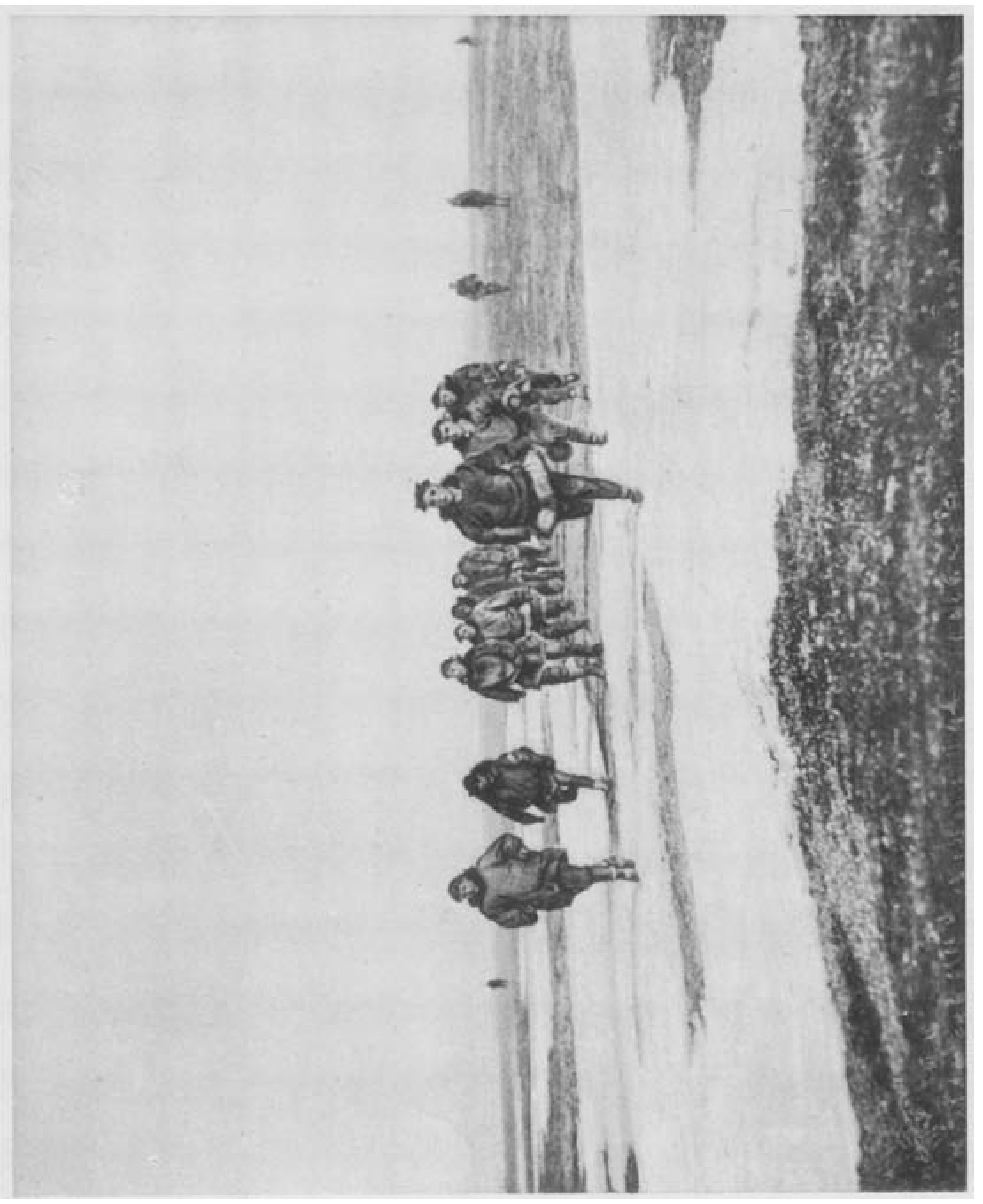
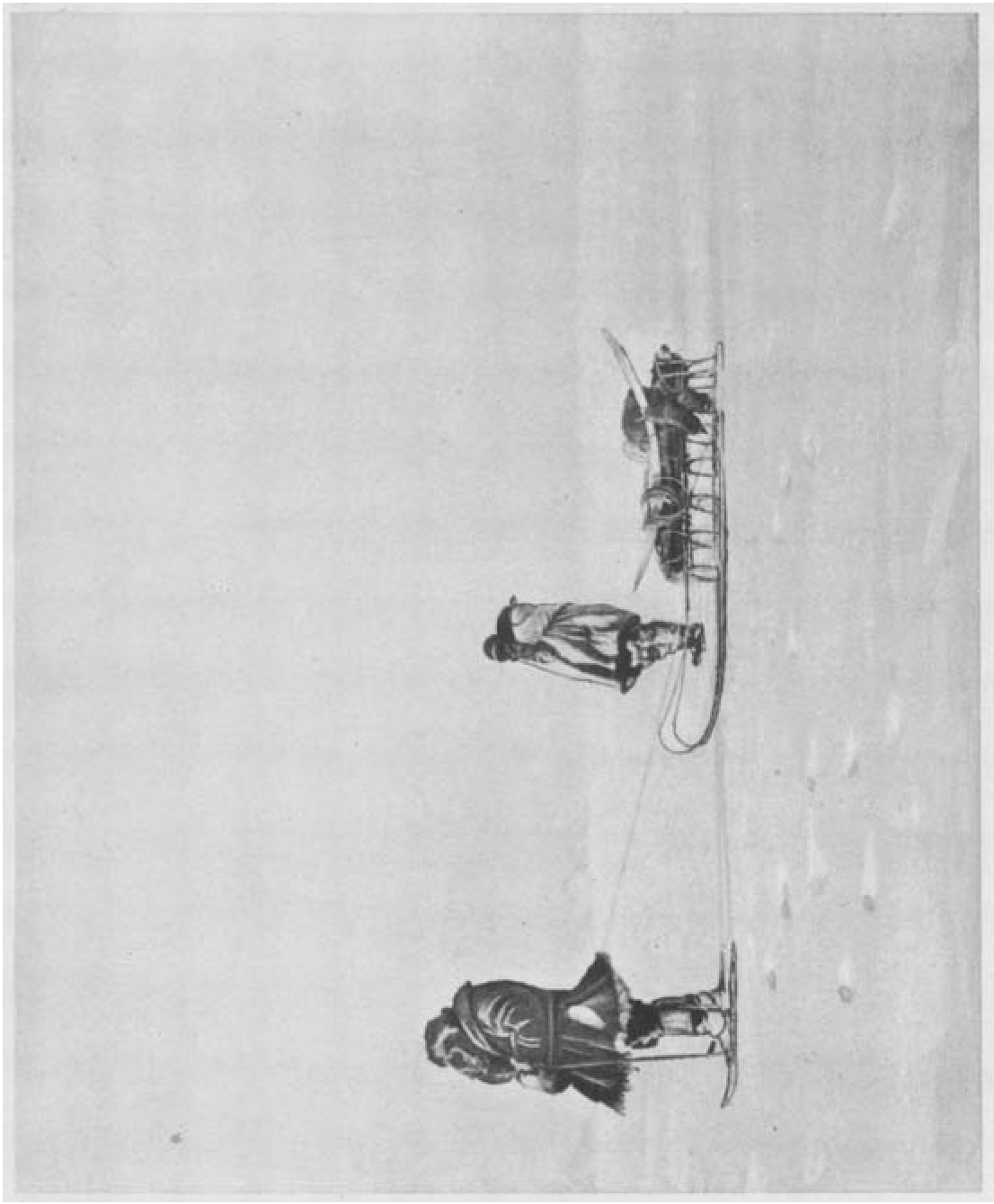
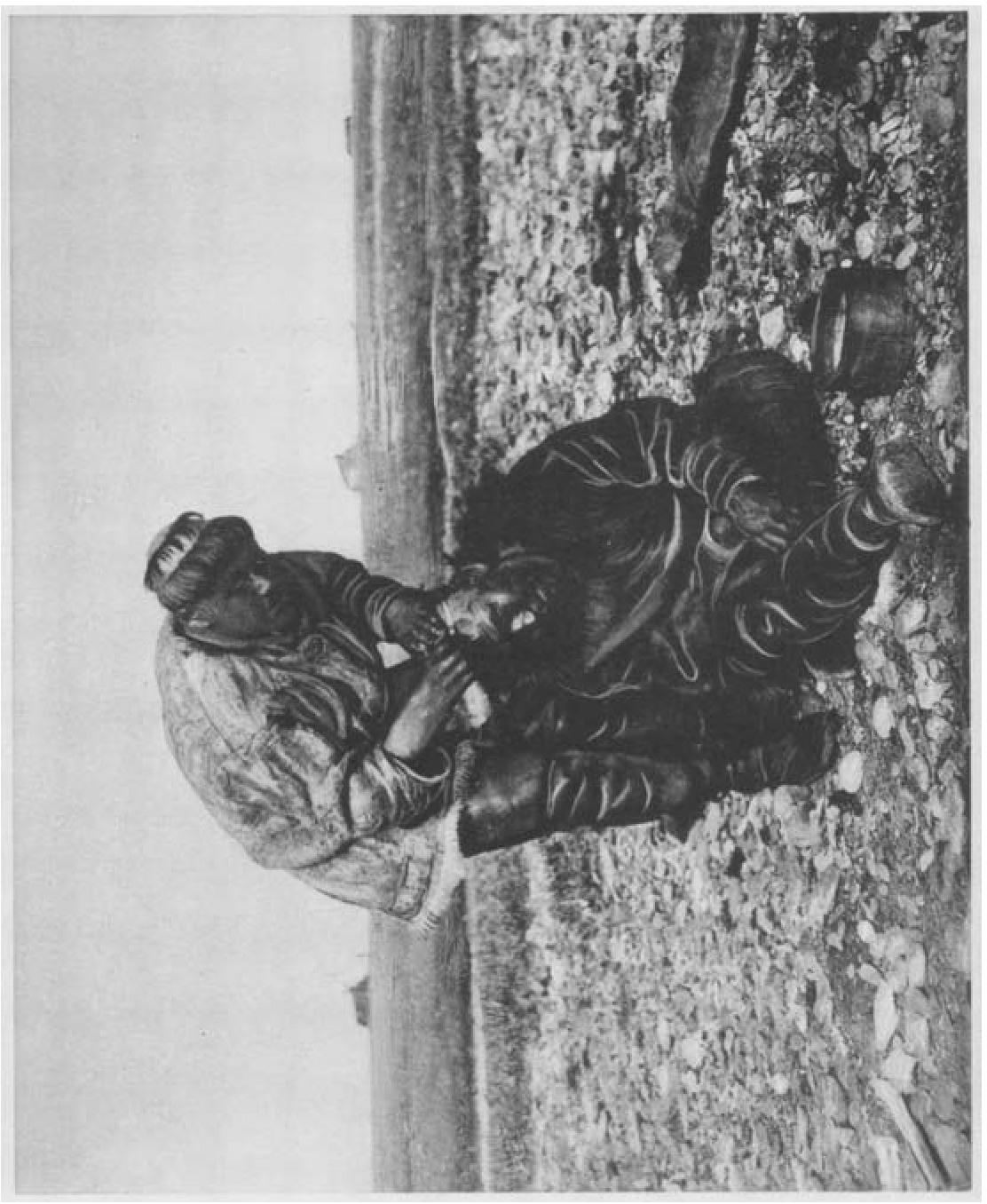
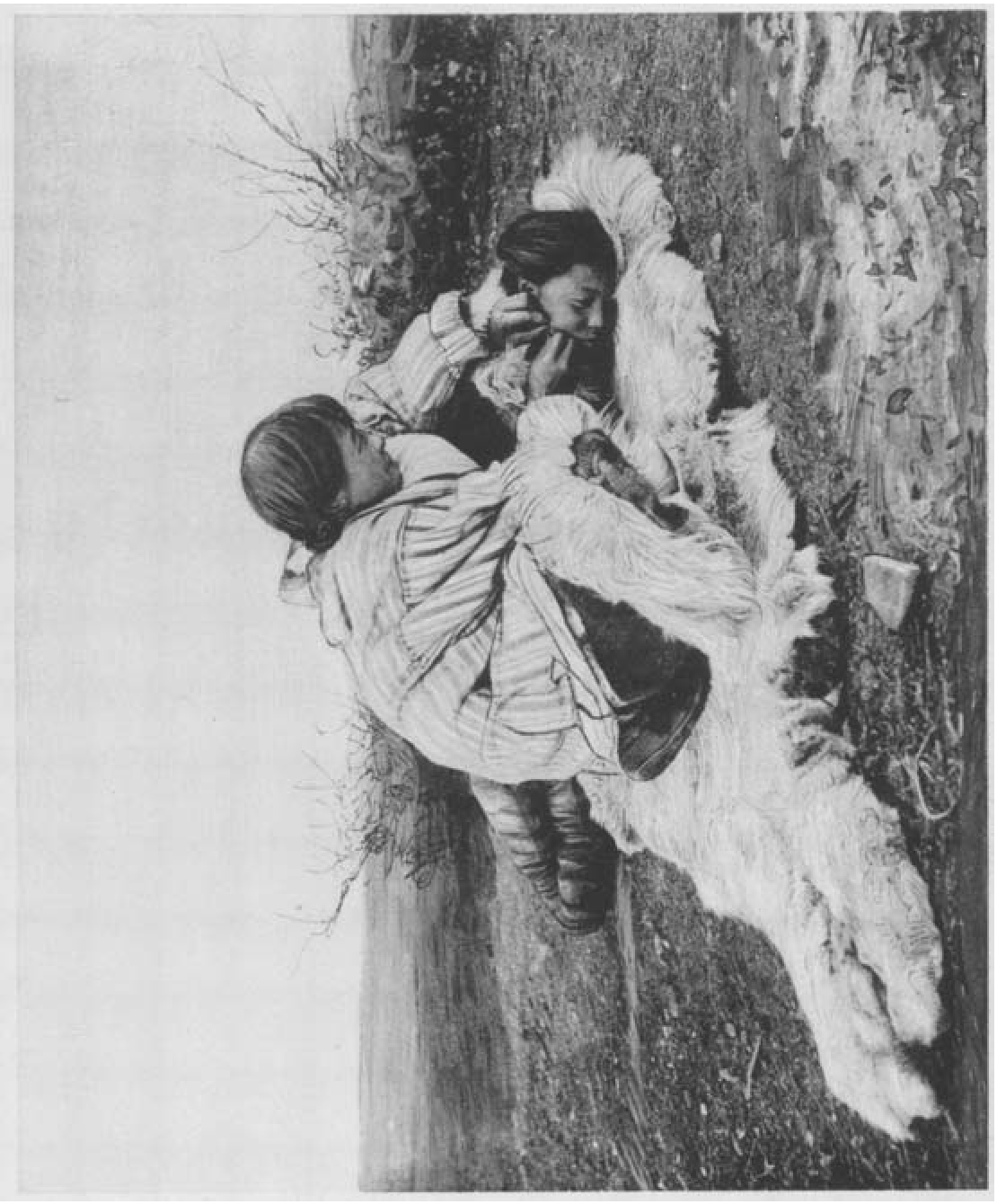
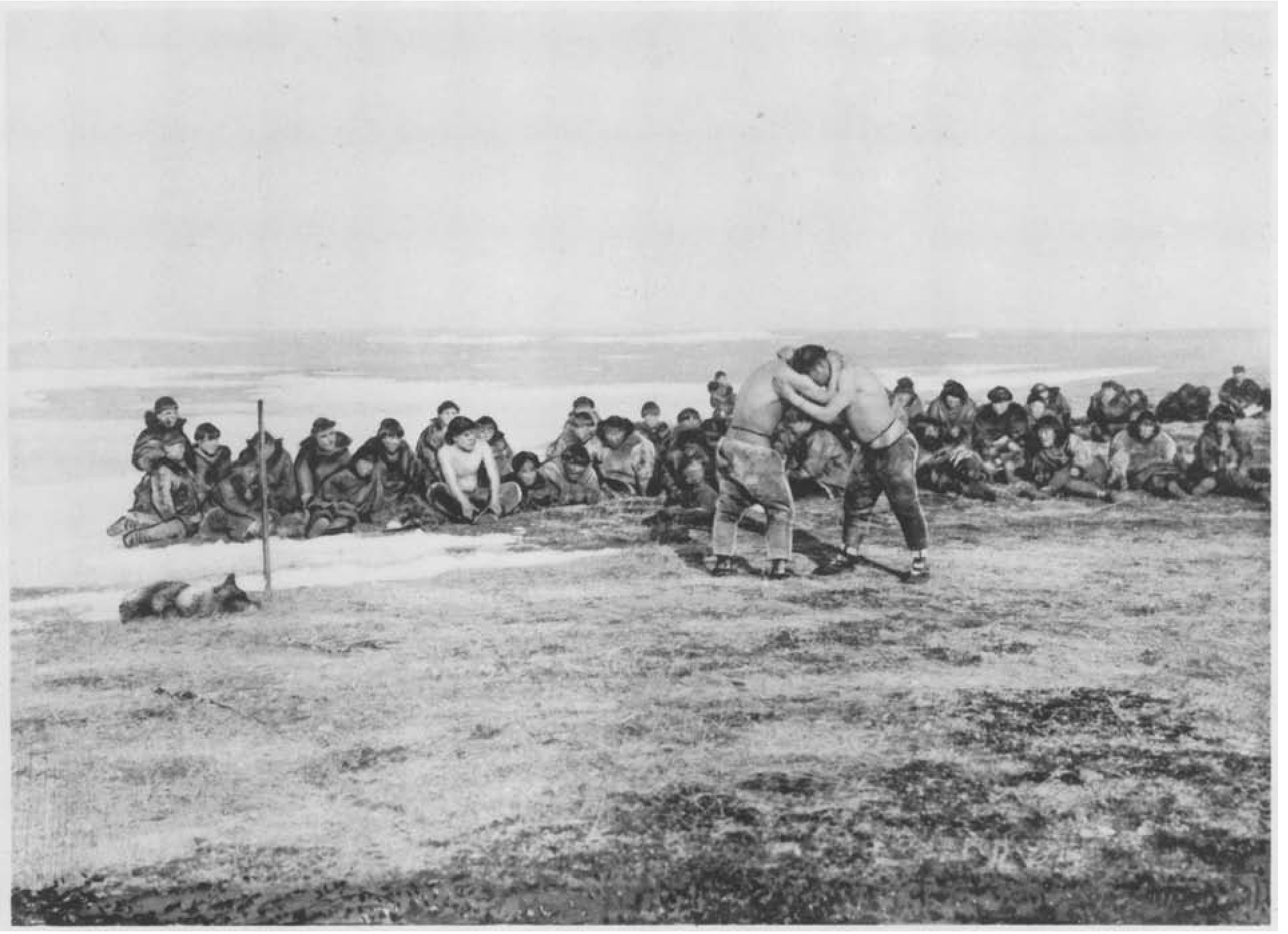
Women also wrestle, but their matches generally end in scratching and pulling hair. Members of alien tribes are also allowed to take part in all of[267]🗗uncollated the sports described; but if a stranger should be so imprudent as to take the best prize, the people are likely to resent it, and might even try to retaliate in some way.
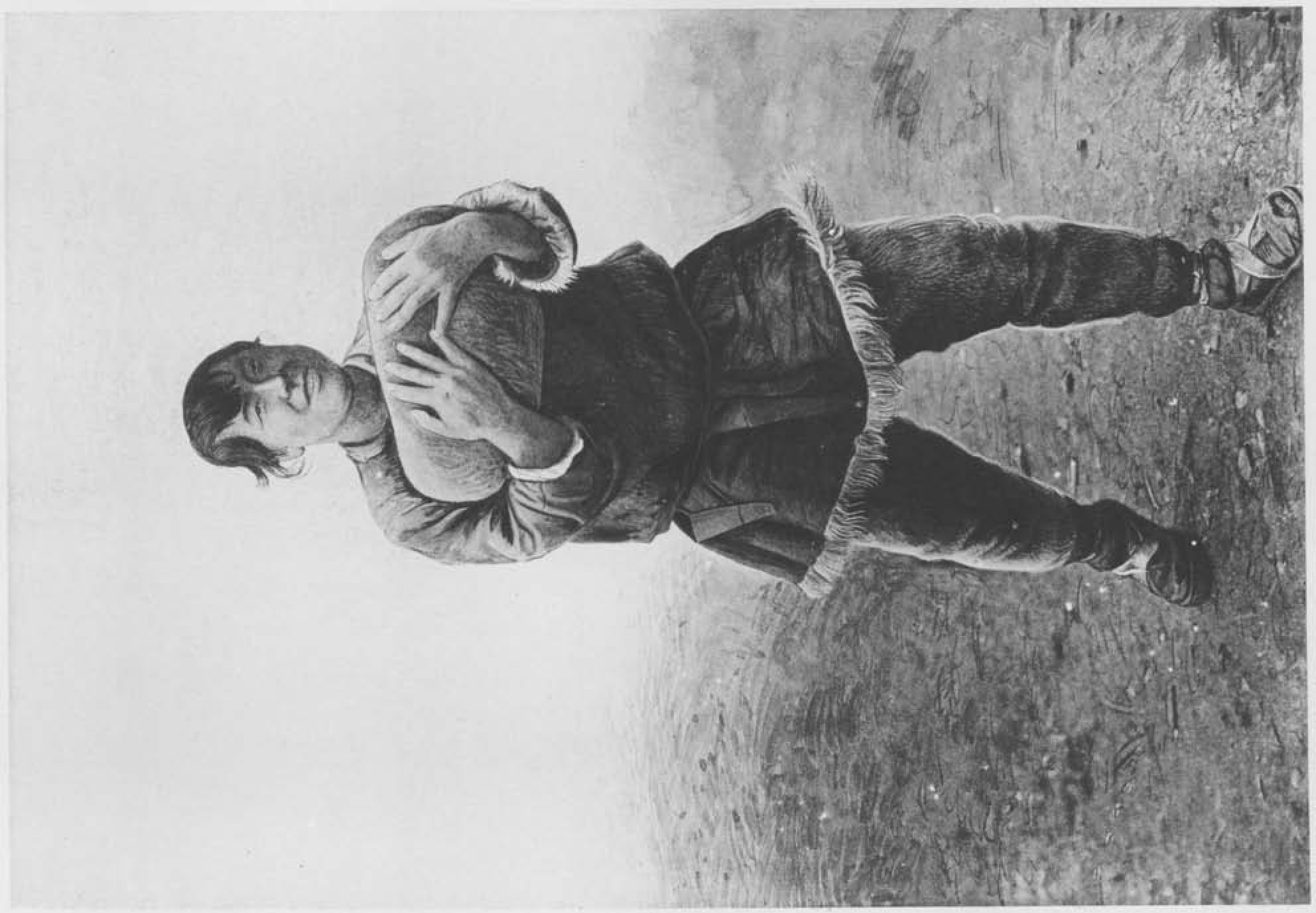
The Maritime Chukchee and Eskimo have foot-races (Plate XXX, Fig. 1) and wrestling-matches (Plate XXXI, Fig. 1) of the same character as those above described, as well as nearly all the other sports which we shall now take up.
I have already noted the fighting-contests of former times and the physical exercises with stones (Plate XXVIII, Fig. 1) and trunks of trees.¹ In all exercises long and continuous running plays the most important part. The common expression for these exercises is “becoming lighter of foot” (inetviˊrkɪn). Even at the present time, if a young man is vanquished by an unfriendly rival in a wrestling-contest, he will sometimes train for a whole year, dragging heavy loads, running, carrying burdens, etc., in order to acquire more agility and strength for another contest. Cases of this kind are often mentioned in tales. For instance, in the legend of Talo² it is stated that the hero lies idle in his tent for about a year, eating an enormous amount and storing up fat and muscle. Then suddenly he starts training. At first he is so slow in dragging a small sledge behind him, that the moving train of his family gets far ahead of him, and he reaches the camping-place only late the next morning. He perseveres, however, in his exercises, and from day to day increases his speed and the load he is drawing. On the twentieth day he is able to pull six loaded sledges, and still keep ahead of the moving train. All this time he eats nothing and does not enter his tent, sleeping for only a few hours each night out in the open on the snow. After that he practises other exercises. For whole days he will throw his lance or jump over the tents, across the lakes, or over large forests from one border to the other, until he feels ready to conquer the Taˊn˙ñɪt.
Tossing in blankets is a kind of religious performance with the Maritime Chukchee and Eskimo, and will therefore be described later, in the chapters dealing with this subject. Other amusements of less importance are practised by grown people and children whenever occasion presents, without prizes being offered and without general gatherings.
Jumping-matches are often arranged on the spur of the moment by young people in camps or villages. Each tries to make the longest jump possible, keeping his heels together, and getting a start by a few preliminary jumps.
Arm-pulling, finger-pulling, neck-pulling, and stick-pulling are practised in pairs. For these the contestants lock arms or fingers, have a rawhide loop passed around their necks, or put their feet sole to sole and grasp the same stick, holding it horizontally above their knees. Then they strain and pull until one gives way.
Young women amuse themselves with a game similar to our skip-rope.[268]🗗uncollated Two women hold the ends of a line, and swing it around regularly, while a third jumps over the middle of it, keeping her knees and heels together. I have not noticed any particular rules about the order of the jumps, like those found by Parry among the Iglulik Eskimo.¹
Another game is a contest in crawling on the knees, which is rather difficult for women, on account of their clumsy breeches. In one sort of race the contestants move around while bending forward and taking hold of the toes of their boots with their hands. In another they crouch on the ground, imitating the motion of the seal.
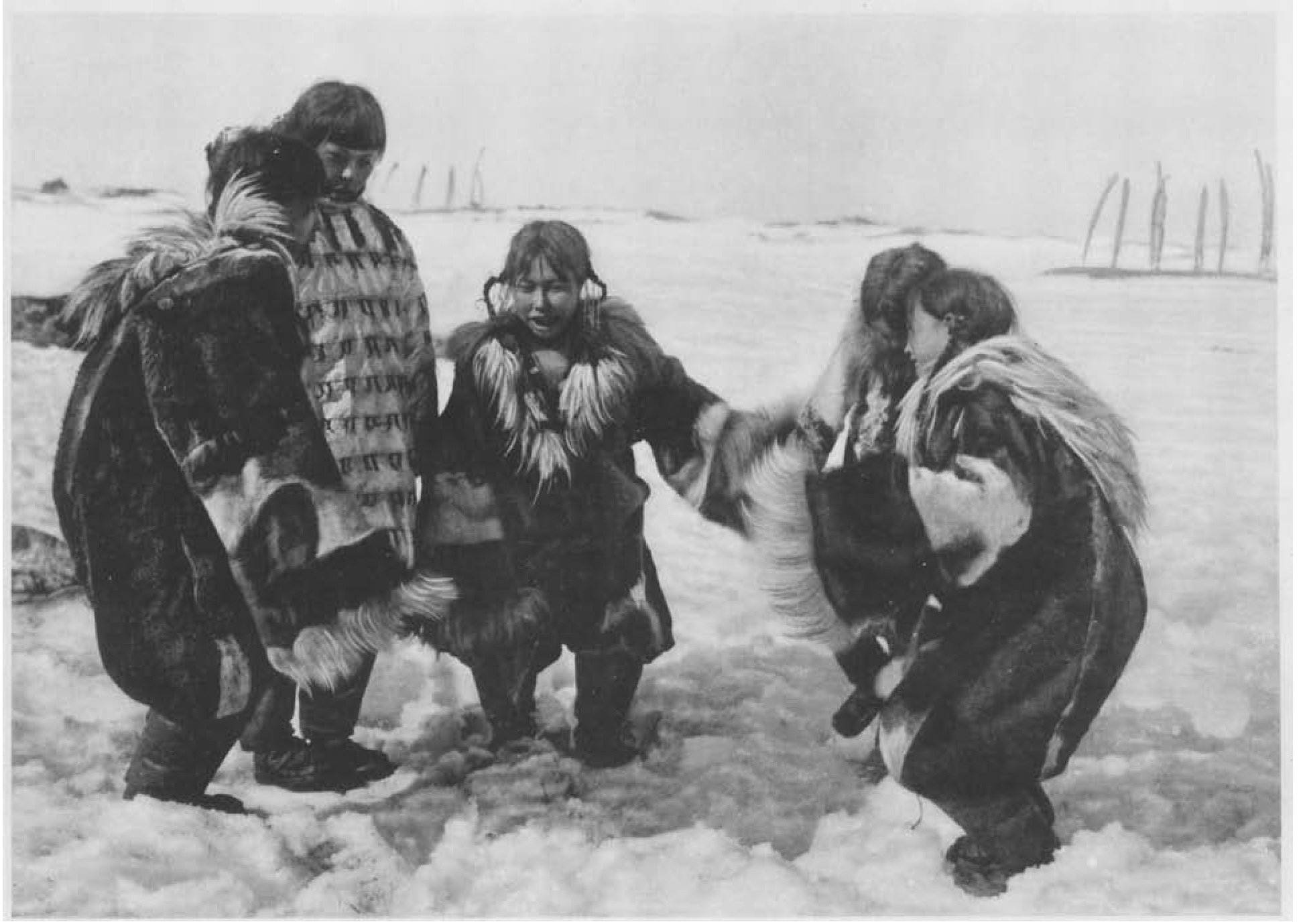
SONGS AND DANCES. — The dances performed at ceremonials by men or women will be described farther on. Young girls have dances of their own, which are meant to imitate the motions of various animals or certain human actions. They are accompanied by peculiar songs, or rather rhythmical guttural sounds produced by alternately drawing in and letting out the breath. The act of making these sounds is termed “to call with the throat” (pič-eiñeˊrkɪn). Two or more girls take positions opposite each other or in a circle (see Plate XXVII, Fig. 4) and in succession produce the sounds, keeping time carefully, and quickly taking their turns one after the other. The singing is begun with low hoarse notes. Imitative sounds are introduced later in a much higher key. While singing, the girls sway the upper part of their bodies back and forth, and then go through various imitative motions in connection with the sounds uttered (Plates XXXI, Fig. 2; XXVII, Fig. 4). Young boys taking part in the dance hold up their hands and snap their fingers, at the same time producing a peculiar clicking sound with their tongues. Each song, with the accompanying dance, has the name of the animal represented.
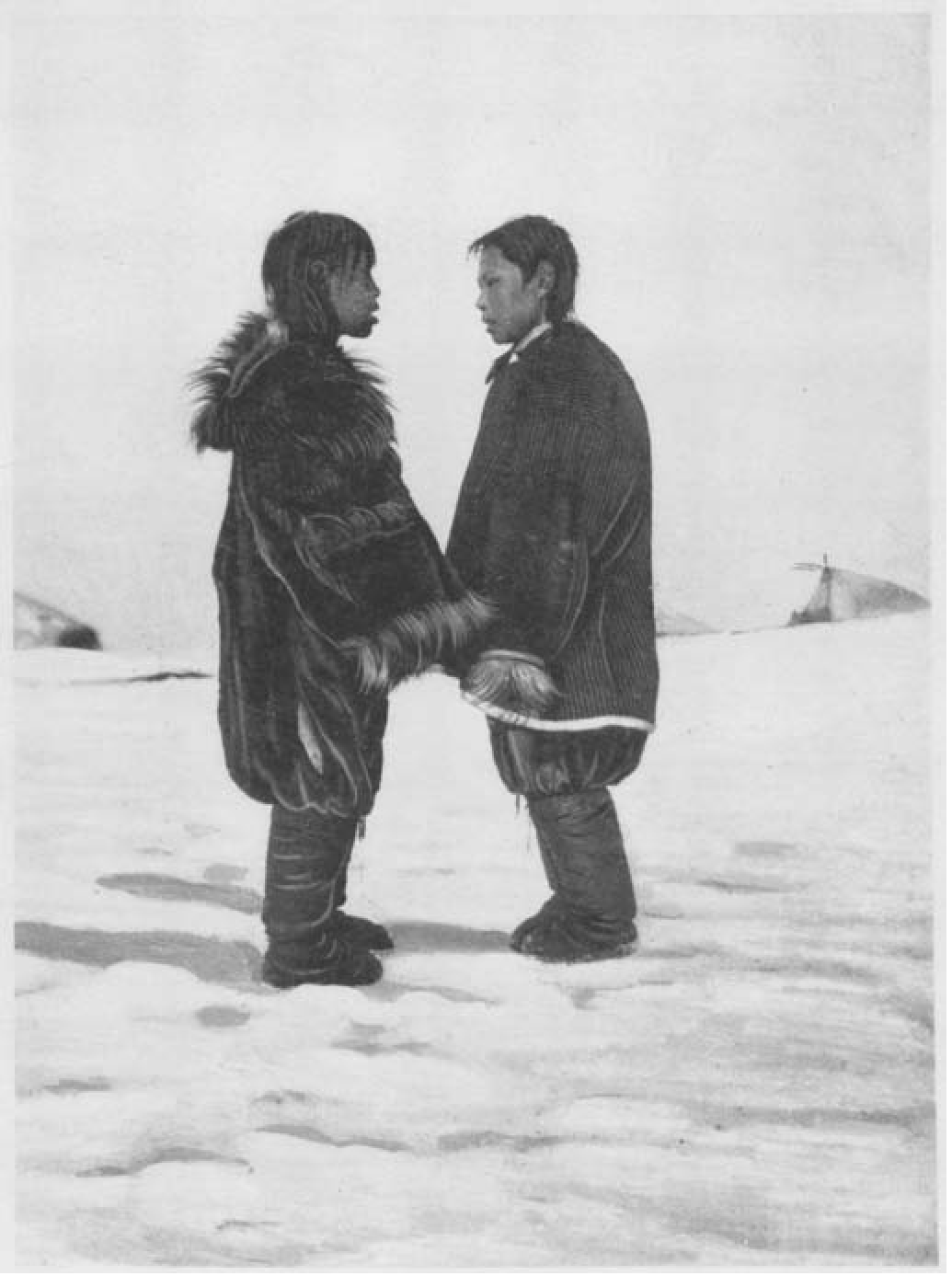
The most frequently performed are the Raven and The-One-eyed-One dances. The imitative sounds of the former represent the croaking of the Raven. The girls for a while also keep repeating, “Raven, Raven!” in hoarse sounds produced while drawing in the breath. While dancing, the girls hop around, pretend to seek for something, peck at the ground, etc. The song of The-One-eyed-One is accompanied by a few words sung in the same manner as “Raven.” It runs like this: “The-One-eyed-One called with his throat till his other eye got out (of the socket)” (Kowlaˊiñɪn pičeˊiñei rɪpeˊt pɪˊtqa-lêlantoˊê). The dancers make faces and squint their eyes alternately, representing The-One-eyed-One. He is supposed to have been an old man who wanted to have a contest of “calling with the throat” with some young girls. In the contest his only eye came out of the socket under the strain.
Among other songs may be mentioned “The Song of the Fox.” It is a kind of dialogue between the fox and the bear, and reproduces a widely known tale, in which the fox pretends to heal the bear’s wounds with red-hot stones, and finally kills him. The fox speaks in a thin treble voice; the bear[269]🗗uncollated answers in a deep bass voice, which gradually weakens. A similar theme occurs in Indian tales.¹
In the dance and song of the geese the motions and cackling of the white-fronted goose (Anser albifrons) are imitated. In “The Song of the Fighting Sandpiper” (Totanus pugnax) are imitated the quaint motions of those birds in their social gatherings during the early nesting-season.²
Songs of the long-tailed duck (Fuligula glacialis), swan, walrus, seal, and of reindeer-rutting, are either imitative songs or are accompanied by imitative dances. One dance is an imitation of the scraping of skins. Another is called “The Boneless One.” Its song has the following words: “I became boneless!” (Aˊnɪ vai! aˊnɪ vai!). The dance is accompanied by violent jerking motions of the head and arms to pretend that the dancers have no bones at all.
Another class of these songs represents the act of copulation, with a rather queer dance and even with imitative sounds. The dance often ends in two girls lying on the ground imitating sexual intercourse. Frequently young boys also take part in the performance.
CHILDREN’S GAMES, TOYS, ETC. — Boys and half-grown young men of the Reindeer people have a few simple games of their own. Of these may be mentioned swinging on a rope suspended from two trees or around an upright pole, like a merry-go-round. The Maritime people are without these games because they live on a treeless tundra. In another game a block of wood is suspended from a tree by a rope, and the youth try to catch it with their small lassos. Although the block is kept constantly swinging, a good marksman almost never misses his throw.
The scoring runs like this: “1. I saw an elk’s track; 2. I overtook the elk; 3. I killed it.” The fact that elk-hunting is represented, shows that the play must be of ancient origin.³
A rather curious game represents the Raven chasing a group of small children. At first a mother stands holding on to the children, with the Raven opposite her. He scrapes the ground with his hands, and the following conversation takes place: —
Mother. What are you doing? Raven. I am digging a hole. Mother. What for? Raven. To put pebbles in. Mother. What do you want the pebbles for? Raven. To shoot at your children. Mother. Why will you shoot? Raven. They have spoiled my corral.
[270]🗗uncollatedThen the Raven runs after the children, who scatter, shouting, “The Raven’s eyes are lean, our eyes are fat!”
A game with almost identically the same details exists among the Russians of the Kolyma. In fact, games similar to this are known throughout the civilized world. It is hard to tell whether in this particular case it was conceived under Russian influence or whether it sprang up independently in connection with numerous Raven legends which play an important part in the mythology of all the tribes living around Bering Sea.
Some of the children’s games have an elaborate method of counting the points scored. Thus the curious game of “immersing into syphilis,” which I mentioned before,¹ has twenty-four points to score. It is played by two persons, or by two groups of two or three persons each, who try to lasso a block of wood lying on the ground or thrown into the air. Each successful throw counts one. The counting runs thus: “1. I cover you with eruption; 2. I immerse you to the sole; 3. I immerse you to the vamp; 4. I immerse you to the instep; 5. I immerse you to the ankle;” and so on until all the points corresponding to parts of the human body have been named, from the sole of the foot to the crown of the head. The points may be won back one by one, or they may be doubled.
A still more complicated system of counting refers to the succession of various incidents of the reindeer-breeding life. It goes like this: “1. I moved to the first summer quarters; 2. I castrated the bucks; 3. I moved on to the mid-summer quarters; 4. I slaughtered; 5. I prepared boots; 6. I drove (the herd) inland; 7. I carried away the kettles; 8. On the grass border; 9. I got entangled in the grass; 10. I came out of the grass; 11. In the lower bush; 12. I got entangled in the bush; 13. I came out of the bush; 14. In the thickness of the bush; 15. I got entangled in the thickness of the bush; 16. I came out of the thickness of the bush; 17. On the clearing; 18. I prepared inner trousers; 19. I sucked a reindeer-dam; 20. I burned bones.” This point forms the climax, and from here begins the return journey, though the names of the stages are generally different from those preceding. The total number of points is thus thirty-nine. They are often followed by syphilitic counting or by another counting having six points and referring to the hunting of wild reindeer or seals. Other plans of scoring refer to the slaughtering of reindeer and to various hunting-pursuits.
Games with elaborate countings are of a lively character. Those who are backward are goaded on with jeers. For instance, in the syphilis play the winners will assert that the losers have lost their noses withal; or in the hunting-play they will taunt the loser with, “You must be hungry [on account of the unsuccessful hunt], cut off your boy’s diaper-strings and eat them!” This derision often causes games of this character to end in quarrels.
[271]🗗uncollatedPlaying ball is more common among the Maritime Chukchee, who live in settled villages, and whose life is more regular than in the scattered, ever-moving camps.
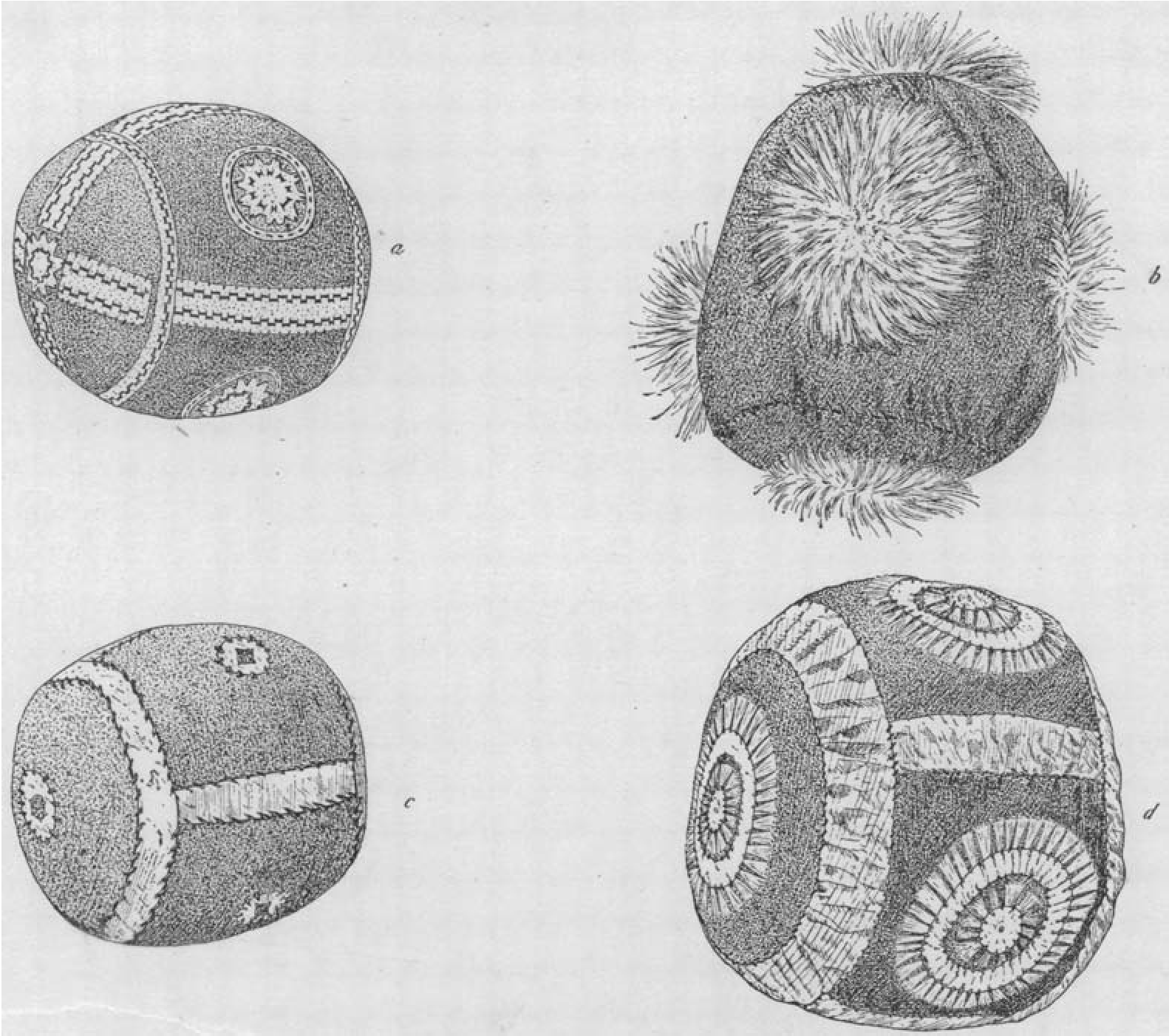
The Chukchee employ both hand-balls and foot-balls, which differ chiefly in size (Fig. 196, a-d). The word used for the ball (qeˊpel), however, signifies “kick,” “kicked thing,” and therefore is connected more closely with the football. The outward appearance of the balls resembles very much that of the balls used by Alaskan Eskimo. There are no particular rules for ball-playing. The participants, mainly young boys and girls, are divided into two parties. The ball is thrown or kicked by one party, while the members of the other party try to catch it. Often the girls take one side, and the boys the other. Still more frequently they all run about, trying to catch the ball as it flies from side to side.
Sometimes a whole reindeer-skin is folded and fashioned into a large clumsy-looking foot-ball, and almost the entire population of the village joins in tossing and kicking it about.
[272]🗗uncollated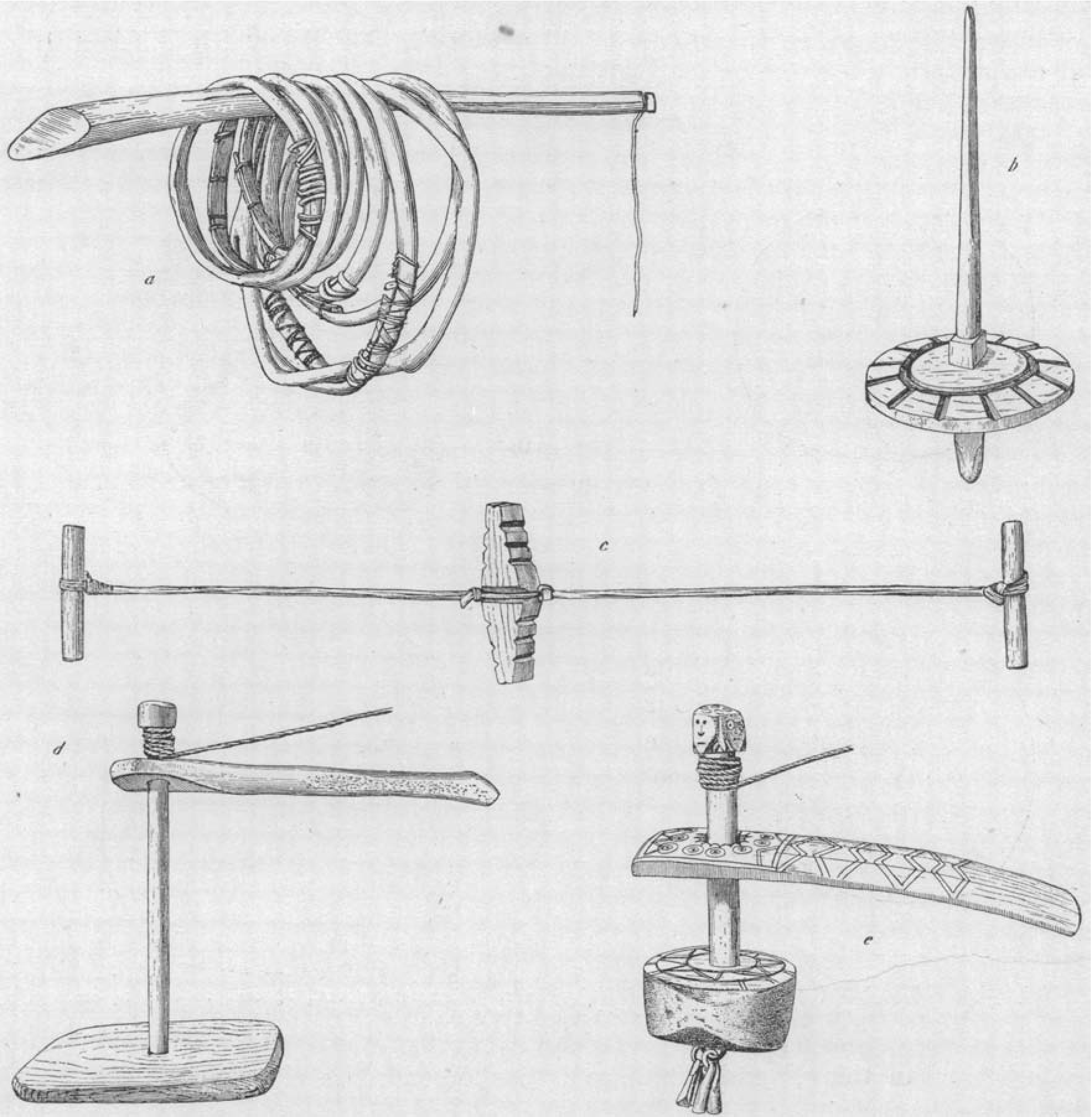
A game which is called oˊkkal is played with a slender stick and a number of small wooden hoops of various sizes (Fig. 197, a). The hoops are thrown upwards in a bunch, and one of the party tries to catch on the stick as many hoops as possible. The hoops caught are taken off in pairs and returned to the general bunch. If there is an odd hoop left over, it is said to be “killed.” It is left out of the lot thrown up, and counts one for the lucky catcher. This odd hoop also gives him the right to try again. If no hoop, or an even number of hoops, is caught, the turn is forfeited, and the next party begins to play. After all the hoops have been “killed,” the[273]🗗uncollated winner has the right to give the loser a stroke on the palm of his hand with the stick used in the game, for every point he has gained on him. The game is sometimes varied by throwing a bundle of sticks into the air and catching them with the hand as they fall. The scoring and the ultimate reward are identical with those of the hoop-game.
Gambling-games are little known among the Chukchee. I was told that among the Maritime Chukchee on the Arctic shore there is a simple game played for stakes, which consists in throwing a small piece of gristle against a large flat stone so that it will rebound high in the air. The one who catches the gristle gets the stakes, which are usually matches, copper caps, and similar small objects.
At the present time many camps and villages have learned to play cards from their Russian neighbors or from American whalers. Among the Reindeer Chukchee of the Kolyma, passionate gamblers may now be met who have lost their all in play against more clever Russian neighbors.
Children have various toys, most of them small imitations of objects of every-day life, such as little boots, sledges, wooden or ivory dogs and reindeer with the proper harness, snowshoes, bows and arrows. Grasping in each hand a slender willow branch having many offshoots to represent antlers, the boys will gallop up and down, playing reindeer.
Tops (Fig. 197, b) are favorite toys. Their shape is similar to that of the American Eskimo top. Buzzes (Fig. 197, c) are made of various materials, — ivory, wood, tough skin, and even a piece of dried fish. Much of the ivory carving is also used by children for toys. An implement exactly like that represented by Nelson¹ is used by the Chukchee as a kind of top. A specimen of it was obtained on Anadyr Bay (Fig. 197, d). It consists of a horizontal antler handle with one end broadened and containing a hole, through which passes the rod of the top to be spun. This is kept from slipping out of the handle by a knob at the upper end and a square piece of wood at the bottom. The latter forms the body of the top. In spinning the top, a cord is wound around the rod above where it passes through the handle and just under the knob. By holding the top vertically and pulling the string off quickly, it will spin rapidly for a short time with the knob resting on the handle.
I obtained from the Kerek three specimens of the same implement (Fig. 197, e). They are made of ivory and adorned with various geometrical designs. The handle is bent slightly downwards. The hole and the knob are serrated, so that in revolving the constant chafing produces a sort of buzzing noise. The knob has four sides, with similar face designs on opposite sides. The implement is used for a kind of game in which four persons take part, two on a side. Two of the faces on one specimen have big round eyes; on the other specimens they are marked with a curved line across the cheeks. These[274]🗗uncollated are called “faces of the spirits.” Two other faces are called “the faces of men.” The participants stand in a circle, with partners facing each other. The rod is spun in the middle by somebody. When the top stops spinning, the party that is faced by the spirits has lost. The stakes are small, and consist usually of pieces of sinew, single beads, or matches.
Nelson obtained his specimen from St. Lawrence Island. He considers it a cord-spinner, or, rather, a cord-twister, and suggests that the idea of it was borrowed from the whalers, because no other specimen was seen by him anywhere in the regions visited.
Among the collections in the National Museum at Washington, however, I found another specimen of this implement (Cat. No. 63382), labelled “Diomede Island,” and collected also by Nelson. In the sketch in his book the piece with the hole is represented in a vertical position, while the ivory weight is represented as grasped in the hand of the operator for the purpose of setting the implement rotating. In the specimens of my collection the weight does not have a shape adapted to be grasped by the hand.
The implements of the Mexican and Zuñi Indians having a similar shape serve for twisting grass-fibre and horsehair. In this case they have no weight attached, and the piece with the hole in it is no longer used as a handle, but is much longer and heavier, apparently for the purpose of being revolved for twisting cords.
Perhaps the Northern implement has degenerated from some borrowed[276]🗗uncollated form primarily used for twisting; but whalers could hardly have had anything to do with the introduction of such an implement. The connection is evidently older, and is yet to be traced.
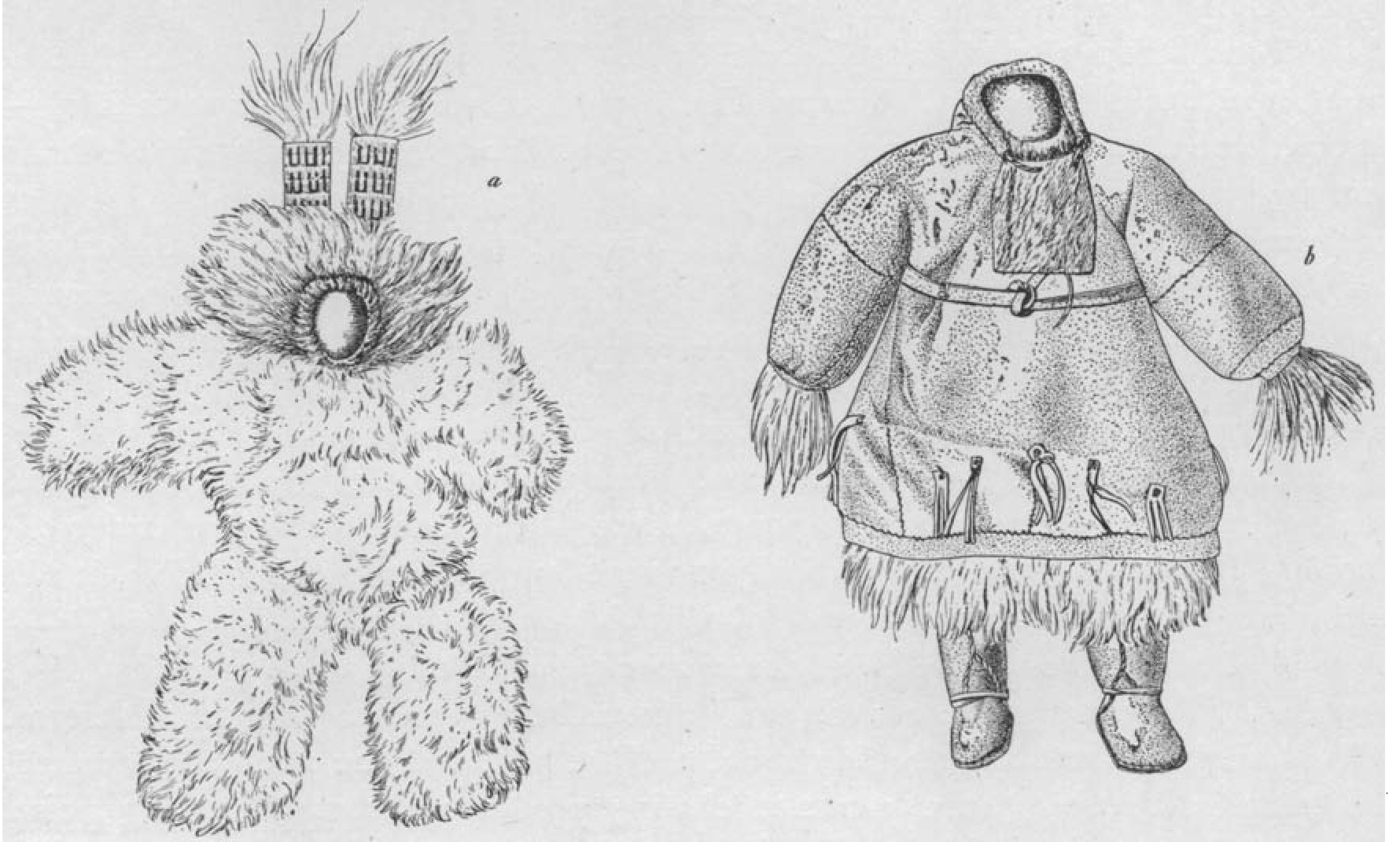
The girls of the Chukchee have small lamps and dishes, and dolls of various sizes (Fig. 198, a, b), sometimes almost as big as a very small baby. The dolls have clothes that are carefully made, and represent grown persons and children of both sexes. The favorite one is that representing a small infant wearing a diaper and baby-clothes. Some of the dolls pass by inheritance from generation to generation. They are even supposed to be connected with the fecundity of women.
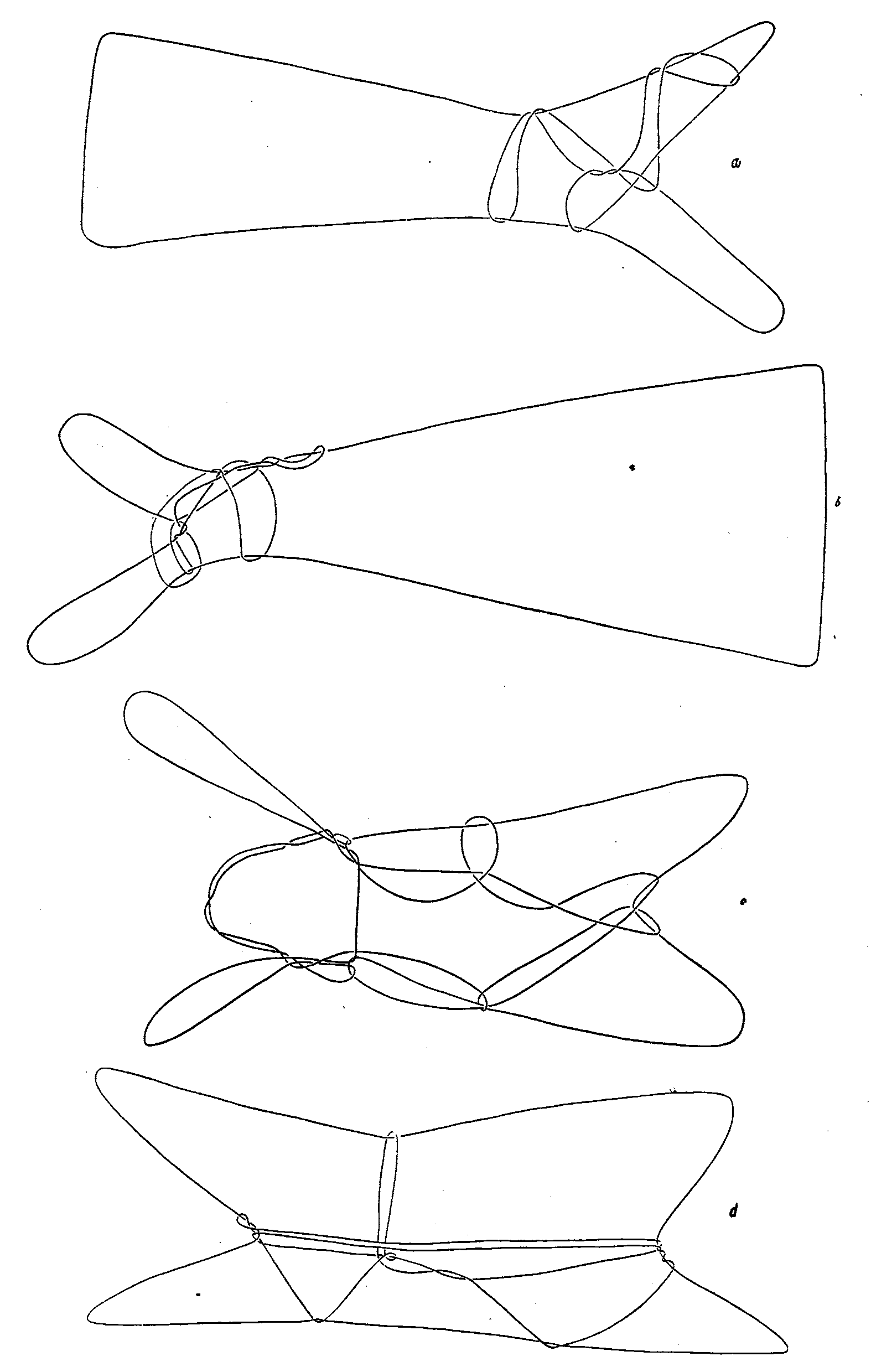
The women and children are fond of making figures by skilfully winding loops of thread around the fingers of both hands. The game is called yuˊᵋut, and is somewhat analogous to cat’s-cradle of civilized people. It exists among the Eskimo tribes of America, and is mentioned by Boas as occurring among the Central Eskimo,¹ and by Kroeber among the Eskimo of Smith Sound.² In Asia it existed among the Chukchee from the Kolyma to the Pacific coast. In former times it was also known among the Kamchadal and the Koryak. Some of the devices in my collection are very similar to those represented by Boas and Kroeber; for instance, compare Fig. 199, a, representing the wild reindeer, with Fig. 525, a, in Boas’s Central Eskimo, p. 569; Fig. 199, b, representing a fox, with Kroeber’s Fig. 52, a, a dog; Fig. 199, c, representing a whale, with Kroeber’s Fig. 53, a, a narwhal; Fig. 199, d, representing a man in a canoe, with a specimen from Smith Sound (Cat. No. (??/????) a) in the Eskimo Hall of this Museum.
[1-359]🗗uncollatedEXPLANATORY NOTE. Names of native villages and other localities are given in aboriginal form with phonetic spelling. Names of Russian and Russianized villages are printed in the English transcription of the Russian form. In a few cases a literal translation of the Russian name is given. Russian equivalents of native names or of English translations are given in the following lists. Northern Kamchatka and Adjacent Pacific Shore. Chukchee Peninsula. Kiˊčhɪn Кичиги Indian Point Мысъ Чаплинъ Qareˊñɪn Карага East Cape Мысъ Дежневъ Ewleˊwun Пусторѣцкъ Чечинская губа or Pitkaˊheñ Подкагерно Čeˊčin Bay Заливъ Адмирала Бутакова Tɪˊḷḷɪran Тилечики Kuluˊči Колючинъ Iˊlir Култусно Aˊlut Олюторскъ Iˊlpi Хатырка¹ The Lower Kolyma. Qaˊyɪlɪn Хаилино Cape Alutorsky, Cape Anannon² Forest Border Край Лѣсовъ Keiˊñu-weˊem³ (R.) Медвѣжья рѣка (Bear River) Gishiga Bay. With the Mosquito У Комарка Large Chukchee River Большая Чукочья рѣка Poiˊtɪn Парень Small Chukchee River Малая Чукочья рѣка Vaiˊkenan Каменское Two Brooks У Двухъ Високъ Egaˊč R. Шестаковка Wolverine River Россомашья рѣка Anadyr Country. The Middle Omolon. Under the Cliffs У Утесика Karbaschan⁴ Small Boat. Hare Mountains Ушканій хребетъ White River Бѣла рѣка Red River Краснина or Красная The Upper Kolyma. Pike River Щучья рѣка Big River Большая рѣка Shoudon⁵ River Лаудонъ or Сухая