XVIIBirth and Death
Birth
The regulations bearing upon birth begin, of course, when the woman is first aware that she is with child. From that time on, both the husband and the wife must every morning, on awaking from sleep, put on their clothes as quickly as possible, go out of the tent, and take a look in the direction of the morning dawn. Some make a hasty tour around the tent, following the direction of the sun’s course. Not until after that may the woman re-enter the inner room to light the lamp. It is desirable that both parties should leave their bed together. The woman, however, may go out alone; but, if the man wishes to appear first, he must take with him one of the boots belonging to his wife. Neglect of any of these particulars will make the offspring come slowly, and will cause its flesh to be flabby. Moreover, the married couple must not transgress the customary rule that places the pillow of the Chukchee bed on the entrance-side of the sleeping-room, and which is often ignored by the people.
The garments for the new-comer are prepared in secret, lest some one of the “alien” people should see them. When the clothing for the prospective infant is spoken of, it is called “belly-protector,” in order not to use the real word.
The mother works up to the very last hour. The more active she herself is, the stronger and healthier will be her child.
The husband and the wife sleep together till well nigh the labor-time, and there is no restriction against their conjugal life during this period. After birth, it is considered more fitting for the husband to have no intercourse with the woman for ten days, because, before the expiration of that time, the traces of the birth must still remain in the body of the mother. On the other hand, if the married couple are desirous of having another child as soon as possible (in the event of the first one having died shortly after the deliverance), they will have intercourse before the end of this term, and this is believed to be conducive to another conception.
When the time of labor is at hand, no stranger is allowed to enter the inner room of the family; and even near relatives of the male sex must keep far away, especially if they roam about in the day-time. It is feared that some invisible but evil influence will cling to them, and try to approach the lying-in woman. When the time of labor begins, all males, not even excepting the small children, must leave the sleeping-room, and they must not return[510]🗗uncollated until after all traces of the birth are removed.¹ They may remain in the outer tent, but they must keep very quiet. The female members of the family may stay inside, though it is thought more judicious that there should be as few people as possible present. An old woman — a mother or an aunt — usually stays with the woman in order to give her a hand in arranging matters.
I have spoken before of the tendency of the Chukchee women to reduce all assistance at this time to the strictest minimum. Nevertheless, when help is necessary, it is given to the woman. I know cases where, in the absence of female relatives, the husband has ministered to his wife in her first labors.
When the child has come into the world, the mother ties up the navel with a string of sinew into which a few of her own hairs have been plaited. This string, of course, has been prepared beforehand, and kept ready at hand. She cuts the navel with a sharp stone, which will serve her for that purpose during her whole life. The stone is simply taken from one of the skin-scrapers, and ever after that is kept in the clothes-bag of the woman. The navel is left unwrapped, but is kept rubbed all the time with dry powdered coal, till at last it falls off. The child is rubbed over with urine from the mother, which has been kept for the purpose; and the bunch of grass that was used in the rubbing is immediately burnt on the hearth.
With the Reindeer people a young doe is slaughtered, and, in the largest kettle of the household, a plentiful supply of strong broth is prepared from its brisket. The water or snow for the broth is brought by the husband. While filling the kettle, he puts the wooden drum-stick across the upper rim of the kettle, and repeats three times a short formula like the following: “O Sun! give us warm water.” The woman in child-birth puts a large robe on over her bare body, and places under its folds the kettle full of warm broth. Over the steam of the broth she warms her breasts, believing that this process will make them soften. Then she eats some meat, and drinks of the broth as much as she is able to take. She alone must empty the full kettle, and the sooner this is done, the better. During the first two weeks she feeds on the choicest meat, always carefully boiled, and drinks large quantities of strong broth. The broth is considered well adapted to produce a flow of milk into her breasts.
Immediately after the delivery, the body of the woman is tightly bound around the hips with a cord in order to bring the bones of her body into their former position. The Chukchee believe that, without this, the woman will become sickly, and that her life will be shortened. The binding must not be undone for three days, during which time the woman keeps mostly in the inner room, though she may for a short while creep out into the outer[511]🗗uncollated tent. On the fourth day the cord is untied, and the woman may then stay in the outer tent, busying herself about her household duties.
BLOOD-PAINTING. — On the fifth day, the ceremony of blood-painting is performed. For this the woman with the child is put into the family sledge, with one reindeer attached, and is carried around the outer tent, following the direction of the sun’s course. The sledge is brought to a stop at the sacrificing-place behind the tent,¹ where all the charms and images are arranged, ready for the sacrifice. The reindeer that drew the sledge is slaughtered; and the mother with the child, and at least two other members of the family, paint on their faces the usual blood-marks. The charms, and also the three central poles of the tent-frame, are also painted with blood. The woman takes the sinews out of the legs of the reindeer, and stores them away to be used as her boot-strings. Neglect to do this brings on pains in the legs, and rheumatism.
The ceremony of blood-painting is in many cases performed sooner, even on the second day after delivery. This haste is attributable to the idea that, before the ceremony, the new-born child is highly susceptible to evil influence; while after that, it is under the protection of family charms and sacred things.
Before the ceremony is performed, no person coming from outside is allowed to enter the house, especially in the evening. Even the father of the child, should he come from a visit to the herd, must first enter a neighbor’s house, or at least rub against his body a small pup, which, as said before,² will overcome the evil influence. After the ceremony, these precautions are not in force, and are renewed only when contagious diseases are prevalent, or when the child is suffering. In this latter case it is also forbidden to sell, or give away to strangers, anything belonging to the house, as the child’s health might be given away with the object.
It so happened that several times, on my arrival at a Chukchee camp, I was refused admission to the houses, in order to protect the children from evil influences; and some of these experiences were not extremely happy.
The woman must not leave the outer tent before the blood-painting ceremony is performed. Should she do so, her walking on the snow would bring on violent snow-storms.³
The after-birth is placed on the ground in the corner of the tent. Three small sticks are tied together, in imitation of the three principal poles of the tent-frame, and are set over the after-birth. They represent a tent. After the camp is left, a piece of leather is wrapped around them to represent the tent-covers.
The Maritime Chukchee and the Koryak place the after-birth, together with its small tent, outside of the house, in the open country.⁴
[512]🗗uncollatedAfter the ceremony, the mother proceeds to find a name for the child. This is done by divination with a suspended object, which may be the divinatory stone, or some part of the mother’s or child’s dress, such as a boot or a cap. The mother, while holding the suspended object in her hands, enumerates, one by one, the names of all deceased relatives, saying with each name, “This and this has come?” When the object loses its balance and begins to swing, the name is selected. Then the people say aloud, “Such and such a one has returned to us.” This is more than a mere verbal formula. For instance, I met on the Wolverene River a Reindeer Chukchee family who, two years before, had lost their chief, who was much beloved by his sons and nephews. Immediately afterward the wife of the oldest son of the deceased man gave birth to a son, to whom was given the name of his grandfather. He was considered, in a way, as a re-incarnation of the deceased one, and therefore was always spoken of as the house-master. At one time, when the youngest and favorite daughter of the deceased one — but who, nevertheless, had a violent temper — began to abuse her oldest sister, the mother said, “Tell the house-master [meaning the small boy]. Let him try and make her silent. She is his favorite child.”
In other cases the name is selected in quite different ways, frequently from indications received in dreams. Thus, the mother accepts for the child the name of the first object that comes to her sight after her delivery, or the name of the first animal that crosses her path after leaving the tent. The intention of this method is probably to mislead the “spirits,” who will not be able to recognize the child under the incidental name of the first thing seen, selected by chance. Nevertheless, even in this case, the name selected is often the name of a deceased relative, which, in days gone by, was chosen in the same manner. Similar methods of naming children are used also by the Asiatic Eskimo.
Often the name fixed upon does not agree with the child, who then grows slowly, and is sickly, or, as the Chukchee say, “It has heavy bones.” Then a shaman, or a “knowing person,” is invited, who proceeds to change the name. This process is sometimes repeated five or six times during the first few years of the child’s life.
PROTECTING-INCANTATION. — If the parents are afraid that the child will die, a special kind of incantation is used, which is called “Child-protecting Incantation” (keimiˊtkin êˊwg̣an). It is performed by means of one or several pieces of red hematite, which must be picked up on the seashore, close to the water. The Chukchee call it “liver-stone.” In cases of necessity — for instance, in winter-time, and especially among the Reindeer people of the inland country — any other red stone may be used; but it must be taken from the side of the hill lying in the direction of the sea.
[513]🗗uncollatedWhen the first child has died young, it is considered to have traced the way for the following ones. In order to stop this fatal succession, the incantation must be performed as soon as possible. The care of the matter falls on the father of the child, and it is most propitious if he himself is able to perform the ceremony. If he is not able, he invites some of his experienced relatives, who can name several “knowing people” possessed of the incantation in question. These latter are more frequently male than female. The choice of the performer is indicated by divination with a suspended object, in the usual way. Then the husband goes to seek the designated person, who may be more than fifty miles away. As said before, the “knowing man” must at first refuse, and he may persist in this refusal for even three or four days, to avoid the displeasure of the Deity. The negotiations are carried on in whispers, in the strictest secrecy, and only inside of the sleeping-room.
The best time of all for performing the ceremony is during the first three days of the young moon, but, nevertheless, in the day-time. For this a small fire is built up before the entrance, and a number of plates laden with various meats, cooked or dried, are placed on both sides of it. The performer gives each of the parents a small piece of red stone wrapped in leather formed into a necklace. Then he pronounces an incantation, of which the following may serve as a fair specimen: —
“You are not on this earth; you are within this stone. No wind may reach you; no iceberg may crush you, but it will break into pieces against the edges of the stone. You are not on this earth. In the open ocean there lies a big sea-animal born at the same time with the earth and the world. This animal is a sea-lion. Its back is like an island, it is covered with earth and stones. You are on its back.”¹
A similar necklace is put, with the same incantation, on the child’s neck. The performer takes the child in his arms, and makes three rounds among the plates of meat, stepping over them forward and backward, and retracing his steps, in order to make his trail more intricate. Then the fire and the principal “directions” are fed from the plates. What remains of the meat is eaten by those present. The lobes of the child’s ears are pierced, and ear-ornaments, each made of three small colored beads, are inserted. Several additional figures of “guardians,” made of leather, are sewed to the child’s garment. Its name is also changed.
EXPOSURE OF INFANTS. — Sarytcheff says that in his time the Chukchee exposed their misshaped infants.² I have said before, that I know of no such practice in modern times.³ But in the case of a lying-in woman dying in her labors, the babe is often smothered and exposed, together with the mother,[514]🗗uncollated in a common funeral.¹ The people, however, more frequently try to raise the child, either on the milk of another suckling woman, if there is any at hand, or by feeding it with broth, and, in the Maritime villages, with thin pap prepared from American flour bought from whalers, which is mixed with a little oil.
I also gathered among the Asiatic Eskimo, in various villages, some curious information about the method which is applied to feed and raise babies born prematurely. A baby of this kind is put into the soft skin of a big sea-bird. This skin, taken off whole and turned, has the feathers inside. Then it is tied up very securely, and hung over a big lamp in which a small flame is kept constantly burning. Of course, in doing this, they take care that the child’s head shall be in a proper position. In this position the babe is kept for from a week to four weeks, during which time it is fed with small quantities of oil, as well as with mother’s milk drawn from her breasts. Little by little the portion of milk is increased, and at last the babe is allowed to suckle. I had no opportunity of witnessing an operation of this kind, but I was told that two young men whom I saw in Uñiˊsak were raised by their mothers in this way.
NAMES. — I will give here a few details as to the significance of Chukchee names, male and female, which is in a great measure influenced by the ideas and ceremonies described in the preceding pages. A great part of the names have reference to the idea of the return of the deceased from another world. Such are, for men. —
Yeˊtɪlɪn, The One Coming. Atčɪˊɪrg̣ɪn, Roˊčhɪlɪn, The One from Another Shore. Reˊmkɪlɪn, Guest. Notalqoˊt, The One Standing up from the Raˊhtɪlɪn, The One Coming Home. Ground. Omrɪlqoˊt, The One Standing up Strong. Penelquˊt, The One Standing up after having Kɪtɪlquˊt, The One Standing up Suddenly. Rested. Nuvaˊt, The One Brought Back. Peˊlqᴀntɪ, The One Coming Back. Pañaˊnto, The One Restored from Fatigue. Vaaˊlɪrg̣ɪn, The One who has Rested. Hɪˊuqäi, The Unknown One. G̣ɪrg̣oˊl, The Upper One.
Names of the same class for women: —
Yetyeˊut, The One Coming. Qutyeˊut, The One Standing up. Roˊčhɪña, The Woman from the Other Shore. Raˊhtɪña, The Woman Coming Home. Hiˊuñe, The Unknown Woman.
In another group, more embellished but also relating to the coming from the other world, are male names like these: —
Tñeˊnteg̣rew, The One Descending from Dawn. Tñeˊnɪntɪn, The One Thrown from Dawn. Tñečeiˊvun, The One Coming Afoot from Dawn. Tñeruˊltɪn, The One Going Aside from Dawn. Qêˊrg̣ɪnto, The One Coming out from the Light. Qêrg̣ukwaˊt, The One Sticking in the Light.
[515]🗗uncollatedNames of the same class for women: —
Tñeñeˊut, The Woman from Dawn. Qêˊrg̣ɪña, The Woman from Light. Qêrg̣uˊkwa-ñaˊut, The Woman Sticking in Light.
The combinations with “Dawn” and “Light” are numerous, and remind one somewhat of the ancient names of Aryan peoples, among whom similar combinations are often met with. Some names refer to the pronounced characteristic of the person. Such are, —
Omrɪˊɪrg̣ɪn, The Strong One. Aiñaˊɪrg̣ɪn, The (Loud) Crying One. Ranaˊwkurg̣ɪn, The Straight One. Oˊmrɪña, The Strong Woman. Ranaˊwñaw, The Straight Woman.
The class of protecting names given by the shamans was mentioned in the chapter on shamanism.¹ Among them are the names of “alien” tribes, Aiˊwan, Taˊn˙ñitan, Eˊtel; the names of animals, Aˊᵋttᴇn (“dog”), Keiˊñin (“bear”), Yileˊil (“marmot”), Êˊᵋhɪlhɪn (“wolf”); and the corresponding names for women, Aˊttɪñe (“dog woman”), Yiˊleñe (“marmot woman”); also Keleˊwg̣i (a man’s name) and Keˊleññä (a woman’s name) from keˊlᴇ; Äᵋqäˊwg̣i, Äᵋqäˊñña, from äˊᵋqä (“evil”).
For the same purpose, protection from evil spirits, female names are given to men; for instance Veˊhɪtkɪ-ñew (Scratching-Woman), the male shaman who has been mentioned several times before. Steller speaks² of the same practice obtaining among the Kamchadal. The names taken from material objects are less numerous. Such are, —
Wuˊkwun, Stone. Wuˊkwuqäi, Little Stone. Uˊttäqäi, Splinter. Uˊttᴀñᴀ, Wooden Woman. Poiˊhɪn, Spear. Vaˊlᴇ, Knife. Titiˊñᴀ (fem.), Needle.
From most of the names mentioned above, derivatives are formed by means of suffixes. In names of males we find -teg̣ɪn -taˊg̣ɪn (in other compounds, signifying “limit”), -n˙qew -n˙qaw (probably from nɪ-nqeˊw-qin, “[he is] strong”), -wg̣i -wg̣ê (origin unknown); in female names, -ñeˊut -ñaˊut, -ññe -ñña, -ñe -ña (all signifying “woman”), -tvaˊal (verbal stem signifying “repose”). For instance, Qoraˊwg̣ê, from qoraˊñɪ (“reindeer”), Nuten˙qeˊw (“strong on the ground”), Nuteteˊhɪn (“ground-limit”), etc. Other instances have been previously given. The derivative names are more numerous than the primary ones. It is customary to have all the names of the family, or the greater part of them, derived from the same stem; for instance, Notalqoˊt, Nuten˙qeˊw, Nuteˊwg̣i, Nuteteˊhɪn, Nuˊte-ñeˊut, Notaˊtvaal.
Several names are selected without reference to these rules. Such are, Qlaˊul (“man”), Čaˊkɪhêt (“sister”), ᴇˊndiw (“uncle”), etc.
A large class of names have no significance in the Chukchee language,[516]🗗uncollated such as Čeˊqum, Qaˊpleq, Qaˊtɪk, Periˊ. Such names are more numerous among the Maritime Chukchee, and some of them at least were probably taken from the Eskimo; for instance, Čeˊple (Chukchee), Čaˊplak (Eskimo). The identical form of this name appears, however, also among the Koryak. On the other hand, many of the Chukchee names are assumed by the Asiatic Eskimo. I have also said that shamans sometimes assume a name from the principal of their protecting spirits; for instance, Ñaw-rɪˊrkᴀ (“she-walrus”), Valv-ɪnpɪnaˊčhɪn (“raven old man”), etc.
Pet names and nicknames are used freely among the Chukchee, some of them being quite obscene; such as, Loloˊqai (“little penis”), Rɪh-ñoˊiñɪn (“hairy anus”). Others refer to some notorious act of the person designated. I have already mentioned the names of Knee-Walker and Necklaced Latuˊwg̣ê.¹ One man had the very suggestive name of Complete-Liar; another, of Separate-Soup-Eater, etc. A man of my acquaintance was nicknamed Frozen-Carcass; because, several years before, he had stolen the frozen carcass of a reindeer; another, who stole a steel trap, was called Trap. Sometimes, at first, the nicknamed persons take offence at being thus named; but such an epithet takes root gradually, and finally supersedes the original name. Thus the majority of the persons mentioned had discarded their name received at birth, and gave the derisive appellation as their only name.
Pet names given in infancy cling with especial tenacity to their possessors. Some of them — such as Loˊlo (“penis”), Loloˊqai (“little penis”) — become real names, which are given after the divinatory process.
The name of the father is sometimes added to the name of the son, thus forming the beginning of the family name. Instances of this are found in Kokoˊlê-Yaˊtirg̣ɪn, that is, Yaˊtirg̣ɪ̂n, son of Kukuˊli; Tatk-omruˊwg̣ê, that is, Omruˊwg̣ê, son of Taˊtko; etc. Less frequently the wife assumes the name of her husband; for example, Notaiˊmê-ñaw, the wife of Notaiˊmen. Regarding Tɪluˊwg̣ê-Yaˊtirg̣ɪn (Yaˊtirg̣ɪn, husband of Tɪluˊwg̣ê), the transformed shaman, see chapter on shamanism.²
Death
DECEASED AS PROTECTORS. — As has been said before, deceased persons are regarded by the Chukchee as working in a twofold capacity, — that of benevolent protectors and assistants, and that of dangerous beings, very near to the keˊlet, who, even when they mean well, may cause only harm to the living.³
The elements of the cult of ancestors, which exists in the Chukchee ceremonials, comport with the first point of view. Such is the usage of adding to the string of household charms small bits of fur taken from the[517]🗗uncollated clothing of the deceased.¹ I would mention here that I was told that in olden times it was customary to eat the flesh of the one deceased, which, for that purpose, was distributed among the nearest relatives. This flesh was eaten mixed with tallow. Among the Yukaghir of the Kolyma, the flesh and the bones of the deceased were also distributed among the relatives; but, instead of being eaten, they were made into family amulets. Judging by the accounts of the oldest inhabitants, leather bags filled with human bones and dried flesh formed, up to comparatively recent times, the principal sacred things of the family, even among the Russianized Yukaghir.
A bag of bones was called simply “grandfather,” and this “grandfather” was supposed to afford to his descendants the most effective assistance. His descendants appealed to him in the various affairs of their life, especially when asking for success in hunting or for protection against an attack by evil spirits. Similarly among the Chukchee, people in disastrous circumstances sometimes seek relief from one of their dead. For instance, a Reindeer family, a large part of whose herd has gone astray, will apply to the most respected of all their dead ancestors, and the one who consequently receives most of the sacrifices. They will request him to bring back the reindeer, and they will promise him a fat buck or two in payment for his good services. “The dead are always with us. They look upon us, and they may give us protection,” said a Chukchee to me.
DECEASED AS ENEMIES. — Every variety of precaution and all the protective incantations performed at the time of the funeral have had their inception from the second point of view. These contradictory ideas about the deceased are nevertheless very natural, and exist among many primitive peoples. The natives, however, are conscious of the discrepancy between the two points of view, and tried to explain it to me in their own way.
They said to me, “The deceased one, while he lies in the tent, is not dangerous. He becomes bad, only when he is taken out into the wilderness, whence he may come back a spirit.” And again: “The material objects connected with the deceased are not harmful. Only when he himself comes back will he do harm. On the other hand, the deceased people come back to us over and over again, countless times, through the womb of the woman.”
Others said, “Not all deceased persons will do harm. Only a part of them bear ill-will toward living people: those will come back for harm. The most dangerous are the double dead, the completely dead. They are beyond being re-born into this world, and hence they become evil spirits in the other world. They live on the very border of the country of the deceased people, and walk along the water’s edge together with keˊlet. During the funeral ceremony, some such dead are overturned with the sledge, and fall face downward.[518]🗗uncollated This is the surest sign by which to recognize their particular properties. The other deceased persons are good.”
The idea of persons doubly dead exists also among other primitive tribes.¹ “The Greenlanders pitied the poor souls who must pass in storm the dreadful mountains where the dead descend to the other world; for then a soul is like to come to harm, and die the other death, where there is nothing left.”²
The distinction between the good and bad classes of deceased persons drawn by my Chukchee informers does not correspond, however, to other conceptions, and only accentuates the contradictory state of ideas that exists about this matter. The idea of deceased people being harmful is much more common than the belief in the protecting powers of deceased ancestors.³
Fear of the dead and the idea of the necessity of taking precautionary measures against their return are so deeply implanted in the Chukchee mind that they appear even in the children’s plays. In the Maritime villages I saw young boys amusing themselves among the ruins of underground houses with a peculiar play of this kind. One boy would pretend to be dead. Then his companions would bind him up with thong, and carry him away to the place of pretended funeral. After a while he would turn to a keˊlᴇ, and come back to the house with frightful cries and grimaces. One of the boys would act as a shaman, and beat the imaginary drum. Then the keˊlᴇ would act like a shamanistic spirit, and answer to the songs and calls of the improvised shaman with various “separate voices.”
Especially harmful is the dead body, even the merest fragments of it, which, as said before, are used in preparing the much-dreaded “spells.” A man who, walking alone in the country, suddenly meets a corpse lying in the open, incurs great danger. If he turns back and tries to retrace his steps, the corpse will follow, and soon will pass ahead of him, barring his way. From that time he will have hardly a chance of escape, and finally the dead one will act on him as a keˊlᴇ of Iuˊmetun, throwing him into the much-dreaded fits and convulsions.⁴ This belief evidently arises from the fact that Iuˊmetun is also supposed to live in the open country, where he watches the victims occasionally passing by, and then pursues them, following leisurely but very obstinately behind. Nevertheless, even in the matter of corpses, I obtained information of quite a contrary kind.
The deceased one is called in Chukchee “the ancient one” (peneˊelɪn⁵) or[519]🗗uncollated “principal inhabitant” (eˊun-reˊmkɪn). The place where his body lies is considered his permanent dwelling. To pitch a camp close to this dwelling leads to no harm. A lonely traveller who stops for a night near the funeral place, far from being harmed by the “principal inhabitant,” may, on the contrary, be protected by him from attacks by keˊlet. In several tales the “principal inhabitant” wards off from the people of a camp an imminent attack of this kind, and teaches the occupants the necessary precautions against the danger. Presumably it is an ancestor or near relative of the campers, who helps his own people.
In one tale a young man goes to the dead body of his father for protection. But the corpse says, “I cannot keep you near me. I am disintegrated, and my house is very cold.” After that the “spirit” instructs the young man how to win the young daughter of a rich reindeer-breeder. In still another very characteristic and widely known tale, a young girl finds in the country a bare skull, and takes it home. She conceals it in her clothes-bag, and from time to time takes it out and laughs at it. And the bare skull returns the laugh. At last her mother takes notice of something unusual in her behavior, and finally discovers the skull. The whole family are panic-stricken. They flee, leaving the girl alone and without any means of subsistence. The girl begins to lament before the skull, and, in a paroxysm of despair, she even kicks it with her toes. The skull departs in search of its body, and soon comes back in the shape of a fine young man, bringing along a large herd and a long train of sledges. After that they lived happily. This tale represents the corpse as being at the same time something much dreaded and also as having the capacity of giving protection to a chosen person.
FUNERAL, REINDEER CHUKCHEE. — Immediately after death, the body is stripped of all its clothing, including necklace and amulets, and laid in the sleeping-room between two skins with the leather side turned inward, so that one serves as bedding and the other as covering. It is considered more or less sinful to “show to the daylight” the dead body, especially its face and genitalia. The inmates of the house must leave the room; but one man at least must stay all the time with the body, because, should it be left alone, it might revive, and do harm. This, by the way, refutes the previous assertion by the natives, that the deceased while in the house is “good.”
The funeral ceremony is performed on the day after death; and during the night there must be two watchers, for fear that, in the darkness, one man might be roughly handled by the corpse. As soon as a man is dead, and so long as his body is in the house, one of the inmates must act as a special enchanter against the evil influence of the deceased. This person is called the “fortifier” (tanoˊmñᴀlɪn), meaning that he fortifies the people, and especially the house, against the deceased one. Either a man or a woman[520]🗗uncollated may act; often a special “knowing one” is invited for the principal part of the ceremony.
On the first day the “fortifier” only supplies each of the inmates with a new amulet, which is usually made of a scrap of sinew, and must be wrapped either around the little finger of the right hand, or around the right wrist. The ceremony begins with the dressing of the body in the funeral clothes, which, for the most part, are prepared beforehand, especially by the older people. Or at least the skins for that use have been stored in the clothing-bags. Then all the women of the family take to cutting and preparing the clothes with the utmost possible speed. New, unused clothes from the common stores of the family may be employed for the funeral dress; but to leave the body in its former every-day clothes is considered a slight to the deceased, and is done only in the case of very poor people, or under extraordinary circumstances; for instance, when death happens while on a journey in a strange country, among “alien” people.
For male dress, no overcoat is used. For the dress of women, the old overcoat of every-day wear may be used, but all tassels and fringes must be taken off. No woven stuff bought from civilized people may form any part of the funeral dress. In selecting skins for the funeral dress, preference is given to the white ones, both for men and for women. The soles of the boots must be of ground-seal skin, but not from the rough skin of the reindeer’s foot,¹ because the latter is not fit to wander in the regions of the deceased. The cap forms no part of the funeral dress. In the dress of the women, the head is covered with the hood of the overcoat; in the dress of the men, an extra hood is sewed on to the fur shirt, contrary to the ordinary cut of this garment among the Chukchee, but resembling the style of the Koryak. The Chukchee, on the other hand, fashion this hood after the style of an infant’s garment, which is also supplied with a large hood,¹ and they sometimes call a deceased man “one with a hood.” This name is also applied to infants. The garments, for the most part, are double, but not necessarily so. The stockings and the under trousers are often omitted.
The skins for the funeral dress must not be dyed with alder, which calls to mind the proscription against the use of alder at the time of the hunt of various animals.² The garments must be sewed with unblackened sinew-thread, whereas the thread for the garments of the living must be blackened with soot. No knots must be tied in the thread, as every knot tied forebodes danger to the life of some member of the family.³ The funeral garments are spread on the skin covering the body. To them are added, for a man, a knife in a new sheath, a spear, a bow with arrows, a small whetstone in a skin sheath, a pipe and a tobacco-pouch with a few bits[521]🗗uncollated of tobacco in it, a cup or a drinking-tube, and also three toy bags for provisions. For a woman, the spear and the bow are omitted, but there are added scraper and work-bag with needle-case and thimble.
Among other taboos connected with the funeral must be mentioned the interdiction against beating the drum for three nights during the time of the ceremony. The day on which the remains are carried away to the funeral place is especially dangerous. The beating of the drum might call the deceased back to the house. In corroboration of this idea I was told several stories, in which a shamanistic performance brought a deceased person back to the house, and the corpse dropped through the roof to its former place. Then the ceremonial, with all the incantations, had to be repeated, again. Another prescription forbids any kind of woman’s work with needle and scraper, during the same period of time as in the first case, and especially in the evening. Both rules refer to all houses of the camp or the village, and even to all other settlements in the vicinity.
Dressing of the Dead Body. — Among the reindeer-breeders, two reindeer are slaughtered in the morning, and a small fire is made before the entrance of the tent, which receives the usual sacrifice. Then two, three, or four couples of nearest relatives of the deceased, men and woman in equal number, enter the inner room and proceed to dress the body for the funeral. They are called “followers.” Ameal is spread upon the skin covering the body. The part of the skin close to the mouth of the departed one is ripped, and crumbs of meat and tallow are thrust in under, in order that he may have his part of the food. Then the “followers” take off their shoes and stockings, and turn up their pantaloons as high as possible. They sit down on both sides of the body, and thrust their bare legs under the corpse, so that it is entirely lifted from the lower skin, and rests on the legs of the “followers.” After that, they proceed to bid the last farewell to the deceased. This is begun by the husband or wife, the father or mother, and is then repeated by every one of the “followers.”
For this, the acting party takes one of the hands of the deceased, and chafes with it his bare waist and buttocks. After that, the party touches in the same manner the buttocks of the deceased, repeating words of improvised farewell. For instance, a husband said in my hearing, to his deceased wife, “Well, well! What can I do? We have lived together for so many years, and now you are going away! Do not keep an evil mind against me! My head was never very strong. If I acted unfairly towards you, have no bad feeling against me!”.
After the farewell, the “followers” wash the body! This is done symbolically, from a tiny wooden cup made for the purpose, and with a small bunch of grass like that used by the Chukchee for wiping their fingers after meals. Every one of the “followers” dips the bunch into the cup, and then[522]🗗uncollated passes it over the body, and hands it on to the next person. Then they proceed to put the clothes on the body, which — considering that the body is covered with a heavy skin, and that no part of it must be laid bare to the gaze of those present — is a work of no little difficulty. At every hitch in this task, the “followers” admonish the dead one, saying, “Leave off! make haste! You have to go away. Do not be so obstinate!” The face of the dead person is carefully covered over with the bib¹ of the fur shirt, and the hood is drawn over and tied around the head. The belt of the man’s dress, and a small piece of the collar-fringe of the woman’s combination-suit, are taken off to be added to the household charms under the name of enaˊal.² Some families, however, take simply a small piece of reindeer-skin and sew to it a narrow strip of dog-skin. This represents a fur shirt trimmed with dog-skin, and, by further association, the dead man himself. During the preparations for the funeral this is added to the clothes of the dead spread in the sleeping-room, as described before, and afterward taken off for the household charms. It, also, is called enaˊal.
Divination. — After being dressed, the body is moved over to the centre of the sleeping-room or to the outer tent, having its head, all the time, directed to the exit; and the “fortifier,” or, less frequently, the nearest relative of the deceased, proceeds to divining by the method of suspension. This, for men, is done with a walking-staff, and for women, with the long handle of a skin-scraper. The position of the body is the same as in the similar process with living persons. The divinatory performance takes about two hours, being repeated two or three times, at first in the inner room, then in the outer room, and then again out of doors, before the entrance of the tent. One of the first questions refers to the manner in which the body shall be disposed of.
For this the Chukchee generally have two methods, — either by burning the body on a funeral pyre, or by carrying it away and leaving it on the ground in the wilderness. Most of the Maritime people and of the reindeer-breeders of the Chukchee Peninsula use, of course, the second method; while the villages lying close to large accumulations of driftwood — as, for instance, those on Cape Erri and also those of the reindeer-breeders of the Anui and Anadyr — both burn and expose their corpses. Each family, however, uses one and the same method from generation to generation. Thus a family in the habit of burning its dead will, when solemnizing a funeral on the open tundra, send two or three sledges to bring fuel from a distance of even thirty or forty miles. Several pack-sledges will be taken apart and broken, and tent-poles split up, to increase the size of the pyre. Nevertheless, the deceased one must be “asked” which method he personally chooses for himself, and[523]🗗uncollated his funeral may be arranged differently from that ordinarily used by the family. For instance, the remains of a person belonging to a family wont to burn their dead may be exposed in the open country if the body gives plain indications to that effect through the divinatory process. Cases of replacing exposure of the body by cremation are less frequent, because of the scarcity of fuel. The bodies of those who have died from syphilis must not be burned, lest the fire may be contaminated. Of course, this refers only to “genuine syphilis;” that is, to those cases of syphilis which are acknowledged as unclean, and “subject to shunning.”¹ During the spread of contagious diseases, all the dead bodies are generally left unburnt, because of the desire to get rid of them as soon as possible.
Exposure is, on the whole, prevalent among the Chukchee, and must be considered as their fundamental method of funeral. The Koryak living more to the south, where there is an abundance of fuel, have, on the contrary, adopted exclusively cremation of bodies. The Keˊrek, in whose country, again, there is a dearth of fuel, throw their dead into the sea from some steep rock on the shore.
After the method of disposing of the body has been decided, the deceased person is asked about the place he chooses for the funeral. Hill-slopes, and, in general, all higher places well dried in summer by the sun, are considered fittest for the purpose. Several of these are mentioned aloud before the dead body, till the sudden feeling of lessened weight makes the performer move the staff upward, which, as explained before,² renders the answer affirmative. Then the method of the last journey is chosen. Every man who has reindeer will, of course, “desire” to use them for his funeral journey, because it is necessarily very long and tiresome. But a very poor man, who has no reindeer of his own, has to perform this journey on foot. The reindeer of another man — newly bought, or borrowed for the purpose — are of no use in these circumstances.
The approaches to the country of the dead are very intricate; and while the new-comer wanders about, seeking the abode of his own family, the former owners of the reindeer will recognize them, even from afar, by their smell, and will immediately intercept the wanderer in order to take from him their belongings. The same apprehension is felt respecting newly borrowed clothing or skins. Therefore a man who dies suddenly in a strange country — for instance, on a trading-expedition — must be taken to the funeral place in his ordinary clothing, even though there are people around who would lend him a new suit. In a former work³ I have given a description, taken down from a native, of such a funeral in a strange country. The deceased had no relatives in the place, nor had he any team of his own with which to[524]🗗uncollated perform his last journey: therefore he had, perforce, to renounce the use of reindeer on this occasion. The description continues, —
“Then they asked the corpse, ‘How do you wish to go away? Do you want to take a team?’ But the dead man answered, ‘No!’ They asked him, ‘Maybe you want to walk?’ He said, ‘I will walk, but you must give me a walking-staff.’” Of course, the last answer was procured by means of divination. In another relation of a similar kind, the narrator ventured to express his severe disapproval of the stinginess of those among the dead who would grudge a poor man a few clothes borrowed from their successors.¹ A person who has several teams is asked about them one by one, and the choice between them is determined in the way described above. The corpse is often asked also about the man who will direct his reindeer on the last journey, and thus be the leader of the funeral cortège, and also about an extra “fortifier” to be invited. Then the questioner proceeds to inquire the cause of the death and of means warding off further attacks by the keˊlet. The future fate of every person present is also made the subject of inquiry, as is described in another account of this kind: —
“They ask the corpse, ‘Will the disease come again afterward?’ and then they draw the stick. The corpse answers, ‘The disease will not come back, the evil state of things.’ — ‘Tell us plainly about all those standing around, whether to any of them there will happen some evil or misfortune. Tell it of them one by one.’ If, while they ask about some one of the bystanders, the weight is light in drawing, that one will surely die soon.”²
Then follow questions concerning the coming fortune of the herd, about the hunting-pursuits, etc. For instance, in a case I mentioned before, the husband proceeded personally to question his deceased wife. He lifted the stick which supported by a strap the head of the dead body, and began with the divination. His first question was, “What place do you want to choose for your funeral?” But the body was as heavy and motionless as ever. “Oh!” said the old man, “my mind is not very strong: perhaps I offended you with something. You must not hold ill-will to me. You know that you have to go away.” But the body obstinately refused to answer. “Perhaps you are angry,” said the old man, “that I brought you here from Chaun; but this is your own country, the mountains and the rivers all are your own. It is quite becoming that you should lie here.”³ But the body was motionless, as before. “Alas!” complained the old man, “I am sure you are angry. Now I see that you have sent us this snow-storm because your mind is not at rest.” [The snow was falling thick outside of the tent.] His[525]🗗uncollated hand suddenly felt the changing of the weight, and the head of the dead body moved upwards. “Woe is me!” exclaimed the old man. “It was not my fault that our son grew ill because of the reindeer incantation. Had you not to pay his debt yourself?” The stick moved upwards again.
There had been an incantation about wild reindeer, in the application of which the son of the old couple made some grave mistake. Because of this he was immediately taken ill. Now it seemed that the keˊlet took the mother in the place of the son. The old woman was evidently displeased, and therefore continued to refuse to answer about the funeral place. The old man tried to admonish her, repeating, “Be reasonable! Let this have an end! You hamper the ceremony.” When at last the corpse gave a satisfactory answer, the people were afraid to ask the angered old woman about the future, but immediately took the body out of the tent.
In most cases the body is carried out of the tent, not through the entrance, but through the roof, which is untied for the purpose, or from under the folds of the tent-cover, somewhere on the back side of the tent. Every trace of this improvised exit is immediately obliterated; and thus the deceased one, if he should come back, would not be able to recognize the way. A small pup is often sacrificed near the place where the body was carried out, and is left lying there for three days, until the funeral performance is ended.
When the dead body is out of the tent, it is carried to the real entrance, and put on a sledge which has been placed at the left side. With a new thong it is carefully tied to the sledge. The head of the sledge is pointed toward the entrance of the house; and the rear of the sledge, in the direction of the way to be taken.
If possible, an entirely new sledge is used; but, that failing, the best one obtainable is selected for the purpose. All broken and mended parts are, as far as possible, replaced by new ones, which are considered more suitable for the long journey of the dead person. Two long round poles are put crosswise under the runners, so that the sledge, with the body tied on it, may easily be drawn forward and backward, the poles acting as rollers. Then the divinatory questioning is often performed again from the very beginning. A hitch in the motion of the sledge is considered as disclosing a negative answer; and a smooth, easy motion shows that the answer is in the affirmative.
The things destined for the private use of the deceased are also fastened on the sledge, and the reindeer are attached to it. The chief of the train sits down on the sledge, astride of the body, and then the procession starts. The funeral cortège of a man well to do will consist of from fifteen to twenty sledges, while a poor man will be followed by only one or two of his nearest relatives. A corpse which has to “walk afoot” will be drawn on the sledge[526]🗗uncollated by the chief of the cortège. The other people, of course, must likewise follow on foot.
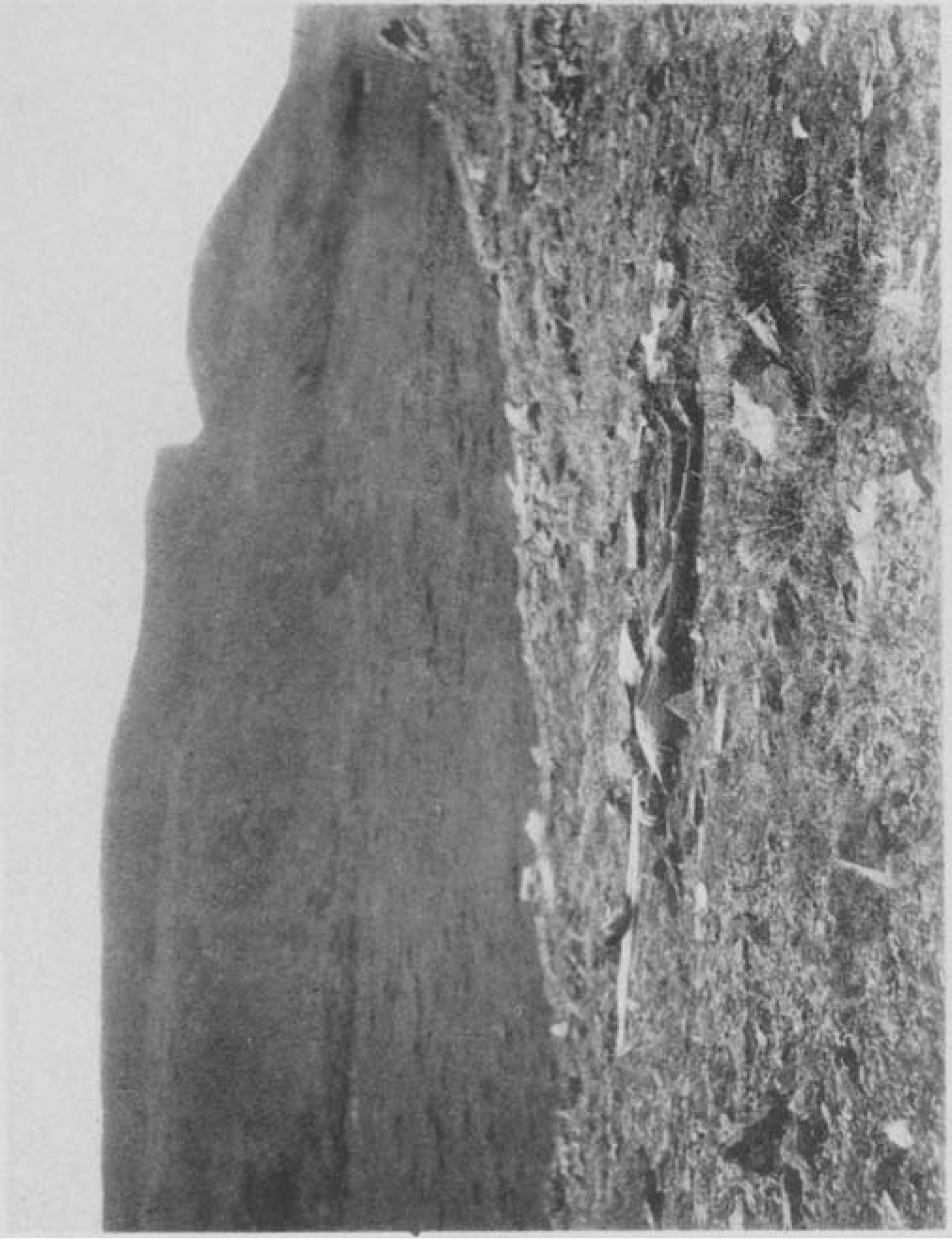
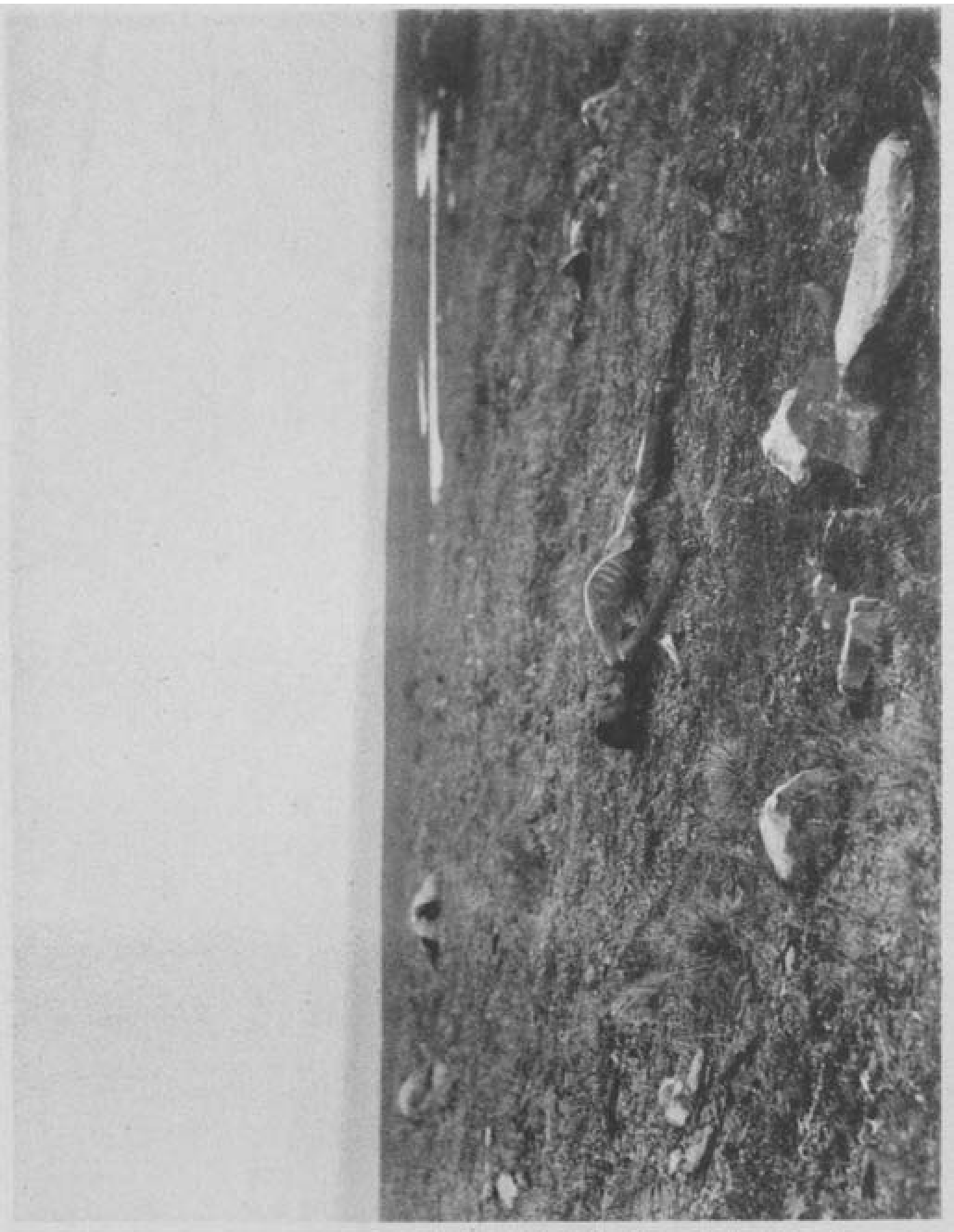
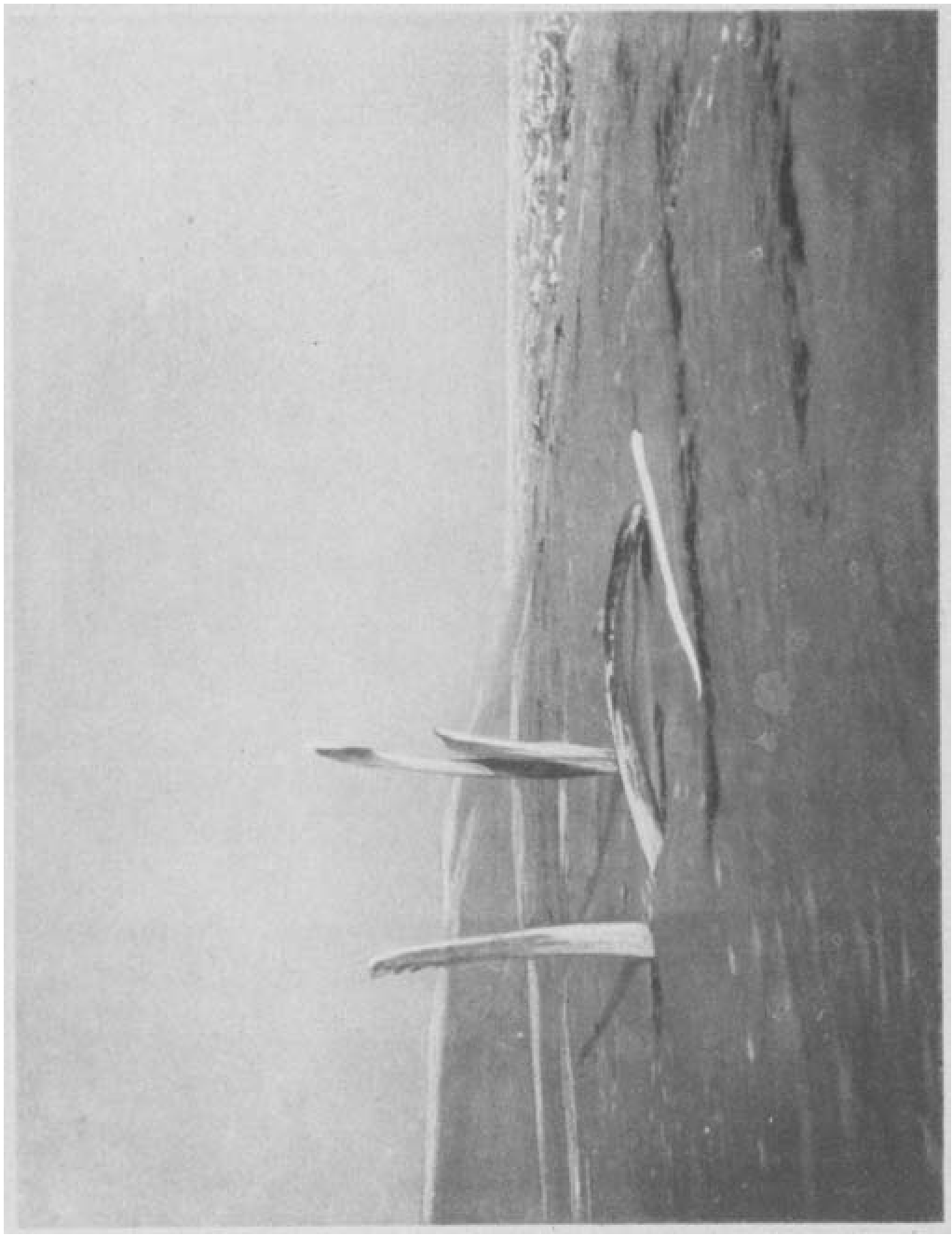
Exposing of the Body. — On arriving at the place indicated by divination, the people choose some level spot for the funeral, and, laying off on it a portion about the size of the body, they encircle it with stones in the form of an elongated oval. (Plate XXXIV, Figs 1, 2). One end of the oval is pointed toward midnight, and the opposite end is left partly open. This enclosure of stones is called “enclosure of the dead one” (palaˊwkun). Sometimes three stones are considered sufficient to form the enclosure. One is placed near the head of the corpse, and the other two, one near each shoulder. In this case the stones selected must be larger than usual. When stones are scarce, as in the interior and far from the river-banks, the enclosure may be formed of three short logs, laid out in the same order as the three big stones of the “enclosure of the dead one.”
The sledge with the corpse is pointed with its head toward midnight. Then the reindeer are unhitched, and with four knives they are stabbed simultaneously from the right and from the left side. As soon as they have fallen, the harness is put on again; but the collars are now placed over the right shoulder, the reverse of the usual way. The chief of the cortège, sitting in his place astride of the corpse, jerks the reins violently, and urges the reindeer with the whip, pretending that he is going fast to the country of the dead. The other people encourage him, exclaiming, “Hurry up! go faster!” When the slaughtered reindeer kick about in the last agonies, the people exclaim, “Oh, they are going fast!” The chief of the cortège says, “I have reached the confines of the country of the dead.” When the reindeer cease kicking, the chief of the cortège says, “We have arrived.” If the reindeer micturate before their death, it is considered a very good sign for the living people.
The harness is taken off the dead reindeer, the corpse is lifted from the sledge, and put, still all wound up with thong, upon the ground within the “enclosure of the dead one.” Its head is pointed toward midnight. The place has been previously strewn with bits of tallow and sausage brought for that purpose. The reindeer are skinned, and their meat is cut off in large, thin slices. The bones of the legs are broken with an adze, and the antlers chopped off together with the top of the crown. Two tent-poles are placed on the ground near the feet of the corpse, pointed in the direction of its legs. These poles are its wooden legs, to be employed in the country of the dead. Usually they are the same poles that were laid under the runners of the sledge, near the entrance, at the time of divination. In case of necessity, the tent-poles may be replaced by long sticks cut off in the woods. Then several of the “followers” approach the corpse and proceed to prepare it for the next step in the ceremony. Previous to that, all of them[527]🗗uncollated caw like ravens, or bark like foxes, three times. This is done to conceal their identity and to make it appear that they are ravens or foxes.
Then they begin to break the thong and to cut the clothes of the corpse, replacing each piece with a slice of meat, until the whole body is incased in this new covering. The face is covered with the duodenum. A long piece of the thong is untied. This the “fortifier” winds around his waist, and takes home to perform an incantation over it. Last of all, the pieces of clothing are pulled from beneath the corpse. All the pieces cut off are laid together at the right side of the body. The things brought along for the personal use of the dead — such as the pipe, the knife, etc. — are also left on the ground near the body. It is interesting to note that, among other things, a small wooden image of a canoe is often left there. The Chukchee say that it serves the deceased for that part of his journey which must be made by water. The Reindeer Chukchee in actual life, however, have very little occasion to use the canoe, at least in the interior of the country.
The sledge, the harness, and the traces are also cut and broken, and the pieces are added to the heap. I was told that the sledges might be left whole, but that they were broken lest the Russians or the Tungus should take them away from the funeral place. Indeed, I know of cases where whole sledges and other objects which were left near the corpse were really appropriated by the people of “alien” tribes. One cossack on the Lower Kolyma told me that, in one of his travels over the tundra, he took from the funeral place of a Chukchee woman a cup and saucer of cheap china and an iron scraper. The next night the woman appeared to him in a dream and begged for her property. He was so affected by that dream, that he returned to the funeral place, from which he had already travelled thirty miles, and restored the stolen goods. The Russianized natives of the Kolyma who accompanied me always showed an inclination to rob the Chukchee funeral places of everything useful, but without any such scruples as those described above, and it was difficult for me to prevent them from so doing. On the other hand, in the camps on the Chukchee Peninsula and in the Maritime villages, where there is no danger of theft from the funeral places, the things left with the deceased are nevertheless very frequently broken or spoiled, as, indeed, is done by many other tribes at funerals.
The carcasses of the reindeer are left on the spot, and the two sets of antlers are placed at some distance from the body, one on either side of the head. Then the “fortifier,” or the nearest relative of the deceased, proceeds to rip up the body. He does it with a long knife, carefully avoiding to touch the body with his hands, though they are protected with mittens or with gloves of special form; that is, those with three fingers only. With two strokes of the knife, which cross each other, the “fortifier” opens the breast, and lays bare the internal organs. Of these, the liver and the heart are also[528]🗗uncollated split with the knife; and the “fortifier,” on inspecting them closely, will proclaim to the by-standers the probable reason of the death. For instance, once in my presence it was said, “The liver is quite diseased, the heart is full of pus. With organs in such a state, it was evidently impossible to live any longer.” Another time it was said, “The liver looks dry; the heart is shrunken to a small lump. It shows that the deceased one died from fear, from despair at the attack of the keˊlet.”
I was told that sometimes indications are found of the harmful influence of evil “spells,” created by some human enemy of the deceased; but I had no opportunity of witnessing a case like that.
At last the “fortifier” cuts the throat of the corpse, and leaves the body. This last stroke is to prevent the spirit of the deceased from following the people of the cortège, and it is considered quite indispensable. A murderer, even, after despatching his victim and before leaving the body, cuts the throat, in order to prevent the spirit of the victim from pursuing him. A desire to free the soul of the dead, which will escape through the cut and fly away with such impetus as to make it difficult for it to come back again, is given as the reason for these actions.
Protecting-Incantations. — After the ceremony is ended, the participants arrange themselves again, but the order of the cortège is reversed. It passes now around the body from left to right, and proceeds on its return to the camp. The changing of the order is, of course, a defensive measure to ward off pursuit by the dead. On the return journey, the “fortifier” and the chief of the cortège, who now close the rear, perform several incantations, all of which, so to speak, belong to the cycle of the “magic-flight” tales.
Thus the chief of the cortège, having with him a snow-beater, now traces with its point at several localities, after the procession has passed by, a line across the road. This line is to be transformed into a chasm or into a deep river. The “fortifying” person will leave behind one or several small stones, which will be turned into steep mountains. He will bring along a small cup and the bunch of grass which served for washing the corpse, and will hide these objects separately in the snow on his return journey. The cup will transform itself into a sea, and the grass into a dense forest. Similar incantations are repeated at home, before the entrance of the tent.
The skins of the slaughtered reindeer are taken to the house and spread in the sleeping-room, where they must remain for five days. The “fortifying” person enchants a piece of sheet-iron having many holes pierced in it. This iron is placed under one of the skins of the bedding in the sleeping-room. If the deceased should try to enter the sleeping-room from under ground, he would be caught in the holes in the sheet-iron, which would act like an iron net.
The oldest two women of the tent must meet the cortège on its arrival. They present to the returning people a bunch of newly twisted sinew-thread[529]🗗uncollated which has been strengthened with incantations. Each member of the cortège carries a small twig of willow, around which he winds a piece of thread received from one of the old women. Then he removes the thread, and winds it around his right wrist, but neither ties nor fastens it. The twig is put on the hearth as a purifying sacrifice, destroying any unclean influence caused by contact with the dead body. The thread wound around the wrist is worn there till it drops off, which will happen after a day or two.
All the members of the procession, holding one another by the hand, form a large ring, which is encircled by that part of the thong that was taken home from the funeral. Each of the members takes hold of it, and each one cuts off the part nearest to himself. This severs all connection between them; and the spirit of the deceased, if it should ever come back, would have to find them out one by one. The pieces of the thong are generally wound around the waist for a belt, though any other use is also admissible.
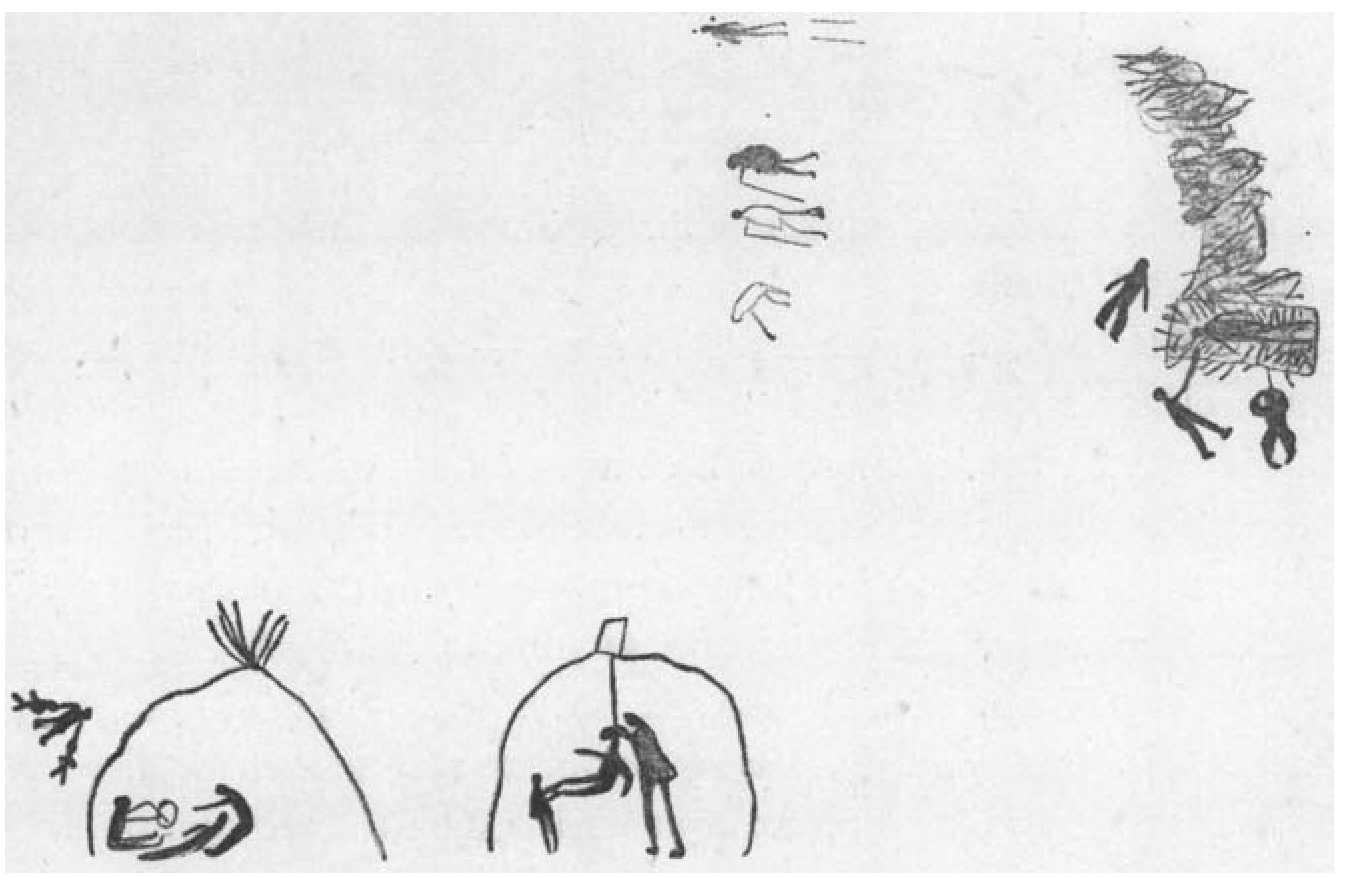
Fig. 300 is copied from a native drawing representing death and burial. In the house on the left a man dies. The shaman gives his drum to another man in token of his impotence. A keˊlᴇ goes away, carrying in both hands the souls of the man, in much the same way as men carry small game. Above, on the left, three men return from a burial-place where the corpse was left exposed. A small stone is left by them on the road as part of an incantation. The chief of the cortège traces a line on the ground, making another incantation. On the right a corpse is being burned. A woman standing by weeps.
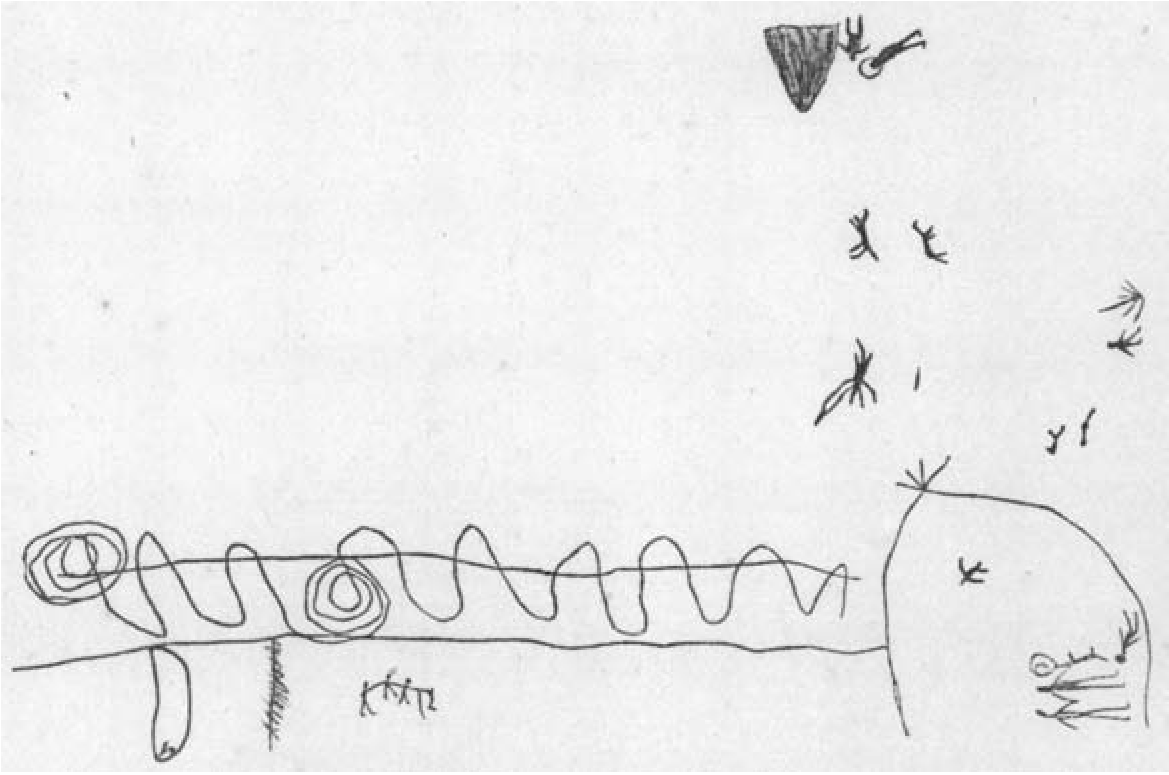
In Fig. 301, which is of similar provenience, the house of the “Upper Being” is represented near the upper right-hand corner. He stands before the entrance with his wife. From below, two sacrificed animals ascend to him. One is a dog, the carcass of which is lying below, with the guts drawn out according to custom. The other is a sacrificial substitute for a reindeer, made of pieces of sausage. Dawn-Woman is standing on the right-hand side, in[530]🗗uncollated the middle, near a dry tree with roots bared from the soil. Sacrifices ascend toward her also. They are an image of a reindeer made of leaf-pudding, and three beads strung on a thread of sinew. In the right-hand corner, below, a house of deceased people is represented. A shaman tries to lead away one man. He has in his hands a coil of thong and a pelt, which represent the payment given in advance. Two spirits are assisting him, — one in the shape of a bird, the other human. Farther to the left a keˊlᴇ and another shaman draw in opposite directions the soul of a dead man. The shaman carries a staff with a long tassel. The trail of the dead man runs in a zigzag course, and he must pass on his way a forest and two round lakes.
Visit to the Funeral Place. — On the second day after the funeral, the relatives and friends of the dead one visit the corpse. This visit is called “fetching of iron,” because most of the iron objects left with the deceased are taken away, and replaced by wooden reproductions. Perhaps this name has been devised in modern times, because, in conjunction with it, the ceremony is also called “visiting the dead.” Besides fetching the iron, one of its objects is to see whether beasts of prey have disturbed the body. If this happens very soon, the relatives of the deceased feel secure. On the contrary, any prolonged delay in the destruction of the body by beasts signifies that the dead one is waiting for a companion. Another object of the “visit” is to offer sacrifices, and to leave antlers with the dead.
The people who take part in “visiting the dead” are much more numerous than the “followers” of the funeral procession. The inhabitants of the camp, even the small children, go in a body; and guests come from a circuit of fifty miles, especially if the deceased was a wealthy reindeer-breeder. The herd, or a part of it, is brought along. Each of the visitors must bring to the dead some little present, — a piece of sausage, some marrow from a bone, a lump of sugar, a leaf of tobacco. The women of the camp prepare and bring along quantities of sausage and meat-pudding, also all the marrow from the reindeer slaughtered on the day of the funeral.
On reaching the corpse, the “fortifier” pretends to catch it with a lasso[531]🗗uncollated brought for the purpose. Then the noose of the lasso is arranged on the ground so as to encircle the head of the corpse and all the objects deposited for the use of the deceased one on the day of the funeral. Then the corpse receives an offering from each member of the party. The remainder of the food is spread on the stones near the dead body, and the guests partake of it. This is considered as a meal offered by the deceased. Then the slaughtering begins. If the family is rich, each of the guests will receive a slaughtered reindeer. The poor or the avaricious kill only a few animals, and distribute the meat among their friends; but then there will not be such a multitude of guests. The legs of the reindeer are broken and the marrow is extracted. The heads are cooked in large kettles, and the feast begins, during which the corpse receives its share of all the courses.
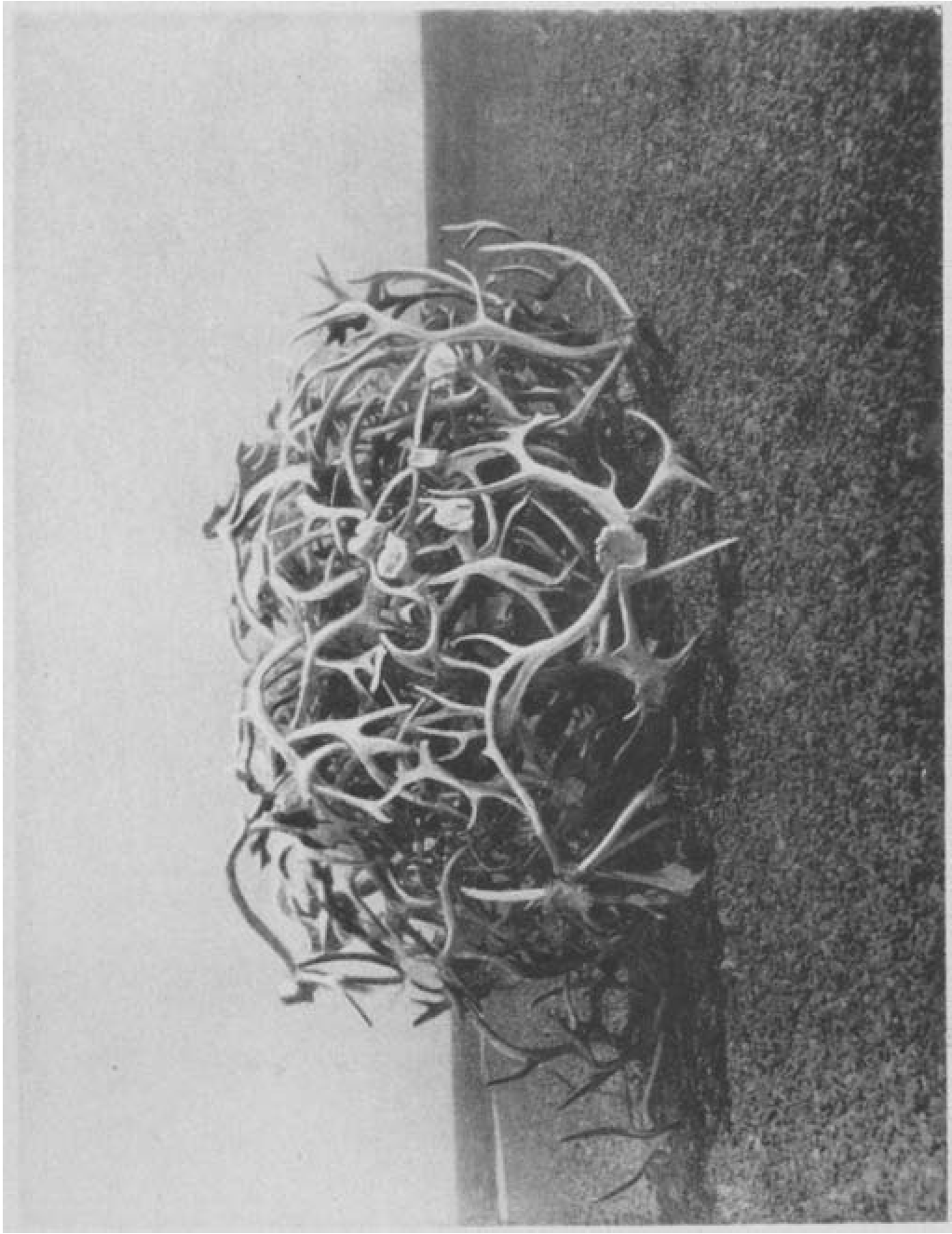
The antlers are hewn off, as usual, with the tops of the crown, and are burned for a few seconds in the fire to make them secure against harm by wild beasts, which the odor of the smoke will frighten away. After that, the antlers are arranged in a line extending from the head of the corpse toward the direction of midnight. The antlers of each set are pointed upward, and their bases are pressed firmly into the ground, and made fast with stones or logs. The heap of antlers is called “antlers’ store” (tɪˊnmai). All the contents of the paunches of the slaughtered animals are emptied on the ground, and the iron objects left with the corpse are purified by immersing them in this mass. Then they are taken out and carried home. In their places are left, partly wooden substitutes, partly equivalents of inferior quality; for instance, a splinter of bone instead of iron needles, evidently as material of which to make bone needles, a stone scraper in the place of an iron scraper, etc. Other objects — as cups, pipes, pouches — are not exchanged. The bow also, as well as the iron arrows, are left in their places. Other iron objects also are sometimes left with the corpse. I saw, for instance, iron knives and adzes on funeral places, though, as a rule, they were old and much used, and evidently had been given to the deceased in place of implements of a better quality. I saw even old rifles, but they were always broken.
After the purification of the iron, the “fortifier” proceeds to the divining, using either a special stone or any object suitable for suspension from a stick. The details and the questions are similar to those on the day of the funeral. The magic precautions against pursuit by the spirit are also repeated with many variations. I saw, for instance, at one funeral at which I was present, an old man urinate close to the head of the corpse, which astonished even the other participants in the ceremony. His purpose was to create a river between the corpse and himself.
On coming home, another feast follows, during which the piece of skin taken from the clothes of the dead is put in the place of honor in the inner room, and receives its share of the food. This is repeated at every meal[532]🗗uncollated for five days, after which the piece of skin is added to the household charms. The number of days which must elapse between the first and the last performance is the same as in the birth ceremonial. After five days, the people visit the corpse again to see if wild beasts have at last mutilated the body. On the return from this visit, the whole camp arranges the feast of antlers, even though it may be quite out of season. If antlers are scarce, they gather together all the loose ones that can be found, though the use of such antlers for the antler ceremonial is generally forbidden.
On coming back from the second visit, the family move their tent to another place, though it be only five or six feet distant. Especially is this the case if the dead one was carried out, as sometimes happens, through the usual entrance of the tent.
Still later the chief of the funeral procession must perform additional incantations in order to protect himself from being pursued by the deceased. To give an illustration of this, he will some time during the following summer wade through the water in a pool, proclaiming aloud, “I am not a man: I am a white gull, I am an eider-duck.” If he should fail to do this, a dangerous illness would be sure to attack him.
Such is a typical performance of the funeral ceremony of a Reindeer Chukchee, with exposure of the corpse in the open country, and with much slaughtering for sacrifice. For the poorer people, of course, all the details are much simplified. The bodies of the deceased who “go away afoot” will not be covered with meat. After the cutting of the clothes, two pieces will be left on the body, — one covering the face, and the other covering the genitalia. The bodies of small children are sometimes cut to pieces and scattered in all directions. The purpose of this is to show to the World (Ñaˊrg̣ɪnên¹) the extreme grief of the parents, and to reproach him for his severity towards the child.
Burning. — The details of the ceremony of burning the dead are more or less similar to those previously described. The reindeer slaughtered on the day of the funeral are left unskinned on the spot, with the legs broken and the antlers chopped off. Neither the clothes nor the thongs are taken from the body, which is laid on the pyre upon its back, and covered with logs. The entrails, for the most part, are not inspected, and only the throat is cut. The parts not consumed by the fire are left among the embers of the pyre.
The fire for the pyre is kindled with matches or with a strike-a-light. The fire-drill of the family must not be used for this purpose, as so doing would contaminate the hearth. In the absence of matches or of a strike-a-light, a special fire drill and board are prepared, which must be left on the[533]🗗uncollated funeral place after the ceremonial. On the other hand, a dead woman often receives, among the objects given to her for her last journey, a model of a fire drill and board, with accessories.
Sacrifice to the Dead. — The next year the family, when passing with their herd near the place of the funeral, visit the deceased and leave with him more antlers. The same thing is done afterward year by year, as often as time and occasion permit. The “antlers’ store” is considered to represent the dwelling of the deceased; and the Chukchee say that, if it is not in good order, the dead one feels cold: therefore they take care to add to it as many antlers as they can. As soon as the “antlers’ store” has enlarged considerably, the people put all the antlers into one heap, which gradually increases to vast proportions.
Year after year the family store away a part of the antlers from the slaughter of their reindeer, to be added to the mounds of their dead (see Plate XXXIV, Fig. 4). For this, only the best antlers, taken from an animal actually killed, are used. Antlers that fall off are considered unfit for the purpose. The antlers of wild reindeer, and also the many branched or palmated antlers of large domesticated bucks, are considered the most desirable for the purpose.
Of course, only the most respected among the dead receive such proofs of consideration. If there are several of these in the family, each is supplied with antlers in turn, or as the family passes near the various funeral places. On the other hand, antlers destined for a particular mound are often carried along for two or three months before they reach their destination.
Besides this, nearly every year, during one of the great ceremonials of the fall, separate commemorative sacrifices are performed in honor of the dead. In a sacrifice of this kind, a reindeer is slaughtered and laid on the ground at the left side of the entrance, with the head pointed toward the direction of the funeral place. Then some small mound of earth near the sacrifice is considered to represent the funeral mound in question. It is sprinkled with blood, and small pieces of marrow and brain are scattered over it. Those who perform the sacrifice exclaim, “Yo ho! come here and eat!” in the same way as is done in the usual sacrifice. In other cases the sacrifice is buried in the ground, close to the entrance of the tent. All of the flesh of the slaughtered animal is cooked and eaten, while the dead one receives his share on his symbolical mound. Afterward the antlers are either taken to the actual place of the funeral, or are left on the ground near the mound of sacrifice. Whoever has several dead of equal importance must bring a sacrifice to each of them, or, if he wants to apportion his offerings, he must designate the sacrifice of each year for one of the dead. On the funeral places of the respected dead belonging to wealthy families, or on those of renowned shamans, large heaps of antlers gradually accumulate. For instance,[534]🗗uncollated the “antlers’ store” of Amraˊkwurg̣ɪn,¹ the chief of the Reindeer Chukchee, is higher than the stature of a man.
On the large island of Aˊčon, near Chaun Bay, is an ancient mound of antlers which is connected with the name of Qeˊeqi, a female shaman whose funeral had been held at that place. The mound is said to be very old, and is partly sunk into the ground. The part exposed is still more than a fathom high and five fathoms in diameter. I saw also in the Anui country heaps which, perhaps, had been more than half a century in accumulating, and which already contained several hundred sets of antlers.
In contrast with the commemorative sacrifice, which is almost always personal, the “antlers’ store,” as soon as it reaches the proportions of a heap, partly loses its personal character, and may commemorate all members of the family. Thus, in the funeral places of the Maritime people, where all the dead of the village are exposed, the antlers are gathered into several large heaps, in commemoration of all the dead whose bodies were disposed of near it. New sets of antlers are brought in by individual families for their dead, but after a while they are added to one of the common heaps.
I know of cases among the Reindeer people where whole families were swept off by famine or disease, and the relatives, unwilling to leave them without funeral, would bring a collective sacrifice for the whole family, and then build up an “antlers’ store,” without even caring to find the place where the bodies of the dead were lying.
In some cases a person dying in a strange country, as while on a trading-expedition, will express a desire to be laid in his native land. This desire may be made known either before the end, or, as happens more frequently, afterward, by divination. However, the body of the dead is very rarely taken to his home, but is disposed of on the spot. Then, when his people return to their own country, they arrange another ceremony, which is performed with the same details as if they had the body. Even an “enclosure of the dead one” is made of stones or logs, and an “antlers’ store” is arranged close to it. From that time this place is considered as the actual funeral place of the deceased person, and it receives from year to year its share of antlers.
FUNERAL, MARITIME CHUKCHEE. — The Maritime people are unable to offer sacrifices to the dead in such abundance, and therefore with them the whole ceremony is less complicated. The chief features, however, are the same. They expose the bodies on the ground, cutting and pulling away the clothes, and covering the face and the genitalia with a few strips of skin. Sometimes thin flat stones are used for the purpose. The body is surrounded with an enclosure, which may be replaced by three stones.² Near the feet[535]🗗uncollated of the body are laid one or two long sticks to serve as legs in the land of the dead.¹ Sometimes the sticks are placed apart, or even near the head of the corpse. These sticks are not necessarily taken from the house-frame. Since wood is scarce, the people take it wherever they find suitable material. The antlers are begged or bought from the nearest reindeer-breeders, and those of wild reindeer killed on the hunt are also used.
All corpses are exposed on the same place by the whole village, so that a kind of cemetery is formed. Broad and even mountain-slopes are selected for this in some villages; while in others, on the contrary, the funeral place is chosen on the very shore, near the water. To give an illustration, the dead of the village of Uñiˊsak are exposed on the point of the spit, about half a mile from the village. The spit is in the form of a low ridge sloping on both sides. The continuation of the ridge forms the chief street of the village, separating the houses into two groups. This street is considered to be the way by which the dead and the spirits go to the village, and nobody dares to select a house site on it, so that it remains unoccupied all the time.
In winter the corpses are taken to the funeral place on a sledge drawn by dogs or by the house-mates of the dead. In summer they are carried suspended from the pole which is to be left with the body, being firmly tied to it, the face directed towards the pole. The carriers of the corpse often change places, or are replaced by others, evidently for the purpose of circumventing the deceased in the case of pursuit. On reaching the spot, the pole is untied, and deposited in its usual place, near the feet of the corpse. In other cases the body is tied all around with thong, three pairs of loops being left on each end, by which the “followers” carry it. A dog is killed on the funeral place, and the guts are drawn out and laid on the ground, forming a loop.
All kinds of sacrifices are given to the dead. I found scattered everywhere on the funeral places, besides dry bones and skulls, heaps of antlers, broken rifles, empty brandy-bottles, playing-cards, etc. Kuvaˊr, a trader of Uñiˊsak, whose name has been mentioned several times, left on the funeral place of one of his sons even a graphophone and an old whaling-boat. All these objects were also broken. Here evidently there was no fear of theft. The breaking of the things, as explained by the natives, has for its purpose the separation of their soul (uviˊrit), which may then be taken along by the deceased one.
The commemorative sacrifice is performed early in the fall, a little later[536]🗗uncollated than the first fall ceremonial of the reindeer-breeders. Indeed, the Maritime people, who as a rule visit the camps about that time, have to carry back to their villages the reindeer-meat and antlers necessary for the sacrifice. They carry the latter to their dead, and arrange a feast, in which the dead also receive their part.
Each family has a special place for the sacrifice to the dead, which is in the cemetery, and is called “hearth enclosure” (pênuˊkwun). If, during the ceremony, there are close by corpses of those who have died recently, various precautions are taken. Some of those who are sacrificing bring harpoons and lances, and use them as if stalking the dead, and striking them with their weapons. Others bring thongs, and spread slings before the corpses. After finishing the ceremony, the people repeat their hostile demonstrations and then run away in a most hurried manner.
Among the Maritime people it often happens that persons die at sea whose bodies are never recovered. Those who have perished in this manner receive a special sacrifice offered at the very edge of the water. In the feast, the share of the dead is thrown into the water. One and the same place on the shore serves for all commemorative sacrifices of this kind, and each family has two “hearth enclosures” in which to offer them, — one in the village cemetery for those who died on land; and another on the shore, close to the water, for those who perished at sea.
A man who is supposed to have perished at sea, but who in the end escapes and lands on shore, must undergo a purifying ceremony. For this he is girded with a piece of thong. Then a dog is sacrificed to the sea, on the shore. After that the man is taken to the refuse-heap used by his family, where he must lie down on the ground and wallow in the rubbish. This resembles the purification, among the Reindeer people, of the objects connected with the funeral, through immersing them in the refuse from the paunches of slaughtered reindeer.