VIIHabitations; Household Utensils
Habitations
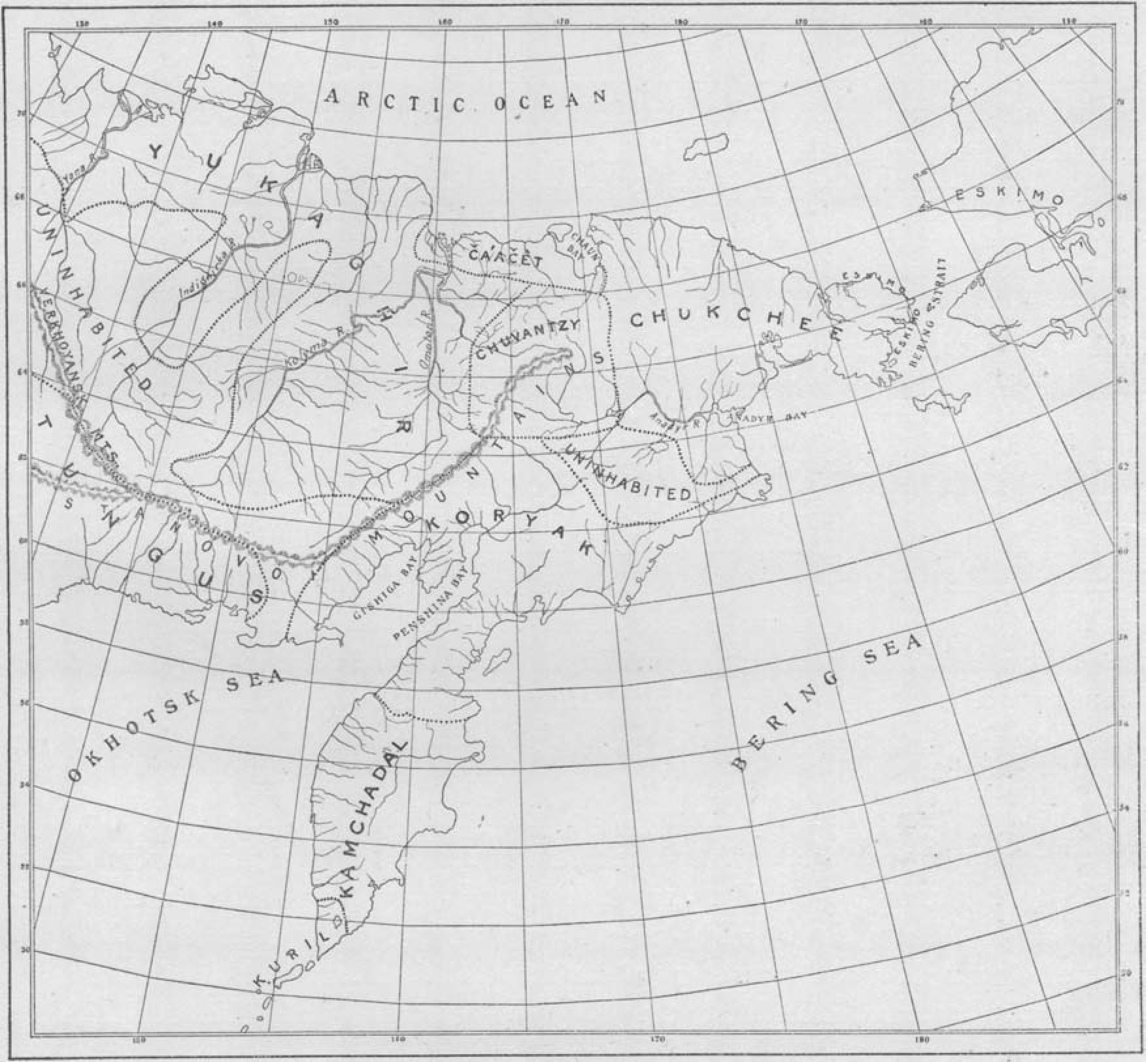
“GENUINE HOUSE.” — The general type of the Chukchee habitation is that of a large, round, skin tent, with a square inner room, which during the winter forms the dwelling-room, and is carefully protected against the cold. This type of house has several variations, and is always called “genuine house” (lɪˊê-ran).¹
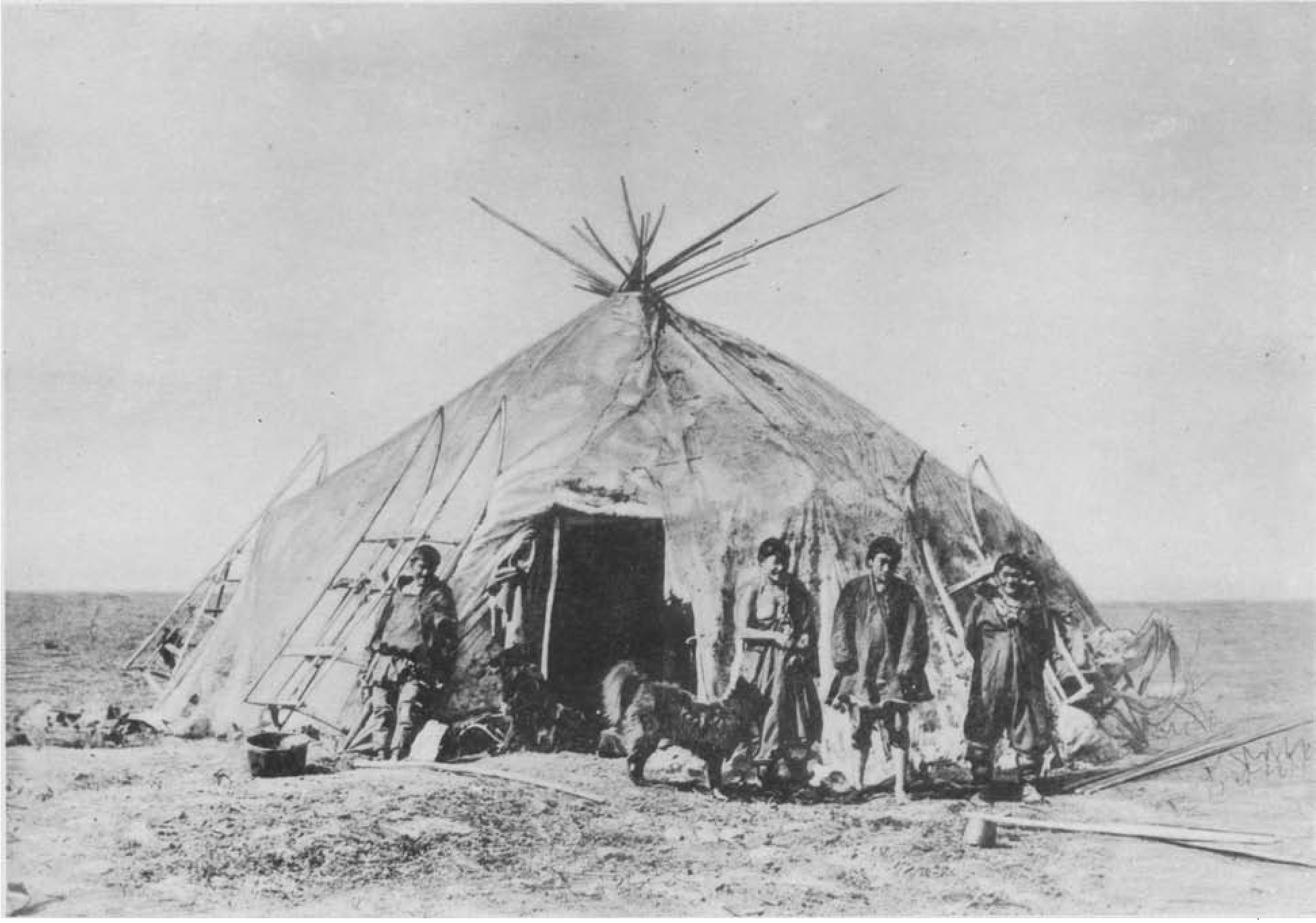
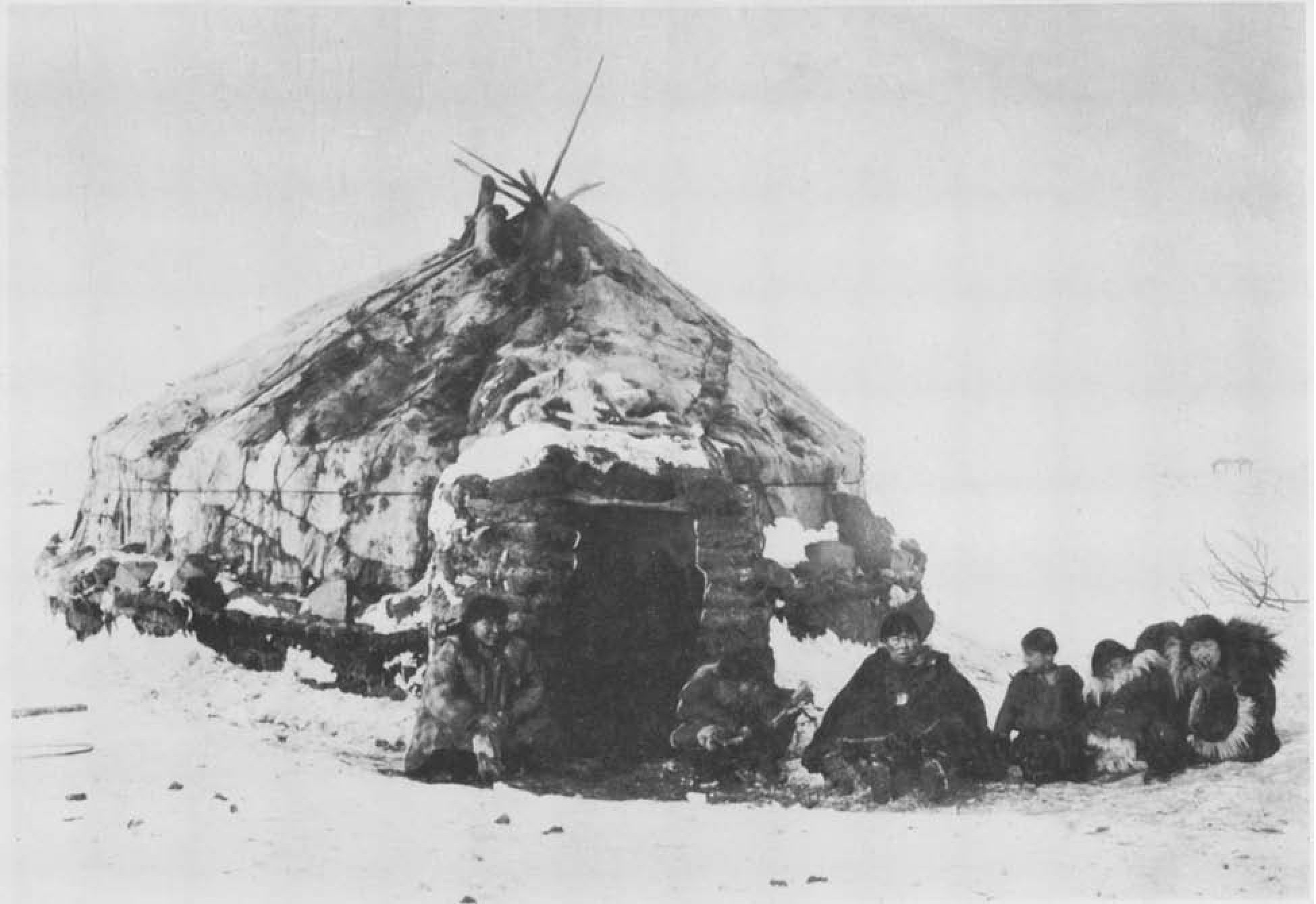
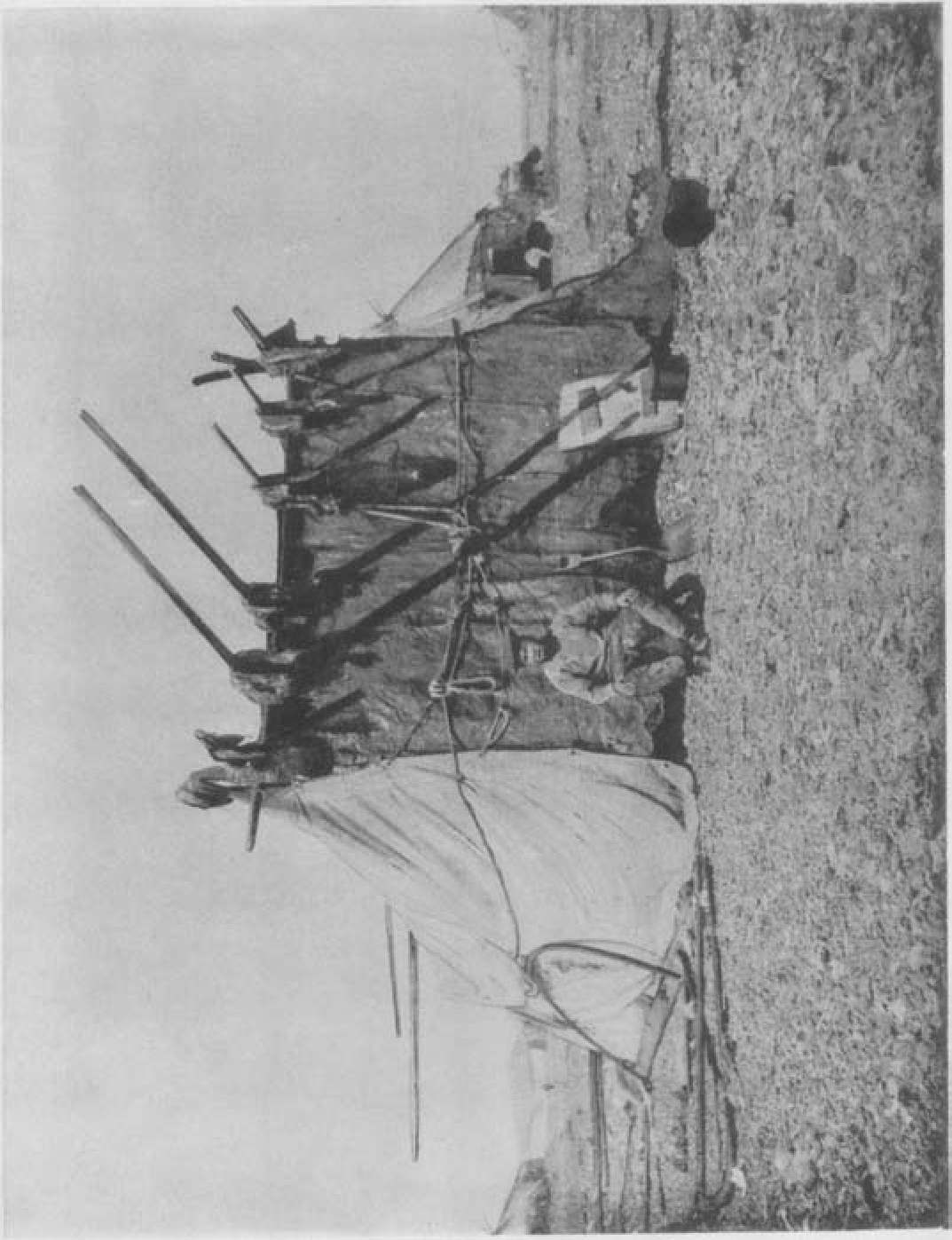
HOUSE OF THE REINDEER CHUKCHEE. — The tent (yaraˊñɪ) of the Reindeer Chukchee (Plate XII, Fig. 1) is round with flaring sides. Its height in the centre is from ten to fifteen feet; and its diameter, from fifteen to twenty-five feet.
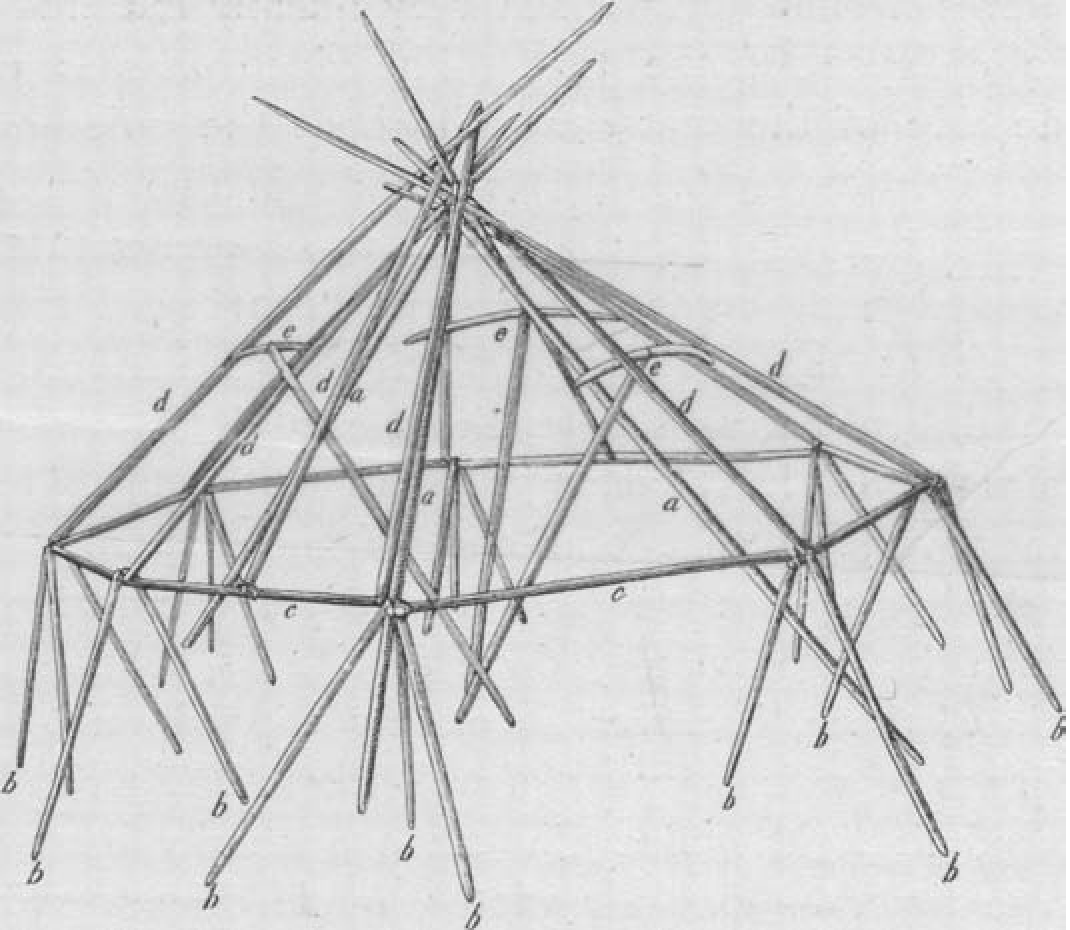
The framework of the outer tent is of the same construction for both winter and summer (Fig. 92). Its central supports are three large, stout poles (a), which are tied together through holes in their tops, so that they can be set up firmly on the ground to form a tripod. These poles are considered as the foundation of the tent, and belong to the sacred objects of the household. Therefore, when a new house is founded, this set of three poles (teˊwrɪril), after being prepared and tied together, receives a separate sacrifice, and is anointed with blood. A number of short thin stakes (vaˊrêt) joined in pairs or threes (b) are placed around the central poles, forming a wide circle. They support cross-bars (učviˊčɪt), c, the ends of which are tied to them. Long thin roof-poles (uˊttᴀmɪt), d, are tied at one end to these points of junction, while their other ends simply rest on the top of the central tripod, supported by it, and in turn bracing it upon all sides. The whole frame is firm and elastic at the same time. The poles are stronger, and the lashings are more carefully made, than[170]🗗uncollated in the frames of the Lamut tents, though the construction is essentially the same in both.
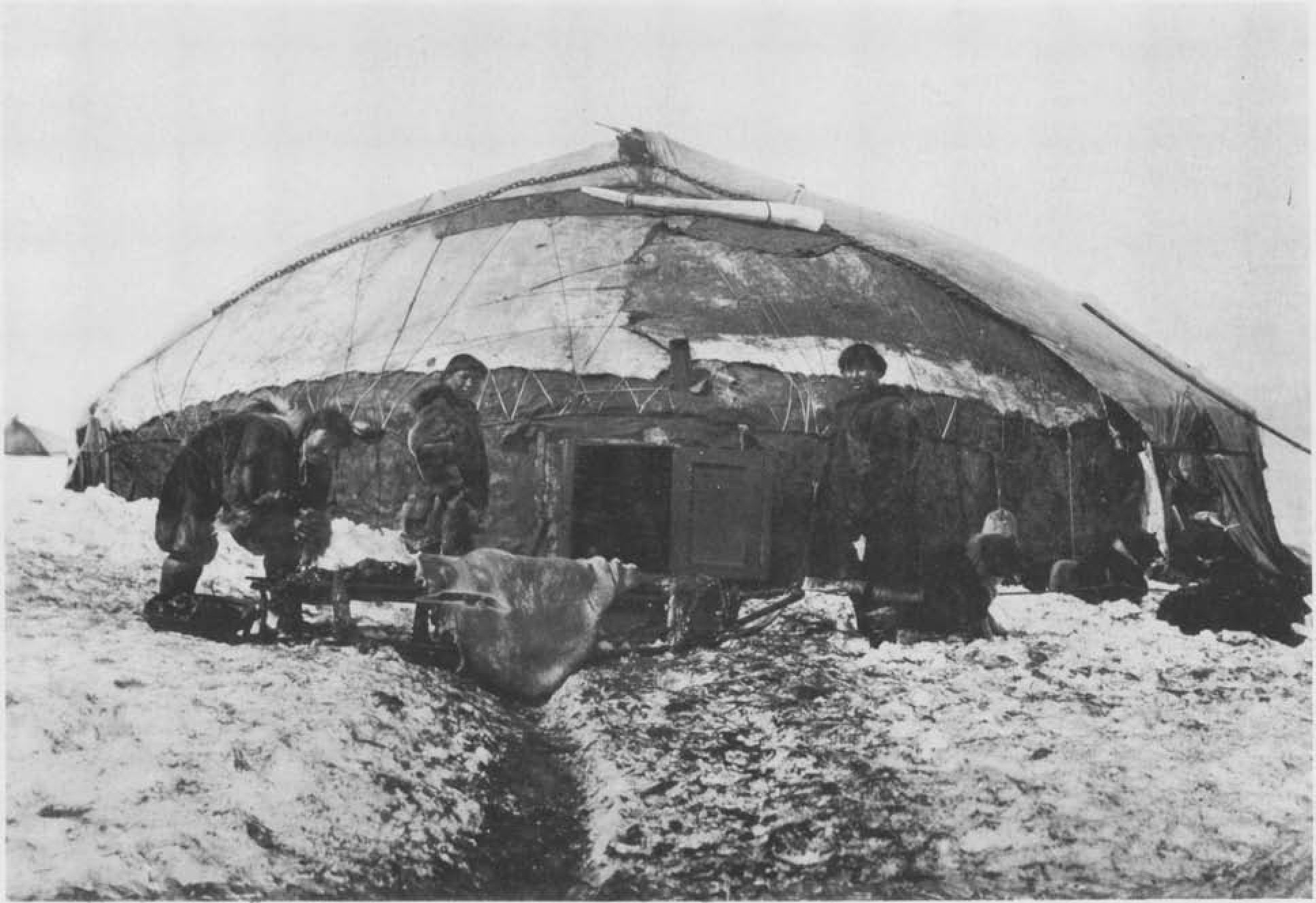
When the skin cover is on, three large stretchers are used to tighten its sides (Fig. 92, e). The stretcher consists of a thin, slightly curved cross-piece fastened in the middle to the end of a long pole. The cross-piece is set against one of the roof-poles (d), and the butt-end of the pole is firmly propped against the ground; then it is pushed outward as far as possible by successive jerks. The tent, propped with the stretchers on all sides, looks like a highly inflated bladder, and is able to resist a strong wind. To make it still more solid, the central poles and some of the most important joints of the frame are strengthened by means of heavy stones tied to them with ropes, or by loaded sledges, which are pushed from inside against the skin cover, the lower end of which is secured under the runners. The sledges are connected with the upper part of the frame by taut cords. Fastened with thongs and secured with stones and sledges, the Chukchee tent is able to withstand the fiercest wind-storms of the open tundra. I had occasion, however, to witness a snowstorm which very quickly battered the frame, and almost caused the collapse of the tent. The deep masses of snow which drifted against one side of the tent gradually bent the poles out of shape.
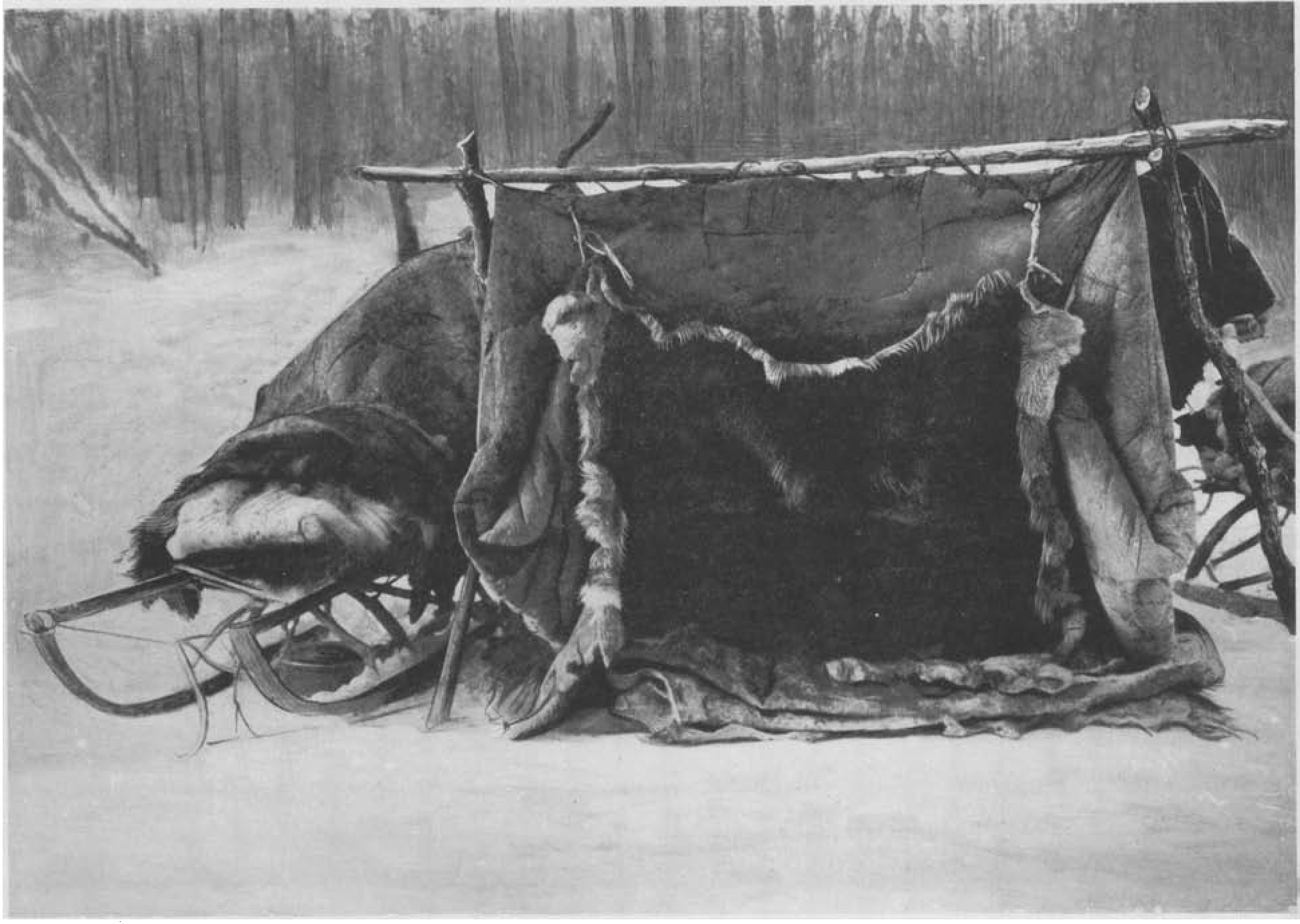
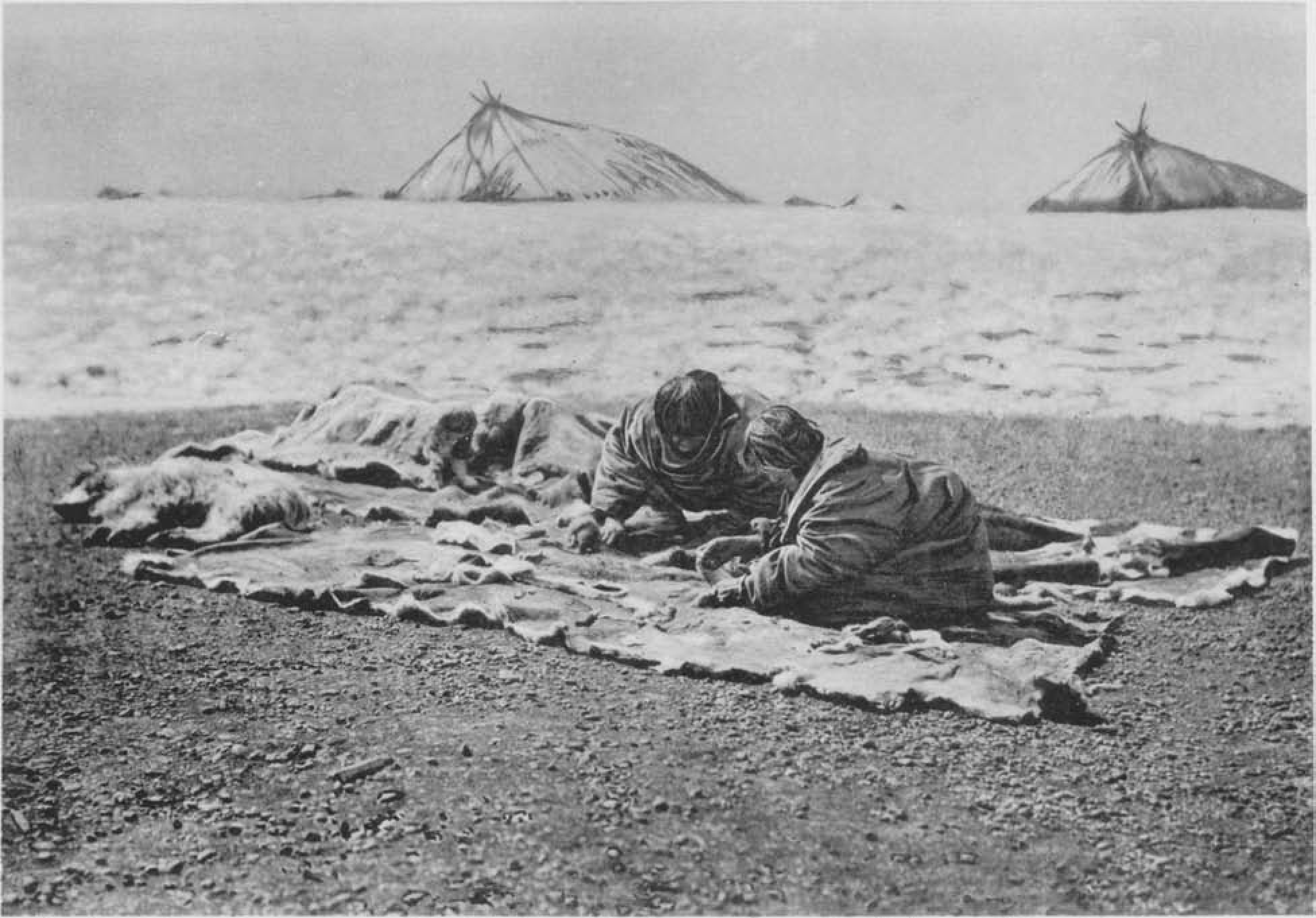
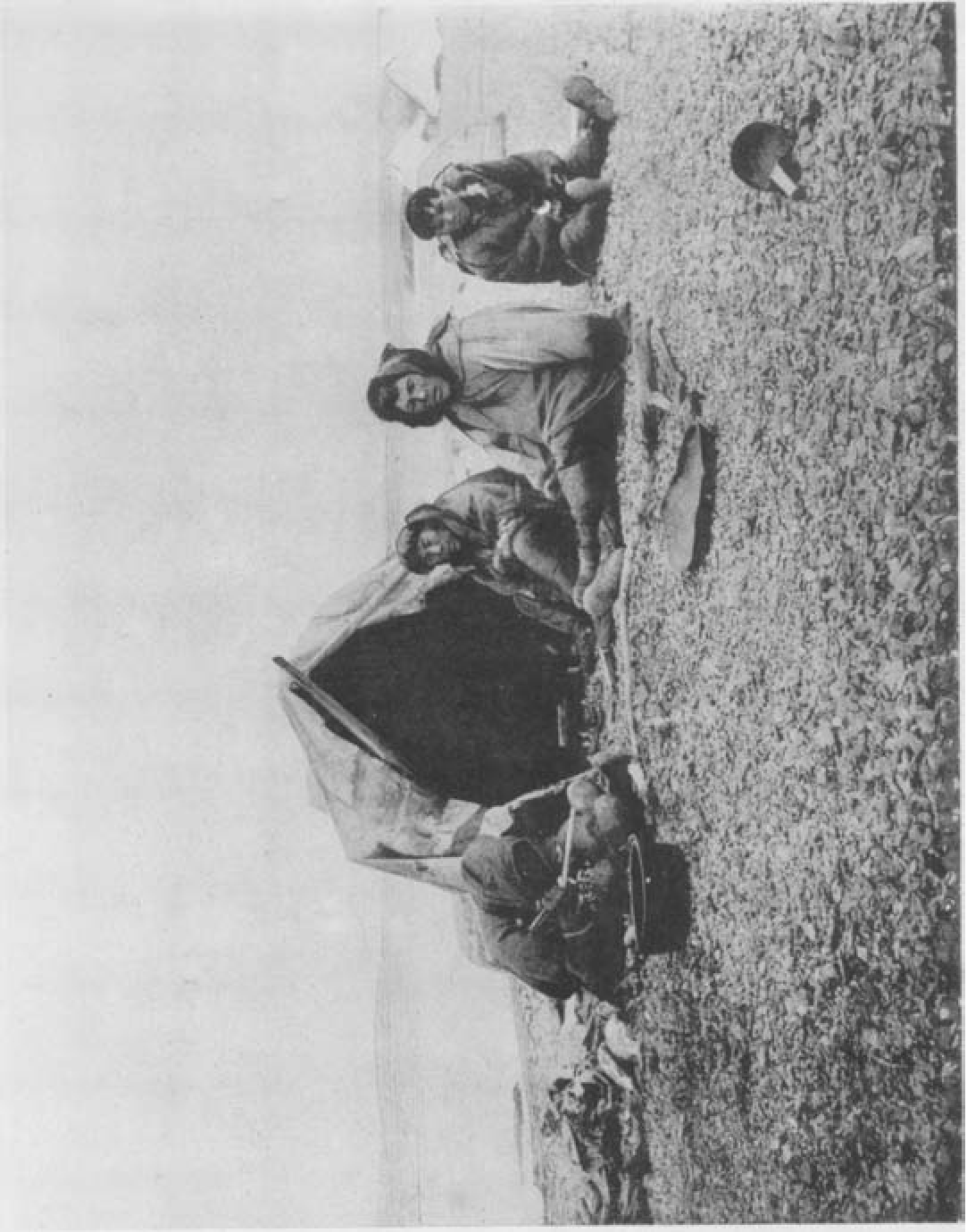
The cover (retteˊm) is made in two pieces: only in small tents is it in one piece. It is thrown over the frame with the hair side out, and is then fastened with cords which have been sewed to its ends. A circular opening is left at the top for purposes of ventilation. The strongest of these cords are drawn across the tent inside, and fastened to the bottoms of the central poles or to heavy sledges. An entrance is left between the two halves of the cover, so that one end of the flap may be turned aside and then fall back by its own weight. The cover is made of skins of full-grown reindeer, which have previously done service as covers of the inner room. The thick hair of these, however, is closely clipped off to make them lighter. In front, a piece of walrus-gut or of well-scraped thin reindeer-skin is sometimes inserted to admit light. The Chukchee generally have two tent-covers in use at the same time, — one for winter, made of new skins, in which every small hole is carefully patched (Plate XII, Fig. 2); and an old one for the summer. In summer the new cover is carefully folded up and preserved for the next year.
The Chukchee pick out for camps flat places without too much snow. After the places for the tents have been designated, the women scrape off the snow with adze-shaped scrapers of antler or of bone (Fig. 93). They pull up all the small shrubs, and then fill in the holes with loose earth or snow.
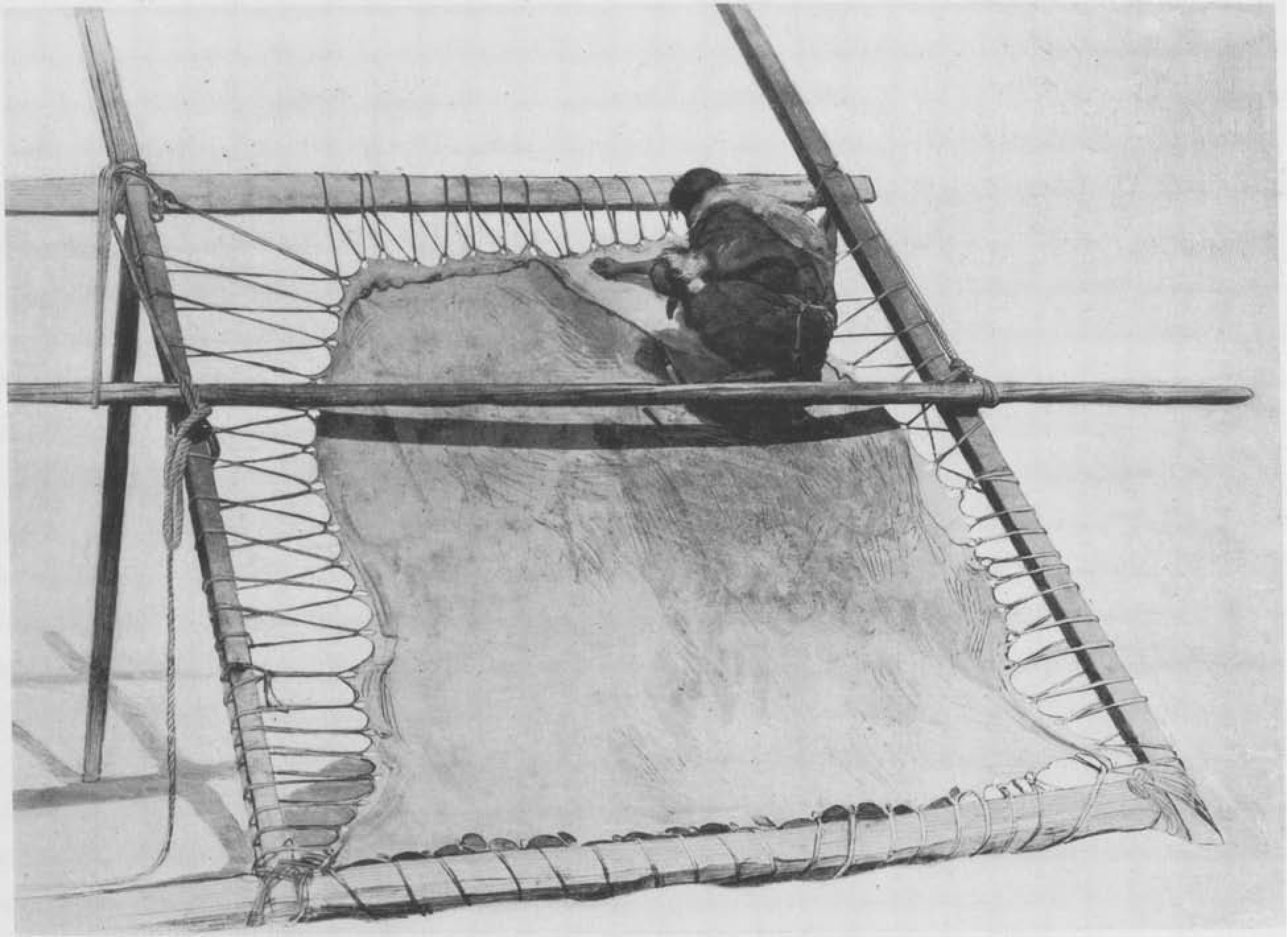
The Inner or Sleeping Room. — The inner room (yoroˊñɪ) has the shape of a large rectangular box set on the floor with its bottom-end up (Plate XIII, Fig. 2). Its dimensions vary considerably. In the smallest there is hardly room enough for four people to sleep side by side, while the largest is high[171]🗗uncollated and wide enough for a person to walk about. The usual dimensions are about 4½ feet in height, 7 feet in breadth, and 12 feet in length. The entrance is in the long side, which faces the flap of the outer tent.

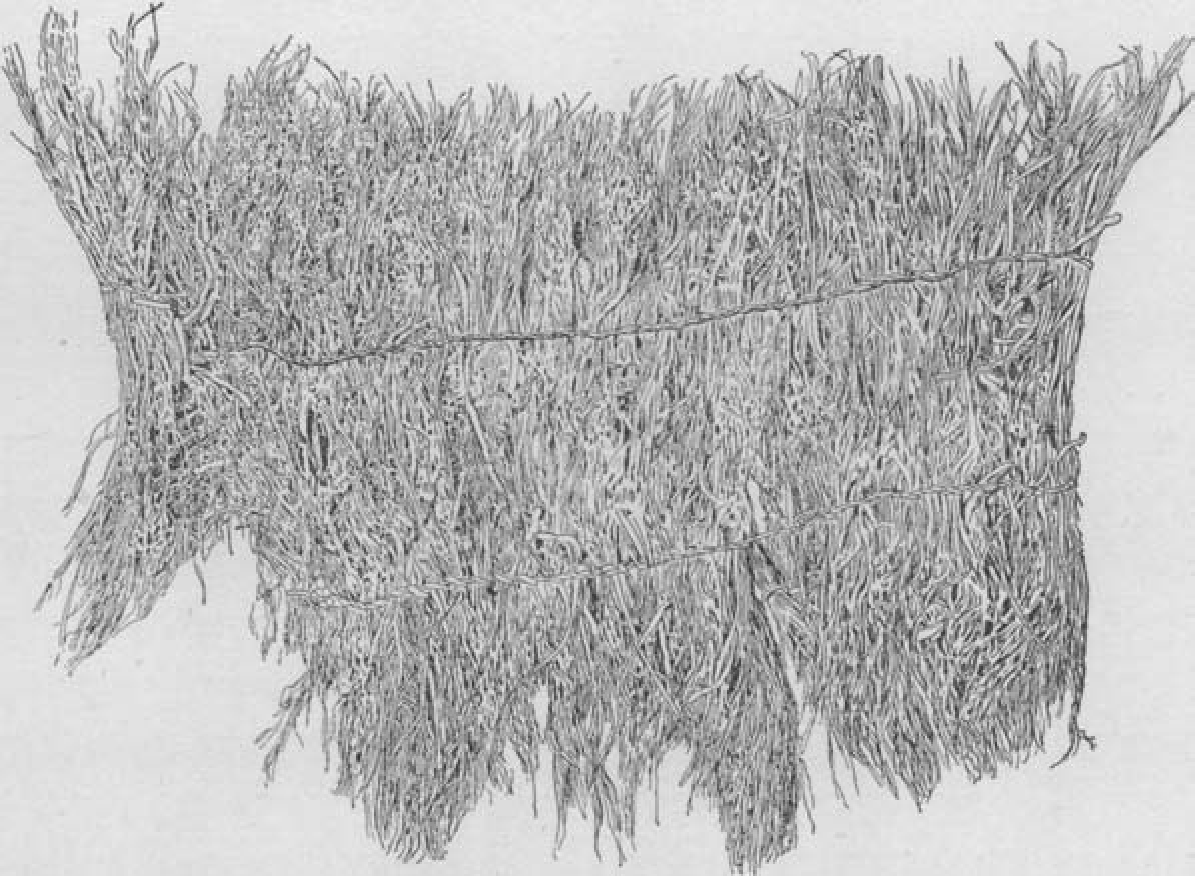
The cover of the inner room is held in position by numerous loops which are sewed to it, and are passed over two long horizontal poles. The rear pole is fastened to the frame of the outer tent. The front pole is supported by two forked stakes of sufficient size. These stakes are called “thumbs” (eˊtti). The floor is covered with willow twigs or with a coarse matting (Fig. 94) made of these, and then with thick skins. The lower ends of the sides of the cover are tucked under the outer edge of the bedding. At the entrance are the bed-pillows, which are made up of one or two oblong bags filled with odds and ends of skins and clothing. These extend along the whole front cover, which can be tucked under them.
The material out of which the cover of the inner room is made varies considerably, according to the season. In the cold season, while the family is still moving with the herd, it is made of the thickest skins with the hair side in, and must be renewed every other year, because each bare spot on the surface of the skins interferes with the comfort of the inmates. These inner rooms, covered with heavy skins, are in use throughout the fall and spring, and among several divisions of the tribe — for instance, the people of the Kolyma tundra — throughout the whole winter. They are lighted by a single lamp, but heated almost exclusively by the animal heat of the dwellers (Plate XIV). Each room is of a size proportionate to the number of inmates, and becomes habitable only after all of them are inside and the loose lower ends of the cover are[172]🗗uncollated tucked in so as to exclude all ventilation. During the night the vapor of the breath and the exhalations from the bodies, having no way of escape, settle down on the fur of the cover. In the morning all the people have to go out; and the women break up the room, and leave its covering to freeze on the snow for an hour or two; then they beat the frost out of the hairy folds with heavy snow-beaters, and afterwards spread the cover on the ground to dry, or hang it up on a tree.
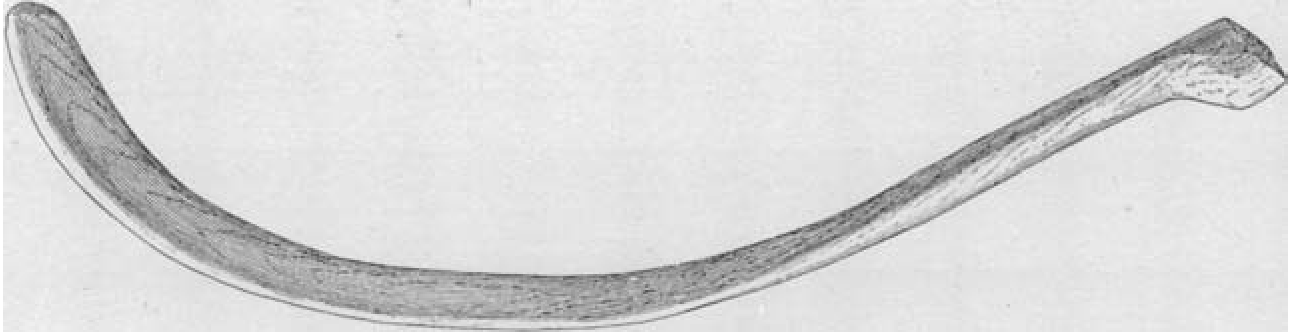
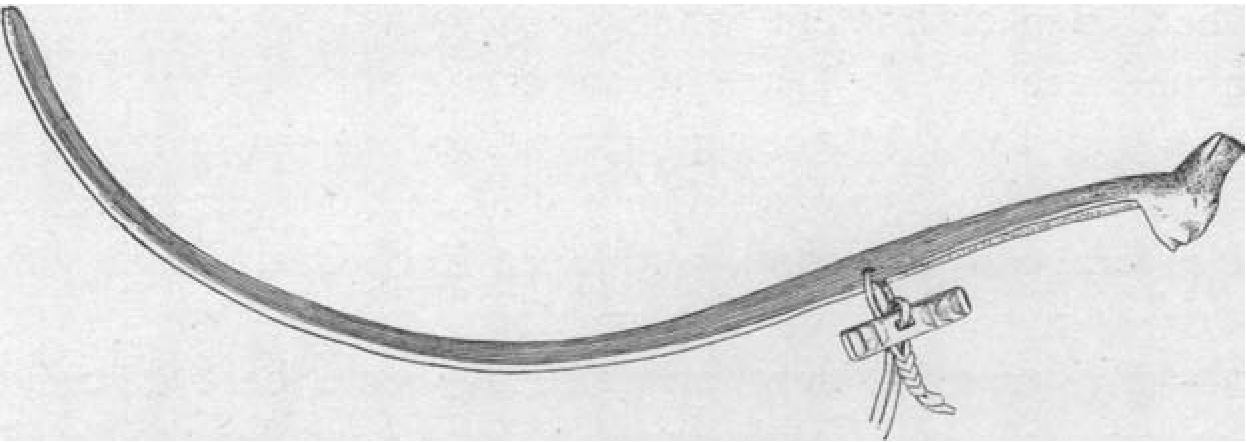
The snow-beater (Fig. 95) is made of antler or wood, and has a somewhat curved shape, often wider toward the end, and more slender toward the handle, which is rounded, and has a knob to give a better grip for the hand. Its length is from 50 cm. to 70 cm. The women, when using it, lift it high over their heads, and then suddenly bring the end down with force upon the spread skin. They work alternately with the right and left hands, rapidly changing from one to the other. Usually two women work on the same cover, since one alone would find it difficult to stretch and manage the heavy skin cover. The beating-out of the frost requires considerable strength, and during the whole winter forms the most difficult task of the Reindeer Chukchee woman. However, in the coldest season it is hardly possible to omit a single day’s beating, because, if the sleeping-room is not beaten out, it will become damp the next night, and even drip with moisture. This continual change from damp to frost, and the severe daily beating, cause the cover of the inner room to wear down rapidly.
In the fall and spring, especially during thaws, the sleeping-room may be left undisturbed for two or three days, and thin and worn covers may be used without causing inconvenience.
The two halves of the outer cover require about forty large skins. The cover of the inner room is made of from twelve to fifteen skins. For the beds ten large skins are required. Each sleeping-room is occupied by a separate family, and belongs to one woman, who takes care of it. There are sometimes two sleeping-rooms in the same tent, but this is not very often the case. Usually the sleeping-room is in the rear of the tent, facing the entrance, which is generally toward the northeast (Morning Dawn¹), occasionally toward the north or east. Thus the square walls of the sleeping-room have a fixed position with respect to the compass. The left side faces the northwest, and is called “leeward room” (aig̣ɪˊs˙qa-ron). The right side is toward the southeast,[173]🗗uncollated and is called “windward room” (aiwaˊʟon). These names call to mind the combinations of winds and points of the compass referred to previously.¹
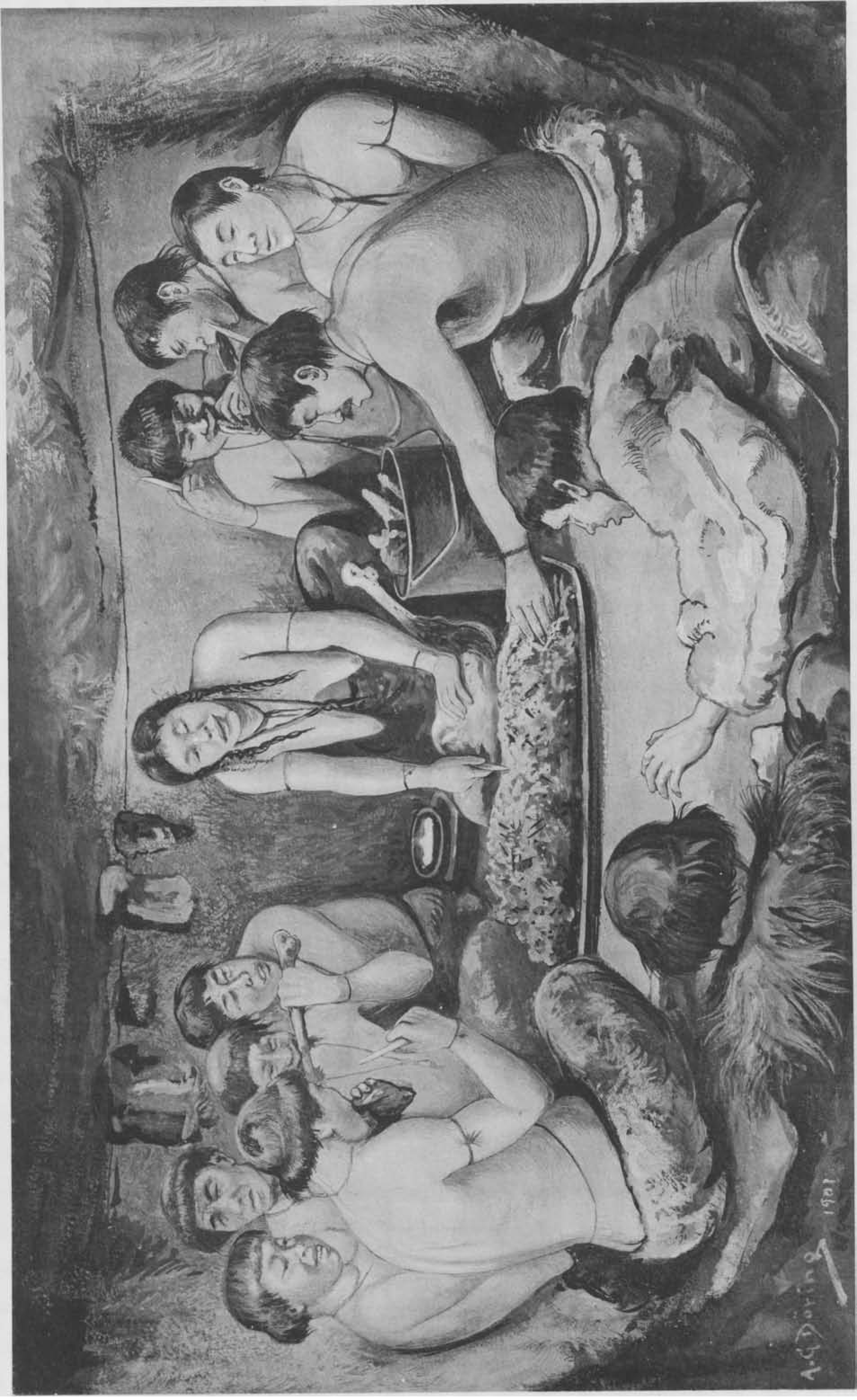
Because of the position of the sleeping-room, the tent often has a somewhat oval shape, the rear bulging out under pressure of the poles used in the construction of the inner room. The rear side (kɪˊnmen) of the sleeping-room has a lamp fixed in the middle, quite near the wall (Plate XIV). Above it, near the ceiling, a line is stretched, which serves for hanging up small articles of dress that require drying over the lamp. The left side of the sleeping-room is always occupied by the master and his wife, and is therefore also called “master’s place;” while the right side is given up to the younger members of the family, and, when necessary, to guests and strangers. The Chukchee sleeping-room, however, affords little room for the stranger. A few extra men crowd it considerably, and are compelled to sit crouching in the strangest postures while eating or conversing. When there are a number of guests, they can only thrust their heads in, and must keep the rest of their bodies outside of the room, lying flat on their stomachs, and raising themselves up, like so many seals, from under the tent-cover, which is fastened around their shoulders. As these gatherings are usually accompanied by a common meal, and trays of steaming meat and kettles of boiling tea are brought inside, the temperature becomes quite unbearable. The guests strip to the waist, the inmates even farther than this, and their naked bodies are flushed with heat and covered with perspiration. The only way to improve the situation is to lift up the front of the inner tent-cover for a while, and let in a wave of fresh cold air, which almost instantly lowers the temperature several degrees, and causes the moisture to condense in thick white clouds. Such changes of temperature, which occur several times during the evening, are trying to the most hardened constitution, and the natives often catch cold from the sudden frosty draughts. After the visitors have departed, the temperature quickly goes down, and the inmates must be careful not to let in any more cold air. Therefore, after the evening meal, nobody is allowed to go outside; and so, to satisfy the demands of nature, every person is supplied with a special vessel (Fig. 96), which the mistress pushes with one hand out from under the room cover, and empties on a large slab of snow which lies near at hand in the outer room.
The people, like the American Eskimo, sleep with their heads to the entrance, reclining on the common pillow. They cover themselves with blankets made of several heavy skins sewed together, similar to those of the Eskimo. Each blanket serves for a whole family.
[174]🗗uncollated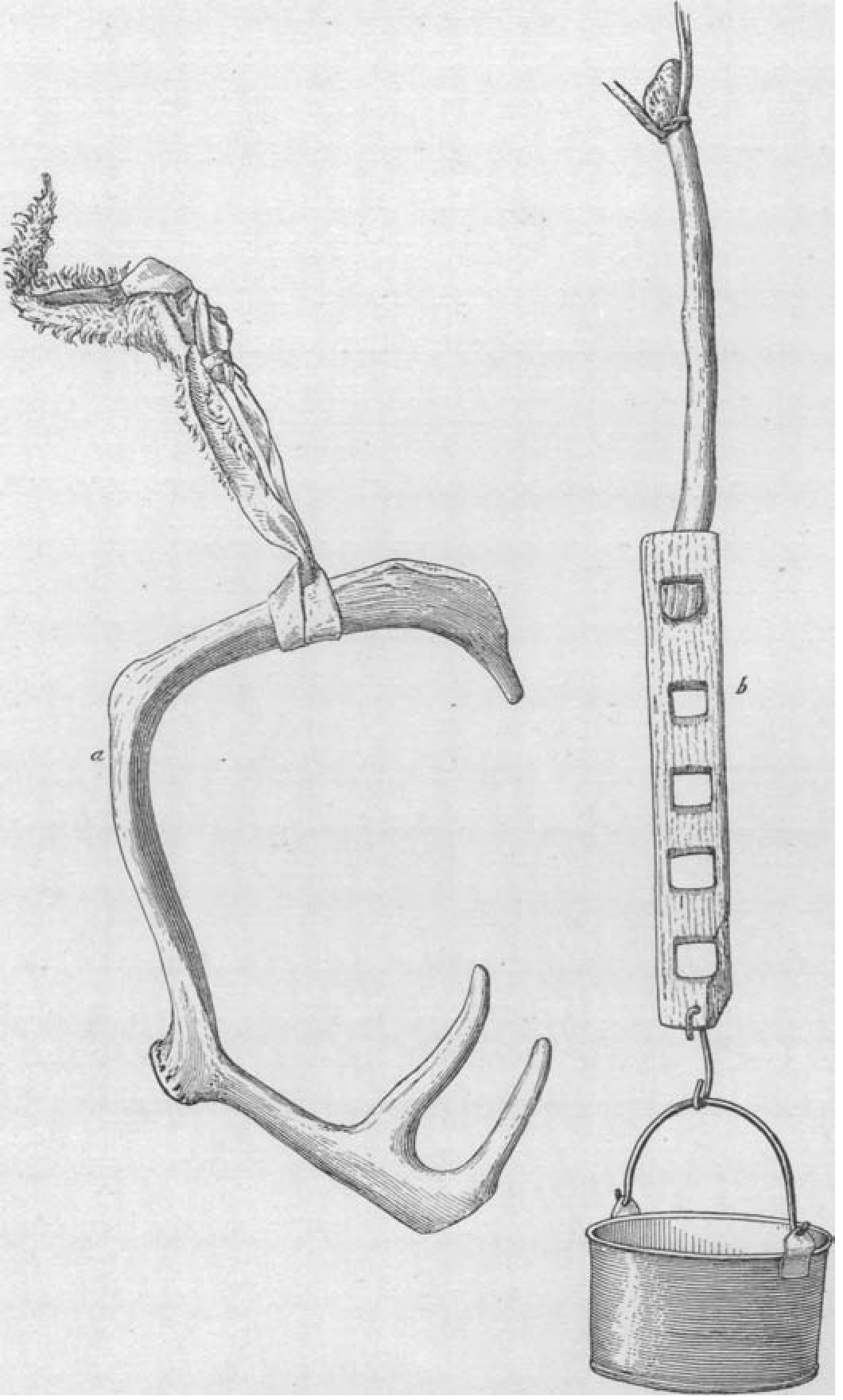
The fire is made in the centre of the outer room, right under the vent-hole, and the hearth is surrounded by stones laid side by side. Sometimes the fire and the vent-hole are placed nearer to one side, so as to leave more space in the tent. Pots and kettles are suspended from hooks which are fastened with a piece of thong to one of the central poles. The hooks vary in form, most of them being similar to those used by the Lamut and Russianized natives. They are made of wood, iron, bone, or antler (Fig. 97, a). I collected a hook made of a pair of antlers taken off with the top of the skull, as is usual among the Chukchee. Another kind of hook (Fig. 97, b), made of wood, is used with an adjustable attachment to the kettle, so that its height over the fire can be regulated. This form of hook occurs throughout northern Asia and Europe as far west as Finland. Within the borders of the forest the fire is made outside the tent, to avoid filling it with smoke. On the tundra, where fuel is scarce, and often brought from a distance of thirty miles, the fire is always made inside the tent, because it is thus protected from the wind and there is less waste of fuel.
When kindling a fire, the Chukchee women split logs into slender chips. They keep the fire as low as possible, and take care to put it out as soon as the cooking is done. They are so accustomed to economize in their fuel, that they continue to stint themselves even within the forest, so that the remains of a Chukchee fire can be easily distinguished from those of other tribes. On the whole, the Chukchee do not use the fire of the hearth for heating-purposes. The temperature[175]🗗uncollated inside of the outer room, even while cooking is going on, is almost the same as that outside. The herdsmen or hunters, when sleeping in the open, although they may have an abundance of fuel, are often content to make a small smouldering fire from which to light their pipes, or do not make any fire; whereas the Lamut and the Yukaghir send up a blaze that wards off the cold from a space of several yards around, and often keep it up during the whole night in order to get a chance to sleep comfortably.
Movable House. — The type of tent and sleeping-room here described is especially used in moving about with the herd. That used by the family is very heavy, and requires — with poles, cover, and bedding — six or seven sledges. Whenever the herdsmen leave their principal camp, they carry with them a small sleeping-room, with a light tent, which is often not properly pitched, but only loosely thrown over the sleeping-room to keep off the snow. In this type of house it is difficult to dry damp clothing. Fur clothing generally becomes damp quickly, even in dry, cold weather, especially when it is worn directly on the skin, without any underclothing. When damp, it does not protect the body from the cold: therefore it must be dried every night while its owner is asleep. In the sleeping-room of the Reindeer Chukchee the only place for drying things is directly over the lamp. Only small articles, such as mittens, socks, and boots, can be placed there. Large pieces of clothing, such as shirt or trousers, are dried in a way similar to that used in drying the sleeping-room cover; i. e., by freezing the dampness out, then shaking it off with the snow-beater, and finally drying for a long time in the cold dry wind. The Chukchee herdsman sometimes walks for a fortnight in damp clothes without a chance to dry them, and takes off his undershirt only when it is quite spoiled and unfit for further use. On this account the Reindeer Chukchee are always anxious to avoid the damp. For instance, before coming into the inner room, the whole dress, from the cap to the shaggy boot-soles, is well beaten with the beater to remove the slightest trace of snow, which otherwise would melt in the warm interior and cause additional trouble. In the evening, when the sleeping-tents are put in place ready for occupancy, the entire camp begins to resound on all sides with the short rapping of the snow-beaters, which lasts for half an hour before all the people are ready to retire. Travellers and herdsmen often have beaters of their own, which are carried on the belt or are attached to the sledge-grating.
The snow-beaters for clothing (Fig. 98) are more slender than those used for the room-covers. The knob is often fashioned in the shape of a human or dog’s head, which then plays the rôle of the protecting spirit, the so-called “travelling-companion” (leiˊhu-tuˊmg̣ɪn).¹
Winter House. — Late in the fall most of the families, especially those[176]🗗uncollated who have small children, cease to move about, and settle down for three or four months within the forest border, and construct a special winter dwelling (see Plate V, Fig. 2). This consists of three parts. The entrance-room (tɪˊʟɪ-ran) is formed of a few stakes tied together, and loosely covered with an old tent-cover. It serves chiefly to keep off the wind and snow from the entrance. It often has no door; and in order to get in, one has to crawl in under the tent-cover. The main tent is constructed in the ordinary way, only, for the most part, an old cover is used, because it is likely to be damaged by the hearth-fire within. This fire is kept up all day long; and on this account, as well as on account of the well-sheltered entrance, the temperature of the tent is not very low, usually 10°-12° above zero Fahrenheit, while outside it may range from 50° to 60° below. The sledges are piled up near the tent, high enough not to be covered by the drifting snow, and after this are tied with thongs to prevent the wind from throwing down the pile. Only a few driving-sledges are left free for daily use.
The sleeping-room is much larger than that of the movable tent, and bears marked similarity to that of the Maritime Chukchee, only it is dirtier and is made more carelessly. The usual dimensions are 5 feet in height, 8 feet in breadth, and 14-16 feet in length. It occupies the whole rear of the tent, leaving only a small space on the sides for storing provisions. The skin cover is made of fawn-skins taken late in the fall, the hair side out. It is drawn tightly across a rectangular frame made of flat, narrow sticks. On the outside it is covered with a thick layer of dried grass tied up in sheaves and fastened side by side. The frame is so strong that a man can walk on top of it. The whole structure is covered with a piece of tent-covering, with the ends carefully tucked in below. The floor is covered with skins of the thong-seal or of the walrus, and over them some scraps of reindeer-skin are put for seats, while the bedding is rolled up and taken away during the day.
One or two lamps burn constantly within, to keep the place dry. There is no kind of ventilation whatsoever: therefore the sleeping-room, although warm enough, in course of time becomes very unclean, and acquires an odor offensive even to the inmates. Notwithstanding the burning lamp, the skin cover becomes damp and covered with mildew. When newly constructed, the sleeping-room is dried by carrying in a pile of burning coals on an iron pan. The same method is sometimes applied afterwards, though it is dangerous,[177]🗗uncollated because the small, low room is filled with charcoal-fumes, which will not entirely disappear for a day or two.
The winter sleeping-room serves also for only a single small family. Sometimes two inner rooms are joined together at an angle. There is no partition between, and a separate lamp is lighted by each family in its own part. This large double sleeping-room is quite similar to that of the Maritime Chukchee and Asiatic Eskimo, as will be described later. In my opinion, the stationary winter house is the typical form of the Chukchee dwelling, while the movable tent is a variety comparatively new, and not even very well adapted to the exigencies for which it is used. It is cumbersome, and requires many reindeer to carry it, especially when compared to the Lamut tent. When under way, it hampers considerably the progress of a Chukchee family.
Summer House. — The summer habitation is arranged in about the same way as the movable winter tent, except that its place cannot be changed till the first snow is on the ground. Therefore all the sledges are piled together for the summer. The best driving-sledges are untied, and the lashings and wooden parts carefully gathered in bundles and concealed in the middle of the pile.
The whole is protected with parts of old tent-covers not in use. These generally serve as tarpaulins. For the summer tent and for the summer sleeping-room, old worn-out covers are used, and the people also wear old clothing which was discarded in winter. The sleeping-room cover is closely cropped with a sharp knife, and is usually put up with the hair side out. A large piece of tent-cover tarpaulin is stretched over it above, resting on several sticks fastened to the outer frame. This serves to keep off the rain, which would come through the vent-hole and through the small holes of the outer tent.
The place of the camp cannot be changed during the whole summer; but in the middle of June, in connection with the first summer ceremonial, the tents are broken up and shifted some fifty or sixty feet. This change is very desirable, because the house is exceedingly unclean. Sometimes at the end of July the family will again change to avoid the offensive smell of their old surroundings. Even in winter the people are often driven out of their warm habitations by the same cause, and resort to the use of the movable tent much earlier than usual.
An or-raˊn (“wooden house”) is a lodge made of poles, used by the Reindeer Chukchee inside the border of the forests as an annex to the large winter house. Some kinds of work — the boiling out of tallow from bones and the scraping of skins — are done in this lodge. In its simple conical shape, it occurs also among the Russianized Yukaghir as a summer dwelling or as a dog-shelter. Long logs that are collected for fuel in winter are often put in the same position to prevent them from being blocked with snow.
[178]🗗uncollatedThe Reindeer Chukchee have no particular storehouses or cellars. The space in the tent behind the sleeping-room (called yaˊñan) serves for storing meat, tallow, etc.; while blood, oil, and the like, are stored in large bags that are kept outside.
For the summer a small hole is dug in the middle of the tent, and meat is kept there to preserve it from decay. The opening of the hole is covered with skins and grass; and it is usually only two feet deep, its bottom reaching the frozen layer of soil, which the Chukchee, with his primitive tools, cannot penetrate.
HOUSE OF THE MARITIME CHUKCHEE. — The winter lodging of the Maritime Chukchee is more or less similar to that of the Reindeer people. The frame, however, is constructed differently, chiefly on account of the scarcity of wood for poles. One great pole forms the central support (Plate XV, Fig. 1). It is placed upright, its lower end being firmly stuck into the ground, while the other end has a cross-piece tied to it to support the roof-poles. Stakes of wood or of bone of the whale replace the vaˊrêt. They are planted in the ground, and form the frame for the walls. The cross-pieces and long poles are tied on as usual, but occasionally whales’ ribs are used instead of wood. The whole structure is often surrounded by a low wall of sod (Plate XV, Fig. 3) or of stones, and the cover drawn over the frame is fastened to it by stones and pieces of sod. The stretchers with cross-pieces are also used for tightening the cover. The entrance faces the sea. It is often sheltered by a small structure of sod (Plate XVI, Fig. 1) or of stones, or by a piece of tent-covering thrown over a few stakes, as in the case of the winter houses of the Reindeer people.
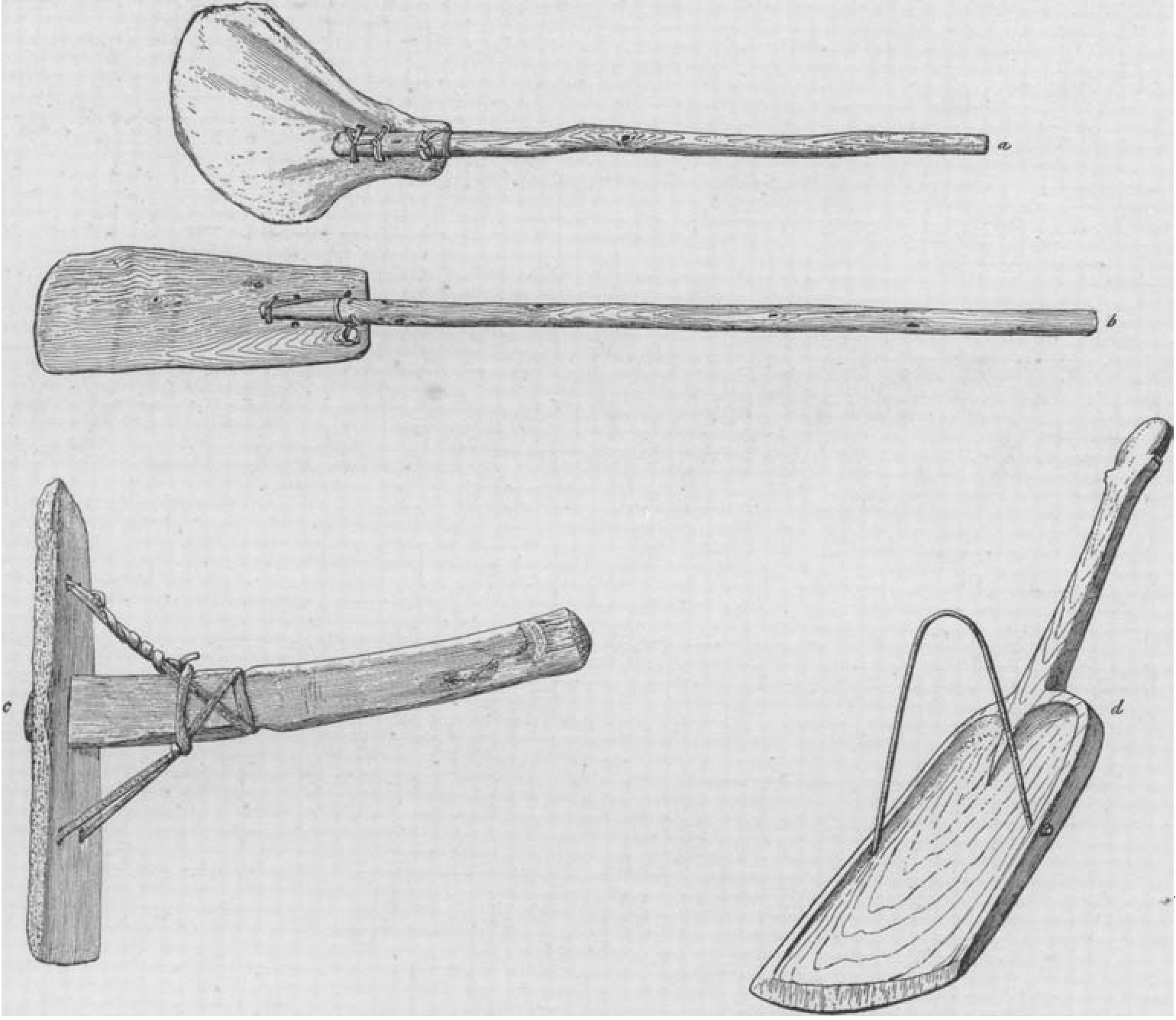
For cutting the sod, digging the loose earth, and levelling the spot intended for the house, shovels of wood and of walrus shoulder-blades (Fig. 99, a, b), and picks of bone (Fig. 99, c), are used, though nowadays these are gradually being superseded by iron implements. The forms of those made of bone or wood are similar to those used by the American Eskimo.¹ Fig. 99, d, represents a shovel collected among the Lamut, though the Kolyma Reindeer Chukchee use exactly the same form. It also resembles the shovel used in Alaska and represented by Nelson.¹
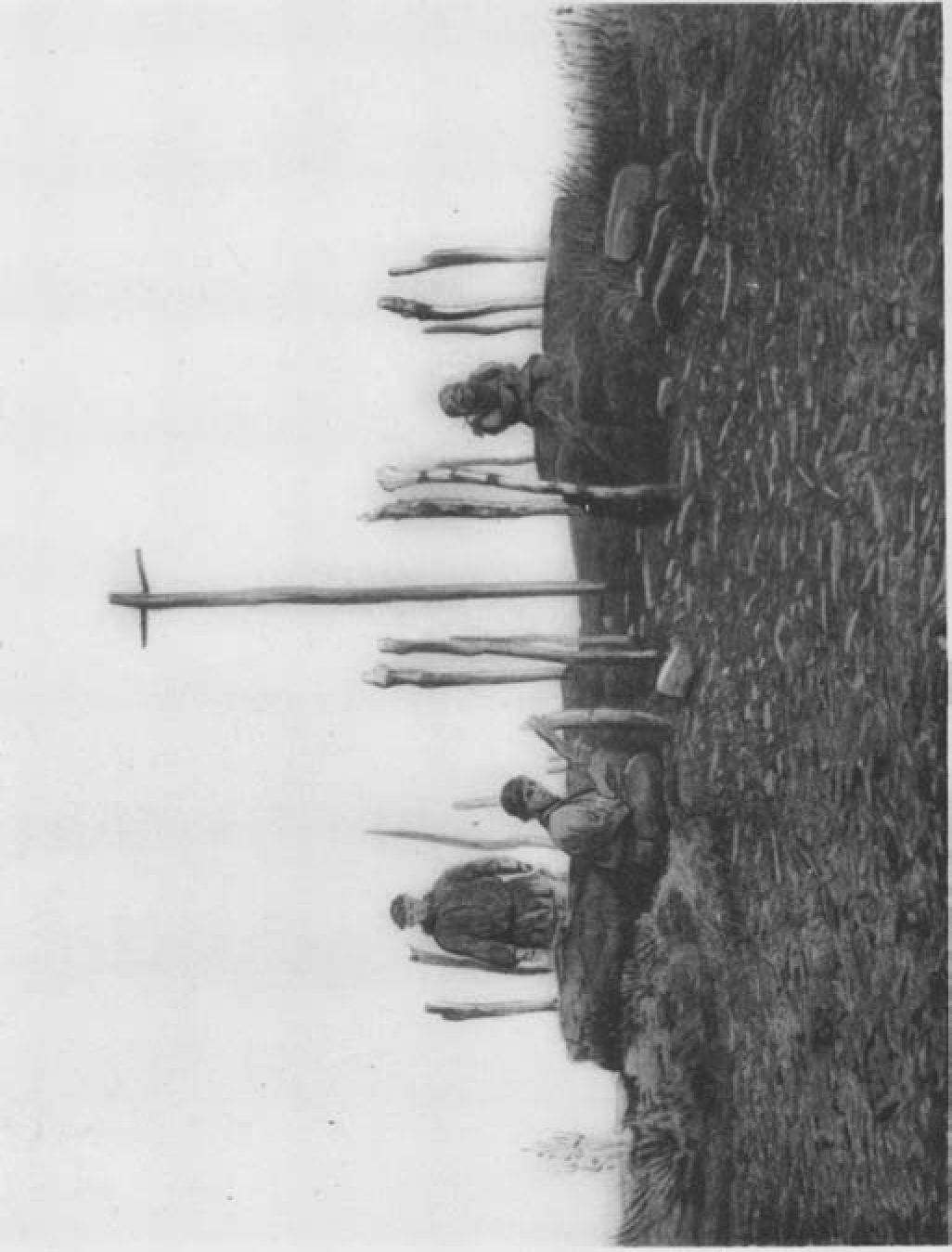
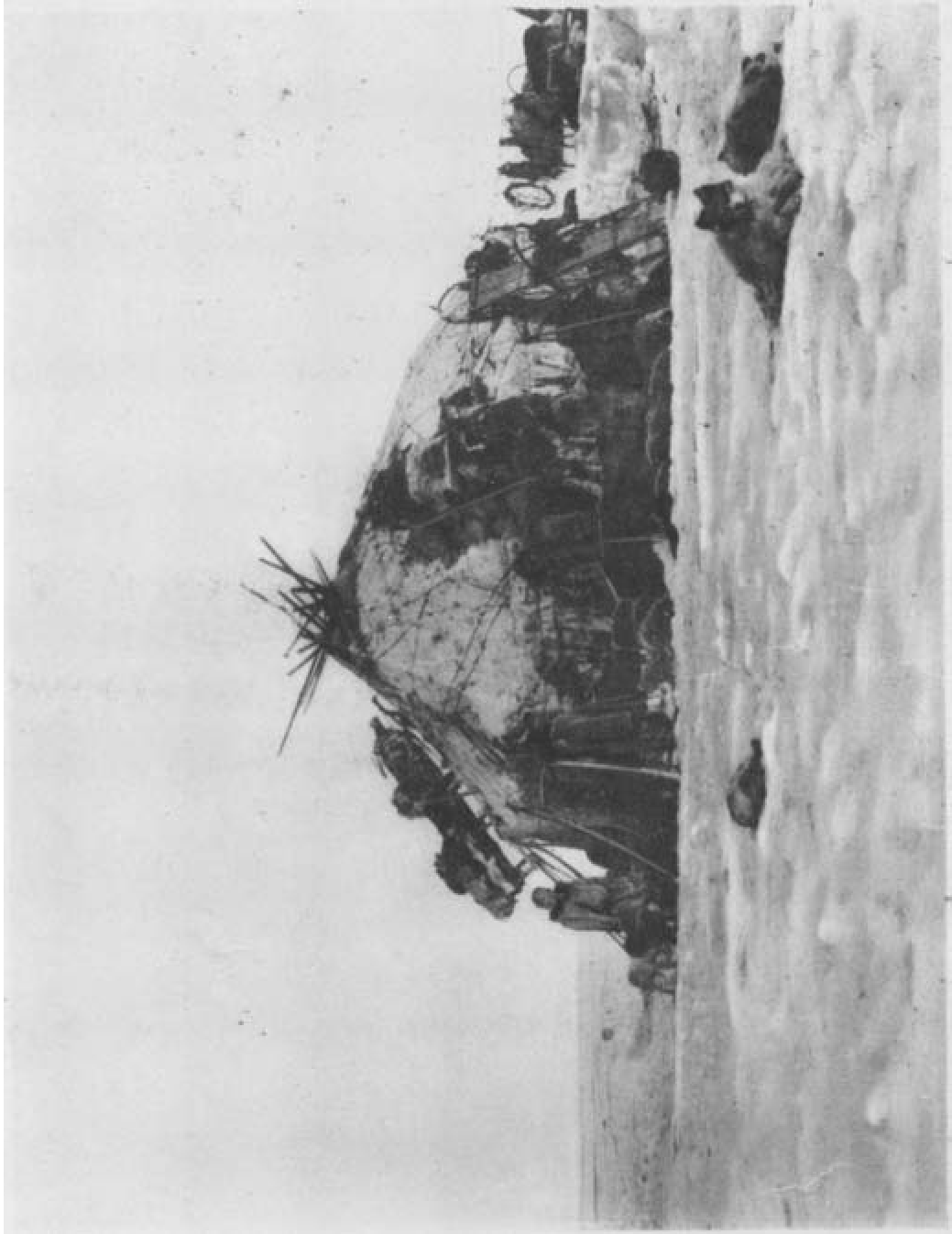
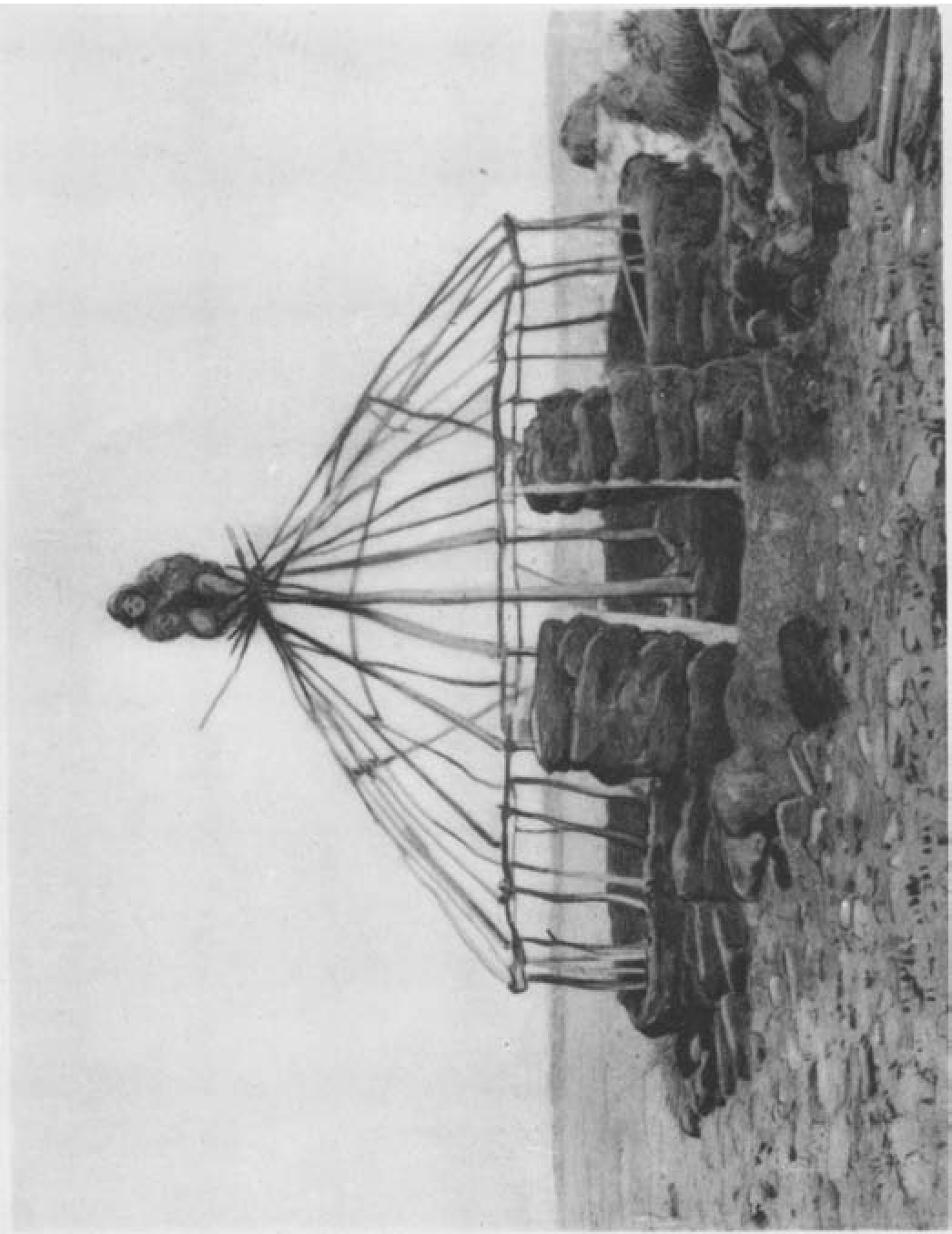
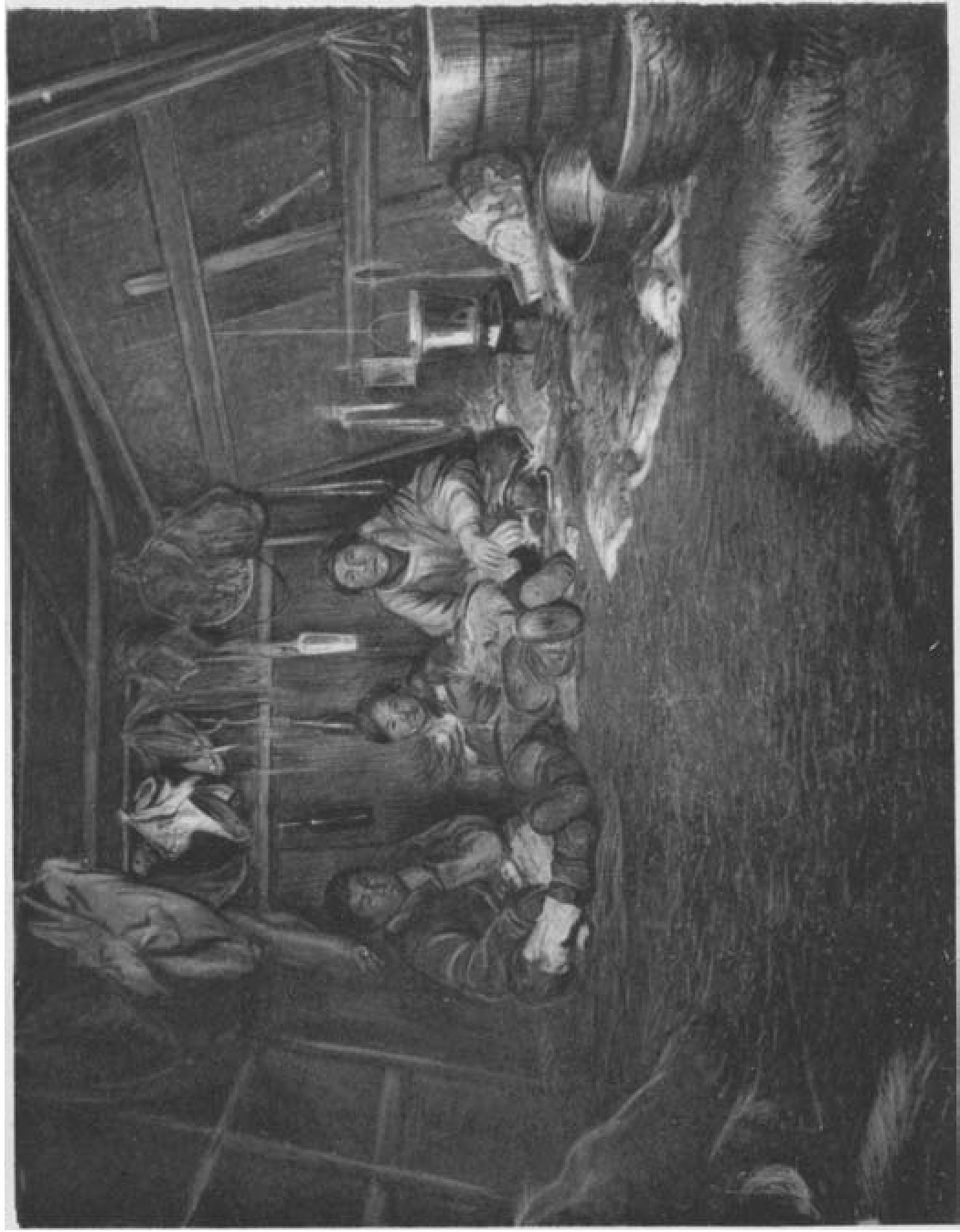
The covering of the house is for the most part sewed together out of worn-out pieces of tent-covering bought from the Reindeer people. In front a large walrus-skin is placed, in order to give protection against the storms, which usually come from the sea. In more recent years old sail-cloth has begun to be used instead of old reindeer-skins, especially in the Eskimo settlements. Every part of the cover is well fastened with thongs, and weighted down by means of heavy stones and loaded sledges, and even iron chains (Plate XV, Fig. 2). The inner room is almost always double, both sections meeting at an angle.[179]🗗uncollated It has three or even four lamps of various sizes, which are used not only for light, but also for cooking (Plate XV, Fig. 4).
It is usually larger than the inner room of the tents of the Reindeer people; and among well-to-do families it may be about 30 feet in length, 10 feet in breadth, and 6 feet in height. The outer tent is also larger than that of the Reindeer Chukchee. I saw one house which was forty feet in diameter and had eleven stretchers to support the frame. In the outer tent, on both sides of the sleeping-room, are placed two huge seal-skin bags, which are used for purposes of storage.
The bottom of the sleeping-room is covered with a large walrus-hide, forming a hard and smooth floor to tread on. The steadily burning lamps make the room warm and dry, and even afford a chance for ventilation, which is effected either by lifting the front or by opening a special hole in the wall, which may be closed by a round stopper made of a piece of reindeer-skin. Damp clothes are dried by hanging them on pegs or by stretching them on strings tied along the walls.
[180]🗗uncollatedAt the end of May the winter abode is usually abolished, and the summer tent is pitched adjacent to it. The cover of this is made of walrus or thong-seal skins, to afford protection against rains and rough weather. The sleeping-room is similar to that of the Reindeer people, but its cover is also made of tough walrus-hide.
The Eskimo of the Asiatic shore and of St. Lawrence Island nowadays arrange their winter houses in a quite similar way, only the outer cover is almost always made of sail-cloth and has a wooden door, — often the door of a boat’s cabin picked up from wreckage or received from the whalers (Plate XVI, Fig. 2).
In the summer, besides the double tent (lɪˊê-ran) before described, sheds of irregular form are sometimes constructed of poles, and covered with walrus-skins (Plate XVII, Figs. 3, 4). Sometimes the shelter consists only of a tent-cover thrown over a few stakes joined together. Tents of cloth bought from whalers are also used.
Hut. — The small village that in former times existed in Anadyr Bay, had huts constructed of wood and covered with earth and sod.
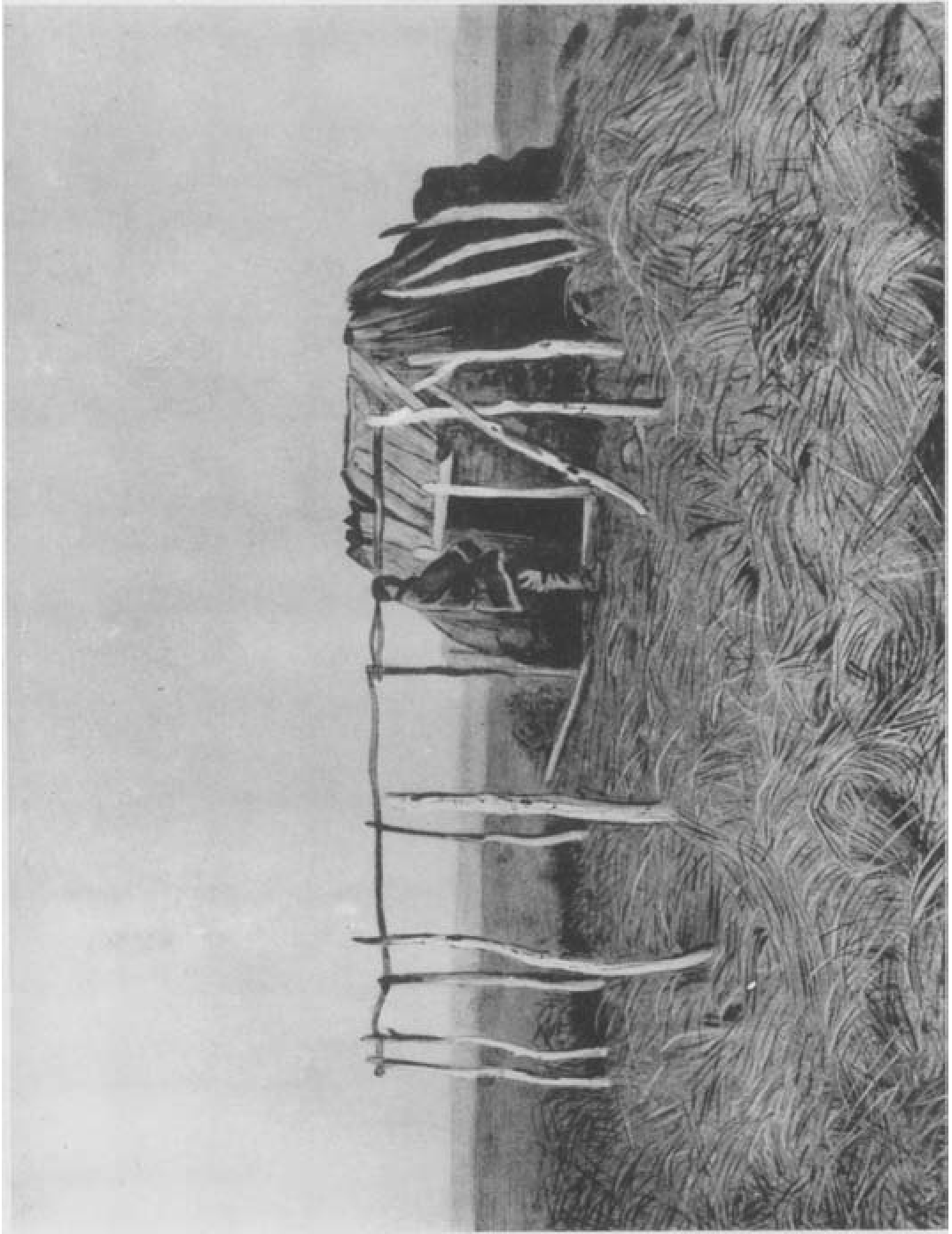
Two families of those living in Veᵋñ (Mariinsky Post), not far from the site of the village mentioned, still construct for their winter lodges small huts with wooden frames covered over with earth and stones. The hut has a hole in the roof for the escape of smoke, and within is a sleeping-room of the usual shape. The hut has a square wooden door covered with scraps of reindeer-skin for greater warmth. Plate XVII, Fig. 2, represents one of these huts. The poles in the front serve for hanging dried fish on.
A few Chukchee families of the Middle Anadyr live in wooden huts somewhat similar to the Yakut “yurta.” These were copied from the yurtas of the Anadyr Russians, who of late years, however, have replaced their yurtas with log-cabins of the usual Northeast-Siberian type. In ancient times wooden huts of this type may have been in more common use in this territory. Remains of huts found on the Bear Islands are more or less of this type. In the deserted villages of the Yukaghir situated on the Middle Omolon, and inhabited about seventy-five years ago, I have seen huts of the same type. It is not easy to decide whether this type of dwelling is due to Yakut influence, or whether it is an ancient type that developed independently. The construction of the fireplace differs in all of them from that of the Yakut houses. They had no stove with wooden chimney, but simply a central hearth, with a square hole in the roof just above it. In modern times the Yakut, arrangement of the fireplace has been copied by most of the Russians and Yukaghir in their log-cabins and huts, and the Chukchee of the Middle Anadyr have also adopted it.
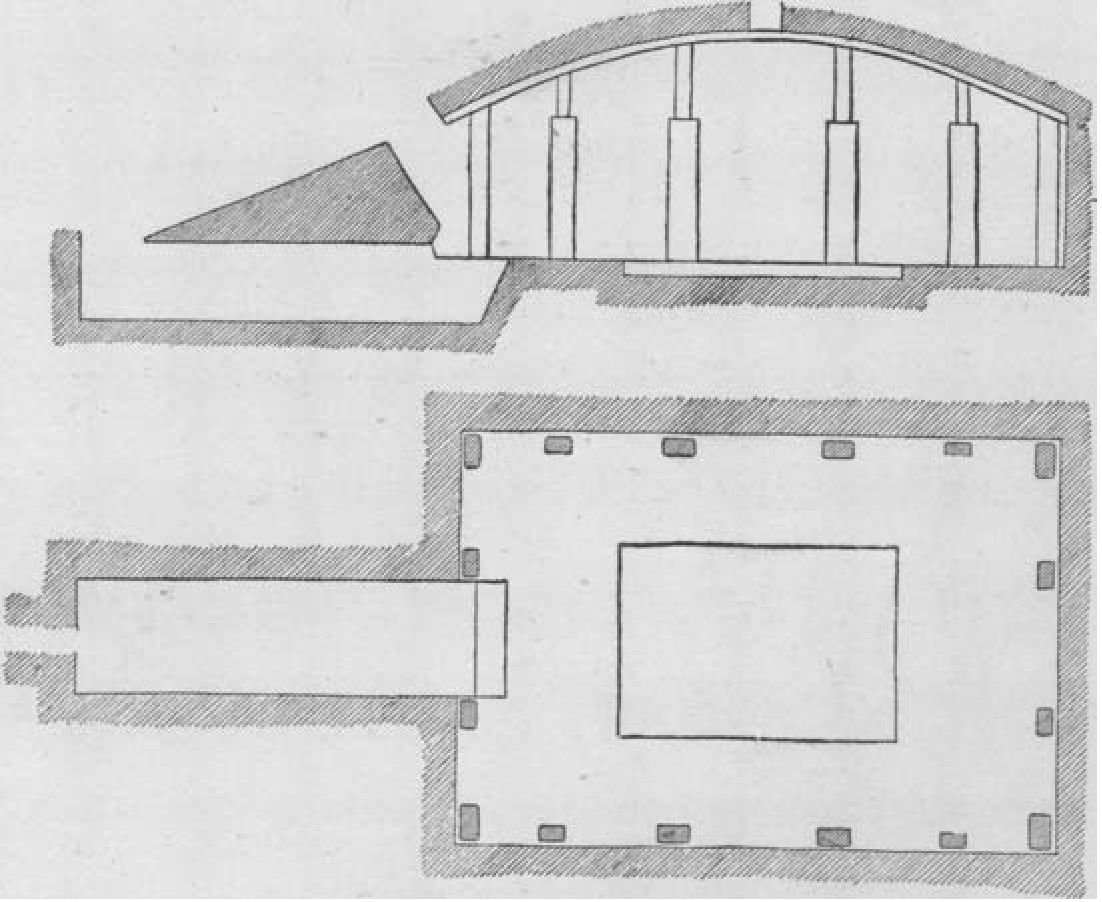
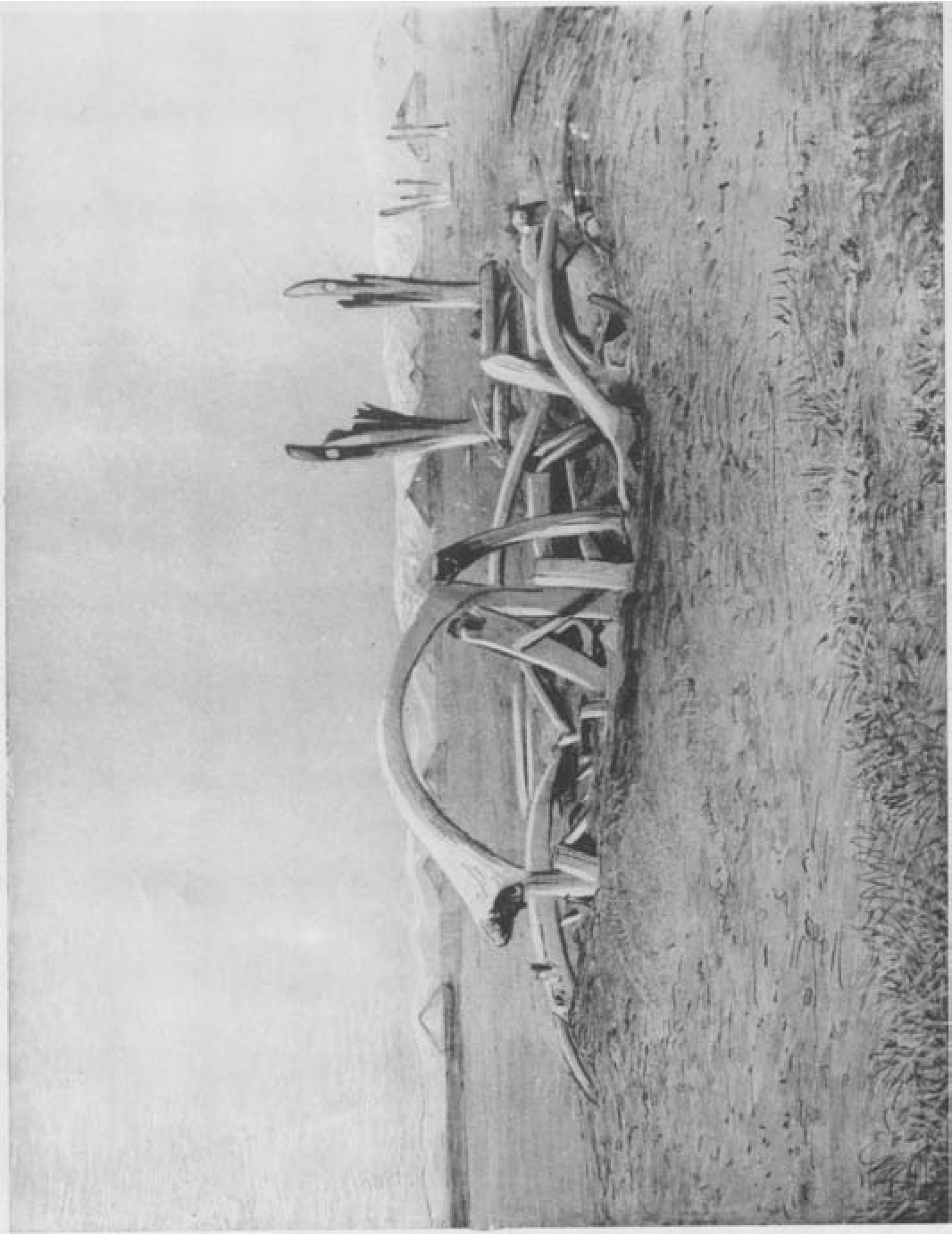
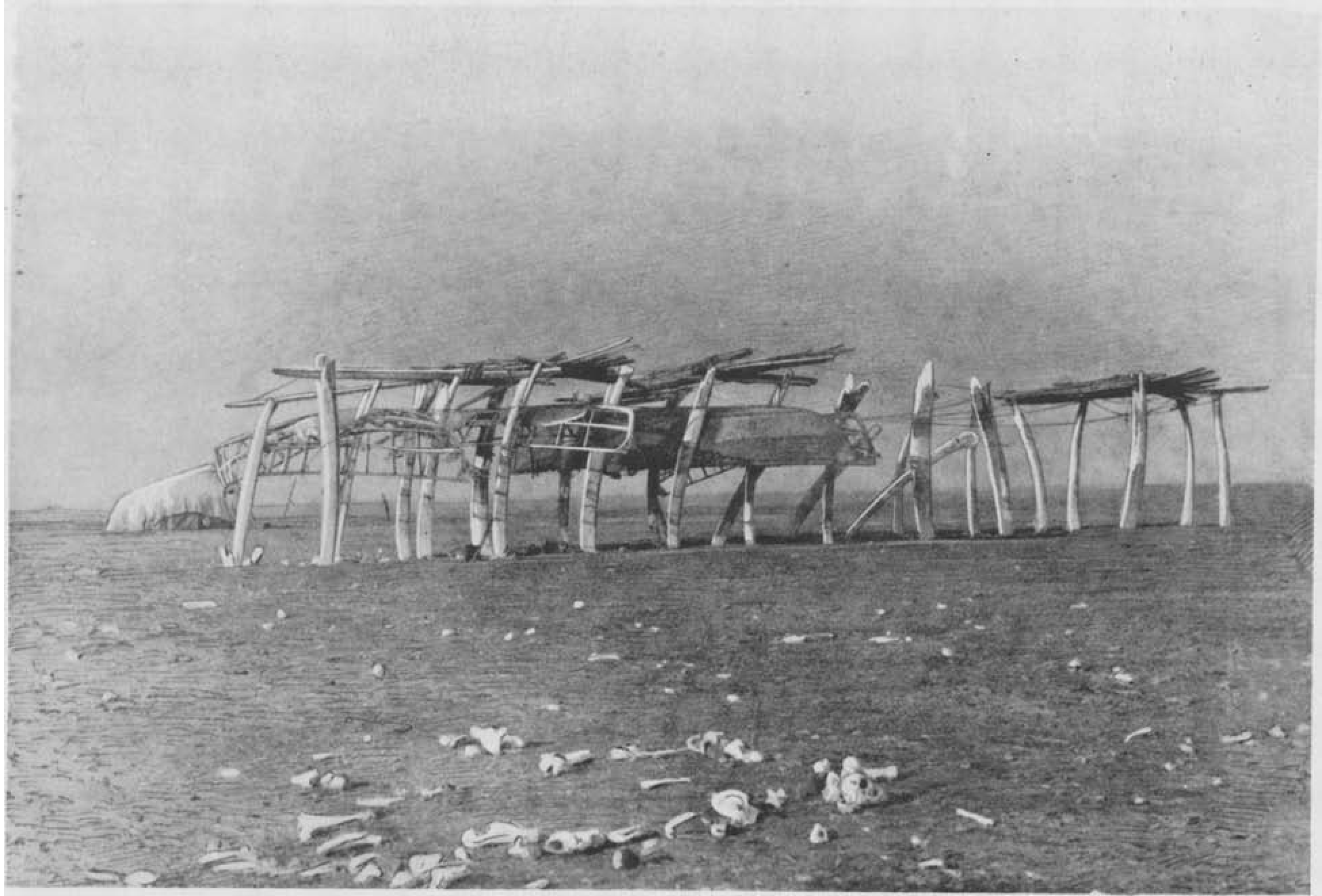
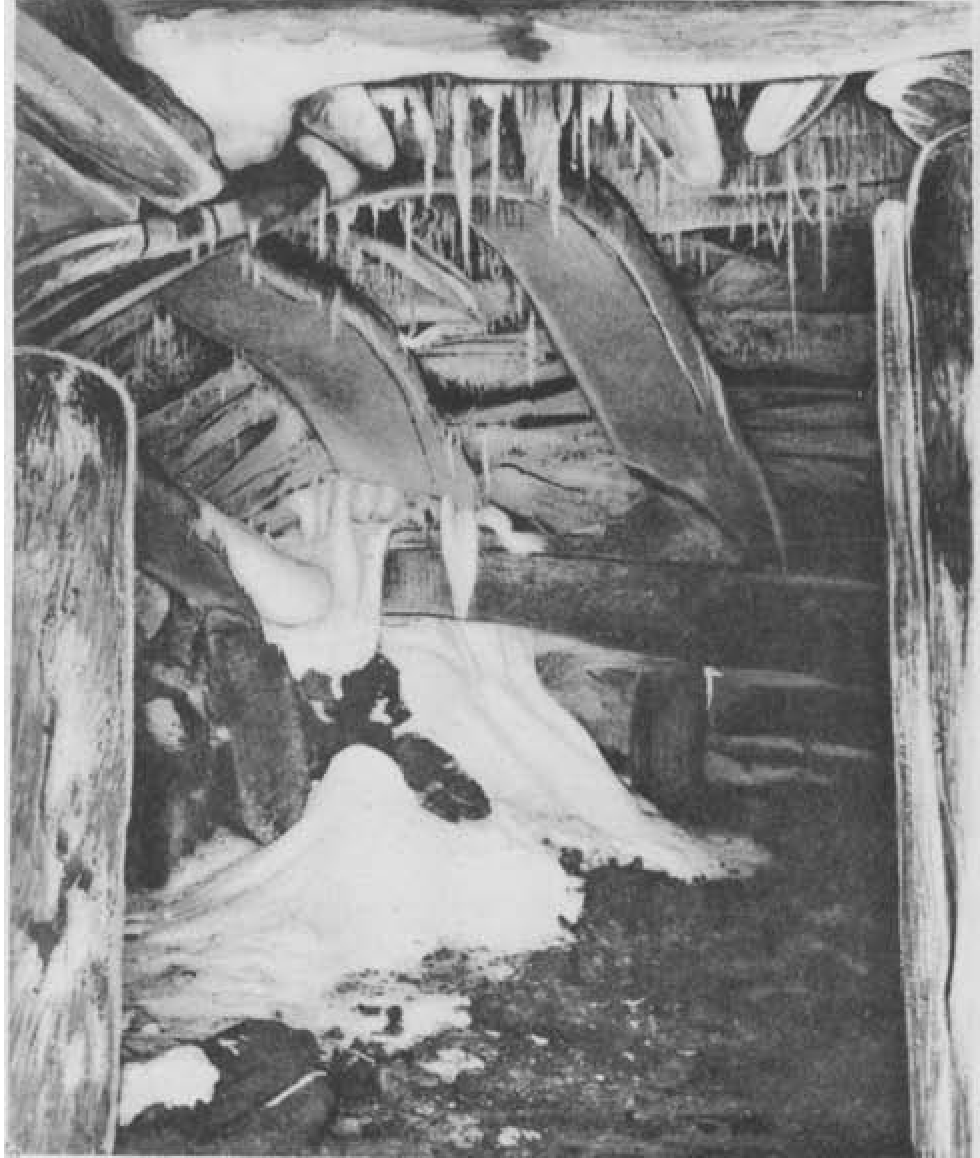
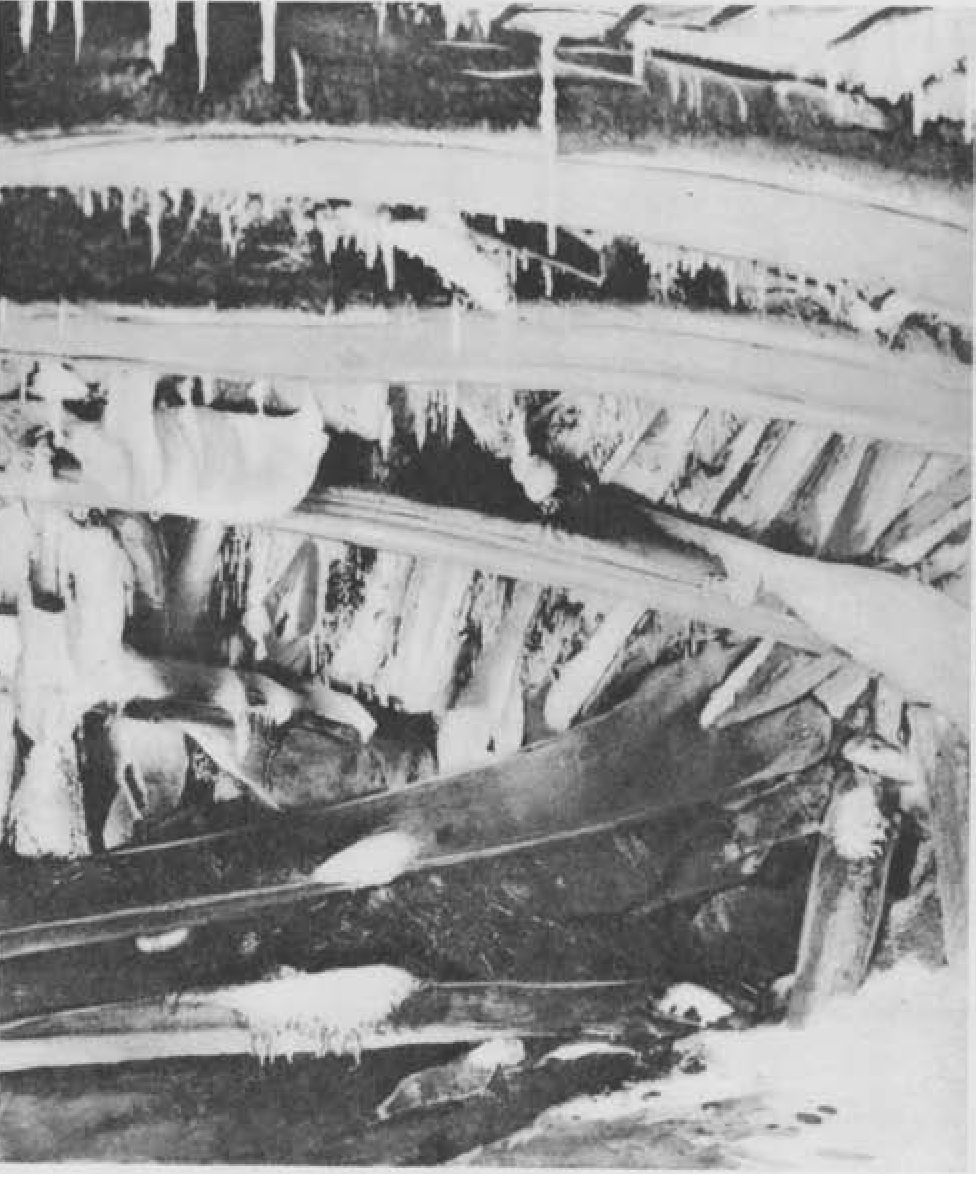
Underground House. — In all the Chukchee and Eskimo villages that I visited on the Pacific coast, ruins of the so-called “jaw-bone houses” (Plate[181]🗗uncollated XVII, Fig. 1) (waˊlkar; pl., waˊlkarat) are found. These ruins seem to be ancient, and are either circular holes or flat mounds, with some battered rafters and beams of bone of the whale. In some villages — as, for example, in ᴇˊnmɪlɪn — the inhabitants have forgotten the exact location of most of the ruins, because the village has been shifted several times since. In Euˊnmun and Wuteˊen the “jaw-bone houses” overhanging the flat sandy shore were, gradually destroyed by the weather, and crumbled down, together with the ledge of rock on which they stood. In other villages, for instance, in Čeˊčin and at Indian Point, they are in the immediate vicinity of the present habitations, and the villagers still remember to what families most of the ruins belong. As before mentioned, they claim that these houses went out of use three generations ago. At the time of Hooper’s visit in 1848, houses of the modern type were already in use, and he mentions having seen half-ruined underground houses which were in no better condition when I found them, fifty-two years later. The waˊlkar of the Maritime Chukchee and Asiatic Eskimo had a frame made of jaw-bones. Heavy pieces were set in the ground in an upright position at intervals all around the house, and were held in place by earth and stones. Sometimes there were about sixteen of these supports, so that they formed a regular fence. Large pieces of jaw-bone or of whale’s ribs were superposed as rafters, and smaller pieces were inserted to make the structure more compact. The floor, or at least the middle part of it, was paved with flat pieces of bone. Then the whole structure was covered with sod, and a thick layer of loose earth was strewn around the bottom. Often the waˊlkar was started with a circular excavation, and, after being well covered with earth, appeared to be a half-underground house, with only the roof protruding above the surface. Even the “jaw-bone houses” built above ground, in the course of a long period of time, assumed the shape of small hillocks, with a human lodging-place inside. Of all the waˊlkarat that I have seen, on the Pacific coast, only one, in the village of Nuˊnlig̣ren, retains its original shape. A comparison with other ruins shows that it is a typical underground “jaw-bone house.” It is a large rectangular apartment, 20 feet long, 14 feet wide, and 7½ feet high in the middle. A strong “jaw-bone” frame incrusted in the hardened earth supports its walls (Fig. 100). Most of the uprights which support the side-walls are formed of two parts, the upper being thinner than that below. The upper parts are not fastened to those below, but are firmly implanted on their top. The pressure of the rafters, and the weight of the soil which covers the structure, help to hold them in place. The roof is formed of several curved beams, which rest on other uprights, short and stout, leaned against the front and the rear wall (Plate XVIII, Figs. 2, 3). Like the underground house of other tribes, it has two entrances. One is through a long underground passage, and could be used only in winter, because in summer it was filled with water. The level of the floor[182]🗗uncollated of the inner room was above the level of the passage, so that the water could not injure the living-room. The other entrance, in the upper part of the wall, was a circular hole, which could also be shut by means of a shoulder-blade. It was used only in summer; in winter it was stuffed with grass, then covered with the shoulder-blade and secured with stones. The lower passage was cleared of snow and ice and used till the next spring.¹
In the centre of the living-room a large flat stone served as a support for a large lamp, which burned day and night. Over the lamp, in the roof, was placed a vertebra of a whale, and its opening served as an air-hole. The floor was raised on all four sides, and on the low platforms thus made four sleeping-rooms of the usual shape were arranged. These were occupied by four families, so that the house had about twenty inmates. This house at Nuˊnlig̣ren, however, was the largest in the whole village. Underground houses of the usual size had only two platforms, — one on the right and one on the left side of the entrance, each with one sleeping-room. Thus, in the modern houses with double sleeping-room, the same number of families are found as in the ancient houses. The underground houses were constructed with the aid of all the neighboring families, and were strengthened and enlarged during many subsequent years. They were occupied generation after generation, till at last the accumulation of dirt and stench within would become so great as to drive away the inhabitants. The natives say that the unwholesomeness of these abodes, fixed forever on the same spot, was the chief reason why the population left them altogether and turned to the skin houses. On St. Lawrence Island the natives of Čibuˊkak, who, as mentioned before, have adopted the Asiatic type of skin house for their constant abode, still use the old underground houses in the other parts of the island during their sealing expeditions in winter.
The Rev. Lerrigo, who is also a physician, told me that these underground houses are veritable breeding-houses for the microbes of consumption and of several other diseases, and expressed the opinion that the decrease in the[183]🗗uncollated population of the island was due, for the most part, to the unwholesome condition of the houses.
So, upon the whole, we must admit for this part of northeastern Asia two principal types of house. One is the “jaw-bone house,” which in ancient times existed in many places along the Arctic and the Pacific shores, but which at present has almost altogether gone out of use. It is more or less similar to the habitations of the Eskimo in America, and of the Koryak and Kamchadal in Asia. Another type is the double skin house, the “genuine house” of the Chukchee. It is also ancient, and the Chukchee consider it as characteristic of their tribe. Outside of the Chukchee territory, setting aside its recent adoption by the Asiatic Eskimo, it occurs only among the Reindeer Koryak.
Snow-House. — The vaulted snow-house, which is typical for the Eskimo tribes, does not occur anywhere on the Asiatic coast. Of all the tribes of northeastern Asia, only the Kerek, who have no sufficient supply of wood or skins to construct adequate winter houses, utilize snow as building-material. Their half-underground house has a frame roughly constructed of such poles and pieces of wood as they can find on the shore. Crooked branches of stunted willow and birch trees are placed between to fill in the spaces, and the whole is lined, from within with such skins as they can scrape together, and from without with sod and loose earth. A long, low, narrow passage made of similar material forms the entrance. It is divided into three parts, closed by skin curtains. This structure is used in spring and summer as it is; but in the fall it is covered with a thick layer of snow several feet deep, and fashioned into a well-defined round or rectangular form, which gives to this house some outward likeness to the Eskimo snow-house.
The interior arrangements are much like those of the houses of other branches of the Maritime Koryak. The lack of a roof-entrance with its characteristic tree-ladder, however, gives it a peculiar feature. On that part of the shore no logs fit for the purpose can be found. Thus the use of the tree-ladder ceases suddenly on this part of the Asiatic shore for want of material. Farther to the northward and eastward, across Bering Strait, along the American shore on the Arctic and Pacific Oceans, are found various types of houses. Still farther to the south, in America, after the forest border is reached again, the square roof-entrance and the notched tree-ladder re-appear in exactly the same shapes as among the Koryak and Kamchadal in Asia.
Cellars and Boat Supports. — Underground cellars were and are used in all Chukchee villages for storing provisions. They also have supports made of bone of the whale in their walls, and the entrance consists often of a square frame with a shoulder-blade cover. Sometimes a vacant underground house is used for a cellar.¹
Supports for boats, spare tent-covering, etc. (Plate XVIII, Fig. 1), also[184]🗗uncollated racks for drying seal-meat and fish, are still constructed of bone of the whale, or the people make use of old structures of this kind, because jaw-bone will last for a very considerable time, even in the open air.
Such frames usually consist of four stout uprights firmly embedded in the ground, with cross-bars tied to their upper ends, and a platform made of poles, or of bone of whale, laid across the bars. Some of these simple structures were erected on the cliffs overhanging the sea. During the winter-time, if any of the seal-hunters were overtaken by a storm on the open ice, these platforms served as beacons: the women ascended them, carrying burning lamps under their transparent overcoats of walrus-gut, and stood there for hours, shouting, and displaying their lights to guide the wanderers. Over the platform a light bunch of feathers, called pag̣g̣oˊlhɪn (“vane”), was suspended from a thin staff. It was consulted by the hunter in observations of wind and weather. Such vanes are still in use among the Maritime Chukchee, and even among those who are settled on the Middle Anadyr.
Household Utensils
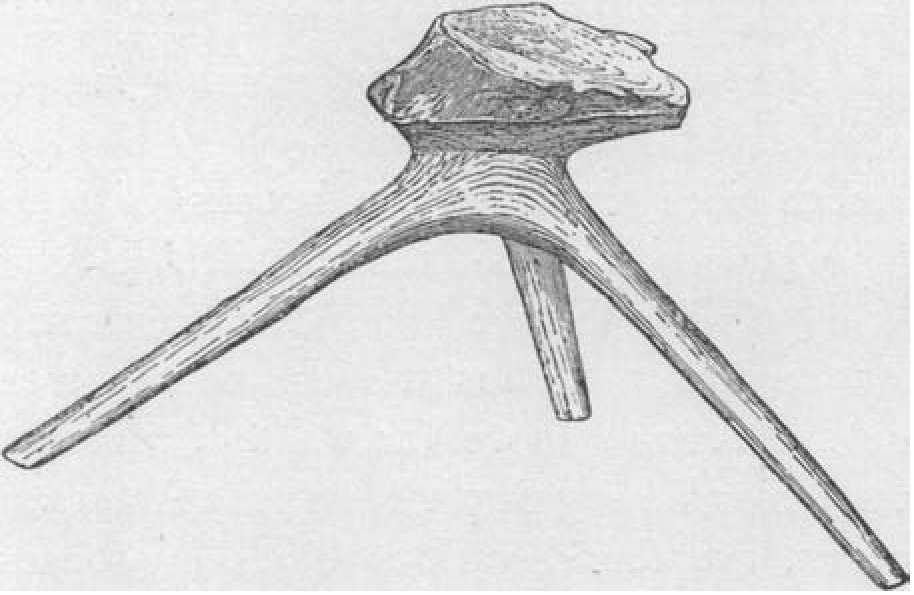
FURNITURE. — The Chukchee houses have little furniture. In the outer tent as well as in the inner room the people sit on outspread skins with their legs crossed, and crouch or lie flat on their stomachs, as described above. Sometimes three-legged stools (Fig. 101), fashioned in one piece from the butt of a tree with its roots or from a pair of large reindeer-antlers cut off with the top of the skull, are used in the house or outside, as, for instance, when sealing in winter. Tables consisting of large square wooden boards with four legs about three inches in height are used. These, however, are copies of the tables seen in Russian houses.
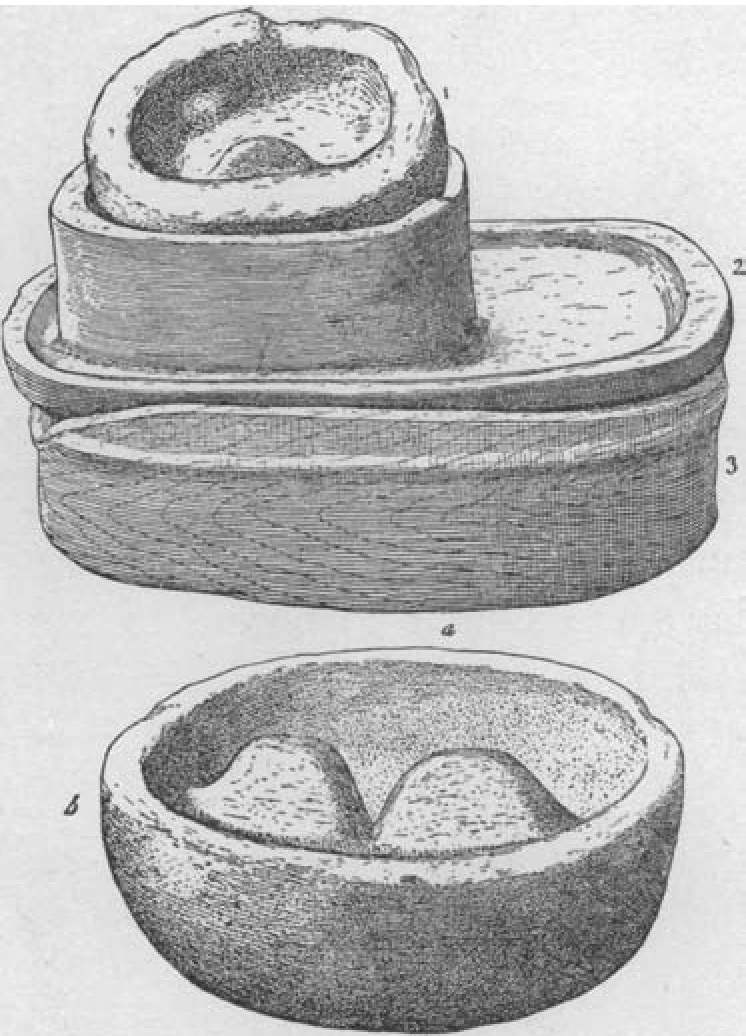
LAMP. — The chief appurtenance of the inner room, of both the Reindeer and Maritime divisions of the tribe, is the lamp, which gives light and heat. The lamp used by the Reindeer people is small and round in shape, and is made either of clay (Plate XX, Fig. 1; also Fig. 102, a¹) or of sandstone hollowed out with an adze (Fig. 102, b). Since the appearance of iron, old saucepans and pieces of cast-off kettles, battered into the shape of a bowl, are used for the same purpose. Wooden bowls having one edge covered with sheet-iron are also used as lamps. The lamp is usually placed in a shallow wooden bowl, standing,[185]🗗uncollated in its turn, on a tray (Fig. 102, a³). Sometimes this bowl and tray are made of one piece (Fig. 102, a²). Another tray serves as a support for the whole. All these vessels serve to catch the drippings of oil. The material used for lighting is either blubber, or, in all inland regions, the tallow tried out of the reindeer-bones, which have been crushed with a stone hammer. The latter material is the better, because reindeer-tallow is very hard and contains a large proportion of stearine. It burns with a soft bright light, without smoke or odor. The wick is made of sphagnum thoroughly dried and spread in a thin narrow layer across the front edge of the lamp. To burn properly it requires continual trimming, which is done with a slender chip of wood. Instead of sphagnum, rotten wood or thin half-burnt shavings may be used. The lamp inside has a bridge, flat and inclined backwards. Its edges do not reach the sides of the lamp, and the middle has a deep cleft almost to the level of the bottom. The fuel, blubber, or tallow is placed behind the bridge, and the lamp is set in its wooden bowl somewhat obliquely. The slant causes the oil oozing from the blubber, or the melting tallow, to flow down to the wick along the walls of the lamp or through the cleft in the dividing ridge. Pounded blubber is sometimes used in the lamp to make the extraction of the oil easier. Oftentimes the lamp is simply filled with oil, and placed on the tray in a horizontal position, though it is then much more apt to smoke. The seal-oil lamp also gives off a strong unpleasant smell, offensive even to the natives.
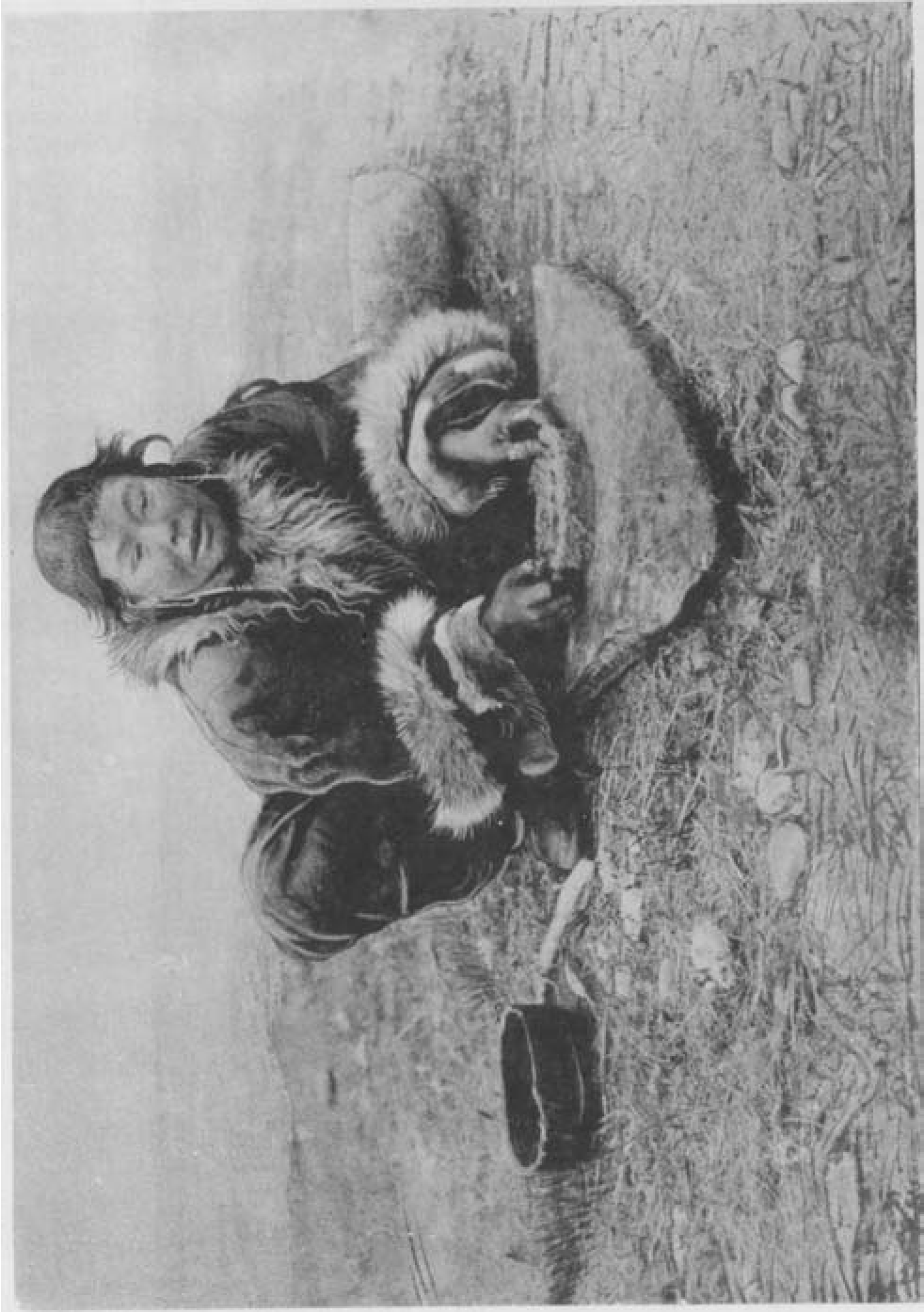
The ordinary lamp of the people, both Maritime Chukchee and Eskimo (Fig. 103, a), is larger than that used by the Reindeer people. It has an oval, almost rectangular shape, and is made of clay. The bridge is vertical. For cooking, still larger lamps, with two bridges (Fig. 103, b) and moss wicks arranged on both sides of the lamp, are used. The bridges are often divided in the middle. The lamp is placed horizontally on a large wooden dish, and the kettle suspended over it from a peg. Round lamps of clay and sandstone are also used, and sometimes are put in a large round kettle-shaped vessel of clay, with one side cut out in a half-circle (Fig. 104, a) to give a better support to the oblique position of the lamp.¹
[186]🗗uncollated
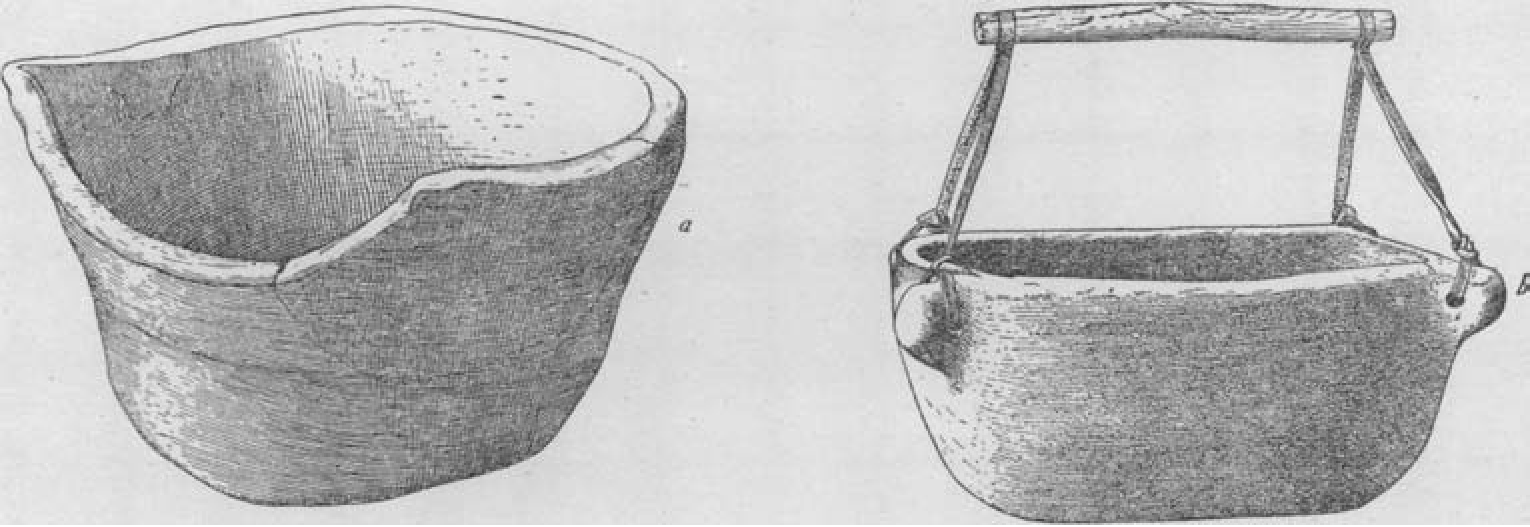
KETTLE. — The old women still have a vivid recollection of the clay kettles which were used in former times, and two of these were made for me, — one in Mariinsky Post (Fig. 104, b), and the other in Indian Point. They are similar in shape to the soapstone kettles of the American Eskimo,¹ except that the clay walls are necessarily thicker and clumsier. Some clay kettles from St. Lawrence Island, also of the same shape, are among the collections of the National Museum in Washington. Some fragments which I found on Baron Korff’s Bay demonstrate that the Koryak of the Pacific coast must have used similar kettles. Some of these fragments have the same texture as the Chukchee kettles described above. The others, as well as some fragments from the ancient “jaw-bone houses” of the Asiatic Eskimo, are too thin to be considered as parts of such kettles, and indicate that other shapes were also in use.
The kettles and the lamps of my collection are not baked. When being manufactured, they are covered with a coating of reindeer or seal blood, sometimes mixed with ochre, and well dried before the fire. After this they are filled with oil and left to stand for several days, during which time the oil penetrates the pores of the clay. This makes the kettle less brittle. In ancient times the kettles and some of the lamps may have been baked. At least, some of those from St. Lawrence Island, mentioned above, are well baked, and I was told by Mr. W. Hough that some of them which he had[187]🗗uncollated occasion to test display baking not less complete than any earthenware of American make. Some of the fragments from Baron Korff’s Bay seem also to have been baked.
I am not aware of the occurrence of any soapstone kettles or lamps on the Asiatic side,¹ but the customs of the Chukchee concerning the taking from the cliffs of pieces of sandstone fit for the manufacture of lamps correspond to those of the American Eskimo regarding soapstone. Thus every piece of sandstone has to be “bought” from the cliff with a little blubber or with a small piece of tobacco-leaf. The man going for sandstone has to strip to the waist, or in winter at least to take off his outer coat, or else the displeasure of the “owner of the place”² will bring on a heavy storm.
The clay kettle of northeastern Asia, as well as the soapstone kettle of arctic America, is evidently one of the contrivances of the Maritime people. Its elongated rectangular form is adapted to the shape of the lamp over which it was hung in cooking. Perhaps in former times a square frame of poles connected by cross-bars was used to suspend it, as is the case with the American Eskimo. The Chukchee woman, when cooking out of doors, often builds, instead of the wooden tripod generally used in Siberia, a square frame of sticks with cross-pieces at the top. Nowadays, however, the clumsy clay vessels have long been superseded by copper and iron kettles and teapots. No special frame is used for them in the sleeping-room, and the kettles are suspended simply on a peg or a hook fastened to the wooden frame of the wall.
I have already spoken about the hooks used for hanging the kettle in the outer tent. The Reindeer Chukchee of the Omolon employ for this purpose a special pole, which is fastened in an upright position near the hearth, with the upper end protruding through the vent-hole. The pole is made from the slender trunk of a larch-tree, and one of the branches is retained. The line of the kettle-hook is tied to it. The pole is called “single Jack,” “single man” (yanřaᵋ-laˊul), and is used also in some of the Koryak camps.
BONE-BREAKING SET. — Another important household utensil, especially with the Reindeer Chukchee, is the bone-breaking set (Fig. 105), which consists of several stone mauls (Fig. 105, b), a large flat stone upon which to lay the bones, and a flat cylindrical vessel made out of walrus-hide, and serving as a receptacle for the broken bones (Fig. 105, a).
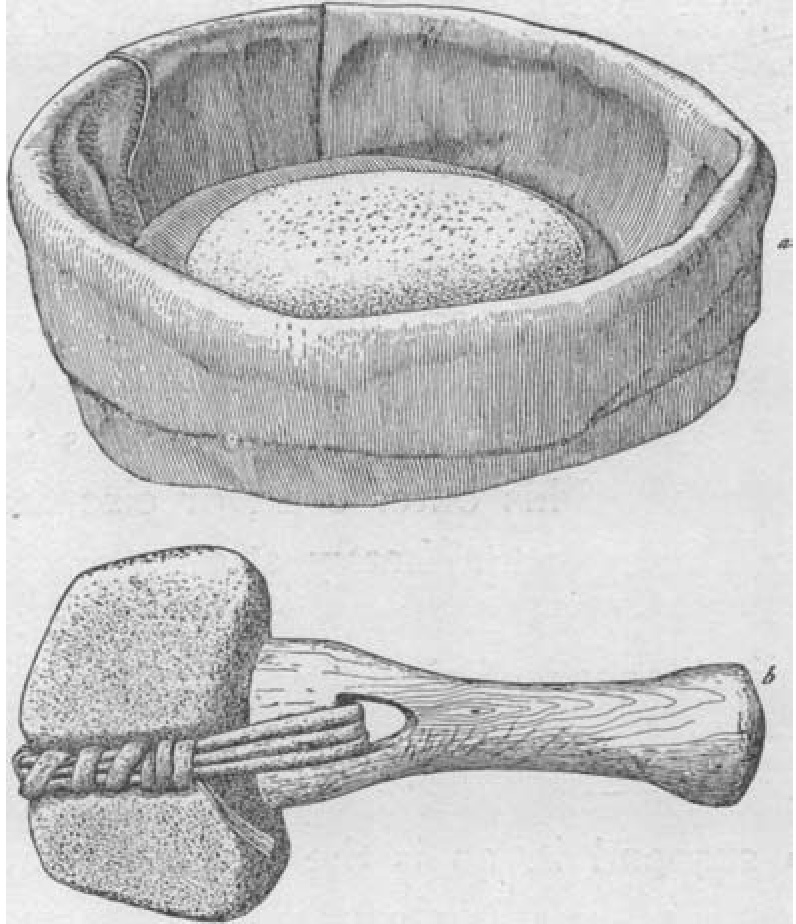
The stone maul (rɪˊpeˊñɪ) is oblong in shape, with a groove in the middle, and a short handle tied to it by means of strong lashings. It has exactly the same form among the Markova Russianized natives, who call it mangaˊuda, a word which is supposed to belong to the old Chuvantzy language. It is one of the most familiar of the kitchen tools, and is especially used for splitting[188]🗗uncollated marrow-bones to extract the marrow from them; it is also used for breaking all kinds of bones from which tallow is to be extracted, and for crushing all kinds of frozen meat, fish and blubber, which form some of the standard items of Chukchee fare.
WATER-SUPPLY. — One of the great needs of the Chukchee household in winter-time is a sufficient supply of water for cooking and drinking, especially at present, when the drinking of hot tea has almost entirely superseded the eating of hard snow, which was usual in former times. Cooking over the lamp, even in an iron kettle, is at best a slow process, particularly so if the kettle is filled with snow or ice that must be first melted and then heated. The process is considerably shortened when begun with water instead of ice or snow. When a river or lake is near by, and the ice is not too thick to be broken through, water is taken from a hole in the ice. Otherwise the largest vessel in the house is kept full of ice all the time. This dissolves gradually. The vessel is usually hung up to escape casualties, and a large wooden dish is put under it to catch the drippings.
The movable sleeping-room of the Reindeer Chukchee is not suitable to melt ice in. For the night-time a kettleful of ice-cold water or of broth cooled with pieces of hard snow is put inside for the benefit of the inmates. Its place is on the skin in front of the lamp, where nobody is allowed to sleep. Because of the general lack of room, the kettle is often upset by the foot of one of the inmates, and the contents are spilled over the sleepers. This arrangement presents another proof that the movable type of sleeping-room is a comparatively recent variation from the stationary type, and is not thoroughly adapted to the conditions it has to meet.
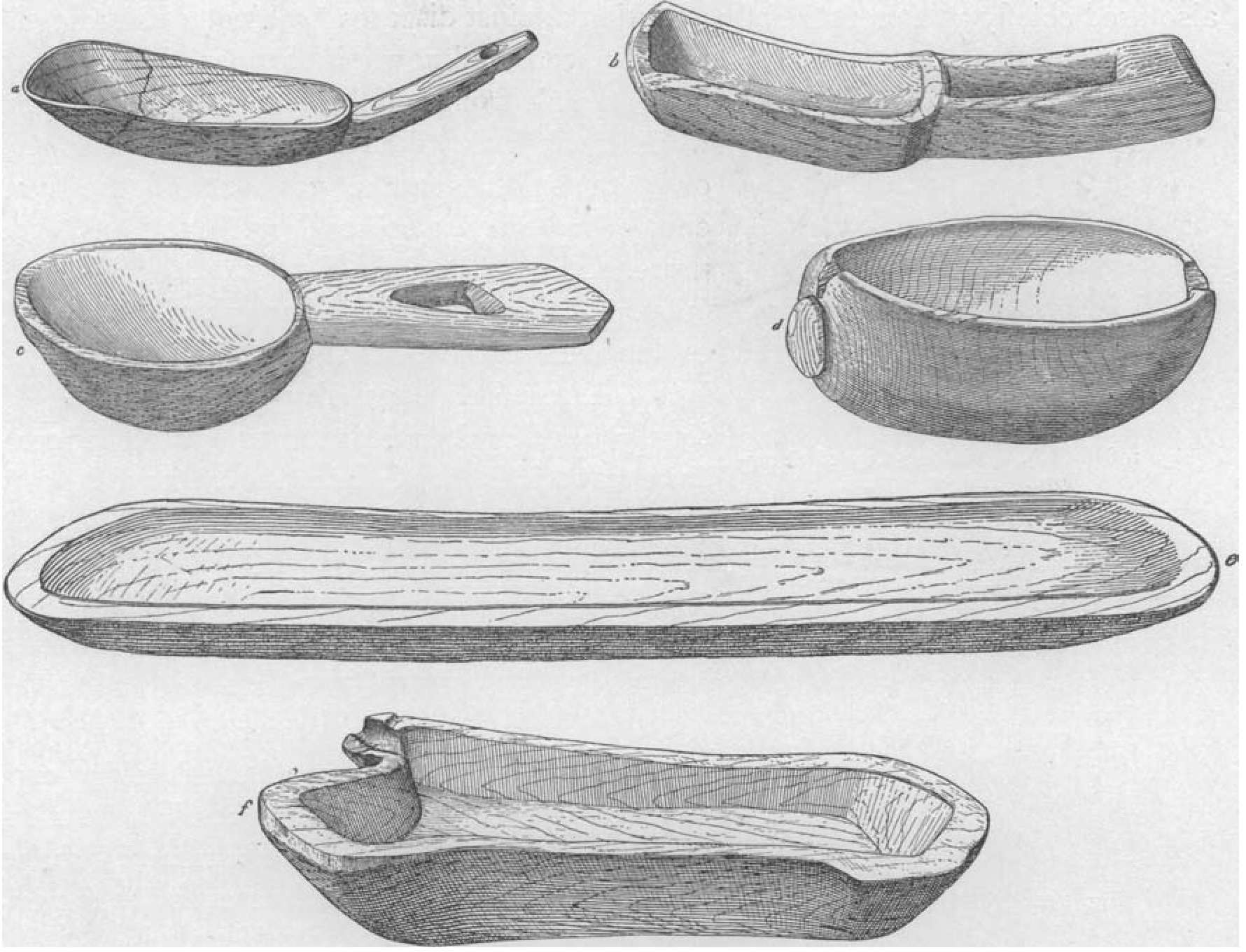
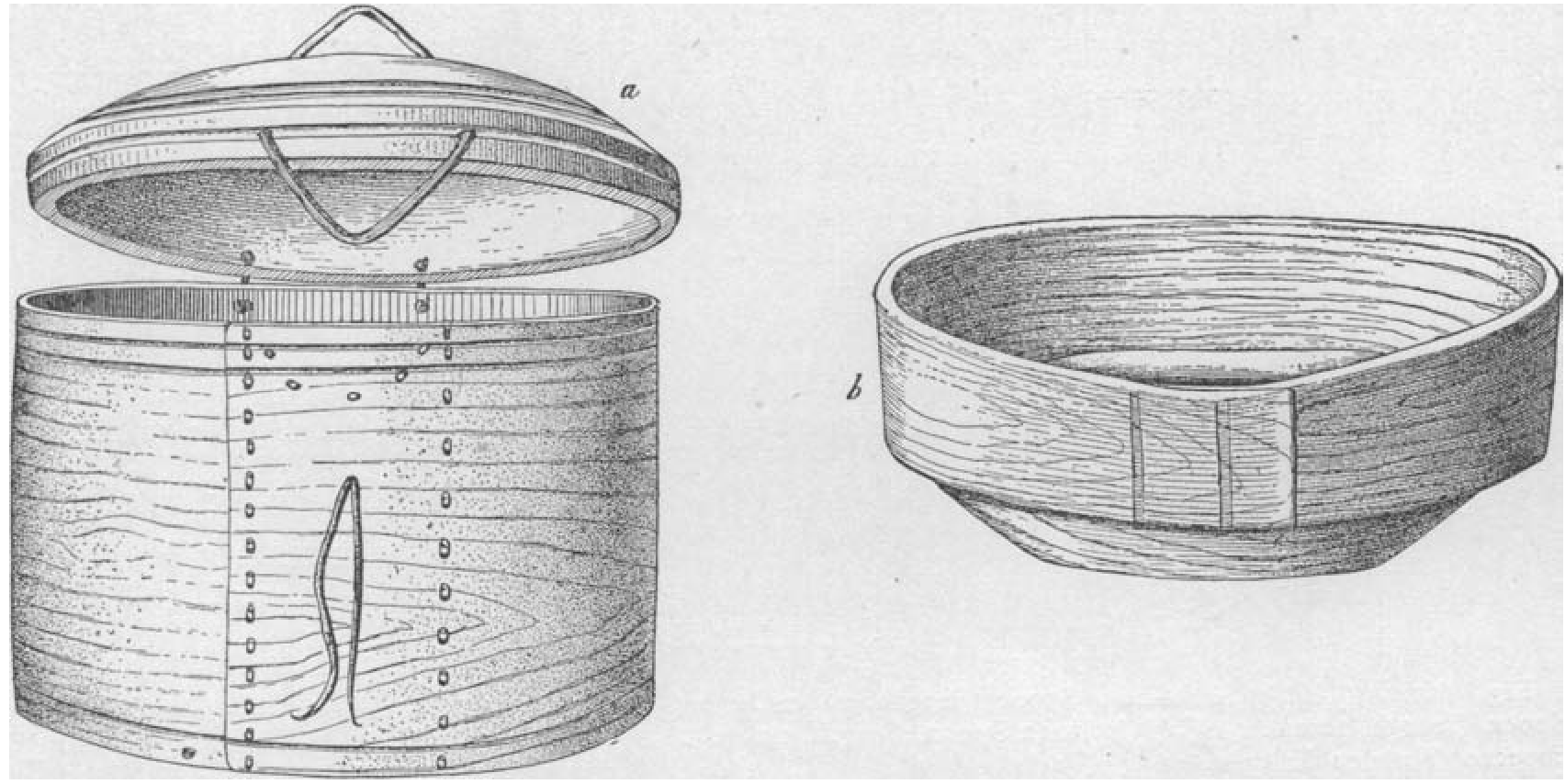
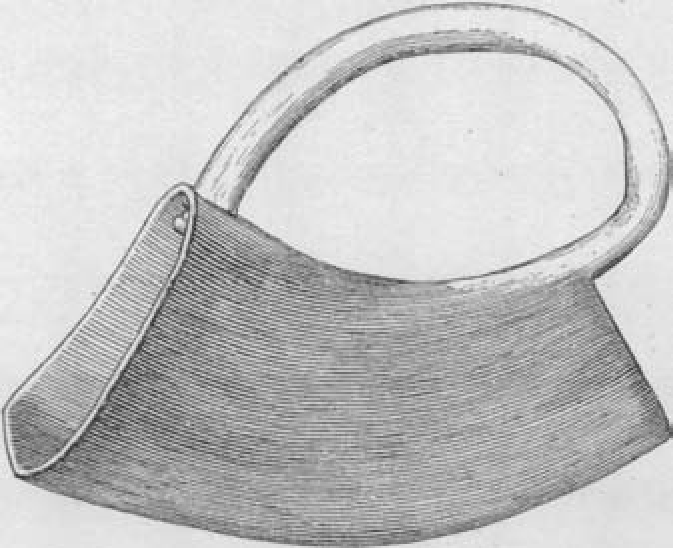


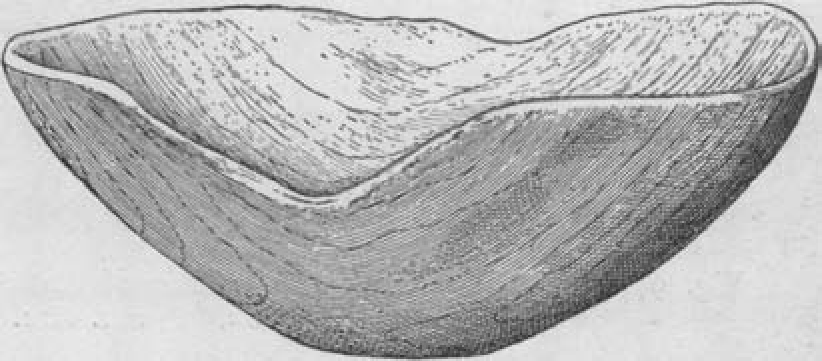
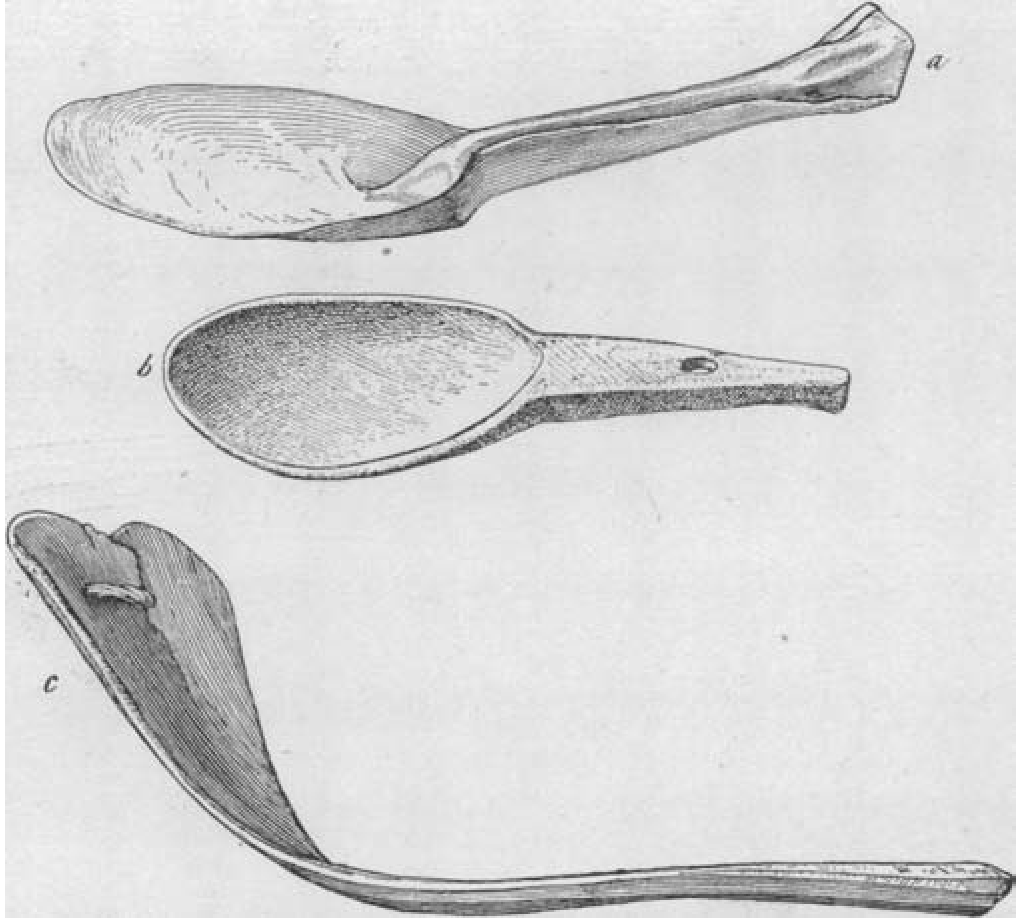
DISHES, BOWLS, ETC. — Wooden trays and dishes, bowls, and dippers (Fig. 106, a-f) of various sizes are made of wood, and used by the Chukchee for the purpose of serving food and drink. Those with sides of bent pine-wood sewed together, and fastened with pegs to a flat bottom (Fig. 107), are brought from Alaska across Bering Sea or from St. Lawrence Island. In several tales there appears, as an object of luxury, a carved drinking-cup of sheep-horn (Fig. 108). Such cups are even now valued more highly than the imported hardware. Drinking-tubes made of the leg-bones of swans (Fig. 109) are[190]🗗uncollated also used chiefly as a measure of precaution against diseases “subject to shunning.”¹ Spoons were unknown in former times, broth being drunk from small cups of various shapes, while mush was taken simply with the fingers or with small spatulæ cut out of the rear end of a marline-spike (Fig. 110). At the present time, spoons (Fig. 111, a, b, c) are fashioned of wood, sheep-horn, bone, or ivory; or a piece of cast-off sheet-metal is wrought into the required shape by hammering or by simply bending it with the teeth. Many spoons have capacious bowls and short handles, calling to mind the original form of the drinking-cup. As a rule, all these utensils are similar in shape to those used by American Eskimo.
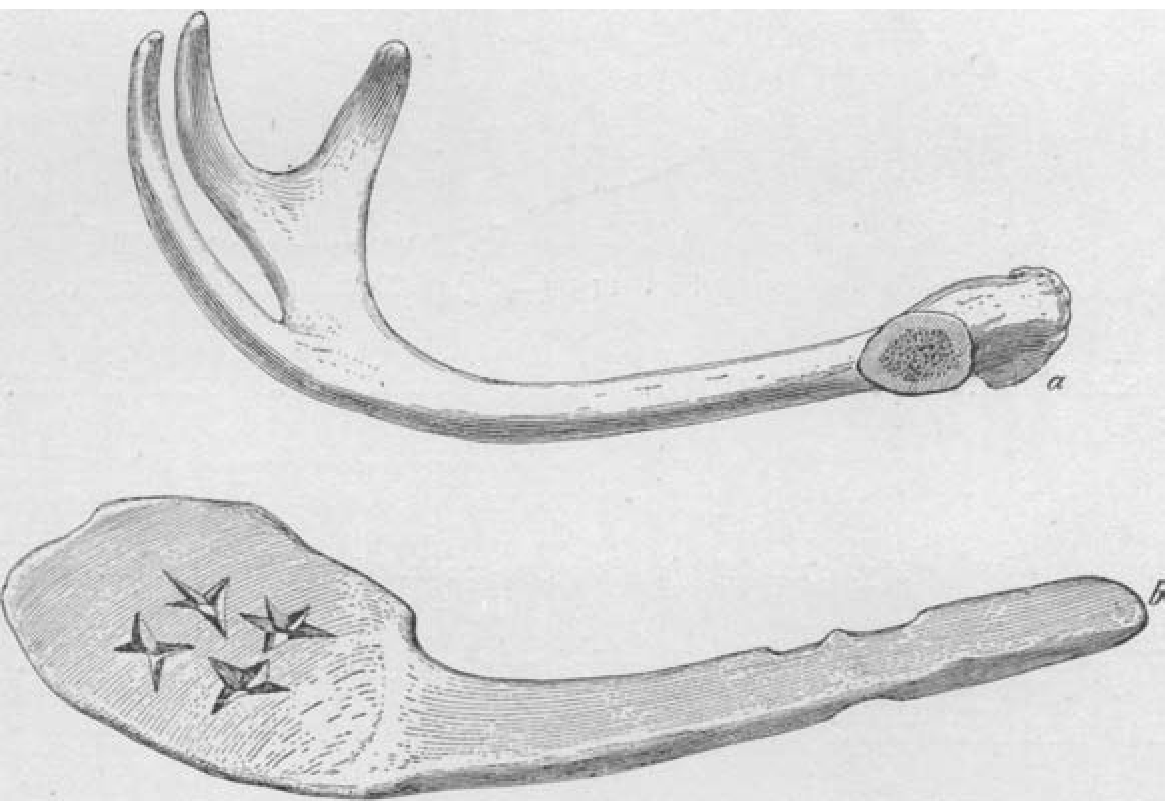
A stout branch of antler, with a spade-like end and several points curved upwards, is used for taking boiled meat out of the pot (Fig. 112, a). Fish-skimmers (Fig. 112, b) are usually made of wood, and their form is copied from the forms of those used by the Russianized fishermen.
Tooth-picks of whalebone are sometimes met with. The specimen represented in Fig. 113 was perhaps used also as tweezers for pulling[191]🗗uncollated out the hair of the mustache. To prevent its being lost, it was stuck through a hole in the belt. Cups of walrus-hide (Fig. 114), for holding oil or mush, are occasionally used.

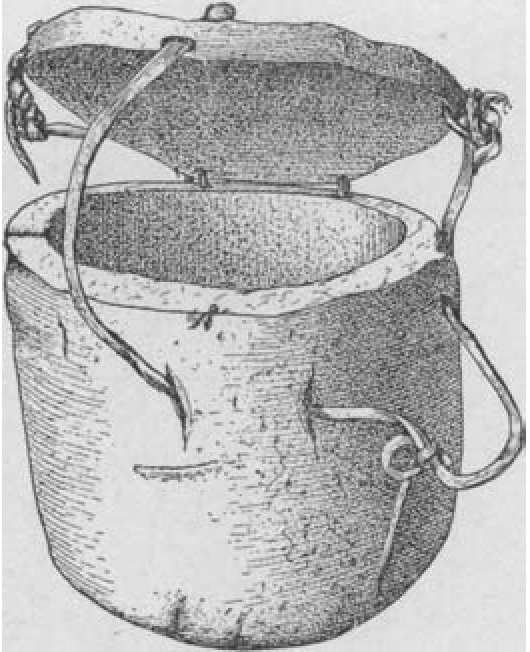
Every kind of cheap hardware is bought from the traders, especially cups, glasses, and saucers, for tea-drinking. When these are broken into pieces, the Chukchee have a clever way of mending them by keeping the pieces together y means of a combination of iron clasps. This is done, however, in imitation of the Russianized natives. When a man travels alone, he carries his cup and saucer, often incased in a small round wooden box closely fitting the chinaware. The cups and saucers of the Reindeer people’s household are carried along in square wooden boxes, for the most part bought from the Russianized natives or from the Maritime Koryak. The Maritime Chukchee, on the contrary, have little opportunity to work and deal in boxes, on account of the scarcity of wood.
BAGS. — The bags for storing food usually consist, in the case of the Maritime Chukchee, of a complete seal-skin, with all the natural openings carefully sewed up. A rip across the breast forms the mouth of the bag. This kind of bag is used for several purposes, — for floats of harpoon-lines, for holding putrid meat for dog-food, etc. The inland reindeer-breeders, who have little seal-skin, make storage-bags out of old reindeer-skins, but always give them an oblong form with a mouth across the middle. These bags are usually so large that a single bag filled with putrid meat, or with blood mixed with pounded leaves, forms a sledge-load for one reindeer.
Similar bags (Fig. 115) are used for storing clothes and old scraps of skin. The flat narrow pillow-bag of the movable sleeping-room has a similar shape.
[192]🗗uncollated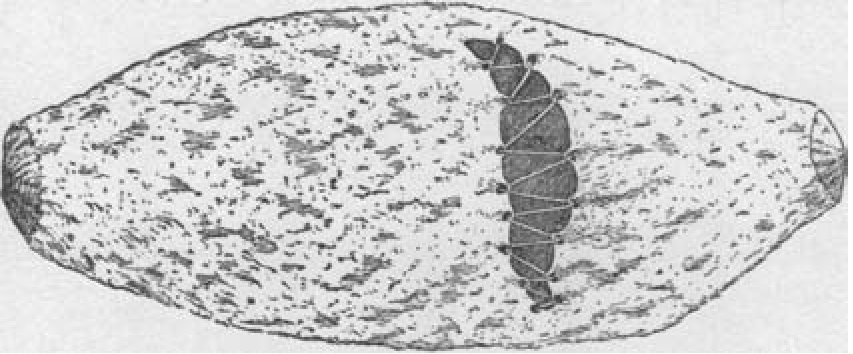
The bags filled with oil or blubber, on the contrary, are rounded, with a short slit for a mouth. The blubber is pulled out of the bag with a hook

(Fig. 116), which is essentially the same also among the Eskimo, the Koryak, and the Kamchadal.