XClothing
There is no particular difference between the clothes of Reindeer and those of Maritime Chukchee, except that the former use better reindeer-skins, while the latter use seal-skins more frequently. Skins of reindeer-fawns are highly prized as material for clothing, because they are very warm and at the same time so light that a man clad in double garments is able to bustle around in the open quite freely. When Middendorff¹ says that in his opinion a good sheep-skin coat is to be preferred for travel, it may be ascribed to the fact that he travelled only with the Tungus. The latter select for clothing either the thinnest summer skins for making their holiday garments, or the heaviest winter skins for making short overcoats, which are put on over the usual clothes for riding-trips in the middle of winter. Moreover, the Tungus usually have only small herds of reindeer, and cannot very well choose their time for slaughtering or pick those animals whose skins are best fitted for clothing, as the wealthy reindeer-breeders of the extreme northeast do. Skins of the wolf, and perhaps also those of the wild sheep, surpass those of the reindeer in their wearing and protecting qualities, but both are too rare to be used regularly as material for clothing.
The Maritime people in these regions, unlike the American Eskimo, use seal-skin but little for coats. This is because seal gives but slight protection against the cold, while, on the other hand, it brings a much better price in exchange for reindeer-skins. For this reason we find that only reindeer-skin is used for winter coats. Seal-skin is more useful for trousers, because it wears better, especially in the damp weather of spring. For spring and summer boots, seal-skin is most serviceable. It is tough, wears extremely well, and affords better protection against dampness and water than any other hide known to these natives. While the Maritime Chukchee depend on reindeer-breeders for their winter clothes, the latter obtain boots and sole leather from the coast tribes. Late in the spring, when short of seal-skin, the herdsmen will use it only to patch out the uppers of a pair of ordinary reindeer-skin boots, so that they will wear better in the damp snow.
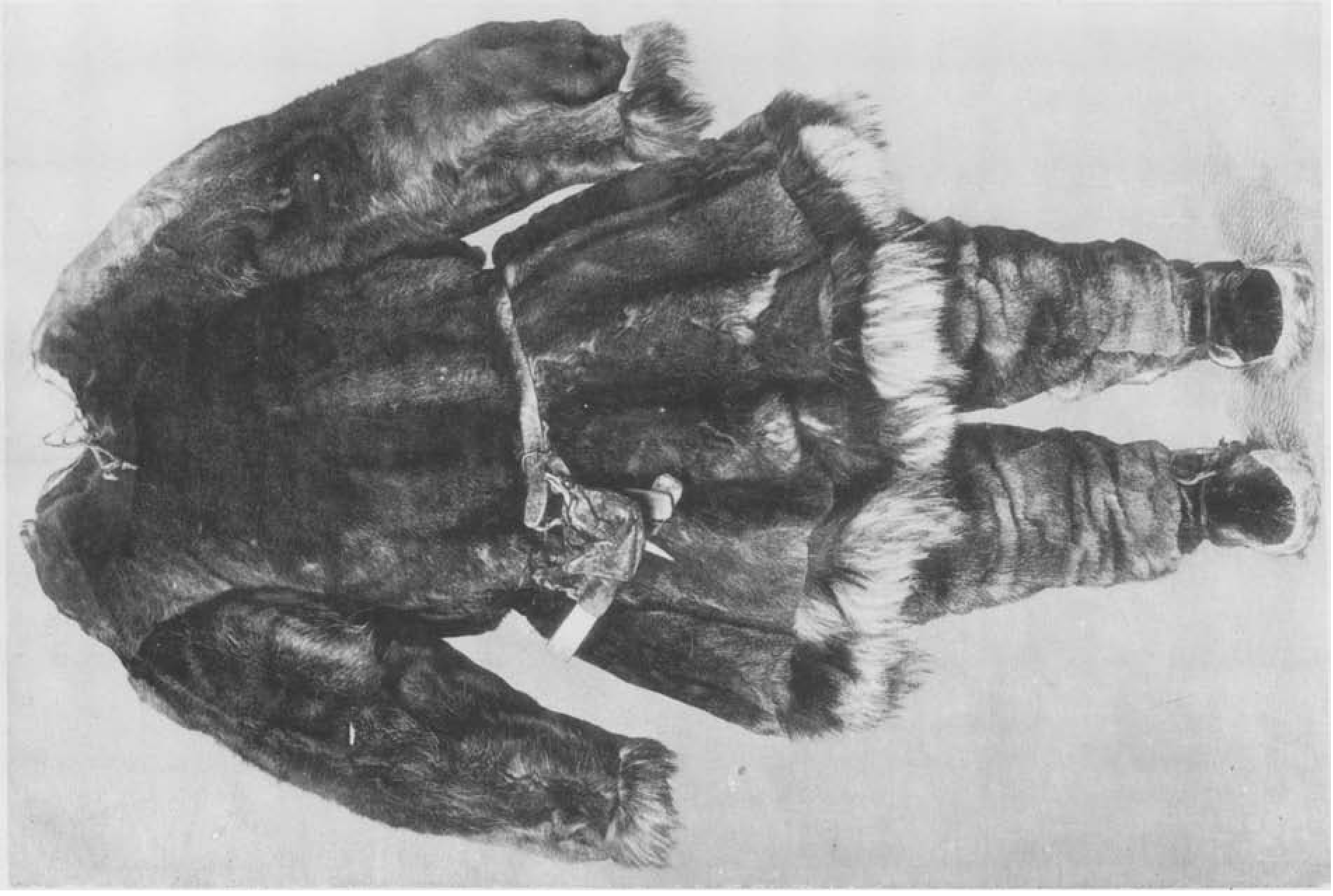
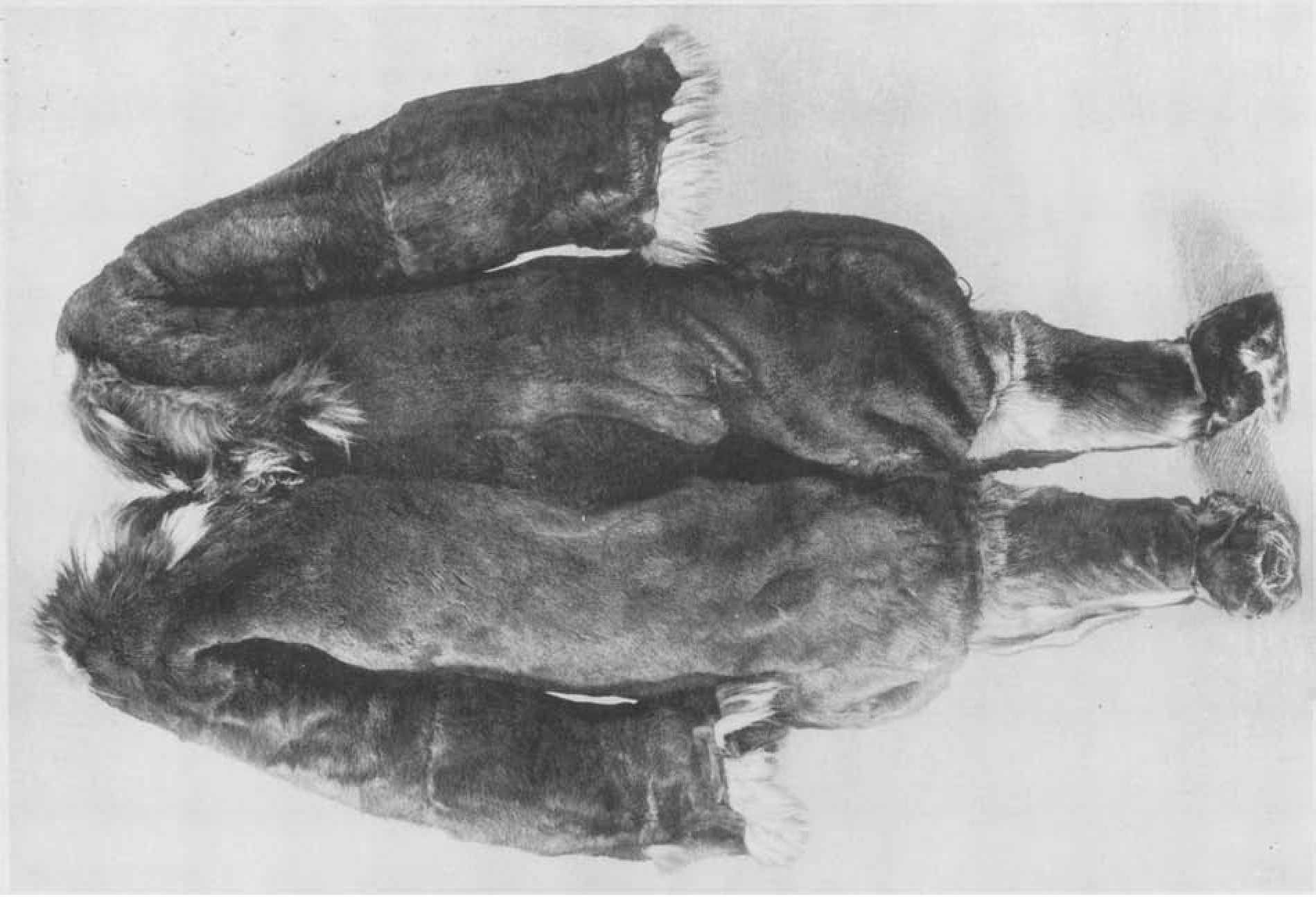
WINTER CLOTHING FOR MEN. — The style of clothes used by Chukchee and Koryak men in winter is admirably adapted to its purpose. It therefore prevails among most of the tribes of northeastern Asia, including the Russians. Even the northern Lamut, who in ordinary life wear narrow coats, and aprons of a peculiar cut common among the Tungus tribes throughout eastern Siberia,[235]🗗uncollated put on the heavy fur shirts of the Chukchee when they drive a reindeer-sledge. Their own clothing does not sufficiently protect them from the heavy wind blowing against their faces, and from the lumps of snow thrown up by the reindeer-hoofs and the runners of the sledges.
Each part of the Chukchee winter garments for men or women is made in two pieces, an inner and an outer one, the former with the hair side in, and the latter with the hair side out. These pieces are worn without being sewed together, in order that they may be separated for drying, but they fit together so exactly as to form practically a single garment. The inner part is usually made of very soft-haired material, so that it will not irritate the skin, and can be worn without underclothing even by a European.
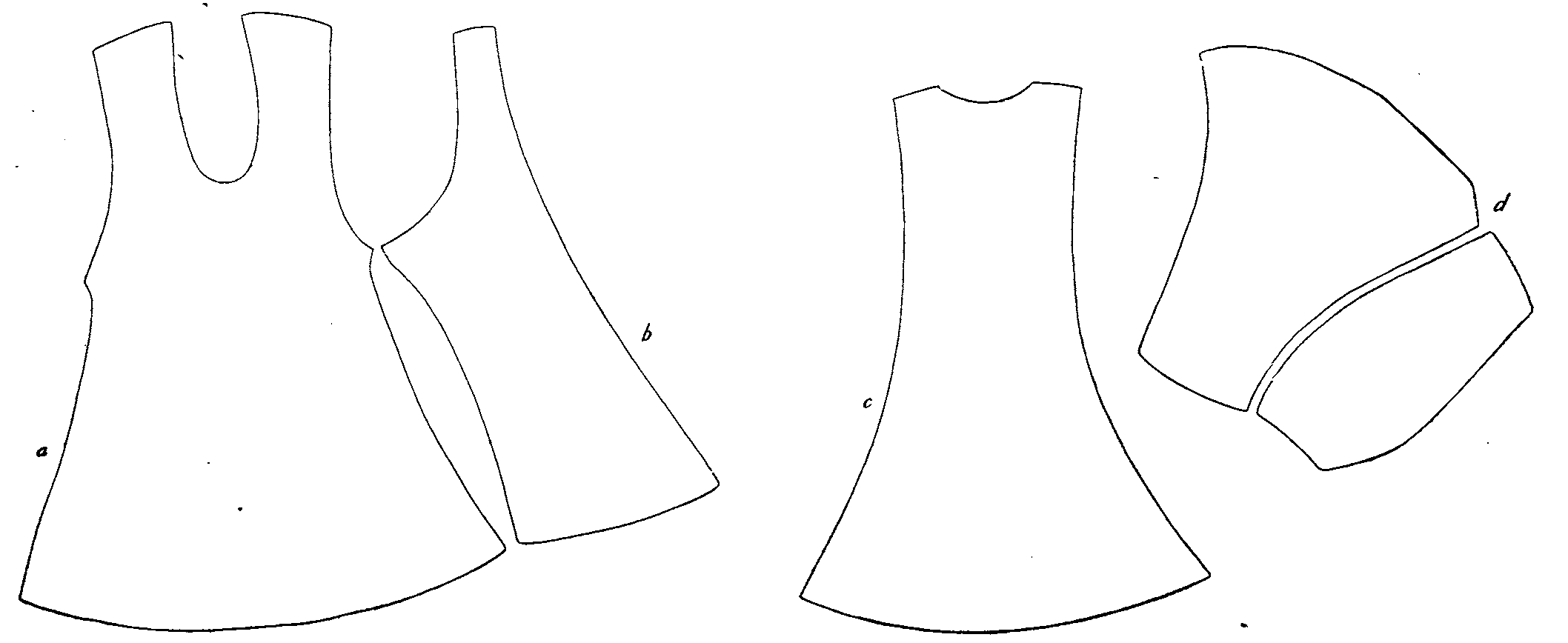
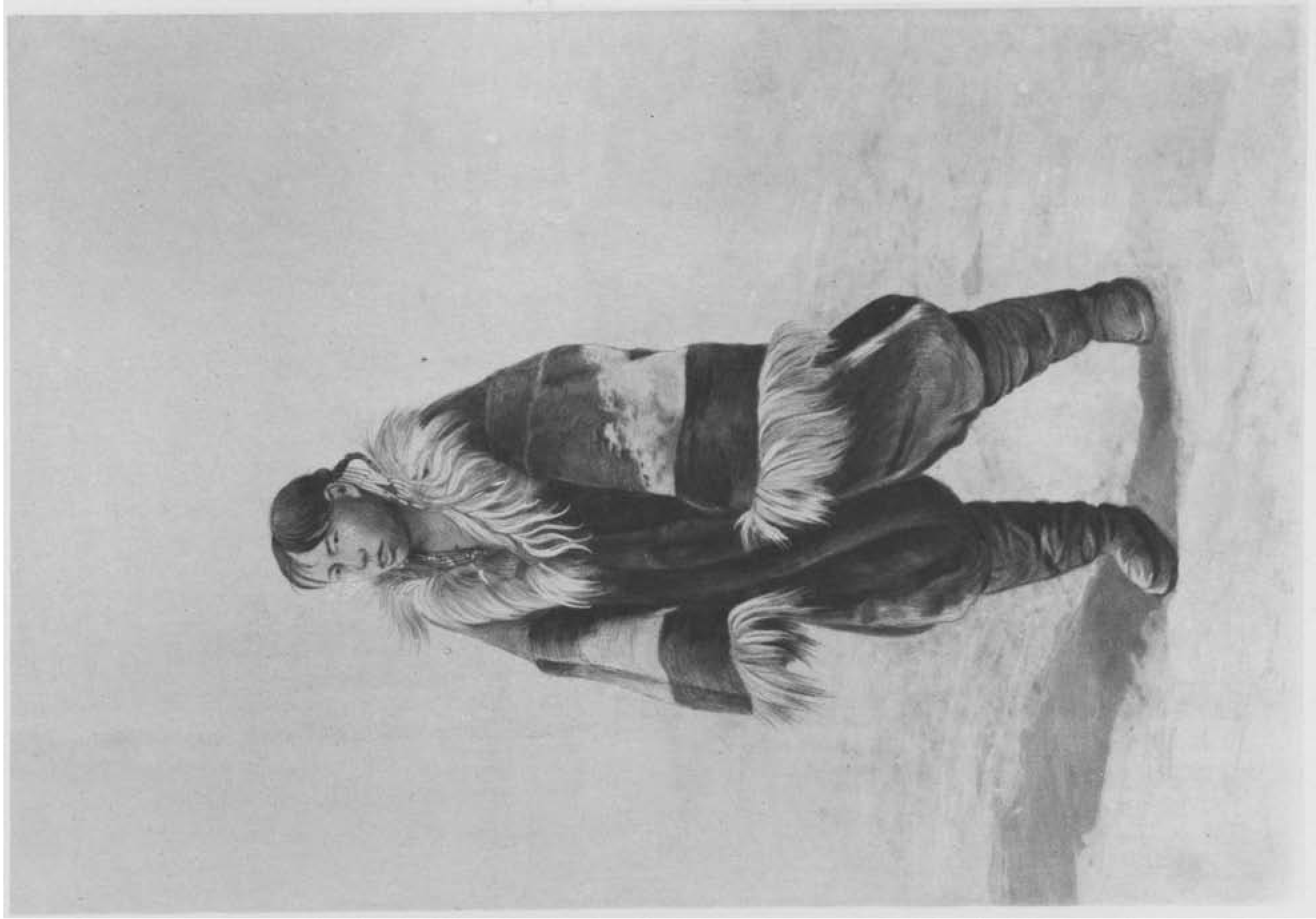
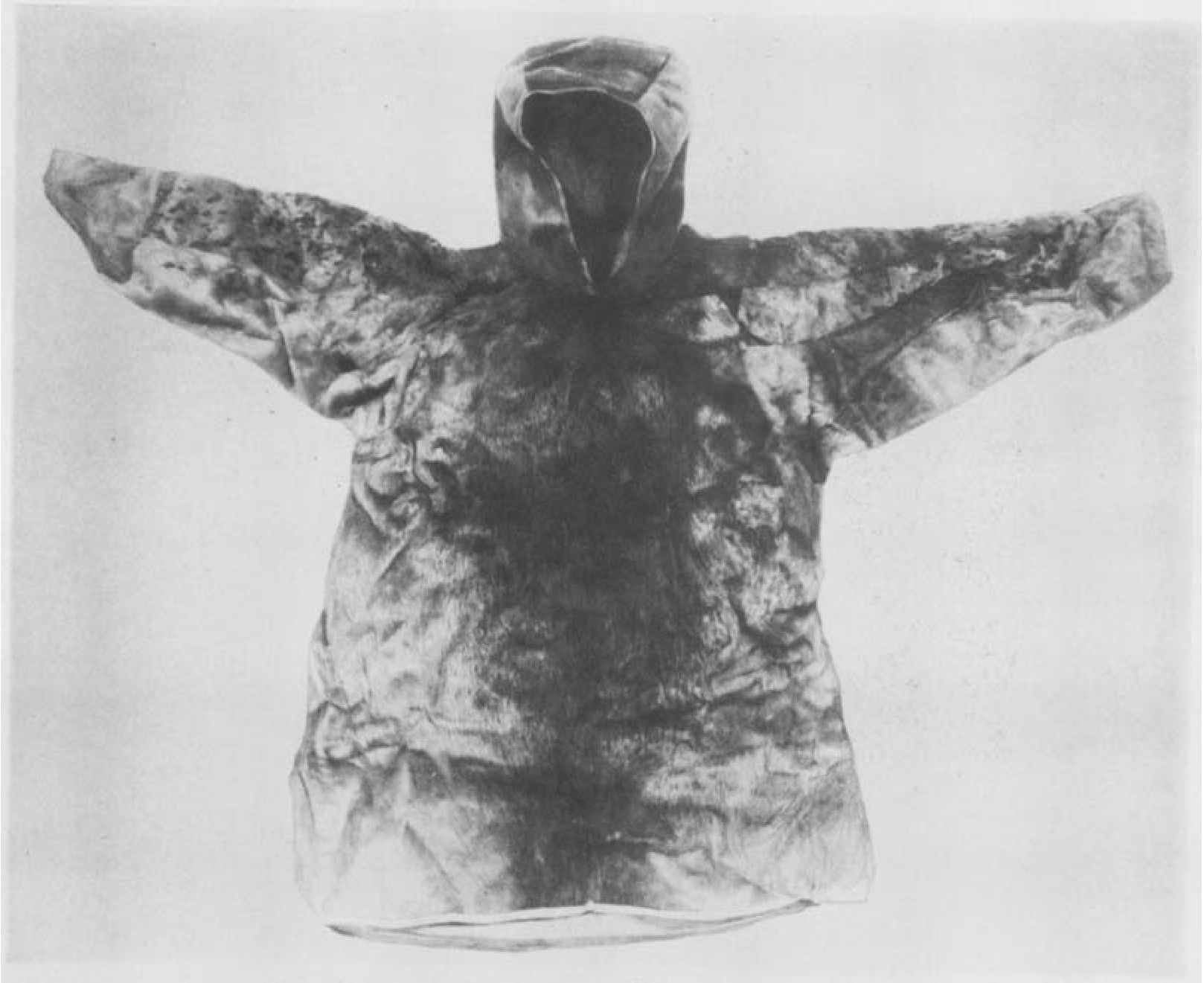
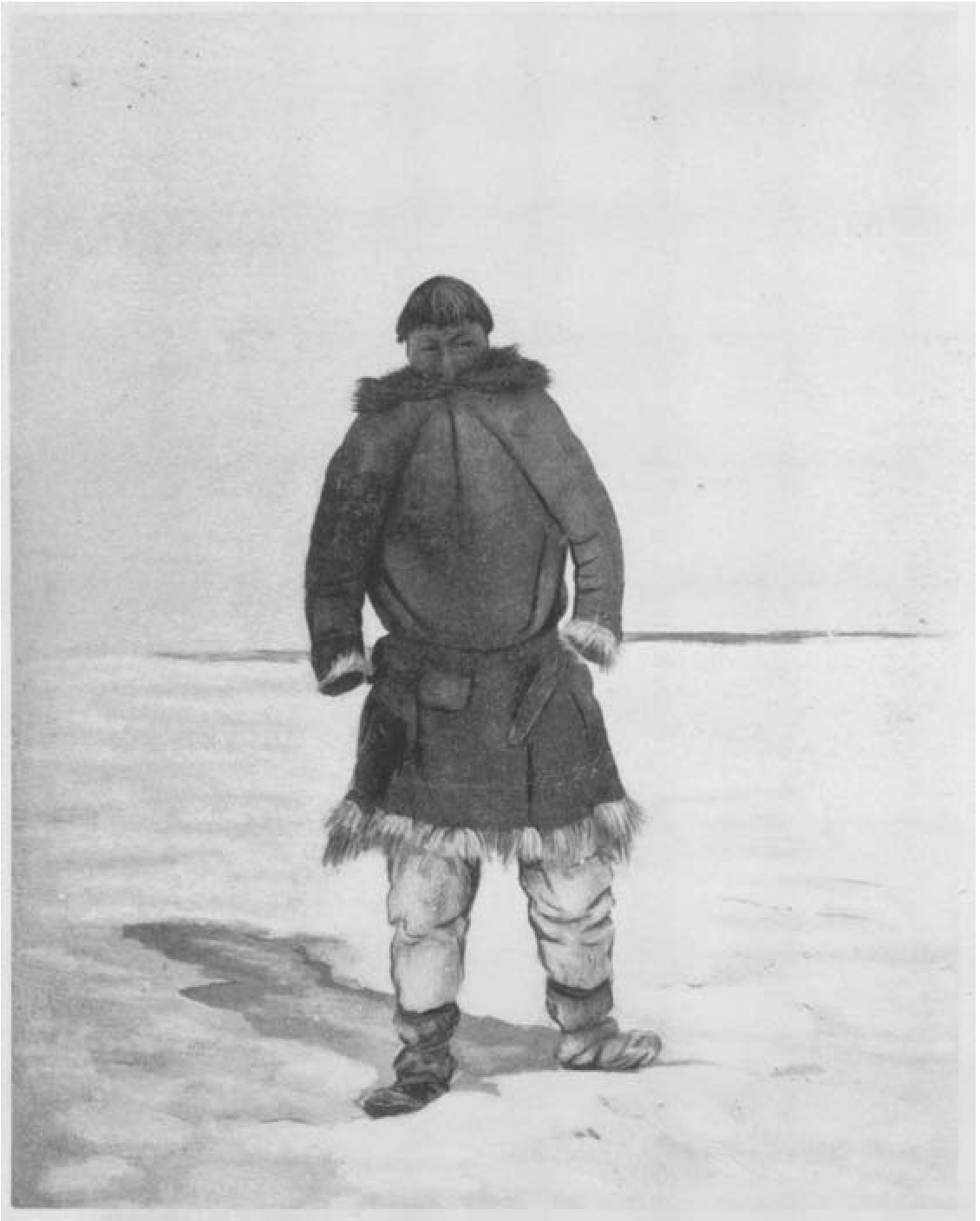
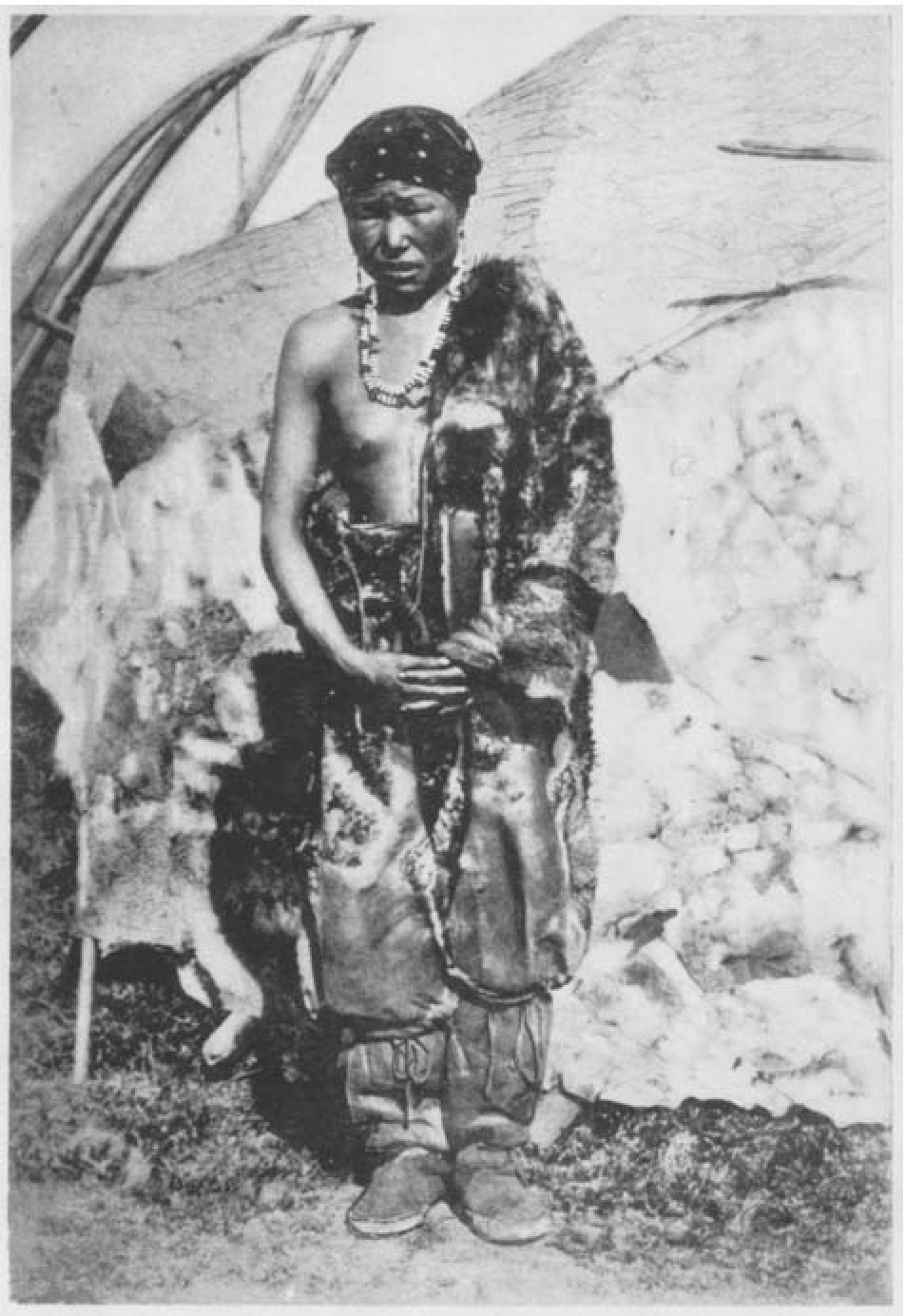
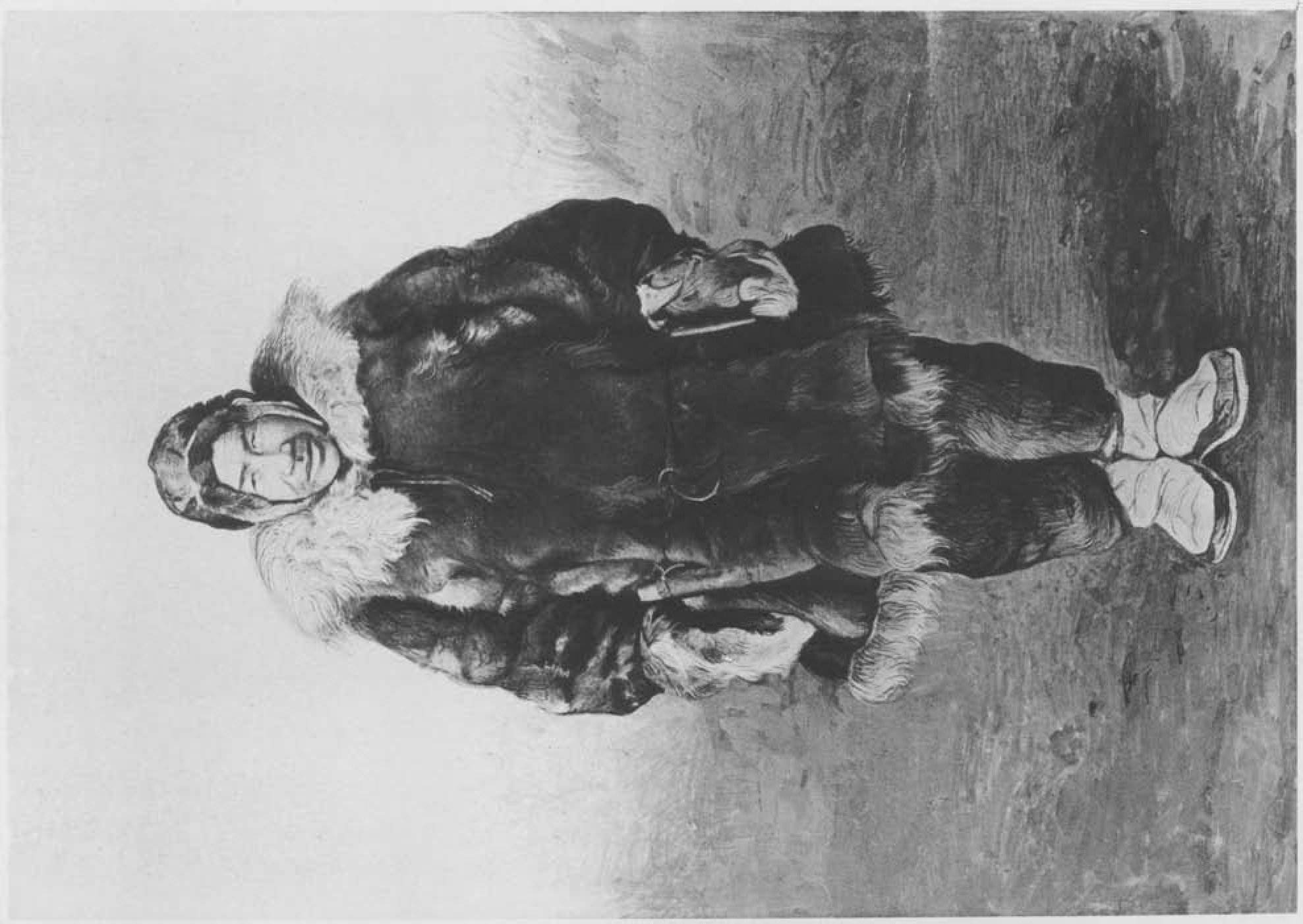
The chief piece of clothing is a heavy fur shirt almost reaching to the knees, with no hood attached, and with a rather large opening in the collar (Plates XXIII, Fig. 1; XXIV, Fig. 2; also Fig. 168). Koryak shirts are longer, and often have a hood; but among the Chukchee only the shroud has a hood, which is drawn over the face of the dead body. The shroud is therefore called by them “the hooded garment.” The collar of the Chukchee shirt is bound with a narrow piece of skin folded over so that a stout sinew string may be pulled through to tighten the collar as much as desired. The ends of the string come out on the breast. The Chukchee assert that the string is added to strengthen the neck of the shirt in case of a scuffle; otherwise it would give way when pulled hard in wrestling.
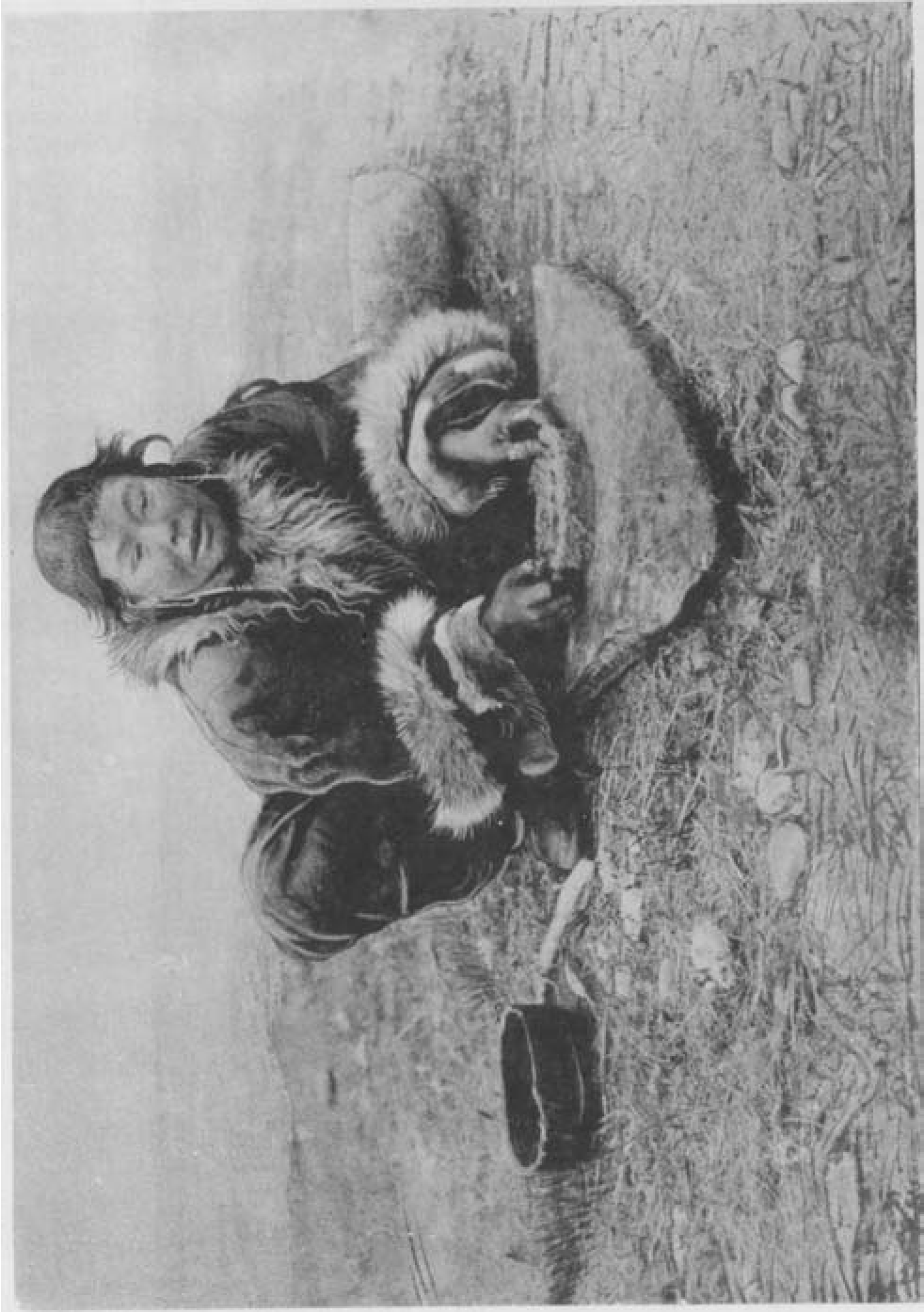
The shirts of the Maritime people, (Plate XXIV, Fig. 1) are of the same cut as those of the reindeer-breeders. They often wear cast-off clothing of the Reindeer people, because the herdsman wears his coat only one winter, often only half of this time. After that, the women of his family make him a new[236]🗗uncollated coat, and the old one is sold to the Maritime neighbors. It is still fairly warm and appears well, but in reality the leather has deteriorated and the hair thinned out, so that it offers appreciably less protection from the cold.
The neck of the inner shirt is often trimmed with a broad strip of dog’s or wolf’s fur, as shown on Plate XXIV, Fig. 2. This may be folded back, forming a thick and warm collar. The lower edges of both parts of the shirt are trimmed with narrow pieces of fur. The inner shirt is a trifle longer, so that the garment appears to have a double row of trimming around the bottom. This trimming is usually of dog-skin, but in the best shirts wolf, fox, and wolverene trimming is used. The last-named is considered the prettiest, wolverene-skin being highly prized among the Chukchee and among the Eskimo on both shores of Bering Sea.
The Koryak fur shirt is trimmed below with a broad strip of fur of the same material as the body of the shirt, but different in color. This strip is commonly bordered with a narrow piece of dark-colored reindeer-skin, and with beaver or otter in garments of the well-to-do. The same method of trimming fur shirts is adopted by the Russianized Yukaghir and Kamchadal, as well as by some of the Chukchee on the Pacific side. On the whole, however, a characteristic feature of the Chukchee shirt, distinguishing it from that of the Koryak, is the absence of this lower strip.
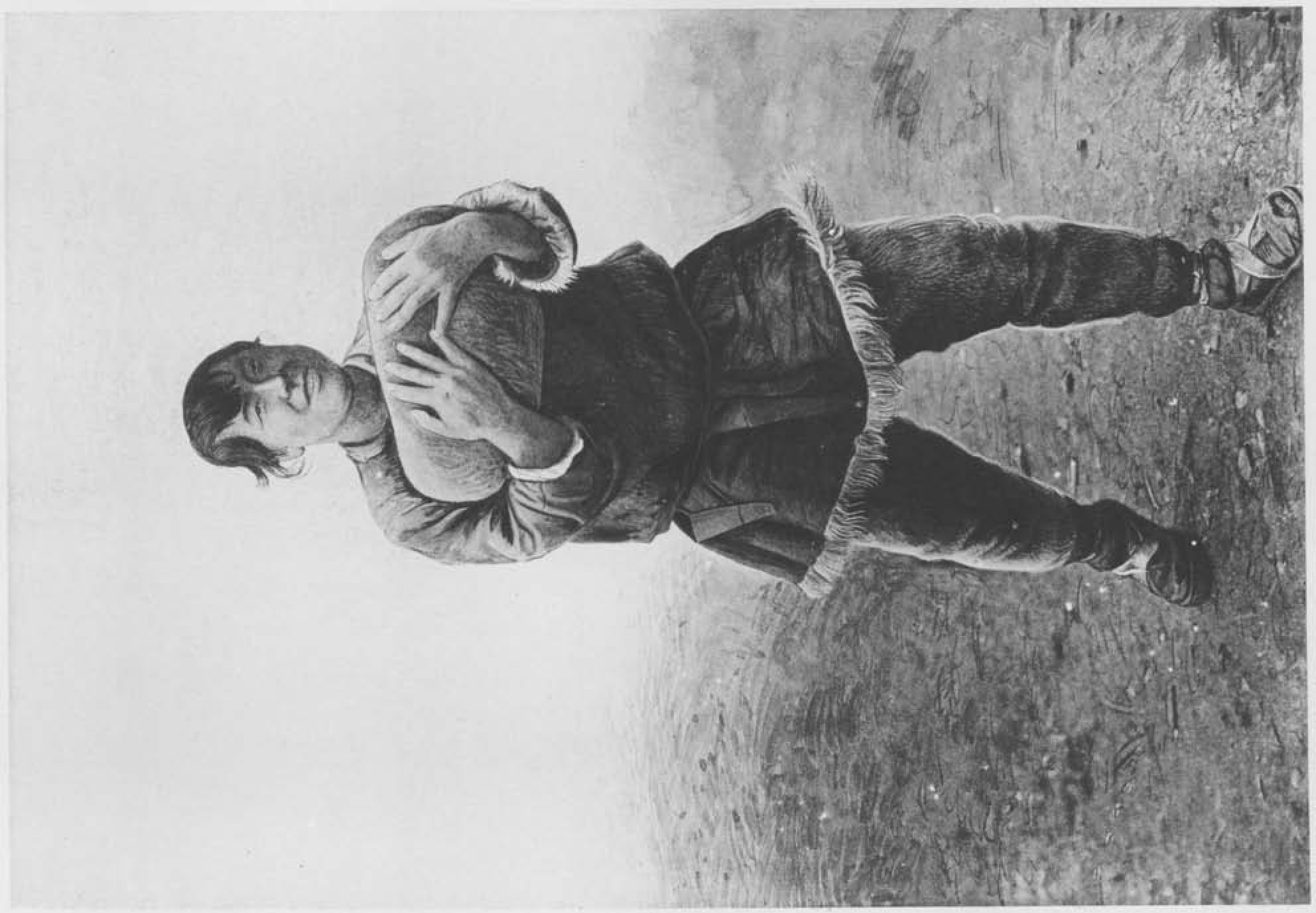
The sleeves of the shirts are full at the shoulder, and narrow at the wrist. The opening is slightly gathered in, and bordered with a narrow strip of fur. If desired, the arms can be drawn out of the sleeves into the bosom of the shirt. Indeed, this is a favorite position with the Chukchee when taking their ease (see Plate XXVII, Figs. 1, 2). The shirt is so ample, that when the arms are drawn in, the man can without difficulty turn in the garment, which then looks more like a small tent. When sleeping in the open without an overcoat, a Chukchee man makes full use of the shelter of his ample shirt. He tightens the belt and then draws in his arms, turns up his fur collar, and draws his head inside, and then pulls the front of his thick fur cap up to the neck-opening. Fortified in this manner, he can sleep snugly in the most severe cold or during a heavy fall of snow. In the morning he will shake off the snow just like an animal after sleeping in the open.
The young people make their upper shirt of thin fawn-skins from the first fall slaughtering. These look smoother and neater than the others. The inner shirt, of course, has to be made of thicker skins. With the simpler clothes the reverse is the case. I have already noted that for colors, dark brown, spotted, and pure white are preferred. The young people, too, have their shirts short, while those of old men reach sometimes considerably below the knees, and are made of the thickest autumn skins. They then look more like heavy overcoats than mere shirts.
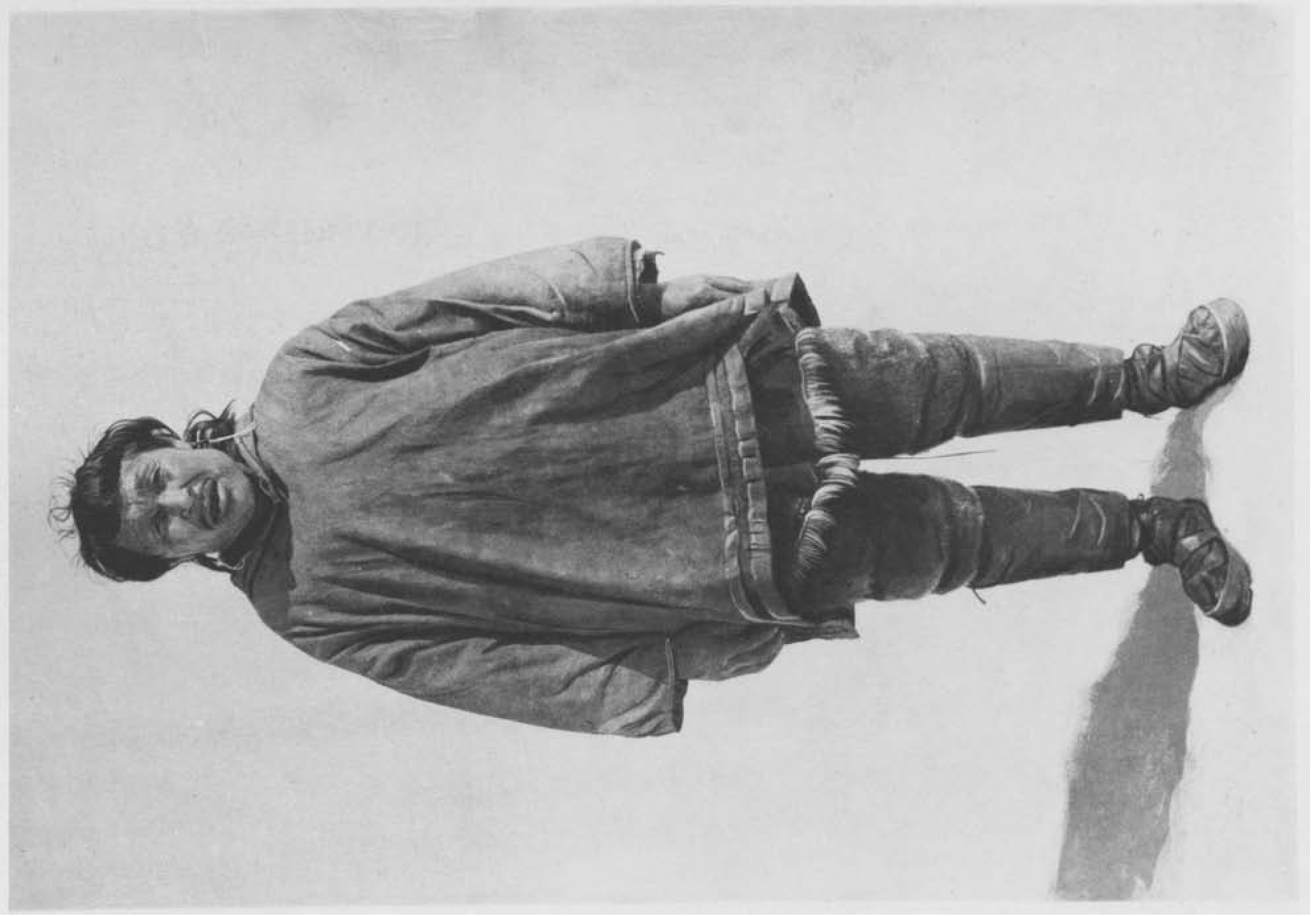
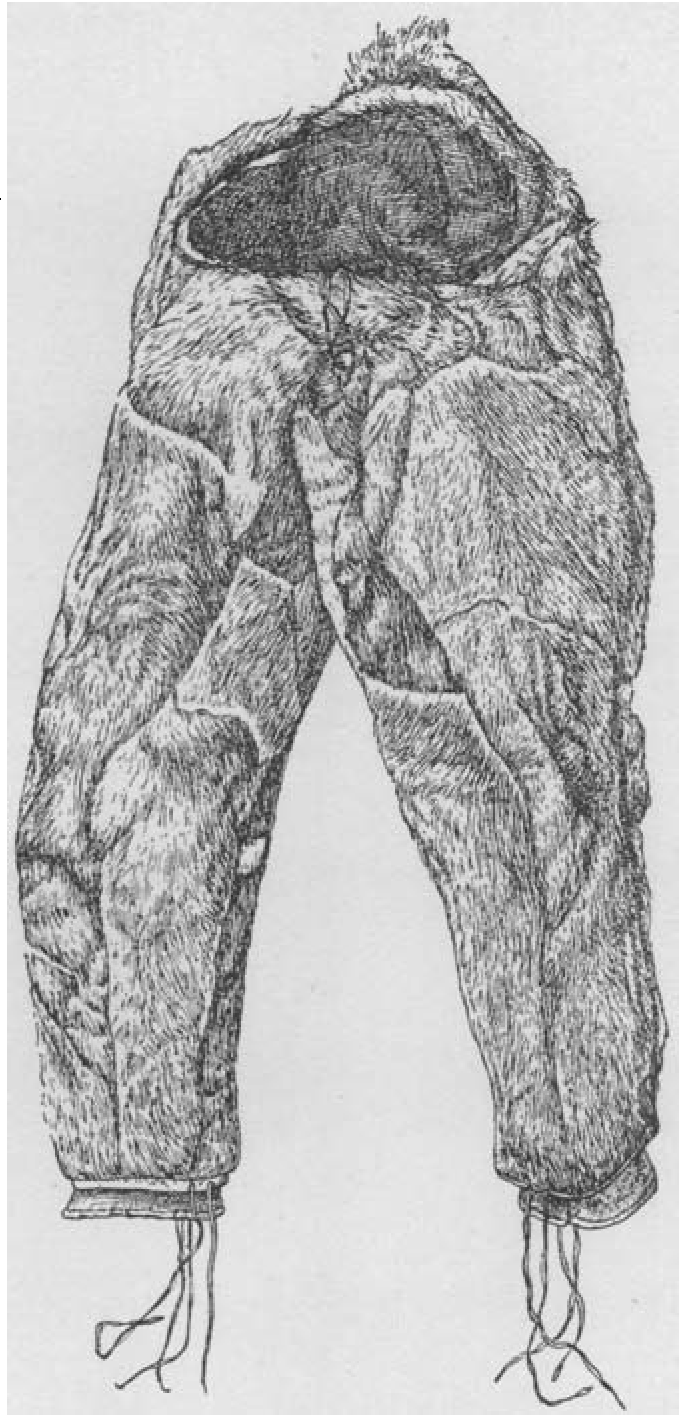
The outer trousers (Fig. 169) are made chiefly of the leg-skins of the[237]🗗uncollated reindeer, the hair running downward. By this arrangement the snow does not stick at all to their sleek surface. For the middle of winter the outer trousers are made of thick fawn-skins (Plate XXIII, Fig. 1). Among other advantages, these skins require fewer seams than those made of leg-skins. Since the cold comes in through each seam, this makes a very marked difference in the amount of protection afforded. On the other hand, the leg-skin trousers are not so susceptible to dampness, and are therefore better for spring than those of fawn-skins. Well-to-do people have their trousers made of the leg-skins of the wolf, which combine great toughness and warmth.
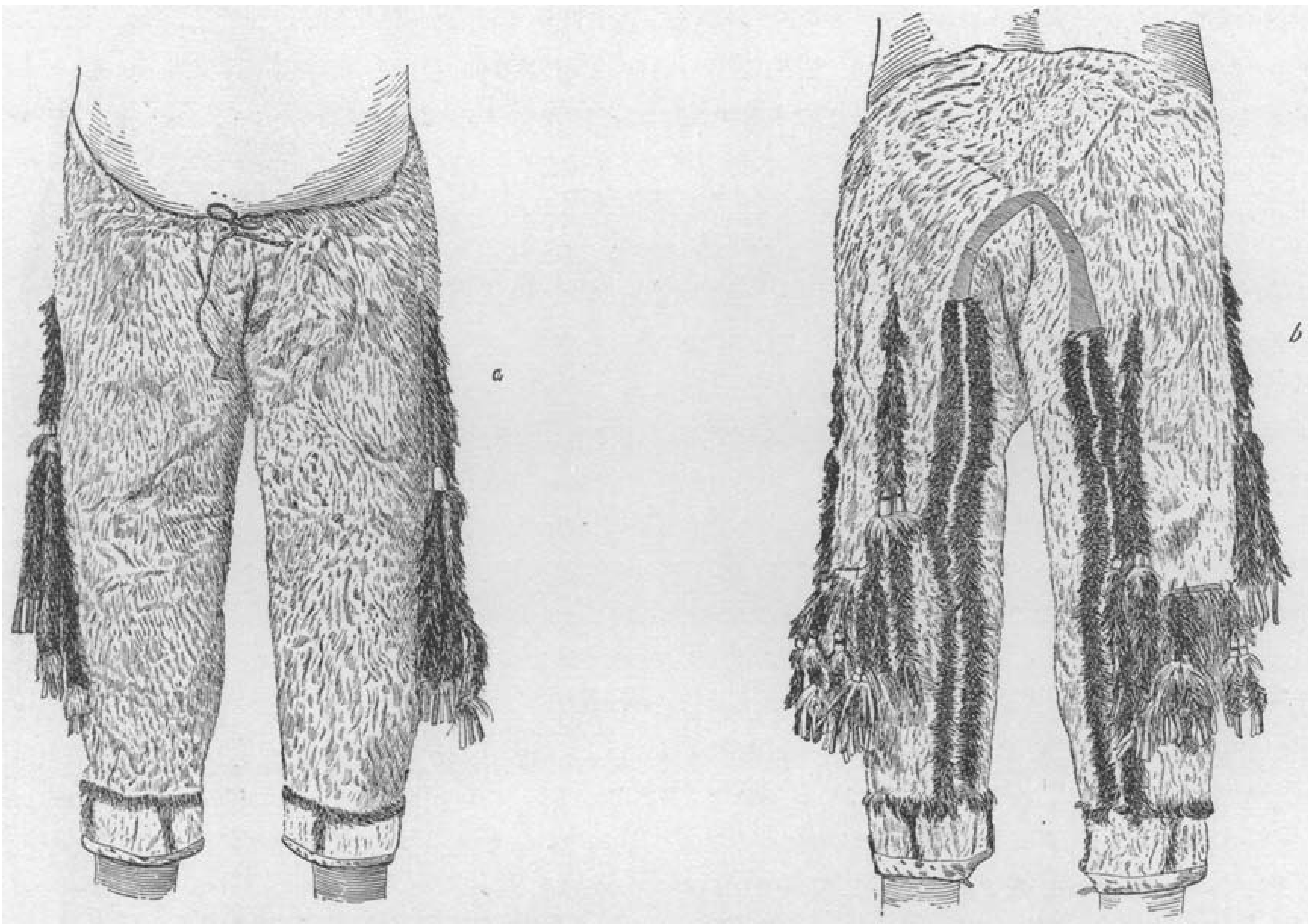
The inner trousers are made of soft fawn-skins of varying thickness, according to the season. The Chukchee trousers have no regular belt and are short in the waist, scarcely reaching the navel (see Fig. 170). They are held in place by a sinew string which passes through a hem at their upper edge. Notwithstanding this, they always have a tendency to slip down. The Chukchee men habitually give a peculiar jerk to their bodies to throw the trousers back to the proper place. The trousers are narrow, and fit the calf of the leg tightly. On the lower edge they have the usual gathering-string, which can be drawn tight around the ankle. The short legs of the Chukchee boots are always put inside the trousers, so that, when the latter are tied, the whole is impervious to snow.
Trousers of seal-skin are worn in spring and in summer by the Maritime people, and by reindeer-breeders who live near the coast. Their cut is exactly the same as that of the trousers of reindeer-skin, and they are often adorned their full length with narrow stripes dyed purple. Those worn by young men often have numerous tassels of the skin of a seal-pup dyed red¹ (Fig. 170). Trousers with many tassels indicate the claim of their owner to a wrestling reputation, from which fact they are called “wrestler’s trousers.” Wealthy people sometimes have dress trousers, likewise tasselled, and made of the skin of fur-seal, which is extremely rare on these shores.
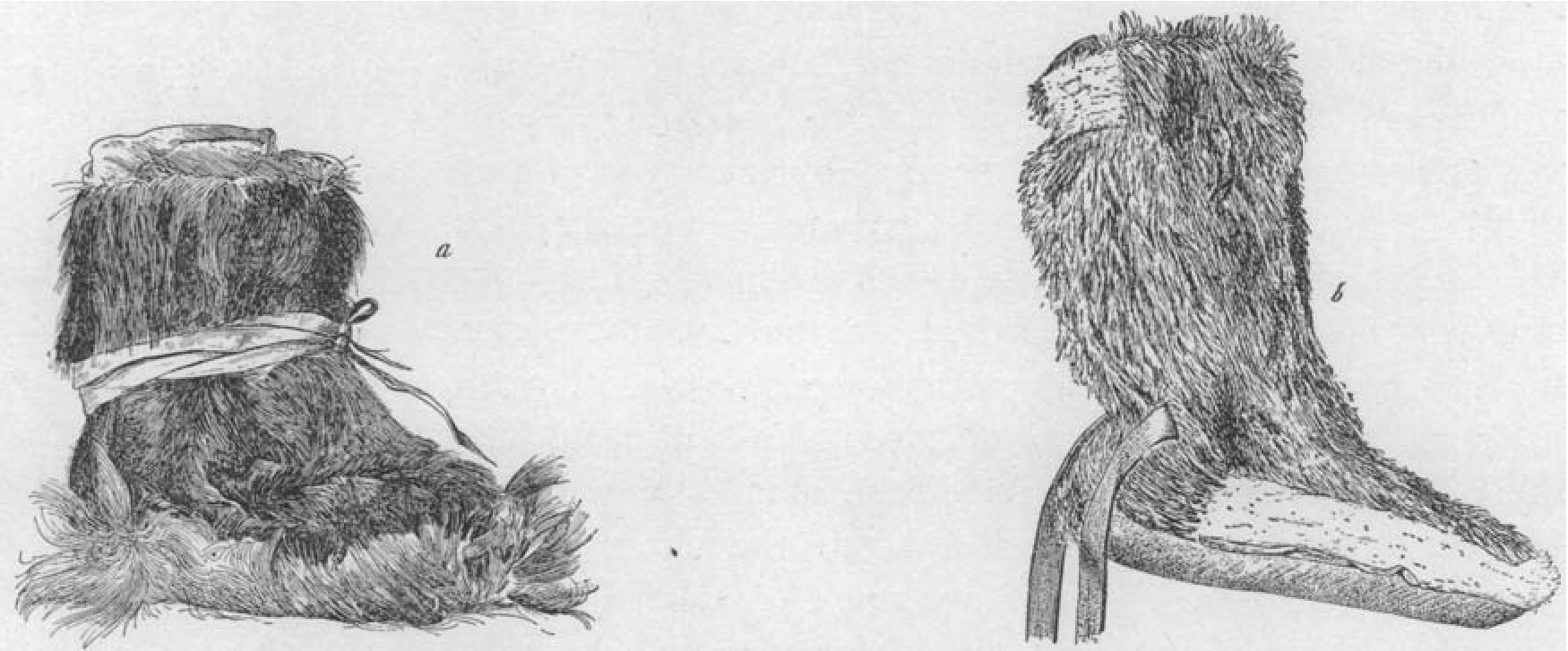
Winter boots are made of reindeer-leg skin with the hair side out (Fig. 171, a). They vary in thickness according to the season. The Chukchee[238]🗗uncollated are very particular about this, and change their boots almost every month. The boots are generally made of black skin, with a narrow strip of white in the vamp. The legs of men’s boots are usually short. Around the edge of the sole is an upright strip of skin, to which is attached the piece covering the top of the foot (Fig. 171, b). This gives more room for the toes, and at the same time makes the boot fit the foot more snugly. On account of[239]🗗uncollated this peculiar vamp, the Chukchee winter boot has a square-shaped toe. The same shape is used for the summer boots of seal-skin or curried leather, though the vamp in the latter consists of a plain piece sewed to the sole. Other tribes of northeastern Asia neighboring on the Chukchee generally wear boots with pointed toes. In the Yakut boots the toes even bend upward with a long curved strip, somewhat resembling the well-known mediæval form. The natives are well aware of the peculiar square shape of the toe of the Chukchee boot. In one of the legends of the local Russians about their early war with the Chukchee, a party of the latter is discovered by means of the square-shaped grass insoles which they had thrown into the river flowing past their camp. The soles for the coldest time of the year are made of patches of very tough skin taken from between the four toes of the reindeer’s foot. These patches are covered with thick tufts of hair, dirty white in color, and almost as stiff as bristles. They are sewed together, fashioned into a sole, and then well dried. The sole has the hair side out, so that the whole covering of the man, from the crown of his head to the sole of his foot, literally bristles with hair, like the skin of an animal.
In former times the Maritime Chukchee on the Arctic shores used the leg-skins of the white bear for making winter boots, including the soles. This fact was also noted by Nordenskiöld. These parts of the bear-skin are exceedingly tough and covered with thick white hair, so they serve the purpose well. Nowadays, however, the skin of a polar bear brings a very good price either from Russian or American buyers, so the natives have ceased to use it for shoes. Only the elbow-protectors, that form part of the seal-hunter’s dress,¹ continue to be made of polar-bear skin. For all other seasons, covering about nine months of the year, the soles of boots are made of thong-seal hide with the hair side in, or of split walrus-skin. The latter is not so durable as ground-seal skin. Notwithstanding the extreme toughness of these hides, the herdsmen wear them out quickly, especially in summer. The inland camps are always in want of hides for making soles. In the Kolyma country thong-seal hides sell for twenty fawn-skins apiece. Even cow’s hide, furnished by Yakut traders, is gladly bought at the rate of three reindeer-bucks for one hide. Poor people, unable to procure enough hide for soles, make them of pieces of skin taken from the neck of old reindeer-bucks. This leather is tough enough for soles, especially when taken from wild animals, but it is more susceptible to damage by dampness.
The boot-string is made of strips of curried leather, which are sewed to the boot on both sides, a little behind the ankle (Fig. 171, b), and taper towards the ends. In fastening the boot they are crossed over the heel, and then wound around the ankle and tied with a simple knot on the front side of the boot.
[240]🗗uncollatedShort socks, made of fawn-skin in mid-winter and of reindeer-leg skin in other seasons, are similar in cut to the boots. They have the same strip passing around the edge of the foot. They are always worn with the hair side in, so that here again the boot and sock form the usual double article of clothing. The Chukchee do not use for their socks very thick fawn-skin, not even in the depth of winter, because it is supposed that a man keeps his feet warm chiefly by motion. Indeed, a herdsman can use only thin leg-skin socks, else his feet will perspire too much. As noted before, this lowers to a considerable degree the protecting-power of clothes. A Yakut, when travelling on horseback, requires extra covering for his feet, because they are exposed to the cold from all sides. He therefore wears over the stockings of fawn-skin short socks of the thick fluffy skin of the polar hare. His boots are often made of the thick curried hide of a horse or an elk. Although these are not so warm as leg-skin, they are better proof against dampness. Russian merchants, officials, and other travellers wear double socks of thick fawn-skin. Their boots are made of leg-skins, have soles of reindeer-sole, and thick grass insoles. They are often extremely large. One pair in the collection has soles 33 cm. long, 15 cm. wide, and 40 cm. around the foot, near the instep. Sometimes travellers wear over each boot a kind of furry bag to further protect them from the cold. These are copied from the Tungus, who, when sleeping in the open, protect their feet by this means.
Insoles of grass are used in all seasons, even with light summer boots, which are worn without socks, because the native boots, with their thin, pliable soles, are unfit to be worn without a grass insole. Tough, long-bladed grass is selected for this purpose. The villages on the most exposed shores procure this grass from the inland country by barter. Grass only partly dried is good for insoles. In the fall women gather quantities of it to last their families throughout the year.
Boots with long legs, reaching to the knee and fastened over the trousers with a gathering-string around the top, are often worn by men, although they really belong to the woman’s attire. In many cases men wear them, on the order of a shaman, as a means of concealing their identity, or at the bidding of spirits, as the first step in transforming their individuality from male to female.¹ Leggings of reindeer-leg skin are also used occasionally.
Mittens are made of reindeer-leg skin of various thicknesses. Their cut is the same among all the tribes of northeastern Siberia (Fig. 172). Winter gloves are almost unknown among the Chukchee. At present the Eskimo women at Indian Point make very clumsy gloves in imitation of those of the American whalers. The winter gloves that were formerly made were chiefly connected with the performance of magic. Thus a very rude shamanistic dress² has a left-hand glove attached to it.
[241]🗗uncollated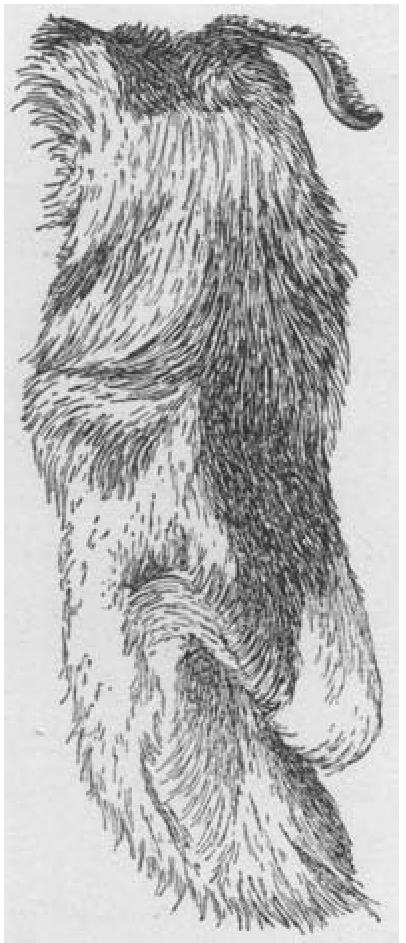
In funeral ceremonials gloves with only three fingers are used. They are worn by the woman who cuts up the body, in order to keep her hands free from contamination.
Mittens are not made double, because the tough reindeer-leg skin of which they are made would make it impossible to handle anything with a double mitten. During a journey the hands are always kept in motion sufficiently to remain warm. The working-people of other tribes of the country have mittens of the same shape and material. The Russians, on the other hand, have adopted, besides the type described above, another style of mitten, which is made of curried skin, lined inside with soft fawn-skin, and trimmed around the wrist with a narrow strip of fluffy beaver-skin. A little above the wrist the mitten has a cross-slit through which the hand may be conveniently thrust for any special work requiring the use of the fingers. The slit is trimmed with fluffy fur, squirrel or beaver, to keep the cold out. These mittens are really better suited for short walks within the village than for real work or for travelling.
The Russian merchants and officials have adopted still another style of mitten, a combination of the two above described. It is double. The outside is made of the soft leg-skins of the white, red, or gray fox; and the inside, of the belly-skins of the same animals. The palm and the inner surface of the thumb are of cloth or curried leather, which makes the mitten fairly flexible in spite of its excessive thickness. The cross-slit above the wrist is usually present, but the mittens are so heavy that no cold enters it. These mittens, I think, are the largest in the world. Those in the collection are 32 cm. long and 15 cm. wide. The thumb is 8 cm. long. The Koryak and the Kamchadal, and even the Gilyak and the Tungus of the Amur River, have, in their turn, imitated in native material various patterns of mittens and gloves made by the Russians. These show a mixture of native and Russian elements. Thus the Koryak have mittens and gloves of curried leather, lined with fur, with a cross-slit under the wrist. The Tungus of the Amur (see specimen, Cat. No. (??/????)) have mittens of the leg-skin of the reindeer, with palms of curried leather and a cross-slit bordered with fur; also mittens of curried leather lined with fur (see specimen, Cat. No. (??/????)).
The Chukchee cap (Fig. 173) fits the head closely, and its triangular flaps snugly enclose the ears. These ends are joined by a band of cloth or curried leather of such length that when they are crossed under the chin the band will hold them in place by being pulled over the crown of the head (see Plate XXVIII, Fig. 2).
[242]🗗uncollated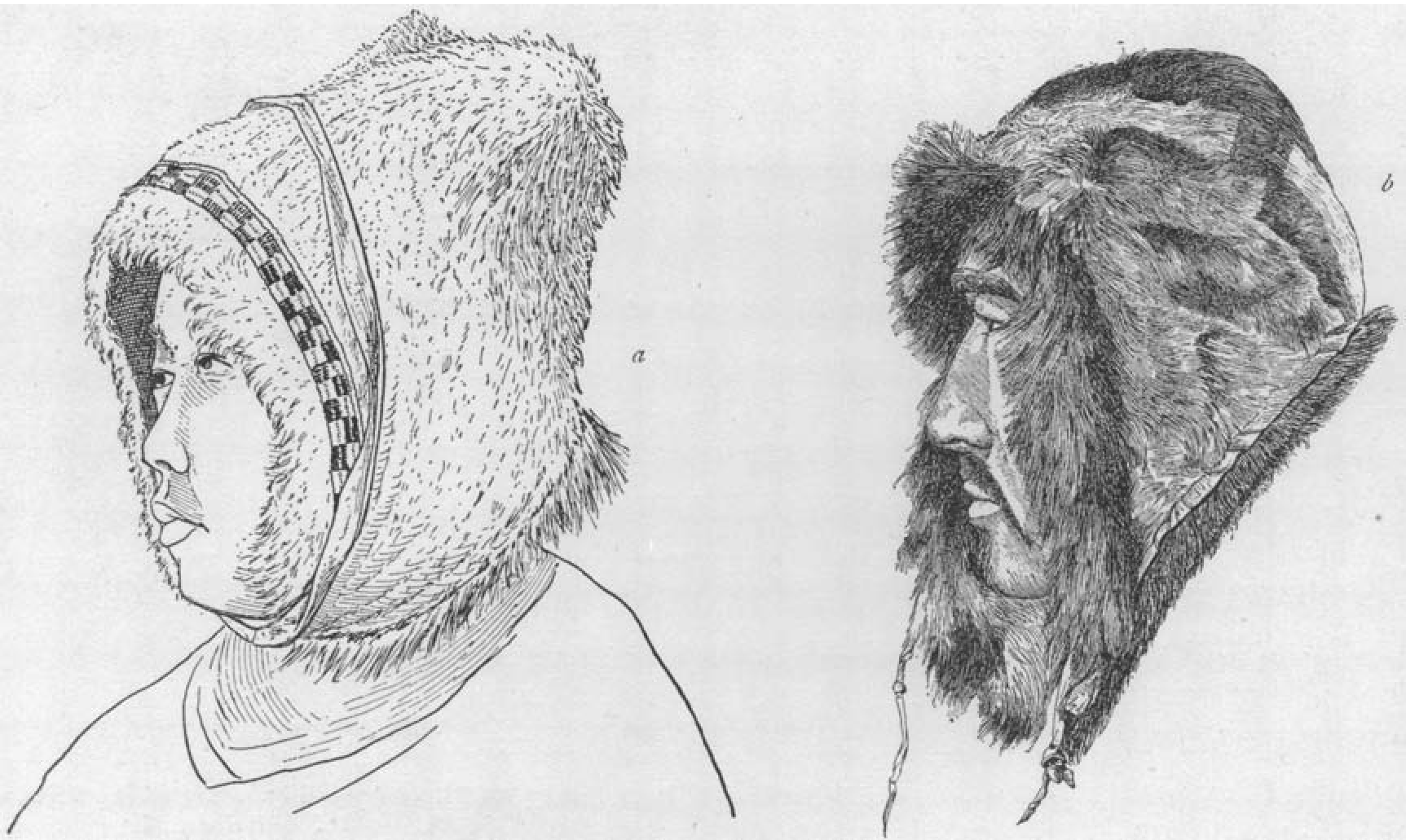
The cap of this shape is worn by all the tribes of the country, including the Tungus. The Russians have, besides this cap, a combination of it and of the round shaggy cap of the cossacks, which, in its turn, is derived from a style worn by the nomadic tribes of the West Asiatic prairies. The Chukchee cap is double, like other parts of their clothing. It is generally made of the leg-skins of various animals, — reindeer, fawns, dogs, wolverenes, etc. It is trimmed on the front with a strip of some handsome fur, and on the back with a narrow strip of thinner skin or leather. Sometimes the front is adorned with a few rows of gay-colored beads. The heaviest cap, worn over this ordinary one in winter travelling, is made of thick reindeer-skin or of the head part of the wolf’s skin, arranged in such a manner that the ears stand up on top. These ears are often decorated with small tassels of red-dyed seal-skin or of crimson cloth.
Poor people protect the neck with a kind of short boa (Fig. 174, a) made of a narrow piece of reindeer-skin folded together and sewed. The wealthy use scarfs and shawls bought from the traders. Boas of squirrel-tails, made by the Lamut, are much worn by Chukchee men and women, who trade them for reindeer-skins.
The Chukchee men also wear under their chin a kind of square bib (Fig. 174, b) made of thin reindeer-leg skin, and fastened around the neck. This protects the shirt from the frost that collects from the breath. All the overcoats of men and the frocks of women are supplied with a similar square piece in front for the same purpose.
[243]🗗uncollated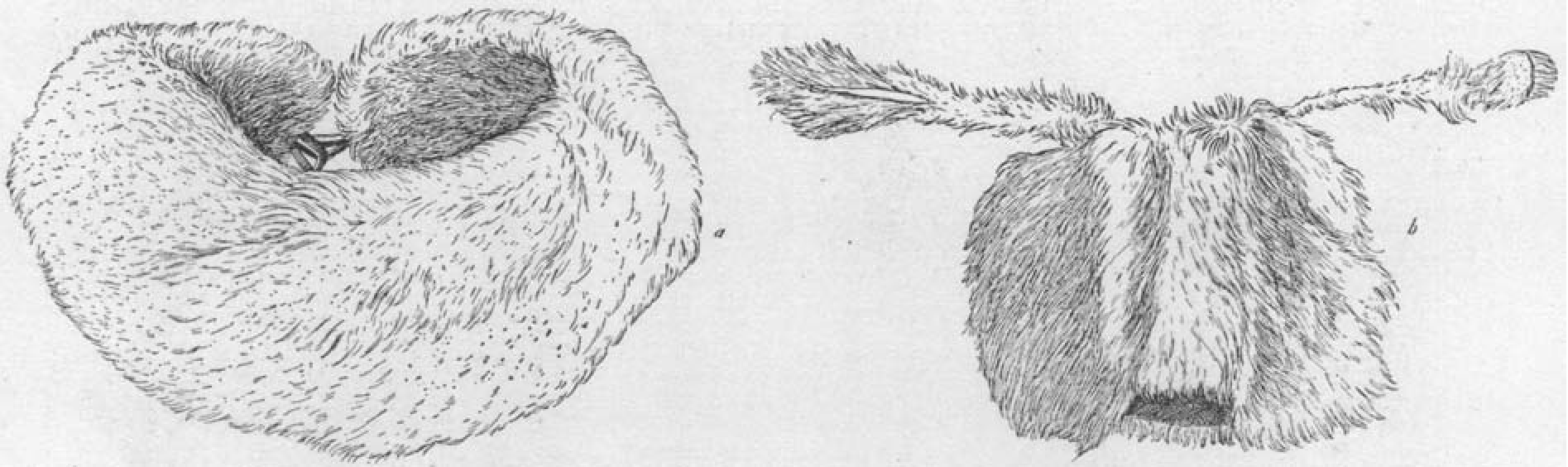
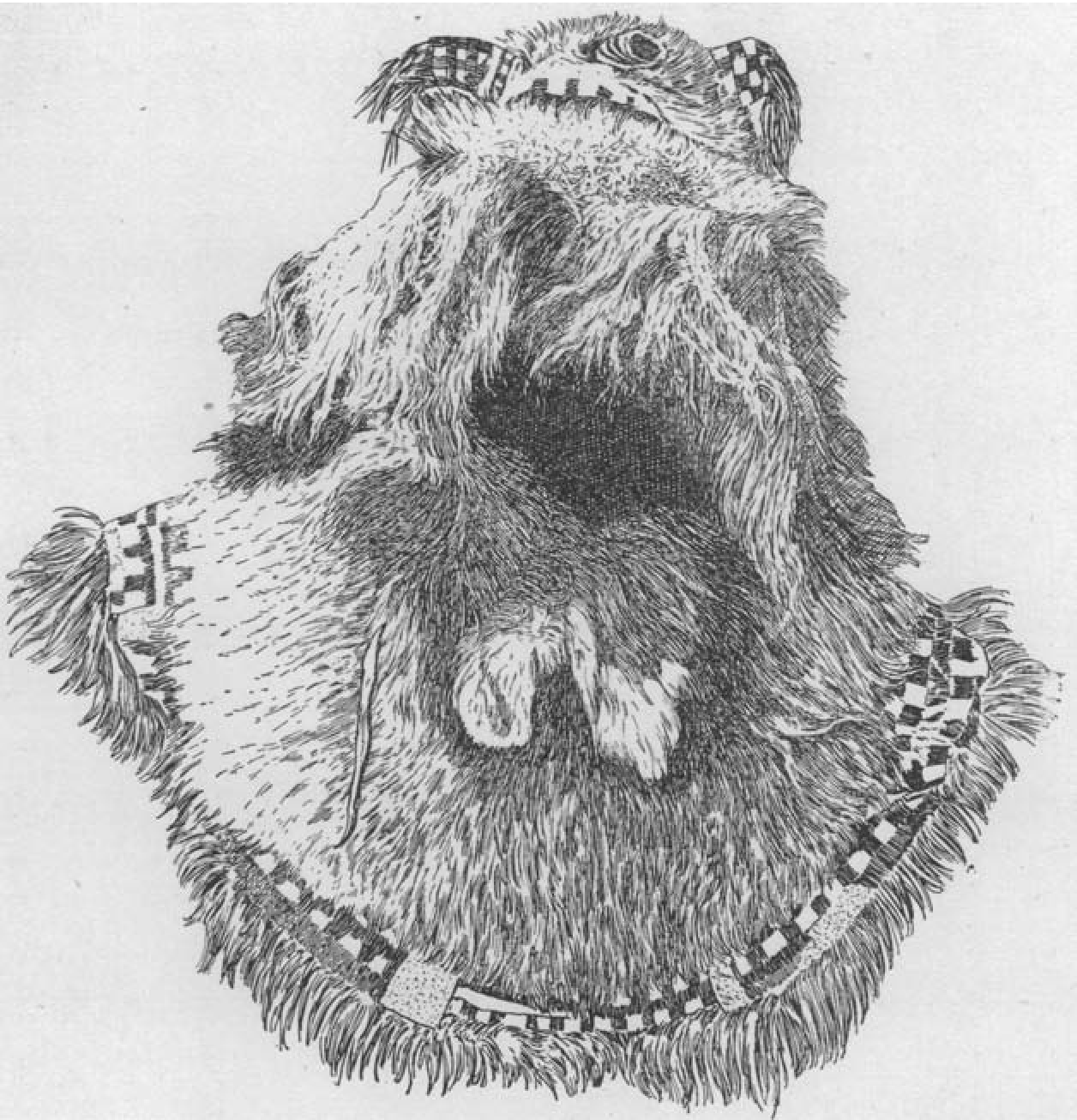
A large hood (Fig. 175) of thick reindeer or wolf skin is worn in stormy weather. It covers the head and the shoulders. Many people prefer it to the overcoat, because it may be put on or taken off more readily.
The overcoats worn by the Chukchee are made of various materials, such as reindeer-skins, curried leather, calico of bright pattern, white and blue drilling, flannel, broadcloth, etc. Their chief purpose is to give protection against the wind and to keep the snow from their fur garments. The overcoat of the Koryak and the Russianized Yukaghir, on the contrary, is intended to protect the wearer from the cold. The Chukchee depends for that solely on his regular clothes.
On the whole, the Chukchee and the Asiatic Eskimo are more hardened to the cold than their neighbors on the southwest, because they live in far more exposed regions, with no fuel for fire. They do not even supply themselves with heavy overcoats, and while travelling sleep in the open without extra covering. The Koryak[244]🗗uncollated and the Kamchadal, on the contrary, during a night passed in the open, have a cheerful fire, and protect themselves with heavy double overcoats and sleeping-bags made of thick skins. The Chukchee seldom use fawn-skins for their overcoats, because the hair and skin are not sufficiently tough and durable. Summer skins of full-grown reindeer, with their short slick hair, are most suitable. Thicker skins, employed for this purpose, have their hair previously cropped short. They are worn with the hairy side in. The outside is usually dyed yellow with ochre, or dark red with alder-bark.
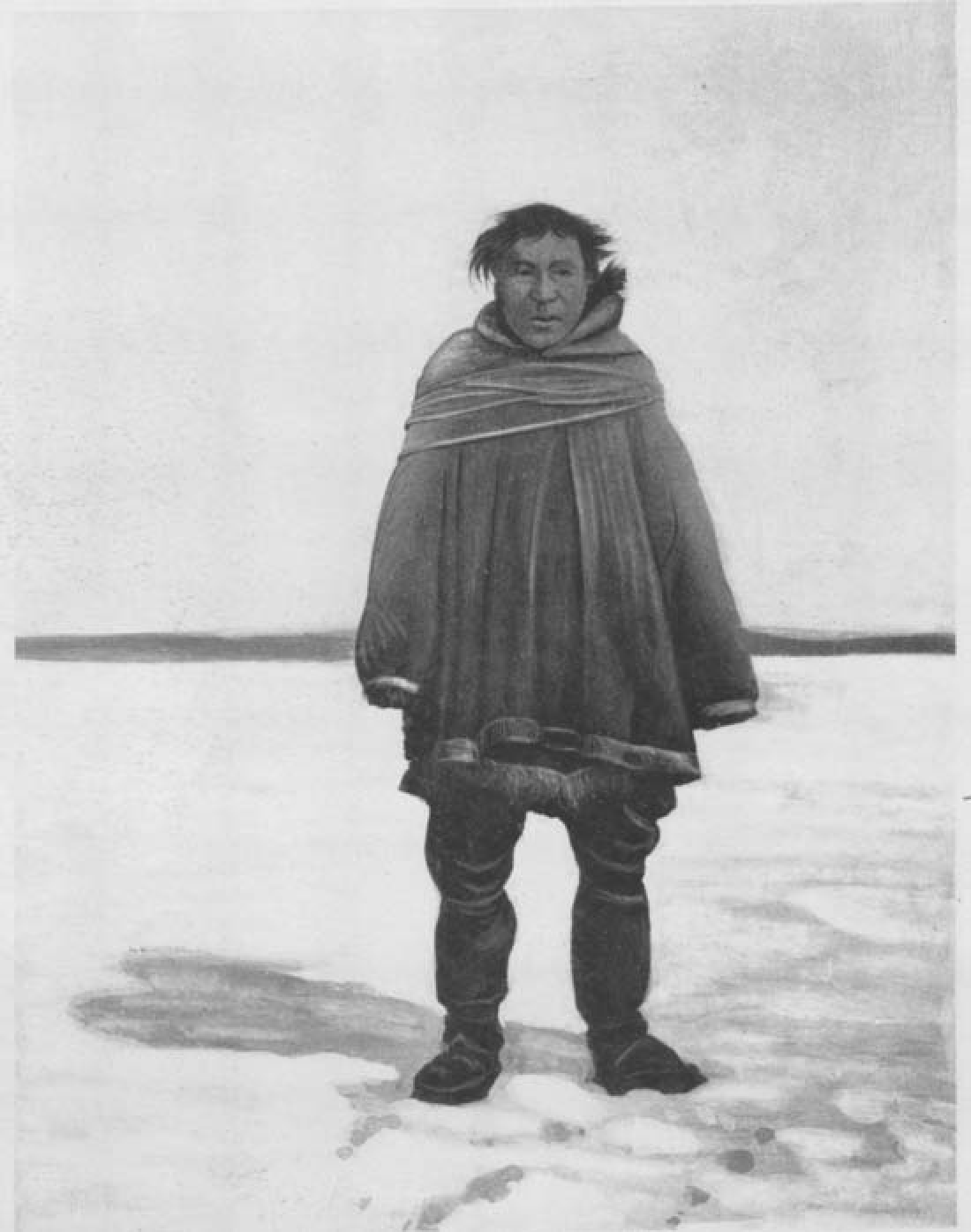
Chukchee overcoats are made in the form of long ample frocks reaching far below the knees, with a loose hood, and very full sleeves gathered at the wrists. The lower edge is often bordered with narrow strips of fur or leather. Near the edge the overcoat is trimmed with a band of leather, usually of different color, the reverse side of the skin being turned out.
The overcoats of the southwestern tribes are trimmed along the lower edge with much broader strips of cotton or cloth of bright colors, — white, red, or blue. These are embroidered in various designs.
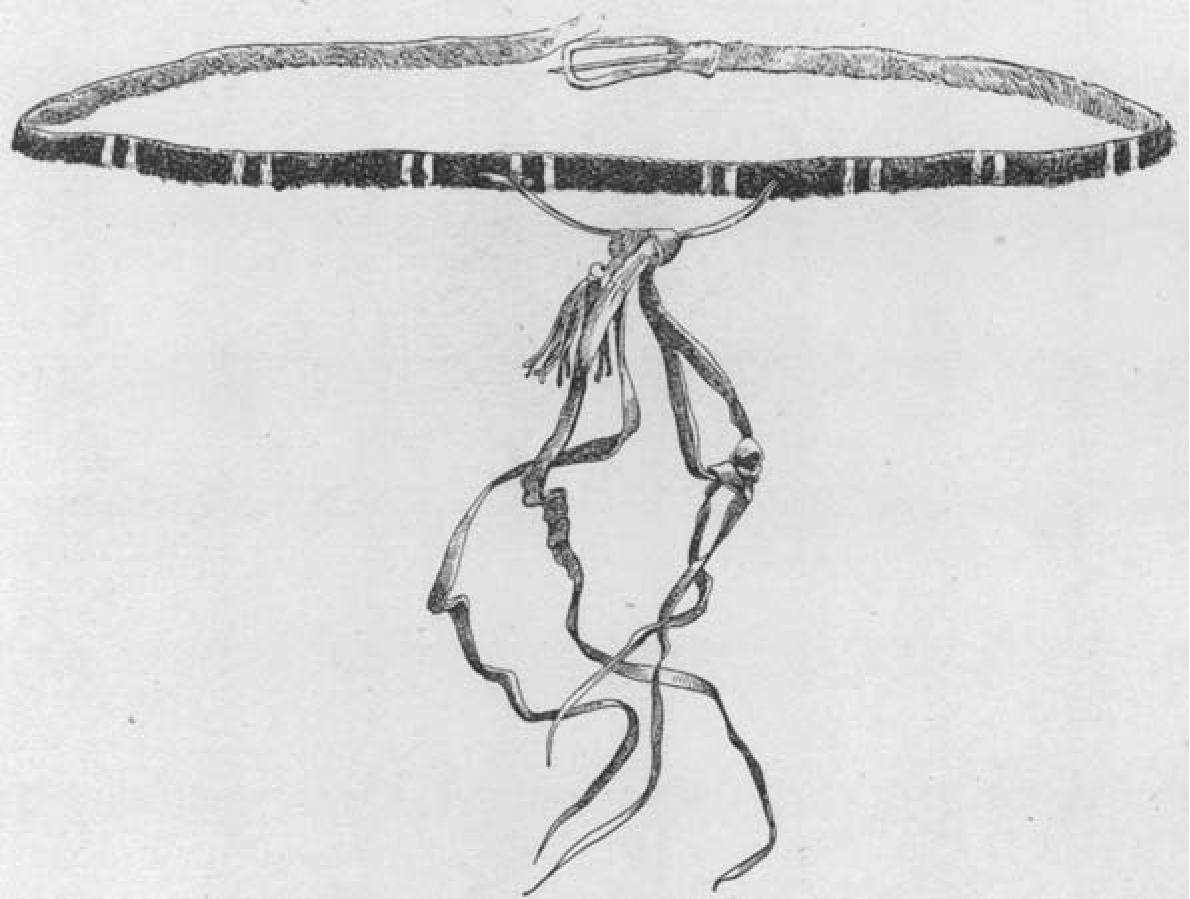
The belt is made of a piece of tough leather, with a clasp of ivory or of iron. It is sometimes rudely adorned with buttons, bells, or other jingling objects. Fig. 176 represents a Chukchee belt with a big iron clasp. Strips of leather tied into knots and sewed on the back of the belt form an amulet, as will be described later. The simplest form of belt is made of an odd piece of thin leather thong, with a small stone that serves as a button. The other end of the belt has a loop which slips over the stone button. In other cases pieces of sinew string or thong, without clasp, are simply tied around the waist to serve as a belt.
WINTER CLOTHING FOR WOMEN. — The dress of the Chukchee woman does not seem so well adapted to its purpose as that of the man. Its main part, a combination-garment, is found in the same style also among the Koryak and the Kamchadal. Indeed, the curious cut of this garment, with its full, dangling sleeves and somewhat low neck, suggests a remote origin in a milder climate than Arctic Asia (see Plate XXIV, Fig. 2).
[245]🗗uncollated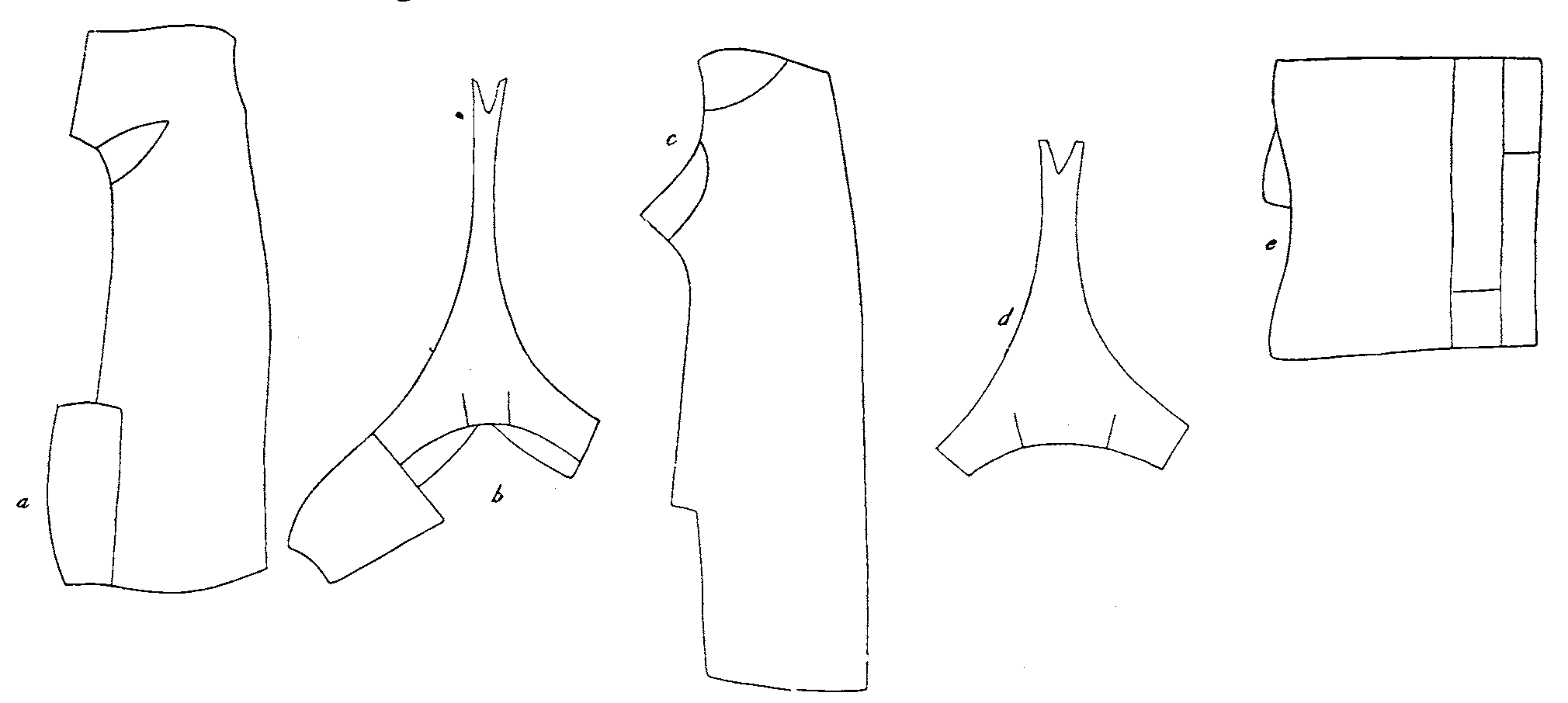
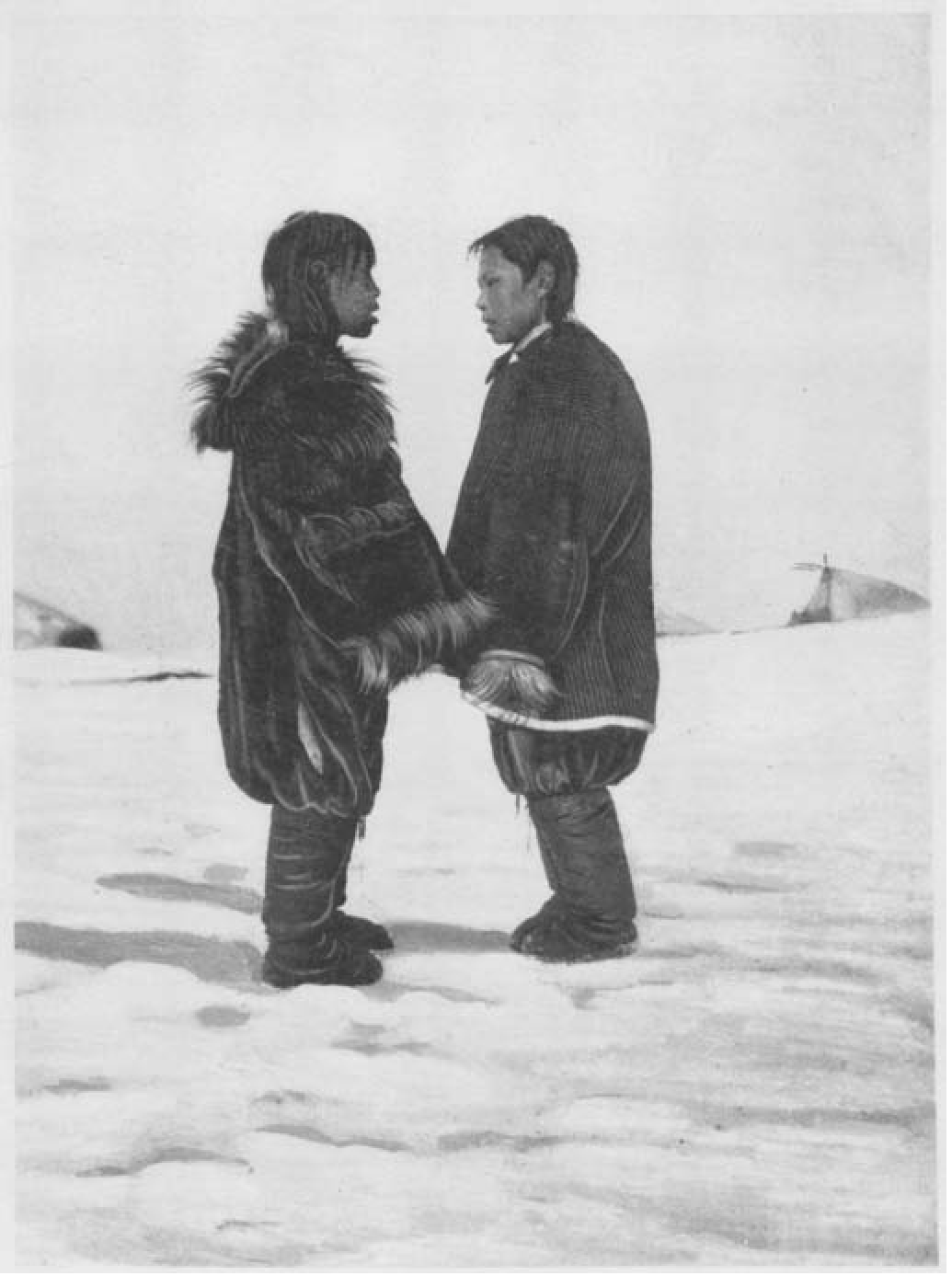
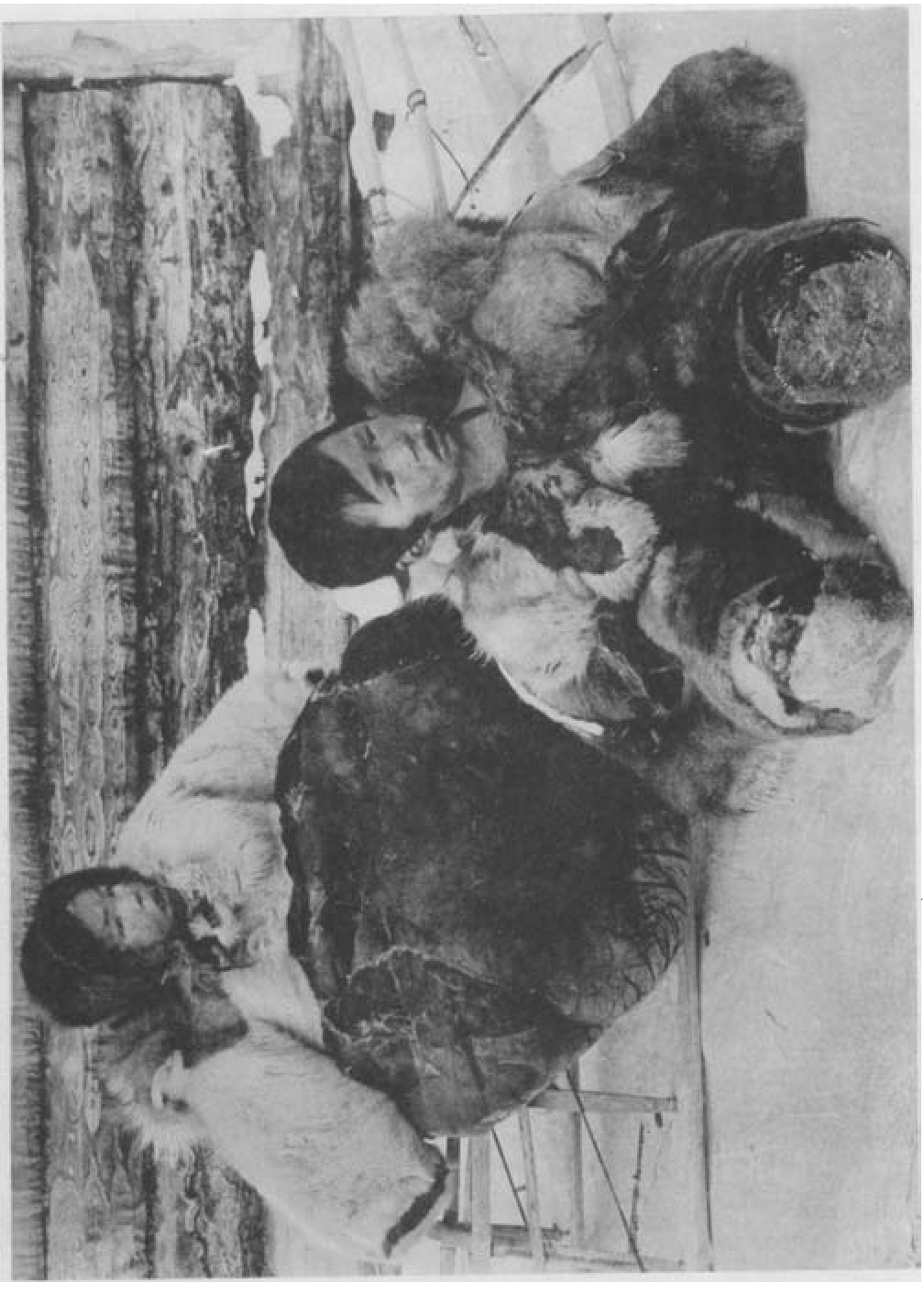
The combination-garment (see Plate XXIII, Fig. 2; also Fig. 177) consists of a bodice, large at the shoulders, but rather close-fitting at the waist, and passing into baggy trousers that reach a little below the knees. The neck of the bodice is cut quite low both front and back, especially for younger women. To keep off the cold it is bordered with a double or even a triple row of trimming of the thick fur of the dog, fox, or wolf. On the suits of young women these strips of fur are of different hues, contrasting strikingly with each other. Of course this does not prevent the cold winds of the tundra from penetrating under the bodice. The sleeves are very full, and so long that they interfere with the work of the woman. Moreover, they are not gathered in at the opening. On account of these sleeves, the woman, when occupied in several branches of work, has to thrust her right arm and shoulder out of the bodice, while the sleeve is left dangling down the back. This attitude, with half of the bust bare, is one of the most typical for Chukchee women (see Plate XXVII, Fig. 3). The front of the garment opens a short distance down from the neck, and may be fastened with curried leather bands attached to both edges. The garment is without any opening to allow the women to attend to the requirements of nature. For such purposes the body must be entirely removed, allowing the garment to fall down on the knees. In winter the women then cover their naked bodies with overcoats thrown over their shoulders, but in summer they may be seen about the camps quite uncovered. The leg-openings of the breeches are fastened over the boots with a gathering-string.
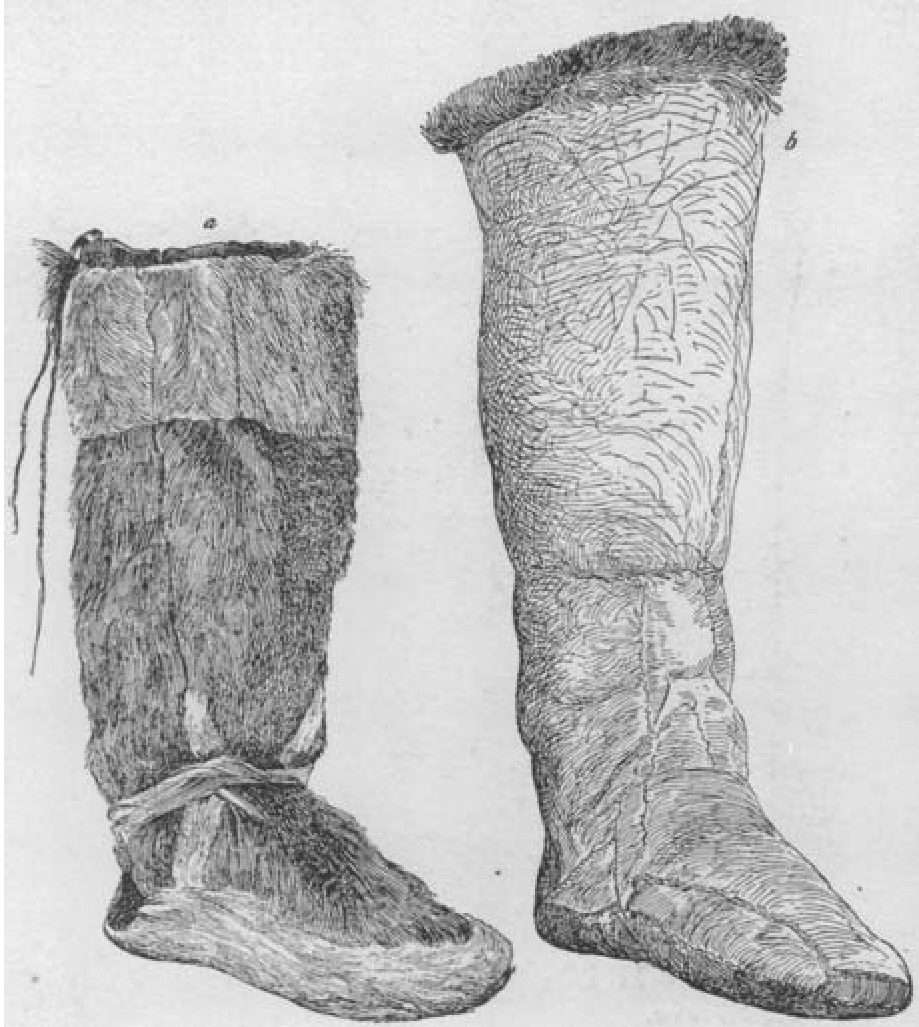
The boots reach to the knee. The upper edge either has a hem through which a string is pulled (Fig. 178, a) or is left rough as in the boots of men.[246]🗗uncollated This is because the boot-legs are generally tucked under the legs of the breeches. The stockings (Fig. 178, b) are also long, and fit the leg snugly. The foot of the stocking is made of fawn-skin, while the leg is often made of the thick skin of the full-grown reindeer. The calves of women bulge out with these stockings and boots. Their baggy trousers also hamper free movement, especially while walking through deep snow. I have heard young girls who have to tend to the herd complain about the inconvenience of the female garb of their tribe. In several cases I knew of herdswomen adopting man’s dress. Even the gait of Chukchee women is influenced by their clothing. The Lamut describe them as walking with legs spread apart. The Chukchee retaliate by saying that the Lamut girls are chained like dogs because their aprons are decorated with iron chains and various metal ornaments.
The material for women’s dress is the same as that for the men’s; viz., fawn-skins of different thicknesses. The garments are likewise made double, with the hair of the inner piece touching the skin, and that of the other turned outward.
The color preferred is brown with small white spots in the region of the knees. White skins are used but seldom by women.
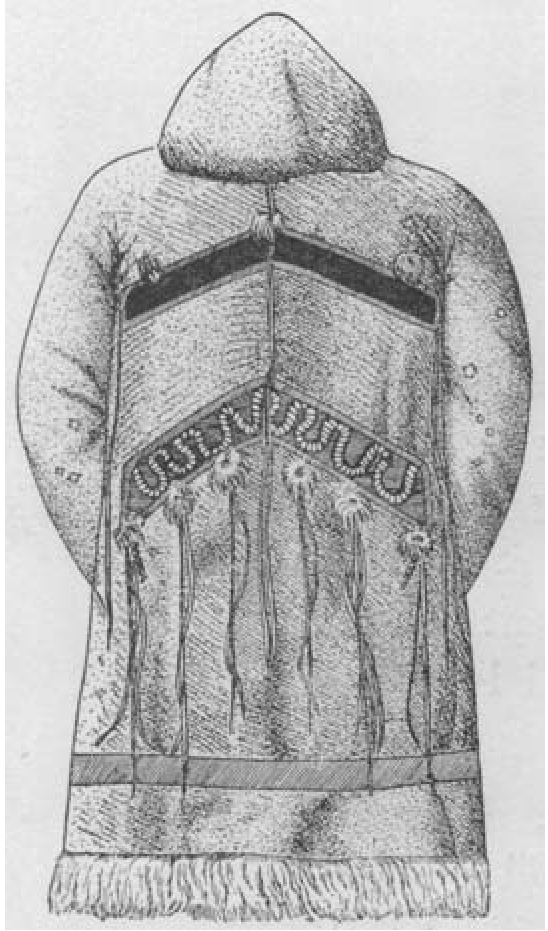
The woman’s overcoat is shaped something like that of the man, only it is comparatively shorter and fuller than the latter (Plate XXV, Fig. 2). It is made of thin summer skins of grown reindeer. The flesh side is worn outside, and is dyed red with alder-bark. The overcoat is adorned with fringe and with patches of fur scattered over the front and back. Sometimes the back is further decorated with strips of colored cloth and rude embroidery (Fig. 179). It shows some similarity to the back of the Samoyed coat pictured by Middendorff.¹
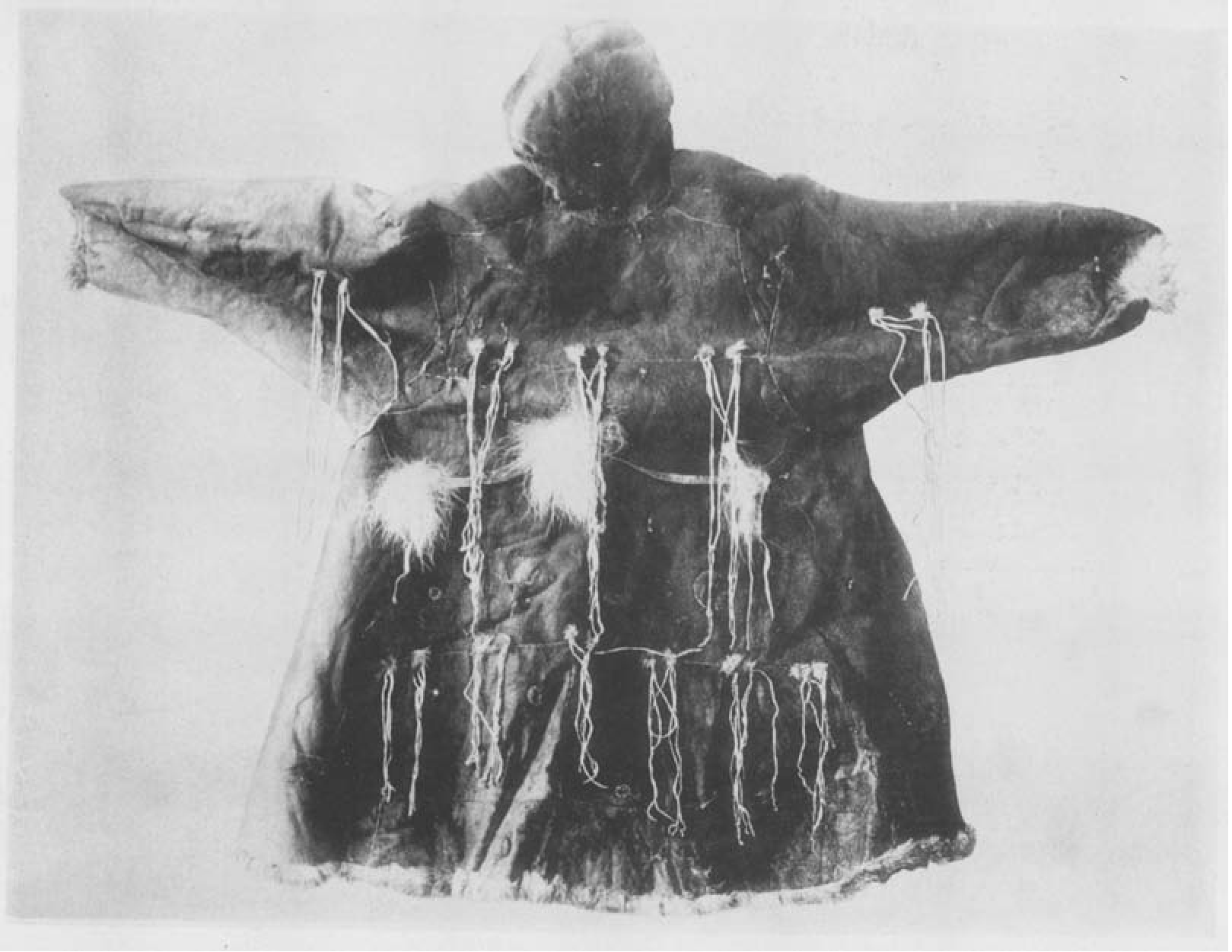
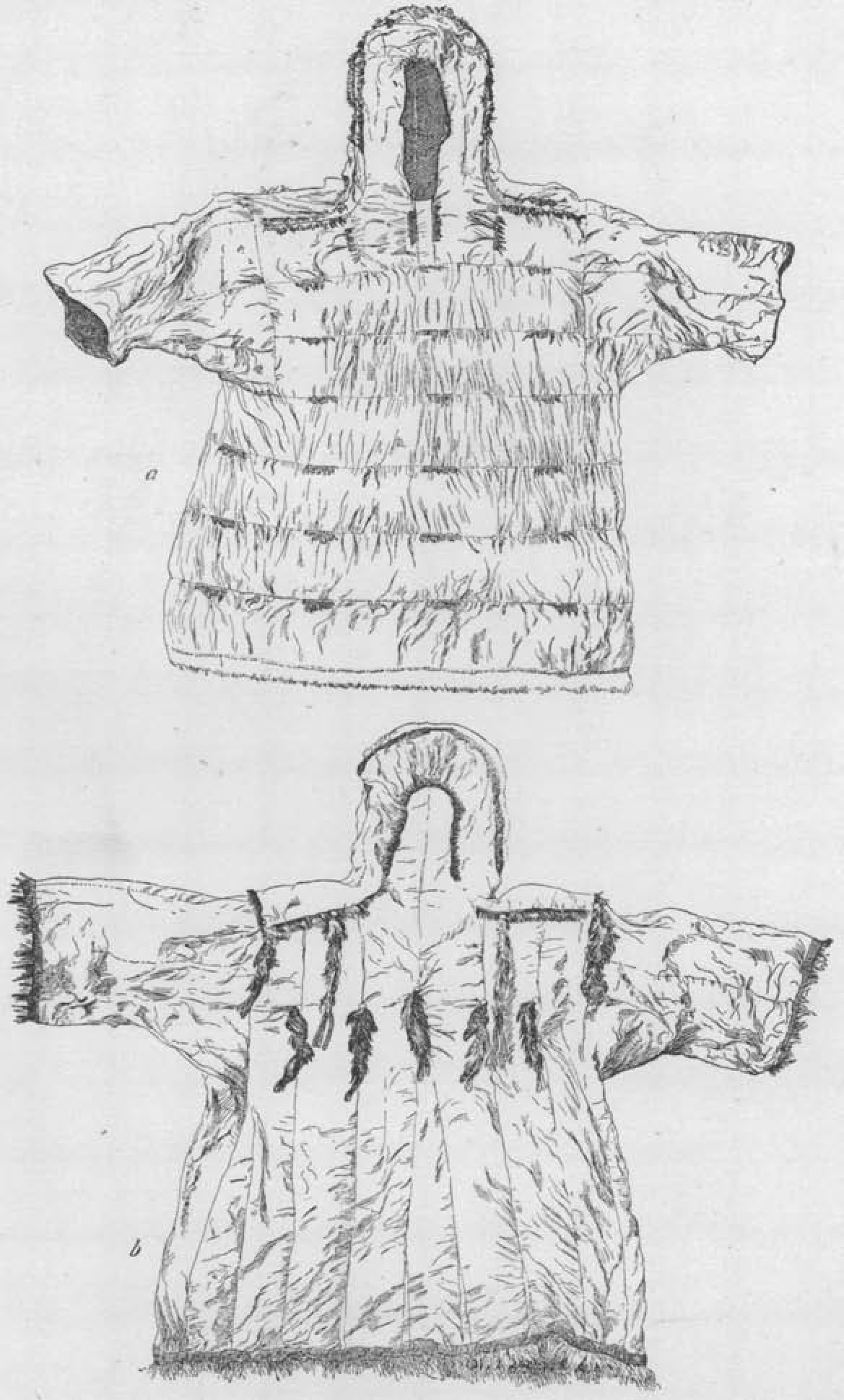
The Chukchee women wear this overcoat over their usual dress when going for a walk or ride in the open air. It must also be put on in ceremonial dances and performances. The Koryak women wear the overcoat with their ordinary costume, and consider the combination-suit as underclothing.
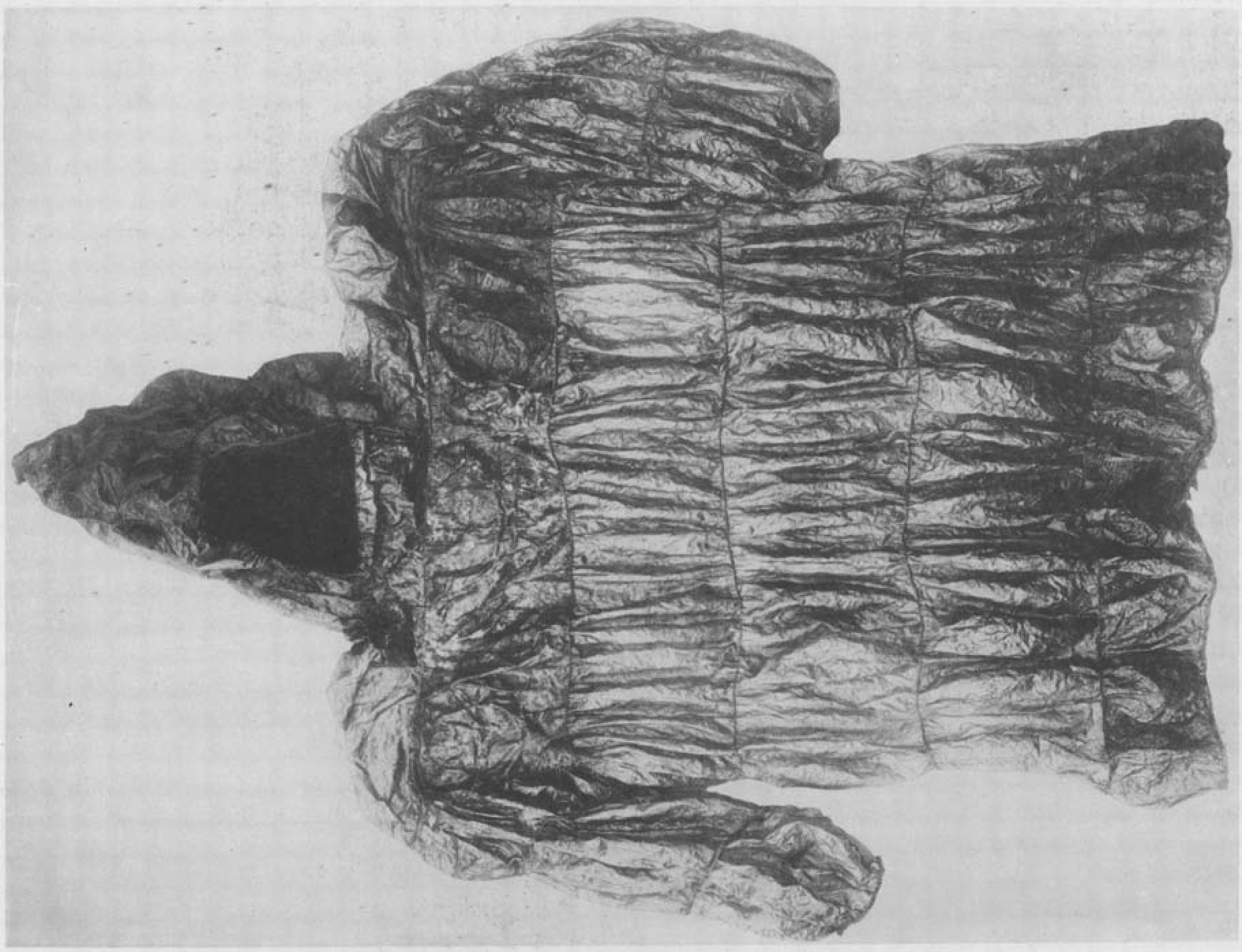
The Chukchee women sometimes have overcoats made of cotton, but do not wear these so frequently as the men. In the Pacific villages the Chukchee and the Eskimo young women also have overcoats made of thin guts of seal and walrus carefully bleached and quite transparent. They are exceedingly light, and not ungraceful in appearance (Fig. 180). The guts are neatly stitched together in long bands, and the coat is trimmed with tassels and small red tufts of feathers from the heads of crested auks. It is probable that this frock or coat belonged originally to the Eskimo costume. Even now the best are brought from St. Lawrence Island, where seals are plentiful and crested auks also abound. The Maritime Chukchee, however, have adopted it as a dress for the great fall ceremonial. They believe that the sea-god Kereˊtkun and his wife wear overcoats of exactly the same shape. Therefore while bringing sacrifices to Kereˊtkun, the whole family, down to the small children, don this garment in imitation of the deity. At all other times these coats are kept in bags.
[248]🗗uncollatedWomen’s caps and mittens are quite similar to those of men. The women also tie bright cotton handkerchiefs around their heads, after the manner of the Russians.
SUMMER CLOTHING. — The Chukchee have no special summer garments, properly speaking. Indeed, there is little need for them in those latitudes. Fur clothes are used all the year round; the old, half-worn clothes, which are of little use in the coldest season, being worn during the summer months. Dampness and rain are much more destructive to fur clothing than the dry snows of winter. So the Chukchee, who in mid-winter is clad in clean and handsome furs, in the summer wears the worst clothing he has. Even the well-to-do reindeer-breeders then look exceedingly shabby. The people, who have accustomed themselves to severe cold, apparently consider it not worth while to prepare for the milder, damp weather of the short summer months.
In the summer-time coats are worn either single or double. If single, they are always worn with the hair side in. Among the Reindeer Chukchee, trousers and shoes are made of strongly smoked tent-covering (retteˊm), which has the advantage of not shrinking after having been wetted.¹ The trousers have the usual cut. The soles of the boots are made of hard thong-seal hide. The boots often have small guards around the front to keep the toes from being hurt by striking against stones and roots that lie exposed during the summer. These shoes are worn with thick grass insoles, but without socks. They fit the foot closely, so that when walking ankle-deep in the numerous bogs and mountain brooks, very little water can remain in the shoe. The soles, moreover, are pierced with two rows of small holes made with a bodkin, to facilitate the outlet of the water. Even after a long walk through water, when a stretch of dry ground is reached, the shoes dry very rapidly under the pressure of the foot. As there are no stockings inside, the feet will be quite dry in half an hour’s time.
The summer trousers and boots of the Maritime Chukchee, as has been noted before, are made of seal-skin, which is much more suitable for this purpose than any kind of reindeer-skin. The seal-skin is curried and the epidermis is left on, or the skin is well scraped and blackened with soot. Thanks to the thickness and oiliness of seal-skin, they are nearly impervious to water.
The typical boot reaches to the knee (Fig. 181, a), and has clumsy, rather full legs. The large soles are crimped around the edge. This latter process is quite similar to that used by the American Eskimo. Since the Asiatic women have no special boot-sole creasers, they use their teeth for this purpose.
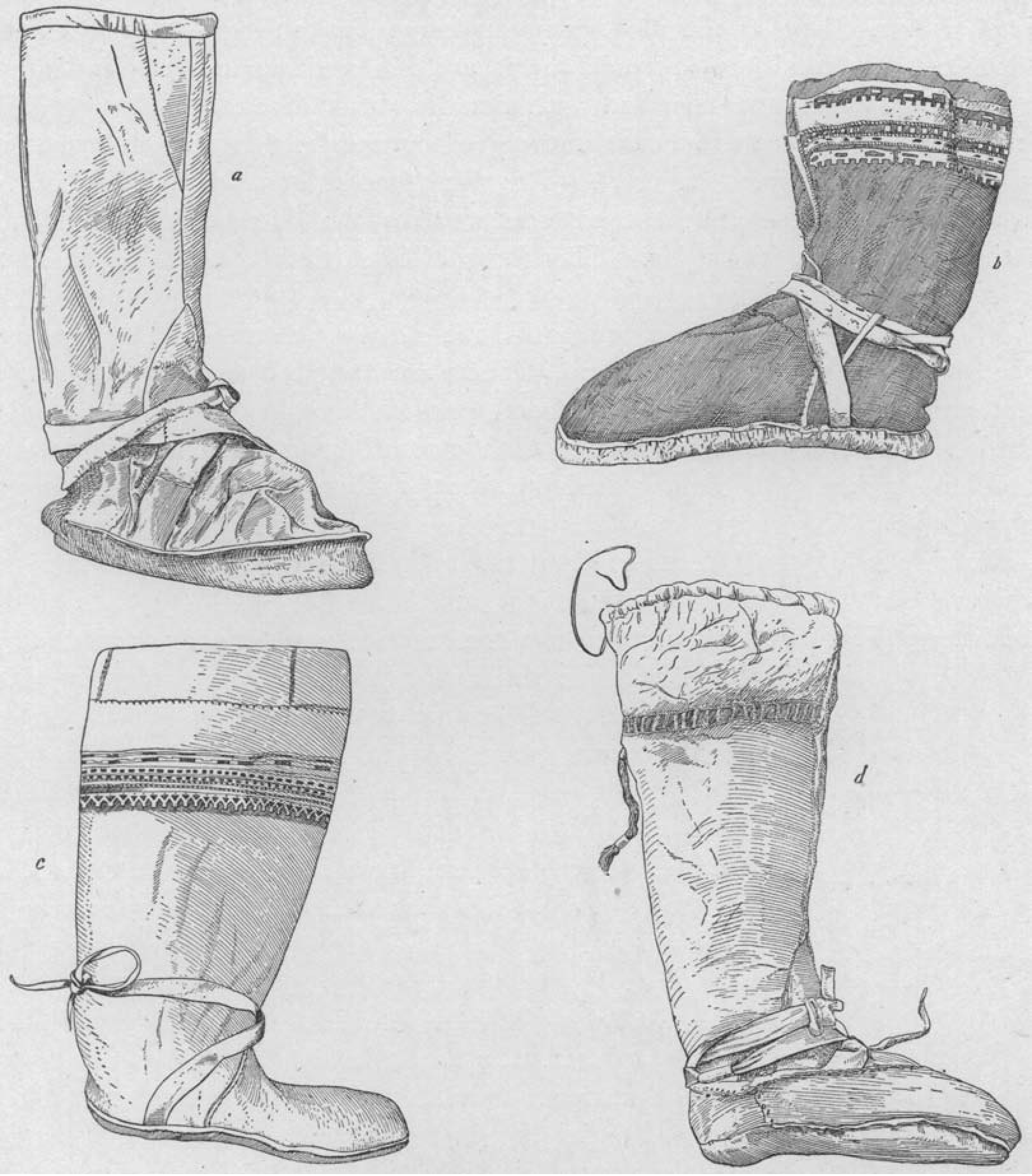
The Koryak women have small ivory knives which are similar to the boot-sole creasers of the Alaskan Eskimo; but, curiously enough, they do not use them in boot-making, but only for tracing patterns on soft curried leather, or cloth for the embroidered fringe of the overcoat. Boots of the style just[249]🗗uncollated described are made on both shores of Bering Sea by the Maritime Chukchee, the Asiatic Eskimo, and the American Eskimo of Alaska. Whaling-crews and miners use them in preference to the civilized form of foot-gear. In Asia they are traded off to the inland camps of Reindeer people, and some of them reach even the market-places of the Kolyma. Some of the seal-skin boots are much longer. Boots and trousers combined, made of curried seal-skin, are occasionally seen. These are useful for seal-hunters and fishermen, who walk constantly through cold water.
[250]🗗uncollatedBesides the boots and shoes already described, the Reindeer and Maritime Chukchee have the so-called “dry boots” (keˊrg̣ɪ-pčeˊkɪt), which are worn at home when resting from the fatigue of travel and work. These boots are of various shapes. One of the most common forms has the legs made of thin slick reindeer-leg skin, and the feet of brown, smoked, and curried retteˊm leather.¹ The tops of these are trimmed with narrow strips of crimson-dyed seal-skin or red cloth. Others are made entirely of curried leather and adorned with rude embroidery (Fig. 181, b, c). The “dry boots” of women (Fig. 181, d) bear a close resemblance to the patterns used by the Koryak, the Kamchadal, and the Russianized Yukaghir. This form of boot thus appears to be spread over a very large area.
With most forms of summer boots the strings are attached in the same way as among the Alaskan Eskimo. They are fastened to both sides of the instep, and in tying are crossed in front, passed through two loops placed on each side of the boot near the sole, then crossed behind the heel and wound around the ankle, and finally tied in front. This method of fastening the strings is used for curried reindeer-skin shoes of the Reindeer herdsmen, for seal-skin boots of the Maritime hunters, and, among the Koryak, on “dry shoes” and short summer boots made of retteˊm.
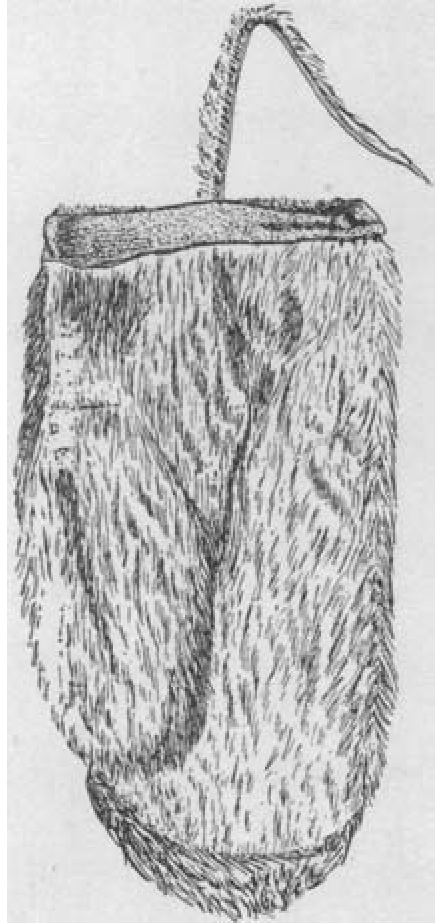
Mittens (Fig. 182) for summer use are made of seal-skin or curried retteˊm leather, and are similar in shape to those worn in winter. Gloves of curried leather are sometimes worn, but are probably copied after Russian and Lamut patterns.
Caps are made either of the thinnest leg-skins of fawns or of curried leather. Large hoods of the latter material, similar in shape to the storm-hoods for winter use, are worn for protection from insects. They are often trimmed with leather fringe around the face and all along the lower edge.
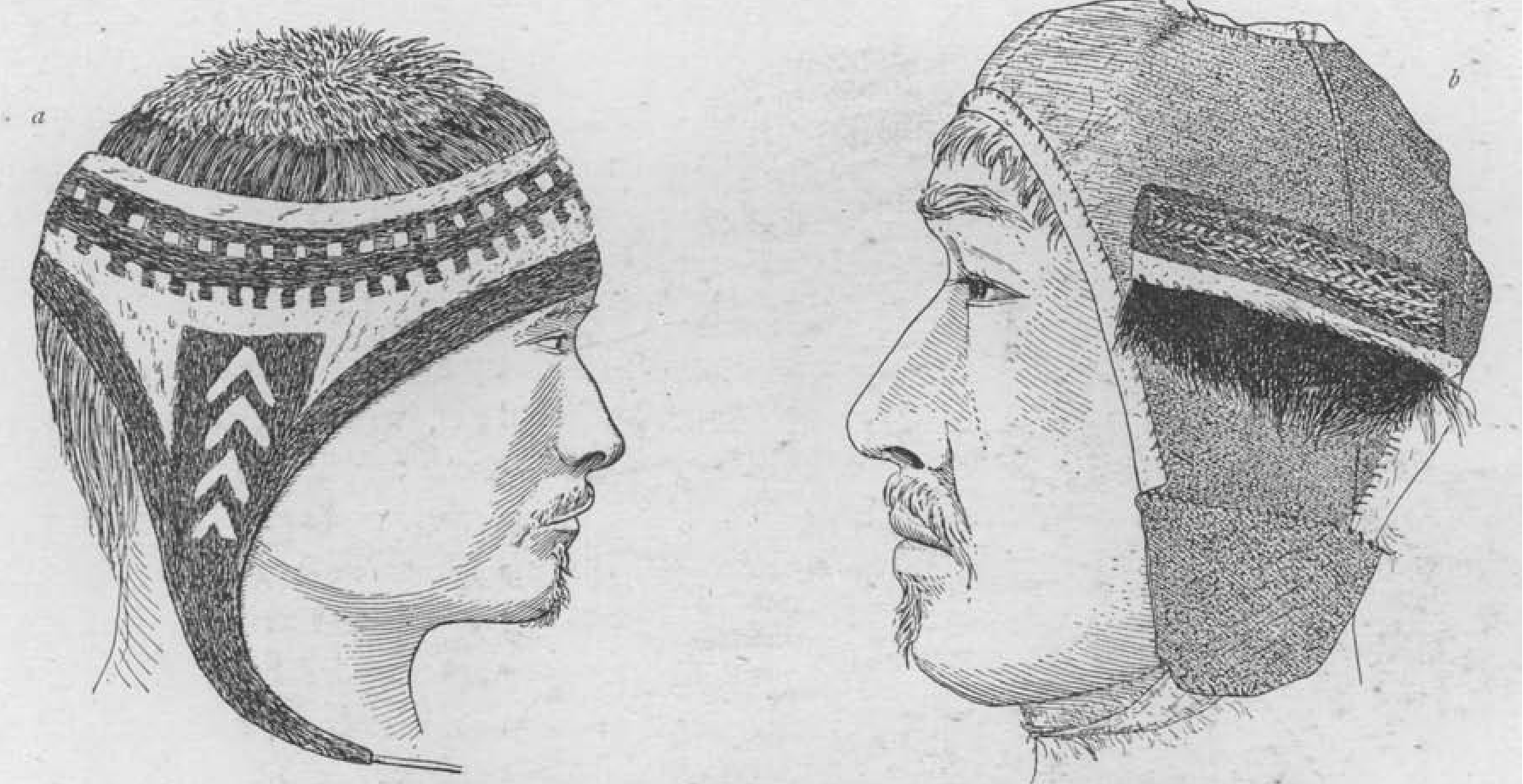
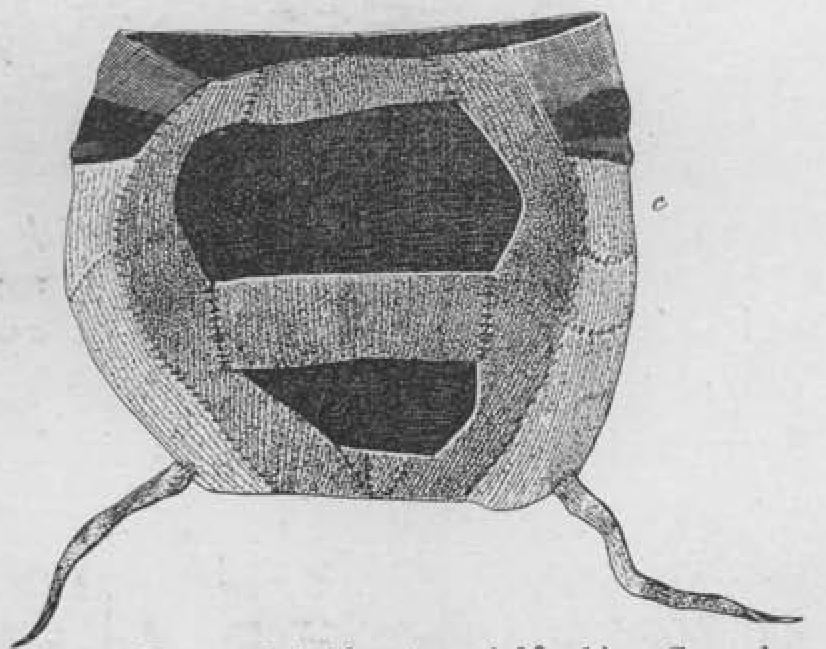
In the spring-time the herdsmen wear light caps without crowns (Fig. 183, a). These are more common in the inland camps. The Maritime young men, while foot-racing and indulging in other athletic exercises, sometimes wear crownless caps of a somewhat different pattern (Fig. 183, b). A third style is worn by Lamut hunters. This combines the crownless cap with a protector for cheeks and chin. The illustration (Fig. 183, c) represents a cap of this last style, seen from the front. Two leather bands — one running across the fore-head, and the other passing under the nose — prevent the cap from slipping off. The pattern in vogue among the Alaskan Eskimo (represented in Nelson’s book) does not resemble any of the forms[251]🗗uncollated mentioned, but reminds one rather of the ear-laps used by the Russian cossacks on the Kolyma, which are worn under the parade fur cap to protect the ears from the cold of winter. These, however, are made of plain cloth, and are not adorned with embroidery, as in Alaskan specimens.
The summer overcoats worn by herdsmen are chiefly made of the skin of reindeer killed in spring, when the hide is thinnest, and the fur is half-shed and in its poorest condition. The hair is scraped off, but the skins are prepared very roughly, because extra care would not show after the coat had passed through the first rainstorm. These overcoats are so stiff that they can be put on only when moistened with water. At the same time, they are very light and convenient for herdsmen.
Overcoats made of retteˊm leather (Plate XXVIII, Fig. 1), are also worn in summer, but are heavier than those described here. They do not shrink after being exposed to rain, and, if made of the thickest leather, are waterproof to a considerable degree. The Maritime Chukchee and the Eskimo wear waterproof coats made of seal or walrus guts (see Plate XXVI, Fig. 2), quite similar to the American Eskimo patterns. Seal-skin overcoats are used very rarely because of the high value of that material (see Plate XXV, Fig. 1).
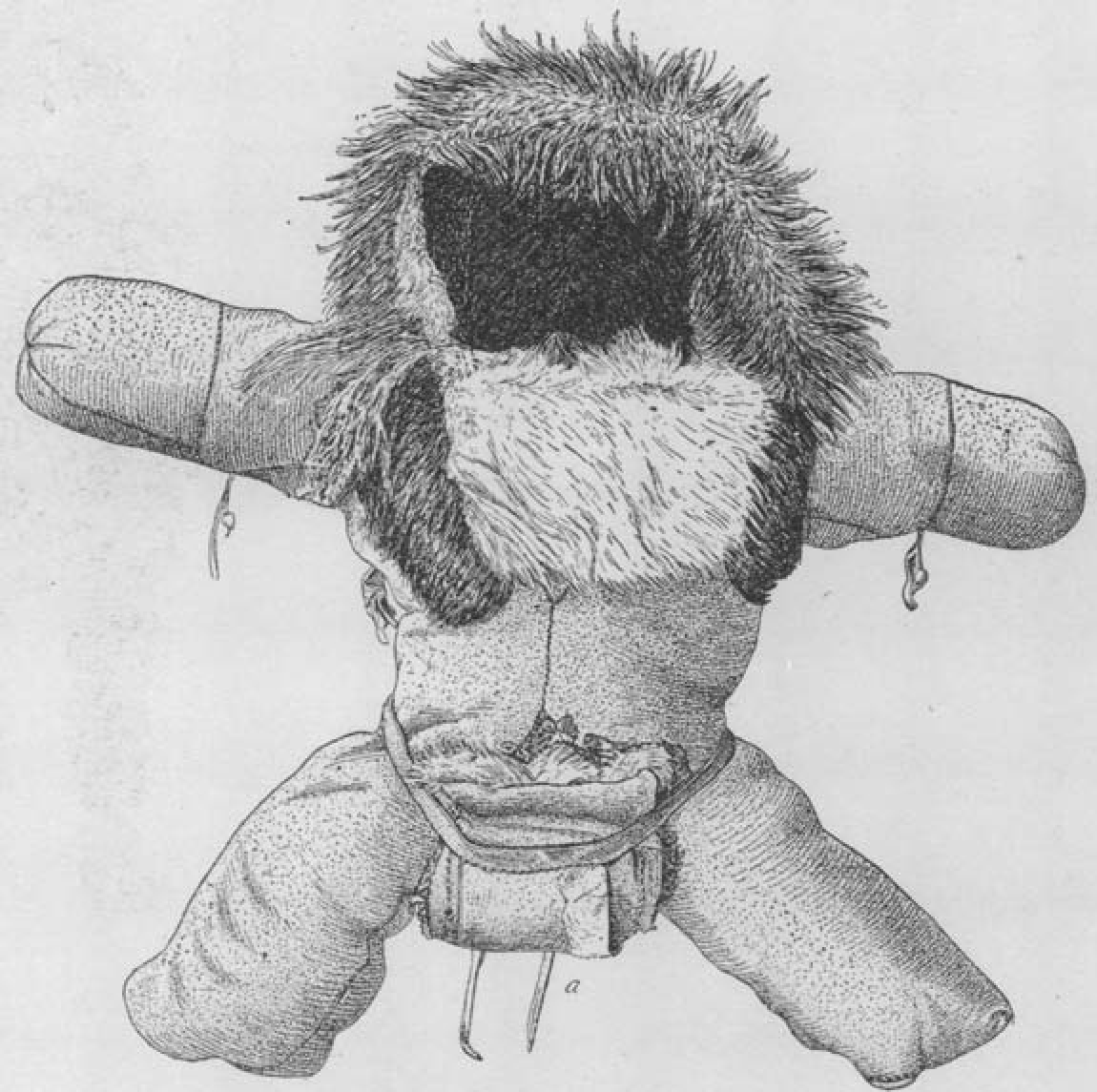
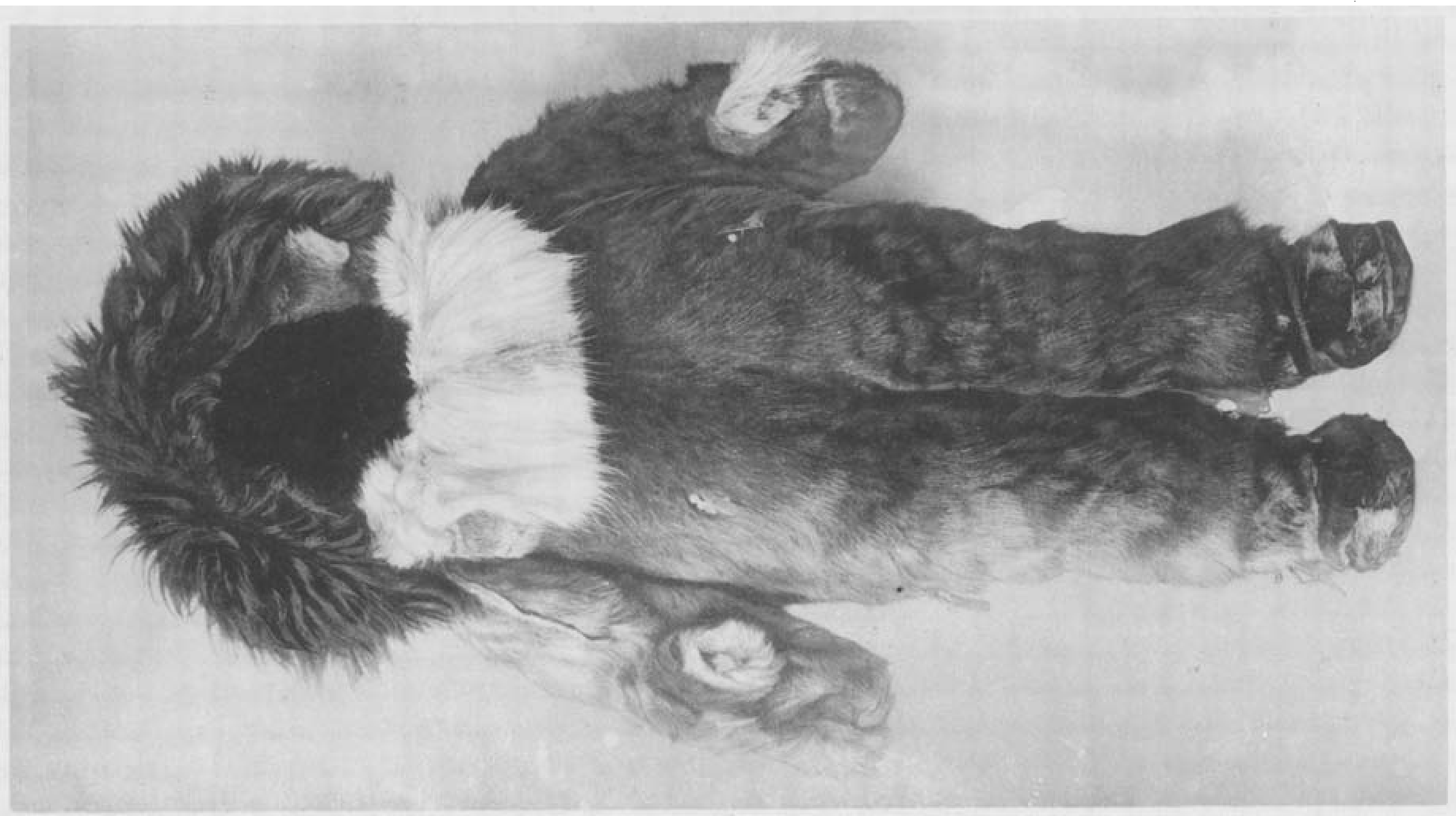
CHILDREN’S CLOTHING. — The child’s dress is a combination-suit (Fig. 184; Plate XX, Fig. 4), and is called in Chukchee kaˊlhê-kêˊr (“joint-suit”). It has[252]🗗uncollated a large hood trimmed with fur. The sleeves and breeches have no openings at all, so that the child’s feet and hands are kept warm inside. A square diaper (maˊkɪ) is sewed on at the back (Fig. 184, a). It can be tucked between the child’s legs, and its ends fastened in front by strings. With small infants this diaper is filled with a mixture of reindeer-moss and hair, which absorbs the excreta and is changed several times a day. This diaper with moss has been adopted by all the tribes of northeastern Siberia, including the Russians, because of its practical convenience. Its Russian name, мака (maˊka), is taken from the Chukchee.
The combination-suit of new-born infants is made of the softest fawn-skins, the hair side in. Since at this early age babies are kept out of the open air, the doubling of the suit is unnecessary. A little later double suits made of thicker fawn-skins are used.
The garments of children are trimmed with all kinds of charms and pendants made of beads and strips of leather. As the children grow, the combination-suit undergoes gradual changes. Sleeves are supplied with slits cut on the side some distance from the end (Plate XXVI, Fig. 1). Through this slit the hand may be thrust out and easily drawn back again. When the child begins to walk, the breeches of the suit are also supplied with openings, and short-legged boots of fawn-skin are worn. The use of the breech-cloth is continued after the moss matting becomes unnecessary. Small boys up to about three years of age, walking around with the strings of this diaper untied and dragging behind them in the snow, is a familiar sight in Chukchee or Koryak camps.
At the age of about six or eight years, both boys and girls receive garments of the usual cut; but the latter retain the diaper piece considerably longer, because the regular female garment is not adapted to the child’s needs.
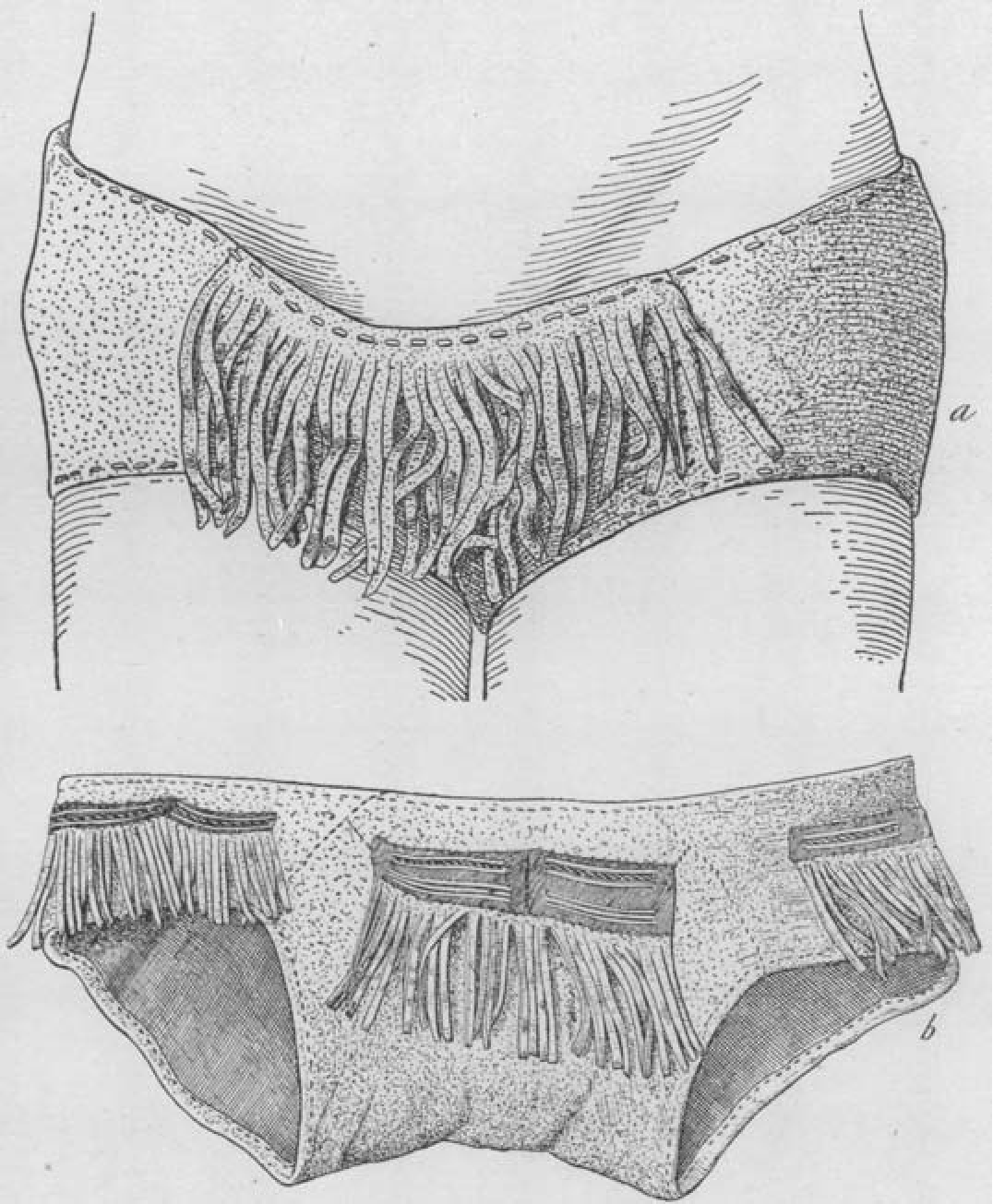
LOIN-BREECHES. — The Maritime people, both Chukchee and Eskimo, when in the inner sleeping-room, are accustomed to strip naked except for[253]🗗uncollated short loin-breeches. These are used by both men and women. They are made of curried leather (Fig. 185, a, b) or (in modern times) also of calico or cloth. Many of them are adorned with leather fringe. The men also wear crownless caps (see Fig. 183, b). Young boys and girls, when in the inner room, often strip off all their clothing, the girls having only a few strings of beads around their waist as a suggestion of a breech-cloth.
In the Chukchee villages on the Arctic shore, and also in those on the Pacific which lie nearest to East Cape, the inhabitants are familiar with the use of the loin-breeches. The Chukchee in the villages southwest of the Asiatic Eskimo, however, do not wear this garment, and consider it of Eskimo origin. The Reindeer people wear no loin-breeches, since they do not strip naked while in their houses.
HAIR-DRESSING. — Many of the Chukchee men cut the hair on the crown of the head as close as possible, so that it looks almost as if shaven, forming a kind of tonsure (see Plate XXIX, Fig. 4). The hair around the tonsure is trimmed to look like fringe, sometimes in a double row (Plate XXX, Fig. 3). On top of the head, on both sides of the tonsure, two long locks are left by some of the men. These locks look not unlike the ears of an animal. The fashion of wearing a tonsure is in use also among the Koryak and among the Asiatic and American Eskimo. Among the Chukchee it is of late years gradually being superseded by the ordinary style of hair-cut.
The tonsure and fringe are resorted to whenever it is thought necessary, for superstitious reasons, to change one’s appearance. For instance, a person thus protects himself from the spirits of contagious diseases, or a murderer conceals his identity from the revengeful soul of his victim. From the same motive, usually on command of shamans, men may allow their hair to grow, and plait it in braids after the fashion of women, or leave a few locks on the temples or on the back of the neck, to be plaited into a small braid.[254]🗗uncollated A single white bead is sometimes braided in with the hair at the front of the head (Plate XXIX, Fig. 3). This is supposed to serve as a protecting charm, and will be referred to later. On Plate XXIX, Fig. 1, will be noticed a small piece of perforated iron.
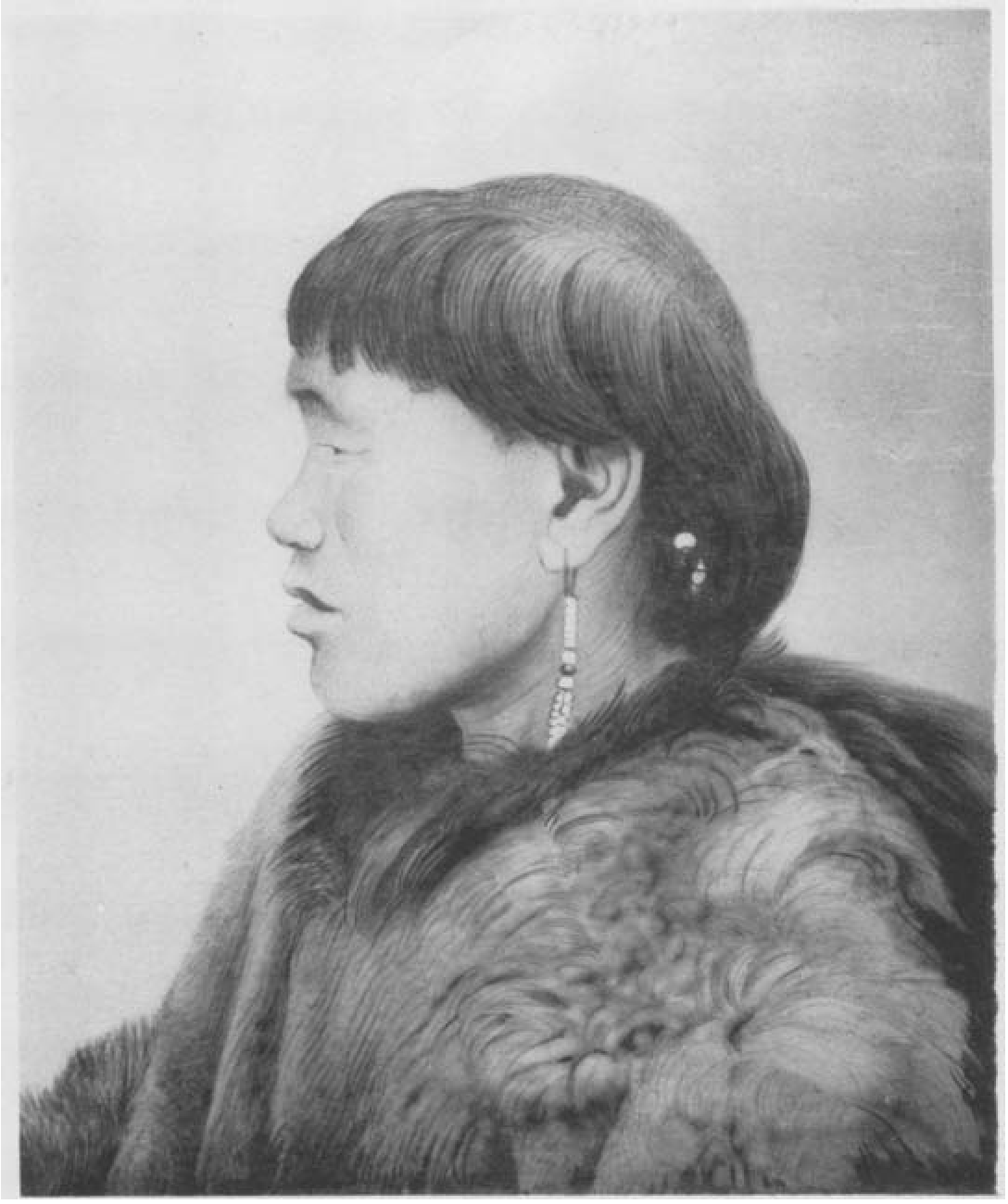
Women sometimes plait into their hair in front a number of small gay-colored beads merely for ornament. In dressing the hair, the women form two braids on the sides of the head, quite near the temples (Plate XXIX, Fig. 2). The braids are adorned with strings of small beads and buttons (see Fig. 188, g, h, k). Married women arrange their braids at the back of the head in a coil, and cover them with a cotton neckerchief in Russian style (Plate XXVII, Fig. 3). Young women and girls leave their braids hanging down over the shoulders, and join their ends together with a narrow band.
The Chukchee allow the mustache and whiskers to grow. Only a few young men pull them out with tweezers, which are probably copied after those of some neighboring tribe. In this respect the Koryak are similar to the Chukchee, while the Lamut and the Eskimo pull out the scanty growth of hair on their faces very carefully.
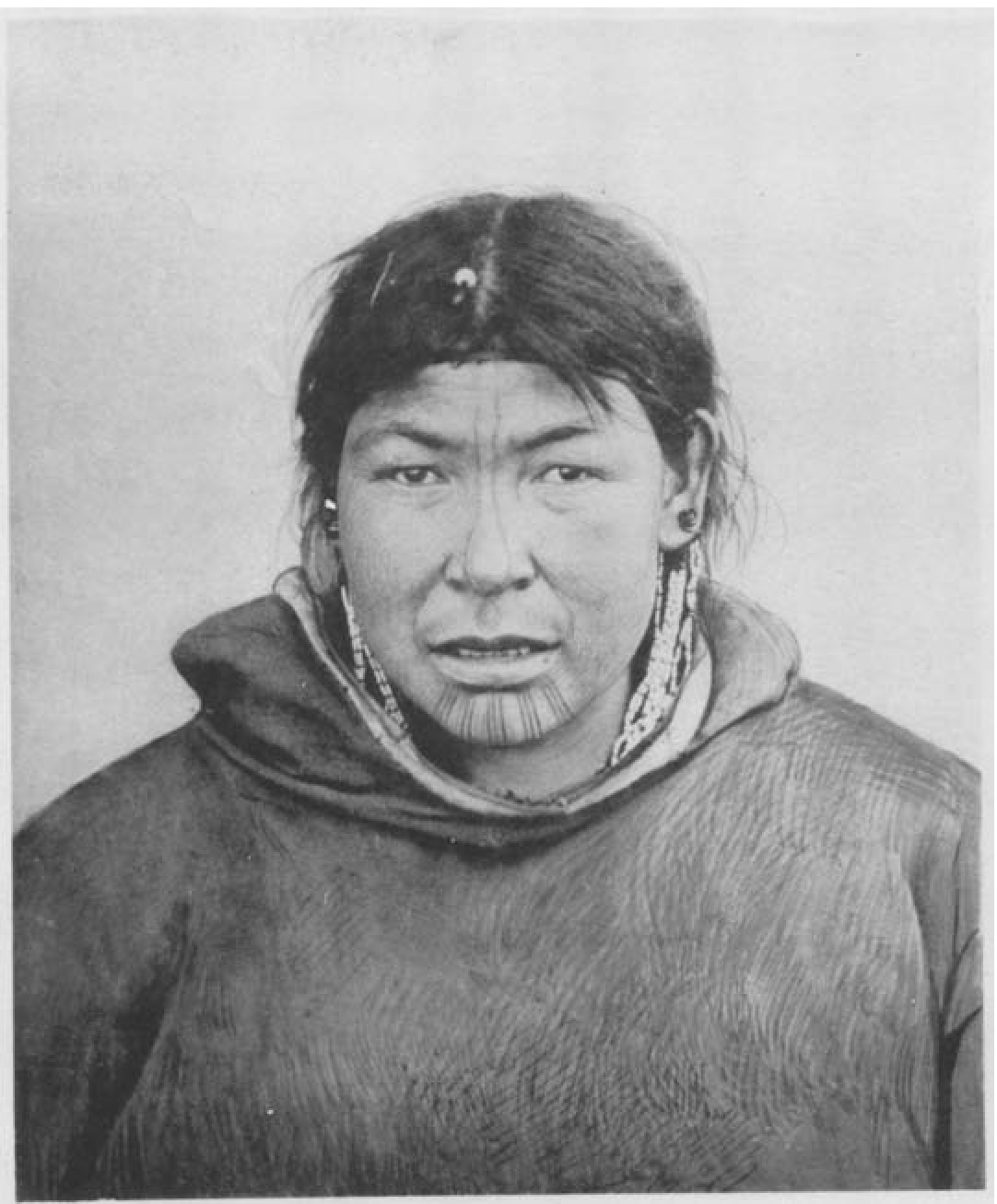
TATTOOING. — Tattooing is done with a needle, by means of which a thin thread, blackened with soot or with powder, is drawn through the skin. It is practised on girls of ten years or even younger, though it requires considerable endurance (see Plate XXX, Fig. 4). The women of the Reindeer Chukchee are contented with only a few lines (Fig. 186, a). Two of these run vertically on both sides of the nose. On account of these tattoo-lines several tales speak of a heroine with a punctured nose as a Chukchee woman par excellence. Several vertical lines adorn the chin. Childless women tattoo on both cheeks three equidistant lines running all the way around. This is considered one of the charms against sterility. I know of cases, however, where young women and girls have adorned their cheeks with such lines with no reference to child-bearing. Many women of the Reindeer branch have no tattooing at all.
Of the Maritime people, the Eskimo women, both on the mainland and on St. Lawrence Island, adorn their faces and hands with more or less elaborate tattooing (Fig. 186, b-e).
The Chukchee of the Pacific villages south of Indian Point practise tattooing similar to that of the Reindeer people, while in the northern villages more elaborate designs are occasionally used (Fig. 186, f-h). In the Arctic villages, so far as I am aware, the tattooing is like that of the Reindeer people.
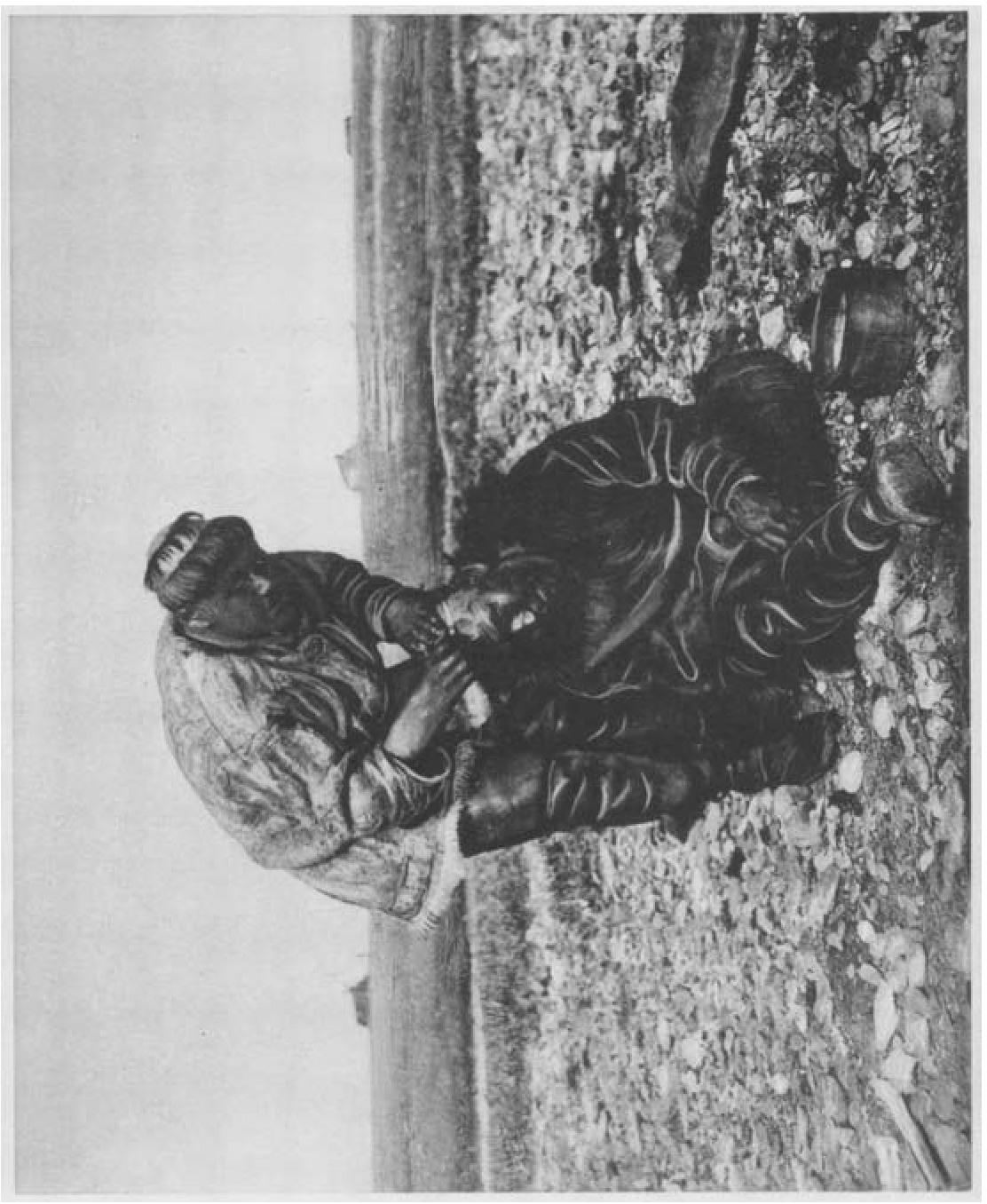
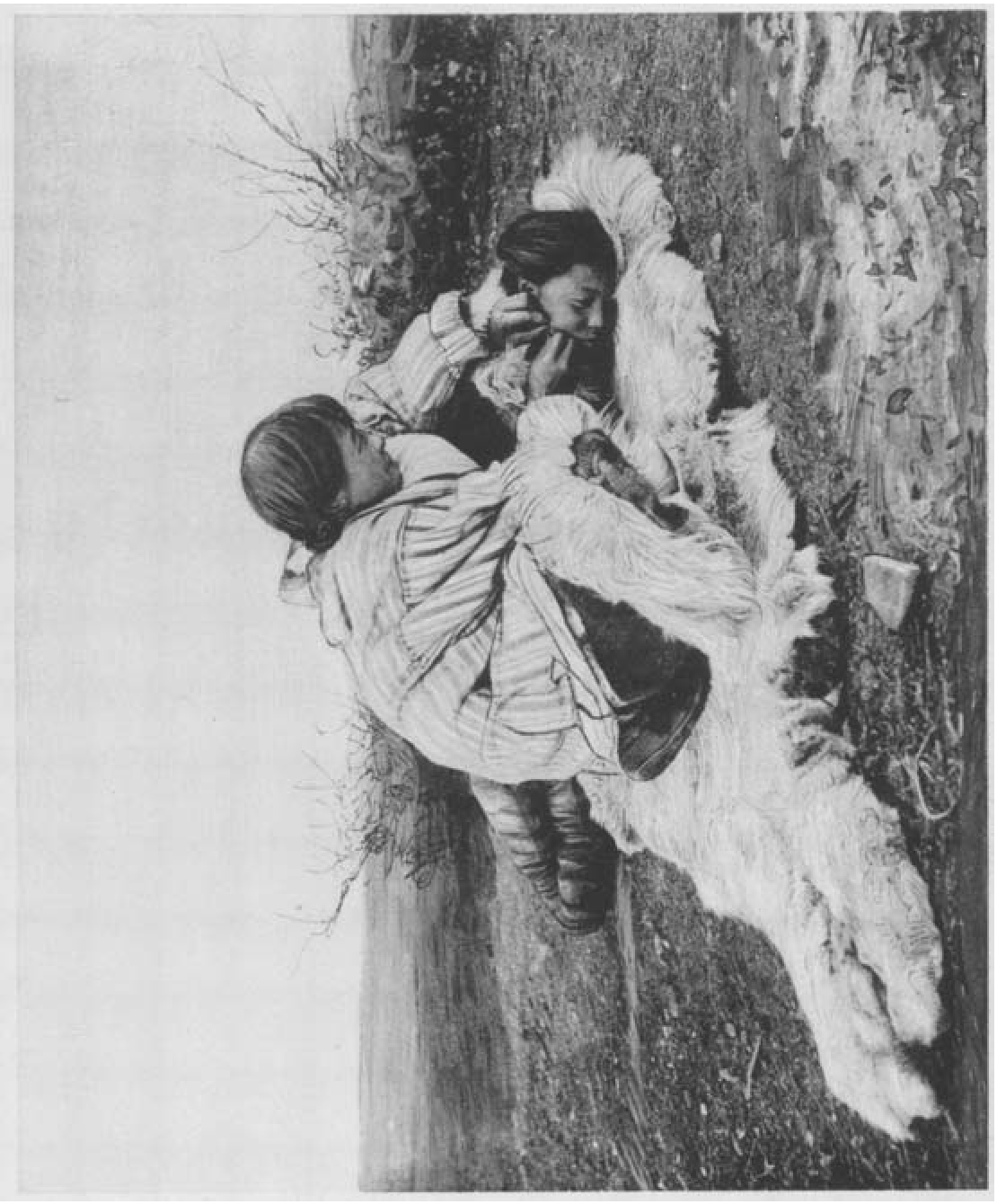
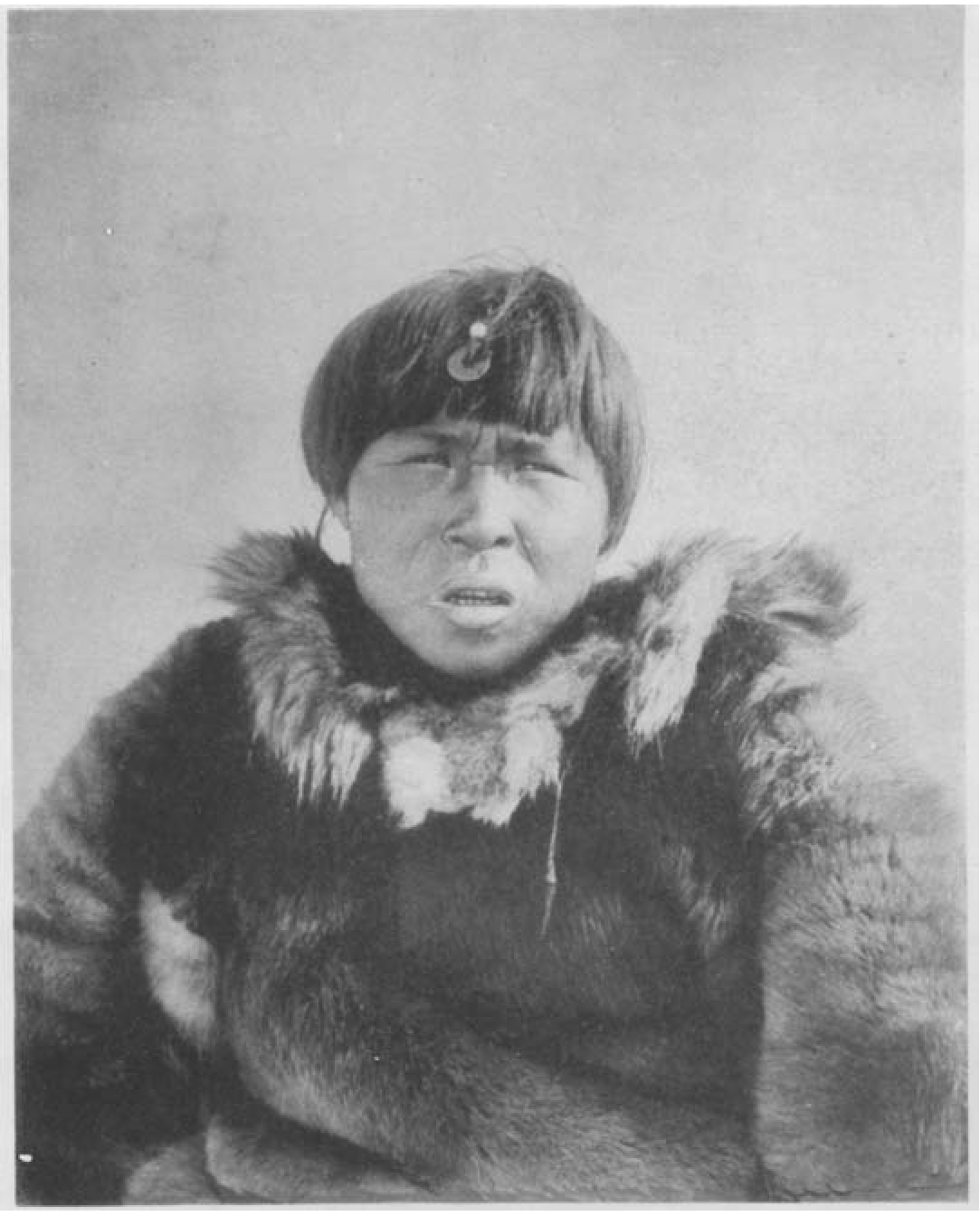
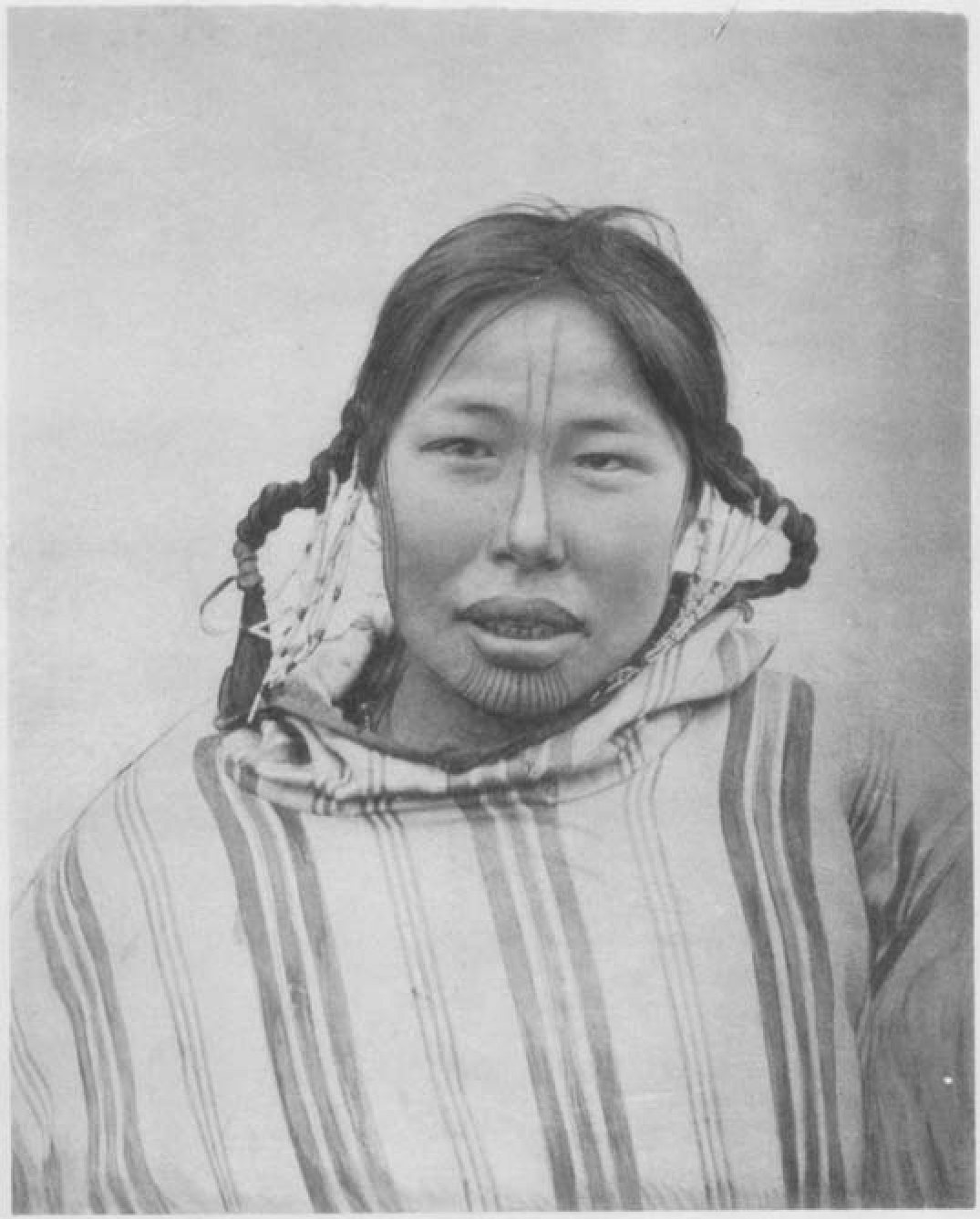
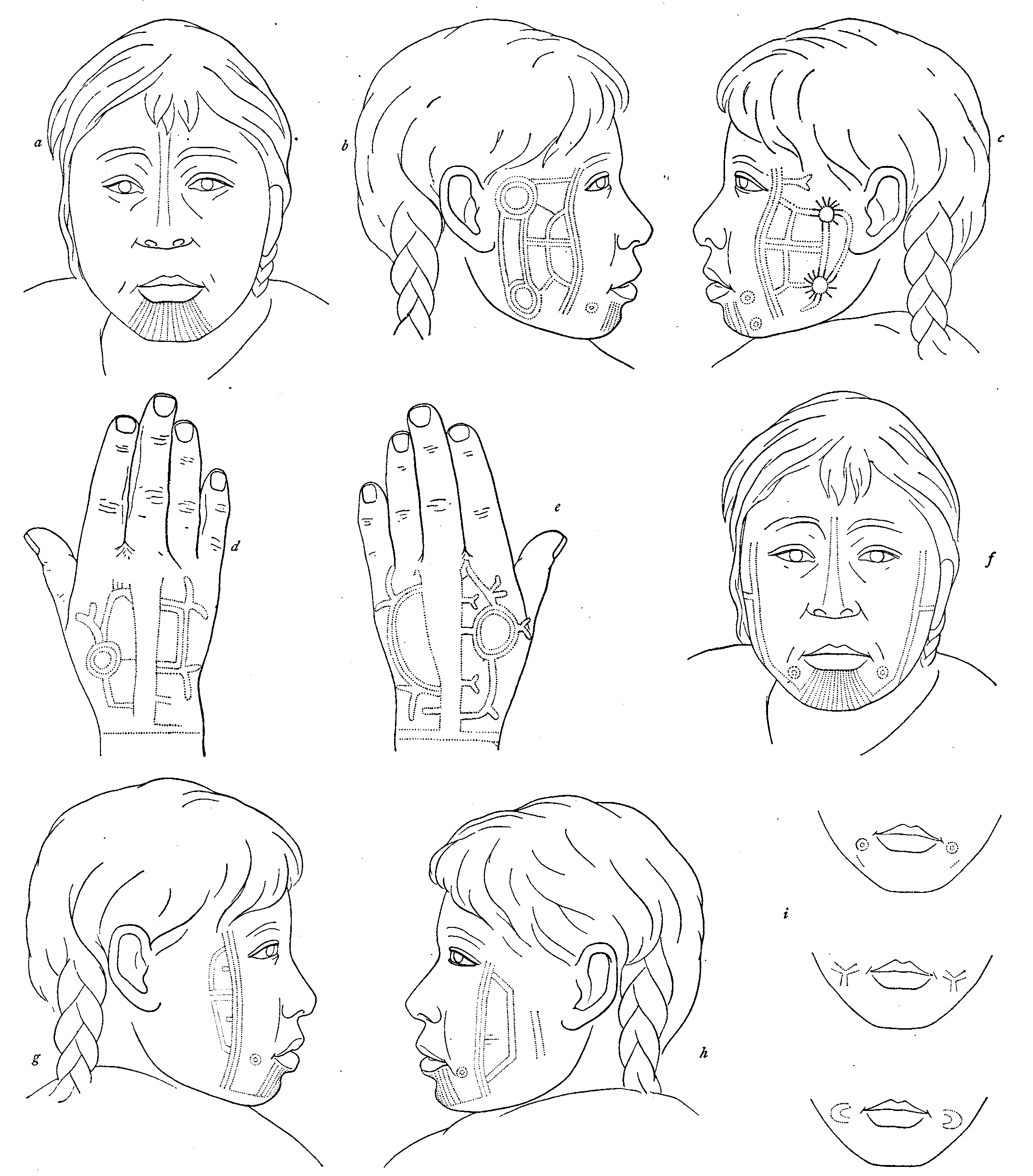
Men are not tattooed, except in the Eskimo villages and the nearest Chukchee settlements, where a great many have two small marks tattooed on both cheeks near the mouth (Fig. 186, i). Nelson suggests that they may be substitutes for labrets, which possibly were worn by the people in olden times.¹[256]🗗uncollated This is probably true, though their position does not quite correspond to the usual position of the labret. These marks are now intended only as charms against spirits. The same is true of other marks, representing human figures, of which I shall speak later. I heard from the Kolyma Chukchee that in ancient times a man, after killing an enemy, tattooed a dot on the back of his right wrist. For each similar performance a dot was added, sometimes in this way forming quite a line of dots running from the wrist toward the elbow. In modern times, among the Maritime people, the hunter who succeeds in killing his first whale or polar bear has a simple mark tattooed near every joint of his limbs.
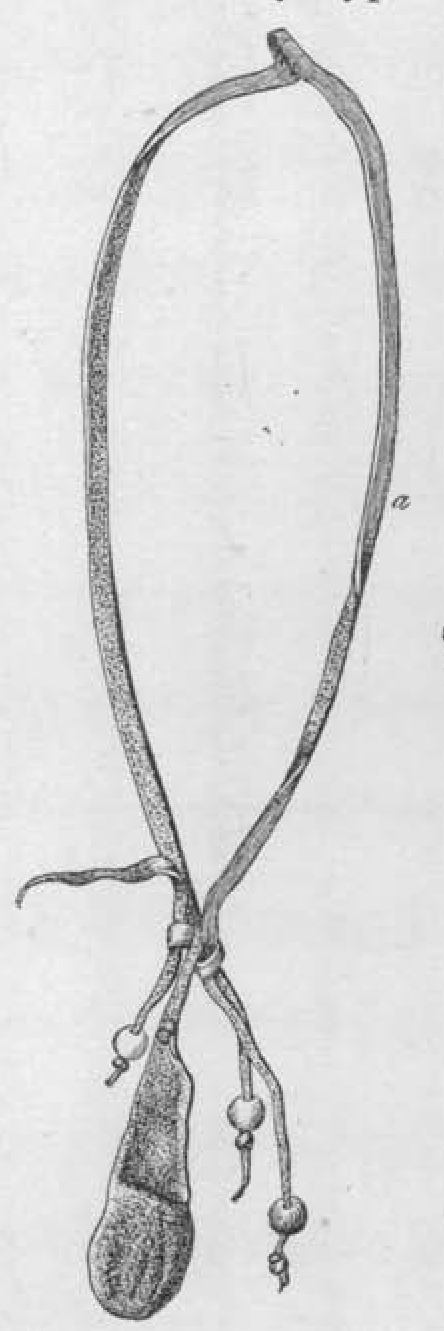
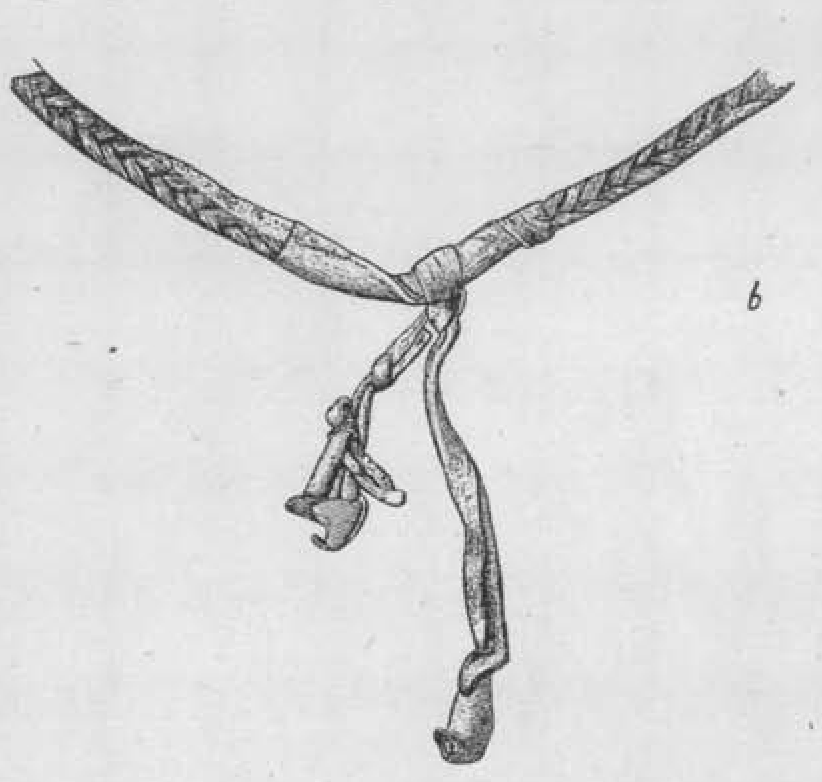
PERSONAL ADORNMENT. — Chukchee men and women, embellish their persons with various adornments of rudest fashion, most of which are regarded as protecting charms or amulets. Most prominent among these are necklaces. The ordinary type is a slender leather band (Fig. 187, a), much soiled, often broken in one or two places and retied with ungainly knots (see Fig. 190, a). In front is fastened a tiny pouch for the tobacco-quid. An amulet sewed up in a piece of leather may be added, or even a small figure carved of ivory (Fig. 187, b). At present, however, beads are considered best suited for this purpose. Some of those who have been baptized add a brass crucifix.
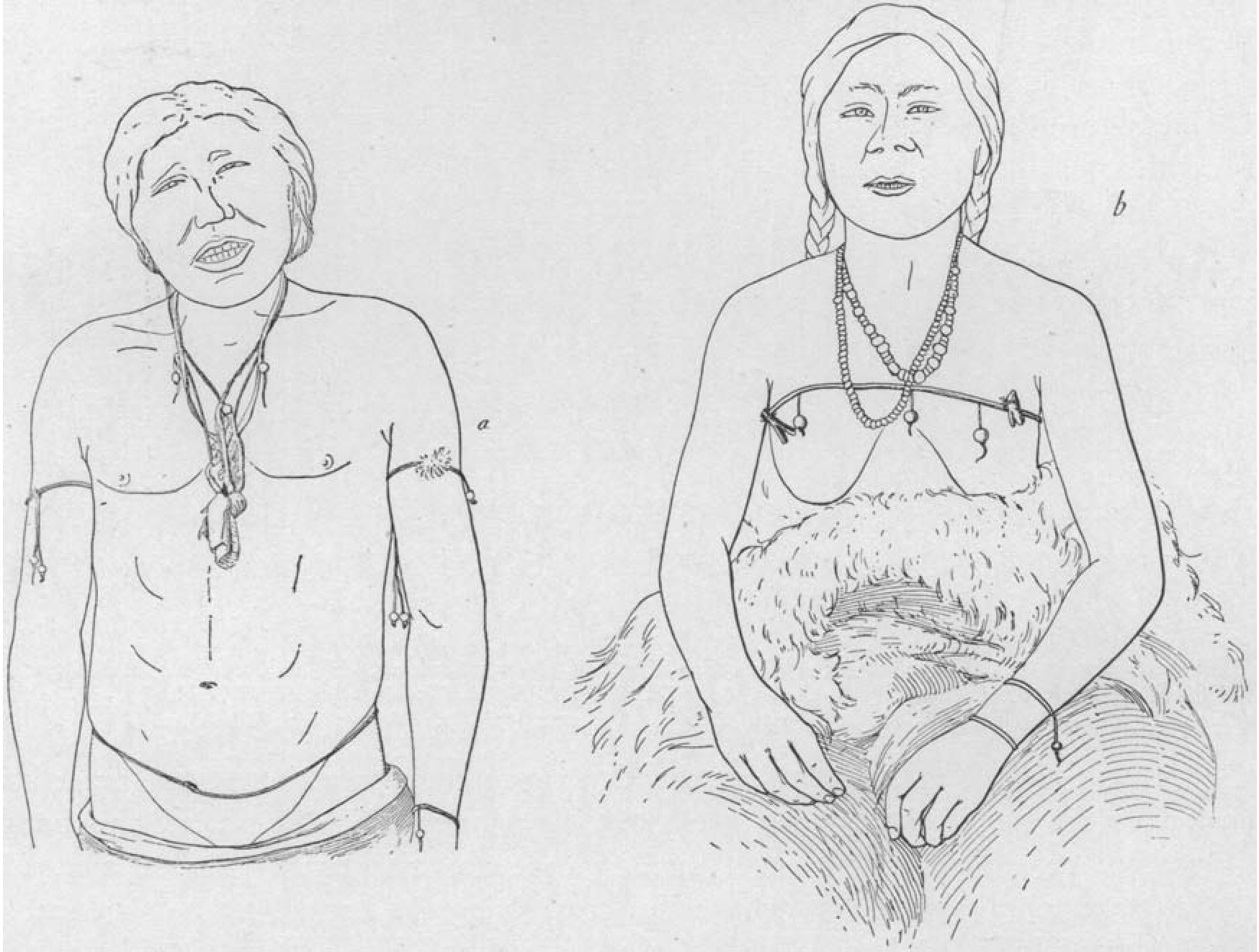
Necklaces of this shape are worn by most of the people (see Fig. 190, a), and are put on at an early age. Women wear, in addition, necklaces made of beads of various sizes and colors, strung together on sinew thread and wound around the neck in several coils (Figs. 188, a, i; 190, b; also Plate XXVII, Fig. 3). These necklaces are often embellished with buttons of brass and porcelain, bottoms of cartridges, heads of brass nails, handles of broken china cups, etc. These trinkets are arranged with poor taste and without any symmetry. Often the necklace of a woman represents a mass of different strings hopelessly entangled. Among the Maritime Chukchee and Eskimo many men wear necklaces of a string of large beads.
[257]🗗uncollated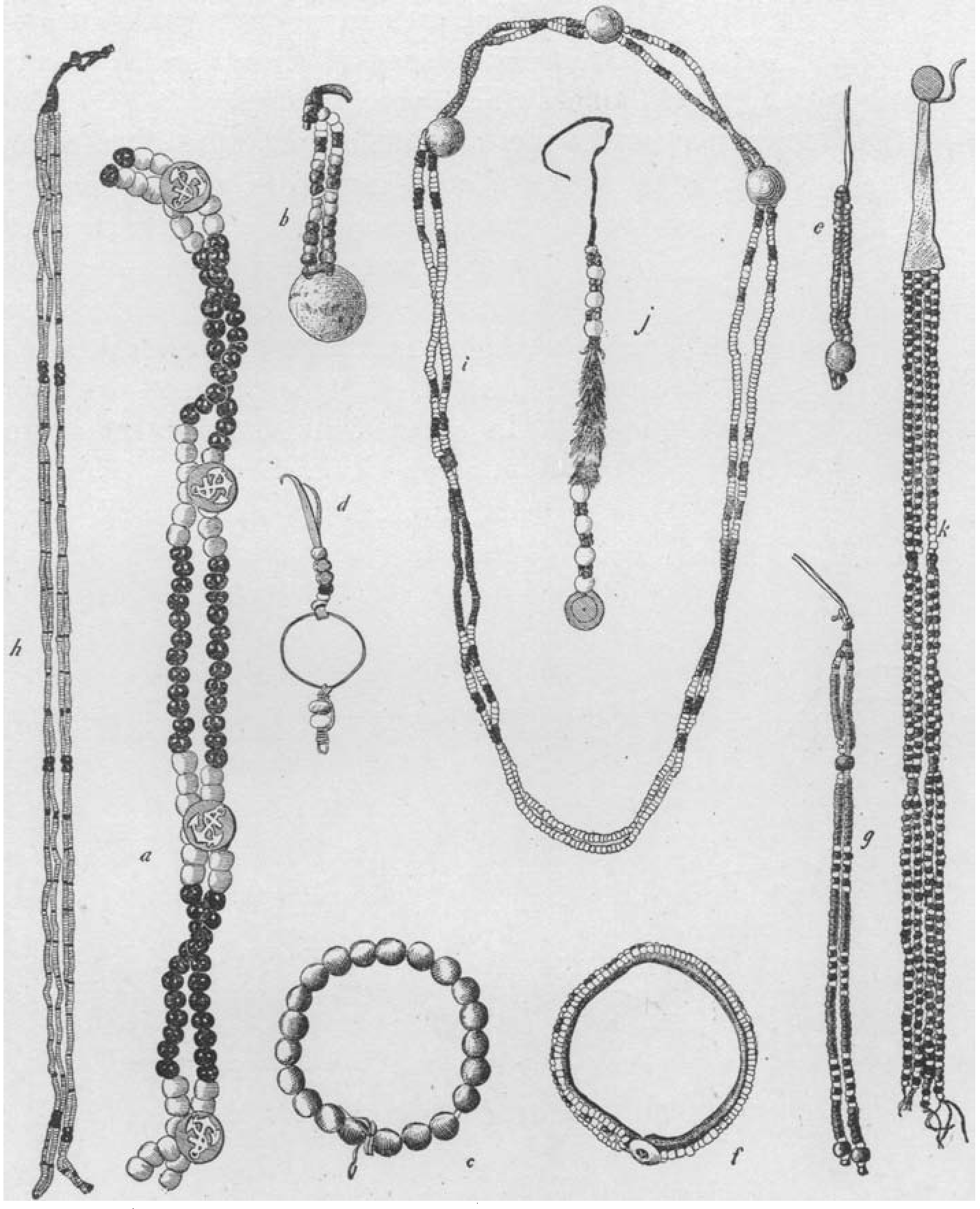
The bracelet of the most usual type is made to match the necklace. It is a narrow strip of leather, with a single bead tied to one of the ends (Fig. 189, a; Fig. 190, a, b). Very few Chukchee are seen without these bracelets on at least one of their wrists. Some add an extra bead or wind the band around twice. Arm-bands of a similar style are also worn (Fig. 190 a, b). More ornamental bracelets are made of a string of large beads or of small beads sewed in several rows on a strip of leather (Fig. 188, c, f). Bracelets of iron and brass are also used (Fig. 189, b), though these are generally bought from the neighboring tribes. The same may be said of brass, copper, and iron finger-rings (Fig. 189, c).
[258]🗗uncollated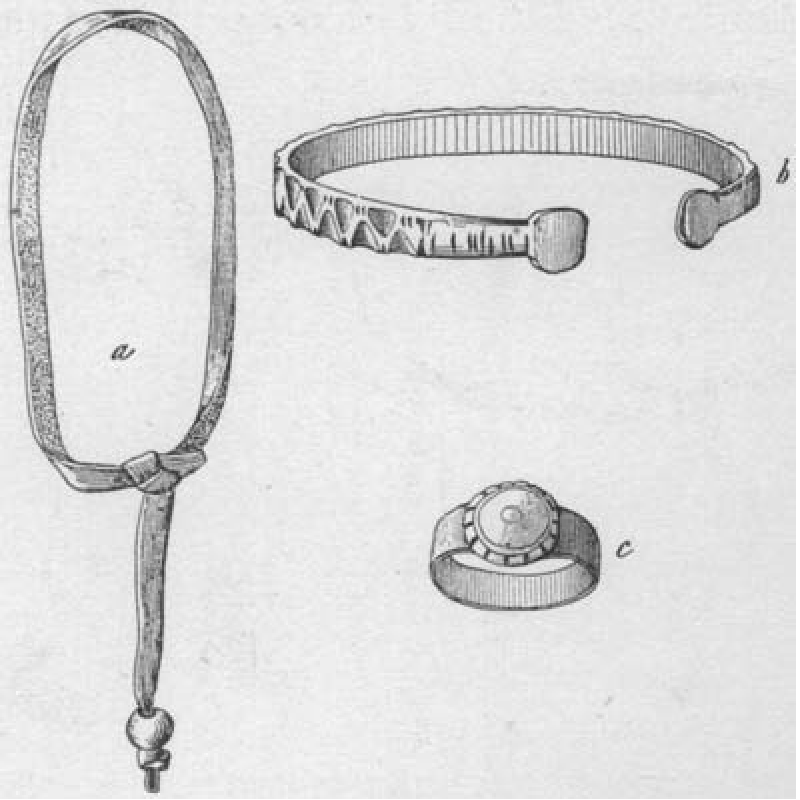
Women often wear around the wrist or over the chest, under their clothing, a string with a few beads on it (Fig. 190, b). The men simply use a thin strip of leather or a cord of sinew for the same purpose (Fig. 190, a).
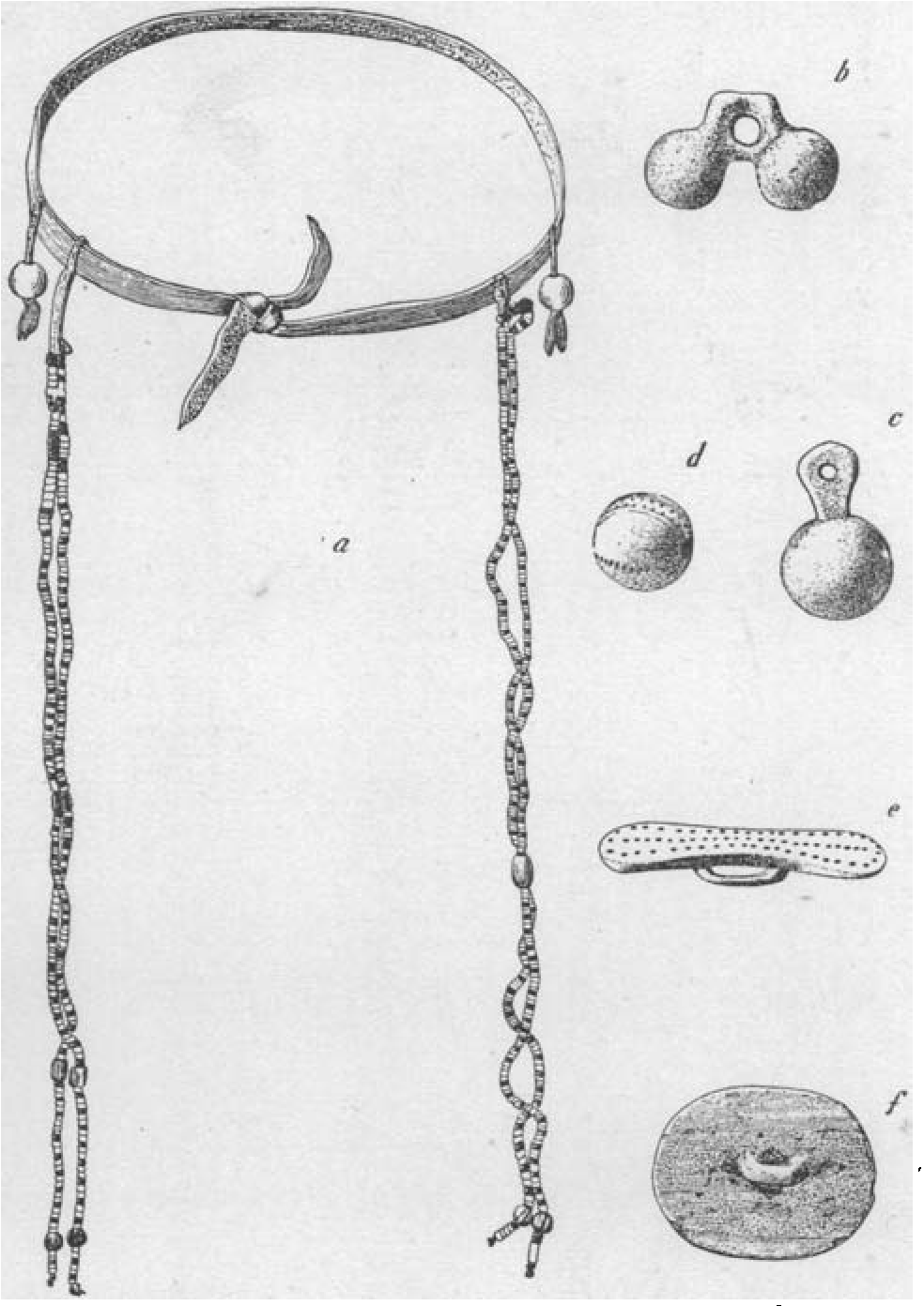
Middle-aged men often wear a kind of head-band (Fig. 191, a) similar in style to the leather necklace. It is made of a very narrow strip of leather, adorned at intervals with a few large beads and having a few strings of smaller beads hanging from it. These ornaments are also amulets. In olden times the attachments consisted of small blocks of wood. These represented protecting spirits, and were called “wooden manikins” (ottaˊᵋ-laˊulqaitê). I saw one head-band of this kind worn by an old man among the Reindeer people on the Wolverene River. Head-bands with wooden images attached are[259]🗗uncollated mentioned in several tales. Similar wooden manikins, forked at one end, may be seen on the breast-band of the women (Fig. 190, b). Their shape represents one of the typical images of guardian and assistant spirits, which are much used by the Chukchee. They will be discussed at length, in Chapter XIII.
Ear-rings are usually made of small beads strung on leather or sinew (Fig. 188, e, j). A larger bead or a disk of silver battered out of a small coin is added at the end (Fig. 188, b). Ear-rings of thin silver wire in combination with a few beads strung on leather (Fig. 188, d) are also used. The latter two forms are characteristic of the Lamut. Ear-rings of silver wire are similar to those of the Gilyak figured by Schrenck.¹ Ear-rings are fastened by passing a string through a hole in the lobe of the ear and tying a knot in the end of the string to prevent it from slipping out (see Plate XXIX, Fig. 3). This method of holding the ear-rings in place is used by most of the tribes of this region. Even the ear-rings of thin silver wire are thus fastened to the ear with a short strip of leather. For greater safety the two rings are often joined by a fine thread passing around the back of the head.
Many men also wear ear-rings, generally by order of a shaman. These, however, are sometimes fastened simply with a loop slung over the ear.
Single beads on long leather strings are sewed to the clothes at various places, serving at the same time both as a charm and as an ornament. Women frequently have a long pendant dangling from the front of their bodice down as low as the knees.
In earlier times ivory beads and pendants were used for ear-rings and other ornaments. I could find but a few of these, all of which are very carefully made, and seem to be only imitations of glass beads (Fig. 191, d). Others (Fig. 191, b, c) resemble the ivory ornaments for women’s jackets used[260]🗗uncollated by the Central Eskimo.¹ It is uncertain whether, before the arrival of Europeans, the Chukchee used necklaces made of small objects strung together.
I have heard that necklaces of the vertebræ of fish were worn by children. One of the dolls I collected had a necklace of tiny stones of irregular form tied together on a sinew thread.
Buttons are little known to the Chukchee, since their garments do not require any. Some buttons carved out of ivory are used for clasping belts or for buttoning pouches and work-bags (Fig. 191, e, f). They may be compared to the buttons belonging to the Gilyak, and illustrated by Schrenck.²
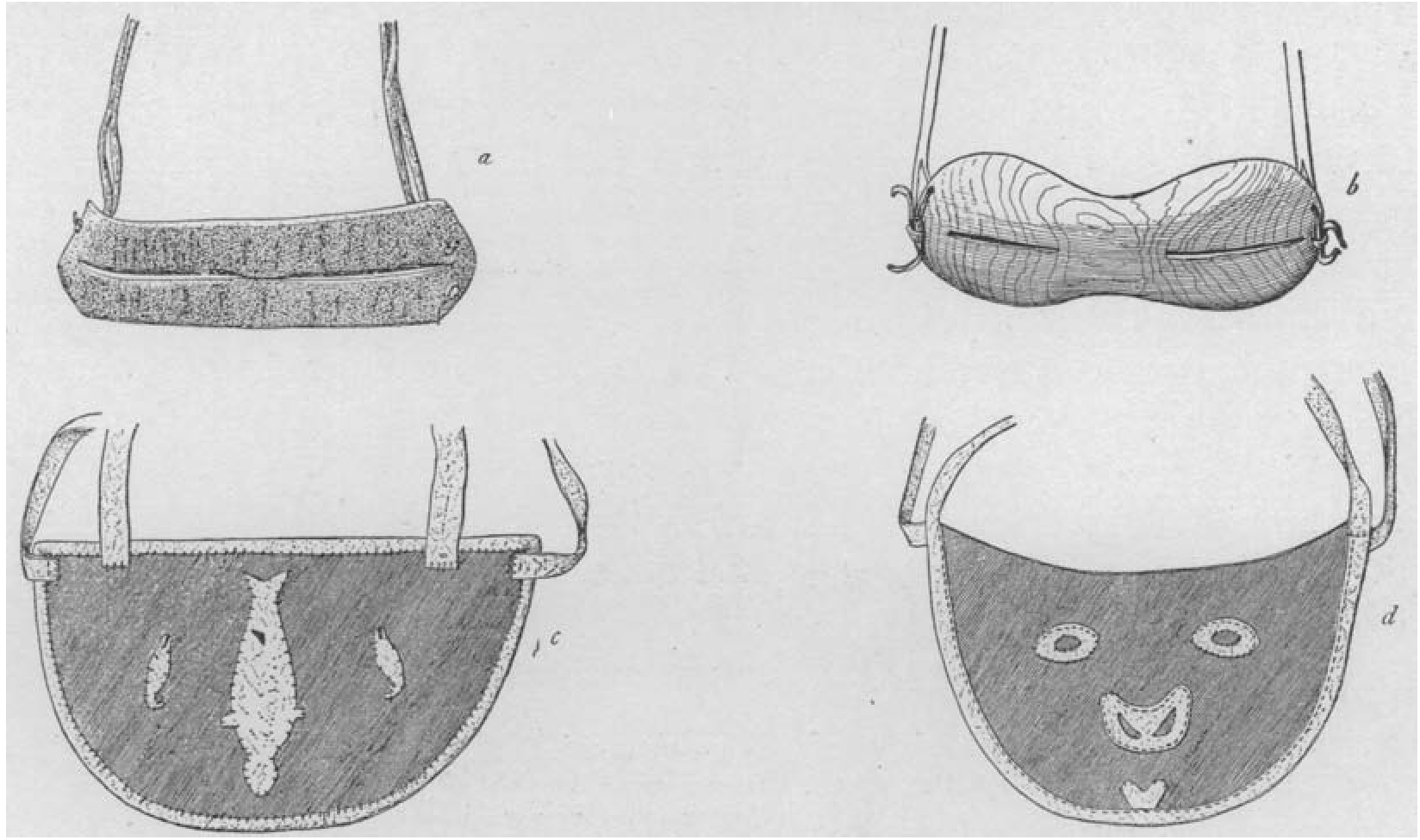
SNOW-GOGGLES. — Snow-goggles of leather and wood (Fig. 192, a, b) are used by the Chukchee, the Asiatic Eskimo, the Lamut, and other tribes of northeastern Asia. They have narrow slits similar to those in the specimens from the American Eskimo. The Lamut sometimes fashion snow-goggles of the same shape out of thin sheets of silver hammered out of silver coins. Nowadays snow-goggles of Yakut make, covered with a net of horsehair, are bought from Russian traders. Glass goggles from civilized countries are also eagerly purchased. The Chukchee sometimes imitate European snow-goggles, but in place of smoked glass or hair-netting they use round bits of iron pierced with numerous holes.
I once saw among the Reindeer Chukchee an eye-shade used by a man who had weak eyes. It was made of thick leather, and fastened with strings[261]🗗uncollated around the back of his head. Among the Maritime people, owners of boats, who usually sit at the stern steering, put on eye-shades during their hunting-expeditions. The harpooneer also wears an eye-shade. The eye-shades which I collected belong to the Asiatic Eskimo. All of them represent masks at the same time. One has on it the image of a killer-whale and two walruses (Fig. 192, c); another, the face of a walrus without tusks (Fig. 192, d); a third has two eyes, which are said to represent whale’s eyes.
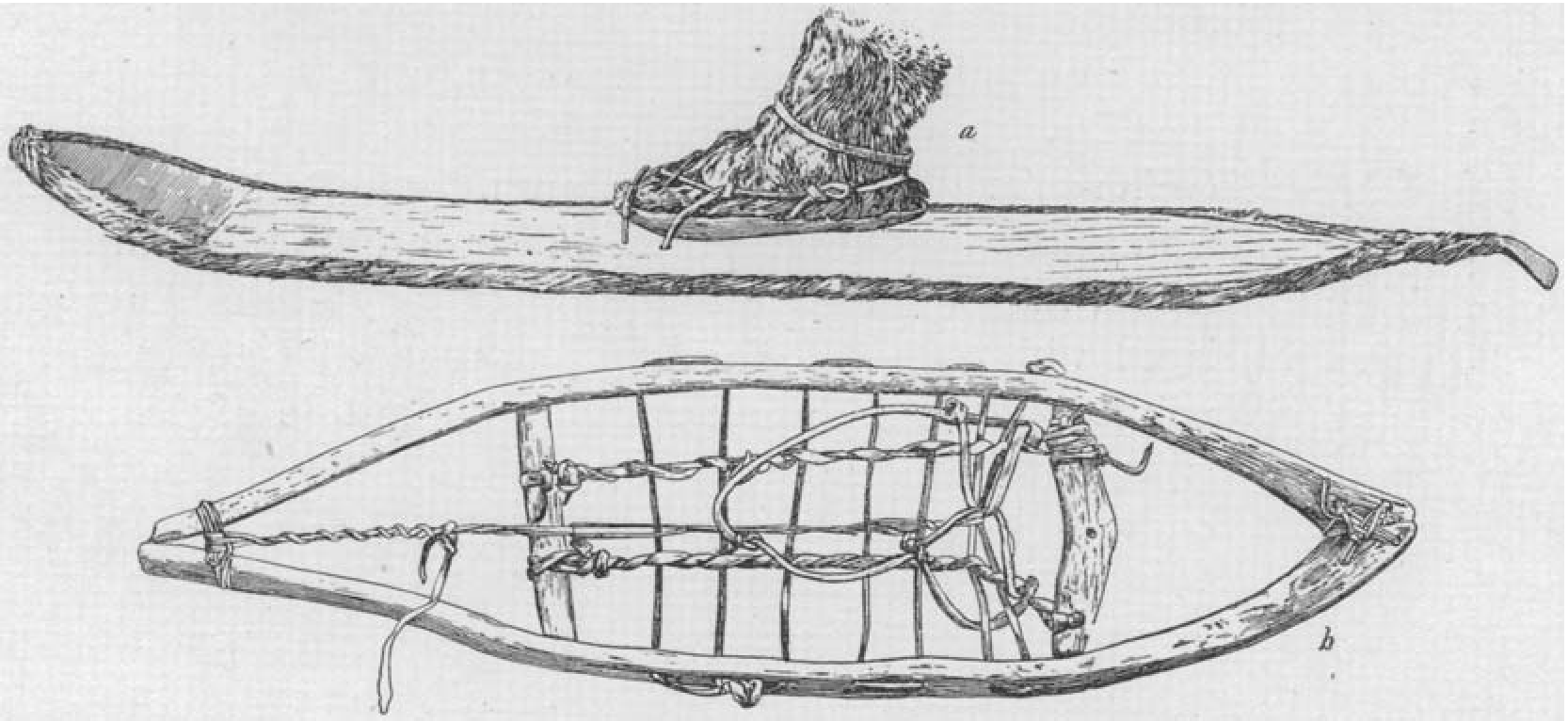
SNOWSHOES, STAFFS, AND ICE-CREEPERS. — The snowshoes used in northeastern Asia are of two varieties, in accordance with the character of the ground on which they are to be used. Those used within the forest-border, where the snow is soft and abundant, are made of long, thin boards. Those used by the Yakut are narrow, and are not covered with skins. They are therefore called “bare snowshoes.” Those used by the Lamut are broader, and covered underneath with slick reindeer-leg skins, the hair turning backward to assist in ascending hills and yet glide along smoothly on the level or down grades. Their length is from 125 cm. to 130 cm.; and breadth, from 24 cm. to 26 cm. The Kamchadal snowshoes are more clumsily made, and covered with seal-skin, which does not serve nearly as well as reindeer-skin. Snowshoes covered with leg-skins (Fig. 193, a) are known also among the Reindeer Chukchee on both the Arctic and the Pacific shores (see Plate XXX, Fig. 2). They are bought either from the Lamut or from the Russianized natives, and are used in winter for travel in the forests. They are very useful in hunting reindeer on the hard-crusted snow, because their large surface prevents the foot from breaking through the thin crust of the snow.
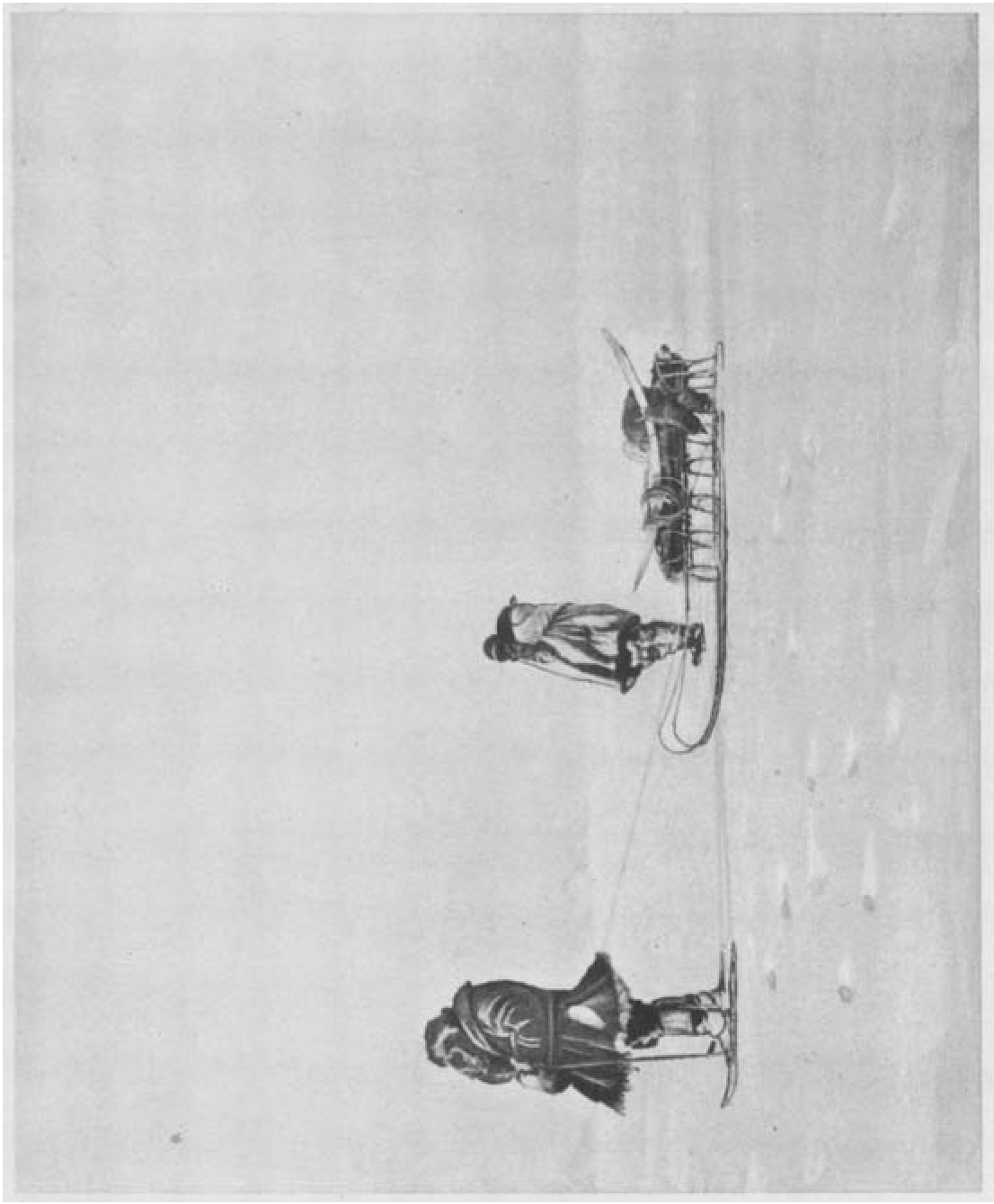

Nordenskiöld¹ obtained a specimen of these snowshoes from the Arctic Chukchee, and considered them hopelessly clumsy. He says that he could[262]🗗uncollated not even admit any possible use for them until he saw a Japanese picture representing an Ainu man driving a reindeer while on such snowshoes (i. e., the snowshoes served as a sledge). The title of the Japanese book from which the picture is taken is given by Nordenskiöld as “Journey to the Northern Part of Japan (Yezo).” It is to be regretted that no more details are given. It is almost needless to say, that, however attractive the picture may be on the pages of the Japanese book, it is altogether fantastic. Ainu do not drive reindeer either with snowshoes or in any other way. My own experience and the opinion of the natives both contradict Nordenskiöld when he speaks of the clumsiness of these snowshoes. The Lamut, who are the best snowshoe-runners in northeastern Asia, achieve wonders with this particular kind of shoe. Several times I had Lamut runners wearing such snowshoes who accompanied my dog-team for miles and miles without any visible strain. The dogs ran in the deep, hard-beaten track. The Lamut runners glided by their side over the surface of the snow. Races on such snowshoes are also run among the Lamut runners, in which they attain a speed equal to that of the fastest race-reindeer.
The other variety of snowshoe, and the one typical of the Chukchee (Fig. 193, b), is the so-called “raven feet” (veˊlvɪ-yeˊhɪt; in local Russian, лапки, “paws,” which is evidently a translation of the same term). They are made with a wooden frame, rather small in size (60-70 cm. by 16-20 cm.), and interlaced with thongs. The frame is rounded between the two pointed ends. The foot rests on the middle of the net, and is fastened with a loop. The loop for the foot is the same on both kinds of snowshoes.
Netted snowshoes are used by natives when walking on uneven ground, where the other kind of shoe would be quite useless. Herdsmen, for example, wear them when tending the reindeer in the pastures, where the snow is scraped and ploughed up by the feet of the animals. Seal-hunters also wear them in walking on the outskirts of the rugged ice.
Snowshoes having a similar name are in use also among the Koryak. Their construction is essentially the same, only the frame is more elongated. Snowshoes of this kind are also well known in America among the Eskimo and the northern Indians from the Pacific to the Atlantic Ocean.
The runner on snowshoes steadies himself with a long staff. On the end it has a small hoop supported by spokes of whalebone or thong (Fig. 194, a),[263]🗗uncollated which prevents it from sinking through the snow. The staff with the hoop is well known among the American Eskimo. In Asia, however, it is used chiefly with the broad snowshoes in walking on soft snow. When travelling with netted snowshoes on hard ground, there is much less need for support. The staff of this form is known through all the Arctic country of the Old World as far west as Lapland.
Foot-racers and even herdsmen in the summer-time use a short staff (Fig. 194, b), the lower end of which is tipped with spikes made of antler. Often a couple of nails serve for spikes. While running, the man thrusts the staff as far ahead as possible, and supports himself on it, trying to lengthen his steps. Instead of this staff, runners will often use plain wooden sticks.
Another kind of staff is used in climbing mountains. It has a head of antler or iron, with two large, slightly curved spikes not unlike walrus-tusks. These spikes are used for catching to rocks in the most difficult places. This staff is used mainly among the Kamchadal in hunting sheep or bears on the rugged mountains. A similar form is found among the Lamut hunters. I have also seen specimens among those Chukchee of the Kolyma who live farther to the south.
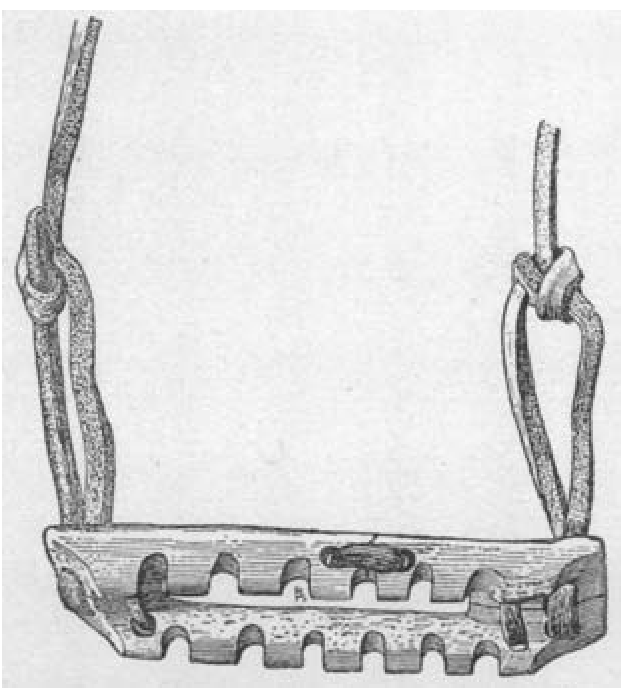
Chukchee and Koryak, when walking over smooth ice, use ivory creepers identical in shape with those of the American Eskimo (Fig. 195). These are fastened to the sole crosswise to prevent slipping.