XXIIIContact of the Chukchee with the Russians¹
DISCOVERY. — The first information concerning the Chukchee was brought by the Cossack Michael Stadukhin, who, in 1644, went to the Kolyma River and founded the winter hamlet (зимовье) of Nishne-Kolymsk.
[681]🗗uncollatedManykin-Nevstruyev says that the Kolyma River was discovered in the year 1638. Maydell mentions as the discoverer of the Kolyma the Cossack Ivan Erastov, with his companions. He says that in 1644 three winter hamlets were founded on the Kolyma River, — Nishne-Kolymsk, Sredne-Kolymsk, and Verkhne-Kolymsk (Lower Kolymsk, Middle Kolymsk, and Upper Kolymsk).¹ I am not sure that all three hamlets were founded as early as that, and all in exactly the same year. On a copy of a chart of Siberia, made in the year 1672 all three winter hamlets are mentioned, — the Lower, the Middle, and the Upper. Nishne-Kolymsk in some documents was called “Dog Fortress,” doubtless because of the dogs used for driving. It was the largest of the three settlements. From Michael Stadukhin we have a report of the 22d of April, 1647, taken down, as was the custom, from his own words, by the Government clerk in the assembly-room (съѣзжая изба), in the presence of the two governors of the Yakutsk Province, Pushkin and Suponev.² In this report it is said that “the public-service official (служилый человѣкъ),³ Michael Stadukhin, who, in the past 154th year (1646), went from the Kolyma River with the Czar’s tribute, relates that he was on the Kolyma River two years for collecting the Czar’s tribute. The Kolyma is a great river of the size of the Lena. It runs in the same direction, east and north. On this Kolyma River live the natives, Kolyma men of their own tribe, driving [Reindeer] and walking [sedentary],⁴ — numerous people, — and they have a language of their own; on this Kolyma, and also on a separate river, the Chiukhcha (чюхча), — and this river Chiukhcha flows directly to the sea, and its mouth lies on this side[682]🗗uncollated of the Kolyma River on our way (from the west), — on this Chiukhcha River live natives of their own tribe. They are called ‘Chiukhchee,’ the same as the Samoyed, Reindeer and sedentary. He had a woman captive from the Kolyma, Kaliba by name. That woman had lived among the Chiukhcha for three years. She told him about the island which is in the sea, — when going by ship to the Kolyma River, on the left hand. Those Chiukhcha, in the winter-time, go in one day from their dwelling-place on their river to that island, and there they kill walrus and bring home the walrus-heads with the tusks; and, according to their custom, they pray to those walrus-heads.” Stadukhin himself had not seen any walrus-tusk, but the Russian hunters (промышленные люди)¹ had told him that they had seen walrus-tusks in the possession of the Chiukhcha. He continues: “The runners of their reindeer-sledges are made of the same walrus-tusk. These Chiukhcha have no sables, because they live on the tundra near the sea, and the best and the darkest sable comes from the Kolyma.”²
This report is very interesting. The name “Chiukhcha” is mentioned in it for the first time; and from the words of Stadukhin it follows that in that time, on the Chukchee River, to the west of the Kolyma, there lived natives called Chukchee, Reindeer and sedentary. I mentioned before that those natives were probably of Čaˊačên stock.³ Still more remarkable are the details concerning the walrus-hunt of those natives on one of the Bear Islands. Walrus, even in modern times, migrate to the northern shores of the Bear Islands; and the Reindeer Chukchee sometimes go over to those islands for the purpose of hunting them, just as described in the report. In the time of Stadukhin, however, walrus-hunting was evidently carried on more extensively. The natives brought home walrus-heads and prayed to them; that is, they arranged a certain ceremonial with walrus-heads. Up to the present, walrus-heads have played a prominent part in the principal ceremonials of the Maritime Chukchee.⁴
WARS. Seventeenth Century Wars. — Soon after the discovery of the Kolyma, in 1647, the Cossack Basile Kolesnikov founded the fortress of Anadyr, though, according to other information, it was founded by Semen Deshnev in 1649.⁵ Semen Deshnev, with Theodote Alexeiev and Gerasim Ankudinov, after a first ineffectual attempt in the year 1647, succeeded a year later in rounding East Cape. Most of their ships were lost. Two stranded somewhere to the south of Anadyr.⁶ The year 1649 actually found[683]🗗uncollated several parties of Cossacks and service-men on the Anadyr. One party was headed by Semen Deshnev and the inspecting service official (служилый приказный человѣкъ)¹ Semen Motora. Another party was headed by Michael Stadukhin, who had come from the Kolyma River. Stadukhin made attempts to subjugate to himself all other parties, and to be the chief leader of the public officials of Anadyr. The strife brought forth several reports, which were presented to the Governor of Yakutsk.² All these reports are just as interesting as the report of Michael Stadukhin concerning the Kolyma.
Thus one Theodore Vetoshka, in a report of 1655, says, “In the past 157th year (1649) it became known on the Kolyma River — from the lips of Angara, the hostage of the Khodyntzy,³ whom we, your slaves [the report is formulated as a direct address to the Czar], took on the upper stream of the Anui River, and from other captives in the same raid of ours — that a new trans-mountain river, the Anadyr,⁴ comes quite near to the upper course of the Anui. By reason of these facts we have gathered together among ourselves volunteer hunters, and we have struck the ground (i. e., petitioned) before you, O Czar! because we desired to go to that new country with the intention of bringing down the tributeless tribes under your high hand, and we had to give into your treasury forty sables. Then we were given leave to undertake that service, together with the public officials Semen Motora and comrades.... And in the same 157th year, in the month of July, the service-men Michael Stadukhin and comrades made an attempt to go by sea from the Kolyma River to the new river Pahycha,⁵ but came back from the sea to the Kolyma on Sept. 7. When we came over the mountain to the Anadyr River, and he (Michael Stadukhin) was going down the Anadyr and passed by our camp, he sent to us, requesting that we come to him and ask to be accepted into his regiment, and stating that if we did not consent, he would order all of us to be exterminated. Then he took from us by force the inspecting official Semen Motora, and put him into the stocks for nine days, and extorted from him a paper promising to remain under his (Michael’s) command.”
It seems that Michael Stadukhin could not accomplish his purpose. So[684]🗗uncollated in the next year, the 158th (1650), on April 23, according to another report, Semen Motora and comrades went to the winter hamlet of Semen Deshnev, founded for tribute purposes. Then follows in the report a description of the continuous warfare against the natives.
“The Anadyr River is populous,” say the Cossacks, “and the men in the public service are too few. In the 159th year (1651) we went against the people of Anauli,¹ and God helped us to take their fortified hamlet (острожекъ). They had stakes prepared for the purpose, axes put on long handles, and knives. We fought with them hand to hand. They killed four of our men and wounded many with those stakes; and in the 160th year, (1652), Dec. 7, in a similar fight, they shot at us, and killed Semen Motora, the inspecting official.”
The Cossacks asked for sables; but the Anauli men said, “We have no sables, because we do not live in the woods. The Reindeer people come to us. When they come, we shall buy sables from them and bring the tribute to the Czar.” And in this 163d year (1655), adds the report, Kolupai and Lok, the Anauli hostages, went to the mountains to buy sables from the Reindeer. Khodyntzy men for tribute.
This report shows that the Anauli and the Khodyntzy were friendly among themselves. The former lived on the river; the latter had reindeer, and wandered with them on the mountain with wood and sables; i.e., to the south from the Anadyr River. Both tribes were probably of Chuvantzy stock, though the latter are mentioned separately as a Reindeer people. At the same time the tribute hostages, Chekchoi and brothers, presented a petition: “Over the mountain from the Penshina River there have come to us numerous unpeaceful Koryak men. They have murdered our kinsmen, plundered our houses, captured our wives and children, and driven away the reindeer. We suffer pillage and abuse all the time from those people, and we cannot abide it any longer.” The Koryak frontier lay somewhere along the upper course of the Penshina River, nearly as it is at present. The country on the Anadyr River and its affluents was occupied by several branches of the Chuvantzy stock, Reindeer and sedentary, such as the Khodyntzy, the Anauli, and the Chuvantzy proper.
In another report Semen Deshnev and his comrades say, “And in the 160th year (1652) we went by ship to sea, and at the mouth of the Anadyr River we found a spit. It came into the sea beyond the bay. On that spit the walrus come out, and on that spit may be found the tusks of the dead walrus. They come in great numbers, and their place on the cape is all around for more than half a verst,² and upshore for thirty or forty sashen.³[685]🗗uncollated All the game does not come from the water to the shore. Much of it is in the water near the shore; and the hunters who are from the Russian Arctic Sea say that game is less numerous in the Russian Sea.”
The spit mentioned here is probably Geek Cape, on the south end of Anadyr Bay, called in Chukchee G̣iˊg̣g̣rin. Even nowadays walrus are in the habit of going to that low sandy shore, and the Anadyr Chukchee and Cossacks visit it for hunting-purposes; but the walrus-herds of the ancient time have dwindled down to little groups, and no tusks of dead animals can be found on the shore.
At the time of the first conquest, walrus were so numerous, that one party of public-service men presented to the Treasury fifty puds¹ of walrus-ivory. The report of that party says, “We found on the spit near the mouth of the Anadyr River ivory of dead walrus. We gathered that ivory, put away for the Czar three puds of it,² and the remainder we divided among ourselves. Altogether, we gathered for the Czar a great profit, — fifty puds of walrus-ivory, the first pud three tusks, the second pud four tusks, etc.” So the tusks of the first pud each weighed twelve pounds Avoirdupois. The same report states, “In the 162d year (1654), when we were on that spit for the purpose of gathering those walrus-tusks, close to that spit lived also some Koryak people, who slunk along with the intention of murder. Then I, Yuriy, and my comrades, and the service-men Semen Deshnev and comrades, went against those men, and found their hamlet, fourteen large houses. And their place was fortified; but with the aid of God we took that fort, and also women and children. The best men, however, escaped, and took with them their wives and children. Because they were quite numerous, each house had ten families and more. We, on the contrary, were not many, — twelve men in all.”
The Koryak in question could have been no other people than the Keˊrek from Cape Navarin. Though at the present time quite wretched and rapidly dying out, the Keˊrek, according to their own traditions, were in former times much more numerous, had large boats, and lived on walrus. They also may have been in the habit of going to the Anadyr spit for hunting. Nowadays almost the whole number of the Keˊrek tribe hardly equals the population of that single ancient village, which, according to the report, had fourteen large houses, with ten families and more in each house.³
In this way the Kolyma and the Anadyr Rivers were occupied by the Russians. The chief desire of the Cossacks was for sable peltries, and everywhere[686]🗗uncollated they asked the natives for these. As mentioned above, the Kolyma River, which for the last fifty years has known no sables, abounded at that time, on the contrary, in the best, very dark sable. According to Slovtzov, in the eighteenth century the fair of Sredne-Kolymsk brought to the treasury as the usual tithe ninety doublescores¹ of sables. Therefore the whole number of sables brought to the fair was about thirty-six thousand.
The Anadyr River, on the other hand, as may be seen from the reports quoted above, even in earlier times, had no sables because of the scarcity of wood. In the first years, however, the Cossacks succeeded in extorting from the natives a considerable number of sable-skins, whole and split, probably acquired by the natives from their southern neighbors. On the Anadyr River and to the north of Kolymsk, the Cossacks turned their attention to walrus-tusks, which were also of great value. According to a record contained in one of the reports mentioned, fourteen sables were equivalent to one pud of walrus-ivory; so that the fifty puds of walrus-ivory mentioned above were equivalent to seven hundred sables; i.e., to seventeen double-scores and a half of sable-peltries. Numerous decrees of the Government were issued in reference to the quality of the tribute to be collected from the natives. Most of them say, “You have to take good and whole sables, without bare spots, with tails and with bellies; and you must not take as Czar’s tribute sables not whole, and with bare spots, or rotten and torn ones, and not full-haired. You have to take the tribute and presents and enter them in the tribute-books, year after year, and one name after another. You have to take of walrus-tusks, as tribute, only the best, and of medium size. Small tusks, weighing less than one pound each, you must not take for tribute.”
A great number of natives were exterminated by the conquerors. The reports are full of remarks like the following: “The village was taken, and all the people put to death.” The natives defended themselves with the courage of despair; but in the contests, they could do no more than kill a few of the assailants. Then they had to give way before steel blades and fire-arms. Those that were left alive promised to pay tribute, and gave the best men as hostages. The Cossacks, however, were quite far from enjoying their position. The northern clime and the conditions of life were too severe even for those adventurers. Thus one report says, “We live on dead red-fish [several species of Oncorhyncus, such as O. keta, O. niarka, O. gorbusha]. Of white-fish we catch but little, because we have no good nets. We do not dare to feed the Czar’s hostages with that dead fish, lest they die from scurvy: so we spare the white-fish and feed them with that.” Another report says, “We are starving to death, we feed on cedar-bark. Whatever fish was left we spared for the hostages, and portioned that off to them.”
Along with war came trade with the natives. Thus, in the year 1646[687]🗗uncollated a certain Isai Ignatyev went by sea from the mouth of the Kolyma eastwards. He was passing between the ice-fields and the shore, and went as far as Chaun Bay. There he carried on traffic with the Chukchee, and then returned to the Kolyma.¹
In 1649 a public-service man of the Yakutsk fortress, Timothy Bulgakoff, was sent to the Kolyma. He left the mouth of the Lena, and reached the Omoloi River. There be staid for four weeks, because of the ice and the unfavorable weather. After that he went farther, but could not reach the Kolyma: so he turned back toward the mouth of the Lena. On the way he met eight galiots (galleys) full of the Czar’s serving-men, traders and adventurers, who also were waiting for a favorable wind. At last the south wind cleared off the ice. So they joined forces and set off for the open sea. At sea they met four other ships going from the Kolyma. Near the Bay of Khroma all of them were caught in the ice. The ships were crushed; but the people escaped on ice-floes, and after many hardships succeeded in landing at the mouth of the Indighirka River.²
This lively movement of the Russians in the Arctic waters of eastern Siberia presents a strange contrast to their modern inactivity. The Russian creoles, the descendants of the first conquerors, forgot the art of constructing ships and their use. One of the reasons of this was that those ships were too helpless and unwieldy to be used for travel among the ice of the Arctic Ocean, and almost every other voyage ended in ruin.
The ships used by the Cossacks were called “cocha” (коча, pl. кочи). They were large and uncouth, made of wooden planks tied together with split willow-roots. These were fastened in the drill-holes with wooden pins. Sphagnum was used for caulking. A heavy stone served for an anchor. The sails were made, for the most part, of curried reindeer-skins sewed together. Up to the present time the small river-boats of the Kolyma River have been built in the same way by Russian creoles and by the Yukaghir of the Upper Kolyma. By the way, the Yukaghir far surpass the Russians at present in their skill in making boats, and their boats are eagerly bought by Russians in Sredne-Kolymsk and Nishne-Kolymsk, though there cannot be the slightest doubt that the Yukaghir learned the art of boat-making from the Russians.
The art of constructing those clumsy ships was almost lost as early as the beginning of the eighteenth century. Thus, in one of the reports of the first years of the eighteenth century, the Cossacks say, “Our ships are small, and the sails weak. We are unable to make larger ships, as in former times.”
For the next half-century we have only one historical date, 1690. In this year the Cossack officer Basile Kusnetzov went on an expedition to the country of the Koryak, and then to the country of the Chukchee. There he was murdered by the Chukchee, together with all his followers.³
[688]🗗uncollatedWars in the Eighteenth Century. — From the first years of the eighteenth century we have again a series of interesting reports of Cossacks and service-men. One of these reports, of March 14, 1710, runs as follows:¹
“In the year 1701 the tribute-men of Anadyr, the Yukaghir of the Khodynsky clan,² Nekrasko and his kinsmen, petitioned the official of Anadyr, the boyar-son (боярскій сынъ)³ Semen Chernyshevsky, asking him to send service-men against the unpeaceful Chukchee of Anadyr Cape, who assaulted them, — the Yukaghir, — in the time of reindeer-hunting, with murder and depredation. According to that petition Semen sent the narrators — twenty-four Russians and one hundred and ten Yukaghir and Koryak — against the Chukchee. They left in the month of April, and were on the expedition twenty-eight weeks. They found on the seacoast thirteen houses of the walking (sedentary) Chukchee, and requested them to bow down under the high hand of the great Czar and to pay tribute; but the Chukchee gave no tribute, and retreated into their houses. The Cossacks made an attack. Ten men were killed, and their wives and children taken captive. Many of the captives strangled themselves and stabbed each other to death. Other Chukchee escaped, and all of them began to gather in one place on the cape. The Cossacks going back from the battle-place met them, about three hundred, and fought again and killed two hundred and more. The others escaped. The next day they met the Chukchee again in great numbers, Reindeer and walking (sedentary) Chukchee, three thousand and more. They fought the whole day until evening, and killed many; but the Chukchee also wounded seventy men among the Cossacks and the tribute-paying Yukaghir. After that the Chukchee retreated and staid not far away. The Cossacks were besieged by them for five days, and then fled to the Anadyr.”
According to another report, the public official Ivan Lokosov, in the year 1709, was sent against the unpeaceful Chukchee. He brought one Chukchee man, who consented to pay tribute, also the Cossack son Ivan Ankudinov, who was captured by the Chukchee and lived in captivity twelve years and a half.⁴
In still another report, some public-service men — Ivan Zerkalnikov. Athanase Troizkoi, Cyril Jaravlev — say, “We were going by sea from the fortress of Zashiversk [on the Indighirka River] under Daniel Busormanov, along the coast, off the ice. The water was shallow and difficult; the weather, unfavorable. God gave us no way. We had many halts, and could not reach the mouth[689]🗗uncollated of the Kolyma River, and Daniel Busormanov remained on the shallow coast near the mouth of the Konkova River. We were starving. So he, Daniel, sent us by tundra to the winter hamlet (зимовье) of the Lower Kolyma. We lost our way and fed on weeds, and reached the Kolyma on the tenth day, where we found Cossacks occupied with fishing. There we have staid until this present year 1710. In January of this year some Chukchee robbers came with deceit to the Lower Kolyma winter hamlet. One of them was taken captive, Niˊtkal, according to his Chukchee name. The said Niˊtkal said that Daniel Busormanov, going by sea, did not recognize the mouth of the Kolyma, and passed beyond as far as the mouth of the Big River; and there the Shelag Chukchee murdered him and his comrades.”¹ This is the first direct mention of the unknown Shelag, much earlier than that by Wrangell.²
Still more interesting is the report of Sept. 2, 1711, presented in the fortress of Anadyrsk, in the judicial chamber (судная изба), to the officer Matthew Skrebykin by the serving-man Popov, who was sent to the Chukchee Land to collect information concerning the Chukchee, and also to invite them to pay tribute.
The report says, “He [Popov] and the Anadyr hunter George Toldin, and the newly baptized Yukaghir Ivan Tereshkin, went from the mouth of the Anadyr to Chukchee Cape. And those unpeaceful Chukchee said that before that the Russian men had come to them by sea,³ but they had paid them no tribute. Likewise at the present time they would not pay anything, nor would they give hostages . . . And from that cape he came with his comrades to the Anadyr River, and collected tribute from the River Chukchee Nokon and his comrades, — five red foxes, one fox from every man. The Reindeer Chukchee live on the cape along the hills. The ‘walking’ Chukchee live on both sides of the cape, in earthen houses along the spits, near the sea, where the walrus dwell . . . According to their custom, the Chukchee, when concluding an agreement, call on the Sun as a witness.
“And opposite that Anadyr Cape, on both sides of the Kolyma Sea and of the Anadyr Sea, there is to be seen an island. About that island, the Cape Chukchee Makachkin and his kinsmen have told him for quite certain that there live upon that island (large) toothed people. Their religion and customs and language are different from those of the Chukchee, and since ancient times there has been no peace between the Cape Chukchee and those island people. They attack each other and fight. The fighting of the islanders is with bows, and of the Chukchee the same. Of those island people he has seen among the Chukchee about ten or more taken captive. Besides their natural teeth, they have small pieces of walrus-ivory put in through the cheeks close to the natural teeth.
[690]🗗uncollated“And from the Cape to that Island it is possible to go in the summer-time in one day, in a baidara with oars; and in the wintertime, with reindeer, also in one day. Upon this island are game of every kind, sables and martens, foxes, polar foxes, wolves, wolverenes, polar bears, marine beavers (sea-otters). They feed on sea-game, roots and berries, and weeds. Upon this island also are trees of every kind, — cedar, pine, fir, larch. And the wood of those island trees they (Peter and his comrades) have seen in the houses, on the baidaras and canoes of those Chukchee. And those island people live in the same way as the Chukchee, and they have no authorities. And on the Cape there are no peltries besides wolves and red foxes, and even those are few, because there is no wood at all. And these Chukchee, Reindeer and walking [sedentary] have bow-men, approximately about two thousand, besides those of the Anadyr River, who have fifty bow-men and more. As to the island people, Makachkin and the captive islanders said to him, to Peter and his comrades, ‘They are three times as numerous as the Chukchee;’ and he (Makachkin) has been visiting that island on war-expeditions during many years. And the Chukchee call that island a large land.”¹
This description of polar America adjacent to Bering Sea is quite clear and detailed. One must not forget that it was made seventeen years earlier than the voyage of Bering. “(Large-) toothed” is evidently a translation of the Chukchee “(large-) mouthed” (yɪkɪrg̣aˊulɪt).² Semen Deshnev, in his reports of 1648, also mentions the (large-) toothed men living on two small islands, evidently on the Diomede Islands. Not without interest is the mention of the River Chukchee of the Anadyr, Nokon and his comrades, who paid tribute for five men. Up to the present time the River Chukchee of the Middle Anadyr pay about the same amount of tribute. Much in use among them is the name “Nikon.” This name is of Greek origin, and belongs to the Greek-Orthodox calendar; but it may have some connection with the name “Nokon” of the beginning of the eighteenth century.
From all this information it may be seen that the war against the Chukchee was carried on almost without interruption, and certainly without mercy. The Chukchee, however, in this respect, did not remain behind the Russians.
I collected in the village Pokhotsk, on the Lower Kolyma, several interesting tales of the inroads and raids of the Chukchee against the Russian settlements on both the Kolyma and the Anadyr. Pokhotsk, for example, is a large village at the western mouth of the Kolyma. It is inhabited by the descendants of the ancient Cossacks, who in 1876 were transferred to the burghess class (мѣщане). The former Cossack race has preserved itself in that village comparatively in its purest form. The tales probably refer to the first decades of the eighteenth century: —
[691]🗗uncollated“It was in the Chukochya (adjective from Chukchee) hamlet. This hamlet lies forty miles to the west of Pokhotsk. It is now uninhabited, save that some fishing is done there early in the fall. There was a watch-tower there. Now it has fallen down, and lies on its side. It happened long ago. The tower was built to watch from there for the Chukchee. It was quite large. Every wall was four sashen (twenty-eight feet) high. Its top was on exactly the same level as the church in the town (of Nishne-Kolymsk). It had two floors, one below and another above. One time an old man stood on the top of the tower watching. The morning was dawning. He looked over the river (a tributary of the Kolyma, the so-called ‘Chukchee Channel,’ quite narrow and quiet). The trunk of a tree, lying on its side, was visible, and all at once it appeared to him as if a man clad in a Chukchee overcoat, — an overcoat made of seal-intestines, similar to our window-covering, — were stepping over that trunk. The old man said to the younger people, ‘Look here, boys! It seems as if the Chukchee were stealing about and wanted to attack our village.’ The younger people did not believe him. He took a bag on his back, a walking-staff in his hand, and walked away to Pokhotsk. They staid there for the summer, then for the fall also. When the nights grew longer, the Chukchee came, surprised them in their sleep, and killed all of them. As soon as any one ran out of the house, they would kill him then and there. Two brothers, however, were so nimble that the Chuckchee could not, in spite of all their efforts, either stab them with spears, or hit them with arrows. So they ran about. At last the older brother passed by an old Chukchee woman sitting on a reindeer-sledge, — so old she could hardly walk. She threw a bone arrow at him and hit him under the knee. He fell down, and exclaimed, ‘Oh, you, my brother! Do you want to live in the world all alone by yourself? How could you live like that?’ The other immediately surrendered, and both were killed. Still another young man fell down among the dead with face upwards, simulating death. He lay there thus, and looked on. They dressed one brother in an overcoat of white reindeer-skins, and on the other one they put an overcoat of spotted reindeer-skins. They laid the first one on bedding of white skin, and the other on bedding of spotted skin. The old woman, unable to walk, crept along from corpse to corpse, and looked into each face. When she reached the one feigning death, she took her tailoring-knife. It was of iron and very old, with no edge, because the Chukchee in that time had hardly any iron. With that blunt-edged knife she began to chop him quite slowly across the forehead. Tap, tap! tap, tap! She broke all the middle portion of his forehead; but he uttered not a sound, God granted him such patience. When they had gone, he arose and went to Pokhotsk with the news. The report was sent to the fortress of Nishne-Kolymsk. At that time the Cossacks in the fortress were as numerous as mosquitoes. The magazines, at present empty, were filled with flour up to the ceiling. So a party was sent, properly armed, to overtake the Chukchee. They came to the Chukochya hamlet, and saw smoke off the ridge of hills, — the so-called ‘Chukchee Ridge,’ to the west of the Kolyma. Still they did not want to have a fight. In those days they were afraid of the very name of the Chukchee. So they played false, and said nothing about the smoke. They came back and said, ‘We have seen nothing.’ “In after times the Chukchee related the following: ‘We came from over the river upon the ice, and spent the summer on the Chukchee Ridge. When the Russians came to hunt moulting geese, we tried to throw our grass insoles¹ across the path of those who were friendly to us, in order to make them think of it; but they paid no attention.’ After that the Chukchee wandered in various directions. One party reached the Indighirka River. Some young men went to hunt geese. There was an old man, Portniaghin, on the Portniaghin fishing-coast. They came to him, and said, ‘It is very strange! When we are hunting geese, Chukchee bone arrows come over to us from somewhere. One of our number has already been killed. Still, when we land on the shore and look for the enemy, we are unable to find anything.’ He said, ‘Take me to that place. Perhaps I can find them.’ So they went together. ‘Where is the place?’ — ‘This here.’ They landed, and ascended the bank, but nobody was there. Only a number of hummocks were to be seen on the swampy plain, — very many of them, and quite big ones. ‘There!’ said the old man, ‘shoot at those hummocks!’ They shot at the hummocks. With every[692]🗗uncollated shot a Chukchee man falls down. The Chukchee would tear up a hummock, and dig out a place under it. Then they would sit down and cover themselves with hummocks,¹ looking through the long grass hanging around. Thus they killed them all, and they were more than twenty. “Another party went across the tundra, and arrived at the hamlet Duvannoye, on the Kolyma River. It was in the night-time. Numerous people lived there. The Chukchee killed them all. Previously they had pierced with knives the bottoms of the boats lying on the shore, so that when the people tried to flee to the river with these boats, the boats sank and the people were drowned. From there the Chukchee went to the mouth of the Omolon River, but the Yukaghir of Omolon drove them back. They tell that tale themselves. Many other Chukchee dispersed on the tundra. The ancient Yukaghir used to put beads into their dead-falls for bait. They would string them on a thread and hang them inside, and connect them with the trigger. The Chukchee would creep in for these beads, and then be caught under the falling weight. The owner would come and see the blockhead lying there still alive. Then the Chukchee would try to speak Russian: ‘Kotora topora, shita, bita!’ The Russian would thereupon treat the guest to whatever he had in his hand, were it axe or spear. So after a while all of them were exterminated.”
Another tale is as follows: —
“On the Anadyr side there were also numerous people, and the Chukchee exterminated all of them. There was a town there. People lived in that town early in the fall. Then in the evening ravens began to gather from all sides, croaking incessantly. The old men and the old women would say, ‘Why are they croaking so? It seems as if the Chukchee wanted to attack us again!’ Some gave credence, and others did not. Then the Chukchee really came at early dawn, attacked them in their sleep, killed the men, and took the women captive. One woman had a babe at the breast. She fled with that child in her arms. After a while she heard pursuers coming. Looking back, she saw two men driving reindeer and following her. When she looked back, one shot at her and hit the baby. So it was killed. The mother fell over the little one with a loud wail. They caught her and carried her away. She had a knife, so she drew it forth and killed herself. Three other women were led away by the Chukchee. On the way one escaped. There was a steep, overhanging river-bank partly fallen down. She crept into the hollow, and they could not find her. They thrust their spears into the hollow, pierced her coat in several places, but were unable to hit her body. They spent a whole day there, and at last went away. Two other women were carried away. Their husbands were absent. Both were rich. When they came back and found no wives, they began to prepare something by way of ransom. They bought tobacco. Those Chukchee lived on an island across the strait. The two husbands went in a boat to that island. One woman, seeing her husband, began to cry. The other was quite insensible. At the same time both had nursing infants in their arms. The men offered ransom, — a bagful of tobacco for each head. The Chukchee said, ‘We will give back the women, but the children we will not give back.’ So they put the women into the boat and rowed away. The Chukchee husbands stood on the shore with the babes in their arms. As soon as the women left, one of the Chukchee wailed aloud and slapped himself on his thighs with open palms. ‘Oh, but I am a fool! I took the tobacco and lost the woman! Where shall I find another one like her!’ The other was silent, as if insensible; and lo, the other woman three times fled back to the Chukchee. Twice she was rescued betimes; the third time she was lost altogether. Doubtless the Chukchee altered her soul by means of shamanistic magic.”
It is not easy to distinguish in these stories the element of fiction from possible historical events. The watch-tower in the Chukochya hamlet really existed. When visiting the place, I have seen its ruins on the ground. The watch was probably directed against the western people living on the Big Chukchee River. We find thereabouts a number of geographical names[693]🗗uncollated connected with the Chukchee, — Chukchee Channel, Chukchee Ridge, Chukochya Hamlet.¹ Still the story mentions that the Chukchee came over from the other side of the river.
The attack of the Chukchee on the hamlet Duvannoye is also an historical fact. Even the name Duvannoye (“Spoil Shared”) is connected with the attack. In front of the hamlet stands a high wooden crucifix, as is the custom in many Russian villages of the Kolyma. The inhabitants show the traces of Chukchee arrows that were shot at that crucifix during the assault. A number of other names of villages and localities of the Lower Kolyma have reference to the atrocities supposed to have been perpetrated by the Chukchee invaders. — the village Pogromnoye (“Destroyed One”), the river Ubiyenna (“Murdered One”), the river Tomilina (“Languishing”).²
In the story referring to the Anadyr, some episodes are clearly borrowed from Chukchee folk-tales. Thus the episode of the woman who concealed herself in the hollow and escaped the thrusts of the spear is met with in the Chukchee tale about “Eleˊndi and his Sons” which has been mentioned several times before. In that tale it concerns a Chukchee girl captured by Koryak invaders. The episode of the ransoming of captive women from an island across the strait must have been taken from a Chukchee tale referring to a war with the American Eskimo.
Pavlutsky’s Expedition. — I presume that the Chukchee raids may have been one among other causes which led to the organization of the military expedition of Shestakov and Pavlutsky, the most important of all that ever had place in those countries. It began in the year 1729; and in the next year Shestakov was defeated, and perished.³ Pavlutsky undertook several more expeditions; but he also was defeated, and perished in the year 1747. Mr. Jochelson⁴ has given most of the details of those expeditions, and has also discussed the strange theory of Maydell, who wanted to prove that most of the Chukchee fighting was treacherously done by disguised Koryak.
I have mentioned some details in regard to the death of Pavlutsky, taken chiefly from local tradition. A few more facts may be added from historical sources. According to Slovtzov, the first expedition of Pavlutsky started in 1731 from the fortress of Anadyrsk, and proceeded northward to the Arctic Sea. He had two hundred and fifteen Russians and about two hundred Koryak and Yukaghir. After two months of marching, he reached the seashore,[694]🗗uncollated and travelled along it for two weeks. Then he had an encounter with the Chukchee. Three battles were fought in the course of a month. The Chukchee were defeated. Pavlutsky turned to the Bay of Anadyr, and reached Anadyrsk on Oct. 21. According to other information, Pavlutsky took a great number of reindeer, also about three hundred Chukchee women, who, however, all perished on the way to Yakutsk. Notwithstanding all such captures, Chukchee female prisoners are but rarely mentioned in the lists of population of those districts, of which we have several referring to the period spoken of. Thus, in the register of 1762, among the population of Nishne-Kolymsk is mentioned one captive woman, a Chukchee native, Liliˊña. In the documents of 1811 is mentioned an old Cossack widow, Krasnoyarov, born a Chukchee woman, Shishukha (probably Ciˊčeñe), etc.
In 1738 about two thousand Chukchee, armed with bows, made a raid against the Koryak of the Anadyr district, killed many, and drove off their reindeer-herds. In 1741 the Cabinet Council of Russia resolved to increase the garrison of Anadyrsk and to renew the war. The Cossack party soon gained such a victory over the Chukchee, that the Cossacks were able to replace the hard bread for three months and a half with dried meat captured from the Chukchee. The garrison included four hundred Cossacks and one hundred other men, besides the exiled criminals who also were sent to Anadyr until March of the year 1764. In the year 1747 the Chukchee began again to make inroads into the Koryak territory. On March 21, Pavlutsky went in pursuit of a large Chukchee party. He bade the main body of his soldiers to follow behind, and he himself went forward, having with him only eighty men. Soon he overtook the enemy, who were very numerous, standing on the hill, The Russians held a council. One lieutenant proposed to wait for the other party; but the other lieutenant, Gornitzyn, said angrily, “It seems that our Cossacks are warlike only at home, and in battle they are weak-hearted. The present is the time to strike the enemy.” So they rushed onward, but a part of the Chukchee caught them from behind. A part of the Cossacks fled with driving-reindeer, and escaped the peril. Pavlutsky and some others fought valiantly, but were all killed. The hill here mentioned is, according to tradition, the Yukaghir Hill not far from Markova. The other stories mentioned before agree well with this historical account, and give even the same name of the lieutenant, who goaded the Cossacks on to battle. According to the tradition, he was the first to flee from the Chukchee.¹
The war continued after Pavlutsky’s defeat. The next year, 1748, there came to Anadyrsk a company of soldiers and some more Cossacks. In the year 1752 a hundred soldiers were sent to Anadyrsk under Major Shmalev. In the year 1759 the Chukchee besieged the fortress of Anadyrsk. The people[695]🗗uncollated were starving. At last Lieutenant Kekurov, with three hundred men, sallied forth through the besieging multitude, and secured provisions from a successful reindeer-hunt.
Further details of the first expedition of Pavlutsky are contained in the report of eleven of its members, presented to Lieut-Col. Plenisner, the commandant of Okhotsk in the year 1763.¹ They vary slightly from the preceding account as to the number of soldiers and the dates of battles; and I should consider them quite trustworthy were it not for the fact that the report was written thirty-two years after the events described. According to that report, Pavlutsky’s party was made up of 236 Russians, and 280 Koryak and Yukaghir. They went across the desert to the Arctic Sea, and on reaching it, turned to the east. On May 9 they found a house of the Maritime Chukchee and murdered all the people. Shortly afterwards they found another house, and also murdered its inmates. Then they had a battle with a large party of Reindeer Chukchee, in which about four hundred and fifty of the enemy were killed, and a hundred and fifty women and children taken captive. On the Russian side two were killed and about seventy wounded, but none severely. After that they found a Chukchee fortress which was constructed of driving-sledges and pack-sledges, covered with walrus-hide and strengthened with large stones, hummocks, and earth.
All this was bound around with thong. They took it and destroyed everything. Inside of it were five houses.² On the 29th of June there was a second battle. The Chukchee were about one thousand strong, and the battle lasted from morning until dinner-time. About three hundred were killed, but only ten were captured. All others escaped. At the same time large herds of reindeer were captured; in all, about forty thousand heads. In a third battle about five hundred Chukchee took part, about forty of whom were killed, and all the others escaped. One Cossack was also killed. They came to the Anadyr in the first days of November. In the summer-time they travelled on foot, carrying their flintlocks and ammunition. The provisions were carried on pack-reindeer. They had enough food, but several died on the expedition from various diseases.
Another report of 1763 describes an expedition of Pavlutsky that was undertaken in 1744, and began on the 4th of February. Pavlutsky had with him four hundred Russians. The party went along the Pacific shore as far as Mečiˊwmɪn Bay, and then returned. Several Chukchee houses, of the Reindeer tribe as well as of the Maritime people, were destroyed, and the people exterminated. The Russian party suffered from want of fuel and[696]🗗uncollated also from starvation, and could hardly reach the shores of the Anadyr again. To the same year, 1763, belong three other reports,¹ taken down, one from Chukchee visitors to the Anadyr River; another from a Cossack who was taken captive by the Reindeer Chukchee and spent about two years with them; and the third from a captive woman, a native of America, who was taken by the islanders when ten years old, then sold to Reindeer Chukchee for an iron-headed spear and two white fawn-skins, and by her last owner given to a Cossack of Anadyr in exchange for a copper kettle. All these reports contain interesting details concerning the Chukchee and also about America. Regarding the Chukchee, the Russian captive mentions that he has seen how a father killed his son, and a brother killed another brother. Then he describes how the Yukaghir of the Anadyr came to the Chukchee to ransom off their captives. The Yukaghir brought tobacco, kettles, knives, axes, bows and arrows, and beads. They ransomed off nine people. The Chukchee were quite contented, and gave to the Yukaghir fawn-skin coats, white fawn-skins, white reindeer-leg skins, coats of marten-skin, red foxes. As to America, the Chukchee visitor, in the first report, mentions that the people living there are called Kykhmyn.² They have needles of copper. This copper is red, and they get it in their own country, but in which way they procure it he does not know. In the winter and in the spring those American people arrange large hunts for wild reindeer. They cut down for this purpose large abatis and arrange fences so that the reindeer are caught by thousands. They bring sacrifices to the sun and to the sea, saying, “I give you here a sacrifice from my labor. You also be my assistant in my need” (this short incantation is quite Chukchee, both in sense and in style).³
The captive woman said that the American people had houses made of green wood, poplar, larch, and aspen, beam to beam standing aslant. Their form is round. They are covered with earth. The summer lodges are also of round form, covered with reindeer-skins and walrus-hide. The store-rooms are dug into the ground. The people have no iron, with the exception of a few iron knives bought from the Chukchee. They obtain fire by striking one stone against another. They cook their food in earthen pots manufactured for the purpose.
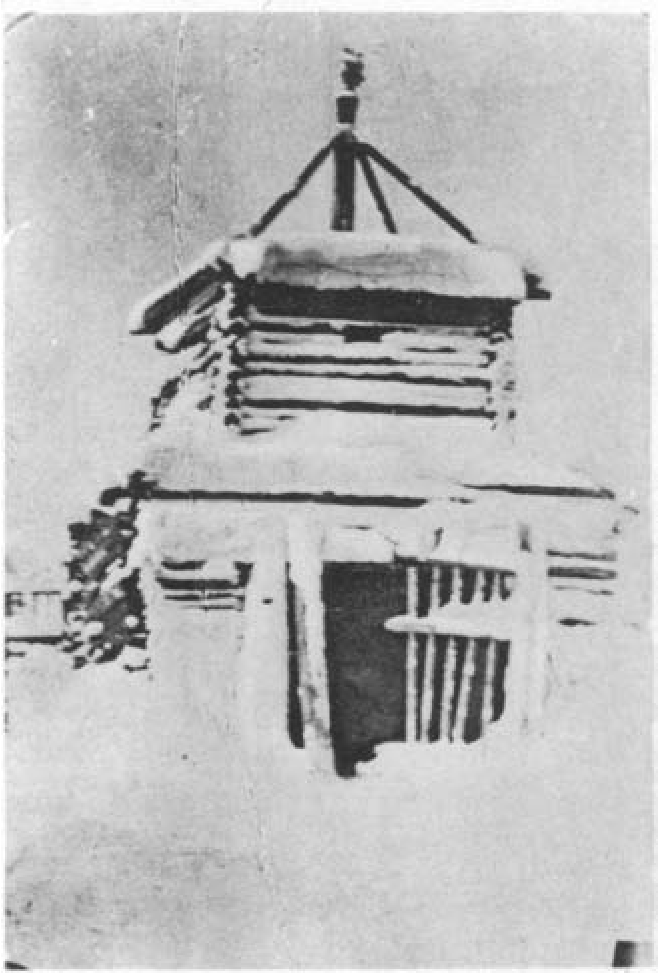
It may not be out of place to mention here several expeditions of Demetrius Laptev, the marine lieutenant who in 1739-42 surveyed the Arctic coast from the Lena River to the Large Baranov Cape, though his expeditions were purely scientific, and had no reference to Chukchee wars. Laptev, with his assistants, had to pass a winter in the desert, on the eastern branch of[697]🗗uncollated the Kolyma River, near the ocean. They built there, on Thick Cape, large wooden barracks and a high tower, standing apart, on the cape. Both are still standing at the present time. The tower is called by the people “Laptev’s Beacon).” They say that a fire was burning on the top of this tower as a beacon for Laptev’s people straggling in the desert, though the top of Thick Cape is much higher than the top of the tower, and more open to view, so that there was no need of a special wooden tower.
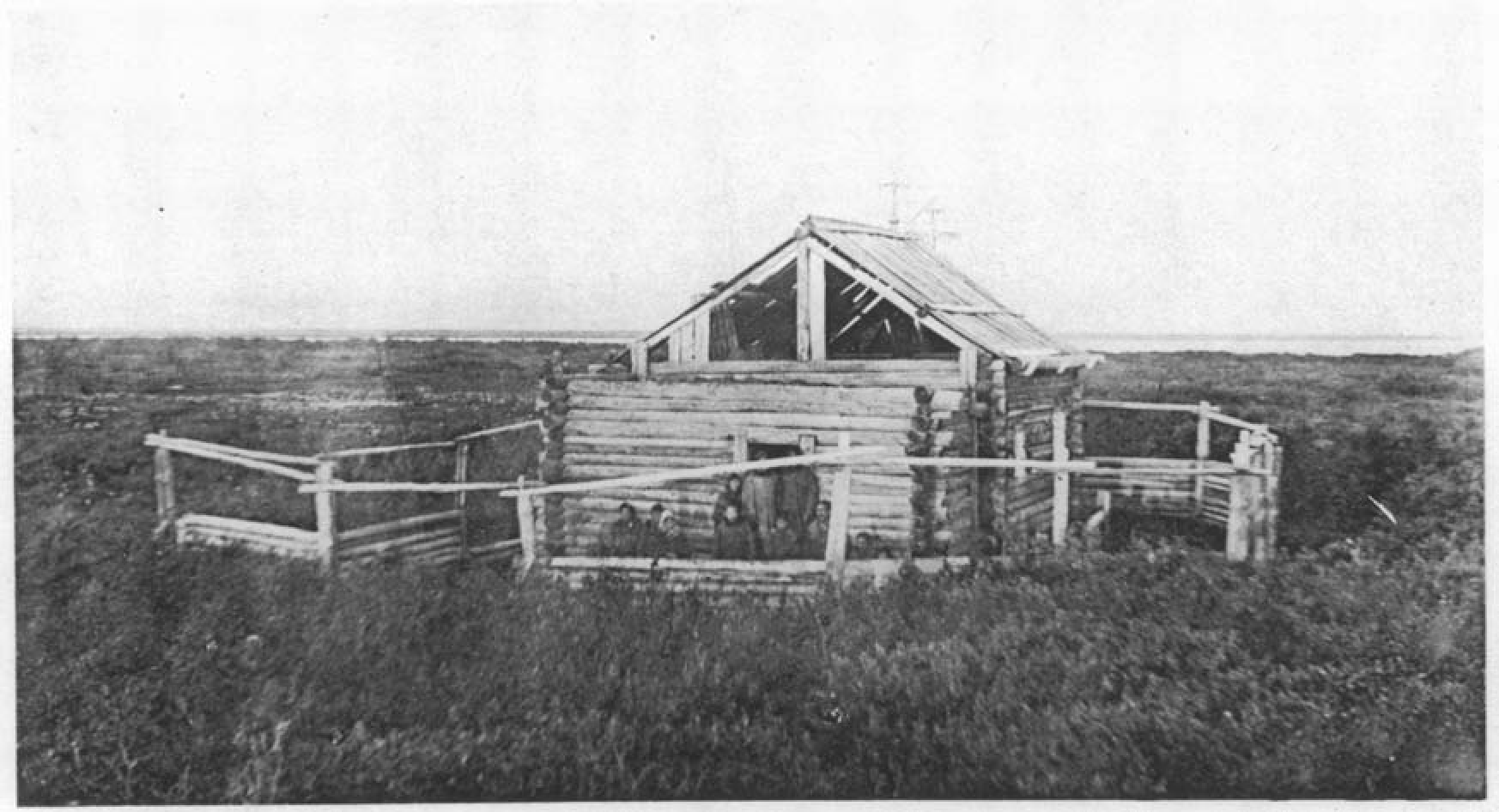
I will also mention two merchants of Yakutsk, Shalaurov and Bakhov, who in 1755-64 went on several expeditions from the mouth of the Lena River eastwards. They went for trading-purposes, and got as far as Cape Erri. There they perished, with all their companions. The so-called Shalaurov barracks, which they built for use during one of those winters, are also still standing on the Lower Kolyma shore, near the ocean.
Cessation of War. — The expedition of Pavlutsky was the last military enterprise of the Russians against the Chukchee. Shortly after that the Government decided to abandon a plan which turned out to be so difficult and expensive, and which did not promise any valuable results.
Mr. Jochelson’s surmise that the cessation of Russian expeditions to the country of the Chukchee was due to the fact that the latter were poor in objects of tribute,¹ may be corroborated by evidence.
Thus numerous reports of the Cossacks and public-service men, some of which I have already quoted, repeat always, “There [in the country of the Chukchee] is no game except wolves and red foxes, and even these are scarce because of the lack of wood.” In answer to these reports, the Government issued orders as follows: “You are to go there to the unpeaceful Chukchee, and request them to bow down under the Czar’s high hand, to the eternal payment of tribute, and to take from them an oath of allegiance to arrange register-books and to have them taxed with tribute according to those books; and if in that country sables and foxes are really scarce, take for tribute walrus-ivory.”²
Seventeen years after the death of Pavlutsky began the breaking-up of the Russian military reign in the extreme northeast of Siberia. The fortress of Anadyrsk was given up in the year 1764. The Governor-General of East Siberia says in his report of Nov. 24, 1792, “The fortress of Anadyrsk, which existed during the years 1710-64, cost the Treasury 539,246 rubles, and it also caused a loss of 841,760 rubles to various peoples who had to carry Government freight, the total expenses being 1,381,607 rubles; revenue for the whole time, 29,152 rubles. For this reason it was abandoned in 1764.”³[698]🗗uncollated The total expense for one small arctic fort is almost incredibly large, especially when account is taken of the utter destitution of the inhabitants of Eastern Siberia; and when we consider the value of money in the eighteenth century, this total should really be trebled. As to the exact year of the abandonment of Anadyrsk, some historians give it as 1771. I found in the Archives of Nishne-Kolymsk, however, quite certain indications that this happened in 1764. The church of Anadyrsk was dismantled, and its, bells and utensils taken to Gishiginsk and Sredne-Kolymsk, in 1766. In 1774 the Anadyr bells were transferred from Sredne-Kolymsk to Gishiginsk.
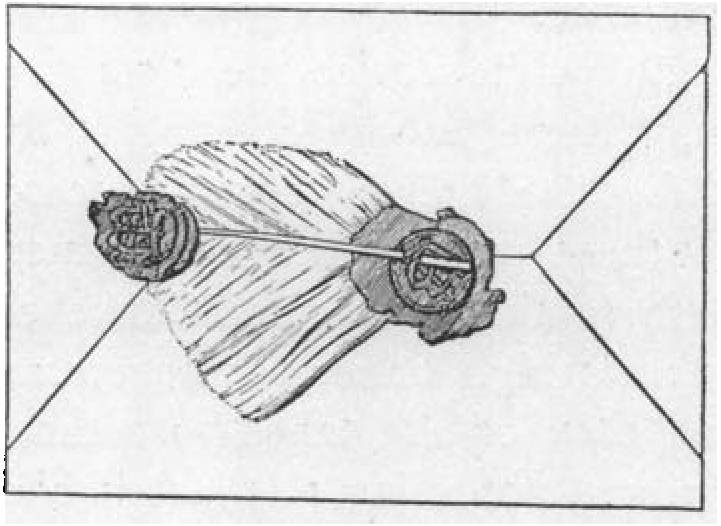
In 1769 the greater part of the military garrison of Nishne-Kolymsk was also recalled.¹ According to the Register of 1762, the entire population of the fortress was, full-grown men, 585; children, 53; women, 236. Most of the people were soldiers, Cossacks, and “public-service men.” Only a part of these Cossacks were left in the country. A century later the whole number of Russian full-grown men in the whole country of the Lower Kolyma was 128 (data taken from my census in 1895). The remaining Cossacks were used for various local needs, chiefly for guarding the Government store-houses and for carrying mail, also as orderlies, servants, and guides assigned to all officials of somewhat higher rank. Fig. 302 represents the envelope in which a package was sent by an extra messenger with the utmost speed. A swan-feather fastened to the paper with sealing-wax indicated to every one that the messenger had to fly onward like a bird, and no delay was to be suffered. A package of this kind is called “flying post.”
Perhaps it would be interesting to mention that some of these Cossacks were armed with bows as late as the thirties ot the nineteenth century. Thus I have the list of Cossacks who were sent to the Anui fair in the year 1837. It runs as follows: “S. Kotelnikov, bow; Miron Popov, flintlock; Ivan Kyprianov, bow;” etc.
These remaining Cossacks were divided into two parts. 1. Settled Cossacks (станичные казаки) lived in the village Pokhotsk, at the western mouth of the Kolyma and its dependencies. They had to perform only local service. In 1876 the settled Cossacks were partly dismissed, and partly transferred to the position of common citizens of the burghess class (мѣщане). 2. The serving Cossacks proper were scattered all over the country, chiefly in the towns of Sredne-Kolymsk and Nishne-Kolymsk. They formed two companies or “commandoes.” Together with other Cossack companies scattered in various[699]🗗uncollated towns and districts of the Province of Yakutsk, they formed the Cossack regiment of Yakutsk, the single Cossack regiment belonging to the infantry, and governed, as an exception to the military rule, by the Minister of the Interior.
Settlement on the Anadyr began again in the year 1784, but the new settlers were not so much Russians as Russianized natives. The village was moved to Markova, seven miles distant from the former site.
The settlement of Nishne-Kolymsk was moved in 1773 to its present site. Before that it was situated fifteen miles away, on the so-called Stadukhin Channel. This channel was formerly a large branch of the river, but gradually it became shallow. The new settlement was founded on the main river, opposite the mouths of both Anui Rivers, which enter the Kolyma River almost at the same place. The new place had some houses before this transfer. It had no strategic advantages, but was excellently chosen for purposes of traffic. The old fort was surrounded by palisades. The new one had no palisades, though, according to a former tradition, it was also called a “fortress.” Sredne-Kolymsk, on the Middle Kolyma, was also fortified in olden times. One small wooden tower still stands on the corner of the church courtyard on the hill in the middle of the town (see Plate XXXV, Fig. 1).
Even these facts show that the Chukchee war ceased altogether. The Chukchee, when let alone, changed with surprising rapidity from an “unpeaceful” to a “peaceful” people.
TRADE. — One might suppose that some relation still existed between the Chukchee and the Russians. Thus, in the year 1779, the Cossack lieutenant, Ivan Kobelev, was sent from Gishiginsk to Chukchee Cape.¹ This Kobelev afterwards accompanied Billings in his journeys through the country of the Chukchee. In the succeeding half-century he served as the first official interpreter of the Chukchee language. He lived to a very old age, more than. a hundred years, and his name is mentioned as late as 1849.
Some trade was carried on by barter on the Middle Anadyr, near the mouth of the Red River, one of its affluents. There the summer hunting of wild reindeer was participated in by all the tribes of the vicinity: and along with the Yukaghir and the Chuvantzy, the Reindeer Chukchee also came there, and even the Maritime Chukchee in their skin boats. We have information of such a visit of the Chukchee on Aug. 5, 1763.²
Opening of Trade on the Kolyma. — Intercourse with the Chukchee was renewed on a large scale in 1788 by Banner, the chief officer of Zashiversk. Zashiversk was a town on the Indighirka River. After the recall of the garrisons, the Kolyma officer was made subordinate to the Indighirka officer, the one nearest to the west. At the present time, Zashiversk has ceased to exist, the Kolyma is again a separate district, and the Indighirka is subordinate to[700]🗗uncollated the town of Verkhoyansk. The Chukchee were quite eager to trade with the Russians. They wanted Russian wares; above all, iron and tobacco: so the Russians and the Chukchee agreed to meet every year in the spring-time for trading-purposes, in some place to the east of the Kolyma. At first a place on the Large Anui, at the mouth of its affluent the Angarka River, was selected for this purpose. In the year 1805 Zashiversk was deprived of its governing position, and the official centre of the Kolyma country removed to Sredne-Kolymsk. A few years after that the Chukchee spring fair was also removed to the Dry Anui.
Anui Fair. — A wooden fort was built and surrounded by palisades, as was usual with the forts of former times. The Russians were still afraid of the Chukchee, and wanted to be protected against sudden attacks; but the attacks never occurred, and other fairs were arranged in the country of the Gishiga, without any palisades, in a cluster of block-houses built for the purpose, or even in the open tundra on the snow.
I obtained from the Chukchee a curious story about the beginning of the Anui fair. According to that story, the Chukchee wanted trade so badly, that they were ready to force the Russians to open it, even by personal constraint. “Many years after the murder of Yäkuˊnnin [Pavlutsky¹] the spring fair on the Anui Fiver was opened for the first time. Numerous people gathered, — Chukchee, Russians, Chuvantzy, — and wanted to begin bartering at once. An officer from the Czarina (Katherine the Second) also came and declared, ‘My heart is full of anger. You have killed so many men of the Czarina, I will not permit this traffic.’ The Chukchee people began to deny the accusation. ‘We did not do it. The people of Anadyr did it.’ Four strong men walked around in the Russian fortress. There is nothing to do. They peep into the house of the officer through a chink in the door quite attentively. There he sits, clad in red, — red cap, red coat, red boots. One says, ‘Let us break down this door and seize him!’ They broke the door, caught the red man, and carried him to one of the camps. He cried out, calling for rescue, but nobody heard his voice. The next morning the Russian people made an outcry. The local officer requested that they give back the officer of the Czarina. ‘No,’ said the Chukchee, ‘we must first open up trade.’ The four strong men released the captive, and, to appease his anger, they gave him two black foxes. Then the people said, ‘We cannot trade without an interpreter.’ So they found Keˊka, a man of Chuvantzy stock, who lived on the Big River, and made him their interpreter.”²
Another tale referring to the same time states, “After a while they ceased fighting. The people of Eˊtel (Chuvantzy) who used to be killed by both parties became their interpreters. They all became friendly, and the war ceased. Then Nuteˊwg̣i, a man of Chuvantzy stock, went to a Chukchee strong man,[701]🗗uncollated Eeñeiˊvu, and carried a paper relating to the stopping of the war. Along with that paper he took a large medal of silver.”
The paper in question, together with the medal, were actually preserved in a Chukchee family on the Large Anui River. The owners put them in a flat wooden box, and used this box in the ceremonial as one of the family charms. I bought it from them. The paper proved to be a document dated Feb. 8, 1789. It was directed to a “Chukchee Chaun Chief, Khamakhei, who in the year 1788 expressed his desire to become a subject of her Majesty, and to pay tribute, together with his kinsmen. For that promise he was presented with a crimson coat, and with a parade dagger bearing the inscription ‘Russian true subject.’ Thus all authorities would thereafter have to meet him as a true subject and a slave of her Majesty.”
Khamakhei is the Chukchee name Qɪˊmɪqäi (“Little Worm”). Another man of this name, whom Wrangel met on Cape Erri, may have been the descendant of this first “true subject.” It may be seen from this document that the Russian officials sought again to induce the Chukchee to become subjects, and to pay tribute; but from this time on, it was done with great caution, by means of persuasion and without any constraint. This policy has not changed up to recent times, notwithstanding the fact that efforts were made by a few officers to force the Chukchee into more real subjection. The most active of all in this respect was Maydell.
Even the Russian Code contains special articles referring to “natives not wholly subjugated.”¹ Of these articles, the 1254th says. “They are governed and judged according to their own customs and usages, and are subject to Russian law only in case of murder or pillage committed on Russian territory.” I mentioned before that at the Anui fair only the inner space of the fort is considered to be Russian territory. Outside the gate begins the free territory of the Chukchee.
Article 1256 says, “The Chukchee pay tribute in quantity and quality according to their own free will.” This article, however, was excluded in the next edition of the Code, in 1876.
Chukchee Tribute and “Chukchee Presents.” — In order to induce the Chukchee to consent more readily to the payment of tribute, Banner obtained from the Government a yearly assignment for the so-called “Chukchee presents.” The sum was assigned from funds of his Imperial Majesty’s own Cabinet, in accordance with the fact that tribute from the natives was turned likewise into the same Cabinet. The sum varied greatly from year to year. Thus, in the year 1791 it was 500 rubles; in the next year, only 85 rubles; a century later, in 1861, and after that, it was 150 rubles. Maydell mentions 143 rubles as the probable sum for the year 1869. With this money were bought tobacco, kettles, and knives, which were then taken to the fair and[702]🗗uncollated given to the Chukchee as if in payment for their tribute. The tribute was, as in earlier times, from each man one fox, mostly red, but sometimes also white, though the white fox is considerably cheaper than the red one. It seems that in the beginning the Chukchee, in their eagerness for trade, were even ready to pay some real tribute.
Thus, the tale about the opening of the Anui fair, cited before, continues as follows: “The officer from the Czarina said again, ‘My heart is angry. Why have you killed so many of the Czar’s people?’ — ‘Control your anger,’ said the Chukchee. ‘Stop asking about the murdered men. Better assign a chief to count all the people. Let the chief, with the people, pay to the Czarina tribute in restitution for the murdered men.’”
I have this tale from a member of the family of Eiˊheli, whose name has been mentioned several times; and probably it reflects knowledge of the more recent measures carried out by Maydell. Still most of it refers to an earlier time. The Russians certainly could have succeeded in exacting some kind of trade-tax, to be collected at the fair. Instead of that, they tried to introduce again tribute by subjection, the same as that which led to all the earlier wars. This tribute was paid very irregularly, — one year (1835) by twenty-seven men, another year (1837) by twenty men, and still another year (1838) by only eight. And with the presents of the Government the paying of tribute soon became quite similar to traffic. The Chukchee wanted to get the most possible, the Russian officer wanted to give less, and thus haggling over the tribute ensued. Still, in most cases the present given represented the current price of the furs brought for tribute. Thus in 1806 the Chukchee tribute was ten red foxes; as an equivalent in presents, 27 pounds of tobacco, valued at 40.5 rubles, were given. The Governor of the Yakutsk Province, however, was displeased with the transaction, because the value of the foxes was equal to the value of the tobacco, plus transportation. In 1832, for each red fox, three pounds of tobacco and an iron spear-head were given, which was still less favorable for the Russians. In 1837, for each red fox, two pounds and a half of tobacco, a large knife, some beads, needles, also candy, hard tack, etc., were given.
The so-called “complimentary tribute” (поклонный ясакъ)¹ also appeared from time to time. Thus in 1812 there were presented to the Czar seven black foxes on the part of seven different men. In 1814 there were presented to the Czar by the Chukchee seventy puds of walrus-ivory and seventeen puds of peltries. This last present is uncommonly large. I presume that it was simply the result of traffic carried on by officials with Government property for the benefit of the Treasury.
Some of the Chukchee tribute was paid by the Reindeer Chukchee, another portion by the Maritime Chukchee traders (kavraˊlɪt), who played such[703]🗗uncollated an important rôle in the Russo-Chukchee trade. The presents, consequently, were distributed between these two groups of tributaries. The Maritime group was much more important, because all the best peltries of American provenience were brought by the traders of this group.
Regulations of Treskin. — Trade at the Anui fair was carried on more or less uninterruptedly until 1811. In that year General Treskin, Governor of Irkutsk, introduced a set of rules which were to regulate with the utmost strictness trade with the Chukchee. These rules were put into force in 1812, and observed, until 1869, when they were repealed by Maydell. Treskin, even for his time, was famous for his cruelty and corruptness, and his career terminated by his being officially prosecuted in court. Among his other qualities was his constant desire to regulate strictly the whole course of life, which is so characteristic of all the bureaucracy of the St. Petersburg period of Russian history. The most essential feature of his rules and regulations was the fixed table of prices for all the more expensive objects of sale brought to the fair; such as beavers, all kinds of foxes, martens, and walrus-ivory, and, as the Russian equivalent, tobacco, and often also kettles, iron, and copper. The staple article of value offered for sale by the Chukchee was the red fox; and that offered by the Russians, tobacco. Objects of minor value, such as reindeer-meat and seal-thong, were sold at free prices in exchange for iron-work, sugar, etc. In some years fawn-skins were included in the table, but for the most part these were sold free. In some years Cossacks and the common citizens were given the right to carry on some small traffic with the Chukchee to the amount of one pud of tobacco, but only for the necessaries of life, such as meat and clothing. In other years even that right was taken away.
The table of prices had to be established every year by deputies of traders, in accord with the chief officer and the principal Chukchee traders; but usually it ran on from year to year without change, as follows: —
Chukchee Equivalent. 1 pud (36 lbs. Avoirdupois) tobacco, or 1 pud of iron kettles, or 10 red foxes. 1 pud of copper kettles 1 black fox 20 red foxes. 1 gray fox . . 2 red foxes. 1 beaver or otter . . . . 2 red foxes. 1 lynx . . . . . . . 3 red foxes. 1 overcoat of marten 5 red foxes. 1 bear-skin . . . 1 red fox. 3 martens 1 red fox. 4 white foxes 1 red fox. 4 average walrus-tusks 1 red fox. 4 fawn-skins 1 red fox. 1 parkee 1 red fox.
The foxes and all other peltries had to be full-haired and whole, with a tail[704]🗗uncollated and all four paws. Before the opening of the fair, all the tobacco was divided, under the inspection of deputies, into piles of one or two puds, put into leather bags, and then sealed. It had to be quite dry and of good quality. Sprinkling with water, which adds to the weight, was forbidden. Trade with objects of fixed value was permitted but one day. After that the less important trade began, which was free. Thus the chief object of value offered in trade by the Russians was made, like money, quite uniform among all the traders. The kettles, iron or copper, were also of about the same quality. The peltries of the Chukchee, on the contrary, varied considerably in quality and value. This unequal position of the two trading-parties led to the strange scenes described by Wrangell.¹ For instance, trade was opened on the ice of the river near the fortress. When the signal was given, the Chukchee quietly remained by their sledges; while the Russians would rush ahead, dragging their tobacco and doing their utmost to outrun each other and to secure the best peltries.
The merchants as a body were inclined to support these regulations, because they hoped by their means to keep the price of Russians articles of value on a certain level, sufficiently high, and purposely so fixed; or, as it is stated in the first draught of the regulations drawn up in the year 1811, “Nobody has a right to make exchanges under value. On the contrary, every one must take care to raise the price as high as possible, so that the traffic shall be more profitable for our side.”
This is plain enough. Still in the course of time some changes in the table became necessary. They appeared in the shape of so-called “supplements,” added to the fixed prices. Thus in the forties of the nineteenth century 10 red foxes were worth 1 pud of tobacco, and a kettle as supplement; 20 foxes brought 2 puds of tobacco, a kettle, and a wolverene-skin. Individual traders, on the contrary, were all the time trying to elude the regulations, underselling the others, buying articles of lesser value with tobacco, selling to the Chukchee traders on credit, which was also forbidden. Some merchants had a secret agreement with their Chukchee friends, and put into their sealed tobacco-bags some special “supplement.” One merchant, for instance, found a way for many years of putting into each large bag of tobacco a small flask of alcohol. His trade was quite prosperous. All this brought on continuous trouble, mutual complaints, denunciation, and endless chicanery. The trespassers were punished with the utmost severity, especially those of the poorer class. Thus in the year 1838 a trader named Bereshnov was deprived of the right of trading for ten years because he exchanged with one Chukchee ten pounds of tobacco for such reindeer-skins as were not included in the table. He wanted those skins for his sister’s clothing. In bartering for foxes, he was short by three-fourths of a fox-skin. In the year 1842 Miastukov, a poor man, underwent the same penance for thirteen years, because in bartering for foxes he was[705]🗗uncollated short one paw. On the other hand, the merchants, acting as a body, were bent on monopolizing the whole trade with the Chukchee at the yearly Anui fair, to the exclusion of every other way and place. Thus in the year 1849 the merchants of Kolymsk entered a complaint against the Yakutsk merchant Basile Trifonov because he wanted to re-open the disused trail to Anadyr and Gishiga. This Trifonov was very active. He made several attempts to find the trail. One time, guided by the official chart, he lost his way, and returned to Omolon. On the way he visited the camps of the Chukchee and the Lamut, and the merchants complained to the authorities that this was an infringement of the regulations of the Anui fair.
In the year 1859 a similar complaint was entered against another merchant, Nicholas Bereshnov, by his three cousins, Paul, Lucas, and Gabriel Bereshnov, and it had immediate effect. I could give a long series of such examples from the Archives of the Kolyma. Earlier than that, in the year 1834, the Cossacks of Nishne-Kolymsk made a complaint even against the Yukaghir of Yelombal, on the Large Anui River, because, in order to get food for themselves, they worked on iron and traded off the products of their work to the Chukchee; and this was immediately forbidden.
Nevertheless, in the year 1826, the whole body of merchants complained of the restrictions on trade. They accused the officials of having put a restraint on trade for their own private interests, since they themselves carried on considerable trade. In accordance with these complaints, the Siberian Committee, in 1831, tried to establish free trade. The Report of the Committee points out that because of these restrictions, the prices of imported wares are exeedingly high. Thus tobacco, which is valued in Yakutsk at eighteen rubles per pud, is valued in Verkhoyansk at five rubles per pound; i. e., at more than ten times the original price. An axe is valued at ten rubles. It is remarkable that the permission given by the Siberian Committee for free trade had no effect at all. On the contrary, in 1837 the order forbidding merchants to go to the camps and settlements of the natives was reiterated. The same was repeated several times, in 1839, 1840, 1847. The restraint was evidently stronger than the permission to exercise freedom in trading.
Maydell’s Reform. — This condition of affairs lasted until 1859, when Maydell repealed the regulations, and established free trade. At the same time he tried to abolish the custom of giving to the Chukchee presents in exchange for tribute, and to introduce a real tribute. He accomplished this, together with a curious administrative reform in regard to the nearest groups of the Reindeer Chukchee, while the Maritime Chukchee remained outside of his sphere of influence. Still, in 1869 he gave no presents at the Anui fair, not even to the Maritime traders, for their tribute. I have already spoken of Maydell’s reform, which was based on the attempt to create official clans for the purpose of exacting tribute; these clans were to have chiefs at the head,[706]🗗uncollated with a “Highest Chief of all the Chukchee,” as a kind of hereditary prince, ruling the whole tribe. The family to whose lot this dignity fell was in reality one of the richest reindeer-breeding families in the whole country. The head of this family, in Maydell’s time, was Amraˊwkurg̣ɪn, a man of great personal ability, both physical and moral. His father’s name was Yaˊtirg̣ɪn; and Yaˊtirg̣ɪn’s father was Gêlaˊɪrg̣ɪn (“Marmot”). In a document of 1812 this “Marmot” is called the “Chaun Chukchee Chief.” Khamakhei, in the document of 1789 cited above, was also called “Chaun Chukchee Chief.” The western limit of the Chukchee in that time lay near the Chaun River.
I mentioned before that the Russian authorities, from the very first years, tried to find chiefs among the Chukchee, in order, through their mediation, to exert an influence over the whole tribe. Since the Chukchee had no chiefs, the Russian officials addressed their attentions simply to the more wealthy and influential persons, and bribed them with presents, — gave them gaudy coats, bright medals, and daggers inlaid with silver, — although usually without practical result. Amraˊwkurg̣ɪn inherited from his father two such medals and one coat. He was given several others besides; so that his son Eiˊheli was able to hang form his neck, when in full parade dress, five ponderous disks in yellow and white. Amraˊwkurg̣ɪn was very modest about displaying his strange rank; but Eiˊheli, who had far less good sense than his father, often presented quite a foolish appearance. I will quote the official report of the chief official of the Kolyma for 1884: “This funny man came to me in full parade, saying, ‘I am the Chukchee chief. I am the Czar.’”
I witnessed a meeting of Eiˊheli with another official newly come from Yakutsk, and inexperienced in local affairs. Eiˊheli was quite drunk, and his crimson coat was all besmeared with filth. Still, when he hiccoughed out his usual “I am the Chukchee Czar,” the haughty official hastily stood up and did obeisanse. After that, when Eiˊheli was going, he sped forwards and opened the door with his own hand for the Chukchee majesty. Following this example, the other Russians often called Eiˊheli “the black Chukchee czar” or “the tundra czar.” I was witness to another occurrence, when a well-to-do trader fell upon his knees before this dignitary with a complaint against some Anui Chukchee who had charged too high a price for their slaughtered reindeer. Eiˊheli said nothing: he had no influence with the people in question. Other chiefs, supposed to rule their clans, have just as little influence as the first dignitary. After a while, all the “clans” became mingled. The supposed clansmen changed their abode, and quite forgot their former relations. I remember that in the year 1895 one Toˊlɪño, an acquaintance of mine, was made an assistant to the chief of the Anui clan. He told me very judiciously, “Now I am a chief, and I have this dagger and a package of papers as signs of my dignity. Still where in the world are my people? I am unable to find any.”
[707]🗗uncollatedExpansion of the Reindeer Chukchee and New Tribute. — As one reason for the introduction of the new tribute among the Reindeer Chukchee, Maydell cited the circumstance that from the time of the cessation of hostilities they were slowly but incessantly moving westward and southward. In the time of the Russian war their western frontier was somewhere west of the Chaun River and on the upper courses of both Anui Rivers. In the thirties of the nineteenth century their camps extended to the Large Baranikha River, although this country was considered as having belonged, from times of old, to the Yukaghir of the Anui. In the fifties of the nineteenth century the Chukchee proceeded first to the Labugen, then to the Pohinden, both affluents of the Dry Anui River. Their onward movement was connected with the vanishing of the Yukaghir. These last died out, or receded to the Kolyma, because the wild-reindeer herds were turned away from their yearly migratory route across the Anui and Kolyma Rivers. This last circumstance was probably due to the increase of the Chukchee herds. Thus the pacification of the country proved unfavorable to the lower material culture of the Yukaghir hunters, and quite favorable to the nomad culture of the Chukchee, which was higher than that of the Yukaghir, though in other respects the Chukchee were more primitive.
In the end of the fifties of the nineteenth century the foremost Chukchee camps crossed the Kolyma River to the west, and were approaching the Omolon River on the south. All this territory was formerly occupied by the Yukaghir, who were already half extinct; but the Chukchee were conscious that the land was not theirs, and considered themselves under obligation to pay at least something for those new pastures. Maydell asserts that he was the first to give permission to the Chukchee to cross the Kolyma River, but this is not the case. Some Chukchee crossed the Kolyma as early as 1859 with the permission of one of the predecessors of Maydell. Another party crossed the Kolyma River in 1866. As to the tribute, Maydell had good sense enough to abolish the former standard of one red fox per head as too high, and not easily obtained by the reindeer-breeding Chukchee on their treeless tundras. He established a new standard, low in price and easily procured, — one reindeer-skin scraped and worked into soft leather. A considerable number of such skins are prepared by all the tribes of the country. Some of them are used for clothing; others are exported to Yakutsk, there to be used by the Yakut also for clothing. Each Chukchee family has, besides, a number of spare reindeer-skins. Thus the women are able at all times to prepare soft curried leather. Still the collecting of soft skins as tribute proved a failure. Many of the Chukchee brought skins of bad quality or none at all; and the deficiency was paid by Amraˊwkurg̣ɪn and the other chiefs. Here Maydell again showed his good sense by substituting a money equivalent for the tribute of skins, one ruble for every single skin. This standard is[708]🗗uncollated the lowest, in comparison with that of all other native tribes of East Siberia; and the whole amount of tribute was put at 247 rubles. From that time on, this tribute was paid every year by the Reindeer Chukchee, although a goodly portion of it was not paid by the tributaries, but was furnished instead by the rich chiefs of the clans. From that time, the Reindeer Chukchee also ceased to receive presents for their tribute.
Maydell forbade the giving of tribute-presents to the Maritime traders also. This might have been the last of the Chukchee presents had not a new factor come into play, — the loss of importance of the Anui fair, and the desire of the authorities to give it some support. The chief reason of this decrease in importance was the diminution in the number of American peltries brought to the Kolyma market. Before this, all beavers and martens and fully half of the foxes, sold on the Kolyma, were of American provenience. A large portion of the iron and tobacco also went to the American shore, even far inland, through the mediation of the Chukchee. In more recent times these peltries have found their way from Alaska to the United States. Some of the beavers and martens, which bring quite a good price in Asia, were still going the former way, but chiefly those of inferior quality. Even a large part of the peltries from the Maritime Chukchee and the Asiatic Eskimo went to America through the medium of whalers. The Maritime traders (kavraˊlɪt) would take American wares and carry them inland to the Reindeer camps to be exchanged for fawn-skins and ready-made garments. Thus this branch of the trade, also, did not reach the fairs of the Kolyma.¹
The number of Maritime Chukchee who attended the Anui fair, which in former times usually amounted to a couple of scores, fell to ten and even less. Then the authorities thought to attract them again by restoring the tribute-presents. This was done very soon after Maydell’s time. In the year 1889 the Governor of Yakutsk, Svetlitzky, ordered that these presents be increased as the only means of attracting the Maritime Chukchee. Every one who should bring a companion with him would be entitled to special recompense. According to this order, each individual share was more than doubled. In the year 1889 twelve Maritime Chukchee paid tribute at the fair, and received for one red fox, for instance, one large kettle, one knife, one spear-head, several pounds of tobacco, beads, candy, and hard-tack. The value of the presents was much higher than that of the tribute. In the official papers of that time these presents are called “return presents to the Chukchee, not subjected to Russia.” This state of things lasted up to very recent times. Four or five of the Maritime tributaries would come to the fair every year, bringing a dozen tribute-foxes, their own and those of their absent friends “entered in the register.” A few new-comers would also ask to be put on the tribute-list; but the chief official would usually refuse to do so, because[709]🗗uncollated new bargains of such a kind would be of little use. The tributaries would come to the Anui fair without a large amount of peltries for trade, only with their tribute and a few skins for buying liquor; and the whole transaction degenerated into a complete sham. I was informed that for the last two or three years the Chukchee presents have been withheld again, but I am not quite sure about this.
On account of hard times, when the fortress of Anadyrsk was abolished, the Russian authorities were under the impression that in dealing with the Chukchee the utmost caution and prudence are required. This idea has been retained up to quite recent times. I have spoken before of the Anui-fair riot of 1895, the details of which are so characteristic. Another interesting incident happened ten years before, in 1884. A Russian creole of Nishne-Kolymsk, Semen Drushinin, while on a trading-trip to Cape Erri, had some difficulties with the Maritime Chukchee of that place about a seal-carcass that was offered for sale. He paid a “false price” for it, and the seal was taken back from him against his will. Angered by this, Drushinin declared that the Governor of Yakutsk would come to the Kolyma in order to punish the Chukchee, for which purpose he would bring powder and ammunition to the amount of ten pack-horse loads. When the Chukchee made light of this threat, he added, pointing up to the sky, where the aurora borealis was shining with uncommon brightness, “See that flame! Have you seen the like before? God is warning you! That is your blood!”
The whole affair sprang from a denouncement by another creole, hostile to Drushinin, and seems to be grossly exaggerated. Nevertheless it caused great commotion among all the Russian authorities of the country. Drushinin was arrested and put into jail. An extra messenger was sent to the Governor of Yakutsk; another was sent to the Chukchee “chiefs” with the solemn declaration that the Russian Government had no part in the words of Drushinin. The chief official even proposed to the Chukchee, that, if required, he would come himself and assure them of the peaceful intentions of the Government. The Russian creoles were warned that they must take care not to give the Chukchee even the slightest reason for displeasure, under heavy penalty according to martial law, etc. I do not know the result of all this, nor whether Drushinin was really court-martialled.
CHIEF OFFICERS OF THE ANADYR. — The Anadyr country, after the abolishment of the fortress in 1764, had no officials, and was governed from Gishiginsk. The first official was appointed in 1889, at the time of the opening of the steamship-line from Vladivostok to Mariinsky Post once a year. This first official was Grinevitsky, a doctor of medicine, who died there a year afterward, having asked in vain for a furlough to more civilized countries. He also made a request in his official report for permission to be called, not the chief official, but only the doctor, because the Chukchee are a freedom-loving[710]🗗uncollated people, and must first become accustomed to the idea of authority. His request, however, was not granted. After that, for three years Anadyr again had no representative of the official authority. Only a few Cossacks, from Petropavlovsk in Kamchatka, were sent to stay at Mariinsky Post. Life there was quite wearisome. Thus one year no fuel was left for them by the state steamer, and they were obliged to gather driftwood throughout the winter from under the snow. They had no dogs, and had to drag their fuel themselves on a sledge. They would go for fuel, and lose their way in a snowstorm. Some of them told me, in speaking about this, “We knew nothing about the country, and were sent against our will. We left our families in Kamchatka. So, when we were in the greatest trouble, some one of us would fling himself on the ground, and wail aloud (in old Russian fashion), ‘Oh, my mother! why have you borne me for this trouble? O God! why have you brought me to this country? Oh, we are wretched!’ etc.”
Then, in 1894, N. Gondatti — at present Governor of the Tobolsk Province — was appointed chief officer of the Anadyr. He staid there three years. Mr. Gondatti, who, like Maydell, was partly moved by scientific interests, tried to imitate him also in his administrative activity. Thus he sent his assistant, Ankudinov, to the Keˊrek to induce them to pay tribute. The Keˊrek are the most wretched tribe of all northwestern Siberia, perhaps even more wretched than the Yukaghir; and they are rapidly vanishing, partly through starvation. It is only just to say that no violent means were used, and that the timid Keˊrek were rather coaxed into paying a few fox-skins into the Russian Treasury. In a report by Mr. Gondatti the exaction of this tribute is extolled as “the subjection of a tribe heretofore quite independent.” It should be added that the Keˊrek paid their tribute once or twice. Then they ceased to come to the Anadyr and also to pay tribute. When on a visit to Indian Point, Mr. Gondatti also displayed much official zeal, as he himself has described partly in his papers,¹ partly in conversation. Thus he sealed in the village of Uñiˊsak, with the sealing-wax of the Russian Crown, one of the native storehouses filled with strong liquors; and the seals were not broken until the time of his departure, which, however, happened shortly afterwards. He also tried to counteract the supposed influence of the “transformed shamans,” going so far as to employ chastisement personally inflicted ad hominem. He selected also three trustworthy men, and appointed all three elders or chiefs of the village Uñiˊsak. With each of these chiefs he left a duly written paper and a Russian flag, with instructions to hoist the latter as soon as a Russian ship should come into the harbor. This happened so rarely that the whole ceremony very soon fell into desuetude. In the same spirit Mr. Gondatti,[711]🗗uncollated during the three years of his stay at Anadyr, kept a detailed account of all sales and purchases, debits and credits, of the Russianized natives.¹
I know another official who at the very same time held sway on the Lower Kolyma, and who, in order to exterminate syphilis, kept another account, not less detailed, of all sexual intercourse between men and women, hoping in this way to find the bearers of the original disease. Both records were failures, but they are very characteristic for the whole system of the administration of the country.
TRADE IN ALCOHOL. — I made mention before of the brisk trade in strong liquor which is carried on in the Kolyma country between the Russians and the Chukchee.² A few more words regarding this matter may be interesting. In the thirties of the nineteenth century, liquor was still very scarce at the Anui fair. Only the aged interpreter Kobelev, whose name has already been mentioned, was able to sell some at retail. The price of the liquor was a marten-skin for a small glassful. One of the documents adds, that because of this traffic, he was greatly loved by all the people. At the same time, however (1827), Nishne-Kolymsk had a regular saloon, where even fruit-brandy (five barrels³) was sold. In 1842 there was a great famine on the Lower Kolyma, and some cases of death by starvation on both Anui Rivers. In the same year the saloon above mentioned sold thirty barrels of undiluted alcohol, and in 1847 even fifty barrels. In 1864 the price of alcohol at the Anui fair was two beaver-skins for one bottle.
From that time on, the imports of alcohol into the Kolyma country increased quite regularly until they reached three hundred barrels yearly. At the same time the price regularly decreased. During my stay on the Kolyma, the price of alcohol in the saloons of Sredne-Kolymsk was two or two and a half rubles per bottle. The saloon of Nishne-Kolymsk was abolished, but plenty of liquor was to be had on the Lower Kolyma. The price at the Anui fair was a red fox-skin per bottle, which is five times cheaper than the price in 1864. In 1895 the Cossack commander of Sredne-Kolymsk, by official order, sent a man to the Reindeer Chukchee of the western tundra to buy reindeer for alcohol, only in the order the alcohol was called simply “liquor.” The man brought with him one barrel of this liquor, and slaughtered twenty-two reindeer. I was a witness to the whole transaction. I was informed[712]🗗uncollated recently that the importation of alcohol into the Kolyma country has lately been forbidden. It remains to be seen how strictly this prohibition will be enforced; but of course some such law, however slack, is much better than to allow the importation to go on unhindered. If the trade in liquor could also have been stopped from the American side, the vanishing of native tribes of this country would probably proceed at least more slowly than at present.
GENERAL CHARACTER OF RUSSIAN ADMINISTRATION. — Such is the history of the official influence of the Russians upon their Chukchee neighbors. To understand it properly, one must bear in mind the general character of the Russian Administration in the far east of Siberia. The rule of the Moscow Government, which lasted in European Russia until the beginning of the eighteenth century, continued in Siberia half a century longer. Thus all the Chukchee wars, and those who took active part in them, the Cossacks and public-service men, the boyar-sons, their reports, and all the search for tribute, belong wholly to the old period of Russian history. The Government of this period was at least frank and plain in its dealings. The Cossacks and their chiefs wanted tribute and submission of the natives. Their principal means of enforcing their desires was by the use of fire-arms (огненный бой), by taking hostages, by torturing on the rack, and by executions.
In the latter part of the eighteenth century the St. Petersburg method of administration was extended also to Siberia. German terms took the place of Russian ones in all branches of the Administration, the ample coats of the old style were exchanged for foreign-looking uniforms, and the system of bureaucracy developed to its full vigor. For the next century and up to the present time it has remained in Siberia almost without change. Kolyma, Yana, and other remote districts of the arctic zone, are the worst governed of all.
Expenses. — As an example, the expenses of administration of the Kolyma district may be given. The personnel of the Administration consists of five people, who receive yearly, in round numbers, a total of ten thousand rubles salary and three hundred pud of flour. Each “serving” Cossack also has a right, from his seventh year of age up to his dismissal after twenty-five years of service, to a single “ration” (паекъ), which is equal to a hundred and fifty rubles and twelve pud of flour each year. The whole number of such rations is about one hundred: so that the total of merely the salaries of members of the Administration is about twenty-five thousand rubles and fifteen hundred pud of flour. If we count the flour at only eight rubles and a half per pud, as it was in the early nineties of the nineteenth century, the total for salary would be thirty-seven thousand five hundred rubles. Moreover, the priests, of whom there are seven, receive eight thousand rubles salary, and five hundred pud of flour. The total expenses of the State for administration thus reach[713]🗗uncollated probably about fifty thousand rubles.¹ All this is spent for a population of three thousand who are more or less sedentary, and of another three thousand wandering natives; i.e., more than eight rubles per man. The total revenue of the Government from the Kolyma country is less than ten thousand rubles per year.
As a rule, the officials are sent to remote districts such as the Kolyma either as punishment for some trespass, or they go tempted by the comparatively high salary and the short term of service (ten years) necessary for a full pension. They enjoy the full freedom of their administrative position, which leads them very soon to indulge in excesses. After two or three years a higher official is sent from Yakutsk to inspect and to verify the accounts. This often ends either in the district official heavily bribing the inspector, or in his being deprived of his position and impeached before the court. Fully one half of the chief officials of the Kolyma have ended their careers and even their lives while under impeachment. Some of them, too, have been adventurers from the very beginning. Even criminals sent from European Russia to Siberia have then been accepted again into service and sent as far as the Kolyma. I may mention here Vinogradov, who was in service in the thirties of the nineteenth century. In the year 1837 a member of the Provincial Council, Ring, was sent to inspect his office. Almost immediately the two got into a violent quarrel, which ended all of a sudden in the death of Ring. Local tradition says that Vinogradov caused Ring to be poisoned; and I have found in the Archives an order, directed by Vinogradov to the private commander of the Cossacks of Nishne-Kolymsk, referring to the death of Ring, and of rather doubtful significance. Another document referring to 1839, when Vinogradov was dismissed and impeached before a court, mentions his attempt to murder his wife, for which he was legally prosecuted. His wife was the daughter of a local priest. He accused her of improper conduct, “too improper even for the Kolyma,” as it is stated in the document. I might mention more episodes of a similar character and of more recent date.
It is no wonder that the doings of such an Administration present forms quite strange, to say the least. I will give a few instances. The inquiries for all persons wanted by the courts or police throughout the immense empire are sent, as a rule, to every district, however remote. Thus the mail, which up to very recent times came only three times a year, would bring piles of such orders, and all local archives are full of them: as, for example, the order of the chief secretary of military affairs inquiring for the dismissed Lieut-Col. von Stempel and his step-daughter Eugenie Krumones, in reference to their[714]🗗uncollated petition for the acceptance of the said Eugenie Krumones into the Institution for the Education of Gentle-born Girls; another order inquiring for a banker, Matthias Leibion, from The Hague in Holland; and many more; not to speak of the political refugees who fled abroad, and none of whom of course might wish to go to the Kolyma of their own free will. These orders are followed by circulars, not less numerous, concerning the collection of “free-will offerings” of official character, chiefly for building monuments, — for the monument to Count A. A. Bobrinsky, for which 3.35 rubles were collected; for the monument to the composer Glinka in Smolensk, for which 1.50 rubles were collected from the Yukaghir in 1822; for the House of Good Intention in Nishne-Kolymsk, for which 225 rubles were collected (this was to have been a kind of club-house; the plan probably originated with Wrangell, but the house was never built). There are also collections for the hospital in Constantinople, for the Voluntary Fleet, etc. After that follow long tables of local statistics, which year after year are compiled in the following manner: —
Asses and mules ooo Corn gathered ooo Camels and buffaloes ooo Tanneries ooo Catholics ooo Tallow-boileries ooo Protestants ooo Pay to a working-man per day ooo Corn sowed ooo Pay to a working-woman per day ooo
and so on for scores of pages. If any of these ooo are not sent in time to Yakutsk, there comes from there an angry reproval, with a threat of punishment by law. I have in my collection several samples of such official correspondence. I should mention also that, though not an official in the service of the Government, still even I have received an official circular from the Russian Society of Sericulture, with the offer to undertake the same in the Kolyma country. A promise of a moderate subsidy was added at the end. I must confess that I did not answer the circular. So in due time (after nine months) I received from the same society a letter the purport of which was politely put with much insistance to remind me of the former offer.
When the local official scientists want to produce some original statistics, they turn out to be original indeed. Thus, in the Archives of a settlement in Kamchatka I found a copy of a statistical report, which, among other items, included the following account: —
Peter Rybin 52 years old. Semen Bereskin 43 years old, etc. Total the whole village 2236 years old.
Extortion. — Under piles of such fantastic documents are concealed oppression and extortion of every kind, very real, and often not bereft of cunning. Thus salt is taken from Yakutsk to the Kolyma at the expense of the Government, to be sold there to all the inhabitants. The expense of transportation is 8.50 rubles per pud, and more. The price is established[715]🗗uncollated once for all, 1.20 rubles per pud. The difference is over 7 rubles. Thus the merchants who undertake every year to carry the salt allowance from Yakutsk to the Kolyma prefer to carry one tenth of the quantity agreed upon; for the other nine tenths they get the receipts from the chief officer at Sredne-Kolymsk. The salt of the previous years remains in the storehouse, and only a small quantity is sold to the people. The large profit is divided among the merchant contractors and the officials interested in the transaction. It is needless to mention that all the state provisions in the care of such keepers are subject to constant reduction and destruction by mice, wind, inundation, moisture, mildew, fire, partly real, partly fictitious, for the benefit of the supervisors. I found in official reports paragraphs in which even sheet-lead is mentioned as subject to desiccation.
I will give still another example. In all clans and communities of natives and creoles, besides the ordinary tribute and taxes, there is collected also the so-called “dark collection” (темный сборъ), which is spent without any account being kept of it. It goes to all the officials, from the lowest clerk up to the chief of the district. I know also of cases where the chief of the district would lose at card-playing the whole amount of the taxes of some community, and then would make the accounts so complicated that they had to pay it again the next year as arrears.
Strange Reforms. — When administrators of this kind undertake certain reforms, still worse things than extortion result. Thus the chief officer of the Kolyma, in the year 1888, suddenly conceived the idea that he would introduce into his district the smoking of herrings. It must be borne in mind, first of all, that there are no herring in the Kolyma River; but there is a small fish there, Coregonus albula, the meat of which is soft and very tender, which goes under the name of herring. The places for smoke-drying were selected, as if purposely, up the river, where even this species of Coregonus is quite scarce. The inhabitants built the sheds and undertook the smoke-drying. Of course they knew just as little about it as did the official instigator of the experiment. As may have been expected, the result was that some of the “herring” were charred to coals, others dropped off from the rods, and some of the remaining ones were quite bitter and unfit for eating. It should not be forgotten that the people on the Kolyma River live on fish as their staple food, without bread or vegetables. Only freshly caught or frozen fish is suitable for such a diet. Fish dried in the sun and slightly smoked afterwards, as is done by the inhabitants, and fish slightly salted (three pounds of salt to a hundred pounds of fish, the proportions used among the Russian creoles of the Kolyma in salting), are also eaten by them. Strongly salted fish, on the other hand, or fish smoked in the usual civilized way, is almost unfit for the local diet.
One year the catching of spawning fish was suddenly prohibited, though[716]🗗uncollated fish-roe forms one of the important items in the diet of the inhabitants, and is used, mixed with flour, for baking a special kind of cakes. Moreover, the fish come into the rivers full of roe for the purpose of spawning. To catch no spawning fish is to catch almost nothing. The next year the same official ordered the Russian creoles of the Lower Kolyma to undertake another experiment, that of making salt. A party was sent to the seashore. They took with them a large kettle, gathered some fuel, and tried to extract the salt from the water by boiling it. All these experiments, too, were undertaken in the summer-time, when every pair of working hands and every hour of time are of exceeding value to the population.
Two years before that the Governor of Yakutsk also was possessed by the idea of reforms. So he ordered the chief officer of Kolymsk to exterminate immediately all the team-dogs of the Kolyma country, and to replace them with driving-reindeer. Each house-master had to receive five reindeer. The order says, “The dogs consume the food of men. Therefore famine comes so often.” This order, however, was not put into execution. Otherwise the whole fishing population of the Kolyma River, Russian, Yakut, and Yukaghir, who know nothing about reindeer-breeding, would be left “walking,” as they say on the Kolyma. It is needless to add that this population literally could not exist without their dog-teams. Reforms of this kind have not ceased up to the present time. Thus I was informed that in the year 1906 a new one was undertaken. In this year, after the well-known revolutionary outbreaks, an order was issued in St. Petersburg for the confiscation of arms throughout the country. This order duly reached the Kolyma. Then the assessor of the district went up the river, taking the firelocks from the Tungus hunters, and even the belt-knives¹ from the whole sedentary population.
Relief of Famine. — It is at least the duty of an Administration that costs so much, both to the state and to the population, to assist the people in times of public calamities, which in these countries occur almost yearly as regularly as the seasons change. The Administration has to lend assistance in times of famine, and to afford medical succor in times of disease. Only those that pay tribute have a right to this official assistance. Famines occur on the Kolyma at least every other year. Their usual season is during the months of March and April, when all the stored provisions are exhausted, and fresh supplies have not yet come to hand. To relieve famine, the Administration has arranged for the collection of supplies of dried and frozen fish. Each community has its separate stores, and the members of some are obliged to turn over yearly one tenth, and even one seventh, of the whole product of their fisheries. Accordingly the stores must increase from year to year in[717]🗗uncollated a very large measure. The trouble is, however, that the fish cannot be preserved in good condition for too long a time. Therefore, when a famine comes, it happens too often that the fish-stores are either gone or quite putrid and not fit for use. In cases of great need, the Administration distributes among the starving population some of the rye-flour from the storehouses of the Crown. This is given as a loan, which is to be covered afterwards, and the heavy official price paid in full. In some years this is as high as fourteen rubles per pud (twenty cents in American money per pound Avoirdupois). All this (i.e., fish and flour), however, falls to the share only of the Russian creoles and the Russianized natives. The others, especially those that dwell too far from Russian towns, receive no succor, and are not rarely reduced to death by starvation and to cannibalism. I am informed that in the last few years, when fishing on the Kolyma has not been fairly successful, cases of starvation and cannibalism among the Tungus and Yukaghir have happened quite frequently. The latter tribe is dwindling away quite perceptibly.
The Chukchee, who for the most part pay no tribute, have no right to official assistance, but it seems they do not feel themselves much the worse for that. I mentioned before a Russian creole who grew up among the Chukchee and lived the same life as they do in a nomadic camp, and with a herd of reindeer. His name was Alexis Kasanov. Still, being a Russian creole, and moreover a member of the Russian community on the Lower Kolyma, which is burdened to the utmost with taxes, collections, and requisitions, he had to bear a goodly share of all these payments. When he was in arrears, his fellow-citizens contrived to seize him at the Anui fair or in Nishne-Kolymsk; and he was released only after full payment. His Chukchee neighbors paid nothing. Naturally he was not well contented with his Russian origin. One time in my presence he came to the chief official of the Kolyma and wanted to enter a petition to the Czar, asking to be released from the rank of a Russian creole, and to be lowered to the position of a tributary Chukchee. “They pay only one ruble per year,” said he. The chief official declared that this was impossible. “Then you would forfeit any right to the assistance of the Administration,” added he. “Do not bother me with your exactions,” said the poor Russian nomad, “and I will never ask for your assistance.” Kasanov married a Chukchee woman according to Chukchee rites. He refused to have the Christian rite performed. “Then my children would be entered as Russians,” he explained. “I prefer to have them illegal and Chukchee, as their mother is.” The whole mode of thought of this man is quite Chukchee. Thus he says that if the authorities will continue to be so severe on him in the payment of arrears, he will settle the question by destroying his own life. All this took place in the year 1895-96. I do not know whether Kasanov is still alive.
Medical Succor. — Medical succor is another branch of official assistance.[718]🗗uncollated The Kolyma country is ravaged by various diseases, among which syphilis and leprosy have attracted most of the attention of the authorities, perhaps for the reason that their external forms are so horrible and shocking. The town of Sredne-Kolymsk even had a hospital destined for the poorest people suffering from these two diseases. No words are adequate to represent fully the horrors of this hospital. It stood in the middle of the so-called “Hungry Ward” of the town, and was in the shape of a large hut of Yakut style. Not only its walls, but even the ground all around it, were soaked with filth. The patients were mostly Yakut, all suffering from the worst forms of the disease. Only such were brought to this hospital. All the others, if there was still a single ray of hope for them, were kept out. I witnessed a case where a man suffering from syphilis was brought in from the country. He had made a journey of a hundred miles crouched on a small Yakut sledge, which was drawn by a saddle-horse attached by means of long traces fastened to the saddle-bow, in Yakut fashion. When the assistant surgeon bade him strip, he tucked up his fur shirt and showed us a round birch-bark vessel tied up to his loins, and filled with completely destroyed tissues. When these were cut off, he did not even feel any pain.
I should add also that the better half of the food destined for the sustenance of the sufferers was appropriated by the warden; so that they had to apply for alms to private individuals. Sometimes, when their diet ran too short, they would send in a threat that they would leave the hospital in a body and crawl around from house to house (most of them were unable to walk). Then the citizens would pay a ransom to keep them quiet.¹
This is the sort of medical assistance that is given to the population in the Kolyma country. A surgeon is included on the official staff of the district, but his place almost always remains vacant. Those that are occasionally sent from Russia find employment much nearer than the Kolyma. Even the southern part of eastern Siberia has so little medical assistance, that a real graduated physician is not allowed to pass through into the arctic desert. Thus in the Kolyma district there are only non-graduated assistant surgeons without knowledge and experience, who go there either on account of the short time of service that entitles them to a pension, or half crazy from drinking and sent to the Kolyma as a punishment.
Vaccination has been practised in the Kolyma district for a full century, ever since 1806. Young men specially selected for the purpose, the so-called “vaccination-boys,” received brief instructions from the assistant surgeon, and travelled from village to village, vaccinating the young and the old. In 1884, as soon as the first news came of the small-pox epidemic having broken out in the neighboring districts, a small-pox committee was organized, and the[719]🗗uncollated vaccination-boys were sent to inspect the population. They found that nearly everybody had been vaccinated. Those that were not, were vaccinated this time. Immediately after that, the small-pox came, and destroyed about one third of the whole population. It proved afterwards that the vaccine sent from Irkutsk sealed in small tubes was worthless, and the vaccination-boys kept their lancets in such a state, that they were more suitable for inoculating syphilis than for simple vaccination. Exactly the same occurrences were repeated in 1889, at the second outbreak of the small-pox.
The first graduated physician visited the Kolyma in 1817. He was Dr. Reslein, chief physician of the province of Yakutsk. He was, according to Gedenstrom, one of the most charitable men of his time, but at the same time he was of a quite eccentric character. He would receive no payment or presents for his medical assistance. The greater part of his salary he left in the Treasury, and took only as much as he thought necessary for his scanty sustenance. Any cynic of modern times could hardly surpass him in his mode of life. In the winter-time, during the most severe cold, he used to wear summer clothes, a light uniform, a hat, rarely an overcoat of broadcloth. In the year 1817 he received an order from the Government to send some physician from Yakutsk to Zashiversk and Sredne-Kolymsk, on account of syphilis and leprosy, which were ravaging those countries. Reslein, who was about seventy years old, chose to go himself. He left Yakutsk in October, notwithstanding the cold, clad in broadcloth. On the way he used to alight from his horse, run about, or even turn somersaults, in order to keep himself warm. In this way he made fifteen hundred versts, and then his feet were frost-bitten. He was taken to Sredne-Kolymsk on a litter, wrapped in skins. There he amputated several of his toes himself, and after six months he died. He lies buried in Sredne-Kolymsk. He left a great number of manuscripts, which came into possession of his heirs.¹
The strange fate of Dr. Reslein has served as the basis of a tale, which I collected on the Lower Kolyma. The old doctor is described as a young courtier of very high blood, who was sent to the Kolyma for political reasons, and preferred to destroy his own life. “The Kolyma is not worthy of such a man,” he would say before his death. All this, of course, is pure fiction.
Since this first medical visit of Reslein, I am aware of but one other graduated surgeon, Dr. Nekrasov, who lived in the Kolyma district during the seventies of the nineteenth century, and died there. Another one came during our stay in the early nineties. He seemed not to be in his full mental health, and had to leave very soon. In the last years of the nineteenth century, Dr. Mitzkevich, a political exile to one of the southern districts of the Yakutsk Province, proposed to go to the Kolyma as a district surgeon, and was allowed to do so. When his term of exile expired, he was replaced[720]🗗uncollated by another exiled physician, Dr. Popov, who also went to the Kolyma of his own free will, and remained there more than two years.
Schools. — A few words will not be amiss regarding the Kolyma schools. There are schools in Sredne-Kolymsk and Nishne-Kolymsk, and even in Piatistennoye on the Large Anui River. All of them are parish schools. The teaching is of such a kind, that the children have to be brought there by requisition; although at the same time every private attempt at teaching (by political exiles) finds pupils enough, and even pays. Among others, the Yakut clans of Sredne-Kolymsk are obliged to send pupils to the school of the town. They send orphans and children of the poorest people. Some of these somehow learn to read and write without having learned the Russian language; so that on the Kolyma one may sometimes see the strange sight of a half savage man reading aloud a letter in a language almost wholly unknown to himself, for the benefit of a Russian creole who knows the language, but is illiterate.
Scientific Expeditions. — Even scientific expeditions arranged by the Government, when going to these remote countries, too often only served to increase the oppression of the inhabitants, Russians and natives. Slovtzov mentions one of the first instances of this. Gmelin and Müller, in 1735, when leaving Irkutsk for Lake Baikal with light baggage, were not contented with the thirty-seven horses assigned to them by the authorities, but sent their men to the market-place and ordered them to capture more horses. They started from the station Goloustnaia with a hundred and fifty horses. All these horses were not paid for. They were delivered on requisition. For the expedition of Bering, enormous quantities of provisions and ammunition were dragged by the Yakut through the whole Yakutsk Province to Okhotsk. Most of the horses perished on the way. To this Slovtzov adds, “No expedition of such greatness and fame had, up to that time, gone through all Siberia. God grant that, out of compassion for the poor country, future times may never know a fame so ruinous!”¹ Of all the expeditions of former times that visited the Kolyma country, that of Baron Wrangell (1820-24) seems to have been the most scrupulous and sober-minded. Still local tradition looks upon this expedition in a light very similar to that given in the opinion of Slovtzov, cited above. I collected this tradition on the Lower Kolyma, among the Russian creoles.
“In the olden times there came an expedition. Its chief was a baron; and another one was a steersman, Anjin (Anjou). They brought with them a large boat, and put it in the middle of the river; and neither wind nor tempest could do anything to it. It was only rocking slightly under it. The steersman ordered his bedding to be hung up like a baby’s cradle. In this cradle he slept usually, rocked by the wind. He would awaken only when the wind subsided and ceased rocking the cradle. “They visited all the villages, and in every village they would arrange a feast. To that feast[721]🗗uncollated they invited the people, — husbands with young wives, fathers with grown-up daughters. All night they sang and danced and played, till the time came to go home. Then they would choose such women or girls as suited their fancy, and would detain them, of their own free will or by force. A husband who came with a wife would return alone, or a father without his daughter, or a brother without his sister. The women and girls had to stay with them as long as they remained in the village. After a while they would leave the village, and everything in their houses would be left to the women. Some of the husbands would receive them back, and some would not. In the latter case the women had to live alone and be wretched. Oh, these husbands! How foolish they were! It was not their will nor the woman’s will. The superiors gave the order, and what could be done? Thus they lived in our country through the spring and the summer. When fall came, they went to the sea with their dogs. They took with them the best men of all the country, — those that knew the sea and were clever in travelling. When driving on the sea, they saw an island. There were churches with golden tops, houses and people all of purest gold. When they came nearer, an old woman came to meet them. The baron was a pipe-smoker, so she gave him a golden pipe. Anjou took snuff. She gave him a snuff-box. Then she said, ‘I know you are seeking the passage to America. Better go back. This is the limit of human travel. If you want to pass on, you shall never go back.’ They held a council, and then turned from the island and went across the sea. After a while they found open water. In the middle stood a tree, high up to the very sky. This tree would bend down and enter the water. After a while it would emerge from the water full of fish. And while it was swinging up high, all the fish were being consumed. They felt afraid of this tree, and turned off to the right, toward the land. After a while they found another island. It was quite deserted. Tobacco was growing there; and the leaves were so large, that each one would suffice to swaddle a man’s head in it. They took some and left the island, going to the land. At the place where they stopped the first night, a thundering noise came suddenly from the direction of the island. The drivers were frightened, and woke them up. They sat down upon the sledges, and the dogs ran away at a furious rate. Still the noise grew nearer and nearer. Finally the ice began to heave and roll like billows. They drove on without sleeping or eating, and at last reached the land. There they stopped to rest. When they awoke in the morning, they saw that all the ice was broken, and gathered into icebergs. They came to the fortress (of Nishne-Kolymsk), went to the church, and took a solemn oath to keep silence corcerning the things they had seen on the sea, because they knew that if they should disclose these secrets, all the people in the country must perish. So they kept their oath, and not until many years later did some old men relate a part of their adventures.”
GENERAL CHARACTER OF CREOLE POPULATION. — The manners and the ways of the Russian creole population, who represent on the Kolyma the race of the conquerors, fully correspond to the kind of government they have. I have mentioned before the extreme looseness as regards sexual life which reigns in all Russian settlements of the arctic part of eastern Siberia, from the mouth of the Yana to the southern part of Kamchatka. The people on the Kolyma say, “Our water is of such quality that we cannot do otherwise.” Perhaps in reality this easy excitability is influenced, not by the water, indeed, but by the diet of fat fish which prevails on the Kolyma. Mr. Jochelson believes that the sexual looseness of the Russians has arisen under Yukaghir influence, and even asserts that the Russian term “maiden-children” is a term adopted from the Yukaghir maˊrxid-uˊo (i.e., “child born by a maiden”).¹ It cannot be denied that the Yukaghir influence on the Russian population was quite considerable. Still for such things as illegal children, the Russians had[722]🗗uncollated their own terms, quite ancient, and brought over from across the Ural Montains. Thus, besides the “maiden-children,” the Russian creoles have also “widow-children,” and the joint number in both categories forms about thirty per cent of all the Russian infants. Exactly the same proportion exists among the Chukchee. Some Russian families, numerous and well-to-do, have at their head an old female who bore all her children in the maiden state. Even the family names are derived from a Christian name of such a maiden patriarch, or rather matriarch; for instance, Наташонки (“sons of Nathalie”), Катьконки (“sons of Kate”), etc. There are families in which aversion to marriage has even acquired a morbid character. The people say that in such families old mothers will take an oath from their sons that they will never marry. “You may live in fornication, if you desire it; but to your marriage I shall not give my blessing.” Their aim is to extinguish their name. The daughters are allowed to marry. The two rich families, Chertkov and Uvarovsky, are said to have stood under such an oath in the last generation. The first family has already vanished. The second one contains two brothers. Both have paramours and children; but, since they are not married, their children bear another name. All this is told on the Kolyma from mouth to mouth with many comments, though I cannot tell how far it is true. Still, I have noticed also among the Russianized Yukaghir of the Lower Kolyma, who are rapidly dying out, the same morbid aversion to marriage, though in connection with other facts. “Too much trouble,” say these wretched people in reference to marriage.¹ The Russian creoles are dying out only a little more slowly than the Yukaghir.
Syphilis has also taken quite deep root among the Russian creoles. The blood of new generations is tainted, and the remnant of their vigor is dying away. Card-playing in its worst forms is also widely spread among the Russian creoles. Games of hazard prevail; and regular cheating, even among the upper crust, is almost considered a lawful means of winning a fortune. Social relations are harsh and egotistic. All the people who are a little better off than others lend money or food in small quantities at fabulous rates; two hundred per cent yearly, and even more, being charged; and even the poorest people consider this as quite natural. “Why,” explained one of the poorest debtors to me, “since he had a chance, he pressed me dry. If I could, I should do the same to him.” On the Lower Kolyma such mutual relations assume an almost artless character. All are quite poor, all charge each other large percentages and demand heavy payments, and in the end nobody receives anything. The amounts are credited, and the credits balance very nearly. Even taxes and other exactions are hardly paid by the community.
The creoles are of one accord in the belief that the natives of all the various tribes may be oppressed and bled in every manner possible. In common[723]🗗uncollated parlance, they do not call them “men,” but “beasts,” “creatures.” Their tribal names are used in diminutive terms of derision, as is proper in the Russian language: чукчишки, “(those) small Chukchee;” якутишки, “(those) small Yakut.”
GREEK ORTHODOX MISSION. — The Russian Orthodox Church has always been merely a branch of the Russian Government. Its missionary work in Siberia was performed solely at the expense of the State and under the control of the Administration. One of the influential participants in this work even goes so far as to say, “Most of all, they [the natives] point to the fact that there does not exist a direct order of the Czar for the adoption of the Russian creed. They say, ‘If the Czar should desire that all of us become Russians, he would certainly send an order to that effect.’ They understand by instinct that the adoption of the Russian Creed is not only an affair of the Church, but also that of the State.”¹ On the other hand, and in direct connection with this position, the history of the activity of Greek-Orthodox missionaries among the tribes of Siberia, as Mr. Waldemar Jochelson justly remarks,² cannot be considered honorable, with the exception of a few noble personalities, like the Aleut missionary Veniaminov or the Altai missionary Verbitzky.
The first attempt to baptize the Chukchee was probably made immediately after the first encounter of the Russians with that tribe. In the first half-century, however, this was rather difficult, because of the absence of priests or missionaries. Thus, Argentov mentions that in the chapel of the Kolyma, in the absence of priests, the service was performed by laymen. Even later laymen would perform baptism. Nil, Archbishop of Irkutsk, even as late as 1848, ordered the priests to denounce and extirpate this evil.³
The first church in the Kolyma district was built in Nishne-Kolymsk during the first years of the eighteenth century. In 1704 a communion-cloth was sent from Tobolsk in western Siberia to Dog Fortress. In 1771 Sredne-Kolymsk had also a church, that of the Intercession of the Holy Virgin, but this church was a “black” one.⁴ In the same year Sredne-Kolymsk had only three houses. About the same time Verkhne-Kolymsk had only a chapel dedicated to St. Nicholas. The Anadyr Church, according to Argentov, was built in 1743. The next year the first missionary, the monk Flavian, with three assistants, was sent to this country; but all of them were murdered by[724]🗗uncollated the Koryak in 1745. The first priests in both countries belonged to the family of Trifonov. Thus, we find in Nishne-Kolymsk, in the year 1753, the priest Michael Trifonov. This priest was the sole one for the whole country, and had to visit all three of the Kolyma towns; and before that he was priest of the Anadyr Chukchee. In 1757 we find another priest, Procope Trifonov, who was transferred to Anadyr in 1758; but in 1764, after the abolishment of the fortress of Anadyrsk, he was restored to his former place.
In 1812, with the new trade-regulations, the priest of Nishne-Kolymsk received a new nomination as a Chukchee missionary. The name of this first missionary was Gregory Slieptzov. He remained in his former parish, however, and only had to visit the Anui fair once a year. Argentov mentions that in 1811-12 Slieptzov made a trip to the Chaun country. The next “parish missionary,” A. Trifonov, who went to the Kolyma in 1816, has never visited the Chukchee. In his time the Archbishop of Irkutsk, Michael, wrote an epistle to the Chukchee, exhorting them to adopt Christianity (1818). I wonder how many Chukchee have read the said epistle!
In 1848, at the instance of Archbishop Nil, a small church was built on the Arctic shore at the mouth of Big River (Large Baranikha River), two hundred miles from Nishne-Kolymsk, and A. Argentov was appointed the first missionary. It seems that before that he had been an ordinary priest on the Lower Kolyma for more than four years. He says in his diary that the place was selected not very happily, because the Chukchee do not live there continually, but only come from time to time. This, of course, is quite true. Nevertheless Argentov went to his church along the seacoast with five boats of the usual Kolyma type. These boats are so clumsy and fragile that it is a matter of wonder that the expedition did not meet with some catastrophe. The people who came in the boats built a block-house for Argentov, and then went back, leaving him with his wife and a maid-servant. A few months after that Argentov was obliged to flee from his mission, because the Chukchee neighbors wanted to compel him to enter with them into a bond of group-marriage. The story is well remembered on the Kolyma among the Russians as well as among the Chukchee. Argentov, who travelled much among the Chukchee, and visited Chaun River and Cape Erri, was tempted to conclude friendship with one Chukchee, Ataˊto, and also with his wife. Probably at that time he did not know the rules of the Chukchee group-marriage; but after a short time Ataˊto returned the visit, and asked for reciprocity. He had some companions with him, and so refusal was of no avail. At the critical moment, however, the maid-servant consented to take the place of the mistress. The Chukchee probably did not know the difference; and, moreover, according to Chukchee ideas, the family has a right, in marriage complications, to substitute one woman for another. Some of these details I have from Ataˊto himself, who in 1895 was still living. Shortly after that,[725]🗗uncollated Argentov left his lonely church. This was the first and the last attempt of the Chukchee missionary to live among the Chukchee in the desert. Maydell, in 1870, undertook to build a church on the Yelombal River, an affluent of the Large Anui River. This church was to be the centre of the Christian propaganda among the Reindeer Chukchee. Amraˊwkurg̣ɪn donated to the church four hundred reindeer for slaughter. These were eaten by the Russian creoles; and the church, and the house for the priest, were built, but nobody ever lived there.
The next missionaries — probably owing to the unhappy episode told above — were selected among the monks. Their number gradually increased. At the close of the nineteenth century three of them were already on the Kolyma, — one as head of the mission in Nishne-Kolymsk; another in the village Piatistennoye, on the Large Anui River; and the third in the Yakut settlement Sen-quel, on the outskirts of the western tundra. The place for this missionary was selected personally by the Bishop of Yakutsk, Dionisius; and it was to be on the Big Chukchee River, in the middle of the desert. The bishop says in his order, “The very name of the river shows that this place has served from ancient times as a habitation of the Chukchee.” Bishop Dionisius evidently wanted by his order to solve the ethnographic problem of the Big Chukchee River, which has not yet been solved by scientists. The place has really served as a habitation in times far remote, but serves no longer as such. Since the country about the Big Chukchee River is so thoroughly a desert, the new missionary had to remain on the outskirts of the tundra, in one of the outlying Yakut settlements.
At the present time the Kolyma country has seven priests, with a corresponding number of churchmen, — four with parishes, and three Chukchee missionaries. For a Christian population of about four thousand, including the baptized Chukchee, this number is perhaps a little too large. Verkhne-Kolymsk, Sredne-Kolymsk, and Nishne-Kolymsk have wooden churches. Other villages have only rough wooden chapels, where services are held once or twice a year by the priest, who comes for the purpose. Plate XXXV, Fig. 3, represents the chapel of the village of Pokhotsk, on the Lower Kolyma. The Anadyr country has one parish priest, who at the same time acts as missionary to the Chukchee.
It is not my plan to speak about the parish priests of the Kolyma. Incidentally I will mention only one fact. In the eighties of the nineteenth century there was in the province of Yakutsk one single priest of pure Yakut blood, newly ordained at that time. Now, in the whole province of Yakutsk there is a single parish, where the inhabitants do not know anything of the Yakut language, and rather despise the Yakut national element. This parish is Nishne-Kolymsk. The single Yakut priest was appointed to the single anti-Yakut parish, I do not know whether purposely or not. After a few[726]🗗uncollated years spent in his parish, the Yakut priest became consumptive and died in the middle of the nineties.
I mentioned before that the manner and customs of the clergy of the Kolyma do not differ much from those of the other Russian creole population. Not to speak of modern times, the Archives are full of historical indications to that effect. I will cite only some of those that are connected with the mission.
Thus in 1821 the priest of Sredne-Kolymsk, Michael Sivtzov, was impeached before the court because he took from a newly baptized Lamut his wedded wife, and forced her to remain in his house. Many more accusations were added. In 1826 the priest Basile Trifonov was impeached before the court on account of his traffic in alcohol with the Chukchee. In 1837 the above-mentioned chief official, Vinogradov, wrote a letter to the preacher of the Chukchee mission of that time, saying that the said preacher had brought from the Anui fair “a pile of Chukchee sins, to the amount of four pack-horses” (twenty-four puds). The preacher answered, “This letter shows your lack of zeal for the building-up of the church and for service to the fatherland.” The missionaries received funds and wares for presents to the Chukchee, and distributed them in the same way as the civil authorities of the country. Thus each newly baptized heathen received sugar, tobacco, and other things of value, the same as when paying allegiance to the Czar. Both acts, however, usually went together; and, as one of the missionaries writes in his report to the bishop, “To be baptized for the heathen means to pay the tribute to the Czar of heaven.” This method of encouraging people to be converted by bribing them with presents led to many strange scenes. One of them is described by Matushkin in “Wrangell’s Voyage.”¹ It happened at the Anui fair, where a young Chukchee suddenly jumped out of the baptismal font and ran stark naked around the room, crying, “Enough! I do not want any more of it! Where is my tobacco?”
It seems that sometimes the missionaries, even, were at the same time the collectors of the tribute. Thus, in the year 1814 the before-mentioned Gregory Slieptzov, when on his visit to the Chaun Chukchee, induced seventy-six Chukchee men to take the oath of allegiance. Some of them were also baptized. On this occasion he brought to Nishne-Kolymsk eighty-seven puds of walrus-ivory and of various peltries; and all this he turned into the Treasury.² The Chaun Chukchee, it seems, attempted to take his life on account of these peltries and walrus-tusks; and he was saved only by the assistance of a rich Chukchee, Valetka, who persuaded them to desist.³ In modern times the conditions are just the same. I have seen an official paper sent from the consistory of Yakutsk to the head of the church mission on the Kolyma. It referred to the question of keeping Lent by newly christened Chukchee, who[727]🗗uncollated live exclusively on meat diet. On the margin was added in pencil, “Send me some good dried fish. I like it very much.” The request was signed “Father Dorimedont.” Perhaps this private request for dried fish had some connection with the question of Lent. The fish was duly sent to the amount of three “bundles” (one hundred and twenty large fishes), and was never paid for, as is the custom in such matters between superiors and inferiors.
PRESENT STATE. — Of the three Chukchee missionaries who were on the Kolyma in the nineties of the nineteenth century, during my stay there, one, Father Victor (see Plate XXXV, Fig. 2), lived constantly in Nishne-Kolymsk. He was the missionary for the Maritime Chukchee, and the head of the mission. The chief interest of his life lay in dog raising. He spent all his salary on his team, though he could not drive it himself, but kept a special driver. As to the interests of the mission, year after year he made preparations for some far-off trip, but somehow every year his plans were frustrated. The nearest Maritime Chukchee lived on Cape Erri, and at one time a voyage to Cape Erri was actually undertaken by him. He found the people in the first Chukchee settlement all murdered, and fled back, horror-stricken. I have referred to this episode before. Father Victor knew nothing of the Chukchee language, or even of the trade jargon.¹
Father Venedict was the missionary for the western Reindeer Chukchee. He lived, as already mentioned, on the western tundra, in a Yakut settlement, Sen-quel. Some of the Reindeer Chukchee of the western tundra would occasionally come to his place, and he would try to have intercourse with them. For this purpose he had to employ two interpreters. One translated from Russian into Yakut. All the Russian creoles from the Middle Kolyma can do as much. The other interpreter, usually one of the Yukaghir of the tundra who wander thereabouts, translated from Yakut into Chukchee. Through this double medium Father Venedict had to preach the Gospel to his Reindeer Chukchee flock. One may imagine the success he would have in this enterprise. His stay at Sen-quel was interrupted by an unpleasant official investigation concerning a certain kettle that was spirited away from one of his neighbors. The accusation was not proved, and so came to nought. After that, however, he did not care to stay at Sen-quel. Father Venedict was a man of many eccentricities. He was said to have come from Russia to Yakutsk on foot. While on the Kolyma, he wrote several letters to the civil and spiritual authorities, denouncing other priests of the Kolyma, and also various laymen. His denunciations were quite groundless, and without result. He also boasted aloud of having promised the Bishop of Yakutsk, that, unlike the other missionaries, he would make the rounds through all the villages and camps of the Chukchee, and bring them all to holy baptism. For this purpose he received from the bishop two thousand rubles. His enmity towards[728]🗗uncollated the other priests and missionaries led him to act very strangely at times. Thus he would pay no attention to religious ceremonials performed by other priests, and would perform the church marriage-ritual for a Chukchee man already married, etc.
After the affair of the kettle, Father Venedict suddenly resolved to make good his promise to the bishop, and he actually went away with some Reindeer Chukchee who were going toward East Cape. He travelled about two years, and visited all the Chukchee villages along the coasts of both oceans. Of course, he had to suffer many hardships. All his provisions were exhausted, and during the last part of his journey he lived completely the life of the natives. I met him on the Wolverene River, when he had fairly started on his voyage. This was in the spring of 1897.
While on another journey through the Chukchee villages on the Pacific shore, three years afterwards, Kɪlaˊtɪ, a Chukchee in the village of Valkaˊʟ̣ên, gave me some interesting details about his return to the Anadyr. Father Venedict went to see Kɪlaˊtɪ with some Maritime Chukchee, and staid with him for eighteen days. Before that he had lived some days in the American log-cabin on St. Lawrence Bay. The Americans were acting as agents of the American Government for buying reindeer. Mr. I. Kelly was one of them. They showed much kindness to the travelling priest, gave him some provisions, a rifle, a knife, a hatchet, etc. Kɪlaˊtɪ related the story thus: —
“Our place is not very windy; but farther on to the south, halfway to the village Rêˊtkên, near the river Iruˊ-veˊem, the wind blows all the time: so it was impossible to go there. We told him so. He would not believe us, and, after a few days of waiting, left on foot, quite alone, and without provisions. He was much afraid to stay with our people for another winter. We said to him, ‘The Russian settlement is not far, you will have time to reach there;’ but he thought we were deceiving him, so he left on foot along the shore. I caught him, however, and brought him back. He left again, and this time gained quite a little headway. The wind was cutting; but I harnessed my team and went in pursuit. After some time I saw him on the shore. Then I stopped my dogs, and began to steal along towards him as one steals up to a wild reindeer, because he was greatly agitated, and I was afraid that he would run away. Then all of a sudden I stepped out in front of him. Then I said, ‘Now, do come back! You see it is impossible to go. We have no chiefs or authorities. So, if the wind should blow you into the sea, your people would not believe it. They would say that we killed you. It would be a bad thing, a great calamity, and interrupt the traffic.’ He said nothing, but lay down on the ground and turned away from me. All at once a white fox jumped out from the stones. The dogs followed. I caught hold of the sledge, but was unable to stop it: so I tried at least to direct it properly; but we were so near to the brink, that I expected every minute to fall into the water. At last I succeeded in stopping the dogs. The water was as if boiling underneath. I felt very angry, and said to the priest, ‘See, now! For your sake I nearly lost my life by being drowned in the water. Sit down on the sledge! Otherwise I shall bind you.’ So I brought him back. In a week after that the wind subsided. Then I said, ‘Now let us go!’ So we went, and reached Mariinsky Post.”
At Mariinsky Post, Kɪlaˊtɪ was rewarded with some tea and tobacco. Father Venedict himself had no shirt on, and his fur clothes were full of insects. He proceeded to Markova, and thence to Kolyma. On this last journey he again had bad luck. He and his companions lost their way in the snow, and[729]🗗uncollated were almost starving, when some Tungus who were passing by saw their tracks and came to their rescue. Shortly afterwards Father Venedict left the Kolyma and went to Yakutsk. I do not think that he will ever come back. The journey of Father Venedict is quite remarkable. I do not think, however, that he has done much for the spread of the Gospel. When starting on his journey, he knew absolutely nothing of the Chukchee language. In his camp was a young Russian woman who was married to a Chukchee. This woman acted as an interpreter for him. They parted somewhere on the Arctic shore. After that he had to give all his attention to the mere necessities of life and to the continuation of his journey; at least, Kɪlaˊtɪ and the other Chukchee said nothing about Venedict’s preaching. On the contrary, they related that he was silent for the most part, but all of a sudden began to cry “like a little baby.” His trial was too hard.
The third missionary of this time was Father Michael. This one was not a monk. He was a deacon for a long time, and wanted greatly to be ordained as a priest. For this purpose he began to visit the Chukchee camps, though he was occupied, not with preaching, but with trading. He also tried to write a dictionary of the Chukchee language. The people of the Kolyma said laughingly, “He writes his dictionary on fawn-skins, and sends it to Nishne-Kolymsk by large bagfuls;” and, indeed, there was much truth in this. For instance, he brought with him some small pictures representing images of the saints, printed on paper, which he received free of cost from Yakutsk. He sold these pictures to the pious Lamut and Yukaghir at the rate of a squirrel-skin for each piece.
At last he was ordained. Then, not needing his dictionary any longer, he gave it to me. I have it now among my papers. It is a small quire of paper, quite greasy, unbound, and written in pencil. Father Michael’s system was the following. He copied all the words from a small printed Russian-German dictionary, and then tried to translate them into Chukchee with the aid of an interpreter. Among other words translated were “duke,” “governess,” etc. Apart from this attempt at scientific work, he knew very little of the Chukchee language. He was made Chukchee missionary because at the time of his ordination there was no parish unoccupied. He was appointed for work among the Reindeer Chukchee to the east of the Kolyma. He made frequent journeys among the camps, but chiefly for trading-purposes.
With such preachers, it is no wonder that most of the Chukchee, with the exception of those who live nearest to the Russian settlements, have remained until now unbaptized. Even those that have, properly speaking, been baptized, cannot be called Christians even in name. Not one of them knows so much as the name of Christ. They do not care to remember the new Christian names given to them. They live as they have lived, bring sacrifices to the “good beings” and to the “evil spirits,” practise magic and[730]🗗uncollated shamanism. I may mention here that the Russian creoles, even in this respect, do not differ very much from the Chukchee. During my stay on the Kolyma, I brought back from the Large Anui River the ancient dress of a Yukaghir shaman, along with his drum and other appurtenances. About this time a well-to-do merchant, Nekhoroshev, who had come from Yakutsk a few years before, suddenly had an attack of some mental disease. His wife invited a Yakut shaman to practise some magic for his recovery. The shaman declared that he wanted to use my shamanistic dress. The woman, afraid of the consequences, applied to the priest of Sredne-Kolymsk, who performed the duties of superintendent. He said with great prudence, “If it can be of any use, I permit you to use both the shaman and the dress.” A few years afterwards, in 1902, a large sum of money (28,000 rubles) was spirited away from the Board of Police of the Kolyma. After some ineffectual searching, the chief officer, acting on the advice of the same superintendent of the church, applied to shamans. At first a Yakut shaman was invited, then a Tungus shaman; but both proved to be more sober-minded than the members of the Administration. They declared that the paper moneys of the Government have water-marks in their tissue, so their assistant spirits cannot look for them. Two years after that it appeared that the money was stolen by the sacristan of the church. These two episodes may give an idea of the actual state of Christianity among the Russian creoles on the Kolyma.
AMERICAN INFLUENCE. — The Maritime Chukchee keep almost wholly beyond the reach of Russian influence. Instead of that, on the Pacific shore, chiefly in the Eskimo villages, American influence is felt in some degree. This influence has come about through trade with the whalers. I have spoken of it before. After half a century of commercial intercourse with American whalers, not a few of the younger people speak some English. They have learned civilized methods of counting, the use of the calendar, of watches, and of the ship’s compass. Some of them are employed on whaling-ships as extra hands, being good seamen. Occasionally they visit Cape Nome, St. Michaels, and even San Francisco. When I was at Indian Point, some of my younger native friends expressed a warm desire to learn reading and writing. One of them, Čeˊlqar by name, had succeeded by his own efforts in telling the letters of the alphabet when printed in large type. I have a letter of his, written in large printed characters, with barbarous spelling curiously phonetic. The letter runs as follows: “I WLTL YUO ALASNEIT ME CAM POORESSEB ME NO KERDT NETD. MERAKN MAN. NOO . GOOD . MAI POOI. CEREI AYN PEIEB E LIKM ROOSEN MAN GOOD MAN SOOBBOS E KVTM MAI POOI PEIEB MEI VEL GOOD.” This signified, “I will tell you. Last night me came board o’ ship. Me no got nothing. American man no good. My boy cried (to have a) pipe. He like him. Russian man good man. Suppose he gave it him my[731]🗗uncollated boy pipe, my feel good.” The letter was signed “Salker.”¹ After such a letter, I had to give the boy a pipe to prove that his judgment was not at fault and that I was a good man.
The young men even went so far as to reproach me for the absence of a school at Indian Point, saying, “The Americans on St. Lawrence Island teach the children: why do not you do the same here?” All this produced a pleasant impression, the more so, as it came quite voluntarily and unconstrained.
Another result of American influence, far less pleasant, is that due to the great destruction of animal life in the waters of Bering Sea, chiefly that of whales, and partly also of walrus. Thus, the whalers take the whalebone, and leave the carcass floating on the water. This wanton extermination of the largest species of animal on earth brings with it the gradual restriction of resources for all the natives living along the coast. The Keˊrek are starving, because the walrus have ceased to visit the coast south of Anadyr Bay.
It is fortunate for the Maritime Chukchee and Asiatic Eskimo that the whalers of late have ceased to hunt walrus, because it does not pay. The walrus plays so important a part in the diet of these tribes, that without it they might have gone the way of the Keˊrek. One of my Eskimo acquaintances put it in the following simple way: “When the Americans came to us, we had a talk with them, and we said, ‘Take the whales, but leave us the walrus. We also want something to eat. We shall give you all the walrus-tusks.’ And they consented.”
From the native point of view, the decrease in animal life on the seashore is brought about, first of all, by the infringement, on the part of the Americans, of the well-known taboo against the burning of fuel during the whole winter season.² For this reason the natives are generally averse to the idea of having an American settlement in their vicinity. As another of my Eskimo acquaintances expressed it in his broken English, “Russian king big captain. American king big captain, not very. Speak em, sell em, twelve miles this shore, twelve miles that shore. Twenty-four miles land down on the beach. American man speak: ‘Give you ten thousand dollar.’ — ‘No!’ — ‘What is the matter?’ — ‘No!’ — ‘American man plenty fire, smell im by and by, walruses, seals, come away. Indian Point men seek em, hunt em, no, nothing. By and by die. No! American man trade em whiskey plenty. Indian Point men drink em, fight. No good. American man plenty s— of b—.’”
This is a description of how a “Russian king,” being asked by the Americans to sell them twelve miles of the seashore in Asia, declined to do[732]🗗uncollated so out of regard for the well-being of the Asiatic coast dwellers. Human nature is everywhere the same. “Indian Point men” know quite a good deal of the Americans, and very little of the Russians: so they denounce the former, and represent the latter in a romantic light. The Reindeer Chukchee from the shores of both Anui Rivers, and even from Anadyr, do exactly the reverse. Thus one of the Anadyr Reindeer Chukchee told me about the matter: “The Americans are very good. They come with steamers, and they have everything. They sell cheap, and give without any pay. They bring rifles and ammunition, and say, ‘You shoot game, and the peltry bring to us, and we will buy it.’ They kill a whale and take only the whalebone. The meat they give to the people. They are clever hunters, hardy seamen, they kill every living thing. You Russians are quite bad. You sit down at home. You do not know how to hunt. You have nothing. Your sale is heavy. You would not give without pay even a tobacco-quid. Therefore we do not love you, but love them.”
GENERAL CONCLUSIONS. — In conclusion, I must repeat, in the first place, that the Russianization of the Chukchee has made no progress at all during the two centuries of Russian intercourse with the Chukchee. The Chukchee kept the language, all their ways of living, and their religion. Even the few families of the river Chukchee of the Middle Anadyr have not adopted the Russian language. They have adopted the Russian chimney on their huts; and under Russian influence there have sprung up among them riddles and proverbs, partly translated from the Russian, and of a character different from that of the other folk-lore of the Chukchee; and that is all.
As to the question of what was brought into the life of the Chukchee through Russian influence, I should say that the first thing brought by the Russians was a request for tribute and war. The fate of the Chukchee, however, was different from the fate of all other native tribes, in that they successfully repelled the first, and held their ground in the second; and, when the war at last ceased, they preserved intact all their national vigor, and so they could avail themselves of peace. This explains the spread of the Reindeer Chukchee westward and southward, and the subsequent increase of their herds.
In modern times, the same as two centuries ago, Russianization for this nomadic and primitive people would mean destruction and death. It is their good fortune that the latest contrivances of the Russian Administration, like the “clans” and the “chiefs,” and the voluntary tribute, are mere outward forms, and do not produce much change in their material or special life.
Russian influence has brought to the Chukchee tools and instruments of iron, flintlocks and powder, iron kettles, and hardware. These are real acquisitions. Colored beads, and overcoats of gaudy calico, are also to be counted among such acquisitions, since they satisfy the æsthetic sense much better than the corresponding native objects. I wonder whether such a thing as a calico[733]🗗uncollated shirt should also be added to the total number of useful innovations. Even the Russian creoles use a single shirt without change, and keep it on their backs until it drops off in old greasy rags. The Reindeer Chukchee occasionally put on an old shirt bought from the Russians. They call it “louse-catcher” (mɪčuˊkwun), and assert that its chief purpose is to attract the lice from the skin, so that they can be easily destroyed.
Along with all these acquisitions were also brought contagious diseases, alcohol, and card-playing, and their influence certainly equals that of the newly introduced inventions. I will repeat once more the words of Kuvaˊr, the Eskimo trader at Indian Point (see p. 36), in reference to this very circumstance: “The spirits, it seems, take care that the people of this country shall not multiply. In olden times war was sent down to ward off increase. After that, in spite of the abundant variety of sea-game, famine would come and carry off the surplus. At present, with the fulsome supply of American food, the disease comes down, and the result is exactly the same.”
From all that has been said, the general conclusion may be drawn that the Chukchee tribe, Reindeer or Maritime, being very primitive, may continue to exist in its barren desert only if left alone by civilization. As soon as the latter comes too near, the Chukchee must follow in the way of so many other primitive tribes, and die.