XVIProtective and Aggressive Magic
INCANTATIONS. — Belief in the significance of magic formulas, often accompanied by certain actions prescribed for the occasion, has a firm hold among the Chukchee. According to a verbal communication of Mr. Jochelson, incantations among the Koryak form almost the main substance of their practical religion, rites are incantations put into practice, and amulets derive their force from the formulas which were pronounced over them, and they are called simply “things enchanted.”
In his work on the Koryak religion and mythology, Mr. Jochelson says, however, “It seems to me that there are two elements which participate in this transformation into a guardian, of a piece of wood shaped into a crude likeness of a human figure. First, there is the conception of a concealed vital principle in objects apparently inanimate. Second, there is the mysterious influence of an incantation upon the vital principle; i. e., the power of the words of man to increase the force of the vital principle, and to direct it to a certain activity.”¹ This statement makes the predominance of incantations in the Koryak conceptions of “guardians” less absolute.
In consonance with this latter assertion, perhaps, incantations are held in hardly less esteem among the Chukchee. Magic formulas must be pronounced during their ceremonials, and with them certain prescriptions must be carried out. Ignorance of these requirements, or neglect in the performance of them, menaces the power of the ceremonial, and may cause a withdrawal of the protecting forces and an attack by hostile “spirits.” Most of the younger people, of course, on being asked about such formulas, declared that they had no knowledge of them, and that they performed only the outward part of the ceremonials, according to the example of their forefathers. They ascribe this ignorance to their own foolishness and to the tendency of modern times to a disbelief in the mysterious, or even to the ridicule of it as mere superstition. In this, however, they are not quite sincere, because, on the whole, it is considered advisable to conceal everything about the incantations. Usually one of the older members of the family will know at least a few of them, which he will use to make his ceremonials more effective. It is true that some of the more careless people do actually perform their ceremonials without incantations, but this state of things continues only till some misfortune befalls them. The latter would at once be imputed to such unprotected state,[470]🗗uncollated and the family would have to apply to a shaman or some other competent person to acquire an incantation for future use.
I have already spoken of the way in which amulets are selected. They certainly acquire a great part of their power from incantations pronounced over them. The natives explained to me that the ancient charms and amulets are very powerful, because of the number of incantations which were pronounced over them in a succession of years. Among the Koryak, according to Mr. Jochelson, amulets lose power with the lapse of time, and the incantations must be repeated over them at stated intervals.¹
Success in the most important pursuits of life is also considered to be acquired from incantations, which are pronounced at various times. Thus, for instance, success in reindeer-breeding is always ascribed exclusively to powerful incantations which belong to the owner, and insure the prosperity of his herd. A man well to do must make it his constant care to buy from divers people additional incantations good for reindeer-breeding. A poor man, on the contrary, is said to be foolish and to have no incantations insuring luck in reindeer-breeding. A man whose herd is on the decrease believes that his incantations have lost their power, and, if he finally becomes poor, he usually throws aside some of his incantations, and loses the remaining ones, forgetting the order of the words and actions necessary for their effect. The incantation is said to force the owner to lose it.
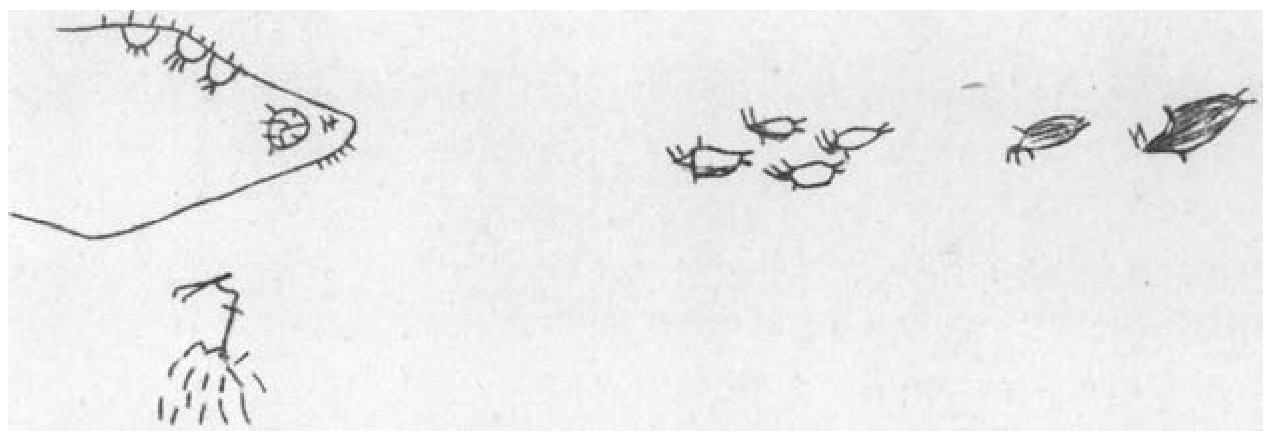
In the same way, incantations, among the Maritime people, insure a lucky issue in the hunting of sea-mammals. In these the women are considered more skilful than the men. Sitting at home, and practising incantations near the hearth, they draw the animals toward the shore.² For instance, on a sketch (Fig. 293) which forms a part of a large drawing, with all kinds of sea-pursuits represented upon it, a person making incantations on the shore, at the point of the cape, causes a herd of walrus to come from the open sea and approach the shore with all speed.
Besides this, a number of incantations of every possible kind exist among the Chukchee. There is no moment of life and no action too trifling to have its special incantation. A man driving reindeer will make use of an incantation to shorten the distance ahead. In like manner, a hungry person[471]🗗uncollated eating with others, from the same dish, will try by an incantation to make the motions of his rivals slower than his own. Women apply incantations to their sinew-thread in order to make it stronger. A man who has forgotten a magic formula will resort to another incantation which is helpful in recalling to one’s mind things which are forgotten.
A number of incantations relate to matters of love. Those referring to birth, death, and funeral-rites, will be treated in a separate chapter. A large proportion of incantations refer to the cure of diseases. As may be seen from this enumeration, incantations are usually benevolent in their purport toward man. In this they are at variance with another series of magic acts, which always portend harm to some one.
These latter are called in Chukchee uiˊwel. Most of them are supposed to have a capricious material shape created for them by the person performing the incantation. They may be animals, monsters, or even inanimate objects. In this shape they are sent to the person “doomed to anger,” to lure him in some way to danger and destruction. After that they come back, and are themselves destroyed, or simply disintegrate on the spot. I call them “spells,” in the absence of any more adequate word.
Conformably with this difference between incantations and “spells,” the “Old Women of the Time of the First Creation,” mentioned in several formulas, are there called also “Women of Incantation,” signifying that their performance is beneficent to the applicant. The small old woman of Keˊrek stock, mentioned in the tale of the Scabby Shaman,¹ who did much harm to the hero of the tale, is called, on the contrary, an “Old Woman of Spells.” There are, however, several branches of incantations which are also harmful in their purpose. These are called “Spell Incantation” (oiwaˊčirg̣-êˊwg̣an) or “Anger Incantation” (aˊnñêna-êˊwg̣an). Of these I shall speak later on.
Some of the incantations have a very short formula, consisting often of but a few words. Others are more elaborate, and are directed to various stars and “Beings,” with an application to every one for some spirit assistance. Many of them are contrived in the form of a dialogue between the performer and the powers to whom application is made.
Incantations may be inherited from parents, who, dying or growing old, transfer to their heirs their spiritual as well as their material property. Or they may be received in dreams from various vaˊɪrg̣ɪt or keˊlet, or may even be bought from competent persons. These are, of course, mostly shamans; but, besides the shamans, there are also those who know a great many incantations, and, moreover, know how to apply them, and who, therefore, are able to give advice and assistance in various cases of trouble. Such persons are called the “knowing ones” (hiuleˊt-reˊmkɪn, “knowing people”).[472]🗗uncollated The same expression is used in the languages of the neighboring tribes and even in local Russian.
To transfer an incantation is, however, no easy matter. Incantations are given by supernatural protectors to a special person only, because the protector had compassion for that person’s particular trouble. Therefore the incantations are intended for the personal use of the one to whom given, and the supernatural powers will be angry on the application of them to the use of another person. Hence, even though a person is perfectly willing to transfer an incantation, it may take several days of urging and persuasion before this person will agree to proceed to the transmission. Through this method the supernatural powers may see how serious is the need of the applicant, and take compassion upon him also, which, of course, would assure the special effectiveness of the incantation. Thus, in the case of incantations protecting the life of small children, even the nearest relative, when he lives at a distance, will repeatedly refuse to come to the house in need, and will consent only after several attempts on the part of the parents of the child.
A shaman, however, is less scrupulous about giving his help. He asks his “spirits” for a new incantation on behalf of the person applying, which, in most cases, consists, not in words, but only in special prescribed actions. On the contrary, he will try to keep for himself the “genuine incantations,” the fruit of his knowledge, and will not transfer any of them without a special demand, and payment.
The transference of incantations must not be made without pay of real or at least of symbolical character, or the supernatural powers will be angry with both parties, and the incantation will lose its force. Moreover, the receiving party will be unable to keep in mind the words of the formula. The transfer must be made without witnesses; otherwise, the incantation will lose its power, or the third person, although unwillingly, will become possessed of it.
The shaman, or any other person who wishes to practise the incantation for his own use or in behalf of others, pronounces the formula in an inaudible whisper; for, should even a stone hear the mysterious words, it would deprive the owner of their possession, and gain them for itself. After finishing the incantation, the person practising must spit at his left side, which is supposed to fasten the incantation to the object in view. The same thing is done when transferring the incantation to another person. The spitting indicates that the possessor renounces the incantation, and gives it over to the other party. According to a similar idea in a Koryak tale, Big-Raven sells his daughter to a seal for a song, which the last-named spits into the mouth of Big-Raven.¹ The incantations in dialogues, however, are pronounced aloud,[473]🗗uncollated and it is supposed that the supernatural party, who answers the questions of the performers through their own mouths, will take care to protect their possession of the formula.
From all this it may easily be concluded that it is no light matter to collect the formulas of incantations from the Chukchee. I succeeded on various occasions and in different localities in collecting about forty incantations, which are given at the end of this chapter. Some of them are simply formulas to be pronounced: others, evidently, are a kind of description as to how the formula must be pronounced and acted upon.
The language of the incantations, on the whole, is the usual Chukchee: but there are some obsolete words used in them, and there is even one the meaning of which is already lost by the people. This proves that the words of the formula have an equal importance with the action, and that, from ancient times, there was a tendency toward consolidation and the exclusion of any possible change. The general character, and even the details, of the incantations, are the same throughout the whole Chukchee territory. Of the reindeer-breeding incantations, those of the Kolyma country closely resemble those of the Anadyr. The same may be said of the incantations relating to the cure of diseases, to the protection against the coming-back of the dead, etc.
The supernatural powers mentioned in the incantations are the Upper Being, the Sun, the Moon, various stars, among others the Pebbly River (the Milky Way). The last was mentioned also in connection with shamanism, though I could not collect any tales having a bearing on the personal character ascribed to it, such as exist, for instance, regarding Orion or the Pleiades.
Some of the short formulas are of a general character, and could have been called simply prayers. For instance, a Chukchee, while sacrificing to any of the spirits or “Beings,” will say, “Oh, let me look on (the world) for a while!” or, “Let me walk around for a while!” or, “Receive my offering and give me luck!” or “Let me take you for an assistant in my pursuits!” or, “Be good!” or, “Let us live well!” or, still more simply, “There, come and eat!”
The Chukchee, however, consider these formulas also as incantations, because the conception of the latter is with them more general, and the power of such a prayer is considered to lie, not in the meaning of the words, but in a certain prescribed order in which they are pronounced and acted upon. On account of the reasons given before, the short formulas are, in most cases, pronounced in a low whisper.
In the collection of incantations given at the end of the chapter, the first two (No. 1, a, b) deal with wild reindeer coming to the herd, which, as said before, is considered a manifest sign of the “reindeer-luck”¹ of the[474]🗗uncollated owner. On p. 379 the details of the manner in which an incantation like this is put into practice were given. The incantations request the supernatural forces to send down various objects of their possession, through the influence of which the person pronouncing the incantation may transform the wild reindeer into a tame one.
Incantation No. 2 is used by the Chukchee inhabitants of the Middle Anadyr in hunting wild reindeer crossing the river.¹ I have already said that this hunt is of great importance to the people, who live solely by its produce. Therefore a number of incantations and methods of divination are used to secure a plentiful arrival of the game, and to make the hunters invisible to it. Some of the formulas include the employment of the sexual parts in a manner similar to that described in connection with shamanism. For instance, in order to foretell the chances of the incoming hunt, the hunter descends to the river-bank, and, taking off his clothing, sits down on some flat, even spot covered with thick compact sand. Then he stands up and looks at the impression left by his body upon the sand. If the private parts are clearly imprinted there, it is considered a good omen: if not, the spirits are unpropitious to the hunt. Then the house-charms are taken to the shore and a sacrifice is made to them in order to secure anew their protection in the incoming pursuit.
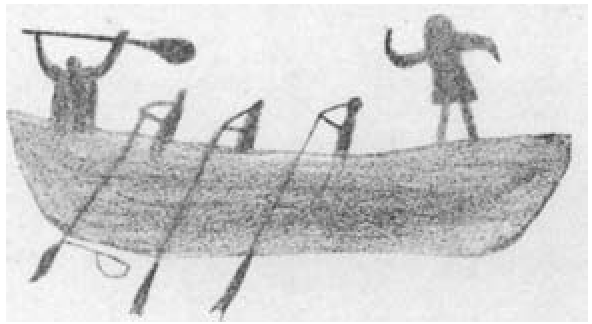
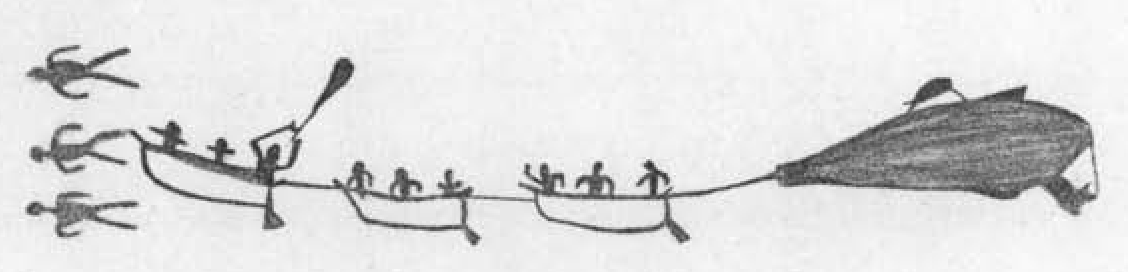
Of not less importance are the incantations for hunting sea-mammals. Of these, however, I could secure only one. In hunting from a boat (Fig. 294) the incantation of this kind is pronounced by the steersman, who at the same time is the owner of the boat. For this purpose he stands, and raises the steering-paddle aloft in a horizontal position. The same gesture, according to Mr. Hoffman, is used by the Alaskan Eskimo as a signal of the discovery of game.² In Fig. 273 (p. 395), men, pronouncing an incantation, point upward wooden drum-sticks which they carry in their hands. This gesture is repeated in several other drawings. It seems to be used on land, while the lifting horizontally of the paddle is used on sea in sealing-pursuits. Nevertheless, in Fig. 295, which represents the whale ceremonial, the steersman of the last boat, who is performing an incantation, likewise points upward the paddle he holds in his hands. Another man, who meets the whale, has in his hands a sacrificing-vessel and a long drum-stick adorned with tassels.
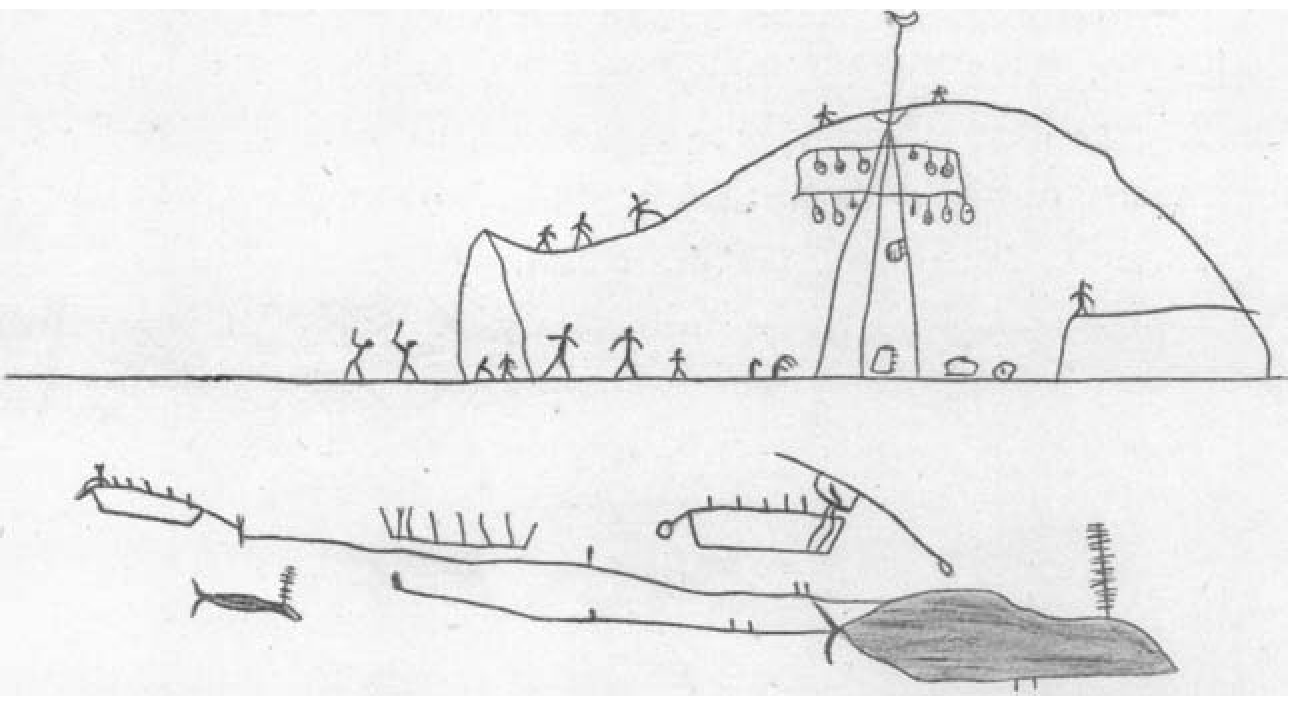
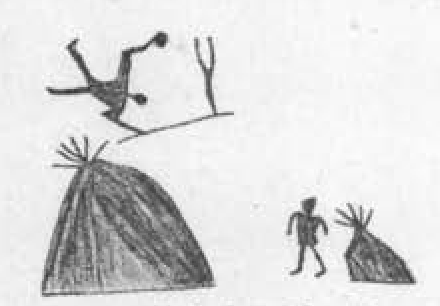
Incantations for improving bad weather apply for the help of supernatural forces against wind and tempest. The first one of this kind (No. 4, a) was[475]🗗uncollated given to me by a native fellow-traveller of mine during the great snow-storms in the fall of 1899, which had considerably hampered our progress on the Middle Anui. The owner of the incantation was so sure of its effectiveness that he proclaimed himself ready to bet on it a sound whipping against a drink of alcohol. After the incantation was duly pronounced, the weather began to improve, and he was about to proclaim his triumph when the storm came back with redoubled violence. When I asked him afterward about the matter, he answered artlessly, “It is the great big world around. How can I cover it all with this small incantation of mine?”
Incantation No. 4, b, was used several times in my presence by the people of Mariinsky Post, who have great faith in its effectiveness. Still another incantation requires that a young boy, quite naked, shall be sent out of the house during the storm. He must run three times around the house, following the direction of the sun’s course, repeating all the while, “O storm! leave off. I have no place to dry my clothes.”
Steller mentions a very similar requirement among the Kamchadal.¹ He also says that they were forbidden to go out of their house in the winter-time with bare feet, because it would cause snow-storms. A somewhat similar custom exists among the Chukchee in regard to a woman newly delivered from her labor.²
The Russianized natives of the Kolyma and Anadyr, in order to repress the wind, “catch” it in a big overcoat spread windward, and then speedily tie up the garment. The wind “tied up” may be quiet for twenty-four hours, but after that time it must be let loose. If it should be kept captive longer than that, it would, when finally freed, become a severe and prolonged storm. This method of subduing the wind is known also to the Chukchee.
A number of incantations are used for defence against the coming of the keˊlet (Nos. 5, a-e). In these the person pronouncing the incantation, instead of asking assistance of the supernatural forces, tries to frighten away the harmful “spirits” by various means and devices. He pretends to have fierce bears or other monsters tied up to his door, which make the entrance of keˊlet impossible (No. 5, a);³ or he declares to the keˊlet that his house is transformed into iron, and that the entrance is protected by a sharp knife[476]🗗uncollated that will cut up any intruder (No. 5, b). If there is no house to secure, the man pronouncing the incantation will proclaim that he is hidden in various places not accessible to the keˊlet (No. 5, c-e). Besides those incantations the texts of which are given, I will mention a few more.
Thus, a lone man driving reindeer, who stops for a night in the wilderness, proclaims that he is hidden in the left ear of his left reindeer, or even in its anus, or, again, under the lining of his large outer cap. A man sleeping in a strange house will pronounce similar formulas in order to defend himself from the “house-spirits,” who, as a rule, are hostile to all “alien” people. Even a prospective bridegroom, who, in order to win his bride, serves his term of work with her family, takes similar precautions, because he supposes the “house-spirits” are averse to his purpose.
There are a number of other methods to prevent the admission of the keˊlᴇ to the person or to the house under protection. The person casting the spell will draw a line on the snow, and thus create a chasm or a deep river; he will put a small stone or a piece of ice before the entrance, and proclaim it transformed into a high mountain or an iceberg, etc. These methods are used especially in funeral ceremonials, of which I shall speak later on.
In connection with this group of incantations must be mentioned also those which are used by reindeer herdsmen to protect the herd against the spirits of disease (No. 6), or against wolves (No. 7). The latter, as has been said, range with the “spirits.”
A number of incantations are used for purposes of magic medicine. Some of them, as related before, are of a dramatic character (No. 8, a-c). In them application for help is made to some supernatural “Being,” whose descent and whose assistance to the patient are then acted. The supernatural “Being” is represented by a blade of grass growing upon a hummock, by a splinter of wood, etc.; while the person performing the incantation talks both for himself and for the “Being” called to help, often even changing his voice to make the performance more vivid.
Among the supernatural beings applied to in these incantations must be mentioned an Old-Woman-of-the-Time-of-the-First-Creation, a Woman-of-Light, and a Hummock-Woman who lives on the top of the hummock with a female neighbor who also has a hummock-house. Their names are given as Raˊučha-ñaˊut and Kuˊča-ñaˊut. The first one, who is called the “Chief Woman,” is probably the same as the old Dawn-Topca Woman¹ who lives in a separate house in the direction of the morning.
It must be mentioned also that the person performing the incantation is called the “Father” of the patient. This person refers to the patient as to[477]🗗uncollated his child, evidently in order to induce the supernatural powers to have compassion on his sorrow (No. 8, c).¹
In other incantations (Nos. 8, d-m) used in magic medicine, the person performing calls to his aid some beast or monster; or, more often, he pretends to transform himself into that monster or beast. In this shape he treats the diseased part of the body so roughly that the source of the disease concealed within it is destroyed or frightened away. Often the limb affected, or the source of the disease, is declared to be transformed into such material shape as to make more convenient the cleansing or the destroying operation described in the formula. For instance, an ailing stomach is made into a bay of the sea, and the big sea is called to send a strong current to the shore and to clean away all the rubbish. Or the illness is transformed into a flock of ptarmigan, which are destroyed by a supernatural bird with iron quills and claws. Or a swollen limb is supposed to be a mound of snow, and a sturgeon is made to flop about in it and cut it up with his sharp fins, etc.
In one of the incantations (No. 8, i), help is demanded from a little flying spider, which, under the name of Spider-Woman, figures also in several stories.² The incantation requests it to come down and to sew up the freshly cut wound, which is bleeding profusely. Other incantations mention the Raven Kuˊrkɪl (No. 8, g), the Magic Woman, and the Spermophius-Woman (No. 8, m), — all of which figure in the folk-lore of the Chukchee.
Special incantations (Nos. 9, a-c) are intended to intercept dying persons on their way to the other world. So great is the Chukchee belief in their efficacy, that they suppose they can even bring back to life persons really dead. Most of these incantations (No. 1, a, b) are similar in character. The person pronouncing the incantation asks the supernatural force to send down its dog, or pretends to transform himself into that dog. In this shape he intercepts the patient on his way, and makes him return, barking, and snapping at his face.
Besides the two incantations of this kind which were collected on the Pacific shore, another somewhat similar one is mentioned in a story from the Kolyma country. The story deals with a case of actual suicide which happened on the western tundra of the Kolyma in the nineties of the last century. Relative to bringing back the dead, it says, “A man going away along the trail of the dead may be turned back by a dog. To do this the performer must whisper an incantation into the dog’s left ear, and send it in pursuit. The performer says, ‘Go and bring back the man. We will feed you with the choicest morsels!’ The dog intercepts the patient on his way, and makes him turn by jumping at his face. After the patient has been restored to life, the dog is immediately killed.” The story adds naively that the less difficult cases yield[478]🗗uncollated to the incantation, but the more dangerous ones are hard to deal with.¹ In another story collected in the same country, and also dealing with an incident of real life, a man was killed by a neighbor. The body was cut in pieces, and these were buried one by one in separate places. The family of the victim thought he was lost somewhere in the country around. In order to find him, they performed an incantation upon a dog, which was then sent on the search. The dog found all the pieces one by one, and brought them to the camp. They were put together by the relatives and burned on the funeral pyre. After that the dog was killed in sacrifice to the World (Ñaˊrgɪnên).² Then the family found the murderer and killed him. I have mentioned also the important rôle of the dog in frightening away the “spirits of disease.”³
Incantation No. 9, c, which also was given to me as having a special power to bring back the dead, is one of the usual incantations of magic medicine. It calls down the Pebbly River, and then proclaims that the patient is transformed into the rapid of its stream, and thus cleansed of all rubbish, that is, of disease.
The love-incantations are of the usual symbolical type. In one (No. 11, a) the performer watches the woman in question as she passes water, and then pretends that the heart and intestines of the woman fall down together with the water. After that he demands ice-creepers from the Morning-Dawn, and tramples with them on the intestines of his victim.
In another incantation (No. 11, b) the performer proclaims that he is about to extract the internal organs of the woman, whom he pretends to entangle in a seal-net. Then he pretends to turn the husband of the woman into a seal’s carcass, and the woman into a doe, which flees from the offensive odor of the carrion.
In still another incantation (No. 12) a jealous woman pretends to turn her rival into carrion. She transforms the man in question into a big bear, which eats of the carrion, but soon vomits it up.
It may be seen that, though the incantations were collected in different and often quite distant localities, the methods used in them are similar even in details.
The so-called “Raven Incantation” (No. 13) stands apart from the other specimens of the kind. It was said to be used by shamans in order to acquire power to harm other people. It is, however, only a dramatized form of a tale well known to the Chukchee and to the Eskimo, both on the Asiatic shore and in Alaska.⁴ It may be compared also with the actions of mischievous shamans when they come out in the night-time and ask the supernatural forces to give them power to harm their enemies.
[479]🗗uncollatedAmong the malign incantations, some are of the same symbolical character. In one, the text of which is not given, the performing person proclaims his victim to be transformed into a seal-skin, and then requests the shrimps to come from the sea and to eat it. In another incantation of this kind, given to me by Scratching-Woman, the person performing asserts that he has taken the victim, and put it into a cooking-pot, there to be wrung through a piece of old net, like half-digested moss from the reindeer-stomach.¹ Then the performer pretends to take the stuff out of the pot and to put it into a hole dug for that purpose in the ground. The hole is covered with a bird’s wing. Then the stuff within is transformed into a dog, who, attracted by the scent from the camps, as dogs are wont to be, goes from camp to camp. The same incantation is also used for the creation of an artificial dog to be employed for a “spell.”
Two groups of harmful incantations have special names. One is called eiˊᵋut, and has for its purpose the reduction of the speed of a rival in a race on foot or with reindeer, the loss of his strength in wrestling, etc. In one of the formulas (No. 14, a) the performing person ties his adversary with the line of the Spider-Woman. In another formula of this kind (No. 14, b), the performer hampers the swiftness of his rivals by pretending to put a many-branched tree-trunk across their trail. The incantations for bringing back the dying are also called eiˊᵋut, because they have for their purpose the curbing of the speed of the dead on their last trail.
The other group of harmful incantations in question are called nineˊwg̣et. It includes various manipulations carried out with the flesh of corpses. The flesh is taken from the corpses, which have been recently left on a burial-place. For this the person acting comes in the night-time to the corpse. He stops at a distance, takes off all his clothes, and then creeps to the corpse on all-fours, quite naked, and pretending to be a fox. To increase the resemblance, he even drags one of his legs, in imitation of a fox-tail, and cries, “Ka, ka, ka!” imitating the barking of that animal. He carries a knife in his teeth, and, approaching the corpse, cuts off a small piece of the flesh of the left shoulder, and, if possible, takes also some of the brain. Then he goes back to his clothes in the same animal-like manner. The piece of flesh is dried in the open air, far from the house. To make it effective, a small particle must be mixed with food, and given to the person “doomed to anger.” It is believed to work like poison. After the victim has swallowed it, his mouth will be completely covered with burns, his stomach will burst, and he will speedily die.
Some persons, in procuring the flesh, even dispense with the knife, and use their teeth for tearing away the desired pieces. This greatly increases[480]🗗uncollated the effectiveness of the charm. Another way of doing the same is for the person acting to pretend to be a raven. He hops to the corpse, holding the knife between his teeth, and pretending that it is his beak, and he also caws like a raven. When he is close to the corpse, he bends down and pretends to peck at it with his knife-beak, after which he may cut off the desired piece. This method calls to mind the Raven Incantation mentioned before, and also some details of the funeral ritual, in which, also, participants pretend to be ravens.
In another method of doing the same thing, the person acting pretends that the corpse is a seal on the ice, and stalks it in the well-known characteristic manner. When he is close enough, he thrusts his knife at the corpse, pretending that he is throwing the harpoon. After that, the performer is free to take his piece of flesh.
The chief purpose of all these methods is evidently, not so much to intensify the power of the “spell,” as to defend one’s self against the revenge of the dead person whose corpse is being despoiled.
It is supposed also that a human skull may be used as a vessel in which to cook certain magic preparations, though no details regarding this custom are known. Several tales, however, mention old “women of spell,” who mix their decoctions in a human skull: therefore our attempts to collect skulls of the natives were discouraged, and even caused us to be suspected of the worst practices.
Similar methods of sorcery were used by other neighboring peoples. Thus Sarytcheff mentions¹ that, while he was on the Andreyanoff Islands, a native (Aleut) shaman said to one of his female patients, that her malady was caused by her father, who, when in pursuit of sea-mammals, used to take the brains out of dead men’s skulls in order to smear his harpoon-points with them.
SPELLS. — In the preparation of “spells” some typical methods, well known among many tribes, are used also by the Chukchee. Thus, to prepare a “spell,” one must procure some particle belonging to the victim’s body, — a lock of hair, a scraping of the nails, or one must pick up a piece of snow freshly impregnated with its urine. If any one of these are dried, wrung, or put near the fire, the victim will undergo an analogous process. Figurines representing the victim are made of wood, of grass, or of pounded leaves. These may be stabbed, or dried, or beaten, and the process will likewise be transmitted to the person “doomed to anger.”
The person performing a “spell” may also injure his victim by throwing its image, made of grass, between his own legs, which he has spread apart for the purpose. The person doing this must bend for the action so as to touch the ground with his head, and then throw the image with the greatest possible[481]🗗uncollated force. The image must be left on the spot, exposed to the open air. In the same measure that it is damaged by the progress of time, the victim also sickens, and finally dies.
A blade of grass, a splinter of wood, or even a lump of earth taken out of the fresh footprint of the person “doomed to anger,” may also be used to perform upon it magic operations of the kind described.
According to another method, the performing person pretends to become a wolf, and smears his mouth with fresh blood, proclaiming it to be the blood of the victim. This may be compared with Incantation No. 8, d. In still another case the performing person slaughters a reindeer in sacrifice to the Moon, and then cuts off the head and puts it on a stake, asking the Moon to make the victim similar to this reindeer. Then the victim is struck with palsy.
In a “spell” of the Maritime Chukchee, the performer places before the entrance of the victim’s house a few long leaves of a species of seaweed. The leaves are pierced with numerous holes, and therefore may serve as a net, in the meshes of which the soul of the victim is captured. This may be compared with an analogous action by the keˊlet.¹
But the most characteristic of all the “spells” used by the Chukchee are the artificial creations, which are materialized, and then sent to destroy the enemy. The same peculiar conception is to be met with among the American Eskimo.²
The idea of such “spells” is so familiar to the Chukchee, that they try to represent even the malevolent incantation as something likewise materialized. For instance, in the tale of “The Scabby Shaman,” Rɪˊntew catches the malign incantations of all his enemies, one by one, and ties them up separately in a number of mittens. In the morning he distributes the mittens among the baffled would-be wizards, and tells them in turn, “These are your words, — and these are yours, — and these, yours.”³
A “spell,” once materialized, must be sent immediately in search of the victim. It may, however, be intercepted and made ineffectual by some magic power greater than that of its particular owner. Then it may be appropriated by the victor, and, indeed, it will insist on being appropriated by him and sent against its former owner. If rejected by the new wizard, it will, notwithstanding, of its own accord, go back to its former owner and retaliate on him for its failure.
Thus I mentioned in the preceding chapter the image of such a “spell” which was intercepted by the shaman Scratching-Woman, and then appropriated by him for his own use. Similar ideas are to be found in the folk-lore of civilized peoples. Thus the demons mastered by a wizard are said to clamor constantly for more work, and that of a character harmful to others. If they remain unoccupied, they may fall on their master and tear him to pieces:[482]🗗uncollated therefore, when no victim is assigned to destruction, the wizard makes his demons twist ropes of sand, drain the sea with a bailer, etc.
The artificial “spell” may appear in various shapes, and also may change its appearance at the will of its creator. Often it is an animal, or even a group of animals, or, on the contrary, only some part of the carcass, — for instance, the upper half of a ground-seal, a fox-head without body or legs, — also a man or a woman, or even any inanimate object, such as a stone or a tree.
In some cases the first sight of the materialized “spell” makes the victim lose his reason, and die raving mad. In other cases, on the contrary, the victim believes that he has before himself a real animal, a fit object for hunt; and the ultimate catastrophe happens quite naturally as an accident of the hunt. Thus I obtained a very characteristic story about two Chukchee families between whom an old feud existed. At last one family left the country, and settled at a distance of several hundred miles. After a number of years, a wild reindeer-buck came to the camp of one of the members of this family, and began to graze in sight of the houses. Of course, it was only a materialized “spell,” because a real reindeer would not dare to come so near a human habitation. It was sent by the “knowing people” of the other family, who had not forgotten that the last bloodshed was effected by their adversaries.
The time was well chosen, because, of all the men of the camp, only the master was present. On seeing the reindeer, he shot at it with his bow. The reindeer took to flight, but ran rather slowly, being evidently wounded by the arrow. The man, who was fleet of foot, followed in pursuit. This was the last time he was seen alive by any person. After two days, his wife, alarmed by his prolonged absence, went to a neighboring camp several miles distant, and asked the people to help her in her hunt for the missing man. After a few hours’ search, they found him on a large lake in the vicinity. It was early in the fall, and the ice of the lake was not yet covered with snow. The fleeing reindeer had lured him upon the ice, and there in a swift chase the man fell down and broke his neck. Of course, no trace of the reindeer was to be seen. It had fulfilled its mission, and without doubt had returned to the “knowing people” who had sent it on its errand. I had this story from the brother of the man who perished, and his death was scored up as a new case for revenge against the other party.¹
In a Chukchee tale, several versions of which were collected, a man or a woman desiring to have revenge on a female foe creates a dog of snow, of brindle-wolf color, and transforms it into a young man. The “spell” is immediately sent to the camp of the victim, where it acts like a real young man, and succeeds in making love to the woman “doomed to anger.” The owner of the “spell,” however, is able to guide its actions from afar, and at[483]🗗uncollated the required moment he calls lightly, “Wuteˊl, Wuteˊl!” this being the name usually given to dogs of this color.¹ Under the action of the call, the man again becomes a dog, and drags away the woman as dogs usually do. The body of the woman is torn to pieces, and only a small part of the pelvis is brought to the house of the master of the “spell.” The dog, after coming home, vanishes. The details about the dog-man cohabiting with a woman, after the manner of dogs, occurs also in the tales of the American Eskimo,² but the dog is not represented as a materialized “spell.”
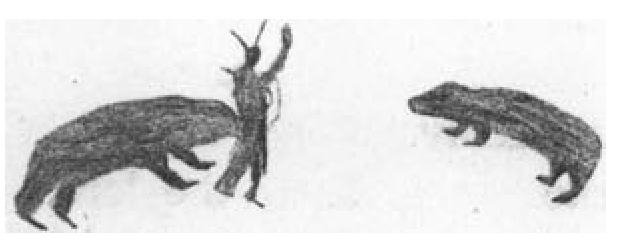
In the collection of Chukchee sketches, the materialized “spell” is represented by several drawings. Now it is a half-bodied seal sent by a mischievous shaman to frighten a seal-hunter; again it has the form of two bears who have caught a woman “doomed to anger,” and are torturing her, tossing her body to and fro between themselves like a ball (Fig. 296).
The malicious incantations are believed to work sometimes in the same way as do the materialized “spells;” that is, by inducing the person “doomed to anger” to meet the harm in a quasi-natural way. For instance, while travelling on the Wolverene River, I met a man by the name of Peˊtki, who formerly was one of the fleetest runners in the whole neighborhood. His rivals, desirous that his speed should be impaired, sent an incantation to him by which he was induced, while in his own sleeping-room, to sit down on a bare knife, and in such a manner that half of the blade entered his thigh. When I saw him, he was still suffering from the wound, and it was impossible to say whether that leg would not be permanently lame as the result of the accident.
The people are excessively afraid of all kinds of “spells” and harmful incantations; but, on the other hand, they often wish to retaliate on the suspected wrong-doer. Even a great shaman of the mischievous kind is not safe from the revenge of his neighbors, who by common consent may cause his death.³ Thus, in the tale of “The Scabby Shaman,” the people wronged by young Rɪˊntew make complaint to his father, and then the whole village plans the destruction of the young shaman.
Even in modern times, when harm of an unexpected character is ascribed to the pernicious influence of an unfriendly neighbor, the latter runs the risk of paying for the suspected witchcraft with his life. Thus, in the year 1896,[484]🗗uncollated during the spring fair on the Wolverene River, I was present at a series of reindeer-races in the camps of the richest inhabitants. Two persons were all the time striving against each other for the victory. Their names were Toˊlɪño and Yaˊtirg̣ɪn. The reindeer of Toˊlɪño, however, were better than those of his rival, and he was victor several times. Then, at one race, the right reindeer of his team suddenly stumbled and fell, not fifty feet distant from the goal, which gave to Yaˊtirg̣ɪn the chance to snatch the prize first. Of course, the accident was ascribed to a harmful incantation of the kind known as eiˊᵋut.¹ In my presence the uncle of Toˊlɪño, frightened by the accident, tried to persuade him to stop racing and prepare for the return journey to his camp, which was two hundred miles distant. Toˊlɪño was obstinate, and determined to continue. Two days later, to the horror of all, Toˊlɪño died suddenly. The death, of course, was ascribed to the witchery of his rival; the more so, as the latter with his family left the country hastily on the next day, and went eastward in the direction of the Chaun River. In his haste, he even left behind a part of his large herd of reindeer, which were taken by the family of the deceased. The brother of the latter promised to visit, the next fall, the country of Chaun in order to settle the blood-score.
In another case, which happened the same year at the Anui fair, one Chukchee accused his neighbor of killing his son by witchcraft a few months before that time. The two families were not very friendly, and it seems that the supposed wizard, when under the influence of brandy, was wont to boast of his magic skill. Be that as it may, the father, thirsting for revenge, watched for the wizard as he was passing on a trail among the camps, and shot him down with a rifle. The brothers of the murdered man wanted to have blood for blood; but even they felt that the wronged father was within his right, and after some controversy the affair was settled without even weregild.
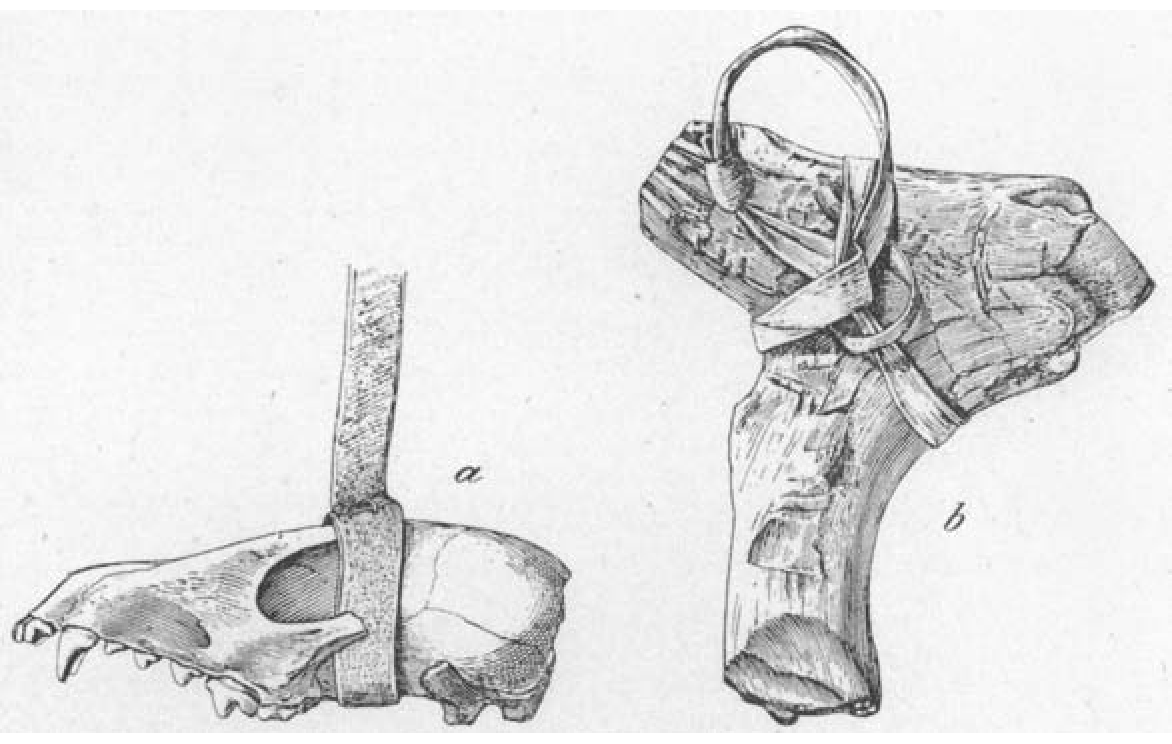
DIVINATION. — Of the methods of divination, the most common is that with a suspended object. The Chukchee and the Eskimo alike use for this the so-called “divining-stone” (yɪtkoˊmk-uˊkwun, literally, “swinging-stone”). Any pebble with a string tied around it may serve the purpose, although stones somewhat bizarre in form are preferred. Often the skull of an animal (Fig. 297, a) is used for the purpose, a “wooden spirit”² (Fig. 297, b), a rough image of a “guardian,” or even a piece of wood cut off under peculiar circumstances. On the other hand, the divination may be performed without a special implement by using the boot or cap of the person interested, or even the body of the person himself.
The method employed with any divinatory object is to suspend it by a string from the hand, or, better still, from the end of a stick; for instance, a walking-staff or the long handle of a scraper. The soothsayer asks his[485]🗗uncollated questions aloud or mentally, and then raises the object in the air. If the answers are favorable, the object will begin to swing; if unfavorable, it will remain motionless, and, even when pushed, will persistently return to its original position and remain quiet (Plate XXXIII, Fig. 4).
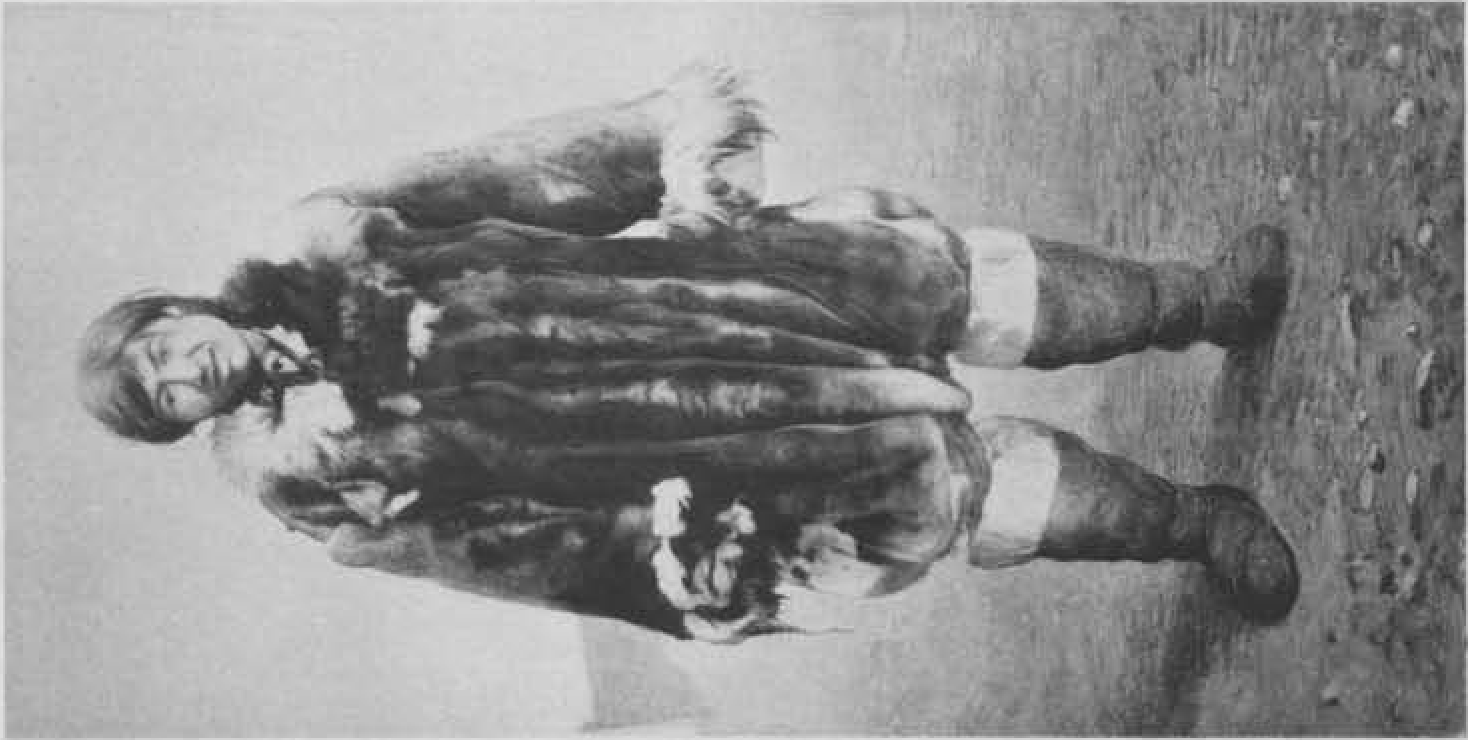
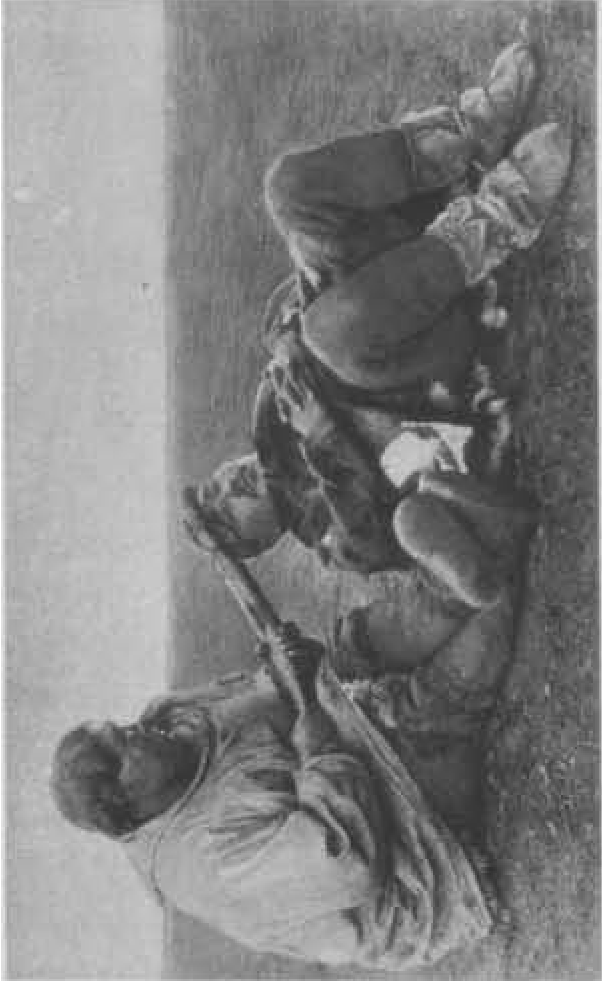
When the body of a living man is used in divination, his head is bound around with a string, the other end of which is tied to a stick. Then questions are asked and the stick is lifted. If the answers are favorable, the head will feel so light that it will apparently be lifted of itself. In the contrary case, the soothsayer will be unable to lift it from the ground. In this latter method the person whose head is being lifted may ask his questions mentally, so that nobody can hear them. This method of divination is identical with that used by the American Eskimo.¹ The same method is resorted to with bodies of the dead to obtain information as to the various details of the funeral, or the future of the remaining members of the family.
Another method is that of tying the dead body, dressed for the funeral, to the rails of a sledge. The sledge is then placed across two long smooth poles lying side by side on the ground, so that the runners can easily slide on them. Then the soothsayer asks his questions, and tries to pull the sledge along. If the answers are favorable, the sledge will run ahead smoothly: if unfavorable, some hitch will prevent it from moving. The principle is evidently the same as that of head-lifting.
At variance with this, the answers given before as favorable — spontaneous swinging of the object suspended, easy and smooth motion of human bodies suspended or of sledges resting on rollers — are sometimes taken only as affirmative, no matter whether favorable or not to the questioner; and those given as unfavorable are, on the other hand, taken only as negative. To avoid misunderstandings, however, the questions are, for the most part, put in such a way that the affirmative would coincide with the favorable, and vice versâ.
[486]🗗uncollatedAs an instance of the contrary, an extract from a description of a Chukchee funeral, taken down from the mouth of a native, may be cited.
“Then they lay down rollers under the sledge and try to draw it. (They ask the deceased) ‘Of all those present here, say straightly whether anything ill shall befall them. Tell that about all, one by one, not hiding anything.’ If, on asking about some particular person, the sledge runs smoothly and without hitch, he will surely die.”¹
The method of divination by suspension is widely spread among both the Reindeer and the Maritime Chukchee, and is employed in almost all cases of life. Once, while in a camp on the Wolverene River the night before a great race, I was weighing some medicine on a small brass balance. A man who sat close by wanted to have a look at the balance, and when he took it from my hand, of course it began swinging. The Chukchee took this as a sign that the balance wanted to be used for soothsaying. He took advantage of this to ask it about the arrangement of the race for the morrow.
“Shall we arrange it together, or separately?” asked he. “Give a good sign! Give a favorable omen!” There were two men desiring to arrange the race, and it was a question whether they should join their stakes, or not. The balance gave an answer in the required sense. The man asked several other questions, which were all answered favorably, because the unstable thing swayed to and fro with the slightest motion of the hand of the performer. Suddenly, when he put forward a question about the foot-race, the balance stood still. One of the cords supporting the plates became hooked to the end of the lever, and its free motion was disturbed. “Desist, desist!” cried the other people, frightened; but it was too late. Now, when the balance did give an unfavorable answer, it was necessary to coax it to change it, and to answer more acceptably in its new, entangled position. The experiment took over half an hour, and still the balance would not answer satisfactorily.
Divination with suspended objects is well known also among the Asiatic Eskimo and among the Koryak. Those on the Pacific side use their amulets, known by the name of “grandmother” (aˊn˙ai), for this purpose. In a Koryak tale, a spirit-woman makes her husband use for this purpose his own penis. By its motion they are able to determine the movements of human people, who flee before their approach. Many Chukchee tales also mention the custom of keˊlet trying to foretell the success of their man-hunting by swinging a human skull. This serves them as a divining-stone equally as well as the skull of an animal serves man for the same purpose.
Among the Kamchadal, according to Steller,² a woman shaman used to sit in a corner, and, winding a red thread around one of her legs, try to lift it from the ground. If the leg seemed heavy to lift, a negative answer to the question was implied: if it seemed light, the answer was in the affirmative.[487]🗗uncollated Nelson¹ tells of a similar method of divination among the Eskimo southward from the mouth of the Yukon. For divination by head-lifting among other Eskimo of America, I will refer to Dr. Boas.²
Another method of divination, nearly as much in use as the one just spoken of, is that with a shoulder-blade, the centre of which is kept over a small fire till it is partly carbonized, and cracks in all directions. The details of the cracks determine the meaning of the answer. This method, however, cannot be applied to every circumstance of life, because the indications of the cracks are necessarily limited. Among the Reindeer Chukchee its chief use is for determining the direction of the next moving of the camp. It is also employed to foretell the success of a hunt or of a journey, the approach of the wind, the imminent danger of a contagious disease, or of an attack on the herd by wolves.
The Reindeer Chukchee use for divination only the shoulder-blade of the domesticated reindeer. The animal, in most cases, is killed for this particular purpose, though the bones of every reindeer brought for sacrifice, or slaughtered for meat, are also fit to be used. The bone is taken raw, and the meat carefully cleaned from it. Then a small piece of burning coal is kept close to its centre. It is fanned, by means of blowing or light swinging, till the bone is carbonized, and gives the first crack. After the performance, the burned place is immediately broken through and reduced to crumbs, but the bone itself is added to the common kitchen-stock used for trying tallow. During the fall, the shoulder-blade of the left side is used for divination in personal or family affairs, while that of the right side is called “alien,” and used for divination in the affairs of other people. During this period, divination is employed, first, when changing camp after the first fall of snow, then again about two months afterwards, when moving into winter-quarters.
In the winter time, divination is seldom used, but it is resumed in the spring, when moving from the winter-pastures to the summer abode. This moving is considered as “returning,” the tundra being the principal country for the Chukchee people. It is called “descending road” (taˊhrɪ-têlaˊn), meaning the descent from the wooded hills to the open tundra and to the sea.³ Even the families who ascend the mountains in the direction of the glaciers of the watershed call it by the same name. During this time, divination is used for every new move; but now the bone of the right side is used for the affairs of the family, while that of the left side is considered “alien.” However, for all journeys made without reference to the moving of the herd, — for instance, for trading-trips or for hunting-expeditions, — the left shoulder-blade is used throughout the year.
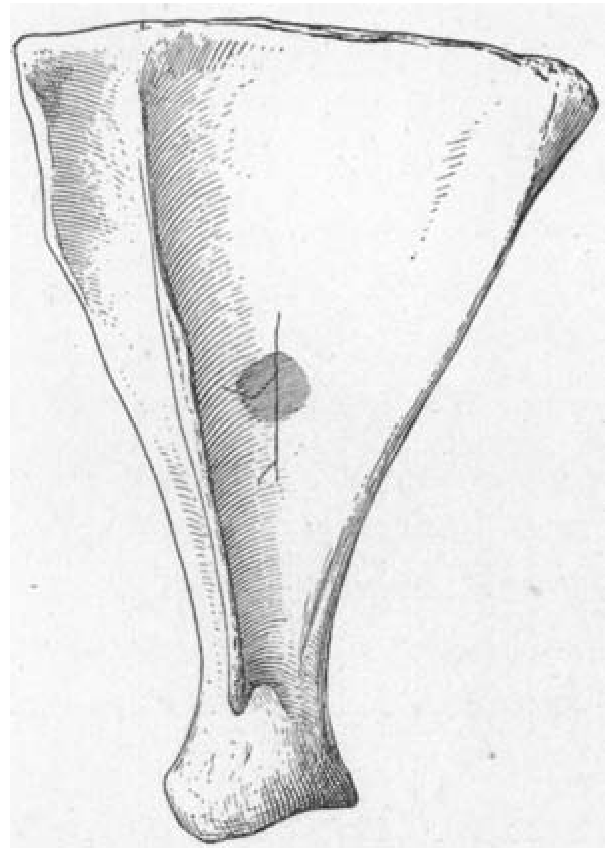
In explaining the lines of the cracks, the shoulder-blade must be kept[488]🗗uncollated with the broad part upwards (Fig. 298). The ridge in the middle is called “mountain” (ičvuiˊg̣ɪn), and is considered to represent the mountains and the inland generally. All the lower part of the shoulder-blade beneath the burned spot is called “bottom of bone” (aˊᵋmhê), and is considered to represent the underground countries. The outer edge of the shoulder-blade, all around the broad part and down to the very bottom, is called “sea” (aˊñqᴀ), and is considered to represent the sea-coast.
Usually one vertical crack is formed, with various ramifications above and below. The following principles are applied for their explanation. Everything that comes from the sea is good, even though it be from under the supposed level of the ground: “Nothing evil comes from the sea.” Indications from the underground, or “bottom of the bone,” on the contrary, are of evil character. From the mountain above the level, there may appear indications of either kind, good or evil.
If there is produced only one vertical line, it is a favorable indication; but if this line is short, or, on the contrary, if it reaches the very edge of the bone, the indications are unfavorable. Should the bone burn too quickly, it is likewise unfavorable. The small cross-lines not reaching up to the principal crack, when in the upper region, foretell only news of something; while the longer lines, crossing the principal crack, foretell the arrival of the thing. A large cross zigzag line foretells greatness of the thing which will come. For instance, a detached cross-line from the “mountain” may signify news about wild reindeer; a longer line, the coming of wild reindeer; and a zigzag line, the abundance of the wild reindeer; etc. A cross-line from the “bottom of the bone” foretells an attack by wolves, or the arrival of the “spirit of disease,” or even death. A line formed on the top of the principal crack signifies a snow-storm; a semicircular line on the same place signifies unexpected death. A detached line in the region of the “sea” signifies some unexpected news. Thus, for instance, cracks on the shoulder-blade represented in Fig. 298 indicate (1) abundance of some game coming from the mountain, evidently reindeer, because it was the season for the reindeer-hunt; (2) the coming of wolves to the herd of the camp.
In performing divination regarding the direction of moving, the person must first select a direction, and then inquire about it. If the indications are unfavorable, — that is, if some evil is indicated as likely to happen on the journey, — the proposed direction is abandoned. In this case the shoulder-blade[489]🗗uncollated itself is immersed in a mass of stuff emptied from the reindeer-paunch, which is generally considered as highly effective for ceremonial cleansing of this kind. While immersing the bone, the person says, “This is not my shoulder-blade: this is an ‘alien’ shoulder-blade.” Then the bone is left sticking in the stuff. On the next day another reindeer is killed and the divination resumed for a changed direction of the route. This is watched with the keenest attention, lest, through some carelessness, the true meaning should be misunderstood.
An unfavorable indication of a shoulder-blade may be tested by divination with the sinew of a reindeer-leg. A piece of sinew is wound tightly around a splinter of wood several times. If it unwinds quite smoothly, this is considered a favorable sign, and the indication of the shoulder-blade may be rejected. If, on the contrary, it becomes entangled, this corroborates the indication of the shoulder-blade, and some reverses are likely to happen. Then another shoulder-blade may be tried for some other direction of moving.
The Maritime people use the shoulder-blades of the seal for purposes of divination, but this is done less frequently, chiefly because there are no questions to decide regarding the choice of direction of moving. The attention of the people is naturally directed, not so much to the possible result of hunting-expeditions, as to procuring help and protection from the supernatural forces, so as to obtain a favorable issue for the hunt.
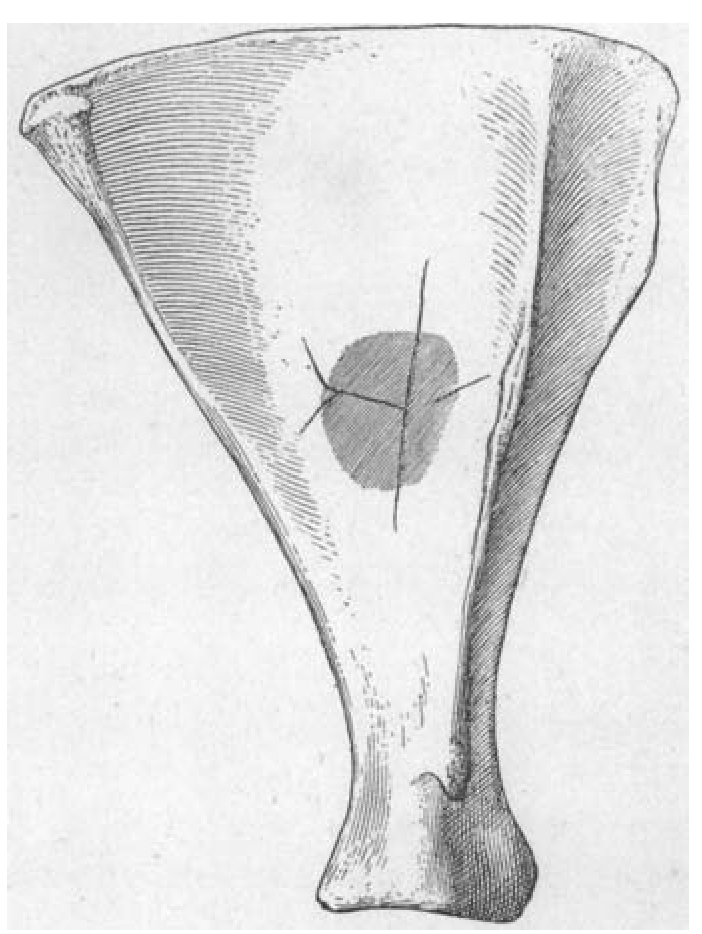
The Chuvantzy and even the Lamut of the Anadyr country have also adopted this way of foretelling the future, and the latter probably imitated it from their Chukchee neighbors. The explanation of the lines, adopted by the Lamut, is, however, simpler than that of the Chukchee. The Lamut, for instance, do not distinguish between the sea and the mountain side of the shoulder-blade. They do not even pay attention to the position in which the blade is held, but are occupied exclusively with the lines. Among the collections of the Museum there are several shoulder-blades of Lamut provenience, which were burnt over the fire for divination. One of the most characteristic is represented in Fig. 299. The vertical line on it signifies the route of the Lamut; one branch of the bifurcated line coming from the left side signifies the coming of the reindeer; and the body of the line signifies the joint way of the Lamut and the reindeer after having come together. Evidently the[490]🗗uncollated hunt will be successful, because the line signifying the way in common is exceedingly long. The detached line on the other side of the principal line signifies the reindeer which will succeed in passing by the hunters and reaching the mountains.¹
There are several other methods of divination; for instance, the person puts an amulet or a splinter of wood into his left mitten, and shakes it violently till the small object flies out of the mitten. It is a good sign if it falls to the right: the contrary is a bad sign. Divination with blades of grass is very common. The person takes eight blades of grass, and, forming a slender sheaf, ties it in the middle; then he ties consecutively the ends of the grass-blades which touch one another, after which the sheaf is undone. If the blades were so tied as to form an uninterrupted circle, the indication is favorable: if not, it is unfavorable. Such a method seems almost sure to prognosticate bad luck. Many persons, however, succeeded in my presence in forming a circle of blades tied together. I cannot tell whether this was the result of good luck or of cleverness, though they assured me that the thing was done quite honestly without any trick. In a former chapter² I alluded to the use, among the Maritime Chukchee, of lumps of tallow for purposes of divination.
Dreams. — I have already spoken of the influence of dreams in the arrangement of the various details of Chukchee ceremonials.³ In arranging the thanksgiving ceremonial and the races, dreams are especially important. These two are even called “dream-echoes” (rêˊtɪ-taaˊññɪrg̣ɪn), showing how often they are arranged solely on indications of a dream. Indeed, even if a small boy should see in a dream that his family performed a thanksgiving ceremonial, it would be considered necessary to fulfil the dream under danger of most serious misfortunes. The keˊlet and vaˊɪrg̣ɪt also appear to people in dreams to give them warning, or even to ask them for sacrifices. I mentioned in the preceding chapter the “spirits of disease” who came to Aiñanwaˊt in a dream, before the breaking-out of real danger.⁴
Once when I was travelling with a party of Chukchee in the country of the Dry Anui, we stopped over night on the shores of a certain lake. In the morning one of the natives told us that the owner of the lake came to him in a dream and asked him for a sacrifice. “You are a new-comer to this country,” said the owner of the lake. “You must give me a present.” The man was actually a new-comer to that part of the country. Accordingly he sacrificed to the lake a piece of tobacco-leaf and a small lump of sugar. But the “spirit” had in mind some other thing. The native had with him a little brandy in a glass bottle, which he was carrying as a present to his old father. At first there were two full bottles of the brandy, but a small portion[491]🗗uncollated was all that was now left, and the dutiful son wished to keep that little till he came to the house. The “spirit,” however, appeared to him again the next night, “almost in his waking moments,” and unceremoniously tugged at his sleeve. “Friend,” said he, “I want that liquor. I have not tasted any for a very long time.”
In the morning the Chukchee was very angry at that demand of the “spirit.” “I am no resident of these places,” repeated he. “I am simply a passer-by. He has never given me anything.” And he kept the brandy in spite of the thirsty “spirit” of the lake. Two days afterward, when we had gone fifty miles from the lake, he suddenly caught cold and fell ill. The cold proved to be influenza, and he was obliged to stop at the next camp, which, fortunately for him, was already arranged for the winter. The camp also had been stricken by influenza; but it was on the decrease, and the people were now out of danger. I heard afterward that the man with the brandy likewise recovered, and, after a week or so, proceeded on his way, but I very much doubt his ability to keep the brandy for his old father.
Another time, in a Maritime village, the mistress of the house where I stopped suddenly became indisposed. In the morning, her husband said that some one came to him in a dream and asked him for his spotted dog. He offered another dog, because the spotted one was the best of the whole team; but the visitor insisted, repeating that “spirits,” like men, fancy spotted things. Accordingly, in the morning the spotted dog was stabbed with the spear, and offered to the “direction” of the evening.
OMENS. — In the course of the preceding pages I have mentioned several times the Chukchee belief in omens; for instance, should a slaughtered reindeer fall upon the wound, this is considered as less favorable than to fall on the opposite side, especially if the reindeer had been slaughtered for a definite sacrifice. For the animal to fall backward forebodes misfortune. Therefore, in the very process of slaughtering, the people try by dexterous jerking of the halter to make the reindeer fall with the wound upward. It is not good, however, to exaggerate this tendency, otherwise the sacrifice will not count in the eyes of the divinities.
To dream of the loss of a tooth may presage illness or death, the tooth symbolizing the soul, which is in danger of being lost. The yawning of reindeer during a journey bodes the coming of evil spirits. The crackling of the fire on the hearth foretells the coming of guests. The last sign, as is well known, is widespread among various peoples.
TABOOS. — I did not find many taboos among the Chukchee, Reindeer or Maritime, nor among the Asiatic Eskimo. In this, these tribes differ greatly from the American Eskimo, whose whole life and whose pursuits are closely interwoven with numerous taboos.
Regarding the taboo in reference to a woman’s menses, the Reindeer[492]🗗uncollated Chukchee consider that during that time the husband and wife must sleep apart, or the woman will grow sickly, and soon become sterile. A like result is represented as following the infraction of other taboos connected with sexual life.¹ I was told, however, that several “who are foolish” transgress this interdiction, and have intercourse with their wives during the time of the menses. Among the Maritime people, both the Chukchee and the Asiatic Eskimo, the taboo concerning the menses is much stronger. A woman at the time of her courses must carefully avoid even to approach her husband. Even her breath is considered as impure: should it touch her husband or any other man; it would contaminate him, and destroy his chance in sea-hunting pursuits. He would even run the risk of being drowned at sea. In these latter details we see a resemblance to the ideas of the American Eskimo.
The chief taboo among the Maritime people, both Chukchee and Eskimo, is a strict prohibition against the use of wood for fuel during the winter. The time during which this taboo is in force is marked by the going-away and the coming-back of sea-fowl, since all other indications are not sure. The cold continues almost throughout the year, and the ice-floes change their position with a change of winds, and may be drifted off from shore even in the middle of winter. The reason given for the taboo is, that the smell of the smoke will “frighten away” the seals and the walruses. A coal-fire is admissible: nevertheless, the Maritime people feel much disturbed by the attempts of civilized people to settle for the winter in their vicinity. They assert that, on the American shore, the sea-mammals have greatly decreased because of the infraction of the taboo by numerous white settlers who have come to the native villages.
Another very important taboo refers to the precaution relative to scraping skins, and especially to rubbing them with alder, when the carcass of a killed whale is hauled to the shore. Any use of alder is forbidden till the whole amount of meat and blubber is stored away by the villagers. A woman who has her hands stained with alder-juice makes the “noble guest” suffer. If she washes her hands in sea-water, she causes all the whales to leave the shore.
The same proscription existed among the Yukaghir of the Lower Kolyma in regard to the reindeer-hunt.
Women must take no part whatever in the preparations for the hunt of wild reindeer; for instance, it is forbidden to send a woman to fetch a forgotten object. While on the watch for wild reindeer, it is forbidden to call it by its name, or to point toward it with a finger. It is forbidden to cook seal-meat, fish, and reindeer-meat in the same pot while the hunt is going on and all these are fresh from the slaughter. When taken from the storehouse, the various kinds of meat may be cooked indiscriminately in the same pot.
[493]🗗uncollatedA restriction like this exists among the Yukaghir and Yakut, and also among the Kamchadal.¹ The rules of the American Eskimo regarding the same matter are much more strict and complex.²
The owners of the lakes, rivers, and sea-bays, have an aversion to iron. If, in fishing or sealing, any iron tool is dropped into the water, the catch will be immediately cut off. The same belief exists among the Russianized Yukaghir. It is forbidden to kill a living fish fresh from the water with an iron weapon. It is forbidden to kill the eagle and a sea-bird of the species of Synthliborhamphus antiquus Gm. The killing of an eagle brings storm; and the killing of the other species, fog. The birds of this latter species, however, may be killed singly from time to time. When a mother-bird with her little ones is met by a hunter, he may kill the latter, but he must immediately take to flight, lest the mother-bird revenge on him the death of her young. If she gives pursuit, he must show her a talisman in the shape of a dried carcass of a bird of the same species, which is often carried for this purpose on the boat. Then she will be frightened, and will desist from pursuit. The bodies of young birds killed under such conditions may serve as amulets, insuring luck in sea-hunting. With the appearance of shot-guns bought from the Americans, the taboo against this bird became less strict, because the bird-hunters simply shoot down anything that flies by. Notwithstanding this, when, during our stay in the village of Uñiˊsak, we wanted to kill a few birds for our zoölogical collection, the inhabitants constantly asked us not to kill too many, lest fog and bad weather should come to the shore, and cause starvation and suffering.
When stopping over night on a journey, the stick stuck obliquely into the ground for supporting the kettle over the fire must point in the direction of the journey. Some taboos and proscriptions about food will be found in the chapter on food.³ The proscription about the necessity of stripping and bringing sacrifice, when hewing off a piece of sandstone for manufacturing a lamp, has also been mentioned.⁴
Among both the Reindeer and the Maritime people it is forbidden to throw away crumbs and remnants of food. The Reindeer people connect it with success in reindeer-breeding; for instance, they say that, if a reindeer-bone is not entirely gnawed up, the reindeer will be stricken with some disease. If the same thing happens with a bone of a leg, the herd will be visited by hoof-disease, etc. Therefore housewives gather carefully all remnants of food, especially bones, and burn them in the fire. The Maritime people believe that the “Being” of the sea will be angry for any neglect of scraps of the meat which he gives to the people; but they are not so careful[494]🗗uncollated about the scraps, especially in time of plenty. It is forbidden to sing or whistle while eating, also to laugh while an animal is being skinned.
I have previously mentioned the taboo about interchange of fire. Another taboo of a similar kind is directed against trading off to another person anything of long and intimate possession, — things “clinging to the heart” (liˊñliñqin), be they of much or of trifling value. Thus, a man may trade off a driving-sledge when it is newly made, but not after it has been in his possession for a long time. Likewise a man must not sell the driving-reindeer belonging to the team that he is chiefly using; but he can freely trade off the other reindeer and the pack-sledge reindeer. This explains somewhat the seeming contradiction between the words of Kennan, who says that he was unable to buy live reindeer from the Chukchee,¹ and the fact that the trade in live reindeer exists everywhere in the Chukchee territory. Kennan without doubt wanted to buy good driving-reindeer for his personal use, which, of course, was no easy matter. When selling a live reindeer, it is well to pull a tuft of hair from its mane or head. If this hair is thrown into the fire of the family’s hearth, it will prevent any part of the reindeer-luck from departing with the reindeer.
A taboo existing among the Asiatic Eskimo forbids staying away from one’s native land longer than five consecutive years. Here, again, the number five has peculiar importance.² By “native land” is understood the natal village and the surrounding territory. But the territories of more remote Eskimo villages are considered as “alien” land. I was told by the natives, that families who have lived for five years away from their native country must either return, or consider themselves expatriated. In that case they must try to establish close relations with the “spirits” of their new dwelling-place. Indeed, though many families of Asiatic Eskimo often move from place to place, in accordance with the vicissitudes of seal-hunting,³ they rarely go very far, and even then they try as soon as possible to return to their native village. Thus, most of the inhabitants of Iˊᵋen, in Providence Bay, go almost every spring to the village of Euˊnmun, lying not far off on the shore, where the seal-catch is more abundant, but after that they return to their own territory. As to more distant villages, I know cases where families from Uñiˊsak, who had staid for four years in the village of Iˊmtun, returned to their native country in the summer of the fifth year, and vice versâ.
I do not know whether similar customs prevail among the American Eskimo. Among the Maritime Chukchee a taboo like this could hardly obtain, because the whole tribe is more unstable, almost half nomad, and the reindeer-breeding section, moreover, has too much attraction for the Maritime[495]🗗uncollated villages to allow them to hamper their movements by similar customs.
Another taboo of the Asiatic Eskimo forbids long migratory journeys with household and family, to be performed on dog-sledges. Such journeys must be performed exclusively in summer-time and with the large skin boat of the family.
Still another taboo existing among the Asiatic Eskimo refers to the boats going to the open sea for hunting sea-mammals. They are forbidden to take with them provisions and fresh water, and especially fuel for cooking. Indeed, to make a fire in a boat in the open sea is considered as a grave trespass against the hunting-chance of the party. The hunters, therefore, can assuage their thirst only by sucking sea-ice, when pieces of a proper quality can be found, or by swallowing the viscous fluid from the intestines of walrus or thong-seal before mentioned.
For provisions, the hunters usually take only raw or dried meat. To take along cold cooked meat is permitted only after the coming of puffins, which for this reason are often called simply the “cooked.” To cook a meal in the boat is, however, strictly forbidden. To cut off and eat a piece of raw meat from one of the animals freshly killed by their exertions is considered most fitting for the hunters. As the Maritime people consume the gristle, the intestines, and the blubber, — raw as well as cooked, — this proscription does not seem to be very inconvenient for them.
I cannot say what may be the cause of this strange taboo. The natives themselves are conscious that it seriously hampers their hunting-expeditions, since it makes it impossible for them to go far out to sea. They say, however, that the Sea-Being instituted this taboo through his care for the people, lest too many of them perish in the open sea. The Sea-Being gave to the Maritime people an explicit command not to venture out in the open sea beyond the limit where the line of the shore-hills could be seen, and for further security he instituted this taboo.
The arctic Chukchee, however, have no such taboo. They take with them cooked meat, water, fuel for fire, skins, and covering for their beds. While in the open sea, they make a fire in the boat on a large piece of sod or on a flat box filled with sand, and cook their meat on that improvised hearth. Therefore they are able to go out into the open sea far beyond the limit of sight of the shore-hills. There they eat and sleep, and often stay for two or three days, which, of course, gives them more chance for hunting. For their return they rely on the north wind, which blows there frequently, and brings their boats in toward the shore.
The Maritime Chukchee of the Pacific shore are not, however, so daring on the sea, and their sea-expeditions are by no means the equal of those of the Eskimo.¹
[496]🗗uncollatedTranslations of Incantations¹
1. INCANTATIONS FOR TAMING WILD REINDEER-BUCKS WHO HAVE JOINED THE HERD OF DOMESTICATED ANIMALS.
(a) It is a wonder, it is a wonder. I tugged at your heart’s life (tetkeˊyuñ),¹ together with the aorta. I drew it out of your anus, and appropriated it to myself. (The person practising the incantation picks up from the footprint of the animal two splinters or blades of grass, and puts them into his left mitten. On coming home, these must be wrapped in a piece of leather, and suspended in the inner room, over the lamp.) It is a wonder, it is a wonder. I drew out your psalterium, I took it out of your anus and put it over your nose, like a bag. It is a wonder, it is a wonder. I make you into a tame doe. How is it? Go and look for a husband among the people of the Morning-Dawn! It is a wonder, it is a wonder. You have brought the son of the heaven’s crack. It is a wonder, it is a wonder. You have brought the son of the Morning-Dawn’s top.² It is a wonder, it is a wonder. You have brought the son of the “separate clouds.” It is a wonder, it is a wonder. I have put you on a broad rock. It is a wonder, it is a wonder. I have put you on a large rock. It is a wonder, it is a wonder. I have put you in a large ravine. It is a wonder, it is a wonder. With the stones falling down from both sides, I made your eyes unseeing. It is a wonder, it is a wonder. With the stones falling down from both sides, I made your ears unhearing. How is it? I fastened stones to the points of your hair. How is it? O Zenith! give me your striking-stone. (The person practising the incantation appears as if about to take something with his left hand.) I will put it on this one’s crown, among the antlers. How is it? I have put you on a large lake. It is a wonder, it is a wonder. I put you with unseeing eyes on a glacier which is splitting with great noise. How is it? O Zenith! give me your forked wood; I will put it on this one’s neck. It is to be trampled upon by the herd from both sides.
I ask an incantation from the World (Ñaˊrg̣ɪnên). I beg from the Front Head (the star Arcturus)³ the right-side reindeer of his team and that most thoroughly broken reindeer that leads the train of his sledges. I tie the aorta of the wild reindeer-buck to these two. From the top of the Zenith I haul down the heart’s life (tetkeˊyuñ), and with this I strike you on the head. After that I cry out, “Ka, ka, ka!” but he cannot fly, being tied up. The Pebbly River (the Milky Way) I make for my road. I call the East and the West Wind to bring me smoke from every camp around. Then I build a big fire before the entrance of my tent, and I say, “You are my chief guest! Come in! Let us feast at my house; let us eat. What is the best? You are my chief son-in-law. Take a wife from my people.” After that, the[497]🗗uncollated wild reindeer becomes quite tame, and even comes to the train of the sledges. After a while, however, it must be killed, and all the elements of the incantation returned to their owners. The right-side reindeer is returned to the Front Head. Meat puddings also are prepared with which to feed the Winds. They are scattered (in crumbs) in all directions. The end.¹
Told by Aiñanwaˊt, a Reindeer Chukchee man of the Kolyma Country.
(b) When a wild reindeer-buck that has just shed his hair joins a domesticated herd, the owner says, “Let us try it and make of him a tame reindeer! Let him create offspring for us!” He goes to the herd and pronounces an incantation. He talks to the Being of the Zenith. “Listen to me, you there above! I am in great need. This one wants to go away, and he is the first of his kind that I have seen here. Give me your wooden stake! I will stick it into his foot and fasten him to the ground; I will thrust it in between his antlers; I will pierce his lower jaw, and bring it down to the level of the ground. With what else will I pin to the ground this fleet-footed reindeer-buck? I will gather bowlders from all sides, and pile them up between his antlers. How will he move his head? I will wrap his ears with sod. I will gather withered sedge-grass and cover his nose with it. Let all bad odors from every part of the earth enter into his nose! I make him into a fawn newly born. O Vaˊɪrg̣ɪn! do not despise my demand. Let me get possession of him! I will give you in exchange something equally worthy of desire.” Then he spits, to fasten the incantation. After that he says, “Bring the herd to the house!” The wild buck is very tame. They drive the herd windward, so that he will smell the odor of the house, and hear the noise of the people. But he is heavy, and less shy than before. The end.
Told by Keᵋuteˊhɪn (man) on the Oˊnmɪlɪn Tundra, 1901.
2. INCANTATION USED ON THE MIDDLE ANADYR IN HUNTING WILD REINDEER.
I call every game, every living thing, from the very first limit of creation. A young pintail duck I use for my leader, it is so clever in hiding from everybody. I call an old pintail duck to be my leader. The lone reindeer-buck I make to wade into the water. Oh! let us try to adopt it for the leader! Let him give his call before the reindeer! Now I sing, “Just so, just so! Oh! who are you?” I use the distance (to the game) of yesterday, I use the distance of to-day. I make them appear before me! I cover my face with the soot; to every kind of game I become unknown; to every species of animal I become unrecognizable. Only the soot of my face appears[498]🗗uncollated before their eyes. Taking off my breeches, I stand on the ground without any precautions. My buttocks have three eyes, and they keep watch for me. They see every hidden keˊlᴇ, and they make the keˊlᴇ’s eyes to close. The foremost reindeer I make very slow, using the two legs of the small pintail duck, forked in two from its buttocks. Everything difficult to smell of I am using all the time. I enter the confines of every place without any precaution. I may sleep without care. All game have a liking for me; every kind of game has a great love for me. Thus I have almost acquired a good careless sleep. The thing lying under my pillow I have for my protector. Blowing over it, I make it rebound backwards. I make it scatter downwards. The end.
Told by Nikon Tahraˊtirg̣ɪn (man) in the village Chikaˊyeva, on the Middle Anadyr, 1900.
3. INCANTATION FOR HUNTING SEA-MAMMALS.
When the hunters, having gone out in a boat, have found a herd of walrus sleeping on the ice, and the boat makes a noise striking against the small ice around, the man who practises the incantation says, “O walrus! I put your ears on a broad iron pan, lest you should be able to hear the rapping noise.” Then the hunters are able to approach, and kill all of the herd.
Told by Wɪyêˊnto (man) at Mariinsky Post, 1900.
4. INCANTATIONS FOR IMPROVING BAD WEATHER.
(a) I am crying to the Zenith, straight windward. “Old woman, scrape the sky all over with your little copper butchering-knife! A huk! You have great breasts. I beat my hands three times, then I fall backward. I put my left mitten on my right hand.” The end.
Told by Rɪteˊhrew (man) in the village Chikaˊyeva, on the Middle Anadyr, 1900.
(b) “Western Wind, look here! Look down on my buttocks. We are going to give you some fat. Cease blowing!” (The man pronouncing the incantation lets his breeches fall down, and bucks leeward, exposing his bare buttocks to the wind. At every word he claps his hands.)
Told by Aˊnɪqai (man) in Mariinsky Post, 1900.
5. INCANTATIONS AGAINST THE COMING OF KEˊLET.
(a) When evening comes, I tie up two big bears, one on either side of my entrance, and I speak thus: “You are so big and strong! At your side, nothing ill can befall me.” If the keˊlet try to enter, the bears would catch them, because they are quite fierce. It is difficult to pass them by, or to[499]🗗uncollated make an assault while they are there. Then there is a small old woman, quite blind, and armed with an iron whip. She swings her whip all night long, here and there before my entrance. It frightens away the keˊlet, and prevents them from making an attack. After that, two big polar owls are put on the watch around this house. They have iron beaks and iron wings. Their beaks are very sharp. When the keˊlᴇ, the murderer, who is wont to make assaults, comes to the house and wants to enter it, they strike at him with their beaks, wound him severely, and peck out his eyes. His blood flows away far into the wilderness. Then he feels afraid, and leaves off.
Told by Veˊlvuñe (woman) in the village of Čeˊčin.
(b) I make the house of human people into a closed iron ball. It has no entrance and no windows, and there is only a small vent-hole on top. I put around this hole a sharp knife-blade. No keˊlᴇ can enter through it; no source of death knows anything about it. In the evening, in the time for sleep, something bad will try to attack the house. One will say, “Let us enter this house!” — “Yes, let us do it!” They go around the house, looking for the entrance. There is no entrance, and they cannot find it. “Oh! what side shall we try? It is wonderful. We cannot find the entrance. Let us do it from below. We will enter it through the ground of the outer tent!” They dive into the ground, but have to re-appear on the other side. It is impossible to enter, because the house is all iron. They come again to the front. “Where shall we try it, oh! I hear the people’s voices inside. There now! Let me try and climb to the roof.” One of them climbs to the roof and sees the vent-hole. “Oh! I have found it! Here is a place to make an attempt. Come, now! lower me down this hole, upon a rope.” They lower him down; but the hole is narrow, and armed with a sharp blade. It cuts him all over. The blood spurts out, even the intestines come out, and he cannot endure the pain. “Oh! oh! Haul me up! I shall die! I have bruised and lacerated my whole body.” They haul in the rope. His bowels and intestines are all out, and he is covered with blood. “Oh! let us go away! It is too bad. My body is all cut to pieces. I have nearly met my death here. We do not want it.” They leave the game and go away.
Told by Keˊᵋulin (man) in the village of Mɪˊs˙qᴀn, 1900.
(c) If I am afraid to sleep alone, I say that I have cut off the left half of a female dog’s body, and I gather the dog’s blood in the hollow of my hand. In this blood I go to sleep. Who can see where I am? That’s all.
Told by Scratching-Woman (man) at Mariinsky Post, 1900.
(d) When I am afraid of keˊlet, while sleeping alone, I say, “I make myself into a small stone. I enter the stone. It is lying on the seashore.[500]🗗uncollated Every wind is blowing upon it; every wave is washing over it. I am safe.” It is good also to swallow a small stone. Then, when the keˊlᴇ comes, he cannot find the man among the pebbles on the shore.
Told by Aiñanwaˊt, a Reindeer Chukchee man, in the Kolyma Country, 1895.
(e) If I am afraid of keˊlet, when travelling alone in the night-time, I take the throat of a reˊkkeñ¹ for my road. He has a long neck. Travelling inside of it, the other keˊlet would not be able to find me.
Told by Qoˊtêrg̣ɪn (man) in the village of Mɪˊs˙qᴀn, 1900.
6. INCANTATION USED TO PROTECT THE HERD FROM THE HOOF-DISEASE.
I ask from the Master of the Pebbly River a big iron box. I put into it my herd, and then turn the key. How can he (that is, the keˊlᴇ) enter there?
7. INCANTATION AGAINST ATTACK by WOLVES, TO BE USED BY A HERDSMAN.
To protect my herd from wolves, I surround it with a long line suspended in the air. Upon this line I hang a number of clothes, which swing in all directions, and frighten the wolves. Thus they cannot approach the herd.
Nos. 6 & 7 told by Scratching-Woman at Mariinsky Post, 1900.
8. INCANTATIONS OF MAGIC MEDICINE.
(a) I went out into the open air. At some distance from the house there are hummocks, — two hummocks covered with grass. One of them is the nearer, although it is no great distance away. I suppose that I have travelled as far as the region beyond the skies. Coming quite close to the nearer hummock, I cry out, “Halloo!” I say it to myself, but it is as if the hummock called to me. Then I answer, “No, it is I!” — “How wonderful! Where from?” — “No, I come from the people below!” — “How wonderful! For what have you come? You have come from a very long distance.” It is a little old woman who talks to me, — a Woman of the First Creation, Kuˊčä-ñeˊut by name, who is sitting in the inner room of her house. The other hummock is her neighbor, the chief inhabitant of the place. She is a woman of many incantations: her name is Raˊučha-ñaˊut.² “Well, let us hear what the other woman will say, — Raˊučha-ñaˊut, the possessor of the incantations. Go to her!” I start as if about to go farther on to the chief house. Again a conversation, as the first time. “Halloo!” — “Who is there?” — “No, it is I!” — “How wonderful! Where from?” — “I belong to the people[501]🗗uncollated below.” — “How wonderful! What for?” — “Now listen! A man of my people is sick. He suffers greatly. Therefore I come to you for help.” — “Ho! It is wonderful! And what says the other woman?” — “She says, ‘Go and see what the chief inhabitant will say!’” — “Indeed! Wait a moment till I come out. It cannot be that you have travelled such a long distance without any result.” Then I gather a weed from the top of that hummock, as if it were the old woman whom I am taking with me. We come back to the first house. “Halloo!” Now there are two of us. My companion cries out, “O mother! let us go! It must not be that this man has come hither without any good result.” — “Ay, ay! Wait for me! I am coming!” Now I gather another blade of grass, and I carry both of them to the house, as if I had returned from a land very far off, from beyond the sky. All the people of the house are waiting for me. I put the two old women beside the suffering man, close to his pillow. In the morning we prepare two tiny bags with little pieces of skin. Small bits of fat are put into them, and shreds of sinew into each bag separately. This represents the payment to the old women in meat and thongs. Then I take them back to their former place, and I leave each of them at their respective hummock house. After that I come back, pretending again to return from beyond the sky.¹
(b) When I am sick, I demand assistance from the Right Side of the Morning-Dawn. “Oh, help my need; look down upon me with the Godly Substance (añaˊñ-vaˊɪrg̣ɪn)!” The Right Side of the Morning-Dawn answers, “I refuse!” — “O you, the Top of the Dawn, help my need; look down upon me with the Godly Substance!” The Top of the Dawn answers, “I refuse!” From the Left Side of the Morning-Dawn I ask for assistance. “Help my need; look down upon me with the Godly Substance!” The Left Side of the Morning-Dawn answers, “I refuse!” I ask the Front Head (the star Arcturus), “Help my need; look down upon me with the Godly Substance!” The Front Head answers, “Ask the Rear Head (the star Vega). Near the right corner of thy house there abides a Woman of Light, a Hummock-Woman, an Old Woman from the Time of the First Creation: ask her for an incantation!” I visit her. “What have you come for?” — “I am suffering! Look down upon me with the Godly Substance!” — “Well, I will try!” She gives me a blade of grass, an iron blade, which is an iron hawk. I rub my body with that grass, and draw out the disease, which I turn into a flock of ptarmigan. These are to be caught and eaten by the iron hawk.²
(a) and (b) told by a Reindeer Chukchee of the Kolyma Country.
(c) When a man is suffering, they call the Man from the Upper Region, and they speak thus: “Come down! I want to use you for my ‘assistant.’[502]🗗uncollated Indeed, what shall I do? Where shall I find any other help? I do not know. With your permission I will take you for my ‘assistant.’ Search for me. Here I am without any help at all!”
Then the man pronouncing the incantation picks up any small thing, for instance, a splinter of wood, and pretends that it is the Man from the Upper Region. Then he demands from the Front Head (the star Arcturus) its reindeer-team, and says, “O Front Head! give me your best reindeer-bucks. This man will use them for his team.” He demands also from Rulteˊnnin (the constellation Orion) his whip. Then the Man from the Upper Region starts on his searching journey. First of all he visits the “Ground Beings.” He arrives there, and they say, “You have come?” (but in reality the man does not leave the place) — “Yes, I have come!” — “Who are you?” — “Oh! I am employed only for an ‘assistant.’ I come to ask where that man is. He is here, probably!” — “But we do not know anything. It is wholly unknown. We cannot tell!” Then he goes away (of course, the man is standing motionless), and begins to talk again, and he says, “Oh! where shall I go? Where is he?” He goes to the Upper Being (G̣ɪrg̣oˊl-vaˊɪrg̣ɪn). “Oh! you have come.” — “Yes!” — “What do you want?” — “I am only on a search. I am an ‘assistant’ for those people.” — “Indeed! But we do not know. That man did not come to us. It is quite unknown!” — “You say so! But where may he be?
He comes home and finds the patient, who is now dead. He says, “Oh, I could not find him! The people yonder do not know about him. Oh, it is hard! Where shall I find him? I will go and look among the people of Darkness.” He comes to the Darkness. “You have come” — “Yes! Oh, oh! There he is!” Here at last he is found by the seeker. “Then you are here?” — “Yes! I have come here. Here I am abiding!” — “Oh, let us go home! I am assisting those people. Indeed, for that they have called me! Let us return! I will take you with me.” And he really takes him along. (For this the man picks up another small splinter, holding it with his left hand. This means that the Man from the Upper Region brings back the soul, and makes it retrace its way.) At the same time the person pronouncing the incantation blows into the right ear and scratches the head of the patient. The splinter of wood is put under the pillow of the patient. At last the dead one recovers his breath, then his voice comes back to him, and then he is able to take a sitting posture. Then the man practising the incantation demands from the Morning-Dawn some clothes for the patient. He says, “See here! This one is without clothes, this child of mine here!¹ Give me some clothes, and I will put them on his body.” (He stretches his hand upward, as if taking clothes from above.) Then he puts on the clothes, and says, “I have put upon you clothes which are unassailable (by the keˊlet).” After that they carry the patient back into the house, because, for the last[503]🗗uncollated performance, they took him out of the sleeping-room. Now they restore him to his place. Before entering the house, his whole body must be smeared over with ochre. After that, he recovers completely.
Told by Qoˊtêrg̣ɪn (man) in the village of Mɪˊs˙qᴀn, 1900.
(d) If a man is suffering, there is an old bear, a Big Bear of the Time of the First Creation. I make myself into that bear. All his hair is completely white, though he is no polar bear. I lick over my own fingers, and catch with them the suffering man. At every spot where he feels pain I clutch him tightly. Then I blow with force over his whole body, quite naked.¹
Told by a Reindeer Chukchee of the Kolyma Country.
(e) If I want to cure some one from disease, I transform him into earth, and transform myself into a huge bear. I am strong; I am clawing the earth, and scattering it around. Then I put the disease into the hole, and cover it with the earth again. Thus I make everything tight.
Told by Scratching-Woman (man) at Mariinsky Post, 1900.
(f) “The bird Karpaiˊñin! there comes Karpaiˊñin with iron quills, which are very sharp.² He enters the mouth of the patient, and makes his dwelling-place inside of him. Inspect the liver, scratch it all over with your iron paws, stab it all over with your sharp iron quills! Let the disease go out from the neck, from the breast, from the stomach, from the whole body.” After that, the patient paints his body all over with soot, which represents the feathers of the iron bird.³
Told by a Reindeer Chukchee of the Kolyma Country.
(g) For Pains in the Stomach. I call Kuˊurkɪl (the name of the Raven). This abdomen of mine I make into a bay of the sea. The bay is frozen, altogether bound with ice. Plenty of rubbish is frozen there in the ice of the bay; the rubbish is the disease of my stomach. “Oh! you, my stomach, you are full of pain. I make you into a frozen bay, into a bad ice-floe, into a very old ice-floe. Ho!” I call to Kuˊurkɪl. “You, Kuˊurkɪl, you travel around from very remote times. I want your assistance. What are you going to do with this bay? It is frozen. Mischievous people made it freeze. You have a strong beak. What are you going to do?” Then the Raven breaks the ice through, but in reality it is the disease which is broken. Everything that has stuck under the water I cause to be carried away; it is floating on the surface. Then he comes⁴ to the man who asked for assistance,[504]🗗uncollated and says to him, “I have finished!” — “All right!” — “Now I call to the great Sea, ‘O Sea, you are great! Turn back the great river that flows to the seashore!’ There comes the wind from the sea, great storm, high billows. I call to all of you!” He catches the patient by the skin of the abdomen. The man who pronounces the incantation keeps his hands on the stomach of the patient, pretending that his palms are the billows. With these he kneads the abdomen, and massages it. While doing this he says, “Here I am cleaning away all rubbish; I make it to be drifted away by the water.” Then he falls backward, as if the breath of the great wind from the sea had dragged him away. Then the sea begins to ebb; the tide is at the lowest. The pebbles, which have been here since very long ago (these are in reality his intestines) are bare of water. There is no water near them. “I make you into a very dry place; I make you into a dry sandy shore. A hairy maggot is rolling on the sand, it rolls into its hair all the rubbish from the ground.” Then the man who pronounces the incantation blows with all his strength. He smears over with saliva his right palm. He brings snow from outside, and makes it melt in his mouth. Then he brings a blade of grass, and fastens it to the necklace of the patient. Then he wipes the saliva from his palm. Then the people bring the payment. They make a diminutive skin bag, and put into it crumbs of sausage, dry leaves instead of skins, a little piece of meat, and a tiny strip of thong. The shaman takes all these, and carries them home. He carries them to the sacrificing place behind his own tent. There he takes out everything. He stabs the pieces of sausage with his knife:¹ these are his reindeer for slaughter. He scatters the sacrifice to the Being of Incantation (êwg̣aˊnvu-vaˊɪrg̣ɪn), — the thong, the beads, and the tobacco; then he comes back. The evening comes, and they enter the inner room. The next morning they visit the patient again. “Halloo! how are you?” — “Indeed, I am a little better!” Then the other one fetches a small river,² and puts it into the chamber-vessel to be also used afterwards for washing and sweeping the illness. From that time on, he begins to improve, and gradually recovers altogether. That is all.
Told by Keˊᵋulin (man) in the village of Mɪˊs˙qᴀn, 1900.
(h) For Pain in the Abdomen. When my belly is ailing, I call the bear from the Rear Head (the star Vega), and tie him on my belly as a belly-protector. Then I say, “O bear! you are strong. Lick my belly; lick it and bite it! With your biting allay my pain.” That is all.
Told by Scratching-Woman (man) at Mariinsky Post, 1900.
(i) To cure Cuts and Wounds. If I have cut myself, or if another[505]🗗uncollated person has hurt his foot with an axe, or has severed a vein, so that blood spurts out like a jet of urine, it is a cause of great fright. If the flow of blood is not stopped right away, it will cause death. I have an incantation for such an occasion. One must demand help from the Zenith. The person says, “Come down, you flying spider, who are the Spider of the Time of the First Creation.” Then he appears to be taking the spider in his left hand. “There, now! sew this together.” He appears to sew the wound, and then bandages it with scraps of skin. When, after some time, the bandages are undone, the cut is closed and looks quite like an old scar.¹
(j) For curing a Swelling. To reduce a swelling which is slow in bursting, I have a special incantation. I say, “There is a Little Seal of the Time of the First Creation. I have transformed myself into that seal, and I have pierced the thick ice above!” Then I breathe three times over the swelling, which bursts after a while, or perhaps on the next day.²
(i) and (j) told by a Reindeer Chukchee of the Kolyma Country.
(k) Another Cure for a Swelling. Inside of the swelling there lies a boneless fish, — a Sturgeon. He moves his sharp fins, and cuts up the swelled place. On the top of the swelling there lies a Hare. He makes the snow under him melt with warmth. Between the two, the swelling bursts.
Told by Hɪyewteˊhɪn (man) at Mariinsky Post, 1900.
(l) For curing an Ailing Limb. Taking a piece of cloth, I go out of the house early in the morning, and, turning to the Dawn, say, “O Dawn! this is my sea. Give upon my sea a wing of the butterfly.” With this wing I rub the patient. This is not an ailing limb; this is the ground. I rub it with the wing from the upper earth of the Dawn, then it will stop ailing.
Told by Scratching-Woman (man) at Mariinsky Post, 1900.
(m) For curing Pain in the Legs. This is not a leg; it is a place chosen by the Raven for its night’s repose. The Mouse-Woman and the Spermophilus-Woman scrape off the snow. The Raven asks of his wives, “Why is that stranger suffering so from pain in his leg?” — “We do not know.” The Raven goes to the Pebbly River. “I will bring some of its water, and I will rub it over the ailing place: let it cease to feel pain.” Then he goes away to the Northeast Wind. “Halloo!” — “Halloo!” — “Why is this stranger suffering so from his leg? I could not do anything. My single incantation was spoiled by my own wife!” — “Well, go home!” After a while there comes the Northeast Wind, which carries away the fallen leaves and the rubbish, and thoroughly cleans the ailing spot.
Told by Hɪyewteˊhɪn (man) at Mariinsky Post, 1900.
[506]🗗uncollated9. INCANTATIONS TO BRING BACK THE DYING.
(a) When a man has just died, and the body is lying in the inner room, another person leaves the house, goes into the wilderness, and talks to the Upper Being, to the Morning-Dawn. He says, “My mind is uncertain. Enough (stop doubting). Whom else may I ask for help? You are the fittest. Oh! give me your dog. I will also use it as a dog for myself. I am sorrowful for my child; it is gone away to a far-off place. Therefore let me use that dog for my assistant.” He makes a motion with his left hand, as if receiving the dog from somewhere. Then he comes back and blows into the ear of the dead person, and howls like a dog, “Uu, uu, uu!” Then this dog starts on, pursuing the dead man. It follows him, barking and howling, “Haw, haw, haw!” Soon it passes ahead of him, and meets him on the road with fierce barking. It snaps at him, and intercepts his way in every direction. At last it makes him come back from his long journey. Then he must enter the body and put it on again. After that he begins to breathe, and gradually improves, and finally he, though dead, revives again.
Told by Rɪkeˊwg̣ɪ (man) at Mariinsky Post, 1900.
(b) If I want to retard one going away, I will transform, of my five fingers, the little one into the dying man, and hold it tightly in my palm. When he walks onward, I will intercept his way. I will bark like a dog, and make him come back. I will make his soul into a drifted tree; I will blow as a high wind, and I will call it to the shore; I will draw it with my breath toward the land: “Kamo, kamo, kamo, kamo!” I will catch the tree by its roots, and draw it to the shore.
Told by Kamenvaˊt, a Reindeer Chukchee, man, in the Kolyma Country, 1897.
(c) When a man suffering from disease becomes quite weak, and is about to die, he is carried out of the house, and his body is rubbed over with something, for instance, with snow. Then another man talks to the Upper Regions. He calls to the Pebbly River, and speaks thus: “O Pebbly River, come down! I will use you for my assistant!” At the same time he calls also the East Wind. Then comes a great fall of rain. The river is greatly swollen. The patient becomes the rapids of the stream; everything is carried away. He becomes quite clean, and the water takes with it all rubbish. Then the sufferer becomes better, and is carried back into the house.
Told by Rɪkeˊwg̣ɪ (man) at Mariinsky Post, 1900.
10. HARMFUL INCANTATION (Oiwaˊčirg̣-Êˊwg̣an).
To whatsoever person has incurred my anger, I say, “You are not a man! you are an old seal-skin!” I call the shrimps from the sea. “O Shrimps![507]🗗uncollated scratch at the skin, and make it full of holes. Be your anger as great as is mine! Destroy him speedily, before the coming of the fall!” Indeed, in a few days he is dead.¹
Told by a Reindeer Chukchee of the Kolyma Country.
11. LOVE-INCANTATIONS.
(a) If I want to have any woman, I follow her all the time. When she urinates, I see her urine falling down, and then I say, “This is not urine that falls down; this is your heart and liver and kidneys, that fall down together.” I go to the Morning-Dawn, and I ask him to give me boots with iron ice-creepers. With these boots I trample on that woman’s heart and intestines, and hurt them with the iron ice-creepers. Then she will have a liking for me, and her heart will be hurt with it.
Told by Hɪyewteˊhɪn at Mariinsky Post, 1900.
(b) If I want to have this woman, I take out her heart and liver, then I go towards the Evening “direction,” and hang her organs on both sides of the Evening. Then I say, “Here is the heart and the liver of that woman. Make them entangled in a seal-net! Let her be without her intestines! let her pine away with desire for me! — This man is not your husband. This is a seal’s carcass drifted to the seashore, rotting upon the pebbles. Every wind blows upon it, and its bones are bared. And you are not a woman; you are a young reindeer-doe. The smell of the carrion comes to you, and you flee away, and come into my possession.”
Told by Keˊᵋulin (man) in the village of Čeˊčin, 1900.
12. INCANTATION USED BY A JEALOUS WOMAN AGAINST HER RIVAL.
“Then you are this woman! You have so much of my husband’s love that he begins to lose all liking for me. But you are not a human being! I make you into carrion lying on the pebbly shore, — old carrion inflated with rottenness. I make my husband into a big bear. The bear comes from a distant land. He is very hungry; he has been starving for a long time. He sees the carrion; seeing it, he eats of it. After a while he vomits it out. I make you into the stuff vomited. My husband sees you, and says, ‘I do not want it!’ My husband takes to despising you.”
At the same time I make this body of mine into a young beaver that has just shed his hair. I make smooth every hair of mine. My husband will leave his former liking, and turn again to me, because she is repugnant[508]🗗uncollated to look upon. (She spits, and with the saliva smears her whole body from head to foot. Indeed, the husband begins to be drawn towards her.)
“I, who was till now neglected, I turn myself back towards him; I make myself into a deadly pain for him. Let him be attracted by the smell from here, and have a desire for me. If I reject him, let him be still more insistent!” And really the husband leaves off his former passion.
Told by Äqäˊññä (woman) in the village of Čeˊčin, 1901.
13. RAVEN INCANTATION.
The Raven sees carrion lying in the wilderness. “Let me go and call the neighbors. I have found game that is lying quite motionless.” A crowd of ravens come to the carrion and alight on it. “Stop there! Let the chief come here!” The chief comes, — the Raven chief. “I will begin from the spot around the eyes.” (He alights, and, turning up his sleeves, takes out his knife. The others do the same. Their knives glisten in the sun. Nevertheless, they are only raven-beaks.) I spread an enchanted noose. One knife is entangled in it. Nevertheless, it is a raven-beak. The Raven wants it back. “Give me back my knife!” says he. “How can I live without my knife?” But the fact is, that it is only his own beak. “Give me back my knife, my only one.” — “I will not.” — “What shall I give to buy it off?” — “Give me the power on such and such a man!” Then the Raven, in order to regain the knife, will give one of his incantations to be used for my own purposes.¹
Told by Hɪyewteˊhɪn (man) at Mariinsky Post, 1900.
14. INCANTATIONS AGAINST THE RIVALS IN A FOOT-RACE.
(a) I get the line of the Spider-Woman, and make of it my lasso. This I throw on the person “doomed to anger.” His whole body becomes wound around and around with it, and then he soon tires, loses his strength, and wants to sit down. If he does not, he becomes heated quickly, is covered with sweat, and blood spurts from his nose. He spits out blood, and cannot keep up with his rival.²
Told by a Reindeer Chukchee of the Kolyma Country.
(b) If I desire to rob somebody of swiftness in running, I bring the trunk of a tree from across the sea. I keep the trunk in my teeth. The trunk has many branches. These I put down across the road of my adversary. He will stumble over them, and his speed will be hampered.
Told by Scratching-Woman (man) at Mariinsky Post, 1900.